

ISO/IEC 10373-1:2020
(Main)Cards and security devices for personal identification — Test methods — Part 1: General characteristics
General Information
- Abstract
This document describes the test methods for characteristics of identification cards according to ISO/IEC 7810 and other standards, such as those listed in the Introduction. NOTE 1 Criteria for acceptability do not form part of this document but are found in other International Standards including those mentioned in the introduction. NOTE 2 Test methods described in this document are intended to be performed separately. A given card is not required to pass through all the tests sequentially.
- Status
- Published
- Publication Date
- 21-Oct-2020
- Technical Committee
- ISO/IEC JTC 1/SC 17 - Cards and security devices for personal identification
- Current Stage
- 9092 - International Standard to be revised
- Start Date
- 22-Sep-2025
- Completion Date
- 29-Aug-2026
Buy Documents

ISO/IEC 10373-1:2020 - Cards and security devices for personal identification -- Test methods
ISO/IEC 10373-1:2020 - Cards and security devices for personal identification — Test methods — Part 1: General characteristics/22/2020
Overview
ISO/IEC 10373-1:2020 - "Cards and security devices for personal identification - Test methods - Part 1: General characteristics" specifies standardized test methods for physical and some electrical characteristics of identification cards and security devices. It defines how to measure card properties referenced in ISO/IEC 7810 and related standards (environment, pre‑conditioning, measurement uncertainty) but does not set pass/fail criteria - those are given in other International Standards.
Key topics and technical scope
This part of ISO/IEC 10373 focuses on reproducible test procedures and reporting for general card characteristics, including:
- Test environment and pre‑conditioning: default conditions, selection of methods, tolerances and total measurement uncertainty.
- Card geometry and dimensions: thickness, height and width measurements.
- Card warpage and dimensional stability: static warpage and changes under temperature/humidity.
- Peel strength and adhesion: peel tests for overlays and laminated layers (including edge‑peel).
- Chemical and heat resistance: reagents, procedures and reporting for resistance to chemicals and to heat.
- Mechanical durability: bending stiffness, dynamic bending stress, dynamic torsional stress, and adhesion/blocking.
- Surface and optical properties: opacity, surface distortions, raised/depressed areas, embossing relief height.
- Non‑destructive inspection: X‑ray procedures.
- ICC (integrated circuit card) specific tests: conventions for electrical measurements on contact cards, contact dimensions and location, mechanical strength of contacts, ESD considerations, holders and default measurement positions.
- Test documentation: prescribed apparatus descriptions, step‑by‑step procedures and required test report contents for each method.
Practical applications and users
ISO/IEC 10373-1:2020 is used by organizations that design, manufacture, test or certify identity credentials and security cards:
- Card manufacturers and laminators - validate production quality (warpage, peel strength, dimensional stability).
- Smartcard module and contact supplier labs - verify contact dimensions, mechanical strength and ESD behavior for ICCs.
- Testing and certification laboratories - implement standardized test methods for compliance testing and reporting.
- Government ID programs and card issuers - define procurement test protocols and acceptance testing referencing separate acceptance criteria.
- Security integrators and quality assurance teams - ensure durability and longevity of payment, ID, access and transit cards.
Related standards
- ISO/IEC 7810 (physical characteristics of ID cards) - referenced for dimensions and baseline criteria.
- Other parts of ISO/IEC 10373 (for additional card tests) and standards that define acceptability criteria and performance requirements.
Keywords: ISO/IEC 10373-1:2020, identification cards test methods, card durability testing, ISO/IEC 7810, ICC contact tests, card warpage, peel strength, card dimensional stability.
Relations
- Effective Date
- 06-Jun-2022
- Effective Date
- 19-Dec-2015
- Effective Date
- 19-Dec-2015
Buy Documents
ISO/IEC 10373-1:2020 - Cards and security devices for personal identification -- Test methods
ISO/IEC 10373-1:2020 - Cards and security devices for personal identification — Test methods — Part 1: General characteristics/22/2020
Get Certified
Connect with accredited certification bodies for this standard

BSI Group
BSI (British Standards Institution) is the business standards company that helps organizations make excellence a habit.

NYCE
Mexican standards and certification body.
Sponsored listings
Frequently Asked Questions
ISO/IEC 10373-1:2020 is a standard published by the International Organization for Standardization (ISO). Its full title is "Cards and security devices for personal identification — Test methods — Part 1: General characteristics". This standard covers: This document describes the test methods for characteristics of identification cards according to ISO/IEC 7810 and other standards, such as those listed in the Introduction. NOTE 1 Criteria for acceptability do not form part of this document but are found in other International Standards including those mentioned in the introduction. NOTE 2 Test methods described in this document are intended to be performed separately. A given card is not required to pass through all the tests sequentially.
This document describes the test methods for characteristics of identification cards according to ISO/IEC 7810 and other standards, such as those listed in the Introduction. NOTE 1 Criteria for acceptability do not form part of this document but are found in other International Standards including those mentioned in the introduction. NOTE 2 Test methods described in this document are intended to be performed separately. A given card is not required to pass through all the tests sequentially.
ISO/IEC 10373-1:2020 is classified under the following ICS (International Classification for Standards) categories: 35.240.15 - Identification cards. Chip cards. Biometrics. The ICS classification helps identify the subject area and facilitates finding related standards.
ISO/IEC 10373-1:2020 has the following relationships with other standards: It is inter standard links to ISO/IEC 10373-1:2020/Amd 1:2023, ISO/IEC 10373-1:2006/Amd 1:2012, ISO/IEC 10373-1:2006. Understanding these relationships helps ensure you are using the most current and applicable version of the standard.
ISO/IEC 10373-1:2020 is available in PDF format for immediate download after purchase. The document can be added to your cart and obtained through the secure checkout process. Digital delivery ensures instant access to the complete standard document.
Standards Content (Sample)
INTERNATIONAL ISO/IEC
STANDARD 10373-1
Third edition
2020-10
Cards and security devices for
personal identification — Test
methods —
Part 1:
General characteristics
Cartes et dispositifs de sécurité pour l'identification personnelle —
Méthodes d'essai —
Partie 1: Caractéristiques générales
Reference number
©
ISO/IEC 2020
© ISO/IEC 2020
All rights reserved. Unless otherwise specified, or required in the context of its implementation, no part of this publication may
be reproduced or utilized otherwise in any form or by any means, electronic or mechanical, including photocopying, or posting
on the internet or an intranet, without prior written permission. Permission can be requested from either ISO at the address
below or ISO’s member body in the country of the requester.
ISO copyright office
CP 401 • Ch. de Blandonnet 8
CH-1214 Vernier, Geneva
Phone: +41 22 749 01 11
Email: copyright@iso.org
Website: www.iso.org
Published in Switzerland
ii © ISO/IEC 2020 – All rights reserved
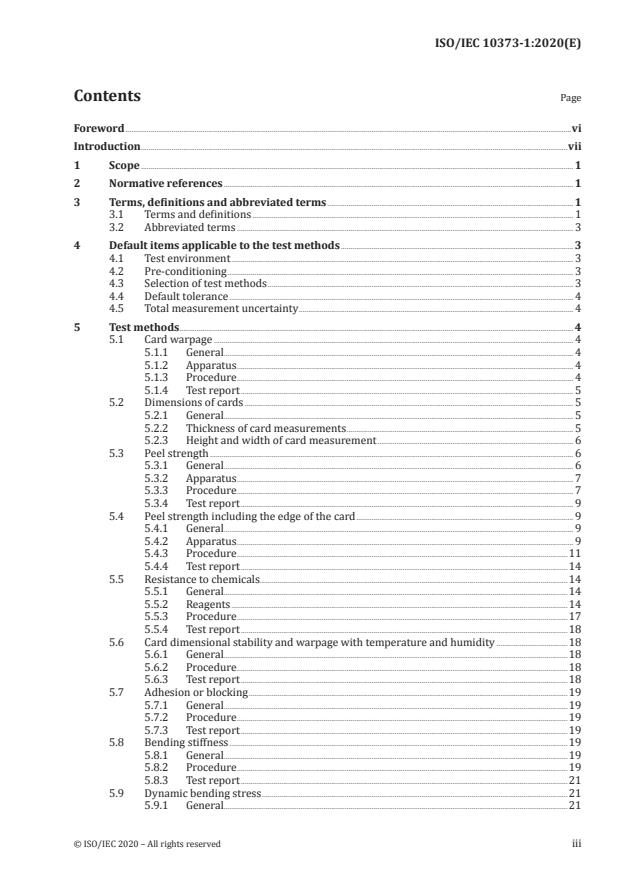
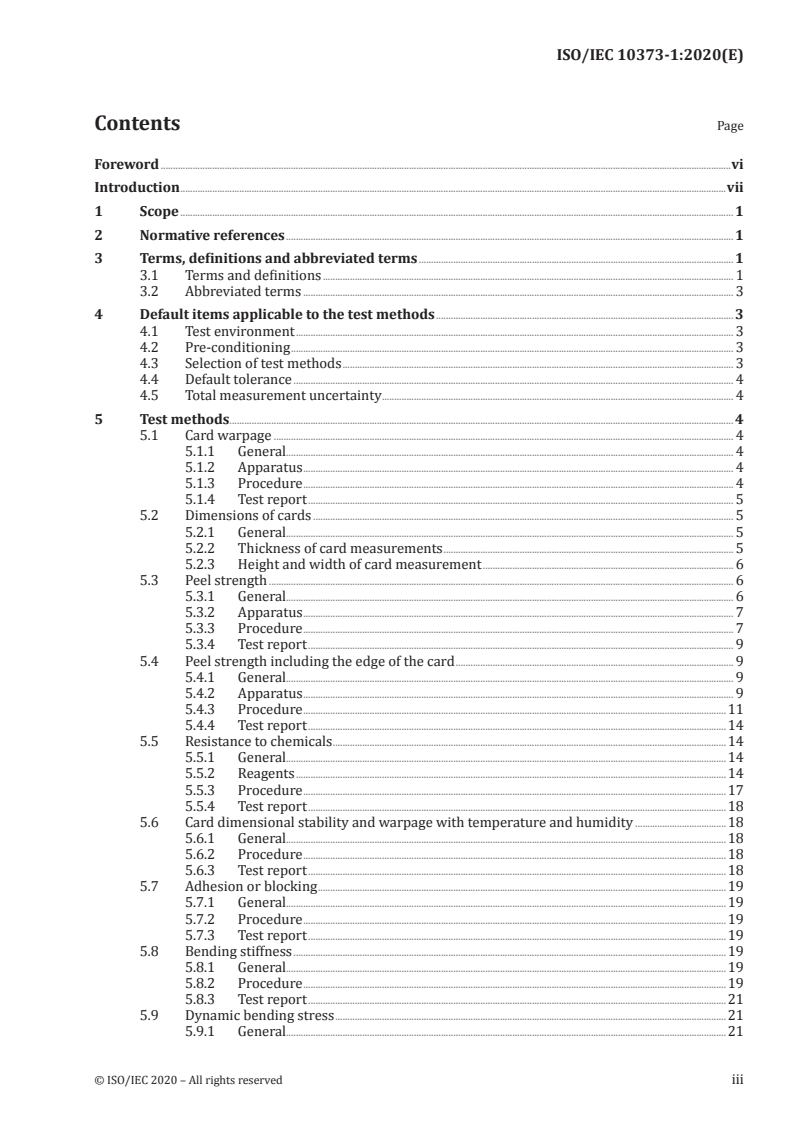
Contents Page
Foreword .vi
Introduction .vii
1 Scope . 1
2 Normative references . 1
3 Terms, definitions and abbreviated terms . 1
3.1 Terms and definitions . 1
3.2 Abbreviated terms . 3
4 Default items applicable to the test methods . 3
4.1 Test environment . 3
4.2 Pre-conditioning . 3
4.3 Selection of test methods . 3
4.4 Default tolerance . 4
4.5 Total measurement uncertainty . 4
5 Test methods . 4
5.1 Card warpage . 4
5.1.1 General. 4
5.1.2 Apparatus . 4
5.1.3 Procedure . 4
5.1.4 Test report . 5
5.2 Dimensions of cards . 5
5.2.1 General. 5
5.2.2 Thickness of card measurements . 5
5.2.3 Height and width of card measurement . 6
5.3 Peel strength . 6
5.3.1 General. 6
5.3.2 Apparatus . 7
5.3.3 Procedure . 7
5.3.4 Test report . 9
5.4 Peel strength including the edge of the card . 9
5.4.1 General. 9
5.4.2 Apparatus . 9
5.4.3 Procedure .11
5.4.4 Test report .14
5.5 Resistance to chemicals .14
5.5.1 General.14
5.5.2 Reagents .14
5.5.3 Procedure .17
5.5.4 Test report .18
5.6 Card dimensional stability and warpage with temperature and humidity .18
5.6.1 General.18
5.6.2 Procedure .18
5.6.3 Test report .18
5.7 Adhesion or blocking .19
5.7.1 General.19
5.7.2 Procedure .19
5.7.3 Test report .19
5.8 Bending stiffness .19
5.8.1 General.19
5.8.2 Procedure .19
5.8.3 Test report .21
5.9 Dynamic bending stress .21
5.9.1 General.21
© ISO/IEC 2020 – All rights reserved iii
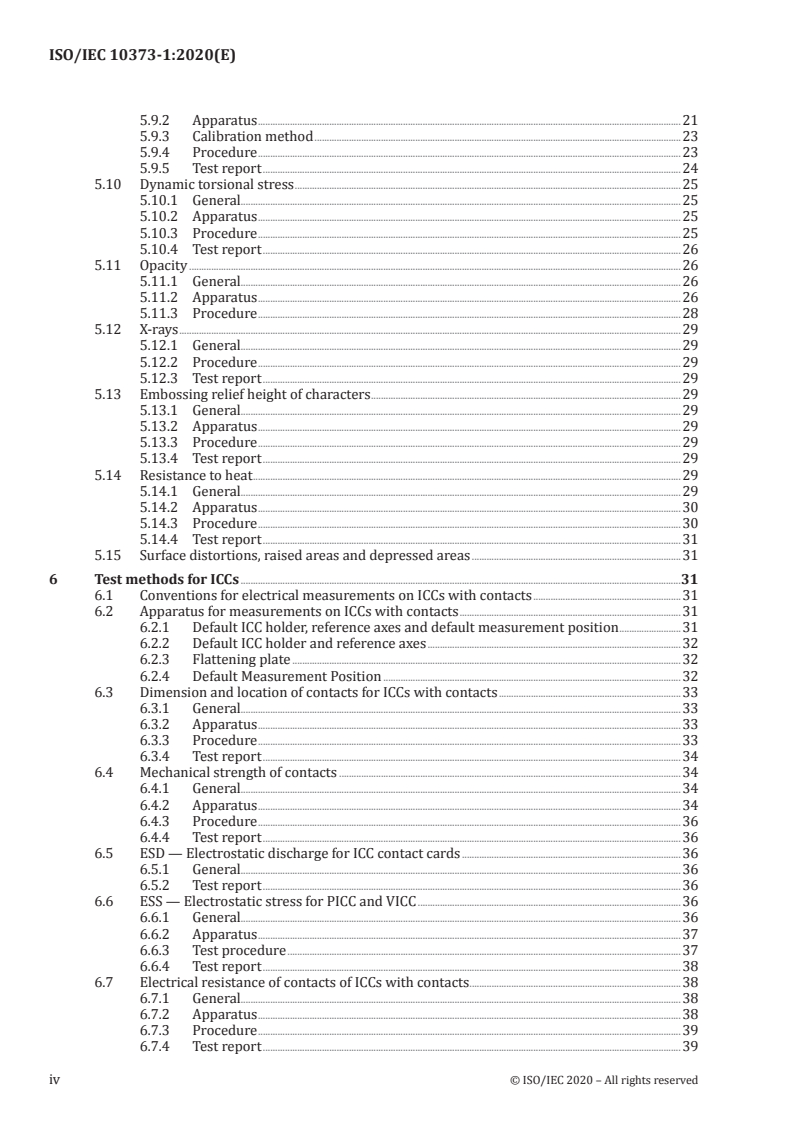
5.9.2 Apparatus .21
5.9.3 Calibration method .23
5.9.4 Procedure .23
5.9.5 Test report .24
5.10 Dynamic torsional stress .25
5.10.1 General.25
5.10.2 Apparatus .25
5.10.3 Procedure .25
5.10.4 Test report .26
5.11 Opacity .26
5.11.1 General.26
5.11.2 Apparatus .26
5.11.3 Procedure .28
5.12 X-rays .29
5.12.1 General.29
5.12.2 Procedure .29
5.12.3 Test report .29
5.13 Embossing relief height of characters .29
5.13.1 General.29
5.13.2 Apparatus .29
5.13.3 Procedure .29
5.13.4 Test report .29
5.14 Resistance to heat .29
5.14.1 General.29
5.14.2 Apparatus .30
5.14.3 Procedure .30
5.14.4 Test report .31
5.15 Surface distortions, raised areas and depressed areas .31
6 Test methods for ICCs .31
6.1 Conventions for electrical measurements on ICCs with contacts .31
6.2 Apparatus for measurements on ICCs with contacts .31
6.2.1 Default ICC holder, reference axes and default measurement position .31
6.2.2 Default ICC holder and reference axes .32
6.2.3 Flattening plate .32
6.2.4 Default Measurement Position .32
6.3 Dimension and location of contacts for ICCs with contacts .33
6.3.1 General.33
6.3.2 Apparatus .33
6.3.3 Procedure .33
6.3.4 Test report .34
6.4 Mechanical strength of contacts .34
6.4.1 General.34
6.4.2 Apparatus .34
6.4.3 Procedure .36
6.4.4 Test report .36
6.5 ESD — Electrostatic discharge for ICC contact cards .36
6.5.1 General.36
6.5.2 Test report .36
6.6 ESS — Electrostatic stress for PICC and VICC .36
6.6.1 General.36
6.6.2 Apparatus .37
6.6.3 Test procedure .37
6.6.4 Test report .38
6.7 Electrical resistance of contacts of ICCs with contacts .38
6.7.1 General.38
6.7.2 Apparatus .38
6.7.3 Procedure .39
6.7.4 Test report .39
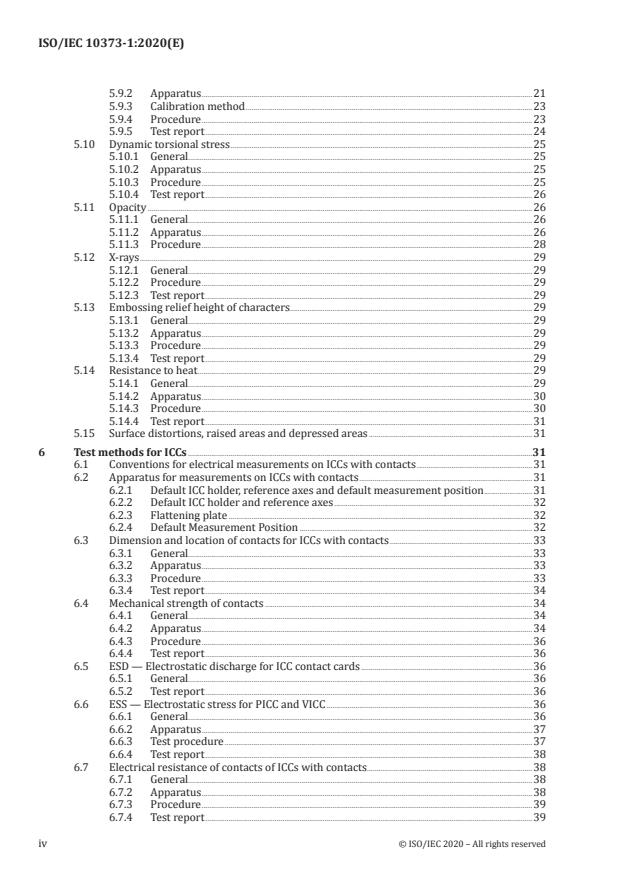
iv © ISO/IEC 2020 – All rights reserved
6.8 Additional test methods regarding electrostatic effects .40
6.9 Surface profile of contacts of ICCs with contacts .40
6.9.1 General.40
6.9.2 Apparatus .40
6.9.3 Procedure .40
6.9.4 Test report .41
6.10 ICC — Mechanical strength: 3 wheel test for ICCs with contacts .41
6.10.1 General.41
6.10.2 Apparatus .41
6.10.3 Procedure .45
6.10.4 Test report .46
Annex A (informative) Electrostatic discharge conductivity of cards .47
Annex B (informative) ESD sensitivity of cards to CDM .57
Bibliography .61
© ISO/IEC 2020 – All rights reserved v
Foreword
ISO (the International Organization for Standardization) and IEC (the International Electrotechnical
Commission) form the specialized system for worldwide standardization. National bodies that
are members of ISO or IEC participate in the development of International Standards through
technical committees established by the respective organization to deal with particular fields of
technical activity. ISO and IEC technical committees collaborate in fields of mutual interest. Other
international organizations, governmental and non-governmental, in liaison with ISO and IEC, also
take part in the work.
The procedures used to develop this document and those intended for its further maintenance are
described in the ISO/IEC Directives, Part 1. In particular, the different approval criteria needed for
the different types of document should be noted. This document was drafted in accordance with the
editorial rules of the ISO/IEC Directives, Part 2 (see www .iso .org/ directives).
Attention is drawn to the possibility that some of the elements of this document may be the subject
of patent rights. ISO and IEC shall not be held responsible for identifying any or all such patent
rights. Details of any patent rights identified during the development of the document will be in the
Introduction and/or on the ISO list of patent declarations received (see www .iso .org/ patents) or the IEC
list of patent declarations received (see http:// patents .iec .ch).
Any trade name used in this document is information given for the convenience of users and does not
constitute an endorsement.
For an explanation of the voluntary nature of standards, the meaning of ISO specific terms and
expressions related to conformity assessment, as well as information about ISO's adherence to the
World Trade Organization (WTO) principles in the Technical Barriers to Trade (TBT), see www .iso .org/
iso/ foreword .html.
This document was prepared by Joint Technical Committee ISO/IEC JTC 1, Information technology,
Subcommittee SC 17, Cards and security devices for personal identification.
This third edition cancels and replaces the second edition (ISO/IEC 10373-1:2006), which has been
technically revised. It also incorporates the Amendment ISO/IEC 10373-1:2006/Amd.1:2012. The main
changes compared to the previous edition are as follows:
— three electrostatic discharge tests and the mechanical strength of contacts have been added;
— the ultraviolet light and static magnetic fields tests have been removed;
— the peel strength including the edge of the card test has been added; this test differs from the peel
strength test by allowing layer bond strength measurement at the card edge and the middle area of
the card;
— chemical lists have been revised into tables, which now include the base chemicals for Fuel B and
artificial perspiration solutions (a normative reference was provided in the second edition);
— technical changes have been made to the dynamic bending stress calibration method and opacity
measurement reporting;
— figures, tables and NOTEs have been revised to facilitate understanding of the tests;
— address for availability of optical reference (ORM7810) media has been changed;
— test methods have been refined and relaxed where technically appropriate.
A list of all parts in the ISO/IEC 10373 series can be found on the ISO website.
Any feedback or questions on this document should be directed to the user’s national standards body. A
complete listing of these bodies can be found at www .iso .org/ members .html.
vi © ISO/IEC 2020 – All rights reserved
Introduction
The changes to the last version are a result of industry feedback, harmonisation of standards, and
inter-laboratory studies (round robin studies) performed by experts from SC 17's Working Group 1.
Additional information has been provided as NOTEs within the test methods
This document defines the ISO/IEC test methods for physical requirements of cards and security
devices for personal identification and is utilised by other requirements and test methods. For example,
the following ISO/IEC standards refer to this document for one or more test methods.
— ISO/IEC 7501 (all parts)
— ISO/IEC 7811 (all parts)
— ISO/IEC 7812 (all parts)
— ISO/IEC 7813
— ISO/IEC 7816 (all parts)
— ISO/IEC 10373 (all parts)
— ISO/IEC 10536 (all parts)
— ISO/IEC 11693 (all parts)
— ISO/IEC 11694 (all parts)
— ISO/IEC 11695 (all parts)
— ISO/IEC 14443 (all parts)
— ISO/IEC 15693 (all parts)
— ISO/IEC 18013 (all parts)
— ISO/IEC 18328 (all parts)
— ISO/IEC 18745 (all parts)
— ISO/IEC 24789 (all parts)
© ISO/IEC 2020 – All rights reserved vii
INTERNATIONAL STANDARD ISO/IEC 10373-1:2020(E)
Cards and security devices for personal identification —
Test methods —
Part 1:
General characteristics
1 Scope
This document describes the test methods for characteristics of identification cards according to
ISO/IEC 7810 and other standards, such as those listed in the Introduction.
NOTE 1 Criteria for acceptability do not form part of this document but are found in other International
Standards including those mentioned in the introduction.
NOTE 2 Test methods described in this document are intended to be performed separately. A given card is not
required to pass through all the tests sequentially.
2 Normative references
The following documents, in whole or in part, are normatively referenced in this document and
are indispensable for its application. For dated references, only the edition cited applies. For undated
references, the latest edition of the referenced document (including any amendments) applies.
ISO/IEC 7810, Identification cards — Physical characteristics
ISO/IEC 7816-2, Identification cards — Integrated circuit cards — Part 2: Cards with contacts —
Dimensions and location of the contacts
ISO/IEC 10373-2, Identification cards — Test methods — Part 2: Cards with magnetic stripes
ISO 3696, Water for analytical laboratory use — Specification and test methods
ISO 9227, Corrosion tests in artificial atmospheres — Salt spray tests
IEC 61000-4-2, Electromagnetic compatibility (EMC) — Part 4-2: Testing and measurement techniques —
Electrostatic discharge immunity test
IEC 60749-26, Semiconductor devices — Mechanical and climatic test methods — Part 26: Electrostatic
discharge (ESD) sensitivity testing — Human body model (HBM)
ANSI/ESDA/JEDEC JS-002, ESDA/JEDEC Joint Standard For Electrostatic Discharge Sensitivity Testing -
Charged Device Model (CDM) - Device Level
3 Terms, definitions and abbreviated terms
3.1 Terms and definitions
For the purposes of this document, the following terms and definitions apply.
ISO and IEC maintain terminological databases for use in standardization at the following addresses:
— ISO Online browsing platform: available at https:// www .iso .org/ obp
— IEC Electropedia: available at http:// www .electropedia .org/
© ISO/IEC 2020 – All rights reserved 1
3.1.1
test method
method for testing characteristics of identification cards for the purpose of confirming their compliance
with International Standards
3.1.2
testably functional
having survived the action of some potentially destructive influence to the extent that any:
a) magnetic stripe present on the card shows a relationship between signal amplitudes before and
after exposure that is in accordance with the base standard;
b) integrated circuit connected to contacts continues to provide an Answer to Reset response which
conforms to the base standard (3.1.13);
c) integrated circuit connected to an antenna continues to provide a response to an ATQA (Type A) or
ATQB (Type B);
d) other integrated circuit continues to operate as intended;
e) optical memory present in the card continues to show optical characteristics which conform to the
base standard
Note 1 to entry: ISO/IEC 7816-2 defines the contacts.
Note 2 to entry: ISO/IEC 14443 (all parts) defines the antenna, ATQA and ATQB.
Note 3 to entry: ISO/IEC 7811 (all parts) defines the magnetic strip.
Note 4 to entry: ISO/IEC 11693 (all parts) defines the optical memory.
3.1.3
warpage
deviation from flatness
3.1.4
embossing relief height
local increase in the height of the card surface produced by the embossing process
3.1.5
peel strength
ability of a card to resist separation of adjacent layers of material in its structure
3.1.6
resistance to chemicals
ability of a card to resist degradation of its performance and appearance as a result of exposure to
commonly encountered chemicals
3.1.7
dimensional stability
ability of a card to resist dimensional variation when exposed to defined temperatures and humidity
3.1.8
adhesion or blocking
tendency of cards to stick together when stacked
3.1.9
bending stiffness
ability of a card to resist bending
2 © ISO/IEC 2020 – All rights reserved
3.1.10
dynamic bending stress
cyclically applied bending stress of defined magnitude and orientation relative to the card
3.1.11
dynamic torsional stress
cyclically applied torsional stress of defined magnitude and orientation relative to the card
3.1.12
dual interface chip card
DICC
card or object combining the functionality of a ICC and a PICC
3.1.13
base standard
standard to which the test method (3.1.1) is used to verify conformance
3.1.14
electrostatic discharge
ESD
sudden flow of electricity between two electrically charged objects caused by contact, an electrical
short, or dielectric breakdown
3.1.15
electrostatic stress
ESS
stress applied to a PICC or VICC by an electrostatic field
3.1.16
electrostatic discharge conductivity
ESDC
ability of a card to conduct or transport electrostatic discharge (3.1.14)
3.2 Abbreviated terms
ICC integrated circuit card as defined in ISO/IEC 7810 (all parts)
PICC proximity integrated circuit(s) card or object as defined in ISO/IEC 14443 (all parts)
VICC vicinity integrated circuit(s) card or object as defined in ISO/IEC 15693 (all parts)
4 Default items applicable to the test methods
4.1 Test environment
Unless otherwise specified, testing shall take place in an environment having a temperature of
23 °C ± 3 °C (73 °F ± 5 °F) and a relative humidity of 40 % to 60 %.
4.2 Pre-conditioning
Where pre-conditioning is required by the test method, the identification card to be tested shall be
conditioned to the test environment for a period of 24 h before testing.
4.3 Selection of test methods
Tests shall be applied as required to test the attributes of the card defined by the relevant base standard
© ISO/IEC 2020 – All rights reserved 3
4.4 Default tolerance
Unless otherwise specified, a default tolerance of ±5 % shall be applied to the quantity values given
to specify the characteristics of the test equipment (e.g. linear dimensions) and the test method
procedures (e.g. test equipment adjustments).
4.5 Total measurement uncertainty
The total measurement uncertainty should be reported with the results and be considered when
judging conformity. The total measurement uncertainty should be less than 20 % of the permitted
tolerance range. ISO/IEC Guide 98 (all parts) provides guidance for determining and expressing the
total measurement uncertainty.
5 Test methods
5.1 Card warpage
5.1.1 General
The purpose of this test is to measure the degree of warpage of a card test sample.
5.1.2 Apparatus
The test apparatus shall consist of:
— a flat level rigid plate;
— a suitable measurement device or a gauge with an accuracy of ±0,03 mm (0.0012 in).
5.1.3 Procedure
Pre-condition the sample card according to 4.2 before testing and conduct the test under the test
environment defined in 4.1.
Place the sample card on the level rigid plate of the measuring apparatus. At least three corners of the
card shall rest on the plate (warpage of the card in convex form to the plate). Use a suitable measurement
device or gauge to determine that no point on the card's surface is at a distance of more than the
permitted maximum warpage from the level rigid plate, as shown in Figure 1. The measurement device
or gauge shall not change the warpage of the card.
NOTE The point of maximum displacement is not necessarily at the centre of the card.
4 © ISO/IEC 2020 – All rights reserved
Key
1 measurement device or gauge 3 level rigid plate
2 card
NOTE This figure is not to scale.
Figure 1 — Warpage measurement apparatus
5.1.4 Test report
The test report shall state if the warpage of the card complies with the requirement and optionally the
measured warpage.
5.2 Dimensions of cards
5.2.1 General
The purpose of this test is to measure the height, width and thickness of a card test sample.
5.2.2 Thickness of card measurements
5.2.2.1 Apparatus
The test apparatus shall consist of a micrometer with a flat anvil and spindle whose diameter is within
the range of 3 mm to 8 mm (0.12 in to 0.32 in), having a precision of 0,005 mm (0.00020 in) and a
2 2 2 2
pressure range of 0,1 N/mm to 0,4 N/mm (14.5 lbf/in to 58.0 lbf/in ).
5.2.2.2 Procedure
Pre-condition the sample card according to 4.2 before testing and conduct the test under the test
environment defined in 4.1.
Use the micrometer to measure the thickness of the card at four points, one in each of the four
quadrants of the card (see Figure 2 for the location of the quadrants). The measurements shall be made
at locations on the card that do not include signature panels, magnetic stripes or contacts (integrated
circuit/s cards), or any other raised area.
5.2.2.3 Test report
The test report shall give the maximum and the minimum values of the four measurements.
© ISO/IEC 2020 – All rights reserved 5
Key
1, 2, 3, 4 quadrant
Figure 2 — Assignment of quadrants
5.2.3 Height and width of card measurement
5.2.3.1 Apparatus
The following items are required:
— a level horizontal rigid surface having a deviation from flatness not greater than 3,2 μm (0.000128 in)
over the width of the card;
— a measuring device with a precision of 2,5 μm (0.0001 in);
— a load of 2,2 N ± 0,2 N (0.495 lbf ± 0.045 lbf).
5.2.3.2 Procedure
Pre-condition the sample card according to 4.2 before testing and conduct the test under the test
environment defined in 4.1.
Place the sample card on the level horizontal rigid surface and flatten it under the load. Measure the height
and width of the card. Find the maximum and minimum height and the maximum and minimum width.
5.2.3.3 Test report
The test report shall state whether the card conforms to the base standard and shall record the
maximum and minimum values of height and width recorded.
5.3 Peel strength
5.3.1 General
The purpose of this test is to measure the peel strength between card layers.
6 © ISO/IEC 2020 – All rights reserved
5.3.2 Apparatus
The following items are required:
a) sharp cutting knife;
b) pressure sensitive adhesive filament (fibre reinforced) tape or a suitable clamp;
c) tensile tester equipped with chart recorder or equivalent;
d) gripping device;
e) stabilising plate backed with adhesive or adhesive tape is required when the layer being peeled is
more than 20 % of the total card thickness.
— the adhesive strength shall be sufficient to ensure that the plate and card do not separate during
testing;
— the plate shall not bend during the measurement;
— the size of the plate shall be equal to, or greater than, the size of the card.
EXAMPLE A suitable plate can be a 60 mm × 90 mm × 2 mm aluminium plate backed with adhesive tape.
5.3.3 Procedure
Pre-condition the sample card according to 4.2 before testing and conduct the test under the test
environment defined in 4.1.
Cut the card, or score through the layer, to produce sections of width 10,0 mm ± 0,2 mm
(0.390 in ± 0.008 in) as shown in Figure 3.
Key
1 test section 1 4 test section 4
2 test section 2 5 top reference edge
3 test section 3 6 peel strength test area
Figure 3 — Card preparation
Using a sharp knife, cut the layer back from the core approximately 10 mm (0.4 in) and apply the clamp
or adhesive tape to the cut back edge of the layer and core as shown in Figure 4.
© ISO/IEC 2020 – All rights reserved 7
Key
1 apply clamp and/or adhesive tape 3 thicker layer
2 thinner layer
Figure 4 — Specimen preparation for peel test
If the peeling angle cannot be kept at 90° during the measurement, attach the stabilising plate to the
core in advance.
Place the prepared specimen in the tensile tester fixture as shown in Figure 5.
Key
1 stabilising plate 5 diameter rollers
2 double sided adhesive tape 6 gap between rollers
3 thinner layer 7 force F
4 thicker layer
Figure 5 — Specimen mounted in tensile tester
Operate the tensile tester according to the manufacturers' instructions at 300 mm/min (11.8 in/min) to
determine the force F in N (lbf).
8 © ISO/IEC 2020 – All rights reserved
Excluding the first and last 5 mm and any features less than 1 mm in length (spikes) from consideration,
find the test strip having the lowest force value, using Figure 6 as a guide. Exclude peel force results
from regions of test sections where at least one of the peeled layers is less than 10 mm wide (e.g. in the
area of IC contacts).
Divide the measured minimum peel force by the sample width. Record this as the peel strength of the
section. The section with the lowest peel strength value shall be recorded as the peel strength of the card.
Key
1 area not used for evaluation 4 minimum value
2 length spike definition 5 measurement area
3 spike
Figure 6 — Example of force chart recording
5.3.4 Test report
The test report shall give the peel strength, together with the test strip identifier. It shall also include
the chart recording, clearly showing where the recorded minimum value was found, and shall state
whether any tearing occurred.
5.4 Peel strength including the edge of the card
5.4.1 General
The purpose of this test is to determine the peel strength at the edge of the card. In addition, this test
can be performed in such a manner that the peel strength in the centre of the card is also determined,
in which case the values obtained for the centre of the card may be used instead of determining them
using 5.3.
5.4.2 Apparatus
The following items are required:
a) sharp cutting knife;
© ISO/IEC 2020 – All rights reserved 9
b) pressure sensitive adhesive filament (fibre reinforced) tape and/or a suitable clamp;
c) tensile tester equipped with chart recorder or equivalent;
d) stabilising plate meeting the following requirements:
— the plate design shall ensure that the plate and card do not separate during testing;
— plate and sample shall not bend during the measurement;
— the width of the plate shall be equal to or greater than, the width of the prepared specimen; the
length of the plate shall be at least the length of the specimen plus the length of the spacer;
— a spacer with the same thickness as the test specimen, or half of a single card, shall be present
immediately following the end of the test specimen as shown in Figure 7.
— the spacer and specimen or card halves shall be in direct contact with each other, or
— the stabilising plate shall have rails along the edges of the specimen to ensure that the assembly
of plate and specimen are held at a 90° angle to the peel direction. Rails are shown in Figure 8.
Key
1 stabilising plate 4 double
...
INTERNATIONAL ISO/IEC
STANDARD 10373-1
Third edition
2020-10
Cards and security devices for
personal identification — Test
methods —
Part 1:
General characteristics
Cartes et dispositifs de sécurité pour l'identification personnelle —
Méthodes d'essai —
Partie 1: Caractéristiques générales
Reference number
©
ISO/IEC 2020
© ISO/IEC 2020
All rights reserved. Unless otherwise specified, or required in the context of its implementation, no part of this publication may
be reproduced or utilized otherwise in any form or by any means, electronic or mechanical, including photocopying, or posting
on the internet or an intranet, without prior written permission. Permission can be requested from either ISO at the address
below or ISO’s member body in the country of the requester.
ISO copyright office
CP 401 • Ch. de Blandonnet 8
CH-1214 Vernier, Geneva
Phone: +41 22 749 01 11
Email: copyright@iso.org
Website: www.iso.org
Published in Switzerland
ii © ISO/IEC 2020 – All rights reserved
Contents Page
Foreword .vi
Introduction .vii
1 Scope . 1
2 Normative references . 1
3 Terms, definitions and abbreviated terms . 1
3.1 Terms and definitions . 1
3.2 Abbreviated terms . 3
4 Default items applicable to the test methods . 3
4.1 Test environment . 3
4.2 Pre-conditioning . 3
4.3 Selection of test methods . 3
4.4 Default tolerance . 4
4.5 Total measurement uncertainty . 4
5 Test methods . 4
5.1 Card warpage . 4
5.1.1 General. 4
5.1.2 Apparatus . 4
5.1.3 Procedure . 4
5.1.4 Test report . 5
5.2 Dimensions of cards . 5
5.2.1 General. 5
5.2.2 Thickness of card measurements . 5
5.2.3 Height and width of card measurement . 6
5.3 Peel strength . 6
5.3.1 General. 6
5.3.2 Apparatus . 7
5.3.3 Procedure . 7
5.3.4 Test report . 9
5.4 Peel strength including the edge of the card . 9
5.4.1 General. 9
5.4.2 Apparatus . 9
5.4.3 Procedure .11
5.4.4 Test report .14
5.5 Resistance to chemicals .14
5.5.1 General.14
5.5.2 Reagents .14
5.5.3 Procedure .17
5.5.4 Test report .18
5.6 Card dimensional stability and warpage with temperature and humidity .18
5.6.1 General.18
5.6.2 Procedure .18
5.6.3 Test report .18
5.7 Adhesion or blocking .19
5.7.1 General.19
5.7.2 Procedure .19
5.7.3 Test report .19
5.8 Bending stiffness .19
5.8.1 General.19
5.8.2 Procedure .19
5.8.3 Test report .21
5.9 Dynamic bending stress .21
5.9.1 General.21
© ISO/IEC 2020 – All rights reserved iii
5.9.2 Apparatus .21
5.9.3 Calibration method .23
5.9.4 Procedure .23
5.9.5 Test report .24
5.10 Dynamic torsional stress .25
5.10.1 General.25
5.10.2 Apparatus .25
5.10.3 Procedure .25
5.10.4 Test report .26
5.11 Opacity .26
5.11.1 General.26
5.11.2 Apparatus .26
5.11.3 Procedure .28
5.12 X-rays .29
5.12.1 General.29
5.12.2 Procedure .29
5.12.3 Test report .29
5.13 Embossing relief height of characters .29
5.13.1 General.29
5.13.2 Apparatus .29
5.13.3 Procedure .29
5.13.4 Test report .29
5.14 Resistance to heat .29
5.14.1 General.29
5.14.2 Apparatus .30
5.14.3 Procedure .30
5.14.4 Test report .31
5.15 Surface distortions, raised areas and depressed areas .31
6 Test methods for ICCs .31
6.1 Conventions for electrical measurements on ICCs with contacts .31
6.2 Apparatus for measurements on ICCs with contacts .31
6.2.1 Default ICC holder, reference axes and default measurement position .31
6.2.2 Default ICC holder and reference axes .32
6.2.3 Flattening plate .32
6.2.4 Default Measurement Position .32
6.3 Dimension and location of contacts for ICCs with contacts .33
6.3.1 General.33
6.3.2 Apparatus .33
6.3.3 Procedure .33
6.3.4 Test report .34
6.4 Mechanical strength of contacts .34
6.4.1 General.34
6.4.2 Apparatus .34
6.4.3 Procedure .36
6.4.4 Test report .36
6.5 ESD — Electrostatic discharge for ICC contact cards .36
6.5.1 General.36
6.5.2 Test report .36
6.6 ESS — Electrostatic stress for PICC and VICC .36
6.6.1 General.36
6.6.2 Apparatus .37
6.6.3 Test procedure .37
6.6.4 Test report .38
6.7 Electrical resistance of contacts of ICCs with contacts .38
6.7.1 General.38
6.7.2 Apparatus .38
6.7.3 Procedure .39
6.7.4 Test report .39
iv © ISO/IEC 2020 – All rights reserved
6.8 Additional test methods regarding electrostatic effects .40
6.9 Surface profile of contacts of ICCs with contacts .40
6.9.1 General.40
6.9.2 Apparatus .40
6.9.3 Procedure .40
6.9.4 Test report .41
6.10 ICC — Mechanical strength: 3 wheel test for ICCs with contacts .41
6.10.1 General.41
6.10.2 Apparatus .41
6.10.3 Procedure .45
6.10.4 Test report .46
Annex A (informative) Electrostatic discharge conductivity of cards .47
Annex B (informative) ESD sensitivity of cards to CDM .57
Bibliography .61
© ISO/IEC 2020 – All rights reserved v
Foreword
ISO (the International Organization for Standardization) and IEC (the International Electrotechnical
Commission) form the specialized system for worldwide standardization. National bodies that
are members of ISO or IEC participate in the development of International Standards through
technical committees established by the respective organization to deal with particular fields of
technical activity. ISO and IEC technical committees collaborate in fields of mutual interest. Other
international organizations, governmental and non-governmental, in liaison with ISO and IEC, also
take part in the work.
The procedures used to develop this document and those intended for its further maintenance are
described in the ISO/IEC Directives, Part 1. In particular, the different approval criteria needed for
the different types of document should be noted. This document was drafted in accordance with the
editorial rules of the ISO/IEC Directives, Part 2 (see www .iso .org/ directives).
Attention is drawn to the possibility that some of the elements of this document may be the subject
of patent rights. ISO and IEC shall not be held responsible for identifying any or all such patent
rights. Details of any patent rights identified during the development of the document will be in the
Introduction and/or on the ISO list of patent declarations received (see www .iso .org/ patents) or the IEC
list of patent declarations received (see http:// patents .iec .ch).
Any trade name used in this document is information given for the convenience of users and does not
constitute an endorsement.
For an explanation of the voluntary nature of standards, the meaning of ISO specific terms and
expressions related to conformity assessment, as well as information about ISO's adherence to the
World Trade Organization (WTO) principles in the Technical Barriers to Trade (TBT), see www .iso .org/
iso/ foreword .html.
This document was prepared by Joint Technical Committee ISO/IEC JTC 1, Information technology,
Subcommittee SC 17, Cards and security devices for personal identification.
This third edition cancels and replaces the second edition (ISO/IEC 10373-1:2006), which has been
technically revised. It also incorporates the Amendment ISO/IEC 10373-1:2006/Amd.1:2012. The main
changes compared to the previous edition are as follows:
— three electrostatic discharge tests and the mechanical strength of contacts have been added;
— the ultraviolet light and static magnetic fields tests have been removed;
— the peel strength including the edge of the card test has been added; this test differs from the peel
strength test by allowing layer bond strength measurement at the card edge and the middle area of
the card;
— chemical lists have been revised into tables, which now include the base chemicals for Fuel B and
artificial perspiration solutions (a normative reference was provided in the second edition);
— technical changes have been made to the dynamic bending stress calibration method and opacity
measurement reporting;
— figures, tables and NOTEs have been revised to facilitate understanding of the tests;
— address for availability of optical reference (ORM7810) media has been changed;
— test methods have been refined and relaxed where technically appropriate.
A list of all parts in the ISO/IEC 10373 series can be found on the ISO website.
Any feedback or questions on this document should be directed to the user’s national standards body. A
complete listing of these bodies can be found at www .iso .org/ members .html.
vi © ISO/IEC 2020 – All rights reserved
Introduction
The changes to the last version are a result of industry feedback, harmonisation of standards, and
inter-laboratory studies (round robin studies) performed by experts from SC 17's Working Group 1.
Additional information has been provided as NOTEs within the test methods
This document defines the ISO/IEC test methods for physical requirements of cards and security
devices for personal identification and is utilised by other requirements and test methods. For example,
the following ISO/IEC standards refer to this document for one or more test methods.
— ISO/IEC 7501 (all parts)
— ISO/IEC 7811 (all parts)
— ISO/IEC 7812 (all parts)
— ISO/IEC 7813
— ISO/IEC 7816 (all parts)
— ISO/IEC 10373 (all parts)
— ISO/IEC 10536 (all parts)
— ISO/IEC 11693 (all parts)
— ISO/IEC 11694 (all parts)
— ISO/IEC 11695 (all parts)
— ISO/IEC 14443 (all parts)
— ISO/IEC 15693 (all parts)
— ISO/IEC 18013 (all parts)
— ISO/IEC 18328 (all parts)
— ISO/IEC 18745 (all parts)
— ISO/IEC 24789 (all parts)
© ISO/IEC 2020 – All rights reserved vii
INTERNATIONAL STANDARD ISO/IEC 10373-1:2020(E)
Cards and security devices for personal identification —
Test methods —
Part 1:
General characteristics
1 Scope
This document describes the test methods for characteristics of identification cards according to
ISO/IEC 7810 and other standards, such as those listed in the Introduction.
NOTE 1 Criteria for acceptability do not form part of this document but are found in other International
Standards including those mentioned in the introduction.
NOTE 2 Test methods described in this document are intended to be performed separately. A given card is not
required to pass through all the tests sequentially.
2 Normative references
The following documents, in whole or in part, are normatively referenced in this document and
are indispensable for its application. For dated references, only the edition cited applies. For undated
references, the latest edition of the referenced document (including any amendments) applies.
ISO/IEC 7810, Identification cards — Physical characteristics
ISO/IEC 7816-2, Identification cards — Integrated circuit cards — Part 2: Cards with contacts —
Dimensions and location of the contacts
ISO/IEC 10373-2, Identification cards — Test methods — Part 2: Cards with magnetic stripes
ISO 3696, Water for analytical laboratory use — Specification and test methods
ISO 9227, Corrosion tests in artificial atmospheres — Salt spray tests
IEC 61000-4-2, Electromagnetic compatibility (EMC) — Part 4-2: Testing and measurement techniques —
Electrostatic discharge immunity test
IEC 60749-26, Semiconductor devices — Mechanical and climatic test methods — Part 26: Electrostatic
discharge (ESD) sensitivity testing — Human body model (HBM)
ANSI/ESDA/JEDEC JS-002, ESDA/JEDEC Joint Standard For Electrostatic Discharge Sensitivity Testing -
Charged Device Model (CDM) - Device Level
3 Terms, definitions and abbreviated terms
3.1 Terms and definitions
For the purposes of this document, the following terms and definitions apply.
ISO and IEC maintain terminological databases for use in standardization at the following addresses:
— ISO Online browsing platform: available at https:// www .iso .org/ obp
— IEC Electropedia: available at http:// www .electropedia .org/
© ISO/IEC 2020 – All rights reserved 1
3.1.1
test method
method for testing characteristics of identification cards for the purpose of confirming their compliance
with International Standards
3.1.2
testably functional
having survived the action of some potentially destructive influence to the extent that any:
a) magnetic stripe present on the card shows a relationship between signal amplitudes before and
after exposure that is in accordance with the base standard;
b) integrated circuit connected to contacts continues to provide an Answer to Reset response which
conforms to the base standard (3.1.13);
c) integrated circuit connected to an antenna continues to provide a response to an ATQA (Type A) or
ATQB (Type B);
d) other integrated circuit continues to operate as intended;
e) optical memory present in the card continues to show optical characteristics which conform to the
base standard
Note 1 to entry: ISO/IEC 7816-2 defines the contacts.
Note 2 to entry: ISO/IEC 14443 (all parts) defines the antenna, ATQA and ATQB.
Note 3 to entry: ISO/IEC 7811 (all parts) defines the magnetic strip.
Note 4 to entry: ISO/IEC 11693 (all parts) defines the optical memory.
3.1.3
warpage
deviation from flatness
3.1.4
embossing relief height
local increase in the height of the card surface produced by the embossing process
3.1.5
peel strength
ability of a card to resist separation of adjacent layers of material in its structure
3.1.6
resistance to chemicals
ability of a card to resist degradation of its performance and appearance as a result of exposure to
commonly encountered chemicals
3.1.7
dimensional stability
ability of a card to resist dimensional variation when exposed to defined temperatures and humidity
3.1.8
adhesion or blocking
tendency of cards to stick together when stacked
3.1.9
bending stiffness
ability of a card to resist bending
2 © ISO/IEC 2020 – All rights reserved
3.1.10
dynamic bending stress
cyclically applied bending stress of defined magnitude and orientation relative to the card
3.1.11
dynamic torsional stress
cyclically applied torsional stress of defined magnitude and orientation relative to the card
3.1.12
dual interface chip card
DICC
card or object combining the functionality of a ICC and a PICC
3.1.13
base standard
standard to which the test method (3.1.1) is used to verify conformance
3.1.14
electrostatic discharge
ESD
sudden flow of electricity between two electrically charged objects caused by contact, an electrical
short, or dielectric breakdown
3.1.15
electrostatic stress
ESS
stress applied to a PICC or VICC by an electrostatic field
3.1.16
electrostatic discharge conductivity
ESDC
ability of a card to conduct or transport electrostatic discharge (3.1.14)
3.2 Abbreviated terms
ICC integrated circuit card as defined in ISO/IEC 7810 (all parts)
PICC proximity integrated circuit(s) card or object as defined in ISO/IEC 14443 (all parts)
VICC vicinity integrated circuit(s) card or object as defined in ISO/IEC 15693 (all parts)
4 Default items applicable to the test methods
4.1 Test environment
Unless otherwise specified, testing shall take place in an environment having a temperature of
23 °C ± 3 °C (73 °F ± 5 °F) and a relative humidity of 40 % to 60 %.
4.2 Pre-conditioning
Where pre-conditioning is required by the test method, the identification card to be tested shall be
conditioned to the test environment for a period of 24 h before testing.
4.3 Selection of test methods
Tests shall be applied as required to test the attributes of the card defined by the relevant base standard
© ISO/IEC 2020 – All rights reserved 3
4.4 Default tolerance
Unless otherwise specified, a default tolerance of ±5 % shall be applied to the quantity values given
to specify the characteristics of the test equipment (e.g. linear dimensions) and the test method
procedures (e.g. test equipment adjustments).
4.5 Total measurement uncertainty
The total measurement uncertainty should be reported with the results and be considered when
judging conformity. The total measurement uncertainty should be less than 20 % of the permitted
tolerance range. ISO/IEC Guide 98 (all parts) provides guidance for determining and expressing the
total measurement uncertainty.
5 Test methods
5.1 Card warpage
5.1.1 General
The purpose of this test is to measure the degree of warpage of a card test sample.
5.1.2 Apparatus
The test apparatus shall consist of:
— a flat level rigid plate;
— a suitable measurement device or a gauge with an accuracy of ±0,03 mm (0.0012 in).
5.1.3 Procedure
Pre-condition the sample card according to 4.2 before testing and conduct the test under the test
environment defined in 4.1.
Place the sample card on the level rigid plate of the measuring apparatus. At least three corners of the
card shall rest on the plate (warpage of the card in convex form to the plate). Use a suitable measurement
device or gauge to determine that no point on the card's surface is at a distance of more than the
permitted maximum warpage from the level rigid plate, as shown in Figure 1. The measurement device
or gauge shall not change the warpage of the card.
NOTE The point of maximum displacement is not necessarily at the centre of the card.
4 © ISO/IEC 2020 – All rights reserved
Key
1 measurement device or gauge 3 level rigid plate
2 card
NOTE This figure is not to scale.
Figure 1 — Warpage measurement apparatus
5.1.4 Test report
The test report shall state if the warpage of the card complies with the requirement and optionally the
measured warpage.
5.2 Dimensions of cards
5.2.1 General
The purpose of this test is to measure the height, width and thickness of a card test sample.
5.2.2 Thickness of card measurements
5.2.2.1 Apparatus
The test apparatus shall consist of a micrometer with a flat anvil and spindle whose diameter is within
the range of 3 mm to 8 mm (0.12 in to 0.32 in), having a precision of 0,005 mm (0.00020 in) and a
2 2 2 2
pressure range of 0,1 N/mm to 0,4 N/mm (14.5 lbf/in to 58.0 lbf/in ).
5.2.2.2 Procedure
Pre-condition the sample card according to 4.2 before testing and conduct the test under the test
environment defined in 4.1.
Use the micrometer to measure the thickness of the card at four points, one in each of the four
quadrants of the card (see Figure 2 for the location of the quadrants). The measurements shall be made
at locations on the card that do not include signature panels, magnetic stripes or contacts (integrated
circuit/s cards), or any other raised area.
5.2.2.3 Test report
The test report shall give the maximum and the minimum values of the four measurements.
© ISO/IEC 2020 – All rights reserved 5
Key
1, 2, 3, 4 quadrant
Figure 2 — Assignment of quadrants
5.2.3 Height and width of card measurement
5.2.3.1 Apparatus
The following items are required:
— a level horizontal rigid surface having a deviation from flatness not greater than 3,2 μm (0.000128 in)
over the width of the card;
— a measuring device with a precision of 2,5 μm (0.0001 in);
— a load of 2,2 N ± 0,2 N (0.495 lbf ± 0.045 lbf).
5.2.3.2 Procedure
Pre-condition the sample card according to 4.2 before testing and conduct the test under the test
environment defined in 4.1.
Place the sample card on the level horizontal rigid surface and flatten it under the load. Measure the height
and width of the card. Find the maximum and minimum height and the maximum and minimum width.
5.2.3.3 Test report
The test report shall state whether the card conforms to the base standard and shall record the
maximum and minimum values of height and width recorded.
5.3 Peel strength
5.3.1 General
The purpose of this test is to measure the peel strength between card layers.
6 © ISO/IEC 2020 – All rights reserved
5.3.2 Apparatus
The following items are required:
a) sharp cutting knife;
b) pressure sensitive adhesive filament (fibre reinforced) tape or a suitable clamp;
c) tensile tester equipped with chart recorder or equivalent;
d) gripping device;
e) stabilising plate backed with adhesive or adhesive tape is required when the layer being peeled is
more than 20 % of the total card thickness.
— the adhesive strength shall be sufficient to ensure that the plate and card do not separate during
testing;
— the plate shall not bend during the measurement;
— the size of the plate shall be equal to, or greater than, the size of the card.
EXAMPLE A suitable plate can be a 60 mm × 90 mm × 2 mm aluminium plate backed with adhesive tape.
5.3.3 Procedure
Pre-condition the sample card according to 4.2 before testing and conduct the test under the test
environment defined in 4.1.
Cut the card, or score through the layer, to produce sections of width 10,0 mm ± 0,2 mm
(0.390 in ± 0.008 in) as shown in Figure 3.
Key
1 test section 1 4 test section 4
2 test section 2 5 top reference edge
3 test section 3 6 peel strength test area
Figure 3 — Card preparation
Using a sharp knife, cut the layer back from the core approximately 10 mm (0.4 in) and apply the clamp
or adhesive tape to the cut back edge of the layer and core as shown in Figure 4.
© ISO/IEC 2020 – All rights reserved 7
Key
1 apply clamp and/or adhesive tape 3 thicker layer
2 thinner layer
Figure 4 — Specimen preparation for peel test
If the peeling angle cannot be kept at 90° during the measurement, attach the stabilising plate to the
core in advance.
Place the prepared specimen in the tensile tester fixture as shown in Figure 5.
Key
1 stabilising plate 5 diameter rollers
2 double sided adhesive tape 6 gap between rollers
3 thinner layer 7 force F
4 thicker layer
Figure 5 — Specimen mounted in tensile tester
Operate the tensile tester according to the manufacturers' instructions at 300 mm/min (11.8 in/min) to
determine the force F in N (lbf).
8 © ISO/IEC 2020 – All rights reserved
Excluding the first and last 5 mm and any features less than 1 mm in length (spikes) from consideration,
find the test strip having the lowest force value, using Figure 6 as a guide. Exclude peel force results
from regions of test sections where at least one of the peeled layers is less than 10 mm wide (e.g. in the
area of IC contacts).
Divide the measured minimum peel force by the sample width. Record this as the peel strength of the
section. The section with the lowest peel strength value shall be recorded as the peel strength of the card.
Key
1 area not used for evaluation 4 minimum value
2 length spike definition 5 measurement area
3 spike
Figure 6 — Example of force chart recording
5.3.4 Test report
The test report shall give the peel strength, together with the test strip identifier. It shall also include
the chart recording, clearly showing where the recorded minimum value was found, and shall state
whether any tearing occurred.
5.4 Peel strength including the edge of the card
5.4.1 General
The purpose of this test is to determine the peel strength at the edge of the card. In addition, this test
can be performed in such a manner that the peel strength in the centre of the card is also determined,
in which case the values obtained for the centre of the card may be used instead of determining them
using 5.3.
5.4.2 Apparatus
The following items are required:
a) sharp cutting knife;
© ISO/IEC 2020 – All rights reserved 9
b) pressure sensitive adhesive filament (fibre reinforced) tape and/or a suitable clamp;
c) tensile tester equipped with chart recorder or equivalent;
d) stabilising plate meeting the following requirements:
— the plate design shall ensure that the plate and card do not separate during testing;
— plate and sample shall not bend during the measurement;
— the width of the plate shall be equal to or greater than, the width of the prepared specimen; the
length of the plate shall be at least the length of the specimen plus the length of the spacer;
— a spacer with the same thickness as the test specimen, or half of a single card, shall be present
immediately following the end of the test specimen as shown in Figure 7.
— the spacer and specimen or card halves shall be in direct contact with each other, or
— the stabilising plate shall have rails along the edges of the specimen to ensure that the assembly
of plate and specimen are held at a 90° angle to the peel direction. Rails are shown in Figure 8.
Key
1 stabilising plate 4 double
...