

ISO/IEC 27039:2015
(Main)Information technology — Security techniques — Selection, deployment and operations of intrusion detection and prevention systems (IDPS)
General Information
- Abstract
ISO/IEC 27039:2015 provides guidelines to assist organizations in preparing to deploy intrusion detection and prevention systems (IDPS). In particular, it addresses the selection, deployment, and operations of IDPS. It also provides background information from which these guidelines are derived.
- Status
- Published
- Publication Date
- 10-Feb-2015
- Drafting Committee
- ISO/IEC JTC 1/SC 27/WG 4 - Security controls and services
- Current Stage
- 9060 - Close of review
- Completion Date
- 04-Mar-2031


Overview
ISO/IEC 27039:2015 - corrected 2016 - is an ISO/IEC standard that provides guidelines for the selection, deployment and operations of intrusion detection and prevention systems (IDPS). It explains background concepts, helps organizations plan for IDPS adoption, and guides ongoing operation and integration of IDPS within an overall information security program. The standard complements ISO/IEC 27001/27002 by supporting controls for timely detection, monitoring and response to security incidents.
Key topics and technical coverage
ISO/IEC 27039 addresses practical and technical aspects of IDPS without prescribing a single implementation. Major topics include:
- IDPS types and scope
- Host-based IDPS (HIDPS) and Network-based IDPS (NIDPS) - differences, roles and selection considerations.
- Selection criteria
- Risk assessment alignment, environment compatibility, performance, scalability, cost, vendor support, verification of capabilities and update strategies.
- Deployment guidance
- Staged deployment approaches and recommended placement considerations (inside/outside firewalls, on backbone links, on critical subnets, host deployments).
- Operations and lifecycle
- Tuning, alert handling, vulnerability management, safeguarding IDPS data, and operational processes for sustained effectiveness.
- Detection and response
- Alert strategies, active vs passive response options, integration with incident response teams (ISIRT), and outsourcing considerations.
- Complementary tools
- Integration with SIEM, firewalls, file integrity checkers, honeypots, vulnerability scanners and anti-malware/content protection.
- Legal, privacy and forensics
- Considerations when monitoring and responding, including privacy constraints and evidence handling.
- Support elements
- Scalability, technical support, training needs and verification/testing of IDPS performance.
Practical applications - who should use it
ISO/IEC 27039 is intended for organizations planning to deploy or operate IDPS, and for third-party service providers and security architects. Typical audiences:
- Security architects and network engineers selecting and placing IDPS components
- Information security managers aligning detection capability with ISO/IEC 27001 controls
- Incident response teams integrating IDPS alerts into response workflows
- Managed security service providers (MSSPs) designing outsourced IDPS services
- Procurement and compliance teams evaluating vendor claims and support requirements
Benefits and SEO keywords
Using ISO/IEC 27039 helps organizations achieve consistent, risk-based IDPS selection, effective IDPS deployment, and robust IDPS operations tied to incident detection and response. Relevant keywords: ISO/IEC 27039, IDPS, intrusion detection, intrusion prevention, host-based IDPS, network-based IDPS, SIEM, incident response, security standards.
Related standards
- ISO/IEC 27001 - Information security management systems (ISMS)
- ISO/IEC 27002 - Security controls guidance
- ISO/IEC 20000 - IT service management (outsourcing/SLA considerations)
- NIST SP 800-94 (referenced background material used in development)
Relations
- Effective Date
- 10-Jul-2010
Related Packages

Get Certified
Connect with accredited certification bodies for this standard

BSI Group
BSI (British Standards Institution) is the business standards company that helps organizations make excellence a habit.

Bureau Veritas
Bureau Veritas is a world leader in laboratory testing, inspection and certification services.

DNV
DNV is an independent assurance and risk management provider.
Sponsored listings
Frequently Asked Questions
ISO/IEC 27039:2015 is a standard published by the International Organization for Standardization (ISO). Its full title is "Information technology — Security techniques — Selection, deployment and operations of intrusion detection and prevention systems (IDPS)". This standard covers: ISO/IEC 27039:2015 provides guidelines to assist organizations in preparing to deploy intrusion detection and prevention systems (IDPS). In particular, it addresses the selection, deployment, and operations of IDPS. It also provides background information from which these guidelines are derived.
ISO/IEC 27039:2015 provides guidelines to assist organizations in preparing to deploy intrusion detection and prevention systems (IDPS). In particular, it addresses the selection, deployment, and operations of IDPS. It also provides background information from which these guidelines are derived.
ISO/IEC 27039:2015 is classified under the following ICS (International Classification for Standards) categories: 35.030 - IT Security; 35.040 - Information coding. The ICS classification helps identify the subject area and facilitates finding related standards.
ISO/IEC 27039:2015 has the following relationships with other standards: It is inter standard links to ISO/IEC 18043:2006. Understanding these relationships helps ensure you are using the most current and applicable version of the standard.
ISO/IEC 27039:2015 is available in PDF format for immediate download after purchase. The document can be added to your cart and obtained through the secure checkout process. Digital delivery ensures instant access to the complete standard document.
Standards Content (Sample)
INTERNATIONAL ISO/IEC
STANDARD 27039
First edition
2015-02-15
Corrected version
2016-05-01
Information technology — Security
techniques — Selection, deployment
and operations of intrusion detection
and prevention systems (IDPS)
Technologies de l’information — Techniques de sécurité — Sélection,
déploiement et opérations des systèmes de détection et prévention
d’intrusion
Reference number
©
ISO/IEC 2015
© ISO/IEC 2015, Published in Switzerland
All rights reserved. Unless otherwise specified, no part of this publication may be reproduced or utilized otherwise in any form
or by any means, electronic or mechanical, including photocopying, or posting on the internet or an intranet, without prior
written permission. Permission can be requested from either ISO at the address below or ISO’s member body in the country of
the requester.
ISO copyright office
Ch. de Blandonnet 8 • CP 401
CH-1214 Vernier, Geneva, Switzerland
Tel. +41 22 749 01 11
Fax +41 22 749 09 47
copyright@iso.org
www.iso.org
ii © ISO/IEC 2015 – All rights reserved
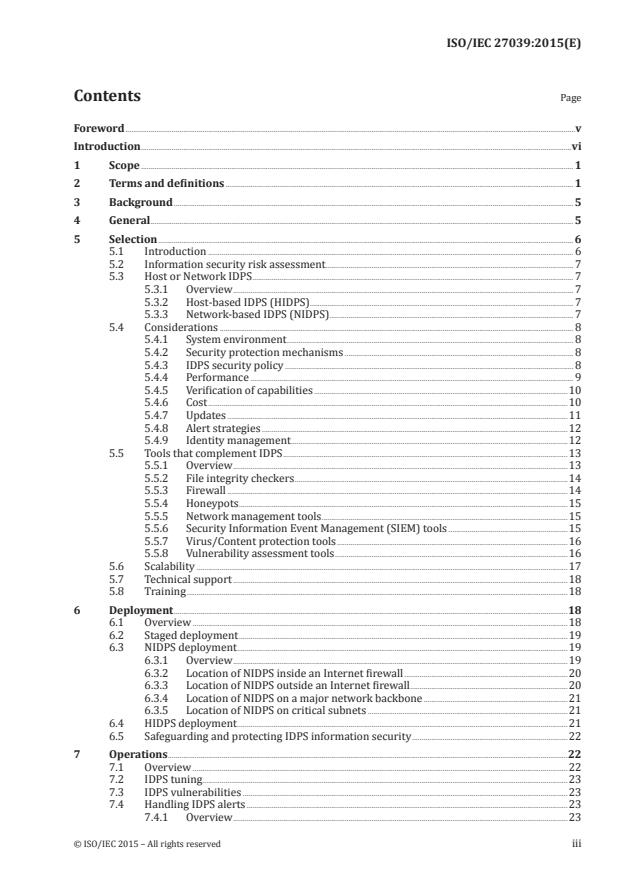
Contents Page
Foreword .v
Introduction .vi
1 Scope . 1
2 Terms and definitions . 1
3 Background . 5
4 General . 5
5 Selection . 6
5.1 Introduction . 6
5.2 Information security risk assessment. 7
5.3 Host or Network IDPS . 7
5.3.1 Overview . 7
5.3.2 Host-based IDPS (HIDPS) . 7
5.3.3 Network-based IDPS (NIDPS) . . 7
5.4 Considerations . 8
5.4.1 System environment . 8
5.4.2 Security protection mechanisms . 8
5.4.3 IDPS security policy . 8
5.4.4 Performance . 9
5.4.5 Verification of capabilities .10
5.4.6 Cost .10
5.4.7 Updates .11
5.4.8 Alert strategies .12
5.4.9 Identity management.12
5.5 Tools that complement IDPS .13
5.5.1 Overview .13
5.5.2 File integrity checkers .14
5.5.3 Firewall .14
5.5.4 Honeypots .15
5.5.5 Network management tools .15
5.5.6 Security Information Event Management (SIEM) tools .15
5.5.7 Virus/Content protection tools .16
5.5.8 Vulnerability assessment tools .16
5.6 Scalability .17
5.7 Technical support .18
5.8 Training .18
6 Deployment .18
6.1 Overview .18
6.2 Staged deployment .19
6.3 NIDPS deployment .19
6.3.1 Overview .19
6.3.2 Location of NIDPS inside an Internet firewall .20
6.3.3 Location of NIDPS outside an Internet firewall .20
6.3.4 Location of NIDPS on a major network backbone .21
6.3.5 Location of NIDPS on critical subnets .21
6.4 HIDPS deployment .21
6.5 Safeguarding and protecting IDPS information security .22
7 Operations .22
7.1 Overview .22
7.2 IDPS tuning .23
7.3 IDPS vulnerabilities .23
7.4 Handling IDPS alerts .23
7.4.1 Overview .23
© ISO/IEC 2015 – All rights reserved iii
7.4.2 Information Security Incident Response Team (ISIRT) .24
7.4.3 Outsourcing .24
7.5 Response options .25
7.5.1 Principles .25
7.5.2 Active response .25
7.5.3 Passive reaction .27
7.6 Legal Considerations .27
7.6.1 Overview .27
7.6.2 Privacy .27
7.6.3 Other legal and policy considerations .27
7.6.4 Forensics .27
Annex A (informative) Intrusion Detection and Prevention System (IDPS): Framework and
issues to be considered .28
Bibliography .48
iv © ISO/IEC 2015 – All rights reserved
Foreword
ISO (the International Organization for Standardization) and IEC (the International Electrotechnical
Commission) form the specialized system for worldwide standardization. National bodies that are
members of ISO or IEC participate in the development of International Standards through technical
committees established by the respective organization to deal with particular fields of technical
activity. ISO and IEC technical committees collaborate in fields of mutual interest. Other international
organizations, governmental and non-governmental, in liaison with ISO and IEC, also take part in the
work. In the field of information technology, ISO and IEC have established a joint technical committee,
ISO/IEC JTC 1.
The procedures used to develop this document and those intended for its further maintenance are
described in the ISO/IEC Directives, Part 1. In particular the different approval criteria needed for
the different types of document should be noted. This document was drafted in accordance with the
editorial rules of the ISO/IEC Directives, Part 2 (see www.iso.org/directives).
Attention is drawn to the possibility that some of the elements of this document may be the subject
of patent rights. ISO and IEC shall not be held responsible for identifying any or all such patent
rights. Details of any patent rights identified during the development of the document will be in the
Introduction and/or on the ISO list of patent declarations received (see www.iso.org/patents).
Any trade name used in this document is information given for the convenience of users and does not
constitute an endorsement.
For an explanation on the meaning of ISO specific terms and expressions related to conformity
assessment, as well as information about ISO’s adherence to the WTO principles in the Technical
Barriers to Trade (TBT), see the following URL: Foreword — Supplementary information.
The committee responsible for this document is ISO/IEC JTC 1, Information technology, Subcommittee
SC 27, Security techniques.
This first edition of ISO/IEC 27039 cancels and replaces ISO/IEC 18043:2006, which has been technically
revised.
This corrected version of ISO/IEC 27039:2015 incorporates the following corrections.
The title of this document has been corrected with the addition of the words ‘and prevention’.
Legal notice
The National Institute of Standards and Technology (NIST), hereby grant non-exclusive license to
ISO/IEC to use the NIST Special Publication on intrusion detection systems (SP800-94 rev1, July 2012)
in the development of the ISO/IEC 27039 International Standard. However, the NIST retains the right to
use, copy, distribute, or modify the SP800-94 as they see fit.
© ISO/IEC 2015 – All rights reserved v
Introduction
Organizations should not only know when, if, and how an intrusion of their network, system, or
application occurs. They also should know what vulnerability was exploited and what safeguards or
appropriate risk treatment options (i.e. risk modification, risk retention, risk avoidance, risk sharing)
should be implemented to prevent similar intrusions in the future. Organizations should also recognize
and deter cyber-based intrusions. This requires an analysis of host and network traffic and/or audit
trails for attack signatures or specific patterns that usually indicate malicious or suspicious intent.
In the mid-1990s, organizations began to use intrusion detection and prevention systems (IDPS) to
fulfil these needs. The general use of IDPS continues to expand with a wider range of IDPS products
being made available to satisfy an increasing level of organizational demands for advanced intrusion
detection capability.
In order for an organization to derive the maximum benefits from IDPS, the process of IDPS selection,
deployment, and operations should be carefully planned and implemented by properly trained and
experienced personnel. In the case where this process is achieved, then IDPS products can assist an
organization in obtaining intrusion information and can serve as an important security device within
the overall information and communications technology (ICT) infrastructure.
This International Standard provides guidelines for effective IDPS selection, deployment, and
operation, as well as fundamental knowledge about IDPS. It is also applicable to those organizations
that are considering outsourcing their intrusion detection capabilities. Information about outsourcing
service level agreements can be found in the IT service management (ITSM) processes based on
ISO/IEC 20000 Series.
This International Standard is intended to be helpful to:
a) An organization in satisfying the following requirements of ISO/IEC 27001:
— The organization shall implement procedures and other controls capable of enabling prompt
detection of and response to security incidents;
— The organization shall execute monitoring and review procedures and other controls to
properly identify attempted and successful security breaches and incidents.
b) An organization in implementing controls that meet the following security objectives of
ISO/IEC 27002:
— To detect unauthorized information processing activities;
— Systems should be monitored and information security events should be recorded. Operator
logs and fault logging should be used to ensure information system problems are identified;
— An organization should comply with all relevant legal requirements applicable to its monitoring
and logging activities;
— System monitoring should be used to check the effectiveness of controls adopted and to verify
conformity to an access policy model.
An organization should recognize that deploying IDPS is not a sole and/or exhaustive solution to satisfy
or meet the above-cited requirements. Furthermore, this International Standard is not intended as
criteria for any kind of conformity assessments, e.g., information security management system (ISMS)
certification, IDPS services or products certification.
vi © ISO/IEC 2015 – All rights reserved
INTERNATIONAL STANDARD ISO/IEC 27039:2015(E)
Information technology — Security techniques —
Selection, deployment and operations of intrusion
detection and prevention systems (IDPS)
1 Scope
This International Standard provides guidelines to assist organizations in preparing to deploy intrusion
detection and prevention systems (IDPS). In particular, it addresses the selection, deployment, and
operations of IDPS. It also provides background information from which these guidelines are derived.
2 Terms and definitions
For the purposes of this document, the terms and definitions given in ISO/IEC 27000 and the
following apply.
2.1
attack
attempts to destroy, expose, alter, or disable information systems and/or information within it or
otherwise breach the security policy
2.2
attack signature
sequence of computing activities or alterations that are used to execute an attack and which are also
used by an IDPS to discover that an attack has occurred and often is determined by the examination of
network traffic or host logs
Note 1 to entry: This can also be referred to as an attack pattern.
2.3
attestation
variant of public-key encryption that lets IDPS software programs and devices authenticate their
identity to remote parties
Note 1 to entry: See remote attestation (2.23).
2.4
bridge
network equipment that transparently connects a local area network (LAN) at OSI layer 2 to another
LAN that uses the same protocol
2.5
cryptographic hash value
mathematical value that is assigned to a file and used to “test” the file at a later date to verify that the
data contained in the file has not been maliciously changed
2.6
denial-of-service
DoS
unauthorized access to a system resource or the delaying of system operations and functions, with
resultant loss of availability to authorized users
[SOURCE: ISO/IEC 27033-1:2009]
© ISO/IEC 2015 – All rights reserved 1
2.7
distributed denial-of-service attack
DDoS
unauthorized access to a system resource or the delaying of system operations and functions in the way
of compromising multiple systems to flood the bandwidth or resources of the targeted system, with
resultant loss of availability to authorized users
2.8
demilitarized zone
DMZ
logical and physical network space between the perimeter router and the exterior firewall
Note 1 to entry: The DMZ can be between networks and under close observation but does not have to be so.
Note 2 to entry: They are generally unsecured areas containing bastion hosts that provide public services.
2.9
exploit
defined way to breach the security of information systems through vulnerability
2.10
firewall
type of barrier placed between network environments — consisting of a dedicated device or a composite
of several components and techniques — through which all traffic from one network environment
traverses to another, and vice versa, and only authorized traffic as defined by the local security policy
is allowed to pass
[SOURCE: ISO/IEC 27033-1:2009]
2.11
false positive
IDPS alert when there is no attack
2.12
false negative
no IDPS alert when there is an attack
2.13
honeypot
generic term for a decoy system used to deceive, distract, divert, and encourage the attacker to spend
time on information that appears to be very valuable, but actually is fabricated and would not be of
interest to a legitimate user
2.14
host
addressable system or computer in TCP/IP-based networks like the Internet
2.15
intruder
individual who is conducting, or has conducted, an intrusion or attack against a victim’s host, site,
network, or organization
2.16
intrusion
unauthorized access to a network or a network-connected system, that is, deliberate or accidental
unauthorized access to information systems, to include malicious activity against information systems,
or unauthorized use of resources within information systems
2 © ISO/IEC 2015 – All rights reserved
2.17
intrusion detection
formal process of detecting intrusions, generally characterized by gathering knowledge about abnormal
usage patterns, as well as what, how, and which vulnerability has been exploited to include how and
when it occurred
2.18
intrusion detection system
IDS
information systems used to identify that an intrusion has been attempted, is occurring, or has occurred
2.19
intrusion prevention system
IPS
variant on intrusion detection systems that are specifically designed to provide an active response
capability
2.20
intrusion detection and prevention system
IDPS
intrusion detection systems (IDPS) and intrusion prevention systems (IPS) software applications
or appliances that monitor systems for malicious activities, where IDS focus is to only alert on the
discovery of such activity while IPS have the potent to prevent some intrusions upon detection
Note 1 to entry: IPS is deployed actively in the network if attack prevention is desired. If deployed in passive
mode, it will not offer such functionality and effectively function as a regular IDS by providing alerts only.
2.21
penetration
unauthorized act of bypassing the security mechanisms of information systems
2.22
provisioning
process of loading the correct software, security policy, and configuration data for information
technology (IT) devices
2.23
remote attestation
processes of using digital certificates to ensure the identity, as well as the hardware and software
configuration, of IDPS and to securely transmit this information to a trusted operations centre
2.24
response
incident response or intrusion response
action taken to protect and restore the normal operational conditions of information systems and the
information stored in it when an attack or intrusion occurs
2.25
router
network device that is used to establish and control the flow of data between different networks, by
selecting paths or routes based upon routing protocol mechanisms and algorithms
Note 1 to entry: The networks can themselves be based on different protocols.
Note 2 to entry: The routing information is kept in a routing table.
[SOURCE: ISO/IEC 27033-1:2009]
2.26
server
computer system or program that provides services to other computers
© ISO/IEC 2015 – All rights reserved 3
2.27
Service Level Agreement
SLA
document that defines the technical support or business performance objectives including measures
for performance and consequences for failure the provider of a service can provide its clients
2.28
sensor
component/agent of IDPS which collects event data from information systems or a network under
observation
Note 1 to entry: Also referred to as a monitor.
2.29
subnet
segment of a network that shares a common address component
2.30
switch
device which provides connectivity between network connectivity devices by means of internal
distribution mechanisms, with the switching technology typically implemented at layer 2 or layer 3 of
the OSI reference model
Note 1 to entry: Switches are distinct from other local area network interconnection devices (e.g. a hub) as the
technology used in switches sets up connections on a point-to-point basis.
[SOURCE: ISO/IEC 27033-1:2009]
2.31
test access port
TAP
typically passive devices that do not install any overhead on the network packet but also increase the
level of the security as they make the data collection interface invisible to the network, where a switch
can still maintain layer 2 information about the port
Note 1 to entry: A TAP also gives the functionality of multiple ports so network issues can be debugged without
losing the IDPS capability.
2.32
trojan horse
malicious program that masquerades as a benign application
2.33
virus
type of malware which is software designed with malicious intent containing features or capabilities
that can potentially cause harm, directly or indirectly, to the user and/or the user’s system
2.34
virtual private network
VPN
restricted-use logical computer network that is constructed from the system resources of a physical
network by using encryption and/or by tunnelling links of the virtual network across the real network
[SOURCE: ISO/IEC 18028-3:2005]
2.35
vulnerability
weakness of an asset or control that can be exploited by one or more threats
[SOURCE: ISO/IEC 27000:2012]
4 © ISO/IEC 2015 – All rights reserved
3 Background
The purpose of intrusion detection and prevention system (IDPS) is passively monitoring, detecting and
logging inappropriate, incorrect, suspicious or anomalous activity that may represent an intrusion and
provide an alert and/or an automated response when these activities are detected. It is the responsibility
of the appointed IT Security personnel to actively review IDPS alerts and associated logs in order to
make decisions on adequate responses. When an organization needs to detect promptly intrusions to
the organization’s information systems and responds appropriately to them, an organization should
consider deploying IDPS. An organization can deploy IDPS by getting IDPS software and/or hardware
products or by outsourcing capabilities of IDPS to an IDPS service provider.
There are many commercially available or open-source IDPS products and services that are based on
different technologies and approaches. In addition, IDPS is not “plug and play” technology. Thus, when
an organization is preparing to deploy IDPS, an organization should, as a minimum, be familiar with
guidelines and information provided by this standard.
Fundamental knowledge about IDPS is mainly presented in Annex A. This annex explains the
characteristics of different types of IDPS:
— Network-based, which monitors network traffic for particular network segments or devices and
analyses the network and application protocol activity to identify suspicious activity;
— Host-based, which monitors the characteristics of a single host and the events occurring within that
host for suspicious activity as well as three basic approaches for detection analysis, i.e. signature-
based detection, statistical anomaly-based detection, stateful protocol analysis detection.
Behavioural analysis applies to network-based and host-based IDPS. This approach examines network
traffic and host activities to identify threats that generate abnormal behaviour, such as distributed
denial of service (DDoS) attacks, brute force attacks, certain forms of malware, and policy violations
(e.g. a client system providing network services to other systems).
A host-based intrusion detection and prevention system (HIDPS) derives its source of information
from one or more hosts, while a network-based intrusion and prevention system (NIDPS) derives
its information from traffic of one or more network segments. The misuse-based approach models
attacks on information systems as specific attack signatures, and then systematically scans the system
for occurrences of these attack signatures. This process involves a specific encoding of previous
behaviours and actions deemed intrusive or malicious. The anomaly-based approach attempts to detect
intrusions by discovering significant deviations from normal behaviour on the assumption that attacks
are different from normal/legitimate activity and can therefore be detected by systems that identify
these differences.
An organization should understand that the source of information and the different analysis approaches
may result in both advantages and disadvantages or limitations, which can impact the ability or
inability to detect specific attacks and influence the degree of difficulty associated with installing and
maintaining the IDPS.
4 General
IDPS functions and limitation, presented in Annex A, indicate that an organization should combine
host-based (including application monitoring) and network-based approaches to achieve reasonably
complete coverage of potential intrusions. Each type of IDPS has its strengths and limitations; together
they can provide better security event coverage and alert analysis.
Combining the IDPS technologies depends on the availability of a correlation engine on the alert
management system. Manual association of HIDPS and NIDPS alerts may result in IDPS operator
overload without any additional benefit and the result may be worse than choosing the most appropriate
output from one type of IDPS.
The process of selecting, deploying and operating IDPS within an organization is shown in Figure 1
along with the clauses that address the key steps in this process.
© ISO/IEC 2015 – All rights reserved 5
Figure 1 — Selection, deployment, and operations of IDPS
5 Selection
5.1 Introduction
There are many IDPS products and products families available. They range from extremely capable
freeware offerings that can be deployed on a low-cost host to very expensive commercial systems
requiring the latest hardware available. As there are so many different IDPS products to choose
from, the process of selecting IDPS that represents the best fit for an organization’s needs is difficult.
Furthermore, there may be limited compatibility between various IDPS products offered in the market
place. Additionally, because of mergers and the potentially wide geographical distribution of an
organization, organizations may be forced to use different IDPS and the integration of these diverse
IDPS can be very challenging.
Vendor brochures may not describe how well an IDPS can detect intrusions and how difficult it is to
deploy, operate and maintain in an operational network with significant amounts of traffic. Vendors
may indicate which attacks can be detected, but without access to an organization’s network traffic, it
is very difficult to describe how well the IDPS can perform and avoid false positives and negatives. Also
the proactive and reactive capabilities of an IDPS need to be assessed independently and mapped to
organizational requirements. This should include the need for deep packet inspection and reassembly
versus the need for network performance and cost considerations. Consequently, relying on vendor
provided information about IDPS capabilities is neither sufficient nor recommended.
6 © ISO/IEC 2015 – All rights reserved
ISO/IEC 15408 (all parts) may be used in the evaluation of an IDPS. In such a case, a document called
“Security Target” may contain more accurate and reliable description than vendor brochures concerning
IDPS performance. An organization should use this document in their selection process.
The following sub-clauses provide the major factors that should be used by an organization in the IDPS
selection process.
5.2 Information security risk assessment
Prior to the selection of an IDPS, an organization should perform an information security risk
assessment, aimed at identifying the attacks and intrusions (threats) to which the organization’s
specific information systems might be vulnerable, taking into account factors such as the nature of
information used by the system and how it needs to be protected, the types of communication systems
used, and other operational and environmental factors. By considering these potential threats in the
context of their specific information security objectives, the organization can identify controls, which
provide cost-effective mitigation of the risks. The identified controls would provide the basis of the
requirements for the functions provided by their IDPS.
NOTE Information security risk assessment and management is the subject of International Standard
(ISO/IEC 27001).
Once the IDPS is installed and operational an on-going process of risk management should be
implemented to periodically review the effectiveness of the controls in light of changes to the system’s
operations and the threat environment.
5.3 Host or Network IDPS
5.3.1 Overview
IDPS deployment should be based on an organizational risk assessment and asset protection priorities.
When selecting IDPS, the most effective method to monitor events should be investigated. Both Host-
based IDPS (HIDPS) and Network-based (NIDPS) can be deployed in tandem. Where such an IDPS
monitoring method is selected, an organization should implement it in stages starting with a NIDPS, as
they are usually the simplest to install and maintain, then HIDPS should be deployed on critical servers.
Each option has its own advantages and disadvantages. For example, in the case where an IDPS is
deployed outside an external firewall, an IDPS can generate a large number of alerts that do not require
careful analysis because a large amount of the alerting events can indicate scans that are already being
effectively prevented by the external firewall.
5.3.2 Host-based IDPS (HIDPS)
The choice of a HIDPS demands the identification of target hosts. The expensive nature of full-scale
deployment on every host in an organization normally results in the deployment of HIDPS on critical
hosts only. Therefore the deployment of HIDPS should be prioritized according to risk analysis
results and cost-benefit considerations. An organization should deploy an IDPS capable of centralized
management and reporting functions when HIDPS is deployed on all or a significant number of hosts.
5.3.3 Network-based IDPS (NIDPS)
The main factor to consider when deploying a NIDPS is where to position the system sensors. Options
include:
— Inside external firewalls;
— Outside external firewalls;
— On major network backbones;
© ISO/IEC 2015 – All rights reserved 7
— Between trust boundaries.
5.4 Considerations
5.4.1 System environment
Based on a security risk assessment, an organization should first determine, in order of priority, what
assets should be protected and then tailor the IDPS to that environment. At a minimum, the following
system environment information needs to be collected to accomplish this objective:
— Network diagrams and maps specifying the number and locations of hosts, entry points to networks
and connections to external networks;
— Description of the enterprise network management system;
— Operating systems for each host;
— Number and types of network devices such as routers, bridges, and switches;
— Number and types of servers and dialup connections;
— Descriptors of any network servers, including types, configurations, application software and
versions running on each;
— Connections to external networks, including nominal bandwidth and supported protocols;
— Return paths that are not the same as the incoming connection path, i.e. asymmetric data flow.
5.4.2 Security protection mechanisms
After the technical attributes of the system’s environment have been documented, the security
protection mechanisms presently installed should be identified. At a minimum, the following
information is needed:
— Demilitarized Zone (DMZ)
— Numbers, types, and locations of firewalls and filtering routers;
— Identification of authentication servers;
— Data and link encryption;
— Malware/Anti-virus packages;
— Access control products;
— Specialized security hardware such as cryptographic hardware;
— Virtual Private Networks (VPNs);
— Any other installed security mechanisms.
5.4.3 IDPS security policy
After the system and general security environments have been identified, the security policy for the
IDPS should be defined. At a minimum, the policy needs to answer the following key questions:
— What information assets are to be monitored?
— What is the policy for fail-open and fail-closed conditions?
— What type of IDPS is needed?
8 © ISO/IEC 2015 – All rights reserved
— Where can the IDPS be placed?
— What types of attacks should be detected?
— What type of information should be logged?
— What type of response or alert can be provided when an attack is detected?
The IDPS security policy represents the goals the organization has for the IDPS investment. This is the
initial step in attempting to gain the maximum value from the IDPS asset.
In order to specify IDPS security policy goals and objectives, an organization should first identify the
organization’s risks from internal and external sources. An organization should realise that some IDPS
vendors define IDPS security policies as the set of rules that IDPS uses to generate alerts.
A review of the existing organization security policy should provide a template against which the
requirements of the IDPS can be determined and stated in terms of standard security goals of
confidentiality, integrity, availability, and non-repudiation as well as more generic management goals
such as privacy, protection from liability, manageability.
An organization should determine how it would react when an IDPS detects that a security policy has
been violated. Specifically, in the case that an organization wishes to respond actively to certain kinds
of violations, the IDPS should be configured to do so and the operational staff should be informed of
the organization’s response policy so that they can deal with alarms in an appropriate manner. For
example, a law enforcement investigation may be required to assist in the effective resolution of a
security incident. Relevant information, including IDPS logs, may be required to be handed over to the
law enforcement body for evidentiary purposes.
Additional information concerning security incident management can be found in ISO/IEC 27035.
5.4.4 Performance
Performance is another factor to consider when selecting IDPS. At a minimum, the following questions
should be answered:
— What bandwidth needs to be processed by the IDPS?
— What level of false alarms can be tolerated when operating at that bandwidth?
— Can the cost of a high speed IDPS be justified or can a moderate or slow IDPS suffice?
— What are the consequences of missing a potential intrusion because of IDPS performance limitations?
— What is the performance impact when deep packet inspection and reassembly occurs?
Sustainable performance can be defined as the ability to consistently detect attacks within a given
bandwidth utilization. In most environments, there is little tolerance for an IDPS missing or dropping
packets in traffic that could be part of an attack. At some point, as the bandwidth and/or network traffic
increases, many IDPS will no longer be able to effectively and consistently detect intrusions.
A combination of load balancing and tuning can increase efficiency and performance. For example:
— Knowledge is required of the organization’s network and its vulnerabilities: Every network is
different; an organization should determine what network assets need protection and what attack
signature tuning is likely to be associated with those assets. This is generally accomplished through
a risk assessment process.
— Performance of most IDPS can be much better in the case where they are configured to handle a
limited amount of network traffic and services. For example, an organization that does a lot of e
commerce can need to monitor all Hypertext Transfer Protocol (HTTP) traffic and to tune one or
more IDPS to look for only attack signatures associated with web traffic.
© ISO/IEC 2015 – All rights reserved 9
— Proper load balancing configuration can allow the signature based IDPS to work much faster and
more thoroughly because the signature based IDPS needs only to process through an optimized
smaller attack signature database and not through a database of all possible attack signatures.
Load balancing is used to split available bandwidth in IDPS deployment. However, bandwidth splitting is
likely to introduce problems such as: additional cost, management overhead, traffic de-synchronization,
alert duplication, and false negatives. Furthermore, current IDPS technology is reaching gigabits speed
and as a result the benefits versus cost of load balancing may be minimal.
5.4.5 Verification of capabilities
Reliance on vendor provided information about the capabilities of IDPS is generally not sufficient. An
organization should request additional information and perhaps a demonstration of the suitability
of a particular IDPS to the organization’s environment and security goals. Most IDPS vendors have
experience in adapting their products as target networks grow and some are committed to support
new protocol standards, platform
...