

ISO 10303-218:2004
(Main)Industrial automation systems and integration — Product data representation and exchange — Part 218: Application protocol: Ship structures
General Information
- Abstract
ISO 10303-218:2004 specifies the use of the integrated resources necessary for the scope and information requirements for the exchange of product definition data and its configuration and approval status information for ship structural systems. Configuration in this context pertains to data specific to revision tracking and change history of selected ship structural entities within the product model. Approval pertains to the company internal approval and the classification society approval. ISO 10303-218:2004 supports the shipbuilding activities and applications associated with the design phase and the manufacturing phase. NOTE 1 The application activity model in Annex F provides a graphical representation of the processes and information flows that are the basis for the definition of the scope of ISO 10303-218:2004. NOTE 2 The detailed technical discussion in Annex L provides details that define the basis for the definition of the scope of ISO 10303-218:2004 and details that define the basis of harmonization with other parts of ISO 10303 for product exchange of data for ships. The following are within the scope of ISO 10303-218:2004: product definition data pertaining to the ship structure which includes hull structure, superstructure and all other internal structures of commercial and naval ships; product definition data pertaining to the ship structure; product definition data pertaining to the pre-design phase of the ship structure; product definition data pertaining to the main design phase of the ship structure; product definition data pertaining to the manufacturing phase of the ship structure; product definition data pertaining to the product structuring of ships, including the structuring by system and by assemblies within the ship; product definition data identifying the ship general characteristics which are relevant to the design of the ship structure. NOTE The general characteristics include ship main dimensions, designations and principle characteristics, as well as the rules, regulations and standards applicable to the ship. They also include lightships weight distribution and free-board characteristics for the purpose of design and design approvals. product definition data pertaining to the ship global coordinate system, local coordinate systems and spacing grids, which are used for defining the geometry of the ship structure; product definition data pertaining to the geometrical representation of the ship structure parts and assemblies; product definition data pertaining to the hull plating and the stiffener profiles, and the definition of structural features, which comprise the ship structure parts and assemblies, including functional descriptions. EXAMPLE Edge, corner and interior cut-outs are examples of structural features product definition data pertaining to the design of the welded connections and joints of ship structure parts and assemblies, including edge preparations and weld type and size; product definition data pertaining to the specification of transverse cross-sections through the ship structure for the purpose of approval of strength; product definition data pertaining to ship design loads, including shear forces and bending moments acting on the ship structure, for the purpose of determining the longitudinal strength of the ship; product definition data pertaining to the weights and centres of gravity of the ship structure parts and assemblies; product definition data pertaining to the materials of ship structure, required to manufacture the ship or a part of it; product definition data pertaining to the configuration management of the ship structure, including approval, versioning and change administration; product definition data pertaining to external references, technical documentation and other supporting concepts which are necessary and pertinent to the design and manufacture of the ship structure parts and assemblies. The following are outside the scope of ISO 10303-218:2
- Status
- Published
- Publication Date
- 24-Nov-2004
- Technical Committee
- ISO/TC 184/SC 4 - Industrial data
- Drafting Committee
- ISO/TC 184/SC 4/WG 12 - STEP product modelling and resources
- Current Stage
- 9093 - International Standard confirmed
- Start Date
- 23-Jun-2025
- Completion Date
- 29-Aug-2026
Overview
ISO 10303-218:2004 - part of the ISO 10303 (STEP) series - is an application protocol for product data representation and exchange specifically focused on ship structures. It defines the integrated resources and information requirements needed to exchange product definition data, plus configuration (revision/change history) and approval status (internal company and classification society approvals) for hulls, superstructures and internal structural assemblies. The standard supports shipbuilding through the design and manufacturing phases, and includes informative annexes (e.g., application activity model and technical discussions) to clarify scope and harmonization with other STEP parts.
Key topics and technical requirements
ISO 10303-218:2004 covers technical elements required to represent ship structural data for reliable exchange:
- Product definition data for hull structure, superstructure and internal structures (commercial and naval)
- Design phases: pre-design, main design and manufacturing support
- Configuration management: versioning, change history and approval tracking (company and classification society)
- Geometrical representation: global and local coordinate systems, spacing grids, parts and assemblies
- Structural details: hull plating, stiffener profiles, structural features (cutouts, edges), profiles and assemblies
- Welds and joints: weld types, edge preparations, sizes and related fabrication information
- Structural analysis inputs: transverse cross-sections, design loads, bending moments and shear forces for strength assessment
- Mass properties: weights and centers of gravity for parts and assemblies
- Material and manufacturing data: materials required for fabrication and production definitions
- External references and documentation: links to supporting technical documentation needed for design and manufacture
- Conformance items: AIM/EXPRESS mappings, PICS proforma and implementation requirements are provided to ensure interoperability
Applications
ISO 10303-218 is used to:
- Exchange ship structural models between CAD/PLM/CAM systems
- Share design intent and fabrication data with shipyards and suppliers
- Provide structured data for classification society approvals and regulatory review
- Support lifecycle activities: design validation, production planning and as-built configuration control
- Integrate structural data into FEM/strength-analysis workflows and manufacturing preparation
Who uses this standard
- Naval architects and marine structural engineers
- Shipyards and fabrication shops
- Classification societies and approval authorities
- CAD/CAM/PLM software vendors and system integrators
- Digital engineering and model-based enterprise teams in shipbuilding
Related standards
- ISO 10303 series (STEP) - application protocols and resources
- Referenced parts in the protocol (e.g., ISO 10303-1, -21, -31, -41, -42, -43, -216) for foundational concepts, data formats and EXPRESS/AIM modeling
For implementation details, mappings and conformance guidance consult the full ISO 10303-218:2004 document available from ISO.
Get Certified
Connect with accredited certification bodies for this standard

DNV
DNV is an independent assurance and risk management provider.

Lloyd's Register
Lloyd's Register is a global professional services organisation specialising in engineering and technology.

DVS-ZERT GmbH
German welding certification society.
Sponsored listings
Frequently Asked Questions
ISO 10303-218:2004 is a standard published by the International Organization for Standardization (ISO). Its full title is "Industrial automation systems and integration — Product data representation and exchange — Part 218: Application protocol: Ship structures". This standard covers: ISO 10303-218:2004 specifies the use of the integrated resources necessary for the scope and information requirements for the exchange of product definition data and its configuration and approval status information for ship structural systems. Configuration in this context pertains to data specific to revision tracking and change history of selected ship structural entities within the product model. Approval pertains to the company internal approval and the classification society approval. ISO 10303-218:2004 supports the shipbuilding activities and applications associated with the design phase and the manufacturing phase. NOTE 1 The application activity model in Annex F provides a graphical representation of the processes and information flows that are the basis for the definition of the scope of ISO 10303-218:2004. NOTE 2 The detailed technical discussion in Annex L provides details that define the basis for the definition of the scope of ISO 10303-218:2004 and details that define the basis of harmonization with other parts of ISO 10303 for product exchange of data for ships. The following are within the scope of ISO 10303-218:2004: product definition data pertaining to the ship structure which includes hull structure, superstructure and all other internal structures of commercial and naval ships; product definition data pertaining to the ship structure; product definition data pertaining to the pre-design phase of the ship structure; product definition data pertaining to the main design phase of the ship structure; product definition data pertaining to the manufacturing phase of the ship structure; product definition data pertaining to the product structuring of ships, including the structuring by system and by assemblies within the ship; product definition data identifying the ship general characteristics which are relevant to the design of the ship structure. NOTE The general characteristics include ship main dimensions, designations and principle characteristics, as well as the rules, regulations and standards applicable to the ship. They also include lightships weight distribution and free-board characteristics for the purpose of design and design approvals. product definition data pertaining to the ship global coordinate system, local coordinate systems and spacing grids, which are used for defining the geometry of the ship structure; product definition data pertaining to the geometrical representation of the ship structure parts and assemblies; product definition data pertaining to the hull plating and the stiffener profiles, and the definition of structural features, which comprise the ship structure parts and assemblies, including functional descriptions. EXAMPLE Edge, corner and interior cut-outs are examples of structural features product definition data pertaining to the design of the welded connections and joints of ship structure parts and assemblies, including edge preparations and weld type and size; product definition data pertaining to the specification of transverse cross-sections through the ship structure for the purpose of approval of strength; product definition data pertaining to ship design loads, including shear forces and bending moments acting on the ship structure, for the purpose of determining the longitudinal strength of the ship; product definition data pertaining to the weights and centres of gravity of the ship structure parts and assemblies; product definition data pertaining to the materials of ship structure, required to manufacture the ship or a part of it; product definition data pertaining to the configuration management of the ship structure, including approval, versioning and change administration; product definition data pertaining to external references, technical documentation and other supporting concepts which are necessary and pertinent to the design and manufacture of the ship structure parts and assemblies. The following are outside the scope of ISO 10303-218:2
ISO 10303-218:2004 specifies the use of the integrated resources necessary for the scope and information requirements for the exchange of product definition data and its configuration and approval status information for ship structural systems. Configuration in this context pertains to data specific to revision tracking and change history of selected ship structural entities within the product model. Approval pertains to the company internal approval and the classification society approval. ISO 10303-218:2004 supports the shipbuilding activities and applications associated with the design phase and the manufacturing phase. NOTE 1 The application activity model in Annex F provides a graphical representation of the processes and information flows that are the basis for the definition of the scope of ISO 10303-218:2004. NOTE 2 The detailed technical discussion in Annex L provides details that define the basis for the definition of the scope of ISO 10303-218:2004 and details that define the basis of harmonization with other parts of ISO 10303 for product exchange of data for ships. The following are within the scope of ISO 10303-218:2004: product definition data pertaining to the ship structure which includes hull structure, superstructure and all other internal structures of commercial and naval ships; product definition data pertaining to the ship structure; product definition data pertaining to the pre-design phase of the ship structure; product definition data pertaining to the main design phase of the ship structure; product definition data pertaining to the manufacturing phase of the ship structure; product definition data pertaining to the product structuring of ships, including the structuring by system and by assemblies within the ship; product definition data identifying the ship general characteristics which are relevant to the design of the ship structure. NOTE The general characteristics include ship main dimensions, designations and principle characteristics, as well as the rules, regulations and standards applicable to the ship. They also include lightships weight distribution and free-board characteristics for the purpose of design and design approvals. product definition data pertaining to the ship global coordinate system, local coordinate systems and spacing grids, which are used for defining the geometry of the ship structure; product definition data pertaining to the geometrical representation of the ship structure parts and assemblies; product definition data pertaining to the hull plating and the stiffener profiles, and the definition of structural features, which comprise the ship structure parts and assemblies, including functional descriptions. EXAMPLE Edge, corner and interior cut-outs are examples of structural features product definition data pertaining to the design of the welded connections and joints of ship structure parts and assemblies, including edge preparations and weld type and size; product definition data pertaining to the specification of transverse cross-sections through the ship structure for the purpose of approval of strength; product definition data pertaining to ship design loads, including shear forces and bending moments acting on the ship structure, for the purpose of determining the longitudinal strength of the ship; product definition data pertaining to the weights and centres of gravity of the ship structure parts and assemblies; product definition data pertaining to the materials of ship structure, required to manufacture the ship or a part of it; product definition data pertaining to the configuration management of the ship structure, including approval, versioning and change administration; product definition data pertaining to external references, technical documentation and other supporting concepts which are necessary and pertinent to the design and manufacture of the ship structure parts and assemblies. The following are outside the scope of ISO 10303-218:2
ISO 10303-218:2004 is classified under the following ICS (International Classification for Standards) categories: 25.040.40 - Industrial process measurement and control; 47.040 - Seagoing vessels. The ICS classification helps identify the subject area and facilitates finding related standards.
ISO 10303-218:2004 is available in PDF format for immediate download after purchase. The document can be added to your cart and obtained through the secure checkout process. Digital delivery ensures instant access to the complete standard document.
Standards Content (Sample)
INTERNATIONAL ISO
STANDARD 10303-218
First edition
2004-11-15
Industrial automation systems and
integration — Product data
representation and exchange —
Part 218:
Application protocol: Ship structures
Systèmes d'automatisation industrielle et intégration — Représentation
et échange de données de produits —
Partie 218: Protocole d'application: Structures de navires
Reference number
©
ISO 2004
PDF disclaimer
This PDF file may contain embedded typefaces. In accordance with Adobe's licensing policy, this file may be printed or viewed but
shall not be edited unless the typefaces which are embedded are licensed to and installed on the computer performing the editing. In
downloading this file, parties accept therein the responsibility of not infringing Adobe's licensing policy. The ISO Central Secretariat
accepts no liability in this area.
Adobe is a trademark of Adobe Systems Incorporated.
Details of the software products used to create this PDF file can be found in the General Info relative to the file; the PDF-creation
parameters were optimized for printing. Every care has been taken to ensure that the file is suitable for use by ISO member bodies. In
the unlikely event that a problem relating to it is found, please inform the Central Secretariat at the address given below.
© ISO 2004
All rights reserved. Unless otherwise specified, no part of this publication may be reproduced or utilized in any form or by any means,
electronic or mechanical, including photocopying and microfilm, without permission in writing from either ISO at the address below or
ISO's member body in the country of the requester.
ISO copyright office
Case postale 56 • CH-1211 Geneva 20
Tel. + 41 22 749 01 11
Fax + 41 22 749 09 47
E-mail copyright@iso.org
Web www.iso.org
Published in Switzerland
ii © ISO 2004 – All rights reserved
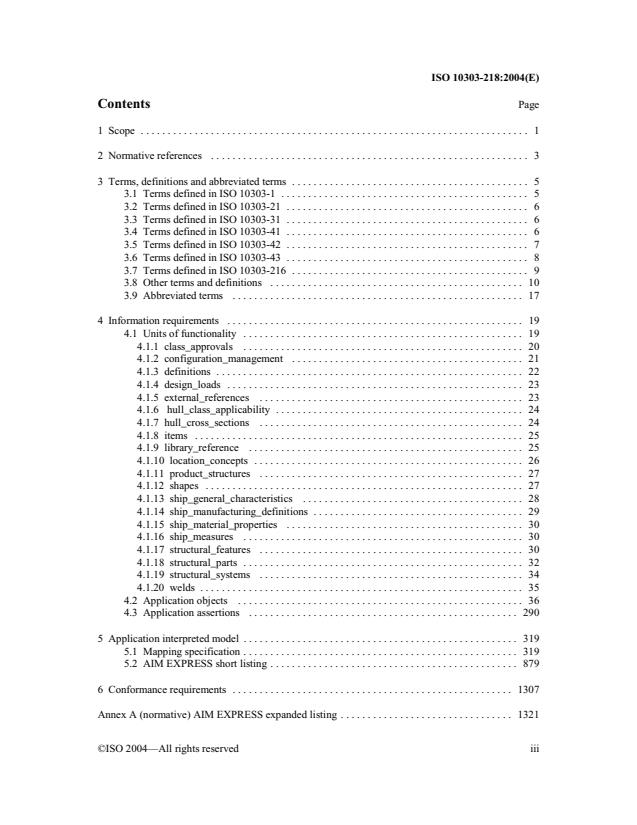
Contents Page
1 Scope . 1
2 Normative references . 3
3 Terms, definitions and abbreviated terms . 5
3.1 Terms defined in ISO 10303-1 . 5
3.2 Terms defined in ISO 10303-21 . 6
3.3 Terms defined in ISO 10303-31 . 6
3.4 Terms defined in ISO 10303-41 . 6
3.5 Terms defined in ISO 10303-42 . 7
3.6 Terms defined in ISO 10303-43 . 8
3.7 Terms defined in ISO 10303-216 . 9
3.8 Other terms and definitions . 10
3.9 Abbreviated terms . 17
4 Information requirements . 19
4.1 Units of functionality . 19
4.1.1 class_approvals . 20
4.1.2 configuration_management . 21
4.1.3 definitions . 22
4.1.4 design_loads . 23
4.1.5 external_references . 23
4.1.6 hull_class_applicability . 24
4.1.7 hull_cross_sections . 24
4.1.8 items . 25
4.1.9 library_reference . 25
4.1.10 location_concepts . 26
4.1.11 product_structures . 27
4.1.12 shapes . 27
4.1.13 ship_general_characteristics . 28
4.1.14 ship_manufacturing_definitions . 29
4.1.15 ship_material_properties . 30
4.1.16 ship_measures . 30
4.1.17 structural_features . 30
4.1.18 structural_parts . 32
4.1.19 structural_systems . 34
4.1.20 welds . 35
4.2 Application objects . 36
4.3 Application assertions . 290
5 Application interpreted model . 319
5.1 Mapping specification . 319
5.2 AIM EXPRESS short listing . 879
6 Conformance requirements . 1307
Annex A (normative) AIM EXPRESS expanded listing . 1321
©ISO 2004—All rights reserved iii
Annex B (normative) AIM short names . 1606
Annex C (normative) Implementation method specific requirements . 1615
Annex D (normative) Protocol Implementation Conformance Statement (PICS) proforma . 1616
Annex E (normative) Information object registration . 1619
Annex F (informative) Application activity model . 1620
Annex G (informative) Application reference model . 1660
Annex H (informative) EXPRESS-G Diagrams . 1710
Annex J (informative) Computer interpretable listings . 1739
Annex K (informative) Application protocol usage guide . 1740
Annex L (informative) Technical discussions . 1741
L.1 Introduction . 1741
L.2 The ship common model . 1743
L.3 Key concepts of ship structures . 1746
L.4 Globally unambiguous identifier usage . 1755
L.5 AIM units for each measure type . 1760
Bibliography . 1765
Index . 1766
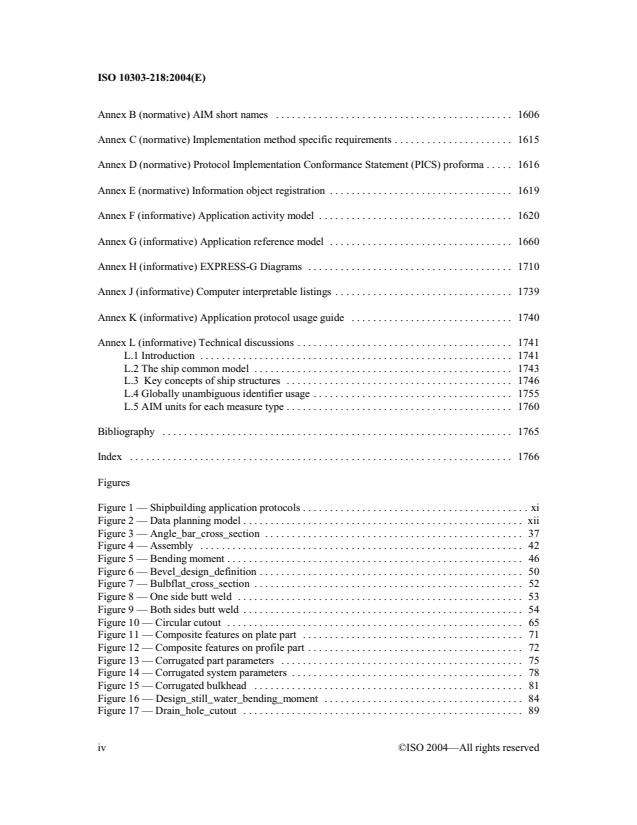
Figures
Figure 1 — Shipbuilding application protocols . xi
Figure 2 — Data planning model . xii
Figure 3 — Angle_bar_cross_section . 37
Figure 4 — Assembly . 42
Figure 5 — Bending moment . 46
Figure 6 — Bevel_design_definition . 50
Figure 7 — Bulbflat_cross_section . 52
Figure 8 — One side butt weld . 53
Figure 9 — Both sides butt weld . 54
Figure 10 — Circular cutout . 65
Figure 11 — Composite features on plate part . 71
Figure 12 — Composite features on profile part . 72
Figure 13 — Corrugated part parameters . 75
Figure 14 — Corrugated system parameters . 78
Figure 15 — Corrugated bulkhead . 81
Figure 16 — Design_still_water_bending_moment . 84
Figure 17 — Drain_hole_cutout . 89
iv ©ISO 2004—All rights reserved
Figure 18 — Drain_hole_cutout shape . 90
Figure 19 — Eliptical_cutout . 96
Figure 20 — Elongated_oval_cutout . 97
Figure 21 — Flat_bar_cross_section . 106
Figure 22 — Global axis placement . 111
Figure 23 — Groove weld types . 112
Figure 24 — Double bottom of a bulk carrier . 117
Figure 25 — Hull cross section of a cargo ship . 118
Figure 26 — Hull cross section of a bulk carrier . 119
Figure 27 — Inward_round_corner_cutout . 132
Figure 28 — Local coordinate system . 140
Figure 29 — Outward_round_corner_cutout . 149
Figure 30 — Part edge cutout . 156
Figure 31 — Part ID locations for various Profile_cross_sections . 157
Figure 32 — Examples of part edge cutout shapes . 157
Figure 33 — Profile design of a simple profile . 171
Figure 34 — Profile design using curve_on_surface geometry for trace line . 172
Figure 35 — Profile design with declination angle . 173
Figure 36 — Profile design using twist . 173
Figure 37 — Rectangular_cutback_corner_cutout . 184
Figure 38 — Round_corner_rectangular_cutout . 188
Figure 39 — Shear_bevel_design_definition . 193
Figure 40 — Spacing positions . 199
Figure 41 — Plate cutouts . 206
Figure 42 — Profile cutouts. 207
Figure 43 — Deck . 211
Figure 44 — Bulkhead . 212
Figure 45 — Double bottom as section . 224
Figure 46 — Double bottom . 224
Figure 47 — Structural_system . 225
Figure 48 — Single bottom . 234
Figure 49 — Deck in three dimensions . 236
Figure 50 — Double bottom in two dimensions . 236
Figure 51 — Shell . 238
Figure 52 — Fore ship in two dimensions . 240
Figure 53 — Fore ship in three dimensions . 241
Figure 54 — Bow . 242
Figure 55 — Bilge keel . 244
Figure 56 — Longitudinal girder . 245
Figure 57 — Tank . 248
Figure 58 — Web frame . 250
Figure 59 — T bar cross section . 255
Figure 60 — Weld examples . 266
Figure 61 — Weld positions . 273
Figure 62 — Weld distortion . 276
Figure 63 — Weld methods . 277
Figure 64 — Weld procedures . 278
Figure 65 — Weld types . 282
Figure 66 — Weld sequence . 286
©ISO 2004—All rights reserved v
Figure F.1 — IDEF0 Basic notation . 1620
Figure F.2 — Node A-0: Describe ship life cycle . 1637
Figure F.3 — Node A0: Perform ship life cycle . 1638
Figure F.4 — Node A1: Specify ship . 1639
Figure F.5 — A12: Prepare bid . 1640
Figure F.6 — A122: Create preliminary design . 1641
Figure F.7 — Node A2: Complete and approve ship design . 1642
Figure F.8 — Node A24: Complete design of ship structure . 1643
Figure F.9 — Node A241: Design ship structure . 1644
Figure F.10 — Node A2412: Create design of classification items . 1645
Figure F.11 — Node A24121: Design of transverse structure . 1646
Figure F.12 — Node A242: Approve design of ship sructure . 1647
Figure F.13 — Node A2424: Check global strength and secondary structure . 1648
Figure F.14 — Node A243: Elaborate ship structure design . 1649
Figure F.15 — Node A2434: Make hull detail design . 1650
Figure F.16 — Node A24341: Design secondary structure . 1651
Figure F.17 — Node A24342: Handle plates . 1652
Figure F.18 — Node A24343: Handle profiles . 1653
Figure F.19 — Node A244: Make production design of ship structure . 1654
Figure F.20 — Node A2442: Create production documents . 1655
Figure F.21 — Node A2443: Refine working information . 1656
Figure F.22 — Node A3: Produce and inspect a ship . 1657
Figure F.23 — Node A34: Test a ship . 1658
Figure F.24 — Node A4: Operate and maintain a ship . 1659
Figure G.1 — ARM EXPRESS-G diagram 1 of 49. 1661
Figure G.2 — ARM EXPRESS-G diagram 2 of 49. 1662
Figure G.3 — ARM EXPRESS-G diagram 3 of 49. 1663
Figure G.4 — ARM EXPRESS-G diagram 4 of 49. 1664
Figure G.5 — ARM EXPRESS-G diagram 5 of 49. 1665
Figure G.6 — ARM EXPRESS-G diagram 6 of 49. 1666
Figure G.7 — ARM EXPRESS-G diagram 7 of 49. 1667
Figure G.8 — ARM EXPRESS-G diagram 8 of 49. 1668
Figure G.9 — ARM EXPRESS-G diagram 9 of 49. 1669
Figure G.10 — ARM EXPRESS-G diagram 10 of 49. 1670
Figure G.11 — ARM EXPRESS-G diagram 11 of 49. 1671
Figure G.12 — ARM EXPRESS-G diagram 12 of 49. 1672
Figure G.13 — ARM EXPRESS-G diagram 13 of 49. 1673
Figure G.14 — ARM EXPRESS-G diagram 14 of 49. 1674
Figure G.15 — ARM EXPRESS-G diagram 15 of 49. 1675
Figure G.16 — ARM EXPRESS-G diagram 16 of 49. 1676
Figure G.17 — ARM EXPRESS-G diagram 17 of 49. 1677
Figure G.18 — ARM EXPRESS-G diagram 18 of 49. 1678
Figure G.19 — ARM EXPRESS-G diagram 19 of 49. 1679
Figure G.20 — ARM EXPRESS-G diagram 20 of 49. 1680
Figure G.21 — ARM EXPRESS-G diagram 21 of 49. 1681
Figure G.22 — ARM EXPRESS-G diagram 22 of 49. 1682
Figure G.23 — ARM EXPRESS-G diagram 23 of 49. 1683
Figure G.24 — ARM EXPRESS-G diagram 24 of 49. 1684
Figure G.25 — ARM EXPRESS-G diagram 25 of 49. 1685
vi ©ISO 2004—All rights reserved
Figure G.26 — ARM EXPRESS-G diagram 26 of 49. 1686
Figure G.27 — ARM EXPRESS-G diagram 27 of 49. 1687
Figure G.28 — ARM EXPRESS-G diagram 28 of 49. 1688
Figure G.29 — ARM EXPRESS-G diagram 29 of 49. 1689
Figure G.30 — ARM EXPRESS-G diagram 30 of 49. 1690
Figure G.31 — ARM EXPRESS-G diagram 31 of 49. 1691
Figure G.32 — ARM EXPRESS-G diagram 32 of 49. 1692
Figure G.33 — ARM EXPRESS-G diagram 33 of 49. 1693
Figure G.34 — ARM EXPRESS-G diagram 34 of 49. 1694
Figure G.35 — ARM EXPRESS-G diagram 35 of 49. 1695
Figure G.36 — ARM EXPRESS-G diagram 36 of 49. 1696
Figure G.37 — ARM EXPRESS-G diagram 37 of 49. 1697
Figure G.38 — ARM EXPRESS-G diagram 38 of 49. 1698
Figure G.39 — ARM EXPRESS-G diagram 39 of 49. 1699
Figure G.40 — ARM EXPRESS-G diagram 40 of 49. 1700
Figure G.41 — ARM EXPRESS-G diagram 41 of 49. 1701
Figure G.42 — ARM EXPRESS-G diagram 42 of 49. 1702
Figure G.43 — ARM EXPRESS-G diagram 43 of 49. 1703
Figure G.44 — ARM EXPRESS-G diagram 44 of 49. 1704
Figure G.45 — ARM EXPRESS-G diagram 45 of 49. 1705
Figure G.46 — ARM EXPRESS-G diagram 46 of 49. 1706
Figure G.47 — ARM EXPRESS-G diagram 47 of 49. 1707
Figure G.48 — ARM EXPRESS-G diagram 48 of 49. 1708
Figure G.49 — ARM EXPRESS-G diagram 49 of 49. 1709
Figure H.1 — AIM diagram 1 of 28 in EXPRESS-G . 1711
Figure H.2 — AIM diagram 2 of 28 in EXPRESS-G . 1712
Figure H.3 — AIM diagram 3 of 28 in EXPRESS-G . 1713
Figure H.4 — AIM diagram 4 of 28 in EXPRESS-G . 1714
Figure H.5 — AIM diagram 5 of 28 in EXPRESS-G . 1715
Figure H.6 — AIM diagram 6 of 28 in EXPRESS-G . 1716
Figure H.7 — AIM diagram 7 of 28 in EXPRESS-G . 1717
Figure H.8 — AIM diagram 8 of 28 in EXPRESS-G . 1718
Figure H.9 — AIM diagram 9 of 28 in EXPRESS-G . 1719
Figure H.10 — AIM diagram 10 of 28 in EXPRESS-G . 1720
Figure H.11 — AIM diagram 11 of 28 in EXPRESS-G . 1721
Figure H.12 — AIM diagram 12 of 28 in EXPRESS-G . 1722
Figure H.13 — AIM diagram 13 of 28 in EXPRESS-G . 1723
Figure H.14 — AIM diagram 14 of 28 in EXPRESS-G . 1724
Figure H.15 — AIM diagram 15 of 28 in EXPRESS-G . 1725
Figure H.16 — AIM diagram 16 of 28 in EXPRESS-G . 1726
Figure H.17 — AIM diagram 17 of 28 in EXPRESS-G . 1727
Figure H.18 — AIM diagram 18 of 28 in EXPRESS-G . 1728
Figure H.19 — AIM diagram 19 of 28 in EXPRESS-G . 1729
Figure H.20 — AIM diagram 20 of 28 in EXPRESS-G . 1730
Figure H.21 — AIM diagram 21 of 28 in EXPRESS-G . 1731
Figure H.22 — AIM diagram 22 of 28 in EXPRESS-G . 1732
Figure H.23 — AIM diagram 23 of 28 in EXPRESS-G . 1733
Figure H.24 — AIM diagram 24 of 28 in EXPRESS-G . 1734
Figure H.25 — AIM diagram 25 of 28 in EXPRESS-G . 1735
©ISO 2004—All rights reserved vii
Figure H.26 — AIM diagram 26 of 28 in EXPRESS-G . 1736
Figure H.27 — AIM diagram 27 of 28 in EXPRESS-G . 1737
Figure H.28 — AIM diagram 28 of 28 in EXPRESS-G . 1738
Figure L.1 — Ship product model . 1741
Figure L.2 — Ship life cycle . 1743
Figure L.3 — SCM framework . 1744
Figure L.4 — Subtypes of items for ship structures . 1747
Figure L.5 — Subtypes of definitions for ship structures . 1747
Figure L.6 — Subtypes of Design_definition for ship structures . 1749
Figure L.7 — Corrugated part model . 1750
Figure L.8 — Corrugated system model . 1751
Figure L.9 — Hierarchy of feature design definitions . 1753
Tables
Table 1 — Conformance classes - Early design & class approval . 1309
Table 2 — Conformance classes - Detail design . 1310
Table 3 — Conformance classes - Manufacturing . 1311
Table 4 — Conformance class - Class approval . 1312
Table 5 — Conformance class elements . 1313
Table 6 — Units used in AIM . 1761
viii ©ISO 2004—All rights reserved
Foreword
ISO (the International Organization for Standardization) is a worldwide federation of national standards
bodies (ISO member bodies). The work of preparing International Standards is normally carried out
through ISO technical committees. Each member body interested in a subject for which a technical
committee has been established has the right to be represented on that committee. International
organizations, governmental and non-governmental, in liaison with ISO, also take part in the work. ISO
collaborates closely with the International Electrotechnical Commission (IEC) on all matters of
electrotechnical standardization.
International Standards are drafted in accordance with the rules given in the ISO/ IEC Directives, Part 2.
Draft International Standards adopted by the technical committees are circulated to the member bodies
for voting. Publication as an International Standard requires approval by at least 75 % of the member
bodies casting a vote.
Attention is drawn to the possibility that some of the elements of this part of ISO 10303 may be the
subject of patent rights. ISO is not to be held responsible for identifying any or all such patent rights.
ISO 10303-218 was prepared by Technical Committee ISO TC 184, Industrial automation systems and
integration, Subcommittee SC 4, Industrial data.
ISO 10303 is organized as a series of parts, each published separately. The structure of ISO 10303 is
described in ISO 10303-1.
Each part of ISO 10303 is a member of one of the following series: description methods,
implementation methods, conformance testing methodology and framework, integrated generic resources,
integrated application resources, application protocols, abstract test suites, application interpreted
constructs, and application modules. This part is a member of the application protocol series.
A complete list of parts of ISO 10303 is available from the Internet:
©ISO 2004—All rights reserved ix
Introduction
ISO 10303 is an International Standard for the computer-interpretable representation of product
information and for the exchange of product data. The objective is to provide a neutral mechanism
capable of describing products throughout their life cycle. This mechanism is suitable not only for
neutral file exchange, but also as a basis for implementing and sharing product databases, and as a basis
for archiving.
This part of ISO 10303 is a member of the application protocol series. This part of ISO 10303 specifies
an application protocol (AP) for the definition of ship structures and its related data.
This application protocol defines the context, scope and information requirements for the communication
of ship structural data and specifies the integrated resources necessary to satisfy these requirements. This
part of ISO 10303 is one of a series of ship building application protocols, that together aim to provide
an integrated computer interpretable product model for ships.
The series of shipbuilding industry application protocols assumes that the ship product model can be
divided into separate ship systems; each covering a key element of the ship for its whole life cycle.
These key elements are:
— ship arrangements;
— ship moulded forms;
— ship distribution systems.
NOTE 1 Distribution systems include piping, heating, ventilation and air conditioning, hydraulics, pneumatics,
electrical, and cable way.
— ship structures;
— ship mechanical systems.
NOTE 2 Mechanical systems include cargo handling, machinery and propulsion.
— ship outfit and furnishings;
— combat systems;
— communication;
— navigation;
— operation.
x ©ISO 2004—All rights reserved
Each separate system is described by one or more different application protocols. The full series of
shipbuilding application protocols is depicted in Figure 1. Those aspects of the ship product model that
are common to each ship application protocol are described consistently and identically in each
application protocol. Within the series of shipbuilding application protocols this part of ISO 10303
details the key element of ship structures.
Figure 1 — Shipbuilding application protocols
This part of ISO 10303 specifies an application protocol for the exchange of product data representing
a ship structures information. These data may needed to be exchanged or shared between different
organizations. Such organizations include ship owners, ship classification societies, design agencies and
fabricators. This AP has been developed to support the shipbuilding activities and computer applications
associated with the pre-design, the main design, the manufacturing, the maintenance (repair), and the
inspection and survey during operation life cycle phases for commercial or naval ships.
Figure 2 illustrates how the ship structures information may be grouped under the following:
— ship common model;
— ship common utilities;
— ship structures;
©ISO 2004—All rights reserved xi
— manufacturing of ship structures;
— class approvals;
— shape representations.
Figure 2 — Data planning model
The unit of functionality (UoF) for ship common model (SCM) specifies the shipbuilding common model
which is used for all ship building APs (currently for AP215, AP216, and AP218). The SCM is
considered to present the framework of Shipbuilding application protocols. The ship common model
UoFs are the basis for the design and manufacturing of ship structures.
xii ©ISO 2004—All rights reserved
The group of UoFs labeled utilities provides the information for configuration management, location
concepts, basic geometry and others, which is used by all shipbuilding application protocols.
The group of UoFs labeled ship structures describes the design definition of ship structures during the
pre-design and design phase of a ship, the manufacturing definitions of ship structures during the
manufacturing phase of a ship, and approvals of the structural parts and hull cross-sections of the ship.
The group of UoFs labeled product definition framework provides the key part of the Ship Common
Model and provides general concepts of how to relate things, how to define their properties and how to
represent them.
The group of UoFs labeled product structure provides different levels of structuring a product mainly by
space, by assembly or by system in a general manner.
The group of UoFs labeled support resources provides all the STEP integrated resources (ISO 10303-41,
42, 43, 44, and 45) used in shipbuilding APs.
Application protocols provide the basis for developing implementations of ISO 10303 and abstract test
suites for the conformance testing of AP implementations.
Clause 1 defines the scope of the application protocol and summarizes the functionality and data covered
by the AP. Clause 3 lists the words defined in this part of ISO 10303 and gives pointers to words defined
elsewhere. An application activity model that is the basis for the definition of the scope is provided in
annex F. The information requirements of the application are specified in clause 4 using terminology
appropriate to the application. A graphical representation of the information requirements, referred to
as the application reference model, is given in annex G. The detailed technical discussion in annex L
provides details that define the basis for the definition of the scope of this part of ISO 10303 and details
that define the basis of harmonization with other parts of ISO 10303 for product exchange of data for
ships.
Resource constructs are interpreted to meet the information requirements. This interpretation produces
the application interpreted model (AIM). This interpretation, given in clause 5.1, shows the
correspondence between the information requirements and the AIM. The short listing of the AIM
specifies the interface to the integrated resources and is given in clause 5.2 Note that the definitions and
EXPRESS provided in the integrated resources for constructs used in the AIM may include select list
items and subtypes which are not imported into the AIM. The expanded listing given in annex A
contains the complete EXPRESS for the AIM without annotation. A graphical representation of the
AIM is given in annex H. Additional requirements for specific implementation methods are given in
annex C.
©ISO 2004—All rights reserved xiii
__________________________________________________________________________________
INTERNATIONAL STANDARD ISO 10303-218:2004(E)
__________________________________________________________________________________
Industrial automation systems and integration —
Product data representation and exchange —
Part 218:
Application protocol: Ship structures
1 Scope
This part of ISO 10303 specifies the use of the integrated resources necessary for the scope and
information requirements for the exchange of product definition data and its configuration and approval
status information for ship structural systems. Configuration in this context pertains to data specific to
revision tracking and change history of selected ship structural entities within the product model.
Approval pertains to the company internal approval and the classification society approval. This
Application Protocol supports the shipbuilding activities and applications associated with the design
phase and the manufacturing phase.
NOTE 1 The application activity model in annex F provides a graphical representation of the processes and
information flows that are the basis for the definition of the scope of this part of ISO 10303.
NOTE 2 The detailed technical discussion in annex L provides details that define the basis for the definition of the
scope of this part of ISO 10303 and details that define the basis of harmonization with other parts of ISO 10303 for
product exchange of data for ships.
The following are within the scope of this part of ISO 10303:
— product definition data pertaining to the ship structure which includes hull structure, superstructure
and all other internal structures of commercial and naval ships;
— product definition data pertaining to the ship structure;
— product definition data pertaining to the pre-design phase of the ship structure;
— product definition data pertaining to the main design phase of the ship structure;
— product definition data pertaining to the manufacturing phase of the ship structure;
— product definition data pertaining to the product structuring of ships, including the structuring by
system and by assemblies within the ship;
— product definition data identifying the ship general characteristics which are relevant to the design
of the ship structure.
NOTE The general characteristics include ship main dimensions, designations and principle characteristics, as
well as the rules, regulations and standards applicable to the ship. It also includes lightships weight distribution and
free-board characteristics for the purpose of design and design approvals.
©ISO 2004—All rights reserved 1
— product definition data pertaining to the ship global coordinate system, local coordinate systems
and spacing grids, which are used for defining the geometry of the ship structure;
— product definition data pertaining to the geometrical representation of the ship structure parts and
assemblies;
— product definition data pertaining to the hull plating and the stiffener profiles, and the definition
of structural features, which comprise the ship structure parts and assemblies, including functional
descriptions.
EXAMPLE Edge, corner and interior cut-outs are examples of structural features.
— product definition data pertaining to the design of the welded connections and joints of ship
structure parts and assemblies, including edge preparations and weld type and size;
— product definition data pertaining to the specification of transverse cross-sections through the ship
structure for the purpose of approval of strength;
— product definition data pertaining to ship design loads, including shear forces and bending
moments acting on the ship structure, for the purpose of determining the longitudinal strength of
the ship;
— product definition data pertaining to the weights and centres of gravity of the ship structure parts
and assemblies;
— product definition data pertaining to the materials of ship structure, required to manufacture the
ship or a part of it;
— product definition data pertaining to the configuration management of the ship structure, including
approval, versioning and change administration;
— product definition data pertaining to external references, technical documentation and other
supporting concepts which are necessary and pertinent to the design and manufacture of the ship
structure parts and assemblies.
The following are outside the scope of this part of ISO 10303:
— product definition data pertaining to the ship structure at the operation and de-commissioning
phases of the ship life cycle;
— business data for the management of a ship development project, such as budgets, schedules and
resource requirements;
— product definition data pertaining to the direct calculation of ship structure in the design stage;
— product definition data pertaining to the coating of structural parts as well as the production
tolerances;
— product definition data pertaining to the ship subdivision;
— product definition data pertaining to the ship distribution systems;
2 ©ISO 2004—All rights reserved
EXAMPLE The electrical, piping and HVAC systems.
— product definition data pertaining to the ship machinery and propulsion systems;
— product definition data pertaining to the ship outfit and furnishing;
EXAMPLE Ladders, some foundations, pre-assembled hull outfit items, doors, and the like.
— product definition data pertaining to ship hull structure parts which are manufactured by forging
or casting.
EXAMPLE Stern frames, rudder horns and propeller shaft brackets.
2 Normative references
The following referenced documents are indispensable for the application of this document. For dated
references, only the edition cited applies. For undated references, the latest edition of the referenced
document (including any amendments) applies.
ISO 657-19 Hot-rolled steel sections — Part 19: Bulb flats (metric series) - Dimensions, sectional
properties and tolerances
ISO/IEC 8824-1 Information technology — Abstract Syntax Notation One (ASN.1): Specification of
basic notation.
ISO 10303-1 Industrial automation systems and integration — Product data representation and
exchange — Part 1: Overview and fundamental principles.
ISO 10303-11 Industrial automation systems and integration — Product data representation and
exchange — Part 11: Description methods: The EXPRESS language reference manual.
ISO 10303-21 Industrial automation systems and integration — Product data representation and
exchange — Part 21: Implementation methods: Clear text encoding of the exchange structure.
ISO 10303-22 Industrial automation systems and integration — Product data representation and
exchange — Part 22: Implementation methods: Standard data access interface.
ISO 10303-28 Industrial automation systems and integration — Product data representation and
exchange — Part 28: Implementation methods: XML representations of EXPRESS schemas and data.
ISO 10303-31 Industrial automation systems and integration — Product data representation and
exchange — Part 31: Conformance testing methodology and framework: General concepts.
ISO 10303-41 Industrial automation systems and integration — Product data representation and
exchange — Part 41: Integrated generic resource: Fundamentals of product description and support.
ISO 10303-42 Industrial automation systems and integration — Product data representation and
exchange — Part 42: Integrated generic resource: Geometric and topological representation.
©ISO 2004—All rights reserved 3
ISO 10303-43 Industrial automation systems and integration — Product data representation and
exchange — Part 43: Integrated generic resource: Representation structures.
ISO 10303-45 Industrial automation systems and integration — Product data representation and
exchange — Part 45: Integrated generic resource: Materials.
ISO 10303-501 Industrial automation systems and integration — Product data representation and
exchange — Part 501: Application interpreted construct: Edge-based wireframe.
ISO 10303-508 Industrial automation systems and integration — Product data representation and
exchange — Part 508: Application interpreted construct: Non-manifold surface.
ISO 10303-510 Industrial automation systems and integration — Product data representation and
exchange — Part 510: Application interpreted construct: Geometrically bounded wireframe.
ISO 10303-511 Industrial automation systems and integration — Product data representation and
exchange — Part 511: Application interpreted construct: Topologically bounded surface.
ISO 10303-514 Industrial automation systems and integration — Product data representation and
exchange — Part 514: Application interpreted construct: Advanced boundary representation.
ISO 13584-26 Industrial automation systems and integration — Parts library — Part 26: Logical
resource: Information supplier identification
ISO 13584-42 Industrial automation systems and integration — Parts library — Part 42: Description
methodology: Methodology for structuring part families
4 ©ISO 2004—All rights reserved
3 Terms, definitions and abbreviated terms
3.1 Terms defined in ISO 10303-1
For the purposes of this document, the following terms defined in ISO 10303-1 apply.
— abstract test suite (ATS);
— application;
— application activity model (AAM);
— application context;
— application interpreted model (AIM);
— application object;
— application protocol (AP);
— application reference model (ARM);
— computer aided design (CAD);
— computer aided manufacture (CAM);
— conformance class;
— conformance requirement;
— data;
— data exchange;
— generic resource;
— information;
— integrated generic resource;
— integrated resource;
— interpretation;
— model;
— PICS proforma;
©ISO 2004—All rights reserved 5
— product;
— product data;
— product information model;
— resource construct;
— test purpose;
— unit of functionality (UoF);
— validation.
3.2 Terms defined in ISO 10303-21
For the purposes of this document, the following term defined in ISO 10303-21 applies.
— implementation method.
3.3 Terms defined in ISO 10303-31
For the purposes of this document, the following terms defined in ISO 10303-31 apply.
— conformance testing;
— postprocessor;
— preprocessor.
3.4 Terms defined in ISO 10303-41
For the purposes of this document, the following terms defined in ISO 10303-41 apply.
— address;
— approval status;
— area measure;
— date and time;
— derived unit;
— identifier;
— label;
— length measure;
6 ©ISO 2004—All rights reserved
— mass measure;
— named unit;
— organization;
— person;
— person and organization;
— plane angle measure;
— positive length measure;
— ratio measure;
— shape representation;
— text;
— time measure;
— unit;
— volume measure.
3.5 Terms defined in ISO 10303-42
For the purposes of this document, the following terms defined in ISO 10303-42 apply.
— axis2 placement 3d;
— boundary;
— bounded curve;
— bounded surface;
— box domain;
— cartesian point;
— circle;
— closed curve;
— connected;
©ISO 2004—All rights reserved 7
— curve;
— curve on surface;
— curve replica;
— edge;
— edge curve;
— fixed reference swept surface;
— geometric representation context;
— line;
— offset surface
— open curve;
— orientable;
— placement;
— point;
— surface;
— surface curve swept surface;
— vector;
— vertex.
3.6 Terms defined in ISO 10303-43
For the purposes of this document, the following terms defined in ISO 10303-43 apply.
— representation;
— representation context;
— representation item;
— representation relationship.
8 ©ISO 2004—All rights reserved
3.7 Terms defined in ISO 10303-216
For the purposes of this document, the following terms defined in ISO 10303-216 apply.
— after perpendicular;
— aft perpendicular;
— amidships;
— baseline;
— breadth;
— buttock line;
— camber;
— centreline;
— centreplane;
— classification;
— configuration management;
— deck;
—depth;
— forward perpendicular;
— frame;
— furnishings;
— hullform;
— hydrodynamic;
— hydrostatic;
— knuckle;
— length between perpendiculars;
— longitudinal;
— midship;
©ISO 2004—All rights reserved 9
----
...