

ISO 20812:2026
(Main)Thermal insulation products for buildings — Cellular glass products — Specification
General Information
- Abstract
This document specifies the requirements and test methods for factory-made cellular glass products which are used for thermal insulation of buildings. The products are manufactured in the form of slabs, faced or unfaced boards, and one-sided blocks. Products covered by this document are also used in prefabricated thermal insulation systems and composite panels. The performance of systems incorporating these products is not covered. This document describes product characteristics and test methods, designation code, marking and labelling. This document does not apply to: — products with a declared thermal conductivity greater than 0,056 W/(m K) at 25 °C; — products for the insulation for the building equipment and industrial installations. This document does not specify the required level of a given property to be achieved by a product to demonstrate fitness for purpose in a particular application. Specific requirements agreed between the purchaser and the supplier, e.g. type, dimensions and forms, regulatory compliance and inspection requirements or certification requirements are outside the scope of this document.
- Status
- Published
- Publication Date
- 15-Jan-2026
- Technical Committee
- ISO/TC 163/SC 3 - Thermal insulation products, components and systems
- Drafting Committee
- ISO/TC 163/SC 3 - Thermal insulation products, components and systems
- Current Stage
- 6060 - International Standard published
- Start Date
- 16-Jan-2026
- Due Date
- 04-May-2026
- Completion Date
- 16-Jan-2026

Overview
ISO 20812:2026 - Thermal Insulation Products for Buildings - Cellular Glass Products - Specification is an international standard developed by the International Organization for Standardization (ISO). It defines the specifications and test methods for factory-made cellular glass products used in the thermal insulation of buildings. These products are manufactured in the form of slabs, faced or unfaced boards, and one-sided blocks, and are widely utilized in prefabricated thermal insulation systems and composite panels for building envelopes.
This standard ensures that manufacturers, specifiers, and quality assurance professionals have a clear reference for product characteristics, test methodologies, designation codes, as well as marking and labelling requirements, promoting uniformity and product reliability across global markets.
Key Topics
- Scope: ISO 20812:2026 applies specifically to factory-made cellular glass products for building insulation, with a declared thermal conductivity not exceeding 0.056 W/(m·K) at 25°C.
- Product Forms: Covers slabs, faced or unfaced boards, and one-sided blocks intended primarily for building envelope insulation.
- Exclusions: Not applicable to cellular glass products with higher thermal conductivity, insulation for building equipment, or industrial installations.
- Performance Properties: Addresses key physical and mechanical properties, including thermal conductivity, compressive strength, dimensional stability, water absorption, water vapour transmission, fire behaviour, and apparent density.
- Test Methods: Standardizes the test methods for each characteristic, ensuring consistent quality assessment and comparability.
- Designation Codes: Describes a clear methodology for product designation, tying key property levels and product forms to the standard.
- Marking and Labelling: Specifies the information that must appear on products, labels, or packaging to ensure traceability and regulatory compliance.
- Factory Production Control (FPC): Outlines minimum testing frequencies for ongoing quality control.
Applications
ISO 20812:2026-compliant cellular glass products are essential for meeting energy efficiency and durability goals in a wide range of building insulation applications. They are commonly used in:
- Building Envelope Insulation: Providing thermal barriers in roofs, walls, and floors to reduce heat loss and improve energy performance.
- Prefabricated Systems: Serving as core insulation materials in prefabricated panels or composite systems for rapid and efficient construction.
- Moisture-Control Applications: Due to their low water absorption and excellent dimensional stability, cellular glass products are suitable for below-grade or high-humidity environments.
- Fire-Resistant Construction: Selected for areas requiring high fire safety standards, given their tested fire behaviour.
Architects, builders, and contractors working on residential, commercial, or public buildings can use ISO 20812:2026 as a guide for specifying high-performance thermal insulation products that meet international quality and safety standards.
Related Standards
- ISO 8301 & ISO 8302: Methods for determining steady-state thermal resistance and thermal properties.
- ISO 1716, ISO 11925-2, & ISO 1182: Fire testing methods for building products.
- ISO 29465 - ISO 29470: Determination of various product dimensions, apparent density, and physical performance.
- ISO 12570 & ISO 12572: Measurement of moisture content and water vapour transmission in building materials.
- ISO 9229 & ISO 10456: Vocabulary and hygrothermal properties relevant to insulation materials.
- ISO 29765 & ISO 29769: Mechanical properties including tensile strength and point load behaviour.
For holistic specification, design, and regulatory compliance, professionals should align their practices using ISO 20812:2026 in conjunction with these related ISO standards.
Keywords: ISO 20812:2026, cellular glass insulation, thermal insulation products, building envelope, test methods, specification, property levels, factory production control, marking and labelling, energy efficiency, fire safety, water vapour resistance.
Get Certified
Connect with accredited certification bodies for this standard

DIBt (Deutsches Institut für Bautechnik)
German Institute for Building Technology.
DIN CERTCO
DIN Group product certification.

Aboma Certification B.V.
Specialized in construction, metal, and transport sectors.
Sponsored listings
Frequently Asked Questions
ISO 20812:2026 is a standard published by the International Organization for Standardization (ISO). Its full title is "Thermal insulation products for buildings — Cellular glass products — Specification". This standard covers: This document specifies the requirements and test methods for factory-made cellular glass products which are used for thermal insulation of buildings. The products are manufactured in the form of slabs, faced or unfaced boards, and one-sided blocks. Products covered by this document are also used in prefabricated thermal insulation systems and composite panels. The performance of systems incorporating these products is not covered. This document describes product characteristics and test methods, designation code, marking and labelling. This document does not apply to: — products with a declared thermal conductivity greater than 0,056 W/(m K) at 25 °C; — products for the insulation for the building equipment and industrial installations. This document does not specify the required level of a given property to be achieved by a product to demonstrate fitness for purpose in a particular application. Specific requirements agreed between the purchaser and the supplier, e.g. type, dimensions and forms, regulatory compliance and inspection requirements or certification requirements are outside the scope of this document.
This document specifies the requirements and test methods for factory-made cellular glass products which are used for thermal insulation of buildings. The products are manufactured in the form of slabs, faced or unfaced boards, and one-sided blocks. Products covered by this document are also used in prefabricated thermal insulation systems and composite panels. The performance of systems incorporating these products is not covered. This document describes product characteristics and test methods, designation code, marking and labelling. This document does not apply to: — products with a declared thermal conductivity greater than 0,056 W/(m K) at 25 °C; — products for the insulation for the building equipment and industrial installations. This document does not specify the required level of a given property to be achieved by a product to demonstrate fitness for purpose in a particular application. Specific requirements agreed between the purchaser and the supplier, e.g. type, dimensions and forms, regulatory compliance and inspection requirements or certification requirements are outside the scope of this document.
ISO 20812:2026 is classified under the following ICS (International Classification for Standards) categories: 91.100.60 - Thermal and sound insulating materials; 91.120.10 - Thermal insulation of buildings. The ICS classification helps identify the subject area and facilitates finding related standards.
ISO 20812:2026 is available in PDF format for immediate download after purchase. The document can be added to your cart and obtained through the secure checkout process. Digital delivery ensures instant access to the complete standard document.
Standards Content (Sample)
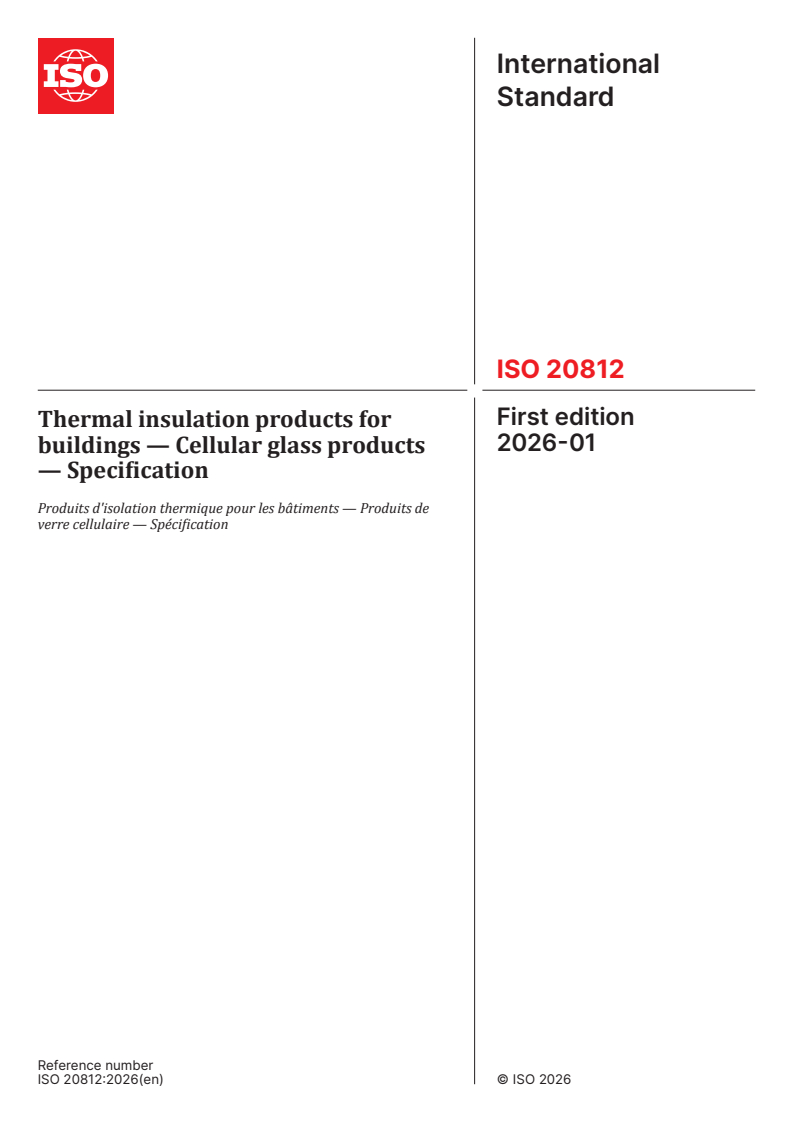
International
Standard
ISO 20812
First edition
Thermal insulation products for
2026-01
buildings — Cellular glass products
— Specification
Produits d'isolation thermique pour les bâtiments — Produits de
verre cellulaire — Spécification
Reference number
© ISO 2026
All rights reserved. Unless otherwise specified, or required in the context of its implementation, no part of this publication may
be reproduced or utilized otherwise in any form or by any means, electronic or mechanical, including photocopying, or posting on
the internet or an intranet, without prior written permission. Permission can be requested from either ISO at the address below
or ISO’s member body in the country of the requester.
ISO copyright office
CP 401 • Ch. de Blandonnet 8
CH-1214 Vernier, Geneva
Phone: +41 22 749 01 11
Email: copyright@iso.org
Website: www.iso.org
Published in Switzerland
ii
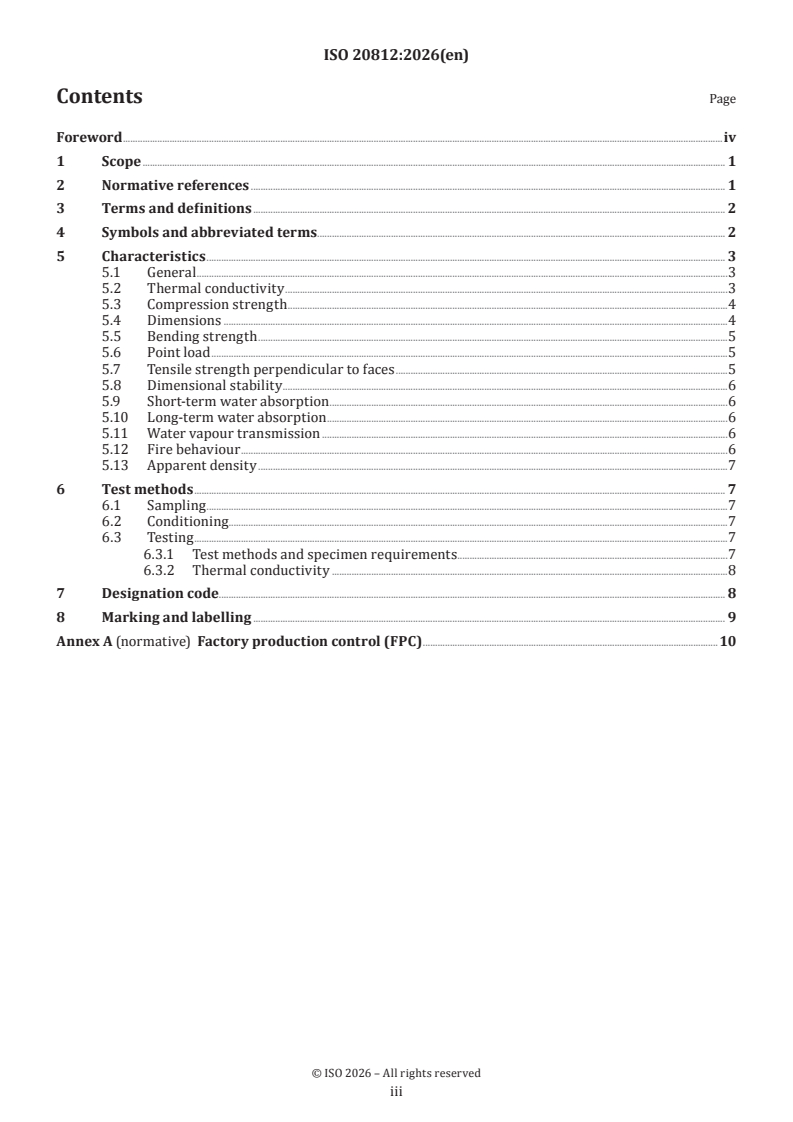
Contents Page
Foreword .iv
1 Scope . 1
2 Normative references . 1
3 Terms and definitions . 2
4 Symbols and abbreviated terms. 2
5 Characteristics . 3
5.1 General .3
5.2 Thermal conductivity .3
5.3 Compression strength .4
5.4 Dimensions .4
5.5 Bending strength .5
5.6 Point load .5
5.7 Tensile strength perpendicular to faces .5
5.8 Dimensional stability .6
5.9 Short-term water absorption . .6
5.10 Long-term water absorption .6
5.11 Water vapour transmission .6
5.12 Fire behaviour .6
5.13 Apparent density .7
6 Test methods . 7
6.1 Sampling .7
6.2 Conditioning.7
6.3 Testing .7
6.3.1 Test methods and specimen requirements .7
6.3.2 Thermal conductivity .8
7 Designation code . . 8
8 Marking and labelling . 9
Annex A (normative) Factory production control (FPC) . 10
iii
Foreword
ISO (the International Organization for Standardization) is a worldwide federation of national standards
bodies (ISO member bodies). The work of preparing International Standards is normally carried out through
ISO technical committees. Each member body interested in a subject for which a technical committee
has been established has the right to be represented on that committee. International organizations,
governmental and non-governmental, in liaison with ISO, also take part in the work. ISO collaborates closely
with the International Electrotechnical Commission (IEC) on all matters of electrotechnical standardization.
The procedures used to develop this document and those intended for its further maintenance are described
in the ISO/IEC Directives, Part 1. In particular, the different approval criteria needed for the different types
of ISO document should be noted. This document was drafted in accordance with the editorial rules of the
ISO/IEC Directives, Part 2 (see www.iso.org/directives).
ISO draws attention to the possibility that the implementation of this document may involve the use of (a)
patent(s). ISO takes no position concerning the evidence, validity or applicability of any claimed patent
rights in respect thereof. As of the date of publication of this document, ISO had not received notice of (a)
patent(s) which may be required to implement this document. However, implementers are cautioned that
this may not represent the latest information, which may be obtained from the patent database available at
www.iso.org/patents. ISO shall not be held responsible for identifying any or all such patent rights.
Any trade name used in this document is information given for the convenience of users and does not
constitute an endorsement.
For an explanation of the voluntary nature of standards, the meaning of ISO specific terms and expressions
related to conformity assessment, as well as information about ISO's adherence to the World Trade
Organization (WTO) principles in the Technical Barriers to Trade (TBT), see www.iso.org/iso/foreword.html.
This document was prepared by Technical Committee ISO/TC 163, Thermal performance and energy use in
the built environment, Subcommittee SC 3, Thermal insulation products, components and systems.
Any feedback or questions on this document should be directed to the user’s national standards body. A
complete listing of these bodies can be found at www.iso.org/members.html.
iv
International Standard ISO 20812:2026(en)
Thermal insulation products for buildings — Cellular glass
products — Specification
1 Scope
This document specifies the requirements and test methods for factory-made cellular glass products which
are used for thermal insulation of buildings. The products are manufactured in the form of slabs, faced or
unfaced boards, and one-sided blocks.
Products covered by this document are also used in prefabricated thermal insulation systems and composite
panels. The performance of systems incorporating these products is not covered.
This document describes product characteristics and test methods, designation code, marking and labelling.
This document does not apply to:
— products with a declared thermal conductivity greater than 0,056 W/(m K) at 25 °C;
— products for the insulation for the building equipment and industrial installations.
This document does not specify the required level of a given property to be achieved by a product to
demonstrate fitness for purpose in a particular application. Specific requirements agreed between
the purchaser and the supplier, e.g. type, dimensions and forms, regulatory compliance and inspection
requirements or certification requirements are outside the scope of this document.
2 Normative references
The following documents are referred to in the text in such a way that some or all of their content constitutes
requirements of this document. For dated references, only the edition cited applies. For undated references,
the latest edition of the referenced document (including any amendments) applies.
ISO 1182, Reaction to fire tests for products — Non-combustibility test
ISO 1716, Reaction to fire tests for products — Determination of the gross heat of combustion (calorific value)
ISO 8301, Thermal insulation — Determination of steady-state thermal resistance and related properties —
Heat flow meter apparatus
ISO 8302, Thermal insulation — Determination of steady-state thermal resistance and related properties —
Guarded hot plate apparatus
ISO 9229, Thermal insulation — Vocabulary
ISO 10456, Building materials and products — Hygrothermal properties — Tabulated design values and
procedures for determining declared and design thermal values
ISO 11925-2, Reaction to fire tests — Ignitability of products subjected to direct impingement of flame — Part 2:
Single-flame source test
ISO 12344, Thermal insulating products for building applications — Determination of bending behaviour
ISO 12570, Hygrothermal performance of building materials and products — Determination of moisture content
by drying at elevated temperature
ISO 12572, Hygrothermal performance of building materials and products — Determination of water vapour
transmission properties — Cup method
ISO 16535, Thermal insulating products for building applications — Determination of long-term water
absorption by immersion
ISO 29465, Thermal insulating products for building applications — Determination of length and width
ISO 29466, Thermal insulating products for building applications — Determination of thickness
ISO 29467, Thermal insulating products for building applications — Determination of squareness
ISO 29468, Thermal insulating products for building applications — Determination of flatness
ISO 29469, Thermal insulating products for building applications — Determination of compression behaviour
ISO 29470, Thermal insulating products for building applications — Determination of the apparent density
ISO 29472, Thermal insulating products for building applications — Determination of dimensional stability
under specified temperature and humidity conditions
ISO 29765, Thermal insulating products for building applications — Determination of tensile strength
perpendicular to faces
ISO 29767, Thermal insulating products for building applications — Determination of short-term water
absorption by partial immersion
ISO 29769, Thermal insulating products for building applications — Determination of behaviour under point
load
ISO 29771, Thermal insulating materials for building applications — Determination of organic cont
...