


ISO/DTS 24929-3
(Main)Child care articles — General safety — Part 3: Chemical hazards
Child care articles — General safety — Part 3: Chemical hazards
Development of deliverables on general and common safety aspects on chemical hazards for child care articles
Articles de puériculture — Sécurité générale — Partie 3: Dangers chimiques
General Information
- Status
- Not Published
- Technical Committee
- ISO/TC 310 - Child care articles
- Current Stage
- 5020 - FDIS ballot initiated: 2 months. Proof sent to secretariat
- Start Date
- 01-May-2026
- Completion Date
- 01-May-2026
Overview
ISO/DTS 24929-3: Child care articles - General safety - Part 3: Chemical hazards is an international standard developed by ISO/TC 310 that outlines essential safety principles and requirements to control chemical hazards in child care articles. This document addresses the growing need for safe, non-toxic environments for children by establishing a systematic framework for classifying, assessing, and managing chemical risks associated with products intended for child care. Applicable to a wide range of articles designed for seating, bathing, feeding, sleeping, transportation, and protection of young children, this standard enhances child safety by minimizing exposure to potentially harmful substances through clear, actionable requirements.
Key Topics
- Classification of Chemical Hazards: This standard categorizes child care articles based on chemical hazard potential, considering factors such as behavioral habits, physiological characteristics, probable exposure routes (oral, dermal, inhalation), and toxicological risk assessment.
- General Safety Principles: ISO/DTS 24929-3 establishes general safety principles by evaluating chemical exposure risk, product use patterns, and children’s development stages, ensuring all child care articles meet fundamental chemical safety requirements.
- Material and Substance Controls: Specific requirements apply to common materials (plastics, rubber, textiles, coatings, leather, and resins), focusing on controlling key hazardous substances like migratable elements, phthalates, azo colorants, formaldehyde, and polycyclic aromatic hydrocarbons (PAHs).
- Exposure and Risk Assessment: The standard details how to assess exposure risk by considering children’s developmental levels and behaviors, such as mouthing and skin contact frequency, directly informing chemical safety thresholds.
- Sampling and Testing Procedures: It prescribes test methods and sampling criteria for evaluating chemical substances in accessible materials, including multi-layer coatings and combinations of identical components.
- Test Reporting: Clear reporting requirements ensure transparent documentation of chemical safety evaluations, supporting traceability and verification.
Applications
ISO/DTS 24929-3 is a foundational document for manufacturers, suppliers, regulatory bodies, and safety organizations concerned with the chemical safety of child care products. Typical applications include:
- Product Design and Development: Assists manufacturers in selecting safe materials and implementing chemical hazard controls early in the product lifecycle.
- Regulatory Compliance: Serves as a benchmark for compliance with international chemical safety requirements for child care articles.
- Market Access: Facilitates entry into global markets by meeting harmonized safety requirements, ensuring consumer confidence in product safety.
- Quality Assurance and Testing: Guides laboratories and quality control personnel in carrying out standardized testing and chemical risk analysis.
- Standardization and Policy Development: Provides a baseline for the creation or revision of national and international standards, regulations, or certification schemes targeting chemical safety in children’s products.
Related Standards
For a comprehensive approach to the chemical safety of child care articles, ISO/DTS 24929-3 references and aligns with several important standards, including:
- ISO 8124 series (Toy safety):
- ISO 8124-1: Safety aspects related to mechanical and physical properties
- ISO 8124-3: Migration of certain elements
- ISO 8124-6: Certain phthalate esters
- ISO 12219-2 / ISO 12219-7: Determination and evaluation of volatile organic compounds and odors from materials.
- ISO 12460-1: Formaldehyde emissions from wood-based panels.
- ISO 14184-1, ISO 14362-1, ISO 14362-3: Methods for determining hazardous substances, such as formaldehyde, azo colorants, and aromatic amines in textiles.
- ISO 17226-1, ISO 17234-1, ISO 17234-2: Chemical tests for leather, focusing on formaldehyde and azo colorants.
- CEN/TS 13387-3: General safety guidelines for child care articles, focusing on mechanical hazards.
- AfPS-GS-2019-01-PAK: Guidelines and methods for assessing polycyclic aromatic hydrocarbons.
Practical Value
By following ISO/DTS 24929-3, stakeholders ensure that child care articles present minimal chemical risks, supporting higher product safety, regulatory compliance, and consumer trust. Implementing this standard demonstrates a commitment to child health and well-being, while streamlining global market access and aiding in the responsible management of hazardous chemicals in children’s environments.
For the latest guidance and product-specific requirements, always consult the most up-to-date versions of relevant referenced standards.
Buy Documents
ISO/DTS 24929-3 - Child care articles — General safety — Part 3: Chemical hazards
REDLINE ISO/DTS 24929-3 - Child care articles — General safety — Part 3: Chemical hazards
Frequently Asked Questions
ISO/DTS 24929-3 is a draft published by the International Organization for Standardization (ISO). Its full title is "Child care articles — General safety — Part 3: Chemical hazards". This standard covers: Development of deliverables on general and common safety aspects on chemical hazards for child care articles
Development of deliverables on general and common safety aspects on chemical hazards for child care articles
ISO/DTS 24929-3 is classified under the following ICS (International Classification for Standards) categories: 97.190 - Equipment for children. The ICS classification helps identify the subject area and facilitates finding related standards.
ISO/DTS 24929-3 is available in PDF format for immediate download after purchase. The document can be added to your cart and obtained through the secure checkout process. Digital delivery ensures instant access to the complete standard document.
Standards Content (Sample)
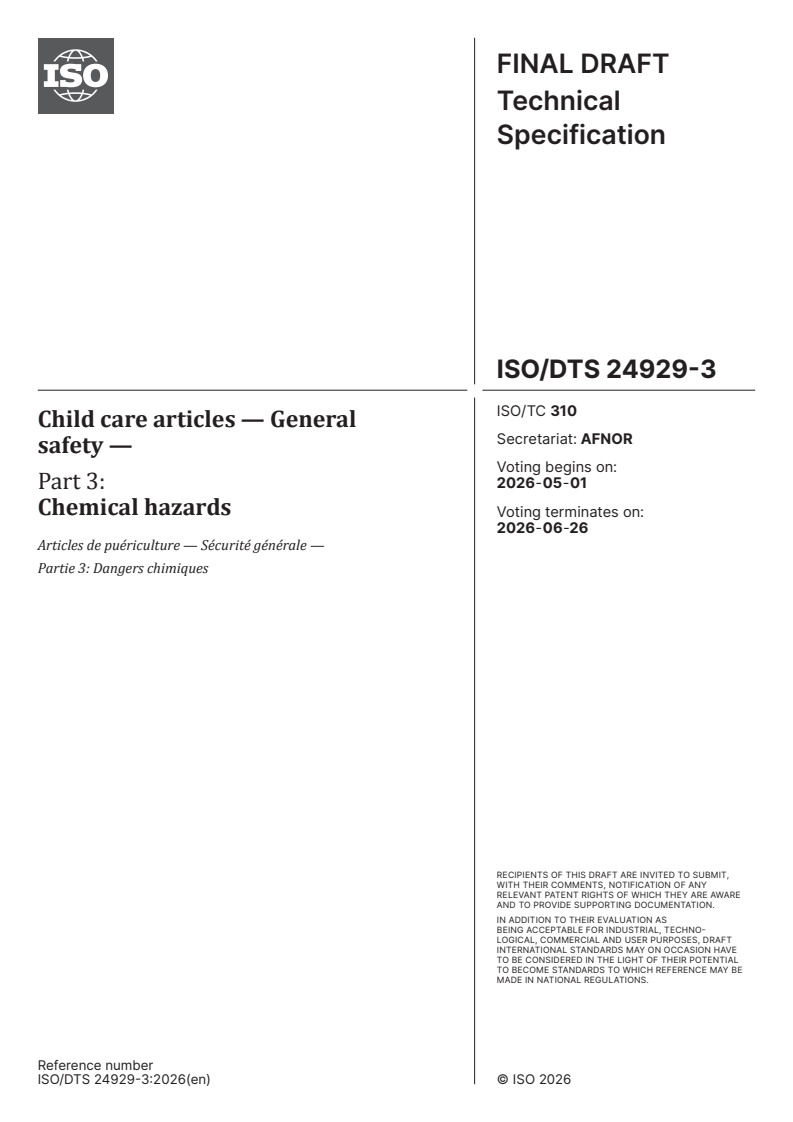
FINAL DRAFT
Technical
Specification
ISO/TC 310
Child care articles — General
Secretariat: AFNOR
safety —
Voting begins on:
2026-05-01
Part 3:
Chemical hazards
Voting terminates on:
2026-06-26
Articles de puériculture — Sécurité générale —
Partie 3: Dangers chimiques
RECIPIENTS OF THIS DRAFT ARE INVITED TO SUBMIT,
WITH THEIR COMMENTS, NOTIFICATION OF ANY
RELEVANT PATENT RIGHTS OF WHICH THEY ARE AWARE
AND TO PROVIDE SUPPOR TING DOCUMENTATION.
IN ADDITION TO THEIR EVALUATION AS
BEING ACCEPTABLE FOR INDUSTRIAL, TECHNO-
LOGICAL, COMMERCIAL AND USER PURPOSES, DRAFT
INTERNATIONAL STANDARDS MAY ON OCCASION HAVE
TO BE CONSIDERED IN THE LIGHT OF THEIR POTENTIAL
TO BECOME STAN DARDS TO WHICH REFERENCE MAY BE
MADE IN NATIONAL REGULATIONS.
Reference number
FINAL DRAFT
Technical
Specification
ISO/TC 310
Child care articles — General
Secretariat: AFNOR
safety —
Voting begins on:
Part 3:
Chemical hazards
Voting terminates on:
Articles de puériculture — Sécurité générale —
Partie 3: Dangers chimiques
RECIPIENTS OF THIS DRAFT ARE INVITED TO SUBMIT,
WITH THEIR COMMENTS, NOTIFICATION OF ANY
RELEVANT PATENT RIGHTS OF WHICH THEY ARE AWARE
AND TO PROVIDE SUPPOR TING DOCUMENTATION.
© ISO 2026
IN ADDITION TO THEIR EVALUATION AS
All rights reserved. Unless otherwise specified, or required in the context of its implementation, no part of this publication may
BEING ACCEPTABLE FOR INDUSTRIAL, TECHNO-
LOGICAL, COMMERCIAL AND USER PURPOSES, DRAFT
be reproduced or utilized otherwise in any form or by any means, electronic or mechanical, including photocopying, or posting on
INTERNATIONAL STANDARDS MAY ON OCCASION HAVE
the internet or an intranet, without prior written permission. Permission can be requested from either ISO at the address below
TO BE CONSIDERED IN THE LIGHT OF THEIR POTENTIAL
or ISO’s member body in the country of the requester.
TO BECOME STAN DARDS TO WHICH REFERENCE MAY BE
MADE IN NATIONAL REGULATIONS.
ISO copyright office
CP 401 • Ch. de Blandonnet 8
CH-1214 Vernier, Geneva
Phone: +41 22 749 01 11
Email: copyright@iso.org
Website: www.iso.org
Published in Switzerland Reference number
ii
Contents Page
Foreword .iv
1 Scope . 1
2 Normative references . 1
3 Terms and definitions . 2
3.1 Terms related to product classification on chemical hazards.2
3.2 Terms related to chemical safety risk .3
3.3 Terms related to exposure .3
4 Principles for establishing chemical safety requirements . 4
4.1 Principles .4
4.1.1 General .4
4.1.2 Classification of child care articles based on chemical hazards .4
4.1.3 Toxicological properties of chemical substances .4
4.1.4 Physiological development level and behaviours of children .4
4.1.5 Exposure routes .4
4.2 Assessment of chemical safety of child care articles . .5
5 General and basic requirements and recommendations . 5
5.1 General .5
5.2 Requirements .5
5.2.1 General .5
5.2.2 Sampling .5
5.2.3 Migration of certain elements .6
5.2.4 Phthalates .6
5.2.5 Azo colorants .7
5.2.6 Polycyclic-aromatic hydrocarbons (PAHs) .8
5.2.7 Formaldehyde .8
6 Test report . 9
Annex A (informative) Exposure and classification of child care articles related to children’s
developmental levels and behavioural habits . 10
Annex B (informative) Infrastructure of hazardous chemicals control on child care articles .23
Annex C (informative) Principles and background of restricting chemical substances .26
Bibliography .33
iii
Foreword
ISO (the International Organization for Standardization) is a worldwide federation of national standards
bodies (ISO member bodies). The work of preparing International Standards is normally carried out through
ISO technical committees. Each member body interested in a subject for which a technical committee
has been established has the right to be represented on that committee. International organizations,
governmental and non-governmental, in liaison with ISO, also take part in the work. ISO collaborates closely
with the International Electrotechnical Commission (IEC) on all matters of electrotechnical standardization.
The procedures used to develop this document and those intended for its further maintenance are described
in the ISO/IEC Directives, Part 1. In particular, the different approval criteria needed for the different types
of ISO document should be noted. This document was drafted in accordance with the editorial rules of the
ISO/IEC Directives, Part 2 (see www.iso.org/directives).
ISO draws attention to the possibility that the implementation of this document may involve the use of (a)
patent(s). ISO takes no position concerning the evidence, validity or applicability of any claimed patent
rights in respect thereof. As of the date of publication of this document, ISO had not received notice of (a)
patent(s) which may be required to implement this document. However, implementers are cautioned that
this may not represent the latest information, which may be obtained from the patent database available at
www.iso.org/patents. ISO shall not be held responsible for identifying any or all such patent rights.
Any trade name used in this document is information given for the convenience of users and does not
constitute an endorsement.
For an explanation of the voluntary nature of standards, the meaning of ISO specific terms and expressions
related to conformity assessment, as well as information about ISO’s adherence to the World Trade
Organization (WTO) principles in the Technical Barriers to Trade (TBT), see www.iso.org/iso/foreword.html.
This document was prepared by Technical Committee ISO/TC 310, Child care articles.
A list of all parts in the ISO 24929 series can be found on the ISO website.
Any feedback or questions on this document should be directed to the user’s national standards body. A
complete listing of these bodies can be found at www.iso.org/members.html.
iv
FINAL DRAFT Technical Specification ISO/DTS 24929-3:2026(en)
Child care articles — General safety —
Part 3:
Chemical hazards
1 Scope
This document establishes principles for the classification of child care articles based on chemical hazards,
behavioural habits, physiological characteristics, exposure routes and chemical risk assessment methods
related to classification. It specifies general and fundamental chemical requirements applicable to all child
care articles. It also describes the relationship between this document and specific product standards.
NOTE 1 Chemical hazards that are unique to specific product categories of child care articles are addressed in
corresponding product standards.
NOTE 2 There are many child care articles, and many materials and chemical substances are used. This document
cannot cover all child care articles and all chemical hazardous substances, which is why this document also gives
principles for dealing with unknown products and chemical substances.
2 Normative references
The following documents are referred to in the text in such a way that some or all of their content constitutes
requirements of this document. For dated references, only the edition cited applies. For undated references,
the latest edition of the referenced document (including any amendments) applies.
ISO 8124-3, Safety of toys — Part 3: Migration of certain elements
ISO 8124-6, Safety of toys — Part 6: Certain phthalate esters
ISO 12460-1, Wood-based panels — Determination of formaldehyde release — Part 1: Formaldehyde emission
by the 1-cubic-metre chamber method
ISO 14184-1, Textiles — Determination of formaldehyde — Part 1: Free and hydrolysed formaldehyde (water
extraction method)
ISO 14362-1, Textiles — Methods for determination of certain aromatic amines derived from azo colorants —
Part 1: Detection of the use of certain azo colorants accessible with and without extracting the fibres
ISO 14362-3, Textiles — Methods for determination of certain aromatic amines derived from azo colorants —
Part 3: Detection of the use of certain azo colorants, which may release 4-aminoazobenzene
ISO 17226-1, Leather — Chemical determination of formaldehyde content — Part 1: Method using high-
performance liquid chromatography
ISO 17234-1, Leather — Chemical tests for the determination of certain azo colourants in dyed leathers — Part
1: Determination of certain aromatic amines derived from azo colourants
ISO 17234-2, Leather — Chemical tests for the determination of certain azo colorants in dyed leathers — Part 2:
Determination of 4-aminoazobenzene
AfPS-GS-2019-01-PAK, Product Safety Commission (AfPS) — GS Specification — Testing and assessment of
Polycyclic Aromatic Hydrocarbons (PAHs) in the awarding of GS Marks
3 Terms and definitions
For the purposes of this document, the following terms and definitions apply.
ISO and IEC maintain terminology databases for use in standardization at the following addresses:
— ISO Online browsing platform: available at https:// www .iso .org/ obp
— IEC Electropedia: available at https:// www .electropedia .org/
3.1 Terms related to product classification on chemical hazards
3.1.1
child care article
article which is designed or obviously intended to facilitate seating, bathing, changing, feeding, mouthing,
sleeping, transportation, activity and protection for young children
3.1.1.1
bathroom supplies
products intended for children to use in toilets, bathrooms, etc., for washing, defecating, bathing, changing
diapers, etc.
EXAMPLE Infant bathers, bath tubs, changing units (for domestic use), bath seats, reducers.
3.1.1.2
early education product
product designed to assist children with developing balance, standing and walking independently
EXAMPLE Baby walking frames.
3.1.1.3
protective equipment
product that is installed on another product to prevent the other product from causing injury to children
(e.g. pinch, bruise) and product that limits the range of activities of children
EXAMPLE Small protective devices, playpens, safety barriers.
3.1.1.4
feeding utensil
product used to assist children in eating and drinking
EXAMPLE Spoon, fork, plate, bowl, food feeder, drinking cup, feeding bottle, training cup and straw.
3.1.1.5
soother
product used to meet children's non-nutritive sucking needs
3.1.1.6
sleeping product
product that has a surface for a child to lie on and that is designed or marketed for a child to sleep on or to
soothe or settle a child
EXAMPLE Bassinets, carry cots, bedside sleepers, footmuff, bed nests, sleep bags, cot bumpers, bed guards, infant
inclined sleep products.
3.1.1.7
transportation product
product intended to hold and transport a child, where the movement of the product can be powered by the
child or others
EXAMPLE Prams, tricycles with a pushchair function, baby walking frames, child seats for cycles, hip carriers,
framed baby carriers.
3.2 Terms related to chemical safety risk
3.2.1
chemical hazard
inherent property of a chemical substance that can cause adverse effects when the human body is exposed
to it
3.2.2
concentration
amount of a material or agent dissolved or contained in unit quantity in a given medium or system
3.2.3
plasticized material
substance with plasticity that is processed by adding plasticizers
Note 1 to entry: Common plasticized materials include plastics (e.g. polyvinyl chloride, polyvinylidene chloride,
polyvinyl acetate, polyurethanes), rubber, coating, paints, decals (see C.2.2).
Note 2 to entry: Polymer plasticizers, most commonly phthalate esters, give the material improved flexibility and
durability.
3.2.4
risk
probability of adverse health effects occurring in the human body under specified circumstances due to
exposure to an agent
3.2.5
toxicity
inherent property of an agent to cause an adverse biological effect
3.3 Terms related to exposure
3.3.1
accessible
contactable by any portion forward of the collar of the accessibility probe
Note 1 to entry: The accessibility probe is described in ISO 8124-1:2022, 5.7.
[SOURCE: ISO 8124-1:2022, 3.1]
3.3.2
daily exposure time
total daily contact time of a chemical substance with children under a certain exposure route
Note 1 to entry: It can be calculated by statistically calculating the single exposure time and daily exposure times.
3.3.3
dermal exposure
exposure (3.3.4) related to contact with the child’s skin
Note 1 to entry: Some chemical substances can remain on children’s skin and then penetrate children’s bodies.
3.3.4
exposure
contact between chemicals and children for a specified duration
3.3.5
exposure route
manner in which a chemical enters the child’s body after exposure (3.3.4)
Note 1 to entry: For example, through the mouth or by inhalation or skin contact.
3.3.6
inhalation exposure
exposure (3.3.4) related to inhalation into a child’s body through breathing
3.3.7
oral exposure
exposure (3.3.4) related to the ingestion of chemicals into a child’s body through oral contact
Note 1 to entry: Child care articles come into contact with children’s mouths through sucking, chewing, licking, etc.
and some chemical substances can enter children’s bodies through saliva.
Note 2 to entry: Child care articles or parts thereof can contain chemical substances, which after being swallowed, can
enter children’s bodies through gastric juice digestion.
4 Principles for establishing chemical safety requirements
4.1 Principles
4.1.1 General
In order to determine the general chemical safety technical requirements in child care articles, the principles
in this document are based on an assessment of the exposure risk of chemical substances that potentially
exist in child care articles, which screened out high-risk chemical substances and set corresponding limit
requirements based on product characteristics, as well as a comprehensive consideration of the toxicological
properties of chemical substances, children’s development level and behaviour, and possible exposure
routes.
4.1.2 Classification of child care articles based on chemical hazards
There are many types of child care articles. Based on the accessibility, function, handling, material, volume
or mass of the product, reasonable exposure due to sucking, licking, swallowing, inhalation or prolonged
contact with the skin, and children’s behavioural characteristics, child care articles can be divided into
several categories, such as bathroom supplies, early education products and protective equipment, feeding
products utensils and soother, sleeping products, transportation products and seats, etc. Details related to
child care article classification are included in Annex A.
4.1.3 Toxicological properties of chemical substances
Toxicological data are the basis for establishing chemical safety indicators. The establishment of chemical
safety requirements requires the knowledge of potential exposure risks of the chemical substances and the
necessity of including these chemical substances in the regulated chemical list of child care articles. In order
to obtain said knowledge, the toxicological properties and release characteristics of the chemical substances
should be fully investigated.
4.1.4 Physiological development level and behaviours of children
In the process of establishing chemical safety requirements, full consideration should be given to the
physiological development level of children at different ages, as well as children’s normal and foreseeable
use of child care articles. These behaviours include touching, mouthing, breathing and dermal contact
behaviours. Annex B provides reference data on children’s physiological development levels and behaviours.
4.1.5 Exposure routes
Based on the characteristics of the product and the behavioural characteristics of the child, the route of
exposure to chemicals in different child care articles can be different. Possible exposure routes of chemical
substances in children’s products include ingestion, inhalation and dermal contact, etc. Annex B gives the
possible exposure routes and related exposure parameters of chemical substances in child care articles.
4.2 Assessment of chemical safety of child care articles
Based on the principles given in 4.1, this document evaluates the chemicals in products. Generally,
hazardous chemicals that are commonly found in various child care articles, have already been restricted
in other products, and pose exposure risks to children during use are classified as Level 1. Potential
hazardous chemicals found only in specific products are classified as Level 2. The evaluation process for
generic and specific chemical safety requirements of products is shown in Annex C. The general chemical
safety requirements specified in this document establish fundamental technical criteria. Chemical safety
provisions stipulated in corresponding product standards are technical specifications developed on the
basis of the general chemical safety requirements, adapted to the characteristics of specific products, and
may refine the general requirements as appropriate. All child care articles shall conform to both the general
chemical safety requirements and the specific product safety requirements. In case of any conflict between
them, the specific product safety requirements shall prevail.
5 General and basic requirements and recommendations
5.1 General
Materials such as plastics, rubber, coatings, textiles and leather are commonly used in child care articles.
The potential high-risk chemicals in these materials can have adverse effects on children during use. Based
on the principles outlined in 4.1, this document evaluates the product characteristics of child care articles,
toxicological properties of potential chemical substances, child development levels and behaviours, and
exposure routes. Ultimately, migratable elements, phthalates, azo colorants, formaldehyde and polycyclic-
aromatic hydrocarbons (PAHs) should be controlled for child care articles. The relevant information on each
chemical can be found in Annex C.
5.2 Requirements
5.2.1 General
See Table 1 for common materials and hazardous substances in child care articles. See 5.2.3 to 5.2.7 for the
restriction requirements of hazardous chemical substances.
Table 1 — Chemicals by material
Materials Migration of certain Phthalates Azo colorants PAHs Formaldehyde
elements
(see 5.2.3) (see 5.2.4) (see 5.2.5) (see 5.2.6) (see 5.2.7)
Plastics X X
Coating X X
X (exclude silicon
Rubber X X
rubber)
Fabric X X X
Leather X X X
Resin-bonded wood X X
Other materials X
NOTE Other materials (e.g. paper and paperboard, wood, bamboo) are included, but metal, glass and ceramic are excluded.
5.2.2 Sampling
The sample for testing shall be representative of the material used in mass production. Identical materials
may be combined and treated as a single test portion. Test portions may be composed of more than one
material or colour only if physical separation, such as dot printing, patterned textiles or mass limitation
reasons, precludes the formation of discrete specimens.
The above sample requirement does not preclude the testing of materials before they are used to manufacture
(raw materials from the manufacturing process).
The manufacturing process should ensure that no additional prohibited risks are added to the materials.
Where a surface is coated with a multi-layer of paint or similar coating, the test sample shall not include
any of the base material. Paint and other similar surface-coating material means a fluid, semi-fluid or other
material, with or without a suspension of finely divided colouring matter, which changes to a solid film when
a thin layer is applied to a metal, wood, leather, cloth, plastic or another surface.
NOTE If the composite materials (e.g. coated fabric) can be mechanically separated, the coating and fabric are
tested separately.
For migration of certain elements and phthalates tests, a test portion of less than 10 mg from a single
laboratory sample shall not be tested.
If the mass of the test portion from a single sample is greater than 10 mg but less than the normal mass for
testing, the test materials should be supplemented as follows:
a) supplement the identical material from other locations of the same sample;
b) sampling from raw materials: if raw materials are used instead of finished product, this should be noted
in the test report.
5.2.3 Migration of certain elements
All accessible materials within the accessible area (see Table 1) shall not exceed the maximum acceptable
element migration in Table 2, considering the correction factor.
The test procedure given in ISO 8124-3 shall be used.
Table 2 — Maximum acceptable element migration from child care article materials
Element Sb As Ba Cd Cr Pb Hg Se
Limit (mg/kg) 60 25 1 000 75 60 90 60 500
5.2.4 Phthalates
All accessible plasticized materials within the protected volume (see Table 1) shall not contain phthalates
exceeding the limits in Table 3.
The test procedure given in ISO 8124-6 shall be used.
Table 3 — Maximum acceptable phthalates in child care articles
1) ®
Substance CAS Registry Number Limit
Bis (2-ethylhexyl) phthalate (DEHP) 117-81-7
Dibutyl phthalate (DBP) 84-74-2
Sum of the four substances less than
0,1 % by mass
Benzyl butyl phthalate (BBP) 85-68-7
Diisobutyl phthalate (DIBP) 84-69-5
Di-n-octyl phthalate (DNOP) 117-84-0
Di-isononyl phthalate (DINP) 28553-12-0
Sum of the three substances less than
68515-48-0
0,1 % by mass
Di-isodecyl phthalate (DIDP) 26761-40-0
68515-49-1
5.2.5 Azo colorants
Coloured fabrics, leather within the protected volume that can come into direct and prolonged contact with
the human skin or oral cavity shall not contain aromatic amines as given in Table 4.
Table 4 — Limits of aromatic amines in child care articles ®
Substance CAS Registry Number Limit
(mg/kg)
4-aminobiphenyl 92-67-1 30
benzidine 92-87-5 30
4-chloro-o-toluidine 95-69-2 30
2-naphthylamine 91-59-8 30
o-aminoazotoluene 97-56-3 30
5-nitro-o-toluidine 99-55-8 30
4-chloroaniline 106-47-8 30
4-methoxy-m-phenylenediamine 615-05-4 30
4,4’-diaminodiphenylmethane 101-77-9 30
3,3’-dichlorobenzidine 91-94-1 30
3,3’-dimethoxybenzidine 119-90-4 30
3,3’-dimethoxybenzidine 119-93-7 30
4,4’-methylenedi-o-toluidine 838-88-0 30
P-cresidine 120-71-8 30
4,4’-methylene-bis-(2-chloro-aniline) 101-14-4 30
4,4’-oxydianiline 101-80-4 30
4,4’-thiodianiline 139-65-1 30
o-toluidine 93-53-4 30
4-methyl-m-phenylenediamine 95-80-7 30
2,4,5-trimethylaniline 137-17-7 30
2-methoxyaniline 90-04-0 30
4-aminoazobenzene 60-09-03 30
2,4-xylidine 95-68-1 30
2,6-xylidine 87-62-7 30 ®
1) CAS Registry Number is a trademark of the American Chemical Society (ACS). This information is given for the
convenience of users of this document and does not constitute an endorsement by ISO of the product named. Equivalent
products may be used if they can be shown to lead to the same results.
The test procedure given in ISO 14362-1 and ISO 14362-3 for fabric, and ISO 17234-1 and ISO 17234-2 for
leather, shall be used.
A test portion below 0,2 g in a single laboratory sample shall be exempted from the test. All colours shall be
tested. Up to three colours may be combined as one specimen. ®
Azo colorants that can form 4-aminoazobenzene generate amines aniline (CAS Registry Number 62-53- ®
3) and 1,4-phenylenediamine (CAS Registry Number 106-50-3) under the conditions of ISO 14362-1 and
ISO 17234-1. Due to detection limits, it can occur that only aniline is detected. If aniline of above 5 mg/kg is
detected, then the presence of these colorants shall be tested as per ISO 14362-3 for fabric or ISO 17234-2 for
leather, which can release 4-aminoazobenzene.
“White” and uncoloured fibres, threads or fabrics are not considered to contain azo colorants and, therefore,
these parts should not be tested. However, attention should be paid to “pale printed” materials as they can
contain azo colorants.
5.2.6 Polycyclic-aromatic hydrocarbons (PAHs)
All accessible natural and synthetic rubber (exclude silicon rubber) components within the protected
volume that come into direct as well as prolonged or short-term repetitive contact shall not contain more
than 0,5 mg/kg of any of the listed PAHs in Table 5.
The test procedure given in AfPS-GS-2019-01-PAK shall be used.
Table 5 — Limits of PAHs in child care articles ®
Substance CAS Registry Number Limit
Benzo[a]pyrene (BaP) 50-32-8 0,5 mg/kg
Benzo[e]pyrene (BeP) 192-97-2 0,5 mg/kg
Benzo[a]anthracene (BaA) 56-55-3 0,5 mg/kg
Chrysen (CHR) 218-01-9 0,5 mg/kg
Benzo[b]fluoranthene (BbFA) 205-99-2 0,5 mg/kg
Benzo[j]fluoranthene (BjFA) 205-82-3 0,5 mg/kg
Benzo[k]fluoranthene (BkFA) 207-08-9 0,5 mg/kg
Dibenzo[a,h]anthracene (DBAhA) 53-70-3 0,5 mg/kg
5.2.7 Formaldehyde
All accessible fabric and leather materials within the protected volume shall not release formaldehyde in
excess of 20 mg/kg (see Table 6).
All resin-bonded wood shall not release formaldehyde in excess of 0,124 mg/m (see Table 6).
Table 6 — Maximum acceptable formaldehyde in child care articles ®
Material Substance CAS Registry Number Limit
Fabric and leather 20 mg/kg
Formaldehyde 50-00-0
Resin-bonded wood 0,124 mg/m
For formaldehyde released from fabric and leather, the test procedure given in ISO 14184-1 for fabric and
ISO 17226-1 for leather shall be used.
Different types of fabrics shall be tested separately but the colour difference can be ignored. A test portion
below 1,0 g in a single laboratory sample shall be exempted from the test.
For formaldehyde released from fibreboard, the test procedure given in ISO 12460-1 shall be used.
6 Test report
The test report shall contain at least the following information:
a) a reference to this document, i.e. ISO/TS 24929-3;
b) type and identity of the product and/or material tested;
c) hazardous chemical substances tested in the product;
d) a complete identification of the sample;
e) a reference to the test procedure used;
f) the test results of the hazardous chemical substances in the product;
g) any deviations from the procedure specified;
h) any unusual features observed during the test;
i) the date of the test.
Annex A
(informative)
Exposure and classification of child care articles related to children’s
developmental levels and behavioural habits
A.1 General
As parenting ideas and methods change, various child care articles are introduced and widely used in the
growth process of children. Children’s self-protection ability is weak, and the chemical hazards present in
child care articles can seriously threaten children’s health and even lives. Since different child care articles
have different functions, usage methods, duration of use, constituent materials, exposure methods, etc.,
different child care articles have different risks based on chemical hazards.
To ensure that child care products are appropriate and safe for children at different stages of physical
and intellectual development, it is essential to first understand the growth and development levels and
behavioural habits of children in specific age groups, and then identify potential risks associated with the
products. Children’s developmental stages and behavioural patterns serve as the foundation for conducting
exposure assessments of specific child care products. Only through a thorough exposure assessment of the
materials and components of these products can more comprehensive, reasonable, and applicable chemical
safety requirements be established.
The information provided in this annex (including children’s growth and development milestones,
behavioural habits, chemical exposure pathways and assessment methodologies, and multi-factor product
classification frameworks) aims to provide necessary references and guidelines for the development of
specific product standards.
A.2 Exposure to chemical hazards of child care articles
A.2.1 Relationship between children’s developmental level, behaviour and chemical
hazards
A.2.1.1 Children’s mouthing behaviour
Mouthing behaviour is an important part of a child’s growth and development. Various studies have shown
that children’s mouthing behaviour is mainly concentrated under the age of three. Children in this age group
will gain a sense of security and happiness by sucking their fingers and various objects. They will explore
the world through mouthing behaviours such as sucking, biting and chewing, and mouthing behaviours can
alleviate pain and discomfort associated with teething. The frequency and daily contact time of children
under the age of three to six decreased slightly with age (see Tables A.1 and A.2). Children aged six and
above basically do not show obvious oral behaviours.
Table A.1 — Videotaped mouthing activity (object to mouth) as median hourly frequency and
median percent of tape time (mean + SD)
Age Frequency Time (%)
Infant 18,1 (24,4+11,6) 3,1 (4,0+2,4)
1 year old 8,4 (9,8+6,3) 1,3 (1,6+1,2)
2 years old 5,5 (7,8+5,8) 0,9 (1,3+1,1)
Preschool 8,4 (10,1+12,4) 1,9 (3,0+3,9)
NOTE See Reference [49].
Table A.2 — Estimated mean daily mouthing time for soother and other objects
Age group Soother Other objects Fingers
1 to 3 months 0:47:13 0:05:14 0:18:22
3 to 6 months 0:27:45 0:12:29 0:49:03
6 to 9 months 0:14:36 0:24:30 0:16:54
9 to 12 months 0:41:39 0:16:25 0:14:07
12 to 15 months 1:00:15 0:12:02 0:08:24
15 to 18 months 0:25:22 0:23:01 0:10:07
18 to 21 months 1:09:02 0:19:49 0:18:40
21 to 24 months 0:25:12 0:12:53 0:35:34
2 years 0:32:55 0:21:46 0:29:43
3 years 0:48:42 0:15:16 0:34:42
4 years 0:16:40 0:10:44 0:19:26
5 years 0:00:20 0:10:00 0:44:06
NOTE Reference [52].
The saliva secretion during children’s mouthing behaviour will have an impact on the limits of chemical
substances in child care articles and the formulation of detection methods (e.g. choose water, saliva test
solution or other solutions as test solution). PD CEN/TR 16918:2015 grades the amount of saliva according
to the observed saliva secretion when children’s mouths are in contact with toys (see Table A.3), as follows:
— No salivation observed.
— Salivation observed:
— Low: Slight amount of saliva observed on the toy, but not on the child’s lips.
— Medium: Saliva present and observed directly on the child’s lips.
— High: Saliva present on the lips and dribbling.
Table A.3 — Degree of salivation
Age group No salivation Low Medium High
(months) (%) (%) (%) (%)
< 3 61 18 12 9
≥ 3, < 6 18 31 38 13
≥ 6, < 10 45 29 19 7
≥ 10, < 13 42 29 23 6
≥ 13, < 19 71 18 8 3
≥ 19, < 25 78 17 3 2
≥ 25, < 31 73 22 6 0
≥ 31, < 37 82 12 5 1
Total sample 60 22 13 4
According to children’s mouthing behaviour, the potential chemical hazards exposure through oral contact
can be set as follows:
— Approximately 0 to 36 months: high risk.
— Approximately 36 to 72 months: moderate risk.
— 72 months and older: low risk.
A.2.1.2 Area of product accessible to children
“Accessibility” is a necessary condition for non-volatile chemical substances to cause harm to the human
body. What kind of child care articles children use in their daily lives and how they use or come into contact
with them is closely related to the child’s developmental level and their basic abilities gradually mastered
during the growth process. When determining the accessible area (or protected volume) of different types of
child care articles and formulating corresponding chemical limit requirements, the following factors should
be considered:
— Motor skills mastered by children, including gross motor skills such as sitting, walking and running, and
fine motor skills such as grasping, pinching and writing. These skills relate to the types of care products
a child can use and how they are used.
— Anthropometric measurement data of children of a specific age, including height, upper limb length,
head circumference, finger circumference, etc. These anthropometric data will determine which parts
of a child care article can be touched by the child, i.e. the accessible area of the child care article. The
anthropometric data can reference CEN/TR 13387-3:2025, Table 1, and Table A.4.
Table A.4 — Other anthropometric data for reference
Dimensions (mm)
Parameter
Age group 0 to 3 3 to 6 6 to 9 9 to 12 12 to 18 18 to 24 24 to 36 36 to 48
(months)
Mean 588 639 705 744 796 850 933 1 013
sd 35 36 30 32 40 40 46 45
Body length or
statue
P5 520 584 647 687 740 799 865 946
P95 631 701 750 794 862 930 1 016 1 098
Mean 391 423 457 476 494 515 549 574
sd 28 24 23 22 21 24 25 24
Sitting height
P5 347 375 423 433 456 469 513 536
P95 430 458 500 507 527 549 589 619
Mean 395 435 448 461 478 485 500 510
sd 14 16 13 14 15 15 16 15
Head circumfer-
ence
P5 370 403 428 440 454 460 474 484
P95 420 457 466 485 503 510 524 535
Mean 36 38 40 41 44 46 46 47
sd 3 3 3 3 3 3 3 3
Hand diameter
P5 32 35 35 38 38 42 42 42
P95 42 42 45 45 48 52 52 52
Mean 68 74 80 89 93 95 102 109
sd 6 6 5 6 6 6 7 7
Hand length
P5 54 61 70 76 80 86 92 98
P95 76 83 86 97 100 105 114 121
Mean 9 9 10 11 11 11 13 13
sd 1 1 1 1 1 1 1 1
Thumb breadth
P5 7 7 9 10 10 10 11 11
P95 10 10 11 12 12 13 14 15
NOTE See ISO/TS 24929-1:—, Annex A. (Under preparation. Stage at the time of publication: ISO/CD TS 24929-1:2024.)
TTabablele A A.44 ((ccoonnttiinnueuedd))
Dimensions (mm)
Parameter
Age group 0 to 3 3 to 6 6 to 9 9 to 12 12 to 18 18 to 24 24 to 36 36 to 48
(months)
Mean 7 7 8 8 8 8 9 9
sd 1 1 1 1 1 1 1 1
Little finger
breadth
P5 6 6 6 6 6 7 8 8
P95 8 8 9 9 9 10 10 11
NOTE See ISO/TS 24929-1:—, Annex A. (Under preparation. Stage at the time of publication: ISO/CD TS 24929-1:2024.)
For example, when a child can sit up independently, hands or other body parts can be used to touch the
parts of the pushchairs other than the parts that are in contact with the body. When the child’s height and
arm length further develop, they can even come into contact with the bottom of the sit unit or bracket of the
product; in this case, the applicable age range of the product and the anthropological data corresponding to
the upper limit of the age should be considered, so as to delineate the maximum accessible area (or protected
volume) of the product that meets the corresponding chemical limit.
A.2.1.3 Developmental level of children’s respiratory system
The impact of volatile chemicals on children’s health is related to the developmental level of children’s
respiratory system. Excluding other factors, children breathe in more volatile chemicals when their
[54]
respiratory systems are more developed. Child-Specific Exposure Factors Handbook (EPA) . gives the
data of inhalation rates (see Table A.5) and the inhalation rate increases with the age of children.
Table A.5 — Inhalation rate of children
3 th 3
Age group Mean (m /day) 95 percentile (m /day)
0 to < 1 month 3,6 7,1
1 to < 3 months — —
3 to < 6 months 4,1 6,1
6 to < 12 months 5,4 8,1
1 to < 2 years 8,0 12,8
2 to < 3 years 9,5 15,9
3 to < 6 years 10,9 16,2
6 to < 11 years 12,4 18,7
11 to < 16 years 15,1 23,5
A.2.1.4 Children’s foreseeable and reasonable use of child care articles
When formulating the chemical hazard limit requirements for child care articles, first the reasonable and
foreseeable use of products should be considered, as well as the exposure routes and possible contact with
product components and materials in such use cases, so as to limit the chemical requirements to the extent
that is reasonable and necessary, avoid setting too low a limit requirement that does not cover all parts of
the product or only considers the most severe exposure route.
Children’s mouth-to-finger contact behaviour is a typical foreseeable use behaviour, and children’s mouthing
behaviour should be the main consideration when formulating chemical substance limits for child care
articles for children under six years old.
NOTE 1 Under normal or foreseeable use, for products that can be reached by children but obviously cannot be
sucked, licked or swallowed by children due to the accessibility, function, mass, size or other characteristics of the
product, the oral exposure can be exempt when formulating chemical substance limit requirements.
NOTE 2 Children usually do not impose behaviours on child care articles including, but not limited to, that it is
almost impossible for children to touch the wheel parts of transportation products used outdoors with their mouths,
and children’s strength is not enough to lift the bathtub in use to touch its bottom surface or bracket bottom, etc.
A.2.2 Main exposure routes of chemicals in child care articles
A.2.2.1 General
The main exposure routes of harmful chemicals in child care articles are oral exposure (see A.2.2.2), skin
exposure (see A.2.2.3) and inhalation exposure (see A.2.2.4).
A.2.2.2 Oral exposure
Oral exposure is the most important route of exposure to harmful chemicals in child care articles, and has
the most significant impact on children’s health. The following factors should be considered when evaluating
the chemical hazards of child care articles exposed through the oral cavity:
— Whether the product or product part is intended for mouth contact (e.g. products such as soother, food
feeder, etc. are intended for mouth contact).
— Whether the product or product parts can be placed in the mouth.
NOTE It is considered that a child care article or accessible part of a product can be placed in the mouth by
children if it is smaller than 5 cm in one dimension or has a detachable or protruding part of that size.
— The mouthing behaviour of children of different ages, especially children under 6 years old.
— Whether the product contains or will produce debris or powder that can easily adhere to children’s
hands, which can lead to hand-to-mouth exposure. Child care articles or parts can produce small parts,
debris and powder swallowed by children through chewing, biting, and other mouthing behaviours, i.e.
there is the possibility of ingestion exposures. In this case the influence of saliva and/or gastric fluid on
the amount of chemical transport should be considered.
A.2.2.3 Dermal exposure
Some child care articles or parts thereof can come into direct skin contact with children during use. Since
children have a higher body surface to body mass ratio, they are considered more sensitive to hazardous
chemicals exposed via dermal contact. The following factors should be considered when evaluating the
chemical hazards of
...
ISO/TSDTS 24929-3:2025(E)
ISO/TC 310/WG 1
Secretariat: AFNOR
Date: 2025-06-072026-04-16
Child care articles — General safety —
Part 3:
Chemical hazards
Articles de puériculture — Sécurité générale —
Partie 3: Dangers chimiques
All rights reserved. Unless otherwise specified, or required in the context of its implementation, no part of this publication
may be reproduced or utilized otherwise in any form or by any means, electronic or mechanical, including photocopying,
or posting on the internet or an intranet, without prior written permission. Permission can be requested from either ISO
at the address below or ISO’s member body in the country of the requester.
ISO copyright office
CP 401 • Ch. de Blandonnet 8
CH-1214 Vernier, Geneva
Phone: + 41 22 749 01 11
E-mail: copyright@iso.org
Website: www.iso.org
Published in Switzerland
ii
Contents
Foreword . iv
1 Scope . 1
2 Normative references . 1
3 Terms and definitions . 2
3.1 Terms related to product classification on chemical hazards . 2
3.2 Terms related to chemical safety risk . 3
3.3 Terms related to exposure . 4
4 Principles for establishing chemical safety requirements . 4
4.1 Principles . 4
4.2 Assessment of chemical safety of child care articles. 5
5 General and basic requirements and recommendations . 6
5.1 General. 6
5.2 Requirements . 6
6 Test report . 10
Annex A (informative) Exposure and classification of child care articles related to children’s
developmental levels and behavioural habits . 12
Annex B (informative) Infrastructure of hazardous chemicals control on child care articles . 26
Annex C (informative) Principles and background of restricting chemical substances . 31
Bibliography . 40
iii
Foreword
ISO (the International Organization for Standardization) is a worldwide federation of national standards
bodies (ISO member bodies). The work of preparing International Standards is normally carried out through
ISO technical committees. Each member body interested in a subject for which a technical committee has been
established has the right to be represented on that committee. International organizations, governmental and
non-governmental, in liaison with ISO, also take part in the work. ISO collaborates closely with the
International Electrotechnical Commission (IEC) on all matters of electrotechnical standardization.
The procedures used to develop this document and those intended for its further maintenance are described
in the ISO/IEC Directives, Part 1. In particular, the different approval criteria needed for the different types of
ISO documentsdocument should be noted. This document was drafted in accordance with the editorial rules
of the ISO/IEC Directives, Part 2 (see www.iso.org/directives).
Attention is drawnISO draws attention to the possibility that some of the elementsimplementation of this
document may beinvolve the subjectuse of (a) patent(s). ISO takes no position concerning the evidence,
validity or applicability of any claimed patent rights in respect thereof. As of the date of publication of this
document, ISO had not received notice of (a) patent(s) which may be required to implement this document.
However, implementers are cautioned that this may not represent the latest information, which may be
obtained from the patent database available at www.iso.org/patents. ISO shall not be held responsible for
identifying any or all such patent rights. Details of any patent rights identified during the development of the
document will be in the Introduction and/or on the ISO list of patent declarations received (see ).
Any trade name used in this document is information given for the convenience of users and does not
constitute an endorsement.
For an explanation of the voluntary nature of standards, the meaning of ISO specific terms and expressions
related to conformity assessment, as well as information about ISO’s adherence to the World Trade
Organization (WTO) principles in the Technical Barriers to Trade (TBT), see www.iso.org/iso/foreword.html.
This document was prepared by Technical Committee ISO/TC 310, Child care articles.
A list of all parts in the ISO 24929 series can be found on the ISO website.
Any feedback or questions on this document should be directed to the user’s national standards body. A
complete listing of these bodies can be found at www.iso.org/members.html.
iv
Child care articles — General safety —
Part 3:
Chemical hazards
1 Scope
This document providesestablishes principles for the classification of child care articles based on chemical
hazards, behavioralbehavioural habits, physiological characteristics, exposure routes, and chemical risk
assessment methods related to classification.
Note 1: Specific It specifies general and fundamental chemical requirements applicable to all child care articles.
It also describes the relationship between this document and specific product standards.
NOTE 1 Chemical hazards involving only one or several typesthat are unique to specific product categories of child
care articles with common characteristics (only related to specific child care articles will be), their are addressed in
corresponding requirements will be specified in specific product standards.
Note NOTE 2 : There are many child care articles, and many materials and chemical substances are used. This
document cannot cover all child care articles and all chemical hazardous substances, which is why this document also
gives principles for dealing with unknown products and chemical substances.
2 Normative references
The following documents are referred to in the text in such a way that some or all of their content constitutes
the requirements of this document. For dated references, only the edition cited applies. For undated
references, the latest edition of the referenced document (including any amendments) applies.
ISO 8124-1, Safety of toys — Part 1: Safety aspects related to mechanical and physical properties
ISO 8124-3, Safety of toys — Part 3: Migration of certain elements
ISO 8124-6, Safety of toys — Part 6: Certain phthalate esters
ISO 12219-2, Interior air of road vehicles — Part 2:Screening method for the determination of the emissions of volatile
organic compounds from vehicle interior parts and materials -Bag method
ISO 12219-7, Interior air of road vehicles -Part 7:Odour determination in interior airof road vehicles and test chamber
air of trim components by olfactory measurements
ISO ISO 12460-1, Wood-based panels — Determination of formaldehyde release — Part 1: Formaldehyde
emission by the 1-cubic-metre chamber method
ISO 14184-1, Textiles — Determination of formaldehyde — Part 1: Free and hydrolysed formaldehyde (water
extraction method)
ISO 14362-1, Textiles — Methods for determination of certain aromatic amines derived from azo colorants —
Part 1: Detection of the use of certain azo colorants accessible with and without extracting the fibres
ISO 14362-3, Textiles — Methods for determination of certain aromatic amines derived from azo colorants —
Part 3: Detection of the use of certain azo colorants, which may release 4-aminoazobenzene
ISO ISO 17226-1, Leather — Chemical determination of formaldehyde content — Part 1: Method using high-
performance liquid chromatography
ISO 17234-1, Leather — Chemical tests for the determination of certain azo colourants in dyed leathers — Part
1: Determination of certain aromatic amines derived from azo colourants
ISO 17234-2, Leather — Chemical tests for the determination of certain azo colorants in dyed leathers — Part 2:
Determination of 4-aminoazobenzene
CEN/TS 13387-3:2025, Child care articles – General safety guidelines – Part 3: Mechanical hazards
AfPS-GS-2019-01-PAK, Product Safety Commission (AfPS) — GS Specification — Testing and assessment of
Polycyclic Aromatic Hydrocarbons (PAHs) in the awarding of GS Marks
3 Terms and definitions
For the purposes of this document, the following terms and definitions apply.
ISO and IEC maintain terminology databases for use in standardization at the following addresses:
— — IEC Electropedia: available at
— — ISO Online browsing platform: available at https://www.iso.org/obp
— IEC Electropedia: available at https://www.electropedia.org/Definitions relating
3.1 Terms related to productsproduct classification on chemical hazards
3.1.1
child care articlesarticle
articlesarticle which areis designed or obviously intended to facilitate seating, bathing, changing, feeding,
mouthing, sleeping, transportation, activity and protection for young children
3.1.1.1
bathroom supplies
products intended for children to use in toilets, bathrooms, etc., for washing, defecating, bathing, changing
diapers, etc.
EXAMPLE Infant bathers, bath tubs, changing units (for domestic use), bath seats, reducers, etc.
3.1.1.2
early education productsproduct
productsproduct designed to assist children with developing balance, standing, and walkwalking
independently
EXAMPLE Baby walking frames.
3.1.1.3
protective equipment
productsproduct that areis installed on other productsanother product to prevent the other productsproduct
from causing injury to children (e.g,. pinch, bruise) and productsproduct that limitlimits the range of activities
of children
EXAMPLE Small protective devices, playpens, safety barriers, etc.
3.1.1.4
feeding utensils and utensilsoother
products and utensilsproduct used to assist children in eating and drinking
EXAMPLE Spoon, fork, plate, bowl, food feeder, drinking cup, feeding bottle, training cup and straw.
3.1.1.5
soother, and products
product used to meet children's non-nutritive sucking needs
3.1.1.53.1.1.6
sleeping productsproduct
products that commonly associated with sleeping
product that has a surface for a child to lie on and that is designed or marketed for a child to sleep on or to
soothe or settle a child
EXAMPLE Bassinets, carry cots, bedside sleepers, footmuff, bed nests, sleep bags, cot bumpers, bed guards, infant
inclined sleep products, etc.
3.1.1.63.1.1.7
transportation productsproduct
Productsproduct intended to hold and transport a child, where the movement of the product maycan be
powered by the child or others
EXAMPLE Prams, tricycles with a pushchair function, baby walking frames, child seats for cycles, hip carriers,
framed baby carriers, etc.
3.2 Definitions relatingTerms related to chemical safety risk
3.2.1
chemical hazard
inherent property of a chemical substance that can cause adverse effects when the human body is exposed to
it
3.2.2
concentration
amount of a material or agent dissolved or contained in unit quantity in a given medium or system
3.2.3
plasticized material
substance with plasticity that is processed by adding plasticizers
Note 1 to entry: Common plasticized materials include plastics (e.g. polyvinyl chloride, polyvinylidene chloride, polyvinyl
acetate, polyurethanes), rubber, coating, paints, decals (see C.2.2, etc. (See D.2.2).).
Note 2 to entry: Polymer plasticizers, most commonly phthalate esters, give the material improved flexibility and
durability.
3.2.4
risk
probability of adverse health effects occurring in the human body under specified circumstances due to
exposure to an agent
3.2.5
toxicity
inherent property of an agent to cause an adverse biological effect
3.3 Terms related to exposure
3.3.1
accessible
contactable by any portion forward of the collar of the accessibility probe
Note 1 to entry: The accessibility probe is described in ISO 8124-1:2022, 5.7.
[SOURCE: ISO 8124-1:2022, 3.1]
3.3.2
daily exposure time
total daily contact time of a chemical substance with children under a certain exposure route
Note 1 to entry: It can be calculated by statistically calculating the single exposure time and daily exposure times.
3.3.3
dermal exposure
exposure (3.3.4) related to contact with the child’s skin
Note 1 to entry: Some chemical substances can remain on children’s skin and then penetrate children’s bodies.
3.3.4
exposure
contact between chemicals and children for a specified duration
3.3.5
exposure route
manner in which a chemical enters the child’s body after exposure (3.3.4)
Note 1 to entry: For example, through the mouth or by inhalation or skin contact.
3.3.6
inhalation exposure
exposure (3.3.4) related to inhalation into a child’s body through breathing
3.3.7
oral exposure
exposure (3.3.4) related to the ingestion of chemicals into a child’s body through oral contact
Note 1 to entry: Child care articles come into contact with children’s mouths through sucking, chewing, licking, etc. and
some chemical substances can enter children’s bodies through saliva.
Note 2 to entry: Child care articles or parts thereof can contain chemical substances, which after being swallowed, can
enter children’s bodies through gastric juice digestion.
4 Principles for establishing of chemical safety requirements
A.1.1.1 General
4.1 Principles
4.1.1 General
In order to determine the general chemical safety technical requirements in child care articles, the principles
in this document assessedare based on an assessment of the exposure risk of chemical substances that
potentially exist in child care articles, which screened out high-risk chemical substances and set
corresponding limit requirements based on product characteristics, as well as a comprehensive consideration
of the toxicological properties of chemical substances, children'schildren’s development level and
behaviorbehaviour, and possible exposure routes.
4.1.14.1.2 Classification of child care articles based on chemical hazards
There are many types of child care articles. Based on the accessibility, function, handling, material, volume or
mass of the product, reasonable exposure due to sucking, licking, swallowing, inhalation or prolonged contact
with the skin, and children’s behavioralbehavioural characteristics, child care articles can be divided into
several categories, such as bathroom supplies, early education products and protective equipment, feeding
products utensils and soother, sleeping products, and transportation products and seats, etc. Details related
to child care article classification are included in Annex A.
4.1.24.1.3 Toxicological properties of chemical substances
Toxicological data isare the basis for establishing chemical safety indicators. The establishment of chemical
safety requirements requires the knowledge of potential exposure risks of the chemical substances and the
necessity of including these chemical substances in the regulated chemical list of child care articles. In order
to obtain said knowledge, the toxicological properties and release characteristics of the chemical substances
should be fully investigated.
4.1.34.1.4 Physiological development level and behaviorsbehaviours of children
In the process of establishing chemical safety requirements, full consideration should be given to the
physiological development level of children at different ages, as well as children'schildren’s normal and
foreseeable use of child care articles. These behaviorsbehaviours include touching, mouthing, breathing, and
dermal contact behaviors. Annex Bbehaviours. Annex B provides reference data on children'schildren’s
physiological development levels and behaviorsbehaviours.
4.1.44.1.5 Exposure routes
Based on the characteristics of the product and the behavioralbehavioural characteristics of the child, the
route of exposure to chemicals in different child care articles maycan be different. Possible exposure routes of
chemical substances in children'schildren’s products include ingestion, inhalation and dermal contact, etc.
Annex B gives the possible exposure routes and related exposure parameters of chemical substances in child
care articles.
4.2 Assessment of chemical safety of child care articles
Based on the above principles given in 4.1, this document evaluates the chemicals in products. Generally,
hazardous chemicals that are commonly found in various child care articles, have already been restricted in
other products, and pose exposure risks to children during use, are classified as Level 1. Potential hazardous
chemicals found only in specific products are classified as Level 2. The evaluation process for generic and
specific chemical safety requirements of products is shown in Annex C All child care articles should meet the .
The general chemical safety requirements set outspecified in this document. Specific child care articles should
meet the chemical safety requirements set out establish fundamental technical criteria. Chemical safety
provisions stipulated in corresponding product standards are technical specifications developed on the basis
of the general chemical safety requirements, adapted to the characteristics of specific products, and may refine
the general requirements as wellappropriate. All child care articles shall conform to both the general chemical
safety requirements and the specific product safety requirements. In case of any conflict between them, the
specific product safety requirements shall prevail.
5 General and Basicbasic requirements and recommendations
5.1 General
Materials such as plastics, rubber, coatings, textiles, and leather are commonly used in child care articles. The
potential high-risk chemicals in these materials maycan have adverse effects on children during use. Based on
the principles outlined in 4.1Chapter 4,, this document evaluates the product characteristics of child care
articles, toxicological properties of potential chemical substances, child development levels and
behaviorsbehaviours, and exposure routes. Ultimately, it considers migratable elements, phthalates, azo
colorants, formaldehyde and polycyclic-aromatic hydrocarbons (PAHs) should be controlled for child care
articles. The relevant information on each chemical can be found in Annex CAnnex D.
5.2 Requirements
5.2.1 General
See Table 1 for common materials and hazardous substances in child care article, and see 5.2.3articles. See
5.2.3 to 5.2.75.2.8 for the restriction requirements of hazardous chemical substances.
Table 1— Chemicals by material
Migration of Phthalate Azo Formaldehyd
Materials
s colorants e
Polycyclic-
Certain certain
aromatic
(See 5.2.4) (See 5.2.5) (See 5.2.7)
elements
hydrocarbons
(PAHs)
(See 5.2.3)
(See
5.2.6)PAHs
(see 5.2.3) (see 5.2.4) (see 5.2.5) (see 5.2.6) (see 5.2.7)
Plastics X X
Coating X X
X (exclude
Rubber X X
silicon rubber)
Fabric X X X
Leather X X X
Resin-bonded wood X X
Other materials X
NOTE 1: Other materials (e.g.,. paper and paperboard, wood, bamboo) are included, but metal, glass and ceramic are excluded.
5.2.2 Sampling
The sample for testing shall be representative of the material used in mass production. Identical materials
may be combined and treated as a single test portion. Test portions may be composed of more than one
material or colour only if physical separation, such as dot printing, patterned textiles or mass limitation
reasons, precludes the formation of discrete specimens.
The above sample requirement does not preclude the testing of materials before they are used to manufacture
(raw materials from the manufacturing process).
NOTE 1 The manufacturing process should ensure that no additional prohibited risks are added to the
materials.
Where a surface is coated with a multi-layer of paint or similar coating, the test sample shall not include any
of the base material. Paint and other similar surface-coating material means a fluid, semi-fluid or other
material, with or without a suspension of finely divided colouring matter, which changes to a solid film when
a thin layer is applied to a metal, wood, leather, cloth, plastic or another surface.
NOTE 2 If the composite materials (e.g.,. coated fabric) can be mechanically separated, the coating and fabric are
tested separately.
For migration of certain elements and phthalates tests, a test portion of less than 10 mg from a single
laboratory sample shall not be tested.
If the mass of the test portion from a single sample is greater than 10 mg but less than the normal mass for
testing, the test materials should be supplemented as follows:
a) supplement the identical material from other locations of the same sample;
b) sampling from raw materials: if raw materials are used instead of finished product, this should be noted
in the test report.
5.2.3 Migration of certain elements
All accessible materials within the accessible area (see Table 1) shall not exceed the maximum acceptable
element migration in Table 2, considering the correction factor.
The test procedure given in ISO 8124-3 shall be used.
Table 2— Maximum acceptable element migration from child care article materials
Element Sb As Ba Cd Cr Pb Hg Se
10001 0
Limit (mg/kg) 60 25 75 60 90 60 500
5.2.4 The test procedure given in ISO 8124-3 shall be used.Phthalates
All accessible plasticized materials within the protected volume (see Table 1) shall not contain phthalates
exceeding the limits in Table 3.
The test procedure given in ISO 8124-6 shall be used.
Table 3— Maximum acceptable phthalates in child care articlearticles
Substance CAS No.Registry Limit
®1)
Number
Bis (2-ethylhexyl) phthalate (DEHP) 117-81-7
Sum of the four substances less than
Dibutyl phthalate (DBP) 84-74-2
0,1 % by mass
Benzyl butyl phthalate (BBP) 85-68-7
1) ®
CAS Registry Number is a trademark of the American Chemical Society (ACS). This information is given for the
convenience of users of this document and does not constitute an endorsement by ISO of the product named. Equivalent
products may be used if they can be shown to lead to the same results.
Substance CAS No.Registry Limit
®1)
Number
Diisobutyl phthalate (DIBP) 84-69-5
Di-n-octyl phthalate (DNOP) 117-84-0
Di-isononyl phthalate (DINP) 28553-12-0
Sum of the three substances less than
68515-48-0
0,1 % by mass
Di-isodecyl phthalate (DIDP) 26761-40-0
68515-49-1
5.2.5 Azo colorants
Coloured fabrics, leather within the protected volume that can come into direct and prolonged contact with
the human skin or oral cavity shall not contain aromatic amines as given in Table 4.
Table 4— Limits of aromatic amines in child care articles
Substance CAS No.Registry Limit ®
Number (mg/kg)
4-aminobiphenyl 92-67-1 30
benzidine 92-87-5 30
4-chloro-o-toluidine 95-69-2 30
2-naphthylamine 91-59-8 30
o-aminoazotoluene 97-56-3 30
5-nitro-o-toluidine 99-55-8 30
4-chloroaniline 106-47-8 30
4-methoxy-m-phenylenediamine 615-05-4 30
4,4’-diaminodiphenylmethane 101-77-9 30
3,3’-dichlorobenzidine 91-94-1 30
3,3’-dimethoxybenzidine 119-90-4 30
3,3’-dimethoxybenzidine 119-93-7 30
4,4’-methylenedi-o-toluidine 838-88-0 30
P-cresidine 120-71-8 30
4,4’-methylene-bis-(2-chloro-aniline) 101-14-4 30
4,4’-oxydianiline 101-80-4 30
4,4’-thiodianiline 139-65-1 30
o-toluidine 93-53-4 30
4-methyl-m-phenylenediamine 95-80-7 30
2,4,5-trimethylaniline 137-17-7 30
2-methoxyaniline 90-04-0 30
4-aminoazobenzene 60-09-03 30
2,4-xylidine 95-68-1 30
Substance CAS No.Registry Limit ®
Number (mg/kg)
2,6-xylidine 87-62-7 30
The test procedure given in ISO 14362-1 and ISO 14362-3 for fabric, and ISO 17234-1 and ISO 17234-2 for
leather, shall be used.
A test portion below 0,2 g in a single laboratory sample shall be exempted from the test. All colours shall be
tested. Up to three colours may be combined as one specimen. ®
62-
Azo colorants that can form 4-aminoazobenzene generate amines aniline (CAS numberRegistry Number ®
53-3) and 1,4-phenylenediamine (CAS numberRegistry Number 106-50-3) under the conditions of ISO
14362-1 and ISO 17234-1. Due to detection limits, it can occur that only aniline is detected. If aniline of above
5 mg/kg is detected, then the presence of these colorants shall be tested as per ISO 14362-3 for fabric or ISO
17234-2 for leather, which can release 4-aminoazobenzene.
“White” and uncoloured fibres, threads or fabrics are not considered to contain azo colorants and, therefore,
these parts should not be tested. ButHowever, attention should be paid to “pale printed” materials as they can
contain azo colorants.
5.2.6 Polycyclic-aromatic hydrocarbons (PAHs)
All accessible natural and synthetic rubber (exclude silicon rubber) components within the protected volume
that come into direct as well as prolonged or short-term repetitive contact shall not contain more than
0,5 mg/kg of any of the listed PAHs in Table 5.
The test procedure given in AfPS-GS-2019-01-PAK shall be used.
Table 5 — Limits of PAHs in child care articles
CAS No.Registry
Substance Limit ®
Number
Benzo[a]pyrene (BaP) CAS No 50-32-8 0,5 mg/kg
Benzo[e]pyrene (BeP) CAS No 192-97-2 0,5 mg/kg
Benzo[a]anthracene (BaA) CAS No 56-55-3 0,5 mg/kg
Chrysen (CHR) CAS No 218-01-9 0,5 mg/kg
Benzo[b]fluoranthene (BbFA) CAS No 205-99-2 0,5 mg/kg
Benzo[j]fluoranthene (BjFA) CAS No 205-82-3 0,5 mg/kg
Benzo[k]fluoranthene (BkFA) CAS No 207-08-9 0,5 mg/kg
Dibenzo[a,h]anthracene (DBAhA) CAS No 53-70-3 0,5 mg/kg
5.2.7 Formaldehyde
All accessible fabric and leather materials within the protected volume shall not release formaldehyde in
excess of 20 mg/kg (see Table 6See Table 6).).
All resin-bonded wood shall not release formaldehyde in excess of 0,124 mg/m (see Table 6See Table 6).).
Table 6— Maximum acceptable formaldehyde in child care articles
CAS No.Registry
Limit
Material Substance ®
Number
Fabric and leather 20 mg/kg
Formaldehyde 50-00-0
Resin-bonded wood 0,124 mg/m
For formaldehyde released from fabric and leather, the test procedure given in ISO 14184-1 for fabric and ISO
17226-1 for leather shall be used.
Different types of fabrics shall be tested separately but the colour difference can be ignored. A test portion
below 1,0 g in a single laboratory sample shall be exempted from the test.
For formaldehyde released from fibreboard, the test procedure is definedgiven in ISO 12460-1 shall be used.
6 Test report
4.1 Requirements
The test report shall contain at least the following information:
a) a reference to this document (, i.e. ISO XXXX);/TS 24929-3;
b) type and identity of the product and/or material tested;
c) hazardous chemical substances tested in the product;
d) a complete identification of the sample;
e) a reference to the test procedure used;
f) the test results of the hazardous chemical substances in the product;
g) any deviations from the procedure specified;
h) any unusual features observed during the test;
i) the date of the test.
Annex BAnnex AAnnex A
(informative)
Exposure and Classificationclassification of child care articles related to
children’s developmental levels and behavioralbehavioural habits
B.1A.1 A.1 General
As parenting ideas and methods change, various child care articles are introduced and widely used in the
growth process of children. Children'sChildren’s self-protection ability is weak, and the chemical hazards
present in child care articles can seriously threaten children'schildren’s health and even lives. Since different
child care articles have different functions, usage methods, duration of use, constituent materials, exposure
methods, etc., different child care articles have different risks based on chemical hazards.
To ensure that childcarechild care products are appropriate and safe for children at different stages of physical
and intellectual development, it is essential to first understand the growth and development levels and
behavioralbehavioural habits of children in specific age groups, and then identify potential risks associated
with the products. Children’s developmental stages and behavioralbehavioural patterns serve as the
foundation for conducting exposure assessments of specific childcarechild care products. Only through a
thorough exposure assessment of the materials and components of these products can more comprehensive,
reasonable, and applicable chemical safety requirements be established.
The information provided in this appendix—annex (including children’s growth and development milestones,
behavioralbehavioural habits, chemical exposure pathways and assessment methodologies, and multi-factor
product classification frameworks—) aims to provide necessary references and guidelines for the
development of specific product standards.
A.2 Terms and definitions related to exposure
6.1.11.1.1
accessible
contactable by any portion forward of the collar of the accessibility probe
Note 1: The accessibility probe is described in ISO 8124-1, 5.7.
Note 2: This definition is intended to be consistent with that in ISO 8124-1.
6.1.21.1.1
daily exposure time
The total daily contact time of a chemical substance with children under a certain exposure route. It can be calculated by
statistically calculating the single exposure time and daily exposure times.
6.1.31.1.1
dermal exposure
Child care articles may come into contact with children's skin during use, and some chemical substances may
remain on children's skin and then penetrate into children's bodies.
6.1.41.1.1
exposure
The contact between chemicals and children for a specified duration.
6.1.51.1.1
exposure route
How the chemical enters the child's body after exposure (for example, through mouth, inhalation, skin
contact).
6.1.61.1.1
inhalation exposure
The gas containing a certain concentration of chemical substances released by the child care article is inhaled
into the body through the breathing of the child.
6.1.71.1.1
oral exposure
Child care articles come into contact with children's mouths through sucking, chewing, licking, etc., and some
chemical substances may enter children's bodies through saliva; chemical substances in child care articles or
parts thereof, after being swallowed, may enter children's bodies through gastric juice digestion.
B.2A.2 A.3 Exposure to chemical hazards of child care articles
B.2.1A.2.1 A.3.1 Relationship between children'schildren’s developmental level,
behavior,behaviour and chemical hazards
B.2.1.1A.2.1.1 A.3.1.1 Children'sChildren’s mouthing behaviorbehaviour
Mouthing behaviorbehaviour is an important part of a child'schild’s growth and development. Various studies
have shown that children'schildren’s mouthing behaviorbehaviour is mainly concentrated under the age of
3three. Children in this age group will gain a sense of security and happiness by sucking their fingers and
various objects. They will explore the world through mouthing behaviorsbehaviours such as sucking, biting,
and chewing, and mouthing behaviorsbehaviours can alleviate pain and discomfort associated with teething.
The frequency and daily contact time of children under the age of 3-6three to six decreased slightly with age
(see Tables A.1Table A.1 and A.2Table A.2).). Children aged 6six and above basically do not show obvious oral
behaviorsbehaviours.
Table A.1 –— Videotaped mouthing activity (object to mouth) as median hourly frequency and
median percent of tape time (mean + SD)
Age Frequency Time (%)
Infant 18.,1 (24.,4+11.,6) 3,1 (4.,0+2.,4)
1 -year -old 8.,4 (9.,8+6.,3) 1.,3 (1.,6+1.,2)
2-year- years old 5.,5 (7.,8+5.,8) 0.,9 (1.,3+1.,1)
Preschool 8.,4 (10.,1+12.,4) 1.,9 (3.,0+3.,9)
NOTE See Reference[49]NOTE: Black K, Shalat S.L., Freeman N.C., Jimenez M., Donnelly K.C. & Calvin J. A. Children's mouthing
behavior and food-handling behavior in an agricultural community on the US / Mexico border. 3.J.Expo.Sci. Environ. Epidemiol.
2004,15 pp.244-251.
Table A.2 -— Estimated mean daily mouthing time for soother and other objects
Age Groupgroup Soother Other objects Fingers
1- to 3 months 0:47:13 0:05:14 0:18:22
3- to 6 months 0:27:45 0:12:29 0:49:03
6- to 9 months 0:14:36 0:24:30 0:16:54
9- to 12 months 0:41:39 0:16:25 0:14:07
Age Groupgroup Soother Other objects Fingers
12- to 15 months 1:00:15 0:12:02 0:08:24
15- to 18 months 0:25:22 0:23:01 0:10:07
18- to 21 months 1:09:02 0:19:49 0:18:40
21- to 24 months 0:25:12 0:12:53 0:35:34
2 years 0:32:55 0:21:46 0:29:43
3 years 0:48:42 0:15:16 0:34:42
4 years 0:16:40 0:10:44 0:19:26
5 years 0:00:20 0:10:00 0:44:06
NOTE Reference[52]NOTE: Norris B. & Smith S. Research into the mouthing behaviour of children up to 5 years old. Institute for
Occupational Ergonomics. School of Mechanical, Materials, Manufacturing Engineering and Management, University of Nottingham.
2002. Research commissioned by the Consumer and Competition Policy Directorate, DTI.
The saliva secretion during children'schildren’s mouthing behaviorbehaviour will have an impact on the limits
of chemical substances in child care articles and the formulation of detection methods (for example:e.g. choose
water, saliva test solution or other solutions as test solution). PD CEN/TR 16918:2015 grades the amount of
saliva according to the observed saliva secretion when children'schildren’s mouths are in contact with toys
(see Table A.3):), as follows:
— No salivation observed.
— Salivation observed:
— Low: Slight amount of saliva observed on the toy, but not on the child’s lips.
— Medium: Saliva present and observed directly on the child’s lips.
— High: Saliva present on the lips and dribbling.
Table A.3— Degree of salivation
Age groups
No salivation Low Medium High
group
(%) (%) (%) (%)
(months)
< 3 61 % 18 % 12 % 9 %
≥ 3, < < 6 18 % 31 % 38 % 13 %
≥ 6, < < 10 45 % 29 % 19 % 7 %
≥ 10, < < 13 42 % 29 % 23 % 6 %
≥ 13, < < 19 71 % 18 % 8 % 3 %
≥ 19, < < 25 78 % 17 % 3 % 2 %
≥ 25, < < 31 73 % 22 % 6 % 0 %
≥ 31, < < 37 82 % 12 % 5 % 1 %
Total Samplesample 60 % 22 % 13 % 4 %
To sum up, accordingAccording to children'schildren’s mouthing behaviorbehaviour, the potential chemical
hazards exposure through oral contact can be set as belowfollows:
— Approximately 0~ to 36 months: high risk.
— Approximately 36~ to 72 months: moderate risk.
— 72 months and older: low risk.
B.2.1.2A.2.1.2 A.3.1.2 Area of product accessible to children
“Accessibility” is a necessary condition for non-volatile chemical substances to cause harm to the human body.
What kind of child care articles children use in their daily lives and how they use or come into contact with
them areis closely related to the child’s developmental level and thetheir basic abilities gradually mastered
during the growth process. When determining the accessible area (or protected volume) of different types of
child care articles and formulating corresponding chemical limit requirements, the following factors should
be considered:
— Motor skills mastered by children, including gross motor skills such as sitting, walking, and running, and
fine motor skills such as grasping, pinching, and writing. These skills relate to the types of care products a
child maycan use and how they are used;.
— Anthropometric measurement data of children of a specific age, including height, upper limb length, head
circumference, finger circumference, etc. These anthropometric data will determine which parts of a child
care article can be touched by the child, that is,i.e. the accessible area of the child care article. The
anthropometric data can reference to Table 1 of CEN/TR 13387-3:2025, Table 1, and Table A.4Table A.4
below.
Table A.4 –— Other anthropometric data for reference
Dimensions (mm)
Age 0 to 3 3 to 6 6 to 9 9 to 12 12 to 18 to 24 to 36 to
Parameter
group 18 24 36 48
(months)
588 639 705 744 796 850 933 10131 0
Mean
sd 35 36 30 32 40 40 46 45
Body length or
statue
P5 520 584 647 687 740 799 865 946
631 701 750 794 862 930 10161 0 10981 0
P95
16 98
Mean 391 423 457 476 494 515 549 574
sd 28 24 23 22 21 24 25 24
Sitting height
P5 347 375 423 433 456 469 513 536
P95 430 458 500 507 527 549 589 619
Mean 395 435 448 461 478 485 500 510
sd 14 16 13 14 15 15 16 15
Head
circumference
P5 370 403 428 440 454 460 474 484
P95 420 457 466 485 503 510 524 535
Mean 36 38 40 41 44 46 46 47
Hand diameter sd 3 3 3 3 3 3 3 3
P5 32 35 35 38 38 42 42 42
Dimensions (mm)
Age 0 to 3 3 to 6 6 to 9 9 to 12 12 to 18 to 24 to 36 to
Parameter
group 18 24 36 48
(months)
P95 42 42 45 45 48 52 52 52
Mean 68 74 80 89 93 95 102 109
sd 6 6 5 6 6 6 7 7
Hand length
P5 54 61 70 76 80 86 92 98
P95 76 83 86 97 100 105 114 121
Mean 9 9 10 11 11 11 13 13
sd 1 1 1 1 1 1 1 1
Thumb
breadth
P5 7 7 9 10 10 10 11 11
P95 10 10 11 12 12 13 14 15
Mean 7 7 8 8 8 8 9 9
sd 1 1 1 1 1 1 1 1
Little finger
breadth
P5 6 6 6 6 6 7 8 8
P95 8 8 9 9 9 10 10 11
Note:NOTE See ISO/TS 24929-1,:—, Annex A. (Under preparation. Stage at the time of publication: ISO/CD TS 24929-1:2024.)
Note: For example, when a child can sit up independently, hands or other body parts can be used to touch the
parts of the pushchairs other than the parts that are in contact with the body. When the child'schild’s height
and arm length further develop, it maythey can even come into contact with the bottom of the sit unit or bracket
of the product,; in this case, the applicable age range of the product and the anthropological data
corresponding to the upper limit of the age should be considered, so as to delineate the maximum accessible
area (or protected volume) of the product mutthat meets the corresponding chemical limit.
B.2.1.3A.2.1.3 A.3.1.3 Developmental level of children'schildren’s respiratory system
The impact of volatile chemicals on children'schildren’s health is related to the developmental level of
children'schildren’s respiratory system. Excluding other factors, children breathe in more volatile chemicals
[54]
when their respiratory systems are more developed. Child-Specific Exposure Factors Handbook (EPA) ).
gives the data of inhalation raterates (see Table A.5Table A.5),) and the inhalation rate increases with the age
of children.
Table A.5 –— Inhalation Raterate of children
3 th th 3
Age Groupgroup Mean (m /day) 95 95 percentile (m /day)
0 to < < 1 month 3.,6 7.,1
1 to < < 3 months /— /—
3 to < < 6 months 4.,1 6.,1
6 to < < 12 months 5.,4 8.,1
1 to < < 2 years 8.,0 12.,8
2 to < < 3 years 9.,5 15.,9
3 to < < 6 years 10.,9 16.,2
3 th th 3
Age Groupgroup Mean (m /day) 95 95 percentile (m /day)
6 to < < 11 years 12.,4 18.,7
11 to < < 16 years 15.,1 23.,5
B.2.1.4A.2.1.4 A.3.1.4 Children'sChildren’s foreseeable and reasonable use of child care articles
When formulating the chemical hazard limit requirements for child care articles, one should first consider the
reasonable and foreseeable use of products should be considered, as well as the exposure routes and possible
contact with product components and materials in such use cases, so as to limit the chemical requirements to
the extent that is reasonable and necessary, avoid setting too low a limit requirement that does not cover all
parts of the product or only considers the most severe exposure route.
Note 1: Children’s mouth-to-finger contact behaviorbehaviour is a typical foreseeable use behaviorbehaviour,
and children’s mouthing behaviorbehaviour should be the main consideration when formulating chemical
substance limits for child care articles for children under 6six years old.
Note 2: NOTE 1 Under normal or foreseeable use, for products that can be reached by children but obviously cannot be
sucked, licked or swallowed by children due to the accessibility, function, weightmass, size or other characteristics of the
product, the oral exposure can be exempt when formulating chemical substance limit requirements.
Note 3: NOTE 2 Children usually do not impose behaviorsbehaviours on child care articles including, but not limited to:,
that it is almost impossible for children to touch the wheel parts of transportation products used outdoors with their
mouths, and children'schildren’s strength is not enough to lift the bathtub in use to touch its bottom surface or bracket
bottom, etc.
B.2.2A.2.2 A.3.2 Main exposure routes of chemicals in child care articles
A.2.2.1 General
The main exposure routes of harmful chemicals in child care articles are: oral exposure (see A.2.2.2,), skin
exposure (see A.2.2.3,) and inhalation exposure (see A.2.2.4.).
B.2.2.1A.2.2.2 A.3.2.1 Oral exposure
Oral exposure is the most important route of exposure to harmful chemicals in child care articles, and has the
most significant impact on children'schildren’s health. The following factors
...
Questions, Comments and Discussion
Ask us and Technical Secretary will try to provide an answer. You can facilitate discussion about the standard in here.
Loading comments...