


ISO/IEC 30145-3:2020
(Main)Information technology — Smart City ICT reference framework — Part 3: Smart city engineering framework
Information technology — Smart City ICT reference framework — Part 3: Smart city engineering framework
This document describes a framework, structured in layers of ICT technologies, essential for smart cities' operation. This framework also provides the mapping of the ICT techniques to various system entities in order to support the smart city's business, knowledge management, and operational systems from the engineering perspective.
Technologies de l'information — Cadre de référence des TIC dans les villes intelligentes — Partie 3: Titre manque
General Information
Standards Content (Sample)
INTERNATIONAL ISO/IEC
STANDARD 30145-3
First edition
2020-08
Information technology — Smart City
ICT reference framework —
Part 3:
Smart city engineering framework
Reference number
©
ISO/IEC 2020
© ISO/IEC 2020
All rights reserved. Unless otherwise specified, or required in the context of its implementation, no part of this publication may
be reproduced or utilized otherwise in any form or by any means, electronic or mechanical, including photocopying, or posting
on the internet or an intranet, without prior written permission. Permission can be requested from either ISO at the address
below or ISO’s member body in the country of the requester.
ISO copyright office
CP 401 • Ch. de Blandonnet 8
CH-1214 Vernier, Geneva
Phone: +41 22 749 01 11
Email: copyright@iso.org
Website: www.iso.org
Published in Switzerland
ii © ISO/IEC 2020 – All rights reserved
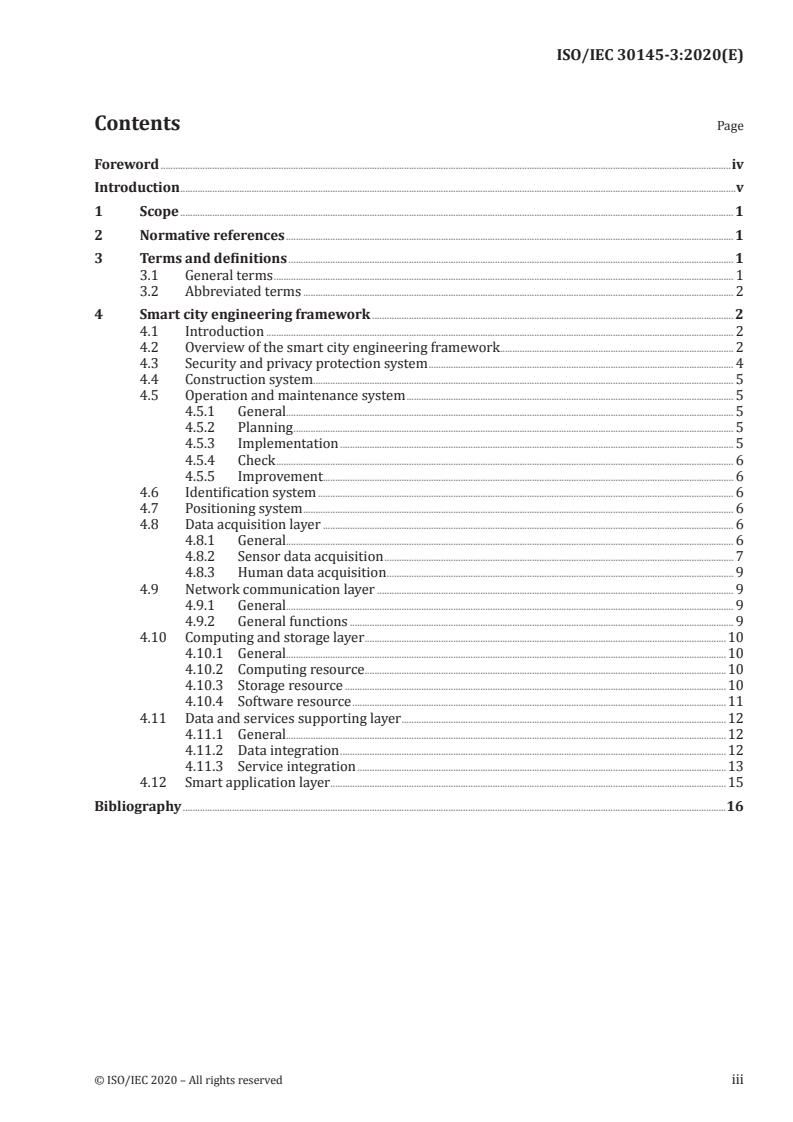
Contents Page
Foreword .iv
Introduction .v
1 Scope . 1
2 Normative references . 1
3 Terms and definitions . 1
3.1 General terms . 1
3.2 Abbreviated terms . 2
4 Smart city engineering framework . 2
4.1 Introduction . 2
4.2 Overview of the smart city engineering framework. 2
4.3 Security and privacy protection system . 4
4.4 Construction system . 5
4.5 Operation and maintenance system . 5
4.5.1 General. 5
4.5.2 Planning . 5
4.5.3 Implementation . 5
4.5.4 Check . 6
4.5.5 Improvement. 6
4.6 Identification system . 6
4.7 Positioning system . 6
4.8 Data acquisition layer . 6
4.8.1 General. 6
4.8.2 Sensor data acquisition . 7
4.8.3 Human data acquisition . 9
4.9 Network communication layer . 9
4.9.1 General. 9
4.9.2 General functions . 9
4.10 Computing and storage layer .10
4.10.1 General.10
4.10.2 Computing resource . .10
4.10.3 Storage resource .10
4.10.4 Software resource .11
4.11 Data and services supporting layer .12
4.11.1 General.12
4.11.2 Data integration .12
4.11.3 Service integration .13
4.12 Smart application layer .15
Bibliography .16
© ISO/IEC 2020 – All rights reserved iii
Foreword
ISO (the International Organization for Standardization) and IEC (the International Electrotechnical
Commission) form the specialized system for worldwide standardization. National bodies that
are members of ISO or IEC participate in the development of International Standards through
technical committees established by the respective organization to deal with particular fields of
technical activity. ISO and IEC technical committees collaborate in fields of mutual interest. Other
international organizations, governmental and non-governmental, in liaison with ISO and IEC, also
take part in the work.
The procedures used to develop this document and those intended for its further maintenance are
described in the ISO/IEC Directives, Part 1. In particular, the different approval criteria needed for
the different types of document should be noted. This document was drafted in accordance with the
editorial rules of the ISO/IEC Directives, Part 2 (see www .iso .org/ directives).
Attention is drawn to the possibility that some of the elements of this document may be the subject
of patent rights. ISO and IEC shall not be held responsible for identifying any or all such patent
rights. Details of any patent rights identified during the development of the document will be in the
Introduction and/or on the ISO list of patent declarations received (see www .iso .org/ patents) or the IEC
list of patent declarations received (see http:// patents .iec .ch).
Any trade name used in this document is information given for the convenience of users and does not
constitute an endorsement.
For an explanation of the voluntary nature of standards, the meaning of ISO specific terms and
expressions related to conformity assessment, as well as information about ISO's adherence to the
World Trade Organization (WTO) principles in the Technical Barriers to Trade (TBT), see www .iso .org/
iso/ foreword .html.
This document was prepared by Joint Technical Committee ISO/IEC JTC 1, Information technology.
A list of all parts in the ISO/IEC 30145 series can be found on the ISO website.
Any feedback or questions on this document should be directed to the user’s national standards body. A
complete listing of these bodies can be found at www .iso .org/ members .html.
iv © ISO/IEC 2020 – All rights reserved
Introduction
0.1 General
The purpose of this document is to assist city chief information officers (CIO) and other stakeholders in
planning and implementing a smart city. It comprises the following three parts:
— Part 1: Smart city business process framework
— Part 2: Smart city knowledge management framework
— Part 3 (this document): Smart city engineering framework
Each of the three parts is aimed at a different role or viewpoint within the city and thus separate focus
needs to be maintained. The "separation of concerns" is a principle for the development of a city as it
uses ICT to deliver the vision and objectives for the city. The value of using the separation of concerns
is to simplify development and maintenance of the architecture as the city both develops and delivers
improved outcomes for the city stakeholders.
Figure 1 shows the components of the smart city ICT reference framework, which consist of
5 components: stakeholders, vision and outcomes, the business process framework, the knowledge
management framework, and the engineering framework. While stakeholders, vision and outcomes,
and the engineering framework are described in this document, the business process framework and
1) 2)
knowledge management framework are described in ISO/IEC 30145-1:— and ISO/IEC 30145-2:— ,
respectively.
1) Under preparation. Stage at the time of publication: ISO/IEC DIS 30145-1:2020.
2) Under preparation. Stage at the time of publication: ISO/IEC DIS 30145-2:2020.
© ISO/IEC 2020 – All rights reserved v
Figure 1 — Smart city ICT reference framework
0.2 Stakeholders
The stakeholders served by the smart city ICT reference framework are businesses, citizens, government
organizations and non-government organizations. This stakeholder list is not exhaustive but defines
the key stakeholders in a smart city and the user for the smart city ICT reference framework.
0.3 Vision and outcomes
The motivation of making a city smart is a result of a shared vision and a set of agreed outcomes from
all of the city stakeholders. The vision and outcomes of the smart city ICT reference framework are
well-being, transparency, sustainability, economic development, efficiency and resilience, collaboration
and innovation. This vision and outcomes list is not exhaustive but defines the key vision and outcomes
of a smart city. The smart city ICT reference framework articulates a vision that the smart city will be
transparent in the delivery of city services which meet city sustainability ambitions. This vision uses
collaboration and innovation approaches to deliver desired city outcomes. City outcomes are expected
to improve efficiency and resilience of city services and promote economic development activities
which enhance the well-being of citizens.
vi © ISO/IEC 2020 – All rights reserved
INTERNATIONAL STANDARD ISO/IEC 30145-3:2020(E)
Information technology — Smart City ICT reference
framework —
Part 3:
Smart city engineering framework
1 Scope
This document describes a framework, structured in layers of ICT technologies, essential for smart
cities' operation. This framework also provides the mapping of the ICT techniques to various system
entities in order to support the smart city’s business, knowledge management, and operational systems
from the engineering perspective.
2 Normative references
There are no normative references in this document.
3 Terms and definitions
For the purposes of this document, the following terms and definitions apply.
ISO and IEC maintain terminological databases for use in standardization at the following addresses:
— ISO Online browsing platform: available at https:// www .iso .org/ obp
— IEC Electropedia: available at http:// www .electropedia .org/
3.1 General terms
3.1.1
data
symbols and signals that represent properties of objects, persons, events and their environment
Note 1 to entry: In the English language the term “data” is generally used as a plural noun. For use in the singular,
the term “data item” is sometimes used.
3.1.2
information
structured data (3.1.1) that are endowed with meaning and purpose
Note 1 to entry: Information is data that have been shaped into a form that is meaningful and useful to
human beings.
3.1.3
positioning system
system of instrumental and computational components for determining position
EXAMPLE Inertial, integrated, linear, optical and satellite positioning systems.
[SOURCE: ISO 19116:2019, 3.24]
© ISO/IEC 2020 – All rights reserved 1
3.1.4
positional accuracy
closeness of coordinate value to the true or accepted value in a specified reference system
Note 1 to entry: The phrase “absolute accuracy” is sometimes used for this concept to distinguish it from relative
positional accuracy. Where the true coordinate value may not be perfectly known, accuracy is normally tested by
comparison to available values that can best be accepted as true.
[SOURCE: ISO 19116:2019, 3.22]
3.1.5
heterogeneous computing
system that uses more than one kind of processor or cores
3.1.6
heterogeneous computing resources
combination of hardware and software that can support heterogeneous computing (3.1.5)
3.1.7
data integration
process of combining data (3.1.1) residing in different sources and providing users with a unified
view of them
3.2 Abbreviated terms
WGS84 world geodetic system
GPS global positioning system
GLONASS global navigation satellite system
PZ-90 parametry zemli 1990 goda
4 Smart city engineering framework
4.1 Introduction
This document gives descriptions of a Smart city from an engineering perspective. It consists of two
parts, the horizontal engineering layers and the vertical systems. For each of the business processes
defined and categorized in ISO/IEC 30145-1, a city uses the knowledge defined by the knowledge
management framework in ISO/IEC 30145-2. Additionally, the knowledge defined by the knowledge
management framework in ISO/IEC 30145-2 is used to understand how the engineering framework is
implemented. The function of the horizontal layers is to provide a clear mapping of different techniques
and components needed for smart city business processes. The function of the vertical systems is to
guarantee the consistency of the technical implementation of a smart city.
4.2 Overview of the smart city engineering framework
Figure 2 shows the smart city engineering framework from the ICT perspective. The framework consists
of 5 horizontal layers and 5 vertical cross layer systems with 4 types of smart city stake holders. The
five layers are data acquisition layer, network communication layer, computing and storage layer, data
and services supporting layer and smart application layer; whereas the five systems are security and
privacy protection system, construction system, operation and maintenance system, identification
system and positioning system. In addition, the four types of city users are citizens, enterprises,
governmental entities and non-governmental entities. The five layers and five systems are introduced
in detail in 4.3 to 4.12 respectively.
2 © ISO/IEC 2020 – All rights reserved
The data acquisition layer provides the capability to sense the world and take actions. The network
communication layer consists of Internet, the telephone network, the cable television network and
their convergence. The computing and storage layer includes resources for computing, data storage
and foundation software. The data and services supporting layer fuses the data capture capability,
communication capability, data storage capability and computing capability into data management
and service management capability. The smart application layer offers smart applications and their
integrations across industries and domains with support from the layers underneath. The security
and privacy protection system addresses the security requirements of a smart city. The operation
and maintenance system addresses the ability of a smart city to operate and maintain its IT services.
The construction system addresses the ability of a smart city to transit its IT services into sustainable
operations for design, planning, construction, maintenance and other aspects of smart city needs. The
identification system provides all layers of the engineering framework with identification services.
The positioning system is one of the basic systems in a smart city providing inertial, integrated, linear,
optical and satellite positioning services.
Figure 2 — Smart city engineering framework
From the six-domain IoT Reference Model (RM) and Reference Architecture (RA) in ISO/IEC 30141, the
entities in the smart city engineering framework, which is a layer-based framework, shown in Figure 2,
can be mapped as shown in Table 1.
Table 1 — Mapping of the layers and entities in the smart city engineering framework to the six
domains of ISO/IEC 30141 IoT RA
ISO/IEC 30141 IoT RA Smart City Engineering Framework
Domain Layer Sub-layer Entities
— Not specified in the
Engineering Framework;
but in takeholders. They
are:
— business entities;
stakeholders
(not identified within the
User Domain (UD) NA
— citizens;
Engineering
Framework)
— government
organizations; and
— non-government
organizations
© ISO/IEC 2020 – All rights reserved 3
Table 1 (continued)
ISO/IEC 30141 IoT RA Smart City Engineering Framework
Domain Layer Sub-layer Entities
— service management
service integration — service integration
Operation & Management data & services
Domain (OMD) supporting layer
— service usage
— data management &
data integration
governance
— smart government
— smart transportation
— smart education
smart application layer N/A
— smart healthcare
— smart home
— smart campus
Application & Service
— service acquisition &
service integration
Domain (ASD)
aggregation
— data integration &
data & services
processing
supporting layer
data integration
— intelligent mining &
analysis
— computing resource
computing & storage
N/A — storage resource
layer
— software resource
— fundamental data
— shared exchangeable data
data & services
data resources
supporting layer
— application domain data
Resource Access &
— Internet data
Interchange Domain (RAID)
— computing resource
computing & storage
N/A — storage resource
layer
— software resource
Sensing & Controlling data & services — data acquisition &
data integration
Domain (SCD) supporting layer integration
— physical entities in each
application domain,
smart application layer
e.g., transportation,
Physical Entity Domain
healthcare, etc.
(PED)
— physical entities being
data & services data acquisition &
monitored for data
supporting layer aggregation
acquisition
4.3 Security and privacy protection system
The security and privacy protection system addresses security requirements such as confidentiality,
integrity and availability. It provides authentication, authorization, non-repudiation, user and role
identity management, integrity, audit, security monitoring, incident response and security policy
4 © ISO/IEC 2020 – All rights reserved
management. This system is applicable to the design, planning, construction, maintenance and other
aspects of the ICT systems of a smart city. This includes protecting the confidentiality and rights of
[9]
individual citizens .
4.4 Construction system
The construction system provides the capabilities of design, planning, construction maintenance and
other aspects of a smart city.
4.5 Operation and maintenance system
4.5.1 General
The operation and maintenance system provides an overall plan for the operation and maintenance
services capabilities; provides necessary resources to implement operation and maintenance service
capabilities, management and services content; ensures the quality of delivery to meet service level
agreement requirements; carries out supervision, measurement, analysis, evaluation and improvement
of operation and maintenance service results and service delivery processes. Existing standards for
ICT service operation and maintenance, such as the ISO/IEC 20000 series, can be used by a smart city.
[3]
Subclauses 4.5.2 to 4.5.5 summarize that approach to service operation and maintenance .
4.5.2 Planning
Planning includes the following aspects:
1. planning operation and maintenance service objects and requirements according to the business
location and capacity, and forming a service catalogue;
2. establishing the appropriate organizational structure and management system following the
service catalogue;
3. implementing operation and maintenance team, processes, and goals, carry out personnel,
resources, technology and process planning, and establishing adapted assessment methods and a
service support system;
4. planning to manage, review and improve the quality of service, and establish internal review and
evaluation mechanisms.
4.5.3 Implementation
Implementation includes the following aspects:
1. developing an overall implementation plan, and performing according to the overall
implementation plan;
2. establishing a communication and coordination mechanism with demand-side;
3. creating appropriate documentation to ensure the traceability of implementation; ensuring
documentation results can be evaluated and measured;
4. constructing an operation and maintenance centre responsible for implementing system
monitoring, operation command, maintenance, equipment management, service response and
other functions;
5. creating the ability to monitor the operational state of hardware, control systems, applications from
the data acquisition layer, the network communication layer, the computing and storage layer, the
data and services supporting layer, the smart application layer, and responding in a timely manner.
© ISO/IEC 2020 – All rights reserved 5
4.5.4 Check
Check includes the following aspects:
1. periodic reviewing of Planning and Implementation to ensure their suitability and effectiveness;
2. investigating customer satisfaction, and statistically analysing the results of Planning and
Implementation;
3. carrying out assessments based on the indicators illustrated in ISO/IEC 30146.
4.5.5 Improvement
Improvement is the ability to continuously improve operation and maintenance services. Improvement
includes the following aspects:
1. establishing an improvement mechanism;
2. analysing planning, implementation and checking triggers the loop of planning- implementation-
check-improvement.
4.6 Identification system
The identification system provides all layers of the engineering framework with identification services.
The identification services provide unique identifiers for people, places, events, etc. as required by each
layer of the framework. At the lowest level of the engineering framework, identification is facilitated
by positioning systems that are based on a common i.e. “shared” reference framework, e.g., World
[16]
Geodetic System (WGS84) . Identification of people can be as simple as country or city specific
unique identifiers (e.g., citizen ID), or as complicated as using biometric recognition technology to
identify a person with some degree of accuracy, or even more complex where fragmentary information
from multiple sources is combined/fused to hypothesize identify with perhaps an even lower degree of
accuracy. The assignment of unique identifiers by identification system applies also to events, places,
and documents.
4.7 Positioning system
The positioning system ensures that all other systems have a common idea of the spatial position
of things. Many of these positioning services will be operated outside the city architecture and will
provide a positioning servi
...
Questions, Comments and Discussion
Ask us and Technical Secretary will try to provide an answer. You can facilitate discussion about the standard in here.