

ISO 7195:2020
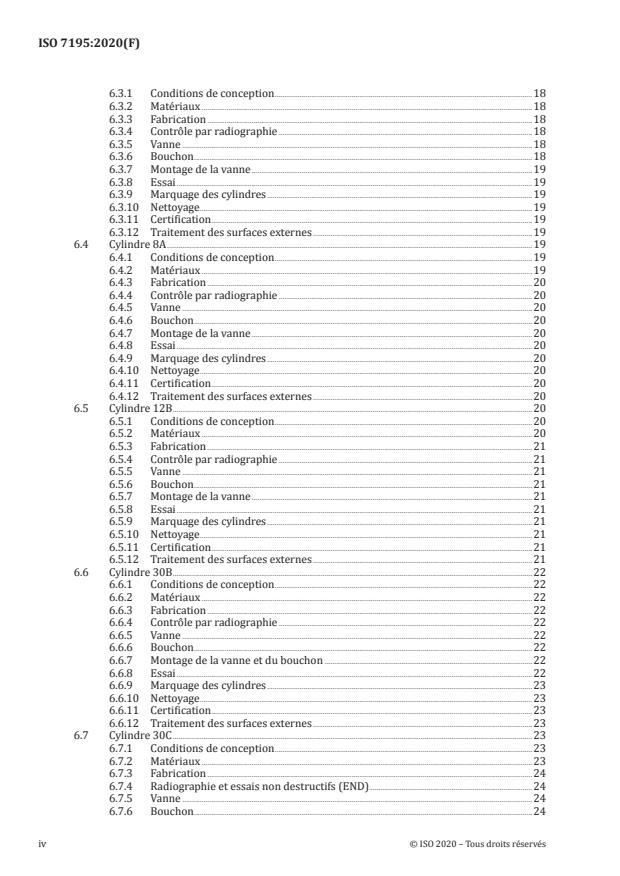
(Main)Nuclear energy — Packagings for the transport of uranium hexafluoride (UF6)
General Information
- Abstract
This document provides the following: — specifications for cylinders for the transport of uranium hexafluoride (UF6) to provide compatibility among different users, — description of cylinder designs, but is not intended to develop new designs, — fabrication requirements for the procurement of new cylinders designed for the transport of 0,1 kg or more of uranium hexafluoride, — fabrication requirements for the procurement of new valve protections, valves and plugs, and — requirements for cylinders and valve protections in service.
- Status
- Published
- Publication Date
- 19-Nov-2020
- Technical Committee
- ISO/TC 85/SC 5 - Nuclear installations, processes and technologies
- Drafting Committee
- ISO/TC 85/SC 5/WG 4 - Transportation of radioactive material
- Current Stage
- 9092 - International Standard to be revised
- Start Date
- 30-Apr-2026
- Completion Date
- 29-Aug-2026
Buy Documents

ISO 7195:2020 - Nuclear energy -- Packagings for the transport of uranium hexafluoride (UF6)
ISO 7195:2020 - Nuclear energy — Packagings for the transport of uranium hexafluoride (UF6)/20/2020

ISO 7195:2020 - Energie nucléaire -- Emballages pour le transport de l’hexafluorure d’uranium (UF6)
ISO 7195:2020 - Energie nucléaire — Emballages pour le transport de l’hexafluorure d’uranium (UF6)/20/2020
Overview
ISO 7195:2020 - "Nuclear energy - Packagings for the transport of uranium hexafluoride (UF6)" specifies requirements for cylinders and valve protections used to transport uranium hexafluoride. The standard:
- defines fabrication requirements for new cylinders intended to carry 0.1 kg or more of UF6,
- describes accepted cylinder designs (not intended to create new designs), and
- sets requirements for valves, plugs, valve protections, in-service inspection, testing, cleaning, marking, certification and records.
Keywords: ISO 7195:2020, UF6 transport, uranium hexafluoride cylinders, valve protection, fabrication requirements, cylinder inspection.
Key Topics
The standard covers technical and management topics, including:
- Management system and documentation needs for procurement and manufacture.
- Design and materials considerations for specific cylinder types (examples listed: 1S, 2S, 5B, 8A, 12B, 30B).
- Fabrication requirements for new cylinders and valve protections, including surface treatment, cleanliness and certification.
- Non‑destructive examinations (NDE) such as radiography and other inspections required during fabrication.
- Testing protocols for new and in‑service cylinders (pressure/functional tests referenced).
- Marking, records and certification required for traceability and regulatory compliance.
- In‑service requirements: routine inspections, periodic inspections and tests, maintenance, repair and alteration procedures.
- Valve and plug specifications, installation and maintenance of valve protections.
Applications
ISO 7195:2020 is practical for organizations involved in the nuclear fuel cycle and radioactive material transport:
- Cylinder manufacturers and fabricators producing UF6 packagings.
- Nuclear fuel processing and conversion facilities that store or ship UF6.
- Logistics and transport providers handling UF6 shipments.
- Regulatory bodies and inspection agencies assessing cylinder conformity and in‑service fitness.
- Procurement and quality assurance teams specifying acceptance criteria, testing and documentation for cylinders and valves.
Using ISO 7195 helps ensure compatibility among different users, safe handling of UF6, consistent inspection regimes, and traceable certification for transport packagings.
Related Standards
Relevant complementary documents often consulted with ISO 7195 include:
- IAEA Regulations for the Safe Transport of Radioactive Material (for transport packaging and routing rules).
- National pressure‑vessel codes and quality management standards (e.g., ISO 9001) for fabrication and supplier control.
For compliance, users should combine ISO 7195:2020’s cylinder and valve requirements with applicable transport regulations and local authority requirements.
Relations
- Effective Date
- 26-Aug-2023
- Effective Date
- 23-Apr-2020
Buy Documents
ISO 7195:2020 - Nuclear energy -- Packagings for the transport of uranium hexafluoride (UF6)
ISO 7195:2020 - Nuclear energy — Packagings for the transport of uranium hexafluoride (UF6)/20/2020
ISO 7195:2020 - Energie nucléaire -- Emballages pour le transport de l’hexafluorure d’uranium (UF6)
ISO 7195:2020 - Energie nucléaire — Emballages pour le transport de l’hexafluorure d’uranium (UF6)/20/2020
Get Certified
Connect with accredited certification bodies for this standard

DNV
DNV is an independent assurance and risk management provider.

Lloyd's Register
Lloyd's Register is a global professional services organisation specialising in engineering and technology.
DNV Energy Systems
Energy and renewable energy certification.
Sponsored listings
Frequently Asked Questions
ISO 7195:2020 is a standard published by the International Organization for Standardization (ISO). Its full title is "Nuclear energy — Packagings for the transport of uranium hexafluoride (UF6)". This standard covers: This document provides the following: — specifications for cylinders for the transport of uranium hexafluoride (UF6) to provide compatibility among different users, — description of cylinder designs, but is not intended to develop new designs, — fabrication requirements for the procurement of new cylinders designed for the transport of 0,1 kg or more of uranium hexafluoride, — fabrication requirements for the procurement of new valve protections, valves and plugs, and — requirements for cylinders and valve protections in service.
This document provides the following: — specifications for cylinders for the transport of uranium hexafluoride (UF6) to provide compatibility among different users, — description of cylinder designs, but is not intended to develop new designs, — fabrication requirements for the procurement of new cylinders designed for the transport of 0,1 kg or more of uranium hexafluoride, — fabrication requirements for the procurement of new valve protections, valves and plugs, and — requirements for cylinders and valve protections in service.
ISO 7195:2020 is classified under the following ICS (International Classification for Standards) categories: 27.120.30 - Fissile materials and nuclear fuel technology. The ICS classification helps identify the subject area and facilitates finding related standards.
ISO 7195:2020 has the following relationships with other standards: It is inter standard links to ISO 7195:2020/Amd 1:2026, ISO 7195:2005. Understanding these relationships helps ensure you are using the most current and applicable version of the standard.
ISO 7195:2020 is available in PDF format for immediate download after purchase. The document can be added to your cart and obtained through the secure checkout process. Digital delivery ensures instant access to the complete standard document.
Standards Content (Sample)
INTERNATIONAL ISO
STANDARD 7195
Third edition
2020-11
Nuclear energy — Packagings for the
transport of uranium hexafluoride
(UF )
Energie nucléaire — Emballages pour le transport de l’hexafluorure
d’uranium (UF )
Reference number
©
ISO 2020
© ISO 2020
All rights reserved. Unless otherwise specified, or required in the context of its implementation, no part of this publication may
be reproduced or utilized otherwise in any form or by any means, electronic or mechanical, including photocopying, or posting
on the internet or an intranet, without prior written permission. Permission can be requested from either ISO at the address
below or ISO’s member body in the country of the requester.
ISO copyright office
CP 401 • Ch. de Blandonnet 8
CH-1214 Vernier, Geneva
Phone: +41 22 749 01 11
Email: copyright@iso.org
Website: www.iso.org
Published in Switzerland
ii © ISO 2020 – All rights reserved
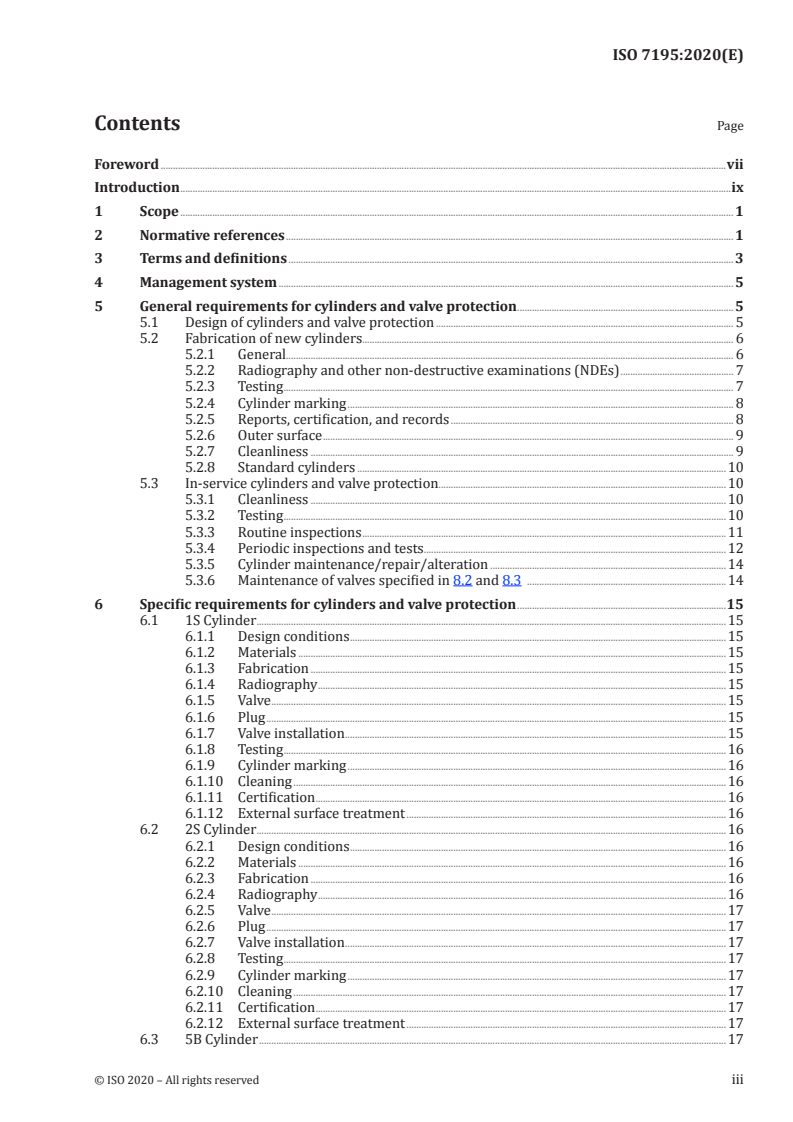
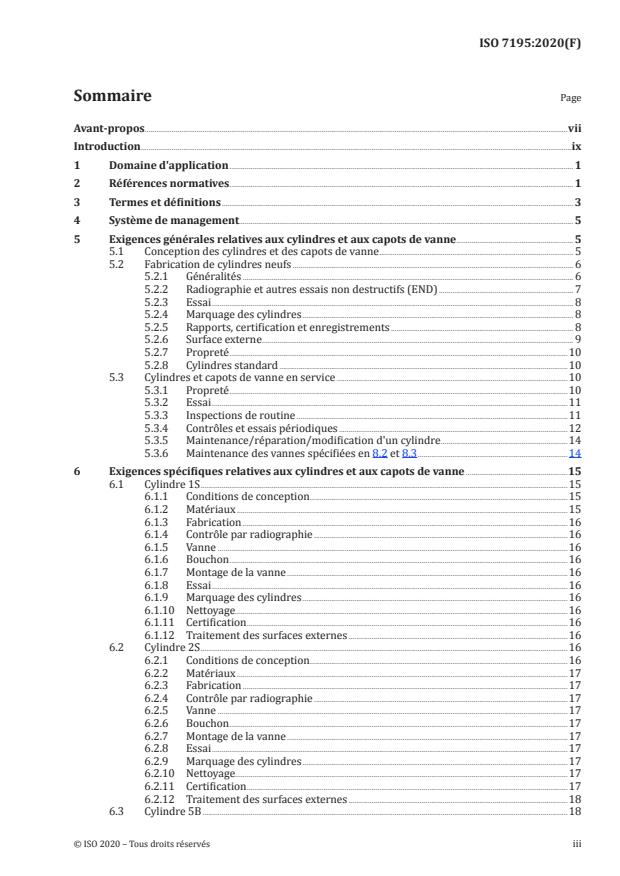
Contents Page
Foreword .vii
Introduction .ix
1 Scope . 1
2 Normative references . 1
3 Terms and definitions . 3
4 Management system . 5
5 General requirements for cylinders and valve protection . 5
5.1 Design of cylinders and valve protection . 5
5.2 Fabrication of new cylinders . . 6
5.2.1 General. 6
5.2.2 Radiography and other non-destructive examinations (NDEs) . 7
5.2.3 Testing . 7
5.2.4 Cylinder marking . 8
5.2.5 Reports, certification, and records . 8
5.2.6 Outer surface . 9
5.2.7 Cleanliness . 9
5.2.8 Standard cylinders .10
5.3 In-service cylinders and valve protection.10
5.3.1 Cleanliness .10
5.3.2 Testing .10
5.3.3 Routine inspections .11
5.3.4 Periodic inspections and tests.12
5.3.5 Cylinder maintenance/repair/alteration .14
5.3.6 Maintenance of valves specified in 8.2 and 8.3 .14
6 Specific requirements for cylinders and valve protection .15
6.1 1S Cylinder .15
6.1.1 Design conditions .15
6.1.2 Materials .15
6.1.3 Fabrication .15
6.1.4 Radiography .15
6.1.5 Valve .15
6.1.6 Plug .15
6.1.7 Valve installation .15
6.1.8 Testing .16
6.1.9 Cylinder marking .16
6.1.10 Cleaning .16
6.1.11 Certification .16
6.1.12 External surface treatment .16
6.2 2S Cylinder .16
6.2.1 Design conditions .16
6.2.2 Materials .16
6.2.3 Fabrication .16
6.2.4 Radiography .16
6.2.5 Valve .17
6.2.6 Plug .17
6.2.7 Valve installation .17
6.2.8 Testing .17
6.2.9 Cylinder marking .17
6.2.10 Cleaning .17
6.2.11 Certification .17
6.2.12 External surface treatment .17
6.3 5B Cylinder .17
6.3.1 Design conditions .17
6.3.2 Materials .17
6.3.3 Fabrication .18
6.3.4 Radiography .18
6.3.5 Valve .18
6.3.6 Plug .18
6.3.7 Valve installation .18
6.3.8 Testing .18
6.3.9 Cylinder marking .18
6.3.10 Cleaning .18
6.3.11 Certification .18
6.3.12 External surface treatment .18
6.4 8A Cylinder .19
6.4.1 Design conditions .19
6.4.2 Materials .19
6.4.3 Fabrication .19
6.4.4 Radiography .19
6.4.5 Valve .19
6.4.6 Plug .19
6.4.7 Valve installation .19
6.4.8 Testing .19
6.4.9 Cylinder marking .19
6.4.10 Cleaning .20
6.4.11 Certification .20
6.4.12 External surface treatment .20
6.5 12B Cylinder .20
6.5.1 Design conditions .20
6.5.2 Materials .20
6.5.3 Fabrication .20
6.5.4 Radiography .20
6.5.5 Valve .20
6.5.6 Plug .20
6.5.7 Valve installation .21
6.5.8 Testing .21
6.5.9 Cylinder marking .21
6.5.10 Cleaning .21
6.5.11 Certification .21
6.5.12 External surface treatment .21
6.6 30B Cylinder .21
6.6.1 Design conditions .21
6.6.2 Materials .21
6.6.3 Fabrication .22
6.6.4 Radiography .22
6.6.5 Valve .22
6.6.6 Plug .22
6.6.7 Valve and plug installation .22
6.6.8 Testing .22
6.6.9 Cylinder marking .22
6.6.10 Cleaning .22
6.6.11 Certification .22
6.6.12 External surface treatment .22
6.7 30C Cylinder .22
6.7.1 Design conditions .22
6.7.2 Materials .22
6.7.3 Fabrication .23
6.7.4 Radiography and non-destructive examination (NDE) .23
6.7.5 Valve .23
6.7.6 Plug .23
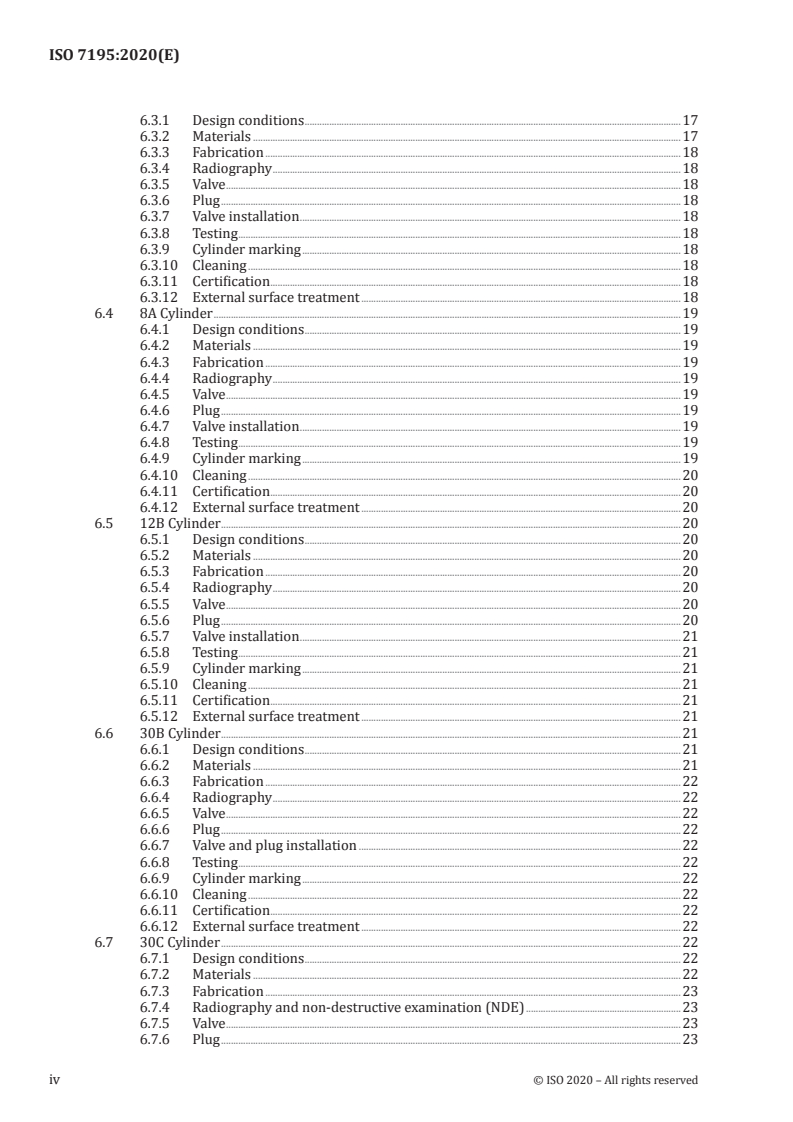
iv © ISO 2020 – All rights reserved
6.7.7 Valve and plug installation .23
6.7.8 Testing .23
6.7.9 Cylinder marking .23
6.7.10 Cleaning .24
6.7.11 Certification .24
6.7.12 External surface treatment .24
6.8 48Y or 48X cylinder .24
6.8.1 Design conditions .24
6.8.2 Materials .24
6.8.3 Fabrication .25
6.8.4 Radiography .25
6.8.5 Valve .25
6.8.6 Plug .25
6.8.7 Valve and plug installation .25
6.8.8 Testing .25
6.8.9 Cylinder marking .25
6.8.10 Cleaning .26
6.8.11 Certification .26
6.8.12 External surface treatment .26
7 General requirements for cylinder valves and plugs.26
7.1 Manufacturing process for valves and plugs .26
7.1.1 Process .26
7.1.2 Materials .26
7.1.3 Material test report . .26
7.1.4 Manufacturing .27
7.1.5 Material stress-relief specifications .27
7.1.6 Cleaning .27
7.1.7 Tinning of valves and plugs .27
7.1.8 Assembly of valves .28
7.1.9 Testing of valves.29
7.1.10 Packaging of valves and plugs .30
7.1.11 Certification .30
7.2 Installation of valves and plugs specified in 8.3 and 8.4 .30
8 Specific requirements for cylinder valves and plugs .31
8.1 Valves for 1S and 2S cylinders .31
8.1.1 General.31
8.1.2 Design conditions .31
8.1.3 Materials .31
8.1.4 Marking .32
8.2 Cylinder valve 50 (3/4 in) .32
8.2.1 Design conditions .32
8.2.2 Materials .32
8.2.3 Material test report . .32
8.2.4 Manufacturing .32
8.2.5 Cleaning .32
8.2.6 Tinning .33
8.2.7 Assembly .33
8.2.8 Testing .33
8.3 Cylinder valve 51 (1 in) .33
8.3.1 Design conditions .33
8.3.2 Materials .33
8.3.3 Material test report . .34
8.3.4 Manufacturing .34
8.3.5 Cleaning .34
8.3.6 Tinning .34
8.3.7 Assembly .34
8.3.8 Testing .34
8.4 Plug .34
8.4.1 Design conditions .34
8.4.2 Materials .35
8.4.3 Machining .35
8.4.4 Cleaning .35
8.4.5 Tinning .35
8.4.6 Certification .35
9 Shipping .35
9.1 Tamper indication .35
9.2 New cylinders .36
9.3 Clean and washed out cylinders .36
9.4 Other cylinders .36
9.5 Outer protection .36
Bibliography .91
vi © ISO 2020 – All rights reserved
Foreword
ISO (the International Organization for Standardization) is a worldwide federation of national standards
bodies (ISO member bodies). The work of preparing International Standards is normally carried out
through ISO technical committees. Each member body interested in a subject for which a technical
committee has been established has the right to be represented on that committee. International
organizations, governmental and non-governmental, in liaison with ISO, also take part in the work.
ISO collaborates closely with the International Electrotechnical Commission (IEC) on all matters of
electrotechnical standardization.
The procedures used to develop this document and those intended for its further maintenance are
described in the ISO/IEC Directives, Part 1. In particular, the different approval criteria needed for the
different types of ISO documents should be noted. This document was drafted in accordance with the
editorial rules of the ISO/IEC Directives, Part 2 (see www .iso .org/ directives).
Attention is drawn to the possibility that some of the elements of this document may be the subject of
patent rights. ISO shall not be held responsible for identifying any or all such patent rights. Details of
any patent rights identified during the development of the document will be in the Introduction and/or
on the ISO list of patent declarations received (see www .iso .org/ patents).
Any trade name used in this document is information given for the convenience of users and does not
constitute an endorsement.
For an explanation of the voluntary nature of standards, the meaning of ISO specific terms and
expressions related to conformity assessment, as well as information about ISO's adherence to
the World Trade Organization (WTO) principles in the Technical Barriers to Trade (TBT) see
www .iso .org/ iso/ foreword .html.
This document was prepared by Technical Committee ISO/TC 85, Nuclear energy, nuclear technologies,
and radiological protection, Subcommittee SC 5, Nuclear installations, processes and fuel technologies,
WG4, Transport of radioactive material.
Any feedback or questions on this document should be directed to the user’s national standards body. A
complete listing of these bodies can be found at www .iso .org/ members .html.
This third edition cancels and replaces the second edition (ISO 7195:2005), which has been technically
revised. The main changes compared to the previous edition are:
— The title of the document has been slightly changed to better reflect its scope;
— The general structure of the document has been partly reorganized to enhance clarity and to ease
comparison with ANSI N14.1;
— The cylinder model 48G has been removed and the cylinder model 30C added;
— The socket head plugs for 30 in and 48 in cylinders have been added (alternative to hex head plugs);
— The list of references and the list of terms and definitions used have been updated;
— “Quality assurance programme” has been replaced by “management system”;
— Clauses related to manufacture, periodic inspection and recertification have been redrafted for
better clarity;
— The possibility for 30B, 48X and 48Y cylinders to use non-destructive examinations as an alternative
to hydrostatic testing during their periodic inspections, with the condition that additional
examinations are carried out at the time of their manufacturing, has been introduced;
— The use of leak test methods other than the specified one is now permitted;
— The existing tie down requirements have been replaced by a reference to the new Appendix IV of
IAEA SSG-26;
— The reuse of valves and plugs removed from cylinders is no longer permitted;
— All the figures have been revised to correct errors, increase clarity and add missing information.
viii © ISO 2020 – All rights reserved
Introduction
The transport of uranium hexafluoride (UF ) is an essential operation in the nuclear industry. The
packaging and transport of UF is subject to the relevant transport regulations for dangerous goods
of each of the countries through or into which the material is transported. This document does not
take precedence over applicable regulations, nor does it relieve the consignor and other parties
from compliance with these regulations. For more detailed information, the user of this document is
encouraged to consult the appropriate regulatory document.
According to IAEA Regulations for the Safe Transport of Radioactive Material (SSR-6), and all
regulations based on, except as allowed in its para. 634, uranium hexafluoride in quantities of 0,1 kg or
more is required to be packaged and transported in accordance with the provisions of this document.
ANSI N14.1 has been used internationally as an industry reference and the standard cylinders included
in ANSI N14.1 have been used widely for international transport of UF . However, in some cases minor
adaptations of the American standard were required to meet local conditions in a particular country.
For example, equivalent materials may have been used instead of the materials specified. Moreover, the
certification of cylinders as pressure vessels can have required equivalent authorization procedures
appropriate in the countries concerned, rather than the US procedure specified.
This document presents primarily information on UF packagings (including cylinders and valve
protection). It is intended to provide for compatibility of UF cylinders among different users within the
nuclear industry. It has been developed from ANSI N14.1, but with incorporation of, and allowance for,
other equivalent materials and national certification procedures.
Throughout this document and in conformity with standard ISO practice, SI metric units are used in
preference to imperial units (which are given in parenthesis for information). However, generic cylinder
designations are based on the diameter expressed in imperial units (48’’ for instance).
If a common, commercially available component uses features that are defined in an appropriate non-SI
metric-based Standard document, only the relevant base units are quoted.
INTERNATIONAL STANDARD ISO 7195:2020(E)
Nuclear energy — Packagings for the transport of uranium
hexafluoride (UF )
1 Scope
This document provides the following:
— specifications for cylinders for the transport of uranium hexafluoride (UF ) to provide compatibility
among different users,
— description of cylinder designs, but is not intended to develop new designs,
— fabrication requirements for the procurement of new cylinders designed for the transport of 0,1 kg
or more of uranium hexafluoride,
— fabrication requirements for the procurement of new valve protections, valves and plugs, and
— requirements for cylinders and valve protections in service.
2 Normative references
The following documents are referred to in the text in such a way that some or all of their content
constitute requirements of this document. For dated references, only the edition cited applies. For
undated references, the latest edition of the referenced document (including any amendments) applies.
ISO 263, ISO inch screw threads — General plan and selection for screws, bolts and nuts — Diameter range
0,06 to 6 in
ISO 6508-1, Metallic materials — Rockwell hardness test — Part 1: Test method
ISO 9712, Non-destructive testing — Qualification and certification of NDT personnel
ISO 12807, Safe transport of radioactive materials — Leakage testing on packages
ANSI/ASME B1.1, Unified Inch Screw Threads (UN and UNR Thread Form)
ANSI/ASME B1.5, Acme Screw Threads
ANSI/ASME B1.20.1, Pipe Threads, General Purpose (Inch)
ANSI/ASME B16.11, Forged Steel Fittings, Socket-Welding and Threaded
ANSI/AWS A5.8M/A5.8, Specification for Filler Metals for Brazing and Braze Welding
ANSI/AWS A5.14/A5.14M, Specification for Nickel and Nickel-Alloy Bare Welding Electrodes and Rods
ANSI/AWS D1.1/D1.1M, Structural Welding Code — Steel
ANSI/CGA V-1, Standard for Compressed Gas Cylinder Valve Outlet and Inlet Connections
ASTM A20/A20M, Standard Specification for General Requirements for Steel Plates for Pressure Vessels
ASTM A36/A36M, Standard Specification for Carbon Structural Steel
ASTM A53/A53M, Standard Specification for Pipe, Black and Hot-Dipped, Zinc–Coated, Welded and
Seamless
ASTM A105/A105M, Standard Specification for Carbon Steel Forgings for Piping Applications
ASTM A106/A106M, Standard Specification for Seamless Carbon Steel Pipe for High-Temperature Service
ASTM A108, Standard Specification for Steel Bar, Carbon and Alloy, Cold-Finished
ASTM A131/A131M, Standard Specification for Structural Steel for Ships
ASTM A193/A193M, Standard Specification for Alloy-Steel and Stainless Steel Bolting Materials for High
Temperature or High Pressure Service and Other Special Purpose Applications
ASTM A234/A234M, Standard Specification for Piping Fittings of Wrought Carbon Steel and Alloy Steel for
Moderate and High Temperature Service
ASTM A240/A240M, Standa
...
INTERNATIONAL ISO
STANDARD 7195
Third edition
2020-11
Nuclear energy — Packagings for the
transport of uranium hexafluoride
(UF )
Energie nucléaire — Emballages pour le transport de l’hexafluorure
d’uranium (UF )
Reference number
©
ISO 2020
© ISO 2020
All rights reserved. Unless otherwise specified, or required in the context of its implementation, no part of this publication may
be reproduced or utilized otherwise in any form or by any means, electronic or mechanical, including photocopying, or posting
on the internet or an intranet, without prior written permission. Permission can be requested from either ISO at the address
below or ISO’s member body in the country of the requester.
ISO copyright office
CP 401 • Ch. de Blandonnet 8
CH-1214 Vernier, Geneva
Phone: +41 22 749 01 11
Email: copyright@iso.org
Website: www.iso.org
Published in Switzerland
ii © ISO 2020 – All rights reserved
Contents Page
Foreword .vii
Introduction .ix
1 Scope . 1
2 Normative references . 1
3 Terms and definitions . 3
4 Management system . 5
5 General requirements for cylinders and valve protection . 5
5.1 Design of cylinders and valve protection . 5
5.2 Fabrication of new cylinders . . 6
5.2.1 General. 6
5.2.2 Radiography and other non-destructive examinations (NDEs) . 7
5.2.3 Testing . 7
5.2.4 Cylinder marking . 8
5.2.5 Reports, certification, and records . 8
5.2.6 Outer surface . 9
5.2.7 Cleanliness . 9
5.2.8 Standard cylinders .10
5.3 In-service cylinders and valve protection.10
5.3.1 Cleanliness .10
5.3.2 Testing .10
5.3.3 Routine inspections .11
5.3.4 Periodic inspections and tests.12
5.3.5 Cylinder maintenance/repair/alteration .14
5.3.6 Maintenance of valves specified in 8.2 and 8.3 .14
6 Specific requirements for cylinders and valve protection .15
6.1 1S Cylinder .15
6.1.1 Design conditions .15
6.1.2 Materials .15
6.1.3 Fabrication .15
6.1.4 Radiography .15
6.1.5 Valve .15
6.1.6 Plug .15
6.1.7 Valve installation .15
6.1.8 Testing .16
6.1.9 Cylinder marking .16
6.1.10 Cleaning .16
6.1.11 Certification .16
6.1.12 External surface treatment .16
6.2 2S Cylinder .16
6.2.1 Design conditions .16
6.2.2 Materials .16
6.2.3 Fabrication .16
6.2.4 Radiography .16
6.2.5 Valve .17
6.2.6 Plug .17
6.2.7 Valve installation .17
6.2.8 Testing .17
6.2.9 Cylinder marking .17
6.2.10 Cleaning .17
6.2.11 Certification .17
6.2.12 External surface treatment .17
6.3 5B Cylinder .17
6.3.1 Design conditions .17
6.3.2 Materials .17
6.3.3 Fabrication .18
6.3.4 Radiography .18
6.3.5 Valve .18
6.3.6 Plug .18
6.3.7 Valve installation .18
6.3.8 Testing .18
6.3.9 Cylinder marking .18
6.3.10 Cleaning .18
6.3.11 Certification .18
6.3.12 External surface treatment .18
6.4 8A Cylinder .19
6.4.1 Design conditions .19
6.4.2 Materials .19
6.4.3 Fabrication .19
6.4.4 Radiography .19
6.4.5 Valve .19
6.4.6 Plug .19
6.4.7 Valve installation .19
6.4.8 Testing .19
6.4.9 Cylinder marking .19
6.4.10 Cleaning .20
6.4.11 Certification .20
6.4.12 External surface treatment .20
6.5 12B Cylinder .20
6.5.1 Design conditions .20
6.5.2 Materials .20
6.5.3 Fabrication .20
6.5.4 Radiography .20
6.5.5 Valve .20
6.5.6 Plug .20
6.5.7 Valve installation .21
6.5.8 Testing .21
6.5.9 Cylinder marking .21
6.5.10 Cleaning .21
6.5.11 Certification .21
6.5.12 External surface treatment .21
6.6 30B Cylinder .21
6.6.1 Design conditions .21
6.6.2 Materials .21
6.6.3 Fabrication .22
6.6.4 Radiography .22
6.6.5 Valve .22
6.6.6 Plug .22
6.6.7 Valve and plug installation .22
6.6.8 Testing .22
6.6.9 Cylinder marking .22
6.6.10 Cleaning .22
6.6.11 Certification .22
6.6.12 External surface treatment .22
6.7 30C Cylinder .22
6.7.1 Design conditions .22
6.7.2 Materials .22
6.7.3 Fabrication .23
6.7.4 Radiography and non-destructive examination (NDE) .23
6.7.5 Valve .23
6.7.6 Plug .23
iv © ISO 2020 – All rights reserved
6.7.7 Valve and plug installation .23
6.7.8 Testing .23
6.7.9 Cylinder marking .23
6.7.10 Cleaning .24
6.7.11 Certification .24
6.7.12 External surface treatment .24
6.8 48Y or 48X cylinder .24
6.8.1 Design conditions .24
6.8.2 Materials .24
6.8.3 Fabrication .25
6.8.4 Radiography .25
6.8.5 Valve .25
6.8.6 Plug .25
6.8.7 Valve and plug installation .25
6.8.8 Testing .25
6.8.9 Cylinder marking .25
6.8.10 Cleaning .26
6.8.11 Certification .26
6.8.12 External surface treatment .26
7 General requirements for cylinder valves and plugs.26
7.1 Manufacturing process for valves and plugs .26
7.1.1 Process .26
7.1.2 Materials .26
7.1.3 Material test report . .26
7.1.4 Manufacturing .27
7.1.5 Material stress-relief specifications .27
7.1.6 Cleaning .27
7.1.7 Tinning of valves and plugs .27
7.1.8 Assembly of valves .28
7.1.9 Testing of valves.29
7.1.10 Packaging of valves and plugs .30
7.1.11 Certification .30
7.2 Installation of valves and plugs specified in 8.3 and 8.4 .30
8 Specific requirements for cylinder valves and plugs .31
8.1 Valves for 1S and 2S cylinders .31
8.1.1 General.31
8.1.2 Design conditions .31
8.1.3 Materials .31
8.1.4 Marking .32
8.2 Cylinder valve 50 (3/4 in) .32
8.2.1 Design conditions .32
8.2.2 Materials .32
8.2.3 Material test report . .32
8.2.4 Manufacturing .32
8.2.5 Cleaning .32
8.2.6 Tinning .33
8.2.7 Assembly .33
8.2.8 Testing .33
8.3 Cylinder valve 51 (1 in) .33
8.3.1 Design conditions .33
8.3.2 Materials .33
8.3.3 Material test report . .34
8.3.4 Manufacturing .34
8.3.5 Cleaning .34
8.3.6 Tinning .34
8.3.7 Assembly .34
8.3.8 Testing .34
8.4 Plug .34
8.4.1 Design conditions .34
8.4.2 Materials .35
8.4.3 Machining .35
8.4.4 Cleaning .35
8.4.5 Tinning .35
8.4.6 Certification .35
9 Shipping .35
9.1 Tamper indication .35
9.2 New cylinders .36
9.3 Clean and washed out cylinders .36
9.4 Other cylinders .36
9.5 Outer protection .36
Bibliography .91
vi © ISO 2020 – All rights reserved
Foreword
ISO (the International Organization for Standardization) is a worldwide federation of national standards
bodies (ISO member bodies). The work of preparing International Standards is normally carried out
through ISO technical committees. Each member body interested in a subject for which a technical
committee has been established has the right to be represented on that committee. International
organizations, governmental and non-governmental, in liaison with ISO, also take part in the work.
ISO collaborates closely with the International Electrotechnical Commission (IEC) on all matters of
electrotechnical standardization.
The procedures used to develop this document and those intended for its further maintenance are
described in the ISO/IEC Directives, Part 1. In particular, the different approval criteria needed for the
different types of ISO documents should be noted. This document was drafted in accordance with the
editorial rules of the ISO/IEC Directives, Part 2 (see www .iso .org/ directives).
Attention is drawn to the possibility that some of the elements of this document may be the subject of
patent rights. ISO shall not be held responsible for identifying any or all such patent rights. Details of
any patent rights identified during the development of the document will be in the Introduction and/or
on the ISO list of patent declarations received (see www .iso .org/ patents).
Any trade name used in this document is information given for the convenience of users and does not
constitute an endorsement.
For an explanation of the voluntary nature of standards, the meaning of ISO specific terms and
expressions related to conformity assessment, as well as information about ISO's adherence to
the World Trade Organization (WTO) principles in the Technical Barriers to Trade (TBT) see
www .iso .org/ iso/ foreword .html.
This document was prepared by Technical Committee ISO/TC 85, Nuclear energy, nuclear technologies,
and radiological protection, Subcommittee SC 5, Nuclear installations, processes and fuel technologies,
WG4, Transport of radioactive material.
Any feedback or questions on this document should be directed to the user’s national standards body. A
complete listing of these bodies can be found at www .iso .org/ members .html.
This third edition cancels and replaces the second edition (ISO 7195:2005), which has been technically
revised. The main changes compared to the previous edition are:
— The title of the document has been slightly changed to better reflect its scope;
— The general structure of the document has been partly reorganized to enhance clarity and to ease
comparison with ANSI N14.1;
— The cylinder model 48G has been removed and the cylinder model 30C added;
— The socket head plugs for 30 in and 48 in cylinders have been added (alternative to hex head plugs);
— The list of references and the list of terms and definitions used have been updated;
— “Quality assurance programme” has been replaced by “management system”;
— Clauses related to manufacture, periodic inspection and recertification have been redrafted for
better clarity;
— The possibility for 30B, 48X and 48Y cylinders to use non-destructive examinations as an alternative
to hydrostatic testing during their periodic inspections, with the condition that additional
examinations are carried out at the time of their manufacturing, has been introduced;
— The use of leak test methods other than the specified one is now permitted;
— The existing tie down requirements have been replaced by a reference to the new Appendix IV of
IAEA SSG-26;
— The reuse of valves and plugs removed from cylinders is no longer permitted;
— All the figures have been revised to correct errors, increase clarity and add missing information.
viii © ISO 2020 – All rights reserved
Introduction
The transport of uranium hexafluoride (UF ) is an essential operation in the nuclear industry. The
packaging and transport of UF is subject to the relevant transport regulations for dangerous goods
of each of the countries through or into which the material is transported. This document does not
take precedence over applicable regulations, nor does it relieve the consignor and other parties
from compliance with these regulations. For more detailed information, the user of this document is
encouraged to consult the appropriate regulatory document.
According to IAEA Regulations for the Safe Transport of Radioactive Material (SSR-6), and all
regulations based on, except as allowed in its para. 634, uranium hexafluoride in quantities of 0,1 kg or
more is required to be packaged and transported in accordance with the provisions of this document.
ANSI N14.1 has been used internationally as an industry reference and the standard cylinders included
in ANSI N14.1 have been used widely for international transport of UF . However, in some cases minor
adaptations of the American standard were required to meet local conditions in a particular country.
For example, equivalent materials may have been used instead of the materials specified. Moreover, the
certification of cylinders as pressure vessels can have required equivalent authorization procedures
appropriate in the countries concerned, rather than the US procedure specified.
This document presents primarily information on UF packagings (including cylinders and valve
protection). It is intended to provide for compatibility of UF cylinders among different users within the
nuclear industry. It has been developed from ANSI N14.1, but with incorporation of, and allowance for,
other equivalent materials and national certification procedures.
Throughout this document and in conformity with standard ISO practice, SI metric units are used in
preference to imperial units (which are given in parenthesis for information). However, generic cylinder
designations are based on the diameter expressed in imperial units (48’’ for instance).
If a common, commercially available component uses features that are defined in an appropriate non-SI
metric-based Standard document, only the relevant base units are quoted.
INTERNATIONAL STANDARD ISO 7195:2020(E)
Nuclear energy — Packagings for the transport of uranium
hexafluoride (UF )
1 Scope
This document provides the following:
— specifications for cylinders for the transport of uranium hexafluoride (UF ) to provide compatibility
among different users,
— description of cylinder designs, but is not intended to develop new designs,
— fabrication requirements for the procurement of new cylinders designed for the transport of 0,1 kg
or more of uranium hexafluoride,
— fabrication requirements for the procurement of new valve protections, valves and plugs, and
— requirements for cylinders and valve protections in service.
2 Normative references
The following documents are referred to in the text in such a way that some or all of their content
constitute requirements of this document. For dated references, only the edition cited applies. For
undated references, the latest edition of the referenced document (including any amendments) applies.
ISO 263, ISO inch screw threads — General plan and selection for screws, bolts and nuts — Diameter range
0,06 to 6 in
ISO 6508-1, Metallic materials — Rockwell hardness test — Part 1: Test method
ISO 9712, Non-destructive testing — Qualification and certification of NDT personnel
ISO 12807, Safe transport of radioactive materials — Leakage testing on packages
ANSI/ASME B1.1, Unified Inch Screw Threads (UN and UNR Thread Form)
ANSI/ASME B1.5, Acme Screw Threads
ANSI/ASME B1.20.1, Pipe Threads, General Purpose (Inch)
ANSI/ASME B16.11, Forged Steel Fittings, Socket-Welding and Threaded
ANSI/AWS A5.8M/A5.8, Specification for Filler Metals for Brazing and Braze Welding
ANSI/AWS A5.14/A5.14M, Specification for Nickel and Nickel-Alloy Bare Welding Electrodes and Rods
ANSI/AWS D1.1/D1.1M, Structural Welding Code — Steel
ANSI/CGA V-1, Standard for Compressed Gas Cylinder Valve Outlet and Inlet Connections
ASTM A20/A20M, Standard Specification for General Requirements for Steel Plates for Pressure Vessels
ASTM A36/A36M, Standard Specification for Carbon Structural Steel
ASTM A53/A53M, Standard Specification for Pipe, Black and Hot-Dipped, Zinc–Coated, Welded and
Seamless
ASTM A105/A105M, Standard Specification for Carbon Steel Forgings for Piping Applications
ASTM A106/A106M, Standard Specification for Seamless Carbon Steel Pipe for High-Temperature Service
ASTM A108, Standard Specification for Steel Bar, Carbon and Alloy, Cold-Finished
ASTM A131/A131M, Standard Specification for Structural Steel for Ships
ASTM A193/A193M, Standard Specification for Alloy-Steel and Stainless Steel Bolting Materials for High
Temperature or High Pressure Service and Other Special Purpose Applications
ASTM A234/A234M, Standard Specification for Piping Fittings of Wrought Carbon Steel and Alloy Steel for
Moderate and High Temperature Service
ASTM A240/A240M, Standa
...
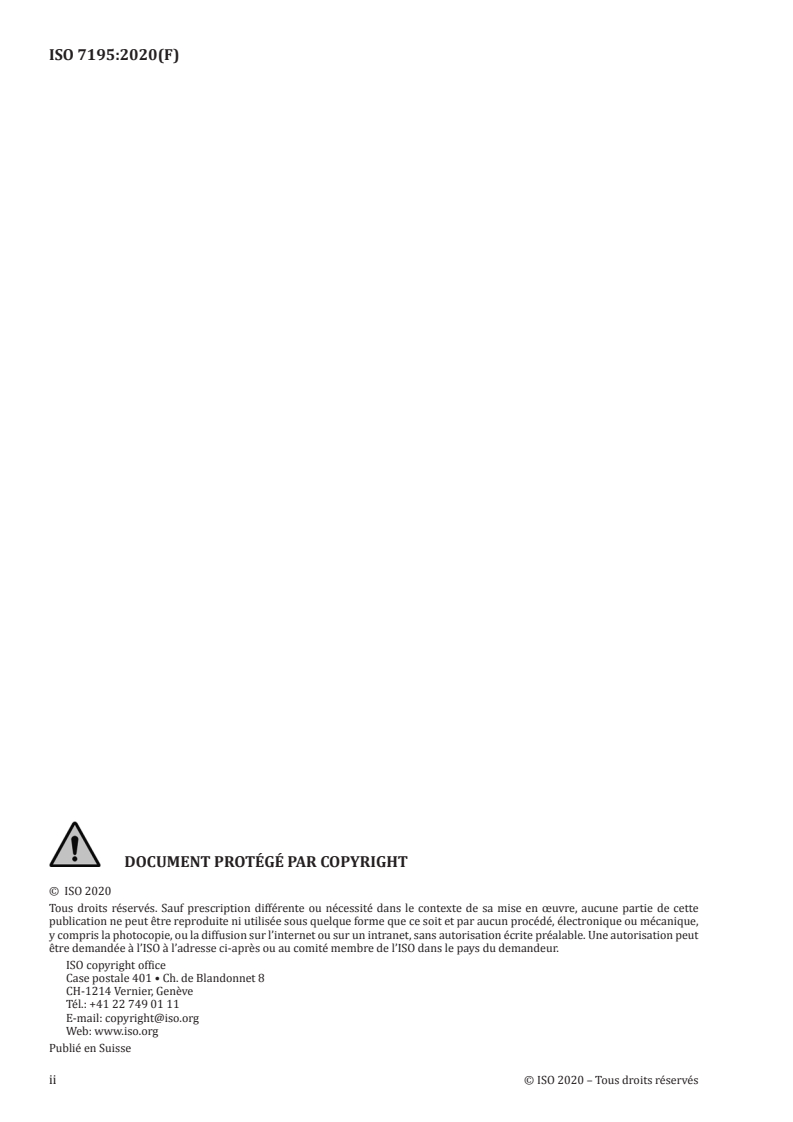
NORME ISO
INTERNATIONALE 7195
Troisième édition
2020-11
Energie nucléaire — Emballages
pour le transport de l’hexafluorure
d’uranium (UF )
Nuclear energy — Packagings for the transport of uranium
hexafluoride (UF )
Numéro de référence
©
ISO 2020
DOCUMENT PROTÉGÉ PAR COPYRIGHT
© ISO 2020
Tous droits réservés. Sauf prescription différente ou nécessité dans le contexte de sa mise en œuvre, aucune partie de cette
publication ne peut être reproduite ni utilisée sous quelque forme que ce soit et par aucun procédé, électronique ou mécanique,
y compris la photocopie, ou la diffusion sur l’internet ou sur un intranet, sans autorisation écrite préalable. Une autorisation peut
être demandée à l’ISO à l’adresse ci-après ou au comité membre de l’ISO dans le pays du demandeur.
ISO copyright office
Case postale 401 • Ch. de Blandonnet 8
CH-1214 Vernier, Genève
Tél.: +41 22 749 01 11
E-mail: copyright@iso.org
Web: www.iso.org
Publié en Suisse
ii © ISO 2020 – Tous droits réservés
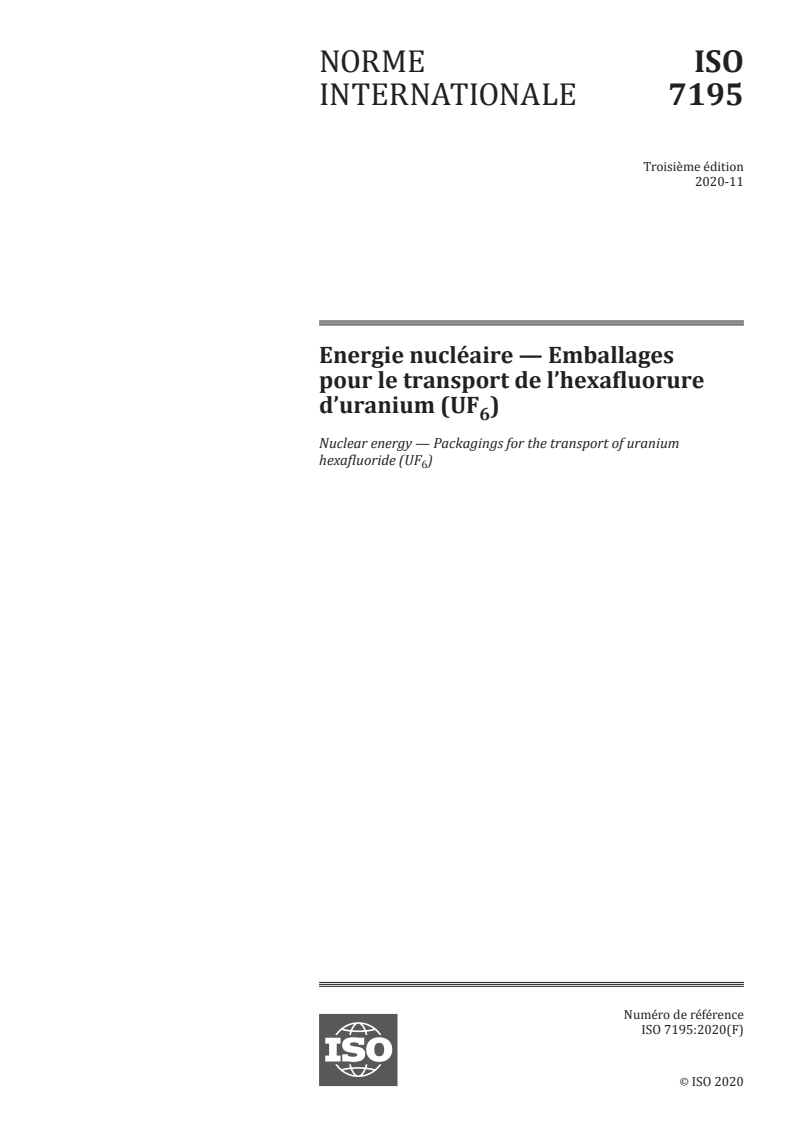
Sommaire Page
Avant-propos .vii
Introduction .ix
1 Domaine d'application . 1
2 Références normatives . 1
3 Termes et définitions . 3
4 Système de management. 5
5 Exigences générales relatives aux cylindres et aux capots de vanne .5
5.1 Conception des cylindres et des capots de vanne . 5
5.2 Fabrication de cylindres neufs . 6
5.2.1 Généralités . 6
5.2.2 Radiographie et autres essais non destructifs (END) . 7
5.2.3 Essai . 8
5.2.4 Marquage des cylindres . 8
5.2.5 Rapports, certification et enregistrements . 8
5.2.6 Surface externe . 9
5.2.7 Propreté .10
5.2.8 Cylindres standard .10
5.3 Cylindres et capots de vanne en service .10
5.3.1 Propreté .10
5.3.2 Essai .11
5.3.3 Inspections de routine .11
5.3.4 Contrôles et essais périodiques .12
5.3.5 Maintenance/réparation/modification d'un cylindre .14
5.3.6 Maintenance des vannes spécifiées en 8.2 et 8.3 .14
6 Exigences spécifiques relatives aux cylindres et aux capots de vanne .15
6.1 Cylindre 1S .15
6.1.1 Conditions de conception .15
6.1.2 Matériaux .15
6.1.3 Fabrication .16
6.1.4 Contrôle par radiographie .16
6.1.5 Vanne .16
6.1.6 Bouchon .16
6.1.7 Montage de la vanne .16
6.1.8 Essai .16
6.1.9 Marquage des cylindres .16
6.1.10 Nettoyage.16
6.1.11 Certification .16
6.1.12 Traitement des surfaces externes .16
6.2 Cylindre 2S .16
6.2.1 Conditions de conception .16
6.2.2 Matériaux .17
6.2.3 Fabrication .17
6.2.4 Contrôle par radiographie .17
6.2.5 Vanne .17
6.2.6 Bouchon .17
6.2.7 Montage de la vanne .17
6.2.8 Essai .17
6.2.9 Marquage des cylindres .17
6.2.10 Nettoyage.17
6.2.11 Certification .17
6.2.12 Traitement des surfaces externes .18
6.3 Cylindre 5B .18
6.3.1 Conditions de conception .18
6.3.2 Matériaux .18
6.3.3 Fabrication .18
6.3.4 Contrôle par radiographie .18
6.3.5 Vanne .18
6.3.6 Bouchon .18
6.3.7 Montage de la vanne .19
6.3.8 Essai .19
6.3.9 Marquage des cylindres .19
6.3.10 Nettoyage.19
6.3.11 Certification .19
6.3.12 Traitement des surfaces externes .19
6.4 Cylindre 8A .19
6.4.1 Conditions de conception .19
6.4.2 Matériaux .19
6.4.3 Fabrication .20
6.4.4 Contrôle par radiographie .20
6.4.5 Vanne .20
6.4.6 Bouchon .20
6.4.7 Montage de la vanne .20
6.4.8 Essai .20
6.4.9 Marquage des cylindres .20
6.4.10 Nettoyage.20
6.4.11 Certification .20
6.4.12 Traitement des surfaces externes .20
6.5 Cylindre 12B .20
6.5.1 Conditions de conception .20
6.5.2 Matériaux .20
6.5.3 Fabrication .21
6.5.4 Contrôle par radiographie .21
6.5.5 Vanne .21
6.5.6 Bouchon .21
6.5.7 Montage de la vanne .21
6.5.8 Essai .21
6.5.9 Marquage des cylindres .21
6.5.10 Nettoyage.21
6.5.11 Certification .21
6.5.12 Traitement des surfaces externes .21
6.6 Cylindre 30B .22
6.6.1 Conditions de conception .22
6.6.2 Matériaux .22
6.6.3 Fabrication .22
6.6.4 Contrôle par radiographie .22
6.6.5 Vanne .22
6.6.6 Bouchon .22
6.6.7 Montage de la vanne et du bouchon .22
6.6.8 Essai .22
6.6.9 Marquage des cylindres .23
6.6.10 Nettoyage.23
6.6.11 Certification .23
6.6.12 Traitement des surfaces externes .23
6.7 Cylindre 30C .23
6.7.1 Conditions de conception .23
6.7.2 Matériaux .23
6.7.3 Fabrication .24
6.7.4 Radiographie et essais non destructifs (END).24
6.7.5 Vanne .24
6.7.6 Bouchon .24
iv © ISO 2020 – Tous droits réservés
6.7.7 Montage de la vanne et du bouchon .24
6.7.8 Essai .24
6.7.9 Marquage des cylindres .24
6.7.10 Nettoyage.24
6.7.11 Certification .24
6.7.12 Traitement des surfaces externes .24
6.8 Cylindre 48Y ou 48X .25
6.8.1 Conditions de conception .25
6.8.2 Matériaux .25
6.8.3 Fabrication .26
6.8.4 Contrôle par radiographie .26
6.8.5 Vanne .26
6.8.6 Bouchon .26
6.8.7 Montage de la vanne et du bouchon .26
6.8.8 Essai .26
6.8.9 Marquage des cylindres .26
6.8.10 Nettoyage.26
6.8.11 Certification .27
6.8.12 Traitement des surfaces externes .27
7 Exigences générales pour les vannes et bouchons de cylindres .27
7.1 Procédé de fabrication des vannes et bouchons .27
7.1.1 Procédé.27
7.1.2 Matériaux .27
7.1.3 Certification des matériaux .27
7.1.4 Fabrication .28
7.1.5 Spécifications relatives à la relaxation des contraintes des matériaux .28
7.1.6 Nettoyage.28
7.1.7 Étamage des vannes et bouchons .29
7.1.8 Assemblage des vannes.29
7.1.9 Essais des vannes .30
7.1.10 Emballage des vannes et bouchons .31
7.1.11 Certification .31
7.2 Installation de la vanne et du bouchon spécifiés en 8.3 et 8.4 .31
8 Exigences spécifiques pour les vannes et bouchons de cylindres.32
8.1 Vannes pour cylindres 1S et 2S .32
8.1.1 Généralités .32
8.1.2 Conditions de conception .33
8.1.3 Matériaux .33
8.1.4 Marquage .33
8.2 Vanne de cylindre type 50 (3/4 in) .33
8.2.1 Conditions de conception .33
8.2.2 Matériaux .33
8.2.3 Certification des matériaux .34
8.2.4 Fabrication .34
8.2.5 Nettoyage.34
8.2.6 Étamage .34
8.2.7 Assemblage .34
8.2.8 Essai .34
8.3 Vanne de cylindre type 51 (1 in) .34
8.3.1 Conditions de conception .34
8.3.2 Matériaux .34
8.3.3 Certification des matériaux .35
8.3.4 Fabrication .35
8.3.5 Nettoyage.35
8.3.6 Étamage .35
8.3.7 Assemblage .35
8.3.8 Essai .36
8.4 Bouchon .36
8.4.1 Conditions de conception .36
8.4.2 Matériaux .36
8.4.3 Usinage .36
8.4.4 Nettoyage.37
8.4.5 Étamage .37
8.4.6 Certification .37
9 Transport .37
9.1 Indication d'intégrité .37
9.2 Cylindres neufs .37
9.3 Cylindres lavés .37
9.4 Autres cylindres .37
9.5 Protection externe.38
Bibliographie .95
vi © ISO 2020 – Tous droits réservés
Avant-propos
L'ISO (Organisation internationale de normalisation) est une fédération mondiale d'organismes
nationaux de normalisation (comités membres de l'ISO). L'élaboration des Normes internationales est
en général confiée aux comités techniques de l'ISO. Chaque comité membre intéressé par une étude
a le droit de faire partie du comité technique créé à cet effet. Les organisations internationales,
gouvernementales et non gouvernementales, en liaison avec l'ISO participent également aux travaux.
L'ISO collabore étroitement avec la Commission électrotechnique internationale (IEC) en ce qui
concerne la normalisation électrotechnique.
Les procédures utilisées pour élaborer le présent document et celles destinées à sa mise à jour sont
décrites dans les Directives ISO/IEC, Partie 1. Il convient, en particulier de prendre note des différents
critères d'approbation requis pour les différents types de documents ISO. Le présent document a été
rédigé conformément aux règles de rédaction données dans les Directives ISO/IEC, Partie 2 (voir www
.iso .org/ directives).
L'attention est attirée sur le fait que certains des éléments du présent document peuvent faire l'objet de
droits de propriété intellectuelle ou de droits analogues. L'ISO ne saurait être tenue pour responsable
de ne pas avoir identifié de tels droits de propriété et averti de leur existence. Les détails concernant
les références aux droits de propriété intellectuelle ou autres droits analogues identifiés lors de
l'élaboration du document sont indiqués dans l'Introduction et/ou dans la liste des déclarations de
brevets reçues par l'ISO (voir www .iso .org/ brevets).
Les appellations commerciales éventuellement mentionnées dans le présent document sont données
pour information, par souci de commodité, à l'intention des utilisateurs et ne sauraient constituer un
engagement.
Pour une explication de la nature volontaire des normes, la signification des termes et expressions
spécifiques de l'ISO liés à l'évaluation de la conformité, ou pour toute information au sujet de l'adhésion
de l'ISO aux principes de l'Organisation mondiale du commerce (OMC) concernant les obstacles
techniques au commerce (OTC), voir le lien suivant: www .iso .org/ iso/ fr/ avant -propos.
Le présent document a été élaboré par le comité technique ISO/TC 85, Énergie nucléaire, technologies
nucléaires, et radioprotection, sous-comité SC 5, Installations nucléaires, procédés et technologies, GT4,
Transport de matières radioactives.
Cette troisième édition annule et remplace la deuxième édition (ISO 7195:2005), qui a fait l'objet d'une
révision technique.
Les principales modifications par rapport à l'édition précédente sont les suivantes :
— légère modification du titre pour mieux refléter le domaine d'application du document ;
— réorganisation partielle de la structure générale du document, afin d'améliorer la clarté et de
faciliter la comparaison avec l'ANSI N14.1 ;
— suppression du modèle de cylindre 48G et ajout du modèle de cylindre 30C ;
— ajout des bouchons à tête creuse pour les cylindres de 30 in et 48 in (en variante aux bouchons à tête
hexagonale) ;
— mise à jour de la liste des références et de la liste des termes et définitions ;
— remplacement de « programme d'assurance de la qualité » par « système de management » ;
— remaniement des paragraphes relatifs à la fabrication, au contrôle périodique et à la recertification
afin d'améliorer la clarté ;
— introduction des essais non destructifs sur les cylindres 30B, 48X et 48Y, pouvant être réalisés à la
place des épreuves hydrauliques ayant lieu pendant le contrôle périodique, pourvu que les examens
supplémentaires soient réalisés au moment de la fabrication ;
— modification pour désormais autoriser l'utilisation de méthodes d'essai d'étanchéité autres que
celle qui est spécifiée ;
— remplacement des exigences d'arrimage existantes par une référence à l'Annexe IV de l'AIEA SSG-26 ;
— modification pour désormais interdire la réutilisation des vannes et bouchons qui ont été déposés
des cylindres ;
— révision de toutes les figures afin de corriger les erreurs, d'améliorer la clarté et d'ajouter des
informations manquantes.
Il convient que l'utilisateur adresse tout retour d'information ou toute question concernant le présent
document à l'organisme national de normalisation de son pays. Une liste exhaustive desdits organismes
se trouve à l'adresse www .iso .org/ fr/ members .html.
viii © ISO 2020 – Tous droits réservés
Introduction
Le transport de l'hexafluorure d'uranium (UF ) est une opération essentielle dans l'industrie nucléaire.
L'emballage et le transport de l'UF sont régis par les règlements appropriés relatifs au transport
des marchandises dangereuses, en vigueur dans chacun des pays sur les territoires desquels les
marchandises sont transportées. Le présent document n'a pas la primauté sur les règlements applicables
et ne dispense pas l'expéditeur et les autres parties concernées de se conformer auxdits règlements.
Pour de plus amples informations, l'utilisateur du présent document est invité à consulter le document
réglementaire approprié.
Selon le Règlement de transport des matières radioactives (SSR-6) de l'AIEA (Agence internationale de
l'énergie atomique), et tous les règlements reposant sur ce dernier, à l'exception des dispositions de son
paragraphe 634, l'hexafluorure d'uranium en quantités égales ou supérieures à 0,1 kg doit être emballé
et transporté conformément aux dispositions du présent document.
L'ANSI N14.1 a servi de référence pour l'industrie sur le plan international, et les cylindres standard
décrits dans l'ANSI N14.1 ont été largement employés pour le transport international d'UF . Toutefois,
dans certains cas, des adaptations mineures de cette norme américaine ont été nécessaires pour
répondre aux conditions locales existant dans certains pays. Par exemple, des matériaux équivalents
peuvent avoir été utilisés à la place des matériaux spécifiés. De plus, la certification des cylindres
comme récipients à pression a pu faire l'objet de procédures d'autorisation équivalentes propres aux
pays concernés au lieu de la procédure spécifiée aux États-Unis.
Le présent document fournit essentiellement des informations sur les emballages pour UF (y
compris les cylindres et capots de vanne). Il vise à assurer la compatibilité des cylindres d'UF entre
les différents utilisateurs de l'industrie nucléaire. Bien qu'il ait été élaboré à partir de l'ANSI N14.1, il
couvre et autorise également d'autres matériaux équivalents ainsi que d'autres procédures nationales
de certification équivalentes.
Tout au long du présent document et en conformité avec la pratique habituelle de l'ISO, les unités
métriques SI sont préférées aux unités impériales (qui sont données entre parenthèses à titre
informatif). Cependant, les appellations d'origine des cylindres sont basées sur le diamètre exprimé en
unités impériales (48'', par exemple).
Lorsqu'un composant courant, disponible dans le commerce, dispose de caractéristiques définies dans
un document normatif utilisant des unités non SI, seules les unités d'origine sont signalées.
NORME INTERNATIONALE ISO 7195:2020(F)
Energie nucléaire — Emballages pour le transport de
l’hexafluorure d’uranium (UF )
1 Domaine d'application
Le présent document fournit les éléments suivants :
— les spécifications des cylindres pour le transport de l'hexafluorure d'uranium (UF ) afin d'assurer
la compatibilité entre les différents utilisateurs ;
— la description de la conception des cylindres, sans avoir pour objet le développement de nouvelles
conceptions ;
— les exigences de fabrication pour l'approvisionnement de cylindres neufs conçus pour le transport
de quantités d'hexafluorure d'uranium égales ou supérieures à 0,1 kg ;
— les exigences de fabrication pour l'approvisionnement de nouveaux capots de vanne, de nouvelles
vannes et de nouveaux bouchons ; et
— les exigences relatives aux cylindres et aux capots de vanne en service.
2 Références normatives
Les documents suivants sont cités dans le texte de sorte qu'ils constituent, pour tout ou partie de leur
contenu, des exigences du présent document. Pour les références datées, seule l'édition citée s'applique.
Pour les références non datées, la dernière édition du document de référence s'applique (y compris les
éventuels amendements).
ISO 263, Filetages ISO en inches — Vue d'ensemble et sélection pour boulonnerie — Diamètres de 0,06 à 6 in
ISO 6508-1, Matériaux métalliques — Essai de dureté Rockwell — Partie 1: Méthode d'essai
ISO 9712, Essais non destructifs — Qualification et certification du personnel END
ISO 12807, Sûreté des transports de matières radioactives — Contrôle de l'étanchéité des colis
ANSI/ASME B1.1, Unified Inch Screw Threads (UN and UNR Thread Form)
ANSI/ASME B1.5, Acme Screw Threads
ANSI/ASME B1.20.1, Pipe Threads, General Purpose (Inch)
ANSI/ASME B16.11, Forged Steel Fittings, Socket-Welding and Threaded
ANSI/AWS A5.8M/A5.8, Specification for Filler Metals for Brazing and Braze Welding
ANSI/AWS A5.14/A5.14M, Specification for Nickel and Nickel-Alloy Bare Welding Electrodes and Rods
ANSI/AWS D1.1/D1.1M, Structural Welding Code — Steel
ANSI/CGA V-1, Standard for Compressed Gas Cylinder Valve Outlet and Inlet Connections
ASTM A20/A20M, Standard Specification for General Requirements for Steel Plates for Pressure Vessels
ASTM A36/A36M, Standard Specification for Carbon Structural Steel
ASTM A53/A53M, Standard Specification for Pipe, Black and Hot-Dipped, Zinc–Coated, Welded and
Seamless
ASTM A105/A105M, Standard Specification for Carbon Steel Forgings for Piping Applications
ASTM A106/A106M, Standard Specification for Seamless Carbon Steel Pipe for High-Temperature Service
ASTM A108, Standard Specification for Steel Bar, Carbon and Alloy, Cold-Finished
ASTM A131/A131M, Standard Specificati
...
NORME ISO
INTERNATIONALE 7195
Troisième édition
2020-11
Energie nucléaire — Emballages
pour le transport de l’hexafluorure
d’uranium (UF )
Nuclear energy — Packagings for the transport of uranium
hexafluoride (UF )
Numéro de référence
©
ISO 2020
DOCUMENT PROTÉGÉ PAR COPYRIGHT
© ISO 2020
Tous droits réservés. Sauf prescription différente ou nécessité dans le contexte de sa mise en œuvre, aucune partie de cette
publication ne peut être reproduite ni utilisée sous quelque forme que ce soit et par aucun procédé, électronique ou mécanique,
y compris la photocopie, ou la diffusion sur l’internet ou sur un intranet, sans autorisation écrite préalable. Une autorisation peut
être demandée à l’ISO à l’adresse ci-après ou au comité membre de l’ISO dans le pays du demandeur.
ISO copyright office
Case postale 401 • Ch. de Blandonnet 8
CH-1214 Vernier, Genève
Tél.: +41 22 749 01 11
E-mail: copyright@iso.org
Web: www.iso.org
Publié en Suisse
ii © ISO 2020 – Tous droits réservés
Sommaire Page
Avant-propos .vii
Introduction .ix
1 Domaine d'application . 1
2 Références normatives . 1
3 Termes et définitions . 3
4 Système de management. 5
5 Exigences générales relatives aux cylindres et aux capots de vanne .5
5.1 Conception des cylindres et des capots de vanne . 5
5.2 Fabrication de cylindres neufs . 6
5.2.1 Généralités . 6
5.2.2 Radiographie et autres essais non destructifs (END) . 7
5.2.3 Essai . 8
5.2.4 Marquage des cylindres . 8
5.2.5 Rapports, certification et enregistrements . 8
5.2.6 Surface externe . 9
5.2.7 Propreté .10
5.2.8 Cylindres standard .10
5.3 Cylindres et capots de vanne en service .10
5.3.1 Propreté .10
5.3.2 Essai .11
5.3.3 Inspections de routine .11
5.3.4 Contrôles et essais périodiques .12
5.3.5 Maintenance/réparation/modification d'un cylindre .14
5.3.6 Maintenance des vannes spécifiées en 8.2 et 8.3 .14
6 Exigences spécifiques relatives aux cylindres et aux capots de vanne .15
6.1 Cylindre 1S .15
6.1.1 Conditions de conception .15
6.1.2 Matériaux .15
6.1.3 Fabrication .16
6.1.4 Contrôle par radiographie .16
6.1.5 Vanne .16
6.1.6 Bouchon .16
6.1.7 Montage de la vanne .16
6.1.8 Essai .16
6.1.9 Marquage des cylindres .16
6.1.10 Nettoyage.16
6.1.11 Certification .16
6.1.12 Traitement des surfaces externes .16
6.2 Cylindre 2S .16
6.2.1 Conditions de conception .16
6.2.2 Matériaux .17
6.2.3 Fabrication .17
6.2.4 Contrôle par radiographie .17
6.2.5 Vanne .17
6.2.6 Bouchon .17
6.2.7 Montage de la vanne .17
6.2.8 Essai .17
6.2.9 Marquage des cylindres .17
6.2.10 Nettoyage.17
6.2.11 Certification .17
6.2.12 Traitement des surfaces externes .18
6.3 Cylindre 5B .18
6.3.1 Conditions de conception .18
6.3.2 Matériaux .18
6.3.3 Fabrication .18
6.3.4 Contrôle par radiographie .18
6.3.5 Vanne .18
6.3.6 Bouchon .18
6.3.7 Montage de la vanne .19
6.3.8 Essai .19
6.3.9 Marquage des cylindres .19
6.3.10 Nettoyage.19
6.3.11 Certification .19
6.3.12 Traitement des surfaces externes .19
6.4 Cylindre 8A .19
6.4.1 Conditions de conception .19
6.4.2 Matériaux .19
6.4.3 Fabrication .20
6.4.4 Contrôle par radiographie .20
6.4.5 Vanne .20
6.4.6 Bouchon .20
6.4.7 Montage de la vanne .20
6.4.8 Essai .20
6.4.9 Marquage des cylindres .20
6.4.10 Nettoyage.20
6.4.11 Certification .20
6.4.12 Traitement des surfaces externes .20
6.5 Cylindre 12B .20
6.5.1 Conditions de conception .20
6.5.2 Matériaux .20
6.5.3 Fabrication .21
6.5.4 Contrôle par radiographie .21
6.5.5 Vanne .21
6.5.6 Bouchon .21
6.5.7 Montage de la vanne .21
6.5.8 Essai .21
6.5.9 Marquage des cylindres .21
6.5.10 Nettoyage.21
6.5.11 Certification .21
6.5.12 Traitement des surfaces externes .21
6.6 Cylindre 30B .22
6.6.1 Conditions de conception .22
6.6.2 Matériaux .22
6.6.3 Fabrication .22
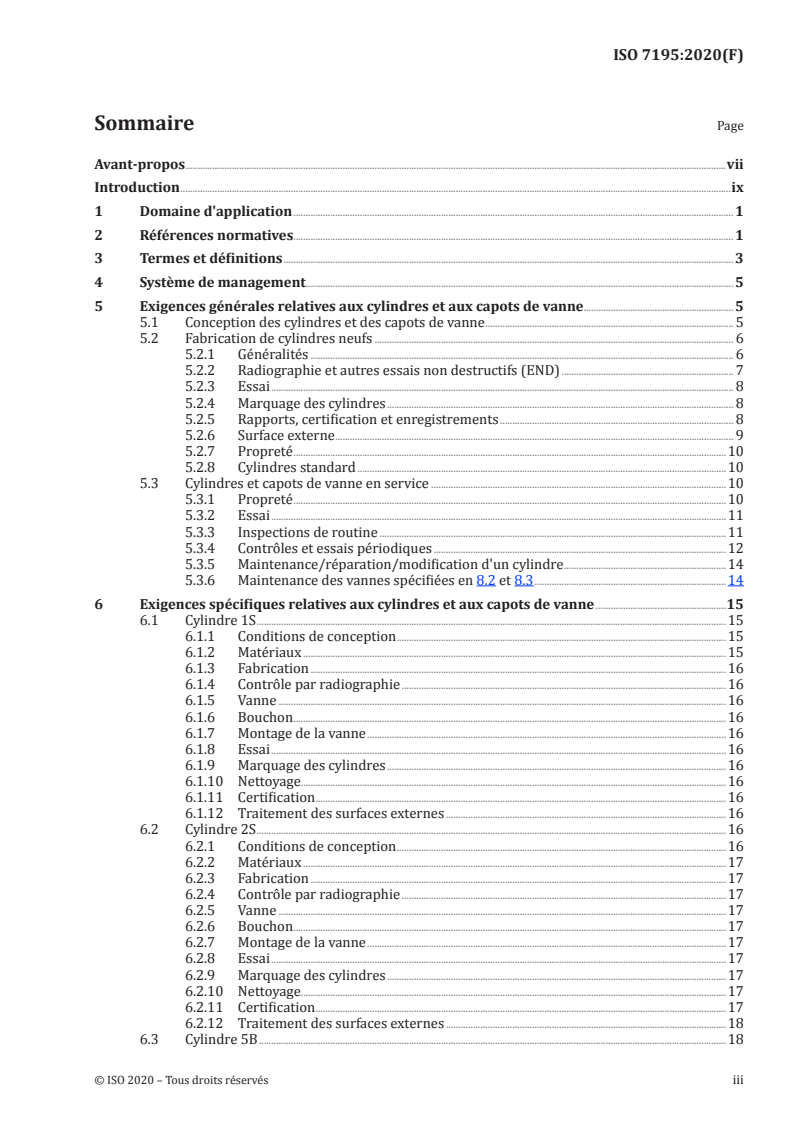
6.6.4 Contrôle par radiographie .22
6.6.5 Vanne .22
6.6.6 Bouchon .22
6.6.7 Montage de la vanne et du bouchon .22
6.6.8 Essai .22
6.6.9 Marquage des cylindres .23
6.6.10 Nettoyage.23
6.6.11 Certification .23
6.6.12 Traitement des surfaces externes .23
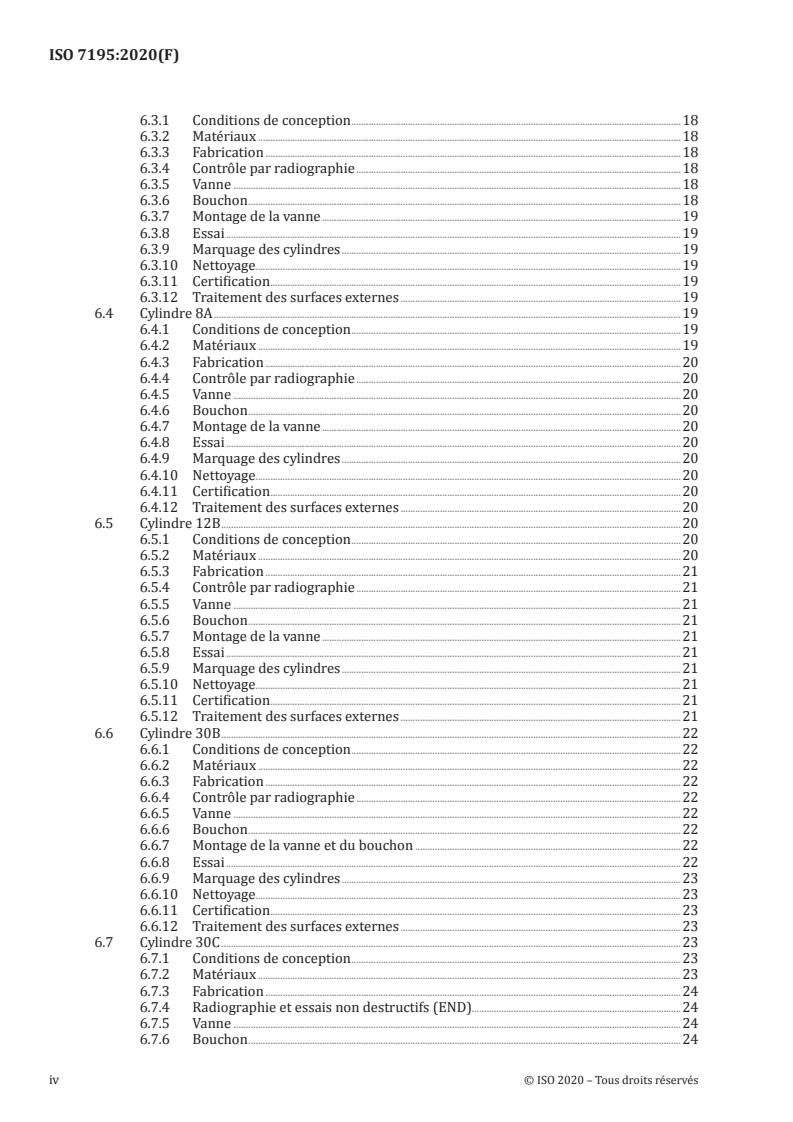
6.7 Cylindre 30C .23
6.7.1 Conditions de conception .23
6.7.2 Matériaux .23
6.7.3 Fabrication .24
6.7.4 Radiographie et essais non destructifs (END).24
6.7.5 Vanne .24
6.7.6 Bouchon .24
iv © ISO 2020 – Tous droits réservés
6.7.7 Montage de la vanne et du bouchon .24
6.7.8 Essai .24
6.7.9 Marquage des cylindres .24
6.7.10 Nettoyage.24
6.7.11 Certification .24
6.7.12 Traitement des surfaces externes .24
6.8 Cylindre 48Y ou 48X .25
6.8.1 Conditions de conception .25
6.8.2 Matériaux .25
6.8.3 Fabrication .26
6.8.4 Contrôle par radiographie .26
6.8.5 Vanne .26
6.8.6 Bouchon .26
6.8.7 Montage de la vanne et du bouchon .26
6.8.8 Essai .26
6.8.9 Marquage des cylindres .26
6.8.10 Nettoyage.26
6.8.11 Certification .27
6.8.12 Traitement des surfaces externes .27
7 Exigences générales pour les vannes et bouchons de cylindres .27
7.1 Procédé de fabrication des vannes et bouchons .27
7.1.1 Procédé.27
7.1.2 Matériaux .27
7.1.3 Certification des matériaux .27
7.1.4 Fabrication .28
7.1.5 Spécifications relatives à la relaxation des contraintes des matériaux .28
7.1.6 Nettoyage.28
7.1.7 Étamage des vannes et bouchons .29
7.1.8 Assemblage des vannes.29
7.1.9 Essais des vannes .30
7.1.10 Emballage des vannes et bouchons .31
7.1.11 Certification .31
7.2 Installation de la vanne et du bouchon spécifiés en 8.3 et 8.4 .31
8 Exigences spécifiques pour les vannes et bouchons de cylindres.32
8.1 Vannes pour cylindres 1S et 2S .32
8.1.1 Généralités .32
8.1.2 Conditions de conception .33
8.1.3 Matériaux .33
8.1.4 Marquage .33
8.2 Vanne de cylindre type 50 (3/4 in) .33
8.2.1 Conditions de conception .33
8.2.2 Matériaux .33
8.2.3 Certification des matériaux .34
8.2.4 Fabrication .34
8.2.5 Nettoyage.34
8.2.6 Étamage .34
8.2.7 Assemblage .34
8.2.8 Essai .34
8.3 Vanne de cylindre type 51 (1 in) .34
8.3.1 Conditions de conception .34
8.3.2 Matériaux .34
8.3.3 Certification des matériaux .35
8.3.4 Fabrication .35
8.3.5 Nettoyage.35
8.3.6 Étamage .35
8.3.7 Assemblage .35
8.3.8 Essai .36
8.4 Bouchon .36
8.4.1 Conditions de conception .36
8.4.2 Matériaux .36
8.4.3 Usinage .36
8.4.4 Nettoyage.37
8.4.5 Étamage .37
8.4.6 Certification .37
9 Transport .37
9.1 Indication d'intégrité .37
9.2 Cylindres neufs .37
9.3 Cylindres lavés .37
9.4 Autres cylindres .37
9.5 Protection externe.38
Bibliographie .95
vi © ISO 2020 – Tous droits réservés
Avant-propos
L'ISO (Organisation internationale de normalisation) est une fédération mondiale d'organismes
nationaux de normalisation (comités membres de l'ISO). L'élaboration des Normes internationales est
en général confiée aux comités techniques de l'ISO. Chaque comité membre intéressé par une étude
a le droit de faire partie du comité technique créé à cet effet. Les organisations internationales,
gouvernementales et non gouvernementales, en liaison avec l'ISO participent également aux travaux.
L'ISO collabore étroitement avec la Commission électrotechnique internationale (IEC) en ce qui
concerne la normalisation électrotechnique.
Les procédures utilisées pour élaborer le présent document et celles destinées à sa mise à jour sont
décrites dans les Directives ISO/IEC, Partie 1. Il convient, en particulier de prendre note des différents
critères d'approbation requis pour les différents types de documents ISO. Le présent document a été
rédigé conformément aux règles de rédaction données dans les Directives ISO/IEC, Partie 2 (voir www
.iso .org/ directives).
L'attention est attirée sur le fait que certains des éléments du présent document peuvent faire l'objet de
droits de propriété intellectuelle ou de droits analogues. L'ISO ne saurait être tenue pour responsable
de ne pas avoir identifié de tels droits de propriété et averti de leur existence. Les détails concernant
les références aux droits de propriété intellectuelle ou autres droits analogues identifiés lors de
l'élaboration du document sont indiqués dans l'Introduction et/ou dans la liste des déclarations de
brevets reçues par l'ISO (voir www .iso .org/ brevets).
Les appellations commerciales éventuellement mentionnées dans le présent document sont données
pour information, par souci de commodité, à l'intention des utilisateurs et ne sauraient constituer un
engagement.
Pour une explication de la nature volontaire des normes, la signification des termes et expressions
spécifiques de l'ISO liés à l'évaluation de la conformité, ou pour toute information au sujet de l'adhésion
de l'ISO aux principes de l'Organisation mondiale du commerce (OMC) concernant les obstacles
techniques au commerce (OTC), voir le lien suivant: www .iso .org/ iso/ fr/ avant -propos.
Le présent document a été élaboré par le comité technique ISO/TC 85, Énergie nucléaire, technologies
nucléaires, et radioprotection, sous-comité SC 5, Installations nucléaires, procédés et technologies, GT4,
Transport de matières radioactives.
Cette troisième édition annule et remplace la deuxième édition (ISO 7195:2005), qui a fait l'objet d'une
révision technique.
Les principales modifications par rapport à l'édition précédente sont les suivantes :
— légère modification du titre pour mieux refléter le domaine d'application du document ;
— réorganisation partielle de la structure générale du document, afin d'améliorer la clarté et de
faciliter la comparaison avec l'ANSI N14.1 ;
— suppression du modèle de cylindre 48G et ajout du modèle de cylindre 30C ;
— ajout des bouchons à tête creuse pour les cylindres de 30 in et 48 in (en variante aux bouchons à tête
hexagonale) ;
— mise à jour de la liste des références et de la liste des termes et définitions ;
— remplacement de « programme d'assurance de la qualité » par « système de management » ;
— remaniement des paragraphes relatifs à la fabrication, au contrôle périodique et à la recertification
afin d'améliorer la clarté ;
— introduction des essais non destructifs sur les cylindres 30B, 48X et 48Y, pouvant être réalisés à la
place des épreuves hydrauliques ayant lieu pendant le contrôle périodique, pourvu que les examens
supplémentaires soient réalisés au moment de la fabrication ;
— modification pour désormais autoriser l'utilisation de méthodes d'essai d'étanchéité autres que
celle qui est spécifiée ;
— remplacement des exigences d'arrimage existantes par une référence à l'Annexe IV de l'AIEA SSG-26 ;
— modification pour désormais interdire la réutilisation des vannes et bouchons qui ont été déposés
des cylindres ;
— révision de toutes les figures afin de corriger les erreurs, d'améliorer la clarté et d'ajouter des
informations manquantes.
Il convient que l'utilisateur adresse tout retour d'information ou toute question concernant le présent
document à l'organisme national de normalisation de son pays. Une liste exhaustive desdits organismes
se trouve à l'adresse www .iso .org/ fr/ members .html.
viii © ISO 2020 – Tous droits réservés
Introduction
Le transport de l'hexafluorure d'uranium (UF ) est une opération essentielle dans l'industrie nucléaire.
L'emballage et le transport de l'UF sont régis par les règlements appropriés relatifs au transport
des marchandises dangereuses, en vigueur dans chacun des pays sur les territoires desquels les
marchandises sont transportées. Le présent document n'a pas la primauté sur les règlements applicables
et ne dispense pas l'expéditeur et les autres parties concernées de se conformer auxdits règlements.
Pour de plus amples informations, l'utilisateur du présent document est invité à consulter le document
réglementaire approprié.
Selon le Règlement de transport des matières radioactives (SSR-6) de l'AIEA (Agence internationale de
l'énergie atomique), et tous les règlements reposant sur ce dernier, à l'exception des dispositions de son
paragraphe 634, l'hexafluorure d'uranium en quantités égales ou supérieures à 0,1 kg doit être emballé
et transporté conformément aux dispositions du présent document.
L'ANSI N14.1 a servi de référence pour l'industrie sur le plan international, et les cylindres standard
décrits dans l'ANSI N14.1 ont été largement employés pour le transport international d'UF . Toutefois,
dans certains cas, des adaptations mineures de cette norme américaine ont été nécessaires pour
répondre aux conditions locales existant dans certains pays. Par exemple, des matériaux équivalents
peuvent avoir été utilisés à la place des matériaux spécifiés. De plus, la certification des cylindres
comme récipients à pression a pu faire l'objet de procédures d'autorisation équivalentes propres aux
pays concernés au lieu de la procédure spécifiée aux États-Unis.
Le présent document fournit essentiellement des informations sur les emballages pour UF (y
compris les cylindres et capots de vanne). Il vise à assurer la compatibilité des cylindres d'UF entre
les différents utilisateurs de l'industrie nucléaire. Bien qu'il ait été élaboré à partir de l'ANSI N14.1, il
couvre et autorise également d'autres matériaux équivalents ainsi que d'autres procédures nationales
de certification équivalentes.
Tout au long du présent document et en conformité avec la pratique habituelle de l'ISO, les unités
métriques SI sont préférées aux unités impériales (qui sont données entre parenthèses à titre
informatif). Cependant, les appellations d'origine des cylindres sont basées sur le diamètre exprimé en
unités impériales (48'', par exemple).
Lorsqu'un composant courant, disponible dans le commerce, dispose de caractéristiques définies dans
un document normatif utilisant des unités non SI, seules les unités d'origine sont signalées.
NORME INTERNATIONALE ISO 7195:2020(F)
Energie nucléaire — Emballages pour le transport de
l’hexafluorure d’uranium (UF )
1 Domaine d'application
Le présent document fournit les éléments suivants :
— les spécifications des cylindres pour le transport de l'hexafluorure d'uranium (UF ) afin d'assurer
la compatibilité entre les différents utilisateurs ;
— la description de la conception des cylindres, sans avoir pour objet le développement de nouvelles
conceptions ;
— les exigences de fabrication pour l'approvisionnement de cylindres neufs conçus pour le transport
de quantités d'hexafluorure d'uranium égales ou supérieures à 0,1 kg ;
— les exigences de fabrication pour l'approvisionnement de nouveaux capots de vanne, de nouvelles
vannes et de nouveaux bouchons ; et
— les exigences relatives aux cylindres et aux capots de vanne en service.
2 Références normatives
Les documents suivants sont cités dans le texte de sorte qu'ils constituent, pour tout ou partie de leur
contenu, des exigences du présent document. Pour les références datées, seule l'édition citée s'applique.
Pour les références non datées, la dernière édition du document de référence s'applique (y compris les
éventuels amendements).
ISO 263, Filetages ISO en inches — Vue d'ensemble et sélection pour boulonnerie — Diamètres de 0,06 à 6 in
ISO 6508-1, Matériaux métalliques — Essai de dureté Rockwell — Partie 1: Méthode d'essai
ISO 9712, Essais non destructifs — Qualification et certification du personnel END
ISO 12807, Sûreté des transports de matières radioactives — Contrôle de l'étanchéité des colis
ANSI/ASME B1.1, Unified Inch Screw Threads (UN and UNR Thread Form)
ANSI/ASME B1.5, Acme Screw Threads
ANSI/ASME B1.20.1, Pipe Threads, General Purpose (Inch)
ANSI/ASME B16.11, Forged Steel Fittings, Socket-Welding and Threaded
ANSI/AWS A5.8M/A5.8, Specification for Filler Metals for Brazing and Braze Welding
ANSI/AWS A5.14/A5.14M, Specification for Nickel and Nickel-Alloy Bare Welding Electrodes and Rods
ANSI/AWS D1.1/D1.1M, Structural Welding Code — Steel
ANSI/CGA V-1, Standard for Compressed Gas Cylinder Valve Outlet and Inlet Connections
ASTM A20/A20M, Standard Specification for General Requirements for Steel Plates for Pressure Vessels
ASTM A36/A36M, Standard Specification for Carbon Structural Steel
ASTM A53/A53M, Standard Specification for Pipe, Black and Hot-Dipped, Zinc–Coated, Welded and
Seamless
ASTM A105/A105M, Standard Specification for Carbon Steel Forgings for Piping Applications
ASTM A106/A106M, Standard Specification for Seamless Carbon Steel Pipe for High-Temperature Service
ASTM A108, Standard Specification for Steel Bar, Carbon and Alloy, Cold-Finished
ASTM A131/A131M, Standard Specificati
...