

ISO 2727:1973
(Main)Modular units for machine tool construction — Headstocks
General Information
- Abstract
Specifies certain dimensions relating to the interchangeability of headstocks used special purpose machines constructed from modular units. Gives furthermore classification and designation.
- Status
- Published
- Publication Date
- 31-Oct-1973
- Technical Committee
- ISO/TC 39 - Machine tools
- Drafting Committee
- ISO/TC 39 - Machine tools
- Current Stage
- 9093 - International Standard confirmed
- Start Date
- 12-Jan-2023
- Completion Date
- 29-Aug-2026
Buy Documents
ISO 2727:1973 - Modular units for machine tool construction -- Headstocks
ISO 2727:1973 - Modular units for machine tool construction — Headstocks/1/1973
ISO 2727:1973 - Éléments standard pour la construction des machines-outils -- Supports de tetes multibroches
ISO 2727:1973 - Éléments standard pour la construction des machines-outils -- Supports de tetes multibroches
ISO 2727:1973 - Éléments standard pour la construction des machines-outils — Supports de têtes multibroches/1/1973
ISO 2727:1973 - Éléments standard pour la construction des machines-outils — Supports de têtes multibroches/1/1973
Overview
ISO 2727:1973 is an international standard published by the International Organization for Standardization (ISO) that defines modular headstocks used in machine tool construction, specifically for special purpose machines built from modular units. This standard focuses on establishing dimensional requirements to ensure the interchangeability of headstocks, facilitating modularity and compatibility in machine tool assembly.
First issued in 1973, ISO 2727 addresses the classification, designation, and key dimensions of headstocks, which are critical elements in machine tools. By standardizing these elements, the standard promotes efficiency in manufacturing, maintenance, and customization of machine tools.
Key Topics
Scope and Application
ISO 2727 applies primarily to headstocks as modular units in specialized machine tools. It specifies dimensions essential for interchangeability and compatibility when assembling modular tool units.Classification and Designation
Headstocks are classified based on the nominal saddle width, with nine standardized sizes:- 125 mm
- 160 mm
- 200 mm
- 250 mm
- 320 mm
- 400 mm
- 500 mm
- 630 mm
- 800 mm
Dimension Specifications
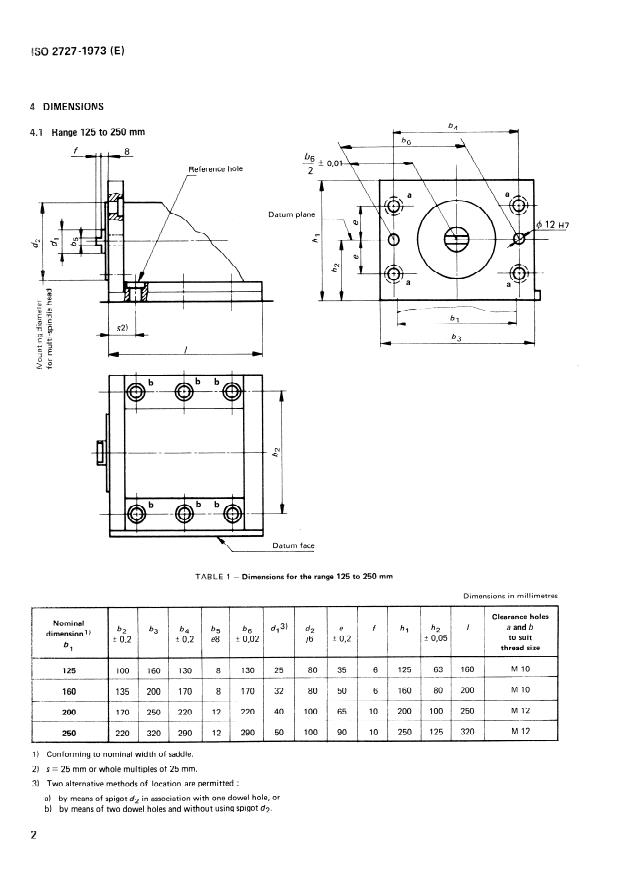
Dimensions differ based on the size range:- For smaller sizes (125 to 250 mm), dimensions are tightly specified including spindle center height, with options for tenon drive or shaft and key drive.
- For larger sizes (320 to 800 mm), dimension specifications include clearance holes and nominal widths, allowing drive methods such as couplings or gear drives with less strict spindle height requirements.
Interchangeability Features
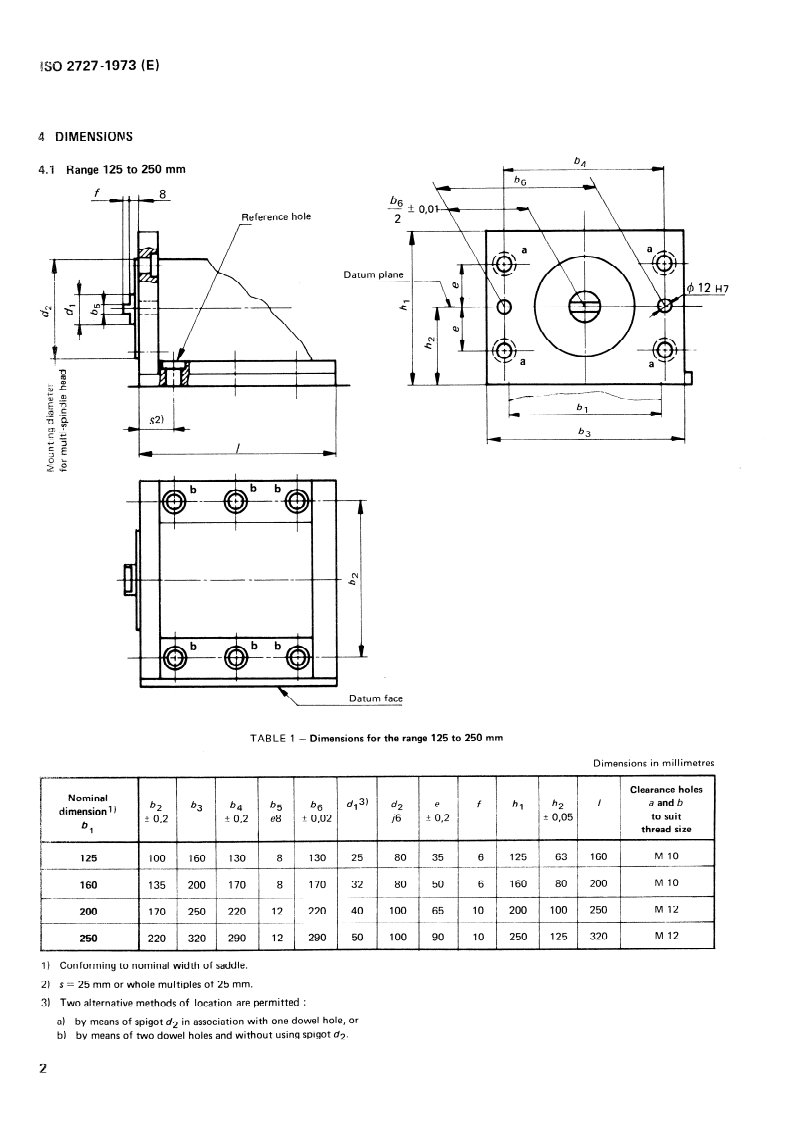
The standard includes precise measurements such as clearance hole sizes, dowel hole placements, and spigot dimensions to allow consistent assembly across different manufacturers and national standards. Two alternative location methods by spigot or dowel holes are permitted.
Applications
ISO 2727:1973 is valuable for industries and engineers involved in the design, fabrication, and maintenance of special purpose machine tools using modular construction techniques. Key applications include:
- Modular Machine Design: Facilitates the design of machine tools from interchangeable headstock modules, improving modular manufacturing efficiency.
- Machine Tool Manufacturing: Enables manufacturers worldwide to produce compatible headstocks adhering to standardized dimensions for seamless assembly.
- Maintenance and Upgrading: Simplifies replacement and upgrading of headstocks in existing modular machine tools due to standardized fit and connection dimensions.
- Multi-Spindle Machines: Supports multi-spindle headstock designs through compatible modular units, enhancing machining productivity and flexibility.
By enabling internationally recognized dimensional standards, ISO 2727 helps organizations reduce manufacturing costs, improve machine reliability, and shorten time-to-market for customized tools.
Related Standards
Professionals working with ISO 2727:1973 may also consider these related standards for comprehensive machine tool modularity and construction guidance:
- ISO 230 Series – Test codes for machine tools, which complement construction standards by specifying testing methods for headstock components.
- ISO 13399 – Tooling and cutting tool data representation, useful in integrating modular headstocks with cutting tools and tool holders.
- ISO 5288 – Modular toolholders for machine tools, applicable in ensuring compatibility of modular components within special purpose machines.
- ISO 9001 – Quality management systems standards, supporting controlled manufacturing processes for modular machine components.
Keywords: ISO 2727, modular headstocks, machine tool construction, special purpose machines, interchangeability, headstock dimensions, modular units, machine tool standard, spindle center height, nominal saddle width.
Buy Documents
ISO 2727:1973 - Modular units for machine tool construction -- Headstocks
ISO 2727:1973 - Modular units for machine tool construction — Headstocks/1/1973
ISO 2727:1973 - Éléments standard pour la construction des machines-outils -- Supports de tetes multibroches
ISO 2727:1973 - Éléments standard pour la construction des machines-outils -- Supports de tetes multibroches
ISO 2727:1973 - Éléments standard pour la construction des machines-outils — Supports de têtes multibroches/1/1973
ISO 2727:1973 - Éléments standard pour la construction des machines-outils — Supports de têtes multibroches/1/1973
Get Certified
Connect with accredited certification bodies for this standard

DVS-ZERT GmbH
German welding certification society.
CARES (UK Certification Authority for Reinforcing Steels)
UK certification for reinforcing steels and construction.
EWF/IIW (European/International Welding Federation)
International welding personnel certification.
Sponsored listings
Frequently Asked Questions
ISO 2727:1973 is a standard published by the International Organization for Standardization (ISO). Its full title is "Modular units for machine tool construction — Headstocks". This standard covers: Specifies certain dimensions relating to the interchangeability of headstocks used special purpose machines constructed from modular units. Gives furthermore classification and designation.
Specifies certain dimensions relating to the interchangeability of headstocks used special purpose machines constructed from modular units. Gives furthermore classification and designation.
ISO 2727:1973 is classified under the following ICS (International Classification for Standards) categories: 25.060.10 - Modular units and other devices. The ICS classification helps identify the subject area and facilitates finding related standards.
ISO 2727:1973 is available in PDF format for immediate download after purchase. The document can be added to your cart and obtained through the secure checkout process. Digital delivery ensures instant access to the complete standard document.
Standards Content (Sample)
INTERNATIONAL STANDARD
INTERNATIONAL ORGANIZATION FOR STANDARDIZATION l MEXAYHAPOAHAII OPTAHM3ALW-l I-IO CTAH~APTM3ALMM~ORGANlSATION INTERNATIONALE DE NORMALISATION
Modular units for machine tool cdnstruction - Headstocks
First edition - 1973-1 l-15
Ref. No. IS0 2727-1973 (E)
UDC 621.9
Descriptors : machine tools, elements, modular structures, multi-spindle head, dimensions, interchangeability.
Price based on 3 pages
FOREWORD
IS0 (the International Organization for Standardization) is a worldwide federation
of national standards institutes (IS0 Member Bodies). The work of developing
International Standards is carried out through IS0 Technical Committees. Every
Member Body interested in a subject for which a Technical Committee has been set
up has the right to be represented on that Committee. International organizations,
governmental and non-governmental, in liaison with ISO, also take part in the work.
Draft International Standards adopted by the Technical Committees are circulated
to the Member Bodies for approval before their acceptance as International
Qandards by the IS0 Council.
International Standard IS0 2727 was drawn up by Technical Committee
lSO/TC 39, Machine-tools, and circulated to the Member Bodies in July 1972.
It has been approved by the Member Bodies of the following countries :
Australia India Switzerland
Belgium Ireland Thailand
Czechoslovakia Poland Turkey
Egypt, Arab Rep. of Romania U.S.A.
Germany South Africa, Rep. of
Hungary Sweden
The Member Bodies of the following countries
expressed disapproval of the
document on technica
grounds :
France
Japan
United Kingdom
0 International Organization for Standardization, 1973 l
Printed in Switzerland
INTERNATIONAL STANDARD
IS0 2727-1973 (E)
Modular units for machine tool construction - Headstocks
1 SCOPE AND FIELD OF APPLICATION
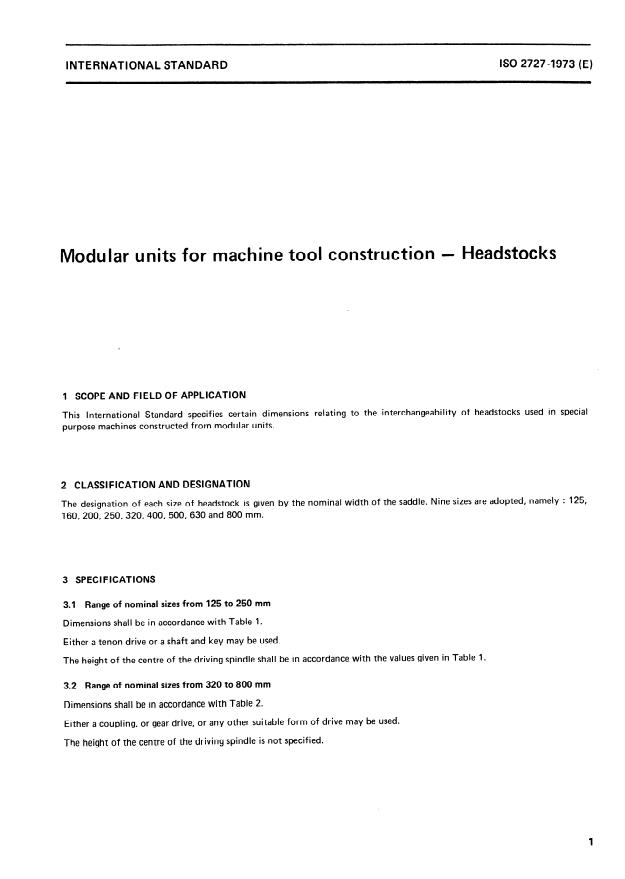
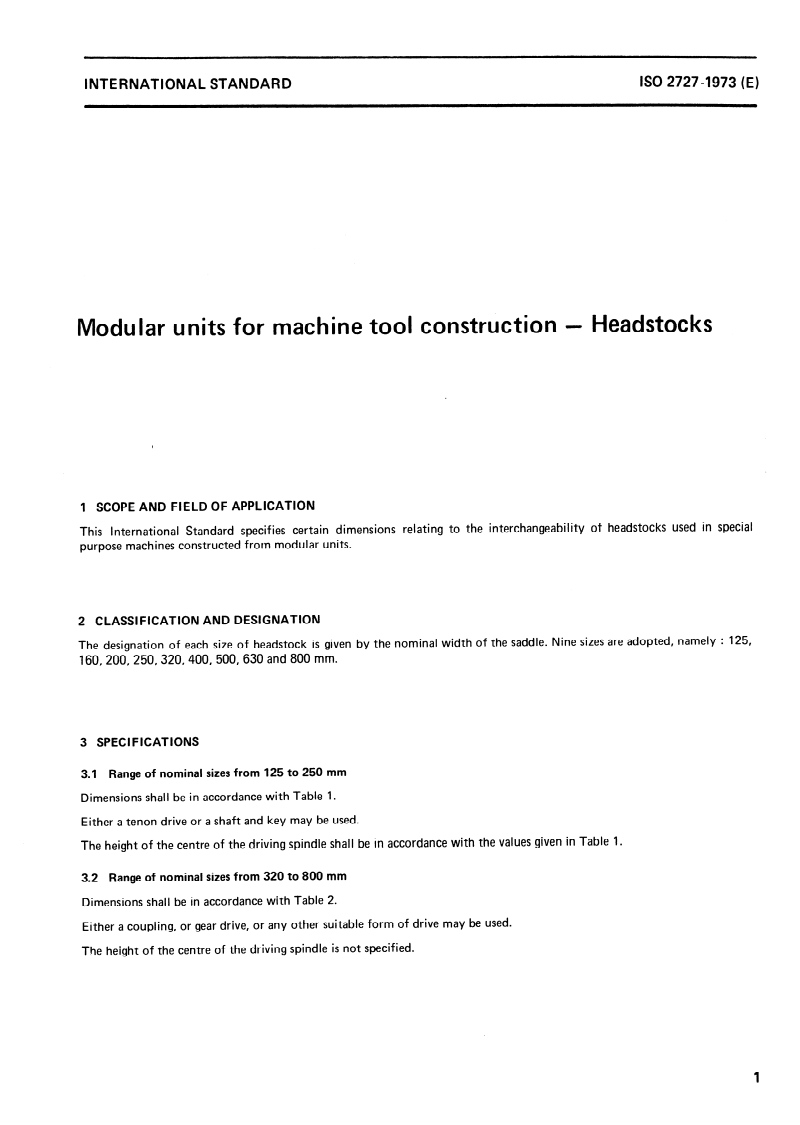
This International Standard specifies certain dimensions relating to the interchangeability of headstocks used in special
purpose machines constructed from modular units.
2 CLASSIFICATION AND DESIGNATION
The designation of each size of headstock is given by the nominal width of the saddle. Nine sizes are adopted, namely : 125,
160,200,250,320,400,500,630 and 800 mm.
3 SPECIFICATIONS
3.1 Range of nominal sizes from 125 to 250 mm
Dimensions shall be in accordance with Table 1.
Either a tenon drive or a shaft and key may be used.
The height of the c
...
INTERNATIONAL STANDARD
INTERNATIONAL ORGANIZATION FOR STANDARDIZATION l MEXAYHAPOAHAII OPTAHM3ALW-l I-IO CTAH~APTM3ALMM~ORGANlSATION INTERNATIONALE DE NORMALISATION
Modular units for machine tool cdnstruction - Headstocks
First edition - 1973-1 l-15
Ref. No. IS0 2727-1973 (E)
UDC 621.9
Descriptors : machine tools, elements, modular structures, multi-spindle head, dimensions, interchangeability.
Price based on 3 pages
FOREWORD
IS0 (the International Organization for Standardization) is a worldwide federation
of national standards institutes (IS0 Member Bodies). The work of developing
International Standards is carried out through IS0 Technical Committees. Every
Member Body interested in a subject for which a Technical Committee has been set
up has the right to be represented on that Committee. International organizations,
governmental and non-governmental, in liaison with ISO, also take part in the work.
Draft International Standards adopted by the Technical Committees are circulated
to the Member Bodies for approval before their acceptance as International
Qandards by the IS0 Council.
International Standard IS0 2727 was drawn up by Technical Committee
lSO/TC 39, Machine-tools, and circulated to the Member Bodies in July 1972.
It has been approved by the Member Bodies of the following countries :
Australia India Switzerland
Belgium Ireland Thailand
Czechoslovakia Poland Turkey
Egypt, Arab Rep. of Romania U.S.A.
Germany South Africa, Rep. of
Hungary Sweden
The Member Bodies of the following countries
expressed disapproval of the
document on technica
grounds :
France
Japan
United Kingdom
0 International Organization for Standardization, 1973 l
Printed in Switzerland
INTERNATIONAL STANDARD
IS0 2727-1973 (E)
Modular units for machine tool construction - Headstocks
1 SCOPE AND FIELD OF APPLICATION
This International Standard specifies certain dimensions relating to the interchangeability of headstocks used in special
purpose machines constructed from modular units.
2 CLASSIFICATION AND DESIGNATION
The designation of each size of headstock is given by the nominal width of the saddle. Nine sizes are adopted, namely : 125,
160,200,250,320,400,500,630 and 800 mm.
3 SPECIFICATIONS
3.1 Range of nominal sizes from 125 to 250 mm
Dimensions shall be in accordance with Table 1.
Either a tenon drive or a shaft and key may be used.
The height of the c
...
NORME INTERNATIONALE
INTERNATIONAL ORGANIZATION FOR STANDARDIZATION l MEX~yHAPOfiHAR OPTAHM3ALWI I-l0 CTAHAAPTM3AI.&iM-ORGANISATION INTERNATIONALE DE NORMALISATION
ÉIéments standard pour la construction des machines-outils -
Supports de têtes multibroches
Première édition - 1973-l 1 o 15
- ~~
z
Réf. No : ISO 2727-1973 (F)
Y CDU 621.9
Descripteurs : machine outil, élément, structure modulaire, tête multibroches, dimension, interchangeabilité.
Prix basé sur 3 pages
AVANT-PROPOS
ISO (Organisation Internationale de Normalisation) est une fédération mondiale
d’organismes nationaux de normalisation (Comités Membres ISO). L’élaboration de
Normes internationales est confiée aux Comités Techniques ISO. Chaque Comité
Membre intéressé par une étude a le droit de faire partie du Comité Technique
correspondant. Les organisations internationales, gouvernementales et non
gouvernementales, en liaison avec I’ISO, participent également aux travaux.
Les Projets de Normes Internationales adoptés par les Comités Techniques sont
soumis aux Comités Membres pour approbation, avant leur acceptation comme
Normes Internationales par le Conseil de I’ISO.
La Norme Internationale ISO 2727 a été établie par le Comité Technique
ISO/TC 39, Machines-outils, et soumise aux Comités Membres en juillet 1972.
Elle a été approuvée par les Comités Membres des pays suivants :
Afrique du Sud, Rép. d’ Inde Tchécoslovaquie
Irlande Thaïlande
Allemagne
Pologne Turquie
Australie
Roumanie U.S.A.
Belgique
Suède
Egypte, Rép. arabe d’
Suisse
Hongrie
res des pays suivants ont d ésappro uvé le document pour des
Les Comités Memb
raisons techniques :
France
Japon
Royaume-Uni
0 Organisation Internationale de Normalisation, 1973 l
Imprimé en Suisse
NORME INTERNATIONALE
60 2727-1973 (F)
Éléments standard pour la construction des machines-outils -
Supports de têtes multibroches
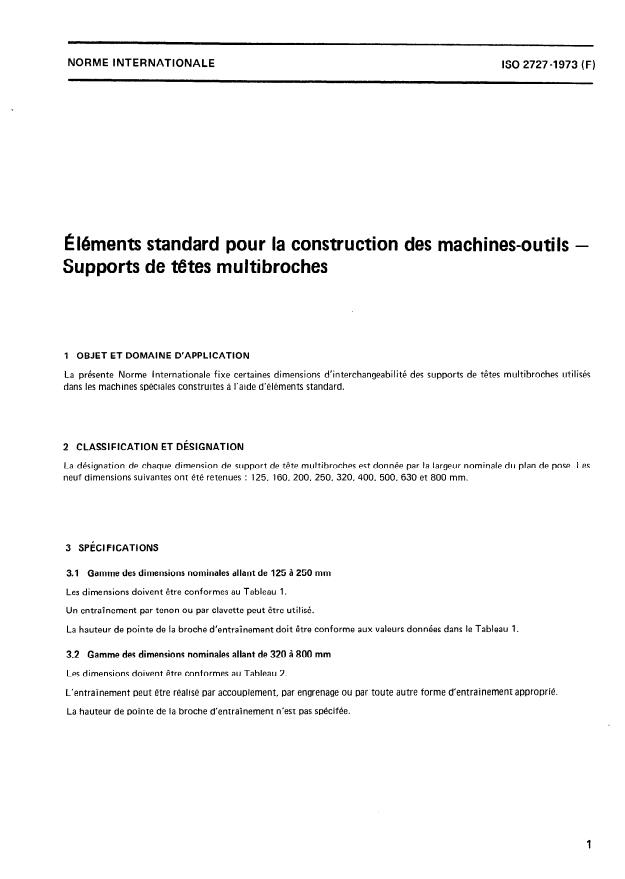
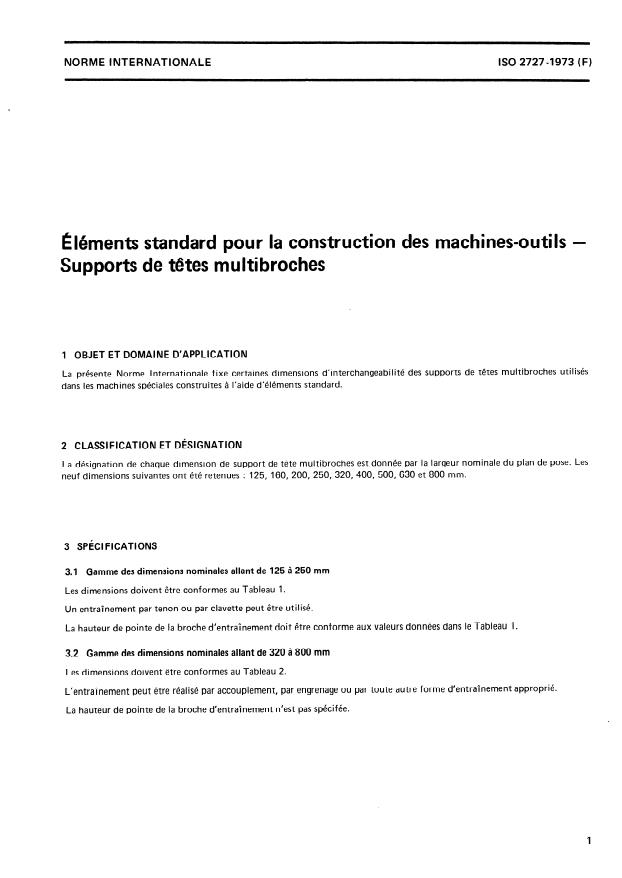
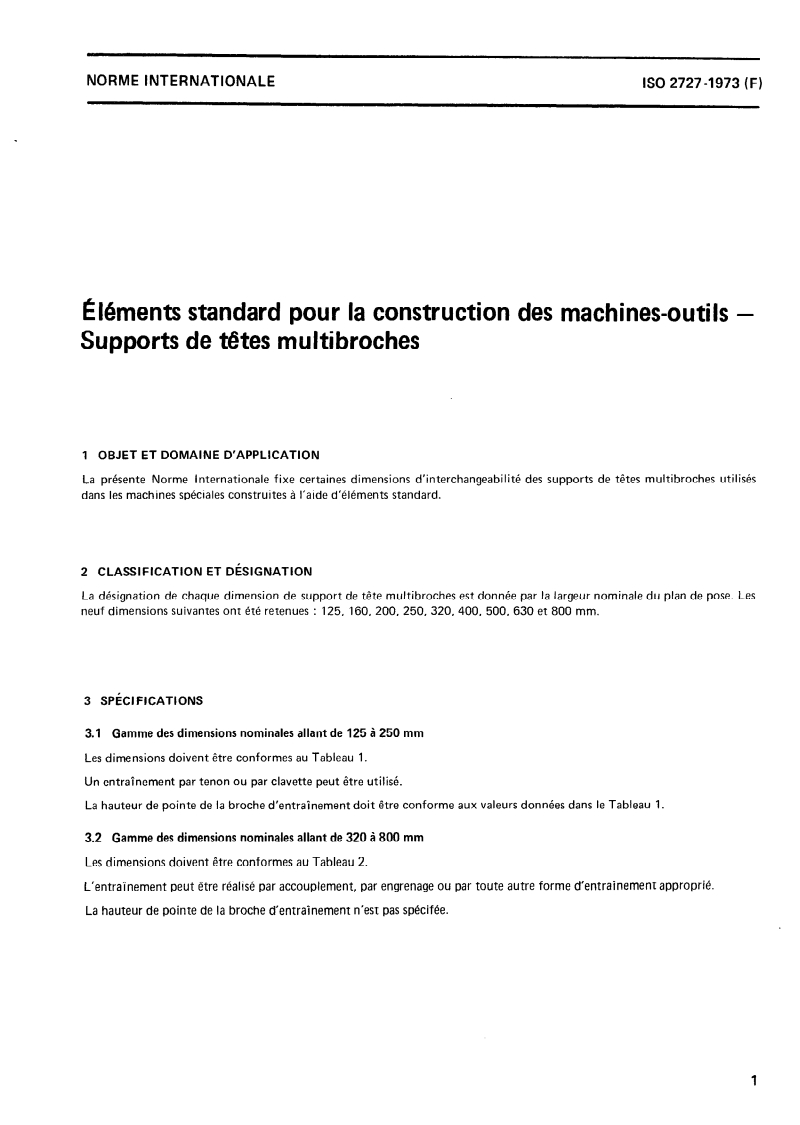
1 OBJET ET DOMAINE D’APPLICATION
La présente Norme Internationale fixe certaines dimensions d’interchangeabilité des supports de têtes multibroches utilisés
dans les machines spéciales construites à l’aide d’éléments standard.
2 CLASSlFICATION ET DÉSIGNATION
La désignation de chaque dimension de support de tête multibroches est donnée par la largeur nominale du plan de pose. Les
neuf dimensions suivantes ont été retenues : 125, 160,200, 250,320
...
NORME INTERNATIONALE
INTERNATIONAL ORGANIZATION FOR STANDARDIZATION l MEX~yHAPOfiHAR OPTAHM3ALWI I-l0 CTAHAAPTM3AI.&iM-ORGANISATION INTERNATIONALE DE NORMALISATION
ÉIéments standard pour la construction des machines-outils -
Supports de têtes multibroches
Première édition - 1973-l 1 o 15
- ~~
Réf. No : ISO 2727-1973 (F)
CDU 621.9
Descripteurs : machine outil, élément, structure modulaire, tête multibroches, dimension, interchangeabilité.
Prix basé sur 3 pages
AVANT-PROPOS
ISO (Organisation Internationale de Normalisation) est une fédération mondiale
d’organismes nationaux de normalisation (Comités Membres ISO). L’élaboration de
Normes internationales est confiée aux Comités Techniques ISO. Chaque Comité
Membre intéressé par une étude a le droit de faire partie du Comité Technique
correspondant. Les organisations internationales, gouvernementales et non
gouvernementales, en liaison avec I’ISO, participent également aux travaux.
Les Projets de Normes Internationales adoptés par les Comités Techniques sont
soumis aux Comités Membres pour approbation, avant leur acceptation comme
Normes Internationales par le Conseil de I’ISO.
La Norme Internationale ISO 2727 a été établie par le Comité Technique
ISO/TC 39, Machines-outils, et soumise aux Comités Membres en juillet 1972.
Elle a été approuvée par les Comités Membres des pays suivants :
Afrique du Sud, Rép. d’ Inde Tchécoslovaquie
Allemagne Irlande Thaïlande
Australie Pologne Turquie
Belgique Roumanie U.S.A.
Egypte, Rép. arabe d’ Suède
Hongrie Suisse
Les Comités Membres des pays suivants ont désapprouvé le document pour des
raisons techniques :
France
Japon
Royaume-Uni
0 Organisation Internationale de Normalisation, 1973 l
Imprimé en Suisse
NORME INTERNATIONALE
60 2727-1973 (F)
Éléments standard pour la construction des machines-outils -
Supports de têtes multibroches
1 OBJET ET DOMAINE D’APPLDCATION
La présente Norme Internationale fixe certaines dimensions d’interchangeabilité des supports de têtes multibroches utilisés
dans les machines spéciales construites à l’aide d’éléments standard.
2 CLASSIFICATION ET DÉSIGNATION
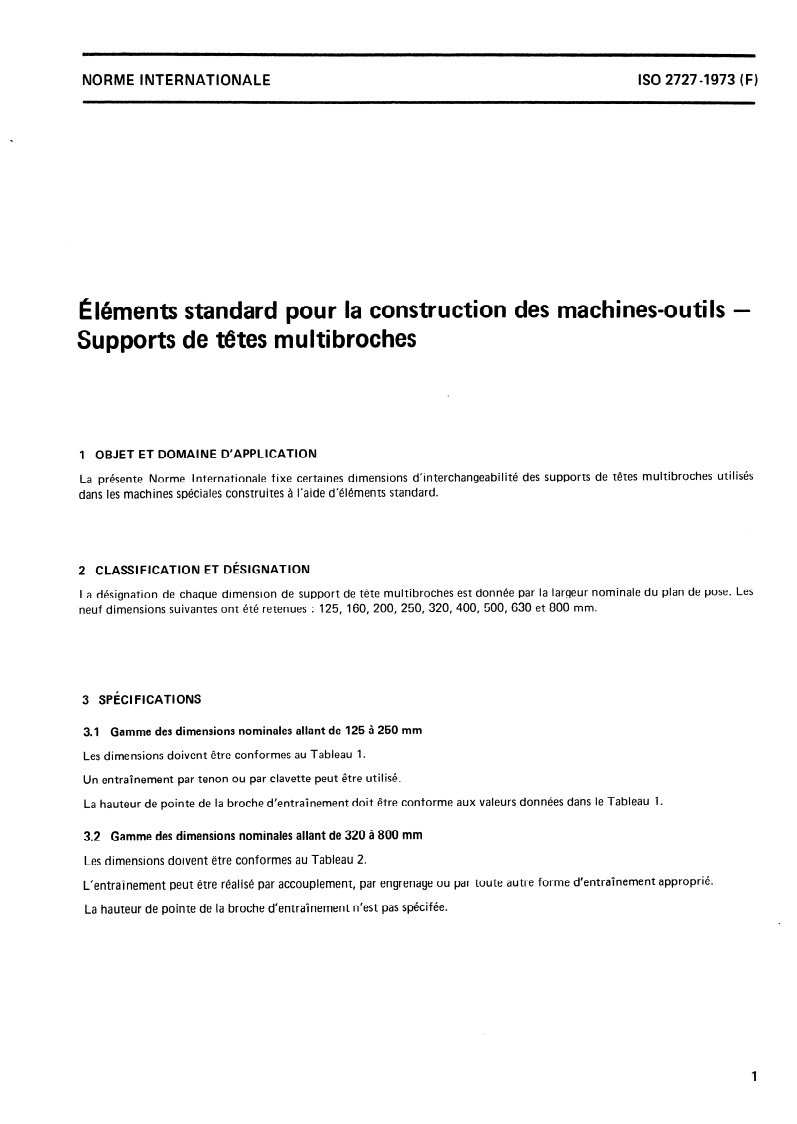
La désignation de chaque dimension de support de tête multibroches est donnée par la largeur nominale du plan de pose. Les
neuf dimensions suivantes ont été retenues : 125,160,200,250,320,400,500,630 et800 mm.
3 SPÉCIFICATIONS
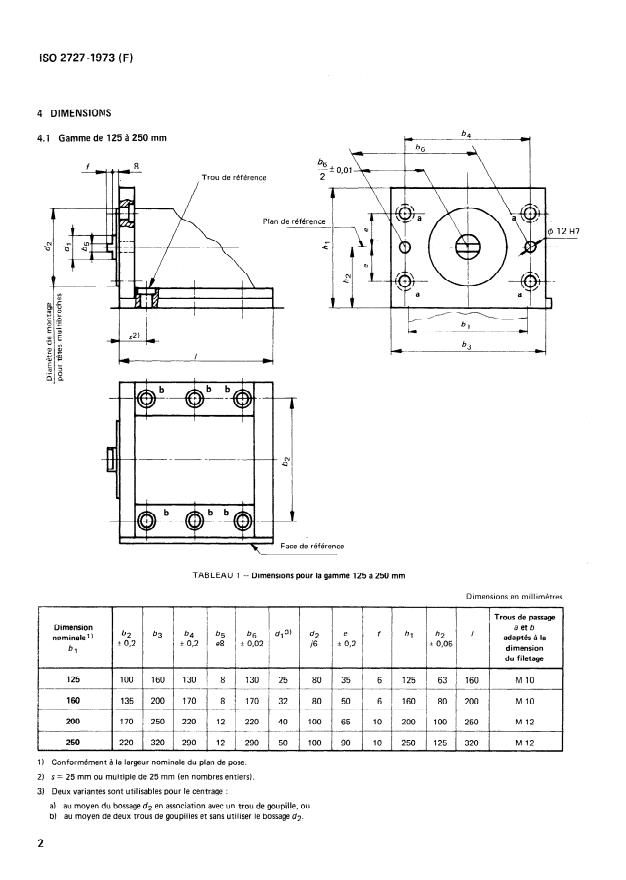
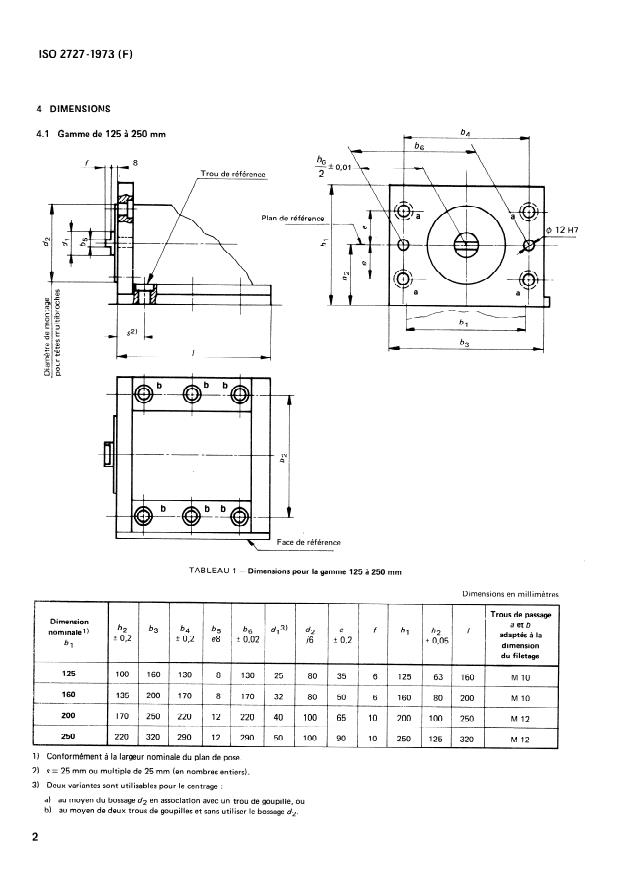
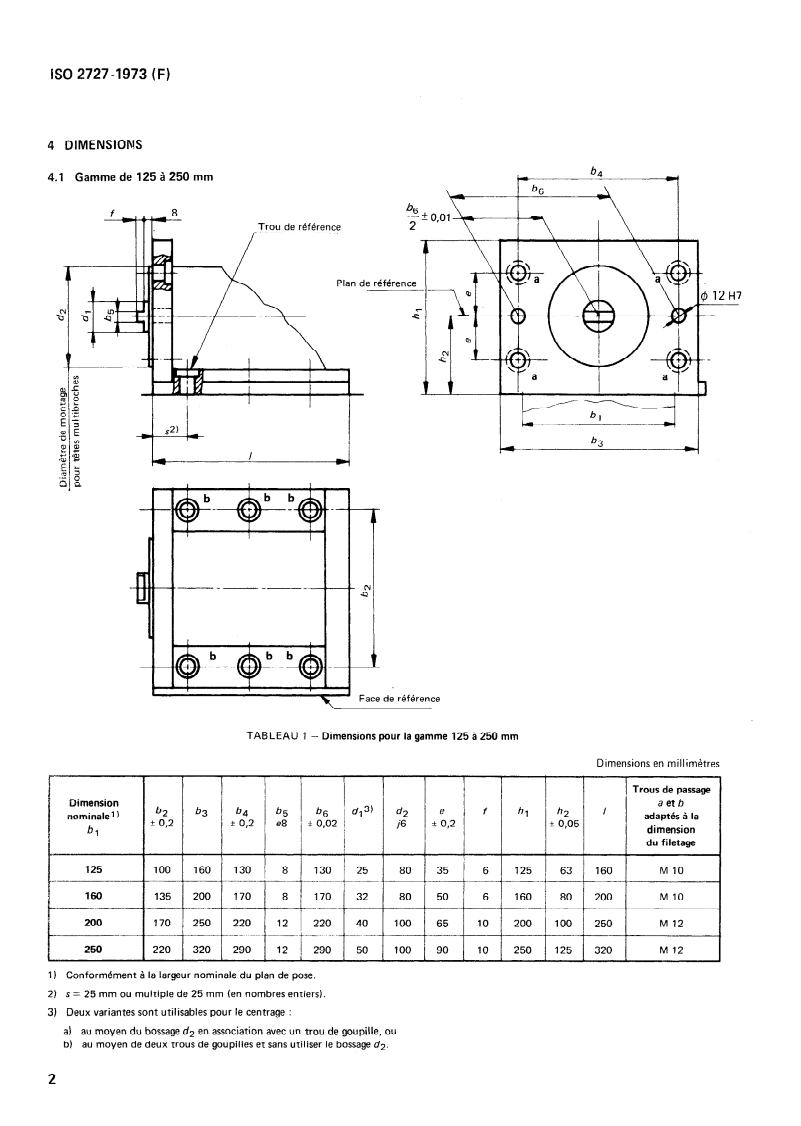
3.1 Gamme des dimensions nominales allant de 125 à 250 mm
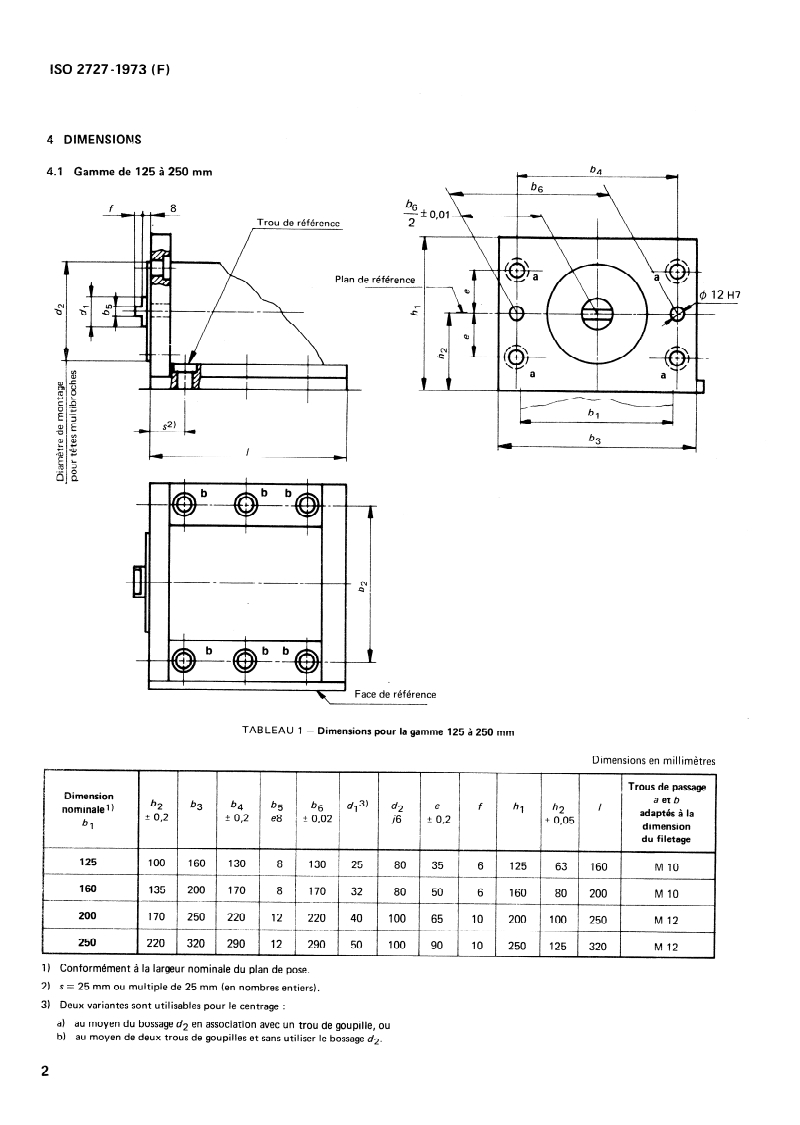
Les dimensions doivent être conformes au Tableau 1.
Un entraînement par tenon ou par clavette peut être utilisé.
La hauteur de pointe de la broche d’entraînement doit être conforme aux valeurs données dans
...
NORME INTERNATIONALE
INTERNATIONAL ORGANIZATION FOR STANDARDIZATION l MEX~yHAPOfiHAR OPTAHM3ALWI I-l0 CTAHAAPTM3AI.&iM-ORGANISATION INTERNATIONALE DE NORMALISATION
ÉIéments standard pour la construction des machines-outils -
Supports de têtes multibroches
Première édition - 1973-l 1 o 15
- ~~
z
Réf. No : ISO 2727-1973 (F)
Y CDU 621.9
Descripteurs : machine outil, élément, structure modulaire, tête multibroches, dimension, interchangeabilité.
Prix basé sur 3 pages
AVANT-PROPOS
ISO (Organisation Internationale de Normalisation) est une fédération mondiale
d’organismes nationaux de normalisation (Comités Membres ISO). L’élaboration de
Normes internationales est confiée aux Comités Techniques ISO. Chaque Comité
Membre intéressé par une étude a le droit de faire partie du Comité Technique
correspondant. Les organisations internationales, gouvernementales et non
gouvernementales, en liaison avec I’ISO, participent également aux travaux.
Les Projets de Normes Internationales adoptés par les Comités Techniques sont
soumis aux Comités Membres pour approbation, avant leur acceptation comme
Normes Internationales par le Conseil de I’ISO.
La Norme Internationale ISO 2727 a été établie par le Comité Technique
ISO/TC 39, Machines-outils, et soumise aux Comités Membres en juillet 1972.
Elle a été approuvée par les Comités Membres des pays suivants :
Afrique du Sud, Rép. d’ Inde Tchécoslovaquie
Irlande Thaïlande
Allemagne
Pologne Turquie
Australie
Roumanie U.S.A.
Belgique
Suède
Egypte, Rép. arabe d’
Suisse
Hongrie
res des pays suivants ont d ésappro uvé le document pour des
Les Comités Memb
raisons techniques :
France
Japon
Royaume-Uni
0 Organisation Internationale de Normalisation, 1973 l
Imprimé en Suisse
NORME INTERNATIONALE
60 2727-1973 (F)
Éléments standard pour la construction des machines-outils -
Supports de têtes multibroches
1 OBJET ET DOMAINE D’APPLICATION
La présente Norme Internationale fixe certaines dimensions d’interchangeabilité des supports de têtes multibroches utilisés
dans les machines spéciales construites à l’aide d’éléments standard.
2 CLASSlFICATION ET DÉSIGNATION
La désignation de chaque dimension de support de tête multibroches est donnée par la largeur nominale du plan de pose. Les
neuf dimensions suivantes ont été retenues : 125, 160,200, 250,320
...
NORME INTERNATIONALE
INTERNATIONAL ORGANIZATION FOR STANDARDIZATION l MEX~yHAPOfiHAR OPTAHM3ALWI I-l0 CTAHAAPTM3AI.&iM-ORGANISATION INTERNATIONALE DE NORMALISATION
ÉIéments standard pour la construction des machines-outils -
Supports de têtes multibroches
Première édition - 1973-l 1 o 15
- ~~
Réf. No : ISO 2727-1973 (F)
CDU 621.9
Descripteurs : machine outil, élément, structure modulaire, tête multibroches, dimension, interchangeabilité.
Prix basé sur 3 pages
AVANT-PROPOS
ISO (Organisation Internationale de Normalisation) est une fédération mondiale
d’organismes nationaux de normalisation (Comités Membres ISO). L’élaboration de
Normes internationales est confiée aux Comités Techniques ISO. Chaque Comité
Membre intéressé par une étude a le droit de faire partie du Comité Technique
correspondant. Les organisations internationales, gouvernementales et non
gouvernementales, en liaison avec I’ISO, participent également aux travaux.
Les Projets de Normes Internationales adoptés par les Comités Techniques sont
soumis aux Comités Membres pour approbation, avant leur acceptation comme
Normes Internationales par le Conseil de I’ISO.
La Norme Internationale ISO 2727 a été établie par le Comité Technique
ISO/TC 39, Machines-outils, et soumise aux Comités Membres en juillet 1972.
Elle a été approuvée par les Comités Membres des pays suivants :
Afrique du Sud, Rép. d’ Inde Tchécoslovaquie
Allemagne Irlande Thaïlande
Australie Pologne Turquie
Belgique Roumanie U.S.A.
Egypte, Rép. arabe d’ Suède
Hongrie Suisse
Les Comités Membres des pays suivants ont désapprouvé le document pour des
raisons techniques :
France
Japon
Royaume-Uni
0 Organisation Internationale de Normalisation, 1973 l
Imprimé en Suisse
NORME INTERNATIONALE
60 2727-1973 (F)
Éléments standard pour la construction des machines-outils -
Supports de têtes multibroches
1 OBJET ET DOMAINE D’APPLDCATION
La présente Norme Internationale fixe certaines dimensions d’interchangeabilité des supports de têtes multibroches utilisés
dans les machines spéciales construites à l’aide d’éléments standard.
2 CLASSIFICATION ET DÉSIGNATION
La désignation de chaque dimension de support de tête multibroches est donnée par la largeur nominale du plan de pose. Les
neuf dimensions suivantes ont été retenues : 125,160,200,250,320,400,500,630 et800 mm.
3 SPÉCIFICATIONS
3.1 Gamme des dimensions nominales allant de 125 à 250 mm
Les dimensions doivent être conformes au Tableau 1.
Un entraînement par tenon ou par clavette peut être utilisé.
La hauteur de pointe de la broche d’entraînement doit être conforme aux valeurs données dans
...