

ISO 6333:1986
(Main)Water quality — Determination of manganese — Formaldoxime spectrometric method
General Information
- Abstract
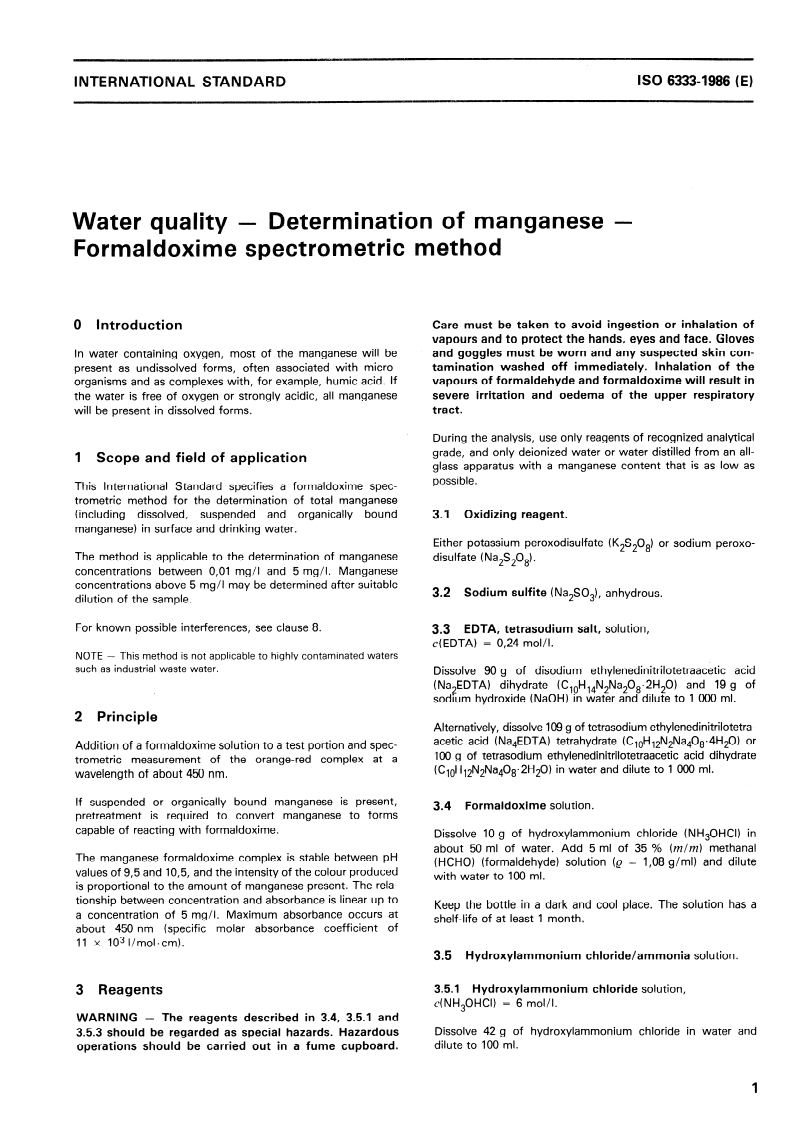
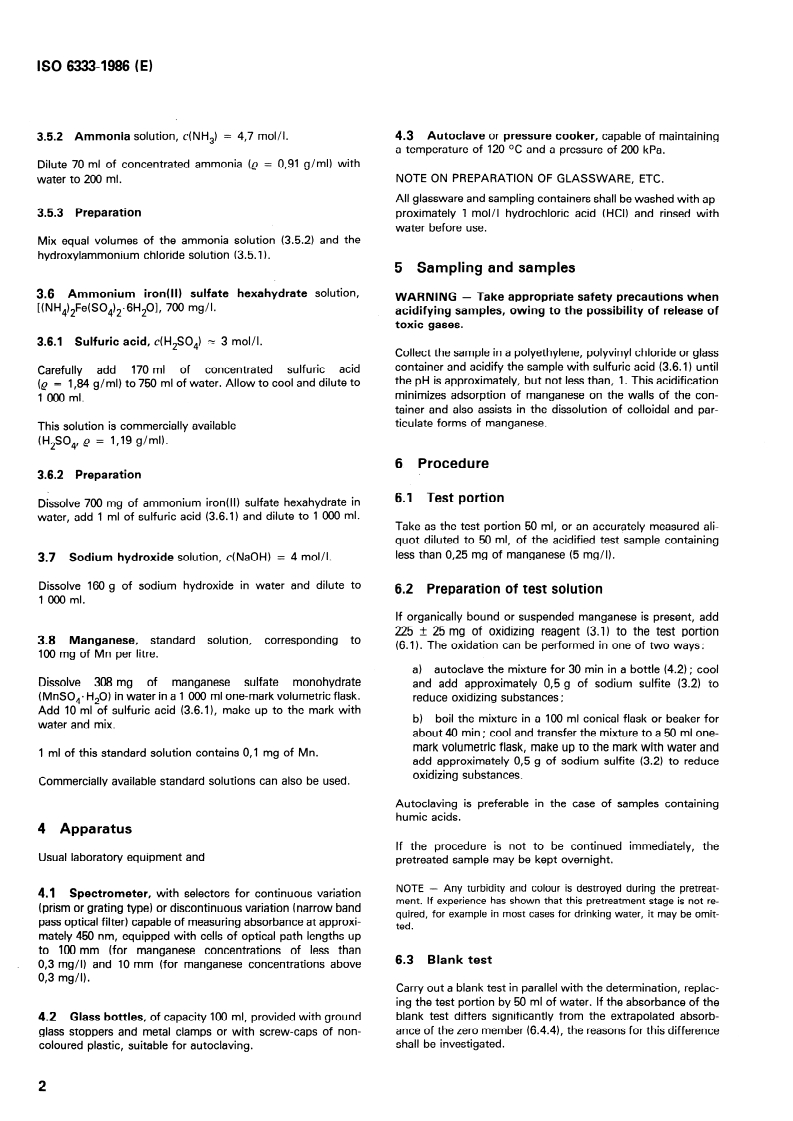
Includes a procedure for surface and drinking water. The procedure is applicable to concentrations between 0,01 mg/l and 5 mg/l. Concentrations above 5 mg/l may be determined after suitable dilution of the sample.
- Status
- Published
- Publication Date
- 26-Mar-1986
- Technical Committee
- ISO/TC 147/SC 2 - Physical, chemical and biochemical methods
- Drafting Committee
- ISO/TC 147/SC 2 - Physical, chemical and biochemical methods
- Current Stage
- 9060 - Close of review
- Completion Date
- 02-Sep-2031
Buy Documents
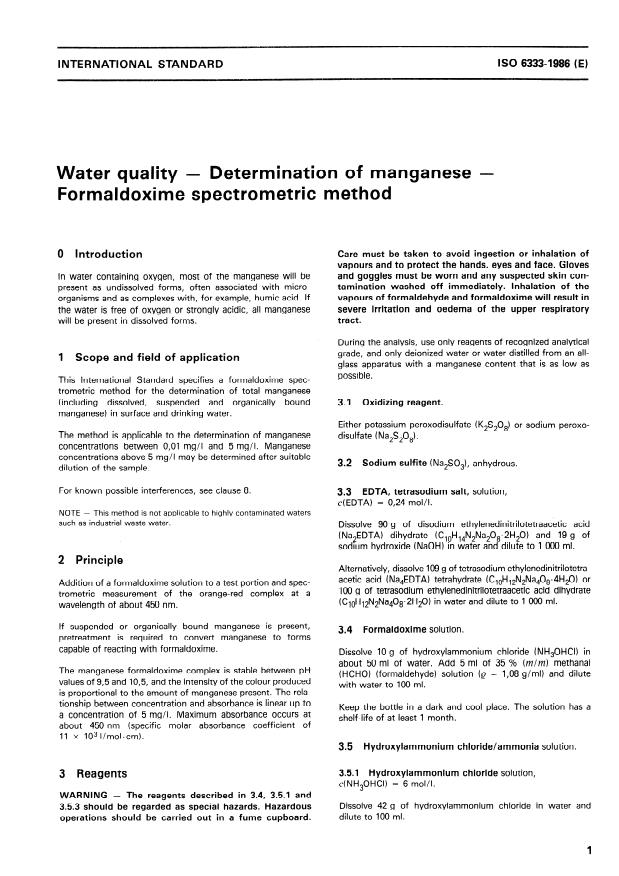
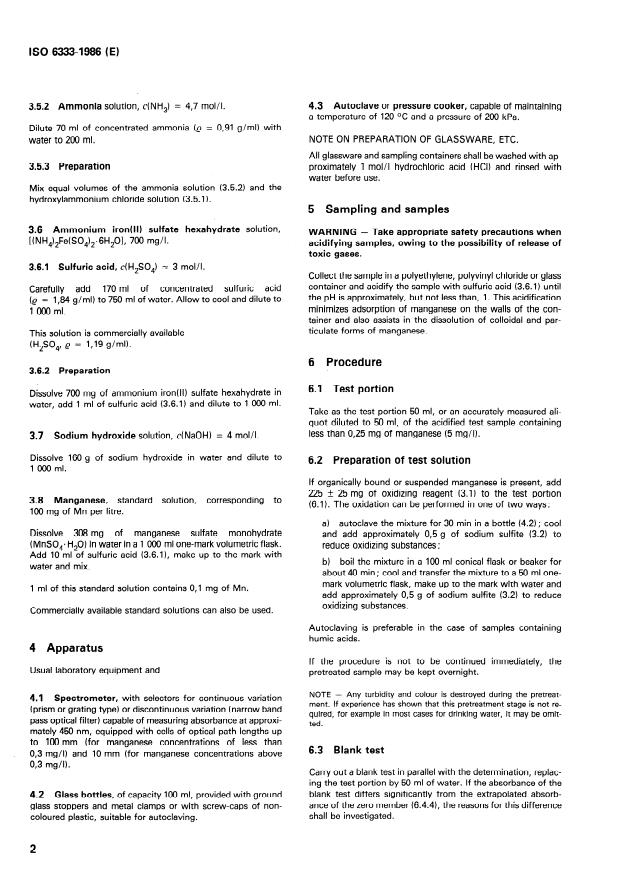
ISO 6333:1986 - Water quality -- Determination of manganese -- Formaldoxime spectrometric method
ISO 6333:1986 - Water quality — Determination of manganese — Formaldoxime spectrometric method/27/1986
ISO 6333:1986 - Qualité de l'eau -- Dosage du manganese -- Méthode spectrométrique a la formaldoxime
ISO 6333:1986 - Qualité de l'eau — Dosage du manganèse — Méthode spectrométrique à la formaldoxime/27/1986
ISO 6333:1986 - Qualité de l'eau — Dosage du manganèse — Méthode spectrométrique à la formaldoxime/27/1986
Overview
ISO 6333:1986 outlines a standardized spectrometric method for determining manganese levels in water using the formaldoxime reaction. This internationally recognized procedure applies to surface water and drinking water, allowing accurate measurement of manganese concentrations ranging from 0.01 mg/l to 5 mg/l. For samples with manganese above 5 mg/l, dilution is recommended before analysis. The method provides reliable and reproducible results, essential for monitoring water quality and ensuring compliance with environmental and health standards.
Key Topics
Scope and Application
- Applicable to manganese determination in both surface and drinking waters
- Suitable concentration range: 0.01 mg/l to 5 mg/l
- Higher concentrations require sample dilution for accuracy
- Not intended for heavily polluted industrial wastewater
Analytical Principle
- Formation of a red-orange manganese-formaldoxime complex
- Measurement of absorbance at approximately 450 nm using spectrometry
- Linear calibration curve enables quantification based on absorbance intensity
Reagents and Preparation
- Use of potassium or sodium peroxodisulfate as oxidizing agents
- Formaldoxime reagent preparation for complex formation
- EDTA solution to reduce interference from iron and other metals
- Proper acidification of samples to stabilize manganese and prevent adsorption
Sample Handling and Pretreatment
- Acidifying water samples to pH near 1 to dissolve suspended manganese forms
- Pre-oxidation via autoclaving or boiling to convert manganese into reactive forms
- Usage of analytical-grade reagents and deionized or distilled water for accuracy
- Ensuring clean glassware through acid washing to avoid contamination
Measurement and Calibration
- Calibration curves created using standardized manganese solutions at known concentrations
- Different cuvette path lengths for low (100 mm) and high (10 mm) concentration ranges
- Regular calibration to maintain method reproducibility and accuracy
Interferences and Mitigation
- Iron(II) ions form competing complexes with formaldoxime, affecting measurement
- Addition of EDTA and specific reagent mixtures (hydroxylammonium chloride with ammonia) to mask interference
- Monitoring for cobalt, calcium, magnesium, and phosphate ions influencing accuracy
- Centrifugation to remove turbidity after complex formation, if necessary
Safety Precautions
- Handling of hazardous chemicals like formaldehyde and hydroxylamine derivatives under fume hoods
- Use of personal protective equipment: gloves, goggles, and face protection
- Proper disposal and storage of reagents to minimize exposure risks
Applications
Water Quality Monitoring
- Testing manganese concentrations to ensure drinking water safety
- Surface water analysis for environmental monitoring and regulatory compliance
- Early detection of manganese pollution from natural or anthropogenic sources
Treatment Process Control
- Assess effectiveness of water treatment systems targeting manganese removal
- Quality assurance in potable water production facilities
Research and Environmental Studies
- Investigating the behavior and fate of manganese in aquatic ecosystems
- Studying metal interactions and interference in complex water matrices
Regulatory Compliance
- Aligning with international water quality standards and environmental regulations
- Providing standardized, reproducible data for reporting and certification purposes
Related Standards
ISO/TC 147 – Water Quality
- The technical committee responsible for the development and maintenance of water-related analytical methods including manganese determination.
Other ISO methods for trace metal analysis in water such as ISO 8288 for iron and ISO 6334 for copper, complementing the manganese determination method to provide a comprehensive water quality profile.
National and regional standards for water quality assessment, often referencing ISO 6333 to ensure uniformity and accuracy in manganese testing.
Keywords: ISO 6333, manganese determination, water quality standard, formaldoxime spectrometric method, surface water analysis, drinking water analysis, spectrophotometry manganese, water contaminant testing, manganese concentration measurement, analytical chemistry water standards.
Relations
- Effective Date
- 25-Aug-2026
- Effective Date
- 25-Aug-2026
- Effective Date
- 25-Aug-2026
- Effective Date
- 25-Aug-2026
- Effective Date
- 10-Jun-2026
Buy Documents
ISO 6333:1986 - Water quality -- Determination of manganese -- Formaldoxime spectrometric method
ISO 6333:1986 - Water quality — Determination of manganese — Formaldoxime spectrometric method/27/1986
ISO 6333:1986 - Qualité de l'eau -- Dosage du manganese -- Méthode spectrométrique a la formaldoxime
ISO 6333:1986 - Qualité de l'eau — Dosage du manganèse — Méthode spectrométrique à la formaldoxime/27/1986
ISO 6333:1986 - Qualité de l'eau — Dosage du manganèse — Méthode spectrométrique à la formaldoxime/27/1986
Get Certified
Connect with accredited certification bodies for this standard

CIS Institut d.o.o.
Personal Protective Equipment (PPE) certification body. Notified Body NB-2890 for EU Regulation 2016/425 PPE.

Kiwa BDA Testing
Building and construction product certification.
Kmetijski inštitut Slovenije
Agricultural Institute of Slovenia. Soil testing, plant health, agricultural product analysis.
Sponsored listings
Frequently Asked Questions
ISO 6333:1986 is a standard published by the International Organization for Standardization (ISO). Its full title is "Water quality — Determination of manganese — Formaldoxime spectrometric method". This standard covers: Includes a procedure for surface and drinking water. The procedure is applicable to concentrations between 0,01 mg/l and 5 mg/l. Concentrations above 5 mg/l may be determined after suitable dilution of the sample.
Includes a procedure for surface and drinking water. The procedure is applicable to concentrations between 0,01 mg/l and 5 mg/l. Concentrations above 5 mg/l may be determined after suitable dilution of the sample.
ISO 6333:1986 is classified under the following ICS (International Classification for Standards) categories: 13.060.50 - Examination of water for chemical substances. The ICS classification helps identify the subject area and facilitates finding related standards.
ISO 6333:1986 has the following relationships with other standards: It is inter standard links to EN 12911:2006, EN ISO 14911:1999, EN 14368:2003, EN 13752:2012, EN 14368:2015. Understanding these relationships helps ensure you are using the most current and applicable version of the standard.
ISO 6333:1986 is available in PDF format for immediate download after purchase. The document can be added to your cart and obtained through the secure checkout process. Digital delivery ensures instant access to the complete standard document.
Standards Content (Sample)
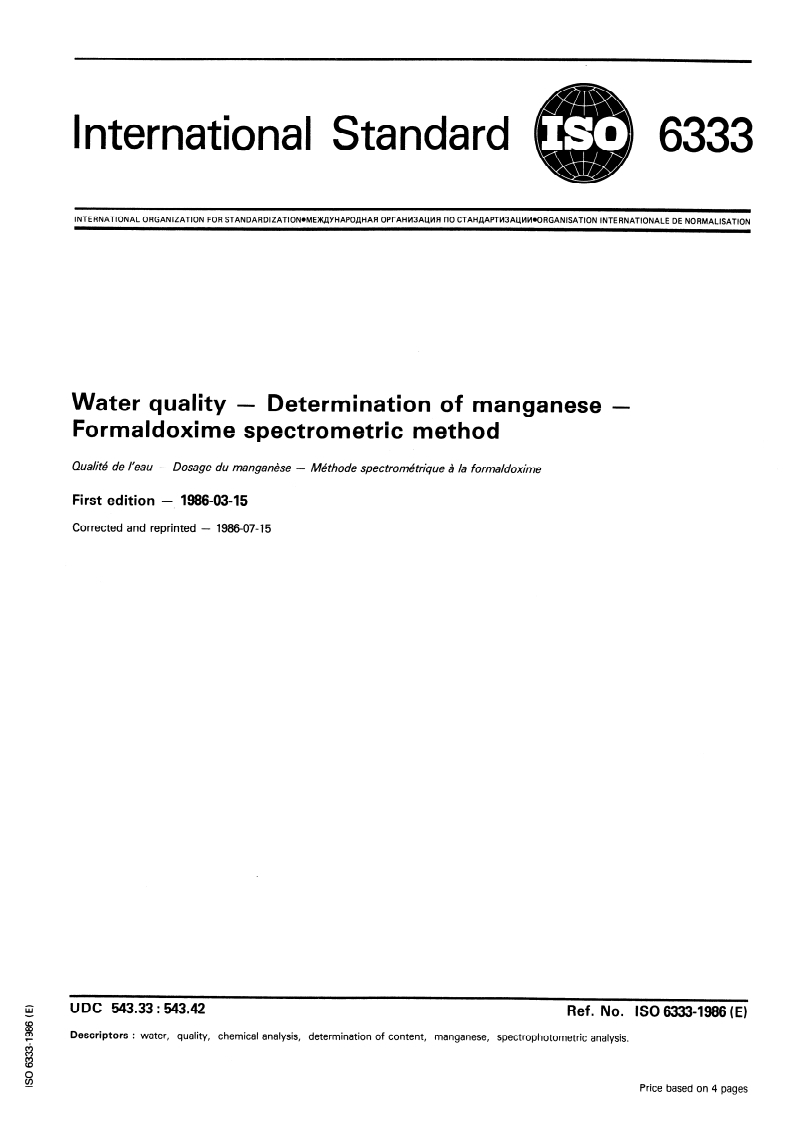
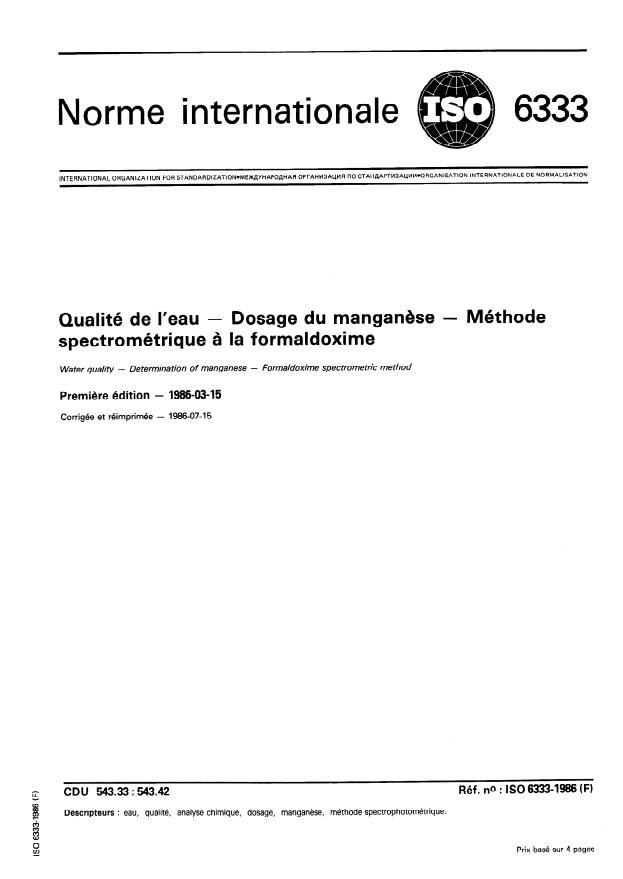
International Standard
INTERNATIONAL ORGANIZATION FOR STANDARDIZATION.ME~YHAPOAHAR OPf-AHM3Ai@lR fl0 CTAH~APT1113A~MM~RGANISATION INTERNATIONALE DE NORMALISATION
Determination of manganese -
Water quality -
Formaldoxime spectrometric method
Qualit4 de l’eau - Dosage du mangankse - iWthode spectrom&igue 2 Ia fot-maldoxime
First edition -, 1986-03-15
Corrected and reprinted - 1986-07-15
Ref. No. ISO 6333-1986 (E)
UDC 543.33: 543.42
Descriptors : watet-, quality, Chemical analysis, determination of content, manganese, spectrophotometric analysis.
Price based on 4 pages
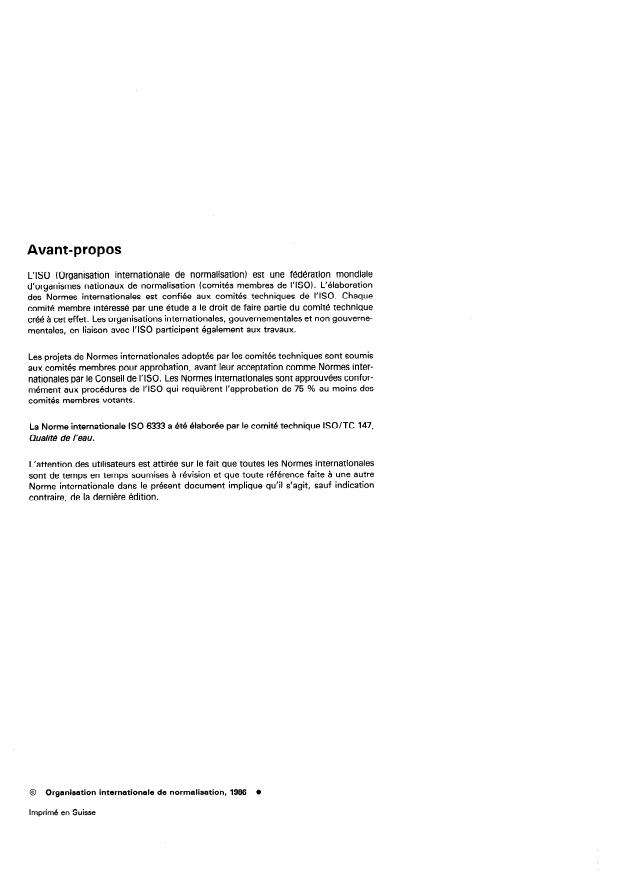
Foreword
ISO (the International Organization for Standardization) is a worldwide federation of
national Standards bodies (ISO member bodies). The work of preparing International
Standards is normally carried out through ISO technical committees. Esch member
body interested in a subject for which a technical committee has been established has
the right to be represented on that committee. International organizations, govern-
mental and non-governmental, in liaison with ISO, also take part in the work.
Draft International Standards adopted by the technical committees are circulated to
the member bodies for approval before their acceptance as International Standards by
the ISO Council. They are approved in accordance with ISO procedures requiring at
least 75 % approval by the member bodies voting.
International Standard ISO 6333 was prepared by Technical Committee ISO/TC 147,
Water quality.
Users should note that all International Standards undergo revision from time to time
and that any reference made herein to any other International Standard implies its
latest edition, unless otherwise stated.
0 International Organkation for Standardkation, 1986
Printed in Switzerland
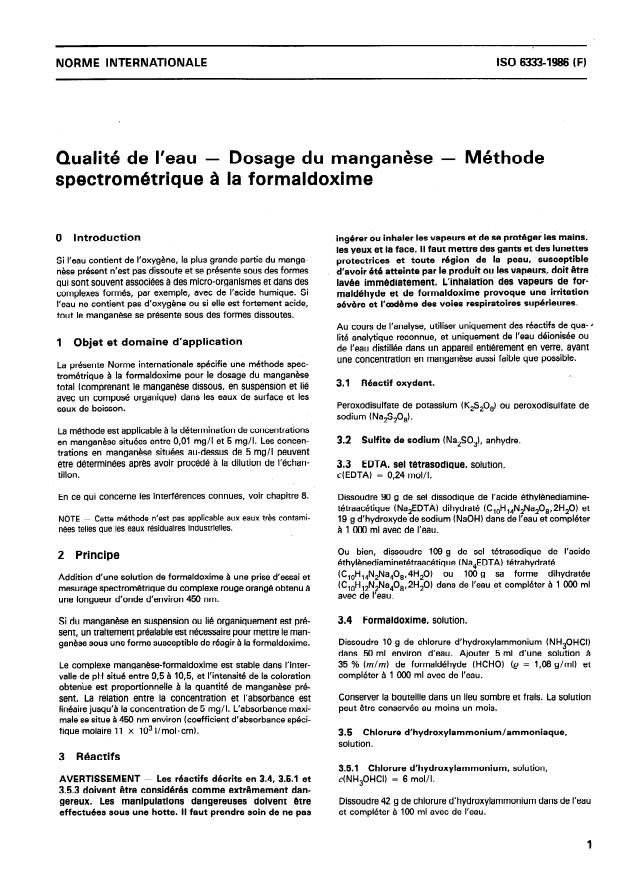
INTERNATIONAL STANDARD ISO 6333-1986 (E)
Determination of manganese -
Water quality -
method
Formaldoxim spectrometric
Care must be taken to avoid ingestion or inhalation of
0 lntroduction
vapours and to protect the hands, eyes and face. Gloves
and goggles must be worn and any suspected skin con-
In water containing Oxygen, most of the manganese will be
tamination washed off immediately. Inhalation of the
present as undissolved forms, often associated with micro-
vapours of formaldehyde and formaldoxime will result in
organisms and as complexes with, for example, humic acid. If
severe irritation and oedema of the upper respiratory
the water is free of Oxygen or strongly acidic, all manganese
tract.
will be present in dissolved forms.
During the analysis, use only reagents of recognized analytical
grade, and only deionized water or water distilled from an all-
1 Scope and field of application
glass apparatus with a manganese content that is as low as
possible.
This International Standard specifies a formaldoxime spec-
trometric method for the determination of total manganese
(including dissolved, suspended and organically bound 3.1 Oxidizing reagent.
manganese) in surface and drinking water.
Either potassium peroxodisulfate (K,S,O,) or sodium peroxo-
The method is applicable to the determination of manganese
disulfate (Na,S,O,).
concentrations between 0,Ol mg/1 and 5 mg/l. Manganese
concentrations above 5 mg/l may be determined after suitable
3.2 Sodium sulfite (Na$O,), anhydrous.
dilution of the Sample.
For known possible interferences, see clause 8.
3.3 EDTA, tetrasodium salt, Solution,
c(EDTA) = 0,24 mol/l.
NOTE - This method is not applicable to highly contaminated waters
such as industrial waste water.
Dissolve 90 g of disodium ethylenedinitrilotetraacetic acid
(Na2EDTA) dihydrate (C,0H,,N2Na20s.2HZO) and 19 g of
sodium hydroxide (NaOH) in water and dilute to 1 000 ml.
2 Principle
Alternatively, dissolve 109 g sf tetrasodium ethylenedinitrilotetra-
acetic acid (Na4EDTA) tetrahydrate (C10H12N2NaJ08.4H20) or
Addition of a formaldoxime Solution to a test Portion and spec-
100 g of tetrasodium ethylenedinitrilotetraacetic acid dihydrate
trometric measurement of the orange-red complex at a
(C10H,2N2Na,08~2H20) in water and dilute to 1 000 ml.
wavelength of about 450 nm.
If suspended or organically bound manganese is present,
Formaldoxime Solution.
34 .
pretreatment is required to convert manganese to forms
capable of reacting with formaldoxime.
Dissolve 10 g of hydroxylammonium chloride (NH30HCI) in
about 50 ml of water. Add 5 ml of 35 % (mlm) methanal
The manganese formaldoxime complex is stable between pH
(HCHO) (formaldehyde) Solution (Q = 1,08 g/ml) and dilute
values of 9,5 and 10,5, and the intensity of the colour produced
with water to 100 ml.
is proportional to the amount of manganese present. The rela-
tionship between concentration and absorbance is linear up to
Keep the bottle in a dark and cool place. The Solution has a
a concentration of 5 mg/l. Maximum absorbance occurs at
shelf-life of at least 1 month.
about 450 nm (specific molar absorbance coefficient of
11 x 103 Vmolcm).
3.5 Hydroxylammonium chloride/ammonia Solution.
3.5.1 Hydroxylammonium chloride Solution,
3 Reagents
c(NH,OHCI) = 6 mol/l.
WARNING - The reagents described in 3.4, 3.5.1 and
Dissolve 42 g of hydroxylammonium chloride in water and
3.5.3 should be regarded as special hazards. Hazardous
dilute to 100 ml.
operations should be carried out in a fume cupboard.
ISO 6333-1986 (EI
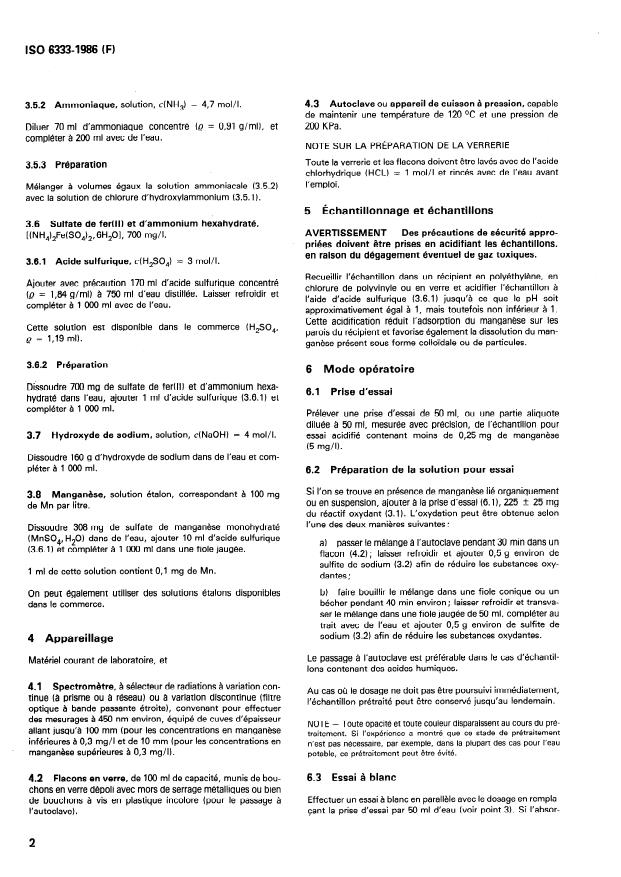
4.3 Autoclave or pressure cooker, capable of maintaining
3.5.2 Ammonia solution, c(NH3) = 4,7 mol/l.
a temperature of 120 OC and a pressure of 200 kPa.
Dilute 70 ml of concentrated ammonia (Q = 0,91 g/ml) with
NOTE ON PREPARATION OF GLASSWARE, ETC.
water to 200 ml.
All glassware and sampling Containers shall be washed with ap-
3.5.3 Preparation
proximately 1 mol/1 hydrochloric acid (HCI) and rinsed with
water before use.
Mix equal volumes of the ammonia Solution (3.5.2) and the
Chlorid e Solution
hydroxylammonium (3.5.1).
5 Sampling and samples
3.6 Ammonium iron( Il) sulfate hexahydrate Solution,
- Take appropriate safety precautions when
WARNING
[(NH,),Fe(SO,),*6H,Ol, 700 mg/l.
acidifying samples, owing to the possibility of release of
toxic gases.
3.6.1 Sulfuric acid, c(H,SO,) = 3 mol/l.
Collect the Sample in a polyethylene, polyvinyl chloride or glass
Container and acidify the Sample with sulfuric acid (3.6.1) until
170 ml of concentrated sulfuric acid
Carefully add
the pH is approximately, but not less than, 1. This acidification
1,84 g/ml) to 750 ml of water. Allow to cool and dilute to
(@ =
minimizes adsorption of manganese on the Walls of the con-
1 000 ml.
tainer and also assists in the dissolution of colloidal and par-
ticulate forms of manganese.
This Solution is commercially available
= 1,19 g/ml).
(H,SO,, e
6 Procedure
3.6.2 Preparation
6.1 Test Portion
Dissolve 700 mg of ammonium iron(ll) sulfate hexahydrate in
water, add 1 ml of sulfuric acid (3.6.1) and dilute to 1 000 ml.
Take as the test Portion 50 ml, or an accurately measured ali-
quot diluted to 50 ml, of the acidified test Sample containing
less than 0,25 mg of manganese (5 mg/l).
37 . Sodium hydroxide Solution, c(NaCH) = 4 mol/l.
Dissolve 160 g of sodium hydroxide in water and dilute to
6.2 Preparation of test solution
1 000 ml.
If organically bound or suspended manganese is present, add
225 - + 25 mg of oxidizing reagent (3.1) to the test Portion
38 Manganese , sta Solution, corresponding
(6.1). The Oxidation tan be performed in one of two ways:
mg of Mn per litre.
a) autoclave the mixture for 30 min in a bottle (4.2) ; cool
Dissolve 308 mg of manganese sulfate monohydrate
and add approximately 0,5 g of sodium sulfite (3.2) to
(MnS04m H,O
...
International Standard
INTERNATIONAL ORGANIZATION FOR STANDARDIZATION.ME~YHAPOAHAR OPf-AHM3Ai@lR fl0 CTAH~APT1113A~MM~RGANISATION INTERNATIONALE DE NORMALISATION
Determination of manganese -
Water quality -
Formaldoxime spectrometric method
Qualit4 de l’eau - Dosage du mangankse - iWthode spectrom&igue 2 Ia fot-maldoxime
First edition -, 1986-03-15
Corrected and reprinted - 1986-07-15
Ref. No. ISO 6333-1986 (E)
UDC 543.33: 543.42
Descriptors : watet-, quality, Chemical analysis, determination of content, manganese, spectrophotometric analysis.
Price based on 4 pages
Foreword
ISO (the International Organization for Standardization) is a worldwide federation of
national Standards bodies (ISO member bodies). The work of preparing International
Standards is normally carried out through ISO technical committees. Esch member
body interested in a subject for which a technical committee has been established has
the right to be represented on that committee. International organizations, govern-
mental and non-governmental, in liaison with ISO, also take part in the work.
Draft International Standards adopted by the technical committees are circulated to
the member bodies for approval before their acceptance as International Standards by
the ISO Council. They are approved in accordance with ISO procedures requiring at
least 75 % approval by the member bodies voting.
International Standard ISO 6333 was prepared by Technical Committee ISO/TC 147,
Water quality.
Users should note that all International Standards undergo revision from time to time
and that any reference made herein to any other International Standard implies its
latest edition, unless otherwise stated.
0 International Organkation for Standardkation, 1986
Printed in Switzerland
INTERNATIONAL STANDARD ISO 6333-1986 (E)
Determination of manganese -
Water quality -
method
Formaldoxim spectrometric
Care must be taken to avoid ingestion or inhalation of
0 lntroduction
vapours and to protect the hands, eyes and face. Gloves
and goggles must be worn and any suspected skin con-
In water containing Oxygen, most of the manganese will be
tamination washed off immediately. Inhalation of the
present as undissolved forms, often associated with micro-
vapours of formaldehyde and formaldoxime will result in
organisms and as complexes with, for example, humic acid. If
severe irritation and oedema of the upper respiratory
the water is free of Oxygen or strongly acidic, all manganese
tract.
will be present in dissolved forms.
During the analysis, use only reagents of recognized analytical
grade, and only deionized water or water distilled from an all-
1 Scope and field of application
glass apparatus with a manganese content that is as low as
possible.
This International Standard specifies a formaldoxime spec-
trometric method for the determination of total manganese
(including dissolved, suspended and organically bound 3.1 Oxidizing reagent.
manganese) in surface and drinking water.
Either potassium peroxodisulfate (K,S,O,) or sodium peroxo-
The method is applicable to the determination of manganese
disulfate (Na,S,O,).
concentrations between 0,Ol mg/1 and 5 mg/l. Manganese
concentrations above 5 mg/l may be determined after suitable
3.2 Sodium sulfite (Na$O,), anhydrous.
dilution of the Sample.
For known possible interferences, see clause 8.
3.3 EDTA, tetrasodium salt, Solution,
c(EDTA) = 0,24 mol/l.
NOTE - This method is not applicable to highly contaminated waters
such as industrial waste water.
Dissolve 90 g of disodium ethylenedinitrilotetraacetic acid
(Na2EDTA) dihydrate (C,0H,,N2Na20s.2HZO) and 19 g of
sodium hydroxide (NaOH) in water and dilute to 1 000 ml.
2 Principle
Alternatively, dissolve 109 g sf tetrasodium ethylenedinitrilotetra-
acetic acid (Na4EDTA) tetrahydrate (C10H12N2NaJ08.4H20) or
Addition of a formaldoxime Solution to a test Portion and spec-
100 g of tetrasodium ethylenedinitrilotetraacetic acid dihydrate
trometric measurement of the orange-red complex at a
(C10H,2N2Na,08~2H20) in water and dilute to 1 000 ml.
wavelength of about 450 nm.
If suspended or organically bound manganese is present,
Formaldoxime Solution.
34 .
pretreatment is required to convert manganese to forms
capable of reacting with formaldoxime.
Dissolve 10 g of hydroxylammonium chloride (NH30HCI) in
about 50 ml of water. Add 5 ml of 35 % (mlm) methanal
The manganese formaldoxime complex is stable between pH
(HCHO) (formaldehyde) Solution (Q = 1,08 g/ml) and dilute
values of 9,5 and 10,5, and the intensity of the colour produced
with water to 100 ml.
is proportional to the amount of manganese present. The rela-
tionship between concentration and absorbance is linear up to
Keep the bottle in a dark and cool place. The Solution has a
a concentration of 5 mg/l. Maximum absorbance occurs at
shelf-life of at least 1 month.
about 450 nm (specific molar absorbance coefficient of
11 x 103 Vmolcm).
3.5 Hydroxylammonium chloride/ammonia Solution.
3.5.1 Hydroxylammonium chloride Solution,
3 Reagents
c(NH,OHCI) = 6 mol/l.
WARNING - The reagents described in 3.4, 3.5.1 and
Dissolve 42 g of hydroxylammonium chloride in water and
3.5.3 should be regarded as special hazards. Hazardous
dilute to 100 ml.
operations should be carried out in a fume cupboard.
ISO 6333-1986 (EI
4.3 Autoclave or pressure cooker, capable of maintaining
3.5.2 Ammonia solution, c(NH3) = 4,7 mol/l.
a temperature of 120 OC and a pressure of 200 kPa.
Dilute 70 ml of concentrated ammonia (Q = 0,91 g/ml) with
NOTE ON PREPARATION OF GLASSWARE, ETC.
water to 200 ml.
All glassware and sampling Containers shall be washed with ap-
3.5.3 Preparation
proximately 1 mol/1 hydrochloric acid (HCI) and rinsed with
water before use.
Mix equal volumes of the ammonia Solution (3.5.2) and the
Chlorid e Solution
hydroxylammonium (3.5.1).
5 Sampling and samples
3.6 Ammonium iron( Il) sulfate hexahydrate Solution,
- Take appropriate safety precautions when
WARNING
[(NH,),Fe(SO,),*6H,Ol, 700 mg/l.
acidifying samples, owing to the possibility of release of
toxic gases.
3.6.1 Sulfuric acid, c(H,SO,) = 3 mol/l.
Collect the Sample in a polyethylene, polyvinyl chloride or glass
Container and acidify the Sample with sulfuric acid (3.6.1) until
170 ml of concentrated sulfuric acid
Carefully add
the pH is approximately, but not less than, 1. This acidification
1,84 g/ml) to 750 ml of water. Allow to cool and dilute to
(@ =
minimizes adsorption of manganese on the Walls of the con-
1 000 ml.
tainer and also assists in the dissolution of colloidal and par-
ticulate forms of manganese.
This Solution is commercially available
= 1,19 g/ml).
(H,SO,, e
6 Procedure
3.6.2 Preparation
6.1 Test Portion
Dissolve 700 mg of ammonium iron(ll) sulfate hexahydrate in
water, add 1 ml of sulfuric acid (3.6.1) and dilute to 1 000 ml.
Take as the test Portion 50 ml, or an accurately measured ali-
quot diluted to 50 ml, of the acidified test Sample containing
less than 0,25 mg of manganese (5 mg/l).
37 . Sodium hydroxide Solution, c(NaCH) = 4 mol/l.
Dissolve 160 g of sodium hydroxide in water and dilute to
6.2 Preparation of test solution
1 000 ml.
If organically bound or suspended manganese is present, add
225 - + 25 mg of oxidizing reagent (3.1) to the test Portion
38 Manganese , sta Solution, corresponding
(6.1). The Oxidation tan be performed in one of two ways:
mg of Mn per litre.
a) autoclave the mixture for 30 min in a bottle (4.2) ; cool
Dissolve 308 mg of manganese sulfate monohydrate
and add approximately 0,5 g of sodium sulfite (3.2) to
(MnS04m H,O
...
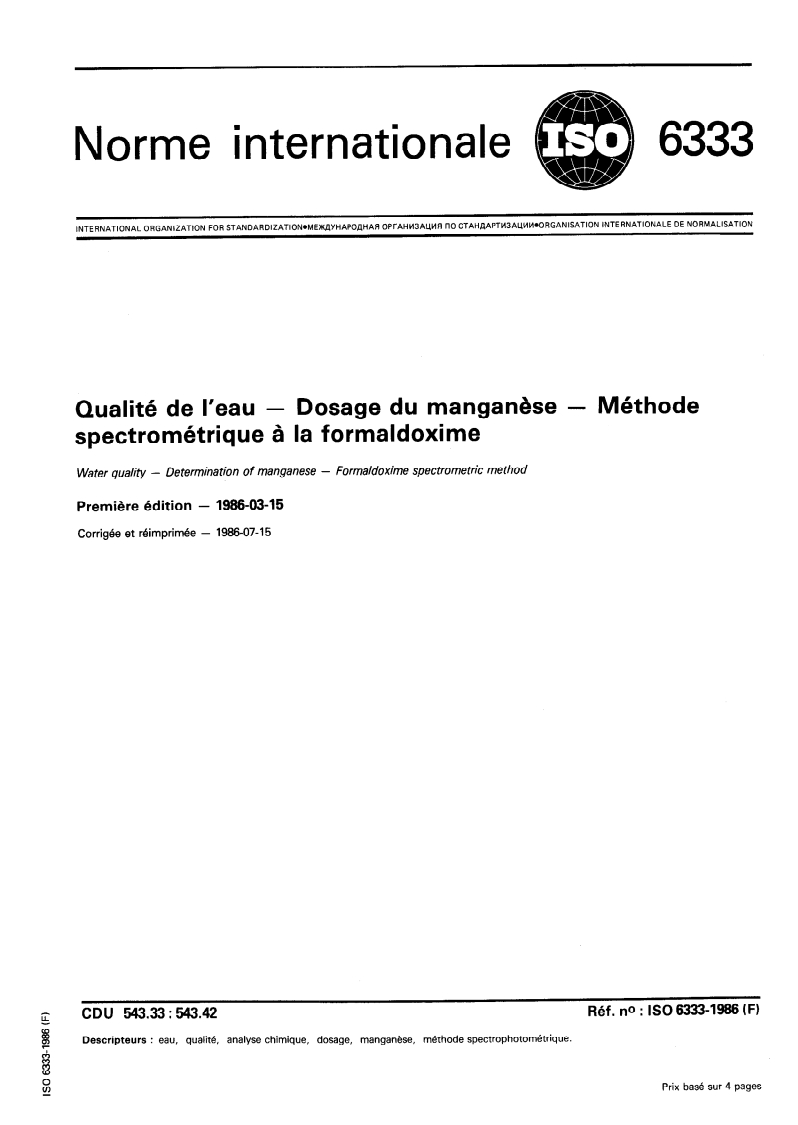
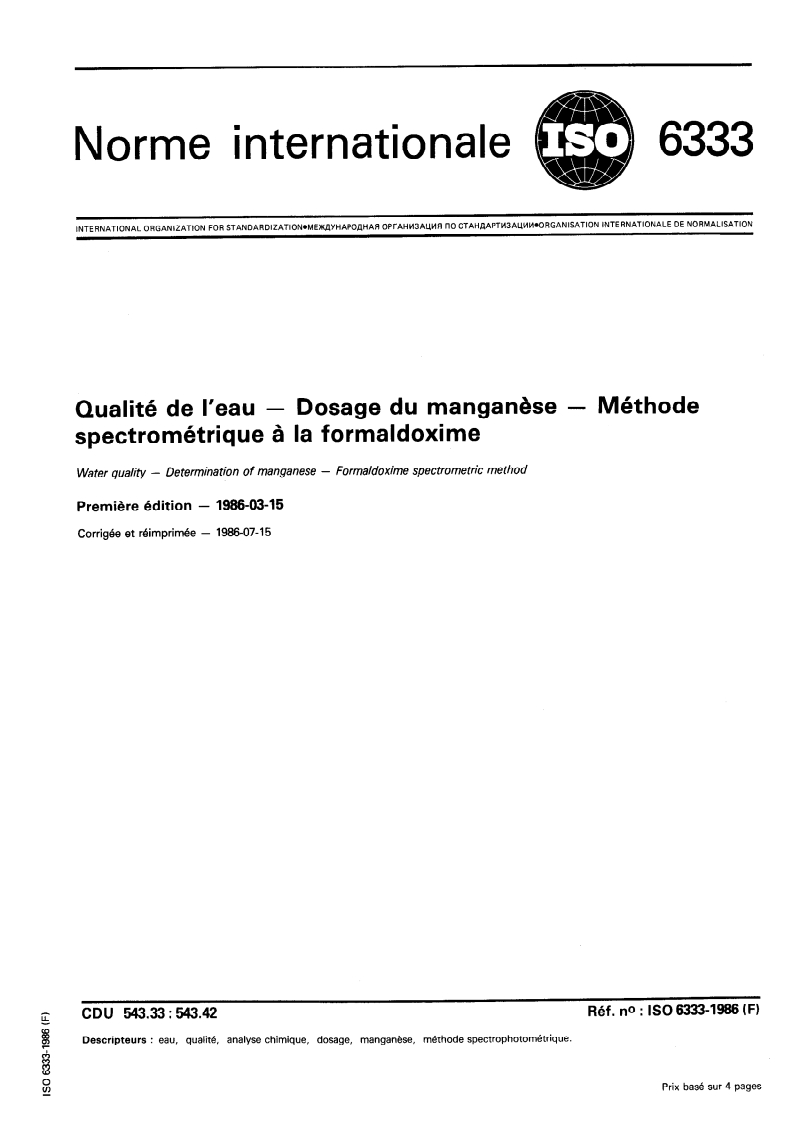
Norme internationale
INTERNATIONAL ORGANIZATION FOR STANDARDIZATION.MEIKfiYHAPOfiHAR OPl-AHM3AuMF-l Il0 CTAH,QAPTM3AL(Mt’WORGANISATION INTERNATIONALE DE NORMALISATION
Qualité de l’eau - Dosage du manganèse - Méthode
spectrométrique à la formaldoxime
Determination of manganese - Formaldoxime spectrometric method
Water quality -
Première édition - 1986-03-W
Corrigée et réimprimée - 1986-07-15
CDU 543.33: 543.42 Réf. no : ISO 6333-1986 (FI
z
Descripteurs : eau, qualité, analyse chimique, dosage, manganèse, méthode spectrophotométrique.
Prix basé sur 4 pages
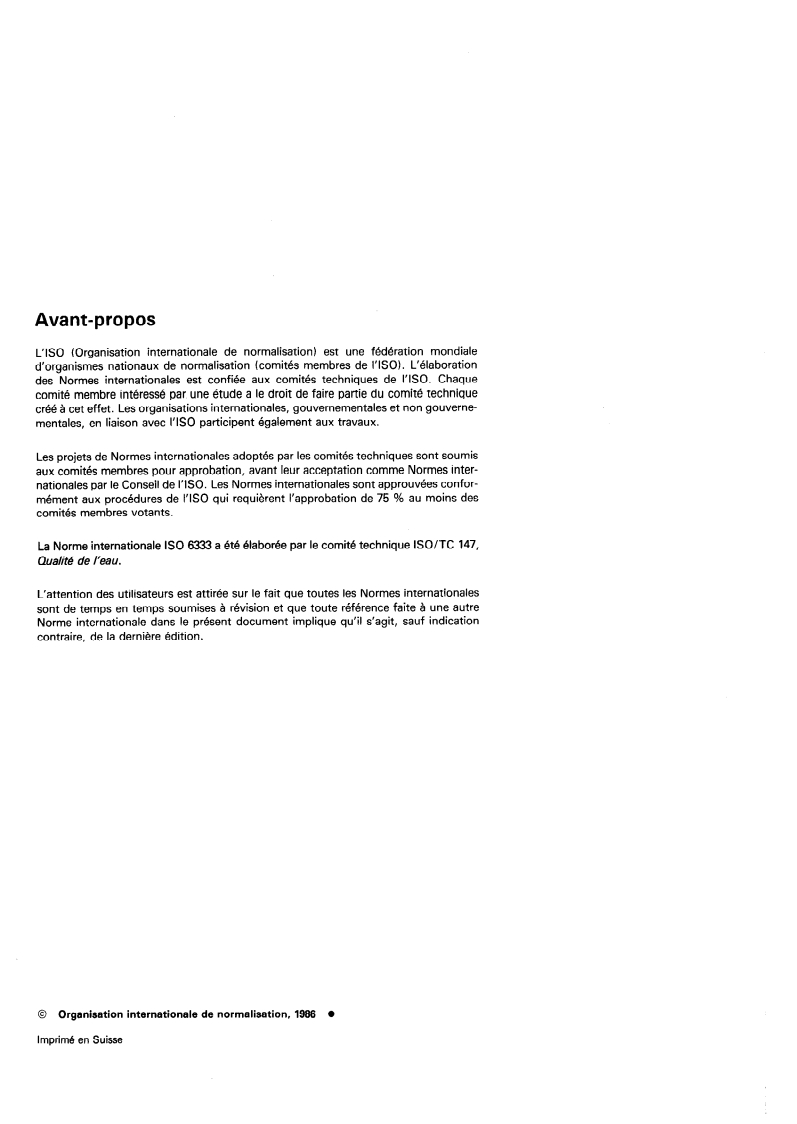
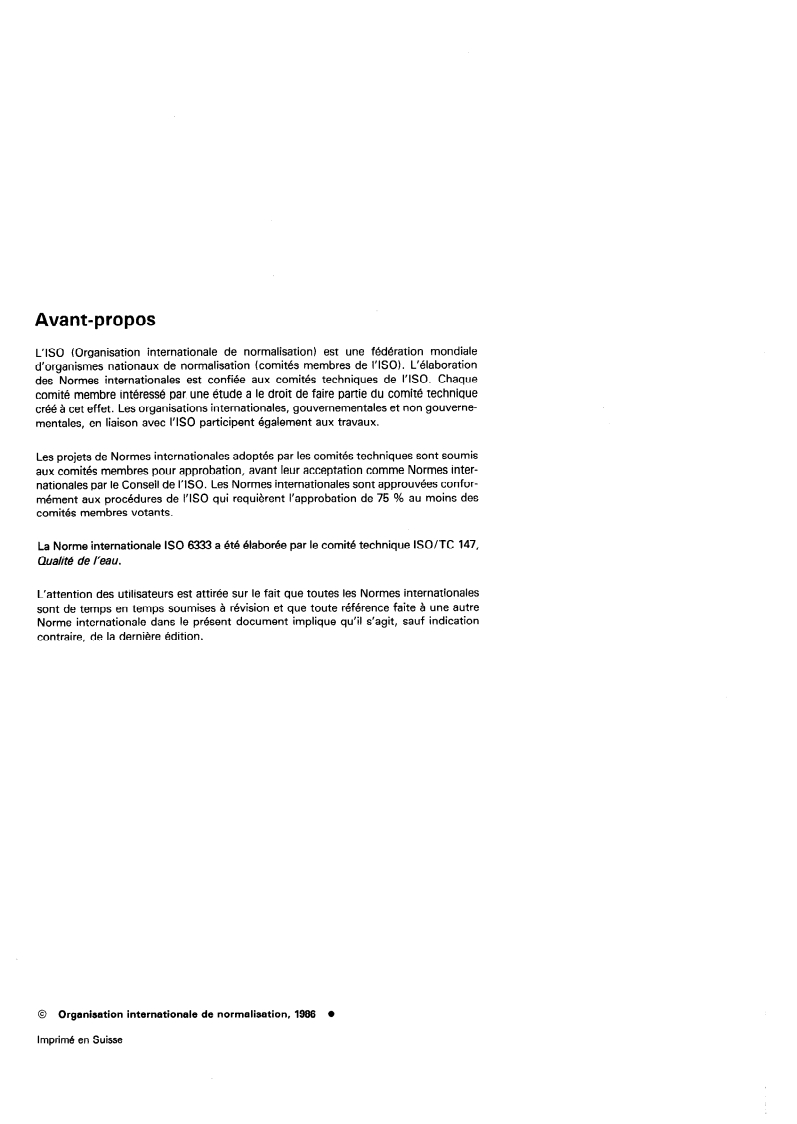
Avant-propos
L’ISO (Organisation internationale de normalisation) est une fédération mondiale
d’organismes nationaux de normalisation (comités membres de I’ISO). L’élaboration
des Normes internationales est confiée aux comités techniques de I’ISO. Chaque
comité membre intéressé par une étude a le droit de faire partie du comité technique
créé à cet effet. Les organisations internationales, gouvernementales et non gouverne-
mentales, en liaison avec I’ISO participent également aux travaux.
Les projets de Normes internationales adoptés par les comités techniques sont soumis
aux comités membres pour approbation, avant leur acceptation comme Normes inter-
nationales par le Conseil de I’ISO. Les Normes internationales sont approuvées confor-
mément aux procédures de I’ISO qui requièrent l’approbation de 75 % au moins des
comités membres votants.
La Norme internationale ISO 6333 a été élaborée par le comité technique ISO/TC 147,
Qualité de l’eau.
L’attention des utilisateurs est attirée sur le fait que toutes les Normes internationales
sont de temps en temps soumises à révision et que toute référence faite à une autre
Norme internationale dans le présent document implique qu’il s’agit, sauf indication
contraire, de la dernière édition.
0 Organisation internationale de normalisation, 1986 0
Imprimé en Suisse
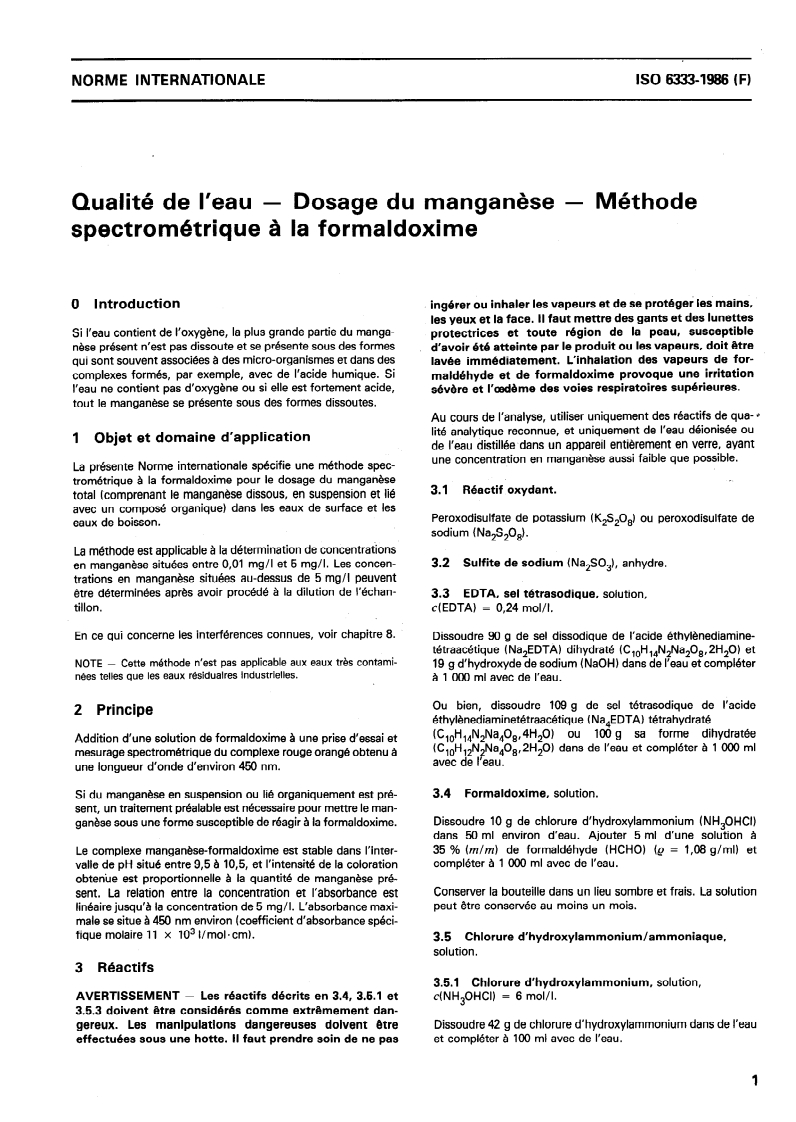
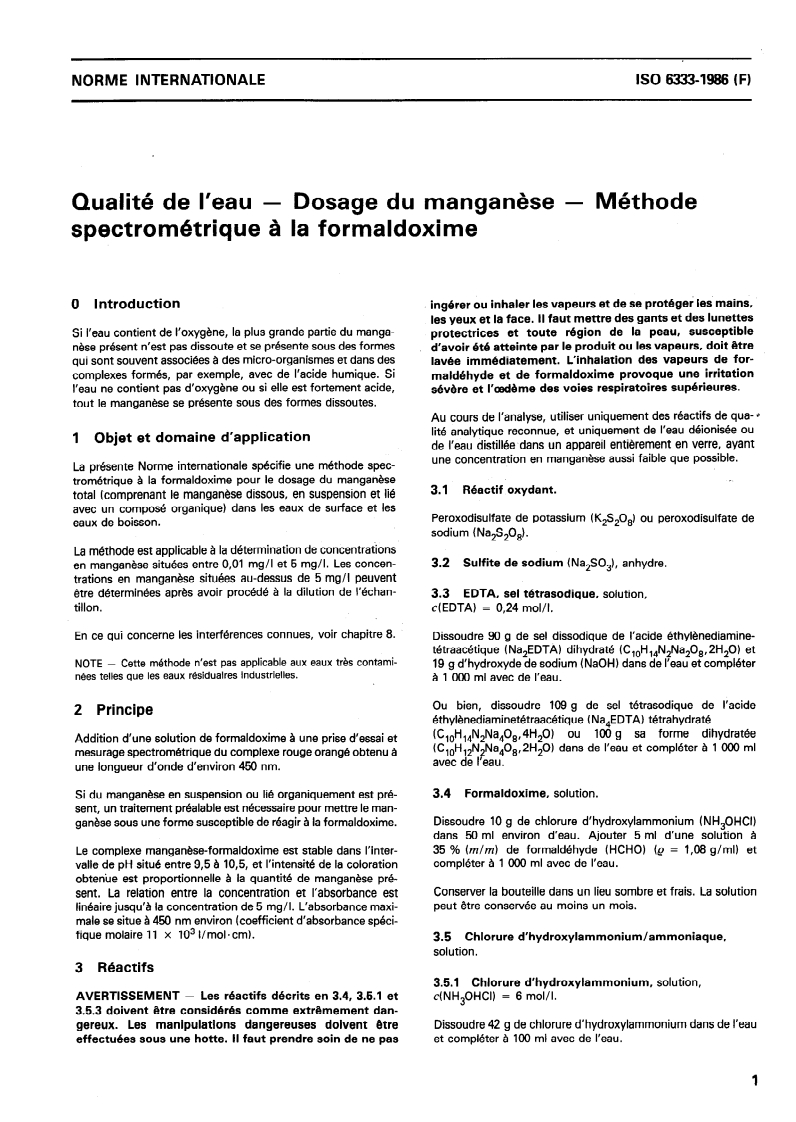
NORME INTERNATIONALE Iso 6333-1986 (F)
Qualité de l’eau
- Dosage du manganèse - Méthode
spectrométrique à la formaldoxime
0 Introduction ingérer ou inhaler les vapeurs et de se proteger les mains,
les yeux et la face. II faut mettre des gants et des lunettes
Si l’eau contient de l’oxygène, la plus grande partie du manga-
protectrices et toute région de la peau, susceptible
nèse présent n’est pas dissoute et se présente sous des formes d’avoir bté atteinte par le produit ou les vapeurs, doit Qtre
qui sont souvent associées à des micro-organismes et dans des
lavee immediatement. L’inhalation des vapeurs de for-
complexes formés, par exemple, avec de l’acide humique. Si maldehyde et de formaldoxime provoque une irritation
l’eau ne contient pas d’oxygéne ou si elle est fortement acide, sévère et l’œdeme des voies respiratoires superieures.
tout le manganése se présente sous des formes dissoutes.
Au cours de l’analyse, utiliser uniquement des réactifs de qua-.&
lite analytique reconnue, et uniquement de l’eau déionisée OU
1 Objet et domaine d’application
de l’eau distillée dans un appareil entierement en verre, ayant
une concentration en manganése aussi faible que possible.
La présente Norme internationale spécifie une méthode spec-
trométrique à la formaldoxime pour le dosage du manganèse
3.1 Réactif oxydant.
total (comprenant le manganése dissous, en suspension et lié
avec un composé organique) dans les eaux de surface et les
Peroxodisulfate de potassium (K2SzOB) ou peroxodisulfate de
eaux de boisson.
sodium (Na,S,O,).
La méthode est applicable à la détermination de concentrations
3.2 Sulfite de sodium (Na,SO,), anhydre.
en manganèse situées entre 0,Ol mg/l et 5 mg/l. Les concen-
trations en manganése situées au-dessus de 5 mg/l peuvent
être déterminées aprés avoir procédé à la dilution de I’échan-
3.3 EDTA, sel tetrasodique, solution,
tillon.
c(EDTA) = 0,24 mol/l.
En ce qui concerne les interférences connues, voir chapitre 8.
Dissoudre 90 g de sel dissodique de l’acide éthylènediamine-
tétraacétique (Na2EDTA) dihydraté (C,,H ,,N,Na,Os, 2H,O) et
NOTE - Cette méthode n’est pas applicable aux eaux trés contami-
19 g d’hydroxyde de sodium (NaOH) dans de l’eau et compléter
nées telles que les eaux résiduaires industrielles.
à 1 000 ml avec de l’eau.
Ou bien, dissoudre 109 g de sel tétrasodique de l’acide
2 Principe
éthylènediaminetétraacétique ( Na4EDTA) tétrahydraté
(C,0H,,N,Na,0,,4HzO) ou 100 g sa forme dihydratée
Addition d’une solution de formaldoxime à une prise d’essai et
(C,0H,2N2Na~08,2HzO) dans de l’eau et compléter à 1 000 ml
mesurage spectrométrique du complexe rouge orangé obtenu à
avec de l’eau.
une longueur d’onde d’environ 450 nm.
3.4 Formaldoxime, solution.
Si du manganése en suspension ou lié organiquement est pré-
sent, un traitement préalable est nécessaire pour mettre le man-
ganése sous une forme susceptible de réagir à la formaldoxime. Dissoudre 10 g de chlorure d’hydroxylammonium (NH,OHCI)
dans 50 ml environ d’eau. Ajouter 5 ml d’une solution à
Le complexe manganése-formaldoxime est stable dans l’inter- 35 % Mm) de formaldéhyde (HCHO) (Q = 1,08 g/ml) et
valle de pH situé entre 9,5 à 10,5, et l’intensité de la coloration compléter à 1 000 ml avec de l’eau.
obtenue est proportionnelle à la quantité de manganése pré-
sent. La relation entre la concentration et I’absorbance est Conserver la bouteille dans un lieu sombre et frais. La solution
linéaire jusqu’à la concentration de 5 mg/l. L’absorbante maxi- peut être conservée au moins un mois.
male se situe à 450 nm environ (coefficient d’absorbance spéci-
fique molaire 11 x 103 I/mol=cm).
3.5 Chlorure d’hydroxylammonium/ammoniaque,
solution.
3 Réactifs
3.5.1 Chlorure d’hydroxylammonium, solution,
AVERTISSEMENT -
Les réactifs décrits en 3.4, 3.5.1 et c(NH,OHCI) = 6 mol/l.
3.5.3 doivent être considérés comme extrêmement dan-
gereux. Les manipulations dangereuses doivent être Dissoudre 42 g de chlorure d’hydroxylammonium dans de l’eau
effectuées sous une hotte. II faut prendre soin de ne pas
et compléter à 100 ml avec de l’eau.
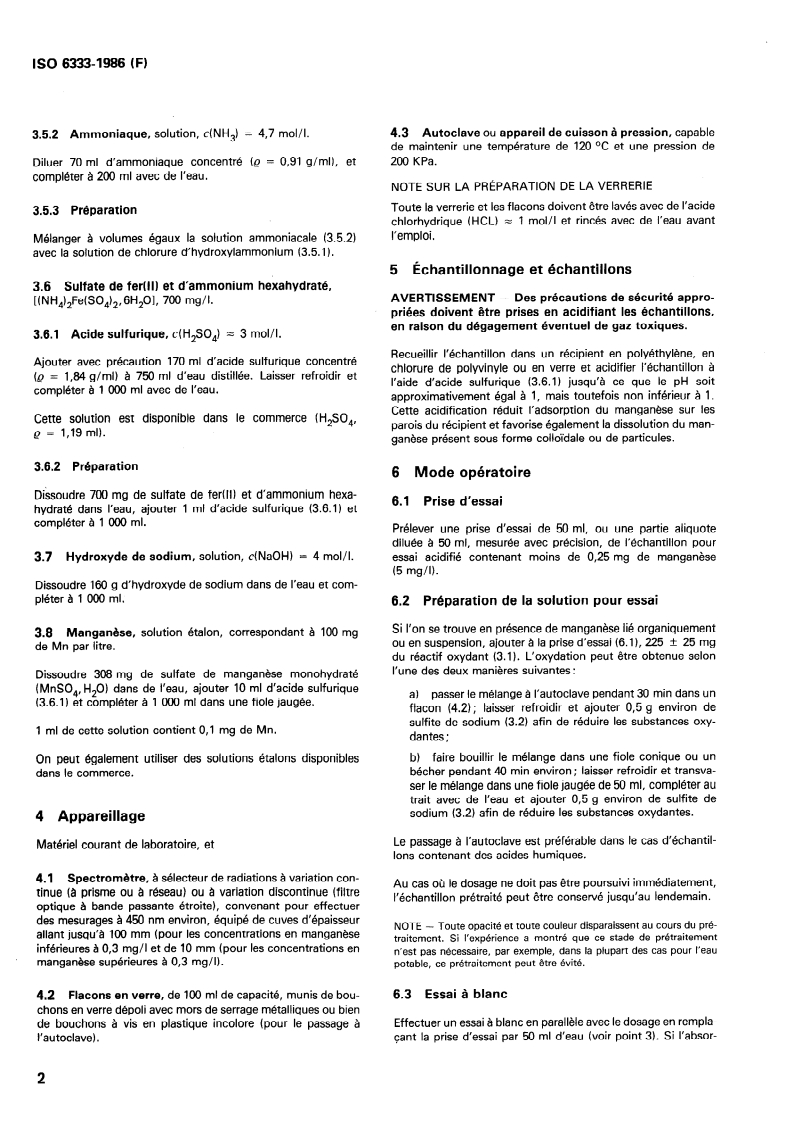
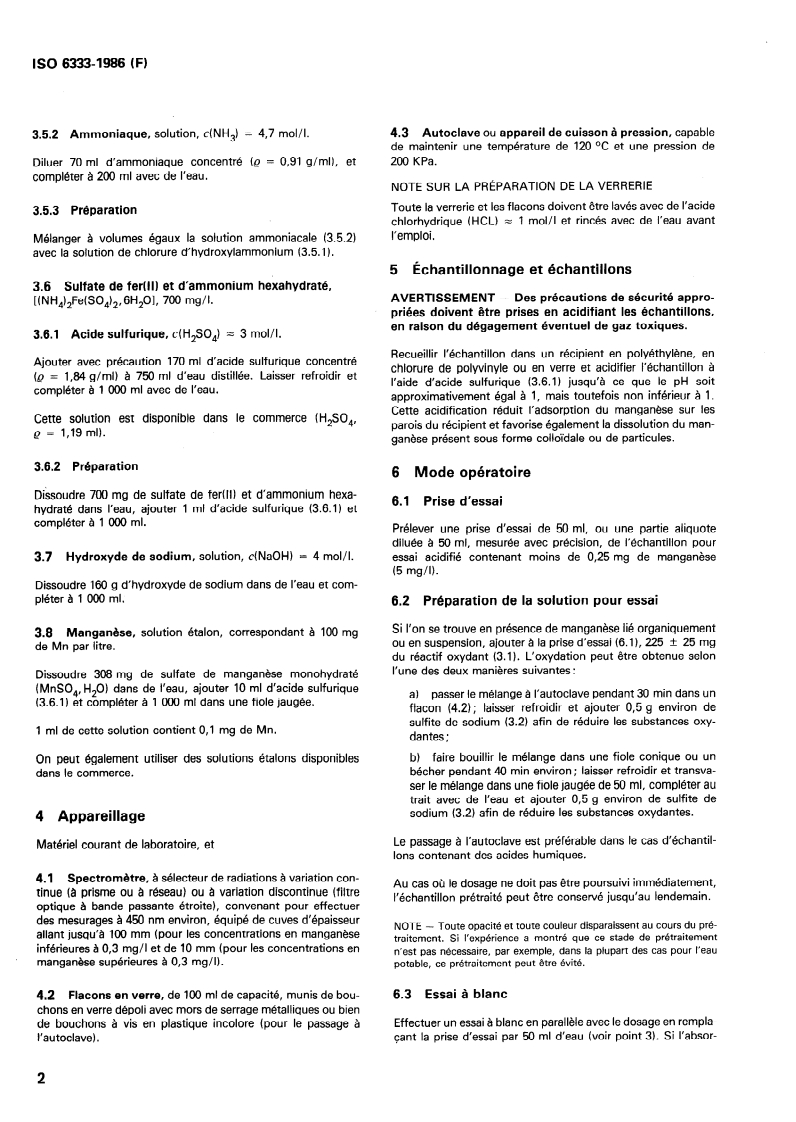
ISO 6333-1986 (FI
3.5.2 Ammoniaque, solution, c(NH3) = 4,7 mol/l. 4.3 Autoclave ou appareil de cuisson à pression, capable
de maintenir une température de 120 OC et une pression de
200 KPa.
Diluer 70 ml d’ammoniaque concentré (Q = 0,91 g/ml), et
compléter à 200 ml avec de l’eau.
NOTE SUR LA PRÉPARATION DE LA VERRERIE
Toute la verrerie et les flacons doivent être lavés avec de l’acide
3.5.3 Préparation
chlorhydrique (HCL) = 1 mol/1 et rincés avec de l’eau avant
l’emploi.
Mélanger à volumes égaux la solution ammoniacale (3.5.2)
avec la solution de chlorure d’hydroxylammonium (3.5.1).
5 Échantillonnage et échantillons
3.6 Sulfate de fetU) et d’ammonium hexahydraté,
AVERTISSEMENT - Des précautions de sécurité appro-
[(NH,)2Fe(S0,),,6H,01, 700 mg/l.
priées doivent être prises en acidifiant les échantillons,
en raison du dégagement éventuel de gaz toxiques.
3.6.1 Acide sulfurique, c(H2S04) = 3 mol/l.
Recueillir l’échantillon dans un récipient en polyéthylène, en
Ajouter avec précaution 170 ml d’acide sulfurique concentré
chlorure de polyvinyle ou en verre et acidifier l’échantillon à
= 1,84 g/ml) à 750 ml d’eau distillée. Laisser refroidir et
k
l’aide d’acide sulfurique (3.6.1) jusqu’à ce que le pH soit
compléter à 1 000 ml avec de l’eau.
approximativement égal à 1, mais toutefois non inférieur à 1.
Cette acidification réduit I’adsorption du manganèse sur les
Cette solution est disponible dans le commerce (H$O,,
parois du récipient et favorise également la dissolution du man-
= 1,19 ml).
e
ganèse présent sous forme colloidale ou de particules.
3.6.2 Préparation
6 Mode opératoire
Dissoudre 700 mg de sulfate de fer(ll) et d’ammonium hexa-
6.1 Prise d’essai
hydraté dans l’eau, ajouter 1 ml d’acide sulfurique (3.6.1) et
compléter à 1 000 ml.
Prélever une prise d’essai de 50 ml, ou une partie aliquote
diluée à 50 ml, mesurée avec précision, de l’échantillon pour
Hydroxyde de sodium, solution, c(NaOH) = 4 mol/l.
3.7 essai acidifié contenant moins de 0,25 mg de manganèse
(5 mg/l).
Dissoudre 160 g d’hydroxyde de sodium dans de l’eau et com-
pléter à 1 000 ml.
6.2 Préparation de la solution pour essai
Si l’on se trouve en présence de manganèse lié organiquement
3.8 Manganèse, solution étalon, correspondant à 100 mg
ou en suspension, ajouter à la prise d’essai (6. l), 225 k- 25 mg
de Mn par litre.
du réactif oxydant (3.1). L’oxydation peut être obtenue selon
l’une des deux manières suivantes:
D
...
Norme internationale
INTERNATIONAL ORGANIZATION FOR STANDARDIZATION.MEIKfiYHAPOfiHAR OPl-AHM3AuMF-l Il0 CTAH,QAPTM3AL(Mt’WORGANISATION INTERNATIONALE DE NORMALISATION
Qualité de l’eau - Dosage du manganèse - Méthode
spectrométrique à la formaldoxime
Determination of manganese - Formaldoxime spectrometric method
Water quality -
Première édition - 1986-03-W
Corrigée et réimprimée - 1986-07-15
CDU 543.33: 543.42 Réf. no : ISO 6333-1986 (FI
z
Descripteurs : eau, qualité, analyse chimique, dosage, manganèse, méthode spectrophotométrique.
Prix basé sur 4 pages
Avant-propos
L’ISO (Organisation internationale de normalisation) est une fédération mondiale
d’organismes nationaux de normalisation (comités membres de I’ISO). L’élaboration
des Normes internationales est confiée aux comités techniques de I’ISO. Chaque
comité membre intéressé par une étude a le droit de faire partie du comité technique
créé à cet effet. Les organisations internationales, gouvernementales et non gouverne-
mentales, en liaison avec I’ISO participent également aux travaux.
Les projets de Normes internationales adoptés par les comités techniques sont soumis
aux comités membres pour approbation, avant leur acceptation comme Normes inter-
nationales par le Conseil de I’ISO. Les Normes internationales sont approuvées confor-
mément aux procédures de I’ISO qui requièrent l’approbation de 75 % au moins des
comités membres votants.
La Norme internationale ISO 6333 a été élaborée par le comité technique ISO/TC 147,
Qualité de l’eau.
L’attention des utilisateurs est attirée sur le fait que toutes les Normes internationales
sont de temps en temps soumises à révision et que toute référence faite à une autre
Norme internationale dans le présent document implique qu’il s’agit, sauf indication
contraire, de la dernière édition.
0 Organisation internationale de normalisation, 1986 0
Imprimé en Suisse
NORME INTERNATIONALE Iso 6333-1986 (F)
Qualité de l’eau
- Dosage du manganèse - Méthode
spectrométrique à la formaldoxime
0 Introduction ingérer ou inhaler les vapeurs et de se proteger les mains,
les yeux et la face. II faut mettre des gants et des lunettes
Si l’eau contient de l’oxygène, la plus grande partie du manga-
protectrices et toute région de la peau, susceptible
nèse présent n’est pas dissoute et se présente sous des formes d’avoir bté atteinte par le produit ou les vapeurs, doit Qtre
qui sont souvent associées à des micro-organismes et dans des
lavee immediatement. L’inhalation des vapeurs de for-
complexes formés, par exemple, avec de l’acide humique. Si maldehyde et de formaldoxime provoque une irritation
l’eau ne contient pas d’oxygéne ou si elle est fortement acide, sévère et l’œdeme des voies respiratoires superieures.
tout le manganése se présente sous des formes dissoutes.
Au cours de l’analyse, utiliser uniquement des réactifs de qua-.&
lite analytique reconnue, et uniquement de l’eau déionisée OU
1 Objet et domaine d’application
de l’eau distillée dans un appareil entierement en verre, ayant
une concentration en manganése aussi faible que possible.
La présente Norme internationale spécifie une méthode spec-
trométrique à la formaldoxime pour le dosage du manganèse
3.1 Réactif oxydant.
total (comprenant le manganése dissous, en suspension et lié
avec un composé organique) dans les eaux de surface et les
Peroxodisulfate de potassium (K2SzOB) ou peroxodisulfate de
eaux de boisson.
sodium (Na,S,O,).
La méthode est applicable à la détermination de concentrations
3.2 Sulfite de sodium (Na,SO,), anhydre.
en manganèse situées entre 0,Ol mg/l et 5 mg/l. Les concen-
trations en manganése situées au-dessus de 5 mg/l peuvent
être déterminées aprés avoir procédé à la dilution de I’échan-
3.3 EDTA, sel tetrasodique, solution,
tillon.
c(EDTA) = 0,24 mol/l.
En ce qui concerne les interférences connues, voir chapitre 8.
Dissoudre 90 g de sel dissodique de l’acide éthylènediamine-
tétraacétique (Na2EDTA) dihydraté (C,,H ,,N,Na,Os, 2H,O) et
NOTE - Cette méthode n’est pas applicable aux eaux trés contami-
19 g d’hydroxyde de sodium (NaOH) dans de l’eau et compléter
nées telles que les eaux résiduaires industrielles.
à 1 000 ml avec de l’eau.
Ou bien, dissoudre 109 g de sel tétrasodique de l’acide
2 Principe
éthylènediaminetétraacétique ( Na4EDTA) tétrahydraté
(C,0H,,N,Na,0,,4HzO) ou 100 g sa forme dihydratée
Addition d’une solution de formaldoxime à une prise d’essai et
(C,0H,2N2Na~08,2HzO) dans de l’eau et compléter à 1 000 ml
mesurage spectrométrique du complexe rouge orangé obtenu à
avec de l’eau.
une longueur d’onde d’environ 450 nm.
3.4 Formaldoxime, solution.
Si du manganése en suspension ou lié organiquement est pré-
sent, un traitement préalable est nécessaire pour mettre le man-
ganése sous une forme susceptible de réagir à la formaldoxime. Dissoudre 10 g de chlorure d’hydroxylammonium (NH,OHCI)
dans 50 ml environ d’eau. Ajouter 5 ml d’une solution à
Le complexe manganése-formaldoxime est stable dans l’inter- 35 % Mm) de formaldéhyde (HCHO) (Q = 1,08 g/ml) et
valle de pH situé entre 9,5 à 10,5, et l’intensité de la coloration compléter à 1 000 ml avec de l’eau.
obtenue est proportionnelle à la quantité de manganése pré-
sent. La relation entre la concentration et I’absorbance est Conserver la bouteille dans un lieu sombre et frais. La solution
linéaire jusqu’à la concentration de 5 mg/l. L’absorbante maxi- peut être conservée au moins un mois.
male se situe à 450 nm environ (coefficient d’absorbance spéci-
fique molaire 11 x 103 I/mol=cm).
3.5 Chlorure d’hydroxylammonium/ammoniaque,
solution.
3 Réactifs
3.5.1 Chlorure d’hydroxylammonium, solution,
AVERTISSEMENT -
Les réactifs décrits en 3.4, 3.5.1 et c(NH,OHCI) = 6 mol/l.
3.5.3 doivent être considérés comme extrêmement dan-
gereux. Les manipulations dangereuses doivent être Dissoudre 42 g de chlorure d’hydroxylammonium dans de l’eau
effectuées sous une hotte. II faut prendre soin de ne pas
et compléter à 100 ml avec de l’eau.
ISO 6333-1986 (FI
3.5.2 Ammoniaque, solution, c(NH3) = 4,7 mol/l. 4.3 Autoclave ou appareil de cuisson à pression, capable
de maintenir une température de 120 OC et une pression de
200 KPa.
Diluer 70 ml d’ammoniaque concentré (Q = 0,91 g/ml), et
compléter à 200 ml avec de l’eau.
NOTE SUR LA PRÉPARATION DE LA VERRERIE
Toute la verrerie et les flacons doivent être lavés avec de l’acide
3.5.3 Préparation
chlorhydrique (HCL) = 1 mol/1 et rincés avec de l’eau avant
l’emploi.
Mélanger à volumes égaux la solution ammoniacale (3.5.2)
avec la solution de chlorure d’hydroxylammonium (3.5.1).
5 Échantillonnage et échantillons
3.6 Sulfate de fetU) et d’ammonium hexahydraté,
AVERTISSEMENT - Des précautions de sécurité appro-
[(NH,)2Fe(S0,),,6H,01, 700 mg/l.
priées doivent être prises en acidifiant les échantillons,
en raison du dégagement éventuel de gaz toxiques.
3.6.1 Acide sulfurique, c(H2S04) = 3 mol/l.
Recueillir l’échantillon dans un récipient en polyéthylène, en
Ajouter avec précaution 170 ml d’acide sulfurique concentré
chlorure de polyvinyle ou en verre et acidifier l’échantillon à
= 1,84 g/ml) à 750 ml d’eau distillée. Laisser refroidir et
k
l’aide d’acide sulfurique (3.6.1) jusqu’à ce que le pH soit
compléter à 1 000 ml avec de l’eau.
approximativement égal à 1, mais toutefois non inférieur à 1.
Cette acidification réduit I’adsorption du manganèse sur les
Cette solution est disponible dans le commerce (H$O,,
parois du récipient et favorise également la dissolution du man-
= 1,19 ml).
e
ganèse présent sous forme colloidale ou de particules.
3.6.2 Préparation
6 Mode opératoire
Dissoudre 700 mg de sulfate de fer(ll) et d’ammonium hexa-
6.1 Prise d’essai
hydraté dans l’eau, ajouter 1 ml d’acide sulfurique (3.6.1) et
compléter à 1 000 ml.
Prélever une prise d’essai de 50 ml, ou une partie aliquote
diluée à 50 ml, mesurée avec précision, de l’échantillon pour
Hydroxyde de sodium, solution, c(NaOH) = 4 mol/l.
3.7 essai acidifié contenant moins de 0,25 mg de manganèse
(5 mg/l).
Dissoudre 160 g d’hydroxyde de sodium dans de l’eau et com-
pléter à 1 000 ml.
6.2 Préparation de la solution pour essai
Si l’on se trouve en présence de manganèse lié organiquement
3.8 Manganèse, solution étalon, correspondant à 100 mg
ou en suspension, ajouter à la prise d’essai (6. l), 225 k- 25 mg
de Mn par litre.
du réactif oxydant (3.1). L’oxydation peut être obtenue selon
l’une des deux manières suivantes:
D
...
Norme internationale
INTERNATIONAL ORGANIZATION FOR STANDARDIZATION.MEIKfiYHAPOfiHAR OPl-AHM3AuMF-l Il0 CTAH,QAPTM3AL(Mt’WORGANISATION INTERNATIONALE DE NORMALISATION
Qualité de l’eau - Dosage du manganèse - Méthode
spectrométrique à la formaldoxime
Determination of manganese - Formaldoxime spectrometric method
Water quality -
Première édition - 1986-03-W
Corrigée et réimprimée - 1986-07-15
CDU 543.33: 543.42 Réf. no : ISO 6333-1986 (FI
z
Descripteurs : eau, qualité, analyse chimique, dosage, manganèse, méthode spectrophotométrique.
Prix basé sur 4 pages
Avant-propos
L’ISO (Organisation internationale de normalisation) est une fédération mondiale
d’organismes nationaux de normalisation (comités membres de I’ISO). L’élaboration
des Normes internationales est confiée aux comités techniques de I’ISO. Chaque
comité membre intéressé par une étude a le droit de faire partie du comité technique
créé à cet effet. Les organisations internationales, gouvernementales et non gouverne-
mentales, en liaison avec I’ISO participent également aux travaux.
Les projets de Normes internationales adoptés par les comités techniques sont soumis
aux comités membres pour approbation, avant leur acceptation comme Normes inter-
nationales par le Conseil de I’ISO. Les Normes internationales sont approuvées confor-
mément aux procédures de I’ISO qui requièrent l’approbation de 75 % au moins des
comités membres votants.
La Norme internationale ISO 6333 a été élaborée par le comité technique ISO/TC 147,
Qualité de l’eau.
L’attention des utilisateurs est attirée sur le fait que toutes les Normes internationales
sont de temps en temps soumises à révision et que toute référence faite à une autre
Norme internationale dans le présent document implique qu’il s’agit, sauf indication
contraire, de la dernière édition.
0 Organisation internationale de normalisation, 1986 0
Imprimé en Suisse
NORME INTERNATIONALE Iso 6333-1986 (F)
Qualité de l’eau
- Dosage du manganèse - Méthode
spectrométrique à la formaldoxime
0 Introduction ingérer ou inhaler les vapeurs et de se proteger les mains,
les yeux et la face. II faut mettre des gants et des lunettes
Si l’eau contient de l’oxygène, la plus grande partie du manga-
protectrices et toute région de la peau, susceptible
nèse présent n’est pas dissoute et se présente sous des formes d’avoir bté atteinte par le produit ou les vapeurs, doit Qtre
qui sont souvent associées à des micro-organismes et dans des
lavee immediatement. L’inhalation des vapeurs de for-
complexes formés, par exemple, avec de l’acide humique. Si maldehyde et de formaldoxime provoque une irritation
l’eau ne contient pas d’oxygéne ou si elle est fortement acide, sévère et l’œdeme des voies respiratoires superieures.
tout le manganése se présente sous des formes dissoutes.
Au cours de l’analyse, utiliser uniquement des réactifs de qua-.&
lite analytique reconnue, et uniquement de l’eau déionisée OU
1 Objet et domaine d’application
de l’eau distillée dans un appareil entierement en verre, ayant
une concentration en manganése aussi faible que possible.
La présente Norme internationale spécifie une méthode spec-
trométrique à la formaldoxime pour le dosage du manganèse
3.1 Réactif oxydant.
total (comprenant le manganése dissous, en suspension et lié
avec un composé organique) dans les eaux de surface et les
Peroxodisulfate de potassium (K2SzOB) ou peroxodisulfate de
eaux de boisson.
sodium (Na,S,O,).
La méthode est applicable à la détermination de concentrations
3.2 Sulfite de sodium (Na,SO,), anhydre.
en manganèse situées entre 0,Ol mg/l et 5 mg/l. Les concen-
trations en manganése situées au-dessus de 5 mg/l peuvent
être déterminées aprés avoir procédé à la dilution de I’échan-
3.3 EDTA, sel tetrasodique, solution,
tillon.
c(EDTA) = 0,24 mol/l.
En ce qui concerne les interférences connues, voir chapitre 8.
Dissoudre 90 g de sel dissodique de l’acide éthylènediamine-
tétraacétique (Na2EDTA) dihydraté (C,,H ,,N,Na,Os, 2H,O) et
NOTE - Cette méthode n’est pas applicable aux eaux trés contami-
19 g d’hydroxyde de sodium (NaOH) dans de l’eau et compléter
nées telles que les eaux résiduaires industrielles.
à 1 000 ml avec de l’eau.
Ou bien, dissoudre 109 g de sel tétrasodique de l’acide
2 Principe
éthylènediaminetétraacétique ( Na4EDTA) tétrahydraté
(C,0H,,N,Na,0,,4HzO) ou 100 g sa forme dihydratée
Addition d’une solution de formaldoxime à une prise d’essai et
(C,0H,2N2Na~08,2HzO) dans de l’eau et compléter à 1 000 ml
mesurage spectrométrique du complexe rouge orangé obtenu à
avec de l’eau.
une longueur d’onde d’environ 450 nm.
3.4 Formaldoxime, solution.
Si du manganése en suspension ou lié organiquement est pré-
sent, un traitement préalable est nécessaire pour mettre le man-
ganése sous une forme susceptible de réagir à la formaldoxime. Dissoudre 10 g de chlorure d’hydroxylammonium (NH,OHCI)
dans 50 ml environ d’eau. Ajouter 5 ml d’une solution à
Le complexe manganése-formaldoxime est stable dans l’inter- 35 % Mm) de formaldéhyde (HCHO) (Q = 1,08 g/ml) et
valle de pH situé entre 9,5 à 10,5, et l’intensité de la coloration compléter à 1 000 ml avec de l’eau.
obtenue est proportionnelle à la quantité de manganése pré-
sent. La relation entre la concentration et I’absorbance est Conserver la bouteille dans un lieu sombre et frais. La solution
linéaire jusqu’à la concentration de 5 mg/l. L’absorbante maxi- peut être conservée au moins un mois.
male se situe à 450 nm environ (coefficient d’absorbance spéci-
fique molaire 11 x 103 I/mol=cm).
3.5 Chlorure d’hydroxylammonium/ammoniaque,
solution.
3 Réactifs
3.5.1 Chlorure d’hydroxylammonium, solution,
AVERTISSEMENT -
Les réactifs décrits en 3.4, 3.5.1 et c(NH,OHCI) = 6 mol/l.
3.5.3 doivent être considérés comme extrêmement dan-
gereux. Les manipulations dangereuses doivent être Dissoudre 42 g de chlorure d’hydroxylammonium dans de l’eau
effectuées sous une hotte. II faut prendre soin de ne pas
et compléter à 100 ml avec de l’eau.
ISO 6333-1986 (FI
3.5.2 Ammoniaque, solution, c(NH3) = 4,7 mol/l. 4.3 Autoclave ou appareil de cuisson à pression, capable
de maintenir une température de 120 OC et une pression de
200 KPa.
Diluer 70 ml d’ammoniaque concentré (Q = 0,91 g/ml), et
compléter à 200 ml avec de l’eau.
NOTE SUR LA PRÉPARATION DE LA VERRERIE
Toute la verrerie et les flacons doivent être lavés avec de l’acide
3.5.3 Préparation
chlorhydrique (HCL) = 1 mol/1 et rincés avec de l’eau avant
l’emploi.
Mélanger à volumes égaux la solution ammoniacale (3.5.2)
avec la solution de chlorure d’hydroxylammonium (3.5.1).
5 Échantillonnage et échantillons
3.6 Sulfate de fetU) et d’ammonium hexahydraté,
AVERTISSEMENT - Des précautions de sécurité appro-
[(NH,)2Fe(S0,),,6H,01, 700 mg/l.
priées doivent être prises en acidifiant les échantillons,
en raison du dégagement éventuel de gaz toxiques.
3.6.1 Acide sulfurique, c(H2S04) = 3 mol/l.
Recueillir l’échantillon dans un récipient en polyéthylène, en
Ajouter avec précaution 170 ml d’acide sulfurique concentré
chlorure de polyvinyle ou en verre et acidifier l’échantillon à
= 1,84 g/ml) à 750 ml d’eau distillée. Laisser refroidir et
k
l’aide d’acide sulfurique (3.6.1) jusqu’à ce que le pH soit
compléter à 1 000 ml avec de l’eau.
approximativement égal à 1, mais toutefois non inférieur à 1.
Cette acidification réduit I’adsorption du manganèse sur les
Cette solution est disponible dans le commerce (H$O,,
parois du récipient et favorise également la dissolution du man-
= 1,19 ml).
e
ganèse présent sous forme colloidale ou de particules.
3.6.2 Préparation
6 Mode opératoire
Dissoudre 700 mg de sulfate de fer(ll) et d’ammonium hexa-
6.1 Prise d’essai
hydraté dans l’eau, ajouter 1 ml d’acide sulfurique (3.6.1) et
compléter à 1 000 ml.
Prélever une prise d’essai de 50 ml, ou une partie aliquote
diluée à 50 ml, mesurée avec précision, de l’échantillon pour
Hydroxyde de sodium, solution, c(NaOH) = 4 mol/l.
3.7 essai acidifié contenant moins de 0,25 mg de manganèse
(5 mg/l).
Dissoudre 160 g d’hydroxyde de sodium dans de l’eau et com-
pléter à 1 000 ml.
6.2 Préparation de la solution pour essai
Si l’on se trouve en présence de manganèse lié organiquement
3.8 Manganèse, solution étalon, correspondant à 100 mg
ou en suspension, ajouter à la prise d’essai (6. l), 225 k- 25 mg
de Mn par litre.
du réactif oxydant (3.1). L’oxydation peut être obtenue selon
l’une des deux manières suivantes:
D
...