

ISO 22846-2:2012
(Main)Personal equipment for protection against falls — Rope access systems — Part 2: Code of practice
General Information
- Abstract
This part of ISO 22846 provides recommendations and guidance on the use of rope access methods for work at height and expands on the fundamental principles given in ISO 22846-1, in conjunction with which it is intended to be used. It is intended for use by employers, employees and self-employed persons who use rope access methods, by those commissioning rope access work and by rope access associations. This part of ISO 22846 is applicable to the use of rope access methods in any situation where ropes are used as the primary means of access, egress or support and as the primary means of protection against a fall, on both man-made and natural features. This part of ISO 22846 is not intended to apply to the use of rope access methods for leisure activities, arboriculture, general steeplejack methods, emergency personal evacuation or to the use of rope rescue (line rescue) techniques by emergency services for rescue work or for rescue training. Nevertheless, individuals engaged in these and similar activities can benefit from the advice given in this part of ISO 22846.
- Status
- Published
- Publication Date
- 01-Mar-2012
- Technical Committee
- ISO/TC 94/SC 4 - Personal equipment for protection against falls
- Drafting Committee
- ISO/TC 94/SC 4 - Personal equipment for protection against falls
- Current Stage
- 9093 - International Standard confirmed
- Start Date
- 19-Feb-2024
- Completion Date
- 29-Aug-2026

Overview - ISO 22846-2:2012 (Rope access code of practice)
ISO 22846-2:2012 is the international code of practice for rope access systems used as a primary means of access, egress, support and fall protection when working at height. It expands on the fundamental principles in ISO 22846‑1 and provides practical recommendations and guidance for planning, managing and executing rope access work on man‑made and natural features.
Keywords: ISO 22846-2, rope access, code of practice, work at height, fall protection, rope access systems, rope access equipment, safety management
Key topics and technical requirements
The standard covers management, personnel competence, equipment and working methods with emphasis on a systems approach where planning, training and suitable equipment are equally important. Major technical topics include:
Management and planning
- Principles for safe rope access operations
- Management systems, method statements and worksite classification
- Hazard identification, risk assessment and record keeping
Personnel and competence
- Selection, training, assessment and recommended competence levels
- Roles, supervision and team composition for rope access tasks
Equipment and maintenance
- Selection criteria, compatibility, marking and traceability
- Inspection, care, cleaning, storage and retiring of equipment
- References to applicable standards and legal requirements
Working methods and rigging
- Access systems, back‑up systems, double protection and common techniques
- Rigging, rope management, anchor considerations and anchor loads
Emergency, welfare and medical
- Emergency planning, rescue considerations and suspension intolerance (suspension trauma)
- Welfare provisions for operatives on site
Practical applications - who uses ISO 22846‑2
ISO 22846‑2 is intended for anyone involved in industrial rope access, including:
- Employers and safety managers developing rope access policies and method statements
- Rope access operatives, supervisors and trainers setting competence and training programs
- Clients, specifiers and contractors commissioning rope access work
- Rope access associations and auditors conducting inspections or safety reviews
Note: the standard is not intended for leisure activities, arboriculture, general steeplejack methods or emergency‑service rescue training, though those users may benefit from its guidance.
Related standards
- ISO 22846‑1 - Fundamental principles for a system of work (to be used together with ISO 22846‑2)
ISO 22846‑2 helps organizations implement consistent, auditable rope access practices, reduce fall‑risk, and support compliance with local regulations and procurement requirements.
Get Certified
Connect with accredited certification bodies for this standard

CIS Institut d.o.o.
Personal Protective Equipment (PPE) certification body. Notified Body NB-2890 for EU Regulation 2016/425 PPE.

Kiwa BDA Testing
Building and construction product certification.
Kmetijski inštitut Slovenije
Agricultural Institute of Slovenia. Soil testing, plant health, agricultural product analysis.
Sponsored listings
Frequently Asked Questions
ISO 22846-2:2012 is a standard published by the International Organization for Standardization (ISO). Its full title is "Personal equipment for protection against falls — Rope access systems — Part 2: Code of practice". This standard covers: This part of ISO 22846 provides recommendations and guidance on the use of rope access methods for work at height and expands on the fundamental principles given in ISO 22846-1, in conjunction with which it is intended to be used. It is intended for use by employers, employees and self-employed persons who use rope access methods, by those commissioning rope access work and by rope access associations. This part of ISO 22846 is applicable to the use of rope access methods in any situation where ropes are used as the primary means of access, egress or support and as the primary means of protection against a fall, on both man-made and natural features. This part of ISO 22846 is not intended to apply to the use of rope access methods for leisure activities, arboriculture, general steeplejack methods, emergency personal evacuation or to the use of rope rescue (line rescue) techniques by emergency services for rescue work or for rescue training. Nevertheless, individuals engaged in these and similar activities can benefit from the advice given in this part of ISO 22846.
This part of ISO 22846 provides recommendations and guidance on the use of rope access methods for work at height and expands on the fundamental principles given in ISO 22846-1, in conjunction with which it is intended to be used. It is intended for use by employers, employees and self-employed persons who use rope access methods, by those commissioning rope access work and by rope access associations. This part of ISO 22846 is applicable to the use of rope access methods in any situation where ropes are used as the primary means of access, egress or support and as the primary means of protection against a fall, on both man-made and natural features. This part of ISO 22846 is not intended to apply to the use of rope access methods for leisure activities, arboriculture, general steeplejack methods, emergency personal evacuation or to the use of rope rescue (line rescue) techniques by emergency services for rescue work or for rescue training. Nevertheless, individuals engaged in these and similar activities can benefit from the advice given in this part of ISO 22846.
ISO 22846-2:2012 is classified under the following ICS (International Classification for Standards) categories: 13.340.60 - Protection against falling and slipping. The ICS classification helps identify the subject area and facilitates finding related standards.
ISO 22846-2:2012 is available in PDF format for immediate download after purchase. The document can be added to your cart and obtained through the secure checkout process. Digital delivery ensures instant access to the complete standard document.
Standards Content (Sample)
INTERNATIONAL ISO
STANDARD 22846-2
First edition
2012-03-01
Personal equipment for protection
against falls — Rope access systems —
Part 2:
Code of practice
Équipement individuel de protection contre les chutes — Systèmes
d’accès par corde —
Partie 2: Code d’application
Reference number
©
ISO 2012
All rights reserved. Unless otherwise specified, no part of this publication may be reproduced or utilized in any form or by any means,
electronic or mechanical, including photocopying and microfilm, without permission in writing from either ISO at the address below or ISO’s
member body in the country of the requester.
ISO copyright office
Case postale 56 • CH-1211 Geneva 20
Tel. + 41 22 749 01 11
Fax + 41 22 749 09 47
E-mail copyright@iso.org
Web www.iso.org
Published in Switzerland
ii © ISO 2012 – All rights reserved
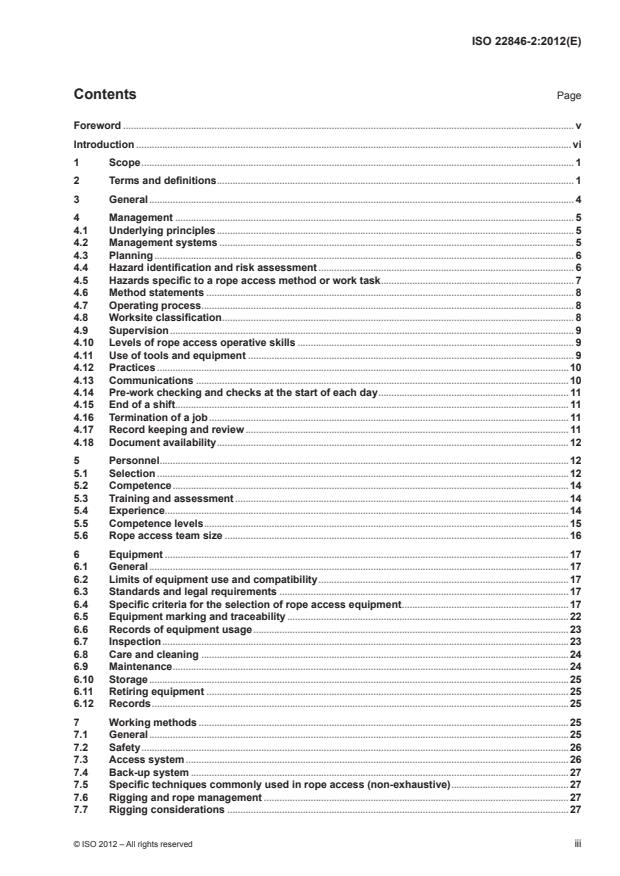
Contents Page
Foreword . v
Introduction .vi
1 Scope . 1
2 Terms and definitions . 1
3 General . 4
4 Management . 5
4.1 Underlying principles . 5
4.2 Management systems . 5
4.3 Planning . 6
4.4 Hazard identification and risk assessment . 6
4.5 Hazards specific to a rope access method or work task . 7
4.6 Method statements . 8
4.7 Operating process . 8
4.8 Worksite classification . 8
4.9 Supervision . 9
4.10 Levels of rope access operative skills . 9
4.11 Use of tools and equipment . 9
4.12 Practices .10
4.13 Communications .10
4.14 Pre-work checking and checks at the start of each day . 11
4.15 End of a shift . 11
4.16 Termination of a job . 11
4.17 Record keeping and review . 11
4.18 Document availability .12
5 Personnel .12
5.1 Selection .12
5.2 Competence .14
5.3 Training and assessment .14
5.4 Experience .14
5.5 Competence levels .15
5.6 Rope access team size .16
6 Equipment .17
6.1 General .17
6.2 Limits of equipment use and compatibility .17
6.3 Standards and legal requirements .17
6.4 Specific criteria for the selection of rope access equipment .17
6.5 Equipment marking and traceability .22
6.6 Records of equipment usage .23
6.7 Inspection .23
6.8 Care and cleaning .24
6.9 Maintenance .24
6.10 Storage .25
6.11 Retiring equipment .25
6.12 Records .25
7 Working methods .25
7.1 General .25
7.2 Safety .26
7.3 Access system .26
7.4 Back-up system .27
7.5 Specific techniques commonly used in rope access (non-exhaustive) .27
7.6 Rigging and rope management .27
7.7 Rigging considerations .27
8 Emergency situations .30
8.1 General .30
8.2 Suspension intolerance (suspension trauma) .31
9 Welfare .31
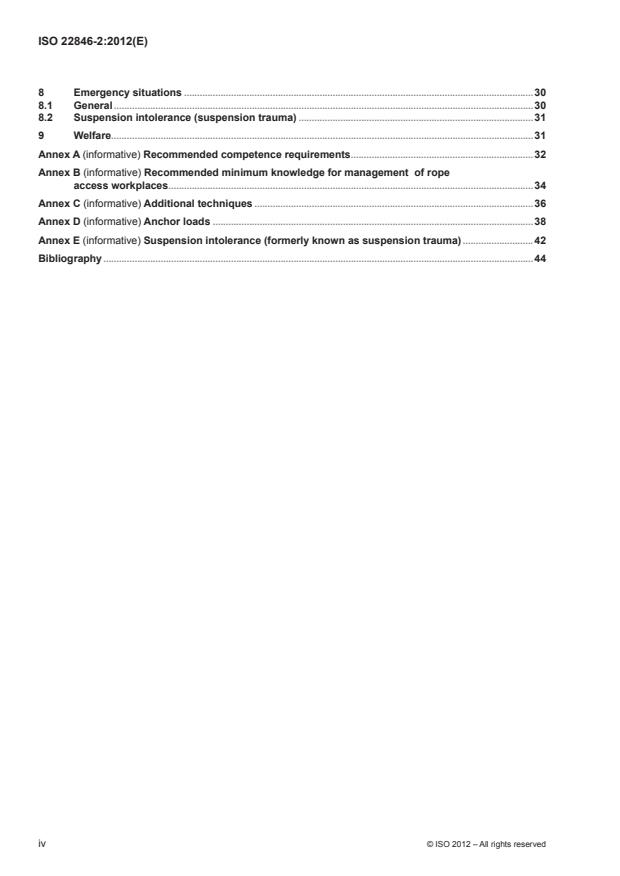
Annex A (informative) Recommended competence requirements .32
Annex B (informative) Recommended minimum knowledge for management of rope
access workplaces .34
Annex C (informative) Additional techniques .36
Annex D (informative) Anchor loads .38
Annex E (informative) Suspension intolerance (formerly known as suspension trauma) .42
Bibliography .44
iv © ISO 2012 – All rights reserved
Foreword
ISO (the International Organization for Standardization) is a worldwide federation of national standards bodies
(ISO member bodies). The work of preparing International Standards is normally carried out through ISO
technical committees. Each member body interested in a subject for which a technical committee has been
established has the right to be represented on that committee. International organizations, governmental and
non-governmental, in liaison with ISO, also take part in the work. ISO collaborates closely with the International
Electrotechnical Commission (IEC) on all matters of electrotechnical standardization.
International Standards are drafted in accordance with the rules given in the ISO/IEC Directives, Part 2.
The main task of technical committees is to prepare International Standards. Draft International Standards
adopted by the technical committees are circulated to the member bodies for voting. Publication as an
International Standard requires approval by at least 75 % of the member bodies casting a vote.
Attention is drawn to the possibility that some of the elements of this document may be the subject of patent
rights. ISO shall not be held responsible for identifying any or all such patent rights.
ISO 22846-2 was prepared by Technical Committee ISO/TC 94, Personal safety — Protective clothing and
equipment, Subcommittee SC 4, Personal equipment for protection against falls.
ISO 22846 consists of the following parts, under the general title Personal equipment for protection against
falls — Rope access systems:
— Part 1: Fundamental principles for a system of work
— Part 2: Code of practice
Introduction
ISO 22846 (all parts) sets out important criteria for the application of rope access systems for industrial purposes.
ISO 22846-1 sets out fundamental principles; this part of ISO 22846 expands on these, giving recommendations
for planning and management, operative competence and responsibilities of personnel, supervision, the
selection, use and care of equipment, and advice on how to implement a safe system of work.
Rope access is a method of working at height, typically using synthetic fibre kernmantel ropes and associated
equipment, used to gain access to, be supported at, and as a means of egress from, a place of work.
The application of rope access methods are regarded as a complete system, in which planning, competence
and suitable equipment are equally important. The malfunction or removal of any component in the system can
weaken the operation or prevent the system from operating properly.
This part of ISO 22846 is intended for use by all persons concerned with the use of rope access, including
operatives, specifiers, managers, rope access supervisors, purchasing personnel, trainers, clients and
regulatory authorities. Users are reminded always to take into account the entire system and not just the
component parts.
To ensure a rope access system operates correctly, at least the following factors are important:
— system management and planning;
— competence of the operatives and correct team composition;
— equipment selection, use and maintenance;
— proper organization and execution of working methods.
There can also be other issues to consider, depending upon the nature and location of the work, the competence
and experience of operatives and possible local or regional legal requirements.
A failure or shortcoming in any of the above can render the entire system deficient.
vi © ISO 2012 – All rights reserved
INTERNATIONAL STANDARD ISO 22846-2:2012(E)
Personal equipment for protection against falls — Rope
access systems —
Part 2:
Code of practice
1 Scope
This part of ISO 22846 provides recommendations and guidance on the use of rope access methods for
work at height and expands on the fundamental principles given in ISO 22846-1, in conjunction with which it
is intended to be used. It is intended for use by employers, employees and self-employed persons who use
rope access methods, by those commissioning rope access work and by rope access associations. This part
of ISO 22846 is applicable to the use of rope access methods in any situation where ropes are used as the
primary means of access, egress or support and as the primary means of protection against a fall, on both
man-made and natural features.
This part of ISO 22846 is not intended to apply to the use of rope access methods for leisure activities,
arboriculture, general steeplejack methods, emergency personal evacuation or to the use of rope rescue (line
rescue) techniques by emergency services for rescue work or for rescue training. Nevertheless, individuals
engaged in these and similar activities can benefit from the advice given in this part of ISO 22846.
2 Terms and definitions
For the purposes of this document, the following terms and definitions apply.
2.1
aid climbing
method of progression in suspension, either by moving from one fixed anchor to another or by the use of
moveable anchors or anchor points
2.2
anchor
fixture or place for the attachment of lines or persons
2.3
anchor line
flexible rope line connected, at one end at least, to an anchor so as to provide a means of support or other
safeguard for a person
NOTE An anchor line may be a working line or a safety line.
2.4
anchor point
attachment point at an anchor for anchor lines or persons
2.5
anchor sling
sling, strop or lanyard made from textiles, wire rope or chain, which is used to provide an anchor point, such as
for anchor lines, to anchors to which it is not possible to connect directly
2.6
ascender
rope adjustment device which, whenever attached to an anchor line of appropriate type and diameter, locks
under load in one direction and slides freely in the opposite direction
2.7
back-up device
rope adjustment device for a safety line of appropriate type and diameter, which accompanies the user during
changes of position or allows adjustment of the length of the safety line, and which locks automatically to the
safety line or only allows gradual movement along it, whenever a sudden load is applied in one direction
NOTE 1 The event of a fall is an example of when a sudden load is likely to be applied in one direction.
NOTE 2 Some back-up devices have the additional capacity to control energy in the event of a fall.
2.8
competent person
designated person suitably trained or qualified by knowledge and practical experience to enable the required
task or tasks to be carried out properly
2.9
connector
openable device used to connect components, which enables the user to link himself/herself directly or
indirectly to an anchor
NOTE Common items are carabiners, but may also include shackles, screw link connectors and other suitable items.
2.10
descender
manually operated, friction-inducing, rope-adjustment device, which, whenever attached to an anchor line
of appropriate type and diameter, allows the user to achieve a controlled descent and to stop with hands off
anywhere on the anchor line
2.11
double protection
method for protecting an operative against falls from a height, whereby two separate and independent
connections are made from the operative’s harness to anchor lines or the structure, such that the failure of any
one connection does not lead to a catastrophic failure or fall
2.12
dynamic rope
rope specifically designed to absorb energy in a fall by stretching, thereby minimizing the impact force
2.13
fall arrest system
personal fall protection system for work at a height by which a fall is intended to be arrested to prevent the
collision of the user with the ground or structure
2.14
fall factor
length of a potential fall divided by the length of rope or lanyard available to arrest it
2.15
free fall
fall where there is no or only minimal collision with any obstruction and where there is no or only minimal
resistance to the effect of gravity
2.16
harness
arrangement of straps, fittings, buckles or other elements suitably designed to support the body and provide
attachment points for the working line and safety line for rope access work
2.17
hierarchy of controls
process of hazard controls whereby a hazard, once identified and assessed for likelihood and severity, is
controlled by elimination or, if this is not possible, is controlled or mitigated in a manner that seeks to provide
the most effective and practical outcome, whilst relying as little as possible on user intervention or action
2 © ISO 2012 – All rights reserved
2.18
kernmantel rope
textile rope consisting of a core enclosed by a sheath
NOTE The core is usually the main load-bearing element and typically consists of parallel elements, which have been
drawn and turned together in single or multiple layers, or of braided elements. The sheath is generally braided or woven
and protects the core from, for example, external abrasion and ultraviolet degradation.
2.19
lanyard
line or sling used to connect a harness to a safety line, working line or anchor
NOTE Also known as a cow’s tail.
2.20
lead climbing
method of progression, not in suspension, in which the operative is supported by the structure and is protected
by a safety line, which is passed through intermediate anchors
NOTE The safety line is passed through an independently anchored fall protection device, which is operated by
another person, and by which a fall can be arrested with a limited force.
2.21
limited free fall
free fall not greater than 600 mm and with an impact force not exceeding 6 kN
2.22
low-stretch rope
textile rope with lower stretch and, therefore, less energy absorption than a dynamic rope
NOTE Sometimes known as a “semi-static rope”.
2.23
method statement
document, prepared by a manager, which describes how a particular job (or type of job where several jobs are
essentially identical) should be undertaken to ensure that any risks to the health and safety of the operatives,
or others who can be affected, are minimized
NOTE 1 The method statement may equally describe how a particular type of job, where several jobs are essentially
identical, should be undertaken.
NOTE 2 It is also known in some jurisdictions as safety method statement, work method statement or safe work method
statement and may form part of documents, such as job safety and environment analysis. Other similar terms may be used
in some jurisdictions.
2.24
restraint
technique whereby a person is prevented by means of a harness and other devices from reaching zones where
the risk of a fall from a height exists
2.25
rope access
technique using ropes, normally incorporating two separately secured systems, one as a means of access and
the other as back-up security, used with a harness in combination with other devices, for getting to and from
the place of work and for work positioning
2.26
rope access manager
person who may define and operate a safe system of work applicable to all worksites
2.27
rope access supervisor
person who may implement a safe rope access working system for a particular worksite and supervise
operatives undertaking specific rope access tasks
2.28
safety line
anchor line provided as a safeguard against falls
2.29
screwlink connector
connector that is closed by a threaded sleeve, which is a load-bearing part of the connector whenever
fully screwed up
2.30
sentry
person responsible for keeping watch to safeguard the anchorage areas and/or the area of ground below or
above the operatives
2.31
traversing
broadly horizontal progression, generally using lead climbing or aid climbing techniques or transverse ropes
or pulley systems
2.32
work positioning
technique that enables a person to work while supported in tension or suspension in such a way that a fall from
a height is prevented or restricted
2.33
working line
anchor line used primarily for suspension, work positioning and restraint, including descending and ascending
3 General
3.1 Rope access should always be carried out as a complete, safe system of work, involving a combination
of aspects, each dependent on the proper implementation of the others.
3.2 After determining whether rope access is a suitable access method for the task, the following fundamental
principles should be considered in establishing which measures are required for a rope access operation.
a) There should always be effective management, including on-site supervision.
b) Rope access methods can be of varying difficulty and complexity. Over and above the complexity of the rope
access methods chosen, other issues should be taken into consideration, e.g. environment, work task, location.
This consideration may lead to the modification of factors such as the access method and rescue plan.
c) Individuals should possess the minimum practical skill level appropriate for the work to be undertaken and
the environment in which they are working.
d) Different minimum requirements for skills apply to individuals according to their specific level of responsibility,
i.e. manager, supervisor and operative.
3.3 The level of complexity or degree of risk presented by the work environment determines
a) the level of skill or experience required by the rope access operatives,
b) the degree of worksite control required,
c) the type of equipment used, and
4 © ISO 2012 – All rights reserved
d) the type of access method required.
3.4 To ensure that a rope access system operates correctly, it is important that at least the following key
subjects be addressed:
a) management (management and planning);
b) personnel (competence of the operatives and correct composition of the team);
c) equipment (selection, use, inspection and maintenance);
d) work methods (properly organized and executed work methods).
These subjects are addressed in this part of ISO 22846, each in its own clause or subclause.
4 Management
4.1 Underlying principles
Each of the underlying principles given in this part of ISO 22846 can be regarded as the foundation of a
decision-making and planning process, which determines a range of suitable personnel and working methods
required for a given worksite. Table 1 shows the responsibility of rope access personnel and the classification
of operatives, and provides terms for such personnel, which are used throughout this part of ISO 22846.
Table 1 — Responsibility of rope access personnel
Title Responsibility
Operative May carry out specific work tasks under supervision
a
Supervisor Able to implement a safe working system for a particular worksite
b
Manager Able to define and operate a safe system of work applicable to
more than one worksite
a
The rope access supervisor should always possess the highest level of practical rope access
skills required for the task being undertaken.
b
The rope access manager and rope access supervisor may be the same person.
4.2 Management systems
4.2.1 The aim in planning and subsequently managing rope access work is to create a working environment
that maximizes safety and minimizes the risk of error and possible injury. The combination of elements needed
to ensure such an environment is often known as a “safe system of work”.
4.2.2 A documented system should be in place to ensure that policies and procedures exist that adequately
control the work.
4.2.3 The system should keep up to date with changing practices and legislation and should take into account
any known incidents.
EXAMPLE Examples include suspension intolerance treatment recommendations, equipment changes and new
techniques.
4.3 Planning
4.3.1 Prior to a rope access project being undertaken, an analysis should be carried out to confirm that rope access
is a suitable method and to ensure there are control systems in place that allow the work to be completed safely.
The following are examples of areas for analysis:
a) how easily and safely a suspended operative is able to use any materials, equipment or tools necessary
for the work and, in particular, whether the reaction from any tool places the operative at risk;
b) whether the work threatens to loosen material which might then fall on people or equipment below;
c) whether the work at any one location is of a duration that puts the operatives at risk of unacceptable
levels of exposure;
d) whether it would be possible to rescue the operatives quickly, using rope access techniques, from any
potential position in which they might find themselves.
NOTE In some jurisdictions, there might also be workplace regulations regarding the use of rope access for some tasks.
4.3.2 Prior to any rope access work commencing, a system should be in place to define or provide for at least
the following:
a) clear lines of responsibility;
b) safety management policy and procedures;
c) assurance that the rope access supervisor has been authorized by the company to act as necessary for
the safety of the operatives, the public and the worksite;
d) procedures for dealing with all hazardous materials, plant, tools or environmental hazards;
e) adequate insurance for the worksite, operatives, public liability and any other aspects that can be relevant
to the worksite or the location;
f) a documented risk assessment, which broadly should be in three parts: identification of any hazards,
assessment of the likelihood and severity of consequences, and methods of hazard control;
g) project planning;
h) selection of staff;
i) methods for ensuring proper communication of relevant information to all staff;
j) records of staff competence, equipment and inspections;
k) rescue plans and equipment.
4.3.3 The minimum management knowledge recommended is set out in Table B.1.
4.4 Hazard identification and risk assessment
4.4.1 If it has been confirmed that rope access is a suitable method to carry out the intended task, employers
should carefully review the procedures to be followed when carrying out the work and determine how hazards
can be removed. If it is not possible to remove hazards, employers should examine how risks can be reduced
to an acceptable level.
4.4.2 The risk assessment should be documented and should cover all aspects of the work to be undertaken.
It should be reviewed regularly during the course of the work in order to account for changing circumstances.
6 © ISO 2012 – All rights reserved
4.4.3 All project planning, hazard identification and risk assessment should seek to follow the hierarchy of
controls. The hierarchy seeks to remove hazards or, if this is not possible, to control them to the highest possible
degree. In so doing, it reduces the probability of an incident occurring rather than having to deal with the
consequences of the incident.
4.4.4 The following steps should be carried out:
a) identify general hazards;
b) identify hazards specific to the task or the worksite;
c) assess the likelihood and consequence of the hazard occurring;
d) seek to eliminate hazards;
e) mitigate against the remaining hazards;
f) determine the experience of personnel required;
g) describe other elements necessary to ensure a safe system of work.
4.4.5 The risk assessment document(s) should be available to personnel working at the site and should be
formally reviewed by them at regular intervals during the course of the work.
4.4.6 Several documents can be prepared. For example, a formal hazard identification/risk assessment,
which covers the entire worksite or a number of operations, may be produced during planning. However, for the
specific on-site work, there is a simpler document which sets out the hazards/risks for that particular worksite.
This document can also provide some form of method statement (see 4.6) for the work team to review. The work
team may prepare this document at the worksite. Irrespective of where the document is produced, the work
team should review it at the worksite.
4.5 Hazards specific to a rope access method or work task
4.5.1 Hazards specific to a rope access method or work task can exist. Examples include:
a) the presence of other trades;
b) the tools being used;
c) the availability of anchor points of suitable size, shape and strength for the proposed access method and
work to be carried out;
d) any hazard placing the public or other workers at risk.
4.5.2 The project planning should take into account the environment in which the work takes place, including:
a) the weather;
b) the presence of contaminating substances which are possibly hazardous, such as bird droppings,
asbestos, etc.;
c) the presence of power lines;
d) local hazards, such as sources of gases and vapours, heat and corrosion;
e) the presence of moving machinery or tools.
4.6 Method statements
4.6.1 On the basis of the risk assessment and safety policy, employers should prepare a suitable work plan
or “method statement”. Separate method statements can be necessary for each particular aspect of the job.
4.6.2 In the method statement, the employer should set out working steps which are to be followed for the
particular work situation. In cases where types of jobs are similar, the method statements may be identical and
may, therefore, be in the form of a general document, which should include either a specific rescue plan or a
procedural outline.
4.6.3 Where the work includes the use of hazardous tools (e.g. welding torches, flame cutters and abrasive
wheels), a more detailed method statement can be needed, detailing possible additional controls to be put in place.
4.7 Operating process
To enable a team to carry out a task, a set of operating processes should be put in place that cover at least
the following:
a) documented method statement;
b) permits required for the work (e.g. for work in confined spaces, hot work or work offshore);
c) worksite induction requirements;
d) requirements for any additional personnel that might be required, such as traffic monitors;
e) physical hand-over procedures, e.g. between shift changes or worksite contractors;
f) any requirement for worksite-specific documentation, e.g. hand-over documentation, end-of-shift
documentation and accident/incident reporting;
g) facilities required for the worksite and the personnel, such as rest facilities, emergency wash facilities,
showers and decontamination facilities;
h) worksite inspection and anchorage design/selection;
i) documented system of work;
j) documented system of incident response, including rescue/retrieval;
k) properly trained and assessed personnel;
l) properly supervised personnel;
m) properly equipped personnel;
n) suitable numbers of personnel at the worksite (minimum two);
o) protection of third parties.
4.8 Worksite classification
There are two general classifications of rope access worksites:
a) Simple: rope access worksite unaffected by any adjacent work or trades, where the anchor line follows a
simple path from anchor point to ground or platform level, where there is no requirement to pass knots or
deviations greater than 20° and where rescues can be carried out straight to ground or platform level.
b) Complex: any rope access worksite where the requirements for a simple worksite cannot be met. The
following are examples of additional factors that may define a complex worksite (non-exhaustive list).
8 © ISO 2012 – All rights reserved
EXAMPLE 1 The use of re-anchors or a significant increase in technique, e.g. when secondary techniques are needed,
especially for rescue, because a single descent to the ground is not possible.
EXAMPLE 2 Competence in long ascents and special rescue methods, e.g. environment without clear egress at the bottom.
EXAMPLE 3 The presence of other trades or activities in the near vicinity, which can impact on the rope access team.
EXAMPLE 4 Working on construction worksites, power stations, petro-chemical plants and similar, where worksite
conditions can be far more complex and demanding.
NOTE Where any doubt exists as to the worksite classification, it is expected that, by default, the team will rate the
worksite as “complex”.
4.9 Supervision
4.9.1 Rope access worksites should be properly supervised to ensure the safety of operatives and others who
can be affected on the worksite.
4.9.2 It is essential that rope access supervisors have the experience and competence to supervise the rope
access work and any potential rescue for each particular rope access project under their supervision. For the
competence requirements of a rope access supervisor, see 5.5.3.
NOTE Table A.1 sets out the recommended competence requirements for basic, intermediate and advanced operatives.
4.10 Levels of rope access operative skills
4.10.1 The result of the planning process undertaken should reflect the classification of the worksite; see 4.8
and the required operative skills.
4.10.2 The skills of operatives and the training received by them for a particular worksite classification or work
situation should be assessed by the rope access supervisor before the operatives are allowed to work at any worksite.
NOTE Any operative can work on a complex worksite, provided he/she have adequate competence and appropriate
supervision is provided.
4.11 Use of tools and equipment
4.11.1 Tools and equipment should be suitable for the work intended and compatible with rope access work.
4.11.2 Operatives should be appropriately trained in the correct use of tools and other work equipment.
4.11.3 Operatives should be able to position themselves and their suspension equipment well away from any
moving parts. If this is not possible, extra control measures should be taken, e.g. additional guards or shields.
4.11.4 All tools or loose equipment should be attached in such a way as to prevent hazards caused by objects
being dropped. Where it is impracticable to attach tools or other equipment to the user (e.g. because of the
weight), they should be suspended independently by a separate line or other method.
4.11.5 Tools that can cause injury to the operative should ideally be fitted with a “dead man’s handle” so that
the power is cut off in the event of a mistake, accident or emergency.
4.11.6 How tools react when started up or when jamming occurs should be taken into consideration and
appropriate controls should be put in place.
4.11.7 Effective communication between those using the tools and those manipulating the anchor lines is essential.
4.11.8 Consideration of the use of tools can indicate the need for a different access method or additional
measures to ensure that operatives remain safe while working. The nature of some work equipment can require
that the length of work periods be limited to prevent discomfort to the operative.
4.11.9 Where an operative has to work with restricted vision and/or hearing (e.g. use of a welding mask), it
is recommended that a second operative be immediately adjacent to the first to act as a spotter, i.e. to guard
against potential problems, such as fire or equipment damage.
4.12 Practices
4.12.1 Before work commences, the rope access supervisor, together with the employer, should ensure that
rescue procedures that are adequate for the particular situation have been agreed upon. They should also
ensure that sufficient personnel and resources are readily available to carry out those procedures, should the
necessity arise.
4.12.2 Where operating on a worksite with more than one discrete working area, adequate supervision should
be provided for each of those discrete areas.
4.12.3 Rope access is a team activity. While there are likely to be numerous specific requirements for a team,
relevant to the work being undertaken, there are some general points which are common to all worksites:
a) one team member should be responsible for supervision and should be capable of doing this at the level
of the work being undertaken;
b) all team members should have adequate, proven competence at the level appropriate to the work
being undertaken;
c) all team members, irrespective of their seniority or experience, should “buddy check” each other’s
equipment before leaving a safe area, e.g. check that knots are tied correctly, harnesses buckled and
adjusted correctly, and connectors closed and locked correctly;
d) on occasion, additional team members can be required to monitor traffic, control hazardous areas, monitor
anchorage areas or similar (i.e. these persons need not necessarily possess rope access skills);
e) the organization and management of a rope access worksite requires not only consideration of the access
requirements, but also the potential needs of operatives following an incident, e.g. where an operative is
injured or following a fall.
4.12.4 When connecting to, and disconnecting from, the rope access system, normally the first connection to
be made and the last to be disconnected should be the back-up device.
EXAMPLE Instances of transferral from anchor line to anchor line constitute an exception to this rule.
4.13 Communications
An effective communications system should be in place. The communications system should provide for at
least the following:
a) the rope access supervisor is in contact with all team members;
b) the system is relevant to the worksite and conditions taking into account issues, such as noise, interference,
other work teams and weather;
c) the system is linked, where necessary, to other people outside the team, such as emergency crews and a
worksite controller;
d) the system is clearly understood and useable by all team members.
10 © ISO 2012 – All rights reserved
4.14 Pre-work checking and checks at the start of each day
4.14.1 At the start of each day, the work team should review the risks which can affect the level of safety. This
review should refer to the method statement and risk assessment. It is preferable that the entire team carry out
this review, that it be documented and that all team members sign the documentation to confirm participation
and understanding.
4.14.2 Rope access equipment should be checked carefully before starting work and during the course of the job.
4.14.3 At the beginning of each working day and at other times as appropriate (e.g. while the equipment is
being relocated during the day), the rope access supervisor should visually check all anchors and anchor lines.
4.14.4 The rope access supervisor should ensure that operatives follow suitable pre-descent/ascent procedures.
Operatives should carefully examine their own harness, descent and ascent devices and anchor lines to check
that they are in good condition and function correctly. Before each descent/ascent, visual checks should be
made of the anchors and any points on the anchor line where chafing can occur. “Buddy checking” of gear by
other members of the team is recommended.
4.15 End of a shift
At the end of each shift, access equipment and work tools should be secured or stored in such a manner as
to ensure that they are kept safe until the next use. A formal hand-over to the next shift should take place in
accordance with local procedures and rules, at which time any relevant information should be passed on.
4.16 Termination of a job
At the termination of a job, care should be taken to clear the worksite properly, with a final inspection of the area
before any permit to work is handed back.
4.17 Record keeping and review
Records should be kept and maintained to allow verification of the status of personnel, equipment and worksite.
Typical records include the following:
a) work planning and management:
1) hazard identification/risk assessments;
2) method statements;
3) design criteria for work being undertaken, where required;
b) personnel:
1) statutory requirements relating to employment, next of kin, etc.;
2) training and competence records;
3) experience;
c) equipment:
1) purchase and obsolescence dates;
2) records of use;
3) inspection and maintenance;
4) user instructions;
5) restrictions or limitations on use;
6) load ratings, e.g. safe working load;
7) batch numbers, serial numbers and other identification markings;
d) incidents:
1) near misses;
2) accidents;
3) investigation results of d) 1) and d) 2).
4.18 Document availability
Relevant documentation should be kept at the worksite and should be available to the worksite personnel for
reference during work.
5 Personnel
5.1 Selection
5.1.1 Suitability
5.1.1.1 All staff working at height should have a working knowledge
...