

ISO/TS 9002:2016
(Main)Quality management systems — Guidelines for the application of ISO 9001:2015
General Information
- Abstract
ISO/TS 9002:2016 provides guidance on the intent of the requirements in ISO 9001:2015, with examples of possible steps an organization can take to meet the requirements. It does not add to, subtract from, or in any way modify those requirements. ISO/TS 9002:2016 does not prescribe mandatory approaches to implementation, or provide any preferred method of interpretation.
- Status
- Published
- Publication Date
- 30-Oct-2016
- Technical Committee
- ISO/TC 176/SC 2 - Quality systems
- Drafting Committee
- ISO/TC 176/SC 2 - Quality systems
- Current Stage
- 9092 - International Standard to be revised
- Start Date
- 17-Apr-2025
- Completion Date
- 29-Aug-2026
Buy Documents




ISO/TS 9002:2016 - Quality management systems — Guidelines for the application of ISO 9001:2015 Released:3/17/2017
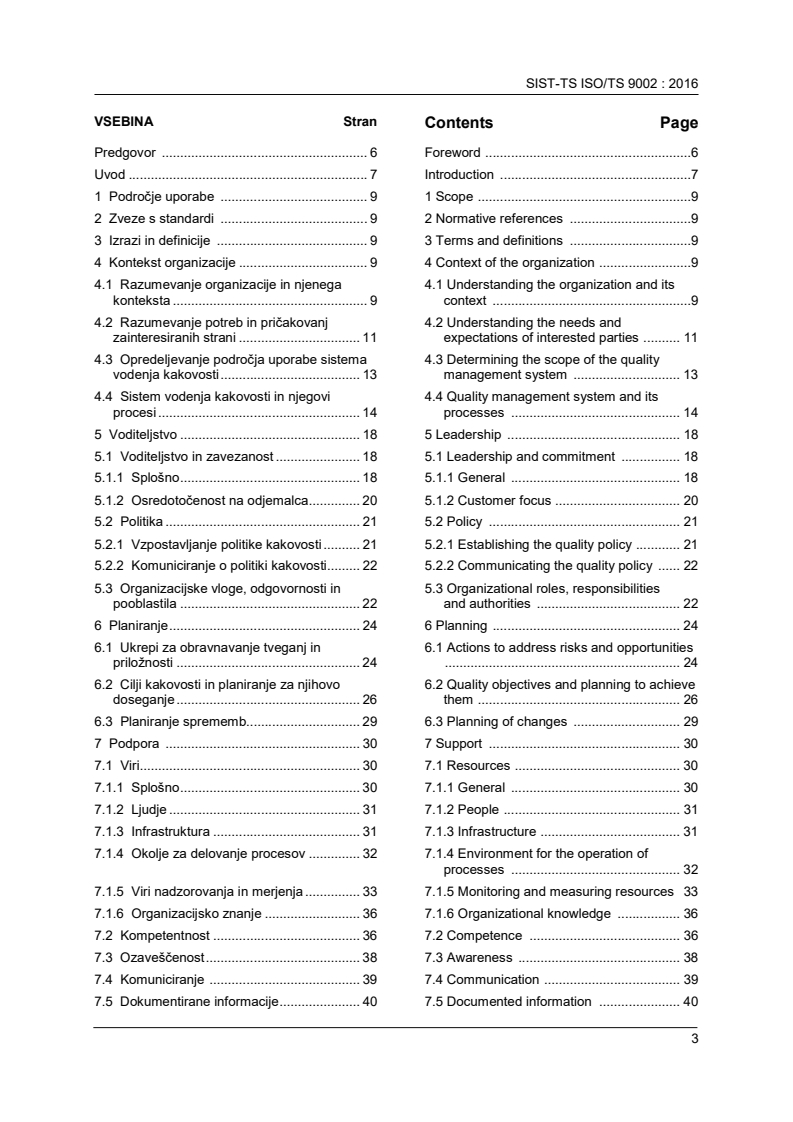
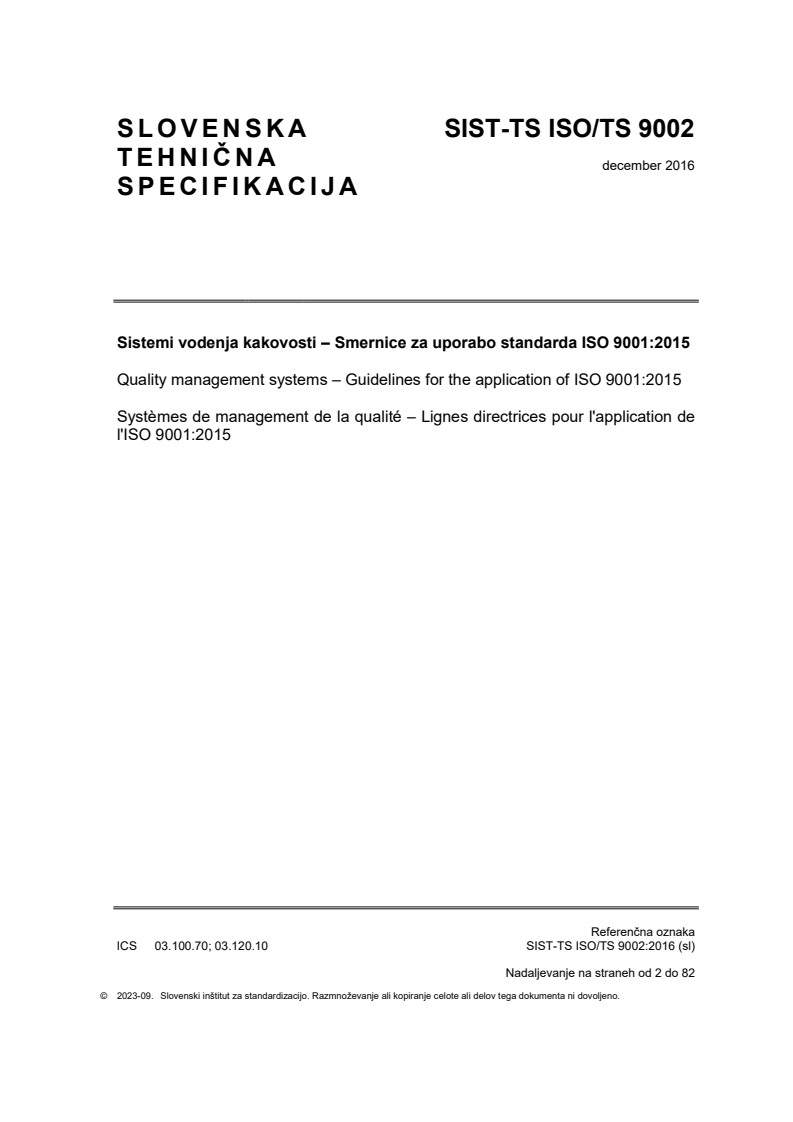
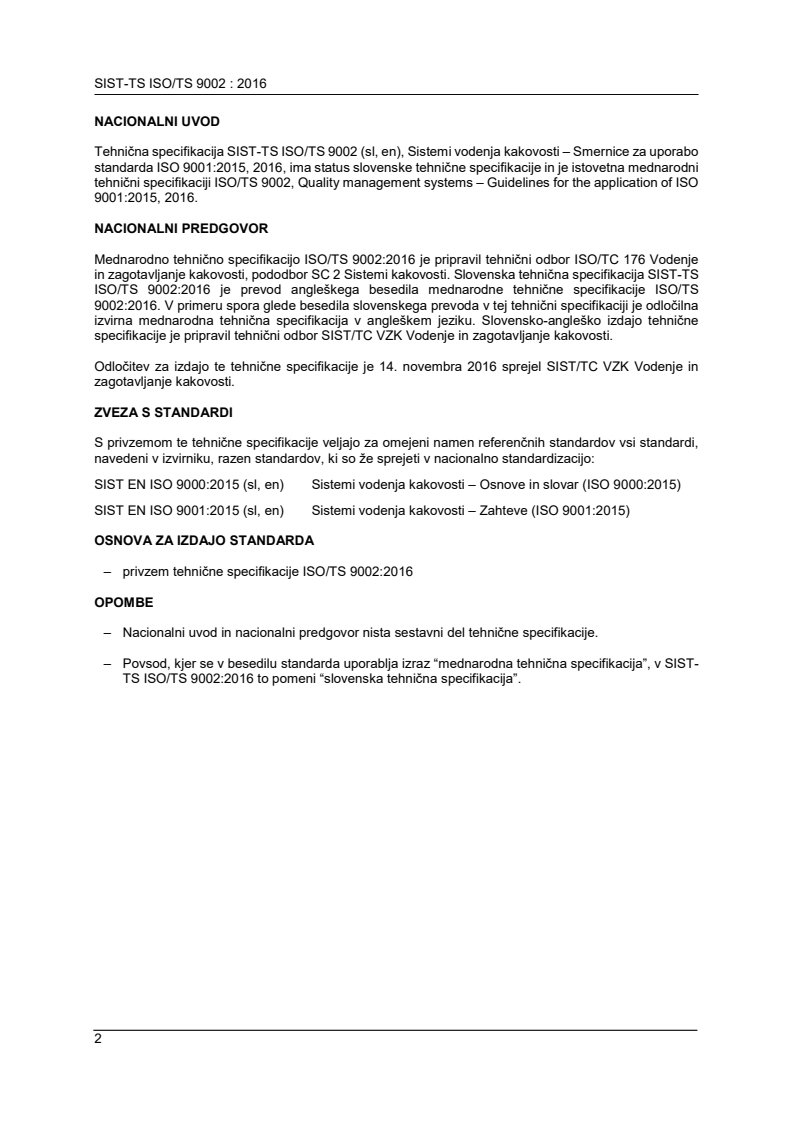
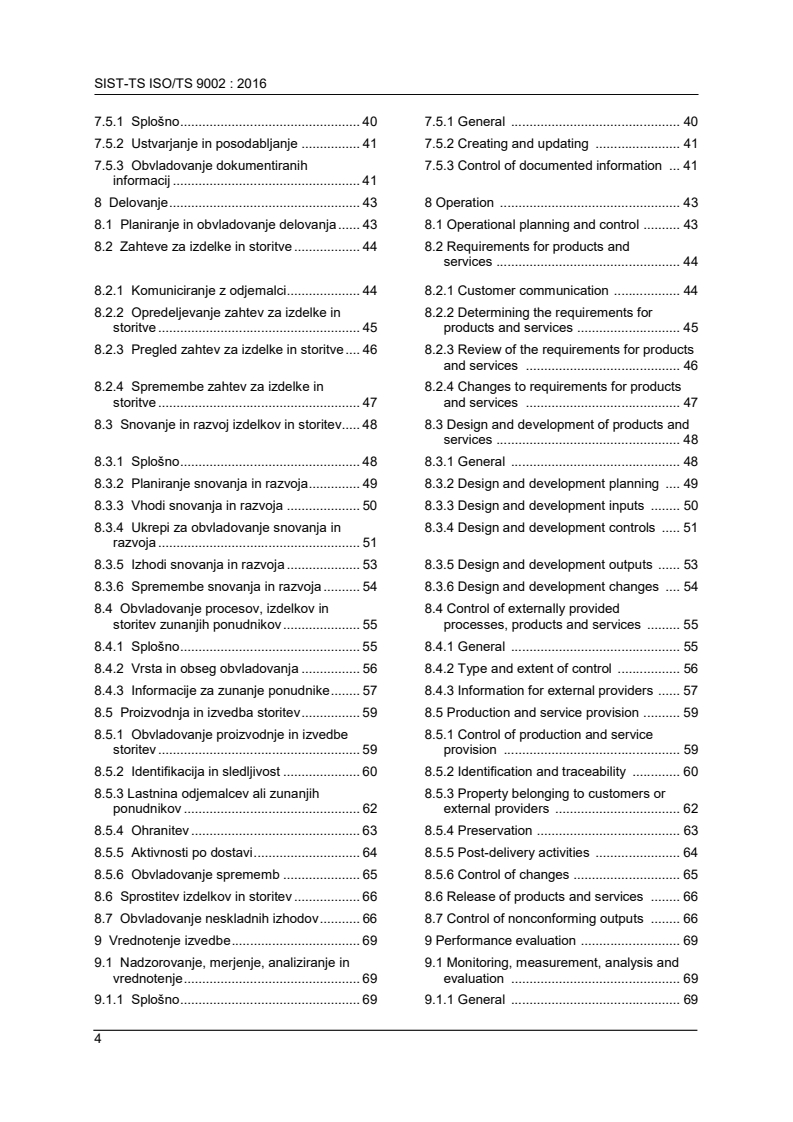
TS ISO/TS 9002:2016
Overview
ISO/TS 9002:2016 - Quality management systems - Guidelines for the application of ISO 9001:2015 - is a Technical Specification published by ISO to help organizations interpret the intent of ISO 9001:2015 requirements. It provides clause-by-clause guidance (correlating to Clauses 4–10 of ISO 9001:2015) and gives examples of possible approaches an organization can take to meet requirements. ISO/TS 9002:2016 does not add to, subtract from or modify ISO 9001:2015, nor does it prescribe mandatory implementation methods or serve as a tool for certification/audit decisions.
Key topics and requirements
The technical topics covered reflect the structure of ISO 9001:2015 and include practical guidance on:
- Context of the organization: understanding internal/external issues and interested parties; determining QMS scope
- Leadership: leadership commitment, customer focus, quality policy, roles and responsibilities
- Planning: actions to address risks and opportunities, quality objectives, planning changes
- Support: resources, competence, organizational knowledge, communication, documented information
- Operation: operational planning and control, requirements for products and services, design and development, control of externally provided processes, production and service provision
- Performance evaluation: monitoring, measurement, customer satisfaction, internal audit, management review
- Improvement: nonconformity and corrective action, continual improvement
The specification offers examples and options (e.g., for control of external providers, evidence for competence, traceability and preservation) but avoids prescriptive solutions.
Practical applications
ISO/TS 9002:2016 is useful for organizations that need to translate ISO 9001:2015 requirements into operational practices. Typical applications:
- Developing or updating a quality management system aligned to ISO 9001:2015
- Creating internal guidance, templates and checklists that reflect the intent of each clause
- Training quality teams and leaders on practical ways to satisfy requirements (e.g., risk-based planning, setting measurable quality objectives)
- Supporting process definition for design & development, supplier control, and release/traceability activities
- Informing management reviews, internal audits and continual improvement activities
Note: because the TS provides guidance and examples, it should not be used as a substitute for ISO 9001:2015 when performing audits or formal certification activities.
Who should use this standard
- Quality managers and implementation teams
- ISO 9001 consultants and trainers
- Small and large organizations seeking practical implementation options
- Organizations needing to align operational practices with the intent of ISO 9001:2015
Related standards
- ISO 9001:2015 - Quality management systems - Requirements (primary standard this TS supports)
- National adoptions (e.g., SIST-TS ISO/TS 9002:2016) reflect localized publishing and distribution
Keywords: ISO/TS 9002:2016, ISO 9001:2015, quality management systems, guidelines, implementation, risk-based planning, internal audit, quality objectives.
Relations
- Effective Date
- 06-Jun-2022
- Effective Date
- 19-Apr-2025
Buy Documents
ISO/TS 9002:2016 - Quality management systems — Guidelines for the application of ISO 9001:2015 Released:3/17/2017
TS ISO/TS 9002:2016
Related Packages
Get Certified
Connect with accredited certification bodies for this standard

BSI Group
BSI (British Standards Institution) is the business standards company that helps organizations make excellence a habit.

Bureau Veritas
Bureau Veritas is a world leader in laboratory testing, inspection and certification services.

DNV
DNV is an independent assurance and risk management provider.
Sponsored listings
Frequently Asked Questions
ISO/TS 9002:2016 is a technical specification published by the International Organization for Standardization (ISO). Its full title is "Quality management systems — Guidelines for the application of ISO 9001:2015". This standard covers: ISO/TS 9002:2016 provides guidance on the intent of the requirements in ISO 9001:2015, with examples of possible steps an organization can take to meet the requirements. It does not add to, subtract from, or in any way modify those requirements. ISO/TS 9002:2016 does not prescribe mandatory approaches to implementation, or provide any preferred method of interpretation.
ISO/TS 9002:2016 provides guidance on the intent of the requirements in ISO 9001:2015, with examples of possible steps an organization can take to meet the requirements. It does not add to, subtract from, or in any way modify those requirements. ISO/TS 9002:2016 does not prescribe mandatory approaches to implementation, or provide any preferred method of interpretation.
ISO/TS 9002:2016 is classified under the following ICS (International Classification for Standards) categories: 03.100.70 - Management systems; 03.120.10 - Quality management and quality assurance. The ICS classification helps identify the subject area and facilitates finding related standards.
ISO/TS 9002:2016 has the following relationships with other standards: It is inter standard links to ISO 16014-5:2019, ISO/DIS 9002. Understanding these relationships helps ensure you are using the most current and applicable version of the standard.
ISO/TS 9002:2016 is available in PDF format for immediate download after purchase. The document can be added to your cart and obtained through the secure checkout process. Digital delivery ensures instant access to the complete standard document.
Standards Content (Sample)
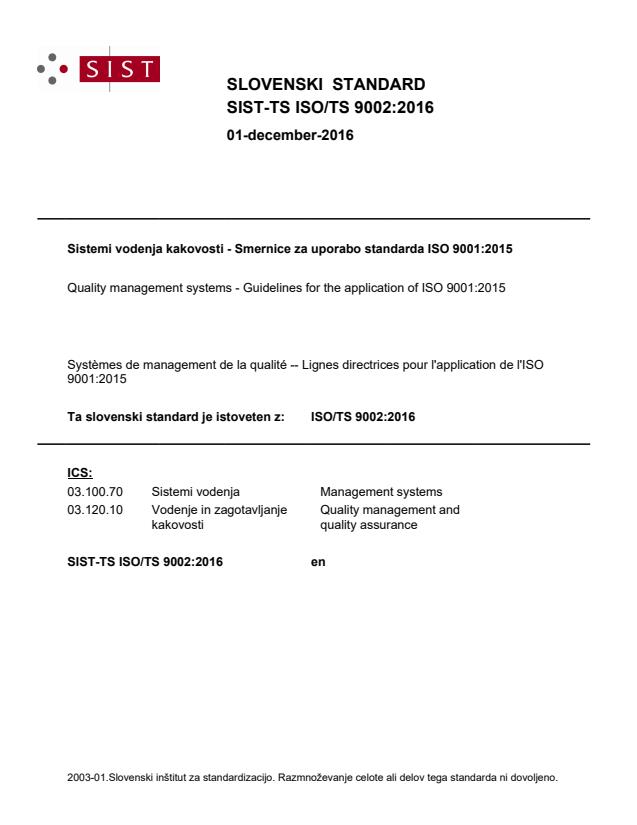
SLOVENSKI STANDARD
01-december-2016
Sistemi vodenja kakovosti - Smernice za uporabo standarda ISO 9001:2015
Quality management systems - Guidelines for the application of ISO 9001:2015
Systèmes de management de la qualité -- Lignes directrices pour l'application de l'ISO
9001:2015
Ta slovenski standard je istoveten z: ISO/TS 9002:2016
ICS:
03.100.70 Sistemi vodenja Management systems
03.120.10 Vodenje in zagotavljanje Quality management and
kakovosti quality assurance
2003-01.Slovenski inštitut za standardizacijo. Razmnoževanje celote ali delov tega standarda ni dovoljeno.
TECHNICAL ISO/TS
SPECIFICATION 9002
First edition
2016-11-01
Quality management systems —
Guidelines for the application of ISO
9001:2015
Systèmes de management de la qualité — Lignes directrices pour
l’application de l’ISO 9001:2015
Reference number
©
ISO 2016
© ISO 2016, Published in Switzerland
All rights reserved. Unless otherwise specified, no part of this publication may be reproduced or utilized otherwise in any form
or by any means, electronic or mechanical, including photocopying, or posting on the internet or an intranet, without prior
written permission. Permission can be requested from either ISO at the address below or ISO’s member body in the country of
the requester.
ISO copyright office
Ch. de Blandonnet 8 • CP 401
CH-1214 Vernier, Geneva, Switzerland
Tel. +41 22 749 01 11
Fax +41 22 749 09 47
copyright@iso.org
www.iso.org
ii © ISO 2016 – All rights reserved
Contents Page
Foreword .v
Introduction .vi
1 Scope . 1
2 Normative references . 1
3 Terms and definitions . 1
4 Context of the organization . 1
4.1 Understanding the organization and its context . 1
4.2 Understanding the needs and expectations of interested parties . 2
4.3 Determining the scope of the quality management system . 4
4.4 Quality management system and its processes . 5
5 Leadership . 7
5.1 Leadership and commitment . 7
5.1.1 General. 7
5.1.2 Customer focus . 8
5.2 Policy . 8
5.2.1 Establishing the quality policy . 8
5.2.2 Communicating the quality policy . 9
5.3 Organizational roles, responsibilities and authorities. 9
6 Planning .10
6.1 Actions to address risks and opportunities .10
6.2 Quality objectives and planning to achieve them .12
6.3 Planning of changes .13
7 Support .14
7.1 Resources .14
7.1.1 General.14
7.1.2 People .14
7.1.3 Infrastructure .14
7.1.4 Environment for the operation of processes .15
7.1.5 Monitoring and measuring resources .16
7.1.6 Organizational knowledge .17
7.2 Competence .18
7.3 Awareness .18
7.4 Communication .19
7.5 Documented information .20
7.5.1 General.20
7.5.2 Creating and updating .20
7.5.3 Control of documented information .20
8 Operation .21
8.1 Operational planning and control .21
8.2 Requirements for products and services .22
8.2.1 Customer communication .22
8.2.2 Determining the requirements for products and services .23
8.2.3 Review of the requirements for products and services .23
8.2.4 Changes to requirements for products and services .24
8.3 Design and development of products and services .24
8.3.1 General.24
8.3.2 Design and development planning .25
8.3.3 Design and development inputs .26
8.3.4 Design and development controls .26
8.3.5 Design and development outputs .27
8.3.6 Design and development changes . .28
8.4 Control of externally provided processes, products and services .28
8.4.1 General.28
8.4.2 Type and extent of control .29
8.4.3 Information for external providers .30
8.5 Production and service provision .31
8.5.1 Control of production and service provision .31
8.5.2 Identification and traceability .32
8.5.3 Property belonging to customers or external providers .32
8.5.4 Preservation .33
8.5.5 Post-delivery activities .34
8.5.6 Control of changes .34
8.6 Release of products and services .35
8.7 Control of nonconforming outputs .35
9 Performance evaluation .37
9.1 Monitoring, measurement, analysis and evaluation .37
9.1.1 General.37
9.1.2 Customer satisfaction .37
9.1.3 Analysis and evaluation .38
9.2 Internal audit .39
9.3 Management review .40
9.3.1 General.40
9.3.2 Management review inputs .41
9.3.3 Management review outputs .41
10 Improvement .42
10.1 General .42
10.2 Nonconformity and corrective action .42
10.3 Continual improvement .43
Bibliography .45
iv © ISO 2016 – All rights reserved
Foreword
ISO (the International Organization for Standardization) is a worldwide federation of national standards
bodies (ISO member bodies). The work of preparing International Standards is normally carried out
through ISO technical committees. Each member body interested in a subject for which a technical
committee has been established has the right to be represented on that committee. International
organizations, governmental and non-governmental, in liaison with ISO, also take part in the work.
ISO collaborates closely with the International Electrotechnical Commission (IEC) on all matters of
electrotechnical standardization.
The procedures used to develop this document and those intended for its further maintenance are
described in the ISO/IEC Directives, Part 1. In particular the different approval criteria needed for the
different types of ISO documents should be noted. This document was drafted in accordance with the
editorial rules of the ISO/IEC Directives, Part 2 (see www.iso.org/directives).
Attention is drawn to the possibility that some of the elements of this document may be the subject of
patent rights. ISO shall not be held responsible for identifying any or all such patent rights. Details of
any patent rights identified during the development of the document will be in the Introduction and/or
on the ISO list of patent declarations received (see www.iso.org/patents).
Any trade name used in this document is information given for the convenience of users and does not
constitute an endorsement.
For an explanation on the meaning of ISO specific terms and expressions related to conformity assessment,
as well as information about ISO’s adherence to the World Trade Organization (WTO) principles in the
Technical Barriers to Trade (TBT) see the following URL: www.iso.org/iso/foreword.html.
The committee responsible for this document is Technical Committee ISO/TC 176, Quality management
and quality assurance, Subcommittee SC 2, Quality systems.
Introduction
This document has been developed to assist users to apply the quality management system requirements
of ISO 9001:2015 Quality management systems – Requirements.
This document provides guidance, with a clause by clause correlation to Clauses 4 to 10 of
ISO 9001:2015, however it does not provide guidance on ISO 9001:2015, Annexes A and B. Where there
is direct correlation between list items (i.e. bullet points) in a clause in ISO 9001:2015 and the guidance,
this is indicated within the clause of this document.
This document gives examples of what an organization can do, but it does not add new requirements to
ISO 9001. The examples in this document are not definitive and only represent possibilities, not all of
which are necessarily suitable for every organization.
ISO 9001 contains requirements that can be objectively audited or evaluated. This document includes
examples, descriptions and options that aid both in the implementation of a quality management
system and in strengthening its relation to the overall management system of an organization. While
the guidelines in this document are consistent with the ISO 9001 quality management system model,
they are not intended to provide interpretations of the requirements of ISO 9001 or be used for audit or
evaluation purposes.
As the requirements of ISO 9001 are generic, this document can be used by organizations of all types,
sizes, levels of maturity and in all sectors and geographic locations. However, the way an organization
applies the guidance can vary based on factors such as the size or the complexity of the organization,
the management model it adopts, the range of the organization’s activities and the nature of the risks
and opportunities it encounters.
Risk is the level of uncertainty inherent in a quality management system. There are risks in all systems,
processes and functions. Risk-based thinking ensures these risks are determined, considered and
controlled throughout the design and use of the quality management system.
Risk-based thinking has been implicit in previous editions of ISO 9001 in such requirements as
determining the type and extent of control for external providers based on the effect of the product
that is going to be provided, or taking corrective action based on the potential effect of an identified
nonconformity.
In addition, in previous editions of ISO 9001, a clause on preventive action was included. By using
risk-based thinking the consideration of risk is integral. It becomes proactive rather than reactive in
preventing or reducing undesired effects through early identification and action. Preventive action is
built-in when a management system is risk-based.
Not all the processes of a quality management system represent the same level of risk in terms of the
organization’s ability to meet its quality objectives. Some need more careful and formal planning and
control than others.
There is no requirement in ISO 9001 to use formal risk management in determining and addressing
risks and opportunities. An organization can choose the methods that suit its needs. IEC 31010 provides
a list of risk assessment tools and techniques that can be considered, depending on the organization’s
context.
In some cases, an organization might have a formal risk management process in place that is required
by customers or statutory and regulatory requirements. In such circumstances, the organization can
adapt its formal risk management process to meet the intent of the requirements in ISO 9001 concerning
risks and opportunities.
In addition to ISO 9001:2015, Annex A, ISO has published a number of other quality management
standards and informative resources which can assist the user and provide information on additional
implementation methods, including:
vi © ISO 2016 – All rights reserved
— the ISO handbook: ISO 9001:2015 for Small Enterprises – What to do ? Advice from ISO/TC 176
— the ISO 9001 Auditing Practices Group (APG) papers: www.iso.org/tc176/
ISO9001AuditingPracticesGroup
— public information on the ISO/TC 176/SC2 website: https://committee.iso.org/tc176sc2
— the ISO handbook: The Integrated Use of Management System Standards.
Additional standards and documents are listed in the Bibliography.
TECHNICAL SPECIFICATION ISO/TS 9002:2016(E)
Quality management systems — Guidelines for the
application of ISO 9001:2015
1 Scope
This document provides guidance on the intent of the requirements in ISO 9001:2015, with examples of
possible steps an organization can take to meet the requirements. It does not add to, subtract from, or
in any way modify those requirements.
This document does not prescribe mandatory approaches to implementation, or provide any preferred
method of interpretation.
2 Normative references
The following documents are referred to in the text in such a way that some or all of their content
constitutes requirements of this document. For dated references, only the edition cited applies. For
undated references, the latest edition of the referenced document (including any amendments) applies.
ISO 9000:2015, Quality management systems — Fundamentals and vocabulary
ISO 9001:2015, Quality management systems — Requirements
3 Terms and definitions
For the purposes of this document, the terms and definitions given in ISO 9000:2015 apply.
ISO and IEC maintain terminological databases for use in standardization at the following addresses:
— ISO Online browsing platform: available at http://www.iso.org/obp
— IEC Electropedia: available at http://www.electropedia.org/
4 Context of the organization
4.1 Understanding the organization and its context
The intent of this subclause is to understand the external and internal issues that are relevant to the
organization’s purpose and strategic direction and that can affect, either positively or negatively,
the organization’s ability to achieve the intended results of its quality management system. The
organization should be aware that external and internal issues can change, and therefore, should be
monitored and reviewed. An organization might conduct reviews of its context at planned intervals and
through activities such as management review.
Information about external and internal issues can be found from many sources, such as through
internal documented information and meetings, in the national and international press, websites,
publications from national statistics offices and other government departments, professional and
technical publications, conferences and meetings with relevant agencies, meetings with customers and
relevant interested parties, and professional associations.
Examples of external and internal issues relevant to the organization’s context can include, but are not
limited to:
a) external issues related to:
1) economic factors such as money exchange rates, economic situation, inflation forecast, credit
availability;
2) social factors such as local unemployment rates, safety perception, education levels, public
holidays and working days;
3) political factors such as political stability, public investments, local infrastructure, international
trade agreements;
4) technological factors such as new sector technology, materials and equipment, patent
expirations, professional code of ethics;
5) market factors such as competition, including the organization’s market share, similar products
or services, market leader trends, customer growth trends, market stability, supply chain
relationships;
6) statutory and regulatory factors which affect the work environment (see ISO 9001:2015, 7.1.4)
such as trade union regulations and regulations related to an industry;
b) internal issues related to:
1) overall performance of the organization;
2) resource factors, such as infrastructure (see ISO 9001:2015, 7.1.3), environment for the
operation of the processes (see ISO 9001:2015, 7.1.4), organizational knowledge (see
ISO 9001:2015, 7.1.6);
3) human aspects such as competence of persons, organizational behaviour and culture,
relationships with unions;
4) operational factors such as process or production and service provision capabilities,
performance of the quality management system, monitoring customer satisfaction;
5) factors in the governance of the organization, such as rules and procedures for decision making
or organizational structure.
At the strategic level, tools such as Strengths, Weaknesses, Opportunities and Threats analysis (SWOT)
and Political, Economic, Social, Technological, Legal, Environmental analysis (PESTLE) can be used.
A simple approach can be useful for organizations dependent on the size and complexity of their
operations, such as brainstorming and asking “what if” questions.
4.2 Understanding the needs and expectations of interested parties
The intent of this subclause is to ensure that the organization considers the relevant requirements of
relevant interested parties, beyond just those of its direct customers. The intention is to focus on only
those relevant interested parties which can have an impact on the organization’s ability to provide
products and services that meet requirements. While not directly stated in ISO 9001, the organization
could consider its external and internal issues (see ISO 9001:2015, 4.1) before, and to assist in,
determining its relevant interested parties.
The list of relevant interested parties can be unique to the organization. The organization can develop
criteria for determining relevant interested parties by considering their:
a) possible influence or impact on the organization’s performance or decisions;
b) ability to create risks and opportunities;
2 © ISO 2016 – All rights reserved
c) possible influences or impact on the market;
d) ability to affect the organization through their decisions or activities.
EXAMPLE 1 Examples of relevant interested parties that can be considered relevant by an organization
include, but are not limited to:
— customers;
— end users or beneficiaries;
— joint venture partners;
— franchisors;
— owners of intellectual property;
— parent and subsidiary organizations;
— owners, shareholders;
— bankers;
— unions;
— external providers;
— employees and others working on behalf of the organization;
— statutory and regulatory authorities (local, regional, national or international);
— trade and professional associations;
— local community groups;
— non-governmental organizations;
— neighbouring organizations;
— competitors.
To understand the needs and expectations of relevant interested parties, several activities and methods
can be carried out. They include working with those responsible for the processes or by using methods
that allow the gathering of information. Methods include, but are not limited to:
— reviewing orders received;
— reviewing statutory and regulatory requirements with compliance or legal departments;
— lobbying and networking;
— participating in relevant associations;
— benchmarking;
— market surveillance;
— reviewing supply chain relationships;
— conducting customer or user surveys;
— monitoring customer needs, expectations and satisfaction.
EXAMPLE 2 Examples of relevant interested party requirements include, but are not limited to:
— customer requirements regarding conformity, price, availability or delivery;
— contracts which have been entered into with customer or external providers;
— industry codes and standards;
— agreements with community groups or non-governmental organizations;
— statutory and regulatory requirements for the product or service provided, and those
that affect the organization’s ability to provide that product or service;
— memoranda of understanding;
— permits, licenses or other forms of authorization;
— orders issued by regulatory agencies;
— treaties, conventions and protocols;
— agreements with public authorities and customers;
— voluntary principles or codes of practice;
— voluntary labelling or environmental commitments;
— obligations arising under contractual arrangements with the organization;
— policies for employees.
The information resulting from these activities should be considered in planning the quality
management system (see ISO 9001:2015, Clause 6).
The organization should be aware that the relevant interested parties and their relevant requirements
can be different for the different products and services provided, and can change due to unforeseen
circumstances or intentional reactions to markets.
The organization should have robust systems in place to monitor and review the relevant requirements
of its interested parties. Monitoring and reviewing can be done by using the organization’s processes
related to customer requirements, design and development of products and services, and (at a more
strategic level) during management review.
4.3 Determining the scope of the quality management system
The intent of this subclause is to determine the boundaries of the quality management system so that
it is defined in a manner that helps the organization meet requirements and the intended results of
the system.
For ISO 9001:2015, 4.3, bullets a) to c), the scope should be established based on:
a) the external and internal issues as determined by the requirements of ISO 9001:2015, 4.1;
b) the relevant requirements of relevant interested parties (such as regulators as well as customers)
as determined in accordance with the requirements in ISO 9001:2015, 4.2;
c) the products and services provided by the organization.
4 © ISO 2016 – All rights reserved
In determining the scope, the organization should also establish the boundaries of the quality
management system by considering such issues as:
— the infrastructure of the organization;
— the organization’s different sites and activities;
— commercial policies and strategies;
— centralized or externally provided functions, activities, processes, products and services.
All requirements of ISO 9001 are considered applicable unless they do not have an effect on the
organization’s ability to provide a product or deliver a service that meets requirements or on its
enhancement of customer satisfaction.
In determining the application of requirements in ISO 9001, the organization should consider each
individual requirement, and not just decide that a whole clause is not applicable. At times, some of the
requirements may be applicable in a clause, or all of the requirements within a clause may, or may not,
be applicable.
The scope should be maintained as documented information. The scope should include details of
the products and services covered. It should also include justification for any requirements that are
determined not to be applicable. This documented information can be maintained in whatever method
the organization determines to meet its needs, such as a manual or a website.
4.4 Quality management system and its processes
4.4.1 The intent of this subclause is to ensure that the organization determines the processes needed
for its quality management system in accordance with ISO 9001. This includes not only the processes for
production and service provision, but also the processes that are needed for the effective implementation
of the system, such as internal audit, management review and others (including processes that are
performed by external providers). For example, if the organization determines the need for a process for
monitoring and measuring resources, the process will need to meet the requirements of ISO 9001:2015,
7.1.5. The level to which processes need to be determined and detailed can vary according to the context
of the organization and the application of risk-based thinking – taking into consideration the extent
to which the process affects the organization’s ability to achieve its intended results, the likelihood of
problems occurring with the process and the potential consequences of such problems.
A process is a set of interrelated or interacting activities that use inputs in order to deliver intended
results. For ISO 9001:2015, 4.4.1, bullets a) to h):
a) the organization should determine the inputs required and the outputs expected from its processes;
inputs required for the processes should be considered from the viewpoint of what is required
for the implementation of the processes as planned; expected outputs should be considered from
the viewpoint of what is expected either by the customers or the subsequent processes; inputs
and outputs can be tangible (e.g. materials, components or equipment) or intangible (e.g. data,
information or knowledge);
b) when determining the sequence and interaction of these processes, the links with the inputs and
outputs of the previous and subsequent processes should be considered; the methods for providing
details of the sequence and interaction of the processes depends on the nature of the organization;
different methods can be used, such as retaining or maintaining documented information (e.g.
process maps or flow diagrams), or a more simple approach, such as a verbal explanation of the
sequence and interaction of the processes;
c) to make sure that processes are effective (i.e. deliver the planned results), the process control
criteria and methods should be determined and applied by the organization; criteria for monitoring
and measurement could be process parameters, or specifications for products and services;
performance indicators should be related to monitoring and measurement, or can be related to the
organization’s quality objectives (criteria); other methods for performance indicators include, but
are not limited to, reports, charts or the results of audits;
d) the organization should determine the resources needed for processes, such as people,
infrastructure, environment for the operation of the processes, organizational knowledge and
monitoring and measuring resources (see ISO 9001:2015, 7.1); considerations on the availability of
resources should include the capabilities and constraints of existing internal resources and those
that are obtainable from external providers;
e) the organization should assign the responsibilities and authorities for its processes by first
determining the activities of the process and then determining the persons who will perform the
activity; the responsibilities and authorities can be established in documented information, such as
organization charts, documented procedures, operational policies and job descriptions, or by using
a simple approach of verbal instructions;
f) the organization should ensure that any actions needed to address risks and opportunities
associated with the processes are implemented (see ISO 9001:2015, 6.1);
g) the organization should consider the performance data obtained through the review of criteria
established for monitoring and measuring; analyse and evaluate this data; and implement any
changes needed to ensure that these processes consistently achieve their intended results;
h) the organization can use the results of analysis and evaluation to determine the necessary actions
for improvement; improvements can be made at the process level (e.g. by reducing variations in
the way an activity is performed) or at the quality management system level (e.g. by reducing the
paperwork associated with the system, allowing persons to concentrate more on managing the
processes).
4.4.2 The intent of this subclause is to ensure that the organization determines the extent of
documented information that is needed.
Documented information is information required to be controlled and maintained by an organization
and the medium on which it is contained.
The appropriate person (e.g. process owner, process output owner, process control person) should
review what information is used for the process to perform consistently to deliver the intended output.
For information (e.g. procedures, work instructions, visual aids, information and communication
systems, drawings, specifications, metrics, reports, key performance indicators [KPIs], meeting
minutes, representative samples, verbal conversations) that is used, an analysis/review of the value to
support the process needs to be carried out. The result will be the decision as to which information will
be treated as documented information. For example, when top management does strategic planning,
they could consult and review relevant information on the internet, such as reports on the current and
future status of the organization’s industry sector that have been developed by governmental agencies
and other relevant parties. This information should not be considered as documented information, as
it is available from the public domain. In contrast, a business plan that includes quality objectives, risk
and opportunities, strategies, among other relevant elements (e.g. the organization’s mission, vision,
values and process map) would need to be considered as documented information.
It is up to the organization to specify the different types of documented information needed to support
the operation of its processes and its quality management system. In determining the type and extent
of documented information needed, the organization should evaluate its own needs and apply risk-
based thinking. It should also give consideration to its size, activities, types of products or services,
complexity of its processes, resources, etc., as well as the potential consequences of nonconformities.
While ISO 9001 specifies the use of documented information in a number of its requirements, there
can be a need for the organization to have additional documented information (such as documented
procedures, websites, work instructions, manuals, regulations, standards, forms, guides, computer
software, telephone “apps”) to control the operation of its processes.
6 © ISO 2016 – All rights reserved
Some of the organization’s documented information will need to be reviewed periodically and be
revised to be kept up to date. ISO 9001 uses the phrase “maintain documented information” in reference
to this type of documented information.
Other documented information needs to be retained unchanged (unless a correction is authorized) to
demonstrate conformity and to have confidence that processes are being carried out as planned, or to
demonstrate whether or not requirements are being fulfilled (this type of documented information is
frequently referred to as a “record”). ISO 9001 uses the phrase “retain documented information” in
reference to this type of documented information. This type of documented information is frequently
related to customer requirements, statutory and regulatory requirements, or the organization’s own
requirements, for retaining documented information.
5 Leadership
5.1 Leadership and commitment
5.1.1 General
The intent of this subclause is to ensure that top management demonstrate leadership and commitment
by taking an active role in engaging, promoting, and ensuring, communicating and monitoring the
performance and effectiveness of the quality management system. The ways it can be applied are
based on various factors, such as the size and complexity of an organization, management style and
organizational culture.
For an organization, “top management” may include, for example, the chief executive officer, managing
director, general manager, chairman, board of directors, executive directors, managing partner(s),
single owner, partner(s) and senior executives/managers. Top management has the power to delegate
authority and provide resources within the organization. If the scope of the management system covers
only part of an organization, then top management refers to those who direct and control that part of
the organization.
Each organization has different needs and its own specific solution that will be decided by top
management. It is important for top management to ensure that the organization’s quality management
system processes are integrated with its business processes.
For ISO 9001:2015, 5.1.1, bullets a) to j), this includes:
a) top management making it clear that they understand and are accountable for the effectiveness
of the quality management system by taking responsibility for its activities and by being able
to explain the results that are achieved; although certain authorities and responsibilities (see
ISO 9001:2015, 5.3) can be delegated, the accountability remains with top management;
b) ensuring that the quality policy (see ISO 9001:2015, 5.2) and quality objectives (see ISO 9001:2015,
6.2) are established while giving consideration to the strategic direction and context of the
organization; the quality policy and quality objectives might be established or reviewed during
routine meetings of top management, such as those for strategic planning or management review
purposes;
c) ensuring that the organization’s quality management system processes are integrated and managed
within its overall business processes, and not treated as “add-on” or conflicting activities;
d) promoting the process approach and risk-based thinking, for example, by ensuring the effective
interaction between processes, with a systematic approach designed to achieve effective flow of
inputs and outputs and co-operation in addressing risks and opportunities;
e) monit
...
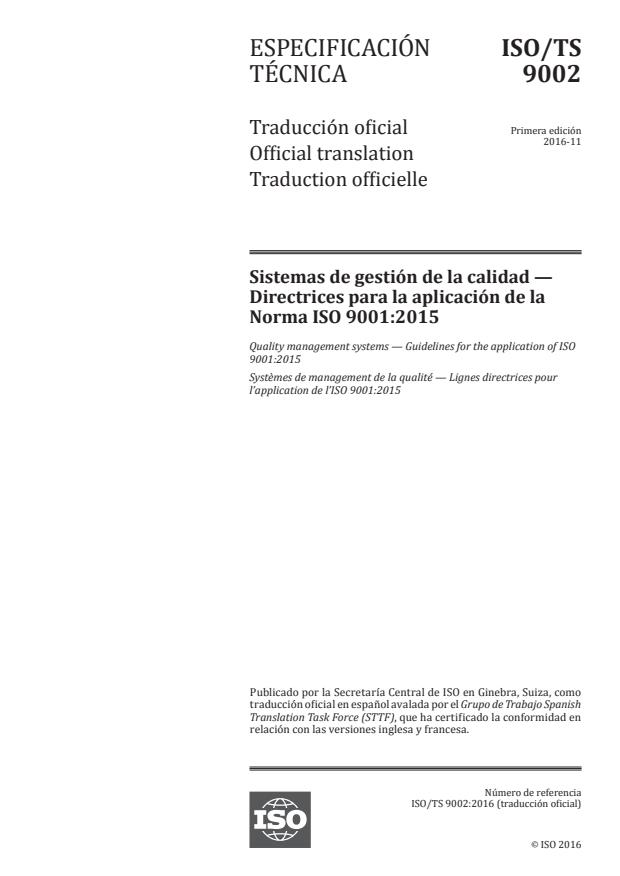
ESPECIFICACIÓN ISO/TS
TÉCNICA 9002
Primera edición
Traducción oficial
2016-11
Official translation
Traduction officielle
Sistemas de gestión de la calidad —
Directrices para la aplicación de la
Norma ISO 9001:2015
Quality management systems — Guidelines for the application of ISO
9001:2015
Systèmes de management de la qualité — Lignes directrices pour
l’application de l’ISO 9001:2015
Publicado por la Secretaría Central de ISO en Ginebra, Suiza, como
traducción oficial en español avalada por el Grupo de Trabajo Spanish
Translation Task Force (STTF), que ha certificado la conformidad en
relación con las versiones inglesa y francesa.
Número de referencia
©
ISO 2016
DOCUMENTO PROTEGIDO POR COPYRIGHT
© ISO 2016, Publicado en Suiza
Reservados los derechos de reproducción. Salvo prescripción diferente, no podrá reproducirse ni utilizarse ninguna parte de
esta publicación bajo ninguna forma y por ningún medio, electrónico o mecánico, incluidos el fotocopiado, o la publicación en
Internet o una Intranet, sin la autorización previa por escrito. La autorización puede solicitarse a ISO en la siguiente dirección o
al organismo miembro de ISO en el país solicitante.
ISO copyright office
Ch. de Blandonnet 8 • CP 401
CH-1214 Vernier, Geneva, Switzerland
Tel. +41 22 749 01 11
Fax +41 22 749 09 47
copyright@iso.org
www.iso.org
Traducción oficial/Official translation/Traduction officielle
ii © ISO 2016 – Todos los derechos reservados
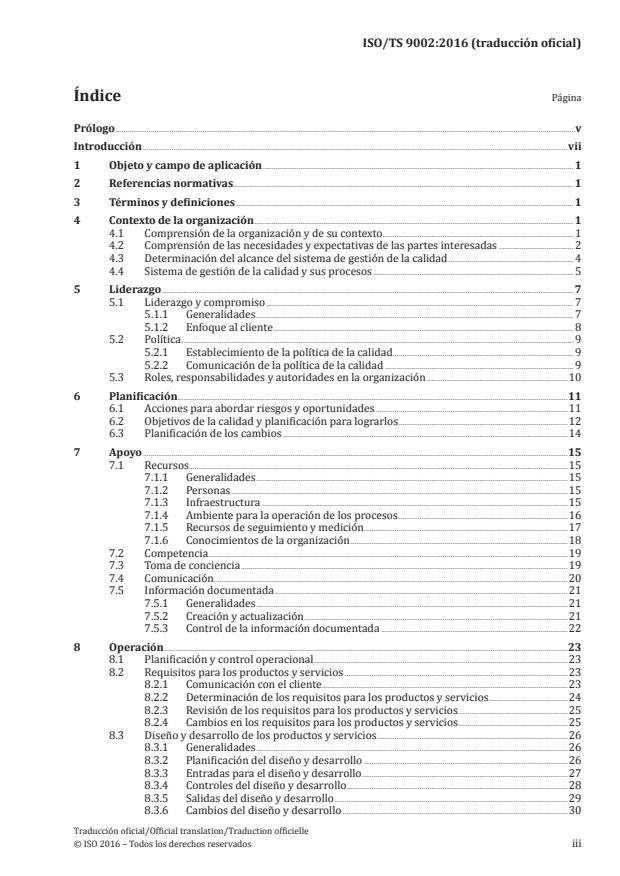
Índice Página
Prólogo .v
Introducción .vii
1 Objeto y campo de aplicación. 1
2 Referencias normativas . 1
3 Términos y definiciones . 1
4 Contexto de la organización . 1
4.1 Comprensión de la organización y de su contexto . 1
4.2 Comprensión de las necesidades y expectativas de las partes interesadas . 2
4.3 Determinación del alcance del sistema de gestión de la calidad . 4
4.4 Sistema de gestión de la calidad y sus procesos . 5
5 Liderazgo . 7
5.1 Liderazgo y compromiso . 7
5.1.1 Generalidades . 7
5.1.2 Enfoque al cliente . 8
5.2 Política . 9
5.2.1 Establecimiento de la política de la calidad . 9
5.2.2 Comunicación de la política de la calidad . 9
5.3 Roles, responsabilidades y autoridades en la organización .10
6 Planificación.11
6.1 Acciones para abordar riesgos y oportunidades .11
6.2 Objetivos de la calidad y planificación para lograrlos .12
6.3 Planificación de los cambios .14
7 Apoyo .15
7.1 Recursos.15
7.1.1 Generalidades .15
7.1.2 Personas .15
7.1.3 Infraestructura .15
7.1.4 Ambiente para la operación de los procesos .16
7.1.5 Recursos de seguimiento y medición .17
7.1.6 Conocimientos de la organización .18
7.2 Competencia .19
7.3 Toma de conciencia .19
7.4 Comunicación .20
7.5 Información documentada .21
7.5.1 Generalidades .21
7.5.2 Creación y actualización .21
7.5.3 Control de la información documentada .22
8 Operación .23
8.1 Planificación y control operacional .23
8.2 Requisitos para los productos y servicios .23
8.2.1 Comunicación con el cliente.23
8.2.2 Determinación de los requisitos para los productos y servicios .24
8.2.3 Revisión de los requisitos para los productos y servicios .25
8.2.4 Cambios en los requisitos para los productos y servicios .25
8.3 Diseño y desarrollo de los productos y servicios .26
8.3.1 Generalidades .26
8.3.2 Planificación del diseño y desarrollo .26
8.3.3 Entradas para el diseño y desarrollo .27
8.3.4 Controles del diseño y desarrollo .28
8.3.5 Salidas del diseño y desarrollo .29
8.3.6 Cambios del diseño y desarrollo .30
Traducción oficial/Official translation/Traduction officielle
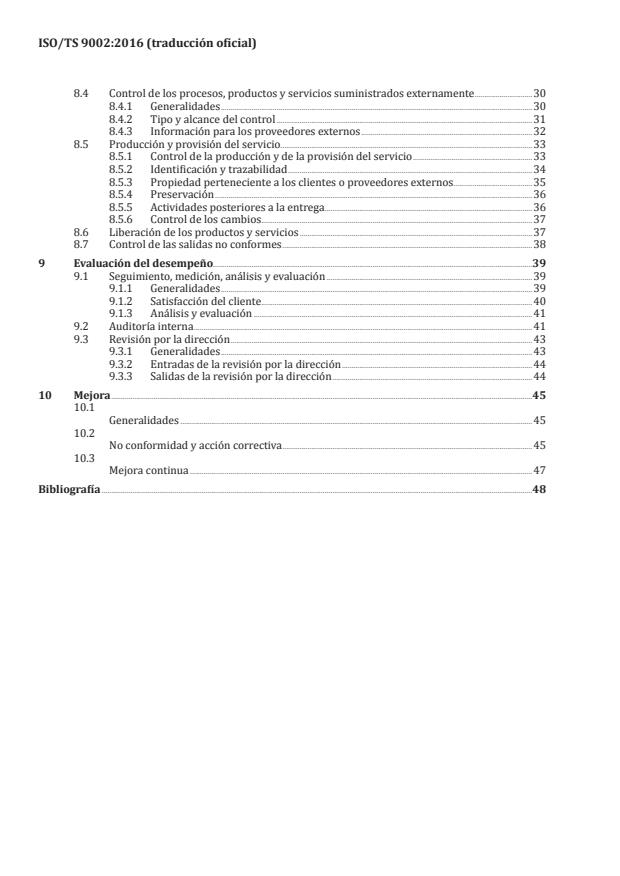
8.4 Control de los procesos, productos y servicios suministrados externamente .30
8.4.1 Generalidades .30
8.4.2 Tipo y alcance del control .31
8.4.3 Información para los proveedores externos .32
8.5 Producción y provisión del servicio.33
8.5.1 Control de la producción y de la provisión del servicio .33
8.5.2 Identificación y trazabilidad .34
8.5.3 Propiedad perteneciente a los clientes o proveedores externos .35
8.5.4 Preservación .36
8.5.5 Actividades posteriores a la entrega .36
8.5.6 Control de los cambios.37
8.6 Liberación de los productos y servicios .37
8.7 Control de las salidas no conformes .38
9 Evaluación del desempeño.39
9.1 Seguimiento, medición, análisis y evaluación .39
9.1.1 Generalidades .39
9.1.2 Satisfacción del cliente .40
9.1.3 Análisis y evaluación .41
9.2 Auditoría interna .41
9.3 Revisión por la dirección .43
9.3.1 Generalidades .43
9.3.2 Entradas de la revisión por la dirección .44
9.3.3 Salidas de la revisión por la dirección .44
10 Mejora .45
10.1
Generalidades .45
10.2
No conformidad y acción correctiva .45
10.3
Mejora continua .47
Bibliografía .48
Prólogo
ISO (Organización Internacional de Normalización) es una federación mundial de organismos
nacionales de normalización (organismos miembros de ISO). El trabajo de preparación de las normas
internacionales normalmente se realiza a través de los comités técnicos de ISO. Cada organismo
miembro interesado en una materia para la cual se haya establecido un comité técnico, tiene el derecho
de estar representado en dicho comité. Las organizaciones internacionales, públicas y privadas, en
coordinación con ISO, también participan en el trabajo. ISO colabora estrechamente con la Comisión
Electrotécnica Internacional (IEC) en todas las materias de normalización electrotécnica.
En la Parte 1 de las Directivas ISO/IEC se describen los procedimientos utilizados para desarrollar
esta norma y para su mantenimiento posterior. En particular debería tomarse nota de los diferentes
criterios de aprobación necesarios para los distintos tipos de documentos ISO. Esta norma se redactó
de acuerdo a las reglas editoriales de la Parte 2 de las Directivas ISO/IEC. www .iso .org/ directives.
Se llama la atención sobre la posibilidad de que algunos de los elementos de este documento puedan
estar sujetos a derechos de patente. ISO no asume la responsabilidad por la identificación de cualquiera
o todos los derechos de patente. Los detalles sobre cualquier derecho de patente identificado durante
el desarrollo de esta norma se indican en la introducción y/o en la lista ISO de declaraciones de patente
recibidas. www .iso .org/ patents.
Cualquier nombre comercial utilizado en esta norma es información que se proporciona para comodidad
del usuario y no constituye una recomendación.
Para obtener una explicación sobre el significado de los términos específicos de ISO y expresiones
relacionadas con la evaluación de la conformidad, así como información de la adhesión de ISO a los
principios de la Organización Mundial del Comercio (OMC) respecto a los Obstáculos Técnicos al
Comercio (OTC), véase la siguiente dirección: http:// www .iso .org/ iso/ foreword .html.
El comité responsable de esta norma es el ISO/TC 176, Gestión y aseguramiento de la calidad,
Subcomité SC 2, Sistemas de la calidad.
Traducción oficial/Official translation/Traduction officielle
Prólogo de la versión en español
Esta Norma Internacional ha sido traducida por el Grupo de Trabajo Spanish Translation Task Force
(STTF) del Comité Técnico ISO/TC 176, Gestión y aseguramiento de la calidad, en el que participan
representantes de los organismos nacionales de normalización y representantes del sector empresarial
de los siguientes países:
Argentina, Bolivia, Brasil, Chile, Colombia, Costa Rica, Cuba, Ecuador, España, Estados Unidos de
América, Honduras, México, Perú y Uruguay.
Igualmente, en el citado Grupo de Trabajo participan representantes de COPANT (Comisión
Panamericana de Normas Técnicas) e INLAC (Instituto Latinoamericano de la Calidad).
Esta traducción es parte del resultado del trabajo que el Grupo ISO/TC 176, viene desarrollando desde
su creación en el año 1999 para lograr la unificación de la terminología en lengua española en el ámbito
de la gestión de la calidad.
Traducción oficial/Official translation/Traduction officielle
vi © ISO 2016 – Todos los derechos reservados
Introducción
Este documento se ha desarrollado para ayudar a los usuarios a aplicar los requisitos del sistema de
gestión de la calidad de la Norma ISO 9001:2015 Sistemas de gestión de la calidad – Requisitos.
Este documento proporciona orientación, con una correspondencia apartado por apartado con los
Capítulos 4 a 10 de la Norma ISO 9001:2015, aunque no proporciona orientación para los Anexos A y B
de la Norma ISO 9001:2015. Cuando existe una correspondencia directa entre elementos de listas (es
decir, puntos) de un apartado de la Norma ISO 9001:2015 y la orientación, se indica dentro del apartado
de este documento.
Este documento proporciona ejemplos de lo que una organización puede hacer, pero no añade nuevos
requisitos a la Norma ISO 9001. Los ejemplos en este documento no son definitivos y sólo representan
posibilidades, de las que no todas son necesariamente adecuadas para todas las organizaciones.
La Norma ISO 9001 contiene requisitos que pueden auditarse o evaluarse de manera objetiva. Este
documento incluye ejemplos, descripciones y opciones que ayudan tanto a la implementación de un
sistema de gestión de la calidad como al fortalecimiento de su relación con el sistema de gestión global
de la organización. Aunque las directrices de este documento son coherentes con el modelo de sistemas
de gestión de la calidad de la Norma ISO 9001, no pretenden proporcionar interpretaciones de los
requisitos de la Norma ISO 9001 ni utilizarse para fines de auditoría o evaluación.
Puesto que los requisitos de la Norma ISO 9001 son genéricos, este documento lo pueden utilizar
organizaciones de todo tipo, tamaño, nivel de madurez, sector y ubicación geográfica. No obstante, la
manera en que una organización aplica la orientación puede variar dependiendo de factores como el
tamaño o la complejidad de la organización, el modelo de gestión que adopte, el rango de actividades de
la organización, y la naturaleza de los riesgos y oportunidades que encuentre.
El riesgo es el nivel de incertidumbre inherente a un sistema de gestión de la calidad. Existen riesgos en
todos los sistemas, procesos y funciones. El pensamiento basado en riesgos asegura que estos riesgos
se determinan, consideran y controlan a lo largo del diseño y el uso del sistema de gestión de la calidad.
El pensamiento basado en riesgos ha estado implícito en ediciones anteriores de la Norma ISO 9001
en requisitos tales como determinar el tipo y la extensión del control sobre los proveedores externos
dependiendo del efecto del producto que se va a proporcionar, o tomar acciones correctivas según el
efecto potencial de una no conformidad identificada.
Además, en ediciones anteriores de la Norma ISO 9001 se ha incluido un capítulo sobre acciones
preventivas. Al usar el pensamiento basado en riesgos la consideración del riesgo es integral. Ésta se
vuelve proactiva en vez de reactiva de cara a la prevención o reducción de efectos indeseados mediante
la identificación y acción temprana. Las acciones preventivas están integradas cuando un sistema de
gestión está basado en riesgos.
No todos los procesos de un sistema de gestión de la calidad representan el mismo nivel de riesgo en
términos de la capacidad de la organización para cumplir sus objetivos de la calidad. Algunos necesitan
una planificación y un control más minuciosos y formales que otros.
No existe ningún requisito en la Norma ISO 9001 sobre la utilización de una gestión de riesgos formal
para determinar y tratar los riesgos y oportunidades. La organización puede elegir los métodos que
convengan a sus necesidades. La Norma IEC 31010 proporciona una lista de las herramientas y técnicas
de evaluación de riesgos que pueden considerarse, dependiendo del contexto de la organización.
En algunos casos, la organización podría disponer ya de un proceso de gestión de riesgos formal
requerido por los clientes o por requisitos legales y reglamentarios. En esas circunstancias, la
organización puede adaptar su proceso de gestión de riesgos formal para cumplir el propósito de los
requisitos de la Norma ISO 9001 respecto a riesgos y oportunidades.
Traducción oficial/Official translation/Traduction officielle
Además del Anexo A de la Norma ISO 9001:2015, ISO ha publicado varias normas de gestión de la calidad
y otros recursos informativos que pueden ayudar al usuario y proporcionar información sobre métodos
adicionales de implementación, incluyendo:
— el Manual ISO: ISO 9001:2015 for Small Enterprises – What to do? Advice from ISO/TC 176
— los documentos del Grupo ISO 9001 Auditing Practices Group (APG): www .iso .org/ tc176/
ISO9001AuditingPracticesGroup
— la información pública en la página web del Subcomité ISO/TC 176/SC 2: https:// committee .iso
.org/ tc176sc2
— el manual ISO: The Integrated Use of Management System Standards.
En la Bibliografía se listan normas y documentos adicionales.
Traducción oficial/Official translation/Traduction officielle
viii © ISO 2016 – Todos los derechos reservados
ESPECIFICACIÓN TÉCNICA ISO/TS 9002:2016 (traducción oficial)
Sistemas de gestión de la calidad — Directrices para la
aplicación de la Norma ISO 9001:2015
1 Objeto y campo de aplicación
Este documento proporciona orientación sobre la intención de los requisitos de la Norma ISO 9001:2015,
con ejemplos de los posibles pasos que una organización puede tomar para cumplir los requisitos. No
añade, substrae ni modifica en manera alguna dichos requisitos.
Este documento no prescribe enfoques obligatorios para la implementación, ni proporciona ningún
método preferido de interpretación.
2 Referencias normativas
Las normas que a continuación se indican son indispensables para la aplicación de esta norma. Para las
referencias con fecha, sólo se aplica la edición citada. Para las referencias sin fecha se aplica la última
edición de la norma (incluyendo cualquier modificación de ésta).
ISO 9000:2015, Sistemas de gestión de la calidad — Fundamentos y vocabulario
ISO 9001:2015, Sistemas de gestión de la calidad — Requisitos
3 Términos y definiciones
Para los fines de este documento, se aplican los términos y definiciones incluidos en la Norma
ISO 9000:2015.
ISO e IEC mantienen bases de datos terminológicas para su uso en normalización en las siguientes
direcciones:
— plataforma de búsqueda Online de ISO: disponible en http:// www .iso .org/ obp
— electropedia de IEC: disponible en http:// www .electropedia .org/
4 Contexto de la organización
4.1 Comprensión de la organización y de su contexto
La intención de este apartado es entender las cuestiones externas e internas que son pertinentes para
el propósito y la dirección estratégica de la organización, y que pueden afectar, tanto positiva como
negativamente, a la capacidad de la organización para lograr los resultados previstos de su sistema de
gestión de la calidad. La organización debería ser consciente de que las cuestiones externas e internas
pueden cambiar, y por tanto, se debería hacer su seguimiento y deberían revisarse. La organización
podría realizar revisiones de su contexto a intervalos planificados y mediante actividades como la
revisión por la dirección.
Puede encontrarse información sobre las cuestiones externas e internas en muchas fuentes, como a
través de información documentada y reuniones internas, en la prensa nacional e internacional, páginas
web, publicaciones de las oficinas nacionales de estadística y de otros departamentos gubernamentales,
publicaciones profesionales y técnicas, conferencias y reuniones con agencias pertinentes, reuniones
con clientes y partes interesadas pertinentes, y asociaciones profesionales.
Traducción oficial/Official translation/Traduction officielle
Los ejemplos de cuestiones externas e internas pertinentes al contexto de la organización pueden
incluir, pero no se limitan a:
a) cuestiones externas relacionadas con:
1) factores económicos como los tipos de cambio, la situación económica, el pronóstico de
inflación, la disponibilidad de crédito;
2) factores sociales como las tasas de desempleo locales, la percepción de seguridad, los niveles
educativos, los días festivos y días laborables;
3) factores políticos como la estabilidad política, la inversión pública, la infraestructura local, los
acuerdos comerciales internacionales;
4) factores tecnológicos como nueva tecnología del sector, materiales y equipos nuevos en el
sector, el vencimiento de patentes, el código ético profesional;
5) factores de mercado como la competencia, incluyendo la cuota de mercado de la organización,
productos o servicios similares, las tendencias del líder del mercado, las tendencias de
crecimiento de clientes, la estabilidad del mercado, las relaciones de la cadena de suministro;
6) factores legales y reglamentarios que afectan al ambiente de trabajo (véase el apartado 7.1.4
de la Norma ISO 9001:2015), como regulación de los sindicatos y regulaciones relacionadas con
una industria;
b) cuestiones internas relacionadas con:
1) desempeño global de la organización;
2) factores de recursos, como infraestructuras (véase el apartado 7.1.3 de la Norma ISO 9001:2015),
entorno para la operación de los procesos (véase el apartado 7.1.4 de la Norma ISO 9001:2015),
conocimiento organizacional (véase el apartado 7.1.6 de la Norma ISO 9001:2015);
3) aspectos humanos como la competencia de las personas, el comportamiento y la cultura
organizacional, las relaciones con los sindicatos;
4) factores operacionales como capacidades de suministro de proceso o producción y servicio,
desempeño del sistema de gestión de la calidad, seguimiento de la satisfacción del cliente;
5) factores en el gobierno de la organización, como reglas y procedimientos para la toma de
decisiones o la estructura organizacional.
A nivel estratégico, pueden usarse herramientas como el análisis de Debilidades, Amenazas, Fortalezas
y Oportunidades y el análisis Político, Económico, Social, Tecnológico, Legal y Ecológico. Un enfoque
sencillo, como la lluvia de ideas y preguntas del tipo “¿qué pasaría si…?”, puede ser útil para las
organizaciones dependiendo del tamaño y la complejidad de sus operaciones.
4.2 Comprensión de las necesidades y expectativas de las partes interesadas
La intención de este apartado es asegurarse de que la organización tiene en cuenta los requisitos
pertinentes de las partes interesadas pertinentes, sin limitarse a los de sus clientes directos. La
intención es centrarse solamente en aquellas partes interesadas pertinentes que pueden tener un
impacto en la capacidad de la organización para proporcionar productos y servicios que cumplan los
requisitos. Aunque la Norma ISO 9001 no lo establece directamente, la organización puede considerar y
apoyarse en sus cuestiones externas e internas (véase el apartado 4.1 de la Norma ISO 9001:2015) para
determinar sus partes interesadas pertinentes.
La lista de partes interesadas pertinentes puede ser exclusiva para la organización. La organización
puede desarrollar criterios para determinar las partes interesadas pertinentes considerando su:
a) posible influencia o impacto en el desempeño o las decisiones de la organización;
Traducción oficial/Official translation/Traduction officielle
2 © ISO 2016 – Todos los derechos reservados
b) capacidad para crear riesgos y oportunidades;
c) posible influencia o impacto en el mercado;
d) capacidad para afectar a la organización mediante sus decisiones o actividades.
EJEMPLO 1 La siguiente es una lista no exhaustiva de algunos ejemplos de partes interesadas pertinentes que
la organización puede considerar relevantes:
— clientes;
— usuarios finales o beneficiarios;
— socios de empresas conjuntas;
— franquiciados;
— dueños de propiedad intelectual;
— casa matriz y organizaciones subsidiarias;
— propietarios, accionistas;
— banqueros;
— sindicatos;
— proveedores externos;
— empleados y otras personas que trabajan en nombre de la organización;
— autoridades legales y reglamentarias (locales, regionales, nacionales o internacionales);
— asociaciones de comercio y asociaciones profesionales;
— grupos comunitarios locales;
— organizaciones no gubernamentales;
— asociaciones de vecinos;
— competidores.
Para entender las necesidades y expectativas de las partes interesadas pertinentes, pueden llevarse a
cabo varias actividades y métodos, que incluyen trabajar con los responsables de los procesos, o usar
métodos que permitan la recopilación de información. Los métodos incluyen pero no se limitan a:
— revisión de los pedidos recibidos;
— revisión de los requisitos legales y reglamentarios con los departamentos de conformidad o legales;
— uso de grupos de presión y redes de contactos;
— participación en asociaciones relevantes;
— evaluación comparativa de mejores prácticas;
— vigilancia de mercado;
— revisión de las relaciones de la cadena de suministro;
— realización de encuestas a clientes o usuarios;
— seguimiento de las necesidades, expectativas y satisfacción de los clientes.
Traducción oficial/Official translation/Traduction officielle
EJEMPLO 2 Los ejemplos de requisitos de partes interesadas pertinentes incluyen, pero no se limitan a:
— requisitos de clientes respecto a la conformidad, precio, disponibilidad o entrega;
— contratos que se han firmado con clientes o proveedores externos;
— códigos y estándares de la industria;
— acuerdos con grupos comunitarios u organizaciones no gubernamentales;
— requisitos legales y reglamentarios para el producto o servicio proporcionado, y aquellos que afectan a la
capacidad de la organización para proporcionar dicho producto o servicio;
— memorandos de acuerdo;
— permisos, licencias y otras formas de autorización;
— órdenes emitidas por agencias reglamentarias;
— tratados, convenciones y protocolos;
— acuerdos con autoridades públicas y clientes;
— principios voluntarios o códigos de prácticas;
— etiquetado voluntario o compromisos ambientales;
— obligaciones que surgen de los acuerdos contractuales con la organización;
— políticas para los empleados.
La información resultante de estas actividades debería tenerse en cuenta para planificar el sistema de
gestión de la calidad (véase el Capítulo 6 de la Norma ISO 9001:2015).
La organización debería ser consciente de que las partes interesadas pertinentes y sus requisitos
pertinentes pueden ser diferentes para los distintos productos y servicios proporcionados, y pueden
cambiar debido a circunstancias imprevistas o a reacciones voluntarias hacia los mercados.
La organización debería disponer de sistemas robustos para hacer el seguimiento y revisar los
requisitos pertinentes de sus partes interesadas. El seguimiento y la revisión pueden hacerse usando
los procesos de la organización relacionados con los requisitos del cliente, el diseño y desarrollo de
productos y servicios, y (a un nivel más estratégico) durante la revisión por la dirección.
4.3 Determinación del alcance del sistema de gestión de la calidad
La intención de este apartado es determinar los límites del sistema de gestión de la calidad para que
esté definido de manera que ayude a la organización a cumplir los requisitos y los resultados previstos
del sistema.
Para los puntos a) a c) del apartado 4.3 de la Norma ISO 9001:2015, el alcance debería establecerse
sobre la base de:
a) las cuestiones externas e internas, según determinan los requisitos del apartado 4.1 de la Norma
ISO 9001:2015;
b) los requisitos pertinentes de las partes interesadas pertinentes (como los reguladores y los clientes),
según se determinen de acuerdo con los requisitos del apartado 4.2 de la Norma ISO 9001:2015;
c) los productos y servicios proporcionados por la organización.
Traducción oficial/Official translation/Traduction officielle
4 © ISO 2016 – Todos los derechos reservados
Al determinar el alcance, la organización debería establecer también los límites del sistema de gestión
de la calidad teniendo en cuenta cuestiones como:
— las infraestructuras de la organización;
— las distintas sedes y actividades de la organización;
— las políticas y estrategias comerciales;
— las funciones, actividades, procesos, productos y servicios centralizados o proporcionados
externamente.
Todos los requisitos de la Norma ISO 9001 se consideran aplicables salvo que no tengan efecto en la
capacidad de la organización para proporcionar un producto o prestar un servicio que cumpla los
requisitos o en la mejora de la satisfacción de sus clientes.
Al determinar la aplicación de los requisitos de la Norma ISO 9001, la organización debería tener en
cuenta cada requisito individual, y no simplemente decidir que un capítulo entero no es aplicable. A
veces algunos de los requisitos pueden ser aplicables en un capítulo, o todos los requisitos de un capítulo
pueden ser o no aplicables.
El alcance debería mantenerse como información documentada. El alcance debería incluir detalles de los
productos y servicios cubiertos. Esta información documentada puede mantenerse con cualquier método
que la organización determine que cumple sus necesidades, tales como un manual o una página web.
4.4 Sistema de gestión de la calidad y sus procesos
4.4.1 La intención de este apartado es que la organización determine los procesos necesarios para su
sistema de gestión de la calidad de acuerdo con la Norma ISO 9001. Esto incluye no sólo los procesos para
la producción y prestación de servicios, sino también los procesos necesarios para la implementación
eficaz del sistema, tales como auditorías internas, revisión por la dirección y otros (incluyendo procesos
que desempeñan proveedores externos). Por ejemplo, si la organización determina la necesidad de un
proceso para hacer el seguimiento y medición de recursos, el proceso necesitará cumplir los requisitos
del apartado 7.1.5 de la Norma ISO 9001:2015. El nivel al que es necesario determinar y detallar los
procesos puede variar de acuerdo con el contexto de la organización y con la aplicación del pensamiento
basado en riesgos – teniendo en consideración el grado en el que el proceso afecta a la capacidad de
la organización para lograr sus resultados previstos, la probabilidad de que sucedan problemas con el
proceso, y las consecuencias potenciales de dichos problemas.
Un proceso es un conjunto de actividades interrelacionadas o que interaccionan entre sí, que usan
entradas a fin de proporcionar los resultados previstos. Para los puntos a) a h) del apartado 4.4.1 de la
Norma ISO 9001:2015:
a) la organización debería determinar las entradas requeridas y las salidas previstas de sus procesos;
las entradas requeridas por los procesos deberían tenerse en cuenta desde el punto de vista de lo
que se requiere para la implementación del proceso según se ha planeado; las salidas previstas
deberían tenerse en cuenta desde el punto de vista de lo que esperan los clientes o los procesos
subsecuentes; las entradas y salidas pueden ser tangibles (por ejemplo, materiales, componentes o
equipos) o intangibles (por ejemplo, datos, información o conocimiento);
b) al determinar la secuencia e interacción de estos procesos, deberían tenerse en cuenta los vínculos
con las entradas y salidas de los procesos previos y subsecuentes; los métodos para proporcionar
detalles de la secuencia e interacción de los procesos dependen de la naturaleza de la organización;
pueden usarse distintos métodos, como conservar o mantener información documentada (por
ejemplo, mapas de proceso o diagramas de flujo), o un enfoque más sencillo, como una explicación
verbal de la secuencia e interacción de los procesos;
c) para asegurarse de que los procesos son eficaces (es decir, proporcionan los resultados planificados),
la organización debería determinar y aplicar los criterios y métodos de control de procesos; los
criterios para el seguimiento y medición podrían ser parámetros del proceso, o especificaciones
Traducción oficial/Official translation/Traduction officielle
para productos y servicios; los indicadores de desempeño deberían relacionarse con el seguimiento
y medición, o pueden relacionarse con los objetivos (criterios) de la calidad de la organización;
otros métodos para indicar el desempeño incluyen pero no se limitan a informes, diagramas o el
resultado de auditorías;
d) la organización debería determinar los recursos necesarios para los procesos, tales como personas,
infraestructuras, entorno para la operación de los procesos, conocimiento organizacional, y recursos
de seguimiento y medición (véase el apartado 7.1 de la Norma ISO 9001:2015); las consideraciones
sobre la disponibilidad de los recursos deberían incluir las capacidades y restricciones de los
recursos internos existentes y de aquellos que se pueden obtener de proveedores externos;
e) la organización debería asignar las responsabilidades y autoridades para sus procesos determinando
primero las actividades del proceso y determinando después las personas que desempeñarán la
actividad; las responsabilidades y autoridades pueden establecerse en información documentada
como diagramas organizacionales, procedimientos documentados, políticas operacionales y
descripciones de puestos, o usando un enfoque sencillo de instrucciones verbales;
f) la organización debería asegurarse de que se implementan todas las acciones necesarias para
tratar los riesgos y oportunidades asociados con los procesos (véase el apartado 6.1 de la Norma
ISO 9001:2015);
g) la organización debería tener en cuenta los datos de desempeño obtenidos mediante la revisión
de los criterios establecidos para el seguimiento y medición; analizar y evaluar estos datos;
e implementar cualquier cambio necesario para asegurarse de que estos procesos logran sus
resultados previstos de manera sistemática;
h) la organización puede usar los resultados del análisis y la evaluación para determinar las acciones
de mejora necesarias; las mejoras pueden hacerse a nivel de proceso (por ejemplo, reduciendo
variaciones en la manera en que se desempeña una actividad) o a nivel del sistema de gestión de la
calidad (por ejemplo, reduciendo los trámites asociados con el sistema, permitiendo a las personas
concentrarse más en gestionar los procesos).
4.4.2 La intención de este apartado es asegurar que la organización determina la extensión de
información documentada que se necesita.
La información documentada es información que requiere ser controlada y mantenida por la
organización así como el medio que la contiene.
La persona adecuada (por ejemplo, el dueño del proceso, el dueño de la salida del proceso, la persona
que controla el proceso) debería revisar la información que se usa para que el proceso se desempeñe
para proporcionar las salidas previstas de manera sistemática. Para la información (por ejemplo,
procedimientos, instrucciones de trabajo, ayudas visuales, sistemas de información y comunicación,
dibujos, especificaciones, métricas, informes, indicadores clave de desempeño [Key Performance
Indicator, KPI], actas de reuniones, muestras representativas, conversaciones verbales) que se use,
es necesario llevar a cabo un análisis/revisión del valor para respaldar el proceso. El resultado será
la decisión de qué información se tratará como información documentada. Por ejemplo, cuando la
alta dirección realiza la planificación estratégica, podría consultar y revisar información relevante
en Internet, como informes sobre el estado actual y futuro del sector industrial de la organización,
desarrollados por agencias gubernamentales y otras partes relevantes. Esta información no debería
considerarse información documentada, puesto que está disponible en el dominio público. En cambio,
sería necesario considerar como información documentada un plan de negocio que incluye objetivos
de la calidad, riesgos y oportunidades y estrategias entre otros elementos pertinentes (por ejemplo, la
misión, visión y valores y un mapa de procesos de la organización).
Corresponde a la organización especificar los distintos tipos de información documentada necesarios
para respaldar la operación de sus procesos y su sistema de gestión de la calidad. Al determinar el tipo y
grado de información documentada necesaria, la organización debería evaluar sus propias necesidades
y aplicar el pensamiento basado en riesgos. También debería tener en cuenta su tamaño, actividades,
tipos de productos o servicios, complejidad de sus procesos, recursos, etc., así como las consecuencias
potenciales de las no conformidades.
Traducción oficial/Official translation/Traduction officielle
6 © ISO 2016 – Todos los derechos reservados
Aunque la Norma ISO 9001 especifica el uso de información documentada en varios de s
...
S L O V E N S K A SIST-TS ISO/TS 9002
T E H N I Č N A
december 2016
S P E C I F I K A C I J A
Sistemi vodenja kakovosti – Smernice za uporabo standarda ISO 9001:2015
Quality management systems – Guidelines for the application of ISO 9001:2015
Systèmes de management de la qualité – Lignes directrices pour l'application de
l'ISO 9001:2015
Referenčna oznaka
ICS 03.100.70; 03.120.10 SIST-TS ISO/TS 9002:2016 (sl)
Nadaljevanje na straneh od 2 do 82
© 2023-09. Slovenski inštitut za standardizacijo. Razmnoževanje ali kopiranje celote ali delov tega dokumenta ni dovoljeno.
SIST-TS ISO/TS 9002 : 2016
NACIONALNI UVOD
Tehnična specifikacija SIST-TS ISO/TS 9002 (sl, en), Sistemi vodenja kakovosti – Smernice za uporabo
standarda ISO 9001:2015, 2016, ima status slovenske tehnične specifikacije in je istovetna mednarodni
tehnični specifikaciji ISO/TS 9002, Quality management systems – Guidelines for the application of ISO
9001:2015, 2016.
NACIONALNI PREDGOVOR
Mednarodno tehnično specifikacijo ISO/TS 9002:2016 je pripravil tehnični odbor ISO/TC 176 Vodenje
in zagotavljanje kakovosti, pododbor SC 2 Sistemi kakovosti. Slovenska tehnična specifikacija SIST-TS
9002:2016. V primeru spora glede besedila slovenskega prevoda v tej tehnični specifikaciji je odločilna
izvirna mednarodna tehnična specifikacija v angleškem jeziku. Slovensko-angleško izdajo tehnične
specifikacije je pripravil tehnični odbor SIST/TC VZK Vodenje in zagotavljanje kakovosti.
Odločitev za izdajo te tehnične specifikacije je 14. novembra 2016 sprejel SIST/TC VZK Vodenje in
zagotavljanje kakovosti.
ZVEZA S STANDARDI
S privzemom te tehnične specifikacije veljajo za omejeni namen referenčnih standardov vsi standardi,
navedeni v izvirniku, razen standardov, ki so že sprejeti v nacionalno standardizacijo:
SIST EN ISO 9000:2015 (sl, en) Sistemi vodenja kakovosti – Osnove in slovar (ISO 9000:2015)
SIST EN ISO 9001:2015 (sl, en) Sistemi vodenja kakovosti – Zahteve (ISO 9001:2015)
OSNOVA ZA IZDAJO STANDARDA
– privzem tehnične specifikacije ISO/TS 9002:2016
OPOMBE
– Nacionalni uvod in nacionalni predgovor nista sestavni del tehnične specifikacije.
– Povsod, kjer se v besedilu standarda uporablja izraz “mednarodna tehnična specifikacija”, v SIST-
TS ISO/TS 9002:2016 to pomeni “slovenska tehnična specifikacija”.
SIST-TS ISO/TS 9002 : 2016
VSEBINA Stran
Contents Page
Predgovor . 6 Foreword .6
Uvod . 7 Introduction .7
1 Področje uporabe . 9 1 Scope .9
2 Zveze s standardi . 9 2 Normative references .9
3 Izrazi in definicije . 9 3 Terms and definitions .9
4 Kontekst organizacije . 9 4 Context of the organization .9
4.1 Razumevanje organizacije in njenega 4.1 Understanding the organization and its
konteksta . 9 context .9
4.2 Razumevanje potreb in pričakovanj 4.2 Understanding the needs and
zainteresiranih strani . 11 expectations of interested parties . 11
4.3 Opredeljevanje področja uporabe sistema 4.3 Determining the scope of the quality
vodenja kakovosti . 13 management system . 13
4.4 Sistem vodenja kakovosti in njegovi 4.4 Quality management system and its
procesi . 14 processes . 14
5 Voditeljstvo . 18 5 Leadership . 18
5.1 Voditeljstvo in zavezanost . 18 5.1 Leadership and commitment . 18
5.1.1 Splošno . 18 5.1.1 General . 18
5.1.2 Osredotočenost na odjemalca . 20 5.1.2 Customer focus . 20
5.2 Politika . 21 5.2 Policy . 21
5.2.1 Vzpostavljanje politike kakovosti . 21 5.2.1 Establishing the quality policy . 21
5.2.2 Komuniciranje o politiki kakovosti . 22 5.2.2 Communicating the quality policy . 22
5.3 Organizacijske vloge, odgovornosti in 5.3 Organizational roles, responsibilities
pooblastila . 22 and authorities . 22
6 Planiranje . 24 6 Planning . 24
6.1 Ukrepi za obravnavanje tveganj in 6.1 Actions to address risks and opportunities
priložnosti . 24 . 24
6.2 Cilji kakovosti in planiranje za njihovo 6.2 Quality objectives and planning to achieve
doseganje . 26 them . 26
6.3 Planiranje sprememb. 29 6.3 Planning of changes . 29
7 Podpora . 30 7 Support . 30
7.1 Viri. 30 7.1 Resources . 30
7.1.1 Splošno . 30 7.1.1 General . 30
7.1.2 Ljudje . 31 7.1.2 People . 31
7.1.3 Infrastruktura . 31 7.1.3 Infrastructure . 31
7.1.4 Okolje za delovanje procesov . 32 7.1.4 Environment for the operation of
processes . 32
7.1.5 Viri nadzorovanja in merjenja . 33 7.1.5 Monitoring and measuring resources 33
7.1.6 Organizacijsko znanje . 36 7.1.6 Organizational knowledge . 36
7.2 Kompetentnost . 36 7.2 Competence . 36
7.3 Ozaveščenost . 38 7.3 Awareness . 38
7.4 Komuniciranje . 39 7.4 Communication . 39
7.5 Dokumentirane informacije . 40 7.5 Documented information . 40
SIST-TS ISO/TS 9002 : 2016
7.5.1 Splošno . 40 7.5.1 General . 40
7.5.2 Ustvarjanje in posodabljanje . 41 7.5.2 Creating and updating . 41
7.5.3 Obvladovanje dokumentiranih 7.5.3 Control of documented information . 41
informacij . 41
8 Delovanje . 43 8 Operation . 43
8.1 Planiranje in obvladovanje delovanja . 43 8.1 Operational planning and control . 43
8.2 Zahteve za izdelke in storitve . 44 8.2 Requirements for products and
services . 44
8.2.1 Komuniciranje z odjemalci . 44 8.2.1 Customer communication . 44
8.2.2 Opredeljevanje zahtev za izdelke in 8.2.2 Determining the requirements for
storitve . 45 products and services . 45
8.2.3 Pregled zahtev za izdelke in storitve . 46 8.2.3 Review of the requirements for products
and services . 46
8.2.4 Spremembe zahtev za izdelke in 8.2.4 Changes to requirements for products
storitve . 47 and services . 47
8.3 Snovanje in razvoj izdelkov in storitev . 48 8.3 Design and development of products and
services . 48
8.3.1 Splošno . 48 8.3.1 General . 48
8.3.2 Planiranje snovanja in razvoja . 49 8.3.2 Design and development planning . 49
8.3.3 Vhodi snovanja in razvoja . 50 8.3.3 Design and development inputs . 50
8.3.4 Ukrepi za obvladovanje snovanja in 8.3.4 Design and development controls . 51
razvoja . 51
8.3.5 Izhodi snovanja in razvoja . 53 8.3.5 Design and development outputs . 53
8.3.6 Spremembe snovanja in razvoja . 54 8.3.6 Design and development changes . 54
8.4 Obvladovanje procesov, izdelkov in 8.4 Control of externally provided
storitev zunanjih ponudnikov . 55 processes, products and services . 55
8.4.1 Splošno . 55 8.4.1 General . 55
8.4.2 Vrsta in obseg obvladovanja . 56 8.4.2 Type and extent of control . 56
8.4.3 Informacije za zunanje ponudnike . 57 8.4.3 Information for external providers . 57
8.5 Proizvodnja in izvedba storitev . 59 8.5 Production and service provision . 59
8.5.1 Obvladovanje proizvodnje in izvedbe 8.5.1 Control of production and service
storitev . 59 provision . 59
8.5.2 Identifikacija in sledljivost . 60 8.5.2 Identification and traceability . 60
8.5.3 Lastnina odjemalcev ali zunanjih 8.5.3 Property belonging to customers or
ponudnikov . 62 external providers . 62
8.5.4 Ohranitev . 63 8.5.4 Preservation . 63
8.5.5 Aktivnosti po dostavi . 64 8.5.5 Post-delivery activities . 64
8.5.6 Obvladovanje sprememb . 65 8.5.6 Control of changes . 65
8.6 Sprostitev izdelkov in storitev . 66 8.6 Release of products and services . 66
8.7 Obvladovanje neskladnih izhodov . 66 8.7 Control of nonconforming outputs . 66
9 Vrednotenje izvedbe . 69 9 Performance evaluation . 69
9.1 Nadzorovanje, merjenje, analiziranje in 9.1 Monitoring, measurement, analysis and
vrednotenje . 69 evaluation . 69
9.1.1 Splošno . 69 9.1.1 General . 69
SIST-TS ISO/TS 9002 : 2016
9.1.2 Zadovoljstvo odjemalcev . 69 9.1.2 Customer satisfaction . 69
9.1.3 Analiziranje in vrednotenje . 71 9.1.3 Analysis and evaluation . 71
9.2 Notranja presoja . 72 9.2 Internal audit . 72
9.3 Vodstveni pregled . 74 9.3 Management review . 74
9.3.1 Splošno . 74 9.3.1 General . 74
9.3.2 Vhodi vodstvenega pregleda . 75 9.3.2 Management review inputs . 75
9.3.3 Izhodi vodstvenega pregleda . 76 9.3.3 Management review outputs . 76
10 Izboljševanje . 77 10 Improvement . 77
10.1 Splošno . 77 10.1 General . 77
10.2 Neskladnosti in korektivni ukrepi . 78 10.2 Nonconformity and corrective action . 78
10.3 Nenehno izboljševanje . 80 10.3 Continual improvement . 80
Literatura . 81 Bibliography . 81
SIST-TS ISO/TS 9002 : 2016
Predgovor Foreword
Mednarodna organizacija za standardizacijo ISO (the International Organization for
(ISO) je svetovna zveza nacionalnih organov za Standardization) is a worldwide federation of
standarde (članov ISO). Mednarodne standarde national standards bodies (ISO member
praviloma pripravljajo tehnični odbori ISO. Vsak bodies). The work of preparing International
član, ki ga zanima področje, za katero je bil Standards is normally carried out through ISO
ustanovljen tehnični odbor, ima pravico biti technical committees. Each member body
zastopan v tem odboru. Pri delu sodelujejo tudi interested in a subject for which a technical
mednarodne vladne in nevladne organizacije, committee has been established has the right
povezane z ISO. V vseh zadevah, ki so to be represented on that committee.
povezane s standardizacijo na področju International organizations, governmental and
elektrotehnike, ISO tesno sodeluje z non-governmental, in liaison with ISO, also
Mednarodno elektrotehniško komisijo (IEC). take part in the work. ISO collaborates closely
with the International Electrotechnical
Commission (IEC) on all matters of
electrotechnical standardization.
Postopki, uporabljeni pri razvoju tega The procedures used to develop this document
dokumenta, in postopki, predvideni za njegovo and those intended for its further maintenance
nadaljnje vzdrževanje, so opisani v Direktivah are described in the ISO/IEC Directives, Part 1.
ISO/IEC, 1. del. Posebna pozornost naj se In particular the different approval criteria
nameni različnim kriterijem odobritve, potrebnim needed for the different types of ISO
za različne vrste dokumentov ISO. Ta dokument documents should be noted. This document
je bil pripravljen v skladu z uredniškimi pravili was drafted in accordance with the editorial
Direktiv ISO/IEC, 2. del (glej rules of the ISO/IEC Directives, Part 2 (see
www.iso.org/directives). www.iso.org/directives).
Opozoriti je treba na možnost, da je nekaj Attention is drawn to the possibility that some
elementov tega dokumenta lahko predmet of the elements of this document may be the
patentnih pravic. ISO ne prevzema odgovornosti subject of patent rights. ISO shall not be held
za identifikacijo katerihkoli ali vseh takih responsible for identifying any or all such
patentnih pravic. Podrobnosti o morebitnih patent rights. Details of any patent rights
patentnih pravicah, identificiranih med pripravo identified during the development of the
tega dokumenta, bodo navedene v uvodu in/ali document will be in the Introduction and/or on
na seznamu patentnih izjav, ki jih je prejela the ISO list of patent declarations received (see
organizacija ISO (glej www.iso.org/patents). www.iso.org/patents).
Morebitna trgovska imena, uporabljena v tem Any trade name used in this document is
dokumentu, so informacije za uporabnike in ne information given for the convenience of users
pomenijo podpore blagovni znamki. and does not constitute an endorsement.
Za razlago pomena specifičnih pojmov in izrazov For an explanation on the meaning of ISO
ISO, povezanih z ugotavljanjem skladnosti, ter specific terms and expressions related to
informacij o tem, kako ISO spoštuje načela conformity assessment, as well as information
Mednarodne trgovinske organizacije (WTO) v about ISO’s adherence to the World Trade
Tehničnih ovirah pri trgovanju (TBT), glej Organization (WTO) principles in the Technical
naslednji naslov URL: Barriers to Trade (TBT) see the following URL:
www.iso.org/foreword.html.
www.iso.org/foreword.html.
Ta dokument je pripravil tehnični odbor ISO/TC The committee responsible for this document
176 Vodenje in zagotavljanje kakovosti, is Technical Committee ISO/TC 176, Quality
pododbor SC 2 Sistemi kakovosti. management and quality assurance,
Subcommittee SC 2, Quality systems.
SIST-TS ISO/TS 9002 : 2016
Uvod Introduction
Ta dokument je bil razvit v pomoč uporabnikom This document has been developed to assist
pri uporabi zahtev sistema vodenja kakovosti v users to apply the quality management system
skladu standardom ISO 9001:2015, Sistemi requirements of ISO 9001:2015 Quality
vodenja kakovosti – Zahteve. management systems – Requirements.
Ta dokument daje napotke o korelaciji med This document provides guidance, with a clause
točkami 4 do 10 standarda ISO 9001:2015, ne by clause correlation to Clauses 4 to 10 of ISO
daje pa napotkov o dodatkih A in B k standardu 9001:2015, however it does not provide
ISO 9001:2015. Kjer obstaja neposredna guidance on ISO 9001:2015, Annexes A and B.
korelacija med postavkami seznama (tj. Where there is direct correlation between list
alinejami) v določeni točki standarda ISO items (i.e. bullet points) in a clause in ISO
9001:2015 in temi smernicami, je to navedeno v 9001:2015 and the guidance, this is indicated
ustrezni točki tega dokumenta. within the clause of this document.
Ta dokument navaja primere, kaj lahko This document gives examples of what an
organizacija stori, ne dodaja pa novih zahtev k organization can do, but it does not add new
ISO 9001. Primeri v tem dokumentu niso requirements to ISO 9001. The examples in this
dokončni, temveč zgolj predstavljajo možnosti, ki document are not definitive and only represent
pa niso vse nujno primerne za vsako possibilities, not all of which are necessarily
organizacijo. suitable for every organization.
ISO 9001 vsebuje zahteve, ki jih je mogoče ISO 9001 contains requirements that can be
objektivno presoditi ali ovrednotiti. V tem objectively audited or evaluated. This document
dokumentu so vključeni primeri, opisi in includes examples, descriptions and options that
možnosti, ki pomagajo tako pri izvajanju sistema aid both in the implementation of a quality
vodenja kakovosti kot pri krepitvi njegovega management system and in strengthening its
odnosa do celotnega sistema organizacije. S relation to the overall management system of an
tem ko so smernice v tem dokumentu skladne z organization. While the guidelines in this
modelom vodenja kakovosti ISO 9001, pa niso document are consistent with the ISO 9001
namenjene razlagam zahtev standarda ISO quality management system model, they are not
9001 ali uporabi za namene presoje oziroma intended to provide interpretations of the
vrednotenja. requirements of ISO 9001 or be used for audit or
evaluation purposes.
Ker so zahteve ISO 9001 splošne, lahko ta As the requirements of ISO 9001 are generic,
dokument uporabljajo organizacije vseh vrst, this document can be used by organizations of
velikosti, stopenj zrelosti ter vseh sektorjev in all types, sizes, levels of maturity and in all
geografskih lokacij. Način, kako bo organizacija sectors and geographic locations. However, the
uporabila te napotke, pa se lahko razlikuje glede way an organization applies the guidance can
na dejavnike, kot so velikost ali kompleksnost vary based on factors such as the size or the
organizacije, sprejeti model upravljanja, obseg complexity of the organization, the management
dejavnosti organizacije ter tveganja in model it adopts, the range of the organization’s
activities and the nature of the risks and
priložnosti, s katerimi se srečuje.
opportunities it encounters.
Tveganje je stopnja negotovosti, povezane s Risk is the level of uncertainty inherent in a
sistemom vodenja kakovosti. Tveganja so quality management system. There are risks in
prisotna v vseh sistemih, procesih in funkcijah. all systems, processes and functions. Risk-
Razmišljanje na podlagi tveganja zagotavlja, da based thinking ensures these risks are
so ta tveganja opredeljena ter da se upoštevajo determined, considered and controlled
in obvladujejo pri vsem snovanju in uporabi throughout the design and use of the quality
sistema vodenja kakovosti. management system.
Razmišljanje na podlagi tveganja je bilo v Risk-based thinking has been implicit in previous
prejšnjih izdajah standarda ISO 9001 implicitno editions of ISO 9001 in such requirements as
v zahtevah, kot sta npr. opredeljevanje vrste in determining the type and extent of control for
obsega nadzora zunanjih ponudnikov na podlagi external providers based on the effect of the
učinka izdelka, ki bo zagotovljen, ali izvajanje product that is going to be provided, or taking
SIST-TS ISO/TS 9002 : 2016
korektivnih ukrepov na podlagi možnega učinka corrective action based on the potential effect of
ugotovljene neskladnosti. an identified nonconformity.
Poleg tega je bila v prejšnjih izdajah ISO 9001 In addition, in previous editions of ISO 9001, a
vključena točka o preventivnih ukrepih. Z clause on preventive action was included. By
uporabo razmišljanja na podlagi tveganja pa je using risk-based thinking the consideration of
upoštevanje tveganja integralno. S pomočjo risk is integral. It becomes proactive rather than
zgodnjega prepoznavanja in ukrepanja postaja reactive in preventing or reducing undesired
prej proaktivno kot reaktivno pri preprečevanju effects through early identification and action.
ali zmanjševanju neželenih učinkov. Preventive action is built-in when a management
system is risk-based.
Vsi procesi sistema vodenja kakovosti ne Not all the processes of a quality management
predstavljajo enake stopnje tveganja v smislu system represent the same level of risk in terms
sposobnosti organizacije, da dosega svoje cilje of the organization’s ability to meet its quality
kakovosti. Nekateri potrebujejo bolj skrbno in objectives. Some need more careful and formal
formalno planiranje in obvladovanje kot drugi. planning and control than others.
V standardu ISO 9001 ni zahteve po formalnem There is no requirement in ISO 9001 to use
obvladovanju tveganja pri opredeljevanju in formal risk management in determining and
obravnavanju tveganj in priložnosti. Organizacija addressing risks and opportunities. An
lahko sama izbere metode, ki ustrezajo njenim organization can choose the methods that suit its
potrebam. V dokumentu IEC 31010 je seznam needs. IEC 31010 provides a list of risk
orodij in tehnik za ocenjevanje tveganj, ki jih je assessment tools and techniques that can be
mogoče upoštevati glede na kontekst considered, depending on the organization’s
organizacije. context.
V nekaterih primerih ima organizacija lahko In some cases, an organization might have a
vzpostavljen formalni proces obvladovanja formal risk management process in place that is
tveganja, ki ga zahtevajo stranke ali so zakonske required by customers or statutory and
oziroma regulativne zahteve. V takšnih regulatory requirements. In such circumstances,
okoliščinah lahko organizacija svoj formalni the organization can adapt its formal risk
proces obvladovanja tveganja prilagodi tako, da management process to meet the intent of the
izpolnjuje namen tistih zahtev standarda ISO requirements in ISO 9001 concerning risks and
9001, ki zadevajo tveganja in priložnosti. opportunities.
V dodatku A je ISO dodatno k ISO 9001:2015 In addition to ISO 9001:2015, Annex A, ISO has
objavil številne druge standarde vodenja published a number of other quality
kakovosti in informativne vire, ki so lahko management standards and informative
uporabniku v pomoč in ki zagotavljajo resources which can assist the user and provide
informacije o dodatnih izvedbenih metodah, ter information on additional implementation
vključujejo: methods, including:
– priročnik ISO: ISO 9001:2015 za majhna – the ISO handbook: ISO 9001:2015 for
podjetja – Kaj storiti ? Nasveti tehničnega Small Enterprises – What to do ? Advice
odbora ISO/TC 176 from ISO/TC 176
– dokumente Skupine ISO 9001 za – the ISO 9001 Auditing Practices Group
presojevalsko prakso (APG): (APG) papers:
www.iso.org/tc176/ISO9001AuditingPractic www.iso.org/tc176/ISO9001AuditingPractic
esGroup esGroup
– javno dostopne informacije na spletni strani – public information on the ISO/TC 176/SC2
ISO/TC 176/SC2: website: https://committee.iso.org/tc176sc2
https://committee.iso.org/tc176sc2
– priročnik ISO: Celostna uporaba – the ISO handbook: The Integrated Use of
standardov sistema vodenja. Management System Standards.
Dodatni standardi in dokumenti so navedeni v Additional standards and documents are listed in
Literaturi. the Bibliography.
SIST-TS ISO/TS 9002 : 2016
Sistemi vodenja kakovosti – Quality management systems –
Smernice za uporabo standarda Guidelines for the application of
ISO 9001:2015 ISO 9001:2015
1 Področje uporabe 1 Scope
Ta dokument daje napotke o namenu zahtev v This document provides guidance on the intent
standardu ISO 9001:2015 in navaja primere of the requirements in ISO 9001:2015, with
možnih ukrepov, ki jih organizacija lahko examples of possible steps an organization can
sprejme, da bi izpolnila te zahteve. Dokument take to meet the requirements. It does not add
tem zahtevam ničesar ne dodaja niti odvzema ali to, subtract from, or in any way modify those
jih kakorkoli spreminja. requirements.
Ta dokument ne predpisuje obveznih pristopov k This document does not prescribe mandatory
izvedbi oziroma ne zagotavlja kakršnekoli approaches to implementation, or provide any
prednostne metode interpretacije. preferred method of interpretation.
2 Zveze s standardi 2 Normative references
Besedilo se sklicuje na naslednje dokumente na The following documents are referred to in the
tak način, da njihova vsebina v celoti ali delno text in such a way that some or all of their content
predstavlja zahteve tega dokumenta. Pri constitutes requirements of this document. For
datiranih sklicevanjih se uporablja le navedena dated references, only the edition cited applies.
izdaja. Pri nedatiranih sklicevanjih se uporablja For undated references, the latest edition of the
zadnja izdaja dokumenta (vključno z dopolnili). referenced document (including any
amendments) applies.
ISO 9000:2015 Sistemi vodenja kakovosti – ISO 9000:2015, Quality management systems
Osnove in slovar – Fundamentals and
vocabulary
ISO 9001:2015 Sistemi vodenja kakovosti – ISO 9001:2015, Quality management systems
Zahteve – Requirements
3 Izrazi in definicije 3 Terms and definitions
V tem dokumentu se uporabljajo izrazi in For the purposes of this document, the terms
definicije iz ISO 9000:2015. and definitions given in ISO 9000:2015 apply.
ISO in IEC vzdržujeta terminološke baze za ISO and IEC maintain terminological databases
uporabo v standardizaciji na naslednjih naslovih: for use in standardization at the following
addresses:
– platforma za spletno brskanje ISO: – ISO Online browsing platform: available at
dostopna na: http://www.iso.org/obp http://www.iso.org/obp
– Elektropedija IEC: dostopna na: – IEC Electropedia: available at
http://www.electropedia.org/ http://www.electropedia.org/
4 Kontekst organizacije 4 Context of the organization
4.1 Razumevanje organizacije in njenega 4.1 Understanding the organization and its
konteksta context
Namen te podtočke je razumeti, katera zunanja The intent of this subclause is to understand the
in notranja vprašanja so relevantna za namen external and internal issues that are relevant to
organizacije in njeno strateško usmeritev ter the organization’s purpose and strategic
katera lahko pozitivno ali negativno vplivajo na direction and that can affect, either positively or
njeno zmožnost dosegati predvidene rezultate negatively, the organization’s ability to achieve
njenega sistema vodenja kakovosti. Organiza- the intended results of its quality management
SIST-TS ISO/TS 9002 : 2016
cija naj se zaveda, da se zunanja in notranja system. The organization should be aware that
vprašanja lahko spremenijo, zato jih je treba external and internal issues can change, and
spremljati in pregledovati. Organizacija lahko therefore, should be monitored and reviewed. An
preglede svojega konteksta izvaja v planiranih organization might conduct reviews of its context
časovnih presledkih in z aktivnostmi, kot je npr. at planned intervals and through activities such
vodstveni pregled. as management review.
Informacije o zunanjih in notranjih vprašanjih je Information about external and internal issues
mogoče pridobiti iz številnih virov, na primer can be found from many sources, such as
preko notranjih dokumentiranih informacij in through internal documented information and
sestankov, nacionalnega in mednarodnega meetings, in the national and international press,
tiska, spletnih strani, publikacij nacionalnih websites, publications from national statistics
statističnih uradov in drugih vladnih služb, offices and other government departments,
strokovnih in tehničnih publikacij, konferenc in professional and technical publications,
srečanj z ustreznimi agencijami ter srečanj s conferences and meetings with relevant
strankami in z relevantnimi zainteresiranimi agencies, meetings with customers and relevant
stranmi in strokovnimi združenji. interested parties, and professional
associations.
Primeri zunanjih in notranjih vprašanj, Examples of external and internal issues
relevantnih za kontekst organizacije, so med relevant to the organization’s context can
drugim lahko: include, but are not limited to:
a) zunanja vprašanja v zvezi z: a) external issues related to:
1) ekonomskimi dejavniki, kot so npr. 1) economic factors such as money exchange
menjalni tečaji, gospodarske razmere, rates, economic situation, inflation forecast,
napoved inflacije, razpoložljivost credit availability;
kreditov,
2) socialnimi dejavniki, kot so npr. lokalne 2) social factors such as local unemployment
stopnje brezposelnosti, dojemanje rates, safety perception, education levels,
varnosti, stopnje izobrazbe, državni public holidays and working days;
prazniki in delavniki,
3) političnimi dejavniki, kot so npr. politična 3) political factors such as political stability,
stabilnost, javne investicije, lokalna public investments, local infrastructure,
infrastruktura, mednarodni trgovinski international trade agreements;
sporazumi,
4) tehnološkimi dejavniki, kot so npr. nova 4) technological factors such as new sector
tehnologija, materiali in oprema v technology, materials and equipment,
sektorju, iztek trajanja patentov, kodeks patent expirations, professional code of
poklicne etike, ethics;
5) tržnimi dejavniki, kot so npr. 5) market factors such as competition,
konkurenca, vključno s tržnim deležem including the organization’s market share,
organizacije, podobni izdelki ali storitve, similar products or services, market leader
vodilni trendi na trgu, trendi rasti kupcev, trends, customer growth trends, market
stabilnost trga, razmerja v dobavni stability, supply chain relationships;
verigi,
6) zakonskimi in regulativnimi dejavniki, ki 6) statutory and regulatory factors which affect
vplivajo na delovno okolje (glej ISO the work environment (see ISO 9001:2015,
9001:2015, točka 7.1.4), kot so npr. 7.1.4) such as trade union regulations and
sindikalni predpisi in predpisi, povezani regulations related to an industry;
z določeno industrijo,
b) notranja vprašanja v zvezi s: b) internal issues related to:
1) splošno uspešnostjo organizacije, 1) overall performance of the organization;
2) dejavniki virov, kot so npr. infrastruktura 2) resource factors, such as infrastructure
(glej ISO 9001:2015, točka 7.1.3), okolje (see ISO 9001:2015, 7.1.3),
SIST-TS ISO/TS 9002 : 2016
za delovanje procesov (glej ISO environment for the operation of the
9001:2015, točka 7.1.4), organizacijsko processes (see ISO 9001:2015, 7.1.4),
znanje (glej ISO 9001:2015, točka organizational knowledge (see ISO
7.1.6), 9001:2015, 7.1.6);
3) človeškimi vidiki, kot so npr. 3) human aspects such as competence of
kompetentnost osebja, organizacijsko persons, organizational behaviour and
vedenje in kultura, odnosi s sindikati, culture, relationships with unions;
4) operativnimi dejavniki, kot so npr. 4) operational factors such as process or
procesne ali proizvodne zmogljivosti in production and service provision
zmožnost zagotavljanja storitev, capabilities, performance of the quality
uspešnost sistema vodenja kakovosti, management system, monitoring
spremljanje zadovoljstva kupcev, customer satisfaction;
5) dejavniki pri upravljanju organizacije, kot 5) factors in the governance of the
so npr. pravila in postopki za odločanje organization, such as rules and
ali organizacijska struktura. procedures for decision making or
organizational structure.
Na strateški ravni se lahko uporabijo orodja, kot At the strategic level, tools such as Strengths,
sta analiza prednosti, slabosti, priložnosti in Weaknesses, Opportunities and Threats
tveganj (SWOT) ter analiza političnih, analysis (SWOT) and Political, Economic,
ekonomskih, socioloških, tehnoloških, pravnih in Social, Technological, Legal, Environmental
okoljskih dejavnikov (PESTLE). Odvisno od analysis (PESTLE) can be used. A simple
velikosti in kompleksnosti organizacije je lahko approach can be useful for organizations
uporaben enostaven pristop, kot sta viharjenje dependent on the size and complexity of their
možganov (brainstorming) ali zastavljanje operations, such as brainstorming and asking
vprašanj "kaj če". “what if” questions.
4.2 Razumevanje potreb in pričakovanj 4.2 Understanding the needs and
zainteresiranih strani expectations of interested parties
Namen te podtočke je zagotoviti, da organizacija The intent of this subclause is to ensure that the
upošteva relevantne zahteve relevantnih organization considers the relevant
zainteresiranih strani, ki presegajo tiste od njenih requirements of relevant interested parties,
neposrednih odjemalcev. Namen je osredotočiti beyond just those of its direct customers. The
se samo na tiste relevantne zainteresirane intention is to focus on only those relevant
strani, ki lahko vplivajo na zmožnost interested parties which can have an impact on
organizacije, da zagotavlja izdelke in storitve, ki the organization’s ability to provide products and
izpolnjujejo zahteve. Čeprav to ni neposredno services that meet requirements. While not
navedeno v standardu ISO 9001, bi lahko directly stated in ISO 9001, the organization
organizacija pred opredelitvijo svojih relevantnih could consider its external and internal issues
zainteresiranih strani in za pomoč pri tem (see ISO 9001:2015, 4.1) before, and to assist
upoštevala svoja zunanja in notranja vprašanja in, determining its relevant interested parties.
(glej ISO 9001:2015, točka 4.1).
Seznam relevantnih zainteresiranih strani je The list of relevant interested parties can be
lahko edinstven za organizacijo. Organizacija unique to the organization. The organization can
lahko razvije kriterije za opredeljevanje develop criteria for determining relevant
relevantnih zainteresiranih strani, tako da interested parties by considering their:
upošteva:
a) njihov možni vpliv na delovanje ali odločitve a) possible influence or impact on the
organizacije, organization’s performance or decisions;
b) njihovo zmožnost ustvarjati tveganja in b) ability to create risks and opportunities;
priložnosti,
c) njihove možne vplive na trg, c) possible influences or impact on the market;
d) njihovo zmožnost, da s svojimi odločitvami d) ability to affect the organization through
ali aktivnostmi vplivajo na organizacijo. their decisions or activities.
SIST-TS ISO/TS 9002 : 2016
1. PRIMER: Primeri zainteresiranih strani, ki jih organizacija EXAMPLE 1 Examples of relevant interested parties that can
lahko šteje za relevantne, med drugim vključujejo: be considered relevant by an organization include, but are
not limited to:
– customers;
– odjemalce,
– end users or beneficiaries;
– končne uporabnike ali koristnike,
– joint venture partners;
– partnerje v skupnem podjetju,
– franchisors;
– dajalce franšize,
– owners of intellectual property;
– lastnike intelektualne lastnine,
– parent and subsidiary organizations;
– matične ali hčerinske organizacije,
– owners, shareholders;
– lastnike, delničarje,
– bankers;
– bankirje,
– unions;
– sindikate,
– external providers;
– zunanje ponudnike,
– employees and others working on behalf of the
– zaposlene in druge, ki delajo v imenu organizacije,
organization;
– statutory and regulatory authorities (local, regional,
– zakonodajne in regulativne organe (lokalne,
national or international);
regionalne, nacionalne ali mednarodne),
– trade and professional associations;
– trgovinska in strokovna združenja,
– local community groups;
– lokalne skupnosti,
– non-governmental organizations;
– nevladne organizacije,
– neighbouring organizations;
– sosednje organizacije,
– competitors.
– konkurente.
Da bi razumeli potrebe in pričakovanja relevantnih To understand the needs and expectations of relevant
zainteresiranih strani, se lahko izvedejo številne aktivnosti in interested parties, several activities and methods can be
metode. Te vključujejo sodelovanje s tistimi, ki so odgovorni carried out. They include working with those responsible for
za procese, ali uporabo metod, ki omogočajo zbiranje the processes or by using methods that allow the gathering
informacij. Te metode med drugim vključujejo: of information. Methods include, but are not limited to:
– pregledovanje prejetih naročil, – reviewing orders received;
– pregledovanje zahtev zakonodaje in regulative z – reviewing statutory and regulatory requirements with
oddelki za ugotavljanje skladnosti ali pravnimi oddelki, compliance or legal departments;
– lobiranje in mreženje, – lobbying and networking;
– sodelovanje v ustreznih združenjih, – participating in relevant associations;
– primerjalne analize, – benchmarking;
– tržni nadzor, – market surveillance;
– pregledovanje odnosov v dobavnih verigah, – reviewing supply chain relationships;
– izvajanje anket odjemalcev ali uporabnikov, – conducting customer or user surveys;
– spremljanje potreb, pričakovanj in zadovoljstva – monitoring customer needs, expectations and
odjemalcev. satisfaction.
2. PRIMER: Primeri zahtev relevantnih zainteresiranih strani EXAMPLE 2 Examples of relevant interested party
med drugim vključujejo: requirements include, but are not limited to:
– zahteve odjemalcev glede skladnosti, cene, – customer requirements regarding conformity, price,
razpoložljivosti ali dostave, availability or delivery;
– pogodbe, sklenjene z odjemalci ali zunanjimi – contracts which have been entered into with customer
ponudniki, or external providers;
SIST-TS ISO/TS 9002 : 2016
– industrijske kodekse ravnanja in standarde, – industry codes and standards;
– sporazume z lokalnimi skupnostmi ali nevladnimi – agreements with community groups or non-
organizacijami, governmental organizations;
– zahteve zakonodaje in regulative za izdelke ali storitve, – statutory and regulatory requirements for the product
ki jih organizacija zagotavlja, ter tiste, ki vplivajo na or service provided, and those that affect the
njeno zmožnost zagotavljanja teh izdelkov ali storitev, organization’s ability to provide that product or service;
– memorandume o soglasju, – memoranda of understanding;
– dovoljenja, licence ali druge oblike pooblastil, – permits, licenses or other forms of authorization;
– ukaze, ki jih izdajo regulativne agencije, – orders issued by regulatory agencies;
– pogodbe, konvencije in protokole, – treaties, conventions and protocols;
– sporazume z javnimi organi in odjemalci, – agreements with public authorities and customers;
– načela prostovoljnosti ali kodekse ravnanja, – voluntary principles or codes of practice;
– prostovoljno označevanje ali okoljske zaveze, – voluntary labelling or environmental commitments;
– obveznosti, izhajajoče iz pogodbenih dogovorov z – obligations arising under contractual arrangements
organizacijo, with the organization;
– politik za zaposlene. – policies for employees.
Informacije, ki izhajajo iz teh dejavnosti, naj se The information resulting from these activities
upoštevajo pri planiranju sistema vodenja should be considered in planning the quality
management system (see ISO 9001:2015,
kakovosti (glej ISO 9001:2015, točka 6).
Clause 6).
Organizacija naj se zaveda, da so relevantne The organization should be aware that the
zainteresirane strani in njihove relevantne relevant interested parties and their relevant
zahteve lahko različne za različne ponujene requirements can be different for the different
izdelke in storitve in da se lahko spremenijo products and services provided, and can change
zaradi nepredvidenih okoliščin ali namernih due to unforeseen circumstances or intentional
odzivov na trgih. reactions to markets.
Organizacija naj ima vzpostavljene zanesljive The organization should have robust systems in
sisteme za nadzor in pregled relevantnih zahtev place to monitor and review the relevant
svojih zainteresiranih strani. Nadzorovanje in requirements of its interested parties. Monitoring
pregledovanje se lahko izvajata s pomočjo and reviewing can be done by using the
procesov organizacije, povezanih z zahtevami organization’s processes related to customer
odjemalcev, s snovanjem in razvojem izdelkov in requirements, design and development of
storitev ter (na bolj strateški ravni) med products and services, and (at a more strategic
vodstvenim pregledom. level) during management review.
4.3 Opredeljevanje področja uporabe 4.3 Determining the scope of the quality
sistema vodenja kakovosti management system
Namen te podtočke je opredeliti meje sistema The intent of this subclause is to determine the
vodenja kakovosti tako, da je določen na tak boundaries of the quality management system
način, da organizaciji pomaga izpolnjevati so that it is defined in a manner that helps the
zahteve in dosegati predvidene rezultate organization meet requirements and the
sistema. intended results of the system.
V skladu z ISO 9001:2015, točka 4.3, alineje a) For ISO 9001:2015, 4.3, bullets a) to c), the
do c), naj se področje uporabe ugotovi na scope should be established based on:
podlagi:
a) zunanjih in notranjih vprašanj, opredeljenih a) the external and internal issues as
z zahtevami ISO 9001:2015, točka 4.1, determined by the requirements of ISO
9001:2015, 4.1;
SIST-TS ISO/TS
...