

ISO 5834-3:2025
(Main)Implants for surgery — Ultra-high-molecular-weight polyethylene — Part 3: Accelerated ageing methods after gamma irradiation in air
General Information
- Abstract
This document specifies a test method for investigating the oxidative stability of ultra-high-molecular-weight polyethylene (UHMWPE) moulded forms as a function of processing and sterilization method. This document describes a laboratory method for accelerated ageing of specimens taken from UHMWPE moulded forms or forms fabricated from these for use in the manufacture of surgical implants. The specimens are aged at elevated temperature and at elevated oxygen pressure, to accelerate oxidation of the material and thereby allow for the evaluation of its potential long-term chemical and mechanical stability.
- Status
- Published
- Publication Date
- 03-Jul-2025
- Technical Committee
- ISO/TC 150/SC 1 - Materials
- Drafting Committee
- ISO/TC 150/SC 1/WG 5 - Plastics
- Current Stage
- 6060 - International Standard published
- Start Date
- 04-Jul-2025
- Due Date
- 05-Dec-2025
- Completion Date
- 04-Jul-2025
Overview
ISO 5834-3:2025 specifies accelerated ageing methods for ultra-high-molecular-weight polyethylene (UHMWPE) used in surgical implants, following gamma irradiation in air. The primary intent is to deliver a standardized laboratory procedure for assessing the oxidative stability of UHMWPE materials as influenced by processing and sterilization. By employing elevated temperature and oxygen pressure, the protocol accelerates oxidation, offering insights into the potential chemical and mechanical stability of UHMWPE components for long-term implantable use.
This standard provides critical guidance to manufacturers, laboratories, and researchers working with UHMWPE, supporting safe and effective material performance in clinical applications. It is recognized as an essential part of quality assurance and conformity assessment for medical device materials.
Key Topics
- Oxidative Stability Testing: Outlines a procedure to evaluate how UHMWPE used in medical implants resists oxidation, which is a critical factor affecting implant lifespan and safety.
- Accelerated Ageing Methods: Describes laboratory-based accelerated ageing using elevated temperatures and oxygen pressures to mimic the long-term effects of oxidative processes post gamma irradiation.
- Material and Specimen Details: Specifies requirements for the UHMWPE test specimens, referencing ISO 5834-2 for moulded forms and mandating test preparation according to ASTM F2003.
- Storage and Reporting Requirements: Addresses storage conditions pre- and post-ageing, and details the structure for comprehensive reporting, which includes specimen preparation, chronology, and ageing conditions.
- Applicability to Various Implant Components: The test method is multi-purpose, suitable for different types of joint replacement components (e.g. hip, knee, spine) in both research and product validation stages.
Applications
ISO 5834-3:2025 is essential in several areas within surgical implant manufacturing and evaluation:
- Material Selection for Implants: Enables manufacturers to compare the oxidative stability of UHMWPE materials, an important determinant in selecting materials with longer expected implant lifespans.
- Quality Control and Compliance: Assists in meeting regulatory requirements and demonstrating compliance with international best practices for surgical implant materials.
- Product Development: Facilitates accelerated ageing studies to evaluate the durability of new UHMWPE-based designs before clinical introduction.
- Mechanical and Chemical Characterization: Prepares test specimens that simulate years of in-vivo or shelf ageing, allowing for reliable assessment of changes in physical, chemical, and mechanical properties.
- Post-Sterilization Evaluation: Particularly useful for products sterilized by gamma irradiation, supporting investigations into the effect of sterilization method on material aging.
Related Standards
Integrating ISO 5834-3:2025 into practice often involves reference to related harmonized standards:
- ISO 5834-2: Implants for surgery - Ultra-high-molecular-weight polyethylene - Part 2: Moulded forms; covers specification and requirements for the material forms used.
- ASTM F2003: Standard practice for accelerated aging of ultra-high molecular weight polyethylene after gamma irradiation in air; referenced for specific test apparatus and protocols.
- ISO 21304-1 & ISO 21304-2: Standards covering designation systems, material specifications, and specimen preparation for PE-UHMW.
- ASTM F648: Specification for UHMWPE powders and fabricated forms, which can inform material choices for surgical use.
Practical Value
Adopting ISO 5834-3 allows stakeholders in the medical device industry to:
- Improve the predictive accuracy of UHMWPE aging under clinical conditions,
- Shorten product development cycles through reliable, standardized accelerated ageing tests,
- Enhance patient safety by ensuring robust performance of implant materials over time,
- Demonstrate due diligence and compliance in regulatory submissions using recognized international methods.
Ultra-high-molecular-weight polyethylene oxidative stability and accelerated ageing of surgical implant materials are crucial for the continued advance and safety of modern medical implants. ISO 5834-3:2025 represents an important tool for achieving consistent, high-quality performance outcomes.
Relations
- Effective Date
- 09-Dec-2023
Get Certified
Connect with accredited certification bodies for this standard

BSI Group
BSI (British Standards Institution) is the business standards company that helps organizations make excellence a habit.

TÜV Rheinland
TÜV Rheinland is a leading international provider of technical services.

TÜV SÜD
TÜV SÜD is a trusted partner of choice for safety, security and sustainability solutions.
Sponsored listings
Frequently Asked Questions
ISO 5834-3:2025 is a standard published by the International Organization for Standardization (ISO). Its full title is "Implants for surgery — Ultra-high-molecular-weight polyethylene — Part 3: Accelerated ageing methods after gamma irradiation in air". This standard covers: This document specifies a test method for investigating the oxidative stability of ultra-high-molecular-weight polyethylene (UHMWPE) moulded forms as a function of processing and sterilization method. This document describes a laboratory method for accelerated ageing of specimens taken from UHMWPE moulded forms or forms fabricated from these for use in the manufacture of surgical implants. The specimens are aged at elevated temperature and at elevated oxygen pressure, to accelerate oxidation of the material and thereby allow for the evaluation of its potential long-term chemical and mechanical stability.
This document specifies a test method for investigating the oxidative stability of ultra-high-molecular-weight polyethylene (UHMWPE) moulded forms as a function of processing and sterilization method. This document describes a laboratory method for accelerated ageing of specimens taken from UHMWPE moulded forms or forms fabricated from these for use in the manufacture of surgical implants. The specimens are aged at elevated temperature and at elevated oxygen pressure, to accelerate oxidation of the material and thereby allow for the evaluation of its potential long-term chemical and mechanical stability.
ISO 5834-3:2025 is classified under the following ICS (International Classification for Standards) categories: 11.040.40 - Implants for surgery, prosthetics and orthotics. The ICS classification helps identify the subject area and facilitates finding related standards.
ISO 5834-3:2025 has the following relationships with other standards: It is inter standard links to ISO 5834-3:2019. Understanding these relationships helps ensure you are using the most current and applicable version of the standard.
ISO 5834-3:2025 is available in PDF format for immediate download after purchase. The document can be added to your cart and obtained through the secure checkout process. Digital delivery ensures instant access to the complete standard document.
Standards Content (Sample)
International
Standard
ISO 5834-3
Third edition
Implants for surgery — Ultra-high-
2025-07
molecular-weight polyethylene —
Part 3:
Accelerated ageing methods after
gamma irradiation in air
Reference number
© ISO 2025
All rights reserved. Unless otherwise specified, or required in the context of its implementation, no part of this publication may
be reproduced or utilized otherwise in any form or by any means, electronic or mechanical, including photocopying, or posting on
the internet or an intranet, without prior written permission. Permission can be requested from either ISO at the address below
or ISO’s member body in the country of the requester.
ISO copyright office
CP 401 • Ch. de Blandonnet 8
CH-1214 Vernier, Geneva
Phone: +41 22 749 01 11
Email: copyright@iso.org
Website: www.iso.org
Published in Switzerland
ii
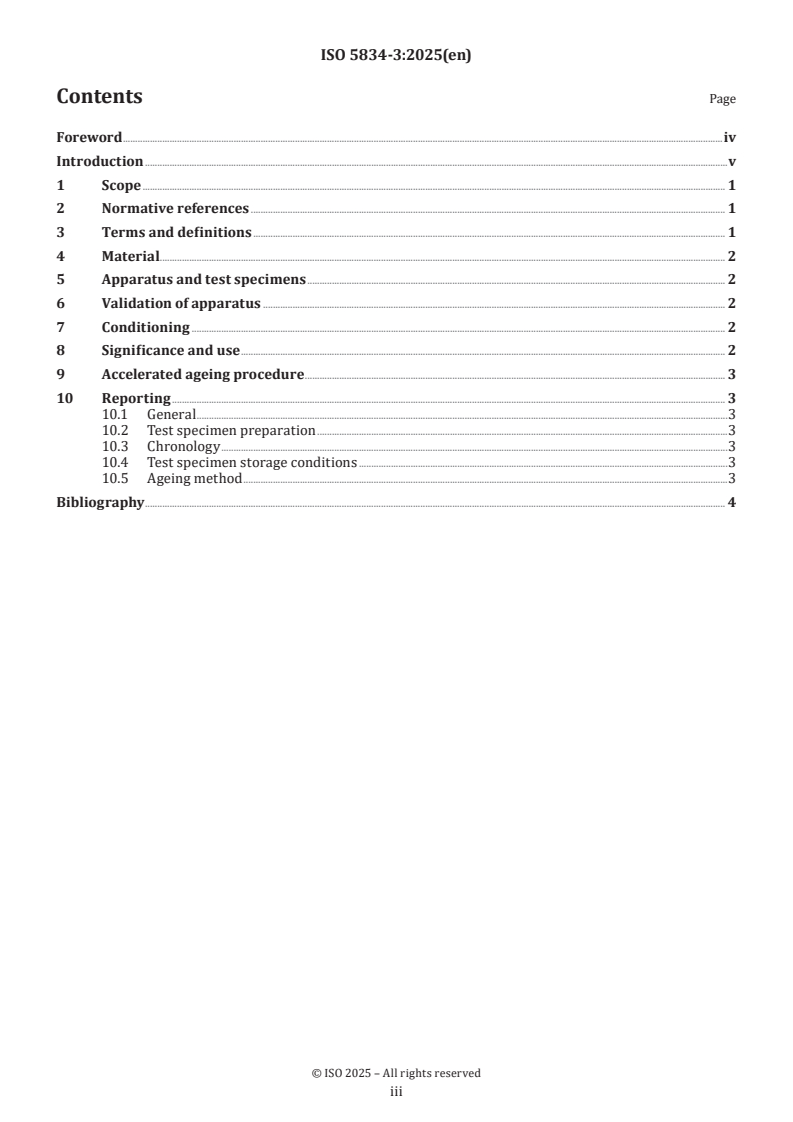
Contents Page
Foreword .iv
Introduction .v
1 Scope . 1
2 Normative references . 1
3 Terms and definitions . 1
4 Material. 2
5 Apparatus and test specimens . 2
6 Validation of apparatus . 2
7 Conditioning . 2
8 Significance and use . 2
9 Accelerated ageing procedure . 3
10 Reporting . 3
10.1 General .3
10.2 Test specimen preparation .3
10.3 Chronology .3
10.4 Test specimen storage conditions .3
10.5 Ageing method .3
Bibliography . 4
iii
Foreword
ISO (the International Organization for Standardization) is a worldwide federation of national standards
bodies (ISO member bodies). The work of preparing International Standards is normally carried out through
ISO technical committees. Each member body interested in a subject for which a technical committee
has been established has the right to be represented on that committee. International organizations,
governmental and non-governmental, in liaison with ISO, also take part in the work. ISO collaborates closely
with the International Electrotechnical Commission (IEC) on all matters of electrotechnical standardization.
The procedures used to develop this document and those intended for its further maintenance are described
in the ISO/IEC Directives, Part 1. In particular, the different approval criteria needed for the different types
of ISO document should be noted. This document was drafted in accordance with the editorial rules of the
ISO/IEC Directives, Part 2 (see www.iso.org/directives).
ISO draws attention to the possibility that the implementation of this document may involve the use of (a)
patent(s). ISO takes no position concerning the evidence, validity or applicability of any claimed patent
rights in respect thereof. As of the date of publication of this document, ISO had not received notice of (a)
patent(s) which may be required to implement this document. However, implementers are cautioned that
this may not represent the latest information, which may be obtained from the patent database available at
www.iso.org/patents. ISO shall not be held responsible for identifying any or all such patent rights.
Any trade name used in this document is information given for the convenience of users and does not
constitute an endorsement.
For an explanation of the voluntary nature of standards, the meaning of ISO specific terms and expressions
related to conformity assessment, as well as information about ISO's adherence to the World Trade
Organization (WTO) principles in the Technical Barriers to Trade (TBT), see www.iso.org/iso/foreword.html.
This document was prepared by Technical Committee ISO/TC 150, Implants for surgery, Subcommittee SC 1,
Materials.
This third edition cancels and replaces the second edition (ISO 5834-3:2019), which has been technically
revised.
The main changes are as follows:
— the normative references have been updated;
— updates have been made to harmonize this document with ASTM F2003-02.
A list of all parts in the ISO 5834 series can be found on the ISO website.
Any feedback or questions on this document should be directed to the user’s national standards body. A
complete listing of these bodies can be found at www.iso.org/members.html.
iv
Introduction
While no known surgical implant material has ever been shown to cause absolutely no adverse reactions
in the human body, long-term clinical experience with the material referred to in this document has shown
that an acceptable level of biological response can be expected when the material is used in appropriate
applications. However, this document covers the raw material and unfinished medical devices, where the
design and fabrication of the device can impact biological response.
v
...