

ISO 3103:2019
(Main)Tea — Preparation of liquor for use in sensory tests
General Information
- Abstract
This document specifies a method for the preparation of a liquor of tea for use in sensory tests, by means of infusing the leaf.
- Status
- Published
- Publication Date
- 08-Dec-2019
- Technical Committee
- ISO/TC 34/SC 8 - Tea
- Drafting Committee
- ISO/TC 34/SC 8 - Tea
- Current Stage
- 9093 - International Standard confirmed
- Start Date
- 08-Jul-2025
- Completion Date
- 29-Aug-2026
Buy Documents
ISO 3103:2019 - Tea -- Preparation of liquor for use in sensory tests
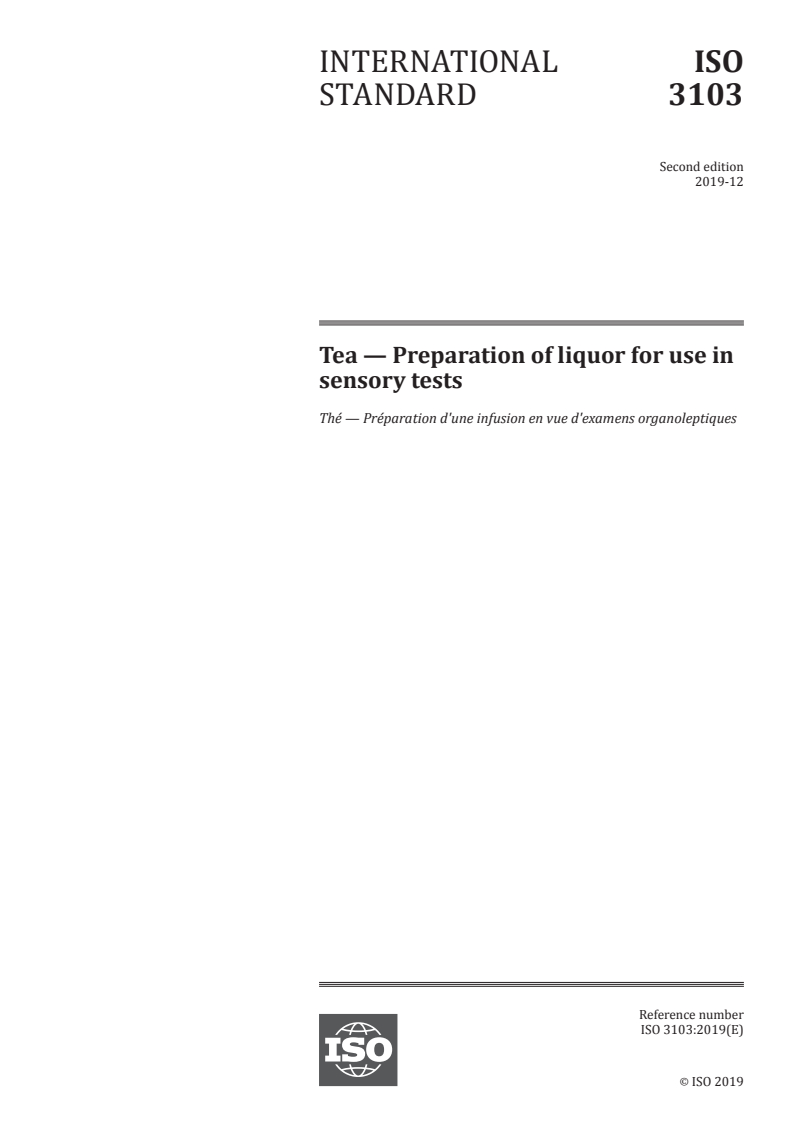
ISO 3103:2019 - Tea — Preparation of liquor for use in sensory tests/9/2019
Overview
ISO 3103:2019 is an international standard established by the International Organization for Standardization (ISO) to specify a consistent and reproducible method for the preparation of tea liquor for sensory evaluation. This document ensures that tea tasting, quality control, and comparative studies across the tea industry can be conducted with rigor and uniformity, regardless of geographical location. It is applicable to both black and green teas derived from Camellia sinensis.
By defining the apparatus, procedures, and reporting requirements, ISO 3103:2019 enhances the reliability of sensory test results and supports the integrity of tea quality assessments.
Key Topics
- Standardized Preparation: Outlines the specific steps for infusing tea leaves using designated pots and bowls made of white porcelain or glazed earthenware to control variables that affect sensory analysis.
- Sensory Evaluation: Enables objective comparison of liquor characteristics, including aroma, flavor, color, and overall organoleptic properties either with or without milk (for black tea).
- Apparatus Specifications: Details the recommended sizes, capacities, and materials for the teapot and bowl, ensuring reproducibility and minimizing variation between test environments.
- Water Quality and Temperature: Stresses the importance of using water similar to local drinking water and specifies temperature parameters for both preparation and evaluation phases.
- Consistent Reporting: Lists mandatory details for the sensory test report (such as tea mass, water volume, brewing time, vessel dimensions, and use of milk) to support traceability and repeatability.
Applications
ISO 3103:2019 is widely utilized in the global tea industry, research institutions, and quality control laboratories for several practical purposes:
- Quality Control: Tea manufacturers and processors use the standard to assess batch consistency, monitor changes in flavor profiles, and verify conformance to product specifications.
- Comparative Testing: Facilitates fair and reproducible side-by-side evaluations of different tea types, blends, or brands, essential for market analysis and product development.
- Research: Universities and research centers adopt the method in sensory studies, shelf-life evaluations, and investigations comparing impacts of production variables.
- Regulatory Compliance: Helps ensure products meet regional or export-import quality standards by providing a recognized method for sensory testing.
- Professional Tasting Panels: Tea tasters and expert panels use this standardized approach to maintain objectivity, reduce biases, and generate reliable feedback.
Related Standards
For a holistic approach to tea quality and testing, organizations may refer to additional relevant standards:
- ISO 1839: Tea - Sampling: Establishes procedures for obtaining representative tea samples for testing.
- ISO 3720: Black tea - Definition and basic requirements: Sets minimum definitions and criteria for black tea.
- ISO 11287: Green tea - Definition and basic requirements: Defines standards for green tea classification and quality.
Practical Value
Adhering to ISO 3103:2019 ensures comparability of sensory results worldwide, supports fair commercial practices, and underpins the credibility of sensory evaluation in tea production and research. By following this international standard, organizations demonstrate their commitment to quality assurance, consistency, and customer satisfaction in the dynamic global tea market.
Relations
- Effective Date
- 04-Feb-2017
Buy Documents
ISO 3103:2019 - Tea -- Preparation of liquor for use in sensory tests
ISO 3103:2019 - Tea — Preparation of liquor for use in sensory tests/9/2019
Get Certified
Connect with accredited certification bodies for this standard

BSI Group
BSI (British Standards Institution) is the business standards company that helps organizations make excellence a habit.

Bureau Veritas
Bureau Veritas is a world leader in laboratory testing, inspection and certification services.

DNV
DNV is an independent assurance and risk management provider.
Sponsored listings
Frequently Asked Questions
ISO 3103:2019 is a standard published by the International Organization for Standardization (ISO). Its full title is "Tea — Preparation of liquor for use in sensory tests". This standard covers: This document specifies a method for the preparation of a liquor of tea for use in sensory tests, by means of infusing the leaf.
This document specifies a method for the preparation of a liquor of tea for use in sensory tests, by means of infusing the leaf.
ISO 3103:2019 is classified under the following ICS (International Classification for Standards) categories: 67.140.10 - Tea; 67.240 - Sensory analysis. The ICS classification helps identify the subject area and facilitates finding related standards.
ISO 3103:2019 has the following relationships with other standards: It is inter standard links to ISO 3103:1980. Understanding these relationships helps ensure you are using the most current and applicable version of the standard.
ISO 3103:2019 is available in PDF format for immediate download after purchase. The document can be added to your cart and obtained through the secure checkout process. Digital delivery ensures instant access to the complete standard document.
Standards Content (Sample)
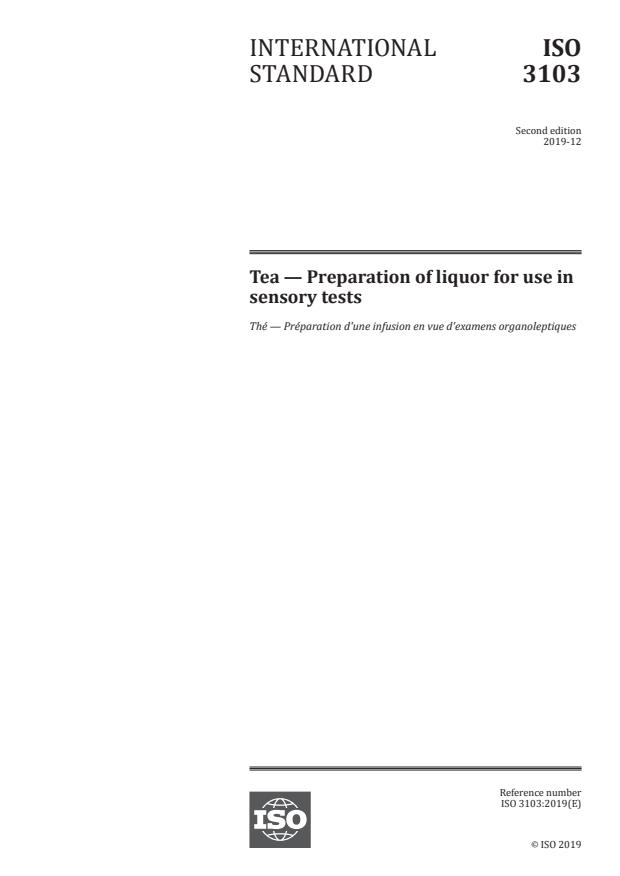
INTERNATIONAL ISO
STANDARD 3103
Second edition
2019-12
Tea — Preparation of liquor for use in
sensory tests
Thé — Préparation d'une infusion en vue d'examens organoleptiques
Reference number
©
ISO 2019
© ISO 2019
All rights reserved. Unless otherwise specified, or required in the context of its implementation, no part of this publication may
be reproduced or utilized otherwise in any form or by any means, electronic or mechanical, including photocopying, or posting
on the internet or an intranet, without prior written permission. Permission can be requested from either ISO at the address
below or ISO’s member body in the country of the requester.
ISO copyright office
CP 401 • Ch. de Blandonnet 8
CH-1214 Vernier, Geneva
Phone: +41 22 749 01 11
Fax: +41 22 749 09 47
Email: copyright@iso.org
Website: www.iso.org
Published in Switzerland
ii © ISO 2019 – All rights reserved
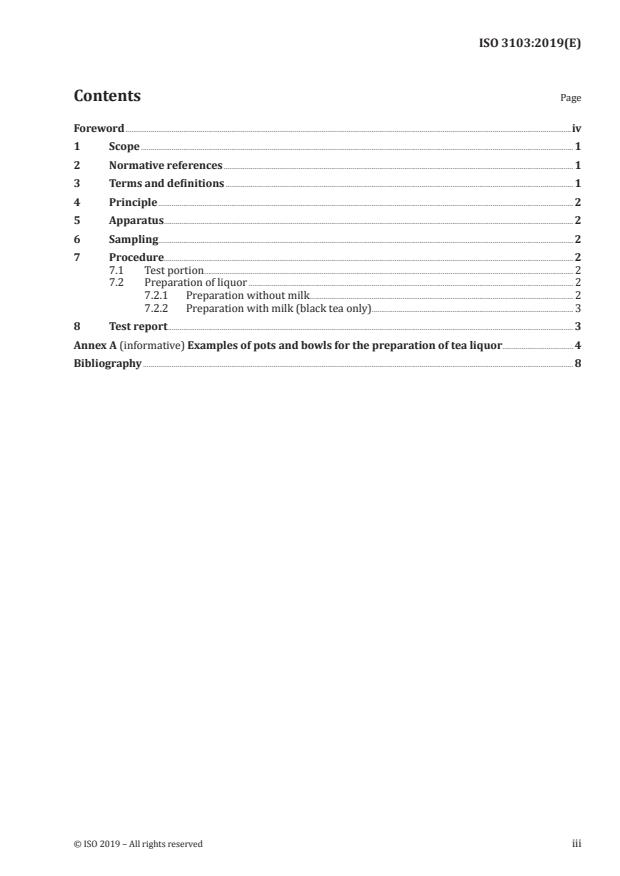
Contents Page
Foreword .iv
1 Scope . 1
2 Normative references . 1
3 Terms and definitions . 1
4 Principle . 2
5 Apparatus . 2
6 Sampling . 2
7 Procedure. 2
7.1 Test portion . 2
7.2 Preparation of liquor . 2
7.2.1 Preparation without milk . 2
7.2.2 Preparation with milk (black tea only). 3
8 Test report . 3
Annex A (informative) Examples of pots and bowls for the preparation of tea liquor .4
Bibliography . 8
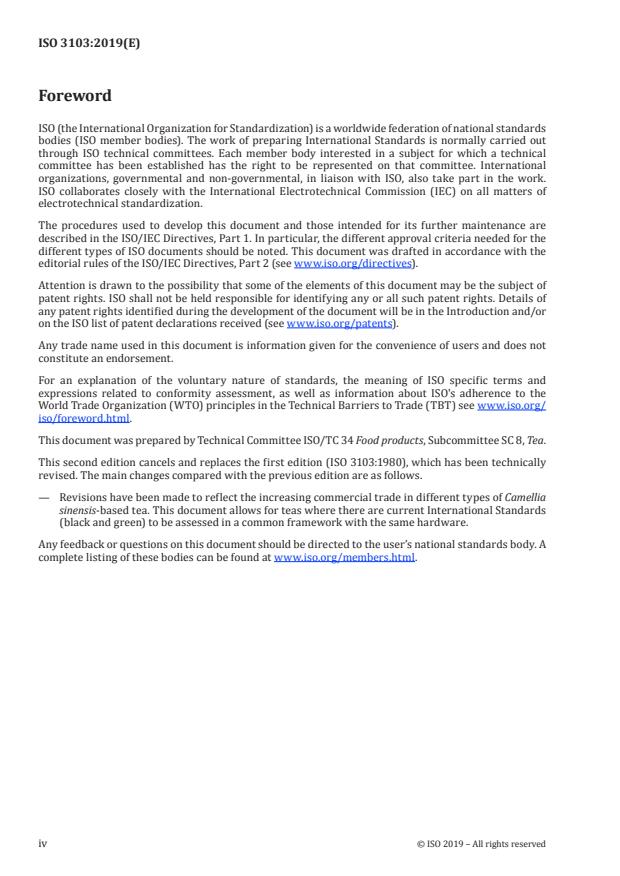
Foreword
ISO (the International Organization for Standardization) is a worldwide federation of national standards
bodies (ISO member bodies). The work of preparing International Standards is normally carried out
through ISO technical committees. Each member body interested in a subject for which a technical
committee has been established has the right to be represented on that committee. International
organizations, governmental and non-governmental, in liaison with ISO, also take part in the work.
ISO collaborates closely with the International Electrotechnical Commission (IEC) on all matters of
electrotechnical standardization.
The procedures used to develop this document and those intended for its further maintenance are
described in the ISO/IEC Directives, Part 1. In particular, the different approval criteria needed for the
different types of ISO documents should be noted. This document was drafted in accordance with the
editorial rules of the ISO/IEC Directives, Part 2 (see www .iso .org/ directives).
Attention is drawn to the possibility that some of the elements of this document may be the subject of
patent rights. ISO shall not be held responsible for identifying any or all such patent rights. Details of
any patent rights identified during the development of the document will be in the Introduction and/or
on the ISO list of patent declarations received (see www .iso .org/ patents).
Any trade name used in this document is information given for the convenience of users and does not
constitute an endorsement.
For an explanation of the voluntary nature of standards, the meaning of ISO specific terms and
expressions related to conformity assessment, as well as information about ISO's adherence to the
World Trade Organization (WTO) principles in the Technical Barriers to Trade (TBT) see www .iso .org/
iso/ foreword .html.
This document was prepared by Technical Committee ISO/TC 34 Food products, Subcommittee SC 8, Tea.
This second edition cancels and replaces the first edition (ISO 3103:1980), which has been technically
revised. The main changes compared with the previous edition are as follows.
— Revisions have been made to reflect the increasing commercial trade in different types of Camellia
sinensis-based tea. This document allows for teas where there are current International Standards
(black and green) to be assessed in a common framework with the same hardware.
Any feedback or questions on this document should be directed to the user’s national standards body. A
complete listing of these bodies can be found at www .iso .org/ members .html.
iv © ISO 2019 – All rights reserved
INTERNATIONAL STANDARD ISO 3103:2019(E)
Tea — Preparation of liquor for use in sensory tests
1 Scope
This document specifies a method for the preparation of a liquor of tea for use in sensory tests, by
means of infusing the leaf.
2 Normative references
The following documents are referred to in the text in such a way that some or all of their content
constitutes requirements of this document. For dated references, only the edition cited applies. For
undated references, the latest edition of the referenced document (including any amendments) applies.
ISO 1839, Tea — Sampling
3 Terms and definitions
For the purposes of this document, the following terms and definitions apply.
ISO and IEC maintain terminological databases for use in standardization at the following addresses:
— ISO Online browsing platform: available at https:// www .iso .org/ obp
— IEC Electropedia: available at http:// www .electropedia .org/
3.1
liquor
solution prepared by extraction of soluble substances from dried tea leaf, under the conditions
described
3.2
infused leaf
tea leaf from which liquor (3.1) has been prepared
3.3
black tea
tea derived solely
...
INTERNATIONAL ISO
STANDARD 3103
Second edition
2019-12
Tea — Preparation of liquor for use in
sensory tests
Thé — Préparation d'une infusion en vue d'examens organoleptiques
Reference number
©
ISO 2019
© ISO 2019
All rights reserved. Unless otherwise specified, or required in the context of its implementation, no part of this publication may
be reproduced or utilized otherwise in any form or by any means, electronic or mechanical, including photocopying, or posting
on the internet or an intranet, without prior written permission. Permission can be requested from either ISO at the address
below or ISO’s member body in the country of the requester.
ISO copyright office
CP 401 • Ch. de Blandonnet 8
CH-1214 Vernier, Geneva
Phone: +41 22 749 01 11
Fax: +41 22 749 09 47
Email: copyright@iso.org
Website: www.iso.org
Published in Switzerland
ii © ISO 2019 – All rights reserved
Contents Page
Foreword .iv
1 Scope . 1
2 Normative references . 1
3 Terms and definitions . 1
4 Principle . 2
5 Apparatus . 2
6 Sampling . 2
7 Procedure. 2
7.1 Test portion . 2
7.2 Preparation of liquor . 2
7.2.1 Preparation without milk . 2
7.2.2 Preparation with milk (black tea only). 3
8 Test report . 3
Annex A (informative) Examples of pots and bowls for the preparation of tea liquor .4
Bibliography . 8
Foreword
ISO (the International Organization for Standardization) is a worldwide federation of national standards
bodies (ISO member bodies). The work of preparing International Standards is normally carried out
through ISO technical committees. Each member body interested in a subject for which a technical
committee has been established has the right to be represented on that committee. International
organizations, governmental and non-governmental, in liaison with ISO, also take part in the work.
ISO collaborates closely with the International Electrotechnical Commission (IEC) on all matters of
electrotechnical standardization.
The procedures used to develop this document and those intended for its further maintenance are
described in the ISO/IEC Directives, Part 1. In particular, the different approval criteria needed for the
different types of ISO documents should be noted. This document was drafted in accordance with the
editorial rules of the ISO/IEC Directives, Part 2 (see www .iso .org/ directives).
Attention is drawn to the possibility that some of the elements of this document may be the subject of
patent rights. ISO shall not be held responsible for identifying any or all such patent rights. Details of
any patent rights identified during the development of the document will be in the Introduction and/or
on the ISO list of patent declarations received (see www .iso .org/ patents).
Any trade name used in this document is information given for the convenience of users and does not
constitute an endorsement.
For an explanation of the voluntary nature of standards, the meaning of ISO specific terms and
expressions related to conformity assessment, as well as information about ISO's adherence to the
World Trade Organization (WTO) principles in the Technical Barriers to Trade (TBT) see www .iso .org/
iso/ foreword .html.
This document was prepared by Technical Committee ISO/TC 34 Food products, Subcommittee SC 8, Tea.
This second edition cancels and replaces the first edition (ISO 3103:1980), which has been technically
revised. The main changes compared with the previous edition are as follows.
— Revisions have been made to reflect the increasing commercial trade in different types of Camellia
sinensis-based tea. This document allows for teas where there are current International Standards
(black and green) to be assessed in a common framework with the same hardware.
Any feedback or questions on this document should be directed to the user’s national standards body. A
complete listing of these bodies can be found at www .iso .org/ members .html.
iv © ISO 2019 – All rights reserved
INTERNATIONAL STANDARD ISO 3103:2019(E)
Tea — Preparation of liquor for use in sensory tests
1 Scope
This document specifies a method for the preparation of a liquor of tea for use in sensory tests, by
means of infusing the leaf.
2 Normative references
The following documents are referred to in the text in such a way that some or all of their content
constitutes requirements of this document. For dated references, only the edition cited applies. For
undated references, the latest edition of the referenced document (including any amendments) applies.
ISO 1839, Tea — Sampling
3 Terms and definitions
For the purposes of this document, the following terms and definitions apply.
ISO and IEC maintain terminological databases for use in standardization at the following addresses:
— ISO Online browsing platform: available at https:// www .iso .org/ obp
— IEC Electropedia: available at http:// www .electropedia .org/
3.1
liquor
solution prepared by extraction of soluble substances from dried tea leaf, under the conditions
described
3.2
infused leaf
tea leaf from which liquor (3.1) has been prepared
3.3
black tea
tea derived solely
...