

ISO 10545-24:2026
(Main)Ceramic tiles — Part 24: Tensile adhesion strength of fibre-combined multilayer ceramic tile and tile adhesive
General Information
- Abstract
This document describes a method for determining the tensile adhesion strength of fibre-combined multilayer ceramic tiles, in particular the adhesion between the back of the fibre-combined multilayer ceramic tiles and the cementitious adhesive used for installation.
- Status
- Published
- Publication Date
- 29-Jan-2026
- Technical Committee
- ISO/TC 189 - Ceramic tile
- Drafting Committee
- ISO/TC 189 - Ceramic tile
- Current Stage
- 6060 - International Standard published
- Start Date
- 30-Jan-2026
- Due Date
- 18-Sep-2026
- Completion Date
- 30-Jan-2026
Overview
ISO 10545-24:2026 defines a standardized method for determining the tensile adhesion strength of fibre-combined multilayer ceramic tiles, specifically evaluating the bond between the back of these tiles and the cementitious adhesives used for installation. This standard ensures objective, reproducible results vital for quality assurance and compliance in ceramic tile installation projects.
Fibre-combined multilayer ceramic tiles, also known as reinforced or back-layered ceramic tiles, incorporate a mesh of glass fibre on their reverse side to enhance structural integrity. Measuring their adhesive performance is essential for safe, durable installations in residential, commercial, and industrial environments.
Key Topics
- Tensile Adhesion Testing: ISO 10545-24 details procedures for sampling, conditioning, and testing fibre-combined multilayer ceramic tiles using a cementitious adhesive classified as at least C2S1 type in accordance with ISO 13007-1.
- Testing Conditions: The standard specifies normal laboratory conditions of 23 ± 2 °C temperature and 50 ± 5% relative humidity to ensure consistent results.
- Failure Modes: Multiple potential failure patterns are recognized, including adhesion failure at the adhesive/substrate or adhesive/tile interface, and cohesive failures within the adhesive layer, substrate, or tile.
- Environmental Durability: Adhesion is assessed after various exposures such as water immersion, heat ageing, and freeze-thaw cycling, reflecting real-world service conditions.
- Reporting Requirements: Mandatory parameters for reporting include adhesive type and classification, testing conditions, measured tensile adhesion strengths (individual and mean values), and observed failure patterns.
Applications
Ensuring reliable adhesion strength for fibre-combined multilayer ceramic tiles is crucial in the following applications:
- Quality Assessment: Manufacturers use this ISO standard to verify product reliability and compliance with regulatory or project requirements.
- Product Development: Research and development teams utilize these testing methods to improve tile design and optimize adhesive formulations.
- Construction and Installation: Specifiers, contractors, and installers consult ISO 10545-24 testing data to select appropriate tile and adhesive combinations for high-performance flooring and wall cladding systems.
- Third-Party Testing: Accredited laboratories follow this standardized procedure to provide independent certification of adhesive performance for tile manufacturers and suppliers.
Adhering to ISO 10545-24:2026 improves confidence in the long-term performance of tiled surfaces, especially where fibre-combined multilayer ceramic tiles are required for enhanced strength or larger formats.
Related Standards
ISO 10545-24:2026 is part of the broader ISO 10545 series on ceramic tile testing. Notable related standards include:
- ISO 10545-1 to ISO 10545-23: Cover various aspects of ceramic tile test methods, including dimensionality, surface quality, and durability.
- ISO 13007-1: Defines terms, specifications, and classification codes for ceramic tile adhesives and grouts, referenced here for adhesive requirements.
- ISO 13007-2: Specifies test methods for adhesives used with ceramic tiles, essential for preparing and evaluating test substrates.
Alignment with these standards promotes harmonized testing methodologies across the tile manufacturing supply chain and supports global trade in ceramic tiles and related installation materials.
Keywords: ISO 10545-24:2026, ceramic tile standards, tensile adhesion strength, fibre-combined multilayer ceramic tiles, tile adhesive testing, ISO 13007, tile installation quality, reinforced ceramic tiles, construction standards, adhesive performance.
Get Certified
Connect with accredited certification bodies for this standard

DIN CERTCO
DIN Group product certification.
DIBt (Deutsches Institut für Bautechnik)
German Institute for Building Technology.

Aboma Certification B.V.
Specialized in construction, metal, and transport sectors.
Sponsored listings
Frequently Asked Questions
ISO 10545-24:2026 is a standard published by the International Organization for Standardization (ISO). Its full title is "Ceramic tiles — Part 24: Tensile adhesion strength of fibre-combined multilayer ceramic tile and tile adhesive". This standard covers: This document describes a method for determining the tensile adhesion strength of fibre-combined multilayer ceramic tiles, in particular the adhesion between the back of the fibre-combined multilayer ceramic tiles and the cementitious adhesive used for installation.
This document describes a method for determining the tensile adhesion strength of fibre-combined multilayer ceramic tiles, in particular the adhesion between the back of the fibre-combined multilayer ceramic tiles and the cementitious adhesive used for installation.
ISO 10545-24:2026 is classified under the following ICS (International Classification for Standards) categories: 83.180 - Adhesives; 91.100.23 - Ceramic tiles. The ICS classification helps identify the subject area and facilitates finding related standards.
ISO 10545-24:2026 is available in PDF format for immediate download after purchase. The document can be added to your cart and obtained through the secure checkout process. Digital delivery ensures instant access to the complete standard document.
Standards Content (Sample)
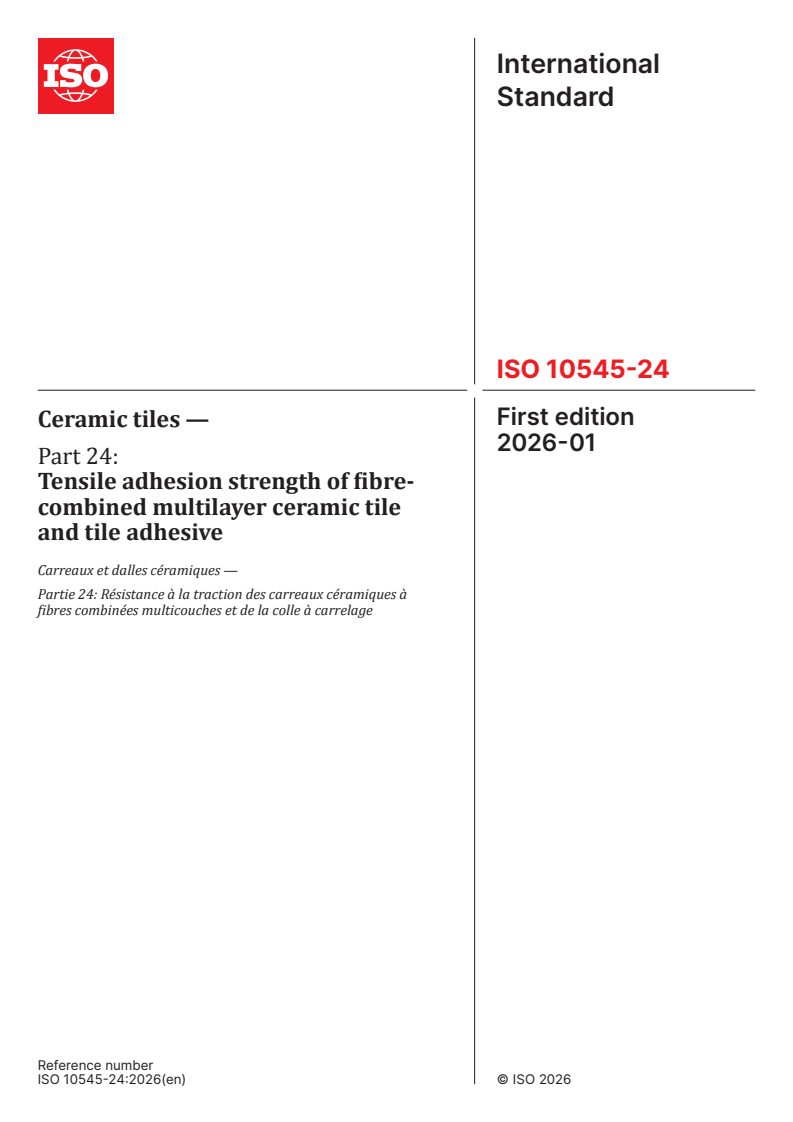
International
Standard
ISO 10545-24
First edition
Ceramic tiles —
2026-01
Part 24:
Tensile adhesion strength of fibre-
combined multilayer ceramic tile
and tile adhesive
Carreaux et dalles céramiques —
Partie 24: Résistance à la traction des carreaux céramiques à
fibres combinées multicouches et de la colle à carrelage
Reference number
© ISO 2026
All rights reserved. Unless otherwise specified, or required in the context of its implementation, no part of this publication may
be reproduced or utilized otherwise in any form or by any means, electronic or mechanical, including photocopying, or posting on
the internet or an intranet, without prior written permission. Permission can be requested from either ISO at the address below
or ISO’s member body in the country of the requester.
ISO copyright office
CP 401 • Ch. de Blandonnet 8
CH-1214 Vernier, Geneva
Phone: +41 22 749 01 11
Email: copyright@iso.org
Website: www.iso.org
Published in Switzerland
ii
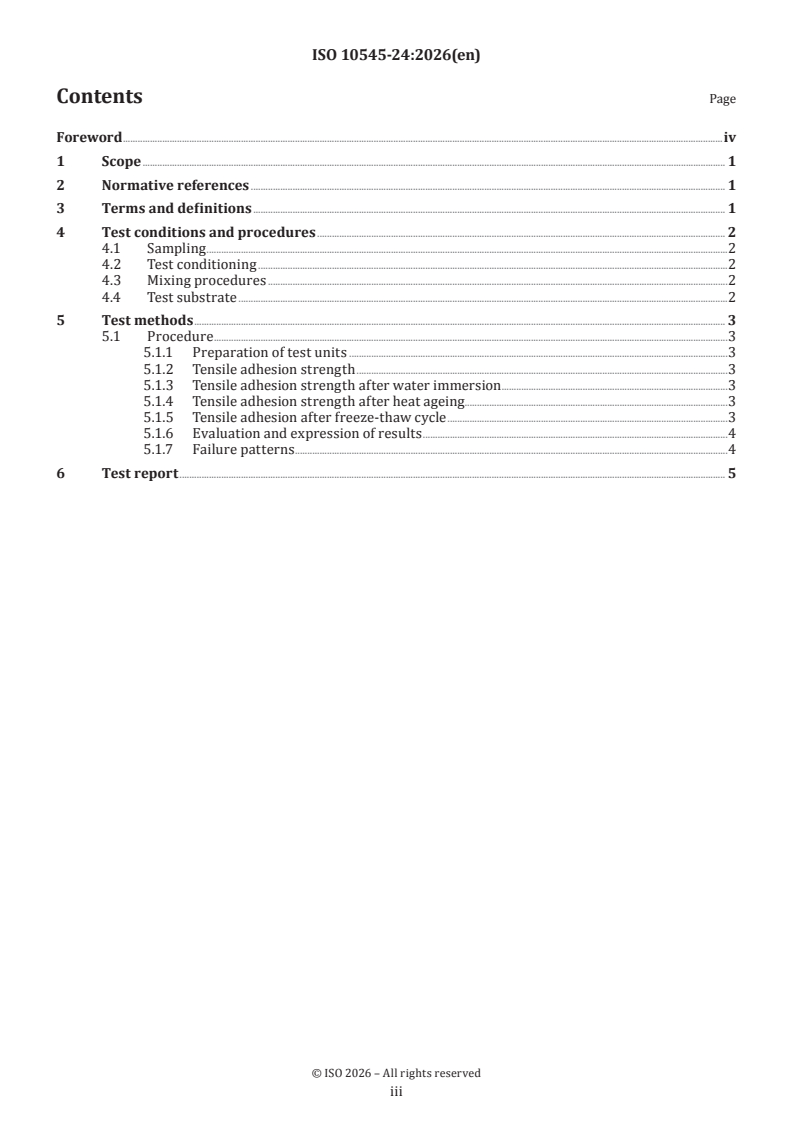
Contents Page
Foreword .iv
1 Scope . 1
2 Normative references . 1
3 Terms and definitions . 1
4 Test conditions and procedures . 2
4.1 Sampling .2
4.2 Test conditioning .2
4.3 Mixing procedures .2
4.4 Test substrate .2
5 Test methods . 3
5.1 Procedure .3
5.1.1 Preparation of test units .3
5.1.2 Tensile adhesion strength .3
5.1.3 Tensile adhesion strength after water immersion .3
5.1.4 Tensile adhesion strength after heat ageing.3
5.1.5 Tensile adhesion after freeze-thaw cycle .3
5.1.6 Evaluation and expression of results .4
5.1.7 Failure patterns .4
6 Test report . 5
iii
Foreword
ISO (the International Organization for Standardization) is a worldwide federation of national standards
bodies (ISO member bodies). The work of preparing International Standards is normally carried out through
ISO technical committees. Each member body interested in a subject for which a technical committee
has been established has the right to be represented on that committee. International organizations,
governmental and non-governmental, in liaison with ISO, also take part in the work. ISO collaborates closely
with the International Electrotechnical Commission (IEC) on all matters of electrotechnical standardization.
The procedures used to develop this document and those intended for its further maintenance are described
in the ISO/IEC Directives, Part 1. In particular, the different approval criteria needed for the different types
of ISO document should be noted. This document was drafted in accordance with the editorial rules of the
ISO/IEC Directives, Part 2 (see www.iso.org/directives).
ISO draws attention to the possibility that the implementation of this document may involve the use of (a)
patent(s). ISO takes no position concerning the evidence, validity or applicability of any claimed patent
rights in respect thereof. As of the date of publication of this document, ISO had not received notice of (a)
patent(s) which may be required to implement this document. However, implementers are cautioned that
this may not represent the latest information, which may be obtained from the patent database available at
www.iso.org/patents. ISO shall not be held responsible for identifying any or all such patent rights.
Any trade name used in this document is information given for the convenience of users and does not
constitute an endorsement.
For an explanation of the voluntary nature of standards, the meaning of ISO specific terms and expressions
related to conformity assessment, as well as information about ISO's adherence to the World Trade
Organization (WTO) principles in the Technical Barriers to Trade (TBT), see www.iso.org/iso/foreword.html.
This document was prepared by Technical Committee ISO/TC 189, Ceramic tile.
A list of all parts in the ISO 10545 series can be found on the ISO website.
Any feedback or questions on this document should be directed to the user’s national standards body. A
complete listing of these bodies can be found at www.iso.org/members.html.
iv
International Standard ISO 10545-24:2026(en)
Ceramic tiles —
Part 24:
Tensile adhesion strength of fibre-combined multilayer
ceramic tile and tile adhesive
1 Scope
This document describes a method for determining the tensile adhesion strength of fibre-combined
multilayer ceramic tiles, in particular the adhesion between the back of the fibre-combined multilayer
ceramic tiles and the cementitious adhesive used for installation.
2 Normative references
The following documents are referred to in the text in such a way that some or all of their content constitutes
requirements of this document. For dated references, only the edition cited applies. For undated references,
the latest edition of the referenced document (including any amendments) applies.
ISO 13007-1, Ceramic tiles — Grouts and adhesives — Part 1: Terms, definitions and specifications for adhesives
ISO 13007-2:2013, Ceramic tiles — Grouts and adhesives — Part 2: Test methods for adhesives
3 Terms and definitions
For the purposes of this document, the following terms and definitions apply.
ISO and IEC maintain terminology databases for use in standardization at the following addresses:
— ISO Online browsing platform: available at https:// www .iso .org/ obp
— IEC Electropedia: available at https:// www .electropedia .org/
3.1
multilayer ceramic tile
ceramic tile with a surface area equal or greater than (7 × 7) cm combined with a material attached to its
back
3.2
fibre-combined multilayer ceramic tile
multilayer ceramic tile in which the coupling material is a mesh of glass fibre
Note 1 to entry: Fibre-combined multilayer ceramic tiles are also defined as “back layered ceramic tiles” or “reinforced
ceramic tiles”.
3.3
notched trowel
toothed tool that facilitates the application of the adhesive as a series of ribs of a uniform thickness
3.4
mass
mass capable of exerting a force of (20 ± 0,05) N with a cross-sectional area of (50 ± 1) mm × (50 ± 1) mm
3.5
pull-head plate
plate consisting of square metallic plates with dimensions of (50 ± 1) mm × (50 ± 1) mm and a minimum
thickness of 8 mm with a suitable fitting for connection to the test machine
3.6
tensile testing apparatus
apparatus consisting of a tes
...