


ISO 21573-2:2020
(Main)Building construction machinery and equipment — Concrete pumps — Part 2: Procedure for examination of technical parameters
Building construction machinery and equipment — Concrete pumps — Part 2: Procedure for examination of technical parameters
This document specifies the procedure and requirements for examining the technical commercial specifications of factory new piston-type concrete pump and rotary-type concrete pump as defined in ISO 21573‑1. It applies to mobile concrete pumps (with or without concrete-placing boom) and stationary concrete pumps.
Machines et matériels pour la construction des bâtiments — Pompes à béton — Partie 2: Procédure pour la détermination des paramètres techniques
General Information
Relations
Standards Content (Sample)
INTERNATIONAL ISO
STANDARD 21573-2
Second edition
2020-12
Building construction machinery and
equipment — Concrete pumps —
Part 2:
Procedure for examination of
technical parameters
Machines et matériels pour la construction des bâtiments — Pompes
à béton —
Partie 2: Procédure pour la détermination des paramètres techniques
Reference number
©
ISO 2020
© ISO 2020
All rights reserved. Unless otherwise specified, or required in the context of its implementation, no part of this publication may
be reproduced or utilized otherwise in any form or by any means, electronic or mechanical, including photocopying, or posting
on the internet or an intranet, without prior written permission. Permission can be requested from either ISO at the address
below or ISO’s member body in the country of the requester.
ISO copyright office
CP 401 • Ch. de Blandonnet 8
CH-1214 Vernier, Geneva
Phone: +41 22 749 01 11
Email: copyright@iso.org
Website: www.iso.org
Published in Switzerland
ii © ISO 2020 – All rights reserved
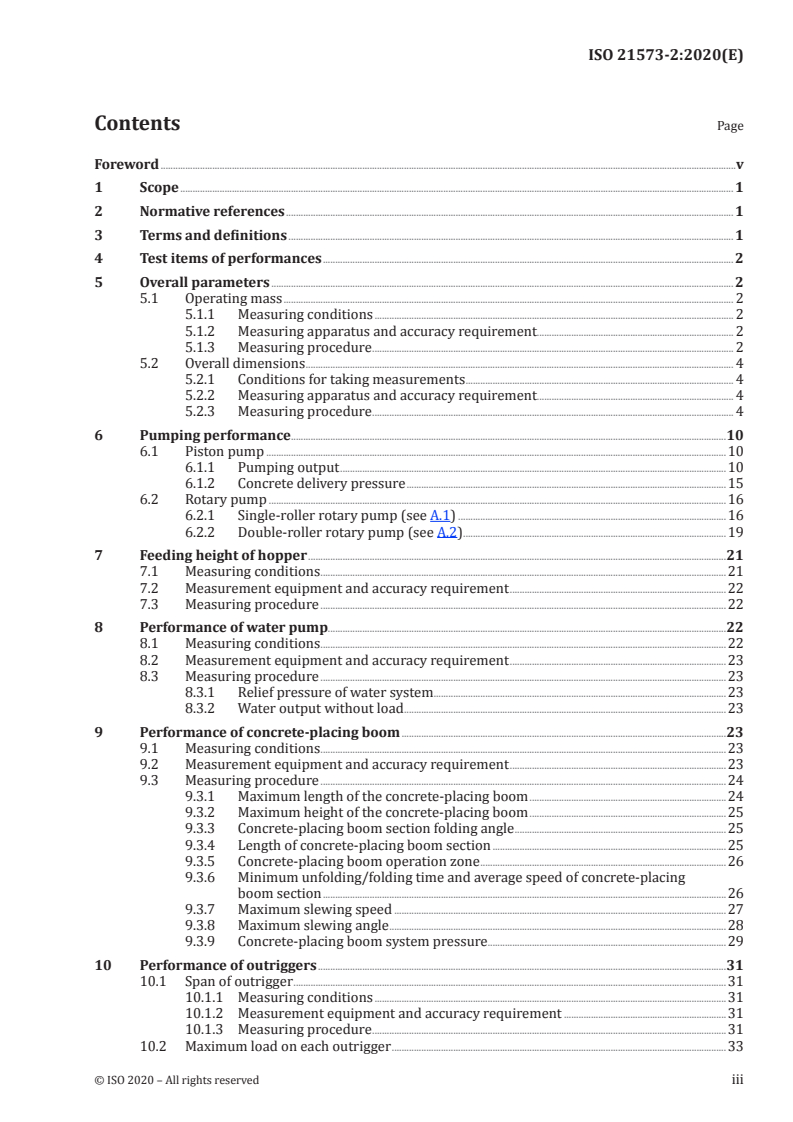
Contents Page
Foreword .v
1 Scope . 1
2 Normative references . 1
3 Terms and definitions . 1
4 Test items of performances . 2
5 Overall parameters . 2
5.1 Operating mass . 2
5.1.1 Measuring conditions . 2
5.1.2 Measuring apparatus and accuracy requirement. 2
5.1.3 Measuring procedure . 2
5.2 Overall dimensions . 4
5.2.1 Conditions for taking measurements . 4
5.2.2 Measuring apparatus and accuracy requirement. 4
5.2.3 Measuring procedure . 4
6 Pumping performance .10
6.1 Piston pump .10
6.1.1 Pumping output .10
6.1.2 Concrete delivery pressure .15
6.2 Rotary pump .16
6.2.1 Single-roller rotary pump (see A.1) .16
6.2.2 Double-roller rotary pump (see A.2) .19
7 Feeding height of hopper .21
7.1 Measuring conditions .21
7.2 Measurement equipment and accuracy requirement .22
7.3 Measuring procedure .22
8 Performance of water pump.22
8.1 Measuring conditions .22
8.2 Measurement equipment and accuracy requirement .23
8.3 Measuring procedure .23
8.3.1 Relief pressure of water system .23
8.3.2 Water output without load .23
9 Performance of concrete-placing boom .23
9.1 Measuring conditions .23
9.2 Measurement equipment and accuracy requirement .23
9.3 Measuring procedure .24
9.3.1 Maximum length of the concrete-placing boom .24
9.3.2 Maximum height of the concrete-placing boom .25
9.3.3 Concrete-placing boom section folding angle .25
9.3.4 Length of concrete-placing boom section .25
9.3.5 Concrete-placing boom operation zone .26
9.3.6 Minimum unfolding/folding time and average speed of concrete-placing
boom section .26
9.3.7 Maximum slewing speed .27
9.3.8 Maximum slewing angle .28
9.3.9 Concrete-placing boom system pressure . .29
10 Performance of outriggers .31
10.1 Span of outrigger .31
10.1.1 Measuring conditions .31
10.1.2 Measurement equipment and accuracy requirement .31
10.1.3 Measuring procedure .31
10.2 Maximum load on each outrigger .33
10.2.1 Measuring conditions .33
10.2.2 Measuring apparatus and accuracy requirement.33
10.2.3 Measuring procedure .33
10.3 Speed of outriggers movement .34
10.3.1 Measuring conditions .34
10.3.2 Measuring apparatus and accuracy requirement.34
10.3.3 Measuring procedure .34
10.4 Outriggers system pressure .37
10.4.1 Measuring conditions .37
10.4.2 Measuring apparatus and accuracy requirement.37
10.4.3 Measuring procedure .37
Annex A (informative) Theoretic pumping output and delivery pressure of rotary pump .39
iv © ISO 2020 – All rights reserved
Foreword
ISO (the International Organization for Standardization) is a worldwide federation of national standards
bodies (ISO member bodies). The work of preparing International Standards is normally carried out
through ISO technical committees. Each member body interested in a subject for which a technical
committee has been established has the right to be represented on that committee. International
organizations, governmental and non-governmental, in liaison with ISO, also take part in the work.
ISO collaborates closely with the International Electrotechnical Commission (IEC) on all matters of
electrotechnical standardization.
The procedures used to develop this document and those intended for its further maintenance are
described in the ISO/IEC Directives, Part 1. In particular, the different approval criteria needed for the
different types of ISO documents should be noted. This document was drafted in accordance with the
editorial rules of the ISO/IEC Directives, Part 2 (see www .iso .org/ directives).
Attention is drawn to the possibility that some of the elements of this document may be the subject of
patent rights. ISO shall not be held responsible for identifying any or all such patent rights. Details of
any patent rights identified during the development of the document will be in the Introduction and/or
on the ISO list of patent declarations received (see www .iso .org/ patents).
Any trade name used in this document is information given for the convenience of users and does not
constitute an endorsement.
For an explanation of the voluntary nature of standards, the meaning of ISO specific terms and
expressions related to conformity assessment, as well as information about ISO's adherence to the
World Trade Organization (WTO) principles in the Technical Barriers to Trade (TBT), see www .iso .org/
iso/ foreword .html.
This document was prepared by Technical Committee ISO/TC 195, Building construction machinery and
equipment, Subcommittee SC 1, Machinery and equipment for concrete work.
This second edition cancels and replaces the first edition (ISO 21573-2:2008), which has been
technically revised.
The main changes compared to the previous edition are as follows:
— added the actual pumping output and efficiency measurement under defined working conditions
(e.g. concrete grade and pumping speed) in order to describe the actual pumping performance;
— added the following characteristic parameters measuring methods:
— operating mass;
— overall dimensions including length (L), width (W) and height (H);
— delivery pressure of pump for driving the distributing and outriggers;
— maximum load on each outrigger;
— outrigger speed;
— complemented performance measuring methods and indicated conditions in the following clauses/
subclauses:
— concrete delivery pressure;
— feeding height of hopper;
— length, height and angle of the boom;
— speed of the concrete-placing boom;
— slewing speed;
— slewing angle;
— span of outrigger.
A list of all parts in the ISO 21573 series can be found on the ISO website.
Any feedback or questions on this document should be directed to the user’s national standards body. A
complete listing of these bodies can be found at www .iso .org/ members .html.
vi © ISO 2020 – All rights reserved
INTERNATIONAL STANDARD ISO 21573-2:2020(E)
Building construction machinery and equipment —
Concrete pumps —
Part 2:
Procedure for examination of technical parameters
1 Scope
This document specifies the procedure and requirements for examining the technical commercial
specifications of factory new piston-type concrete pump and rotary-type concrete pump as defined in
ISO 21573-1.
It applies to mobile concrete pumps (with or without concrete-placing boom) and stationary
concrete pumps.
2 Normative references
The following documents are referred to in the text in such a way that some or all of their content
constitutes requirements of this document. For dated references, only the edition cited applies. For
undated references, the latest edition of the referenced document (including any amendments) applies.
ISO 21573-1, Building construction machinery and equipment — Concrete pumps — Part 1: Terminology
and commercial specifications
3 Terms and definitions
For the purposes of this document, the terms and definitions given in ISO 21573-1 and the following apply.
ISO and IEC maintain terminological databases for use in standardization at the following addresses:
— ISO Online browsing platform: available at https:// www .iso .org/ obp
— IEC Electropedia: available at http:// www .electropedia .org/
3.1
single-roller rotary pump
rotary-type concrete pump that discharges fresh concrete by squeezing an elastic tube by one
rotating roller
3.2
double-roller rotary pump
rotary-type concrete pump that discharges fresh concrete by squeezing an elastic tube between double
rotating rollers
3.3
concrete storage, mixing and feeding device
device for agitating and discharging concrete or mortar
3.4
outrigger span
actual distance between adjacent centrelines of vertical cylinders with outriggers fully extended or
projection distance of the actual distance on the reference plane
4 Test items of performances
The following performances are measured or tested in this examination:
a) overall parameters;
b) pumping performance;
c) feeding height of hopper;
d) performance of the water pump;
e) performance of the concrete-placing boom;
f) performance of the outrigger.
5 Overall parameters
5.1 Operating mass
5.1.1 Measuring conditions
Measure the mass of the concrete pump under the following conditions:
— with the pump fully operational and all systems functional;
— including all standard equipment following the manufacturer's specifications;
— with a driver of mass 75 kg;
— with the fuel tank full;
— with cleaning water, cooling, lubrication and hydraulic systems full;
— with the vehicle parked steadily, the engine switched off, the gearbox shifted to neutral gear, and
the brake released.
— with the weighing of the machine which should be done with the brakes of the truck released, for
safety reasons, apply wheel stoppers on 2 wheels at least.
5.1.2 Measuring apparatus and accuracy requirement
Truck scale should be used as the measuring apparatus with an accuracy of 0,5 %.
5.1.3 Measuring procedure
5.1.3.1 Measuring method
The weighing platform of the scale shall be big enough to accommodate all points of support of the
machinery at one time.
The entry ground of the weighing platform shall be kept at the same level with the weighing platform.
Measure the operating mass as shown in Figure 1.
a) Drive the concrete pump at low speed from one direction into the weighing platform, stop it
'
steadily, and measure the mass G of the concrete pump.
b) Make a turnaround, drive it onto the weighing platform from the opposite direction, stop it steadily,
"
and measure the mass G of the concrete pump again.
2 © ISO 2020 – All rights reserved
a) The first mass measurement
b) The second mass measurement
Key
1 concrete pump
2 weighing platform
3 driving direction
Figure 1 — Diagram for mass measuring of concrete pump
5.1.3.2 Calculation method
Calculate the mass of the concrete pump using Formula (1):
GG'"+
G = −−()G 75 (1)
0 1
where
G
is the mass of the concrete pump (kg);
' "
G , G is the mass of the concrete pump measured by driving it onto the weighing platform from two
0 0
directions respectively (kg);
G
is the actual driver weight (kg).
Record the measurement results in Table 1.
Table 1 — Measurement record — Mass of the concrete pump
Date of measuring Place
Model of concrete pump Serial number
Apparatus Truck scale
Remarks
Characteristics Parameter Measured data Parameter Calculated value
'
G
Operating mass
"
G
G
G
5.2 Overall dimensions
5.2.1 Conditions for taking measurements
Measure the overall dimensions of the concrete pump under the following conditions:
— on the rigid and horizontal ground;
— under non-working state (with the concrete-placing boom folded and the outriggers retracted);
— with the wheels straight forward;
— with the tire pressure required;
— with the doors of the driver cab and hood, base-frame panels and hopper cover closed;
— with the radio antenna retracted;
— not including the license plate, but including the bracket of the license plate.
5.2.2 Measuring apparatus and accuracy requirement
Use a tape measure or comparable apparatus with an accuracy of ±1 mm.
5.2.3 Measuring procedure
5.2.3.1 General
The measurement shall be taken between impenetrable, horizontal or vertical, theoretical planes.
Measure the overall length, overall width, overall height and wheelbase of several typical types of the
concrete pump as shown in Figure 3, Figure 4 and Figure 5. Record the measured values in Table 2,
Table 3 and Table 4.
a) Place the machine on a horizontal area. The machine shall be put into the transport or travel mode
as specified by the manufacturer.
4 © ISO 2020 – All rights reserved
b) The machine shall be placed between two virtual impenetrable planes. Move the virtual planes as
close together as possible without penetrating them. No elements of the machine other than the
specified exemptions are allowed to penetrate the virtual plane. The planes are defined in Figure 2.
c) The measurement taken is the distance between the two parallel planes.
Figure 2 — Planes definition
Key
X X-axi
Z Z-axis
Y Y-axis
1 XY plane
2 parallel to XZ plane
3 parallel to YZ plane
5.2.3.2 Overall length
a) Determine the closest XY plane to the front and rear of the machine.
b) The measurement taken is the distance between the two parallel planes.
c) Record the value as the overall length L (mm) of the machine.
5.2.3.3 Overall width
a) Determine the closest YZ plane to the left and right of the machine, excluding the following
protrusion parts: the rear-view mirrors, side indicator light and flexible mudguards.
b) The measurement taken is the distance between the two parallel planes.
c) Record the value as the overall width W (mm) of the machine.
5.2.3.4 Overall height
a) Determine the closest XZ plane to the top of the machine and ground.
b) The measurement taken is the distance between the two parallel planes.
c) Record the value as the overall height H (mm) of the machine.
5.2.3.5 Wheelbase
a) Determine the XY plane passing through the centrelines of two adjacent axles. Measure the distance
between two planes.
For XY plane passing through the centrelines, place marks on the ground for convenience of
measuring.
b) Record the values as individual wheelbase L , L , L , L , L (mm) of the machine.
1 2 3 4 5
a) 4-axis chassis
b) 5-axis chassis
6 © ISO 2020 – All rights reserved
c) 6-axis chassis
Key
L overall length of machine 1 front
W overall width of machine 2 rear
H overall height of machine 3 right
L wheelbase between 1st and 2nd axles 4 left
L wheelbase between 2nd and 3rd axle 5 plane XZ
L wheelbase between 3rd and 4th axles 6 plane YZ
L wheelbase between 4th and 5th axles
L wheelbase between 5th and 6th axles
Figure 3 — Overall dimensions of the truck mounted concrete pump with concrete-placing boom
Key
L overall length of machine
W overall width of machine
H overall height of machine
L wheelbase between 1st and 2nd axles
1 front
2 rear
3 right
4 left
5 plane XZ
6 plane YZ
Figure 4 — Overall dimensions of the truck-mounted concrete pump for connection of a
conveying pipeline
8 © ISO 2020 – All rights reserved
Key
L overall length of machine
W overall width of machine
H overall height of machine
1 front
2 rear
3 right
4 left
5 plane XZ
6 plane YZ
Figure 5 — Overall dimensions of the trailer-type concrete pump
Table 2 — Measurement record — Overall dimensions of the truck mounted concrete pump
Date of measuring Place
Model of concrete
Serial number
pump
Characteristics Measured data Unit Remarks
Overall length, L mm
Overall width, W mm
Overall height, H mm
L - Wheelbase between 1st and
mm
2nd axles
Overall dimen- L – Wheelbase between 2nd and
mm
sions 3rd axles
L – Wheelbase between 3rd and
mm
4th axles
L – Wheelbase between 4th and
mm
5th axles
L – Wheelbase between 5th and
mm
6th axles
Table 3 — Measurement record — Overall dimensions of the truck-mounted concrete pump for
connection of a conveying pipeline
Date of measuring Place
Model of concrete
Serial number
pump
Table 3 (continued)
Characteristics Measured data Unit Remarks
Overall length, L mm
Overall width, W mm
Overall dimensions Overall height, H mm
Wheelbase, L mm
Table 4 — Measurement record — Overall dimensions of the trailer-type concrete pump
Date of measuring Place
Model of concrete pump Serial number
Characteristics Measured data Unit Remarks
Overall length, L mm
Overall dimensions Overall width, W mm
Overall height, H mm
6 Pumping performance
6.1 Piston pump
6.1.1 Pumping output
6.1.1.1 General
The volumetric output of the concrete pump is indicated by the theoretical pumping output.
Calculate the theoretical pumping output using Formula (2).
28−
QD=×π /46 ××Sn ×× 10 (2)
th t
where
Q is the theoretical output volume (m /h);
th
D
is the diameter of concrete cylinder (mm);
S is the stroke length of concrete piston (mm);
t
-1
n
is the number of strokes per minute (min ), accounting for acceleration and deceleration phases
and the time of shifting of the valve system.
The actual pumping output is related to the volumetric efficiency η and the measuring method is
v
defined in 6.1.1.2 to 6.1.1.5.
6.1.1.2 Measuring conditions
Measure the actual pumping output of the concrete pump under the following conditions:
— on the solid and level ground which meets the requirements for pumping and vehicle trafficability;
— with no rain or snow;
— with a temperature at 0 °C to 40 °C.
10 © ISO 2020 – All rights reserved
6.1.1.3 Measuring apparatus and accuracy requirement
The apparatus shall be as follows:
a) stopwatch with an accuracy of 0,1 %;
b) electronic scale with an accuracy of ±0,5 g with the range of 5 kg to 20 kg;
c) weighing sensor with an accuracy of 1 % with the range of ≥1 500 kg;
d) concrete weighing device which shall be able to accommodate at least 10 pump cycles;
e) concrete storage, mixing and feeding device;
f) concrete delivery pipeline;
g) equipment for recycling of concrete.
6.1.1.4 Measuring preparations
a) Adopt the concrete with slump at 18 cm to 21 cm. An example of recommended ratio is listed in
Table 5.
Table 5 — Measurement report — Example of concrete ratio
Material quantity per m concrete (kg/
Material name Material requirement
m )
Cement General Portland cement 42.5R 330
Water Tap water 166
Natural sand (not less than 80 % mass percent-
Sand 900
age of fine aggregates <2,5 mm)
Fine aggregate(sand): 5 mm to 20 mm
Aggregate 1 080
Coarse aggregate(gravel): 20 mm to 40 mm
Admixture Coal ash 80
Additive Water reducer 6
b) Set up the measuring system as shown in Figure 6.
— Extend the outriggers of the concrete pump till reaching the working state; the hopper of
concrete pump is located under the discharge hopper of the concrete storage, mixing and
feeding device.
— For the concrete pump without concrete-placing boom, connect its outlet port with the concrete
pipeline and place the other end of the pipeline delivery system above the weighing hopper
of the weighing device, as shown in Figure 6 a). The pipeline delivery system shall be 52,5 m
in horizontal distance, 7 m in vertical height, and 125 mm in inside diameter. The pipeline
dimensions are listed in Table 6.
— For the concrete pump with concrete-placing boom, fully unfold the concrete-placing boom to
arched configuration and place the end hose above the weighing hopper of the weighing device,
7 m in vertical height, as shown in Figure 6 b).
NOTE 1 Concrete storage, mixing and feeding device shown in the Figure 6 is demonstrated by a truck mixer
and a similar agitating equipment can also be used.
a) Concrete pump without concrete-placing boom
b) Concrete pump with concrete-placing boom
Key
1 concrete pump without concrete-placing boom
2 concrete storage, mixing and feeding device
3 weighing device
4 pipeline delivery system
5 concrete pump with concrete-placing boom
Figure 6 — Actual pumping output measuring system
Table 6 — Measurement report — Delivery pipeline dimensions
Nominal inner
Type Parameter (mm) Quantity Remarks
diameter (mm)
Straight pipe 125 3 000 (Length) 10
Straight pipe 125 2 000 (Length) 8
Straight pipe 125 1 000 (Length) 6
90° elbow pipe 125 R500 (Radius) 10
The connection type
depends on the type of
Reducer 125 1 000 1
outlet port of concrete
pump
NOTE 2 The type, diameter, parameter and quantity listed in Table 6 are only examples, which can be adjusted
according to the measuring environment.
12 © ISO 2020 – All rights reserved
c) Start with the pumping mortar in order to wet the concrete pipeline fully. Then continue pumping
until the mortar is discharged completely.
d) Feed the material for delivery into the concrete storage, mixing and feeding device equipment and
agitate the equipment uniformly.
e) Take one concrete specimen used for the measuring concrete pump, measure the density of
concrete for 3 times, take the mean value, and record the value in Table 7.
f) Check and calibrate the measuring equipment to ensure that the performance and deviation meet
the accuracy requirements defined in 6.1.1.3.
6.1.1.5 Measuring procedure
6.1.1.5.1 Measuring method
a) The concrete storage, mixing and feeding device starts rotating forward and feeds concrete into
the hopper of measuring concrete pump.
b) After the hopper is nearly full of concrete, the measuring concrete pump starts pumping and
delivers concrete of pipeline into the weighing device.
c) After the weighing device is nearly full of concrete, the concrete storage, mixing and feeding device
stops discharging concrete and at the same time the concrete pump stops pumping, but the hopper
and delivery pipeline of the measuring concrete pump are still full of concrete.
d) The concrete storage, mixing and feeding device equipment starts rotating reversely; open the
discharging gate of weighing device, discharge all concrete in the weighing device to the concrete
storage, mixing and feeding device, close the discharging gate of the weighing device; the concrete
storage, mixing and feeding device rotates reversely for 3 min in order to keep measuring the
concrete uniformity;
e) Before starting pumping again, record the initial weight data of the weighing device in Table 7.
f) Set displacement and start pumping (for a variable displacement pump measure the 20 %, 40 %,
60 %, 80 % and 100% pumping outputs respectively; for a constant displacement pump measure
the 100 % pumping output). At the same time, the concrete storage, mixing and feeding device
starts rotating forward; start the stopwatch.
g) After a minimum of 10 pump cycles or revolutions, stop pumping. At the same time, the concrete
storage, mixing and feeding device stops rotating forward; stop the stopwatch, record the pumping
time this time, and record the value in Table 7.
h) After weighing, record the measuring weight this time, and record the value in Table 7.
i) The concrete storage, mixing and feeding device starts rotating reversely; open the discharging
gate of weighing device, discharge all concrete in the weighing device to the concrete storage,
mixing and feeding device, close the discharging gate of weighing device; the concrete storage,
mixing and feeding device rotates reversely for 3 min in order to keep measuring the concrete
uniformity,
j) Repeat step e) to i) and under each pumping condition measure for 3 times continuously.
6.1.1.5.2 Calculation method
a) Calculate actual pumping output using Formula (3):
G
Q = ×60 (3)
a
ρ×t
where
Q is actual pumping output (m /h);
a
G
is concrete weight (kg);
ρ 3
is concrete density (kg/m );
t
is pumping time (min).
b) Record the actual pumping output measuring results in Table 7 and calculate the mean value of
measuring results for three times under each pumping condition as the actual pumping output of
the concrete pump under this pumping condition.
c) Calculate the volumetric efficiency using Formula (4):
Q
a
η =×100% (4)
v
Q
th
where
η is volumetric efficiency;
v
Q is actual pumping output under each pumping condition (m /h);
a
Q is theoretic output volume (m /h).
th
Table 7 — Measurement report — Actual pumping output
Date of measure Place
Model of concrete pump Serial number
Weight of weighing Actual pumping
Concrete
Measure 3
device (kg) volume, Q (m /h)
Pumping dis- Concrete
a
time, t density, ρ
placement weight, G (kg)
Before After Each meas- Mean
(min)
(kg/m )
pumping pumping ured data value
20 % 2
40 % 2
60 % 2
80 % 2
100 % 2
14 © ISO 2020 – All rights reserved
6.1.2 Concrete delivery pressure
6.1.2.1 Measuring conditions
Measure the delivery pressure under the following conditions:
— the commissioning is finished; the pumping unit can run normally;
— with a temperature at 0 °C to 40 °C.
6.1.2.2 Measurement equipment and accuracy requirement
The measurement equipment shall be as follows:
a) pressure gauges with an accuracy of ±0,2 MPa;
b) plug with a small relief cock to block the delivery line; the plug shall be rated to withstand the
maximum delivery pressure of the pump.
6.1.2.3 Measuring preparations
a) Set up the measuring system as shown in Figure 7.
— Block the delivery line of the concrete pump. Make sure the plug in the delivery line is located at
the highest point of the delivery line. Air pockets shall be avoided.
— Connect the pipeline from the relief cock back to the receiving hopper.
b) Make sure the energy source of the concrete pump is set to provide maximum power.
c) Start pumping and fill the receiving hopper and remaining delivery system with water.
d) Bleed all air out of the delivery system by cycling water through the concrete delivery line.
Key
1 concrete pump
2 plug with a small relief cock
3 pressure gauge
4 pipeline delivery system
Figure 7 — Delivery pressure measuring system
6.1.2.4 Measuring procedure
a) Open the relief cock, start pumping with water.
b) Adjust the relief cock to the closing direction until the hydraulic system is going into relief. The water
pressure cannot be raised anymore by the concrete pump pumping water through the relief cock.
c) Vary energy source revolution per minute or output setting of the concrete pump to raise the water
pressure.
d) Record the maximum generated water pressure p in Table 8.
D
e) Repeat 3 times, obtain the average value, and record the value in Table 8 and Table 9.
Table 8 — Measurement report — Concrete delivery pressure
Date of measuring Place
Model of concrete pump Serial number
Characteristics Measured data Average value Unit Remarks
1st time MPa
Concrete delivery
2nd time MPa
pressure p
D
3rd time MPa
Table 9 — Measurement report — Pumping performance of the concrete pump
Date of measuring Place
Serial num-
Model of concrete pump
ber
Characteristics Measured data Unit Remarks
Maximum revolution speed
-1
min
of hydraulic pump
p
Concrete delivery pressure MPa
D
Maximum number of strokes
-1
min n
per minute of concrete piston
Diameter of concrete cylinder mm D
piston stroke of concrete
mm S
t
cylinder
Concrete Diameter of pumping hy-
mm d
pump draulic cylinder
Rod diameter of pumping
mm d
hydraulic cylinder
Stroke volume m
qD=×π //41S 0
t
Maximum theoretical pump-
Q
m /h
th,max
ing output
Q
Volumetric efficiency (100 %
a
η =×100%
v
displacement)
Q
th
Hydraulic system power
kW
setting
6.2 Rotary pump
6.2.1 Single-roller rotary pump (see A.1)
6.2.1.1 Pumping output
a) Calculate the output volume per one hour using Formula (5):
16 © ISO 2020 – All rights reserved
φ
Vr=×2××α π×
φ
rr=+
2 2 2
rr+−r
()
π
1 5 3
−1
α =cos ×
2××rr 180
()
2××ππr ××ϕ
()
q= −×2 V
()
−9
QN=×60××q 10 (5)
th,max
b) Record the pumping output measuring results in Table 10.
6.2.1.2 Delivery pressure
a) Calculate the delivery pressure of the single-roller rotary pump using Formula (6):
T
p =
r
sin β ×
2π×X
()
G
β =
2π×r
()
4×a
()
X =
G
3π
2
ar=+ r ×cos θ
()
4 3
rr=× 1−sin θ
()
2 2 2
rr+−r
()
ππ
1 3 2
−1
θ =cos ×−
2××rr 180 2
()
rr=−φ−t
2 p
rr=+t
π
Sa= ××b
2
ar=+ r ×cos θ
()
4 3
b=× π×φ
()
p
p = (6)
th,max
S
where
a is the long radius of semi-ellipse contact zone (mm);
b is the short radius of semi-ellipse contact zone (mm);
−1
N is the rotating speed of rotor (min );
p is the load by inside pressure (N);
p is the output pressure (MPa);
th,max
Q is the output volume per one hour (m /h);
th,max
q is the output volume by one rotation of rotor (mm /r);
r is the radius of roller (mm);
r is the distance between pump centre to roller centre (mm);
r is the distance between pump centre and inside contact point between rotor and tube (mm);
r is the distance between inside contact point of roller and tube and roller centre (mm);
r is the perpendicular distance from inside contact point of roller and tube to pump centre-
line (mm);
r is the distance between pump centre and tube centreline (mm);
r is the radius of pump centre to surface of pad (mm);
p
S is the projected area of contact zone of tube and roller (mm );
T is the rotor drive torque (N⋅m);
t is the thickness of pumping tube (mm);
V is the inside volume of tube depressed by roller (mm );
X is the centre of gravity of semi-square contact zone of tube and roller (mm);
G
α is the centre angle occupied by roller used for calculation of V (rad);
β is the angle between p and p (rad);
1 1 0
ϕ is the inside diameter of pumping tube (mm);
θ is the angle between r and r (rad).
3 4
See Figure A.1.
b) Record the delivery pressure measuring results in Table 10.
Table 10 — Measurement report — Concrete pump (single-roller rotary pump)
Date of measuring Place
Model of concrete pump Serial number
18 © ISO 2020 – All rights reserved
Table 10 (continued)
Characteristics Measured data Unit Remarks
Revolution speed of hydraulic
-1
min
pump
No load operation hydraulic
MPa p
n
pressure
Maximum hydraulic pressure
MPa p
r
(relief valve)
-1
Rotating speed of rotor min N
Distance between pump cen-
mm r
tre and tube centreline
Inside diameter of pumping
mm φ
tube
Concrete Inside volume of tube de-
mm V
pump pressed by roller
Output volume per rotation 2
2××ππr ××φ
()
of rotor
m q= −×2 V
()
Load by inside pressure N p
Projected area of contact zone
mm S
of tube and roller
p
Maximum theoretical delivery
MPa
p =
pressure th,max
S
Maximum theoretical pump-
−9
m /h QN=×60××q 10
th,max
ing output
6.2.2 Double-roller rotary pump (see A.2)
6.2.2.1 Pumping output
a) Calculate the output volume per one hour using Formula (7):
φ
Vr=×2××θ π×
rr=+t
r −φ
()
π
−1
θ =cos ×
r 180
3
2××ππr ××φ
()
q= −×2 V
()
−9
QN=×60××q 10 (7)
th,max
b) Record the pumping output measuring results in Table 11.
6.2.2.2 Delivery pressure
a) Calculate the delivery pressure of the single-roller rotary pump using Formula (8):
T
p =
r
2××sinβ
2π×X
()
G
β =
2π×r
()
()4×a
X =
G
3π
ar=×21×−()cos θ 2
3
r −φ
() π
−1
θ =cos ×
r 180
rr=+t
π
Sa= ××b
b= ××()π φ
4
p
p = (8)
th,max
S
where
a is the long radius of semi-ellipse contact zone (mm);
b is the short radius of semi-ellipse contact zone (mm);
−1
N is the rotating speed of rotor (min );
p is the load by inside pressure (N);
p is the maximum theoretical delivery pressure (MPa);
th,max
Q is the maximum theoretical pumping output (m /h);
th,max
q is the output volume per rotation of rotor (mm /r);
r is the radius of roller (mm);
r is the distance between pump casing centre and tube centre circle (mm);
r is the distance between inside contact point of roller and roller centre (mm);
r is the distance between pump centre and tube centreline (mm);
S is the projected area of contact zone of tube and roller (mm );
T is the rotor drive torque (N⋅m);
t is the thickness of pumping tube (mm);
20 © ISO 2020 – All rights reserved
V is the inside volume of tube depressed by roller (mm );
X is the centre of gravity of semi-ellipse contact zone of tube and roller (mm);
G
β is the angle between p and p (rad);
1 1 0
ϕ is the inside diameter of pumping tube (mm);
θ is the angle between r and p (rad).
3 0
b) Record the delivery pressure measuring results in Table 11.
See Figure A.2.
Table 11 — Measurement report — Concrete pump (double-roller rotary pump)
Date of measuring Place
Serial num-
Model of concrete pump
ber
Characteristics Measured data Unit Remarks
Revolution speed of hydrau-
-1
min
lic pump
No load operation hydraulic
MPa p
n
pressure
Maximum hydraulic pressure
MPa p
r
(relief valve)
-1
Rotating speed of rotor min N
Distance between casing cen-
mm r
tre and tube centreline
Inside diameter of pumping
mm φ
tube
Concrete Inside volume of tube de-
mm V
pump pressed by roller
Output volume per rotation
2××ππr ××φ
()
of rotor 3
m q= −×2 V
()
Load by inside pressure N p
Projected area of contact zone
mm S
of tube and roller
Maximum theoretical delivery
p
MPa
pressure p =
th,max
S
Maximum theoretical pump-
−9
m /h QN=×60××q 10
th,max
ing output
7 Feeding height of hopper
7.1 Measuring conditions
Measure the feeding height of hopper under the following conditions:
— on the rigid and horizontal ground;
— with all outriggers fully extended and then raised vertically to the status as specified by the
manufacturer for full operation;
— on a straight line vertical to the support plane (Plane XZ) and parallel with the longitudinal
symmetric plane (Plane YZ) of the machine;
— the rigid parts at the rear-most edge of feeding hopper shall not include the deformable and movable
parts under external force, such as rubber board.
7.2 Measurement equipment and accuracy requirement
Use a tape measure or comparable equipment with an acc
...
Questions, Comments and Discussion
Ask us and Technical Secretary will try to provide an answer. You can facilitate discussion about the standard in here.