


ISO 14505-1
(Main)Ergonomics of the thermal environment — Evaluation of thermal environments in vehicles — Part 1: Principles and methods for assessment of thermal stress
Ergonomics of the thermal environment — Evaluation of thermal environments in vehicles — Part 1: Principles and methods for assessment of thermal stress
ISO 14505-1:2007 gives guidelines for the assessment of thermal stress inside vehicles used for land, sea and air operation. It offers information about the assessment of hot, cold as well as moderate thermal environments by referring to different methods, as specified in International Standards, and specifying the constraints and necessary adjustments needed for the special case of vehicle climate assessment.
Ergonomie des ambiances thermiques — Évaluation des ambiances thermiques dans les véhicules — Partie 1: Principes et méthodes d'évaluation de la contrainte thermique
L'ISO 14505-1:2007 fournit des directives relatives à l'évaluation de la contrainte thermique dans les véhicules utilisés pour le transport terrestre, maritime et aérien. Elle fournit des informations relatives à l'évaluation des ambiances thermiques chaudes, froides et modérées, en se référant aux différentes méthodes spécifiées dans les Normes internationales et en spécifiant les contraintes et ajustements requis pour le cas particulier de l'évaluation du climat dans les véhicules.
General Information
- Status
- Not Published
- Technical Committee
- ISO/TC 159/SC 5 - Ergonomics of the physical environment
- Drafting Committee
- ISO/TC 159/SC 5 - Ergonomics of the physical environment
- Current Stage
- 6000 - International Standard under publication
- Start Date
- 24-Mar-2026
- Completion Date
- 18-Apr-2026
Relations
- Effective Date
- 29-Apr-2023
Overview
ISO 14505-1: Ergonomics of the thermal environment - Evaluation of thermal environments in vehicles - Part 1: Principles and methods for assessment of thermal stress provides internationally recognized guidelines for assessing thermal stress inside vehicles. Developed by ISO Technical Committee 159, Subcommittee 5, this standard targets vehicle thermal environment assessment across land, sea, and air operations. It addresses hot, cold, and moderate climates and specifies requirements and adjustments unique to vehicle climate assessment. The goal is to ensure thermal comfort and safety for vehicle occupants by referencing established methods and adapting them for vehicular contexts.
This standard is vital for manufacturers, designers, ergonomic specialists, and occupational health and safety professionals involved in the automotive, marine, and aerospace industries. It facilitates the creation of healthier, more comfortable vehicle interiors while supporting regulatory and compliance needs.
Key Topics
Principles of Thermal Stress Assessment
- Assessment Areas: Focuses on heat stress, thermal discomfort, and cold stress experienced by vehicle occupants.
- Factors Evaluated: Assesses the combined effects of air temperature, radiant temperature, humidity, air velocity, metabolic rate, and clothing insulation.
- Asymmetric Environments: Addresses challenges of uneven climate conditions common in vehicles due to external environmental exposure and HVAC limitations.
Methods for Measuring In-Vehicle Climate
- Technical Measurements: Provides recommendations for using technical instruments to monitor thermal factors in various locations within the vehicle.
- Equivalent Temperature: Utilizes the concept of equivalent temperature for both whole body and local assessments to offer a unified understanding of thermal exchange.
- Numerical Manikins: Supports the use of virtual human models to simulate and assess thermal conditions, particularly in early-stage vehicle design.
- Human Subject Evaluation: Incorporates human participant assessments to subjectively evaluate thermal comfort under operational conditions.
Assessment Scenarios
- Thermal Comfort: Methods to measure the effectiveness of HVAC systems in maintaining occupant comfort.
- Heat and Cold Stress: Recommendations for assessing the risk of heat strain and cold injuries, including analytical calculations and exposure limits.
- Solar Radiation and Air Movement: Evaluation of the impact of solar gain, direct sun exposure, and variable airflows on occupant comfort and safety.
Applications
- Vehicle Cabins: Supports the design and validation of passenger and operator environments in cars, trucks, buses, trains, boats, and aircraft.
- HVAC System Testing: Forms the basis for performance tests of heating, ventilation, and air-conditioning systems in controlled and real-world scenarios.
- Occupational Health: Aids fleet operators and employers in assessing and mitigating risks related to thermal environments for drivers and crew.
- Simulation and Prototyping: Enables early-stage climate assessment through numerical simulation, reducing time and cost for physical testing.
Related Standards
Leveraging ISO 14505-1 ensures alignment with a suite of global thermal comfort and ergonomics standards, including:
- ISO 7730: Analytical determination of thermal comfort (PMV/PPD indices)
- ISO 7243: Assessment of heat stress using the WBGT index
- ISO 7933: Determination of predicted heat strain
- ISO 11079: Determination and interpretation of cold stress (IREQ)
- ISO 14505-2: Determination of equivalent temperature in vehicle environments
- ISO 14505-3: Evaluation of vehicle thermal comfort using human subjects
- ISO 14505-4: Use of numerical manikins for equivalent temperature calculation
- ISO 9920 & ISO 8996: Thermal insulation of clothing and metabolic rate estimation
For full compliance and best practice in thermal environment ergonomics, consultation of these related documents is recommended.
Keywords: ISO 14505-1, vehicle thermal environment, thermal comfort, thermal stress, HVAC assessment, ergonomics standard, heat and cold stress, numerical manikin, in-vehicle climate, ISO vehicle standards.
Buy Documents
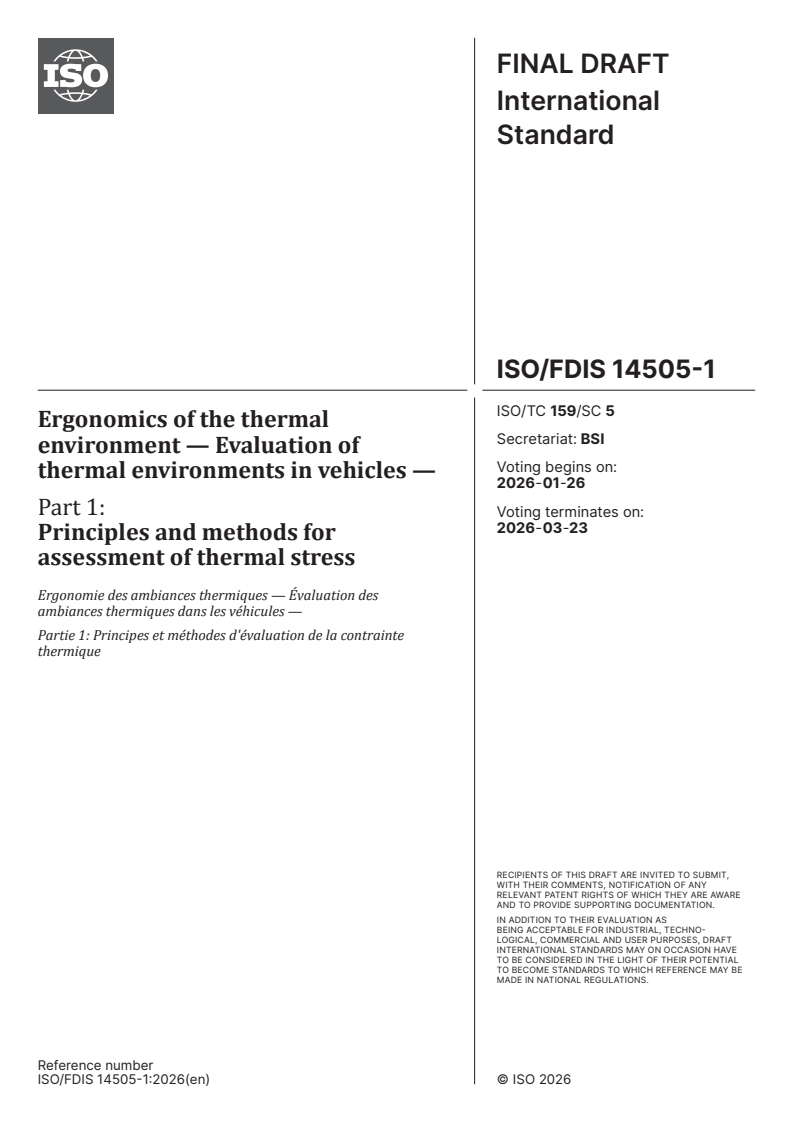

ISO/FDIS 14505-1 - Ergonomics of the thermal environment — Evaluation of thermal environments in vehicles — Part 1: Principles and methods for assessment of thermal stress Released:12. 01. 2026
REDLINE ISO/FDIS 14505-1 - Ergonomics of the thermal environment — Evaluation of thermal environments in vehicles — Part 1: Principles and methods for assessment of thermal stress Released:12. 01. 2026
Get Certified
Connect with accredited certification bodies for this standard

TÜV Rheinland
TÜV Rheinland is a leading international provider of technical services.

TÜV SÜD
TÜV SÜD is a trusted partner of choice for safety, security and sustainability solutions.

BSI Group
BSI (British Standards Institution) is the business standards company that helps organizations make excellence a habit.
Sponsored listings
Frequently Asked Questions
ISO 14505-1 is a draft published by the International Organization for Standardization (ISO). Its full title is "Ergonomics of the thermal environment — Evaluation of thermal environments in vehicles — Part 1: Principles and methods for assessment of thermal stress". This standard covers: ISO 14505-1:2007 gives guidelines for the assessment of thermal stress inside vehicles used for land, sea and air operation. It offers information about the assessment of hot, cold as well as moderate thermal environments by referring to different methods, as specified in International Standards, and specifying the constraints and necessary adjustments needed for the special case of vehicle climate assessment.
ISO 14505-1:2007 gives guidelines for the assessment of thermal stress inside vehicles used for land, sea and air operation. It offers information about the assessment of hot, cold as well as moderate thermal environments by referring to different methods, as specified in International Standards, and specifying the constraints and necessary adjustments needed for the special case of vehicle climate assessment.
ISO 14505-1 is classified under the following ICS (International Classification for Standards) categories: 13.180 - Ergonomics; 43.020 - Road vehicles in general. The ICS classification helps identify the subject area and facilitates finding related standards.
ISO 14505-1 has the following relationships with other standards: It is inter standard links to ISO/TS 14505-1:2007. Understanding these relationships helps ensure you are using the most current and applicable version of the standard.
ISO 14505-1 is available in PDF format for immediate download after purchase. The document can be added to your cart and obtained through the secure checkout process. Digital delivery ensures instant access to the complete standard document.
Standards Content (Sample)
FINAL DRAFT
International
Standard
ISO/FDIS 14505-1
ISO/TC 159/SC 5
Ergonomics of the thermal
Secretariat: BSI
environment — Evaluation of
Voting begins on:
thermal environments in vehicles —
2026-01-26
Part 1:
Voting terminates on:
2026-03-23
Principles and methods for
assessment of thermal stress
Ergonomie des ambiances thermiques — Évaluation des
ambiances thermiques dans les véhicules —
Partie 1: Principes et méthodes d'évaluation de la contrainte
thermique
RECIPIENTS OF THIS DRAFT ARE INVITED TO SUBMIT,
WITH THEIR COMMENTS, NOTIFICATION OF ANY
RELEVANT PATENT RIGHTS OF WHICH THEY ARE AWARE
AND TO PROVIDE SUPPOR TING DOCUMENTATION.
IN ADDITION TO THEIR EVALUATION AS
BEING ACCEPTABLE FOR INDUSTRIAL, TECHNO-
LOGICAL, COMMERCIAL AND USER PURPOSES, DRAFT
INTERNATIONAL STANDARDS MAY ON OCCASION HAVE
TO BE CONSIDERED IN THE LIGHT OF THEIR POTENTIAL
TO BECOME STAN DARDS TO WHICH REFERENCE MAY BE
MADE IN NATIONAL REGULATIONS.
Reference number
ISO/FDIS 14505-1:2026(en) © ISO 2026
FINAL DRAFT
ISO/FDIS 14505-1:2026(en)
International
Standard
ISO/FDIS 14505-1
ISO/TC 159/SC 5
Ergonomics of the thermal
Secretariat: BSI
environment — Evaluation of
Voting begins on:
thermal environments in vehicles —
Part 1:
Voting terminates on:
Principles and methods for
assessment of thermal stress
Ergonomie des ambiances thermiques — Évaluation des
ambiances thermiques dans les véhicules —
Partie 1: Principes et méthodes d'évaluation de la contrainte
thermique
RECIPIENTS OF THIS DRAFT ARE INVITED TO SUBMIT,
WITH THEIR COMMENTS, NOTIFICATION OF ANY
RELEVANT PATENT RIGHTS OF WHICH THEY ARE AWARE
AND TO PROVIDE SUPPOR TING DOCUMENTATION.
© ISO 2026
IN ADDITION TO THEIR EVALUATION AS
All rights reserved. Unless otherwise specified, or required in the context of its implementation, no part of this publication may
BEING ACCEPTABLE FOR INDUSTRIAL, TECHNO-
LOGICAL, COMMERCIAL AND USER PURPOSES, DRAFT
be reproduced or utilized otherwise in any form or by any means, electronic or mechanical, including photocopying, or posting on
INTERNATIONAL STANDARDS MAY ON OCCASION HAVE
the internet or an intranet, without prior written permission. Permission can be requested from either ISO at the address below
TO BE CONSIDERED IN THE LIGHT OF THEIR POTENTIAL
or ISO’s member body in the country of the requester.
TO BECOME STAN DARDS TO WHICH REFERENCE MAY BE
MADE IN NATIONAL REGULATIONS.
ISO copyright office
CP 401 • Ch. de Blandonnet 8
CH-1214 Vernier, Geneva
Phone: +41 22 749 01 11
Email: copyright@iso.org
Website: www.iso.org
Published in Switzerland Reference number
ISO/FDIS 14505-1:2026(en) © ISO 2026
ii
ISO/FDIS 14505-1:2026(en)
Contents Page
Foreword .iv
Introduction .v
1 Scope . 1
2 Normative references . 1
3 Terms and definitions . 1
4 Assessment principles . 2
5 Methods for measurement of in-vehicle climate . 3
5.1 General .3
5.2 Thermal comfort .3
5.2.1 General .3
5.2.2 Whole body evaluation .3
5.2.3 Detailed evaluation using equivalent temperature .4
5.3 Heat stress .4
5.3.1 General .4
5.3.2 Solar radiation .4
5.3.3 Air velocity . . .5
5.3.4 Evaporative heat exchange .5
5.4 Cold stress .5
5.5 Metabolic rate and clothing .5
6 Assessment by means of a numerical manikin . 5
7 Assessment by means of participants . 5
Annex A (informative) Measurement or estimation of metabolism and clothing characteristics . 6
Annex B (informative) Examples of thermal stress assessment . 7
Bibliography . 9
iii
ISO/FDIS 14505-1:2026(en)
Foreword
ISO (the International Organization for Standardization) is a worldwide federation of national standards
bodies (ISO member bodies). The work of preparing International Standards is normally carried out through
ISO technical committees. Each member body interested in a subject for which a technical committee
has been established has the right to be represented on that committee. International organizations,
governmental and non-governmental, in liaison with ISO, also take part in the work. ISO collaborates closely
with the International Electrotechnical Commission (IEC) on all matters of electrotechnical standardization.
The procedures used to develop this document and those intended for its further maintenance are described
in the ISO/IEC Directives, Part 1. In particular, the different approval criteria needed for the different types
of ISO document should be noted. This document was drafted in accordance with the editorial rules of the
ISO/IEC Directives, Part 2 (see www.iso.org/directives).
ISO draws attention to the possibility that the implementation of this document may involve the use of (a)
patent(s). ISO takes no position concerning the evidence, validity or applicability of any claimed patent
rights in respect thereof. As of the date of publication of this document, ISO had not received notice of (a)
patent(s) which may be required to implement this document. However, implementers are cautioned that
this may not represent the latest information, which may be obtained from the patent database available at
www.iso.org/patents. ISO shall not be held responsible for identifying any or all such patent rights.
Any trade name used in this document is information given for the convenience of users and does not
constitute an endorsement.
For an explanation of the voluntary nature of standards, the meaning of ISO specific terms and expressions
related to conformity assessment, as well as information about ISO's adherence to the World Trade
Organization (WTO) principles in the Technical Barriers to Trade (TBT), see www.iso.org/iso/foreword.html.
This document was prepared by Technical Committee ISO/TC 159, Ergonomics, Subcommittee SC 5,
Ergonomics of the physical environment.
This first edition of ISO 14505-1 cancels and replaces ISO/TS 14505-1:2007.
The main change is as follows:
— inclusion of information from ISO 14505-4:2021.
A list of all parts in the ISO 14505 series can be found on the ISO website.
Any feedback or questions on this document should be directed to the user’s national standards body. A
complete listing of these bodies can be found at www.iso.org/members.html.
iv
ISO/FDIS 14505-1:2026(en)
Introduction
The interaction of convective, radiative and conductive heat exchange in a vehicle compartment is very
complex. External thermal loads in combination with the internal heating and ventilation system of the
vehicle create a local climate that can vary considerably in space and time. Asymmetric thermal conditions
arise and these are often the main cause of complaints of thermal discomfort. In vehicles without or with poor
heating, ventilating and air-conditioning system (HVAC-system), thermal stress is determined largely by the
impact of the ambient climatic conditions on the vehicle compartment. Subjective evaluation is integrative,
as the individual combines into one reaction the combined effect of several thermal stimuli. However, it is not
sufficiently detailed or accurate for repeated use. Technical measurements provide detailed and accurate
information, but must be integrated in order to predict the thermal effects on humans. Since several climatic
factors play a role for the final heat exchange of a person, these factors must be integrated to a measure,
representing their relative importance.
v
FINAL DRAFT International Standard ISO/FDIS 14505-1:2026(en)
Ergonomics of the thermal environment — Evaluation of
thermal environments in vehicles —
Part 1:
Principles and methods for assessment of thermal stress
1 Scope
This document gives guidelines for the assessment of thermal stress inside vehicles used for land, sea and air
operation. It offers information about the assessment of hot, cold as well as moderate thermal environments
by referring to different methods and specifying the constraints and necessary adjustments for the special
case of vehicle climate assessment.
2 Normative references
The following documents are referred to in the text in such a way that some or all of their content constitutes
requirements of this document. For dated references, only the edition cited applies. For undated references,
the latest edition of the referenced document (including any amendments) applies.
ISO 13731, Ergonomics of the thermal environment — Vocabulary and symbols
3 Terms and definitions
For the purposes of this document, the terms and definitions given in ISO 13731 and the following apply.
ISO and IEC maintain terminology databases for use in standardization at the following addresses:
— ISO Online browsing platform: available at https:// www .iso .org/ obp
— IEC Electropedia: available at https:// www .electropedia .org/
3.1
cold stress
climatic conditions under which body heat loss is just equal to, or too large for, heat balance at the expense of
significant and sometimes uncompensated physiological strain
3.2
equivalent temperature
temperature of a standard homogenous space in which a person exchanges the same heat loss by convection
and radiation as in the actual conditions under assessment
Note 1 to entry: The standard homogenous space is defined as an environment in which the mean radiant temperature
is equal to the air temperature and there is zero air velocity.
3.3
heat stress
climatic conditions under which the body heat loss is just equal to, or too small for, heat balance at the
expense of significant and sometimes uncompensated physiological strain (heat storage)
ISO/FDIS 14505-1:2026(en)
3.4
local equivalent temperature
temperature of a homogenous “room”, with mean radiant temperature equal to air temperature and zero air
velocity, in which a defined zone of the human body surface exchanges the same heat loss by convection and
radiation as in the actual conditions under assessment
3.5
numerical manikin
virtual thermal manikin recreating a thermal manikin, or a digital model of a thermal manikin used to
calculate performance
3.6
thermoneutral zone
temperature interval within which the body maintains heat balance exclusively by vasomotor reactions
3.7
vehicle
confined, normally fully enclosed, space of a mobile or stationary unit intended for transportation of or
operation by humans
3.8
heating, ventilating and air-conditioning system
HVAC-system
devices that control the temperature, humidity, and purity of the air in an enclosed space
4 Assessment principles
The thermal environment in a vehicle changes as a function of the external climatic conditions and the quality
and capacity of the HVAC-system of the cabin. Most vehicles are able to supply heating or cooling of the cabin
under adverse external climatic conditions, thus reducing the extreme levels of climatic stress. However, in
simple vehicles and during break-down of the HVAC-system, the operator can possibly be subjected to high
levels of thermal stress.
The assessment of the thermal conditions in vehicles is based on three types of effect on the operator,
illustrated in Figure 1:
a) heat stress (hot climate);
b) thermal discomfort (moderate climate);
c) cold stress (cold climate).
For all three types, an analysis of the actual conditions is made using methods described in existing
International standards or similar documents (see Figure 1). The evaluation focuses on the stress on the
exposed individual (stress test).
The metho
...
ISO/DISFDIS 14505-1:2025(en)
ISO /TC 159/SC 5
Secretariat: BSI
Date: 2025-06-252026-01-12
Ergonomics of the thermal environment — Evaluation of thermal
environments in vehicles —
Part 1:
Principles and methods for assessment of thermal stress
Ergonomie des ambiances thermiques — Évaluation des ambiances thermiques dans les véhicules —
Partie 1: Principes et méthodes d'évaluation de la contrainte thermique
FDIS stage
ISO/FDIS 14505-1:2026(en)
All rights reserved. Unless otherwise specified, or required in the context of its implementation, no part of this publication
may be reproduced or utilized otherwise in any form or by any means, electronic or mechanical, including photocopying,
or posting on the internet or an intranet, without prior written permission. Permission can be requested from either ISO
at the address below or ISO’s member body in the country of the requester.
ISO copyright office
CP 401 • Ch. de Blandonnet 8
CH-1214 Vernier, Geneva
Phone: + 41 22 749 01 11
EmailE-mail: copyright@iso.org
Website: www.iso.org
Published in Switzerland
ii
ISO/DISFDIS 14505-1:20252026(en)
Contents
Foreword . iv
Introduction . v
1 Scope . 1
2 Normative references . 1
3 Terms and definitions . 1
4 Assessment principles . 2
5 Methods for measurement of in-vehicle climate . 4
5.1 General . 4
5.2 Thermal comfort . 4
5.3 Heat stress . 5
5.4 Cold stress. 5
5.5 Metabolic rate and clothing. 6
6 Assessment by means of a numerical manikin . 6
7 Assessment by means of participants . 6
Annex A (informative) Measurement or estimation of metabolism and clothing characteristics . 7
Annex B (informative) Examples of thermal stress assessment . 8
Bibliography . 10
iii
ISO/FDIS 14505-1:2026(en)
Foreword
ISO (the International Organization for Standardization) is a worldwide federation of national standards
bodies (ISO member bodies). The work of preparing International Standards is normally carried out through
ISO technical committees. Each member body interested in a subject for which a technical committee has been
established has the right to be represented on that committee. International organizations, governmental and
non-governmental, in liaison with ISO, also take part in the work. ISO collaborates closely with the
International Electrotechnical Commission (IEC) on all matters of electrotechnical standardization.
The procedures used to develop this document and those intended for its further maintenance are described
in the ISO/IEC Directives, Part 1. In particular, the different approval criteria needed for the different types of
ISO document should be noted. This document was drafted in accordance with the editorial rules of the
ISO/IEC Directives, Part 2 (see www.iso.org/directives).
ISO draws attention to the possibility that the implementation of this document may involve the use of (a)
patent(s). ISO takes no position concerning the evidence, validity or applicability of any claimed patent rights
in respect thereof. As of the date of publication of this document, ISO had not received notice of (a) patent(s)
which may be required to implement this document. However, implementers are cautioned that this may not
represent the latest information, which may be obtained from the patent database available at
www.iso.org/patents. ISO shall not be held responsible for identifying any or all such patent rights.
Any trade name used in this document is information given for the convenience of users and does not
constitute an endorsement.
For an explanation of the voluntary nature of standards, the meaning of ISO specific terms and expressions
related to conformity assessment, as well as information about ISO's adherence to the World Trade
Organization (WTO) principles in the Technical Barriers to Trade (TBT), see www.iso.org/iso/foreword.html.
This document was prepared by Technical Committee ISO/TC 159, Ergonomics, Subcommittee SC 5,
Ergonomics of the physical environment.
This first edition of ISO 14505-1 cancels and replaces ISO/TS 14505-1:2007.
The main change is as follows:
— inclusion of information from ISO 14505-4:2021.
A list of all parts in the ISO 14505 series can be found on the ISO website.
Any feedback or questions on this document should be directed to the user’s national standards body. A
complete listing of these bodies can be found at www.iso.org/members.html.
iv
ISO/DISFDIS 14505-1:20252026(en)
Introduction
The interaction of convective, radiative and conductive heat exchange in a vehicle compartment is very
complex. External thermal loads in combination with the internal heating and ventilation system of the vehicle
create a local climate that can vary considerably in space and time. Asymmetric thermal conditions arise and
these are often the main cause of complaints of thermal discomfort. In vehicles without or with poor heating,
ventilating and air-conditioning system (HVAC-system), thermal stress is determined largely by the impact of
the ambient climatic conditions on the vehicle compartment. Subjective evaluation is integrative, as the
individual combines into one reaction the combined effect of several thermal stimuli. However, it is not
sufficiently detailed or accurate for repeated use. Technical measurements provide detailed and accurate
information, but must be integrated in order to predict the thermal effects on humans. Since several climatic
factors play a role for the final heat exchange of a person, these factors must be integrated to a measure,
representing their relative importance.
v
DRAFT International Standard ISO/DIS 14505-1:2025(en)
Ergonomics of the thermal environment — Evaluation of thermal
environments in vehicles — —
Part 1:
Principles and methods for assessment of thermal stress
1 Scope
This document gives guidelines for the assessment of thermal stress inside vehicles used for land, sea and air
operation. It offers information about the assessment of hot, cold as well as moderate thermal environments
by referring to different methods and specifying the constraints and necessary adjustments for the special
case of vehicle climate assessment.
2 Normative references
The following documents are referred to in the text in such a way that some or all of their content constitutes
requirements of this document. For dated references, only the edition cited applies. For undated references,
the latest edition of the referenced document (including any amendments) applies.
ISO 13731, Ergonomics of the thermal environment — Vocabulary and symbols
3 Terms and definitions
For the purposes of this document, the terms and definitions given in ISO 13731 and the following apply.
ISO and IEC maintain terminology databases for use in standardization at the following addresses:
— — ISO Online browsing platform: available at https://www.iso.org/obp
— — IEC Electropedia: available at https://www.electropedia.org/
3.1 3.1
cold stress
climatic conditions under which body heat loss is just equal to, or too large for, heat balance at the expense of
significant and sometimes uncompensated physiological strain
3.2 3.2
equivalent temperature
temperature of a standard homogenous space* in which a person exchanges the same heat loss by convection
and radiation as in the actual conditions under assessment
*Note 1 to entry: The standard homogenous space is defined as an environment in which the mean radiant temperature
is equal to the air temperature and there is zero air velocity.
3.3 3.3
heat stress
climatic conditions under which the body heat loss is just equal to, or too small for, heat balance at the expense
of significant and sometimes uncompensated physiological strain (heat storage)
ISO/FDIS 14505-1:2026(en)
3.4 3.4
local equivalent temperature
temperature of a homogenous “room”, with mean radiant temperature equal to air temperature and zero air
velocity, in which a defined zone of the human body surface exchanges the same heat loss by convection and
radiation as in the actual conditions under assessment
3.5 3.5
numerical manikin
virtual thermal manikin recreating a thermal manikin, or a digital model of a thermal manikin used to calculate
performance
3.6 3.6
thermoneutral zone
temperature interval within which the body maintains heat balance exclusively by vasomotor reactions
3.7 3.7
vehicle
confined, normally fully enclosed, space of a mobile or stationary unit intended for transportation of or
operation by humans
3.8 3.8
heating, ventilating and air-conditioning system
HVAC-system
devices that control the temperature, humidity, and purity of the air in an enclosed space
4 Assessment principles
The thermal environment in a vehicle changes as a function of the external climatic conditions and the quality
and capacity of the HVAC-system of the cabin. Most vehicles are able to supply heating or cooling of the cabin
under adverse external climatic conditions, thus reducing the extreme levels of climatic stress. However, in
simple vehicles and during break-down of the HVAC-system, the operator can possibly be subjected to high
levels of thermal stress.
The assessment of the thermal conditions in vehicles is based on three types of effect on the operator,
illustrated in Figure 1Figure 1::
a) a) heat stress (hot climate);
b) b) thermal discomfort (moderate climate);
c) c) cold stress (cold climate).
For all three types, an analysis of the actual conditions is made using methods described in existing
International standards or similar documents (see Figure 1Figure 1).). The evaluation focuses on the stress on
the exposed individual (stress test).
The methods do not provide information on the performance of the vehicle HVAC-system, as the external
conditions are not standardized, but are subject to evaluation in combination with the system. Performance
tests require standardized environmental conditions and focus on the evaluation of the performance of the
HVAC-system under standardized conditions (see example in Annex BAnnex B).). Recommendations for this
kind of test are given in ISO 14505-2.
If no test facilities are available, or if the prototype vehicles are incomplete, the performance evaluation can
be carried out by numerical simulation using a numerical manikin. Recommendations for this type of
simulation are given in ISO 14505-4. When the prototype vehicles are complete, the assessment can be carried
ISO/DISFDIS 14505-1:20252026(en)
out by measurement. Recommendations for the measurement and assessment are given in ISO 14505-2 and
other related standards (see Clause 5Clause 5).). Finally, the subjective assessment of the thermal conditions,
both as a result of thermal stress or as part of performance tests, can be carried out on the basis of ISO 14505-
3. For people with special requirements, assessment can be made by using ISO 28803.
Figure 1 — Schematic illustration of principles for climate evaluation
ISO/FDIS 14505-1:2026(en)
5 Methods for measurement of in-vehicle climate
5.1 General
This clause provides information on suggested methods for use in various types of thermal stress in vehicles
under driving conditions. Additional information for the actual assessment is given in Annex AAnnex A and
examples are given in Annex BAnnex B.
5.2 Thermal comfort
5.2.1 General
The achievement of thermally comfortable conditions in a vehicle cabin is the aim of the HVAC-system. Most
systems are able to create more or less comfortable climates after an in
...
Questions, Comments and Discussion
Ask us and Technical Secretary will try to provide an answer. You can facilitate discussion about the standard in here.
Loading comments...