


ISO 12402-7:2020
(Main)Personal flotation devices — Part 7: Materials and components — Safety requirements and test methods
Personal flotation devices — Part 7: Materials and components — Safety requirements and test methods
This document specifies the minimum requirements for the construction and performance of materials and components of personal flotation devices, as well as the relevant test methods.
Équipements individuels de flottabilité — Partie 7: Matériaux et composants — Exigences de sécurité et méthodes d'essai
Le présent document spécifie les exigences minimales de construction et de performances des matériaux et composants des équipements individuels de flottabilité, ainsi que les méthodes d'essai correspondantes.
General Information
Relations
Standards Content (Sample)
DRAFT INTERNATIONAL STANDARD
ISO/DIS 12402-7
ISO/TC 188/SC 1 Secretariat: DIN
Voting begins on: Voting terminates on:
2015-06-11 2015-09-11
Personal flotation devices —
Part 7:
Materials and components — Safety requirements and test
methods
Équipements individuels de flottabilité —
Partie 7: Matériaux et composants — Exigences de sécurité et méthodes d’essai
ICS: 13.340.70
ISO/CEN PARALLEL PROCESSING
This draft has been developed within the International Organization for
Standardization (ISO), and processed under the ISO lead mode of collaboration
as defined in the Vienna Agreement.
This draft is hereby submitted to the ISO member bodies and to the CEN member
bodies for a parallel five month enquiry.
Should this draft be accepted, a final draft, established on the basis of comments
received, will be submitted to a parallel two-month approval vote in ISO and
THIS DOCUMENT IS A DRAFT CIRCULATED
formal vote in CEN.
FOR COMMENT AND APPROVAL. IT IS
THEREFORE SUBJECT TO CHANGE AND MAY
NOT BE REFERRED TO AS AN INTERNATIONAL
STANDARD UNTIL PUBLISHED AS SUCH.
To expedite distribution, this document is circulated as received from the
IN ADDITION TO THEIR EVALUATION AS
committee secretariat. ISO Central Secretariat work of editing and text
BEING ACCEPTABLE FOR INDUSTRIAL,
composition will be undertaken at publication stage.
TECHNOLOGICAL, COMMERCIAL AND
USER PURPOSES, DRAFT INTERNATIONAL
STANDARDS MAY ON OCCASION HAVE TO
BE CONSIDERED IN THE LIGHT OF THEIR
POTENTIAL TO BECOME STANDARDS TO
WHICH REFERENCE MAY BE MADE IN
Reference number
NATIONAL REGULATIONS.
ISO/DIS 12402-7:2015(E)
RECIPIENTS OF THIS DRAFT ARE INVITED
TO SUBMIT, WITH THEIR COMMENTS,
NOTIFICATION OF ANY RELEVANT PATENT
RIGHTS OF WHICH THEY ARE AWARE AND TO
©
PROVIDE SUPPORTING DOCUMENTATION. ISO 2015
ISO/DIS 12402-7:2015(E)
© ISO 2015
All rights reserved. Unless otherwise specified, no part of this publication may be reproduced or utilized otherwise in any form
or by any means, electronic or mechanical, including photocopying, or posting on the internet or an intranet, without prior
written permission. Permission can be requested from either ISO at the address below or ISO’s member body in the country of
the requester.
ISO copyright office
Case postale 56 • CH-1211 Geneva 20
Tel. + 41 22 749 01 11
Fax + 41 22 749 09 47
E-mail copyright@iso.org
Web www.iso.org
Published in Switzerland
ii © ISO 2015 – All rights reserved
ISO/DIS 12402-7
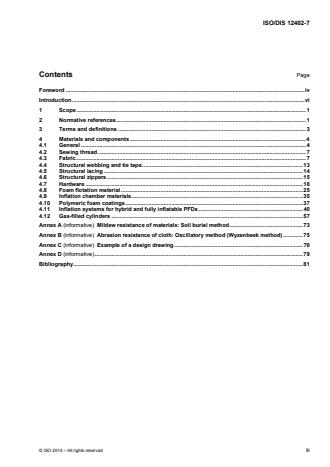
Contents Page
Foreword . iv
Introduction . vi
1 Scope . 1
2 Normative references . 1
3 Terms and definitions . 3
4 Materials and components . 4
4.1 General . 4
4.2 Sewing thread . 7
4.3 Fabric . 7
4.4 Structural webbing and tie tape . 13
4.5 Structural lacing . 14
4.6 Structural zippers . 15
4.7 Hardware . 18
4.8 Foam flotation material . 25
4.9 Inflation chamber materials . 35
4.10 Polymeric foam coatings . 37
4.11 Inflation systems for hybrid and fully inflatable PFDs . 40
4.12 Gas-filled cylinders . 57
Annex A (informative) Mildew resistance of materials: Soil burial method . 73
Annex B (informative) Abrasion resistance of cloth: Oscillatory method (Wyzenbeek method) . 75
Annex C (informative) Example of a design drawing . 78
Annex D (informative) . 79
Bibliography . 81
ISO/DIS 12402-7
Foreword
ISO (the International Organization for Standardization) is a worldwide federation of national standards bodies
(ISO member bodies). The work of preparing International Standards is normally carried out through ISO
technical committees. Each member body interested in a subject for which a technical committee has been
established has the right to be represented on that committee. International organizations, governmental and
non-governmental, in liaison with ISO, also take part in the work. ISO collaborates closely with the
International Electrotechnical Commission (IEC) on all matters of electrotechnical standardization.
International Standards are drafted in accordance with the rules given in the ISO/IEC Directives, Part 2.
The main task of technical committees is to prepare International Standards. Draft International Standards
adopted by the technical committees are circulated to the member bodies for voting. Publication as an
International Standard requires approval by at least 75 % of the member bodies casting a vote.
Attention is drawn to the possibility that some of the elements of this document may be the subject of patent
rights. ISO shall not be held responsible for identifying any or all such patent rights.
ISO 12402-7 was prepared by Technical Committee ISO/TC 188, Small craft, Subcommittee SC 1, Personal
safety Equipment.
This second edition cancels and replaces the first edition (ISO 12402-7:2006, ISO 12402-7:2006/A.1:2010), of
which have been technically revised. The main changes with respect to the previous edition are listed below:
a) Temperature of temperature cycling (4.1.6.3) was changed from (65 ± 2)°C into (60 ± 2)°C ;
b) Compliance criteria in Table 1 Sewing thread were changed;
c) Requirements for fabrics performance were changed (see 4.3.2 and Table 2);
d) New chromaticity coordinates x and y and luminance factor β for yellow, orange and red non-fluorescent
colours of lifejacket material were added (see Table 3);
e) New chromaticity coordinates x and y and luminance factor β for yellow, yellow-orange, orange and
orange-red fluorescent colours of lifejacket material were added (see Table 4);
f) Compliance criteria of structural webbing (see Table 5) were modified;
g) Compliance criteria of structural tie tape (see Table 6) were modified;
h) New subclause "General" to structural lacing was added (see 4.5.1);
i) Immersion of zippers, automatic and manual inflation systems in IRM 902 oil was deleted and ambient
temperature replaced by (20 ± 2)°C (see Tables 8, 17 and 18);
j) Compliance criteria of webbing closures and adjusters were modified (see Table 9);
k) Compliance criteria of lacing closures and adjusters were modified (see Table 10);
l) Number of samples reduced for density test on foam flotation material deleted (see Table 12);
m) Dimensional test for foam flotation material deleted;
n) Test method for the compressibility of inherently buoyant material was modified (see 4.8.2.4);
iv © ISO 2015 – All rights reserved
ISO/DIS 12402-7
o) Compliance criteria of inflation chamber materials were modified (see Table 15).
ISO 12402 consists of the following parts, under the general title Personal flotation devices:
⎯ Part 2: Lifejackets, performance level 275 - Safety requirements;
⎯ Part 3: Lifejackets, performance level 150 - Safety requirements;
⎯ Part 4: Lifejackets, performance level 100 - Safety requirements;
⎯ Part 5: Buoyancy aids (level 50) - Safety requirements;
⎯ Part 6: Special purpose lifejackets and buoyancy aids - Safety requirements and additional test methods;
⎯ Part 7: Materials and components - Safety requirements and test methods;
⎯ Part 8: Safety requirements and test methods;
⎯ Part 9: Test methods;
⎯ Part 10: Selection and application of personal flotation devices and other relevant devices.
ISO/DIS 12402-7
Introduction
ISO 12402 has been prepared to give guidance on the design and application of personal flotation devices
(hereafter referred to as PFDs) for persons engaged in activities, whether in relation to their work or their
leisure, in or near water. PFDs manufactured, selected, and maintained to this standard should give a
reasonable assurance of safety from drowning to a person who is immersed in water.
Requirements for lifejackets on large, commercial seagoing ships are regulated by the International Maritime
Organization (IMO) under the International Convention for the Safety of Life at Sea (SOLAS). ISO 12402
allows for the buoyancy of a PFD to be provided by a wide variety of materials or designs, some of which may
require preparation before entering the water (e.g. inflation of chambers by gas from a cylinder or blown in
orally). However, PFDs can be divided into the following two main classes:
⎯ those which provide face up in-water support to the user regardless of physical conditions (lifejackets),
and
⎯ those which require the user to make swimming and other postural movements to position the user with
the face out of the water (buoyancy aids).
Within these main two classes there are a number of levels of support, types of buoyancy, activation methods
for inflatable devices, and auxiliary items (such as location aids), all of which will affect the user’s probability of
survival. Within the different types of buoyancy allowed, inflatable PFDs either provide full buoyancy without
any user intervention other than arming (i.e. PFDs inflated by a fully automatic method) or require the user to
initiate the inflation. Hybrid PFDs always provide some buoyancy but rely on the same methods as inflatable
PFDs to achieve full buoyancy. With inherently buoyant PFDs, the user only needs to put the PFD on to
achieve the performance of its class.
PFDs that do not require intervention (automatically operating PFDs) are suited to activities where persons
are likely to enter the water unexpectedly; whereas PFDs requiring intervention (e.g. manually inflated PFDs)
are only suitable for use if the user believes there will be sufficient time to produce full buoyancy, or help is
close at hand. In every circumstance, the user should ensure that the operation of the PFD is suited to the
specific application. The conformity of a PFD to this part of ISO 12402 does not imply that it is suitable for all
circumstances. The relative amount of required inspection and maintenance is another factor of paramount
importance in the choice and application of specific PFDs.
ISO 12402 is intended to serve as a guide to manufacturers, purchasers, and users of such safety equipment
in ensuring that the equipment provides an effective standard of performance in use. Equally essential is the
need for the designer to encourage the wearing of the equipment by making it comfortable and attractive for
continuous wear on or near water, rather than for it to be stored in a locker for emergency use. Throwable
devices and flotation cushions are not covered by this part of ISO 12402. The primary function of a PFD is to
support the user in reasonable safety in the water. Within the two classes, alternative attributes make some
PFDs better suited to some circumstances than others or make them easier to use and care for than others.
Important alternatives allowed by ISO 12402 are the following:
⎯ to provide higher levels of support (levels 100, 150, or 275) that generally float the user with greater water
clearance, enabling the user’s efforts to be expended in recovery rather than avoiding waves; or to
provide lighter or less bulky PFDs (levels 50 or 100);
⎯ to provide the kinds of flotation (inherently buoyant foam, hybrid, and inflatable) that will accommodate
the sometimes conflicting needs of reliability and durability, in-water performance, and continuous wear;
⎯ to provide automatically operating (inherently buoyant or automatically inflated) PFDs that float users
without any intervention on their part, except in initially donning the PFD (and regular inspection and
rearming of inflatable types), or to provide user control of the inflatable PFD’s buoyancy by manual and
oral operation; and
vi © ISO 2015 – All rights reserved
ISO/DIS 12402-7
⎯ to assist in detection (location aids) and recovery of the user.
PFDs provide various degrees of buoyancy in garments that are light in weight and only as bulky and
restrictive as needed for their intended use. They will need to be secure when worn, in order to provide
positive support in the water and to allow the user to swim or actively assist herself/himself or others. The PFD
selected shall ensure that the user is supported with the mouth and nose clear of the water under the
expected conditions of use and the user’s ability to assist.
Under certain conditions (such as rough water and waves), the use of watertight and multilayer clothing, which
provide (intentionally or otherwise) additional buoyancy, or the use of equipment with additional weight (such
as tool belts) will likely alter the performance of the PFD. Users, owners and employers need to ensure that
this is taken into account when selecting a PFD. Similarly, PFDs may not perform as well in extremes of
temperature, although fully approved under this part of ISO 12402. PFDs may also be affected by other
conditions of use, such as chemical exposure and welding, and may require additional protection to meet the
specific requirements of use. If the user intends taking a PFD into such conditions, she/he has to be assured
that the PFD will not be adversely affected. This part of ISO 12402 also allows a PFD to be an integral part of
a safety harness designed to conform to ISO 12401, or an integral part of a garment with other uses, for
example to provide thermal protection during immersion, in which case the complete assembly as used is
required to conform to this part of ISO 12402.
In compiling the attributes required of a PFD, consideration has also been given to the potential length of
service that the user might expect. Whilst a PFD needs to be of substantial construction and material, its
potential length of service often depends on the conditions of use and storage, which are the responsibility of
the owner, user and/or employer. Furthermore, whilst the performance tests included are believed to assess
relevant aspects of performance in real-life use, they do not accurately simulate all conditions of use. For
example, the fact that a device passes the self-righting tests in swimming attire, as described herein, does not
guarantee that it will self-right an unconscious user wearing clothing; neither can it be expected to completely
protect the airway of an unconscious person in rough water. Waterproof clothing can trap air and further
impair the self-righting action of a lifejacket.
It is essential that owners, users and employers choose those PFDs that meet the correct standards for the
circumstances in which they will be used. Manufacturers and those selling PFDs have to make clear to
prospective purchasers the product properties, alternative choices and the limitations to normal use, prior to
the purchase.
Similarly, those framing legislation regarding the use of these garments should consider carefully which class
and performance levels are most appropriate for the foreseeable conditions of use, allowing for the higher risk
circumstances. These higher risk circumstances should account for the highest probabilities of occurrence of
accidental immersion and the expected consequences in such emergencies. More information on the
selection and application is given in ISO 12402-10.
DRAFT INTERNATIONAL STANDARD ISO/DIS 12402-7
Personal flotation devices — Part 7: Materials and components
- Safety requirements and test methods
1 Scope
This part of ISO/DIS 12402 specifies the minimum requirements for construction and performance of materials
and components of personal flotation devices as well as relevant test methods.
2 Normative references
The following referenced documents are indispensable for the application of this document. For dated
references, only the edition cited applies. For undated references, the latest edition of the referenced
document (including any amendments) applies.
ISO 105-A02, Textiles — Tests for colour fastness — Part A02: Grey scale for assessing change in colour
ISO 105-E02, Textiles — Tests for colour fastness — Part E02: Colour fastness to sea water
ISO 105-X12, Textiles — Tests for colour fastness — Part X12: Colour fastness to rubbing
ISO 139, Textiles — Standard atmospheres for conditioning and testing
ISO 188:2011, Rubber, vulcanized or thermoplastic — Accelerated ageing and heat resistance tests
ISO 1302, Geometrical Product Specifications (GPS) — Indication of surface texture in technical product
documentation
ISO 1421:1998, Rubber- or plastics-coated fabrics — Determination of tensile strength and elongation at
break
ISO 1926, Rigid cellular plastics — Determination of tensile properties
ISO 2062, Textiles — Yarns from packages — Determination or single-end breaking force and elongation at
break
ISO 2411:2000, Rubber- or plastics-coated fabrics — Determination of coating adhesion
ISO 3696:1987, Water for analytical laboratory use — Specification and test methods
ISO 4674-1:2003, Rubber- or plastics-coated fabrics — Determination of tear resistance — Part 1: Constant
rate of tear methods
ISO 4892-1:1999, Plastics — Methods of exposure to laboratory light sources — Part 1: General guidance
ISO 4892-2:2013, Plastics — Methods of exposure to laboratory light sources — Part 2: Xenon-arc lamps
ISO 5470-2:2003, Rubber- or plastics-coated fabrics — Determination of abrasion resistance —
Part 2: Martindale abrader
ISO 6330, Textiles — Domestic washing and drying procedures for textile testing
ISO 7229:1997, Rubber- or plastics-coated fabrics — Measurement of gas permeability
ISO/DIS 12402-7
ISO 7854:1995, Rubber- or plastics-coated fabrics — Determination of resistance to damage by flexing
ISO 9073-4, Textiles — Test methods for nonwovens — Part 4: Determination of tear resistance
ISO 9227:2012, Corrosion tests in artificial atmospheres — Salt spray tests
ISO/DIS 12402-2:2015, Personal flotation devices — Part 2: Lifejackets, performance level 275 — Safety
requirements
ISO/DIS 12402-3:2015, Personal flotation devices — Part 3: Lifejackets, performance level 150 — Safety
requirements
ISO/DIS 12402-4:2015, Personal flotation devices — Part 4: Lifejackets, performance level 100 — Safety
requirements
ISO/DIS 12402-5:2015, Personal flotation devices — Part 5: Buoyancy aids (level 50) — Safety requirements
ISO/DIS 12402-6:2015, Personal flotation devices — Part 6: Special purpose lifejackets and buoyancy aids —
Safety requirements and additional test methods
ISO 13934-1, Textiles — Tensile properties of fabrics — Part 1: Determination of maximum force and
elongation at maximum force using the strip method
ISO 13934-2, Textiles — Tensile properties of fabrics — Part 2: Determination of maximum force using the
grab method
ISO 13937-2, Textiles — Tear properties of fabrics — Part 2: Determination of tear force of trouser-shaped
test specimens (Single tear method)
ISO 13938-1, Textiles — Bursting properties of fabrics — Part 1: Hydraulic method for determination of
bursting strength and bursting distension
ISO 13938-2, Textiles — Bursting properties of fabrics — Part 2: Pneumatic method for determination of
bursting strength and bursting distension
EN 590, Automotive fuels — Diesel — Requirements and test methods
EN 10088-1, Stainless steels — Part 1: List of stainless steels
CIE publication No. 15.2, Colorimetry
ASTM D 412-98, Standard Test Methods for Vulcanized Rubber and Thermoplastic Elastomers —Tension
ASTM D 471-98, Standard Test Method for Rubber Property-Effect of Liquids
ASTM D 882-02, Standard Test Method for Tensile Properties of Thin Plastic Sheeting
ASTM D 1683, Standard Test Method for Failure in Sewn Seams of Woven Apparel Fabrics
ASTM D 2061, Standard Test Methods for Strength Tests for Zippers
ASTM D 2062, Standard Test Methods for Operability of Zippers
ASTM D 5034-95, Standard Test Method for Breaking Strength and Elongation of Textile Fabrics (Grab Test)
FTMS 191A, Federal Test Method Standard
2 © ISO 2015 – All rights reserved
ISO/DIS 12402-7
3 Terms and definitions
For the purposes of this document, the terms and definitions given in ISO 12402-1 2 to ISO 12402-5 and the
following apply.
3.1
coated fabric
flexible material composed of a textile fabric and an adherent polymeric material
3.2
design inflation range
range of buoyancy and pressure, as specified by the manufacturer, to which a chamber is capable of being
inflated to provide the intended in-water performance
3.3
filling density
mass of the gas charge for gas-filled cylinders or other inflation-medium containers, in kilograms, divided by
the volume of the inflation-medium container, in litres
3.4
foam flotation material
closed-cell (cells not interconnecting) foamed polymeric material
3.5
full inflation
chamber or chambers inflated to any value within the design inflation range
3.6
inflation system
means of inflating one or more chambers to make the PFD buoyant or more buoyant on demand, either
actively or passively with respect to the user’s action
3.7
initial jaw separation
distance between the bottom of the top clamp and the top of the bottom clamp of a tensile test machine prior
to testing
3.8
multi-eyelet guide
polymeric part designed to be sewn into a PFD and having a series of holes to insert lacing for adjustment of
the fit of a PFD
3.9
status indicator
part or parts of an inflation system which provide user feedback to assist in keeping an inflaTable PFD in an
armed and ready condition
EXAMPLES single-point status indicator, multi-point status indicator, cylinder seal indicator
3.10
polymeric foam coating
coating applied to flotation foam in place of a fabric covering to protect and strengthen the finished PFD
3.11
selvage
uncut edge portion of a fabric
ISO/DIS 12402-7
3.12
serviceability
ease with which the inflation system mechanism is properly rearmed
3.13
serviceable
capable of continued use, i.e. exhibits no signs of functional deterioration, broken or deformed hardware, non-
functional indicators, blocked or detached oral inflation tube, or detached manual inflator trigger
3.14
adult PFD
PFD intended for users with a mass greater than (or equal to) 40 kg
3.15
child lifejacket
lifejacket intended for users with a mass greater than (or equal to) 15 kg and less than 40 kg
3.16
child buoyancy aid
buoyancy aid intended for users with a mass greater than (or equal to) 25 kg and less than 40 kg
3.17
structural parts, materials and components
parts, materials, or components that are integral to the device and that are essential for its correct function
and performance
3.18
ride-up prevention system
system that helps to secure the PFD in its functional position on the body and prevent the PFD from riding up
the body towards the head.
4 Materials and components
4.1 General
4.1.1 Principles
All structural materials and components of personal flotation devices shall meet the requirements specified in
this part of ISO/DIS 12402:2015.
The human subject performance tests shall be witnessed by a test panel of at least 2 experts familiar with
testing and the products specified in the relevant parts of ISO/DIS 12402:2015.
The human subject performance tests shall be carried out under the direction of a test house’s test panel that
is experienced in these specific test procedures. These tests shall be observed by at least 2 experienced
observers from the panel and repeated with 3 experienced observers from the panel if there is any question
about the performance observed. An observer is to be qualified by having experience of observing (or
conducting under the supervision of a qualified observer) the specific test on at least 3 occasions.
NOTE 1 It is recommended that the test panel have at least one member of the test house regularly
participating in experience exchanges and round robin tests.
4.1.2 Sampling
Two samples (one from each end of the range) of materials and components common to a range of products
may be presented and the results used to cover the full range of products.
4 © ISO 2015 – All rights reserved
ISO/DIS 12402-7
4.1.3 Pass or fail criteria
All required samples shall pass all objective tests for the component or material to meet the requirements of
this part of ISO/DIS 12402. For any test identified as subjective or which uses human test subjects, because
of the high variability between subjects and the difficulty in assessing some subjective measures, a
component may be accepted on the basis of the following additional testing. If a component does not
completely meet the requirements of a test for a particular measurement or does so but with only one test
subject, another two samples or subjects (within similar physical characteristics, if applicable) shall be
subjected to the same test and before the same test personnel. Such subjective tests shall be witnessed by a
test panel of at least two experts familiar with testing the products specified in the series of
ISO/DIS 12402:2015 and repeated with three experts if there is any question about the performance
observed. If this additional test is still not clearly passed in accordance with this part of ISO/DIS 12402:2015,
then the component or material shall be deemed to have failed. The test panel should deem that the
component or material has passed the test only if it has now fulfilled the test requirements completely.
4.1.4 Units of measurement
Units of measurement shall be in accordance with ISO 31.
4.1.5 Material
4.1.5.1 Non-metallic components and fabrics
Non-metallic components and fabrics shall not be damaged when tested in accordance with the relevant
Tables of this standard.
4.1.5.2 Corrosion of metal components
When tested in accordance with ISO 9227 for a minimum of 160 h, metal components shall not be significantly
affected by corrosion when tested in accordance with the relevant Tables of this standard.
No metallic component shall affect a magnetic compass of a type commonly used in small boats by more than
1° when placed 500 mm from the compass.
4.1.5.3 Innocuousness
The foam flotation material shall not contain CFC or HCFC.
ISO/DIS 12402-7
4.1.6 Sample conditioning
4.1.6.1 General
Materials and components common to a range of products may be presented as one sample of each item.
Prior to testing, materials and components shall be conditioned.
4.1.6.2 Standard conditioning
a) Except for textile products (i.e., fabric, webbing, thread, tie tape), the applicable number of samples
specified in each section shall be conditioned at (23 ± 2) °C and (50 ± 5) % relative humidity for not less
than 24 h prior to the tests.
b) For textile products, the samples shall be conditioned according to ISO 139 for not less than 24 h.
c) If it is spelled out that the sample is to be tested under “wet conditions”, the sample shall be soaked for
+ 0,2
6 h in fresh water, or as specified by the test procedure itself.
4.1.6.3 Temperature cycling
Where required by the test method, the component or sample of fabric shall be conditioned, in its normal
storage state, and then immediately exposed for (24 ± 0,5) h at a temperature of (−30 ± 2) °C, then for
(24 ± 0,5) h at a temperature of (60 ± 2) °C. Any damage shall be assessed by visual examination and be
reported. The component or sample shall undergo ten cycles.
4.1.6.4 Accelerated weathering
Laboratory exposure of components and fabrics for PFDs to conditions representative of elements found in a
severe outdoor environment including light and water shall be conducted by exposing samples in a xenon
weathering machine in accordance with ISO 4892-1 and ISO 4892-2 as further defined by the following
specifications.
⎯ Exposure: 500 kJ/(m × nm) at 340 nm of UV radiation.
⎯ Sample mounting: mount samples with the face side (the side normally exposed to sunlight in service)
toward the light so that the centre of each sample is in the same plane as the perpendicular to the
centreline of the light source.
⎯ Irradiance: 0,55 W/m at 340 nm.
⎯ Filters: daylight filters.
⎯ Black panel temperature: (63 ± 2) °C.
⎯ Dry bulb temperature: (42 ± 2) °C.
⎯ Relative humidity: 50 % (during light-only cycle).
⎯ Water temperature: (20 ± 5) °C.
⎯ Test cycles: 102 min of light/18 min of light and continuous water spray/24 min dark and water spray.
NOTE This test is not applicable to fabrics related to PFDs complying with ISO/DIS 12402-5:2015.
6 © ISO 2015 – All rights reserved
ISO/DIS 12402-7
4.2 Sewing thread
4.2.1 Construction
Sewing thread shall not contain natural fibres or be monofilament.
4.2.2 Performance
Sewing thread shall comply with the requirements specified in Table 1 where they contribute to the structural
strength of the PFD.
4.2.3 Loop breaking strength
For the loop breaking strength test, the test machine described in ISO 2062 shall be used. Secure both ends
of one piece in one clamp of the testing machine so that the length of the loop equals half the total length
between the jaws. Pass one end of the second piece through the loop formed by the first, and secure both
ends of the second piece in the other clamp of the machine. Separate the clamps at a rate of
(300 ± 10) mm/min.
Table 1 — Sewing thread
Sample
Test Number of
a
Property Exposure Compliance criteria
size
method samples
mm
Single 1 Standard conditioning ISO 2062 5 for each For exposure 1, the average
1 000 ± 10
strand colour for breaking strength of five
2 Accelerated weathering
breaking each samples shall be at least 25 N.
according to 4.1.6.4
exposure
For exposure 2, the average
breaking strength of five
samples shall be at least 15 N.
Loop Standard See 4.2.3 5 (each 500 min. Average breaking strength of
a
breaking consisting five samples shall be at least
conditioning
strength of two 44 N.
pieces)
a
Where various colours are tested then as minimum the brightest and the darkest colours and minimum the brightest and the
darkest fluorescent colours shall be tested.
4.3 Fabric
4.3.1 General
Only fabrics which are structural to maintain the performance of the product under test shall be tested.
Decorative and other fabrics shall not be tested.
4.3.2 Performance
4.3.2.1 Fabric used as drainage material shall comply with all of the applicable fabric requirements.
Following weathering according to 4.1.6, the tensile strength shall be measured using the grab method given
in ISO 13934-2.
4.3.2.2 Textile woven fabrics shall have an as received tensile strength as specified in Table 2, measured
using the grab method given in ISO 13934-2.
4.3.2.3 Textile knitted fabrics shall have an as received burst strength as specified in Table 2, measured
using the method given in ISO 13983-1 or ISO 13983-2.
ISO/DIS 12402-7
4.3.2.4 Fabrics used in the construction of covers of buoyant compartments, the ride-up prevention
system, and any other component the failure of which would render the PFD non-conformant with this part of
ISO 12402, shall comply with the requirements of table 2 when tested according to the standards specified in
table 2.
4.3.2.5 Fabric shall comply with the acceptance criteria specified in Table 2 when subjected to the tests
therein. Separate samples shall be used for each different conditioning exposure.
8 © ISO 2015 – All rights reserved
ISO/DIS 12402-7
Table 2 — Fabric
Sample
Test Number of a
Property Exposure size Compliance criteria
method samples
mm
Tensile 1. Standard conditioning ISO 5 warp As specified by Following exposure 1, the
strength 13934-2, and 5 weft test method average of 5 samples shall be
2. Accelerated
(woven except that for each at least 400 N for each
weathering according to
fabrics jaw breaks separate direction.
4.1.6.4
only) may be exposure
Following each separate
3. 70 h
included in
exposure 2 and 3, the
immersion in:
the average
average of 5 samples shall be
3.1 fuel B according to
results.
at least 260 N.
ASTM D 471- 06 or
diesel fuel according to
b
EN 590
3.2 0,5 %
c
detergent according to
ISO 6330
Bursting 1. Standard conditioning ISO 6 for each Following exposure 1, the
130 × 130
strength 13938-1 or separate average of 6 samples shall be
2. Accelerated
(knitted ISO exposure at least 800 kPa.
weathering according to
fabrics 13938-2
4.1.6.4 Following each separate
only)
exposure in 2 and 3, the
3. 70 h
average of 6 samples shall be
immersion in:
at least 480 kPa.
3.1 fuel B according to
ASTM
D 471- 06 or diesel fuel
d
according to EN 590
3.2 0,5 %
c
detergent according to
ISO 6330
Tearing Standard ISO 5 warp Average of 5 samples shall be
50 × 200
strength conditioning 13937-2 5 weft at least 25 N for each
(woven direction.
fabrics
d
only
Yarn Standard See 4.3.2.6 5 warp Average of 5 samples shall be
100 × 150
slippage conditioning 5 weft at least 220 N.
(woven
fabrics
only)
Open- Standard See 4.3.2.7 The openness of weave shall
ness of conditioning not exceed 20 %.
e
weave
Adhesion Standard ISO 2411 2 warp The coating adhesion shall be
50 × 200 or
f
conditioning and at least 7 N/cm.
strength 75 × 200
2 weft
or 5 warp
and
5 weft
ISO/DIS 12402-7
Table 2 — Fabric (continued)
a
Applies to each colour except for fabrics related to PFDs complying with ISO/DIS 12402-5:2015 where a minimum of one colour
shall be tested.
b
Exposure tests to be based on typical fuels used in the intended area of application
c
ECE non phosphate detergent
d
Tear resistance of woven fabrics shall be tested according to ISO 13937-2, [tensile speed (100 ± 10) mm/min, with a pretension of
2 N for materials of up to 200 g/m2, 5 N for materials of over 200 g/m2 and up to 500 g/m2, and 10 N for materials of over
500 g/m2], and shall be not less than 35 N.
e
Applies to external cover fabrics only, does not apply to gusset, lining, or drainage fabric.
f
Applies only to coated fabric with a coating of 185 g/m2 or more and where the base fabric or scrim does not comply with the
applicable strength requirements when fabric is uncoated.
4.3.2.6 Yarn slippage (woven fabrics only)
The warp samples specified in Table 2 shall be cut with the long dimension parallel to the warp yarns and weft
samples shall be cut with the long dimension parallel to the weft yarns. No two warp samples shall contain the
same warp yarns and no two weft samples shall contain the same weft yarns. No sample shall include
selvage.
The narrow end of the sample shall be inserted approximately 5 mm into the nine-hole chuck illustrated in
Figure 1 and centred. A nine-needle bit shall be aligned with the holes in the chuck so that the smooth side of
the needles faces the 5 mm edge of the sample. The needles shall be forced through the fabric past the scarf
joint so that the fabric lays against the blade of the needles.
The tensile machine shall be a constant-rate-of-traverse (CRT) or constant-rate-of-extension (CRE) machine.
The tensile machine shall be equipped with clamps having front jaws 25 mm × 25 mm and back jaws
25 mm × 38 mm or more wide. The nine-hole chuck shall be centred and clamped in the upper jaws of the
machine so the sample hangs lengthwise. The holes in the chuck shall be perpendicular to the direction of
pull. The fabric shall be clamped to the lower jaws of the machine. Separation between the holes in the chuck
and the top of the jaws shall be 65 mm. The yarns shall be parallel to the direction of pull. The jaws shall then
be separated at a rate of (300 ± 10) mm/min.
The maximum force required to cause rupture shall be recorded.
10 © ISO 2015 – All rights reserved
ISO/DIS 12402-7
Dimensions in millimetres
Key
1)
1 Singer® thin ball-point needles (size 18). The needles used have a conventional cylindrical profile (not U-bladed)
and standard scarf. The grooves of the needles all face in the same direction, perpendicular to the plane formed by
the nine needles
2 nine-hole spacer
Figure 1 — Nine-needle apparatus
4.3.2.7 Openness of weave
The openness of weave, see Table 2, shall be determined using a full width sample at least 1 000 mm long.
Five separate measurements shall be taken across the width of the roll. For each measurement, a 650 mm
area shall be marked on the fabric. No measurement shall be within 25 mm of the selvage edge.
In the area of the marked fabric material, the size of each opening shall be measured using an optical
comparator with a magnification of 5 ×. Openings on the edge of a 650 mm area shall be counted as one
whole opening only if more than 50 % of the opening is inside the marked square.
1)
This information is given for the convenience of users of this part of ISO/DIS 12402:2015 and does not constitute an
endorsement by ISO of the product named. Equivalent products may be used if they can be shown to lead to the same
results.
ISO/DIS 12402-7
The openness of the weave shall be calculated according to formula:
100 × S
θ = (1)
n
where
θ is the openness of weave;
S is the total surface area of openings (mm );
n is the number of 650 mm areas.
4.3.3 Colour
4.3.3.1 The colour of the exposed portions (excluding components such as webbing, zips and other
fittings) of a lifejacket when deployed in normal floating position shall be in the colour range from yellow to red;
the chromaticity for non-fluorescent colours shall lie within one of the areas defined in Table 3 and the
luminance factor shall exceed the corresponding minimum in Table 3. The chromaticity coordinates and the
minimum luminance factor for fluorescent colours shall comply with Table 4.
4.3.3.2 The colour of the material samples shall be measured with the procedures defined in CIE
publication No. 15.2 with polychromatic illumination D , 45/0 geometry and 2° standard observer. The
specimen shall have a black underlay with reflectance of less than 0,04. The specimens shall be conditioned
for at least 24 h at (20 ± 2) °C and (65 ± 5) % relative humidity. If the test is carried out in other conditions, the
test shall be conducted within 5 min after withdrawal from the conditioning atmosphere.
NOTE The results from the different test machines may vary ±5 %.
4.3.3.3 The colour fastness (dry and wet) of lifejacket material when determined in accordance with
ISO 105-A02 shall be resistant to rubbing (wet and dry), when tested in accordance with ISO 105-X12 to at
least step 4, and to salt water when tested in accordance with ISO 105-E02 to at least step 4.
Table 3 — Chromaticity coordinates x and y and luminance factor β for yellow, orange and red non-
fluorescent colours of lifejacket material
Luminance
Chromaticity coordinates
factor
Colour
x y β
0,389 0,610
0,320 0,490
Yellow > 0,35
0,405 0,400
0,500 0,500
0,500 0,500
0,405 0,400
Orange > 0,25
0,470 0,330
0,600 0,400
0,600 0,400
0,470 0,330
Red > 0,15
0,525 0,270
0,700 0,300
12 © ISO 2015 – All rights reserved
ISO/DIS 12402-7
Table 4 — Chromaticity coordinates x and y and luminance factor β for yellow, yellow-orange, orange
and orange-red fluorescent colours of lifejacket material
Luminance
Chromaticity coordinates
factor
Colour
x y β
0,380 0,610
0,320 0,490
Fluorescent yellow > 0,60
0,370 0,440
0,440 0,550
0,440 0,550
0,370 0,440
Fluorescent yellow-orange > 0,50
0,420 0,390
0,505 0,490
0,505 0,490
0,420 0,390
Fluorescent orange > 0,40
0,460 0,350
0,575 0,425
0,575 0,425
0,460 0,350
Fluorescent orange–red > 0,30
0,488 0,320
0,630 0,360
0,630 0,360
0,488 0,320
Fluorescent red > 0,20
0,525 0,280
0,695 0,300
4.4 Structural webbing and tie tape
4.4.1 General
Structural webbing and tie tape shall comply with this part of ISO/DIS 12402:2015 when subjected to the tests
described in Table 5 and Table 6.
lf the component has no influence on the in-water performance test or the load test it can be considered to be
a non-structural component.
4.4.2 Torsional stiffness
Three samples shall be used. The samples specified in Table 6 shall be laid flat on a hard surface, straight,
and not under tension. One end of the sample shall be marked as the reference end. Marks are to be placed
on the sample 32 mm and 1 000 mm from the reference end.
The reference end of the sample shall be held in a clamping surface by taking the end of the strip at the
reference end and folding it over until the end is even with the mark drawn 32 mm from the reference end. The
reference end shall then be placed in a fabric clamp in accordance with the test methods for tensile strength
and elongation of textile fabrics (see ISO 13934-1), centred and perpendicular to the clamp bars.
The end opposite the reference end shall be placed in a clamp. The clamping surface area is
12,5 mm × 115 mm and the jaws are not padded. The end of the strip shall be placed in the jaws of the clamp
so that the 1 000 mm mark is even with the outside bottom edge of the larger jaw of the clamp. The distance
between the fabric clamp and the upper jaw shall be 880 mm.
...
INTERNATIONAL ISO
STANDARD 12402-7
Second edition
2020-07
Personal flotation devices —
Part 7:
Materials and components — Safety
requirements and test methods
Équipements individuels de flottabilité —
Partie 7: Matériaux et composants — Exigences de sécurité et
méthodes d'essai
Reference number
©
ISO 2020
© ISO 2020
All rights reserved. Unless otherwise specified, or required in the context of its implementation, no part of this publication may
be reproduced or utilized otherwise in any form or by any means, electronic or mechanical, including photocopying, or posting
on the internet or an intranet, without prior written permission. Permission can be requested from either ISO at the address
below or ISO’s member body in the country of the requester.
ISO copyright office
CP 401 • Ch. de Blandonnet 8
CH-1214 Vernier, Geneva
Phone: +41 22 749 01 11
Email: copyright@iso.org
Website: www.iso.org
Published in Switzerland
ii © ISO 2020 – All rights reserved
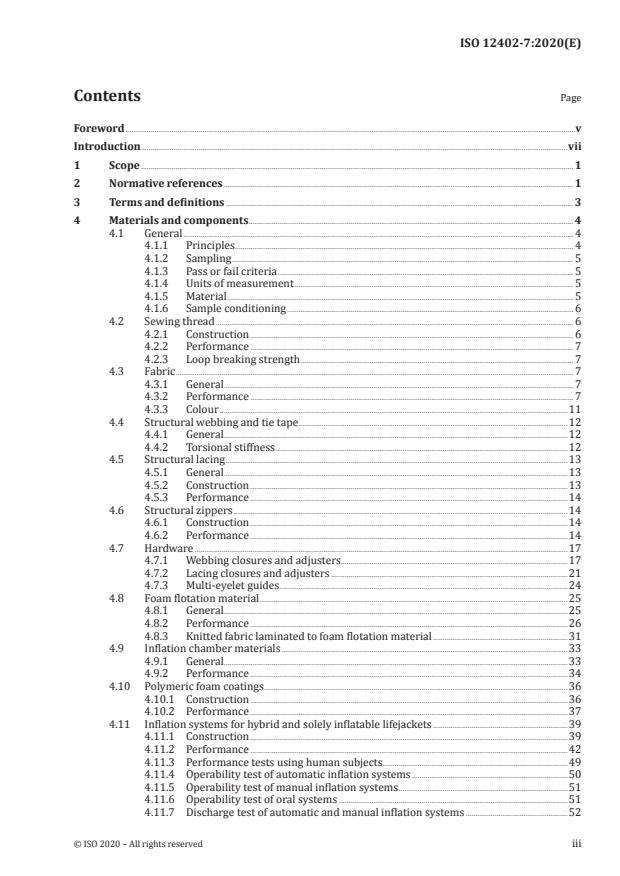
Contents Page
Foreword .v
Introduction .vii
1 Scope . 1
2 Normative references . 1
3 Terms and definitions . 3
4 Materials and components . 4
4.1 General . 4
4.1.1 Principles . 4
4.1.2 Sampling. 5
4.1.3 Pass or fail criteria . 5
4.1.4 Units of measurement . 5
4.1.5 Material . 5
4.1.6 Sample conditioning . 6
4.2 Sewing thread . 6
4.2.1 Construction . 6
4.2.2 Performance . 7
4.2.3 Loop breaking strength . 7
4.3 Fabric . 7
4.3.1 General. 7
4.3.2 Performance . 7
4.3.3 Colour .11
4.4 Structural webbing and tie tape .12
4.4.1 General.12
4.4.2 Torsional stiffness .12
4.5 Structural lacing .13
4.5.1 General.13
4.5.2 Construction .13
4.5.3 Performance .14
4.6 Structural zippers .14
4.6.1 Construction .14
4.6.2 Performance .14
4.7 Hardware .17
4.7.1 Webbing closures and adjusters . .17
4.7.2 Lacing closures and adjusters .21
4.7.3 Multi-eyelet guides . .24
4.8 Foam flotation material .25
4.8.1 General.25
4.8.2 Performance .26
4.8.3 Knitted fabric laminated to foam flotation material .31
4.9 Inflation chamber materials .33
4.9.1 General.33
4.9.2 Performance .34
4.10 Polymeric foam coatings.36
4.10.1 Construction .36
4.10.2 Performance .37
4.11 Inflation systems for hybrid and solely inflatable lifejackets .39
4.11.1 Construction .39
4.11.2 Performance .42
4.11.3 Performance tests using human subjects .49
4.11.4 Operability test of automatic inflation systems .50
4.11.5 Operability test of manual inflation systems .51
4.11.6 Operability test of oral systems .51
4.11.7 Discharge test of automatic and manual inflation systems .52
4.11.8 Humid atmosphere test of automatic inflation systems .53
4.11.9 System durability test of automatic and manual inflation systems .54
4.11.10 Operability test of over-pressure relief valves .54
4.11.11 Pull test of automatic and manual inflation systems, and cylinder-seal-
indicating cylinders .54
4.11.12 Window material .55
4.12 Gas-filled cylinders .56
4.12.1 Construction .56
4.12.2 Tests and acceptance criteria .58
4.12.3 Marking .70
Annex A (informative) Mildew resistance of materials: Soil burial method .71
Annex B (informative) Abrasion resistance of cloth: Oscillatory method (Wyzenbeek method) .73
Annex C (informative) Example of a design drawing .76
Bibliography .77
iv © ISO 2020 – All rights reserved
Foreword
ISO (the International Organization for Standardization) is a worldwide federation of national standards
bodies (ISO member bodies). The work of preparing International Standards is normally carried out
through ISO technical committees. Each member body interested in a subject for which a technical
committee has been established has the right to be represented on that committee. International
organizations, governmental and non-governmental, in liaison with ISO, also take part in the work.
ISO collaborates closely with the International Electrotechnical Commission (IEC) on all matters of
electrotechnical standardization.
The procedures used to develop this document and those intended for its further maintenance are
described in the ISO/IEC Directives, Part 1. In particular the different approval criteria needed for the
different types of ISO documents should be noted. This document was drafted in accordance with the
editorial rules of the ISO/IEC Directives, Part 2 (see www .iso .org/ directives).
Attention is drawn to the possibility that some of the elements of this document may be the subject of
patent rights. ISO shall not be held responsible for identifying any or all such patent rights. Details of
any patent rights identified during the development of the document will be in the Introduction and/or
on the ISO list of patent declarations received (see www .iso .org/ patents).
Any trade name used in this document is information given for the convenience of users and does not
constitute an endorsement.
For an explanation of the voluntary nature of standards, the meaning of ISO specific terms and
expressions related to conformity assessment, as well as information about ISO's adherence to the
World Trade Organization (WTO) principles in the Technical Barriers to Trade (TBT), see www .iso .org/
iso/ foreword .html.
This document was prepared by Technical Committee ISO/TC 188, Small craft, Subcommittee SC 1,
Personal safety equipment.
This second edition cancels and replaces the first edition (ISO 12402-7:2006), which has been technically
revised. It also incorporates the Amendment ISO 12402-7:2006/Amd. 1:2011.
The main changes with respect to the previous edition are as follows:
a) temperature of temperature cycling (4.1.6.3) was changed from (65 ± 2) °C into (60 ± 2) °C;
b) compliance criteria in Table 1, Sewing thread, were changed;
c) requirements for fabrics performance were changed (see 4.3.2 and Table 2);
d) new chromaticity coordinates x and y and luminance factor β for yellow, orange and red non-
fluorescent colours of lifejacket material were added (see Table 3);
e) new chromaticity coordinates x and y and luminance factor β for yellow, yellow-orange, orange and
orange-red fluorescent colours of lifejacket material were added (see Table 4);
f) compliance criteria of structural webbing (see Table 5) were modified;
g) compliance criteria of structural tie tape (see Table 6) were modified;
h) new subclause “General” to structural lacing was added (see 4.5.1);
i) immersion of zippers, automatic and manual inflation systems in IRM 902 oil was deleted and
ambient temperature replaced by (20 ± 2) °C (see Tables 8, 17 and 18);
j) compliance criteria of webbing closures and adjusters were modified (see Table 9);
k) compliance criteria of lacing closures and adjusters were modified (see Table 10);
l) number of samples reduced for density test on foam flotation material (see Table 12);
m) dimensional test for foam flotation material deleted;
n) test method for the compressibility of inherently buoyant material was modified (see 4.8.2.4);
o) compliance criteria of inflation chamber materials were modified (see Table 15).
A list of all parts in the ISO 12402 series can be found on the ISO website.
Any feedback or questions on this document should be directed to the user’s national standards body. A
complete listing of these bodies can be found at www .iso .org/ members .html.
vi © ISO 2020 – All rights reserved
Introduction
ISO 12402 (all parts):2020 deals with personal floatation devices (PFDs) for persons engaged in
activities, whether in relation to their work or their leisure, in or near water. PFDs manufactured,
selected, and maintained to this International Standard give a reasonable assurance of safety from
drowning to a person who is immersed in water. ISO 12402 (all parts):2020 does not include the
following:
— requirements for lifejackets on seagoing ships, which are regulated by the International Maritime
1)
Organization (IMO) under the International Convention for the Safety of Life at Sea (SOLAS);
— throwable devices and flotation cushions.
ISO 12402 (all parts):2020 allows for the buoyancy of a PFD to be provided by a variety of materials or
designs, some of which can require preparation before entering the water (e.g. inflation of chambers by
gas from a cylinder or blown in orally). PFDs can be divided into the following two main classes:
— those which provide face up in-water support to the user regardless of physical conditions
(lifejackets); and
— those which require the user to make swimming and other postural movements to position the user
with the face out of the water (buoyancy aids).
Within these main two classes there are a number of levels of support, types of buoyancy, activation
methods for inflatable devices, and auxiliary items (such as location aids), which all affect the user‘s
probability of survival. Within the different types of buoyancy allowed, inflatable PFDs either provide
full buoyancy without any user intervention other than arming (i.e. PFDs inflated by a fully automatic
method) or require the user to initiate the inflation. Hybrid PFDs always provide some buoyancy but
rely on the same methods as inflatable PFDs to achieve full buoyancy. With inherently buoyant PFDs,
the user only needs to put the PFD on to achieve the performance of its class.
PFDs that do not require intervention (automatically operating PFDs) are suited to activities where
persons are likely to enter the water unexpectedly; whereas PFDs requiring intervention (e.g. manually
inflated PFDs) are only suitable for use if the user believes there will be sufficient time to produce
full buoyancy, if automatic operation would result in entrapment, or if help is close at hand. In every
circumstance, the user should ensure that the operation of the PFD is suited to the specific application.
The conformity of a PFD to this part of the ISO 12402 series: 2020 does not imply that it is suitable for
all circumstances. The relative amount of required inspection and maintenance is another factor of
paramount importance in the choice and application of specific PFDs.
ISO 12402 (all parts):2020 is intended to serve as a guide to manufacturers, purchasers, and users of
such safety equipment in ensuring that the equipment provides an effective standard of performance in
use. Equally essential is the need for the designer to encourage the wearing of the equipment by making
it comfortable and attractive for continuous wear on or near water, rather than for it to be stored in
a locker for emergency use. The primary function of a PFD is to support the user in reasonable safety
in the water. Within the two classes, alternative attributes make some PFDs better suited to some
circumstances than others or make them easier to use and care for than others. Important alternatives
provided by ISO 12402 (all parts):2020 are the following:
— to provide higher levels of support (levels 100, 150, or 275) that generally float the user with greater
water clearance, when required for increasingly severe conditions; or to provide lighter or less
bulky PFDs (levels 50 or 100);
— to provide the kinds of flotation (inherently buoyant foam, hybrid, and inflatable) that
accommodate the sometimes conflicting needs of reliability and durability, in-water performance,
and continuous wear;
1) The International Maritime Organization (IMO) is an institution with domicile in London issuing regulations
which are then published as laws by its Member States.
— to provide automatically operating (inherently buoyant or automatically inflated) PFDs that float
users without any intervention on their part, except in initially donning the PFD (and regular
inspection and rearming of inflatable types), or to provide user control of the inflatable PFDs
buoyancy by manual and oral operation; and
— to assist in detection (location aids) and recovery of the user.
PFDs provide various degrees of buoyancy in garments that are light in weight and only as bulky and
restrictive as needed for their intended use. They need to be secure when worn, in order to provide
positive support in the water and to allow users to swim or actively assist themselves or others. The
PFD selected ensures that the user is supported with the mouth and nose clear of the water under the
expected conditions of use and the user’s ability to assist.
Under certain conditions (such as rough water and waves), the use of watertight and multilayer clothing,
which provide (intentionally or otherwise) additional buoyancy, or the use of equipment with additional
weight (such as tool belts) can alter the performance of the PFD. Users, owners and employers need to
ensure that this is taken into account when selecting a PFD. Similarly, it is possible that PFDs do not
perform as well in extremes of temperature, although meeting ISO 12402 (all parts):2020 requirements.
PFDs can also be affected by other conditions of use, such as chemical exposure and welding, and can
require additional protection to meet the specific requirements of use. Taking a PFD into such conditions
necessitates the assurance that the PFD will not be adversely affected. ISO 12402 (all parts):2020 also
allows a PFD to be an integral part of a safety harness designed to conform to ISO 12401:2009, or an
integral part of a garment with other uses, for example to provide thermal protection during immersion,
in which case the complete assembly as used is expected to conform to ISO 12402 (all parts):2020.
In compiling the attributes required of a PFD, consideration has also been given to the potential length
of service that the user might expect. Whilst a PFD needs to be of substantial construction and material,
its potential length of service often depends on the conditions of use and storage, which are the
responsibility of the owner, user and/or employer. Furthermore, whilst the performance tests included
are believed to assess relevant aspects of performance in real-life use, they do not accurately simulate
all conditions of use. For example, the fact that a device passes the self-righting tests in swimming attire,
as described herein, does not guarantee that it will self-right an unconscious user wearing clothing;
neither can it be expected to completely protect the airway of an unconscious person in rough water.
Waterproof clothing can trap air and further impair the self-righting action of a lifejacket.
It is essential that owners, users and employers choose those PFDs that meet the correct standards for
the circumstances in which they will be used.
The characteristics of the product properties, alternative choices and the limitations to normal use are
to be explained to potential buyers by manufacturers and distributors of PFDs prior to purchase.
Similarly, it is advised that regulators regarding the use of these garments consider carefully which
class and performance levels are most appropriate for the foreseeable conditions of use, allowing
for the higher risk circumstances. These higher risk circumstances should account for the highest
probabilities of occurrence of accidental immersion and expected consequences. Requirements and
recommendations for the correct selection and application of PFDs are given in ISO 12402-10:2020.
viii © ISO 2020 – All rights reserved
INTERNATIONAL STANDARD ISO 12402-7:2020(E)
Personal flotation devices —
Part 7:
Materials and components — Safety requirements and
test methods
1 Scope
This document specifies the minimum requirements for the construction and performance of materials
and components of personal flotation devices, as well as the relevant test methods.
2 Normative references
The following documents are referred to in the text in such a way that some or all of their content
constitutes requirements of this document. For dated references, only the edition cited applies. For
undated references, the latest edition of the referenced document (including any amendments) applies.
ISO 105-A02: 1993, Textiles — Tests for colour fastness — Part A02: Grey scale for assessing change in colour
ISO 105-E02: 2013, Textiles — Tests for colour fastness — Part E02: Colour fastness to sea water
ISO 105-X12: 2016, Textiles — Tests for colour fastness — Part X12: Colour fastness to rubbing
ISO 139:2005/Amd 1:2011, Textiles — Standard atmospheres for conditioning and testing
ISO 188:2011, Rubber, vulcanized or thermoplastic — Accelerated ageing and heat resistance tests
ISO 846:2019, Plastics — Evaluation of the action of microorganisms
ISO 1302:2002, Geometrical Product Specifications (GPS) — Indication of surface texture in technical
product documentation
ISO 13688:2013, Protective clothing — General requirements
ISO 1421:2016, Rubber- or plastics-coated fabrics — Determination of tensile strength and elongation
at break
ISO 1926:2009, Rigid cellular plastics — Determination of tensile properties
ISO 2062:2009, Textiles — Yarns from packages — Determination of single-end breaking force and
elongation at break using constant rate of extension (CRE) tester
ISO 2411:2017, Rubber- or plastics-coated fabrics — Determination of coating adhesion
ISO 3696:1987, Water for analytical laboratory use — Specification and test methods
ISO 4674-1:2016, Rubber- or plastics-coated fabrics — Determination of tear resistance — Part 1: Constant
rate of tear methods
ISO 4892-1:2016, Plastics — Methods of exposure to laboratory light sources — Part 1: General guidance
ISO 4892-2:2013, Plastics — Methods of exposure to laboratory light sources — Part 2: Xenon-arc lamps
ISO 5470-2:2003, Rubber- or plastics-coated fabrics — Determination of abrasion resistance — Part 2:
Martindale abrader
ISO 6330:2012, Textiles — Domestic washing and drying procedures for textile testing
ISO 7229:2015, Rubber- or plastics-coated fabrics — Measurement of gas permeability
ISO 7854:1995, Rubber- or plastics-coated fabrics — Determination of resistance to damage by flexing
ISO 9073-4:1997, Textiles — Test methods for nonwovens — Part 4: Determination of tear resistance
ISO 9227:2017, Corrosion tests in artificial atmospheres — Salt spray tests
ISO 12402-2:2020, Personal flotation devices — Part 2: Lifejackets, performance level 275 — Safety
requirements
ISO 12402-3:2020, Personal flotation devices — Part 3: Lifejackets, performance level 150 — Safety
requirements
ISO 12402-4:2020, Personal flotation devices — Part 4: Lifejackets, performance level 100 — Safety
requirements
ISO 12402-5:2020, Personal flotation devices — Part 5: Buoyancy aids (level 50) — Safety requirements
ISO 12402-6:2020, Personal flotation devices — Part 6: Special purpose lifejackets and buoyancy aids —
Safety requirements and additional test methods
ISO 13934-1:2013, Textiles — Tensile properties of fabrics — Part 1: Determination of maximum force and
elongation at maximum force using the strip method
ISO 13934-2:2014, Textiles — Tensile properties of fabrics — Part 2: Determination of maximum force
using the grab method
ISO 13937-2:2000, Textiles — Tear properties of fabrics — Part 2: Determination of tear force of trouser-
shaped test specimens (Single tear method)
ISO 13938-1:2019, Textiles — Bursting properties of fabrics — Part 1: Hydraulic method for determination
of bursting strength and bursting distension
ISO 13938-2:2019, Textiles — Bursting properties of fabrics — Part 2: Pneumatic method for determination
of bursting strength and bursting distension
ISO 80000-1:2009, Quantities and units — Part 1: General
ISO 80000-2:2019, Quantities and units — Part 2: Mathematical signs and symbols to be used in the natural
sciences and technology
ISO 80000-3:2019, Quantities and units — Part 3: Space and time
ISO 80000-4:2019, Quantities and units — Part 4: Mechanics
EN 590:2013/Amd 1:2017, Automotive fuels — Diesel — Requirements and test methods
EN 10088-1:2014, Stainless steels — Part 1: List of stainless steels
CIE publication No, 15.2, Colorimetry
ASTM D412-16, Standard Test Methods for Vulcanized Rubber and Thermoplastic Elastomers —Tension
ASTM D471-16, Standard Test Method for Rubber Property-Effect of Liquids
ASTM D412-92, Tensile Strength Properties of Rubber and Elastomers
ASTM D2061-07, Standard Test Methods for Strength Tests for Zippers
ASTM D2062, Standard Test Methods for Operability of Zippers
2 © ISO 2020 – All rights reserved
ASTM D882-12, Standard Test Method for Tensile Properties of Thin Plastic Sheeting
FTMS 191A, Federal Test Method Standard
3 Terms and definitions
For the purposes of this document, the following terms and definitions apply.
ISO and IEC maintain terminological databases for use in standardization at the following addresses:
— ISO Online browsing platform: available at https:// www .iso .org/ obp
— IEC Electropedia: available at http:// www .electropedia .org/
NOTE Users of this document are encouraged to consult the Online browsing platform (OBP) for the terms
and definitions given in ISO 12402-2:2020 to ISO 12402-6:2020.
3.1
coated fabric
flexible material composed of a textile fabric and an adherent polymeric material
3.2
cylinder seal indicator
visual display on an inflation system (3.8) which provides information regarding the status of the seal
on an installed cylinder
3.3
design inflation range
range of buoyancy and pressure, as specified by the manufacturer, to which a chamber is capable of
being inflated to provide the intended in-water performance
3.4
weft
yarn running from selvage (3.14) to selvage at right angles to the warp (3.18) in woven fabrics
Note 1 to entry: For knitted fabric see 4.3.2.3.
3.5
filling density
mass of the gas charge for gas-filled cylinders or other inflation-medium containers, in kilograms,
divided by the volume of the inflation-medium container, in litres
3.6
foam flotation material
closed-cell (cells not interconnecting) foamed polymeric material
3.7
full inflation
chamber or chambers inflated to any value within the design inflation range (3.3)
3.8
inflation system
means of inflating one or more chambers to make the PFD buoyant or more buoyant on demand, either
actively or passively of the user's action
3.9
initial jaw separation
distance between the bottom of the top clamp and the top of the bottom clamp of a tensile test machine
prior to testing
3.10
fabric-laminated foam
layered fabric structure wherein a fabric is combined with a continuous sheet of foam flotation material,
either by heat or by an adhesive in such a way that the identity of the continuous sheet material is
retained
3.11
multi-eyelet guide
polymeric part designed to be sown into a PFD and having a series of holes to insert lacing for adjustment
of the fit of a PFD
3.12
multiple-point status indicator
status indicator (3.17) which utilises two or more independent visual display points to communicate
inflation system (3.8) readiness
3.13
polymeric foam coating
coating applied to flotation foam in place of a fabric covering to protect and strength the finished PFD
3.14
selvage
uncut edge portion of a fabric
3.15
serviceability
ease with which the inflation system (3.8) mechanism is properly rearmed
3.16
single-point status indicator
status indicator (3.17) which combines all system checks into a single visual display point to
communicate inflation system (3.8) readiness
3.17
status indicator
part or parts of an inflation system (3.8) which provide user feedback to assist in keeping an inflatable
PFD in an armed and ready condition
3.18
warp
yarn running lengthwise, parallel to the selvage (3.14), in a woven fabric
Note 1 to entry: For knitted fabrics see 4.3.2.3.
4 Materials and components
4.1 General
4.1.1 Principles
All structural materials and components of personal flotation devices shall meet the requirements
specified in this document.
The human subject performance tests shall be witnessed by a test panel of at least 2 experts familiar
with testing and with the products specified in the relevant parts of ISO 12402.
The human subject performance tests shall be carried out under the direction of a test house’s test
panel that is experienced in these specific test procedures. These tests shall be observed by at least
2 experienced observers from the test panel and repeated with 3 experienced observers from the
4 © ISO 2020 – All rights reserved
panel if there is any question about the performance observed. An observer is to be qualified by having
experience of observing (or conducting under the supervision of a qualified observer) the specific test
on at least 3 occasions.
4.1.2 Sampling
Two samples (one from each end of the range) of materials and components common to a range of
products may be submitted and the results used to cover the full range of products.
Unless otherwise specified by the test method, the sampling of components shall be representative of
the production.
4.1.3 Pass or fail criteria
4.1.3.1 All required samples shall pass all objective tests for the component or material to meet the
requirements of this document.
4.1.3.2 For any test identified as subjective or which uses human test subjects, because of the high
variability between subjects and the difficulty in assessing some subjective measures, a component may
be accepted on the basis of the following additional testing. If a component does not completely meet the
requirements of a test for a particular measurement or does so but with only one test subject, another
two samples or subjects (with similar physical characteristics, if applicable) shall be subjected to the
same test and before the same test personnel. Such subjective tests shall be witnessed by a test panel
of at least two experts familiar with testing the products specified in the ISO 12402:2020 series and
repeated with three experts if there is any question about the performance observed. If this additional
test is still not clearly passed in accordance with this document, then the component or material shall be
deemed to have failed. The test panel should deem that the component or material has passed the test
only if it has now fulfilled the test requirements completely.
4.1.4 Units of measurement
Units of measurement shall be in accordance with ISO 80000-1:2009, ISO 80000-2:2019,
ISO 80000-3:2019 and ISO 80000-4:2019.
4.1.5 Material
4.1.5.1 Non-metallic components and fabrics
Non-metallic components and fabrics shall not be damaged when tested in accordance with the relevant
Tables of this document.
4.1.5.2 Corrosion of metal components
When tested in accordance with ISO 9227:2017 for a minimum of 160 h, metal components shall not be
significantly affected by corrosion as specified in the relevant Tables of this document.
4.1.5.3 Magnetic properties
No metallic component shall affect a magnetic compass of a type commonly used in small boats by more
than 1° when placed 500 mm from the compass according to ISO 12402-9:2020, 5.4.
4.1.5.4 Innocuousness
Innocuousness material shall comply with ISO 13688:2013, 4.2.
4.1.6 Sample conditioning
4.1.6.1 General
Materials and components common to a range of products may be presented as one sample of each item.
Prior to testing, materials and components shall be conditioned.
4.1.6.2 Standard conditioning
a) Except for textile products (i.e., fabric, webbing, thread, tie tape), the applicable number of samples
specified in each section shall be conditioned at (23 ± 2) °C and (50 ± 5) % relative humidity for not
less than 24 h prior to the tests.
b) For textile products, the samples shall be conditioned according to ISO 139:2005/Amd 1:2011 for
not less than 24 h.
c) If it is specified that the sample is to be tested under “wet conditions”, the sample shall be soaked
+02,
for 6 h in fresh water, or as specified by the test procedure itself.
4.1.6.3 Temperature cycling
Where required by the test method, the component or sample of fabric shall be conditioned, in its
normal storage state, and then immediately exposed for (24 ± 0,5) h at a temperature of (–30 ± 2) °C,
then for (24 ± 0,5) h at a temperature of (60 ± 2) °C. Any damage shall be assessed by visual examination
and be reported. The component or sample shall undergo ten cycles.
4.1.6.4 Accelerated weathering
Laboratory exposure of components and fabrics for lifejackets to conditions representative of elements
found in a severe outdoor environment, including light and water, shall be conducted by exposing
samples in a xenon weathering machine in accordance with ISO 4892-1:2016 and ISO 4892-2:2013 as
further defined by the following specifications:
— exposure: 500 kJ/(m × nm) at 340 nm of UV radiation;
— sample mounting: mount samples with the face side (the side normally exposed to sunlight in
service) toward the light so that the centre of each sample is in the same plane as the perpendicular
to the centreline of the light source;
— irradiance: 0,55 W/m at 340 nm;
— filters: daylight filters;
— black panel temperature: (63 ± 2) °C;
— dry bulb temperature: (42 ± 2) °C;
— relative humidity: 50 % (during light-only cycle);
— water temperature: (20 ± 5) °C;
— test cycles: 102 min of light/18 min of light and continuous water spray/24 min dark and water spray.
4.2 Sewing thread
4.2.1 Construction
Sewing thread shall not contain natural fibres or be monofilament.
6 © ISO 2020 – All rights reserved
4.2.2 Performance
Sewing thread shall comply with the requirements specified in Table 1 where they contribute to the
structural strength of the lifejacket.
4.2.3 Loop breaking strength
For the loop breaking strength test, the test machine described in ISO 2062:2009 shall be used. Secure
both ends of one piece in one clamp of the testing machine so that the length of the loop equals half the
total length between the jaws. Pass one end of the second piece through the loop formed by the first,
and secure both ends of the second piece in the other clamp of the machine. Separate the clamps at a
rate of (300 ± 10) mm/min.
Table 1 — Sewing thread
a b
Property Exposure Test Number Sample size Requirement
method of samples
mm
Single strand 1) Standard ISO 2062:2009 5 for each 1 000 ± 10 For exposure 1, the breaking
breaking conditioning colour for each strand strength shall be at least
exposure 25 N.
2) Accelerated
For exposure 2, the breaking
weathering
strength shall be at least 15 N.
according to
4.1.6.4
Results shall be given as average
of the five samples.
Loop break- Standard 4.2.3 5 (each con- 500 The loop breaking strength shall
a
ing strength conditioning sisting of two be at least 44 N.
pieces)
Results shall be given as average
of the five samples.
a
Where various colours are tested, as a minimum both the brightest and the darkest colours and the brightest and the
darkest fluorescent colours shall be tested.
b
For compliance see 4.1.3.
4.3 Fabric
4.3.1 General
Only fabrics which are structural to maintain the performance of the product under test shall be tested.
Decorative and other fabrics shall not be tested.
4.3.2 Performance
4.3.2.1 Fabric used as drainage material shall comply with all of the applicable fabric requirements.
Following weathering according to 4.1.6, the tensile strength shall be measured using the grab method
given in ISO 13934-2:2014.
4.3.2.2 Textile woven fabrics shall have an as-received tensile strength as specified in Table 2, measured
using the grab method given in ISO 13934-2:2014.
4.3.2.3 Textile knitted fabrics shall have an as-received burst strength as specified in Table 2, measured
using the method given in ISO 13938-1:2019 or ISO 13938-2:2019.
4.3.2.4 Fabrics used in the construction of covers of buoyant compartments, the ride-up prevention
system, and any other component the failure of which would render the lifejacket non-conformant with
this document, shall comply with the requirements of Table 2 when tested according to the standards
specified in Table 2.
4.3.2.5 Fabric shall comply with the acceptance criteria specified in Table 2 when subjected to the tests
therein. Separate samples shall be used for each different conditioning exposure.
Table 2 — Fabric
a f
Property Exposure Test Number Sample size Requirement
method of samples
mm
Tensile 1) Standard ISO 13934- 5 warp As specified by Following exposure 1,
strength conditioning 2:2014, and 5 weft test method the tensile strength shall
(woven except that jaw for each be at least 400 N for each
2) Accelerated
fabrics breaks may be separate direction.
weathering
only) included in the exposure
Following each separate
according to 4.1.6.4
average results
exposure 2 and 3, the
tensile strength shall be
3) 70 h immersion in
at least 260 N.
fuel B according
to ASTM D471-
Results shall be given
16 or diesel fuel
as average of the five
according to
samples.
EN 590:2013/
b
Amd 1:2017
4) 70 h immersion in
c
0,5 % detergent
according to
ISO 6330:2012
Bursting 1) Standard ISO 13938- 6 for each 130 × 130 Following exposure 1, the
strength conditioning 1:2019 or separate bursting strength shall be
(knitted ISO 13938- exposure at least 800 kPa.
2) Accelerated
fabrics 2:2019
Following each separate
weathering
only)
exposure in 2 and 3, the
according to 4.1.6.4
bursting strength shall be
at least 480 kPa.
3) 70 h immersion in
fuel B according
Results shall be given as
to ASTM D471-
average of the six samples.
16 or diesel fuel
according to
EN 590:2013/
b
Amd 1:2017
4) 70 h immersion
c
in 0,5 % detergent
according to
ISO 6330:2012
Tearing Standard ISO 13937- 5 warp 50 × 200 The tearing strength shall
strength conditioning 2:2000 be at least 25 N for each
5 weft
(woven direction.
fabrics
Results shall be given
only)
as average of the five
samples.
Yarn Standard 4.3.2.1 5 warp 100 × 150 T
...
NORME ISO
INTERNATIONALE 12402-7
Deuxième édition
2020-07
Équipements individuels de
flottabilité —
Partie 7:
Matériaux et composants — Exigences
de sécurité et méthodes d'essai
Personal flotation devices —
Part 7: Materials and components — Safety requirements and test
methods
Numéro de référence
©
ISO 2020
DOCUMENT PROTÉGÉ PAR COPYRIGHT
© ISO 2020
Tous droits réservés. Sauf prescription différente ou nécessité dans le contexte de sa mise en œuvre, aucune partie de cette
publication ne peut être reproduite ni utilisée sous quelque forme que ce soit et par aucun procédé, électronique ou mécanique,
y compris la photocopie, ou la diffusion sur l’internet ou sur un intranet, sans autorisation écrite préalable. Une autorisation peut
être demandée à l’ISO à l’adresse ci-après ou au comité membre de l’ISO dans le pays du demandeur.
ISO copyright office
Case postale 401 • Ch. de Blandonnet 8
CH-1214 Vernier, Genève
Tél.: +41 22 749 01 11
E-mail: copyright@iso.org
Web: www.iso.org
Publié en Suisse
ii © ISO 2020 – Tous droits réservés
Sommaire Page
Avant-propos .v
Introduction .vii
1 Domaine d'application . 1
2 Références normatives . 1
3 Termes et définitions . 3
4 Matériaux et composants . 5
4.1 Généralités . 5
4.1.1 Principe . 5
4.1.2 Échantillonnage . 5
4.1.3 Critères de réussite ou d'échec . 5
4.1.4 Unités de mesure . 5
4.1.5 Matériau . 6
4.1.6 Conditionnement de l'échantillon . 6
4.2 Fils de couture . 7
4.2.1 Construction . 7
4.2.2 Performances . 7
4.2.3 Résistance à la rupture d'une boucle . 7
4.3 Tissu . 8
4.3.1 Généralités . 8
4.3.2 Performances . 8
4.3.3 Couleur .12
4.4 Sangles et rubans structurels .13
4.4.1 Généralités .13
4.4.2 Rigidité de torsion .13
4.5 Attache structurelle .15
4.5.1 Généralités .15
4.5.2 Construction .15
4.5.3 Performances .15
4.6 Fermetures à glissière structurelles .16
4.6.1 Construction .16
4.6.2 Performances .16
4.7 Ferrures éclair structurelles .20
4.7.1 Dispositifs de fermeture et de réglage des sangles .20
4.7.2 Dispositifs de fermeture et de réglage des bandes d'attache .24
4.7.3 Guides à œillets multiples .27
4.8 Matériau de flottabilité en mousse .28
4.8.1 Généralités .28
4.8.2 Performances .30
4.8.3 Tricot enduisant le matériau de flottabilité de type mousse .35
4.9 Matériaux des chambres de gonflage .38
4.9.1 Généralités .38
4.9.2 Performances .38
4.10 Revêtements en mousse polymère .42
4.10.1 Construction .42
4.10.2 Performances .42
4.11 Systèmes de gonflage pour gilets de sauvetage hybrides et entièrement gonflables .45
4.11.1 Construction .45
4.11.2 Performances .48
4.11.3 Essais de performances utilisant des sujets humains .56
4.11.4 Essai d'opérabilité des systèmes de gonflage automatiques .57
4.11.5 Opérabilité des systèmes de gonflage manuels .58
4.11.6 Essai d'opérabilité des systèmes de gonflage buccal.59
4.11.7 Essais de décharge des systèmes de gonflage automatiques et manuels .59
4.11.8 Essai d'exposition à une atmosphère humide pour les systèmes de
gonflage automatiques .61
4.11.9 Essais de durabilité des systèmes de gonflage automatiques et manuels .62
4.11.10 Essai d'opérabilité des valves de surpression .62
4.11.11 Essai de traction des systèmes de gonflage automatiques et manuels et
des indicateurs d'étanchéité de la cartouche .62
4.11.12 Matériau des fenêtres .62
4.12 Cartouches de gaz pleines .64
4.12.1 Construction .64
4.12.2 Essais et critères d'acceptation .66
4.12.3 Marquage .78
Annexe A (informative) Résistance à la moisissure des matériaux : méthode
d'enfouissement dans le sol .79
Annexe B (informative) Résistance du tissu à l'abrasion : méthode oscillatoire (Méthode de
Wyzenbeek) .82
Annexe C (informative) Exemple de dessin de conception .85
Bibliographie .86
iv © ISO 2020 – Tous droits réservés
Avant-propos
L'ISO (Organisation internationale de normalisation) est une fédération mondiale d'organismes
nationaux de normalisation (comités membres de l'ISO). L'élaboration des Normes internationales est
en général confiée aux comités techniques de l'ISO. Chaque comité membre intéressé par une étude
a le droit de faire partie du comité technique créé à cet effet. Les organisations internationales,
gouvernementales et non gouvernementales, en liaison avec l'ISO participent également aux travaux.
L'ISO collabore étroitement avec la Commission électrotechnique internationale (IEC) en ce qui
concerne la normalisation électrotechnique.
Les procédures utilisées pour élaborer le présent document et celles destinées à sa mise à jour sont
décrites dans les Directives ISO/IEC, Partie 1. Il convient, en particulier, de prendre note des différents
critères d'approbation requis pour les différents types de documents ISO. Le présent document a été
rédigé conformément aux règles de rédaction données dans les Directives ISO/IEC, Partie 2 (voir www
.iso .org/ directives).
L'attention est attirée sur le fait que certains des éléments du présent document peuvent faire l'objet de
droits de propriété intellectuelle ou de droits analogues. L'ISO ne saurait être tenue pour responsable
de ne pas avoir identifié de tels droits de propriété et averti de leur existence. Les détails concernant
les références aux droits de propriété intellectuelle ou autres droits analogues identifiés lors de
l'élaboration du document sont indiqués dans l'Introduction et/ou dans la liste des déclarations de
brevets reçues par l'ISO (voir www .iso .org/ brevets).
Les appellations commerciales éventuellement mentionnées dans le présent document sont données
pour information, par souci de commodité, à l’intention des utilisateurs et ne sauraient constituer un
engagement.
Pour une explication de la nature volontaire des normes, la signification des termes et expressions
spécifiques de l'ISO liés à l'évaluation de la conformité, ou pour toute information au sujet de l'adhésion
de l'ISO aux principes de l’Organisation mondiale du commerce (OMC) concernant les obstacles
techniques au commerce (OTC), voir www .iso .org/ avant -propos.
Le présent document a été élaboré par le comité technique ISO/TC 188, Petits navires, Sous-comité SC 1,
Équipements de sécurité individuels.
Cette deuxième édition annule et remplace la première édition (ISO 12402-7:2006), qui a fait l'objet
d'une révision technique. Elle incorpore également l'Amendement ISO 12402-7:2006/Amd. 1:2011.
Les principaux changements par rapport à l'édition précédente sont les suivants :
a) la température du cycle de température (4.1.6.3) a été modifiée de (65 ± 2) °C à (60 ± 2) °C ;
b) les critères de conformité du Tableau 1, Fil de couture, ont été modifiés ;
c) les exigences de performance relatives aux tissus ont été modifiées (voir 4.3.2 et Tableau 2) ;
d) de nouvelles coordonnées de chromaticité x et y et de nouvelles valeurs de facteur de luminance β
ont été ajoutées (voir Tableau 3) pour les couleurs jaune, orange et rouge non fluorescentes pour le
matériau de gilet de sauvetage ;
e) de nouvelles coordonnées de chromaticité x et y et de nouvelles valeurs de facteur de luminance
β ont été ajoutées (voir Tableau 4) pour les couleurs jaune, orange et rouge fluorescentes pour le
matériau de gilet de sauvetage ;
f) les critères de conformité pour les sangles structurelle (voir Tableau 5) ont été modifiés ;
g) les critères de conformité de rubans à nouer structurels (voir Tableau 6) ont été modifiés ;
h) un nouveau paragraphe « Généralités » a été ajouté pour les attaches structurelles (voir 4.5.1) ;
i) l'immersion de fermetures à glissière et des systèmes de gonflage automatiques et manuels
dans l'huile IRM 902 a été supprimée et la température ambiante remplacée par (20 ± 2) °C (voir
Tableaux 8, 17 et 18) ;
j) les critères de conformité des fermetures et ajustements par sangles ont été modifiés (voir
Tableau 9) ;
k) les critères de conformité des fermetures et ajustements par attaches ont été modifiés (voir
Tableau 10) ;
l) le nombre d'échantillons réduit pour l'essai de masse volumique du matériau de flottabilité en
mousse a été supprimé (voir Tableau 12) ;
m) l'essai dimensionnel du matériau de flottabilité en mousse a été supprimé ;
n) la méthode d'essai de la compressibilité des matériaux à flottabilité inhérente a été modifiée
(voir 4.8.2.4) ;
o) les critères de conformité des matériaux de la chambre de flottabilité ont été modifiés (voir
Tableau 15).
Une liste de toutes les parties de la série ISO 12402 se trouve sur le site web de l'ISO.
Il convient que l’utilisateur adresse tout retour d’information ou toute question concernant le présent
document à l’organisme national de normalisation de son pays. Une liste exhaustive desdits organismes
se trouve à l’adresse www .iso .org/ fr/ members .html.
vi © ISO 2020 – Tous droits réservés
Introduction
L'ISO 12402:2020 (toutes les parties) traite des équipements individuels de flottabilité (EIF) pour
les personnes prenant part à des activités en relation avec leur travail ou leur loisir, dans l'eau ou à
proximité. Les EIF fabriqués, choisis et entretenus conformément à la présente Norme internationale
donnent à toute personne immergée dans l'eau une assurance raisonnable d'être protégée contre la
noyade. L'ISO 12402:2020 (toutes les parties) ne couvre pas les aspects suivants :
— les exigences relatives aux gilets de sauvetage sur les grands navires de commerce au long cours,
1)
qui sont réglementées par l'Organisation maritime internationale (OMI) conformément à la
Convention internationale pour la sécurité en mer (SOLAS) ;
— les équipements destinés à être lancés et les coussins flottants.
L'ISO 12402:2020 (toutes les parties) permet d'obtenir la flottabilité d'un EIF à l'aide d'une grande
variété de matériaux ou de modèles, dont certains peuvent nécessiter une préparation avant l'immersion
(par exemple, gonflage des chambres soit au moyen de gaz provenant d'une cartouche, soit par gonflage
buccal). Les EIF peuvent être répartis dans les deux principales classes suivantes :
— ceux qui fournissent une position de flottaison de l'utilisateur avec le visage vers le haut, quelles que
soient les conditions physiques (gilets de sauvetage) ; et
— ceux qui nécessitent que l'utilisateur effectue des mouvements de nage ou d'autres mouvements de
posture pour se positionner avec le visage hors de l'eau (aides à la flottabilité).
Dans ces deux principales classes, il existe plusieurs degrés de soutien, de types de flottabilité, de
méthodes de déclenchement pour les équipements gonflables et accessoires (tels que les aides au
repérage). Tous ces éléments influent sur la probabilité de survie de l'utilisateur. Parmi les types de
flottabilité autorisés, les EIF gonflables soit fournissent une flottabilité totale sans autre intervention
de l'utilisateur que l'armement de l'EIF (c'est-à-dire, les EIF à gonflage totalement automatique), soit
nécessitent une action de l'utilisateur. Les EIF hybrides présentent toujours des propriétés de flottabilité
mais nécessitent le même type d'action que les EIF gonflables pour obtenir une flottabilité totale. Dans
le cas des EIF à flottabilité inhérente, il suffit que l’utilisateur porte l'EIF pour que celui-ci atteigne les
performances de sa classe.
Les EIF ne nécessitant pas d'intervention (les EIF à fonctionnement automatique) conviennent aux
activités dans lesquelles les personnes sont susceptibles d'être immergées accidentellement tandis
que les EIF qui nécessitent une intervention (par exemple, les EIF à gonflage manuel) ne conviennent
que si l'utilisateur pense qu'il aura suffisamment de temps pour obtenir une flottabilité totale ou qu'il
disposera d'une aide à proximité. En toutes circonstances, il convient que l’utilisateur s’assure que le
mode de fonctionnement de l’EIF correspond à l’utilisation spécifique qui en est faite. La conformité
d'un EIF à la présente partie de la série ISO 12402:2020 n'implique pas qu'il convienne dans toutes
les circonstances. La quantité relative d'inspections ou de maintenance requise est un autre facteur
d'importance capitale dans le choix et l'utilisation d'un EIF spécifique.
L'ISO 12402:2020 (toutes les parties) a pour but de fournir un guide à l'attention des fabricants, des
acheteurs et des utilisateurs d'équipements de sécurité de ce type en vue d'assurer l'obtention d'un
niveau effectif de performance lors de leur utilisation. Il est également essentiel que le concepteur
encourage le port d'un tel équipement en le rendant confortable et attrayant afin qu'il soit porté en
continu dans l'eau ou à proximité de l'eau, plutôt que stocké dans une armoire pour une utilisation
en cas d'urgence. La principale fonction d'un EIF consiste à soutenir l'utilisateur dans l'eau dans des
conditions de sécurité raisonnables. Dans les deux classes, d'autres caractéristiques rendent certains
1) L'Organisation maritime internationale (OMI) est une institution domiciliée à Londres qui publie des règlements
qui sont ensuite publiés en tant que lois par ses États membres.
EIF mieux adaptés à certaines circonstances que d'autres ou facilitent leur utilisation et leur entretien.
Les principales alternatives autorisées par l'ISO 12402:2020 (toutes les parties) sont les suivantes :
— fournir des niveaux de soutien plus importants (niveau 100, 150 ou 275) permettant généralement
à l'utilisateur de flotter avec un franc-bord plus important, lorsque des conditions de plus en plus
sévères l'exigent ; ou fournir des EIF plus légers ou moins volumineux (niveau 50 ou 100) ;
— fournir les types de flottabilité (mousse à flottabilité inhérente, hybride et gonflable) qui s'adaptent
aux besoins parfois contradictoires en matière de fiabilité et de durabilité, de performances dans
l'eau et de port en continu ;
— fournir des EIF à fonctionnement automatique (à flottabilité inhérente ou à gonflage automatique)
soutenant l'utilisateur sans aucune intervention de celui-ci, si ce n'est d'avoir préalablement enfilé
l'EIF (ainsi qu'une inspection régulière et le réarmement des EIF gonflables), ou fournir à l'utilisateur
un moyen de contrôler la flottabilité des EIF gonflables par activation manuelle et buccale ; et
— fournir une aide au repérage (aides à la localisation) et au sauvetage de l'utilisateur.
Les EIF fournissent différents degrés de flottabilité dans des vêtements légers, dont le volume
et l'entrave à la liberté de mouvement ne dépassent pas ce qui est requis par l'usage auquel ils sont
destinés. Ils doivent être fermés lorsqu'ils sont portés afin de fournir un soutien positif dans l'eau et
permettre à l'utilisateur de nager ou d'agir pour son propre sauvetage ou celui des autres. L'EIF choisi
assure à l'utilisateur un soutien avec la bouche et le nez hors de l'eau dans les conditions d'utilisation
attendues et la capacité d'assister les autres.
Dans certaines conditions (telles qu'une eau agitée et des vagues), l'utilisation de vêtements étanches
et multicouches qui fournissent (intentionnellement ou non) une flottabilité supplémentaire, ou
l'utilisation d'équipements plus lourds (tels que des ceintures porte-outils), peut altérer l'efficacité
de l'EIF. Les utilisateurs, propriétaires et employeurs doivent s'assurer de la prise en compte de ces
paramètres lors du choix d'un EIF. De même, les EIF peuvent s'avérer moins efficaces à des températures
extrêmes, bien qu'en totale conformité avec les exigences de l'ISO 12402:2020 (toutes les parties). Les
EIF peuvent également être affectés par d'autres conditions d'utilisation, telles qu'une exposition à des
produits chimiques ou des travaux de soudage, et peuvent nécessiter une protection supplémentaire
pour satisfaire aux exigences d'utilisation particulières. L'utilisation d'un EIF dans de telles
conditions nécessite d'avoir la garantie que l'équipement n'en sera pas altéré de manière défavorable.
L'ISO 12402:2020 (toutes les parties) permet également qu'un EIF fasse partie intégrante d'un harnais
de sécurité conçu pour être conforme à l'ISO 12401, ou fasse partie intégrante d'un vêtement destiné à
d'autres utilisations, par exemple pour fournir une protection thermique pendant l'immersion ; dans ce
cas, il est attendu que l'ensemble complet soit conforme à l'ISO 12402:2020 (toutes les parties).
En compilant les qualités requises d'un EIF, la durée de vie potentielle que l'utilisateur peut en attendre
a également été prise en compte. Tandis qu'un EIF conforme aux spécifications doit être solide de par sa
fabrication et le matériau employé, sa durée de vie potentielle dépend essentiellement de ses conditions
d'utilisation et de stockage, qui sont de la responsabilité du propriétaire, de l'utilisateur et/ou de
l'employeur. De plus, bien que les essais de performance soient censés évaluer son efficacité en situation
réelle, ils ne simulent pas exactement toutes les conditions d'utilisation. Par exemple, le fait qu'un
équipement satisfasse aux essais de retournement en maillot de bain ne garantit pas qu'il assurera le
retournement d'une personne inconsciente portant des vêtements, ni qu'il protégera totalement les
voies respiratoires d'une personne inconsciente dans une eau agitée. Un vêtement imperméable peut
piéger de l'air et donc réduire encore plus la possibilité de retournement du gilet de sauvetage.
Il est essentiel que les propriétaires, utilisateurs et employeurs choisissent des EIF conformes aux
normes adaptées aux circonstances dans lesquelles ils seront utilisés.
Les fabricants et les vendeurs d'EIF doivent indiquer clairement aux acheteurs potentiels, avant l'achat,
les caractéristiques du produit, les différents choix possibles et les limites d'utilisation.
De même, il est recommandé que les personnes établissant la réglementation relative au port de ces
vêtements considèrent avec soin la classe et le niveau de performance les plus appropriés aux conditions
d'utilisation prévisibles, en prenant en compte les circonstances les plus sévères. Il convient que ces
viii © ISO 2020 – Tous droits réservés
circonstances à haut risque tiennent compte des probabilités les plus élevées de survenance d'une
immersion accidentelle et des conséquences attendues. Les exigences et recommandations relatives au
choix et à l'application corrects des EIF sont données dans l'ISO 12402-10:2020.
NORME INTERNATIONALE ISO 12402-7:2020(F)
Équipements individuels de flottabilité —
Partie 7:
Matériaux et composants — Exigences de sécurité et
méthodes d'essai
1 Domaine d'application
Le présent document spécifie les exigences minimales de construction et de performances des
matériaux et composants des équipements individuels de flottabilité, ainsi que les méthodes d'essai
correspondantes.
2 Références normatives
Les documents suivants sont cités dans le texte de sorte qu’ils constituent, pour tout ou partie de leur
contenu, des exigences du présent document. Pour les références datées, seule l’édition citée s’applique.
Pour les références non datées, la dernière édition du document de référence s'applique (y compris les
éventuels amendements).
I S O 105 -A02: 19 93, Textiles — Essais de solidité des teintures — Partie A02: Échelle de gris pour l'évaluation
des dégradations
I S O 105 -E02: 2013, Textiles — Essais de solidité des coloris — Partie E02: Solidité des coloris à l'eau de mer
I S O 105 -X 12: 2016 , Textiles — Essais de solidité des coloris — Partie X12: Solidité des coloris au frottement
ISO 139:2005/Amd 1:2011, Textiles — Atmosphères normales de conditionnement et d’essai
ISO 188:2011, Caoutchouc vulcanisé ou thermoplastique — Essais de résistance au vieillissement accéléré
et à la chaleur
ISO 846:2019, Plastiques — Évaluation de l'action des micro-organismes
ISO 1302:2002, Spécification géométrique des produits (GPS) — Indication des états de surface dans la
documentation technique de produits
ISO 13688:2013, Vêtements de protection — Exigences générales
ISO 1421:2016, Supports textiles revêtus de caoutchouc ou de plastique — Détermination de la force de
rupture et de l'allongement à la rupture
ISO 1926:2009, Plastiques alvéolaires rigides — Détermination des caractéristiques en traction
ISO 2062:2009, Textiles — Fils sur enroulements — Détermination de la force de rupture et de l'allongement
à la rupture des fils individuels à l'aide d'un appareil d'essai à vitesse constante d'allongement
ISO 2411:2017, Supports textiles revêtus de caoutchouc ou de plastique — Détermination de l'adhérence du
revêtement
ISO 3696:1987, Eau pour laboratoire à usage analytique — Spécification et méthodes d'essai
ISO 4674-1:2016, Supports textiles revêtus de caoutchouc ou de plastique — Détermination de la résistance
au déchirement — Partie 1: Méthodes à vitesse constante de déchirement
ISO 4892-1:2016, Plastiques — Méthodes d'exposition à des sources lumineuses de laboratoire — Partie 1:
Lignes directrices générales
ISO 4892-2:2013, Plastiques — Méthodes d'exposition à des sources lumineuses de laboratoire — Partie 2:
Lampes à arc au xénon
ISO 5470-2:2003, Supports textiles revêtus de caoutchouc ou de plastique — Détermination de la résistance
à l'usure — Partie 2: Appareil d'essai d'abrasion Martindale
ISO 6330:2012, Textiles — Méthodes de lavage et de séchage domestiques en vue des essais des textiles
ISO 7229:2015, Supports textiles revêtus de caoutchouc ou de plastique — Mesure de la perméabilité aux gaz
ISO 7854:1995, Supports textiles revêtus de caoutchouc ou de plastique — Détermination de la résistance
à la flexion
ISO 9073-4:1997, Textiles — Méthodes d'essai pour nontissés — Partie 4: Détermination de la résistance à
la déchirure
ISO 9227:2017, Essais de corrosion en atmosphères artificielles — Essais aux brouillards salins
ISO 12402-2:2020, Équipements individuels de flottabilité — Partie 2: Gilets de sauvetage, niveau de
performance 275 — Exigences de sécurité
ISO 12402-3:2020, Équipements individuels de flottabilité — Partie 3: Gilets de sauvetage, niveau de
performance 150 — Exigences de sécurité
ISO 12402-4:2020, Équipements individuels de flottabilité — Partie 4: Gilets de sauvetage, niveau de
performance 100 — Exigences de sécurité
ISO 12402-5:2020, Équipements individuels de flottabilité — Partie 5: Aides à la flottabilité (niveau 50) —
Exigences de sécurité
ISO 12402-6:2020, Équipements individuels de flottabilité — Partie 6: Gilets de sauvetage et aides à la
flottabilité pour usages spéciaux — Exigences de sécurité et méthodes d'essai complémentaires
ISO 13934-1:2013, Textiles — Propriétés des étoffes en traction — Partie 1: Détermination de la force
maximale et de l'allongement à la force maximale par la méthode sur bande
ISO 13934-2:2014, Textiles — Propriétés des étoffes en traction — Partie 2: Détermination de la force
maximale par la méthode d'arrachement (Grab test)
ISO 13937-2:2000, Textiles — Propriétés de déchirement des étoffes — Partie 2: Détermination de la force
de déchirure des éprouvettes pantalons (Méthode de la déchirure unique)
ISO 13938-1:2019, Textiles — Propriétés de résistance à l'éclatement des étoffes — Partie 1: Méthode
hydraulique pour la détermination de la résistance et de la déformation à l'éclatement
ISO 13938-2:2009, Textiles — Propriétés de résistance à l’éclatement des étoffes — Partie 2 : Méthode
pneumatique pour la détermination de la résistance et de la déformation à l’éclatement
ISO 80000-1:2019, Grandeurs et unités — Partie 1 : Généralités
ISO 80000-2:2019, Grandeurs et unités — Partie 2: Mathématiques
ISO 80000-3:2019, Grandeurs et unités — Partie 3: Espace et temps
ISO 80000-4:2019, Grandeurs et unités — Partie 4: Mécanique
EN 590:2013/Amd 1:2017, Carburants pour automobiles — Carburant pour moteur diesel (gazole) —
Exigences et méthodes d’essai
EN 10088-1:2014, Aciers inoxydables — Partie 1 : Liste des aciers inoxydables
2 © ISO 2020 – Tous droits réservés
Publication CIE, 15.2, Colorimétrie
ASTM D412-16, Standard Test Methods for Vulcanized Rubber and Thermoplastic Elastomers —Tension
ASTM D471-16, Standard Test Method for Rubber Property-Effect of Liquids
ASTM D412-92, Tensile Strength Properties of Rubber and Elastomers
ASTM D2061-07, Standard Test Methods for Strength Tests for Zippers
ASTM D2062, Standard Test Methods for Operability of Zippers
ASTM D882-12, Standard Test Method for Tensile Properties of Thin Plastic Sheeting
FTMS 191A, Federal Test Method Standard
3 Termes et définitions
Pour les besoins du présent document, les termes et définitions suivants s’appliquent.
L’ISO et l’IEC tiennent à jour des bases de données terminologiques destinées à être utilisées en
normalisation, consultables aux adresses suivantes:
— ISO Online browsing platform: disponible à l’adresse https:// www .iso .org/ obp
— IEC Electropedia: disponible à l’adresse http:// www .electropedia .org/
NOTE Les utilisateurs du présent document sont encouragés à consulter l'Online browsing platform (OBP)
pour les termes et définitions donnés dans l'ISO 12402-2:2020 à l'ISO 12402-6:2020.
3.1
tissu enduit
matériau flexible constitué d'un tissu textile et d'un matériau polymère adhérent
3.2
indicateur d'étanchéité de la cartouche
affichage visuel sur un système de gonflage (3.8) qui fournit des informations relatives à l'état de
l'étanchéité d'une cartouche installée
3.3
plage nominale de gonflage
plage de valeurs de flottabilité et de pression, telle que spécifiée par le fabricant, dans laquelle il
est possible de gonfler une chambre de flottabilité en vue d'obtenir les performances souhaitées en
immersion
3.4
trame
fil qui s'étend d'une lisière (3.14) à une autre en formant des angles droits par rapport à la chaîne (3.18)
sur des tissus tissés
Note 1 à l'article: à l'article : Pour un tissu tricoté, voir 4.3.2.3.
3.5
masse volumique de remplissage
masse de la charge en gaz, en kilogrammes, pour le remplissage des cartouches de gaz ou d'un autre
agent de gonflage, divisée par le volume de la cartouche de l'agent de gonflage, en litres
3.6
mousse de flottabilité
matériau polymère en mousse à cellules fermées (dont les cellules ne s'interconnectent pas)
3.7
gonflage total
chambre(s) gonflée(s) à une valeur comprise dans la plage nominale de gonflage (3.3)
3.8
système de gonflage
dispositif de gonflage d'une ou plusieurs chambres de flottabilité fournissant à l'EIF, à la demande, de la
flottabilité ou une flottabilité supplémentaire, de manière active ou passive selon l'action de l'utilisateur
3.9
écartement initial des mâchoires
distance séparant, avant l'essai, le bas de la mâchoire supérieure et le haut de la mâchoire inférieure
d'une machine de traction
3.10
mousse enduite de tissu
structure en couches de tissu dans laquelle un tissu est associé à une feuille continue de matériau
de flottabilité de type mousse, soit par chaleur soit par application d'un adhésif, de telle manière à
préserver l'identité du matériau de la feuille continue
3.11
guide à œillets multiples
élément en polymère destiné à être cousu sur un EIF et muni d'une série d'œillets destinés à insérer une
sangle d'attache permettant l'ajustement du serrage d'un EIF
3.12
indicateur d'état à affichage multiple
indicateur d'état (3.17) qui utilise au moins deux points d'affichage indépendants pour signifier si le
système de gonflage (3.8) est prêt à l'emploi
3.13
revêtement de mousse en polymère
revêtement appliqué à une mousse de flottabilité au lieu d'un tissu, et destiné à protéger et à renforcer
l'EIF final
3.14
lisière
partie non coupée d'un tissu (bordure)
3.15
facilité de mise en service
facilité avec laquelle le mécanisme du système de gonflage (3.8) est effectivement réarmé
3.16
indicateur d'état à affichage unique
indicateur d'état (3.17) qui regroupe tous les contrôles du système en un même point d'affichage visuel
pour signifier si le système de gonflage (3.8) est prêt à l'emploi
3.17
indicateur d'état
partie(s) d'un système de gonflage (3.8) fournissant des informations à l'utilisateur pour l'aider à
maintenir un EIF gonflable à l'état armé et prêt à l'emploi
3.18
chaîne
fil qui, dans un tissu tissé, s'étend dans le sens de la longueur, parallèlement à la lisière (3.14)
Note 1 à l'article: Pour les tissus tricotés, voir 4.3.2.3.
4 © ISO 2020 – Tous droits réservés
4 Matériaux et composants
4.1 Généralités
4.1.1 Principe
Tous les matériaux et composants des équipements individuels de flottabilité doivent satisfaire aux
exigences spécifiées dans le présent document.
Les essais de performances avec sujet humain doivent être réalisés devant un groupe d'évaluation
d'essai d'au moins 2 experts familiers avec les essais et les produits spécifiés dans les parties concernées
de l'ISO 12402.
Les essais de performances avec sujet humain doivent être effectués sous la direction d'un groupe
d'évaluation issu du laboratoire d'essai et possédant une bonne expérience des présentes méthodes
d'essai spécifiques. Ces essais doivent être suivis par au moins 2 observateurs expérimentés du groupe
d'évaluation, et répétés avec 3 observateurs expérimentés du groupe d'évaluation en cas de doute
concernant les performances observées. Un observateur est considéré comme qualifié lorsqu'il a eu
la possibilité d'observer l'essai spécifiquement concerné (ou de l'effectuer sous la surveillance d'un
observateur qualifié) à au moins 3 occasions.
4.1.2 Échantillonnage
Deux échantillons (un à chaque extrémité de la gamme) de matériaux et de composants communs à
une gamme de produits peuvent être soumis et les résultats être utilisés pour couvrir l'intégralité de la
gamme des produits.
Sauf indication contraire de la méthode d'essai, l'échantillonnage des composants doit être représentatif
de la production.
4.1.3 Critères de réussite ou d'échec
4.1.3.1 Tous les échantillons requis doivent réussir tous les essais objectifs pour que le composant ou
le matériau satisfasse aux exigences du présent document.
4.1.3.2 Pour tout essai identifié comme subjectif ou utilisant des sujets humains, et en raison de la
grande variabilité entre les sujets et de la difficulté d'évaluer certaines mesures subjectives, il est permis
qu'un composant soit accepté sur la base de l'essai supplémentaire suivant. Si un composant ne satisfait
pas complètement aux exigences d'un essai pour un mesurage particulier, ou les satisfait avec une seule
des personnes, deux autres échantillons ou personnes (avec des caractéristiques physiques similaires,
s'il y a lieu) doivent alors être soumis au même essai et devant le même personnel d'essai. De tels essais
subjectifs doivent être réalisés en présence d'un groupe d'au moins deux experts familiarisés avec
les essais et produits spécifiés dans la série ISO 12402:2020, et répétés avec trois experts s'il y a un
doute quelconque sur la performance observée. Si cet essai supplémentaire ne fournit pas de résultats
satisfaisant clairement au présent document, le composant ou le matériau doit alors être réputé avoir
échoué. Il convient que le groupe d'experts déclare que le composant ou le matériau a réussi l'essai,
seulement si celui-ci a désormais satisfait pleinement aux exigences d'essai.
4.1.4 Unités de mesure
Les unités de mesure doivent être conformes à l'ISO 80000-1:2009, l'ISO 80000-2:2019,
l'ISO 80000-3:2019 et l'ISO80000 -4: 2019.
4.1.5 Matériau
4.1.5.1 Composants et tissus non métalliques
Les composants et tissus non métalliques ne doivent pas être endommagés lors des essais effectués
conformément aux tableaux pertinents du présent document.
4.1.5.2 Corrosion des éléments métalliques
Lors d'essais effectués conformément à l'ISO 9227:2017 pendant une période d'au moins 160 h, les
composants métalliques ne doivent pas être affectés de manière significative par la corrosion comme
indiqué dans les tableaux pertinents du présent document.
4.1.5.3 Propriétés magnétiques
Aucun composant métallique ne doit affecter l'indication d'une boussole magnétique d'un type
couramment utilisé sur de petits navires au-delà de 1° lorsqu'il est placé à 500 mm de la boussole,
conformément à l'ISO 12402-9:2020, 5.4 .
4.1.5.4 Innocuité
Le matériau d'innocuité doit être conforme à l'ISO 13688:2013, 4.2.
4.1.6 Conditionnement de l'échantillon
4.1.6.1 Généralités
Les matériaux et composants communs à une gamme d'échantillons peuvent être présentés en tant
qu'échantillon unique de chaque élément.
Préalablement à l'essai, les matériaux et composants doivent être conditionnés.
4.1.6.2 Conditionnement normalisé
a) À l'exception des produits textiles (c'est-à-dire tissu, sangle, fil, rubans), le nombre applicable
d'échantillons spécifié dans chaque article doivent être conditionnés à une température
de (23 ± 2) °C et à une humidité relative de (50 ± 5) % pendant au moins 24 h avant les essais.
b) Pour les produits textiles, les échantillons doivent être conditionnés conformément à
l'ISO 139:2005/Amd 1:2001 pendant au moins 24 h.
c) S'il est spécifié que l'échantillon doit être soumis à essai en « conditions humides », il doit être
+02,
trempé pendant 6 h dans de l'eau douce, ou comme spécifié par la méthode d'essai.
4.1.6.3 Cycle de température
Lorsque cela est requis par la méthode d'essai, le composant ou échantillon de tissu doit être
conditionné, dans son état de stockage normal, puis exposé immédiatement pendant (24,0 ± 0,5) h, à
une température de (-30 ± 2) °C, puis pendant (24,0 ± 0,5) h à une température de (60 ± 2) °C. Tout
dommage doit être évalué par examen visuel et consigné. Le composant ou échantillon doit être soumis
à dix cycles d'essai.
4.1.6.4 Essai de vieillissement accéléré
Des expositions en laboratoire des composants et tissus pour les gilets de sauvetage correspondant
à des conditions représentatives de celles rencontrées dans un environnement extérieur sévère, y
compris les expositions à la lumière et à l'eau, doivent être conduites en exposant les échantillons dans
6 © ISO 2020 – Tous droits réservés
un appareil de vieillissement au xénon, conformément à l'ISO 4892-1:2016 et à l'ISO 4892-2:2013, défini
de manière supplémentaire par les conditions suivantes :
— exposition : 500 kJ/(m × nm) à 340 nm de rayonnement UV ;
— montage des échantillons : monter les échantillons avec la face
...
Questions, Comments and Discussion
Ask us and Technical Secretary will try to provide an answer. You can facilitate discussion about the standard in here.