

ISO/TR 8234:2025
(Main)Road vehicles — Pre-crash classification systems
General Information
- Abstract
This document describes pre-crash classification systems that specify the conflict situations between road traffic actors that lead to real-world crashes. Classification systems are useful tools in defining and understanding the role and actions of traffic actors and therefore, can be applied to the development of vehicle active safety technology, vehicle-safety assessment and traffic-safety research in general. This document addresses pre-crash classification systems that are based on characteristics of conflict situations which can lead to a crash. This document does not address test scenarios that describe the operation domain of assisted or automated driving systems.
- Status
- Published
- Publication Date
- 30-Nov-2025
- Technical Committee
- ISO/TC 22/SC 36 - Safety and impact testing
- Drafting Committee
- ISO/TC 22/SC 36 - Safety and impact testing
- Current Stage
- 6060 - International Standard published
- Start Date
- 01-Dec-2025
- Completion Date
- 01-Dec-2025

Overview
ISO/TR 8234:2025 - Road vehicles - Pre-crash classification systems is a Technical Report from ISO/TC 22/SC 36 that documents existing pre-crash classification systems used to describe conflict situations between road traffic actors that lead to real-world crashes. The report focuses on classification approaches based on characteristics of conflict situations (pre-crash scenarios) and provides structured descriptions of national and project-level systems (e.g., Sweden, Japan, France, USA, Germany, China, CATS, Europe). It is explicitly not a specification of test scenarios for the operational design domain of assisted or automated driving systems.
Key topics
- Scope and purpose: Defines the role of pre-crash classification systems in characterizing conflict situations that can lead to collisions.
- Data basis: Addresses different sources of real-world crash data and how data origin influences classification design.
- Creation methods: Describes approaches used to develop classification taxonomies from empirical crash and conflict data.
- Levels of abstraction: Uses a multi-layer model (the document references a 6‑layer model) to map attributes from coarse scenario types to detailed data layers.
- System descriptions: Summaries of national and project systems (focus, data basis, development method, abstraction levels, intended use).
- Intended use considerations: Guidance on how classification outputs support active safety, assessment and research.
- Limitations: Clarifies exclusions (not addressing ADS operation-domain test scenarios).
Practical applications
ISO/TR 8234:2025 is valuable for professionals who need consistent, evidence‑based ways to describe pre-crash conditions:
- Vehicle manufacturers and ADAS developers: for scenario cataloguing, sensor requirement analysis, and development of active safety algorithms.
- Vehicle-safety assessment and test organizations: to align crash-type taxonomies and interpret real-world relevance of safety tests.
- Traffic-safety researchers and data analysts: for crash causation studies, dataset labelling, and comparative research across jurisdictions.
- Regulators and policymakers: to understand classification frameworks used in safety reporting and harmonization efforts.
- Insurance and forensic analysts: to classify pre-crash conflict situations for risk modelling and reconstruction.
Related standards and context
- Produced under ISO/TC 22 (Road vehicles), Subcommittee SC 36 (Safety and impact testing).
- Serves as a descriptive reference rather than a normative test standard; complements other ISO activities on vehicle safety and assessment.
- Note: ISO/TR 8234:2025 should be used alongside national crash data standards and project-specific taxonomies cited within the report.
Keywords: ISO/TR 8234:2025, pre-crash classification systems, pre-crash scenarios, road vehicles, conflict situations, active safety, vehicle-safety assessment, traffic-safety research.
Get Certified
Connect with accredited certification bodies for this standard

CIS Institut d.o.o.
Personal Protective Equipment (PPE) certification body. Notified Body NB-2890 for EU Regulation 2016/425 PPE.
Great Wall Tianjin Quality Assurance Center
Established 1993, first batch to receive national accreditation with IAF recognition.
Hong Kong Quality Assurance Agency (HKQAA)
Hong Kong's leading certification body.
Sponsored listings
Frequently Asked Questions
ISO/TR 8234:2025 is a technical report published by the International Organization for Standardization (ISO). Its full title is "Road vehicles — Pre-crash classification systems". This standard covers: This document describes pre-crash classification systems that specify the conflict situations between road traffic actors that lead to real-world crashes. Classification systems are useful tools in defining and understanding the role and actions of traffic actors and therefore, can be applied to the development of vehicle active safety technology, vehicle-safety assessment and traffic-safety research in general. This document addresses pre-crash classification systems that are based on characteristics of conflict situations which can lead to a crash. This document does not address test scenarios that describe the operation domain of assisted or automated driving systems.
This document describes pre-crash classification systems that specify the conflict situations between road traffic actors that lead to real-world crashes. Classification systems are useful tools in defining and understanding the role and actions of traffic actors and therefore, can be applied to the development of vehicle active safety technology, vehicle-safety assessment and traffic-safety research in general. This document addresses pre-crash classification systems that are based on characteristics of conflict situations which can lead to a crash. This document does not address test scenarios that describe the operation domain of assisted or automated driving systems.
ISO/TR 8234:2025 is classified under the following ICS (International Classification for Standards) categories: 03.220.20 - Road transport; 13.200 - Accident and disaster control. The ICS classification helps identify the subject area and facilitates finding related standards.
ISO/TR 8234:2025 is available in PDF format for immediate download after purchase. The document can be added to your cart and obtained through the secure checkout process. Digital delivery ensures instant access to the complete standard document.
Standards Content (Sample)
Technical
Report
ISO/TR 8234
First edition
Road vehicles — Pre-crash
2025-12
classification systems
Véhicules routiers — Systèmes de classification pré-collision
Reference number
© ISO 2025
All rights reserved. Unless otherwise specified, or required in the context of its implementation, no part of this publication may
be reproduced or utilized otherwise in any form or by any means, electronic or mechanical, including photocopying, or posting on
the internet or an intranet, without prior written permission. Permission can be requested from either ISO at the address below
or ISO’s member body in the country of the requester.
ISO copyright office
CP 401 • Ch. de Blandonnet 8
CH-1214 Vernier, Geneva
Phone: +41 22 749 01 11
Email: copyright@iso.org
Website: www.iso.org
Published in Switzerland
ii
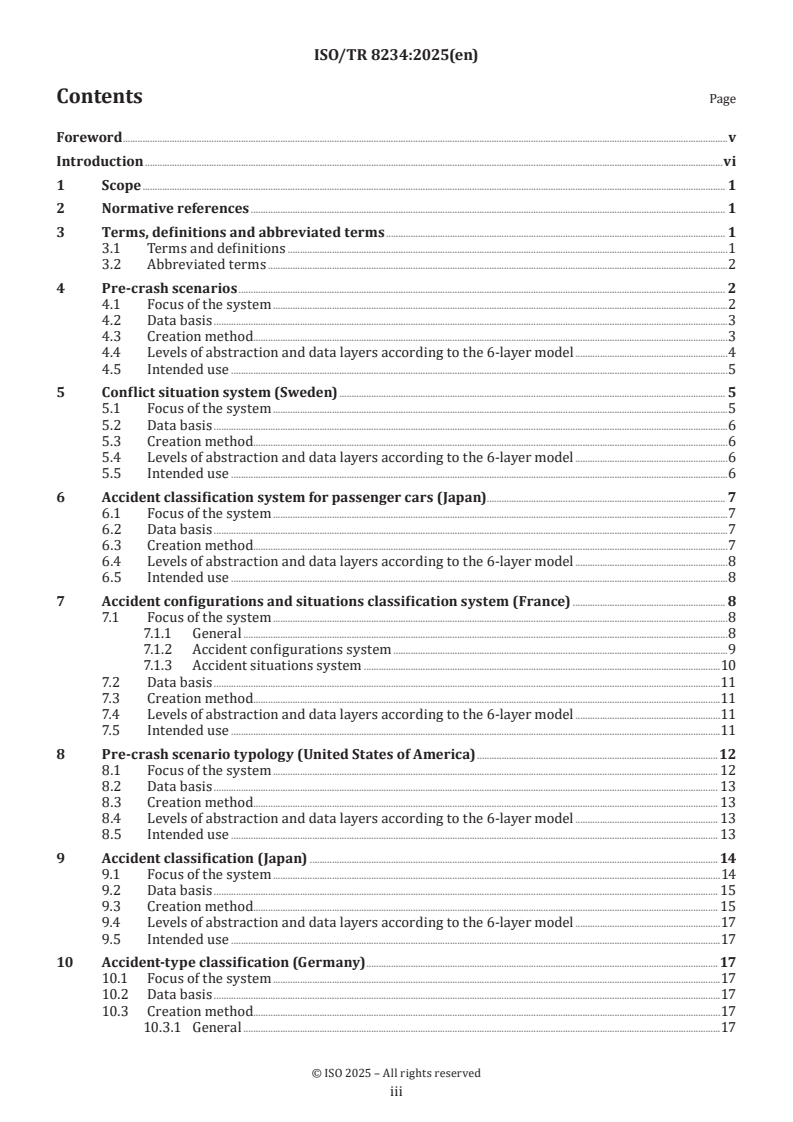
Contents Page
Foreword .v
Introduction .vi
1 Scope . 1
2 Normative references . 1
3 Terms, definitions and abbreviated terms . 1
3.1 Terms and definitions .1
3.2 Abbreviated terms .2
4 Pre-crash scenarios . 2
4.1 Focus of the system .2
4.2 Data basis .3
4.3 Creation method.3
4.4 Levels of abstraction and data layers according to the 6-layer model .4
4.5 Intended use .5
5 Conflict situation system (Sweden) . 5
5.1 Focus of the system .5
5.2 Data basis .6
5.3 Creation method.6
5.4 Levels of abstraction and data layers according to the 6-layer model .6
5.5 Intended use .6
6 Accident classification system for passenger cars (Japan) . 7
6.1 Focus of the system .7
6.2 Data basis .7
6.3 Creation method.7
6.4 Levels of abstraction and data layers according to the 6-layer model .8
6.5 Intended use .8
7 Accident configurations and situations classification system (France) . 8
7.1 Focus of the system .8
7.1.1 General .8
7.1.2 Accident configurations system .9
7.1.3 Accident situations system .10
7.2 Data basis .11
7.3 Creation method.11
7.4 Levels of abstraction and data layers according to the 6-layer model .11
7.5 Intended use .11
8 Pre-crash scenario typology (United States of America) .12
8.1 Focus of the system . 12
8.2 Data basis . 13
8.3 Creation method. 13
8.4 Levels of abstraction and data layers according to the 6-layer model . 13
8.5 Intended use . 13
9 Accident classification (Japan) . 14
9.1 Focus of the system .14
9.2 Data basis . 15
9.3 Creation method. 15
9.4 Levels of abstraction and data layers according to the 6-layer model .17
9.5 Intended use .17
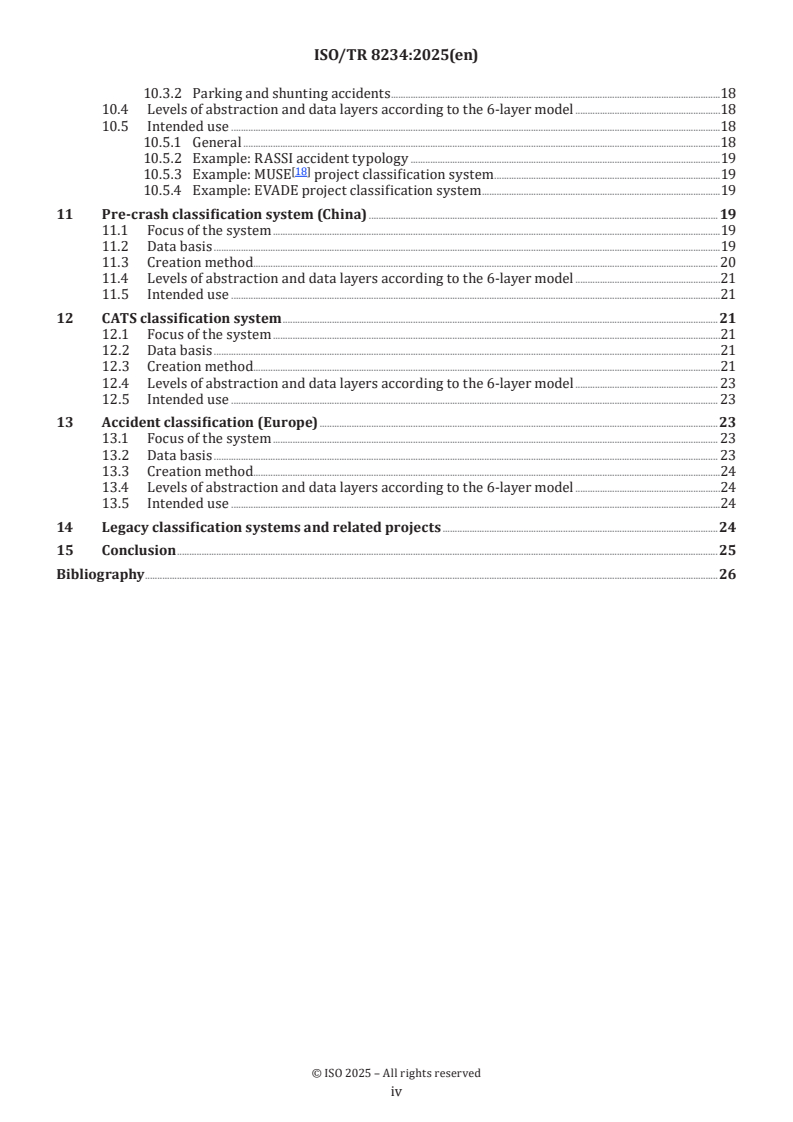
10 Accident-type classification (Germany) . 17
10.1 Focus of the system .17
10.2 Data basis .17
10.3 Creation method.17
10.3.1 General .17
iii
10.3.2 Parking and shunting accidents .18
10.4 Levels of abstraction and data layers according to the 6-layer model .18
10.5 Intended use .18
10.5.1 General .18
10.5.2 Example: RASSI accident typology .19
[18]
10.5.3 Example: MUSE project classification system .19
10.5.4 Example: EVADE project classification system .19
11 Pre-crash classification system (China) . 19
11.1 Focus of the system .19
11.2 Data basis .19
11.3 Creation method. 20
11.4 Levels of abstraction and data layers according to the 6-layer model .21
11.5 Intended use .21
12 CATS classification system .21
12.1 Focus of the system .21
12.2 Data basis .21
12.3 Creation method.21
12.4 Levels of abstraction and data layers according to the 6-layer model . 23
12.5 Intended use . 23
13 Accident classification (Europe) .23
13.1 Focus of the system . 23
13.2 Data basis . 23
13.3 Creation method.24
13.4 Levels of abstraction and data layers according to the 6-layer model .24
13.5 Intended use .24
14 Legacy classification systems and related projects .24
15 Conclusion .25
Bibliography .26
iv
Foreword
ISO (the International Organization for Standardization) is a worldwide federation of national standards
bodies (ISO member bodies). The work of preparing International Standards is normally carried out through
ISO technical committees. Each member body interested in a subject for which a technical committee
has been established has the right to be represented on that committee. International organizations,
governmental and non-governmental, in liaison with ISO, also take part in the work. ISO collaborates closely
with the International Electrotechnical Commission (IEC) on all matters of electrotechnical standardization.
The procedures used to develop this document and those intended for its further maintenance are described
in the ISO/IEC Directives, Part 1. In particular, the different approval criteria needed for the different types
of ISO documents should be noted. This document was drafted in accordance with the editorial rules of the
ISO/IEC Directives, Part 2 (see www.iso.org/directives).
ISO draws attention to the possibility that the implementation of this document may involve the use of (a)
patent(s). ISO takes no position concerning the evidence, validity or applicability of any claimed patent
rights in respect thereof. As of the date of publication of this document, ISO had not received notice of (a)
patent(s) which may be required to implement this document. However, implementers are cautioned that
this may not represent the latest information, which may be obtained from the patent database available at
www.iso.org/patents. ISO shall not be held responsible for identifying any or all such patent rights.
Any trade name used in this document is information given for the convenience of users and does not
constitute an endorsement.
For an explanation of the voluntary nature of standards, the meaning of ISO specific terms and expressions
related to conformity assessment, as well as information about ISO’s adherence to the World Trade
Organization (WTO) principles in the Technical Barriers to Trade (TBT), see www.iso.org/iso/foreword.html.
This document was prepared by Technical Committee ISO/TC 22, Road vehicles, Subcommittee SC 36, Safety
and impact testing.
Any feedback or questions on this document should be directed to the user’s national standards body. A
complete listing of these bodies can be found at www.iso.org/members.html.
v
Introduction
This document describes currently available pre-crash classifications that specify the conflict situation
between road traffic actors that lead to a crash. The document describes classifications that are based on
different real-world crash data types and collection origins. The focus is on the description of attributes and
characteristics of different approaches and their applicability to data-driven traffic safety research. This
document gives examples for research questions which can be addressed with a respective classification
system and the intended use of these classification systems.
The types of the traffic accidents vary in different countries and regions because of different administration
modes, infrastructures, road users, road conditions and vehicle safety levels. Different stakeholders focus on
different aspects of traffic accidents. For example, traffic administrations focus on typical accident modes.
Manufactures focus on technology applications under different working conditions. Testing facilities focus
on technical details like velocity and impact angle. Suppliers focus on the practical performance of specific
parts or systems. At the same time, different accident reasons provide foundations for administrations to
formulate regulations and for manufactures to update relative functions and configurations.
Therefore, traffic-accident research can promote the development of vehicle-safety technology, traffic
administration and infrastructure, vehicle testing and certification, standards and regulations.
Classifications based on traffic accidents can support the systematic and comprehensive description of
the accident situation, which is an important foundation for the subsequent safety technology research
and development. Research on the formulation of different accident classification systems analyses their
difference and contributes to the harmonization of classification levels, accident types, accident reasons and
participants.
The country or region mentioned within brackets on the heading of each method compiled indicates that the
information has been provided by experts from that country or region. It does not indicate that the method
referred to has an official status in that country or region.
vi
Technical Report ISO/TR 8234:2025(en)
Road vehicles — Pre-crash classification systems
1 Scope
This document describes pre-crash classification systems that specify the conflict situations between road
traffic actors that lead to real-world crashes.
Classification systems are useful tools in defining and understanding the role and actions of traffic actors and
therefore, can be applied to the development of vehicle active safety technology, vehicle-safety assessment
and traffic-safety research in general.
This document addresses pre-crash classification systems that are based on characteristics of conflict
situations which can lead to a crash.
This document does not address test scenarios that describe the operation domain of assisted or automated
driving systems.
2 Normative references
The following documents are referred to in the text in such a way that some or all of their content constitutes
requirements of this document. For dated references, only the edition cited applies. For undated references,
the latest edition of the referenced document (including any amendments) applies.
ISO 12353-1, Road vehicles — Traffic accident analysis — Part 1: Vocabulary
3 Terms, definitions and abbreviated terms
For the purposes of this document, the terms and definitions given in ISO 12353-1 and the following apply.
ISO and IEC maintain terminology databases for use in standardization at the following addresses:
— ISO Online browsing platform: available at https:// www .iso .org/ obp
— IEC Electropedia: available at https:// www .electropedia .org/
3.1 Terms and definitions
3.1.1
accident
crash
event in road traffic that leads to property damage or personal injury or both
Note 1 to entry: In order to respect the terminology 'accident' or 'crash' used in different data sources, the terms are
taken as interchangeable for the purpose of this document.
3.1.2
pre-crash
time before an accident or crash (3.1.1) where the accident or crash is unavoidable
3.1.3
near-crash
event in road traffic where traffic participants are not damaged or injured (no property damage or personal
injury), but the event was critical
3.1.4
6-layer model
model for a systematic description of scenarios with six independent layers
Note 1 to entry: The six independent layers are comprehensively described in Reference [27].
3.2 Abbreviated terms
AEB autonomous emergency braking
ASEG accident study expert group
CATS Cyclist-AEB Testing System
CEDATU Central Database for In-Depth Accident Study
CIDAS China In-Depth Accident Study Database
CISS Crash Investigation Sampling System
CNCAP China New Car Assessment Program
CRSS Crash Report Sampling System
EuroFOT European Field Operational Test (EU project)
EVADE EU project
FARS Fatality Analysis Reporting System
GES General Estimates System
GIDAS German In-Depth Accident Study
IGLAD Initiative for the Global Harmonization of (in-depth) Accident Data
ITARDA Institute for Traffic Accident Research and Data Analysis
LAB Laboratory of Accidentology, Biomechanics and Human Behaviour (Nanterre, France)
L3Pilot Level 3 Pilot (EU project)
NASS National Automotive Sampling System
NCAP New Car Assessment Program
OEM original equipment manufacturer
PC passenger car
PCS pre-crash scenario
SHRP2 Strategic Highway Research Program 2
STRADA Swedish Traffic Accident Data Acquisition
UDV German Insurers Accident Research (Unfallforschung der Versicherer)
UTYP Unfalltyp (German for accident type)
VOIESUR Vehicle Occupant Infrastructure Road User Safety Study (Vehicule Occupant Infra-
structure Etudes de la Sécurité des Usagers de la Route)
VRU vulnerable road user
V_CAD Volvo Cars Car Accident Database
VCTAD Volvo Cars Traffic Accident Database
V_PAD Volvo Cars Pedestrian Accident Database
4 Pre-crash scenarios
4.1 Focus of the system
The focus of the classification system called pre-crash scenarios (PCSs) is on the description of the conflict
situation that leads to a critical event or accident. The goal is to identify the first two conflicting participants
and describe their interaction. All possible combinations and degrees of freedom of the participants are
considered. This includes the relative orientation such as same lane or crossing, the directions of travel such
as co-moving or oncoming, and the intention of each participant such as lane change, turning or reversing.
Thus, all possible, however relevant, combinations of actions and goals of the actors in the conflict situation
can be described.
The classification system does not focus on the accident causation such as human behaviour, system failure
or environment conditions, that are the root cause of a conflict. Neither does the system describe the actual
collision combinations such as crash direction or impact position of the involved participants.
The defined set of pre-crash situations is independent of the kind of participation. It can be applied to motor-
vehicles like cars and trucks, and to vulnerable road users like motorcycles, bicycles or pedestrians. Due
to the nature of the road layouts and traffic rules, not all possible combinations are applicable to all traffic
participations. For example, in a right-hand traffic environment, a right-turning car can run into oncoming
bicyclists or pedestrians; however, it cannot encounter an oncoming car.
The classification system allows to view the different conflict situations from the perspective of a motor-
vehicle. Equally, each situation can also be seen through eyes of a vulnerable road user. This allows for a
holistic analysis of relevant accidents from the point-of-view of each participant type.
A catalogue is used to list the available situations with their names and descriptions and including graphic
pictograms.
The classification system was originally developed by Continental AG, based on the Cyclist-AEB Testing
System (CATS, see Clause 12). To include all possible participants, the CATS was extended to also include
other participant types.
4.2 Data basis
The classification system is not limited to a specific accident or driving database. Rather it can utilize a
variety of different data sources. A prerequisite is that the data used contains relevant information on the
combination of the dynamic objects in the conflict situation that might lead to an accident. The information
needed includes the relative positions, the direction of travel, the intention of movement of the involved
traffic participants. This includes at least the two participants in the conflict situation that leads to the
critical event or accident but can also include further participants involved. All relevant vehicle types and
different vulnerable road users are considered as possible conflicting participants.
4.3 Creation method
For generating the classifications, the available pre-crash descriptions, in each data set, are used. Equivalent
descriptions are clustered to generate classifications that are equivalent to a vehicle-safety system, that can
address the pre-crash situation and avoid or mitigate a collision.
Each critical event or accident is considered from the perspective of the first two involved participants.
From each perspective the same accident represents a different situation. The same accident reflects two
different situations that can be addressed by both participants using different safety systems. For example,
in a crossing accident, one participant will observe a crossing-from-right and the other a crossing-from-left
situation. See Figures 1 and 2.
Figure 1 — Creation of PCS from different UTYP
Figure 2 — Process from UTYP to PCS
4.4 Levels of abstraction and data layers according to the 6-layer model
The focus of the classification system is on the description of abstract conflict situations according to the
6-layer model. The abstract situations are the framework for categorizing actual concrete situations as
observed in the real-world.
The classification system only includes information on the movable objects according to level 4 in the
6-layer model.
4.5 Intended use
The classification system allows to, qualitatively and quantitatively, analyse a particular accident occurrence.
This is regardless of the kind of vehicles and participants involved. By applying the method to data from
various regions, a comparison of occurring accidents is possible.
The aim is to represent the whole accident situation in one country or region and make it comparable to
another. Thus, it is possible to identify unaddressed scenarios (white spots). The system is the basis for
analysing the required functionality of active safety systems and automated driving systems. By considering
further details relevant requirements for the design of the sensors, the algorithms and the actuators can
be identified. The classification system is also the basis for a prospective effectiveness assessment by
simulation. With the help of the classification system the field of effect of a safety system can be determined.
Also, a systematic analysis of real-world situations is the basis for developing consumer tests and legal
regulations. See example in Figure 3.
Key
GIDAS 2005-2022
ITARDA 2021
FARS/CRSS 2020
Figure 3 — Exemplary visualization using PCS for motorcycle-to-car accidents
The classification system has been applied to different worldwide accident data sources including GIDAS,
CIDAS, IGLAD, FARS, GES and ITARDA. The clustering method and data analysis examples were presented at
[1],[2]
conferences and respective papers were released.
5 Conflict situation system (Sweden)
5.1 Focus of the system
In 2005, the Volvo Car traffic accident research team recognized the necessity for a classification system
tailored to various traffic scenarios. With the growing emphasis on car safety features aimed at preventing
or reducing crashes, the conflict situation classification was developed. This classification focuses on the
traffic situation leading up to a potential crash rather than the crash itself.
The conflict situation system strives to cover all possibilities of pre-crash movements of involved road users
in relation to each other. It is applicable to both old and new data sources where information about the pre-
crash situations is available. The system is logical and transparent in order to be accessible when collecting
information on crashes and near-crashes.
One major characteristic of the conflict situation system is that it does not include information for anything
other than the moving pattern. No information about pre-crash factors (e.g. traction loss, opponent
information, road section types or geometries, traffic control, speeds) are included in the conflict situation
system. Accordingly, it does not consider crash configurations (e.g. frontal impact or sideswipe, impact
angle, small/wide overlap) either, since conflict situations are about the situation before the crash.
Pre-crash factors and crash information are instead available in complementing variables in the crash
databases to promote effective information storage and consistent annotation and analysis of conflict
situations.
5.2 Data basis
The conflict situation system was initially inspired by the ACC_TYPE classification in the US official crash
databases and was initially applied to severe crashes (as found, for example, in databases with police
reported crashes). Over time, the system evolved to include situations that do not always appear in such
databases. For example, the system includes specific codes for vehicle-to-VRU crashes, and progress is being
made towards identifying all conflict situations for low-speed manoeuvring crashes.
Thus, the system is not limited to one specific database, rather it can be used with any data that contain
information on the relative positions/direction of travel of the involved traffic participants.
5.3 Creation method
Conflict situations are assigned to each traffic participant in the crash, and can be aggregated to the crash
level, see one example with both crash and vehicle level in Figure 4.
crash level vehicle level description pictogram
LT/OD LT/OD host vehicle makes a Left Turn, opponent from
hv S
Opposite Direction intends to go Straight for-
ward
LT/ OD Opponent makes a Left Turn, host vehicle from
hv S
Opposite Direction intends to go Straight for-
ward
Figure 4 — Example for conflict situations
Since the aim of the system is crash avoidance and mitigation research, the conflict situation represents the
conditions leading up to the first event in case of a multiple crash. This means that it is formed based on the
movements of the first involved participant(s) in the crash or the near-crash.
5.4 Levels of abstraction and data layers according to the 6-layer model
The focus is on the description of abstract situations, including information for layer 4.
5.5 Intended use
The conflict situation classification system targets the analysis of pre-crash situations in various data sets
across different types of vehicles and traffic participants. For example, the system enables identification
of relevant pre-crash situations for safety system development and testing (e.g. for ADAS and automated
driving systems) and is also the basis for prospective effectiveness assessments.
The conflict situation classification system has been applied to various crash databases (e.g. VCTAD, V_CAD,
V_PAD, STRADA, GIDAS, CIDAS, IGLAD, FARS, GES, CISS, SHRP2, EuroFOT, L3Pilot) in Volvo Cars internal
reports. In Reference [3] conflict situations in urban intersections and in highways were analysed using
the STRADA database, and in Reference [4] all car-to-cyclist crashes in Volvo Cars cyclist accident database
were investigated.
6 Accident classification system for passenger cars (Japan)
6.1 Focus of the system
The classification system applies to collision and injury accidents involving passenger cars. Mainly, it is
applicable to the accident where there is a collision between a four-wheeled vehicle, motorcycle, bicycle
or pedestrian. The main purpose is to plan or examine the effectiveness of active safety systems such as
autonomous emergency braking (AEB). This classification system was originally developed by DENSO.
6.2 Data basis
This classification system is mainly applied to the GIDAS or CIDAS databases, but it can be applied to other
databases as well. The required information for any database is provided below:
— The relative position, direction of movement and intention of movement of the relevant traffic participants;
— Information on factors affecting the operation of the active safety systems, such as the presence or
absence of slips or rollovers;
— Information of at least two participants involved in a collision.
6.3 Creation method
The classification procedure is shown in Figure 5, explaining the case where a passenger car turns left and a
two-wheeled vehicle goes straight as an example.
Step 1:
Exclude accidents which include skidding or rollover before impact, because these factors affect the
appropriate operation of the active safety systems.
Step 2:
For this use case, choose the accidents that occurred between a passenger car and a two-wheeled vehicle,
and in which the passenger car first strikes the two-wheeled vehicle.
Step 3:
Choose the accidents in which a passenger car turns left and a two-wheeled vehicle goes straight. Depending
on the use case, the accident type code is chosen.
Through steps 1 to 3, the accident cases to be analysed can be extracted. Then it can be further investigated,
for example, what is the shape of the intersection, were there are many accidents and the distribution of
vehicle speed.
This procedure has been discussed in the CIDAS ASEG (accident study expert group) with participants form
manufacturers and suppliers.
Figure 5 — Accident classification method
6.4 Levels of abstraction and data layers according to the 6-layer model
The classification system only includes information on the movable objects according to level 4 in the
6-layer model.
6.5 Intended use
From the results obtained by this classification system, it is possible to qualitatively and quantitatively
analyse the accident occurrence factors and characteristics. Based on this information, the specifications
of sensors and controllers required for active safety systems can be investigated. Statistical accident
[5]
information can also be used to consider some test scenarios for assessment programs.
7 Accident configurations and situations classification system (France)
7.1 Focus of the system
7.1.1 General
The classification system is composed of two sub-systems: one system named “accident configurations”
and the other one named “accident situations”. Both systems were created by LAB in the 1990s regarding
the “accident configuration” system and in the 2000s regarding “accident situations” system. Since then,
1)
different projects (e.g. VOIESUR ) have been the centre of their evolution based on real-world accident
situations.
Both, the “accident configurations” and the “accident situations” classification systems, do not focus on
the accident causation such as human behaviour, system failure or environment conditions. Neither do the
systems describe the actual collision parameters such as crash direction or impact position of the involved
participants.
This classification system was originally developed by LAB.
7.1.2 Accident configurations system
The focus of the “accident configurations” classification system is on the description of the involved road
users intended movement immediately preceding the crash. This classification system allows to allocate one
single pictogram to each accident. All pictograms are classified in seven series as described in Figure 6.
Figure 6 — Accident configurations classification system (decision tree for coding)
Each pictogram describes the participants direction of travels, and the intention of each participant such as
lane change, turning, reversing, etc.
The “accident configurations” system has a pictogram indicating multiple crashes (several vehicles involved
at the same time) but has no pictogram for a succession of accidents. In this case, the sequence into first
crash and following crashes can be decomposed using one different pictogram for each of them.
A catalogue is used to list the available “accident configurations” (168) with their reference numbers and
descriptions and associated pictograms. Some examples are given in Figure 7.
1) Vehicle occupant infrastructure road user safety study (police reports of the year 2011 in France).
Key
110 accidents involving two vehicles: a vehicle travels wrong way on a one-way direction road as another vehicle
comes up from the opposite direction
207 accidents involving at least an overtaking vehicle: a vehicle overtakes using the leftmost lane, as another
vehicle comes up from the opposite direction
320 accidents in an intersection: crash on insertion lane: a vehicle coming from the insertion lane is hit on the
rear-ended by the vehicle travelling on the main road
401 accidents with vehicle leaving/entering parking slot, exiting private way: a driver surprised by a vehicle
merging ahead after leaving its parking slot, makes an urgent evasive manoeuvre
510 single vehicle accidents: vehicle runs off-road to the right, after running off the left road edge and almost or
completely rolling over
803 accidents involving pedestrian: pedestrian crossing the road from right to left is hit by a vehicle
Figure 7 — Examples of accident configurations
7.1.3 Accident situations system
The focus of the “accident situations” classification system is on the description of the involved road users’
intended movement immediately preceding the crash, from each participant’s perspective: causer and
non-causer.
Four groups of drawings illustrate interactions leading to a road accident.
One “accident situation” is associated to each road user involved in the accident.
The four groups are described in Figure 8 a) to d).
a) Group 1: vehicles in loss of control b) Group 2: vehicles hitting pedestrians
c) Group 3: vehicle hit by other in two vehicles, d) Group 4: vehicle involved in intersection acci-
outside of intersection dent collision
Figure 8 — Accident situations groups in use
A catalogue is used to list the available 49 “accident situations” with their reference numbers and descriptions
including drawings.
7.2 Data basis
2)
The two LAB classification systems are originally based on the PVM 1990 study (first accident
3)
configurations issued) and PVM 2000 study (accident situations issued). Both studies rely on real world
French road-crash data.
The level of details is intermediate as it depends on the information contained in police reports.
The representativeness was set up in the context of VOIESUR as follows: data collection of fatal crashes
police reports is exhaustive (100 % representative); data collection of injury crashes police reports is partial
(random selection covering 5 % of French national police reports), so weighted against the national database
(BAAC) for the year 2011.
The LAB classification systems can be applied to other compatible data sources, not only on the national
French database.
7.3 Creation method
For generating the classifications, the available police reports and accidents database are used. Equivalent
descriptions are clustered to generate classifications as shown in 7.1.
The LAB classification systems are not vehicle safety functions-oriented, however they allow to perform
safety function (or system) effectiveness analyses (retrospective or prospective approaches).
In the case of “accident configurations”, each accident is considered as a whole, without identifying the
participants.
In the case of “accident situations”, each
...