

ISO 6590-2:1986
(Main)Packaging — Sacks — Vocabulary and types — Part 2: Sacks made from thermoplastic flexible film
General Information
- Abstract
This part of ISO 6590 defines terms commonly used in plastic sack manufacture. It refers to single- and multi-ply sacks made from thermoplastic flexible films; it does not refer to bags for the retail trade. It specifies types of sacks, constructional details, materials and describes parts of a sack. It delivers alphabetical indices in three languages.
- Status
- Published
- Publication Date
- 05-Mar-1986
- Technical Committee
- ISO/TC 122 - Packaging
- Drafting Committee
- ISO/TC 122 - Packaging
- Current Stage
- 9093 - International Standard confirmed
- Start Date
- 12-Nov-2024
- Completion Date
- 29-Aug-2026
Overview
ISO 6590-2:1986 is an international standard developed by ISO (International Organization for Standardization) under Technical Committee ISO/TC 122, Packaging. This standard specifically addresses the vocabulary and types of sacks made from thermoplastic flexible film. It provides definitions for terminology widely used in the manufacturing of single- and multi-ply plastic sacks, excluding bags intended for retail purposes. The document also details sack types, their construction, materials used, and includes descriptions of sack components. Additionally, it offers multilingual indices to aid in global communication and consistency in the packaging industry.
Key Topics
ISO 6590-2:1986 covers the following essential topics for the packaging sector:
- Terminology: Defines commonly accepted terms in the production of thermoplastic film sacks, ensuring uniform understanding and communication.
- Types of Sacks: Categorizes different sack designs and their applications, focusing on those manufactured from thermoplastic flexible films.
- Constructional Details: Specifies the structural aspects of plastic sacks, such as the number of plies (single or multi-ply), closures, and the configuration of sack parts.
- Materials: Describes suitable thermoplastic flexible films and their characteristics, addressing compatibility and performance in packaging.
- Component Identification: Provides descriptions of individual sack parts, facilitating manufacturing, quality control, and procurement.
- Multilingual Indices: Offers alphabetical indices in English, French, and Russian to support international usage and regulatory compliance.
Applications
The standard serves as an essential reference for organizations involved in the design, production, and use of plastic sacks. Key practical applications include:
- Manufacturing Consistency: Ensures all stakeholders use standardized vocabulary and definitions, supporting quality processes and efficient production lines.
- Specifications and Procurement: Facilitates clear communication between buyers and suppliers when describing sack types, materials, and construction details in technical documents.
- Quality Assurance: Assists organizations in setting criteria for inspection and testing by unifying terms and descriptions.
- International Trade: Supports imports and exports of packaging materials by establishing a common language, minimizing misunderstandings and compliance issues.
- Training and Documentation: Provides a solid foundation for training materials, technical documentation, and certification programs within the packaging industry.
Related Standards
ISO 6590-2:1986 functions within a broader framework of packaging standards. Relevant related standards include:
- ISO 6590-1: Packaging - Sacks - Vocabulary and types - Part 1: Paper sacks
Covers terms and classifications specific to paper-based sack packaging, complementing the plastic sack definitions in Part 2. - ISO/TC 122 standards
Other documents developed by ISO Technical Committee 122 cover a wide array of packaging requirements, safety, and quality aspects.
Keywords: ISO 6590-2, thermoplastic sacks, packaging standards, plastic sack vocabulary, flexible film packaging, packaging terminology, international packaging standard, sack types, packaging materials
By adopting ISO 6590-2:1986, businesses and stakeholders in the packaging supply chain achieve greater accuracy in communication, improved product quality, and smoother cross-border operations. This standard is crucial for harmonizing definitions and practices within the growing global packaging market.
Get Certified
Connect with accredited certification bodies for this standard

BRCGS (Brand Reputation Compliance Global Standards)
Global food safety and quality standards owner.
Sponsored listings
Frequently Asked Questions
ISO 6590-2:1986 is a standard published by the International Organization for Standardization (ISO). Its full title is "Packaging — Sacks — Vocabulary and types — Part 2: Sacks made from thermoplastic flexible film". This standard covers: This part of ISO 6590 defines terms commonly used in plastic sack manufacture. It refers to single- and multi-ply sacks made from thermoplastic flexible films; it does not refer to bags for the retail trade. It specifies types of sacks, constructional details, materials and describes parts of a sack. It delivers alphabetical indices in three languages.
This part of ISO 6590 defines terms commonly used in plastic sack manufacture. It refers to single- and multi-ply sacks made from thermoplastic flexible films; it does not refer to bags for the retail trade. It specifies types of sacks, constructional details, materials and describes parts of a sack. It delivers alphabetical indices in three languages.
ISO 6590-2:1986 is classified under the following ICS (International Classification for Standards) categories: 01.040.55 - Packaging and distribution of goods (Vocabularies); 55.080 - Sacks. Bags. The ICS classification helps identify the subject area and facilitates finding related standards.
ISO 6590-2:1986 is available in PDF format for immediate download after purchase. The document can be added to your cart and obtained through the secure checkout process. Digital delivery ensures instant access to the complete standard document.
Standards Content (Sample)
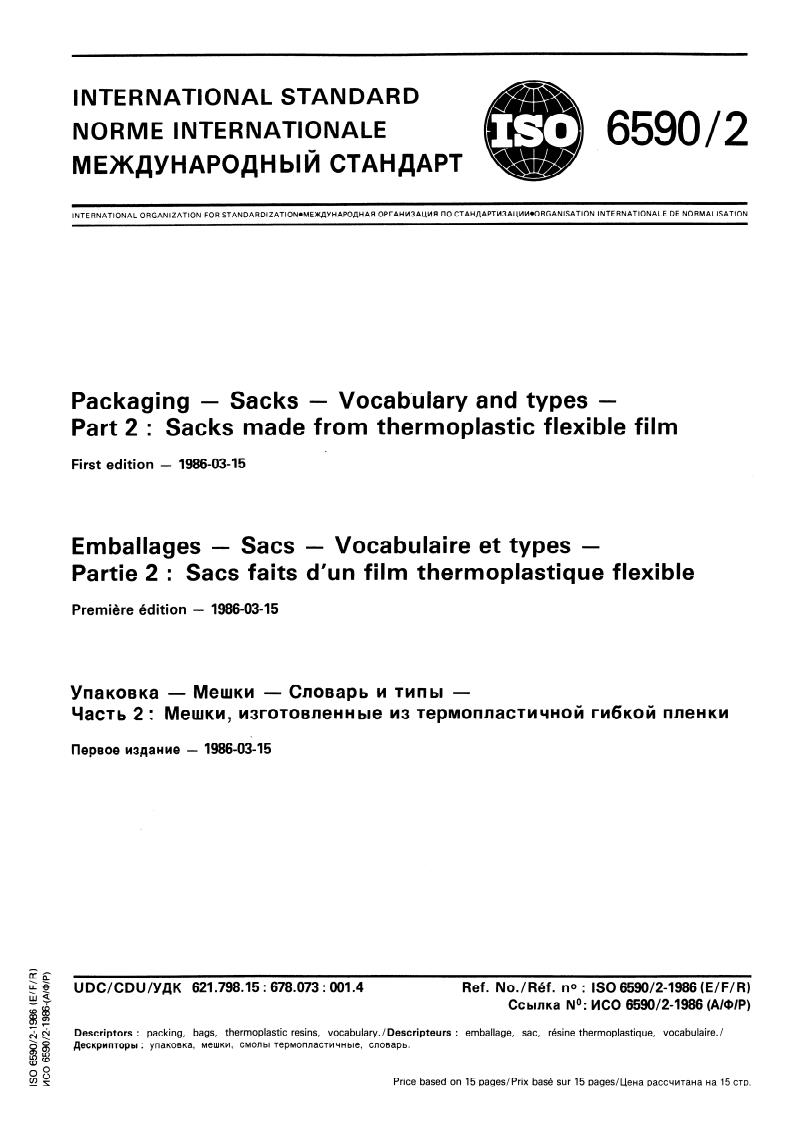
INTERNATIONAL STANDARD
NORME INTERNATIONALE
ME>KAYHAPOflHblM CTAHflAPT
INTERNATIONAL ORGANIZATION FOR STANDARDIZATION.MEIKflYHAPOfiHAR OPI-AHM3AlJMR fl0 CTAH~APTM3ALWlM.ORGANISATlON INTERNATIONALE DE NORMALISATION
Packaging - Sacks - Vocabulary and types -
Part 2 : Sacks made from thermoplastic flexible film
First edition - 1986-03-15
Emballages - Sacs - Vocabulaire et types -
Partie 2 : Sacs faits d’un film thermoplastique flexible
Premiere Edition - 1986-03-15
ynaKO6Ka - MeiuKu - CflOBapb M TMllbl -
+CTb 2 : MeuwI, M3~OTOBfleHHble M3 TepMOllI’laCTWlHOih Wl6KOii IlJleHKb’l
nepeoe MsAaHme - 1986-03-15
UDC/CDlJ/YAK 621.798.15 : 678.073 : 001.4 Ref. No./Ref. no : ISO 6590/2-1986 (E/F/R)
CCblJlKa No: MC0 6590/2-1986 (AMP)
Descriptors : packing, bags, thermoplastic resins, vocabulary. / Descripteurs : emballage, sac, r6sine thermoplastique, vocabulaire. /
AecKpmTopbi : ynai
Price based on 15 pages/Prix bas6 sur 15 pages/ueHa paccwTaHa Ha 15 CTP.
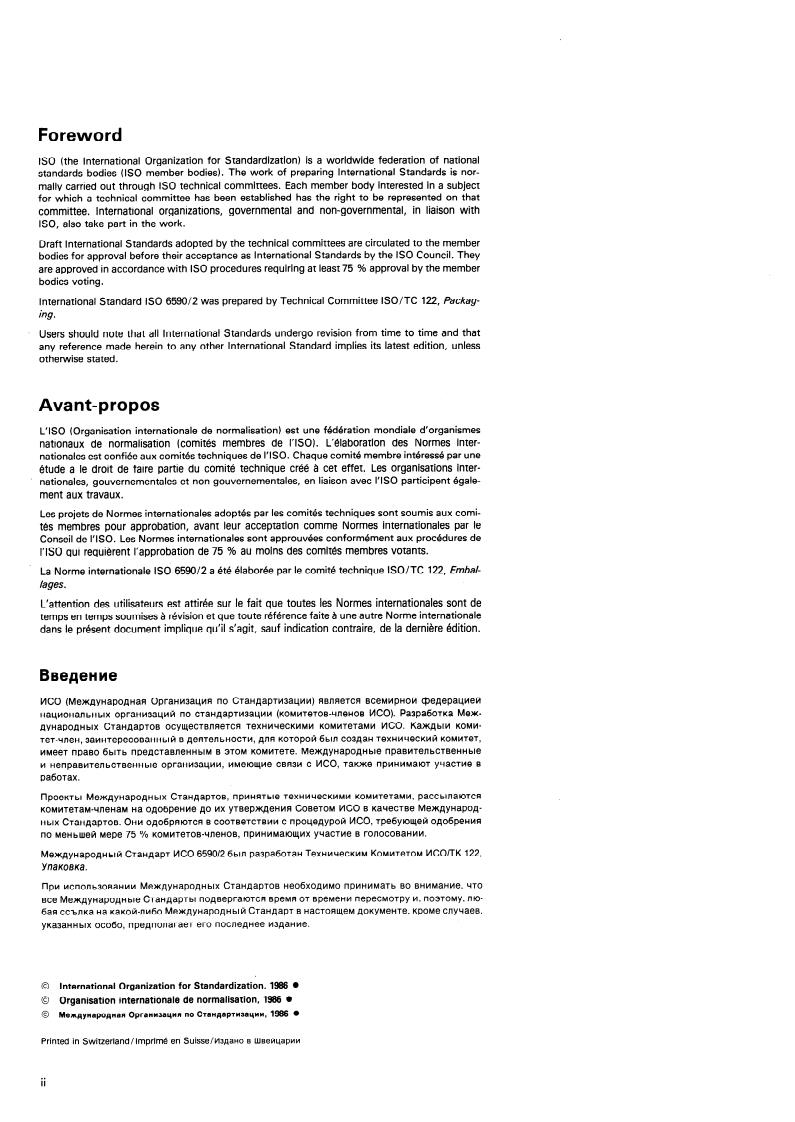
Foreword
ISO (the International Organization for Standardization) is a worldwide federation of national
Standards bodies (ISO member bodies). The work of preparing International Standards is nor-
mally carried out through ISO technical committees. Esch member body interested in a subject
for which a technical committee has been established has the right to be represented on that
committee. International organizations, governmental and non-governmental, in liaison with
ISO, also take patt in the work.
Draft International Standards adopted by the technical committees are circulated to the member
bodies for approval before their acceptance as International Standards by the ISO Council. They
are approved in accordance with ISO procedures requiring at least 75 % approval by the member
bodies voting .
prepared by Technical Committee ISO/TC 122, Packag-
lnterna tional Standard ISO 6590/2 was
ing.
Users should note that all International Standards undergo revision from time to time and that
any reference made herein to any other International Standard implies its latest edition, unless
otherwise stated.
Avant-propos
L’ISO (Organisation internationale de normalisation) est une federation mondiale d’organismes
nationaux de normalisation (comites membres de I’ISO). L’elaboration des Normes inter-
nationales est confiee aux comites techniques de I’ISO. Chaque comite membre interesse par une
etude a Ie droit de faire Partie du comite technique cree a cet effet. Les organisations inter-
nationales, gouvernementales et non gouvernementales, en liaison avec I’ISO participent egale-
ment aux travaux.
Les projets de Normes internationales adoptes par les comites techniques sont soumis aux comi-
tes membres pour approbation, avant leur acceptation comme Normes internationales par Ie
Conseil de I’ISO. Les Normes internationales sont approuvees conformement aux procedures de
I’ISO qui requierent I’approbation de 75 % au moins des comites membres votants.
La Norme internationale ISO a 6th elaboree par Ie comite technique ISO/TC 122,
lages.
L’attention des utilisateurs est attiree sur Ie fait que toutes les Normes internationales sont de
temps en temps soumises a revision et que toute reference faite a une autre Norme internationale
dans Ie present document implique qu’il s’agit, sauf indication contraire, de Ia derniere Edition.
BBeAeHMe
MC0 (Me>K~yriapo~riafr OpraHr43aur4fl no CratiAapTM3aur4r4) frsnflercfl eceMr4pHoM @eRepauMeW
Ha4MOHaAbHblX OpraHVl3aqPlti n0 CTaH~apTPl3a~l’lVl (KOMMTeTOB-WeHOB MCO). PaJpa6OTKa Mem-
flyHapOAHblX CTaHflapTOB OCy~eCTBJlfIeTCR TeXHM~eCKMMM KOMMTeTaMM MCO. KaxgblM KOMM-
TeT-qJleH, 3aPlHTepeCOBaHHblti B AeflTeflbHOCTM, 4flfI KOTOpOti 6btn CO3AaH TeXHMqeCKMfi KOMMTeT,
MMeeT npaB0 6blTb flpeflCTaBfleHHblM B 3TOM KOMMTeTe. Me~~yHapOfiHble npaBl4TeJlbCTBeHHble
M HeflpaBVlTeJlbCTBeHHble OpraHM3a~MM, PlMelOiql’le CBF13M C MCO, TaKme npMHl4MalO-r yraCTl4e B
pa6o-rax.
npOeKTbl Me>KJJyHapOAHblX CTaHflapTOB, npMHflTble TeXHM~eCKMMM KOMMTeTaMM, paCCblJlalOTCFl
KOMMTeTaM-WeHaM Ha o)qO6peHMe fl0 MX yTBep~~eHWl COBeTOM L/1co B Ka’-ieCTBe Me>KAyHapo&
HblX CTaHflapTOB. OHM OJ406pRlOTCf! B COOTBeTCTBMM C npOqeflypOfi MCO, Tpe6ylOll@ti o~o6pekiMFI
n0 MeHbUJefi Mepe 75 % KOMMTeTOB-WeHOB, npMHMMaiO~MX yraCTne B rOnOCOBaHl4k-l.
MemjQfHapO~H blti CTaH&apT MC0 6bin TexHM cleCKMM KOMkITeTOM MCO/TK 122,
YnaKoma.
iIIpl4 MCnOIlb30BaHMM MemjJyHapOflHblX CTaHflapTOB HeO6XOJJqMMO npVlHMMaTb BO BHMMaHMe, qT0
BCe MexflyHapOAHble CTaHQapTbl nOflBepratOTCR BpeMfl OT BpeMeHM nepeCMOTpy M, n03TOMy, !llO-
6aH CCbJlKa Ha KaKOl%Jlkl60 MemC(ytiapOflHblti CTaHflapT B HaCTOR~eM AOKyMeHTe, KpOMe CnyqaeB,
yKa3aHHblx 0~060, npeqnonaraeT er0 nocneflHee u3flaHue.
0 International Organkation for Standardkation, 1986 0
0 Organisation internationale de normalisation, 1986 l
0 MexAytiapoAHafi Opranbfsaqbtfi no Craki~apm3aqw, 1986
Printed in Switzerland/ Imprimb en Suisse/MsAaHo B UJeeWuapMM
ii
Page
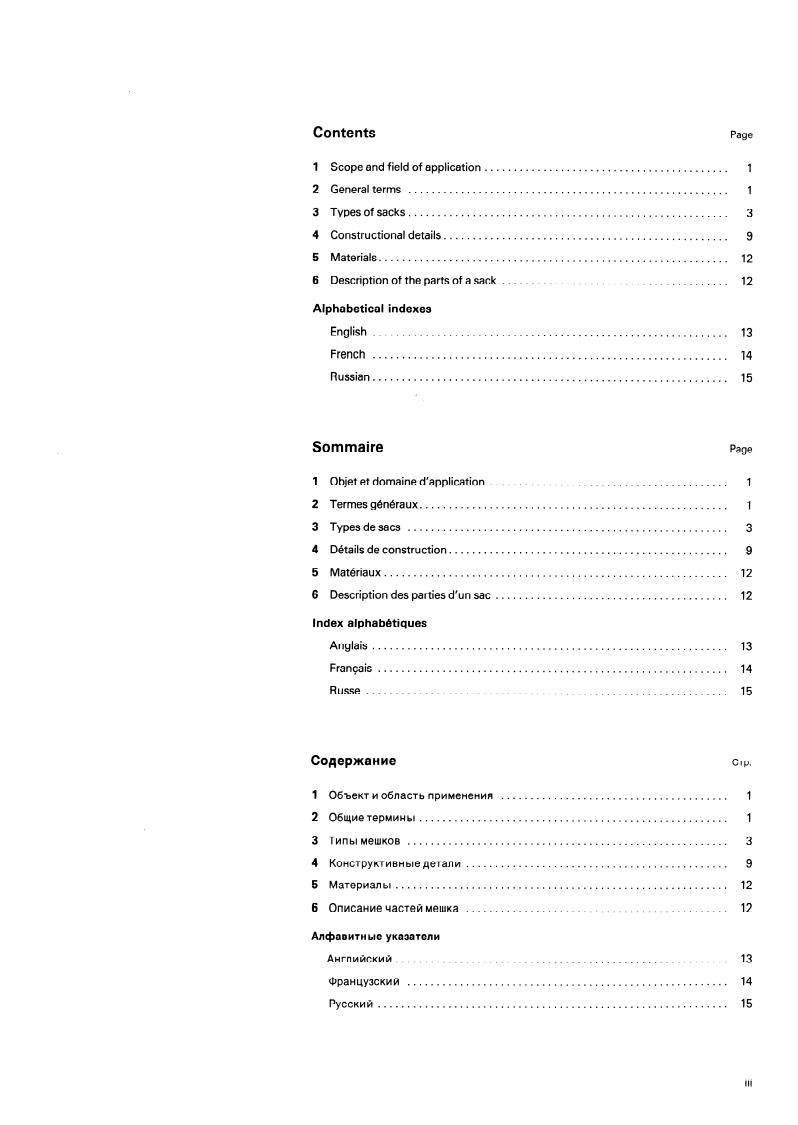
Contents
1 Scope and field of application .
.......................................................
2 Generalterms
.......................................................
3 Typesofsacks
4 Constructional details.
................................................
5 Materials .
6 Description of the Parts of a sack .
Alphabetical indexes
English . 13
French .
Russian .
Page
Sommaire
1 Objet et domaine d’application .
2 Termesgeneraux
.................
...