

ISO 21366:2026
(Main)Traditional Chinese medicine — General requirements for smokeless moxibustion devices
General Information
- Abstract
This document specifies general requirements for the performance and safety of smokeless moxibustion devices. It covers smoke density, moxibustion temperature, noxious gas and test methods for smokeless moxibustion devices. This document is applicable to any combustion-type device that claims to provide smokeless moxibustion. This document does not apply to devices that imitate moxibustion, such as electro moxibustion and infrared moxibustion devices.
- Status
- Published
- Publication Date
- 24-Sep-2026
- Technical Committee
- ISO/TC 249 - Traditional Chinese medicine
- Current Stage
- 6060 - International Standard published
- Start Date
- 25-Sep-2026
- Due Date
- 05-Aug-2026
- Completion Date
- 25-Sep-2026
Overview
ISO 21366:2026 is an International Standard for Traditional Chinese medicine that sets general requirements for smokeless moxibustion devices. It focuses on the performance and safety of combustion-type products that claim to provide smokeless moxibustion, with attention to smoke density, moxibustion temperature, noxious gas emissions, test methods, packaging, and labelling.
This standard is relevant for manufacturers, test laboratories, distributors, and quality teams working with smokeless moxibustion devices. It supports safer product development and clearer market claims by defining how these devices should be assessed and described. The second edition also reflects a technical revision, including a stricter smoke-density statement for products labelled "smokeless".
Key Topics
ISO 21366:2026 covers the main compliance areas needed for smokeless moxibustion device evaluation:
Smoke density
- Specifies test methods and limit values for moxibustion smoke
- Includes normative test procedures in Annex B and Annex C
- Supports objective verification of the smokeless claim
Safety requirements
- Addresses noxious gas emissions such as:
- Carbon monoxide (CO)
- Nitrogen dioxide (NO2)
- Total volatile organic compounds (tVOCs)
- Aldehydes
- Aligns testing with relevant ISO methods for air quality and emissions
- Addresses noxious gas emissions such as:
Moxibustion temperature
- Refers to ISO 18666:2021 for temperature test methods and requirements
Device materials
- Requires materials that may contact the human body to meet applicable requirements from ISO 18666:2021
Packaging and labelling
- Limits the use of the term "smokeless" to products that conform to the standard
- Includes protection requirements for packaging and transport
Applications
ISO 21366:2026 is useful across the traditional Chinese medicine device value chain. Practical applications include:
- Product design and development for smokeless moxibustion devices
- Quality control and conformity assessment in manufacturing
- Laboratory testing of smoke generation and gas emissions
- Regulatory and procurement review for healthcare and wellness products
- Packaging and label verification to support accurate product claims
The standard is especially valuable for organizations seeking to improve indoor air quality, user safety, and product consistency in moxibustion therapies. It also helps distinguish genuine smokeless moxibustion devices from products that merely imitate moxibustion, such as electro moxibustion and infrared moxibustion devices.
Related Standards
ISO 21366:2026 is closely connected with several standards used in testing and product evaluation:
- ISO 18666:2021 - General requirements of moxibustion devices
- ISO 15011-2 - Determination of carbon monoxide and nitrogen dioxide emissions
- ISO 16000-4 - Determination of formaldehyde
- ISO 16000-6 - Determination of volatile organic compounds
- ISO 2248 - Vertical impact test for transport packages
- ISO 7240-2 - Fire detection and alarm control equipment
- ISO/TS 7240-9 - Test fires for fire detectors
- ISO 5659-2 - Smoke generation and optical density testing
For organizations involved in smokeless moxibustion device standards, ISO 21366:2026 provides a practical framework for safer products, more reliable testing, and clearer conformity claims.
Relations
- Effective Date
- 08-Feb-2025
Get Certified
Connect with accredited certification bodies for this standard

BSI Group
BSI (British Standards Institution) is the business standards company that helps organizations make excellence a habit.

TÜV Rheinland
TÜV Rheinland is a leading international provider of technical services.

TÜV SÜD
TÜV SÜD is a trusted partner of choice for safety, security and sustainability solutions.
Sponsored listings
Frequently Asked Questions
ISO 21366:2026 is a standard published by the International Organization for Standardization (ISO). Its full title is "Traditional Chinese medicine — General requirements for smokeless moxibustion devices". This standard covers: This document specifies general requirements for the performance and safety of smokeless moxibustion devices. It covers smoke density, moxibustion temperature, noxious gas and test methods for smokeless moxibustion devices. This document is applicable to any combustion-type device that claims to provide smokeless moxibustion. This document does not apply to devices that imitate moxibustion, such as electro moxibustion and infrared moxibustion devices.
This document specifies general requirements for the performance and safety of smokeless moxibustion devices. It covers smoke density, moxibustion temperature, noxious gas and test methods for smokeless moxibustion devices. This document is applicable to any combustion-type device that claims to provide smokeless moxibustion. This document does not apply to devices that imitate moxibustion, such as electro moxibustion and infrared moxibustion devices.
ISO 21366:2026 is classified under the following ICS (International Classification for Standards) categories: 11.040.99 - Other medical equipment. The ICS classification helps identify the subject area and facilitates finding related standards.
ISO 21366:2026 has the following relationships with other standards: It is inter standard links to ISO 21366:2019. Understanding these relationships helps ensure you are using the most current and applicable version of the standard.
ISO 21366:2026 is available in PDF format for immediate download after purchase. The document can be added to your cart and obtained through the secure checkout process. Digital delivery ensures instant access to the complete standard document.
Standards Content (Sample)
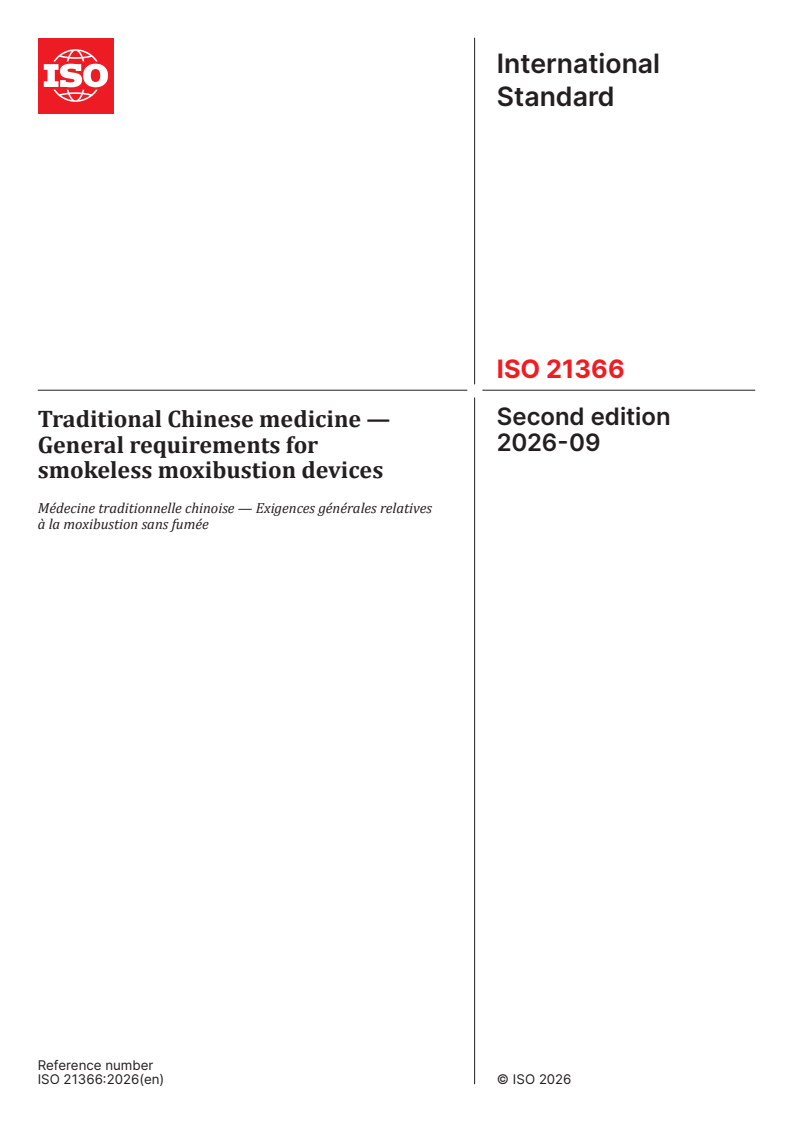
International
Standard
ISO 21366
Second edition
Traditional Chinese medicine —
2026-09
General requirements for
smokeless moxibustion devices
Médecine traditionnelle chinoise — Exigences générales relatives
à la moxibustion sans fumée
Reference number
© ISO 2026
All rights reserved. Unless otherwise specified, or required in the context of its implementation, no part of this publication may
be reproduced or utilized otherwise in any form or by any means, electronic or mechanical, including photocopying, or posting on
the internet or an intranet, without prior written permission. Permission can be requested from either ISO at the address below
or ISO’s member body in the country of the requester.
ISO copyright office
CP 401 • Ch. de Blandonnet 8
CH-1214 Vernier, Geneva
Phone: +41 22 749 01 11
Email: copyright@iso.org
Website: www.iso.org
Published in Switzerland
ii
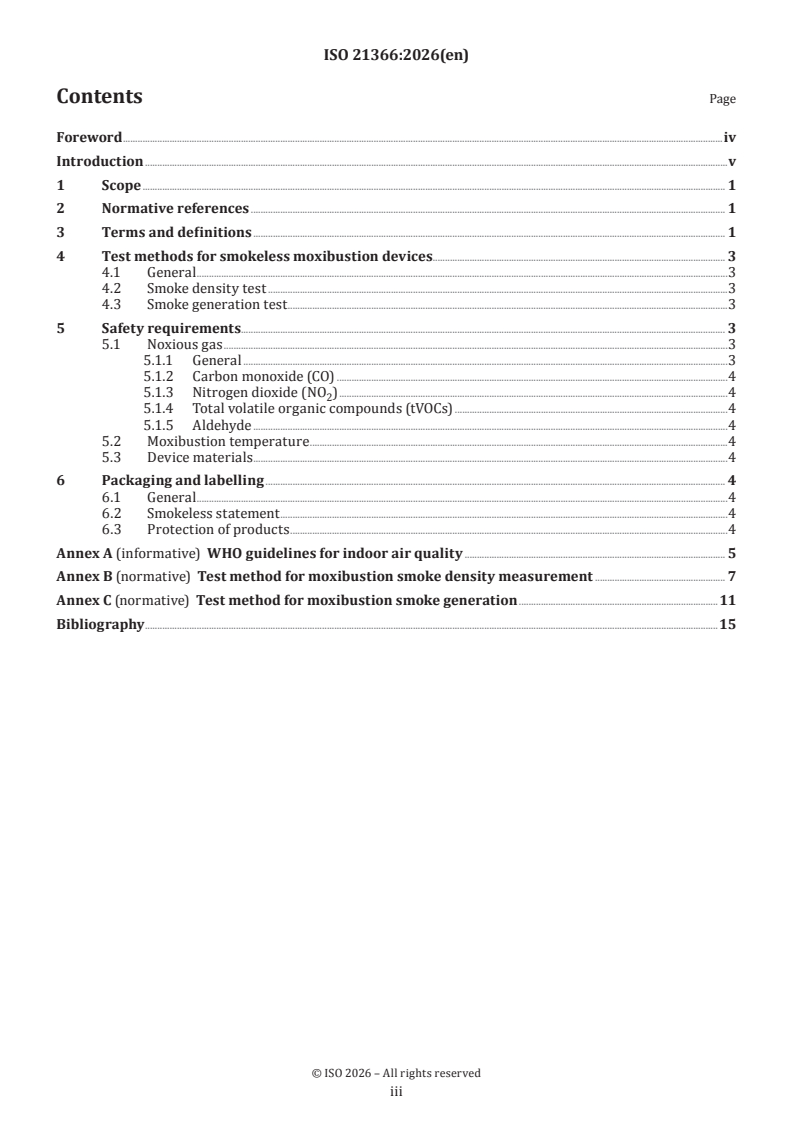
Contents Page
Foreword .iv
Introduction .v
1 Scope . 1
2 Normative references . 1
3 Terms and definitions . 1
4 Test methods for smokeless moxibustion devices . 3
4.1 General .3
4.2 Smoke density test .3
4.3 Smoke generation test .3
5 Safety requirements. 3
5.1 Noxious gas .3
5.1.1 General .3
5.1.2 Carbon monoxide (CO) .4
5.1.3 Nitrogen dioxide (NO ) .4
5.1.4 Total volatile organic compounds (tVOCs) .4
5.1.5 Aldehyde .4
5.2 Moxibustion temperature .4
5.3 Device materials . .4
6 Packaging and labelling . 4
6.1 General .4
6.2 Smokeless statement .4
6.3 Protection of products .4
Annex A (informative) WHO guidelines for indoor air quality . 5
Annex B (normative) Test method for moxibustion smoke density measurement . 7
Annex C (normative) Test method for moxibustion smoke generation .11
Bibliography .15
iii
Foreword
ISO (the International Organization for Standardization) is a worldwide federation of national standards
bodies (ISO member bodies). The work of preparing International Standards is normally carried out through
ISO technical committees. Each member body interested in a subject for which a technical committee
has been established has the right to be represented on that committee. International organizations,
governmental and non-governmental, in liaison with ISO, also take part in the work. ISO collaborates closely
with the International Electrotechnical Commission (IEC) on all matters of electrotechnical standardization.
The procedures used to develop this document and those intended for its further maintenance are described
in the ISO/IEC Directives, Part 1. In particular, the different approval criteria needed for the different types
of ISO documents should be noted. This document was drafted in accordance with the editorial rules of the
ISO/IEC Directives, Part 2 (see www.iso.org/directives).
ISO draws attention to the possibility that the implementation of this document may involve the use of (a)
patent(s). ISO takes no position concerning the evidence, validity or applicability of any claimed patent
rights in respect thereof. As of the date of publication of this document, ISO had not received notice of (a)
patent(s) which may be required to implement this document. However, implementers are cautioned that
this may not represent the latest information, which may be obtained from the patent database available at
www.iso.org/patents. ISO shall not be held responsible for identifying any or all such patent rights.
Any trade name used in this document is information given for the convenience of users and does not
constitute an endorsement.
For an explanation of the voluntary nature of standards, the meaning of ISO specific terms and expressions
related to conformity assessment, as well as information about ISO's adherence to the World Trade
Organization (WTO) principles in the Technical Barriers to Trade (TBT), see www.iso.org/iso/foreword.html.
This document was prepared by Technical Committee ISO/TC 249, Traditional medicine, Subcommittee SC 1,
Traditional Chinese medicine.
This second edition cancels and replaces the first edition (ISO 21366:2019), which has been technically
revised.
The main changes are as follows:
— Changed limit value of smoke density for the statement of 'smokeless' from 200 to 50.
Any feedback or questions on this document should be directed to the user’s national standards body. A
complete listing of these bodies can be found at www.iso.org/members.html.
iv
Introduction
Moxibustion is one of the major traditional medical therapies. Smokeless moxibustion is an emerging form
of the moxibustion therapy. Smokeless moxibustion devices have different forms or are composed of the
materials used in conventional moxibustion without additional materials or processing for their safe use.
The standardization of smokeless moxibustion devices can enhance the efficacy and improve the quality
and safety of moxibustion treatments using smokeless moxibustion devices, especially in regard to
biocompatibility with the human body and indoor air quality.
v
International Standard ISO 21366:2026(en)
Traditional Chinese medicine — General requirements for
smokeless moxibustion devices
1 Scope
This document specifies general requirements for the performance and safety of smokeless moxibustion
devices. It covers smoke density, moxibustion temperature, noxious gas and test methods for smokeless
moxibustion devices.
This document is applicable to any combustion-type device that claims to provide smokeless moxibustion.
This document does not apply to devices that imitate moxibustion, such as electro moxibustion and infrared
moxibustion devices.
2 Normative references
The following documents are referred to in the text in such a way that some or all of their content constitutes
requirements of this document. For dated references, only the edition cited applies. For undated references,
the latest edition of the referenced document (including any amendments) applies.
ISO 2248, Packaging — Complete, filled transport packages — Vertical impact test by dropping
ISO 7240-2, Fire detection and alarm systems — Part 2: Fire detection control and indicating equipment
ISO/TS 7240-9, Fire detection and alarm systems — Part 9: Test fires for fire detectors
ISO 15011-2, Health and safety in welding and allied processes — Laboratory method for sampling fume and
gases — Part 2: Determination of the emission rates of carbon monoxide (CO), carbon dioxide (CO2), nitrogen
monoxide (NO) and nitrogen dioxide (NO2) during arc welding, cutting and gouging
ISO 16000-4, Indoor air — Part 4: Determination of formaldehyde — Diffusive sampling method
ISO 16000-6, Indoor air — Part 6: Determination of organic compounds (VVOC, VOC, SVOC) in indoor and test
chamber air by active sampling on sorbent tubes, thermal desorption and gas chromatography using MS or MS
FID
ISO 18666, Traditional Chinese medicine — General requirements of moxibustion devices
ISO 18666:2021, Traditional Chinese medicine — General requirements of moxibustion devices
ISO 15011-2, Health and safety in welding and allied processes — Laboratory method for sampling fume and
gases — Part 2: Determination of the emission rates of carbon monoxide (CO), carbon dioxide (CO2), nitrogen
monoxide (NO) and nitrogen dioxide (NO2) during arc welding, cutting and gouging
3 Terms and definitions
For the purposes of this document, the following terms and definitions apply.
ISO and IEC maintain terminology databases for use in standardization at the following addresses:
— ISO Online browsing platform: available at https:// www .iso .org/ obp
— IEC Electropedia: available at https:// www .electropedia .org/
3.1
moxibustion device
apparatus that uses moxa floss as the main combustion material and is intended for single or repeated usage
EXAMPLE Moxibustion with tube shape is a type of moxibustion device, such as a short moxa roll with a cardboard
base and a moxa tube (made of cardboard) that is single-use and developed as an alternative to direct moxibustion.
Note 1 to entry: Moxibustion device includes those accessories as defined by the manufacturers that are necessary to
enable the normal use of the moxibustion device.
[1]
[SOURCE: ISO 18666:2021 , 3.1]
3.2
smokeless moxibustion device
variant of the moxibustion device (3.1) designed to reduce the smoke and bad odour caused by combustion by
processing or changing main combustion material from moxa floss
Note 1 to entry: Carbonized moxa floss, carbonized mugwort leaves or other carbonized materials may be used as the
main combustion material.
3.3
aerosol density
smoke density
number of particulates per volume as described operationally by one of two parameters:
— m, an absorbance index, used in the testing of smoke detectors using scattered or transmitted light;
— y, a dimensionless variable, used in the testing of smoke detectors using ionization
Note 1 to entry: These parameters are not concentrations, strictly speaking, but represent values that are proportional
to the concentration and have been shown to function in lieu of a true concentration value for the purposes of these
tests.
[2]
[SOURCE: ISO 7240-1:2025 , 3.5, modified — The order of the terms has been switched so that "smoke
density" is the preferred term.]
3.4
carbon monoxide
CO
gas formed by the combination of one atom of carbon and one atom of oxygen
Note 1 to entry: In its chemical formula, C stands for carbon and O for oxygen. For the purposes of this document, the
CO level is always expressed in terms of mass fraction of CO in air.
[3]
[SOURCE: ISO 12133:2011 , 3.1]
3.5
volatile organic compound
VOC
organic compound where the boiling point is in the range from (50 to 100) °C to (240 to 260) °C
[4]
[SOURCE: ISO 12219-2:2012 , 3.4]
3.6
total volatile organic compound
tVOC
®1)
sum of volatile organic compounds (3.5) sampled on Tenax TA and eluting between and including n-hexane
and n-hexadecane, detected with a flame ionization dete
...