

ISO 22002-7:2025
(Main)Prerequisite programmes on food safety — Part 7: Retail and wholesale
General Information
- Abstract
This document specifies requirements for establishing, implementing and maintaining prerequisite programmes (PRPs) to control food safety hazards in the retail part of the food chain, including wholesalers, food banks and other organizations. This document is applicable to all organizations, regardless of size or complexity. This document does not apply to other parts of the food supply chain. Exclusions to requirements can be supported by a sufficient justification that ensures that the exclusion does not adversely impact food safety.
- Status
- Published
- Publication Date
- 28-Jul-2025
- Technical Committee
- ISO/TC 34/SC 17 - Management systems for food safety
- Drafting Committee
- ISO/TC 34/SC 17 - Management systems for food safety
- Current Stage
- 6060 - International Standard published
- Start Date
- 29-Jul-2025
- Due Date
- 28-Sep-2026
- Completion Date
- 29-Jul-2025
Buy Documents
ISO 22002-7:2025 - Prerequisite programmes on food safety — Part 7: Retail and wholesale Released:29. 07. 2025
ISO 22002-7:2025 - Programmes prérequis pour la sécurité des denrées alimentaires — Partie 7: Commerce de détail et commerce de gros Released:29. 07. 2025
ISO 22002-7:2025 - Prerequisite programmes on food safety — Part 7: Retail and wholesale
Overview
ISO 22002-7:2025 - Prerequisite Programmes on Food Safety - Part 7: Retail and Wholesale provides internationally recognized requirements for establishing, implementing, and maintaining prerequisite programmes (PRPs) that control food safety hazards specifically within the retail and wholesale sectors of the food chain. Published by ISO, this standard applies to organizations of all types and sizes, including supermarkets, wholesalers, food banks, and other food supply outlets. ISO 22002-7:2025 is designed to support food safety management systems that meet the requirements set out in ISO 22000, and it complements other food safety standards to ensure comprehensive protection from food safety risks in food retail and wholesale environments.
Key Topics
ISO 22002-7:2025 covers a comprehensive range of essential topics to provide robust food safety controls in retail and wholesale settings:
- Facility Construction and Layout: Requirements for the physical boundaries, environment, and construction to minimize contamination risks.
- Facility and Workspace Design: Principles for designing internal structures, placing equipment, and organizing storage of food, packaging, and chemicals.
- Utilities Management: Guidelines on water, air, ventilation, and lighting to ensure all utilities are safe and suitable for food environments.
- Pest Control: Procedures for pest monitoring, access prevention, and eradication.
- Waste and Recycling: Methods for effective waste and food loss management, including the handling of waste containers and recycling processes.
- Equipment Suitability and Maintenance: Ensuring all equipment is fit for purpose, maintained, and does not contribute to food contamination.
- Management of Purchased Materials: Control over incoming goods to ensure compliance with food safety requirements.
- Storage, Warehousing, and Transport: Safe storage, dispatch, and transport practices to avoid spoilage or contamination.
- Contamination Prevention Measures: Controls for microbiological, allergenic, physical, and chemical contamination, with emphasis on allergen management and cross-contamination prevention.
- Cleaning and Disinfection: Requirements for cleaning agents, cleaning procedures, and documented sanitation programmes.
- Personal Hygiene and Facilities: Measures covering hygiene facilities, workwear, health status, personnel cleanliness, and management of visitors.
- Product and Consumer Information: Labelling and consumer information for effective traceability and safety communication.
- Food Defence and Fraud: Steps to mitigate intentional adulteration and prevent food fraud.
- Rework Controls: Handling and usage of rework to maintain product integrity and traceability.
- Display Requirements: Proper display, temperature control, product rotation, and monitoring of display equipment.
Applications
ISO 22002-7:2025 is vital for organizations operating in the food retail and wholesale segments, including:
- Supermarkets and Food Retail Outlets: Ensuring safe handling, storage, display, and provision of food to consumers.
- Wholesalers and Food Banks: Safeguarding bulk food handling, distribution, and storage.
- Convenience and Specialty Stores: Providing uniform food safety standards across outlets, both large and small.
By implementing ISO 22002-7:2025, businesses can:
- Enhance Food Safety: Prevent food safety hazards throughout storage, handling, and display.
- Support Regulatory Compliance: Align internal procedures with global food safety standards and regulations.
- Boost Consumer Confidence: Provide safe food products and accurate labelling to earn consumer trust.
- Integrate with ISO 22000 Systems: Seamlessly connect PRPs to their food safety management systems for a holistic approach.
- Enable Scalability: Apply requirements to operations of any scale or complexity.
Related Standards
Organizations seeking alignment and integration with other leading food safety standards should review:
- ISO 22000 - Food safety management systems - Requirements for any organization in the food chain
- ISO 22002-100 - Prerequisite programmes on food safety - Part 100: Requirements for the food, feed, and packaging supply chain
- ISO 20976-1 - Microbiology of the food chain - Challenge tests for food and feed products
- BS/PAS 221:2013 - Prerequisite programmes for food safety in food retail – Specification
- UNI 11890 - Food safety – Validation of operational prerequisite programs
Adopting ISO 22002-7:2025 as part of your food safety management practices not only helps achieve compliance but also promotes a culture of safety, quality, and trust in the food retail and wholesale industries.
Buy Documents
ISO 22002-7:2025 - Prerequisite programmes on food safety — Part 7: Retail and wholesale Released:29. 07. 2025
ISO 22002-7:2025 - Programmes prérequis pour la sécurité des denrées alimentaires — Partie 7: Commerce de détail et commerce de gros Released:29. 07. 2025
ISO 22002-7:2025 - Prerequisite programmes on food safety — Part 7: Retail and wholesale
Get Certified
Connect with accredited certification bodies for this standard

BSI Group
BSI (British Standards Institution) is the business standards company that helps organizations make excellence a habit.

Bureau Veritas
Bureau Veritas is a world leader in laboratory testing, inspection and certification services.

DNV
DNV is an independent assurance and risk management provider.
Sponsored listings
Frequently Asked Questions
ISO 22002-7:2025 is a standard published by the International Organization for Standardization (ISO). Its full title is "Prerequisite programmes on food safety — Part 7: Retail and wholesale". This standard covers: This document specifies requirements for establishing, implementing and maintaining prerequisite programmes (PRPs) to control food safety hazards in the retail part of the food chain, including wholesalers, food banks and other organizations. This document is applicable to all organizations, regardless of size or complexity. This document does not apply to other parts of the food supply chain. Exclusions to requirements can be supported by a sufficient justification that ensures that the exclusion does not adversely impact food safety.
This document specifies requirements for establishing, implementing and maintaining prerequisite programmes (PRPs) to control food safety hazards in the retail part of the food chain, including wholesalers, food banks and other organizations. This document is applicable to all organizations, regardless of size or complexity. This document does not apply to other parts of the food supply chain. Exclusions to requirements can be supported by a sufficient justification that ensures that the exclusion does not adversely impact food safety.
ISO 22002-7:2025 is classified under the following ICS (International Classification for Standards) categories: 67.020 - Processes in the food industry. The ICS classification helps identify the subject area and facilitates finding related standards.
ISO 22002-7:2025 is available in PDF format for immediate download after purchase. The document can be added to your cart and obtained through the secure checkout process. Digital delivery ensures instant access to the complete standard document.
Standards Content (Sample)
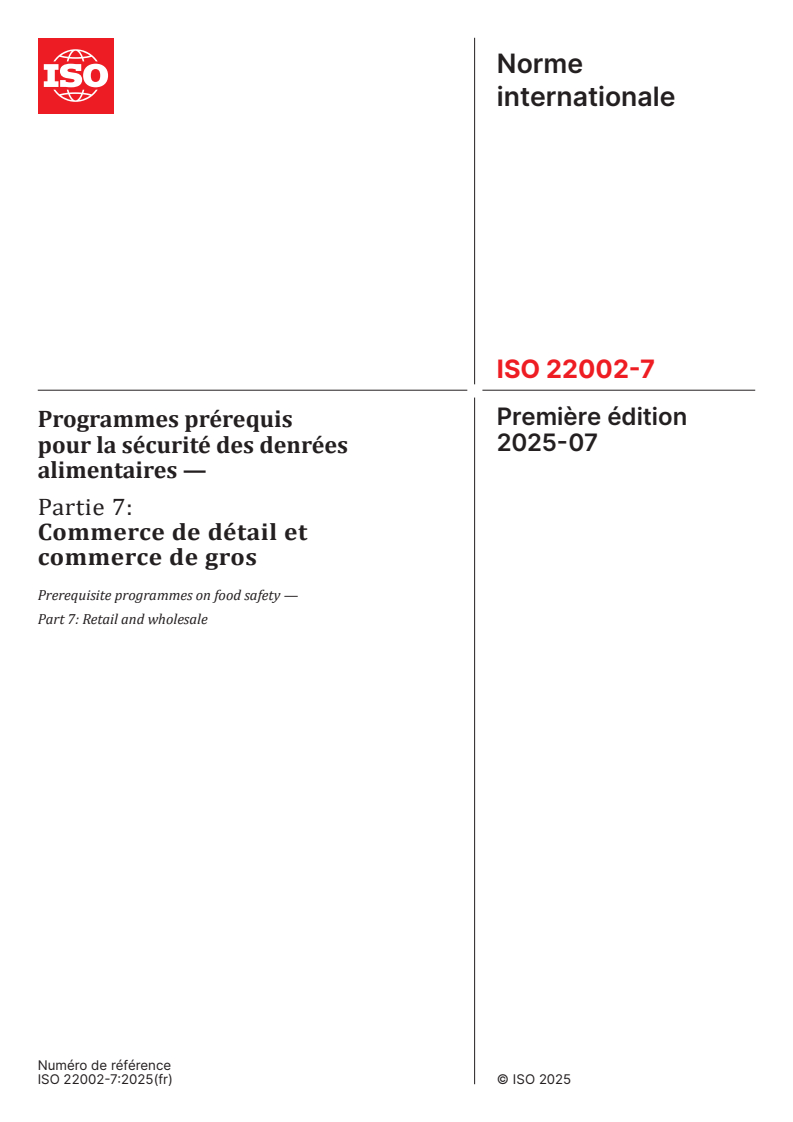
International
Standard
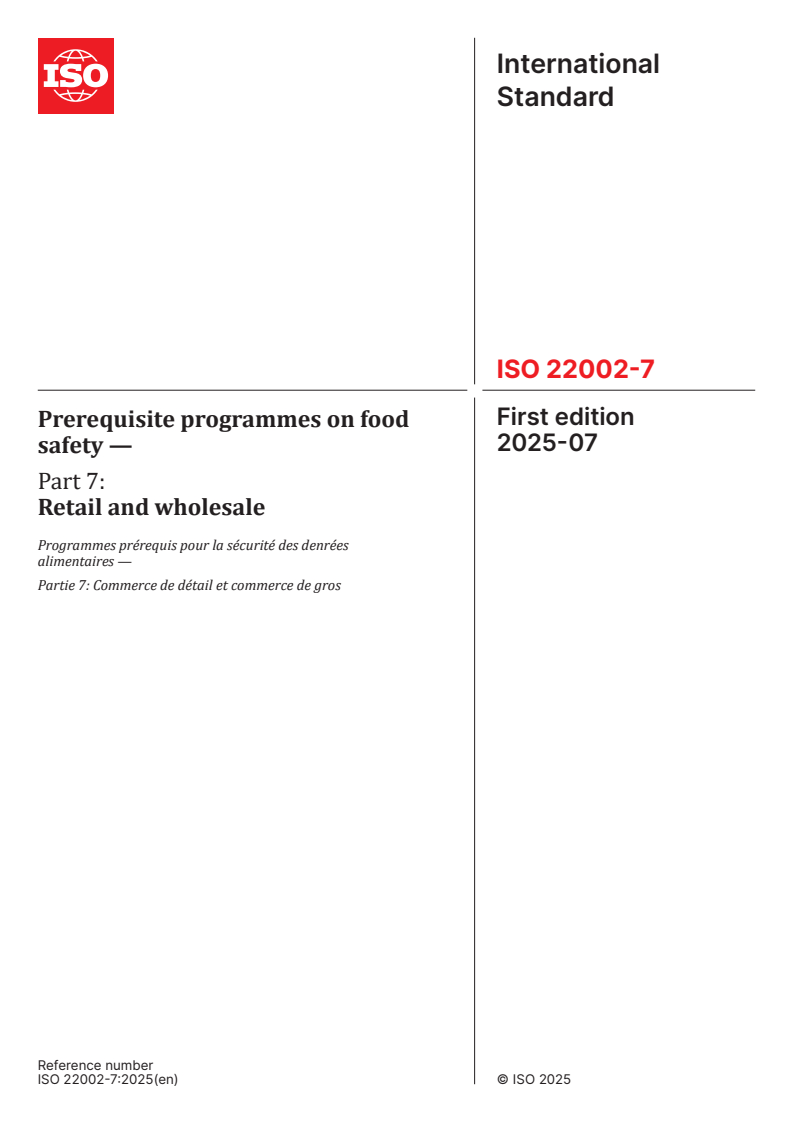
ISO 22002-7
First edition
Prerequisite programmes on food
2025-07
safety —
Part 7:
Retail and wholesale
Programmes prérequis pour la sécurité des denrées
alimentaires —
Partie 7: Commerce de détail et commerce de gros
Reference number
© ISO 2025
All rights reserved. Unless otherwise specified, or required in the context of its implementation, no part of this publication may
be reproduced or utilized otherwise in any form or by any means, electronic or mechanical, including photocopying, or posting on
the internet or an intranet, without prior written permission. Permission can be requested from either ISO at the address below
or ISO’s member body in the country of the requester.
ISO copyright office
CP 401 • Ch. de Blandonnet 8
CH-1214 Vernier, Geneva
Phone: +41 22 749 01 11
Email: copyright@iso.org
Website: www.iso.org
Published in Switzerland
ii
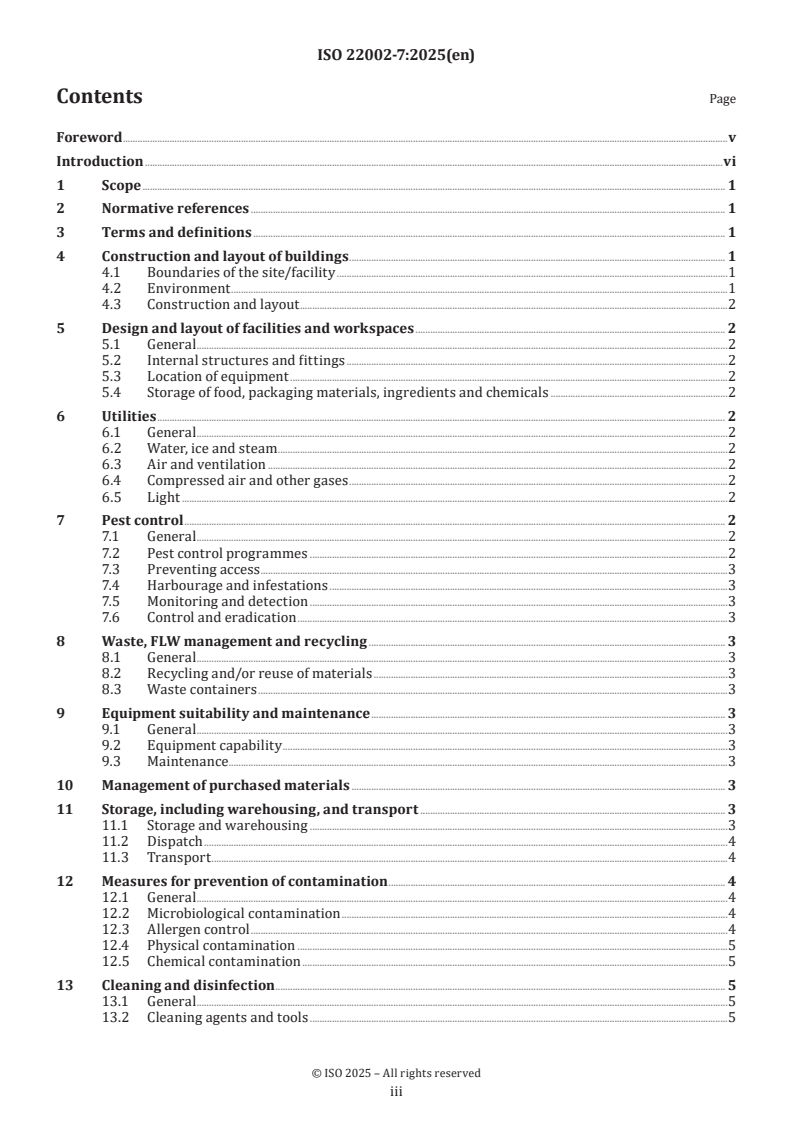
Contents Page
Foreword .v
Introduction .vi
1 Scope . 1
2 Normative references . 1
3 Terms and definitions . 1
4 Construction and layout of buildings . 1
4.1 Boundaries of the site/facility .1
4.2 Environment .1
4.3 Construction and layout .2
5 Design and layout of facilities and workspaces . 2
5.1 General .2
5.2 Internal structures and fittings .2
5.3 Location of equipment .2
5.4 Storage of food, packaging materials, ingredients and chemicals .2
6 Utilities . 2
6.1 General .2
6.2 Water, ice and steam .2
6.3 Air and ventilation .2
6.4 Compressed air and other gases .2
6.5 Light .2
7 Pest control . 2
7.1 General .2
7.2 Pest control programmes .2
7.3 Preventing access .3
7.4 Harbourage and infestations .3
7.5 Monitoring and detection .3
7.6 Control and eradication .3
8 Waste, FLW management and recycling . 3
8.1 General .3
8.2 Recycling and/or reuse of materials .3
8.3 Waste containers .3
9 Equipment suitability and maintenance . 3
9.1 General .3
9.2 Equipment capability .3
9.3 Maintenance .3
10 Management of purchased materials . 3
11 Storage, including warehousing, and transport . 3
11.1 Storage and warehousing .3
11.2 Dispatch .4
11.3 Transport .4
12 Measures for prevention of contamination . 4
12.1 General .4
12.2 Microbiological contamination .4
12.3 Allergen control .4
12.4 Physical contamination .5
12.5 Chemical contamination .5
13 Cleaning and disinfection . 5
13.1 General .5
13.2 Cleaning agents and tools .5
iii
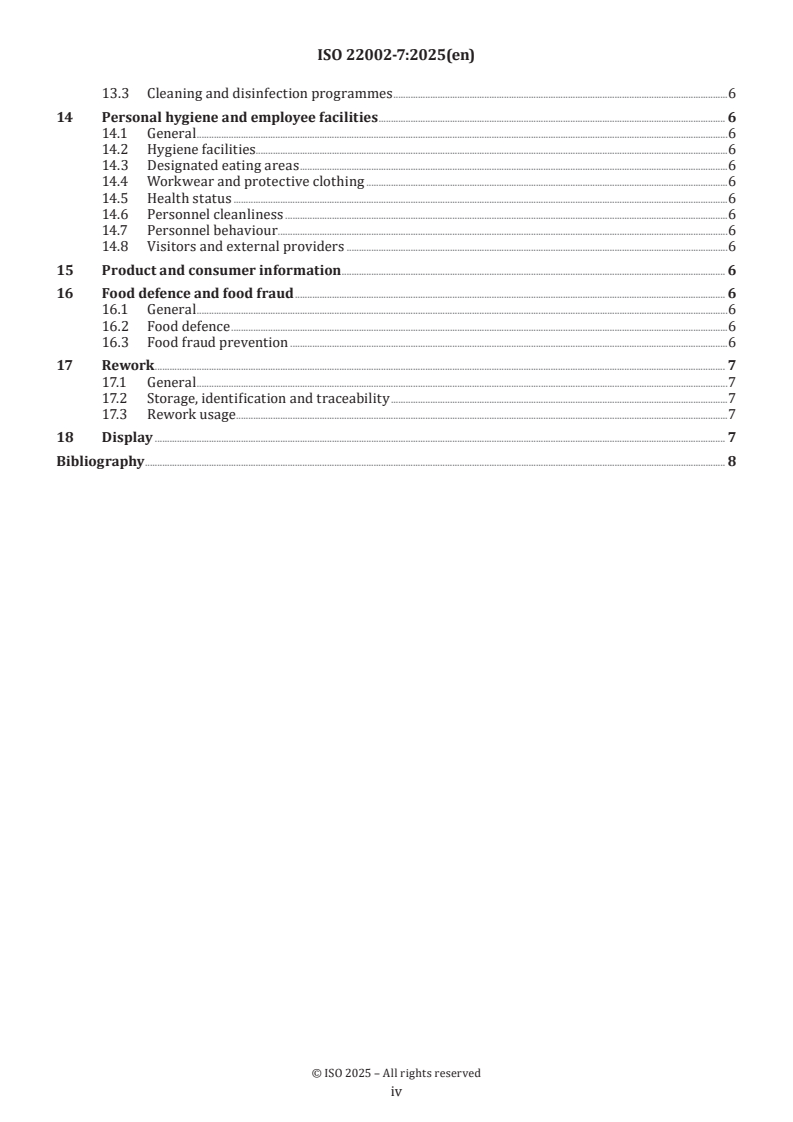
13.3 Cleaning and disinfection programmes .6
14 Personal hygiene and employee facilities . 6
14.1 General .6
14.2 Hygiene facilities.6
14.3 Designated eating areas .6
14.4 Workwear and protective clothing .6
14.5 Health status .6
14.6 Personnel cleanliness .6
14.7 Personnel behaviour . . .6
14.8 Visitors and external providers .6
15 Product and consumer information . 6
16 Food defence and food fraud . 6
16.1 General .6
16.2 Food defence .6
16.3 Food fraud prevention .6
17 Rework . 7
17.1 General .7
17.2 Storage, identification and traceability .7
17.3 Rework usage .7
18 Display . 7
Bibliography . 8
iv
Foreword
ISO (the International Organization for Standardization) is a worldwide federation of national stand
...
Norme
internationale
ISO 22002-7
Première édition
Programmes prérequis
2025-07
pour la sécurité des denrées
alimentaires —
Partie 7:
Commerce de détail et
commerce de gros
Prerequisite programmes on food safety —
Part 7: Retail and wholesale
Numéro de référence
DOCUMENT PROTÉGÉ PAR COPYRIGHT
© ISO 2025
Tous droits réservés. Sauf prescription différente ou nécessité dans le contexte de sa mise en œuvre, aucune partie de cette
publication ne peut être reproduite ni utilisée sous quelque forme que ce soit et par aucun procédé, électronique ou mécanique,
y compris la photocopie, ou la diffusion sur l’internet ou sur un intranet, sans autorisation écrite préalable. Une autorisation peut
être demandée à l’ISO à l’adresse ci-après ou au comité membre de l’ISO dans le pays du demandeur.
ISO copyright office
Case postale 401 • Ch. de Blandonnet 8
CH-1214 Vernier, Genève
Tél.: +41 22 749 01 11
E-mail: copyright@iso.org
Web: www.iso.org
Publié en Suisse
ii
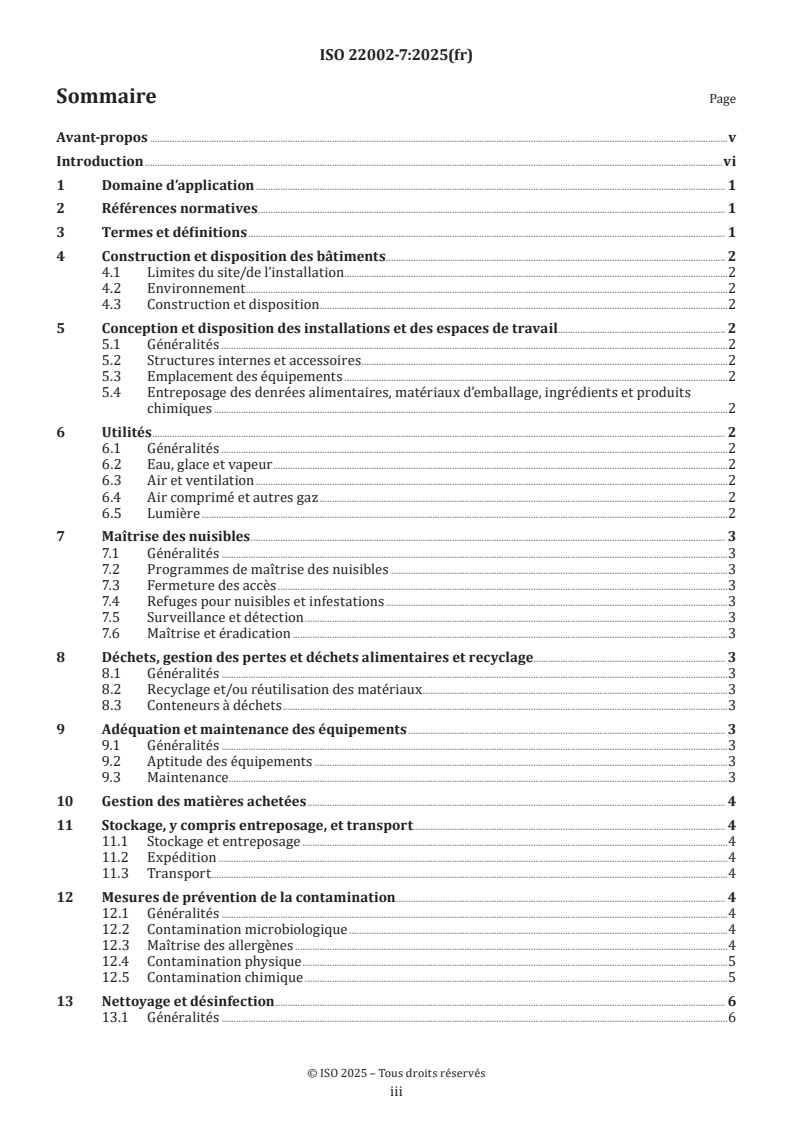
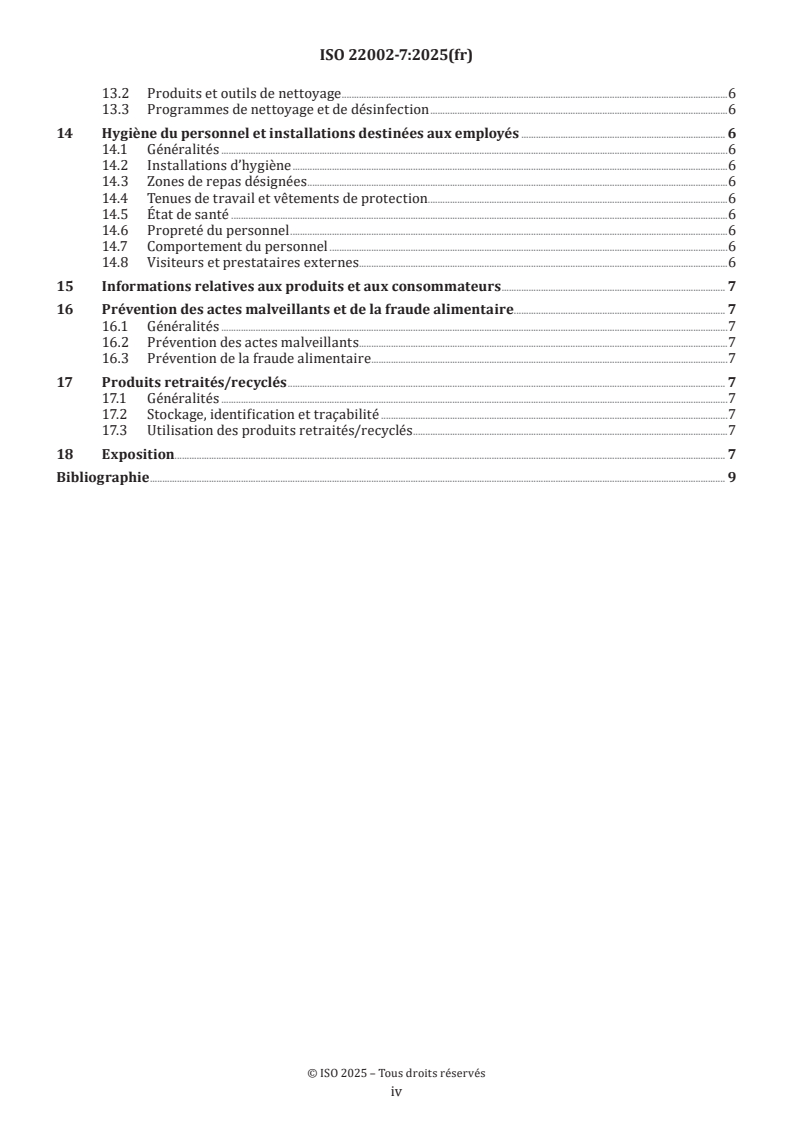
Sommaire Page
Avant-propos .v
Introduction .vi
1 Domaine d’application . 1
2 Références normatives . 1
3 Termes et définitions . 1
4 Construction et disposition des bâtiments . 2
4.1 Limites du site/de l’installation .2
4.2 Environnement .2
4.3 Construction et disposition .2
5 Conception et disposition des installations et des espaces de travail . 2
5.1 Généralités .2
5.2 Structures internes et accessoires .2
5.3 Emplacement des équipements .2
5.4 Entreposage des denrées alimentaires, matériaux d’emballage, ingrédients et produits
chimiques .2
6 Utilités . 2
6.1 Généralités .2
6.2 Eau, glace et vapeur .2
6.3 Air et ventilation .2
6.4 Air comprimé et autres gaz .2
6.5 Lumière .2
7 Maîtrise des nuisibles . 3
7.1 Généralités .3
7.2 Programmes de maîtrise des nuisibles .3
7.3 Fermeture des accès .3
7.4 Refuges pour nuisibles et infestations .3
7.5 Surveillance et détection .3
7.6 Maîtrise et éradication .3
8 Déchets, gestion des pertes et déchets alimentaires et recyclage. 3
8.1 Généralités .3
8.2 Recyclage et/ou réutilisation des matériaux .3
8.3 Conteneurs à déchets .3
9 Adéquation et maintenance des équipements . 3
9.1 Généralités .3
9.2 Aptitude des équipements .3
9.3 Maintenance .3
10 Gestion des matières achetées . 4
11 Stockage, y compris entreposage, et transport . 4
11.1 Stockage et entreposage .4
11.2 Expédition .4
11.3 Transport .4
12 Mesures de prévention de la contamination . 4
12.1 Généralités .4
12.2 Contamination microbiologique .4
12.3 Maîtrise des allergènes .4
12.4 Contamination physique .5
12.5 Contamination chimique .5
13 Nettoyage et désinfection . 6
13.1 Généralités .6
iii
13.2 Produits et outils de nettoyage .6
13.3 Programmes de nettoyage et de désinfection .6
14 Hygiène du personnel et installations destinées aux employés . 6
14.1 Généralités .6
14.2 Installations d’hygiène .6
14.3 Zones de repas désignées .6
14.4 Tenues de travail et vêtements de protection . .6
14.5 État de santé .6
14.6 Propreté du personnel .6
14.7 Comportement du personnel .6
14.8 Visiteurs et prestataires externes .6
15 Informations relatives aux produits et aux consommateurs . 7
16 Prévention des actes malveillants et de la fraude alimentaire . 7
16.1 Généralités .7
16.2 Prévention des actes malveillants .7
16.3 Prévention de la fraude alimentaire . .7
17 Produits retraités/recyclés . 7
17.1 Généralités .7
17.2 Stockage, identification et traçabilité .7
17.3 Utilisation des produits retraités/recyclés .7
18 Exposition. 7
Bibliographie . 9
iv
Avant-propos
L’ISO (Organisation internationale de normalisation) est une fédération mondiale d’organismes nationaux
de normalisation (comités membres de l’ISO). L’élaboration des Normes internationales est en général
confiée aux comités techniques de l’ISO. Chaque comité membre intéressé par une étude a le droit de faire
partie du comité technique créé à cet effet. Les organisations internationales, gouvernementales et non
gouvernementales, en liaison avec l’ISO participent également aux travaux. L’ISO collabore étroitement avec
la Commission électrotechnique internationale (IEC) en ce qui concerne la normalisation électrotechnique.
Les procédures utilisées pour élaborer le présent document et celles destinées à sa mise à jour sont
décrites dans les Directives ISO/IEC, Partie 1. Il convient, en particulier, de prendre note des différents
critères d’approbation requis pour les différents types de documents ISO. Le présent document a
été rédigé conformément aux règles de rédaction données dans les Directives ISO/IEC, Partie 2 (voir
www.iso.org/directives).
L’ISO attire l’attention sur le fait que la mise en application du présent document peut entraîner l’utilisation
d’un ou de plusieurs brevets. L’ISO ne prend pas position quant à la preuve, à la validité et à l’applicabilité de
tout droit de brevet revendiqué à cet égard. À la date de publication du présent document, l’ISO n’avait pas
reçu notification qu’un ou plusieurs brevets pouvaient être nécessaires à sa mise en application. Toutefois,
il y a lieu d’avertir les responsables de la mise en application du présent document que des informations
plus récentes sont susceptibles de figurer dans la base de données de brevets, disponible à l’adresse
www.iso.org/brevets. L’ISO ne saurait être tenue pour responsable de ne pas avoir identifié tout ou partie de
tels droits de propriété.
Les appellations commerciales éventuellement mentionnées dans le présent document sont données pour
information, par souci de commodité, à l’intention des utilisateurs et ne sauraient constituer un engagement.
Pour une explication de la nature volontaire des normes, la signification des termes et expressions
spécifiques de l’ISO liés à l’évaluation de la conformité, ou pour toute information au sujet de l’adhésion de
l’ISO aux principes de l’Organisation mondiale du commerce (OMC) concernant les obstacles techniques au
commerce (OTC), voir www.iso.org/avant-propos.
Le présent document a été élaboré par le comité technique ISO/T
...
Norma Internacional
ISO 22002-7
Primera edición
Programas de prerrequisitos para
2025-07
la inocuidad de los alimentos —
Parte 7:
Venta al por menor y al por mayor
Prerequisite programmes on food safety —
Part 7: Retail and wholesale
Publicado por la Secretaría Central de ISO en Ginebra, Suiza,
como traducción oficial en español avalada por el Translation
Management Group, que ha certificado la conformidad en
relación con las versiones inglesa y francesa.
Número de referencia
DOCUMENTO PROTEGIDO POR COPYRIGHT
© ISO 2025
Todos los derechos reservados. Salvo que se especifique de otra manera o se requiera en el contexto de su implementación, no
puede reproducirse ni utilizarse ninguna parte de esta publicación bajo ninguna forma y por ningún medio, electrónico o mecánico,
incluidos el fotocopiado, o la publicación en Internet o una Intranet, sin la autorización previa por escrito. La autorización puede
solicitarse a ISO en la siguiente dirección o al organismo miembro de ISO en el país del solicitante.
ISO copyright office
CP 401 • Ch. de Blandonnet 8
CH-1214 Vernier, Geneva
Phone: +41 22 749 01 11
Email: copyright@iso.org
Website: www.iso.org
Publicado en Suiza
Versión en español publicada en 2026
Traducción oficial
ii
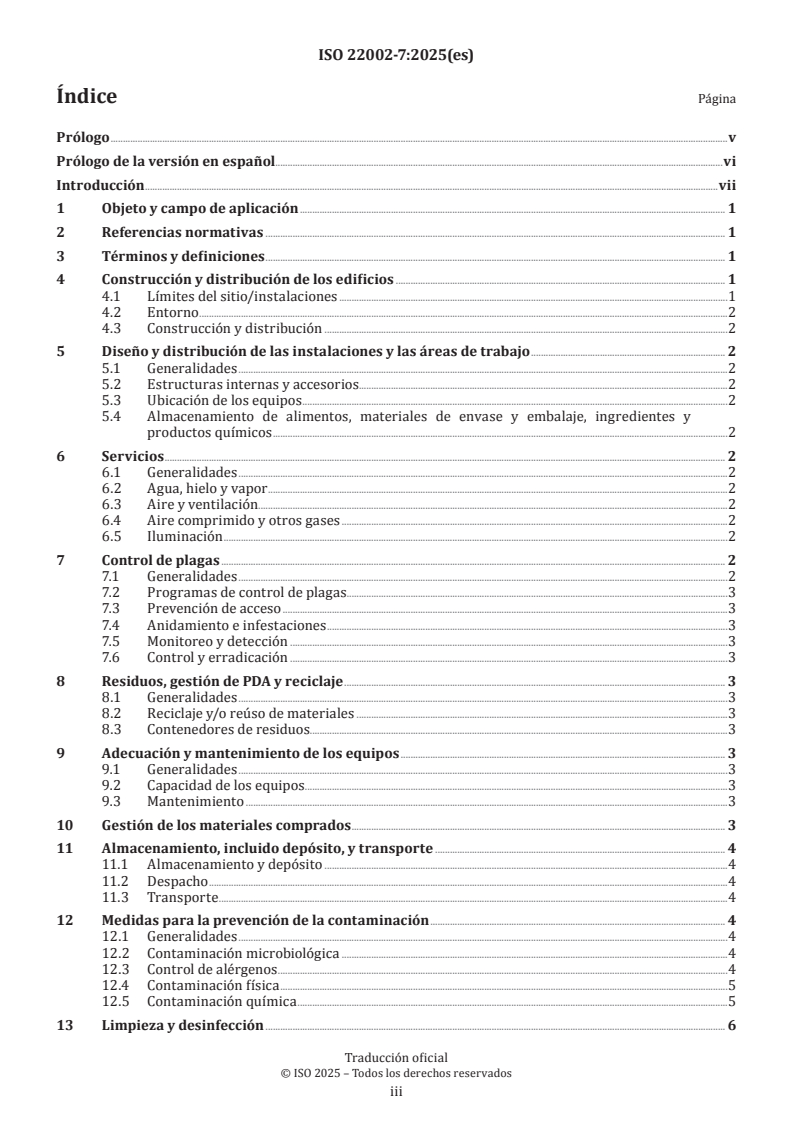
Índice Página
Prólogo .v
Prólogo de la versión en español.vi
Introducción .vii
1 Objeto y campo de aplicación . 1
2 Referencias normativas . 1
3 Términos y definiciones . 1
4 Construcción y distribución de los edificios . 1
4.1 Límites del sitio/instalaciones .1
4.2 Entorno .2
4.3 Construcción y distribución .2
5 Diseño y distribución de las instalaciones y las áreas de trabajo . 2
5.1 Generalidades .2
5.2 Estructuras internas y accesorios .2
5.3 Ubicación de los equipos .2
5.4 Almacenamiento de alimentos, materiales de envase y embalaje, ingredientes y
productos químicos .2
6 Servicios . 2
6.1 Generalidades .2
6.2 Agua, hielo y vapor .2
6.3 Aire y ventilación .2
6.4 Aire comprimido y otros gases .2
6.5 Iluminación .2
7 Control de plagas . 2
7.1 Generalidades .2
7.2 Programas de control de plagas.3
7.3 Prevención de acceso .3
7.4 Anidamiento e infestaciones .3
7.5 Monitoreo y detección .3
7.6 Control y erradicación .3
8 Residuos, gestión de PDA y reciclaje . 3
8.1 Generalidades .3
8.2 Reciclaje y/o reúso de materiales .3
8.3 Contenedores de residuos.3
9 Adecuación y mantenimiento de los equipos . 3
9.1 Generalidades .3
9.2 Capacidad de los equipos .3
9.3 Mantenimiento .3
10 Gestión de los materiales comprados . 3
11 Almacenamiento, incluido depósito, y transporte . 4
11.1 Almacenamiento y depósito .4
11.2 Despacho .4
11.3 Transporte .4
12 Medidas para la prevención de la contaminación . 4
12.1 Generalidades .4
12.2 Contaminación microbiológica .4
12.3 Control de alérgenos .4
12.4 Contaminación física .5
12.5 Contaminación química .5
13 Limpieza y desinfección . 6
Traducción oficial
iii
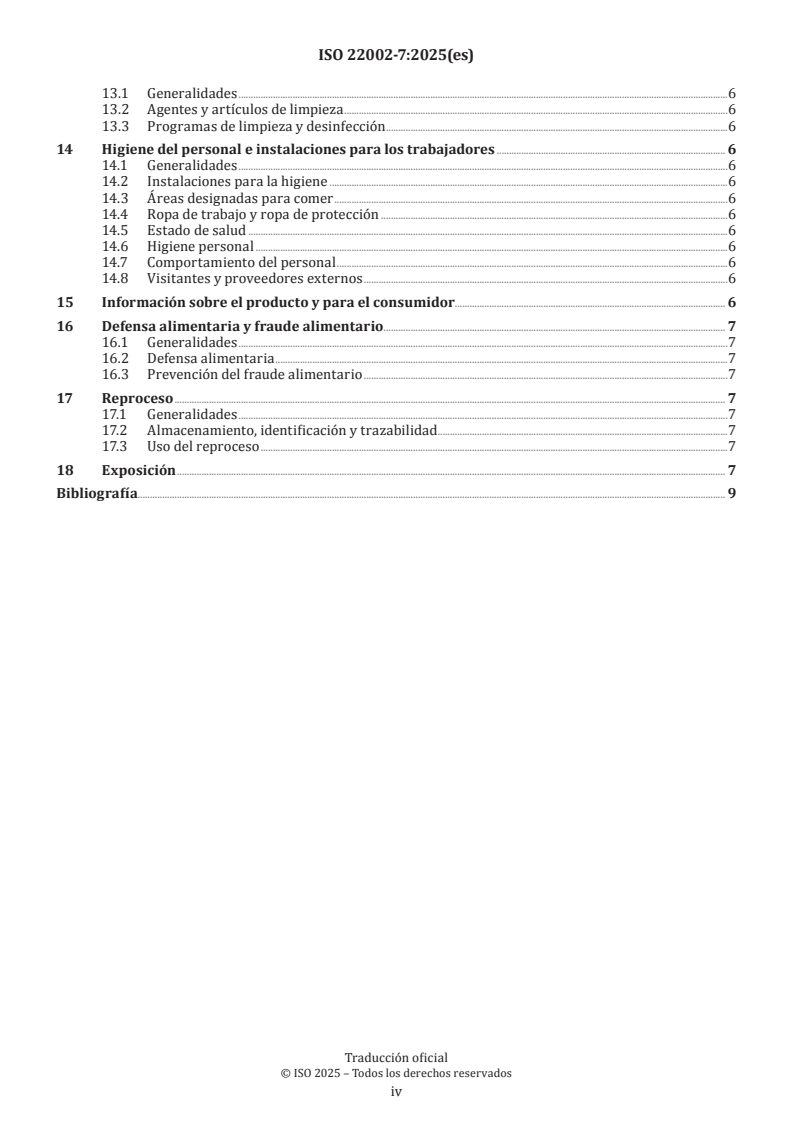
13.1 Generalidades .6
13.2 Agentes y artículos de limpieza .6
13.3 Programas de limpieza y desinfección .6
14 Higiene del personal e instalaciones para los trabajadores . 6
14.1 Generalidades .6
14.2 Instalaciones para la higiene .6
14.3 Áreas designadas para comer .6
14.4 Ropa de trabajo y ropa de protección .6
14.5 Estado de salud .6
14.6 Higiene personal .6
14.7 Comportamiento del personal .6
14.8 Visitantes y proveedores externos .6
15 Información sobre el producto y para el consumidor . 6
16 Defensa alimentaria y fraude alimentario . 7
16.1 Generalidades .7
16.2 Defensa alimentaria .7
16.3 Prevención del fraude alimentario .7
17 Reproceso . 7
17.1 Generalidades .7
17.2 Almacenamiento, identificación y trazabilidad .7
17.3 Uso del reproceso .7
18 Exposición . 7
Bibliografía. 9
Traducción oficial
iv
Prólogo
ISO (Organización Internacional de Normalización) es una federación mundial de organismos nacionales
de normalización (organismos miembros de ISO). El trabajo de elaboración de las Normas Internacionales
se lleva a cabo normalmente a través de los comités técnicos de ISO. Cada organismo miembro interesado
en una materia para la cual se haya establecido un comité técnico, tiene el derecho de estar representado
en dicho comité. Las organizaciones internacionales, gubernamentales y no gubernamentales, vinculadas
con ISO, también participan en el trabajo. ISO colabora estrechamente con la Comisión Electrotécnica
Internacional (IEC) en todos los temas de normalización electrotécnica.
En la Parte 1 de las Directivas ISO/IEC se describen los procedimientos utilizados para desarrollar este
documento y aquellos previstos para su mantenimiento posterior. En particular debería tomarse nota de los
diferentes criterios de aprobación necesarios para los distintos tipos de documentos ISO. Este documento
ha sido redactado de acuerdo con las reglas editoriales de la Parte 2 de las Directivas ISO/IEC (véase
www.iso.org/directives).
ISO llama la atención sobre la posibilidad de que la implementación de este documento pueda conllevar el uso
de una o varias patentes. ISO no se posiciona respecto a la evidencia, validez o aplicabilidad de los derechos
de patente reivindicados. A la fecha de publicación de este documento, ISO no había recibido notificación
de que una o varias patentes pudieran ser necesarias para su implementación. No obstante, se advierte a
los usuarios que esta puede no ser la información más reciente, la cual puede obtenerse de la base de datos
de patentes disponible en www.iso.org/patents. ISO no será responsable de la identificación de parte o la
totalidad de dichos derechos de patente.
Cualquier nombre comercial utilizado en este documento es información que se proporciona para comodidad
del usuario y no constituye una recomendación.
Para una explicación de la naturaleza voluntaria de las normas, el significado de los términos específicos de
ISO y las expresiones relacionadas con la evaluación
...