

ISO 21863:2020
(Main)Water quality — Determination of alkylmercury compounds in water — Method using gas chromatography-mass spectrometry (GC-MS) after phenylation and solvent extraction
General Information
- Abstract
This document specifies a method for the determination of alkylmercury compounds in filtered water samples by gas chromatography-mass spectrometry after phenylation and solvent extraction. This method is applicable to determination of individual methylmercury (MeHg) and ethylmercury (EtHg) compounds in surface water and waste water. The method can be applied to samples containing 0,2 μg/l to 10 μg/l of each compound as mercury mass. Depending on the matrix, the method may also be applicable to higher concentrations after suitable dilution of the sample or reduction in sample size.
- Status
- Published
- Publication Date
- 19-Nov-2020
- Technical Committee
- ISO/TC 147/SC 2 - Physical, chemical and biochemical methods
- Drafting Committee
- ISO/TC 147/SC 2 - Physical, chemical and biochemical methods
- Current Stage
- 9093 - International Standard confirmed
- Start Date
- 01-Apr-2026
- Completion Date
- 29-Aug-2026
Buy Documents


ISO 21863:2020 - Water quality -- Determination of alkylmercury compounds in water -- Method using gas chromatography-mass spectrometry (GC-MS) after phenylation and solvent extraction
ISO 21863:2020 - Water quality — Determination of alkylmercury compounds in water — Method using gas chromatography-mass spectrometry (GC-MS) after phenylation and solvent extraction/20/2020
Overview
ISO 21863:2020 specifies a validated analytical method for the determination of alkylmercury compounds in filtered water samples using gas chromatography–mass spectrometry (GC‑MS) after derivatization by phenylation and solvent extraction. The procedure targets individual methylmercury (MeHg) and ethylmercury (EtHg) in surface water and wastewater and is applicable to concentrations from 0.2 μg/L to 10 μg/L (as mercury mass), with dilution or sample-size adjustment for higher levels. The standard supports water‑quality monitoring and regulatory compliance efforts related to mercury pollution and the Minamata Convention on Mercury.
Key topics and technical requirements
- Scope and matrices: Filtered surface water and wastewater; determination of MeHg and EtHg.
- Derivatization (phenylation): Alkylmercury compounds are phenylated using sodium tetraphenylborate (recommended solution density ~20 g/L) at pH 5.0 (acetate buffer) to form volatile phenylated derivatives suitable for GC.
- Solvent extraction: Liquid–liquid extraction into toluene, dehydration of extracts, and preparation for GC‑MS analysis.
- Instrumental analysis: Gas chromatography coupled with mass spectrometry (GC‑MS) for separation and identification; guidance on optimization, identification, and blank/carry‑over checks.
- Quantification and quality control: Use of an internal standard, calibration (internal standardization), spike‑recovery tests, performance checks, and statistical evaluation of calibration and results.
- Interferences and sampling precautions: Potential interferences from organosulfur compounds (e.g., L‑cysteine), high salt or particulate loads (which may precipitate tetraphenylborate), and GC co‑eluting compounds. Use only fluoropolymer or borosilicate glass containers to prevent mercury loss or contamination.
- Annexes: Informative annexes provide example GC‑MS operating conditions, mass spectra, alternative derivatizing agent (sodium tetrapropylborate), alternative detector (GC‑AFS), and performance data.
Applications and who uses it
- Environmental laboratories performing water quality monitoring for alkylmercury (MeHg/EtHg).
- Regulatory agencies enforcing effluent and environmental standards related to mercury.
- Research institutions studying mercury speciation, biogeochemical cycling, and contaminant transport.
- Industrial facilities tracking wastewater discharges to meet best‑available‑techniques and compliance obligations under the Minamata Convention.
Keywords: ISO 21863:2020, alkylmercury, methylmercury, ethylmercury, GC‑MS, phenylation, solvent extraction, water quality, wastewater analysis, mercury speciation.
Related standards
- ISO 3696 (water for analytical laboratory use)
- ISO 5667 series (water sampling and preservation)
- ISO 8466‑1 (calibration and evaluation of analytical methods)
Buy Documents
ISO 21863:2020 - Water quality -- Determination of alkylmercury compounds in water -- Method using gas chromatography-mass spectrometry (GC-MS) after phenylation and solvent extraction
ISO 21863:2020 - Water quality — Determination of alkylmercury compounds in water — Method using gas chromatography-mass spectrometry (GC-MS) after phenylation and solvent extraction/20/2020
Get Certified
Connect with accredited certification bodies for this standard

CIS Institut d.o.o.
Personal Protective Equipment (PPE) certification body. Notified Body NB-2890 for EU Regulation 2016/425 PPE.

Kiwa BDA Testing
Building and construction product certification.
Kmetijski inštitut Slovenije
Agricultural Institute of Slovenia. Soil testing, plant health, agricultural product analysis.
Sponsored listings
Frequently Asked Questions
ISO 21863:2020 is a standard published by the International Organization for Standardization (ISO). Its full title is "Water quality — Determination of alkylmercury compounds in water — Method using gas chromatography-mass spectrometry (GC-MS) after phenylation and solvent extraction". This standard covers: This document specifies a method for the determination of alkylmercury compounds in filtered water samples by gas chromatography-mass spectrometry after phenylation and solvent extraction. This method is applicable to determination of individual methylmercury (MeHg) and ethylmercury (EtHg) compounds in surface water and waste water. The method can be applied to samples containing 0,2 μg/l to 10 μg/l of each compound as mercury mass. Depending on the matrix, the method may also be applicable to higher concentrations after suitable dilution of the sample or reduction in sample size.
This document specifies a method for the determination of alkylmercury compounds in filtered water samples by gas chromatography-mass spectrometry after phenylation and solvent extraction. This method is applicable to determination of individual methylmercury (MeHg) and ethylmercury (EtHg) compounds in surface water and waste water. The method can be applied to samples containing 0,2 μg/l to 10 μg/l of each compound as mercury mass. Depending on the matrix, the method may also be applicable to higher concentrations after suitable dilution of the sample or reduction in sample size.
ISO 21863:2020 is classified under the following ICS (International Classification for Standards) categories: 13.060.50 - Examination of water for chemical substances. The ICS classification helps identify the subject area and facilitates finding related standards.
ISO 21863:2020 is available in PDF format for immediate download after purchase. The document can be added to your cart and obtained through the secure checkout process. Digital delivery ensures instant access to the complete standard document.
Standards Content (Sample)
INTERNATIONAL ISO
STANDARD 21863
First edition
2020-11
Water quality — Determination of
alkylmercury compounds in water —
Method using gas chromatography-
mass spectrometry (GC-MS) after
phenylation and solvent extraction
Qualité de l'eau — Détermination des composés alkyl mercure dans
l'eau — Méthode par chromatographie gazeuse et spectrométrie de
masse (CG-SM) après phénylation et extraction par solvant
Reference number
©
ISO 2020
© ISO 2020
All rights reserved. Unless otherwise specified, or required in the context of its implementation, no part of this publication may
be reproduced or utilized otherwise in any form or by any means, electronic or mechanical, including photocopying, or posting
on the internet or an intranet, without prior written permission. Permission can be requested from either ISO at the address
below or ISO’s member body in the country of the requester.
ISO copyright office
CP 401 • Ch. de Blandonnet 8
CH-1214 Vernier, Geneva
Phone: +41 22 749 01 11
Email: copyright@iso.org
Website: www.iso.org
Published in Switzerland
ii © ISO 2020 – All rights reserved
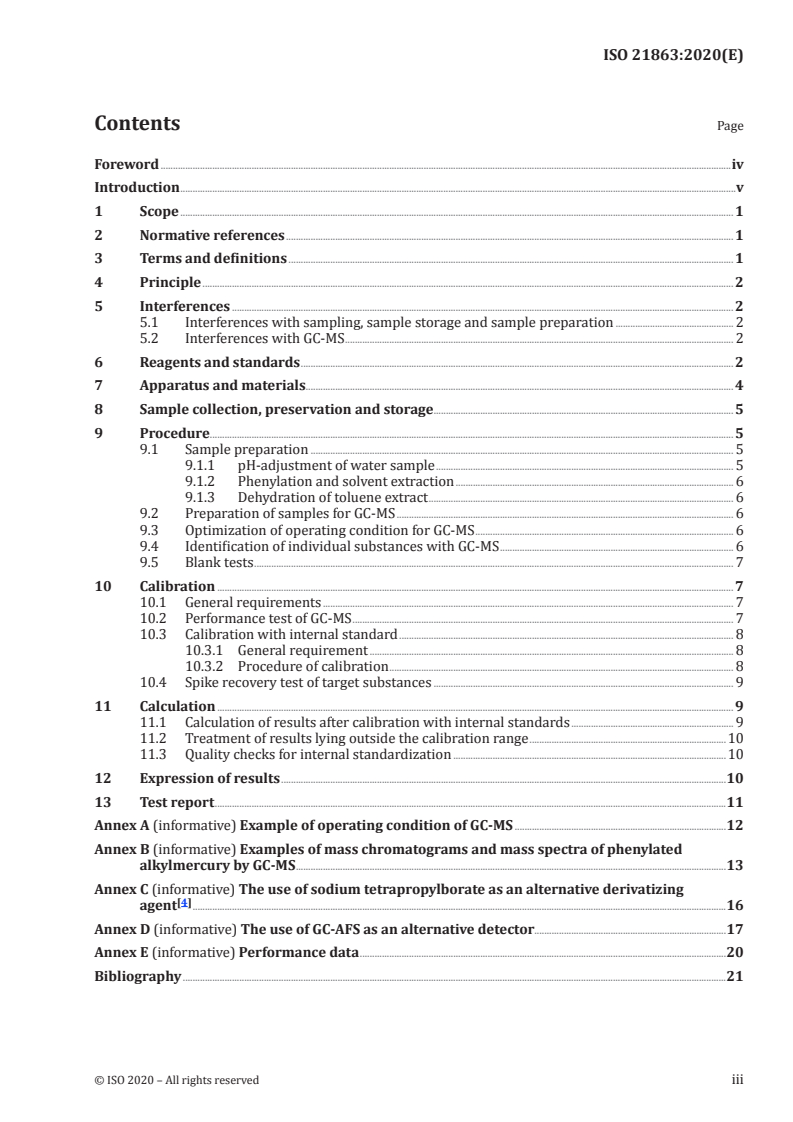
Contents Page
Foreword .iv
Introduction .v
1 Scope . 1
2 Normative references . 1
3 Terms and definitions . 1
4 Principle . 2
5 Interferences . 2
5.1 Interferences with sampling, sample storage and sample preparation . 2
5.2 Interferences with GC-MS . 2
6 Reagents and standards . 2
7 Apparatus and materials. 4
8 Sample collection, preservation and storage. 5
9 Procedure. 5
9.1 Sample preparation . 5
9.1.1 pH-adjustment of water sample . 5
9.1.2 Phenylation and solvent extraction . 6
9.1.3 Dehydration of toluene extract . 6
9.2 Preparation of samples for GC-MS . 6
9.3 Optimization of operating condition for GC-MS . 6
9.4 Identification of individual substances with GC-MS . 6
9.5 Blank tests . 7
10 Calibration . 7
10.1 General requirements . 7
10.2 Performance test of GC-MS . 7
10.3 Calibration with internal standard . 8
10.3.1 General requirement . 8
10.3.2 Procedure of calibration . 8
10.4 Spike recovery test of target substances . 9
11 Calculation . 9
11.1 Calculation of results after calibration with internal standards . 9
11.2 Treatment of results lying outside the calibration range .10
11.3 Quality checks for internal standardization .10
12 Expression of results .10
13 Test report .11
Annex A (informative) Example of operating condition of GC-MS .12
Annex B (informative) Examples of mass chromatograms and mass spectra of phenylated
alkylmercury by GC-MS .13
Annex C (informative) The use of sodium tetrapropylborate as an alternative derivatizing
[4]
agent .16
Annex D (informative) The use of GC-AFS as an alternative detector .17
Annex E (informative) Performance data .20
Bibliography .21
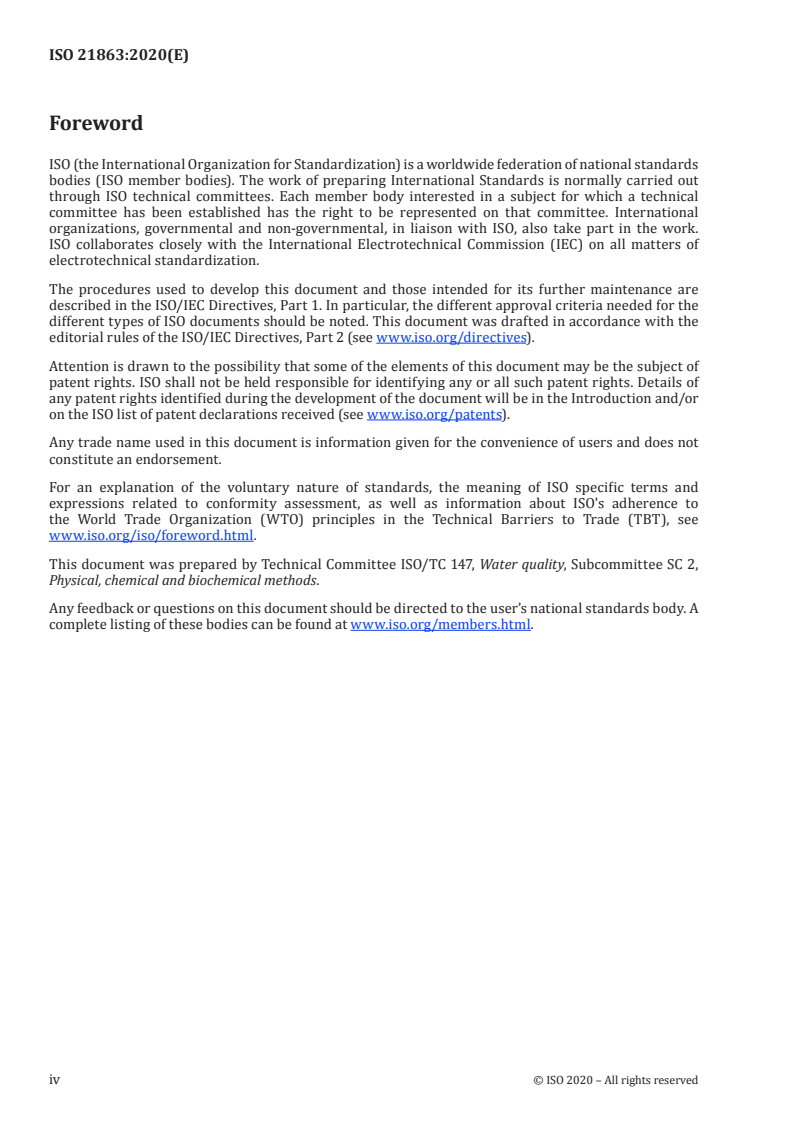
Foreword
ISO (the International Organization for Standardization) is a worldwide federation of national standards
bodies (ISO member bodies). The work of preparing International Standards is normally carried out
through ISO technical committees. Each member body interested in a subject for which a technical
committee has been established has the right to be represented on that committee. International
organizations, governmental and non-governmental, in liaison with ISO, also take part in the work.
ISO collaborates closely with the International Electrotechnical Commission (IEC) on all matters of
electrotechnical standardization.
The procedures used to develop this document and those intended for its further maintenance are
described in the ISO/IEC Directives, Part 1. In particular, the different approval criteria needed for the
different types of ISO documents should be noted. This document was drafted in accordance with the
editorial rules of the ISO/IEC Directives, Part 2 (see www .iso .org/ directives).
Attention is drawn to the possibility that some of the elements of this document may be the subject of
patent rights. ISO shall not be held responsible for identifying any or all such patent rights. Details of
any patent rights identified during the development of the document will be in the Introduction and/or
on the ISO list of patent declarations received (see www .iso .org/ patents).
Any trade name used in this document is information given for the convenience of users and does not
constitute an endorsement.
For an explanation of the voluntary nature of standards, the meaning of ISO specific terms and
expressions related to conformity assessment, as well as information about ISO's adherence to
the World Trade Organization (WTO) principles in the Technical Barriers to Trade (TBT), see
www .iso .org/ iso/ foreword .html.
This document was prepared by Technical Committee ISO/TC 147, Water quality, Subcommittee SC 2,
Physical, chemical and biochemical methods.
Any feedback or questions on this document should be directed to the user’s national standards body. A
complete listing of these bodies can be found at www .iso .org/ members .html.
iv © ISO 2020 – All rights reserved
Introduction
This document specifies a method for the determination of alkylmercury compounds in water by gas
chromatography-mass spectrometry (GC-MS) after phenylation and solvent extraction.
Alkylmercury has high toxicity that causes Minamata disease in the heavy exposure as discovered
at Minamata City in Japan in 1956. Methylmercury in wastewater from an acetaldehyde acetic acid
manufacturing plant was identified as a causative substance. Subsequent investigation revealed that
ethylmercury poisoning has a similar toxic effect as methylmercury. Japanese government set an
effluent standard and an environment standard for alkylmercury.
Minamata Convention on Mercury was adopted by over 140 countries in 2013 for prevention of global
environmental pollution and health damage caused by mercury, and entered into force in 2017. The
convention states that each party shall identify the relevant point source categories and take measures
including the set of release limit values and the use of best available techniques and best environmental
practices. It should be noted that the released inorganic mercury is partially converted to alkylmercury
by biochemical processes of microorganism in water and sediment. Alkylmercury is concentrated in
biota through food chain, and consequently the risk to higher organism increases.
This document will be beneficial to evaluate the risk of alkylmercury from water and to control the
anthropogenic releases of alkylmercury from the relevant point sources.
INTERNATIONAL STANDARD ISO 21863:2020(E)
Water quality — Determination of alkylmercury
compounds in water — Method using gas chromatography-
mass spectrometry (GC-MS) after phenylation and solvent
extraction
WARNING — Persons using this document should be familiar with normal laboratory practice.
This document does not purport to address all of the safety problems, if any, associated with its
use. It is the responsibility of the user to establish appropriate safety and health practices.
IMPORTANT — It is absolutely essential that tests conducted in accordance with this document
be carried out by suitably qualified staff.
1 Scope
This document specifies a method for the determination of alkylmercury compounds in filtered water
samples by gas chromatography-mass spectrometry after phenylation and solvent extraction.
This method is applicable to determination of individual methylmercury (MeHg) and
ethylmercury (EtHg) compounds in surface water and waste water.
The method can be applied to samples containing 0,2 μg/l to 10 μg/l of each compound as mercury
mass. Depending on the matrix, the method may also be applicable to higher concentrations after
suitable dilution of the sample or reduction in sample size.
2 Normative references
The following documents are referred to in the text in such a way that some or all of their content
constitutes requirements of this document. For dated references, only the edition cited applies. For
undated references, the latest edition of the referenced document (including any amendments) applies.
ISO 3696, Water for analytical laboratory use — Specification and test methods
ISO 5667-1, Water quality — Sampling — Part 1: Guidance on the design of sampling programmes and
sampling techniques
ISO 5667-3, Water quality — Sampling — Part 3: Preservation and handling of water samples
ISO 8466-1, Water quality — Calibration and evaluation of analytical methods and estimation of
performance characteristics — Part 1: Statistical evaluation of the linear calibration function
3 Terms and definitions
No terms and definitions are listed in this document.
ISO and IEC maintain terminological databases for use in standardization at the following addresses:
— ISO Online browsing platform: available at https:// www .iso .org/ obp
— IEC Electropedia: available at http:// www .electropedia .org/
4 Principle
Alkylmercury compounds dissolved in a water sample are phenylated with sodium tetraphenylborate
after adjusting the sample solution at pH 5,0 with acetate buffer. The phenylated mercury compounds
are extracted from the water samples into toluene by liquid-liquid extraction. An internal standard is
added to the sample solution prior to pH-adjustment of sample preparation. The phenylated mercury
compounds in the toluene extracts are determined by gas chromatography-mass spectrometry (GC-MS).
5 Interferences
5.1 Interferences with sampling, sample storage and sample preparation
Potential sources of mercury or alkylmercury contamination during sampling, sample storage and
sample preparation include: labware, containers, sampling equipment, reagents, reagent water,
atmospheric dirt and dust, and human contact.
Only fluoropolymer or borosilicate glass containers shall be used for sample storage because mercury
vapor can diffuse in or out of sample solution, if other materials are used.
Apparatus or parts which may come into contact with either water sample or the extract shall be
non-metallic and free from target substances to be determined and interfering substances. All
apparatus and labware shall be cleaned using the cleaning procedure in this method.
Phenylation and solvent extraction are prone to be interfered with large amounts of coexisting
substances. For the majority of natural water samples, this type of interference should not be significant,
but severe interference may be found in some waste water samples which contain high concentration
of coexisting substances. Some organosulfur compounds (e.g. L-cysteine) binding alkylmercury also
interfere with the phenylation. The user should know the level of coexisting substances on typical water
samples using appropriate methods and if severe interferences are indicated, the level of interferences
should be assessed by recovery tests with spiking a standard solution of alkylmercury into water
samples.
If the coexisting substances in a water sample are precipitated with tetraphenylborate during
phenylation step, the precipitates may interfere with the solvent extraction procedure causing
problems in phase separation. For example, potassium of high concentration (> several hundred mg/l)
in water precipitates tetraphenylborate, that leads to interfere with the phase separation. In these
cases, filter the water sample through a glass fibre filter (7.2.2), and then add a new solution of sodium
tetraphenylborate and toluene.
5.2 Interferences with GC-MS
Substances that co-elute with the target alkylmercury or the internal standard may interfere with the
determination. These interferences may lead to incompletely resolved signals and may, depending on
their magnitude, affect accuracy and precision of the analytical results. Non-symmetrical peaks and
peaks broader than the corresponding peaks of the reference substance suggest interferences.
Interferences may also be caused by carry-over contamination mainly from the injection system of
the GC, especially when analysing a sample with low concentration after a sample with much higher
concentration of alkylmercury. A memory test, by injecting toluene, is useful to check the extent of
carry-over.
6 Reagents and standards
Unless otherwise indicated, reagents of purity grade "for analysis" or "for residue analysis" are used as
reagents.
6.1 Water, grade 1, as specified in ISO 3696.
2 © ISO 2020 – All rights reserved
6.2 Hydrochloric acid, c(HCl) = 10 mol/l, ultra-pure grade.
6.3 Acetic acid, c(CH COOH) = 17 mol/l, ultra-pure grade.
6.4 Sodium hydroxide solution, c(NaOH) = 3 mol/l, ultra-pure grade.
6.5 Acetate buffer solution
An aliquot of 11,5 ml of acetic acid (6.3) and 42,5 ml of sodium hydroxide solution (6.4) is dissolved in
water (6.1) to give a final volume of 1,0 l. The final concentration of the acetate is 0,2 mol/l.
6.6 Sodium tetraphenylborate solution, ρ = 20 g/l.
Sodium tetraphenylborate reagent is of purity grade for gas chromatographic analysis, or equivalent.
Two grams of the reagent is dissolved in water (6.1) to give a final volume of 100 ml. The solution
should be immediately used within 1 d after the preparation because the phenylation activity reduces
significantly after this time.
6.7 Toluene, C H CH .
6 5 3
6.8 Methanol, CH OH.
6.9 Sodium sulfate, Na SO , anhydrous, powdered.
2 4
6.10 Methylmercury chloride, CH HgCl.
6.11 Ethylmercury chloride, C H HgCl.
2 5
6.12 2,4,6-trichloroanisole-d3, C H D Cl O.
7 2 3 3
6.13 Poly(ethylene glycol) 300 solution, PEG300, ρ = 100 g/l.
Dissolve 1 g of poly(ethylene glycol) 300 of reagent grade in 10 ml of toluene (6.7) in a stoppered test
tube (7.5).
6.14 Stock solutions of methylmercury chloride and ethylmercury chloride, ρ = 1 000 mg/l.
Hg
Dissolve approximately 0,125 g, accurately weighed, of methylmercury chloride or 0,132 g, accurately
weighed, of ethylmercury chloride in 100 ml of methanol (6.8) or reagent water (6.1) containing 5 ml/l
acetic acid (6.3) and 2 ml/l HCl (6.2) in a fluoropolymer bottle. Each solution should contain approx.
1 000 mg/l CH Hg or C H Hg as Hg. It is also recommended to use commercially available certified
3 2 5
standard solutions of methylmercury chloride or ethylmercury chloride.
6.15 Standard solutions of alkylmercury, ρ = 10 mg/l or 1 mg/l.
Hg
Dilute 100 μl or 10 μl of the stock solution (6.14) to 10 ml of methanol (6.8) or reagent water (6.1)
containing 5 ml/l acetic acid (6.3) and 2 ml/l HCl (6.2). Each solution contains 10 mg/l or 1 mg/l
CH Hg or C H Hg as Hg. It was reported that the amount of the alkylmercury in the standard solution
3 2 5
using acetic acid and HCl has been maintained over a year when stored in a fluoropolymer bottle in a
refrigerator (see Reference [2]).
6.16 Reference solutions of alkylmercury for calibration
Prepare a minimum of five reference solutions with different concentrations for calibration. Pour 100 ml
of reagent water (6.1) in a narrow-neck flat-bottomed flask (7.3) and add stepwise from 10 μl to 100 μl
of the alkylmercury standard solution (6.15) directly into the water using a microliter syringe (7.7)
without contacting it on the wall of the flask. Put the stopper on the flask and stir the solution gently.
The concentrations of alkylmercury are adjusted for the calibration from 0,2 μg/l to 10 μg/l as Hg.
6.17 Check solutions of phenylated alkylmercury for performance of GC-MS
Treat the reference solution of alkylmercury at 10 μg/l (6.16) using the procedure as outlined in 9.1. The
final concentration in the solvent extract should be 200 μg/l of phenylated alkylmercury species due
to the preconcentration factor of the liquid-liquid extraction employed. Dilute the final extracts with
toluene (6.7) at an appropriate ratio to give the concentrations of phenylated alkylmercury ranging
between 4 μg/l and 200 μg/l as Hg. Add 2 μl of PEG300 solution (6.13) in the proportion of 1 ml of
toluene. The addition of PEG300 is required to ensure good chromatographic behaviour of phenylated
alkylmercury. These solutions are used for checking the performance of the GC-MS, such as sensitivity,
linearity of calibration, and resolution of target peaks before conducting an analysis of water samples.
6.18 Internal standard solution, ρ = 40 mg/l.
Weigh 10 mg of 2,4,6-trichloroanisole-d3 (6.12) in a 10 ml volumetric flask and make up to the mark
with methanol. The standard solutions that are commercially available can also be used. Dilute this
solution in the ratio of 1:25 with methanol.
6.19 Operating gases for GC-MS, helium, purity ≥999,99 mmol/mol.
7 Apparatus and materials
7.1 Sample collection bottles, fluoropolymer or borosilicate glass, of capacity 125 ml to 1 000 ml,
with such materials or fluoropolymer-lined cap.
New bottles should be cleaned by heating from 65 °C to 75 °C in 4 mol/l HCl for at least 48 h. After
cooling, they are rinsed three or more times with reagent water, filled with reagent water containing
4 ml/l HCl (6.2) and capped, and placed in a plastic box until use. Rinse the bottles with reagent
water just prior to use for sampling. Bottle blanks should be analysed as described in 9.5 to verify the
effectiveness of the cleaning procedures.
7.2 Filter
7.2.1 Filter for sampling, cellulose acetate or cellulose nitrate, of pore size 0,45 μm.
7.2.2 Filter for solvent extraction, borosilicate glass fibre, diameter of fibres 0,75 μm to 1,5 μm.
7.3 Narrow-neck flat-bottomed flasks, borosilicate glass, of capacity 150 ml to 200 ml, with glass
stoppers, used for phenylation and solvent extraction.
7.4 Volumetric pipettes, capacity 100 ml, used for measuring the volume of water sample
with ±0,08 ml tolerance.
7.5 Stoppered test tubes, capacity 10 ml, used for pre-examination to adjust the pH of the buffered
solutions (9.1.1) or for dehydration of the extracts (9.1.3).
7.6 Vials for GC-MS, made of amber glass, capacity 2 ml, with fluoropolymer-lined screw-cap.
7.7 Microlitre syringe, made of borosilicate glass.
7.8 Disposable Pasteur pipettes, made of borosilicate glass.
4 © ISO 2020 – All rights reserved
7.9 Balances, analytical type capable of weighing 0,1 mg.
7.10 pH meter, with combination glass electrode.
7.11 Magnetic stirrer, with PTFE-coated (PTFE = polytetrafluoroethylene) stirring bar of suitable size.
7.12 Gas chromatograph mass spectrometer (GC-MS), with electron impact ionization.
An example of operating condition of GC-MS is given in Annex A.
7.13 GC column
The column shall be capable of resolving the phenylated alkylmercury and inorganic mercury(II)
compounds (phenylmethylmercury, phenylethylmercury and diphenylmercury) listed in Table 1.
Examples of the columns are shown in Annex A.
Table 1 — Phenylated alkylmercury and inorganic mercury(II) compounds and internal
standard and selected diagnostic ions for identification and quantification in mass
spectrometric detection
Name of mercury Name of mercury Molecular Selected ions for Selected ions for
species in water compounds after formula after identification quantification
samples phenylation phenylation m/z m/z
Methylmercury Phenylated CH HgC H 200, 202, 217, 279, 292, 294 292, 294
3 6 5
methylmercury
Ethylmercury Phenylated C H HgC H 200, 202, 231, 279, 306, 308 306, 308
2 5 6 5
ethylmercury
Inorganic mercury(II) Diphenylmercury C H HgC H 200, 202, 279, 354, 356 354, 356
6 5 6 5
2,4,6-trichloroanisole- C H D Cl O 213, 215 213, 215
7 2 3 3
d3 (internal standard)
8 Sample collection, preservation and storage
Sample bottles should be stored in clean polyethylene bags until analysis. Samples are collected into
rigorously cleaned fluoropolymer or borosilicate glass bottles as specified in ISO 5667-1 and ISO 5667-3
and References [2] and [3]. Collected samples are filtered through a 0,45 μm filter (7.2.1) and preserved
at about pH 1,4 by adding an appropriate amount of HCl (6.2), which can be changed depending on
the acidity of the sample, e.g. 4 ml of HCl per litre of neutral sample. Samples may be shipped to the
laboratory unpreserved if they are kept dark and maintained at 0 °C to 4 °C from the time of collection
until preservation. The samples shall be acid-preserved within 48 h of sampling. Methylmercury in
acid-preserved samples is stable for at least six months, if kept dark and cool (Reference [2]).
9 Procedure
9.1 Sample preparation
9.1.1 pH-adjustment of water sample
Measure 100 ml of the acid-preserved water sample with a volumetric pipette (7.4) and transfer into
a narrow-neck flat-bottomed flask (7.3). The exact volume of the water sample can also be calculated
from its weight and density.
Following sample transfer, neutralize the acid-preserved water sample by adding an appropriate
amount of NaOH solution (6.4), add 5 ml of acetate buffer solution (6.5) and 5 µl of an internal standard
solution (6.18) using a microliter syringe (7.7) without contacting it on the wall of the flask and
adjust the pH of the solutions with diluted HCl or NaOH solution at pH 5,0 ± 0,1. To minimize mercury
contamination, do not dip a pH glass electrode into the sample; take a small aliquot of the water sample
with a clean pipet to a test tube (7.5) and examine the pH for estimating required amounts of acid or
alkali for pH adjustment. In the separate pH test, record the volume used for pH test to calculate exact
sample volume for phenylation. It
...
INTERNATIONAL ISO
STANDARD 21863
First edition
2020-11
Water quality — Determination of
alkylmercury compounds in water —
Method using gas chromatography-
mass spectrometry (GC-MS) after
phenylation and solvent extraction
Qualité de l'eau — Détermination des composés alkyl mercure dans
l'eau — Méthode par chromatographie gazeuse et spectrométrie de
masse (CG-SM) après phénylation et extraction par solvant
Reference number
©
ISO 2020
© ISO 2020
All rights reserved. Unless otherwise specified, or required in the context of its implementation, no part of this publication may
be reproduced or utilized otherwise in any form or by any means, electronic or mechanical, including photocopying, or posting
on the internet or an intranet, without prior written permission. Permission can be requested from either ISO at the address
below or ISO’s member body in the country of the requester.
ISO copyright office
CP 401 • Ch. de Blandonnet 8
CH-1214 Vernier, Geneva
Phone: +41 22 749 01 11
Email: copyright@iso.org
Website: www.iso.org
Published in Switzerland
ii © ISO 2020 – All rights reserved
Contents Page
Foreword .iv
Introduction .v
1 Scope . 1
2 Normative references . 1
3 Terms and definitions . 1
4 Principle . 2
5 Interferences . 2
5.1 Interferences with sampling, sample storage and sample preparation . 2
5.2 Interferences with GC-MS . 2
6 Reagents and standards . 2
7 Apparatus and materials. 4
8 Sample collection, preservation and storage. 5
9 Procedure. 5
9.1 Sample preparation . 5
9.1.1 pH-adjustment of water sample . 5
9.1.2 Phenylation and solvent extraction . 6
9.1.3 Dehydration of toluene extract . 6
9.2 Preparation of samples for GC-MS . 6
9.3 Optimization of operating condition for GC-MS . 6
9.4 Identification of individual substances with GC-MS . 6
9.5 Blank tests . 7
10 Calibration . 7
10.1 General requirements . 7
10.2 Performance test of GC-MS . 7
10.3 Calibration with internal standard . 8
10.3.1 General requirement . 8
10.3.2 Procedure of calibration . 8
10.4 Spike recovery test of target substances . 9
11 Calculation . 9
11.1 Calculation of results after calibration with internal standards . 9
11.2 Treatment of results lying outside the calibration range .10
11.3 Quality checks for internal standardization .10
12 Expression of results .10
13 Test report .11
Annex A (informative) Example of operating condition of GC-MS .12
Annex B (informative) Examples of mass chromatograms and mass spectra of phenylated
alkylmercury by GC-MS .13
Annex C (informative) The use of sodium tetrapropylborate as an alternative derivatizing
[4]
agent .16
Annex D (informative) The use of GC-AFS as an alternative detector .17
Annex E (informative) Performance data .20
Bibliography .21
Foreword
ISO (the International Organization for Standardization) is a worldwide federation of national standards
bodies (ISO member bodies). The work of preparing International Standards is normally carried out
through ISO technical committees. Each member body interested in a subject for which a technical
committee has been established has the right to be represented on that committee. International
organizations, governmental and non-governmental, in liaison with ISO, also take part in the work.
ISO collaborates closely with the International Electrotechnical Commission (IEC) on all matters of
electrotechnical standardization.
The procedures used to develop this document and those intended for its further maintenance are
described in the ISO/IEC Directives, Part 1. In particular, the different approval criteria needed for the
different types of ISO documents should be noted. This document was drafted in accordance with the
editorial rules of the ISO/IEC Directives, Part 2 (see www .iso .org/ directives).
Attention is drawn to the possibility that some of the elements of this document may be the subject of
patent rights. ISO shall not be held responsible for identifying any or all such patent rights. Details of
any patent rights identified during the development of the document will be in the Introduction and/or
on the ISO list of patent declarations received (see www .iso .org/ patents).
Any trade name used in this document is information given for the convenience of users and does not
constitute an endorsement.
For an explanation of the voluntary nature of standards, the meaning of ISO specific terms and
expressions related to conformity assessment, as well as information about ISO's adherence to
the World Trade Organization (WTO) principles in the Technical Barriers to Trade (TBT), see
www .iso .org/ iso/ foreword .html.
This document was prepared by Technical Committee ISO/TC 147, Water quality, Subcommittee SC 2,
Physical, chemical and biochemical methods.
Any feedback or questions on this document should be directed to the user’s national standards body. A
complete listing of these bodies can be found at www .iso .org/ members .html.
iv © ISO 2020 – All rights reserved
Introduction
This document specifies a method for the determination of alkylmercury compounds in water by gas
chromatography-mass spectrometry (GC-MS) after phenylation and solvent extraction.
Alkylmercury has high toxicity that causes Minamata disease in the heavy exposure as discovered
at Minamata City in Japan in 1956. Methylmercury in wastewater from an acetaldehyde acetic acid
manufacturing plant was identified as a causative substance. Subsequent investigation revealed that
ethylmercury poisoning has a similar toxic effect as methylmercury. Japanese government set an
effluent standard and an environment standard for alkylmercury.
Minamata Convention on Mercury was adopted by over 140 countries in 2013 for prevention of global
environmental pollution and health damage caused by mercury, and entered into force in 2017. The
convention states that each party shall identify the relevant point source categories and take measures
including the set of release limit values and the use of best available techniques and best environmental
practices. It should be noted that the released inorganic mercury is partially converted to alkylmercury
by biochemical processes of microorganism in water and sediment. Alkylmercury is concentrated in
biota through food chain, and consequently the risk to higher organism increases.
This document will be beneficial to evaluate the risk of alkylmercury from water and to control the
anthropogenic releases of alkylmercury from the relevant point sources.
INTERNATIONAL STANDARD ISO 21863:2020(E)
Water quality — Determination of alkylmercury
compounds in water — Method using gas chromatography-
mass spectrometry (GC-MS) after phenylation and solvent
extraction
WARNING — Persons using this document should be familiar with normal laboratory practice.
This document does not purport to address all of the safety problems, if any, associated with its
use. It is the responsibility of the user to establish appropriate safety and health practices.
IMPORTANT — It is absolutely essential that tests conducted in accordance with this document
be carried out by suitably qualified staff.
1 Scope
This document specifies a method for the determination of alkylmercury compounds in filtered water
samples by gas chromatography-mass spectrometry after phenylation and solvent extraction.
This method is applicable to determination of individual methylmercury (MeHg) and
ethylmercury (EtHg) compounds in surface water and waste water.
The method can be applied to samples containing 0,2 μg/l to 10 μg/l of each compound as mercury
mass. Depending on the matrix, the method may also be applicable to higher concentrations after
suitable dilution of the sample or reduction in sample size.
2 Normative references
The following documents are referred to in the text in such a way that some or all of their content
constitutes requirements of this document. For dated references, only the edition cited applies. For
undated references, the latest edition of the referenced document (including any amendments) applies.
ISO 3696, Water for analytical laboratory use — Specification and test methods
ISO 5667-1, Water quality — Sampling — Part 1: Guidance on the design of sampling programmes and
sampling techniques
ISO 5667-3, Water quality — Sampling — Part 3: Preservation and handling of water samples
ISO 8466-1, Water quality — Calibration and evaluation of analytical methods and estimation of
performance characteristics — Part 1: Statistical evaluation of the linear calibration function
3 Terms and definitions
No terms and definitions are listed in this document.
ISO and IEC maintain terminological databases for use in standardization at the following addresses:
— ISO Online browsing platform: available at https:// www .iso .org/ obp
— IEC Electropedia: available at http:// www .electropedia .org/
4 Principle
Alkylmercury compounds dissolved in a water sample are phenylated with sodium tetraphenylborate
after adjusting the sample solution at pH 5,0 with acetate buffer. The phenylated mercury compounds
are extracted from the water samples into toluene by liquid-liquid extraction. An internal standard is
added to the sample solution prior to pH-adjustment of sample preparation. The phenylated mercury
compounds in the toluene extracts are determined by gas chromatography-mass spectrometry (GC-MS).
5 Interferences
5.1 Interferences with sampling, sample storage and sample preparation
Potential sources of mercury or alkylmercury contamination during sampling, sample storage and
sample preparation include: labware, containers, sampling equipment, reagents, reagent water,
atmospheric dirt and dust, and human contact.
Only fluoropolymer or borosilicate glass containers shall be used for sample storage because mercury
vapor can diffuse in or out of sample solution, if other materials are used.
Apparatus or parts which may come into contact with either water sample or the extract shall be
non-metallic and free from target substances to be determined and interfering substances. All
apparatus and labware shall be cleaned using the cleaning procedure in this method.
Phenylation and solvent extraction are prone to be interfered with large amounts of coexisting
substances. For the majority of natural water samples, this type of interference should not be significant,
but severe interference may be found in some waste water samples which contain high concentration
of coexisting substances. Some organosulfur compounds (e.g. L-cysteine) binding alkylmercury also
interfere with the phenylation. The user should know the level of coexisting substances on typical water
samples using appropriate methods and if severe interferences are indicated, the level of interferences
should be assessed by recovery tests with spiking a standard solution of alkylmercury into water
samples.
If the coexisting substances in a water sample are precipitated with tetraphenylborate during
phenylation step, the precipitates may interfere with the solvent extraction procedure causing
problems in phase separation. For example, potassium of high concentration (> several hundred mg/l)
in water precipitates tetraphenylborate, that leads to interfere with the phase separation. In these
cases, filter the water sample through a glass fibre filter (7.2.2), and then add a new solution of sodium
tetraphenylborate and toluene.
5.2 Interferences with GC-MS
Substances that co-elute with the target alkylmercury or the internal standard may interfere with the
determination. These interferences may lead to incompletely resolved signals and may, depending on
their magnitude, affect accuracy and precision of the analytical results. Non-symmetrical peaks and
peaks broader than the corresponding peaks of the reference substance suggest interferences.
Interferences may also be caused by carry-over contamination mainly from the injection system of
the GC, especially when analysing a sample with low concentration after a sample with much higher
concentration of alkylmercury. A memory test, by injecting toluene, is useful to check the extent of
carry-over.
6 Reagents and standards
Unless otherwise indicated, reagents of purity grade "for analysis" or "for residue analysis" are used as
reagents.
6.1 Water, grade 1, as specified in ISO 3696.
2 © ISO 2020 – All rights reserved
6.2 Hydrochloric acid, c(HCl) = 10 mol/l, ultra-pure grade.
6.3 Acetic acid, c(CH COOH) = 17 mol/l, ultra-pure grade.
6.4 Sodium hydroxide solution, c(NaOH) = 3 mol/l, ultra-pure grade.
6.5 Acetate buffer solution
An aliquot of 11,5 ml of acetic acid (6.3) and 42,5 ml of sodium hydroxide solution (6.4) is dissolved in
water (6.1) to give a final volume of 1,0 l. The final concentration of the acetate is 0,2 mol/l.
6.6 Sodium tetraphenylborate solution, ρ = 20 g/l.
Sodium tetraphenylborate reagent is of purity grade for gas chromatographic analysis, or equivalent.
Two grams of the reagent is dissolved in water (6.1) to give a final volume of 100 ml. The solution
should be immediately used within 1 d after the preparation because the phenylation activity reduces
significantly after this time.
6.7 Toluene, C H CH .
6 5 3
6.8 Methanol, CH OH.
6.9 Sodium sulfate, Na SO , anhydrous, powdered.
2 4
6.10 Methylmercury chloride, CH HgCl.
6.11 Ethylmercury chloride, C H HgCl.
2 5
6.12 2,4,6-trichloroanisole-d3, C H D Cl O.
7 2 3 3
6.13 Poly(ethylene glycol) 300 solution, PEG300, ρ = 100 g/l.
Dissolve 1 g of poly(ethylene glycol) 300 of reagent grade in 10 ml of toluene (6.7) in a stoppered test
tube (7.5).
6.14 Stock solutions of methylmercury chloride and ethylmercury chloride, ρ = 1 000 mg/l.
Hg
Dissolve approximately 0,125 g, accurately weighed, of methylmercury chloride or 0,132 g, accurately
weighed, of ethylmercury chloride in 100 ml of methanol (6.8) or reagent water (6.1) containing 5 ml/l
acetic acid (6.3) and 2 ml/l HCl (6.2) in a fluoropolymer bottle. Each solution should contain approx.
1 000 mg/l CH Hg or C H Hg as Hg. It is also recommended to use commercially available certified
3 2 5
standard solutions of methylmercury chloride or ethylmercury chloride.
6.15 Standard solutions of alkylmercury, ρ = 10 mg/l or 1 mg/l.
Hg
Dilute 100 μl or 10 μl of the stock solution (6.14) to 10 ml of methanol (6.8) or reagent water (6.1)
containing 5 ml/l acetic acid (6.3) and 2 ml/l HCl (6.2). Each solution contains 10 mg/l or 1 mg/l
CH Hg or C H Hg as Hg. It was reported that the amount of the alkylmercury in the standard solution
3 2 5
using acetic acid and HCl has been maintained over a year when stored in a fluoropolymer bottle in a
refrigerator (see Reference [2]).
6.16 Reference solutions of alkylmercury for calibration
Prepare a minimum of five reference solutions with different concentrations for calibration. Pour 100 ml
of reagent water (6.1) in a narrow-neck flat-bottomed flask (7.3) and add stepwise from 10 μl to 100 μl
of the alkylmercury standard solution (6.15) directly into the water using a microliter syringe (7.7)
without contacting it on the wall of the flask. Put the stopper on the flask and stir the solution gently.
The concentrations of alkylmercury are adjusted for the calibration from 0,2 μg/l to 10 μg/l as Hg.
6.17 Check solutions of phenylated alkylmercury for performance of GC-MS
Treat the reference solution of alkylmercury at 10 μg/l (6.16) using the procedure as outlined in 9.1. The
final concentration in the solvent extract should be 200 μg/l of phenylated alkylmercury species due
to the preconcentration factor of the liquid-liquid extraction employed. Dilute the final extracts with
toluene (6.7) at an appropriate ratio to give the concentrations of phenylated alkylmercury ranging
between 4 μg/l and 200 μg/l as Hg. Add 2 μl of PEG300 solution (6.13) in the proportion of 1 ml of
toluene. The addition of PEG300 is required to ensure good chromatographic behaviour of phenylated
alkylmercury. These solutions are used for checking the performance of the GC-MS, such as sensitivity,
linearity of calibration, and resolution of target peaks before conducting an analysis of water samples.
6.18 Internal standard solution, ρ = 40 mg/l.
Weigh 10 mg of 2,4,6-trichloroanisole-d3 (6.12) in a 10 ml volumetric flask and make up to the mark
with methanol. The standard solutions that are commercially available can also be used. Dilute this
solution in the ratio of 1:25 with methanol.
6.19 Operating gases for GC-MS, helium, purity ≥999,99 mmol/mol.
7 Apparatus and materials
7.1 Sample collection bottles, fluoropolymer or borosilicate glass, of capacity 125 ml to 1 000 ml,
with such materials or fluoropolymer-lined cap.
New bottles should be cleaned by heating from 65 °C to 75 °C in 4 mol/l HCl for at least 48 h. After
cooling, they are rinsed three or more times with reagent water, filled with reagent water containing
4 ml/l HCl (6.2) and capped, and placed in a plastic box until use. Rinse the bottles with reagent
water just prior to use for sampling. Bottle blanks should be analysed as described in 9.5 to verify the
effectiveness of the cleaning procedures.
7.2 Filter
7.2.1 Filter for sampling, cellulose acetate or cellulose nitrate, of pore size 0,45 μm.
7.2.2 Filter for solvent extraction, borosilicate glass fibre, diameter of fibres 0,75 μm to 1,5 μm.
7.3 Narrow-neck flat-bottomed flasks, borosilicate glass, of capacity 150 ml to 200 ml, with glass
stoppers, used for phenylation and solvent extraction.
7.4 Volumetric pipettes, capacity 100 ml, used for measuring the volume of water sample
with ±0,08 ml tolerance.
7.5 Stoppered test tubes, capacity 10 ml, used for pre-examination to adjust the pH of the buffered
solutions (9.1.1) or for dehydration of the extracts (9.1.3).
7.6 Vials for GC-MS, made of amber glass, capacity 2 ml, with fluoropolymer-lined screw-cap.
7.7 Microlitre syringe, made of borosilicate glass.
7.8 Disposable Pasteur pipettes, made of borosilicate glass.
4 © ISO 2020 – All rights reserved
7.9 Balances, analytical type capable of weighing 0,1 mg.
7.10 pH meter, with combination glass electrode.
7.11 Magnetic stirrer, with PTFE-coated (PTFE = polytetrafluoroethylene) stirring bar of suitable size.
7.12 Gas chromatograph mass spectrometer (GC-MS), with electron impact ionization.
An example of operating condition of GC-MS is given in Annex A.
7.13 GC column
The column shall be capable of resolving the phenylated alkylmercury and inorganic mercury(II)
compounds (phenylmethylmercury, phenylethylmercury and diphenylmercury) listed in Table 1.
Examples of the columns are shown in Annex A.
Table 1 — Phenylated alkylmercury and inorganic mercury(II) compounds and internal
standard and selected diagnostic ions for identification and quantification in mass
spectrometric detection
Name of mercury Name of mercury Molecular Selected ions for Selected ions for
species in water compounds after formula after identification quantification
samples phenylation phenylation m/z m/z
Methylmercury Phenylated CH HgC H 200, 202, 217, 279, 292, 294 292, 294
3 6 5
methylmercury
Ethylmercury Phenylated C H HgC H 200, 202, 231, 279, 306, 308 306, 308
2 5 6 5
ethylmercury
Inorganic mercury(II) Diphenylmercury C H HgC H 200, 202, 279, 354, 356 354, 356
6 5 6 5
2,4,6-trichloroanisole- C H D Cl O 213, 215 213, 215
7 2 3 3
d3 (internal standard)
8 Sample collection, preservation and storage
Sample bottles should be stored in clean polyethylene bags until analysis. Samples are collected into
rigorously cleaned fluoropolymer or borosilicate glass bottles as specified in ISO 5667-1 and ISO 5667-3
and References [2] and [3]. Collected samples are filtered through a 0,45 μm filter (7.2.1) and preserved
at about pH 1,4 by adding an appropriate amount of HCl (6.2), which can be changed depending on
the acidity of the sample, e.g. 4 ml of HCl per litre of neutral sample. Samples may be shipped to the
laboratory unpreserved if they are kept dark and maintained at 0 °C to 4 °C from the time of collection
until preservation. The samples shall be acid-preserved within 48 h of sampling. Methylmercury in
acid-preserved samples is stable for at least six months, if kept dark and cool (Reference [2]).
9 Procedure
9.1 Sample preparation
9.1.1 pH-adjustment of water sample
Measure 100 ml of the acid-preserved water sample with a volumetric pipette (7.4) and transfer into
a narrow-neck flat-bottomed flask (7.3). The exact volume of the water sample can also be calculated
from its weight and density.
Following sample transfer, neutralize the acid-preserved water sample by adding an appropriate
amount of NaOH solution (6.4), add 5 ml of acetate buffer solution (6.5) and 5 µl of an internal standard
solution (6.18) using a microliter syringe (7.7) without contacting it on the wall of the flask and
adjust the pH of the solutions with diluted HCl or NaOH solution at pH 5,0 ± 0,1. To minimize mercury
contamination, do not dip a pH glass electrode into the sample; take a small aliquot of the water sample
with a clean pipet to a test tube (7.5) and examine the pH for estimating required amounts of acid or
alkali for pH adjustment. In the separate pH test, record the volume used for pH test to calculate exact
sample volume for phenylation. It
...