

ISO/IEC 29145-1:2014
(Main)Information technology - Wireless Beacon-enabled Energy Efficient Mesh network (WiBEEM) for wireless home network services — Part 1: PHY Layer
General Information
- Abstract
ISO/IEC 29145-1:2014(E) specifies the physical (PHY) layer of WiBEEM (Wireless beacon-enabled energy efficient mesh network) protocol for wireless home network services that supports a low power-consuming wireless mesh network topology as well as device mobility and QoS.
- Status
- Published
- Publication Date
- 26-Mar-2014
- Technical Committee
- ISO/IEC JTC 1/SC 25 - Interconnection of information technology equipment
- Current Stage
- 6060 - International Standard published
- Start Date
- 27-Mar-2014
- Due Date
- 07-Sep-2014
- Completion Date
- 07-Sep-2014
Buy Documents
ISO/IEC 29145-1:2014 - Information technology - Wireless Beacon-enabled Energy Efficient Mesh network (WiBEEM) for wireless home network services
ISO/IEC 29145-1:2014 - Information technology - Wireless Beacon-enabled Energy Efficient Mesh network (WiBEEM) for wireless home network services — Part 1: PHY Layer/27/2014
Overview
ISO/IEC 29145-1:2014 defines the PHY (physical) layer for WiBEEM - the Wireless Beacon-enabled Energy Efficient Mesh network - aimed at wireless home network services. The standard specifies radio frequency operation, packet (PPDU) formats, PHY services and management (PLME), channel assignments, transmit/receive behavior and performance definitions that enable a low‑power mesh topology supporting device mobility and QoS. WiBEEM builds on IEEE 802.15.4 concepts and introduces a beacon‑centric superframe (including a Beacon‑Only Period, BOP) to improve energy efficiency and network responsiveness.
Key topics and technical requirements
- PHY scope and reference model: Defines the PHY service primitives (PD‑SAP and PLME‑SAP) and management interfaces used by higher layers.
- Superframe and beacon mode: Introduces the BOP in the superframe to propagate beacons across mesh nodes for synchronization, mobility support and topology reconfiguration.
- Operating frequencies and channels: Includes band/channel assignments (e.g., 2 450 MHz PHY) and related constraints for home network deployments.
- PPDU and framing: Specifies the general packet formats, SFD and frame length rules for PHY layer PDUs.
- Modulation, spreading and data rates: Describes modulation and chip mapping functions used by the 2.450 MHz PHY and overall PHY signal processing (figures and symbol‑to‑chip mappings are included).
- Receiver and transmitter requirements: Covers transmit power, out‑of‑band spurious emission, receiver sensitivity definitions, ED/CCA functions, turnaround times and error‑vector magnitude (EVM) guidance.
- PHY constants and PIB attributes: Lists PHY constants, parameter information base attributes and enumerations used for configuration and conformance testing.
Practical applications
- Smart home and consumer IoT networks that require low power consumption, scalable mesh connectivity and support for mobile devices (e.g., wearables, portable sensors).
- Home automation systems demanding reliable QoS and timely device discovery/synchronization across mesh nodes.
- Implementations where beacon‑based scheduling and energy efficiency are critical, such as battery‑operated sensors and smart appliances.
Who should use this standard
- Device manufacturers (chipsets, radios, sensors) implementing PHY firmware conformant to WiBEEM.
- System integrators and solution architects designing wireless home networks with mesh and mobility needs.
- Test laboratories and certification bodies validating PHY conformance (PPDU format, receiver sensitivity, TX power, spurious emissions).
- Standards developers and technical committees aligning higher‑layer protocols (MAC, network) with WiBEEM PHY behaviors.
Related standards
- IEEE 802.15.4 (PHY/MAC baseline referenced in the introduction) - WiBEEM extends the beacon and MAC usage for energy‑efficient mesh operation.
- Relevant ISO/IEC 29145 parts for MAC and upper layers (see the ISO/IEC 29145 series for further parts).
Keywords: ISO/IEC 29145-1:2014, WiBEEM, PHY layer, wireless home network, low‑power mesh, beacon mode, superframe, BOP, IEEE 802.15.4, PPDU, receiver sensitivity, QoS, device mobility.
Buy Documents
ISO/IEC 29145-1:2014 - Information technology - Wireless Beacon-enabled Energy Efficient Mesh network (WiBEEM) for wireless home network services
ISO/IEC 29145-1:2014 - Information technology - Wireless Beacon-enabled Energy Efficient Mesh network (WiBEEM) for wireless home network services — Part 1: PHY Layer/27/2014
Get Certified
Connect with accredited certification bodies for this standard

BSI Group
BSI (British Standards Institution) is the business standards company that helps organizations make excellence a habit.

NYCE
Mexican standards and certification body.
Sponsored listings
Frequently Asked Questions
ISO/IEC 29145-1:2014 is a standard published by the International Organization for Standardization (ISO). Its full title is "Information technology - Wireless Beacon-enabled Energy Efficient Mesh network (WiBEEM) for wireless home network services — Part 1: PHY Layer". This standard covers: ISO/IEC 29145-1:2014(E) specifies the physical (PHY) layer of WiBEEM (Wireless beacon-enabled energy efficient mesh network) protocol for wireless home network services that supports a low power-consuming wireless mesh network topology as well as device mobility and QoS.
ISO/IEC 29145-1:2014(E) specifies the physical (PHY) layer of WiBEEM (Wireless beacon-enabled energy efficient mesh network) protocol for wireless home network services that supports a low power-consuming wireless mesh network topology as well as device mobility and QoS.
ISO/IEC 29145-1:2014 is classified under the following ICS (International Classification for Standards) categories: 35.110 - Networking; 35.200 - Interface and interconnection equipment; 35.240.99 - IT applications in other fields. The ICS classification helps identify the subject area and facilitates finding related standards.
ISO/IEC 29145-1:2014 is available in PDF format for immediate download after purchase. The document can be added to your cart and obtained through the secure checkout process. Digital delivery ensures instant access to the complete standard document.
Standards Content (Sample)
ISO/IEC 29145-1
Edition 1.0 2014-03
INTERNATIONAL
STANDARD
colour
inside
Information technology – Wireless beacon-enabled energy efficient mesh
network (WiBEEM) for wireless home network services –
Part 1: PHY layer
All rights reserved. Unless otherwise specified, no part of this publication may be reproduced or utilized in any form
or by any means, electronic or mechanical, including photocopying and microfilm, without permission in writing from
either IEC or IEC's member National Committee in the country of the requester. If you have any questions about
ISO/IEC copyright or have an enquiry about obtaining additional rights to this publication, please contact the address
below or your local IEC member National Committee for further information.
IEC Central Office Tel.: +41 22 919 02 11
3, rue de Varembé Fax: +41 22 919 03 00
CH-1211 Geneva 20 info@iec.ch
Switzerland www.iec.ch
About the IEC
The International Electrotechnical Commission (IEC) is the leading global organization that prepares and publishes
International Standards for all electrical, electronic and related technologies.
About IEC publications
The technical content of IEC publications is kept under constant review by the IEC. Please make sure that you have the
latest edition, a corrigenda or an amendment might have been published.
IEC Catalogue - webstore.iec.ch/catalogue Electropedia - www.electropedia.org
The stand-alone application for consulting the entire The world's leading online dictionary of electronic and
bibliographical information on IEC International Standards, electrical terms containing more than 30 000 terms and
Technical Specifications, Technical Reports and other definitions in English and French, with equivalent terms in 14
documents. Available for PC, Mac OS, Android Tablets and additional languages. Also known as the International
iPad. Electrotechnical Vocabulary (IEV) online.
IEC publications search - www.iec.ch/searchpub IEC Glossary - std.iec.ch/glossary
The advanced search enables to find IEC publications by a More than 55 000 electrotechnical terminology entries in
variety of criteria (reference number, text, technical English and French extracted from the Terms and Definitions
committee,…). It also gives information on projects, replaced clause of IEC publications issued since 2002. Some entries
and withdrawn publications. have been collected from earlier publications of IEC TC 37,
77, 86 and CISPR.
IEC Just Published - webstore.iec.ch/justpublished
Stay up to date on all new IEC publications. Just Published IEC Customer Service Centre - webstore.iec.ch/csc
details all new publications released. Available online and If you wish to give us your feedback on this publication or
also once a month by email. need further assistance, please contact the Customer Service
Centre: csc@iec.ch.
ISO/IEC 29145-1
Edition 1.0 2014-03
INTERNATIONAL
STANDARD
colour
inside
Information technology – Wireless beacon-enabled energy efficient mesh
network (WiBEEM) for wireless home network services –
Part 1: PHY layer
INTERNATIONAL
ELECTROTECHNICAL
COMMISSION
PRICE CODE
P
ICS 35.200 ISBN 978-2-8322-1451-0
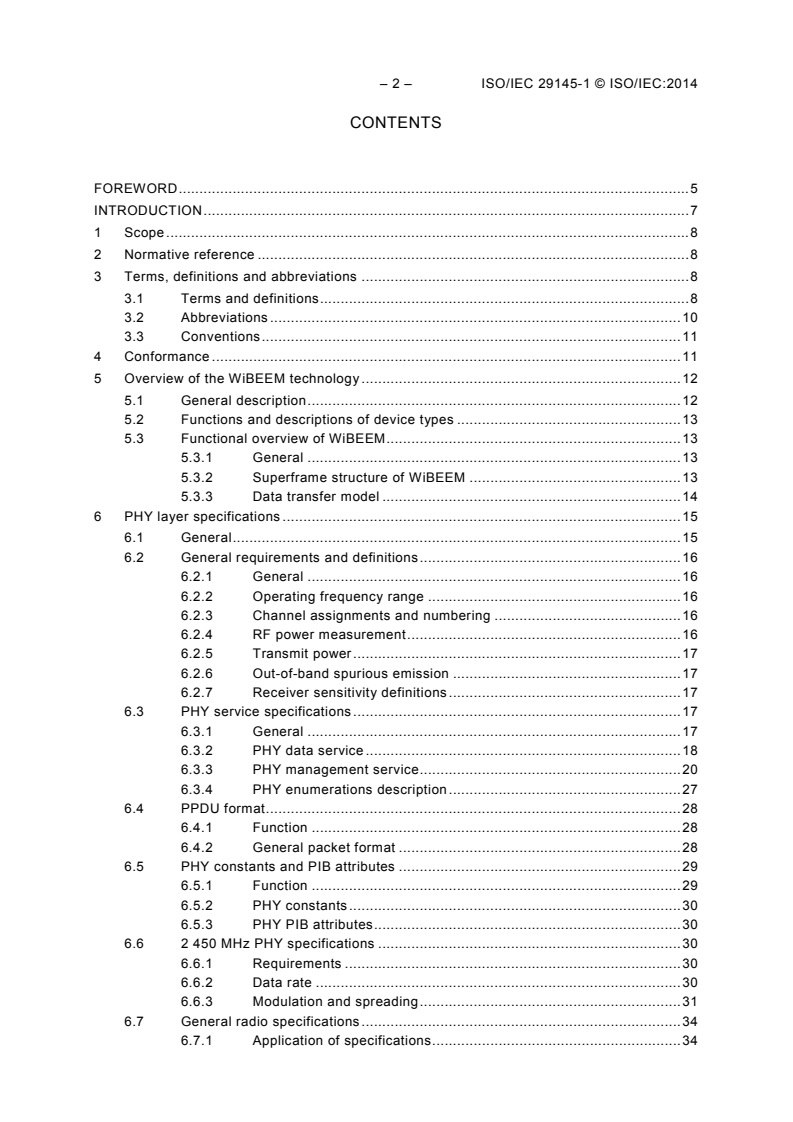
– 2 – ISO/IEC 29145-1 © ISO/IEC:2014
CONTENTS
FOREWORD . 5
INTRODUCTION . 7
1 Scope . 8
2 Normative reference . 8
3 Terms, definitions and abbreviations . 8
3.1 Terms and definitions . 8
3.2 Abbreviations . 10
3.3 Conventions . 11
4 Conformance . 11
5 Overview of the WiBEEM technology . 12
5.1 General description . 12
5.2 Functions and descriptions of device types . 13
5.3 Functional overview of WiBEEM . 13
5.3.1 General . 13
5.3.2 Superframe structure of WiBEEM . 13
5.3.3 Data transfer model . 14
6 PHY layer specifications . 15
6.1 General . 15
6.2 General requirements and definitions . 16
6.2.1 General . 16
6.2.2 Operating frequency range . 16
6.2.3 Channel assignments and numbering . 16
6.2.4 RF power measurement . 16
6.2.5 Transmit power . 17
6.2.6 Out-of-band spurious emission . 17
6.2.7 Receiver sensitivity definitions . 17
6.3 PHY service specifications . 17
6.3.1 General . 17
6.3.2 PHY data service . 18
6.3.3 PHY management service . 20
6.3.4 PHY enumerations description . 27
6.4 PPDU format . 28
6.4.1 Function . 28
6.4.2 General packet format . 28
6.5 PHY constants and PIB attributes . 29
6.5.1 Function . 29
6.5.2 PHY constants . 30
6.5.3 PHY PIB attributes . 30
6.6 2 450 MHz PHY specifications . 30
6.6.1 Requirements . 30
6.6.2 Data rate . 30
6.6.3 Modulation and spreading . 31
6.7 General radio specifications . 34
6.7.1 Application of specifications . 34
ISO/IEC 29145-1 © ISO/IEC:2014 – 3 –
6.7.2 TX-to-RX turnaround time . 34
6.7.3 RX-to-TX turnaround time . 34
6.7.4 Error-vector magnitude (EVM) definition . 34
6.7.5 Transmit centre frequency tolerance . 35
6.7.6 Transmit power . 35
6.7.7 Receiver maximum input level of desired signal . 35
6.7.8 Receiver ED . 35
6.7.9 LQI . 35
6.7.10 CCA. 36
Bibliography . 37
Figure 1 – Superframe structure of WiBEEM . 13
Figure 2 – Communication from an end device to a co-ordinator in a beacon and non-
beacon mode . 14
Figure 3 – Communication from a co-ordinator to an end device in a beacon and non-
beacon mode . 14
Figure 4 – Communications between co-ordinators in a beacon and non-beacon mode . 15
Figure 5 – Communications between end devices . 15
Figure 6 – PHY reference model . 17
Figure 7 – Modulation and spreading functions . 31
Figure 8 – Symbol-to-chip mapping . 32
Figure 9 – O-QPSK chip offset . 32
Figure 10 – Sample baseband chip sequences with pulse shaping . 33
Figure 11 – Error vector calculation . 34
Table 1 – Frequency bands and data rate . 16
Table 2 – Receiver sensitivity definitions . 17
Table 3 – PD-SAP primitives . 18
Table 4 – PD_Data.request parameters . 18
Table 5 – PD_DATA.confirm parameters . 19
Table 6 – PD_DATA.indication parameters . 20
Table 7 – PLME-SAP primitives . 20
Table 8 – PLME-CCA confirm primitive . 21
Table 9 – PLME_ED.confirm parameters . 22
Table 10 – PLME_GET.request parameters . 23
Table 11 – PLME_GET.confirm parameters . 24
Table 12 – PLME-SET-TRX-STATE.request parameters . 24
Table 13 – PLME-SET-TRX-STATE.confirm parameters . 25
Table 14 – PLME_SET.request parameters . 26
Table 15 – PLME_SET.confirm parameters . 27
Table 16 – PHY enumerations description . 28
Table 17 – Format of the PDU . 28
Table 18 – Format of the SFD field . 29
Table 19 – Frame length values . 29
– 4 – ISO/IEC 29145-1 © ISO/IEC:2014
Table 20 – PHY constants. 30
Table 21 – PHY PIB attributes . 30
Table 22 – Minimum receiver jamming resistance requirements for 2 450 MHz PHY . 33
ISO/IEC 29145-1 © ISO/IEC:2014 – 5 –
INFORMATION TECHNOLOGY –
WIRELESS BEACON-ENABLED ENERGY EFFICIENT MESH
NETWORK (WIBEEM) FOR WIRELESS HOME NETWORK SERVICES –
Part 1: PHY layer
FOREWORD
1) ISO (International Organization for Standardization) and IEC (International Electrotechnical Commission) form the
specialized system for worldwide standardization. National bodies that are members of ISO or IEC participate in
the development of International Standards. Their preparation is entrusted to technical committees; any ISO and
IEC member body interested in the subject dealt with may participate in this preparatory work. International
governmental and non-governmental organizations liaising with ISO and IEC also participate in this preparation.
2) In the field of information technology, ISO and IEC have established a joint technical committee, ISO/IEC JTC 1.
Draft International Standards adopted by the joint technical committee are circulated to national bodies for voting.
Publication as an International Standard requires approval by at least 75 % of the national bodies casting a vote.
3) The formal decisions or agreements of IEC and ISO on technical matters express, as nearly as possible, an
international consensus of opinion on the relevant subjects since each technical committee has representation
from all interested IEC and ISO member bodies.
4) IEC, ISO and ISO/IEC publications have the form of recommendations for international use and are accepted
by IEC and ISO member bodies in that sense. While all reasonable efforts are made to ensure that the
technical content of IEC, ISO and ISO/IEC publications is accurate, IEC or ISO cannot be held responsible for
the way in which they are used or for any misinterpretation by any end user.
5) In order to promote international uniformity, IEC and ISO member bodies undertake to apply IEC, ISO and
ISO/IEC publications transparently to the maximum extent possible in their national and regional publications.
Any divergence between any ISO/IEC publication and the corresponding national or regional publication
should be clearly indicated in the latter.
6) ISO and IEC provide no marking procedure to indicate their approval and cannot be rendered responsible for
any equipment declared to be in conformity with an ISO/IEC publication.
7) All users should ensure that they have the latest edition of this publication.
8) No liability shall attach to IEC or ISO or its directors, employees, servants or agents including individual experts
and members of their technical committees and IEC or ISO member bodies for any personal injury, property
damage or other damage of any nature whatsoever, whether direct or indirect, or for costs (including legal fees)
and expenses arising out of the publication of, use of, or reliance upon, this ISO/IEC publication or any other IEC,
ISO or ISO/IEC publications.
9) Attention is drawn to the normative references cited in this publication. Use of the referenced publications is
indispensable for the correct application of this publication.
10) Attention is drawn to the possibility that some of the elements of this International Standard may be the subject of
patent rights. ISO and IEC shall not be held responsible for identifying any or all such patent rights.
International Standard ISO/IEC 29145-1 was prepared by subcommittee 25: Interconnection
of information technology equipment, of ISO/IEC joint technical committee 1: Information
technology.
The list of all currently available parts of the ISO/IEC 29145 series, under the general title
Information technology – Wireless beacon-enabled energy efficient mesh network (WiBEEM)
for wireless home network services, can be found on the IEC web site.
This International Standard has been approved by vote of the member bodies, and the voting
results may be obtained from the address given on the second title page.
– 6 – ISO/IEC 29145-1 © ISO/IEC:2014
This publication has been drafted in accordance with the ISO/IEC Directives, Part 2.
IMPORTANT – The 'colour inside' logo on the cover page of this publication indicates
that it contains colours which are considered to be useful for the correct
understanding of its contents. Users should therefore print this document using a
colour printer.
ISO/IEC 29145-1 © ISO/IEC:2014 – 7 –
INTRODUCTION
This International Standard specifies the WiBEEM (Wireless Beacon-enabled Energy Efficient
Mesh network) protocol, which provides low-power-consuming mesh network functions by
enabling the “beacon mode operation”. WiBEEM is based on the IEEE 802.15.4 standard with
additional upper layer protocols and a specific usage of the MAC layer protocol. Through the
novel use of beacons, WiBEEM technology achieves longer battery life, larger network
support, quicker response, enhanced mobility and dynamic reconfiguration of the network
topology compared with other protocols such as ZigBee.
In the beacon mode, beacon information propagates over the entire mesh network nodes
during the BOP (Beacon-Only Period) of the superframe structure without any beacon
conflicts by utilising a smart beacon scheduling technique in the BOP. It also provides
location information about moving devices without spending extra time running a positioning
and locating algorithm by using RSSI (Received Signal Strength Indication). These features
allow the WiBEEM protocol to be widely used for wireless home network services in the
ubiquitous network era.
One of the key features of the WiBEEM protocol is that it has a special time interval called
BOP (Beacon-Only Period) in the superframe structure that allows more than two beacons to
be transmitted. This unique time period is located at the beginning of the Superframe.
Because the BOP does not use the CSMA/CA mechanism, the network will not work properly
in the beacon mode unless an appropriate algorithm is applied. This algorithm needs to
manage and control multiple beacons in a single superframe. The solution is the Beacon
Scheduling method applied in the BOP to avoid collisions among beacons, providing
synchronisation among all the nodes of the entire mesh network.
For the network layer, the NAA (Next Address Available) mechanism, which is a short address
allocation algorithm, has been adopted to provide an efficient way of utilising the complete
16-bit address space. The NAA algorithm does not limit the maximum number of children
nodes that a node of a mesh network can have. Since the number of children nodes is
unlimited, the NAA mechanism allows the WiBEEM protocol to be used not only for home
network services, but also for community services. WiBEEM can be used where high network
expandability through efficient use of short address spaces, device mobility and end-to-end
QoS are required.
This part of ISO/IEC 29145 specifies the Physical (PHY) layer for the WiBEEM protocol.
– 8 – ISO/IEC 29145-1 © ISO/IEC:2014
INFORMATION TECHNOLOGY –
WIRELESS BEACON-ENABLED ENERGY EFFICIENT MESH
NETWORK (WIBEEM) FOR WIRELESS HOME NETWORK SERVICES –
Part 1: PHY layer
1 Scope
This part of ISO/IEC 29145 specifies the physical (PHY) layer of WiBEEM (Wireless Beacon-
enabled Energy Efficient Mesh network) protocol for wireless home network services that
supports a low power-consuming wireless mesh network topology as well as device mobility
and QoS.
2 Normative reference
The following documents, in whole or in part, are normatively referenced in this document and
are indispensable for its application. For dated references, only the edition cited applies. For
undated references, the latest edition of the referenced document (including any
amendments) applies.
ISO/IEC 29145-2, Information technology – Wireless beacon-enabled energy efficient mesh
network (WiBEEM) for wireless home network services – Part 2: MAC layer
3 Terms, definitions and abbreviations
3.1 Terms and definitions
For the purposes of this document, the following terms and definitions apply.
3.1.1
access control list
table used by a device to determine which devices are authorised to perform a specific
function
3.1.2
association
service used to establish the membership of a device in a wireless mesh network
3.1.3
authentication
service used to establish the identity of one device as a member of the set of devices
authorised to communicate securely to other devices in the set
3.1.4
confidentiality
assurance that communicated data remain private to the parties for whom the data are
intended
3.1.5
co-ordinator
wireless device configured to provide synchronisation services through the transmission of
beacons
ISO/IEC 29145-1 © ISO/IEC:2014 – 9 –
Note 1 to entry: If a co-ordinator is the principal controller of a wireless mesh network, it is called the WMC
(WiBEEM Mesh Co-ordinator).
3.1.6
data integrity
assurance that the data have not been modified from their original form
3.1.7
device
entity containing an implementation of the WiBEEM applications, NWK, MAC and physical
interface to the wireless medium
3.1.8
frame
data format of aggregated bits from a medium access control (MAC) layer entity transmitted in
a specified sequence
3.1.9
packet
format of aggregated bits transmitted in a specified sequence across the physical medium
3.1.10
personal operating space
space of typically about 10 m around a person or object, no matter whether this peron or
object is stationary or in motion
3.1.11
portable device
device that may be moved from location to location, but uses network communications only
while at a fixed location
3.1.12
protocol data unit
unit of data exchanged between two peer entities
3.1.13
pseudo-random number generation
process of generating a deterministic sequence of bits from a given seed that has the
statistical properties of a random sequence of bits when the seed is not known
3.1.14
service data unit
information delivered as a unit through a service access point (SAP)
3.1.15
WiBEEM end device
WiBEEM device acting as the leaf device of a mesh network
3.1.16
WiBEEM mesh co-ordinator
WiBEEM device acting as the principal controller of a mesh network
Note 1 to entry: A WiBEEM mesh network has exactly one WiBEEM mesh co-ordinator.
3.1.17
WiBEEM routable co-ordinator
WiBEEM device acting as the router of a mesh network
– 10 – ISO/IEC 29145-1 © ISO/IEC:2014
3.1.18
wireless medium
medium used to implement the transfer of protocol data units (PDUs) between peer physical
layer (PHY) entities of a low-rate wireless mesh network
3.2 Abbreviations
The following acronyms and abbreviations are used in this standard. They are commonly used
in other industry publications.
AES Advanced Encryption Standard
BO Beacon Order
BOP Beacon Only Period
BOPL Beacon Only Period Length
BPSK Binary Phase-Shift Keying
CAP Contention Access Period
CBC-MAC Cipher Block Chaining Message Authentication Code
CCA Clear Channel Assessment
CSMA-CA Carrier Sense Multiple Access With Collision Avoidance
DSP Deep Sleep Period
ED Energy Detection
EIRP Effective Isotropic Radiated Power
EVM Error-Vector Magnitude
ID Identifier
IFS Interframe Space or Spacing
LLC Logical Link Control
LQ Link Quality
LQI Link Quality Indication
LPDU LLC Protocol Data Unit
LR-WPAN Low-Rate Wireless Personal Area Network
LSB Least Significant Bit
MAC Medium Access Control
MIB MAC Information Base
MLME MAC Layer Management Entity
MLME-SAP MAC Layer Management Entity-Service Access Point
MPDU MAC Protocol Data Unit
MSB Most Significant Bit
MSC Message Sequence Chart
MSDU MAC Service Data Unit
NAA Next Address Available
NB Number Of Backoff (periods)
O-QPSK Offset Quadrature Phase-Shift Keying
PD-SAP PHY Data Service Access Point
PDU Protocol Data Unit
PER Packet Error Rate
PHR PHY Header
ISO/IEC 29145-1 © ISO/IEC:2014 – 11 –
PHY Physical Layer
PIB PAN Information Base
PICS Protocol Implementation Conformance Statement
PLME Physical Layer Management Entity
PLME-SAP Physical Layer Management Entity-Service Access Point
PN Pseudo-Random Noise
POS Personal Operating Space
PPDU PHY Protocol Data Unit
PQP Prioritised QoS Period
PSD Power Spectral Density
PSDU PHY Service Data Unit
QoS Quality of Service
RF Radio Frequency
RSSI Received Signal Strength Indication
RX Receive or Receiver
SAP Service Access Point
SDL Specification and Description Language
SDU Service Data Unit
SFD Start-of-Frame Delimiter
SHR Synchronisation Header
TRX Transceiver
TX Transmit or Transmitter
WED WiBEEM End Device
WiBEEM Wireless Beacon-enabled Energy Efficient Mesh network
WLAN Wireless Local Area Network
WM Wireless Medium
WMC WiBEEM Mesh Co-ordinator
WRC WiBEEM Routable Co-ordinator
3.3 Conventions
All the italicised words used in this standard shall implement all the primitives that are
specified in Clause 6 and represent relevant constants defined and stored in the MIB
(Management Information Base) of each layer.
4 Conformance
A wireless device that claims conformance to this standard shall meet all the requirements
specified in 6.2, and shall implement all the primitives specified in 6.3, the PPDU formats in
6.4, the PHY Constants and the PIB attributes in 6.5, the PHY specifications in 6.6 and the
general radio specifications in 6.7. Each WiBEEM device shall be able to act as a WMC, a
WRC or a WED. When operating in the role of a WMC, it shall act as specified in 5.3.2, when
operating in the role of a WRC, it shall act as specified in 5.3.3, and when operating in the
role of a WED, it shall act as specified in 5.3.3.
– 12 – ISO/IEC 29145-1 © ISO/IEC:2014
5 Overview of the WiBEEM technology
5.1 General description
WiBEEM (Wireless Beacon-enabled Energy Efficient Mesh network) is a low-power-
consuming wireless communication protocol that allows mesh networking capability not only
in the non-beacon mode but also in the beacon mode. It is well suited for collecting sensor
data in ubiquitous harsh environments. One of the most unique features of the WiBEEM
protocol is that even when multiple beacons are used, the mesh network operates properly
without beacon collisions by utilising a smart-beacon scheduling algorithm. Mesh networking
with beacon mode is an enhancement of the non-beacon mesh network. With beacons not
only can sensor nodes within the RF range communicate, but nodes that are located outside
the RF range, no matter how far away, can also reliably transfer data through a multi-hop
communication mechanism without requiring all the intermediate routers to be always turned
on. WiBEEM protocol is a low-power consuming wireless mesh networking technology that
allows wireless connectivity between devices located in ubiquitous harsh environments.
WiBEEM technology that operates in the beacon mode has several advantages. First, the
power efficiency increases by controlling the synchronisation between WMC (WiBEEM Mesh
Co-ordinator) and WRC (WiBEEM Routable Co-ordinator) nodes in a superframe, because all
the nodes can go to DSP (Deep Sleep Period) at the same time. In other words, when the
network is in idle state, all the nodes within the mesh network can enter the DSP
simultaneously, and when the network is awake, the nodes can start transferring data. This
synchronisation mechanism enhances power efficiency, which is one of the most critical
aspects in wireless sensor networks. The second major advantage of WiBEEM protocol is that
mobility is supported. Supporting mobility means that a device can be detected anywhere in
the network and is able to communicate reliably, providing a flexible communications network.
The WiBEEM protocol supports not only peer-to-peer or star network topologies, but also a
beacon-mode mesh network structure that enhances the reliability and flexibility of the entire
mesh network while lowering overall power consumption.
Some of the characteristics of WiBEEM are listed below.
– Over-the-air data rates of minimum 31,25 kbit/s and maximum 250 kbit/s.
– Mesh network as well as star and peer-to-peer operation.
– Two addressing modes are supported: 16-bit short addresses that are allocated by the
mesh network; or 64-bit extended addresses.
– Beacon scheduling method for the avoidance of beacon collisions.
– Carrier sense multiple access with collision avoidance (CSMA-CA) channel access.
– Fully acknowledged protocol for transfer reliability using ARQ protocol.
– Low power consumption for not only star but also mesh topologies.
– Energy detection (ED).
– Link quality indication (LQI).
– 16 channels in the 2 450 GHz band.
Some of the advantages that WiBEEM technology has are stated below.
– It allows multiple beacons to be transmitted in a single superframe, which enables
synchronisation among nodes and thus consumes very little power even in the mesh
network topology.
– It supports large size network expandability without increasing transmission power or
receiver sensitivity.
– It improves data communication reliability using multiple communication paths.
– The network can be easily reconfigured.
– It prolongs battery life by reducing the number of data transmission.
ISO/IEC 29145-1 © ISO/IEC:2014 – 13 –
A system conforming to this standard consists of several components. The most basic is the
device. The first device to be generated in the network is a WiBEEM mesh co-ordinator
(WMC). General devices that communicate with the WMC are called WiBEEM routable co-
ordinators (WRCs). Also, devices that simply transmit the sensed data are called WiBEEM
end devices (WEDs). Two or more devices within a POS (Personal Operating Space)
communicating on the same physical channel constitute a mesh network. However, this mesh
network shall include at least one WMC, operating as the mesh co-ordinator.
5.2 Functions and descriptions of device types
Functions and description of WiBEEM devices are presented in ISO/IEC 29145-2.
5.3 Functional overview of WiBEEM
5.3.1 General
A wireless networking protocol is fully characterised by a superframe structure and a data
transfer model between devices in the MAC layer. The WiBEEM protocol utilises the
superframe structure described in 5.3.2 and data transfer model between WiBEEM devices in
the MAC layer described in 5.3.3.
5.3.2 Superframe structure of WiBEEM
WiBEEM protocol, when it operates in the beacon mode, utilises the superframe structure in
the MAC layer as shown in Figure 1. The WMC determines this superframe structure, which
consists of 5 distinct time slots. The first time slot of the superframe structure is BOP (beacon
only period), where only beacons of all the WRC devices can be transmitted at the times
predetermined by the smart beacon scheduling algorithm without performing CSMA-CA
operation. During this time period, no devices are allowed to transmit any data except the
WRC that was allowed to do so. The beacon payload transmitted by the WMC device
propagates over the entire mesh network and the synchronisation between all the WiBEEM
devices is maintained. Right after the BOP, PQP follows in which traffic with a certain level of
priority is allowed to transmit data. If the WMC device decides not to have QoS support, it can
reset the PQP such that the PQP length is zero. The PQP can also be set up by the request
of any WiBEEM devices when WMC is asked to do so. During the CAP the data transfer can
be carried out, where back-off times are determined based on the priority that the traffic has.
Any device wishing to communicate during the CAP competes with other devices using a
slotted CSMA-CA mechanism. A WiBEEM device that wants to provide parameterised QoS
may use RAP (reservation-based access period), where devices that acquired the permission
to send data from the WMC based on the reservation request can only use this period.
Optionally, the superframe can have a DSP in which all the devices enter a low-power mode.
Figure 1 – Superframe structure of WiBEEM
– 14 – ISO/IEC 29145-1 © ISO/IEC:2014
5.3.3 Data transfer model
When a device wishes to transfer data to a co-ordinator in a beacon mode, it first listens to
the network beacon. When the beacon is heard, the device synchronises to the superframe
structure. At the appropriate time, the device transmits a data frame, using slotted CSMA/CA,
to the co-ordinator. The co-ordinator may acknowledge the successful reception of the data by
transmitting an optional acknowledgement frame. This sequence is summarised in Figure 2a.
When a device wishes to transfer data in a non-beacon mode, it simply transmits a data frame,
using unslotted CSMA-CA, to the co-ordinator. The co-ordinator acknowledges the successful
reception of the data by transmitting an optional acknowledgement frame. The transaction is
now complete. This sequence is summarised in Figure 2a. The procedure for a non-beacon
mode is shown in Figure 2b.
Figure 2a – Beacon mode Figure 2b – Non-beacon mode
Figure 2 – Communication from an end device to
a co-ordinator in a beacon and non-beacon mode
When the co-ordinator wishes to transfer data to a device in a beacon mode (as shown in
Figur 3a), it indicates in the network beacon that the data message is pending. The device
periodically listens to the network beacon and, if a message is pending, transmits a MAC
command requesting the data, using slotted CSMA-CA. WMC or WRC acknowledges the
successful reception of the data request by transmitting an acknowledgement frame. The
pending data frame is then sent using slotted CSMA/CA or, if possible, immediately after the
acknowledgement. The device may acknowledge the successful reception of the data by
transmitting an optional acknowledgement frame. The transaction is now complete. Upon
successful completion of the data transaction, the message is removed from the list of
pending messages in the beacon. The procedure for a non-beacon mode is shown in Figur 3b.
Figure 3a – Beacon mode Beacon mode Figure 3b – Non-beacon mode
Figure 3 – Communication from a co-ordinator to an end
device in a beacon and non-beacon mode
When the co-ordinator wishes to transfer data to another co-ordinator (as shown in Figure 4),
it can send data without using beacons since the co-ordinators are always active.
ISO/IEC 29145-1 © ISO/IEC:2014 – 15 –
Figure 4a – Beacon mode Figure 4b – Non-beacon mode
Figure 4 – Communications between co-ordinators in a beacon and non-beacon mode
End devices do not transmit beacons at any time. When an end device wishes to send data to
another end device, it may communicate with other devices reachable via the build-in radio. In
order to do this effectively, the devices wishing to communicate will need to either receive
constantly or to synchronise with each other. In the former case, the device can simply
transmit data using un-slotted CSMA-CA. In the latter case, other measures need to be taken
in order to achieve synchronisation. End devices wishing to communicate shall send a frame
to the target device notifying that it has data to send, and the receiver has to respond that it is
ready to receive data, a shown in Figure 5. This kind of communication scheme is used in the
power saving mode.
Figure 5 – Communications between end devices
6 PHY layer specifications
6.1 General
This clause specifies the physical layer (PHY) of the WiBEEM protocol. The PHY is
responsible for the following tasks:
– activation and deactivation of the radio transceiver;
– energy detection within the current channel;
– link quality indication for received packets;
– clear channel assessment for CSMA/CA;
– channel frequency selection;
– data transmission and reception.
Constants and attributes that are specified and maintained by the PHY layer specification are
written in the text of this clause in italics. Constants have a general prefix of “a”. Attributes
have a general prefix of “phy”.
– 16 – ISO/IEC 29145-1 © ISO/IEC:2014
6.2 General requirements and definitions
6.2.1 General
This subclause specifies requirements that are common to both of the WiBEEM PHYs.
6.2.2 Operating frequency range
A compliant device shall operate in one or several frequency bands using the modulation and
spreading formats summarised in Table 1.
NOTE The terms “chip rate” and “symbol rate” and corresponding units (chip/s and symbol/s) are used for spread
spectrum code. The chip rate of a code is the number of pulses per second (chips per second) at which the code is
transmitted (or received). The chip rate is larger than the symbol rate since one symbol is represented by multiple
chips. The ratio is known as the spreading factor or processing gain.
Table 1 – Frequency bands and data rate
Spreading parameters Data parameters
PHY Frequency
band
Chip rate Bit rate Symbol rate
Modulation Symbol
MHz MHz
kchip/s kbit/s ksymbol/s
868/915 868 to 868,6 300 BPSK 20 20 Binary
902 to 928 600 BPSK 40 40 Binary
16-ary
O-QPSK 31,25 7,812 5
Orthogonal
16-ary
O-QPSK 62,50 15,625
2 400
Orthogonal
2 450 to 2 000
16-ary
2 483,5
O-QPSK 125 31,25
Orthogonal
16-ary
O-QPSK 250 62,5
Orthogonal
6.2.3 Channel assignments and numbering
A total of 27 channels, numbered 0 to 26, are available across the three frequency bands.
16 channels are available in the 2 450 MHz band, 10 in the 915 MHz band and one in the
868 MHz band. The centre frequency (F ) of these channels is defined as follows:
c
F = 868,3 in MHz, for k = 0
c
F = 906 + 2 (k – 1) in megahertz, for k = 1, 2, ., 10
c
and
F = 2 405 + 5 (k – 11) in megahertz, for k = 11, 12, ., 26
c
where k is the channel number.
For each PHY supported, a compliant device shall support all channels allowed by regulations
for the region in which the device operates.
6.2.4 RF power measurement
Unless otherwise stated, all RF power measurements that either transmit or receive, shall be
carried out at the appropriate transceiver to antenna connector. The measurements shall be
carried out with equipment that is either matched to the impedance of the antenna connector
or corrected for any mismatch. For devices without an antenna connector, the measurements
ISO/IEC 29145-1 © ISO/IEC:2014 – 17 –
shall be interpreted as effective isotropic radiated power (EIRP) (i.e., a 0 dBi gain antenna);
and any radiated measurements shall be corrected to compensate for the antenna gain in the
implementation.
6.2.5 Transmit power
The maximum transmit power shall conform to local regulations. A compliant device shall
have its nominal transmit power level indicated by its PHY parameter.
6.2.6 Out-of-band spurious emission
The out-of-band spurious emissions shall conform to local regulations.
6.2.7 Receiver sensitivity definitions
The definitions in Table 2 are referenced by subclauses elsewhere in this standard regarding
receiver sensitivity.
Table 2 – Receiver sensitivity definitions
Term Definition of term Conditions
Packet error Average fraction of transmitted packets that are
– Average measured over random PSDU data
rate (PER) not detected correctly
– PSDU length = 160 octets
– PER < 1 %
Receiver Threshold input signal power that yields a
sensitivity specific PER
– Power measured at antenna terminals
– Interference not present
6.3 PHY service specifications
6.3.1 General
The PHY provides an interface between the MAC sublayer and the physical radio channel, via
the RF firmware and RF hardware. The PHY conceptually includes a management entity
called the PLME. This entity provides the layer management service interfaces through which
layer management functions may be invoked. The PLME is also responsible for maintaining a
database of managed objects pertaining to the PHY. This database is referred to as the PHY
layer information base (PIB).
Figure 6 depicts the components and interfaces of the PHY.
PD-SAP PLME-SAP
PHY layer PLME
PHY
PIB
RF-SAP
Figure 6 – PHY reference model
– 18 – ISO/IEC 29145-1 © ISO/IEC:2014
PHY provides two services, accessed through two SAPs: PHY data service, accessed through
the PHY data SAP (PD-SAP), and PHY management service, accessed through the PLME’s
SAP (PLME-SAP).
6.3.2 PHY data service
6.3.2.1 Overview
The PD-SAP supports the transport of MPDUs between peer MAC layer entities. Table 3 lists
the primitives supported by the PD-SAP. These primitives are discussed in the subclauses
referenced in Table 3.
Table 3 – PD-SAP primitives
PD-SAP primitive Request Confirm Indication
PD-DATA 6.3.2.2 6.3.2.3 6.3.2.4
6.3.2.2 PD-DATA.request
6.3.2.2.1 Function
The PD-DATA.request primitive requests the transfer of an MPDU (i.e., PSDU) from the MAC
sublayer to the local PHY entity.
6.3.2.2.2 Semantics of the service primitive
The semantics of the PD-DATA.request primitive is as follows:
PD-DATA.request (
psduLength,
psdu
)
Table 4 specifies the parameters for the PD-DATA.request primitive.
Table 4 – PD_Data.request parameters
Name Type Valid range Description
The number of octets contained in the
psduLength Unsigned integer
≤aMaxPHYPacketSize
PSDU to be transmitted by the PHY entity
The set of octets forming the PSDU to be
psdu Set of octets ㅡ
transmitted by the PHY entity.
6.3.2.2.3 When generated
The PD-DATA.request primitive is generated by a local MAC layer entity and issued to its
PHY entity to request the transmission of an MPDU.
6.3.2.2.4 Effect on receipt
The receipt of the PD-DATA.request primitive by the PHY entity will cause the transmission of
the supplied PSDU. Provided the transmitter is enabled (TX_ON state), the PHY will first construct a
PPDU, containing the supplied PSDU and then transmit the PPDU. When the PHY entity has
completed the transmission, it will issue the PD-DATA.confirm primitive with a status of
SUCCESS.
ISO/IEC 29145-1 © ISO/IEC:2014 – 19 –
If the PD-DATA.request primitive is received while the
...
ISO/IEC 29145-1
Edition 1.0 2014-03
INTERNATIONAL
STANDARD
colour
inside
Information technology – Wireless beacon-enabled energy efficient mesh
network (WiBEEM) for wireless home network services –
Part 1: PHY layer
All rights reserved. Unless otherwise specified, no part of this publication may be reproduced or utilized in any form
or by any means, electronic or mechanical, including photocopying and microfilm, without permission in writing from
either IEC or IEC's member National Committee in the country of the requester. If you have any questions about
ISO/IEC copyright or have an enquiry about obtaining additional rights to this publication, please contact the address
below or your local IEC member National Committee for further information.
IEC Central Office Tel.: +41 22 919 02 11
3, rue de Varembé Fax: +41 22 919 03 00
CH-1211 Geneva 20 info@iec.ch
Switzerland www.iec.ch
About the IEC
The International Electrotechnical Commission (IEC) is the leading global organization that prepares and publishes
International Standards for all electrical, electronic and related technologies.
About IEC publications
The technical content of IEC publications is kept under constant review by the IEC. Please make sure that you have the
latest edition, a corrigenda or an amendment might have been published.
IEC Catalogue - webstore.iec.ch/catalogue Electropedia - www.electropedia.org
The stand-alone application for consulting the entire The world's leading online dictionary of electronic and
bibliographical information on IEC International Standards, electrical terms containing more than 30 000 terms and
Technical Specifications, Technical Reports and other definitions in English and French, with equivalent terms in 14
documents. Available for PC, Mac OS, Android Tablets and additional languages. Also known as the International
iPad. Electrotechnical Vocabulary (IEV) online.
IEC publications search - www.iec.ch/searchpub IEC Glossary - std.iec.ch/glossary
The advanced search enables to find IEC publications by a More than 55 000 electrotechnical terminology entries in
variety of criteria (reference number, text, technical English and French extracted from the Terms and Definitions
committee,…). It also gives information on projects, replaced clause of IEC publications issued since 2002. Some entries
and withdrawn publications. have been collected from earlier publications of IEC TC 37,
77, 86 and CISPR.
IEC Just Published - webstore.iec.ch/justpublished
Stay up to date on all new IEC publications. Just Published IEC Customer Service Centre - webstore.iec.ch/csc
details all new publications released. Available online and If you wish to give us your feedback on this publication or
also once a month by email. need further assistance, please contact the Customer Service
Centre: csc@iec.ch.
ISO/IEC 29145-1
Edition 1.0 2014-03
INTERNATIONAL
STANDARD
colour
inside
Information technology – Wireless beacon-enabled energy efficient mesh
network (WiBEEM) for wireless home network services –
Part 1: PHY layer
INTERNATIONAL
ELECTROTECHNICAL
COMMISSION
PRICE CODE
P
ICS 35.200 ISBN 978-2-8322-1451-0
– 2 – ISO/IEC 29145-1 © ISO/IEC:2014
CONTENTS
FOREWORD . 5
INTRODUCTION . 7
1 Scope . 8
2 Normative reference . 8
3 Terms, definitions and abbreviations . 8
3.1 Terms and definitions . 8
3.2 Abbreviations . 10
3.3 Conventions . 11
4 Conformance . 11
5 Overview of the WiBEEM technology . 12
5.1 General description . 12
5.2 Functions and descriptions of device types . 13
5.3 Functional overview of WiBEEM . 13
5.3.1 General . 13
5.3.2 Superframe structure of WiBEEM . 13
5.3.3 Data transfer model . 14
6 PHY layer specifications . 15
6.1 General . 15
6.2 General requirements and definitions . 16
6.2.1 General . 16
6.2.2 Operating frequency range . 16
6.2.3 Channel assignments and numbering . 16
6.2.4 RF power measurement . 16
6.2.5 Transmit power . 17
6.2.6 Out-of-band spurious emission . 17
6.2.7 Receiver sensitivity definitions . 17
6.3 PHY service specifications . 17
6.3.1 General . 17
6.3.2 PHY data service . 18
6.3.3 PHY management service . 20
6.3.4 PHY enumerations description . 27
6.4 PPDU format . 28
6.4.1 Function . 28
6.4.2 General packet format . 28
6.5 PHY constants and PIB attributes . 29
6.5.1 Function . 29
6.5.2 PHY constants . 30
6.5.3 PHY PIB attributes . 30
6.6 2 450 MHz PHY specifications . 30
6.6.1 Requirements . 30
6.6.2 Data rate . 30
6.6.3 Modulation and spreading . 31
6.7 General radio specifications . 34
6.7.1 Application of specifications . 34
ISO/IEC 29145-1 © ISO/IEC:2014 – 3 –
6.7.2 TX-to-RX turnaround time . 34
6.7.3 RX-to-TX turnaround time . 34
6.7.4 Error-vector magnitude (EVM) definition . 34
6.7.5 Transmit centre frequency tolerance . 35
6.7.6 Transmit power . 35
6.7.7 Receiver maximum input level of desired signal . 35
6.7.8 Receiver ED . 35
6.7.9 LQI . 35
6.7.10 CCA. 36
Bibliography . 37
Figure 1 – Superframe structure of WiBEEM . 13
Figure 2 – Communication from an end device to a co-ordinator in a beacon and non-
beacon mode . 14
Figure 3 – Communication from a co-ordinator to an end device in a beacon and non-
beacon mode . 14
Figure 4 – Communications between co-ordinators in a beacon and non-beacon mode . 15
Figure 5 – Communications between end devices . 15
Figure 6 – PHY reference model . 17
Figure 7 – Modulation and spreading functions . 31
Figure 8 – Symbol-to-chip mapping . 32
Figure 9 – O-QPSK chip offset . 32
Figure 10 – Sample baseband chip sequences with pulse shaping . 33
Figure 11 – Error vector calculation . 34
Table 1 – Frequency bands and data rate . 16
Table 2 – Receiver sensitivity definitions . 17
Table 3 – PD-SAP primitives . 18
Table 4 – PD_Data.request parameters . 18
Table 5 – PD_DATA.confirm parameters . 19
Table 6 – PD_DATA.indication parameters . 20
Table 7 – PLME-SAP primitives . 20
Table 8 – PLME-CCA confirm primitive . 21
Table 9 – PLME_ED.confirm parameters . 22
Table 10 – PLME_GET.request parameters . 23
Table 11 – PLME_GET.confirm parameters . 24
Table 12 – PLME-SET-TRX-STATE.request parameters . 24
Table 13 – PLME-SET-TRX-STATE.confirm parameters . 25
Table 14 – PLME_SET.request parameters . 26
Table 15 – PLME_SET.confirm parameters . 27
Table 16 – PHY enumerations description . 28
Table 17 – Format of the PDU . 28
Table 18 – Format of the SFD field . 29
Table 19 – Frame length values . 29
– 4 – ISO/IEC 29145-1 © ISO/IEC:2014
Table 20 – PHY constants. 30
Table 21 – PHY PIB attributes . 30
Table 22 – Minimum receiver jamming resistance requirements for 2 450 MHz PHY . 33
ISO/IEC 29145-1 © ISO/IEC:2014 – 5 –
INFORMATION TECHNOLOGY –
WIRELESS BEACON-ENABLED ENERGY EFFICIENT MESH
NETWORK (WIBEEM) FOR WIRELESS HOME NETWORK SERVICES –
Part 1: PHY layer
FOREWORD
1) ISO (International Organization for Standardization) and IEC (International Electrotechnical Commission) form the
specialized system for worldwide standardization. National bodies that are members of ISO or IEC participate in
the development of International Standards. Their preparation is entrusted to technical committees; any ISO and
IEC member body interested in the subject dealt with may participate in this preparatory work. International
governmental and non-governmental organizations liaising with ISO and IEC also participate in this preparation.
2) In the field of information technology, ISO and IEC have established a joint technical committee, ISO/IEC JTC 1.
Draft International Standards adopted by the joint technical committee are circulated to national bodies for voting.
Publication as an International Standard requires approval by at least 75 % of the national bodies casting a vote.
3) The formal decisions or agreements of IEC and ISO on technical matters express, as nearly as possible, an
international consensus of opinion on the relevant subjects since each technical committee has representation
from all interested IEC and ISO member bodies.
4) IEC, ISO and ISO/IEC publications have the form of recommendations for international use and are accepted
by IEC and ISO member bodies in that sense. While all reasonable efforts are made to ensure that the
technical content of IEC, ISO and ISO/IEC publications is accurate, IEC or ISO cannot be held responsible for
the way in which they are used or for any misinterpretation by any end user.
5) In order to promote international uniformity, IEC and ISO member bodies undertake to apply IEC, ISO and
ISO/IEC publications transparently to the maximum extent possible in their national and regional publications.
Any divergence between any ISO/IEC publication and the corresponding national or regional publication
should be clearly indicated in the latter.
6) ISO and IEC provide no marking procedure to indicate their approval and cannot be rendered responsible for
any equipment declared to be in conformity with an ISO/IEC publication.
7) All users should ensure that they have the latest edition of this publication.
8) No liability shall attach to IEC or ISO or its directors, employees, servants or agents including individual experts
and members of their technical committees and IEC or ISO member bodies for any personal injury, property
damage or other damage of any nature whatsoever, whether direct or indirect, or for costs (including legal fees)
and expenses arising out of the publication of, use of, or reliance upon, this ISO/IEC publication or any other IEC,
ISO or ISO/IEC publications.
9) Attention is drawn to the normative references cited in this publication. Use of the referenced publications is
indispensable for the correct application of this publication.
10) Attention is drawn to the possibility that some of the elements of this International Standard may be the subject of
patent rights. ISO and IEC shall not be held responsible for identifying any or all such patent rights.
International Standard ISO/IEC 29145-1 was prepared by subcommittee 25: Interconnection
of information technology equipment, of ISO/IEC joint technical committee 1: Information
technology.
The list of all currently available parts of the ISO/IEC 29145 series, under the general title
Information technology – Wireless beacon-enabled energy efficient mesh network (WiBEEM)
for wireless home network services, can be found on the IEC web site.
This International Standard has been approved by vote of the member bodies, and the voting
results may be obtained from the address given on the second title page.
– 6 – ISO/IEC 29145-1 © ISO/IEC:2014
This publication has been drafted in accordance with the ISO/IEC Directives, Part 2.
IMPORTANT – The 'colour inside' logo on the cover page of this publication indicates
that it contains colours which are considered to be useful for the correct
understanding of its contents. Users should therefore print this document using a
colour printer.
ISO/IEC 29145-1 © ISO/IEC:2014 – 7 –
INTRODUCTION
This International Standard specifies the WiBEEM (Wireless Beacon-enabled Energy Efficient
Mesh network) protocol, which provides low-power-consuming mesh network functions by
enabling the “beacon mode operation”. WiBEEM is based on the IEEE 802.15.4 standard with
additional upper layer protocols and a specific usage of the MAC layer protocol. Through the
novel use of beacons, WiBEEM technology achieves longer battery life, larger network
support, quicker response, enhanced mobility and dynamic reconfiguration of the network
topology compared with other protocols such as ZigBee.
In the beacon mode, beacon information propagates over the entire mesh network nodes
during the BOP (Beacon-Only Period) of the superframe structure without any beacon
conflicts by utilising a smart beacon scheduling technique in the BOP. It also provides
location information about moving devices without spending extra time running a positioning
and locating algorithm by using RSSI (Received Signal Strength Indication). These features
allow the WiBEEM protocol to be widely used for wireless home network services in the
ubiquitous network era.
One of the key features of the WiBEEM protocol is that it has a special time interval called
BOP (Beacon-Only Period) in the superframe structure that allows more than two beacons to
be transmitted. This unique time period is located at the beginning of the Superframe.
Because the BOP does not use the CSMA/CA mechanism, the network will not work properly
in the beacon mode unless an appropriate algorithm is applied. This algorithm needs to
manage and control multiple beacons in a single superframe. The solution is the Beacon
Scheduling method applied in the BOP to avoid collisions among beacons, providing
synchronisation among all the nodes of the entire mesh network.
For the network layer, the NAA (Next Address Available) mechanism, which is a short address
allocation algorithm, has been adopted to provide an efficient way of utilising the complete
16-bit address space. The NAA algorithm does not limit the maximum number of children
nodes that a node of a mesh network can have. Since the number of children nodes is
unlimited, the NAA mechanism allows the WiBEEM protocol to be used not only for home
network services, but also for community services. WiBEEM can be used where high network
expandability through efficient use of short address spaces, device mobility and end-to-end
QoS are required.
This part of ISO/IEC 29145 specifies the Physical (PHY) layer for the WiBEEM protocol.
– 8 – ISO/IEC 29145-1 © ISO/IEC:2014
INFORMATION TECHNOLOGY –
WIRELESS BEACON-ENABLED ENERGY EFFICIENT MESH
NETWORK (WIBEEM) FOR WIRELESS HOME NETWORK SERVICES –
Part 1: PHY layer
1 Scope
This part of ISO/IEC 29145 specifies the physical (PHY) layer of WiBEEM (Wireless Beacon-
enabled Energy Efficient Mesh network) protocol for wireless home network services that
supports a low power-consuming wireless mesh network topology as well as device mobility
and QoS.
2 Normative reference
The following documents, in whole or in part, are normatively referenced in this document and
are indispensable for its application. For dated references, only the edition cited applies. For
undated references, the latest edition of the referenced document (including any
amendments) applies.
ISO/IEC 29145-2, Information technology – Wireless beacon-enabled energy efficient mesh
network (WiBEEM) for wireless home network services – Part 2: MAC layer
3 Terms, definitions and abbreviations
3.1 Terms and definitions
For the purposes of this document, the following terms and definitions apply.
3.1.1
access control list
table used by a device to determine which devices are authorised to perform a specific
function
3.1.2
association
service used to establish the membership of a device in a wireless mesh network
3.1.3
authentication
service used to establish the identity of one device as a member of the set of devices
authorised to communicate securely to other devices in the set
3.1.4
confidentiality
assurance that communicated data remain private to the parties for whom the data are
intended
3.1.5
co-ordinator
wireless device configured to provide synchronisation services through the transmission of
beacons
ISO/IEC 29145-1 © ISO/IEC:2014 – 9 –
Note 1 to entry: If a co-ordinator is the principal controller of a wireless mesh network, it is called the WMC
(WiBEEM Mesh Co-ordinator).
3.1.6
data integrity
assurance that the data have not been modified from their original form
3.1.7
device
entity containing an implementation of the WiBEEM applications, NWK, MAC and physical
interface to the wireless medium
3.1.8
frame
data format of aggregated bits from a medium access control (MAC) layer entity transmitted in
a specified sequence
3.1.9
packet
format of aggregated bits transmitted in a specified sequence across the physical medium
3.1.10
personal operating space
space of typically about 10 m around a person or object, no matter whether this peron or
object is stationary or in motion
3.1.11
portable device
device that may be moved from location to location, but uses network communications only
while at a fixed location
3.1.12
protocol data unit
unit of data exchanged between two peer entities
3.1.13
pseudo-random number generation
process of generating a deterministic sequence of bits from a given seed that has the
statistical properties of a random sequence of bits when the seed is not known
3.1.14
service data unit
information delivered as a unit through a service access point (SAP)
3.1.15
WiBEEM end device
WiBEEM device acting as the leaf device of a mesh network
3.1.16
WiBEEM mesh co-ordinator
WiBEEM device acting as the principal controller of a mesh network
Note 1 to entry: A WiBEEM mesh network has exactly one WiBEEM mesh co-ordinator.
3.1.17
WiBEEM routable co-ordinator
WiBEEM device acting as the router of a mesh network
– 10 – ISO/IEC 29145-1 © ISO/IEC:2014
3.1.18
wireless medium
medium used to implement the transfer of protocol data units (PDUs) between peer physical
layer (PHY) entities of a low-rate wireless mesh network
3.2 Abbreviations
The following acronyms and abbreviations are used in this standard. They are commonly used
in other industry publications.
AES Advanced Encryption Standard
BO Beacon Order
BOP Beacon Only Period
BOPL Beacon Only Period Length
BPSK Binary Phase-Shift Keying
CAP Contention Access Period
CBC-MAC Cipher Block Chaining Message Authentication Code
CCA Clear Channel Assessment
CSMA-CA Carrier Sense Multiple Access With Collision Avoidance
DSP Deep Sleep Period
ED Energy Detection
EIRP Effective Isotropic Radiated Power
EVM Error-Vector Magnitude
ID Identifier
IFS Interframe Space or Spacing
LLC Logical Link Control
LQ Link Quality
LQI Link Quality Indication
LPDU LLC Protocol Data Unit
LR-WPAN Low-Rate Wireless Personal Area Network
LSB Least Significant Bit
MAC Medium Access Control
MIB MAC Information Base
MLME MAC Layer Management Entity
MLME-SAP MAC Layer Management Entity-Service Access Point
MPDU MAC Protocol Data Unit
MSB Most Significant Bit
MSC Message Sequence Chart
MSDU MAC Service Data Unit
NAA Next Address Available
NB Number Of Backoff (periods)
O-QPSK Offset Quadrature Phase-Shift Keying
PD-SAP PHY Data Service Access Point
PDU Protocol Data Unit
PER Packet Error Rate
PHR PHY Header
ISO/IEC 29145-1 © ISO/IEC:2014 – 11 –
PHY Physical Layer
PIB PAN Information Base
PICS Protocol Implementation Conformance Statement
PLME Physical Layer Management Entity
PLME-SAP Physical Layer Management Entity-Service Access Point
PN Pseudo-Random Noise
POS Personal Operating Space
PPDU PHY Protocol Data Unit
PQP Prioritised QoS Period
PSD Power Spectral Density
PSDU PHY Service Data Unit
QoS Quality of Service
RF Radio Frequency
RSSI Received Signal Strength Indication
RX Receive or Receiver
SAP Service Access Point
SDL Specification and Description Language
SDU Service Data Unit
SFD Start-of-Frame Delimiter
SHR Synchronisation Header
TRX Transceiver
TX Transmit or Transmitter
WED WiBEEM End Device
WiBEEM Wireless Beacon-enabled Energy Efficient Mesh network
WLAN Wireless Local Area Network
WM Wireless Medium
WMC WiBEEM Mesh Co-ordinator
WRC WiBEEM Routable Co-ordinator
3.3 Conventions
All the italicised words used in this standard shall implement all the primitives that are
specified in Clause 6 and represent relevant constants defined and stored in the MIB
(Management Information Base) of each layer.
4 Conformance
A wireless device that claims conformance to this standard shall meet all the requirements
specified in 6.2, and shall implement all the primitives specified in 6.3, the PPDU formats in
6.4, the PHY Constants and the PIB attributes in 6.5, the PHY specifications in 6.6 and the
general radio specifications in 6.7. Each WiBEEM device shall be able to act as a WMC, a
WRC or a WED. When operating in the role of a WMC, it shall act as specified in 5.3.2, when
operating in the role of a WRC, it shall act as specified in 5.3.3, and when operating in the
role of a WED, it shall act as specified in 5.3.3.
– 12 – ISO/IEC 29145-1 © ISO/IEC:2014
5 Overview of the WiBEEM technology
5.1 General description
WiBEEM (Wireless Beacon-enabled Energy Efficient Mesh network) is a low-power-
consuming wireless communication protocol that allows mesh networking capability not only
in the non-beacon mode but also in the beacon mode. It is well suited for collecting sensor
data in ubiquitous harsh environments. One of the most unique features of the WiBEEM
protocol is that even when multiple beacons are used, the mesh network operates properly
without beacon collisions by utilising a smart-beacon scheduling algorithm. Mesh networking
with beacon mode is an enhancement of the non-beacon mesh network. With beacons not
only can sensor nodes within the RF range communicate, but nodes that are located outside
the RF range, no matter how far away, can also reliably transfer data through a multi-hop
communication mechanism without requiring all the intermediate routers to be always turned
on. WiBEEM protocol is a low-power consuming wireless mesh networking technology that
allows wireless connectivity between devices located in ubiquitous harsh environments.
WiBEEM technology that operates in the beacon mode has several advantages. First, the
power efficiency increases by controlling the synchronisation between WMC (WiBEEM Mesh
Co-ordinator) and WRC (WiBEEM Routable Co-ordinator) nodes in a superframe, because all
the nodes can go to DSP (Deep Sleep Period) at the same time. In other words, when the
network is in idle state, all the nodes within the mesh network can enter the DSP
simultaneously, and when the network is awake, the nodes can start transferring data. This
synchronisation mechanism enhances power efficiency, which is one of the most critical
aspects in wireless sensor networks. The second major advantage of WiBEEM protocol is that
mobility is supported. Supporting mobility means that a device can be detected anywhere in
the network and is able to communicate reliably, providing a flexible communications network.
The WiBEEM protocol supports not only peer-to-peer or star network topologies, but also a
beacon-mode mesh network structure that enhances the reliability and flexibility of the entire
mesh network while lowering overall power consumption.
Some of the characteristics of WiBEEM are listed below.
– Over-the-air data rates of minimum 31,25 kbit/s and maximum 250 kbit/s.
– Mesh network as well as star and peer-to-peer operation.
– Two addressing modes are supported: 16-bit short addresses that are allocated by the
mesh network; or 64-bit extended addresses.
– Beacon scheduling method for the avoidance of beacon collisions.
– Carrier sense multiple access with collision avoidance (CSMA-CA) channel access.
– Fully acknowledged protocol for transfer reliability using ARQ protocol.
– Low power consumption for not only star but also mesh topologies.
– Energy detection (ED).
– Link quality indication (LQI).
– 16 channels in the 2 450 GHz band.
Some of the advantages that WiBEEM technology has are stated below.
– It allows multiple beacons to be transmitted in a single superframe, which enables
synchronisation among nodes and thus consumes very little power even in the mesh
network topology.
– It supports large size network expandability without increasing transmission power or
receiver sensitivity.
– It improves data communication reliability using multiple communication paths.
– The network can be easily reconfigured.
– It prolongs battery life by reducing the number of data transmission.
ISO/IEC 29145-1 © ISO/IEC:2014 – 13 –
A system conforming to this standard consists of several components. The most basic is the
device. The first device to be generated in the network is a WiBEEM mesh co-ordinator
(WMC). General devices that communicate with the WMC are called WiBEEM routable co-
ordinators (WRCs). Also, devices that simply transmit the sensed data are called WiBEEM
end devices (WEDs). Two or more devices within a POS (Personal Operating Space)
communicating on the same physical channel constitute a mesh network. However, this mesh
network shall include at least one WMC, operating as the mesh co-ordinator.
5.2 Functions and descriptions of device types
Functions and description of WiBEEM devices are presented in ISO/IEC 29145-2.
5.3 Functional overview of WiBEEM
5.3.1 General
A wireless networking protocol is fully characterised by a superframe structure and a data
transfer model between devices in the MAC layer. The WiBEEM protocol utilises the
superframe structure described in 5.3.2 and data transfer model between WiBEEM devices in
the MAC layer described in 5.3.3.
5.3.2 Superframe structure of WiBEEM
WiBEEM protocol, when it operates in the beacon mode, utilises the superframe structure in
the MAC layer as shown in Figure 1. The WMC determines this superframe structure, which
consists of 5 distinct time slots. The first time slot of the superframe structure is BOP (beacon
only period), where only beacons of all the WRC devices can be transmitted at the times
predetermined by the smart beacon scheduling algorithm without performing CSMA-CA
operation. During this time period, no devices are allowed to transmit any data except the
WRC that was allowed to do so. The beacon payload transmitted by the WMC device
propagates over the entire mesh network and the synchronisation between all the WiBEEM
devices is maintained. Right after the BOP, PQP follows in which traffic with a certain level of
priority is allowed to transmit data. If the WMC device decides not to have QoS support, it can
reset the PQP such that the PQP length is zero. The PQP can also be set up by the request
of any WiBEEM devices when WMC is asked to do so. During the CAP the data transfer can
be carried out, where back-off times are determined based on the priority that the traffic has.
Any device wishing to communicate during the CAP competes with other devices using a
slotted CSMA-CA mechanism. A WiBEEM device that wants to provide parameterised QoS
may use RAP (reservation-based access period), where devices that acquired the permission
to send data from the WMC based on the reservation request can only use this period.
Optionally, the superframe can have a DSP in which all the devices enter a low-power mode.
Figure 1 – Superframe structure of WiBEEM
– 14 – ISO/IEC 29145-1 © ISO/IEC:2014
5.3.3 Data transfer model
When a device wishes to transfer data to a co-ordinator in a beacon mode, it first listens to
the network beacon. When the beacon is heard, the device synchronises to the superframe
structure. At the appropriate time, the device transmits a data frame, using slotted CSMA/CA,
to the co-ordinator. The co-ordinator may acknowledge the successful reception of the data by
transmitting an optional acknowledgement frame. This sequence is summarised in Figure 2a.
When a device wishes to transfer data in a non-beacon mode, it simply transmits a data frame,
using unslotted CSMA-CA, to the co-ordinator. The co-ordinator acknowledges the successful
reception of the data by transmitting an optional acknowledgement frame. The transaction is
now complete. This sequence is summarised in Figure 2a. The procedure for a non-beacon
mode is shown in Figure 2b.
Figure 2a – Beacon mode Figure 2b – Non-beacon mode
Figure 2 – Communication from an end device to
a co-ordinator in a beacon and non-beacon mode
When the co-ordinator wishes to transfer data to a device in a beacon mode (as shown in
Figur 3a), it indicates in the network beacon that the data message is pending. The device
periodically listens to the network beacon and, if a message is pending, transmits a MAC
command requesting the data, using slotted CSMA-CA. WMC or WRC acknowledges the
successful reception of the data request by transmitting an acknowledgement frame. The
pending data frame is then sent using slotted CSMA/CA or, if possible, immediately after the
acknowledgement. The device may acknowledge the successful reception of the data by
transmitting an optional acknowledgement frame. The transaction is now complete. Upon
successful completion of the data transaction, the message is removed from the list of
pending messages in the beacon. The procedure for a non-beacon mode is shown in Figur 3b.
Figure 3a – Beacon mode Beacon mode Figure 3b – Non-beacon mode
Figure 3 – Communication from a co-ordinator to an end
device in a beacon and non-beacon mode
When the co-ordinator wishes to transfer data to another co-ordinator (as shown in Figure 4),
it can send data without using beacons since the co-ordinators are always active.
ISO/IEC 29145-1 © ISO/IEC:2014 – 15 –
Figure 4a – Beacon mode Figure 4b – Non-beacon mode
Figure 4 – Communications between co-ordinators in a beacon and non-beacon mode
End devices do not transmit beacons at any time. When an end device wishes to send data to
another end device, it may communicate with other devices reachable via the build-in radio. In
order to do this effectively, the devices wishing to communicate will need to either receive
constantly or to synchronise with each other. In the former case, the device can simply
transmit data using un-slotted CSMA-CA. In the latter case, other measures need to be taken
in order to achieve synchronisation. End devices wishing to communicate shall send a frame
to the target device notifying that it has data to send, and the receiver has to respond that it is
ready to receive data, a shown in Figure 5. This kind of communication scheme is used in the
power saving mode.
Figure 5 – Communications between end devices
6 PHY layer specifications
6.1 General
This clause specifies the physical layer (PHY) of the WiBEEM protocol. The PHY is
responsible for the following tasks:
– activation and deactivation of the radio transceiver;
– energy detection within the current channel;
– link quality indication for received packets;
– clear channel assessment for CSMA/CA;
– channel frequency selection;
– data transmission and reception.
Constants and attributes that are specified and maintained by the PHY layer specification are
written in the text of this clause in italics. Constants have a general prefix of “a”. Attributes
have a general prefix of “phy”.
– 16 – ISO/IEC 29145-1 © ISO/IEC:2014
6.2 General requirements and definitions
6.2.1 General
This subclause specifies requirements that are common to both of the WiBEEM PHYs.
6.2.2 Operating frequency range
A compliant device shall operate in one or several frequency bands using the modulation and
spreading formats summarised in Table 1.
NOTE The terms “chip rate” and “symbol rate” and corresponding units (chip/s and symbol/s) are used for spread
spectrum code. The chip rate of a code is the number of pulses per second (chips per second) at which the code is
transmitted (or received). The chip rate is larger than the symbol rate since one symbol is represented by multiple
chips. The ratio is known as the spreading factor or processing gain.
Table 1 – Frequency bands and data rate
Spreading parameters Data parameters
PHY Frequency
band
Chip rate Bit rate Symbol rate
Modulation Symbol
MHz MHz
kchip/s kbit/s ksymbol/s
868/915 868 to 868,6 300 BPSK 20 20 Binary
902 to 928 600 BPSK 40 40 Binary
16-ary
O-QPSK 31,25 7,812 5
Orthogonal
16-ary
O-QPSK 62,50 15,625
2 400
Orthogonal
2 450 to 2 000
16-ary
2 483,5
O-QPSK 125 31,25
Orthogonal
16-ary
O-QPSK 250 62,5
Orthogonal
6.2.3 Channel assignments and numbering
A total of 27 channels, numbered 0 to 26, are available across the three frequency bands.
16 channels are available in the 2 450 MHz band, 10 in the 915 MHz band and one in the
868 MHz band. The centre frequency (F ) of these channels is defined as follows:
c
F = 868,3 in MHz, for k = 0
c
F = 906 + 2 (k – 1) in megahertz, for k = 1, 2, ., 10
c
and
F = 2 405 + 5 (k – 11) in megahertz, for k = 11, 12, ., 26
c
where k is the channel number.
For each PHY supported, a compliant device shall support all channels allowed by regulations
for the region in which the device operates.
6.2.4 RF power measurement
Unless otherwise stated, all RF power measurements that either transmit or receive, shall be
carried out at the appropriate transceiver to antenna connector. The measurements shall be
carried out with equipment that is either matched to the impedance of the antenna connector
or corrected for any mismatch. For devices without an antenna connector, the measurements
ISO/IEC 29145-1 © ISO/IEC:2014 – 17 –
shall be interpreted as effective isotropic radiated power (EIRP) (i.e., a 0 dBi gain antenna);
and any radiated measurements shall be corrected to compensate for the antenna gain in the
implementation.
6.2.5 Transmit power
The maximum transmit power shall conform to local regulations. A compliant device shall
have its nominal transmit power level indicated by its PHY parameter.
6.2.6 Out-of-band spurious emission
The out-of-band spurious emissions shall conform to local regulations.
6.2.7 Receiver sensitivity definitions
The definitions in Table 2 are referenced by subclauses elsewhere in this standard regarding
receiver sensitivity.
Table 2 – Receiver sensitivity definitions
Term Definition of term Conditions
Packet error Average fraction of transmitted packets that are
– Average measured over random PSDU data
rate (PER) not detected correctly
– PSDU length = 160 octets
– PER < 1 %
Receiver Threshold input signal power that yields a
sensitivity specific PER
– Power measured at antenna terminals
– Interference not present
6.3 PHY service specifications
6.3.1 General
The PHY provides an interface between the MAC sublayer and the physical radio channel, via
the RF firmware and RF hardware. The PHY conceptually includes a management entity
called the PLME. This entity provides the layer management service interfaces through which
layer management functions may be invoked. The PLME is also responsible for maintaining a
database of managed objects pertaining to the PHY. This database is referred to as the PHY
layer information base (PIB).
Figure 6 depicts the components and interfaces of the PHY.
PD-SAP PLME-SAP
PHY layer PLME
PHY
PIB
RF-SAP
Figure 6 – PHY reference model
– 18 – ISO/IEC 29145-1 © ISO/IEC:2014
PHY provides two services, accessed through two SAPs: PHY data service, accessed through
the PHY data SAP (PD-SAP), and PHY management service, accessed through the PLME’s
SAP (PLME-SAP).
6.3.2 PHY data service
6.3.2.1 Overview
The PD-SAP supports the transport of MPDUs between peer MAC layer entities. Table 3 lists
the primitives supported by the PD-SAP. These primitives are discussed in the subclauses
referenced in Table 3.
Table 3 – PD-SAP primitives
PD-SAP primitive Request Confirm Indication
PD-DATA 6.3.2.2 6.3.2.3 6.3.2.4
6.3.2.2 PD-DATA.request
6.3.2.2.1 Function
The PD-DATA.request primitive requests the transfer of an MPDU (i.e., PSDU) from the MAC
sublayer to the local PHY entity.
6.3.2.2.2 Semantics of the service primitive
The semantics of the PD-DATA.request primitive is as follows:
PD-DATA.request (
psduLength,
psdu
)
Table 4 specifies the parameters for the PD-DATA.request primitive.
Table 4 – PD_Data.request parameters
Name Type Valid range Description
The number of octets contained in the
psduLength Unsigned integer
≤aMaxPHYPacketSize
PSDU to be transmitted by the PHY entity
The set of octets forming the PSDU to be
psdu Set of octets ㅡ
transmitted by the PHY entity.
6.3.2.2.3 When generated
The PD-DATA.request primitive is generated by a local MAC layer entity and issued to its
PHY entity to request the transmission of an MPDU.
6.3.2.2.4 Effect on receipt
The receipt of the PD-DATA.request primitive by the PHY entity will cause the transmission of
the supplied PSDU. Provided the transmitter is enabled (TX_ON state), the PHY will first construct a
PPDU, containing the supplied PSDU and then transmit the PPDU. When the PHY entity has
completed the transmission, it will issue the PD-DATA.confirm primitive with a status of
SUCCESS.
ISO/IEC 29145-1 © ISO/IEC:2014 – 19 –
If the PD-DATA.request primitive is received while the
...