

ISO/FDIS 21762
(Main)Medical devices utilizing non-viable human materials — Application of risk management
- Abstract
This document provides additional requirements and guidance for the evaluation of medical devices manufactured utilizing human tissues or derivatives which are non-viable or rendered non-viable. This document is applicable to materials of human origin (homo sapiens) such as: — heart valves, bones, ligaments, amniotic membranes, cornea; — derivatives of human tissues, such as collagen obtained from human tissue such as skin or tendons; — materials produced in vivo such as enzymes and coagulation factors. This document does not apply to materials of animal origin. This document specifies, in conjunction with ISO 14971, a procedure to identify the hazards and hazardous situations associated with medical devices, to estimate and evaluate the resulting risks, to control these risks, and to monitor the effectiveness of that control. This document outlines the decision process for determining the acceptability of residual risks, taking into account the risk profile and expected benefit as compared to available alternatives, in line with ISO 14971. This document is intended to provide requirements and guidance on risk management related to the hazards typical of medical devices manufactured utilizing human materials such as: a) contamination by bacteria, moulds, yeasts or parasites; b) contamination by viruses; c) contamination by agents causing transmissible spongiform encephalopathies (TSEs) and other transmissible agents; d) material responsible for undesired pyrogenic, immunological or toxicological reactions. NOTE 1 It is not a requirement of this document to have a full quality management system during manufacture. However, attention is drawn to international standards for quality management systems (see ISO 13485) that control all stages of production or reprocessing of medical devices. NOTE 2 For guidance on the application of this document, see Annex A. This document does not address requirements for consent to donation of human materials. This document applies to medical devices other than in vitro diagnostic medical devices manufactured utilizing human materials which are non-viable or have been rendered non-viable.
- Status
- Not Published
- Technical Committee
- ISO/TC 194 - Biological and clinical evaluation of medical devices
- Drafting Committee
- ISO/TC 194 - Biological and clinical evaluation of medical devices
- Current Stage
- 5000 - FDIS registered for formal approval
- Start Date
- 12-Aug-2026
- Completion Date
- 31-Mar-2026
Buy Documents
ISO/FDIS 21762 - Medical devices utilizing non-viable human materials — Application of risk management

REDLINE ISO/FDIS 21762 - Medical devices utilizing non-viable human materials — Application of risk management
Relations
- Consolidates
prEN ISO 21762 - Medical devices utilizing non-viable human materials - Risk management (ISO/DIS 21762:2025) - Effective Date
- 12-Feb-2026
- Effective Date
- 28-Oct-2023
Buy Documents
ISO/FDIS 21762 - Medical devices utilizing non-viable human materials — Application of risk management
REDLINE ISO/FDIS 21762 - Medical devices utilizing non-viable human materials — Application of risk management
Get Certified
Connect with accredited certification bodies for this standard

BSI Group
BSI (British Standards Institution) is the business standards company that helps organizations make excellence a habit.

TÜV Rheinland
TÜV Rheinland is a leading international provider of technical services.

TÜV SÜD
TÜV SÜD is a trusted partner of choice for safety, security and sustainability solutions.
Sponsored listings
Frequently Asked Questions
ISO/FDIS 21762 is a draft published by the International Organization for Standardization (ISO). Its full title is "Medical devices utilizing non-viable human materials — Application of risk management". This standard covers: This document provides additional requirements and guidance for the evaluation of medical devices manufactured utilizing human tissues or derivatives which are non-viable or rendered non-viable. This document is applicable to materials of human origin (homo sapiens) such as: — heart valves, bones, ligaments, amniotic membranes, cornea; — derivatives of human tissues, such as collagen obtained from human tissue such as skin or tendons; — materials produced in vivo such as enzymes and coagulation factors. This document does not apply to materials of animal origin. This document specifies, in conjunction with ISO 14971, a procedure to identify the hazards and hazardous situations associated with medical devices, to estimate and evaluate the resulting risks, to control these risks, and to monitor the effectiveness of that control. This document outlines the decision process for determining the acceptability of residual risks, taking into account the risk profile and expected benefit as compared to available alternatives, in line with ISO 14971. This document is intended to provide requirements and guidance on risk management related to the hazards typical of medical devices manufactured utilizing human materials such as: a) contamination by bacteria, moulds, yeasts or parasites; b) contamination by viruses; c) contamination by agents causing transmissible spongiform encephalopathies (TSEs) and other transmissible agents; d) material responsible for undesired pyrogenic, immunological or toxicological reactions. NOTE 1 It is not a requirement of this document to have a full quality management system during manufacture. However, attention is drawn to international standards for quality management systems (see ISO 13485) that control all stages of production or reprocessing of medical devices. NOTE 2 For guidance on the application of this document, see Annex A. This document does not address requirements for consent to donation of human materials. This document applies to medical devices other than in vitro diagnostic medical devices manufactured utilizing human materials which are non-viable or have been rendered non-viable.
This document provides additional requirements and guidance for the evaluation of medical devices manufactured utilizing human tissues or derivatives which are non-viable or rendered non-viable. This document is applicable to materials of human origin (homo sapiens) such as: — heart valves, bones, ligaments, amniotic membranes, cornea; — derivatives of human tissues, such as collagen obtained from human tissue such as skin or tendons; — materials produced in vivo such as enzymes and coagulation factors. This document does not apply to materials of animal origin. This document specifies, in conjunction with ISO 14971, a procedure to identify the hazards and hazardous situations associated with medical devices, to estimate and evaluate the resulting risks, to control these risks, and to monitor the effectiveness of that control. This document outlines the decision process for determining the acceptability of residual risks, taking into account the risk profile and expected benefit as compared to available alternatives, in line with ISO 14971. This document is intended to provide requirements and guidance on risk management related to the hazards typical of medical devices manufactured utilizing human materials such as: a) contamination by bacteria, moulds, yeasts or parasites; b) contamination by viruses; c) contamination by agents causing transmissible spongiform encephalopathies (TSEs) and other transmissible agents; d) material responsible for undesired pyrogenic, immunological or toxicological reactions. NOTE 1 It is not a requirement of this document to have a full quality management system during manufacture. However, attention is drawn to international standards for quality management systems (see ISO 13485) that control all stages of production or reprocessing of medical devices. NOTE 2 For guidance on the application of this document, see Annex A. This document does not address requirements for consent to donation of human materials. This document applies to medical devices other than in vitro diagnostic medical devices manufactured utilizing human materials which are non-viable or have been rendered non-viable.
ISO/FDIS 21762 is classified under the following ICS (International Classification for Standards) categories: 11.040.99 - Other medical equipment. The ICS classification helps identify the subject area and facilitates finding related standards.
ISO/FDIS 21762 has the following relationships with other standards: It is inter standard links to prEN ISO 21762, ISO 10893-2:2011/Amd 1:2020. Understanding these relationships helps ensure you are using the most current and applicable version of the standard.
ISO/FDIS 21762 is available in PDF format for immediate download after purchase. The document can be added to your cart and obtained through the secure checkout process. Digital delivery ensures instant access to the complete standard document.
Standards Content (Sample)
FINAL DRAFT
International
Standard
ISO/TC 194
Medical devices utilizing non-viable
Secretariat: DIN
human materials — Application of
Voting begins on:
risk management
2026-12-01
Voting terminates on:
2027-01-12
RECIPIENTS OF THIS DRAFT ARE INVITED TO SUBMIT,
WITH THEIR COMMENTS, NOTIFICATION OF ANY
RELEVANT PATENT RIGHTS OF WHICH THEY ARE AWARE
AND TO PROVIDE SUPPOR TING DOCUMENTATION.
IN ADDITION TO THEIR EVALUATION AS
BEING ACCEPTABLE FOR INDUSTRIAL, TECHNO
ISO/CEN PARALLEL PROCESSING LOGICAL, COMMERCIAL AND USER PURPOSES, DRAFT
INTERNATIONAL STANDARDS MAY ON OCCASION HAVE
TO BE CONSIDERED IN THE LIGHT OF THEIR POTENTIAL
TO BECOME STAN DARDS TO WHICH REFERENCE MAY BE
MADE IN NATIONAL REGULATIONS.
Reference number
FINAL DRAFT
International
Standard
ISO/TC 194
Medical devices utilizing non-viable
Secretariat: DIN
human materials — Application of
Voting begins on:
risk management
Voting terminates on:
© ISO 2026
All rights reserved.
RECIPIENTS OF THIS DRAFT ARE INVITED TO SUBMIT,
WITH THEIR COMMENTS, NOTIFICATION OF ANY
This ISO publication is protected by copyright and is owned by ISO and/or its licensors.
RELEVANT PATENT RIGHTS OF WHICH THEY ARE AWARE
The content of this ISO publication is provided under licence, not sold. Use is subject to the applicable licence terms issued by ISO,
AND TO PROVIDE SUPPOR TING DOCUMENTATION.
an ISO member body, or an authorized third-party distributor.
IN ADDITION TO THEIR EVALUATION AS
BEING ACCEPTABLE FOR INDUSTRIAL, TECHNO
Except as required for implementation or expressly permitted by a separate licence, no part of this ISO publication may be
ISO/CEN PARALLEL PROCESSING
LOGICAL, COMMERCIAL AND USER PURPOSES, DRAFT
reproduced, distributed, modified, used, or made available in any form or by any means – electronic or mechanical, including
INTERNATIONAL STANDARDS MAY ON OCCASION HAVE
photocopying, scanning, recording, or posting on internal or external digital platforms. TO BE CONSIDERED IN THE LIGHT OF THEIR POTENTIAL
TO BECOME STAN DARDS TO WHICH REFERENCE MAY BE
Any use beyond the scope of the granted rights is prohibited and may result in legal action.
MADE IN NATIONAL REGULATIONS.
ISO copyright office
CP 401 • CH-1214 Vernier, Geneva
Phone: +41 22 749 01 11
Email: copyright@iso.org
Website: www.iso.org
Published in Switzerland
Reference number
ii
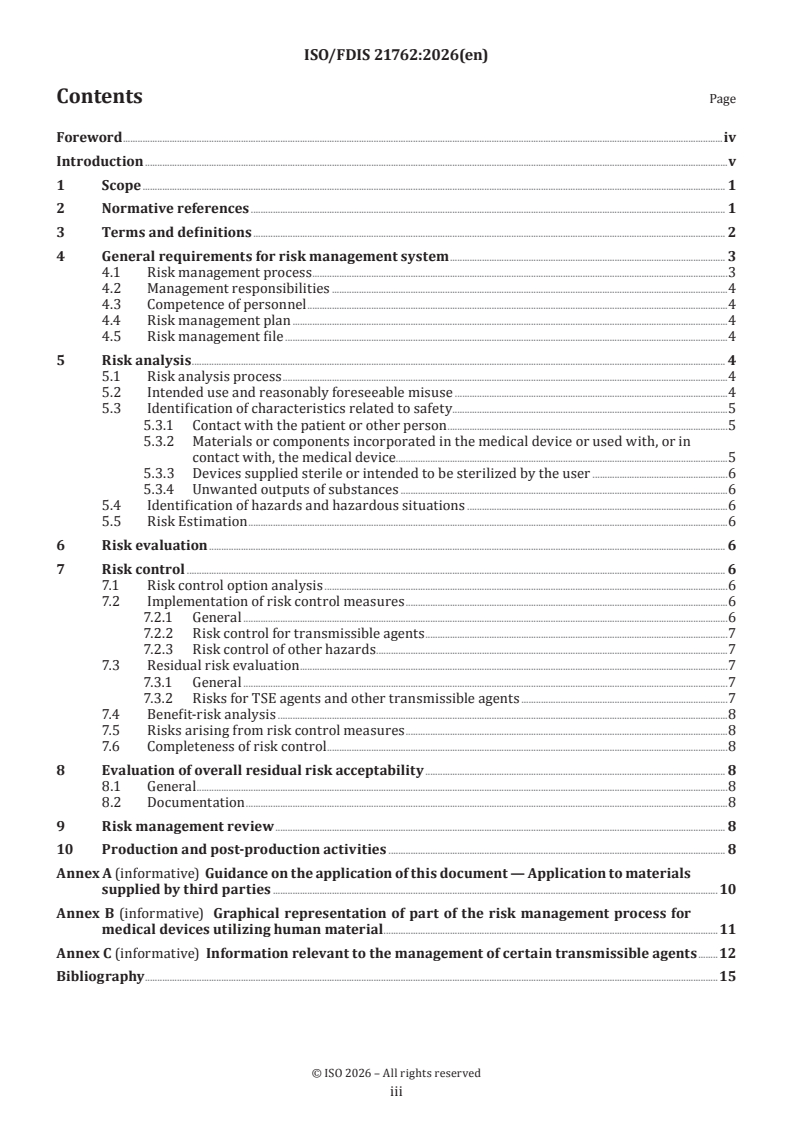
Contents Page
Foreword .iv
Introduction .v
1 Scope . 1
2 Normative references . 1
3 Terms and definitions . 2
4 General requirements for risk management system . 3
4.1 Risk management process .3
4.2 Management responsibilities .4
4.3 Competence of personnel .4
4.4 Risk management plan .4
4.5 Risk management file .4
5 Risk analysis . 4
5.1 Risk analysis process .4
5.2 Intended use and reasonably foreseeable misuse .4
5.3 Identification of characteristics related to safety .5
5.3.1 Contact with the patient or other person .5
5.3.2 Materials or components incorporated in the medical device or used with, or in
contact with, the medical device.5
5.3.3 Devices supplied sterile or intended to be sterilized by the user .6
5.3.4 Unwanted outputs of substances .6
5.4 Identification of hazards and hazardous situations .6
5.5 Risk Estimation .6
6 Risk evaluation . 6
7 Risk control . 6
7.1 Risk control option analysis .6
7.2 Implementation of risk control measures .6
7.2.1 General .6
7.2.2 Risk control for transmissible agents .7
7.2.3 Risk control of other hazards .7
7.3 Residual risk evaluation .7
7.3.1 General .7
7.3.2 Risks for TSE agents and other transmissible agents .7
7.4 Benefit-risk analysis .8
7.5 Risks arising from risk control measures .8
7.6 Completeness of risk control .8
8 Evaluation of overall residual risk acceptability . 8
8.1 General .8
8.2 Documentation .8
9 Risk management review . 8
10 Production and post-production activities . 8
Annex A (informative) Guidance on the application of this document — Application to materials
supplied by third parties . 10
Annex B (informative) Graphical representation of part of the risk management process for
medical devices utilizing human material .11
Annex C (informative) Information relevant to the management of certain transmissible agents .12
Bibliography .15
iii
Foreword
ISO (the International Organization for Standardization) is a worldwide federation of national standards
bodies (ISO member bodies). The work of preparing International Standards is normally carried out through
ISO technical committees. Each member body interested in a subject for which a technical committee
has been established has the right to be represented on that committee. International organizations,
governmental and non-governmental, in liaison with ISO, also take part in the work. ISO collaborates closely
with the International Electrotechnical Commission (IEC) on all matters of electrotechnical standardization.
The procedures used to develop this document and those intended for its further maintenance are described
in the ISO/IEC Directives, Part 1. In particular, the different approval criteria needed for the different types
of ISO document should be noted. This document was drafted in accordance with the editorial rules of the
ISO/IEC Directives, Part 2 (see www.iso.org/directives).
ISO draws attention to the possibility that the implementation of this document may involve the use of (a)
patent(s). ISO takes no position concerning the evidence, validity or applicability of any claimed patent
rights in respect thereof. As of the date of publication of this document, ISO had not received notice of (a)
patent(s) which may be required to implement this document. However, implementers are cautioned that
this may not represent the latest information, which may be obtained from the patent database available at
www.iso.org/patents. ISO shall not be held responsible for identifying any or all such patent rights.
Any trade name used in this document is information given for the convenience of users and does not
constitute an endorsement.
For an explanation of the voluntary nature of standards, the meaning of ISO specific terms and expressions
related to conformity assessment, as well as information about ISO's adherence to the World Trade
Organization (WTO) principles in the Technical Barriers to Trade (TBT), see www.iso.org/iso/foreword.html.
This document was prepared by Technical Committee ISO/TC 194, Biological and clinical evaluation of medical
devices, in collaboration with the European Committee for Standardization (CEN) Technical Committee CEN/
TC 206, Biological and clinical evaluation of medical devices, in accordance with the Agreement on technical
cooperation between ISO and CEN (Vienna Agreement).
Any feedback or questions on this document should be directed to the user’s national standards body. A
complete listing of these bodies can be found at www.iso.org/members.html.
iv
Introduction
Certain medical devices utilize materials of human origin.
Human tissues and their derivatives are used in the design and manufacture of medical devices to provide
performance characteristics that have been chosen for advantages over options which are lower risk from a
transmissible agent perspective. The range and quantities of materials of human origin in medical devices
vary. These materials can comprise a major part of the device (e.g. demineralised or mineral sintered bones,
heart valves, acellular cornea, placenta, dermis, tendons).
ISO 14971 specifies a process for a manufacturer by identifying hazards and hazardous situations associated
with medical devices, including in vitro medical devices, to estimate and evaluate the risks associated with
those hazards, to control these risks and to monitor the effectiveness of the control throughout the life cycle.
This document is intended to be used in conjunction with ISO 14971.
v
FINAL DRAFT International Standard ISO/FDIS 21762:2026(en)
Medical devices utilizing non-viable human materials —
Application of risk management
1 Scope
This document provides additional requirements and guidance for the evaluation of medical devices
manufactured utilizing human tissues or derivatives which are non-viable or rendered non-viable. This
document is applicable to materials of human origin (homo sapiens) such as:
— heart valves, bones, ligaments, amniotic membranes, cornea;
— derivatives of human tissues, such as collagen obtained from human tissue such as skin or tendons;
— materials produced in vivo such as enzymes and coagulation factors.
This document does not apply to materials of animal origin.
This document specifies, in conjunction with ISO 14971, a procedure to identify the hazards and hazardous
situations associated with medical devices, to estimate and evaluate the resulting risks, to control these
risks, and to monitor the effectiveness of that control.
This document outlines the decision process for determining the acceptability of residual risks, taking into
account the risk profile and expected benefit as compared to available alternatives, in line with ISO 14971.
This document provides requirements and guidance on risk management related to the hazards typical of
medical devices manufactured utilizing human materials such as:
a) contamination by bacteria, moulds, yeasts or parasites;
b) contamination by viruses;
c) contamination by agents causing transmissible spongiform encephalopathies (TSEs) and other
transmissible agents;
d) material responsible for undesired pyrogenic, immunological or toxicological reactions.
NOTE 1 It is not a requirement of this document to have a full quality management system during manufacture.
However, attention is drawn to international standards for quality management systems (see ISO 13485) that control
all stages of production or reprocessing of medical devices.
NOTE 2 For guidance on the application of this document, see Annex A.
This document does not address requirements concerning donor consent for the procurement and use of
human materials.
This document applies to medical devices other than in vitro diagnostic medical devices manufactured
utilizing human materials which are non-viable or have been rendered non-viable.
2 Normative references
The following documents are referred to in the text in such a way that some or all of their content constitutes
requirements of this document. For dated references, only the edition cited applies. For undated references,
the latest edition of the referenced document (including any amendments) applies.
ISO 14971:2019, Medical devices — Application of risk management to medical devices
ISO 22442-3, Medical devices utilizing animal tissues and their derivatives — Part 3: Validation of the elimination
and/or inactivation of viruses and transmissible spongiform encephalopathy (TSE) agents
3 Terms and definitions
For the purposes of this document, the terms and definitions given in ISO 14971 and the following apply.
ISO and IEC maintain terminology databases for use in standardization at the following addresses:
— ISO Online browsing platform: available at https:// www .iso .org/ obp
— IEC Electropedia: available at https:// www .electropedia .org/
3.1
cell
smallest organized unit of any living form which is capable of independent existence and of replacement of
its own substance in a suitable environment
[SOURCE: ISO 22442-1:2020, 3.2]
3.2
derivative
non-cellular substance that is extracted from human tissue (3.9), cells (3.1) or other material (such as
cerebral spinal fluid) through a manufacturing process
EXAMPLE Collagen, urokinase.
Note 1 to entry: Some materials included in the example can be considered to be derivatives in some jurisdictions but
not in others.
3.3
human material
cells (3.1), tissues (3.9) or exudates obtained from a human donor which have been rendered non-viable (3.7)
Note 1 to entry: Human DNA extracted for genetic purposes is excluded from this definition.
Note 2 to entry: Exudates are substances which are made by the human body that are not tissues or cells.
3.4
elimination
removal
process by which the number of transmissible agents is reduced
Note 1 to entry: The effectiveness of the process for the elimination of viruses and transmissible spongiform
encephalopathies (TSEs) and other transmissible agents should be expressed mathematically in terms of a reduction
factor (see ISO 22442-1:2020, Clause C.2 and ISO 22442-3:2007, Annex F).
Note 2 to entry: Elimination aims to prevent infection or pathogenic reaction caused by transmissible agents.
[SOURCE: ISO 22442-1:2020, 3.4, modified — "and other transmissible agents" has been added to Note 1 to
entry and Note 2 to entry has been replaced.]
3.5
inactivation
process by which the ability to cause infection or pathogenic reaction by a transmissible agent is reduced
Note 1 to entry: The effectiveness of the process for inactivation of viruses, transmissible spongiform encephalopathies
(TSE) and other transmissible agents should be expressed mathematically in terms of a reduction factor (see
ISO 22442-3:2007, Annex F).
Note 2 to entry: Inactivation aims to prevent infection by, and replication of, transmissible agents.
3.6
medical device
instrument, apparatus, implement, machine, appliance, implant, reagent for in vitro use, software, material
or other similar or related article, intended by the manufacturer to be used, alone or in combination, for
human beings, for one or more of the specific medical purpose(s) of
— diagnosis, prevention, monitoring, treatment or alleviation of disease,
— diagnosis, monitoring, treatment, alleviation of or compensation for an injury,
— investigation, replacement, modification, or support of the anatomy or of a physiological process,
— supporting or sustaining life,
— control of conception,
— disinfection of medical devices,
— providing information by means of in vitro examination of specimens derived from the human body,
and which does not achieve its primary intended action by pharmacological, immunological or metabolic
means, in or on the human body, but which can be assisted in its function by such means
[SOURCE: ISO/IEC Guide 63:2019, 3.7, modified — Note 1 to entry has been deleted.]
3.7
non-viable
having no potential for metabolism or multiplication
3.8
supplier agreement
binding contract between two or more parties that assigns responsibilities for technical requirements
3.9
tissue
organization of cells (3.1) or extra-cellular constituents, or both
Note 1 to entry: Some materials included in this definition can be considered to be tissues in some jurisdictions but not
in others.
3.10
transmissible agent
biological substance capable of transmission from one host or source to a susceptible host
Note 1 to entry: Categories of transmissible agents include: bacterium, mould, yeast, parasite, virus, prion or
pathogenic protein.
Note 2 to entry: Transmissible agents can cause disease or infection in the host.
4 General requirements for risk management system
4.1 Risk management process
The requirements of ISO 14971 shall apply. Conformity to these requirements shall be verified by inspection
of the appropriate documents (e.g. the risk management file).
The manufacturer shall document the rationale for the use of human material (including the choice of
tissues).
4.2 Management responsibilities
The organization responsible for manufacturing the medical device, shall specify, in a supplier agreement,
the principles to be applied, in line with this document, for the sourcing of human material, including:
— technical specifications;
— donor screening and assessment;
— clinical assessment and disease status;
— informed consent;
— ethical conduct;
— anonymisation, data protection and traceability;
— certification of origin;
— audit of sourcing procedures;
— compliance with applicable regulations and standards;
— biosafety and handling procedures.
The organization responsible for sourcing human material shall conduct and document sourcing in line with
the terms and conditions of the supplier agreement and maintain and document traceability of the human
material to the donor.
A process shall be established to verify and document the provenance of human material.
4.3 Competence of personnel
The requirements of ISO 14971:2019, 4.3 shall apply.
4.4 Risk management plan
The requirements of ISO 14971:2019, 4.4 shall apply.
4.5 Risk management file
The requirements of ISO 14971:2019, 4.5 shall apply.
5 Risk analysis
5.1 Risk analysis process
The requirements of ISO 14971:2019, 5.1 shall apply.
5.2 Intended use and reasonably foreseeable misuse
The requirements of ISO 14971:2019, 5.2 shall apply.
5.3 Identification of characteristics related to safety
5.3.1 Contact with the patient or other person
The following factors shall be addressed, if applicable:
a) the quantity of human material considering the lifetime of the device and cumulative effect i.e. the
number of devices which can be used in a single procedure and over the lifetime of the patient;
b) the contact surface area;
c) the type(s) of human material coming into contact with body tissues or fluids;
d) the type of body tissue or fluid it comes into contact with.
NOTE 1 The quantity of human material coming into contact is one of the factors in producing biological effects.
Refer to the ISO 10993 series for the evaluation of such effects.
NOTE 2 The structure of human material being processed can affect the inactivation and elimination of
transmissible agents, and the potential for retaining viable cells can be affected by the structure of the human tissues
and derivatives being processed. Also tissue factors for example growth factors, cytokines, enzymes and other
hormones can have residual activity.
5.3.2 Materials or components incorporated in the medical device or used with, or in contact with,
the medical device
The following factors shall be addressed, if applicable:
a) if viable human materials are utilized in the manufacture of the medical device, verification that the
final medical device contains no viable human material;
b) the intended use of any human material and its expected function in the device;
c) age of the donors;
d) known health conditions of the donor(s) which can present a risk;
e) the type and anatomical source of the human material;
f) the production process, particularly if it uses human materials pooled from more than one donor;
g) the nature of human material utilized in the medical device;
h) the method of utilization or incorporation into the medical device;
i) the evaluation of the production process with regards to the potential to concentrate levels of
transmissible agents potentially present in the starting tissues or derivatives;
j) the potential bioburden in the human material;
k) the potential cross contamination during collection of the human material, transportation, storage and
processing and utilization in the medical device;
In the case of medical devices utilizing several relevant constituents (e.g. from various origins or tissues) or
several similar types of constituents produced using different methods, each individual constituent should
be analysed separately.
5.3.3 Devices supplied sterile or intended to be sterilized by the user
Given the biological nature of human materials or derivatives, variations in the bioburden of the medical
device shall be estimated. Specific consideration shall be given to intrinsic contaminants including
intracellular or extracellular transmissible agents and potential human tissue specific pathogens.
NOTE See also ISO 11737-1 and ISO 14160 regarding the estimation of bioburden.
5.3.4 Unwanted outputs of substances
The possible presence of toxic residue related to the manufacturing process utilized or degradation by-
products shall be addressed taking into account the physical characteristics (e.g. por
...
ISO/TC 194
Secretariat: DIN
Date: 2026-11-17
Medical devices utilizing non-viable human materials —
Application of risk management
Dispositifs médicaux utilisant des matériaux humains non viables — Gestion des risques
First edition
Date: 2026-08-11
This draft is submitted to a parallel vote in ISO, CEN.
© FDIS stage
All rights reserved. Unless otherwise specified,
This ISO publication is protected by copyright and is owned by ISO and/or its licensors.
The content of this ISO publication is provided under licence, not sold. Use is subject to the applicable licence terms issued
by ISO, an ISO member body, or an authorized third-party distributor.
Except as required in the context of its for implementation or expressly permitted by a separate licence, no part of this
ISO publication may be reproduced or utilized otherwise, distributed, modified, used, or made available in any form or
by any means, – electronic or mechanical, including photocopying, scanning, recording, or posting on internal or external
digital platforms.
Any use beyond the internet or an intranet, without prior written permission. Permission can be requested from either
ISO at the address below or ISO's member body in the countryscope of the requester. granted rights is prohibited and
may result in legal action.
ISO Copyright Office copyright office
CP 401 • CH-1214 Vernier, Geneva
Phone: + 41 22 749 01 11
Email: copyright@iso.org
Website: www.iso.org
Published in Switzerland.
iii
ISO/DISFDIS 21762:2025(E2026(en)
Contents Page
Foreword . v
Introduction . vi
1 Scope . 1
2 Normative references . 2
3 Terms and definitions . 2
4 General requirements for risk management system . 4
4.1 Risk management process . 4
4.2 Management responsibilities . 4
4.3 Competence of personnel . 5
4.4 Risk management plan . 5
4.5 Risk management file . 5
5 Risk analysis . 5
5.1 Risk analysis process . 5
5.2 Intended use and reasonably foreseeable misuse . 5
5.3 Identification of characteristics related to safety . 5
5.4 Identification of hazards and hazardous situations . 7
5.5 Risk Estimation . 7
6 Risk evaluation . 7
7 Risk control . 7
7.1 Risk control option analysis . 7
7.2 Implementation of risk control measures . 7
7.3 Residual risk evaluation . 8
7.4 Benefit-risk analysis . 9
7.5 Risks arising from risk control measures . 9
7.6 Completeness of risk control . 9
8 Evaluation of overall residual risk acceptability . 9
8.1 General. 9
8.2 Documentation . 9
9 Risk management review. 9
10 Production and post-production activities . 10
Annex A (informative) Guidance on the application of this document — Application to materials
supplied by third parties . 11
Annex B (informative) Graphical representation of part of the risk management process for
medical devices utilizing human material . 12
Annex C (informative) Information relevant to the management of certain transmissible agents15
Bibliography . 18
iv
Foreword
ISO (the International Organization for Standardization) is a worldwide federation of national standards
bodies (ISO member bodies). The work of preparing International Standards is normally carried out through
ISO technical committees. Each member body interested in a subject for which a technical committee has been
established has the right to be represented on that committee. International organizations, governmental and
non-governmental, in liaison with ISO, also take part in the work. ISO collaborates closely with the
International Electrotechnical Commission (IEC) on all matters of electrotechnical standardization.
The procedures used to develop this document and those intended for its further maintenance are described
in the ISO/IEC Directives, Part 1. In particular, the different approval criteria needed for the different types of
ISO document should be noted. This document was drafted in accordance with the editorial rules of the
ISO/IEC Directives, Part 2 (see www.iso.org/directives).
ISO draws attention to the possibility that the implementation of this document may involve the use of (a)
patent(s). ISO takes no position concerning the evidence, validity or applicability of any claimed patent rights
in respect thereof. As of the date of publication of this document, ISO had not received notice of (a) patent(s)
which may be required to implement this document. However, implementers are cautioned that this may not
represent the latest information, which may be obtained from the patent database available at
www.iso.org/patents. ISO shall not be held responsible for identifying any or all such patent rights.
Any trade name used in this document is information given for the convenience of users and does not
constitute an endorsement.
For an explanation of the voluntary nature of standards, the meaning of ISO specific terms and expressions
related to conformity assessment, as well as information about ISO's adherence to the World Trade
Organization (WTO) principles in the Technical Barriers to Trade (TBT), see www.iso.org/iso/foreword.html.
This document was prepared by Technical Committee ISO/TC 194, Biological and clinical evaluation of medical
devices, in collaboration with the European Committee for Standardization (CEN) Technical Committee
CEN/TC 206, Biological and clinical evaluation of medical devices, in accordance with the Agreement on
technical cooperation between ISO and CEN (Vienna Agreement).
Any feedback or questions on this document should be directed to the user’s national standards body. A
complete listing of these bodies can be found at www.iso.org/members.html.
v
ISO/DISFDIS 21762:2025(E2026(en)
Introduction
Certain medical devices utilize materials of human origin.
Human tissues and their derivatives are used in the design and manufacture of medical devices to provide
performance characteristics that have been chosen for advantages over options which are lower risk from a
transmissible agent perspective. The range and quantities of materials of human origin in medical devices
vary. These materials can comprise a major part of the device (e.g. demineralised or mineral sintered bones,
heart valves, acellular cornea, placenta, dermis, tendons).
ISO 14971 is a general standard which specifies a process for a manufacturer by identifying hazards and
hazardous situations associated with medical devices, including in vitro medical devices, to estimate and
evaluate the risks associated with those hazards, to control these risks and to monitor the effectiveness of the
control throughout the life cycle.
This document can onlyis intended to be used in combinationconjunction with ISO 14971 and is not a “stand-
alone” standard.
Wherever in this document it is stated that something “be addressed”, the reader either takes action to control
the risk or justifies in the risk management report why no such action has been taken.
vi
DRAFT International Standard ISO/FDIS 21762:2026(en)
Medical devices utilizing non-viable human materials — Application
of risk management
1 Scope
This document provides additional requirements and guidance for the evaluation of medical devices
manufactured utilizing human tissues or derivatives which are non-viable or rendered non-viable. This
document is applicable to materials of human origin (homo sapiens) such as:
— — heart valves, bones, ligaments, amniotic membranes, cornea;
— — derivatives of human tissues, such as collagen obtained from human tissue such as skin or tendons;
— — materials produced in vivo such as enzymes and coagulation factors.
This document does not apply to materials of animal origin.
This document specifies, in conjunction with ISO 14971, a procedure to identify the hazards and hazardous
situations associated with medical devices, to estimate and evaluate the resulting risks, to control these risks,
and to monitor the effectiveness of that control.
This document outlines the decision process for determining the acceptability of residual risks, taking into
account the risk profile and expected benefit as compared to available alternatives, in line with ISO 14971.
This document is intended to provideprovides requirements and guidance on risk management related to the
hazards typical of medical devices manufactured utilizing human materials such as:
a) a) contamination by bacteria, moulds, yeasts or parasites;
b) b) contamination by viruses;
c) c) contamination by agents causing transmissible spongiform encephalopathies (TSEs) and other
transmissible agents;
d) d) material responsible for undesired pyrogenic, immunological or toxicological reactions.
NOTE 1 It is not a requirement of this document to have a full quality management system during manufacture.
However, attention is drawn to international standards for quality management systems (see ISO 13485) that control all
stages of production or reprocessing of medical devices.
NOTE 2 For guidance on the application of this document, see Annex AAnnex A.
This document does not address requirements for concerning donor consent to donationfor the procurement
and use of human materials.
This document applies to medical devices other than in vitro diagnostic medical devices manufactured
utilizing human materials which are non-viable or have been rendered non-viable.
ISO/DISFDIS 21762:2025(E2026(en)
2 Normative references
The following documents are referred to in the text in such a way that some or all of their content constitutes
requirements of this document. For dated references, only the edition cited applies. For undated references,
the latest edition of the referenced document (including any amendments) applies.
ISO 14971:2019, Medical devices — Application of risk management to medical devices
ISO 22442--3, Medical devices utilizing animal tissues and their derivatives — Part 3: Validation of the
elimination and/or inactivation of viruses and transmissible spongiform encephalopathy (TSE) agents
3 Terms and definitions
For the purposes of this document, the terms and definitions given in ISO 14971 and the following apply.
ISO and IEC maintain terminology databases for use in standardization at the following addresses:
— — ISO Online browsing platform: available at https://www.iso.org/obp
— — IEC Electropedia: available at https://www.electropedia.org/
3.1 3.1
cell
smallest organized unit of any living form which is capable of independent existence and of replacement of its
own substance in a suitable environment
[SOURCE: ISO 22442-1:2020, 3.2]
3.2 3.2
derivative
non-cellular substance that is extracted from human tissue (3.9,), cells (3.1(3.1)) or other material (such as
cerebral spinal fluid) through a manufacturing process
EXAMPLE Collagen, urokinase.
Note 1 to entry: Some materials included in the example can be considered to be derivatives in some jurisdictions but not
in others.
3.3 3.3
human material
cells (3.1,), tissues (3.9) or exudates obtained from a human donor which have been rendered non-viable
(3.7(3.8))
Note 1 to entry: Human DNA extracted for genetic purposes is excluded from this definition.
3.4
exudate
substance that isNote 2 to entry: Exudates are substances which are made by the human body that are not tissues or cells.
EXAMPLE Hair, urine, bile, milk.
3.4 3.5
elimination
removal
process by which the number of transmissible agents is reduced
[SOURCE: ISO 22442-1:2020 3.4]
Note 1 to entry: The effectiveness of the process for the elimination of viruses and Transmissible Spongiform
Encephalopathiestransmissible spongiform encephalopathies (TSEs) and other transmissible agents should be
expressed mathematically in terms of a reduction factor (see ISO 22442-1:2020, Clause C.2 and ISO 22442-3:2007,
Annex F).
Note 1 2 to entry: Elimination aims to prevent infection or pathogenic reaction caused by transmissible agents.
3.6[SOURCE: ISO 22442-1:2020, 3.4, modified — "and other transmissible agents" has been added to Note 1
to entry and Note 2 to entry has been replaced.]
3.5
inactivation
process by which the ability to cause infection or pathogenic reaction by a transmissible agent is reduced
Note 1 to entry: The effectiveness of the process for inactivation of viruses and , transmissible spongiform
encephalopathies (TSE) and other transmissible agents should be expressed mathematically in terms of a reduction
factor (see ISO 22442-3:2007, Annex F).
Note 2 to entry: Inactivation aims to prevent infection by, and replication of, transmissible agents.
3.6 3.7
medical device
instrument, apparatus, implement, machine, appliance, implant, reagent for in vitro use, software, material or
other similar or related article, intended by the manufacturer to be used, alone or in combination, for human
beings, for one or more of the specific medical purpose(s) of
— — diagnosis, prevention, monitoring, treatment or alleviation of disease,
— — diagnosis, monitoring, treatment, alleviation of or compensation for an injury,
— — investigation, replacement, modification, or support of the anatomy or of a physiological process,
— — supporting or sustaining life,
— — control of conception,
— — disinfection of a medical devicedevices,
— — providing information by means of in vitro examination of specimens derived from the human body,
and which does not achieve its primary intended action by pharmacological, immunological or metabolic
means, in or on the human body, but which can be assisted in its function by such means
[SOURCE: ISO/IEC Guide 63:2019, 3.7 –, modified -— Note 1 to entry has been deleted.]
3.7 3.8
non-viable
having no potential for metabolism or multiplication
ISO/DISFDIS 21762:2025(E2026(en)
3.8 3.9
supplier agreement
binding contract between two or more parties that assigns responsibilities for technical requirements
3.9 3.10
tissue
organization of cells (3.1(3.1)) or extra-cellular constituents, or both
Note 1 to entry: Some materials included in this definition can be considered to be tissues in some jurisdictions but not
in others.
3.10 3.11
transmissible agent
biological substance capable of transmission from one host or source to a susceptible host
Note 1 to entry: Categories of transmissible agents include: bacterium, mould, yeast, parasite, virus, prion, or pathogenic
protein.
Note 2 to entry: Transmissible agents can cause disease or infection in the host.
4 General requirements for risk management system
4.1 Risk management process
The requirements of ISO 14971 shall apply. Conformity to these requirements shall be verified by inspection
of the appropriate documents, (e.g. the risk management file.).
The manufacturer shall document the rationale for the use of human material (including the choice of tissues).
4.2 Management responsibilities
The organization responsible for manufacturing the medical device, shall specify, in a supplier agreement, the
principles to be applied, in line with this document, for the sourcing of human material, including:
— technical specifications;
— donor screening and assessment;
— clinical assessment and disease status;
— informed consent;
— ethical conduct;
— anonymisation, data protection, and traceability;
— certification of origin;
— audit of sourcing procedures;
— compliance with applicable regulations and standards;
— biosafety and handling procedures.
The organization responsible for sourcing human material shall conduct and document sourcing in line with
the terms and conditions of the supplier agreement and maintain and document traceability of the human
material to the donor.
A process shall be established to verify and document the provenance of human material.
4.3 Competence of personnel
The requirements of ISO 14971:2019, 4.3 shall apply.
4.4 Risk management plan
The requirements of ISO 14971:2019, 4.4 shall apply.
4.5 Risk management file
The requirements of ISO 14971:2019, 4.5 shall apply.
5 Risk analysis
5.1 Risk analysis process
The requirements of ISO 14971:2019, 5.1 shall apply.
5.2 Intended use and reasonably foreseeable misuse
The requirements of ISO 14971:2019, 5.2 shall apply.
5.3 Identification of characteristics related to safety
5.3.1 Contact with the patient or other person
The following factors shall be addressed, if applicable:
a) a) the quantity of human material considering the lifetime of the device and cumulative effect i.e.
the number of devices which can be used in a single procedure and over the lifetime of the patient;
b) b) the contact surface area;
c) c) the type(s) of human material coming into contact with body tissues or fluids;
d) d) the type of body tissue or fluid it comes into contact with.
NOTE 1 The quantity of human material coming into contact is one of the factors in producing biological effects.
SeeRefer to the ISO 10993 series for the evaluation of such effects.
NOTE 2 The structure of human material being processed can affect the inactivation and elimination of transmissible
agents, and the potential for retaining viable cells can be affected by the structure of the human tissues and derivatives
being processed. Also tissue factors for example growth factors, cytokines, enzymes and other hormones can have
residual activity.
ISO/DISFDIS 21762:2025(E2026(en)
5.3.2 Materials or components incorporated in the medical device or used with, or in contact with,
the medical device
The following factors shall be addressed, if applicable:
a) a) if viable human materials are utilized in the manufacture of the medical device, verification
that the final medical device contains no viable human material;
b) b) the intended use of any human material and its expected function in the device;
c) c) age of the donors;
d) d) known health conditions of the donor(s) which can present a risk;
e) e) the type and anatomical source of the human material;
f) f) the production process, particularly if it uses human materials pooled from more than one
donor;
g) g) the nature of human material utilized in the medical device;
h) h) the method of utilization or incorporation into the medical device;
i) i) the evaluation of the production process with regards to the potential to concentrate levels of
transmissible agents potentially present in the starting tissues or derivatives;
j) j) the potential bioburden in the human material;
k) k) the potential cross contamination during collection of the human material, transportation,
storage and processing and utilization in the medical device;
In the case of medical devices utilizing several relevant constituents (e.g. from various origins or tissues) or
several similar types of constituents produced using different methods, each individual constituent should be
analysed separately.
5.3.3 Devices supplied sterile or intended to be sterilized by the user
Given the biological nature of human materials or derivatives, variations in the bioburden of the medical
device shall be estimated. Specific consideration shall be given to intrinsic contaminants including
intracellular or extracellular transmissible agents and potential human tissue specific pathogens.
NOTE See also ISO 11737-1 and ISO 14160 regarding the estimation of bioburden.
5.3.4 Unwanted outputs of substances
The possible presence of toxic residue related to the manufacturing process utilized or degradation by-
products shall be addressed taking into account the physical characteristics (e.g. porosity, heterogeneity) and
chemical composition of human materials or derivatives.
5.4 Identification of hazards and hazardous situations
The possible hazards associated with human materials or derivatives shall be identified and documented.
Particular attention shall be given to possible hazards posed by human materials or derivatives with regard
to:
— — potential contamination or cross contamination by transmissible agents and their susceptibility to
elimination and inactivation during processing;
— — potential for contaminants on the finished material which can cause an undesired pyrogenic,
immunological or toxicological reaction;
— — potential for the finished material itself to cause an undesired pyrogenic, immunological or
toxicological reaction. Consideration; consideration should be given to residual tissue factors including
growth factors that may be present in the finished material.
5.5 Risk Estimation
The requirements of ISO 14971:2019, 5.5 shall apply.
6 Risk evaluation
In accordance with ISO 14971, all identified risks shall be evaluated. Biological safety can be evaluated
according to ISO 10993-1. Risk evaluation for transmissible agents shall be implemented by separately
addressing the risks related to different categories of transmissible agents. Annex BAnnex B identifies the
main categories of risk that should be considered.
7 Risk control
7.1 Risk control option analysis
The risk control options shall be documented and justified.
The flowchart in Annex BAnnex B gives an overview of the risk management process. If additional risks are
identified when using this document, the medical device manufacturer may choose to follow any other
relevant standard or any other route. The decision should be justified and documented.
7.2 Implementation of risk control measures
7.2.1 General
The requirements of ISO 14971:2019, 7.2 shall apply.
7.2.2 Risk control for transmissible agents
Risk control shall be implemented by separately addressing the risks related to different categories of
transmissible agents. After defining the characteristics of the medical device, the medical device manufacturer
shall complyconform with the relevant requirements for procurement and ISO 22442-3 for guidance in regard
to inactivation and elimination procedures. Furthermore, the medical device manufacturer shall consider new
upcoming human pathogens and evaluate possible inactivation /and elimination methods based on the state
of the art.
The principles for the conduct of literature review and in
...