


ISO/TS 17444-1:2017
(Main)Electronic fee collection — Charging performance — Part 1: Metrics
Electronic fee collection — Charging performance — Part 1: Metrics
ISO/TS 17444-1:2017 defines metrics for the charging performance of electronic fee collection (EFC) systems in terms of the level of errors associated with charging computation. ISO/TS 17444-1:2017 is a toolbox standard of metrics. The detailed choice of metrics depends on the application and the respective context. ISO/TS 17444-1:2017 describes a set of metrics with appropriate definitions, principles and formulations, which together make up a reference framework for the establishment of requirements for EFC systems and their later examination of the charging performance. The charging performance metrics defined in ISO/TS 17444-1:2017 are intended for use with any Charging Scheme, regardless of its technical underpinnings, system architecture, tariff structure, geographical coverage, or organizational model. They are defined to treat technical details that can be different among technologies and vendors or vary over time as a "black box". They focus solely on the outcome of the charging process, i.e. the amount charged in relation to a pre-measured or theoretically correct amount, rather than intermediate variables from various components as sensors, such as positioning accuracy, signal range, or optical resolution. This approach ensures comparable results for each metric in all relevant situations. The metrics are designed to cover the information exchanged on the Front End interface and the interoperability interfaces between Toll Service Providers, Toll Chargers and Road Users as well as on the End-to-End level.
Perception du télépéage — Performance d'imputation — Partie 1: Métrique
General Information
- Status
- Withdrawn
- Publication Date
- 07-Sep-2017
- Technical Committee
- ISO/TC 204 - Intelligent transport systems
- Drafting Committee
- ISO/TC 204/WG 5 - Fee and toll collection
- Current Stage
- 9599 - Withdrawal of International Standard
- Start Date
- 09-Jun-2023
- Completion Date
- 12-Feb-2026
Relations
- Effective Date
- 12-Feb-2026
- Effective Date
- 06-Jun-2022
- Effective Date
- 06-Jun-2022
- Effective Date
- 06-Jun-2022
- Effective Date
- 10-Dec-2016


Get Certified
Connect with accredited certification bodies for this standard

BSI Group
BSI (British Standards Institution) is the business standards company that helps organizations make excellence a habit.

Great Wall Tianjin Quality Assurance Center
Established 1993, first batch to receive national accreditation with IAF recognition.
Hong Kong Quality Assurance Agency (HKQAA)
Hong Kong's leading certification body.
Sponsored listings
Frequently Asked Questions
ISO/TS 17444-1:2017 is a technical specification published by the International Organization for Standardization (ISO). Its full title is "Electronic fee collection — Charging performance — Part 1: Metrics". This standard covers: ISO/TS 17444-1:2017 defines metrics for the charging performance of electronic fee collection (EFC) systems in terms of the level of errors associated with charging computation. ISO/TS 17444-1:2017 is a toolbox standard of metrics. The detailed choice of metrics depends on the application and the respective context. ISO/TS 17444-1:2017 describes a set of metrics with appropriate definitions, principles and formulations, which together make up a reference framework for the establishment of requirements for EFC systems and their later examination of the charging performance. The charging performance metrics defined in ISO/TS 17444-1:2017 are intended for use with any Charging Scheme, regardless of its technical underpinnings, system architecture, tariff structure, geographical coverage, or organizational model. They are defined to treat technical details that can be different among technologies and vendors or vary over time as a "black box". They focus solely on the outcome of the charging process, i.e. the amount charged in relation to a pre-measured or theoretically correct amount, rather than intermediate variables from various components as sensors, such as positioning accuracy, signal range, or optical resolution. This approach ensures comparable results for each metric in all relevant situations. The metrics are designed to cover the information exchanged on the Front End interface and the interoperability interfaces between Toll Service Providers, Toll Chargers and Road Users as well as on the End-to-End level.
ISO/TS 17444-1:2017 defines metrics for the charging performance of electronic fee collection (EFC) systems in terms of the level of errors associated with charging computation. ISO/TS 17444-1:2017 is a toolbox standard of metrics. The detailed choice of metrics depends on the application and the respective context. ISO/TS 17444-1:2017 describes a set of metrics with appropriate definitions, principles and formulations, which together make up a reference framework for the establishment of requirements for EFC systems and their later examination of the charging performance. The charging performance metrics defined in ISO/TS 17444-1:2017 are intended for use with any Charging Scheme, regardless of its technical underpinnings, system architecture, tariff structure, geographical coverage, or organizational model. They are defined to treat technical details that can be different among technologies and vendors or vary over time as a "black box". They focus solely on the outcome of the charging process, i.e. the amount charged in relation to a pre-measured or theoretically correct amount, rather than intermediate variables from various components as sensors, such as positioning accuracy, signal range, or optical resolution. This approach ensures comparable results for each metric in all relevant situations. The metrics are designed to cover the information exchanged on the Front End interface and the interoperability interfaces between Toll Service Providers, Toll Chargers and Road Users as well as on the End-to-End level.
ISO/TS 17444-1:2017 is classified under the following ICS (International Classification for Standards) categories: 03.220.20 - Road transport; 35.240.60 - IT applications in transport. The ICS classification helps identify the subject area and facilitates finding related standards.
ISO/TS 17444-1:2017 has the following relationships with other standards: It is inter standard links to CEN ISO/TS 17444-1:2017, ISO/TR 8124-8:2014, ISO 18098:2022, ISO/TS 37444:2023, ISO/TS 17444-1:2012. Understanding these relationships helps ensure you are using the most current and applicable version of the standard.
ISO/TS 17444-1:2017 is available in PDF format for immediate download after purchase. The document can be added to your cart and obtained through the secure checkout process. Digital delivery ensures instant access to the complete standard document.
Standards Content (Sample)
TECHNICAL ISO/TS
SPECIFICATION 17444-1
Second edition
2017-09
Electronic fee collection — Charging
performance —
Part 1:
Metrics
Perception du télépéage — Performance d'imputation —
Partie 1: Métrique
Reference number
©
ISO 2017
© ISO 2017, Published in Switzerland
All rights reserved. Unless otherwise specified, no part of this publication may be reproduced or utilized otherwise in any form
or by any means, electronic or mechanical, including photocopying, or posting on the internet or an intranet, without prior
written permission. Permission can be requested from either ISO at the address below or ISO’s member body in the country of
the requester.
ISO copyright office
Ch. de Blandonnet 8 • CP 401
CH-1214 Vernier, Geneva, Switzerland
Tel. +41 22 749 01 11
Fax +41 22 749 09 47
copyright@iso.org
www.iso.org
ii © ISO 2017 – All rights reserved
Contents Page
Foreword .iv
Introduction .v
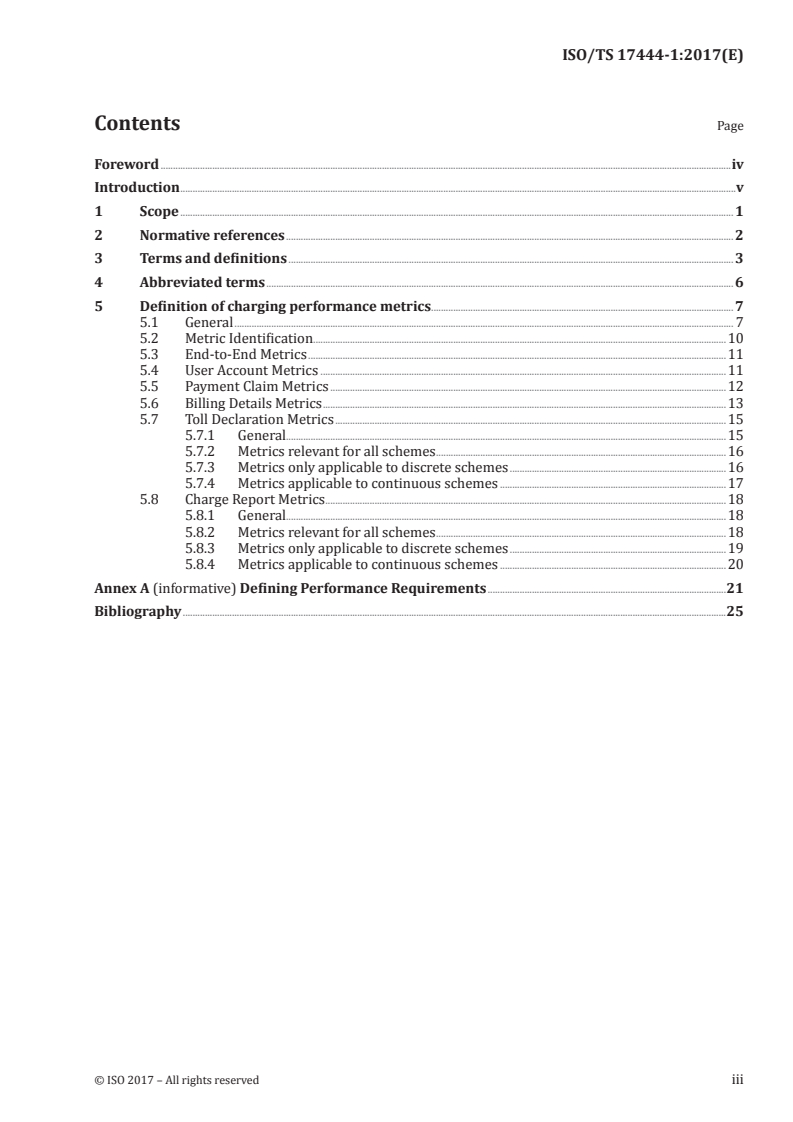
1 Scope . 1
2 Normative references . 2
3 Terms and definitions . 3
4 Abbreviated terms . 6
5 Definition of charging performance metrics . 7
5.1 General . 7
5.2 Metric Identification.10
5.3 End-to-End Metrics .11
5.4 User Account Metrics .11
5.5 Payment Claim Metrics .12
5.6 Billing Details Metrics .13
5.7 Toll Declaration Metrics .15
5.7.1 General.15
5.7.2 Metrics relevant for all schemes .16
5.7.3 Metrics only applicable to discrete schemes .16
5.7.4 Metrics applicable to continuous schemes .17
5.8 Charge Report Metrics .18
5.8.1 General.18
5.8.2 Metrics relevant for all schemes .18
5.8.3 Metrics only applicable to discrete schemes .19
5.8.4 Metrics applicable to continuous schemes .20
Annex A (informative) Defining Performance Requirements .21
Bibliography .25
Foreword
ISO (the International Organization for Standardization) is a worldwide federation of national standards
bodies (ISO member bodies). The work of preparing International Standards is normally carried out
through ISO technical committees. Each member body interested in a subject for which a technical
committee has been established has the right to be represented on that committee. International
organizations, governmental and non-governmental, in liaison with ISO, also take part in the work.
ISO collaborates closely with the International Electrotechnical Commission (IEC) on all matters of
electrotechnical standardization.
The procedures used to develop this document and those intended for its further maintenance are
described in the ISO/IEC Directives, Part 1. In particular, the different approval criteria needed for the
different types of ISO documents should be noted. This document was drafted in accordance with the
editorial rules of the ISO/IEC Directives, Part 2 (see www.iso.org/directives).
Attention is drawn to the possibility that some of the elements of this document may be the subject of
patent rights. ISO shall not be held responsible for identifying any or all such patent rights. Details of
any patent rights identified during the development of the document will be in the Introduction and/or
on the ISO list of patent declarations received (see www.iso.org/patents).
Any trade name used in this document is information given for the convenience of users and does not
constitute an endorsement.
For an explanation on the voluntary nature of standards, the meaning of ISO specific terms and
expressions related to conformity assessment, as well as information about ISO's adherence to the
World Trade Organization (WTO) principles in the Technical Barriers to Trade (TBT), see the following
URL: www.iso.org/iso/foreword.html.
This document was prepared by Technical Committee ISO/TC 204, Intelligent transport systems.
This second edition cancels and replaces the first edition (ISO/TS 17444-1:2012), which has been
revised with the following changes:
— editorial and formal corrections, as well as changes, to improve readability;
— updated terminology.
A list of all parts in the ISO/TS 17444 series can be found on the ISO website.
iv © ISO 2017 – All rights reserved
Introduction
Electronic tolling systems are complex distributed systems involving mission-critical technology
such as dedicated short-range communication (DSRC) and global navigation satellite systems (GNSS)
both subject to a certain random behaviour that may affect the computation of the charges. Thus, in
order to protect the interests of the different involved stakeholders, in particular Service Users and
Toll Chargers, it is essential to define metrics that measure the performance of the system as far as
computation of charges is concerned and ensure that the potential resulting errors in terms of size and
probability are acceptable. These metrics will be an essential tool when establishing requirements for
the systems and also for examination of the system capabilities both during acceptance and during the
operational life of the system.
In addition, in order to ensure the interoperability of different systems, it will be necessary to agree on
common metrics to be used and on the actual values that define the required acceptable performances.
Although this is not covered in this document, it is covered in ISO/TS 17444-2.
Toll schemes take on various forms as identified in ISO 17575 (all parts) and ISO 14906. In order to
create a uniform performance metric specification, toll schemes are grouped into two classes, based
on the character of their primary charging variable: Charging based on discrete events (charges when
a vehicle crosses or stands within a certain zone), and those based on a continuous measurement
(duration or distance).
The following are examples of discrete (event-based) toll schemes.
— Single object charging: a road section, bypass, bridge, tunnel, mountain pass or even a ferry, charged
per passage; most tolled bridges belong to this category.
— Closed road charging: a fixed amount is charged for a certain combination of entry and exit on a
motorway or other closed road network; many of the motorways in Southern Europe belong to this
category.
— Discrete road links charging: determined by usage of specified road links, whether or not used in
their entirety.
EXAMPLE German heavy goods vehicle (HGV) charge.
— Charging for cordon crossing: triggered by passing in or out through a cordon that encircles a city
core, for example.
EXAMPLE Stockholm congestion charging.
The following are examples of continuous toll schemes.
— Charging based on direct distance measurement: defined as an amount per kilometre driven.
EXAMPLE Switzerland’s HGV charge; US basic vehicle miles travelled approach.
— Charging based on direct distance measurement in different tariff zones or road types: defined as
an amount per kilometre driven, with different tariffs applying in different zones or on different
road types. This is a widely discussed approach, also known as Time-Distance-Place charging, and
is under consideration in many European countries.
EXAMPLE OReGO, the pilot programme in Oregon, is an example from North America.
— Time in use charge: determined by the accumulated time a vehicle has been in operation, or,
alternatively, by the time the vehicle has been present inside a predefined zone.
In all these examples of toll schemes, tolls may additionally vary as a function of vehicle class
characteristics such as trailer presence, number of axles, taxation class, operating function, and
depending on time of day or day of week, so that, for example, tariffs are higher in rush hour and lower
on the weekends.
With this degree of complexity, it is not surprising to find that the attempts to evaluate and compare
technical solutions for Service User charging have been made on an individual basis each time a
procurement or study is initiated, and with only limited ability to reuse prior comparisons made by
other testing entities.
The identification of different types of schemes as proposed in ISO 17575 (all parts) and their grouping in
the mentioned two classes is described in Table 1, which also identifies the examples mentioned above.
Table 1 — Tolling scheme designs grouped according to Scheme categories
Examples Scheme type ISO 17575 category
Single object charging Discrete Sectioned roads pricing
Closed road charging Discrete Sectioned roads pricing
Discrete road links charging Discrete Sectioned roads pricing
Charging for cordon crossing Discrete Cordon pricing
Time in use charge Continuous Area pricing — time
Cumulative distance charge Continuous Area pricing — distance
Charging for cumulative distance (or time) in different Continuous Area pricing — distance
zones (or by road type)
No toll schemes are purely continuous. At the very least, a system must be able to stop accumulating
charges when it leaves a jurisdiction in which a charge is due, and resume charging when it returns
or enters another. Additionally, many Charging Schemes are set up so that the tariff is modified using
discrete parameters, such as spatial zones, time spans, vehicle classes, etc. Under those circumstances,
each unit of distance or time costs a different amount depending, for example, on whether it takes
place inside or outside an area, such as a city, whether a trip takes place in rush hour or at night, or
depending on what type of vehicle is used. In this document references to a “continuous system” have to
be understood as those systems having some continuous behaviour even though they can also integrate
some discrete nature. References to “discrete systems” are limited to those systems that are purely
discrete.
In these schemes, all the discrete parts (zones, cordons, events, time, vehicle class, etc.) that a system has
to identify are translated into a particular tariff (e.g. price per kilometre) that has to be applied to the
measured continuous variable (e.g. distance travelled) resulting in another continuous parameter, money.
Some features of discrete and continuous toll schemes that are of relevance for the definition of metrics
proposed in this document are analysed below.
Discrete toll schemes
In a discrete toll scheme, distinct events are associated with the identification of Charge Objects. It
can happen that a vehicle crossed a cordon, passed a bridge or was present in an area on a given day.
An event that takes place can either be correctly recorded by the system or can be missed. However,
there is also the possibility that an event is recorded even though it did not actually take place. This is
summarized in the following matrix in Table 2.
Table 2 — Theoretical event decision matrix for discrete schemes
System detects charge object detection
Event Matrix
Yes No
Missed Recognition
Correct
Yes
Charging
(Undercharging)
Charge object detection
takes place
False Positive
Correct
No
Non-charging
(Overcharging)
vi © ISO 2017 – All rights reserved
In Table 2 are two successful scenarios (Correct Charging and Correct Non-charging) and two
unsuccessful (Missed Recognition and False Positive). The unsuccessful scenarios have very different
consequences. A Missed Recognition, i.e. a charge object detection that takes place but is not recorded
by the system, implies an undercharging, as the Service User is not charged.
In the case of False Positive, a vehicle that is not using the toll domain is being charged for an event which
did not take place. This implies an overcharging which is in violation of the legal rights of the Service
User, and ultimately risks eroding trust in the system.
This document therefore makes a distinction between the two types of errors and defines associated
metrics to protect the interests of the Toll Charger and Service Users in terms of the allowed probabilities
of those events.
Continuous toll schemes
A continuous toll scheme is one where the charge is calculated using accumulated time or distance the
base tariff is applied to.
Note that a discrete scheme with a large number of Charge Objects would lead to charging incremental
variations, and is hence approaching a continuous scheme (the higher the number of events the closer
such schemes are to a continuous scheme). In any case, this would still formally be a discrete scheme.
In discrete toll schemes errors are binary: either a charge object detection is correctly recorded or it
is not. However, in continuous schemes the errors are relatively small and they vary continuously, i.e.
those errors are real (in the mathematical sense) variables instead of logical variables. Figure 1 shows
different levels of dispersion and different directions of bias. The horizontal axis shows the size of
the errors and the vertical axis the probability density. The vertical line in each plot represents zero
charging error. Note that it is possible to have small dispersion (i.e. a small standard deviation) that still
biases charging high or low (i.e. not accurate).
Figure 1 — Idealized plots of error distribution of four different result sets
In Figure 1, Chart A symbolizes the results from a Front End with more dispersion than that used for
Chart B. For all parties involved, B is preferable to A. Charts C and D show two Front Ends with the
same standard deviation, but where Chart C shows one that is consistently undercharging, and Chart D
shows one that is consistently overcharging road usage.
By defining an Accepted Charging Error Interval to the chart, with a lower and an upper bound, as shown
in Figure 2, it is possible to state that for a system to be accepted it must perform so that some minimum
share of the measurements fall inside the interval specified as accepted by the Toll Charger.
viii © ISO 2017 – All rights reserved
Figure 2 — Definition of Accepted Error Interval
Setting the upper and lower bounds far apart relaxes requirements on the equipment evaluated, while
setting them closer together would make the requirement to fulfil harder to pass. By setting the upper
bound closer to the correct charging value and the lower bound farther away, the Toll Charger can
formalize exactly how much more important it is to avoid overcharging than it is to avoid undercharging.
By defining those bounds (Accepted Charging Error Interval) together with the probabilities to be
inside and above those bounds the Toll Charger can define precisely its requirements distinguishing
between overcharging and undercharging. In reality no scheme is purely continuous and all foreseeable
continuous schemes have some discrete components. The discrete nature of real systems can be either
associated to the physical border of a country (continuous measurements take place only if vehicle is
within the country) or to the identification of different urban zones or roads where different tariffs
(per unit of time or distance) are applied.
Thus, continuous schemes have associated metrics that are specific to those continuous systems but
the ones identified for discrete schemes are also applicable.
TECHNICAL SPECIFICATION ISO/TS 17444-1:2017(E)
Electronic fee collection — Charging performance —
Part 1:
Metrics
1 Scope
This document defines metrics for the charging performance of electronic fee collection (EFC) systems
in terms of the level of errors associated with charging computation.
This document is a toolbox standard of metrics. The detailed choice of metrics depends on the
application and the respective context.
This document describes a set of metrics with appropriate definitions, principles and formulations,
which together make up a reference framework for the establishment of requirements for EFC systems
and their later examination of the charging performance.
The charging performance metrics defined in this document are intended for use with any Charging
Scheme, regardless of its technical underpinnings, system architecture, tariff structure, geographical
coverage, or organizational model. They are defined to treat technical details that can be different
among technologies and vendors or vary over time as a “black box”.
They focus solely on the outcome of the charging process, i.e. the amount charged in relation to a pre-
measured or theoretically correct amount, rather than intermediate variables from various components
as sensors, such as positioning accuracy, signal range, or optical resolution. This approach ensures
comparable results for each metric in all relevant situations.
The metrics are designed to cover the information exchanged on the Front End interface and the
interoperability interfaces between Toll Service Providers, Toll Chargers and Road Users as well as on
the End-to-End level.
Metrics on the following information exchanges are defined:
— Charge Reports;
— Toll Declarations;
— Billing Details and associated event data;
— Payment Claims on the level of toll service user accounts;
— User Accounts;
— End-to-End Metrics which assess the overall performance of the charging process.
The details on the rationale of this choice are described in 5.1.
The proposed metrics are specifically addressed to protect the interests of the actors in a toll system,
such as Toll Service Providers, Toll Chargers and Road Users. The metrics can be used to define
requirements (e.g. for requests for proposals) and for performance assessment.
This document recognises two types of situations where a performance assessment is necessary:
a) when an assessment is carried out during a limited time span, such as when formulating
requirements and assessing systems for acquisition purposes, conducting acceptance testing as
part of the commissioning process, or as part of a certification procedure. Any one of these types of
assessment is referred to as an evaluation;
b) when an assessment is needed as an ongoing supervision process, throughout the lifetime of
a system, in order to validate contracted service levels, to identify fraud or malfunction, or to
support ongoing maintenance and performance improvement processes. This type of assessment is
referred to as monitoring.
NOTE 1 Definitions and metrics proposed in this document are intended for both situations.
The following are not covered by this document.
— This document does not propose specific numeric performance bounds, or average or worst-case
error bounds in percentage or monetary units. Those decisions are left to the Toll Charger (or to
agreements between Toll Charger and Service Provider), while providing a way to be sure that there
is a consistent framework for describing system requirements when writing Request for proposals,
for system comparisons during acquisition, for test results, for Service Level Agreements, and
ongoing (post-deployment) performance monitoring.
— This document does not consider the evaluation of the expected performance of a system based on
modelling and measured data from a trial at another place.
— This document does not consider the specification of a common reference system which would be
required for comparison of performance between systems.
— This document does not specify metrics on parts of tolling systems other than the charging process
chain, such as:
— enforcement system;
— security measures.
— This document does not cover metrics on parts of the charging processing chain which are considered
an internal matter of one of the interoperability partners:
— equipment performance, e.g. for on-board equipment, road-side equipment or data centres such
as signal range, optical resolution or computing system availability;
— position performance metrics: The quality of data generated by position sensors is considered
as an internal aspect of the Front End. It is masked by correction algorithms, filtering, inferring
of data and the robustness of the Charge Object recognition algorithms.
Even though some of these aspects have a direct impact on charging performance, they are not
considered explicitly in this document.
NOTE 2 While the Front End interface is considered as internal to the Toll Service Provider domain of
responsibility, it is still covered by metrics. There are two reasons for this exception: firstly, a set of standards
[ISO 17575 (all parts)] exists on this interface, and secondly, the information exchanged on this interface is also
part on the TSP-TC interface (ISO 12855) and therefore metrics are needed.
2 Normative references
The following documents are referred to in the text in such a way that some or all of their content
constitutes requirements of this document. For dated references, only the edition cited applies. For
undated references, the latest edition of the referenced document (including any amendments) applies.
ISO 12855:2015, Electronic fee collection — Information exchange between service provision and toll
charging
ISO 17573:2010, Electronic fee collection — Systems architecture for vehicle-related tolling
2 © ISO 2017 – All rights reserved
ISO 17575-1:2016, Electronic fee collection — Application interface definition for autonomous systems —
Part 1: Charging
3 Terms and definitions
For the purposes of this document, the following terms and definitions apply.
ISO and IEC maintain terminological databases for use in standardization at the following addresses:
— IEC Electropedia: available at http://www.electropedia.org/
— ISO Online browsing platform: available at http://www.iso.org/obp
3.1
absolute charging error
difference between the measured charge (toll) value and the actual value as measured by a reference
system where a positive error means that the measurement exceeds the actual value.
3.2
accepted charging error interval
interval of the relative charging error that the toll charger considers as acceptable, i.e. as correct
charging
3.3
average relative charging error
ratio between the sum of computed charges (measurement) associated to a set of vehicles during a
certain period of time and the actual charge due (reference) minus 1
3.4
billing detail
information needed to determine or verify the amount due for the usage of a given service
Note 1 to entry: If the data is accepted by both the Toll Charger and the Toll Service Provider, then it is called a
concluded Billing Detail which can be used to issue a Payment Claim.
Note 2 to entry: For a given Transport Service, the Billing Detail is referring to one or several valid Toll
Declaration(s). A valid Billing Detail has to fulfil formal requirements, including security requirements, agreed
between the Toll Service Provider and the Toll Charger.
[SOURCE: ISO 12855:2015, 3.1]
3.5
charge object detection
event marking the usage of a charge object
Note 1 to entry: This event refers to the use of a certain object and not to the mechanisms by which detection is
produced.
3.6
charge object
geographic or road related object for the use of which a charge is applied
[SOURCE: ISO 17575-1:2016, 3.5]
3.7
charge parameter change
event occurring within a tolling system, that is relevant for charge calculation, such as change of vehicle
category, but not for the detection of a charge object itself
3.8
charging performance metrics
specific calculations used to describe the charging performance of a system
Note 1 to entry: These calculations are technology and schema-independent.
3.9
charge report
information containing road usage and related information originated at the Front End
Note 1 to entry: In 2009/750/EC, Charge Report is referred to as “toll declaration”.
[SOURCE: ISO 17575-1:2016, 3.6]
3.10
continuous toll scheme
toll scheme where the charge is calculated based on the accumulation of continuously measured
parameter(s), such as distance, time, etc.
3.11
discrete toll scheme
toll scheme where the charge is calculated based on distinct events associated with the identification of
charge objects such as crossing a cordon, passing a bridge, being present in an area, etc.
Note 1 to entry: Each event is associated with a certain charge.
3.12
evaluation
systematic process of determining how individuals, procedures, systems or programs have met
formally agreed objectives and requirements
[SOURCE: ISO 10795:2011, 1.90]
3.13
false positive event
event that was erroneously detected, but did not take place
3.14
Front End
part of a tolling system consisting of an OBE and possibly a proxy where road tolling information and
usage data are collected and processed for delivery to the Back End
Note 1 to entry: The Front End comprises the on-board equipment and an optional proxy.
[SOURCE: ISO/TS 19299:2015, 3.17]
3.15
missed recognition event
usage of a charge object, that is not recorded by the system
3.16
monitoring
collection and assessment of status data for a process or a system
Note 1 to entry: This can be used to observe metrics during operation.
3.17
overcharging
situation where the calculated charge is above the accepted charging error interval
4 © ISO 2017 – All rights reserved
3.18
payment claim
recurring statement referring to concluded billing details made available to the payer by the payee
indicating and justifying the amount due
Note 1 to entry: The payment claim is used by the Toll Service Provider to issue financial objects to its customers
(e.g. invoices on behalf of the Toll Charger). A given toll payment claim refers to billing details (3.1) and takes into
account any specific commercial conditions applicable to a vehicle, a fleet of vehicles, a customer of a Toll Service
Provider and/or a Toll Service Provider. A valid “payment claim” has to fulfil formal requirements, including
security requirements, agreed between the Toll Service Provider and the Toll Charger.
[SOURCE: ISO 12855:2015, 3.10]
3.19
relative charging error
ratio between the absolute charging error and the reference value
Note 1 to entry: The topic of reference values (actual values) and how to handle them will be dealt with in the
examination framework.
3.20
representative trips
trips that are of a distance larger than a defined threshold and so have to be considered by the
related metrics
Note 1 to entry: Only trips which exceed the threshold and cover the specific types of roads of the Toll Regime
have to be considered.
Note 2 to entry: The threshold may be defined as zero.
3.21
successful charging
situation where the toll service user has been correctly charged according to the rules of the system
Note 1 to entry: For discrete Charging Schemes this means that for a given chargeable journey the chargeable
events have been correctly identified and for continuous schemes that the charge determined is within the
accepted charging error interval.
3.22
toll declaration period
period covered by a toll declaration
Note 1 to entry: If the toll declaration period is set to 24 hr then in the Toll Context Data a single Toll Declaration
is submitted for each 24-hr period for each Service User.
3.23
toll service user
customer of a toll service provider, i.e. one liable for toll, owner of the vehicle, fleet operator or driver
depending on the context
3.24
toll charger
entity which levies toll for the use of vehicles in a toll domain
Note 1 to entry: In other documents, the terms operator or toll operator can be used.
[SOURCE: ISO 17573:2015, 3.16]
3.25
toll declaration
statement to declare the usage of a given toll service to a toll charger
Note 1 to entry: A valid toll declaration has to fulfil formal requirements, including security requirements, agreed
between the Toll Service Provider and the Toll Charger.
[SOURCE: ISO/TS 19299:2015, 3.44]
3.26
toll service provider
entity providing toll services in one or more toll domains
Note 1 to entry: In other documents, the terms "issuer" or "contract issuer" can be used.
Note 2 to entry: The toll service provider can provide the OBE or can provide only a magnetic card or a smart
card to be used with OBE provided by a third party (just as a mobile telephone and a SIM card can be obtained
from different parties).
Note 3 to entry: The toll service provider is responsible for the operation (functioning) of the OBE with respect
to tolling.
3.27
trip
part of space-time trajectory of a particular vehicle within a toll domain
Note 1 to entry: The exact definition of the start and end of trip is dependent on the toll domain and technology
approach.
3.28
undercharging
situation where the calculated charge is below the accepted charging error interval
3.29
user account
centrally or on-board stored transport related service rights of the user in his relationship to a service
provider
3.30
user complaint
complaints from users related to a specific service provision
4 Abbreviated terms
CCTV Closed Circuit Television
DSRC Dedicated Short-Range Communications (ISO 14906)
E2E End-to-End
EFC Electronic Fee Collection (ISO 17573)
EETS European Electronic Toll Service (ISO 17573)
FE Front End (ISO 17575-1)
GNSS Global Navigation Satellite System NOTE: Generic term used for a satellite localization sys-
tem such as GPS and GALILEO.
ITS Intelligent Transport Systems
6 © ISO 2017 – All rights reserved
OBE On-Board Equipment (ISO 17573)
OBU On-Board Unit
RSE Roadside Equipment
SLA Service Level Agreement (ISO/IEC 20000-1)
TSP Toll Service Provider (ISO 17573)
TC Toll Charger (ISO 17573)
5 Definition of charging performance metrics
5.1 General
Charging performance metrics can be applied at different levels of the processing chain from the
lowest level where the basic charging information is measured to the final computation of charging
information to be provided to Toll Chargers and Service Users.
In practice, it is worth defining the metrics for information transmitted through established (and
standardized) interfaces, including those that can be defined at an overall Tolling Scheme Level, or the
so-called End-to-End Metrics.
Figure 3 — EFC Architecture and Interfaces
In accordance with ISO 17573, and with the associated interface standards ISO 17575-1 and ISO 12855,
metrics shall be based on the following charging information exchanges highlighted in bold italics in
Figure 3:
— Charge Reports as transmitted from the Front End to the Service Provider's Back End
(ISO 17575-1:2016, 6.2);
— Charging identification and Transfer Charging information as exchanged between the OBE and the
RSE for DSRC systems (ISO 14906);
— Toll Declarations as transmitted from the Service Provider to the Toll Charger for autonomous
systems (ISO 12855:2015, 5.2.7);
— Billing Details as transmitted from the Toll Charger to the Service Provider (ISO 12855:2015, 5.2.8);
— Payment Claims transmitted from the Toll Charger to the Service Provider (ISO 12855:2015, 5.2.9).
NOTE 1 Payment Claims form the basis for User Statements/Invoices as transmitted in the interface between
Service Provider and the User (User Account).
Charging Metrics defined at the level of Charge Reports and Toll Declarations focus on the ability of
the Service Provider Front End and associated back-office functions to correctly detect and report
Charging Events. Charging Metrics defined at the level of Billing Details and Payment Claims focus
on the Toll Charger's ability to correctly determine the Charges incurred by Users based on the Toll
Declarations received. Charging Metrics defined at the level of User Statements/invoices cover the
overall Charging Performance for an individual User, which include other capabilities of the complete
system (communications reliability, infrastructure availability, etc.).
In addition to the metrics that can be defined at the level of interfaces, it is often common practice
to define metrics which measure the overall Charging Performance in a toll scheme, in particular for
procurements of toll schemes where the roles of Toll Charger and Service Provider are provided by a
single entity; these are defined as End-to-End Metrics in this document. In toll schemes where the roles
of Toll Charger and Service Provider are performed by different entities then the E2E metrics measure
the combined performance of the Toll Charger and Service Provider.
For the purposes of this document, charging performance metrics are defined for the six levels below
and are independently presented in 5.3 to 5.8:
— End-to-End Metrics;
— User Account Metrics;
— Payment Claim Metrics;
— Billing Details Metrics;
— Toll Declaration Metrics;
— Charge Report Metrics.
NOTE 2 The Charging Metrics defined in each subclause are not intended to be mutually exclusive and the
decision as to which Charging Metrics to use is out of the scope of this document.
Figure 4 shows the hierarchy of Charging Metrics as defined in this document and illustrates how the
discrete and continuous nature of Tolling Schemes have an impact on the metrics that can be defined
for a particular scheme under consideration.
8 © ISO 2017 – All rights reserved
Figure 4 — Charging Metrics Hierarchy
For the purposes of this document, it is assumed that metrics defined at a level of Billing Details or
higher are independent of whether the Tolling Scheme is continuous or discrete and it is only metrics
that are defined at the Toll Declaration or Charge Report level that are dependent on the Scheme Type.
Figure 5 presents five different examples for defining options for measuring Charging Metrics in a
particular Tolling Scheme.
a) Measures charging performance at each information interface independently from each other (with
reference to the outcome of the previous stage). This is applicable for both DSRC and Autonomous
systems.
b) Measures charging performance at each information interface between Toll Service Provider and
Toll Charger. This is most applicable to Autonomous systems.
c) Measures charging performance of the Toll Charger at the Billing Detail and Payment Claim levels
independently from the performance of the Toll Service Provider for allocating charges to User
Accounts. This is only recommended for scenarios where the Toll Charger is responsible for the
Usage Evidence (DSRC or CCTV tolling). Otherwise, the performance cannot be attributed to a
single responsible entity.
d) Measures charging performance of the Toll Charger at the Payment Claim level independently from
the performance of the Toll Service Provider for allocating charges to User Accounts. This is only
recommended for scenarios where the Toll Charger is responsible for the Usage Evidence (DSRC or
CCTV tolling) and where there is no aggregation of Billing Details within Payment Claims.
e) Measures End-to-End charging performance of the whole Tolling Scheme. This measurement
represents the User’s perception. It can further be recommended if all charging functions are
performed by the same monolithic entity.
Figure 5 — Charging Metrics mapping to toll scheme Implementations
The reference value for the measurement is an important issue. Each black filled circle represents the
reference value for performance evaluation for the next stage (to the right).
NOTE 3 The actual presence of a vehicle cannot be taken as a reference for performance measurement
because it is “unknown”. For every performance metric which involves comparison to the “real world”, a tangible
reference (“usage evidence”) needs to be defined: the record generated to monitor the performance (CCTV, loop
detection, manual auditor log file, Enforcement Record, etc.) is elaborated in ISO/TS 17444-2.
5.2 Metric Identification
The metric's unique identifiers are defined in the following manner: CM-xxx-aa
Where:
a) CM signifies “charging metrics”;
NOTE This is to allow distinctions in case of expansion to other performance metrics.
b) xxx identifies the level of the metric:
— “E2E” for “End-to-End”;
— “UA” for “User Account”;
— “PC” for “Payment Claim”;
— “BD” for “Billing Details”;
10 © ISO 2017 – All rights reserved
— “TD” for “Toll Declaration/Charge Report”, which is also subdivided into:
— “DTD”, signifying “Toll Declaration/Charge Report” for discrete systems, and
— “CTD”, signifying “Toll Declaration/Charge Report” for continuous systems;
— “CR” for “Charge Report”, which is also subdivided into:
— “DCR”, signifying “Charge Report” for discrete systems, and
— “CCR”, signifying “Charge Report” for continuous systems;
c) aa identifies the unique number within the level.
5.3 End-to-End Metrics
End-to-End Charging Performance Metrics are defined at a level which determines the overall
charging performance of a toll scheme across all interfaces on the overall system level for a group of
toll service users.
Table 3 provides details of the metrics that have been defined for End-to-End Charging Metrics.
Table 3 — End-to-End Charging Metrics
Metric ID Metric Name Description Definition
CM-E2E-1 E2E — Correct Charg- Metric that measures the overall This metric defines the probability
ing Rate probability that Users are cor- that for any set of representative trips
rectly Charged by a toll scheme. travelled by a set of Users during a
time span, Δt, the Average Relative
Charging Error is within the Accepted
Charging Error Interval.
CM-E2E-2 E2E — Overcharging Metric that measures the over- This metric defines the probability
Rate all probability that Users are that for any set of representative trips
overcharged by a toll scheme. travelled by a set of Users during a
time span, Δt, the Average Relative
Charging Error is above the Accepted
Charging Error Interval.
CM- E2E-3 E2E — Undercharging Metric that measures the over- This metric defines the probability
Rate all probability that Users are that for any set of representative trips
undercharged by a toll scheme. travelled by a set of Users during a
time span, Δt, the Average Relative
Charging Error is below the Accepted
Charging Error Interval.
CM- E2E-4 E2E — Late Charging Metric that measures the over- This metric defines the probability
all level of late charging within that for any set of representative trips
a toll scheme, i.e. the propor- travelled by a set of Users during a
tion of Charges that appear time span, Δt, the charge object detec-
later than the defined period tions appear on the User Statement
for charge object detections to later than the defined period for the
appear on User Statements. Charging Scheme.
5.4 User Account Metrics
User Account Metrics measure the Charging Performance at the level of the individual Users and can
be related to the number of User Complaints related to Charging received by the Toll Service Provider.
Table 4 provides details of the metrics that have been defined for User Account Metrics.
Table 4 — User Account Metrics
Metric ID Metric Name Description Definition
CM-UA-1 UA — Correct Charg- Metric that measures the level This metric defines the probability
ing Rate of Successful Charging at the that for any set of representative trips
individual User Account Level. travelled by a given User during the
invoicing period the Average Relative
Charging Error is within the Accepted
Charging Error Interval.
CM-UA-2 UA — Overcharging Metric that measures the level This metric defines the probability
Rate of overcharging at the individu- that for any set of representative trips
al User
...
Questions, Comments and Discussion
Ask us and Technical Secretary will try to provide an answer. You can facilitate discussion about the standard in here.
Loading comments...