


ISO 23883
(Main)Meat, fish and their products — Determination of fluoroquinolone residue content — High performance liquid chromatography-tandem mass spectrometry method
Meat, fish and their products — Determination of fluoroquinolone residue content — High performance liquid chromatography-tandem mass spectrometry method
The proposed new work specifies the high performance liquid chromatography-tandem mass spectrometry (LC-MS/MS) method for the determination of fluoroquinolones residues content in meat, fish and their products. This document is applicable to the determination of fluoroquinolones residues in meat, fish and their products, including livestock and poultry.
Viandes, poissons et leurs produits dérivés — Détermination de la teneur en résidus de fluoroquinolone — Méthode par chromatographie liquide à haute performance couplée à la spectrométrie de masse en tandem
General Information
- Status
- Not Published
- Technical Committee
- ISO/TC 34/SC 6 - Meat, poultry, fish, eggs and their products
- Drafting Committee
- ISO/TC 34/SC 6 - Meat, poultry, fish, eggs and their products
- Current Stage
- 6000 - International Standard under publication
- Start Date
- 24-Apr-2026
- Completion Date
- 25-Apr-2026
Overview
ISO 23883 – Meat, fish and their products – Determination of fluoroquinolone residue content – High performance liquid chromatography-tandem mass spectrometry method is an international standard developed by ISO. This standard specifies an analytical method for accurately determining fluoroquinolone residues in meat, fish, and their products using high performance liquid chromatography-tandem mass spectrometry (LC-MS/MS). This document is applicable to a broad range of animal-derived foods, including livestock, poultry, fish, and processed products.
Ensuring the safety of food products is of paramount importance, especially with the widespread use of fluoroquinolones-synthetic broad-spectrum antimicrobials-in veterinary medicine. Regulatory authorities have established maximum residue limits (MRLs) for these compounds in edible animal products to protect public health and prevent antimicrobial resistance. ISO 23883 provides laboratories, regulatory bodies, and the food industry with an internationally harmonized methodology for residue monitoring and regulatory compliance.
Key Topics
Method Scope
The standard covers quantitative determination of enrofloxacin, ciprofloxacin, norfloxacin, ofloxacin, and pefloxacin residues using LC-MS/MS.Principle of the Method
Samples are extracted with acidified acetonitrile, purified via n-hexane extraction, analyzed by LC-MS/MS, and quantified using external standards.Sample Preparation
Procedures include tissue homogenization, extraction, clean-up, and preparation of method blanks to ensure accuracy and reliability.Calibration and Quantification
Standard solutions and internal standards are used to calibrate the instrument, ensuring precise quantification of residues within trace levels.Precision and Limits
Specifications for repeatability, reproducibility, limits of detection (LOD), and limits of quantification (LOQ) are established to guarantee method performance.Reporting Requirements
Clear guidelines for test reporting, including identification, results, deviations, and unusual findings.
Applications
ISO 23883 provides practical value to:
Food Testing Laboratories
Enables reliable detection and quantification of fluoroquinolone residues in meat, fish, and their products, supporting compliance with MRLs.Regulatory Authorities and Inspectors
Facilitates enforcement of food safety regulations and supports public health policy by providing defensible, standardized residue testing.Food Producers and Processors
Assists in routine monitoring and validation of product safety, helping producers demonstrate compliance and safeguard consumer trust.International Trade
Supports equivalence and mutual recognition of residue testing results across borders, promoting fair trade and market access.
Key benefits include:
- Ensuring products meet safety standards for antibiotic residues.
- Reducing the risk of antimicrobial resistance through proper monitoring.
- Providing data to support product labeling and certification.
Related Standards
The application and implementation of ISO 23883 are complemented by several related standards and guidelines:
- ISO 5725-2: Accuracy (trueness and precision) of measurement methods and results – Part 2: Basic method for the determination of repeatability and reproducibility of a standard measurement method.
- ISO 3696: Water for analytical laboratory use – Specification and test methods.
- CAC/GL 50-2004: General guidelines on sampling – Provides recommendations for obtaining representative samples for residue analysis.
ISO 23883 is part of a suite of standards for food product safety, residue analysis, and laboratory best practices, ensuring comprehensive coverage of food safety and quality control requirements.
For adoption, use, and further guidance, laboratories and stakeholders are encouraged to consult the relevant ISO documents and guidelines referenced in this standard.
Buy Documents
ISO/FDIS 23883 - Meat, fish and their products — Determination of fluoroquinolone residue content — High performance liquid chromatography-tandem mass spectrometry method/24/2025
ISO/FDIS 23883 - Meat, fish and their products — Determination of fluoroquinolone residue content — High performance liquid chromatography-tandem mass spectrometry method/12/2026
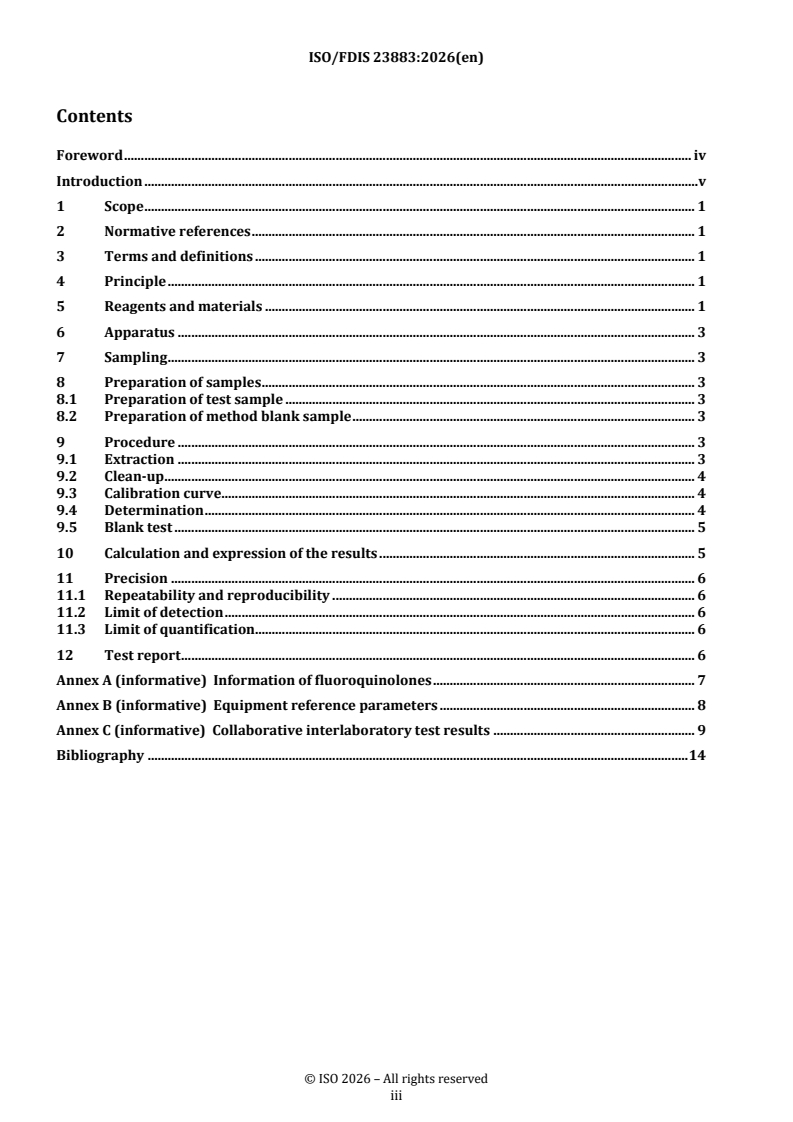
REDLINE ISO/FDIS 23883 - Meat, fish and their products — Determination of fluoroquinolone residue content — High performance liquid chromatography-tandem mass spectrometry method/12/2026
Get Certified
Connect with accredited certification bodies for this standard

BSI Group
BSI (British Standards Institution) is the business standards company that helps organizations make excellence a habit.

Bureau Veritas
Bureau Veritas is a world leader in laboratory testing, inspection and certification services.

DNV
DNV is an independent assurance and risk management provider.
Sponsored listings
Frequently Asked Questions
ISO 23883 is a draft published by the International Organization for Standardization (ISO). Its full title is "Meat, fish and their products — Determination of fluoroquinolone residue content — High performance liquid chromatography-tandem mass spectrometry method". This standard covers: The proposed new work specifies the high performance liquid chromatography-tandem mass spectrometry (LC-MS/MS) method for the determination of fluoroquinolones residues content in meat, fish and their products. This document is applicable to the determination of fluoroquinolones residues in meat, fish and their products, including livestock and poultry.
The proposed new work specifies the high performance liquid chromatography-tandem mass spectrometry (LC-MS/MS) method for the determination of fluoroquinolones residues content in meat, fish and their products. This document is applicable to the determination of fluoroquinolones residues in meat, fish and their products, including livestock and poultry.
ISO 23883 is classified under the following ICS (International Classification for Standards) categories: 67.050 - General methods of tests and analysis for food products; 67.120.10 - Meat and meat products; 67.120.30 - Fish and fishery products. The ICS classification helps identify the subject area and facilitates finding related standards.
ISO 23883 is available in PDF format for immediate download after purchase. The document can be added to your cart and obtained through the secure checkout process. Digital delivery ensures instant access to the complete standard document.
Standards Content (Sample)
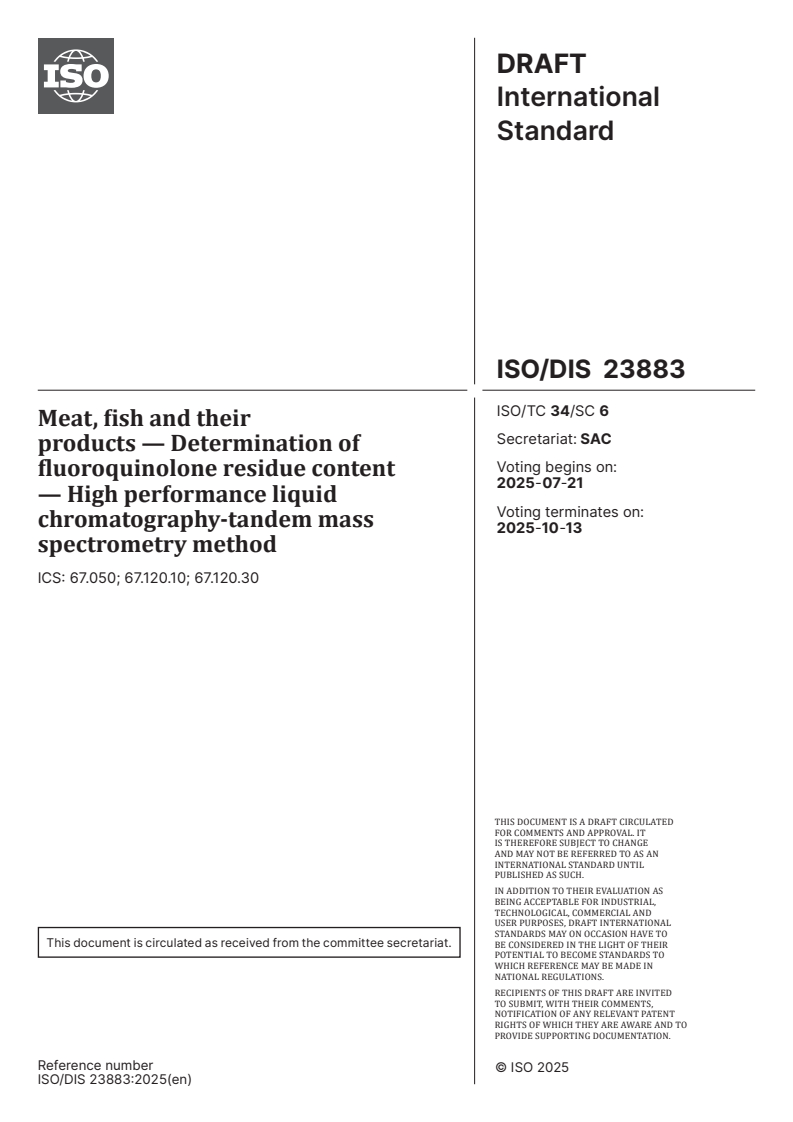
DRAFT
International
Standard
ISO/DIS 23883
ISO/TC 34/SC 6
Meat, fish and their
Secretariat: SAC
products — Determination of
Voting begins on:
fluoroquinolone residue content
2025-07-21
— High performance liquid
Voting terminates on:
chromatography-tandem mass
2025-10-13
spectrometry method
ICS: 67.050; 67.120.10; 67.120.30
THIS DOCUMENT IS A DRAFT CIRCULATED
FOR COMMENTS AND APPROVAL. IT
IS THEREFORE SUBJECT TO CHANGE
AND MAY NOT BE REFERRED TO AS AN
INTERNATIONAL STANDARD UNTIL
PUBLISHED AS SUCH.
IN ADDITION TO THEIR EVALUATION AS
BEING ACCEPTABLE FOR INDUSTRIAL,
TECHNOLOGICAL, COMMERCIAL AND
USER PURPOSES, DRAFT INTERNATIONAL
STANDARDS MAY ON OCCASION HAVE TO
This document is circulated as received from the committee secretariat.
BE CONSIDERED IN THE LIGHT OF THEIR
POTENTIAL TO BECOME STANDARDS TO
WHICH REFERENCE MAY BE MADE IN
NATIONAL REGULATIONS.
RECIPIENTS OF THIS DRAFT ARE INVITED
TO SUBMIT, WITH THEIR COMMENTS,
NOTIFICATION OF ANY RELEVANT PATENT
RIGHTS OF WHICH THEY ARE AWARE AND TO
PROVIDE SUPPORTING DOCUMENTATION.
Reference number
ISO/DIS 23883:2025(en)
DRAFT
ISO/DIS 23883:2025(en)
International
Standard
ISO/DIS 23883
ISO/TC 34/SC 6
Meat, fish and their
Secretariat: SAC
products — Determination of
Voting begins on:
fluoroquinolone residue content
— High performance liquid
Voting terminates on:
chromatography-tandem mass
spectrometry method
ICS: 67.050; 67.120.10; 67.120.30
THIS DOCUMENT IS A DRAFT CIRCULATED
FOR COMMENTS AND APPROVAL. IT
IS THEREFORE SUBJECT TO CHANGE
AND MAY NOT BE REFERRED TO AS AN
INTERNATIONAL STANDARD UNTIL
PUBLISHED AS SUCH.
IN ADDITION TO THEIR EVALUATION AS
BEING ACCEPTABLE FOR INDUSTRIAL,
© ISO 2025
TECHNOLOGICAL, COMMERCIAL AND
USER PURPOSES, DRAFT INTERNATIONAL
All rights reserved. Unless otherwise specified, or required in the context of its implementation, no part of this publication may
STANDARDS MAY ON OCCASION HAVE TO
be reproduced or utilized otherwise in any form or by any means, electronic or mechanical, including photocopying, or posting on
This document is circulated as received from the committee secretariat. BE CONSIDERED IN THE LIGHT OF THEIR
the internet or an intranet, without prior written permission. Permission can be requested from either ISO at the address below
POTENTIAL TO BECOME STANDARDS TO
WHICH REFERENCE MAY BE MADE IN
or ISO’s member body in the country of the requester.
NATIONAL REGULATIONS.
ISO copyright office
RECIPIENTS OF THIS DRAFT ARE INVITED
CP 401 • Ch. de Blandonnet 8
TO SUBMIT, WITH THEIR COMMENTS,
CH-1214 Vernier, Geneva
NOTIFICATION OF ANY RELEVANT PATENT
Phone: +41 22 749 01 11
RIGHTS OF WHICH THEY ARE AWARE AND TO
PROVIDE SUPPORTING DOCUMENTATION.
Email: copyright@iso.org
Website: www.iso.org
Published in Switzerland Reference number
ISO/DIS 23883:2025(en)
ii
ISO/DIS 23883:2025(en)
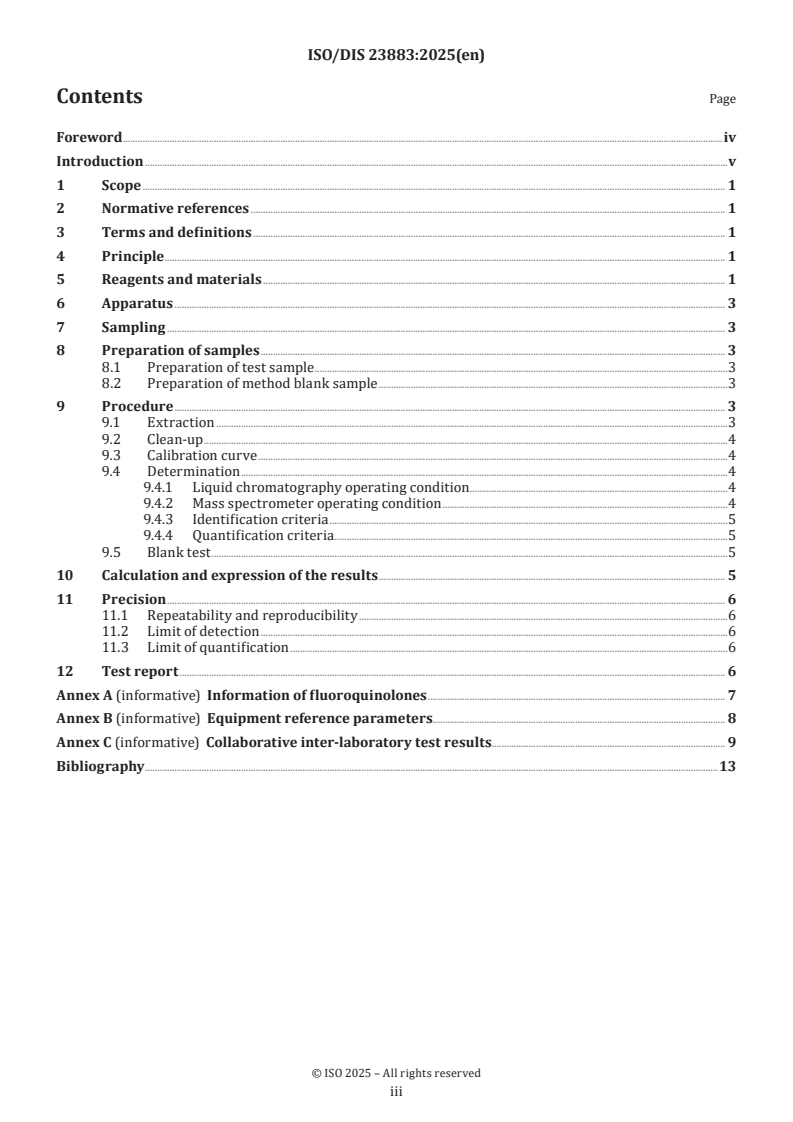
Contents Page
Foreword .iv
Introduction .v
1 Scope . 1
2 Normative references . 1
3 Terms and definitions . 1
4 Principle . 1
5 Reagents and materials . 1
6 Apparatus . 3
7 Sampling . 3
8 Preparation of samples . 3
8.1 Preparation of test sample .3
8.2 Preparation of method blank sample .3
9 Procedure . 3
9.1 Extraction .3
9.2 Clean-up .4
9.3 Calibration curve .4
9.4 Determination .4
9.4.1 Liquid chromatography operating condition.4
9.4.2 Mass spectrometer operating condition .4
9.4.3 Identification criteria .5
9.4.4 Quantification criteria .5
9.5 Blank test .5
10 Calculation and expression of the results . 5
11 Precision . 6
11.1 Repeatability and reproducibility .6
11.2 Limit of detection .6
11.3 Limit of quantification .6
12 Test report . 6
Annex A (informative) Information of fluoroquinolones . 7
Annex B (informative) Equipment reference parameters . 8
Annex C (informative) Collaborative inter-laboratory test results. 9
Bibliography .13
iii
ISO/DIS 23883:2025(en)
Foreword
ISO (the International Organization for Standardization) is a worldwide federation of national standards
bodies (ISO member bodies). The work of preparing International Standards is normally carried out through
ISO technical committees. Each member body interested in a subject for which a technical committee
has been established has the right to be represented on that committee. International organizations,
governmental and non-governmental, in liaison with ISO, also take part in the work. ISO collaborates closely
with the International Electrotechnical Commission (IEC) on all matters of electrotechnical standardization.
The procedures used to develop this document and those intended for its further maintenance are described
in the ISO/IEC Directives, Part 1. In particular, the different approval criteria needed for the different types
of ISO documents should be noted. This document was drafted in accordance with the editorial rules of the
ISO/IEC Directives, Part 2 (see www.iso.org/directives).
ISO draws attention to the possibility that the implementation of this document may involve the use of (a)
patent(s). ISO takes no position concerning the evidence, validity or applicability of any claimed patent
rights in respect thereof. As of the date of publication of this document, ISO had not received notice of (a)
patent(s) which may be required to implement this document. However, implementers are cautioned that
this may not represent the latest information, which may be obtained from the patent database available at
www.iso.org/patents. ISO shall not be held responsible for identifying any or all such patent rights.
Any trade name used in this document is information given for the convenience of users and does not
constitute an endorsement.
For an explanation of the voluntary nature of standards, the meaning of ISO specific terms and expressions
related to conformity assessment, as well as information about ISO's adherence to the World Trade
Organization (WTO) principles in the Technical Barriers to Trade (TBT), see www.iso.org/iso/foreword.html.
This document was prepared by Technical Committee ISO/TC 34, Food products, Subcommittee SC 6, Meat,
poultry, fish, eggs and their products.
Any feedback or questions on this document should be directed to the user’s national standards body. A
complete listing of these bodies can be found at www.iso.org/members.html.
iv
ISO/DIS 23883:2025(en)
Introduction
Fluoroquinolones are synthetic broad-spectrum antimicrobial agents extensively used in veterinary drug
for the prevention and treatment of bacterial infections in food-producing animals. Their widespread
application, particularly in husbandry and aquaculture, has raised concerns about the presence of residual
amounts in edible animal-derived products. Residues of fluoroquinolones in food may cause adverse
health effects for human beings, including allergies and disturbances to the intestinal flora. More critically,
prolonged exposure to sub-therapeutic levels of these compounds through the food chain is considered to be
a contributing factor to the emergence and dissemination of antimicrobial resistance.
To safeguard public health and ensure the safety of animal-derived food, many regulatory authorities have
established maximum residue limits (MRLs) for various fluoroquinolone compounds in meat, fish, and
related products. The effective enforcement of these limits depends on the availability of sensitive, accurate,
and validated analytical methods capable of detecting trace levels of residues in complex biological matrices.
Several analytical approaches have been developed for the determination of fluoroquinolone residues,
including microbiological inhibition tests, immunoassays, and instrumental techniques. While
microbiological and immunological methods are relatively simple and cost-effective, they often suffer from
limited specificity and sensitivity, as well as susceptibility to matrix interferences. In contrast, instrumental
methods such as high performance liquid chromatography-tandem mass spectrometry (LC-MS/MS) offer
significant advantages in terms of selectivity, precision, and detection capability. The ability of LC-MS/MS
to simultaneously quantify multiple fluoroquinolone compounds with high sensitivity makes it particularly
suitable for regulatory monitoring and confirmatory analysis across a variety of food matrices.
v
DRAFT International Standard ISO/DIS 23883:2025(en)
Meat, fish and their products — Determination of
fluoroquinolone residue content — High performance liquid
chromatography-tandem mass spectrometry method
1 Scope
This document specifies the determination of fluoroquinolone residue content in meat, fish and their
products by high performance liquid chromatography-tandem mass spectrometry (LC-MS/MS) method.
This document is applicable to the determination of enrofloxacin, ciprofloxacin, norfloxacin, ofloxacin and
pefloxacin residues in meat, fish and their products, including livestock and poultry.
2 Normative references
The following documents are referred to in the text in such a way that some or all of their content constitutes
requirements of this document. For dated references, only the edition cited applies. For undated references,
the latest edition of the referenced document (including any amendments) applies.
ISO 3696, Water for analytical laboratory use — Specification and test methods
3 Terms and definitions
No terms and definitions are listed in this document.
ISO and IEC maintain terminology databases for use in standardization at the following addresses:
— ISO Online browsing platform: available at https:// www .iso .org/ obp
— IEC Electropedia: available at https:// www .electropedia .org/
4 Principle
The fluoroquinolones residues in the test sample are extracted with acidified acetonitrile, purified by
n-hexane extraction, determined by high performance liquid chromatography-tandem mass spectrometry
(LC-MS/MS), and quantified by an external standard method.
5 Reagents and materials
Use only reagents of recognized analytical grade.
5.1 Water, conforming to ISO 3696, grade 1 or equivalent.
5.2 Methanol, LC grade.
5.3 Acetonitrile, LC grade.
5.4 Formic acid, LC grade.
5.5 Ammonium acetate, LC grade.
ISO/DIS 23883:2025(en)
5.6 Anhydrous sodium sulfate.
5.7 n-Hexane, LC grade.
5.8 Acidified acetonitrile, V/V=1:99.
Add 1 ml of formic acid into 99 ml of acetonitrile.
5.9 Ammonium acetate-formic acid solution, c(CH COONH )=4,0 mmol/l.
3 4
Weigh 0,154 g of ammonium acetate into a 500 ml volumetric flask. Add 0,5 ml formic acid and dilute with
water to the mark.
5.10 Mobile phase mixture, V/V=2:8.
Add 20 ml of methanol into 80 ml of ammonium acetate-formic acid solution (5.9).
5.11 Fluoroquinolone standard reference, certificated reference material, see Annex A.
5.12 Fluoroquinolone isotope internal reference, certificated reference material, see Annex A.
5.13 Standard stock solution, c=1,0 mg/ml.
Weigh 10 mg of each fluoroquinolone (5.11) into a 10 ml volumetric flask respectively. Add 0,2 ml formic acid
and dilute with methanol solution to the mark. This solution is stable for six months when stored in the dark
at a temperature below -18 °C.
5.14 Inter
...
FINAL DRAFT
International
Standard
ISO/FDIS 23883
ISO/TC 34/SC 6
Meat, fish and their
Secretariat: SAC
products — Determination of
Voting begins on:
fluoroquinolone residue content
2026-02-26
— High performance liquid
Voting terminates on:
chromatography-tandem mass
2026-04-23
spectrometry method
RECIPIENTS OF THIS DRAFT ARE INVITED TO SUBMIT,
WITH THEIR COMMENTS, NOTIFICATION OF ANY
RELEVANT PATENT RIGHTS OF WHICH THEY ARE AWARE
AND TO PROVIDE SUPPOR TING DOCUMENTATION.
IN ADDITION TO THEIR EVALUATION AS
BEING ACCEPTABLE FOR INDUSTRIAL, TECHNO
LOGICAL, COMMERCIAL AND USER PURPOSES, DRAFT
INTERNATIONAL STANDARDS MAY ON OCCASION HAVE
TO BE CONSIDERED IN THE LIGHT OF THEIR POTENTIAL
TO BECOME STAN DARDS TO WHICH REFERENCE MAY BE
MADE IN NATIONAL REGULATIONS.
Reference number
ISO/FDIS 23883:2026(en) © ISO 2026
FINAL DRAFT
ISO/FDIS 23883:2026(en)
International
Standard
ISO/FDIS 23883
ISO/TC 34/SC 6
Meat, fish and their
Secretariat: SAC
products — Determination of
Voting begins on:
fluoroquinolone residue content
— High performance liquid
Voting terminates on:
chromatography-tandem mass
spectrometry method
RECIPIENTS OF THIS DRAFT ARE INVITED TO SUBMIT,
WITH THEIR COMMENTS, NOTIFICATION OF ANY
RELEVANT PATENT RIGHTS OF WHICH THEY ARE AWARE
AND TO PROVIDE SUPPOR TING DOCUMENTATION.
© ISO 2026
IN ADDITION TO THEIR EVALUATION AS
All rights reserved. Unless otherwise specified, or required in the context of its implementation, no part of this publication may
BEING ACCEPTABLE FOR INDUSTRIAL, TECHNO
LOGICAL, COMMERCIAL AND USER PURPOSES, DRAFT
be reproduced or utilized otherwise in any form or by any means, electronic or mechanical, including photocopying, or posting on
INTERNATIONAL STANDARDS MAY ON OCCASION HAVE
the internet or an intranet, without prior written permission. Permission can be requested from either ISO at the address below
TO BE CONSIDERED IN THE LIGHT OF THEIR POTENTIAL
or ISO’s member body in the country of the requester.
TO BECOME STAN DARDS TO WHICH REFERENCE MAY BE
MADE IN NATIONAL REGULATIONS.
ISO copyright office
CP 401 • Ch. de Blandonnet 8
CH-1214 Vernier, Geneva
Phone: +41 22 749 01 11
Email: copyright@iso.org
Website: www.iso.org
Published in Switzerland Reference number
ISO/FDIS 23883:2026(en) © ISO 2026
ii
ISO/FDIS 23883:2026(en)
Contents Page
Foreword .iv
Introduction .v
1 Scope . 1
2 Normative references . 1
3 Terms and definitions . 1
4 Principle . 1
5 Reagents and materials . 1
6 Apparatus . 3
7 Sampling . 3
8 Preparation of samples . 3
8.1 Preparation of test sample .3
8.2 Preparation of method blank sample .3
9 Procedure . 3
9.1 Extraction .3
9.2 Clean-up .4
9.3 Calibration curve .4
9.4 Determination .4
9.4.1 Liquid chromatography operating condition.4
9.4.2 Mass spectrometer operating condition .4
9.4.3 Identification criteria .5
9.4.4 Quantification criteria .5
9.5 Blank test .5
10 Calculation and expression of the results . 5
11 Precision . 6
11.1 Repeatability and reproducibility .6
11.2 Limit of detection .6
11.3 Limit of quantification .6
12 Test report . 6
Annex A (informative) Information of fluoroquinolones . 7
Annex B (informative) Equipment reference parameters . 8
Annex C (informative) Collaborative interlaboratory test results. 9
Bibliography .13
iii
ISO/FDIS 23883:2026(en)
Foreword
ISO (the International Organization for Standardization) is a worldwide federation of national standards
bodies (ISO member bodies). The work of preparing International Standards is normally carried out through
ISO technical committees. Each member body interested in a subject for which a technical committee
has been established has the right to be represented on that committee. International organizations,
governmental and non-governmental, in liaison with ISO, also take part in the work. ISO collaborates closely
with the International Electrotechnical Commission (IEC) on all matters of electrotechnical standardization.
The procedures used to develop this document and those intended for its further maintenance are described
in the ISO/IEC Directives, Part 1. In particular, the different approval criteria needed for the different types
of ISO document should be noted. This document was drafted in accordance with the editorial rules of the
ISO/IEC Directives, Part 2 (see www.iso.org/directives).
ISO draws attention to the possibility that the implementation of this document may involve the use of (a)
patent(s). ISO takes no position concerning the evidence, validity or applicability of any claimed patent
rights in respect thereof. As of the date of publication of this document, ISO had not received notice of (a)
patent(s) which may be required to implement this document. However, implementers are cautioned that
this may not represent the latest information, which may be obtained from the patent database available at
www.iso.org/patents. ISO shall not be held responsible for identifying any or all such patent rights.
Any trade name used in this document is information given for the convenience of users and does not
constitute an endorsement.
For an explanation of the voluntary nature of standards, the meaning of ISO specific terms and expressions
related to conformity assessment, as well as information about ISO’s adherence to the World Trade
Organization (WTO) principles in the Technical Barriers to Trade (TBT), see www.iso.org/iso/foreword.html.
This document was prepared by Technical Committee ISO/TC 34, Food products, Subcommittee SC 6, Meat,
poultry, fish, eggs and their products.
Any feedback or questions on this document should be directed to the user’s national standards body. A
complete listing of these bodies can be found at www.iso.org/members.html.
iv
ISO/FDIS 23883:2026(en)
Introduction
Fluoroquinolones are synthetic broad-spectrum antimicrobial agents extensively used in veterinary drug
for the prevention and treatment of bacterial infections in food-producing animals. Their widespread
application, particularly in husbandry and aquaculture, has raised concerns about the presence of residual
amounts in edible animal-derived products. Residues of fluoroquinolones in food can cause adverse health
effects for human beings, including allergies and disturbances to the intestinal flora. More critically,
prolonged exposure to sub-therapeutic levels of these compounds through the food chain is considered to be
a contributing factor to the emergence and dissemination of antimicrobial resistance.
To safeguard public health and ensure the safety of animal-derived food, many regulatory authorities have
established maximum residue limits (MRLs) for various fluoroquinolone compounds in meat, fish and
related products. The effective enforcement of these limits depends on the availability of sensitive, accurate
and validated analytical methods capable of detecting trace levels of residues in complex biological matrices.
Several analytical approaches have been developed for the determination of fluoroquinolone residues,
including microbiological inhibition tests, immunoassays and instrumental techniques. While
microbiological and immunological methods are relatively simple and cost-effective, they often suffer from
limited specificity and sensitivity, as well as susceptibility to matrix interferences. In contrast, instrumental
methods such as high performance liquid chromatography-tandem mass spectrometry (HPLC-MS/MS) offer
significant advantages in terms of selectivity, precision and detection capability. The ability of HPLC-MS/MS
to simultaneously quantify multiple fluoroquinolone compounds with high sensitivity makes it particularly
suitable for regulatory monitoring and confirmatory analysis across a variety of food matrices.
v
FINAL DRAFT International Standard ISO/FDIS 23883:2026(en)
Meat, fish and their products — Determination of
fluoroquinolone residue content — High performance liquid
chromatography-tandem mass spectrometry method
1 Scope
This document specifies the determination of fluoroquinolone residue content in meat, fish and their
products by high performance liquid chromatography-tandem mass spectrometry (HPLC-MS/MS) method.
This document is applicable to the determination of enrofloxacin, ciprofloxacin, norfloxacin, ofloxacin and
pefloxacin residues in meat, fish and their products, including livestock and poultry.
2 Normative references
The following documents are referred to in the text in such a way that some or all of their content constitutes
requirements of this document. For dated references, only the edition cited applies. For undated references,
the latest edition of the referenced document (including any amendments) applies.
ISO 3696, Water for analytical laboratory use — Specification and test methods
3 Terms and definitions
No terms and definitions are listed in this document.
ISO and IEC maintain terminology databases for use in standardization at the following addresses:
— ISO Online browsing platform: available at https:// www .iso .org/ obp
— IEC Electropedia: available at https:// www .electropedia .org/
4 Principle
The fluoroquinolone residues in the test sample are extracted with acidified acetonitrile, purified by
n-hexane extraction, determined by high performance liquid chromatography-tandem mass spectrometry,
and quantified by an external standard method.
5 Reagents and materials
Use only reagents of recognized analytical grade, unless otherwise specified.
5.1 Water, conforming to ISO 3696, grade 1 or equivalent.
5.2 Methanol, LC grade.
5.3 Acetonitrile, LC grade.
5.4 Formic acid, LC grade.
5.5 Ammonium acetate, LC grade.
ISO/FDIS 23883:2026(en)
5.6 Anhydrous sodium sulfate.
5.7 n-Hexane, LC grade.
5.8 Acidified acetonitrile, V/V = 1:99.
Add 1 ml of formic acid into 99 ml of acetonitrile.
5.9 Ammonium acetate-formic acid solution, c(CH COONH ) = 4,0 mmol/l.
3 4
Weigh 0,154 g of ammonium acetate into a 500 ml volumetric flask. Add 0,5 ml formic acid and dilute with
water to the mark.
5.10 Mobile phase mixture, V/V = 2:8.
Add 20 ml of methanol into 80 ml of ammonium acetate-formic acid solution (5.9).
5.11 Fluoroquinolone standard reference, certificated reference material, see Annex A.
5.12 Fluoroquinolone isotope internal reference, certificated reference material, see Annex A.
5.13 Standard stock solution, c = 1,0 mg/ml.
Weigh, to the nearest 0,01 mg, approximately 10 mg of each fluoroquinolone (5.11) into a 10 ml volumetric
flask respectively. Add 0,2 ml formic acid and dilute with methanol solution to the mark. This solution is
stable for six months when stored in the dark at a temperature below −18 °C.
5.14 Internal standard stock solution, c = 0,5 mg/ml.
Weigh, to the nearest 0,01 mg, approximately 5,0 mg of deuterated enrofloxacin, deuterated ciprofloxacin,
deuterated norfloxacin, deuterated ofloxacin and deuterated pefloxacin internal standard substance (5.12)
into a 10 ml vol
...
ISO/DIS FDIS 23883:2025(en)
ISO/TC 34/SC 6/WG 28
Secretariat: SAC
Date: 2025-10-212026-02-11
Meat, fish and their products — Determination of fluoroquinolone
residue content — High performance liquid chromatography-tandem
mass spectrometry method
FDIS stage
ISO/FDIS 23883:2026(en)
All rights reserved. Unless otherwise specified, or required in the context of its implementation, no part of this publication
may be reproduced or utilized otherwise in any form or by any means, electronic or mechanical, including photocopying,
or posting on the internet or an intranet, without prior written permission. Permission can be requested from either ISO
at the address below or ISO’s member body in the country of the requester.
ISO copyright office
CP 401 • Ch. de Blandonnet 8
CH-1214 Vernier, Geneva
Phone: + 41 22 749 01 11
E-mail: copyright@iso.org
Website: www.iso.org
Published in Switzerland
ii
ISO/FDIS 23883:2026(en)
Contents
Foreword . iv
Introduction . v
1 Scope . 1
2 Normative references . 1
3 Terms and definitions . 1
4 Principle . 1
5 Reagents and materials . 1
6 Apparatus . 3
7 Sampling . 3
8 Preparation of samples . 3
8.1 Preparation of test sample . 3
8.2 Preparation of method blank sample . 3
9 Procedure . 3
9.1 Extraction . 3
9.2 Clean-up . 4
9.3 Calibration curve. 4
9.4 Determination . 4
9.5 Blank test . 5
10 Calculation and expression of the results . 5
11 Precision . 6
11.1 Repeatability and reproducibility . 6
11.2 Limit of detection . 6
11.3 Limit of quantification. 6
12 Test report . 6
Annex A (informative) Information of fluoroquinolones . 7
Annex B (informative) Equipment reference parameters . 8
Annex C (informative) Collaborative interlaboratory test results . 9
Bibliography . 14
iii
ISO/FDIS 23883:2026(en)
Foreword
ISO (the International Organization for Standardization) is a worldwide federation of national standards
bodies (ISO member bodies). The work of preparing International Standards is normally carried out through
ISO technical committees. Each member body interested in a subject for which a technical committee has been
established has the right to be represented on that committee. International organizations, governmental and
non-governmental, in liaison with ISO, also take part in the work. ISO collaborates closely with the
International Electrotechnical Commission (IEC) on all matters of electrotechnical standardization.
The procedures used to develop this document and those intended for its further maintenance are described
in the ISO/IEC Directives, Part 1. In particular, the different approval criteria needed for the different types of
ISO document should be noted. This document was drafted in accordance with the editorial rules of the
ISO/IEC Directives, Part 2 (see www.iso.org/directives).
ISO draws attention to the possibility that the implementation of this document may involve the use of (a)
patent(s). ISO takes no position concerning the evidence, validity or applicability of any claimed patent rights
in respect thereof. As of the date of publication of this document, ISO had not received notice of (a) patent(s)
which may be required to implement this document. However, implementers are cautioned that this may not
represent the latest information, which may be obtained from the patent database available at
www.iso.org/patents. ISO shall not be held responsible for identifying any or all such patent rights.
Any trade name used in this document is information given for the convenience of users and does not
constitute an endorsement.
For an explanation of the voluntary nature of standards, the meaning of ISO specific terms and expressions
related to conformity assessment, as well as information about ISO’s adherence to the World Trade
Organization (WTO) principles in the Technical Barriers to Trade (TBT), see www.iso.org/iso/foreword.html.
This document was prepared by Technical Committee ISO/TC 34, Food products, Subcommittee SC 6, Meat,
poultry, fish, eggs and their products.
Any feedback or questions on this document should be directed to the user’s national standards body. A
complete listing of these bodies can be found at www.iso.org/members.html.
iv
ISO/FDIS 23883:2026(en)
Introduction
Fluoroquinolones are synthetic broad-spectrum antimicrobial agents extensively used in veterinary drug for
the prevention and treatment of bacterial infections in food-producing animals. Their widespread application,
particularly in husbandry and aquaculture, has raised concerns about the presence of residual amounts in
edible animal-derived products. Residues of fluoroquinolones in food can cause adverse health effects for
human beings, including allergies and disturbances to the intestinal flora. More critically, prolonged exposure
to sub-therapeutic levels of these compounds through the food chain is considered to be a contributing factor
to the emergence and dissemination of antimicrobial resistance.
To safeguard public health and ensure the safety of animal-derived food, many regulatory authorities have
established maximum residue limits (MRLs) for various fluoroquinolone compounds in meat, fish and related
products. The effective enforcement of these limits depends on the availability of sensitive, accurate and
validated analytical methods capable of detecting trace levels of residues in complex biological matrices.
Several analytical approaches have been developed for the determination of fluoroquinolone residues,
including microbiological inhibition tests, immunoassays and instrumental techniques. While microbiological
and immunological methods are relatively simple and cost-effective, they often suffer from limited specificity
and sensitivity, as well as susceptibility to matrix interferences. In contrast, instrumental methods such as
high performance liquid chromatography-tandem mass spectrometry (HPLC-MS/MS) offer significant
advantages in terms of selectivity, precision and detection capability. The ability of HPLC-MS/MS to
simultaneously quantify multiple fluoroquinolone compounds with high sensitivity makes it particularly
suitable for regulatory monitoring and confirmatory analysis across a variety of food matrices.
v
Meat, fish and their products — Determination of fluoroquinolone
residue content — High performance liquid chromatography-tandem
mass spectrometry method
1 Scope
This document specifies the determination of fluoroquinolone residue content in meat, fish and their products
by high performance liquid chromatography-tandem mass spectrometry (HPLC-MS/MS) method.
This document is applicable to the determination of enrofloxacin, ciprofloxacin, norfloxacin, ofloxacin and
pefloxacin residues in meat, fish and their products, including livestock and poultry.
2 Normative references
The following documents are referred to in the text in such a way that some or all of their content constitutes
requirements of this document. For dated references, only the edition cited applies. For undated references,
the latest edition of the referenced document (including any amendments) applies.
ISO 3696, Water for analytical laboratory use — Specification and test methods
3 Terms and definitions
No terms and definitions are listed in this document.
ISO and IEC maintain terminology databases for use in standardization at the following addresses:
— ISO Online browsing platform: available at https://www.iso.org/obp
— IEC Electropedia: available at https://www.electropedia.org/
4 Principle
The fluoroquinolone residues in the test sample are extracted with acidified acetonitrile, purified by n-hexane
extraction, determined by high performance liquid chromatography-tandem mass spectrometry, and
quantified by an external standard method.
5 Reagents and materials
Use only reagents of recognized analytical grade, unless otherwise specified.
5.1 Water, conforming to ISO 3696, grade 1 or equivalent.
5.2 Methanol, LC grade.
5.3 Acetonitrile, LC grade.
5.4 Formic acid, LC grade.
5.5 Ammonium acetate, LC grade.
5.6 Anhydrous sodium sulfate.
5.7 n-Hexane, LC grade.
ISO/FDIS 23883:2026(en)
5.8 Acidified acetonitrile, V/V = 1:99.
Add 1 ml of formic acid into 99 ml of acetonitrile.
5.9 Ammonium acetate-formic acid solution, c(CH COONH ) = 4,0 mmol/l.
3 4
Weigh 0,154 g of ammonium acetate into a 500 ml volumetric flask. Add 0,5 ml formic acid and dilute with
water to the mark.
5.10 Mobile phase mixture, V/V = 2:8.
Add 20 ml of methanol into 80 ml of ammonium acetate-formic acid solution (5.9).
5.11 Fluoroquinolone standard reference, certificated reference material, see Annex A.
5.12 Fluoroquinolone isotope internal reference, certificated reference material, see Annex A.
5.13 Standard stock solution, c = 1,0 mg/ml.
Weigh, to the nearest 0,01 mg, approximately 10 mg of each fluoroquinolone (5.11) into a 10 ml volumetric
flask respectively. Add 0,2 ml formic acid and dilute with methanol solution to the mark. This solution is stable
for six months when stored in the dark at a temperature below −18 °C.
5.14 Internal standard stock solution, c = 0,5 mg/ml.
Weigh, to the nearest 0,01 mg, approximately 5,0 mg of deuterated enrofloxacin, deuterated ciprofloxacin,
deuterated norfloxacin, deuterated ofloxacin and deuterated pefloxacin internal standard substance (5.12)
into a 10 ml volumetric flask. Add 0,2 ml formic acid and dilute with methanol solution to the mark. This
solution is stable for six months when stored in the dark at a temperature below −18 °C.
5.15 Mixed intermediate standard solution, c = 10 μg/ml.
Measure an appropriate amount of each standard stock solution, dilute it with methanol to make a 10 μg/ml
mixed intermediate standard solution. This solution is stable for one month when stored in the dark at a
temperature below 4 °C.
5.16 Mixed intermediate internal standard solution, c = 5,0 μg/ml.
Measure an appropriate amount of each internal standard stock solution, dilute it with methanol to make a
5,0 μg/ml mixed intermediate internal standard solution. This solution is stable for one month when stored
in the dark at a temperature below 4 °C.
5.17 Mixed standard working solution, c = 0,1 μg/ml.
Measure an appropriate amount of the mixed intermediate standard solution, dilute it with methanol to make
a 0,1 μg/ml mixed standard working solution.
5.18 Mixed internal standard working solution, c = 1,0 μg/ml.
Measure an appropriate amount of the mixed intermediate internal standard solution, dilute it with methanol
to make a 1,0 μg/ml mixed internal standard working solution.
5.19 Microporous membrane, 0,22 μm.
ISO/FDIS 23883:2026(en)
6 Apparatus
6.1 High performance liquid chromatography-tandem mass spectrometer.
High performance liquid chromatography combined with electrospray ionization mass spectrometry.
6.2 Analytical balances, capable of weighing to an accuracy of 0,01 mg and 0,01 g.
6.3 High speed refrigerated centrifuge.
6.4 Vortex.
6.5 Homogenizer.
6.6 Ultrasonic cleaner.
6.7 Rotary evaporator.
7 Sampling
Sampling is not part of the method specified in this docume
...
Questions, Comments and Discussion
Ask us and Technical Secretary will try to provide an answer. You can facilitate discussion about the standard in here.
Loading comments...