

ISO/TS 16791:2020
(Main)Health informatics — Requirements for international machine-readable coding of medicinal product package identifiers
General Information
- Abstract
This document provides guidelines on identification and labelling of medicinal products from the point of manufacture of packaged medicinal product to the point of dispensing the product. This document outlines best practice for AIDC barcoding solutions for applications. Users can, however, consider the coding interoperability requirements for other AIDC technologies, e.g. Radio Frequency Identification (RFID).
- Status
- Withdrawn
- Publication Date
- 28-Sep-2020
- Technical Committee
- ISO/TC 215 - Health informatics
- Drafting Committee
- ISO/TC 215/WG 6 - Pharmacy and medicines business
- Current Stage
- 9599 - Withdrawal of International Standard
- Start Date
- 20-Mar-2026
- Completion Date
- 29-Aug-2026
Buy Documents

ISO/TS 16791:2020 - Health informatics — Requirements for international machine-readable coding of medicinal product package identifiers Released:29. 09. 2020

ISO/TS 16791:2020 - Health informatics — Requirements for international machine-readable coding of medicinal product package identifiers/29/2020
Overview
ISO/TS 16791:2020 - "Health informatics - Requirements for international machine-readable coding of medicinal product package identifiers" - is a Technical Specification that provides guidelines for identifying and labelling medicinal products from manufacture of the packaged product through to dispensing. The document focuses on machine-readable coding (primarily AIDC barcoding) to improve patient safety, traceability, and supply chain integrity. It promotes globally harmonized, interoperable approaches (notably the GS1® System of Standards) while allowing consideration of other AIDC technologies such as RFID.
Key Topics and Technical Requirements
- Scope and purpose
- Guidance for applying international machine-readable coding on medicinal product packages to support health informatics needs.
- AIDC technologies
- Best practices for barcoding solutions; interoperability considerations for other AIDC (e.g., RFID).
- Identification and labelling elements
- Definitions and structures for package identifiers, serialization, batch identifiers, and aggregation (parent-child packaging relationships).
- Traceability and serialization
- Requirements to support traceability from manufacturer to point-of-dispense; serialization to uniquely identify packages.
- Counterfeit mitigation
- Distinction between product authentication and supply chain integrity, with guidelines to combat falsification of medicines.
- Patient safety at point of care
- Use of machine-readable codes to reduce medication errors and improve clinical workflows.
- Operational and economic considerations
- Guidance on procurement, stock management, and stakeholder perspectives (manufacturers, healthcare providers).
- Supporting annexes
- Practical content including packaging hierarchy, relationship of MPID/PCID/GTIN®, examples of package identifiers, and personalized medicine considerations.
Applications and Who Uses It
- Regulatory affairs specialists - design compliant labelling and meet traceability expectations.
- Packaging and artwork designers - implement machine-readable codes on outer and immediate packaging.
- Pharmaceutical manufacturers - apply serialization and AIDC to support global distribution.
- Healthcare providers and pharmacists - scan codes at point of care for verification, dispensing, and inventory control.
- Supply chain/logistics operators - use codes for aggregation, shipment tracking, and integrity checks.
- IT and health informatics teams - integrate coded data into electronic health records and medicinal product dictionaries.
Related Standards
- ISO 11615:2017 - Identification of medicinal products (IDMP) - data elements and structures.
- ISO/TS 19256 - Requirements for medicinal product dictionary systems for healthcare.
- ISO/IEC 15418 and GS1® General Specifications - referenced for GS1 application identifiers and data semantics.
Keywords: ISO/TS 16791, machine-readable coding, medicinal product package identifiers, AIDC, barcoding, RFID, GS1, traceability, serialization, health informatics, patient safety, supply chain integrity.
Relations
- Effective Date
- 12-Feb-2026
- Consolidates
ISO 8124-1:2014 - Safety of toys — Part 1: Safety aspects related to mechanical and physical properties - Effective Date
- 06-Jun-2022
- Effective Date
- 22-Jun-2024
- Effective Date
- 27-Jan-2018
Buy Documents
ISO/TS 16791:2020 - Health informatics — Requirements for international machine-readable coding of medicinal product package identifiers Released:29. 09. 2020
ISO/TS 16791:2020 - Health informatics — Requirements for international machine-readable coding of medicinal product package identifiers/29/2020
Get Certified
Connect with accredited certification bodies for this standard

BSI Group
BSI (British Standards Institution) is the business standards company that helps organizations make excellence a habit.

NYCE
Mexican standards and certification body.
Sponsored listings
Frequently Asked Questions
ISO/TS 16791:2020 is a technical specification published by the International Organization for Standardization (ISO). Its full title is "Health informatics — Requirements for international machine-readable coding of medicinal product package identifiers". This standard covers: This document provides guidelines on identification and labelling of medicinal products from the point of manufacture of packaged medicinal product to the point of dispensing the product. This document outlines best practice for AIDC barcoding solutions for applications. Users can, however, consider the coding interoperability requirements for other AIDC technologies, e.g. Radio Frequency Identification (RFID).
This document provides guidelines on identification and labelling of medicinal products from the point of manufacture of packaged medicinal product to the point of dispensing the product. This document outlines best practice for AIDC barcoding solutions for applications. Users can, however, consider the coding interoperability requirements for other AIDC technologies, e.g. Radio Frequency Identification (RFID).
ISO/TS 16791:2020 is classified under the following ICS (International Classification for Standards) categories: 35.240.80 - IT applications in health care technology. The ICS classification helps identify the subject area and facilitates finding related standards.
ISO/TS 16791:2020 has the following relationships with other standards: It is inter standard links to CEN ISO/TS 16791:2020, ISO 8124-1:2014, ISO 16791:2026, ISO/TS 16791:2014. Understanding these relationships helps ensure you are using the most current and applicable version of the standard.
ISO/TS 16791:2020 is available in PDF format for immediate download after purchase. The document can be added to your cart and obtained through the secure checkout process. Digital delivery ensures instant access to the complete standard document.
Standards Content (Sample)
TECHNICAL ISO/TS
SPECIFICATION 16791
Second edition
2020-09
Health informatics — Requirements
for international machine-readable
coding of medicinal product package
identifiers
Informatique de santé — Exigences pour une identification
internationale, lisible par capture automatique, des produits
médicinaux
Reference number
©
ISO 2020
© ISO 2020
All rights reserved. Unless otherwise specified, or required in the context of its implementation, no part of this publication may
be reproduced or utilized otherwise in any form or by any means, electronic or mechanical, including photocopying, or posting
on the internet or an intranet, without prior written permission. Permission can be requested from either ISO at the address
below or ISO’s member body in the country of the requester.
ISO copyright office
CP 401 • Ch. de Blandonnet 8
CH-1214 Vernier, Geneva
Phone: +41 22 749 01 11
Email: copyright@iso.org
Website: www.iso.org
Published in Switzerland
ii © ISO 2020 – All rights reserved
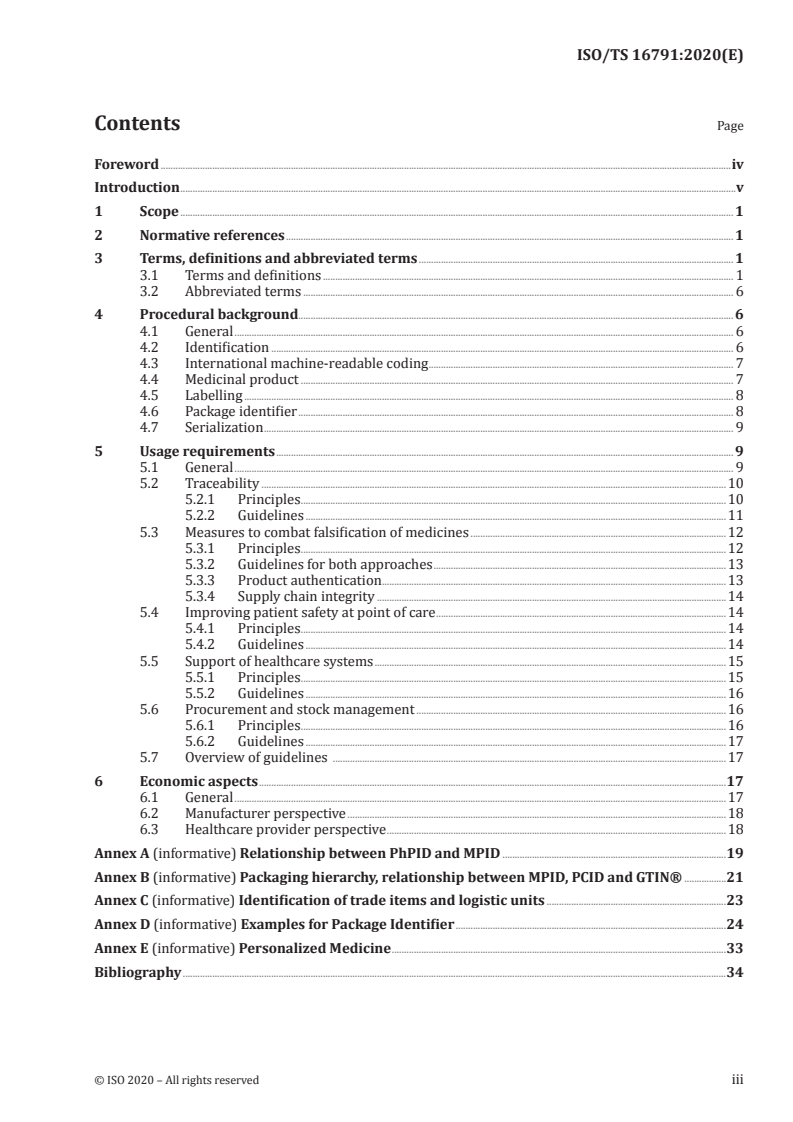
Contents Page
Foreword .iv
Introduction .v
1 Scope . 1
2 Normative references . 1
3 Terms, definitions and abbreviated terms . 1
3.1 Terms and definitions . 1
3.2 Abbreviated terms . 6
4 Procedural background. 6
4.1 General . 6
4.2 Identification . 6
4.3 International machine-readable coding . 7
4.4 Medicinal product . 7
4.5 Labelling . 8
4.6 Package identifier . 8
4.7 Serialization . 9
5 Usage requirements . 9
5.1 General . 9
5.2 Traceability .10
5.2.1 Principles .10
5.2.2 Guidelines .11
5.3 Measures to combat falsification of medicines .12
5.3.1 Principles .12
5.3.2 Guidelines for both approaches .13
5.3.3 Product authentication . .13
5.3.4 Supply chain integrity .14
5.4 Improving patient safety at point of care .14
5.4.1 Principles .14
5.4.2 Guidelines .14
5.5 Support of healthcare systems .15
5.5.1 Principles .15
5.5.2 Guidelines .16
5.6 Procurement and stock management .16
5.6.1 Principles .16
5.6.2 Guidelines .17
5.7 Overview of guidelines .17
6 Economic aspects .17
6.1 General .17
6.2 Manufacturer perspective .18
6.3 Healthcare provider perspective .18
Annex A (informative) Relationship between PhPID and MPID .19
Annex B (informative) Packaging hierarchy, relationship between MPID, PCID and GTIN® .21
Annex C (informative) Identification of trade items and logistic units .23
Annex D (informative) Examples for Package Identifier .24
Annex E (informative) Personalized Medicine .33
Bibliography .34
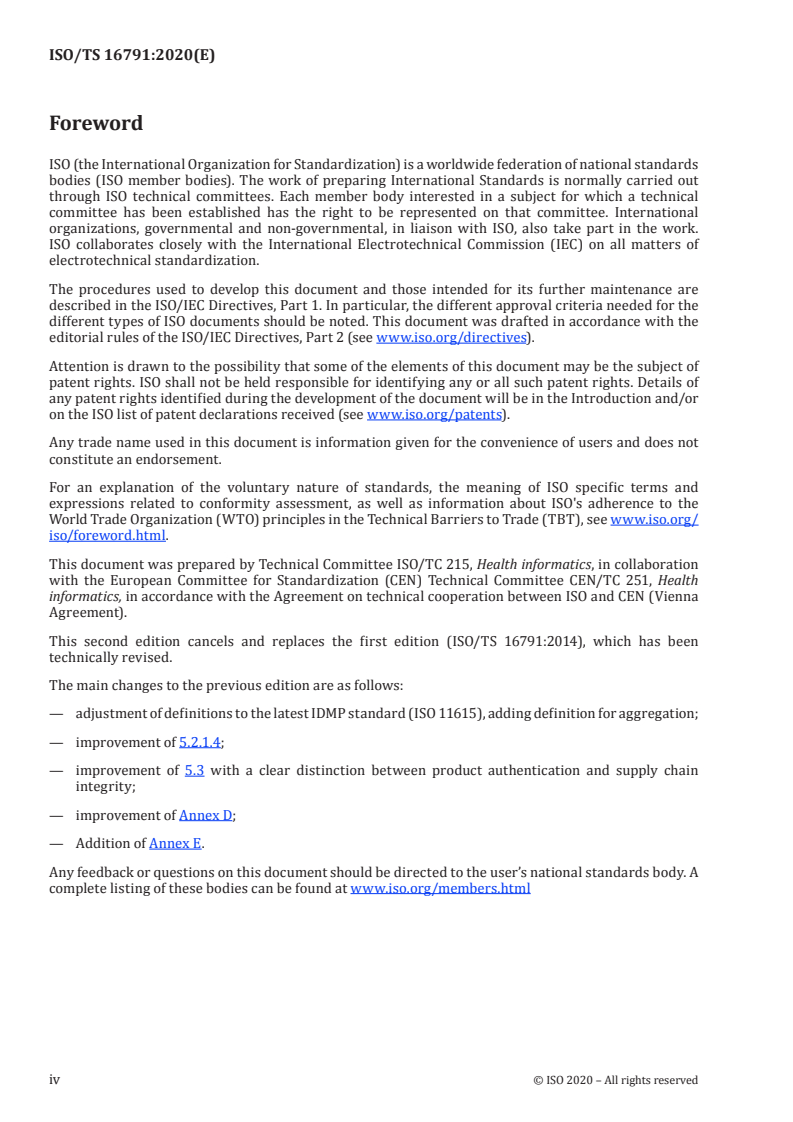
Foreword
ISO (the International Organization for Standardization) is a worldwide federation of national standards
bodies (ISO member bodies). The work of preparing International Standards is normally carried out
through ISO technical committees. Each member body interested in a subject for which a technical
committee has been established has the right to be represented on that committee. International
organizations, governmental and non-governmental, in liaison with ISO, also take part in the work.
ISO collaborates closely with the International Electrotechnical Commission (IEC) on all matters of
electrotechnical standardization.
The procedures used to develop this document and those intended for its further maintenance are
described in the ISO/IEC Directives, Part 1. In particular, the different approval criteria needed for the
different types of ISO documents should be noted. This document was drafted in accordance with the
editorial rules of the ISO/IEC Directives, Part 2 (see www .iso .org/ directives).
Attention is drawn to the possibility that some of the elements of this document may be the subject of
patent rights. ISO shall not be held responsible for identifying any or all such patent rights. Details of
any patent rights identified during the development of the document will be in the Introduction and/or
on the ISO list of patent declarations received (see www .iso .org/ patents).
Any trade name used in this document is information given for the convenience of users and does not
constitute an endorsement.
For an explanation of the voluntary nature of standards, the meaning of ISO specific terms and
expressions related to conformity assessment, as well as information about ISO's adherence to the
World Trade Organization (WTO) principles in the Technical Barriers to Trade (TBT), see www .iso .org/
iso/ foreword .html.
This document was prepared by Technical Committee ISO/TC 215, Health informatics, in collaboration
with the European Committee for Standardization (CEN) Technical Committee CEN/TC 251, Health
informatics, in accordance with the Agreement on technical cooperation between ISO and CEN (Vienna
Agreement).
This second edition cancels and replaces the first edition (ISO/TS 16791:2014), which has been
technically revised.
The main changes to the previous edition are as follows:
— adjustment of definitions to the latest IDMP standard (ISO 11615), adding definition for aggregation;
— improvement of 5.2.1.4;
— improvement of 5.3 with a clear distinction between product authentication and supply chain
integrity;
— improvement of Annex D;
— Addition of Annex E.
Any feedback or questions on this document should be directed to the user’s national standards body. A
complete listing of these bodies can be found at www .iso .org/ members .html
iv © ISO 2020 – All rights reserved
Introduction
Globally, healthcare regulators, medicinal product suppliers, and healthcare providers, among others,
are facing increased pressure to ensure a more secure and safer supply chain for medicinal products.
The primary objective is to ensure optimal patient safety outcomes. Organizations such as the
World Health Organization (WHO), the European Union and the US Congress, along with many other
healthcare organizations are also seeking robust systems that will deliver outcomes to enhance overall
supply chain integrity, to prevent product falsification and to improve patient safety, especially at the
point of care.
Machine-readable coding is a technology capable of achieving these stated outcomes. Therefore, the
core purpose of this document is to provide guidelines for machine-readable coding based on globally
harmonized and interoperable standards for wide scale international implementation.
This document outlines the requirements to implement international machine-readable coding
on medicinal product packages in the healthcare supply chain; this process cannot be isolated from
more general identification practice with medical devices or other categories of products. It assists
all stakeholders implement, use, and optimize Automatic Identification and Data Capture (AIDC)
technologies in their respective enterprises with a particular attention to Health Informatics. In that
respect, this document complements ISO 11615.
As AIDC offers a wide spectrum of potential solutions, particularly for data carriers such as barcodes,
it has highlighted the importance of properly defining data structures to prevent ambiguity when
information is encoded and captured.
Furthermore, the semantics of data carried can be defined by a number of organizations (also called
“issuing agencies”), some with commercial activities, some with a national emphasis, and others with
1)
a standard development organizations’ objective. This particular specification focuses on the GS1®
System of Standards.
The majority of supplies (such as processed food, office supplies, apparels, medical devices and
equipment, medicinal products, etc.) in healthcare around the world use the GS1® System of Standards
for AIDC as it is multi-sectorial and a globally implemented system of standards. Interoperability along
the supply chain is easier to achieve once a single system of standards is used in any market, including
healthcare.
This document is intended to guide healthcare packaging designers, regulatory affairs specialists,
logistics operators, and others to implement AIDC solutions for healthcare.
NOTE 1 See Reference [39].
NOTE 2 See Reference [40].
1) GS1® is a registered trademark. This information is given for the convenience of users of this document and
does not constitute an endorsement by ISO.
TECHNICAL SPECIFICATION ISO/TS 16791:2020(E)
Health informatics — Requirements for international
machine-readable coding of medicinal product package
identifiers
1 Scope
This document provides guidelines on identification and labelling of medicinal products from the point
of manufacture of packaged medicinal product to the point of dispensing the product.
This document outlines best practice for AIDC barcoding solutions for applications. Users can, however,
consider the coding interoperability requirements for other AIDC technologies, e.g. Radio Frequency
Identification (RFID).
2 Normative references
The following documents are referred to in the text in such a way that some or all of their content
constitutes requirements of this document. For dated references, only the edition cited applies. For
undated references, the latest edition of the referenced document (including any amendments) applies.
ISO 11615:2017, Health informatics — Identification of medicinal products — Data elements and structures
for the unique identification and exchange of regulated medicinal product information
ISO/TS 19256, Health informatics — Requirements for medicinal product dictionary systems for health care
3 Terms, definitions and abbreviated terms
For the purposes of this document, the following terms and definitions apply.
ISO and IEC maintain terminological databases for use in standardization at the following addresses:
— ISO Online browsing platform: available at https:// www .iso .org/ obp
— IEC Electropedia: available at http:// www .electropedia .org/
3.1 Terms and definitions
3.1.1
aggregation
aggregated packaging
hierarchical, parent-child relationship between a containing object (i.e. parent) and one or more objects
(i.e. children) which are contained
Note 1 to entry: When the content of a delivery is not homogeneous, aggregation shall be provided by using a
univocal identification of the delivery, such as with a Serial Shipping Container code (SSCC); see Annex C.
3.1.2
application identifier
AI
GS1® prefix that defines the meaning and purpose of the data element that follows, as defined in
ISO/IEC 15418 and GS1® General Specifications
[SOURCE: ISO/IEC 19762:2016, 01.01.82]
3.1.3
automatic identification and data capture
AIDC
methods or technologies for automatically identifying objects, collecting data about them, and entering
that data directly into computer systems, eliminating manual entry
Note 1 to entry: The methods or technologies typically considered as part of AIDC include barcodes which can be
linear or 2-dimensional symbols and Radio Frequency Identification (RFID) tags/chips.
3.1.4
authentication
comparing the attributes of the object itself to what is known about objects of that origin
Note 1 to entry: Attributes include unique identifier besides overt, covert, and/or forensic solutions.
3.1.5
medicinal product batch identifier 1
BAID1
unique identifier allocated to a specific batch of a medicinal product, which appears on the outer
packaging of the medicinal product
Note 1 to entry: It is constructed by using the batch number assigned by the manufacturer and the expiration
date. This is for indexing purposes and to contribute to improving patient safety by allowing for the unique
identification of a medicinal product at the package level.
[SOURCE: ISO 11615:2017, 3.1.51]
Note 2 to entry: BAID1 is market specific.
3.1.6
medicinal product batch identifier 2
BAID2
unique identifier allocated to a specific batch of a medicinal product, which appears on the immediate
packaging, where this is not the outer packaging
Note 1 to entry: It is constructed by using the batch number assigned by the manufacturer and the expiration
date. This is for indexing purposes and to contribute to improving patient safety by allowing for the unique
identification of a medicinal product based at the level of the immediate container.
[SOURCE: ISO 11615:2017, 3.1.52]
Note 2 to entry: ‘immediate packaging’ corresponds frequently to ‘primary packaging’. See Annex B.
3.1.7
batch
lot
specific quantity of a drug or other material that is intended to have uniform character and quality,
within specified limits, and is produced according to a single manufacturing order during the same
cycle of manufacture
[SOURCE: ISO 11615:2017, 3.1.8 — modified, “lot” was added as a preferred term.]
3.1.8
batch number
lot number
identifier assigned to a specific batch of a medicinal product or item resulting from a manufacturing
process at a specific point of time
[SOURCE: ISO 11615:2017, 3.1.9 — modified, “lot number” was added as a preferred term.]
Note 1 to entry: A batch number permits its manufacturing history to be traced.
Note 2 to entry: A batch number is made of series of ASCII characters.
2 © ISO 2020 – All rights reserved
3.1.9
barcode
optical machine-readable representation of data, showing data about the object to which it attaches
Note 1 to entry: Originally, barcodes represented data by varying the widths and spacings of parallel lines, and
can be referred to as linear or one-dimensional (1D). Later they evolved into rectangles, dots, hexagons, and other
geometric patterns in two dimensions (2D). Although 2D systems use a variety of symbols, they are generally
referred to as barcodes as well.
3.1.10
dispense medication
prepare and give out a medicinal product in accordance with a prescription
Note 1 to entry: This includes assessing the pharmaceutical appropriateness including decision support.
Note 2 to entry: See also ISO/TS 19293:2018.
3.1.11
global trade item number
2)
GTIN®
number that is used for the unique identification of trade items worldwide
[SOURCE: ISO/IEC 15420:2009, 3.7 — modified, digit length removed.]
EXAMPLE 1 GS1® Identification Key which comprises a GS1® Company Prefix, an Item Reference and
Check digit.
EXAMPLE 2 Used to identify trade items such as medicinal products and medical devices.
Note 1 to entry: See Annex A for the relationship between MPID, PCID, and GTIN®.
3.1.12
healthcare system
organization of people, institutions, and resources to deliver healthcare services to meet the health
needs of target populations
3.1.13
identification
way information about an object, such as a trade item, can be found in IT systems, such as databases
Note 1 to entry: It refers to a sequence of characters (numerals and/or alpha characters). The identifier is
intended to be a unique sequence structured according to a globally agreed architecture or syntax, and can or
cannot contain inbuilt significance.
3.1.14
identification schema namespace
container for a set of identifiers that allows the disambiguation of homonym identifiers residing in
different identification schema
3.1.15
identifier
ID
description that is sufficient to represent an object in a given environment identification schema
Note 1 to entry: This concept is generic and applies to all identifications mentioned in this document.
2) GTIN® is a registered trademark. This information is given for the convenience of users of this document and
does not constitute an endorsement by ISO.
3.1.16
machine-readable code
code, readable by a machine, that contains information used to establish a relationship between a
physical object such as a medicinal product package and data sources such as medical, production,
logistical and/or reimbursement coding systems
3.1.17
manufacturing
manufacture
process of production from the acquisition of all materials through all processing stages, including final
packaging
3.1.18
marketing authorization
authorization issued from a medicines regulatory agency that allows a medicinal product to be placed
on the market
[SOURCE: ISO 11615:2017, 3.1.40]
3.1.19
marketing authorization holder
organization that holds the authorization for marketing a medicinal product in a region or country
[SOURCE: ISO 11615:2017, 3.1.41— modified, "or country" added.]
3.1.20
medicinal product
pharmaceutical product or combination of pharmaceutical products that may be administered to
human beings for treating or preventing disease, with the aim/purpose of making a medical diagnosis
or to restore, correct or modify physiological functions
Note 1 to entry: The same definition applies for animal health.
[SOURCE: ISO 11615:2017, 3.1.50, — modified, “(or animals)” removed; notes to entry 1 and 2 removed
and a new note 1 to entry added.]
3.1.21
medicinal product identifier
MPID
identifier allocated to a medicinal product supplementary to any existing authorization number as
ascribed by a medicines regulatory agency in a region
[SOURCE: ISO 11615:2017, 3.1.53, — modified, “unique” removed; notes to entry removed.]
3.1.22
medicinal product package identifier
PCID
identifier allocated to a packaged medicinal product supplementary to any existing authorization
number as ascribed by a medicines regulatory agency in a region
[SOURCE: ISO 11615:2017, 3.1.55, — modified, “unique” removed; note to entry removed.]
Note 1 to entry: See Annex D for relationship between MPID, PCID, and GTIN®.
3.1.23
object identifier
OID
globally unique value associated with an object to unambiguously identify it
4 © ISO 2020 – All rights reserved
3.1.24
outer packaging
external container in which a medicinal product is supplied
[SOURCE: ISO 11615:2017, 3.1.57 — modified, note to entry removed.]
Note 1 to entry: Corresponds frequently to “secondary packaging” (see Annex B).
3.1.25
packaging hierarchy
relationship between a medicinal product package and its grouping in larger/smaller quantities
Note 1 to entry: See Annex B for illustration of “primary packaging”, “secondary packaging”, etc.
3.1.26
packaged medicinal product
medicinal product in a container being part of a package, representing the entirety that has been
packaged for sale or supply
[SOURCE: ISO 11615:2017, 3.1.59]
Note 1 to entry: Corresponds frequently to “primary packaging” (see Annex B).
3.1.27
pharmaceutical product
qualitative and quantitative composition of a medicinal product in the dose form approved for
administration in line with the regulated product information
[SOURCE: ISO 11615:2017, 3.1.60]
3.1.28
pharmaceutical product identifier
PhPID
identifier for a pharmaceutical product
[SOURCE: ISO 11615:2017, 3.1.61 — modified, “unique” removed.]
3.1.29
pharmacovigilance
science and activities relating to the detection, assessment, understanding and prevention of adverse
effects or any other medicine-related problem
[SOURCE: WHO, Reporting and learning systems for medication errors: the role of pharmacovigilance
centres, 2014, Annex 1]
3.1.30
radio frequency identification
RFID
wireless non-contact system that uses radio-frequency electromagnetic fields to transfer data from a
tag attached to an object, for the purposes of automatic identification and tracking
3.1.31
serialization
assigning a unique identifier (e.g. a number) to an item (e.g. pack, case or pallet)
Note 1 to entry: This identifier is stored on a database along with other information about the item (e.g.
manufacturer, batch info, etc). Serialization typically includes randomly selected, encrypted, numerical or alpha-
numeric serial number.
Note 2 to entry: According to Reference [51], ‘unique identifier’ is the safety feature which enables the verification
of the authenticity and the identification of an individual pack of a medicinal product.
3.1.32
traceability
ability to track forward the movement through specified stage(s) of the extended supply chain and
trace backward the history, application, or location of that which is under consideration
[SOURCE: Global Traceability Standard for Healthcare, GS1, 2013, 5.2]
3.1.33
univocal coding
unique identifier
identification that is unique to a specific instance and cannot be confused with another identification
3.1.34
verification
reading unique identifier numbers and checking these in a database
3.2 Abbreviated terms
IHE Integrating the Healthcare Enterprise
INN International Non-proprietary Name
NDC National Drug Code (from US FDA)
OCR Optical Character Recognition
4 Procedural background
4.1 General
Clause 4 specifies the distinctions between identification and data carriers (machine-readable coding
and its international characters). It then focuses on medicinal product and the characteristics of their
physical packaging in the marketplace.
Supply chain, traceability, and patient safety require appropriate labelling and the use of packaging
identifiers (as described in ISO 11615). Since new processes are in development in many countries to
fight against falsification, reimbursement fraud, etc., 4.7 addresses serialization, namely the unit (or
instance) identification.
4.2 Identification
In this document, “identification” refers to a sequence of characters (numerals and/or alpha characters).
This identifier shall be a unique sequence structured according to a globally agreed architecture or
syntax and may or may not contain inbuilt significance.
EXAMPLE 1 The identifier for one pre-filled syringe of XYZ medication is: 7665431234887. The identifier for
one telephone-service subscription is: 022 592 74 25.
Uniqueness of the identifier (also referred to as ‘univocal coding’) is the key to ensuring unambiguous
identification. It is important to note that the same sequence of characters can identify different items
or objects belonging to different domains (or contexts), but each unique object within a single domain
(or context) shall also have an unambiguous identifier. Uniqueness is also governed by the selected
identification schema (or namespace) and the domains (contexts) in which the schema applies. The
identification schema rules are therefore paramount.
EXAMPLE 2 7665431234887 uniquely identifies the class pre-filled syringe of XYZ medication in the domain
“GS1”. 022 592 74 25 uniquely identifies a web conference access point in the domain “telephone-service
subscription numbers, Switzerland”.
6 © ISO 2020 – All rights reserved
There are several types of identifiers in computer systems, varying in structure, purpose, governance,
etc. Uniform Resource Identifiers (URIs) are used for electronically available identifiers.
Uniform Resource Identifiers (URIs) can be:
— Uniform Resource Locators (URLs) – which are references to a location and therefore to an identifier
in the source location, such as http:// somewebesite/ products/ identifiers.
— Uniform Resource Names (URN) – which identify an object regardless of its location and availability,
by means of a value (the identifier of the object) and the namespace (how the identifier is assigned).
To ensure uniqueness and availability of the identifiers, there are two approaches – either a
hierarchical identifier assignment, or a random identifier creation. Illustrative examples:
— Object Identifiers (OID), are defined by a naming system with structured (hierarchical), global
governance, to ensure that only one entity can assign identifiers in one space.
— Universally Unique Identifiers (UUID), sometimes called Globally Unique Identifiers (GUID), are
practically unique IDs, generated without a global governance. A UUID is randomly generated
and the probability of two systems creating the same UUID is extremely low, so the UUID can
also be considered unique for practical reasons.
EXAMPLE 3 OID < 2.51.1.1 > delimits the domain “GS1 GTIN” in which product identifier 7665431234887 is
unique. OID < 0.0.17.825.0.6.8 > delimits the domain “callingPartyNumber” in which web conference access point
022 592 74 25 is unique.
3)
EXAMPLE 4 In HL7® FHIR® standard, GTINs® can be used to identify a product, OIDs can be used for
entities, and URLs can identify other online resources such as prescriptions or documents (e.g. URL for the
domain “GS1 GTIN” is https:// www .gs1 .org/ 1/ gtinrules// en/ ).
4.3 International machine-readable coding
Machine-readable coding is the process to transcribe and capture identification from a data carrier
such as a barcode or two-dimensional symbols.
Univocal coding, as described in 4.2, is required when medicinal products are intended to be used in
the international market, if they physically circulate, or if information about them is used across the
jurisdictions. That means that the domain (or context) is not national or regional, but global.
International machine-readable coding is not just limited to packaging identifiers; it also encompasses
attributes such as batch/lot number, expiry date, and serial numbers. Depending on medicinal
product’s characteristics, all of these attributes require semantics in such a way as to allow encoding
and then capturing regardless of the origin of the medicinal products. Application identifiers provide
the semantics of the data carried in an international machine-readable code, and shall therefore be
used uniformly across the global market.
4.4 Medicinal product
Medicinal products are traded in various packaging configurations, between which there is an
established relationship. For example, the pharmaceutical product “Painkiller” has a market
authorization for 100 mg tablets (medicinal product). These tablets can be packed in 10. Packages of
10 tablets can be bundled by 5; bundles can be grouped into cartons of 12 and cartons can be grouped
in shipping cases of 20.
Annex B illustrates these relationships referred to as “packaging hierarchy”. There are numerous complex
situations which are not illustrated in this document but for which the same principles shall apply.
In the packaging hierarchy, each packaging level shall be uniquely identified.
3) HL7® and FHIR® are registered trademarks. This information is given for the convenience of users of this
document and does not constitute an endorsement by ISO.
Medicinal products can be authorized with two or more strengths, each being identified using a
different and unique Pharmaceutical Product Identifier (PhPID) and Medicinal Product ID (MPID).
“Painkiller” can be marketed in 100 mg and in 200 mg tablets. Each of these strengths corresponds to a
different medicinal product. There will be different packaging hierarchies, one for each strength. Again,
for medicinal product, all levels of packaging require univocal identification.
4.5 Labelling
The term AIDC is used to describe the process of automatically capturing (without manual key entry)
the identifier assigned to a product for a given level of packaging using machine-readable coding. AIDC
shall be delivered using a range of technologies including optical symbols, e.g. barcodes, radio frequency
identification (RFID) technologies, and biometrics.
For more than 40 years, standardized optical carriers such as linear barcodes and two-dimensional
symbols have been used by trading partners for AIDC. RFID was once considered as a technology
that could be used for hands-free mass identification and still remains among the possibilities for the
future AIDC widespread adoption. Likewise, trading partners have not adopted other AIDC solutions,
such as OCR and biometrics, because of lack of efficiencies, ease of encoding, decoding, and the use of
proprietary algorithms. However, the use of AIDC based on standardized optical carriers does offer
the possibility for users to attain more efficient and effective logistics and material management. For
medicinal products, the possibility of implementing AIDC at the point of care given is enabled.
The number of possible optical symbols available needs to be contained and standardized. Effective
AIDC uses globally standardized symbols with standardized globally-agreed data encoded in the
symbols. This ensures overall efficiency, i.e. the same type data structures encoded in a set of pre-
defined symbols shall be used by any geography or economy, regardless of the type products (e.g. food,
medicinal products, office devices, etc.). As a result, manufacturers shall standardize their production
processes by using consistent AIDC symbols and eliminating variability. From a user’s perspective, this
increases global interoperability since the identification schema namespace is widespread.
There are many devices and software solutions available for encoding and decoding the data in the
AIDC symbol. All are capable of delivering a wide variety of solutions because of the use of global
standards. Software and devices ensure that they are focused on delivery standard solutions that are
interoperable. In 2017, IHE released a new profile (“Uniform Barcode Processing), to help software
[42]
vendors meet these requirements .
Mass production requires high quality label printing. In addition to manufacturers selecting the right
optical symbol (data carrier) and correct data for the symbol, suitable software shall ensure that the
print quality of the AIDC symbol is satisfactory for reading purposes. Testing symbol readability is an
essential process. Some ISO deliverables, e.g. the ISO/IEC 15426 series, have been developed for testing
and measuring the readability of barcodes. Manufacturers (labellers) shall further pay particular
attention to packaging/label design so that the placement of labels on packaging ensures that the AIDC
process is not compromised. Data encoded in the symbol should be printed in human readable format
to ensure process continuity where readers may not be available, or by equipment failure.
4.6 Package identifier
There are a number of identification relationships that should be understood for effective AIDC of
Medicinal Products. This includes the relationship between Pharmaceutical Product Identifier (PhPID),
Medicinal Product Identifier (MPID), Packaging Identifier (PCID), Marketing Authorization number, and
Global Trade Item Number (GTIN®). The relationship between Marketing Authorization number and
GTIN® varies depending on regulatory framework. There are two main scenarios:
— The Marketing Authorization number and the GTIN® can be the same (i.e. the same sequence of
characters). Examples of this situation can be observed in the US or in France (see Annex D).
8 © ISO 2020 – All rights reserved
NOTE In some countries, such as France or Austria, GTINs® are generated by including a national number
maintained by another authority than the marketing authorization holder. In this circumstance, one uses the
acronym “NTIN” (National Trade Item Number). Usually NTIN correspond to secondary packaging. Primary
packaging and higher levels of packaging are identified by following the normal GTIN® allocation rules.
— A single Marketing Authorization number is delivered by a central Regulator for different markets.
Different GTINs® shall be used to distinguish the different packages of the same medicinal product
as the actual packaging differs from one market to another. An example of this situation is seen in
Europe (i.e. there is central marketing authorization, but there is country specific packaging in the
European Member States). The Marketing Authorization number issued is related to the GTIN® in a
database, not via AIDC.
Annex D illustrates the current scenario in some countries.
The GTIN-14 standard is defined as the unique 14-digit identifier for trade items; it includes, in sequence,
the following:
a) Indicator digit: The indicator digit is a one-digit logistical code, which value can be a zero (0);
b) Country code: The country code is the country code corresponding to the GS1® member
organization of which the brand/license owner is a member;
c) Brand/license owner code - Company prefix: The brand/license owner code is a code allocated to
the brand owner by the GS1® member organization of which the brand/license owner is a member;
d) Product code: Product codes are unique numbers. The value for product code is arbitrary and is at
the discretion of the brand/license owner;
e) Check digit: A final digit calculated from the other digits of GS1® GTIN® (and some other
Identification Keys). This digit is used to check that the data has been correctly composed.
4.7 Serialization
The serial number is an attribute of the product identifier (Global Trade Item Number, GTIN®). This
means that the combination GTIN + Serial Number provides the uniqueness required to develop
tracking and/or verification to the ‘instance’ level of the item for a given level of packaging.
NOTE Some regulations refer to “unique identifier”, which corresponds to the combination GTIN + Serial
Number.
Serial numbers can be either alpha or numeric characters. Alpha characters, as well changing a
character set (see ISO/IEC 8859-1 and ISO/IEC 10646), requires more space in the data carrier, but
increases the numbering capacity with fewer characters. The user community has limited the size of
the serial number to a maximum of 20 characters.
Serial numbers are allocated to secondary or tertiary level packaging and shall not be found on the
primary package (unit of use, i.e. blistered solid forms) packaging. A medicinal product marketed in
its primary package [i.e. hospital packaging (bottle) containing hundreds of solid form] shall have a
GTIN® and should be serialized.
When medicinal product packaging is assigned a GTIN® and is serialized by the manufacturer at the
time of production, the combination GTIN + Serial Number shall be stored in a database so that events
about each item shall be recorded by supply chain partners.
5 Usage requirements
5.1 General
Machine-readable coding systems (AIDC systems) are both widespread and international. The initial
requirements arose from the need of businesses to implement automated re-ordering from suppliers
(often, wholesalers) and when combined with AIDC at the point of sale, allowed businesses to adopt a
non-specific AIDC schema regardless of product type.
Over the years, AIDC or international machine-readable coding has grown in importance. AIDC is now
used for stock management, traceability, patient safety, and in the combat against product falsification.
Clause 5 provides a review of the business processes and normative requirements for medicinal
products; similar processes are in place for other type of products such as medical devices.
5.2 Traceability
5.2.1 Principles
5.2.1.1 General
For the purpose of this document, traceability is considered from the point of manufacture to the
finished and packaged medicinal product, ready for supply according to the market authorization.
Traceability ends when the medicinal product has been dispensed, applied, or administered.
Traceability requires identification and other related information about the medicinal product being
captured or exchanged throughout the supply chain.
Traceability can be required at different levels of granularity. Depending on regulatory requirements,
trading partner needs and business requirements, traceability shall be enabled by product identification
(level one), by production batch and expiry date (level two), and by serial number, (level three). See 5.3
for more information.
NOTE When identification is required at the level of a unique serial number, the term “unique identifier” is
commonly used.
EXAMPLE 1 European Union, Directive 2011/62/EU of the European Parliament and of the Council (…) on the
Community Code relating to medicinal products for human use (…), “unique identifier” in Article 54a, § 2 (a).
As medicinal products are assembled in a packaging hierarchy, identification data shall be labelled in a
machine-readable form ready for AIDC on each level of the hierarchy.
Each level of packaging requiring traceability needs a distinct identifier (GTIN®). Such distinct
identifier shall never be re-used (this applies to all packaging hierarchies). Batch number and expiry
date shall be consistent/identical on the different levels of the hierarchy.
In some special cases (for example, kits where two or more different items are grouped in a single
secondary packaging), the batch number and expiry date applied to the secondary packaging and
higher levels of packaging refers to the grouping as a whole.
EXAMPLE 2 Sweetdream i.V. in a kit (BAID_1) including a vial with powder (BAID_2) and a second vial with
water for injection (a second BAID_2 level).
5.2.1.2 Repackaging
If for any r
...
TECHNICAL ISO/TS
SPECIFICATION 16791
Second edition
2020-09
Health informatics — Requirements
for international machine-readable
coding of medicinal product package
identifiers
Informatique de santé — Exigences pour une identification
internationale, lisible par capture automatique, des produits
médicinaux
Reference number
©
ISO 2020
© ISO 2020
All rights reserved. Unless otherwise specified, or required in the context of its implementation, no part of this publication may
be reproduced or utilized otherwise in any form or by any means, electronic or mechanical, including photocopying, or posting
on the internet or an intranet, without prior written permission. Permission can be requested from either ISO at the address
below or ISO’s member body in the country of the requester.
ISO copyright office
CP 401 • Ch. de Blandonnet 8
CH-1214 Vernier, Geneva
Phone: +41 22 749 01 11
Email: copyright@iso.org
Website: www.iso.org
Published in Switzerland
ii © ISO 2020 – All rights reserved
Contents Page
Foreword .iv
Introduction .v
1 Scope . 1
2 Normative references . 1
3 Terms, definitions and abbreviated terms . 1
3.1 Terms and definitions . 1
3.2 Abbreviated terms . 6
4 Procedural background. 6
4.1 General . 6
4.2 Identification . 6
4.3 International machine-readable coding . 7
4.4 Medicinal product . 7
4.5 Labelling . 8
4.6 Package identifier . 8
4.7 Serialization . 9
5 Usage requirements . 9
5.1 General . 9
5.2 Traceability .10
5.2.1 Principles .10
5.2.2 Guidelines .11
5.3 Measures to combat falsification of medicines .12
5.3.1 Principles .12
5.3.2 Guidelines for both approaches .13
5.3.3 Product authentication . .13
5.3.4 Supply chain integrity .14
5.4 Improving patient safety at point of care .14
5.4.1 Principles .14
5.4.2 Guidelines .14
5.5 Support of healthcare systems .15
5.5.1 Principles .15
5.5.2 Guidelines .16
5.6 Procurement and stock management .16
5.6.1 Principles .16
5.6.2 Guidelines .17
5.7 Overview of guidelines .17
6 Economic aspects .17
6.1 General .17
6.2 Manufacturer perspective .18
6.3 Healthcare provider perspective .18
Annex A (informative) Relationship between PhPID and MPID .19
Annex B (informative) Packaging hierarchy, relationship between MPID, PCID and GTIN® .21
Annex C (informative) Identification of trade items and logistic units .23
Annex D (informative) Examples for Package Identifier .24
Annex E (informative) Personalized Medicine .33
Bibliography .34
Foreword
ISO (the International Organization for Standardization) is a worldwide federation of national standards
bodies (ISO member bodies). The work of preparing International Standards is normally carried out
through ISO technical committees. Each member body interested in a subject for which a technical
committee has been established has the right to be represented on that committee. International
organizations, governmental and non-governmental, in liaison with ISO, also take part in the work.
ISO collaborates closely with the International Electrotechnical Commission (IEC) on all matters of
electrotechnical standardization.
The procedures used to develop this document and those intended for its further maintenance are
described in the ISO/IEC Directives, Part 1. In particular, the different approval criteria needed for the
different types of ISO documents should be noted. This document was drafted in accordance with the
editorial rules of the ISO/IEC Directives, Part 2 (see www .iso .org/ directives).
Attention is drawn to the possibility that some of the elements of this document may be the subject of
patent rights. ISO shall not be held responsible for identifying any or all such patent rights. Details of
any patent rights identified during the development of the document will be in the Introduction and/or
on the ISO list of patent declarations received (see www .iso .org/ patents).
Any trade name used in this document is information given for the convenience of users and does not
constitute an endorsement.
For an explanation of the voluntary nature of standards, the meaning of ISO specific terms and
expressions related to conformity assessment, as well as information about ISO's adherence to the
World Trade Organization (WTO) principles in the Technical Barriers to Trade (TBT), see www .iso .org/
iso/ foreword .html.
This document was prepared by Technical Committee ISO/TC 215, Health informatics, in collaboration
with the European Committee for Standardization (CEN) Technical Committee CEN/TC 251, Health
informatics, in accordance with the Agreement on technical cooperation between ISO and CEN (Vienna
Agreement).
This second edition cancels and replaces the first edition (ISO/TS 16791:2014), which has been
technically revised.
The main changes to the previous edition are as follows:
— adjustment of definitions to the latest IDMP standard (ISO 11615), adding definition for aggregation;
— improvement of 5.2.1.4;
— improvement of 5.3 with a clear distinction between product authentication and supply chain
integrity;
— improvement of Annex D;
— Addition of Annex E.
Any feedback or questions on this document should be directed to the user’s national standards body. A
complete listing of these bodies can be found at www .iso .org/ members .html
iv © ISO 2020 – All rights reserved
Introduction
Globally, healthcare regulators, medicinal product suppliers, and healthcare providers, among others,
are facing increased pressure to ensure a more secure and safer supply chain for medicinal products.
The primary objective is to ensure optimal patient safety outcomes. Organizations such as the
World Health Organization (WHO), the European Union and the US Congress, along with many other
healthcare organizations are also seeking robust systems that will deliver outcomes to enhance overall
supply chain integrity, to prevent product falsification and to improve patient safety, especially at the
point of care.
Machine-readable coding is a technology capable of achieving these stated outcomes. Therefore, the
core purpose of this document is to provide guidelines for machine-readable coding based on globally
harmonized and interoperable standards for wide scale international implementation.
This document outlines the requirements to implement international machine-readable coding
on medicinal product packages in the healthcare supply chain; this process cannot be isolated from
more general identification practice with medical devices or other categories of products. It assists
all stakeholders implement, use, and optimize Automatic Identification and Data Capture (AIDC)
technologies in their respective enterprises with a particular attention to Health Informatics. In that
respect, this document complements ISO 11615.
As AIDC offers a wide spectrum of potential solutions, particularly for data carriers such as barcodes,
it has highlighted the importance of properly defining data structures to prevent ambiguity when
information is encoded and captured.
Furthermore, the semantics of data carried can be defined by a number of organizations (also called
“issuing agencies”), some with commercial activities, some with a national emphasis, and others with
1)
a standard development organizations’ objective. This particular specification focuses on the GS1®
System of Standards.
The majority of supplies (such as processed food, office supplies, apparels, medical devices and
equipment, medicinal products, etc.) in healthcare around the world use the GS1® System of Standards
for AIDC as it is multi-sectorial and a globally implemented system of standards. Interoperability along
the supply chain is easier to achieve once a single system of standards is used in any market, including
healthcare.
This document is intended to guide healthcare packaging designers, regulatory affairs specialists,
logistics operators, and others to implement AIDC solutions for healthcare.
NOTE 1 See Reference [39].
NOTE 2 See Reference [40].
1) GS1® is a registered trademark. This information is given for the convenience of users of this document and
does not constitute an endorsement by ISO.
TECHNICAL SPECIFICATION ISO/TS 16791:2020(E)
Health informatics — Requirements for international
machine-readable coding of medicinal product package
identifiers
1 Scope
This document provides guidelines on identification and labelling of medicinal products from the point
of manufacture of packaged medicinal product to the point of dispensing the product.
This document outlines best practice for AIDC barcoding solutions for applications. Users can, however,
consider the coding interoperability requirements for other AIDC technologies, e.g. Radio Frequency
Identification (RFID).
2 Normative references
The following documents are referred to in the text in such a way that some or all of their content
constitutes requirements of this document. For dated references, only the edition cited applies. For
undated references, the latest edition of the referenced document (including any amendments) applies.
ISO 11615:2017, Health informatics — Identification of medicinal products — Data elements and structures
for the unique identification and exchange of regulated medicinal product information
ISO/TS 19256, Health informatics — Requirements for medicinal product dictionary systems for health care
3 Terms, definitions and abbreviated terms
For the purposes of this document, the following terms and definitions apply.
ISO and IEC maintain terminological databases for use in standardization at the following addresses:
— ISO Online browsing platform: available at https:// www .iso .org/ obp
— IEC Electropedia: available at http:// www .electropedia .org/
3.1 Terms and definitions
3.1.1
aggregation
aggregated packaging
hierarchical, parent-child relationship between a containing object (i.e. parent) and one or more objects
(i.e. children) which are contained
Note 1 to entry: When the content of a delivery is not homogeneous, aggregation shall be provided by using a
univocal identification of the delivery, such as with a Serial Shipping Container code (SSCC); see Annex C.
3.1.2
application identifier
AI
GS1® prefix that defines the meaning and purpose of the data element that follows, as defined in
ISO/IEC 15418 and GS1® General Specifications
[SOURCE: ISO/IEC 19762:2016, 01.01.82]
3.1.3
automatic identification and data capture
AIDC
methods or technologies for automatically identifying objects, collecting data about them, and entering
that data directly into computer systems, eliminating manual entry
Note 1 to entry: The methods or technologies typically considered as part of AIDC include barcodes which can be
linear or 2-dimensional symbols and Radio Frequency Identification (RFID) tags/chips.
3.1.4
authentication
comparing the attributes of the object itself to what is known about objects of that origin
Note 1 to entry: Attributes include unique identifier besides overt, covert, and/or forensic solutions.
3.1.5
medicinal product batch identifier 1
BAID1
unique identifier allocated to a specific batch of a medicinal product, which appears on the outer
packaging of the medicinal product
Note 1 to entry: It is constructed by using the batch number assigned by the manufacturer and the expiration
date. This is for indexing purposes and to contribute to improving patient safety by allowing for the unique
identification of a medicinal product at the package level.
[SOURCE: ISO 11615:2017, 3.1.51]
Note 2 to entry: BAID1 is market specific.
3.1.6
medicinal product batch identifier 2
BAID2
unique identifier allocated to a specific batch of a medicinal product, which appears on the immediate
packaging, where this is not the outer packaging
Note 1 to entry: It is constructed by using the batch number assigned by the manufacturer and the expiration
date. This is for indexing purposes and to contribute to improving patient safety by allowing for the unique
identification of a medicinal product based at the level of the immediate container.
[SOURCE: ISO 11615:2017, 3.1.52]
Note 2 to entry: ‘immediate packaging’ corresponds frequently to ‘primary packaging’. See Annex B.
3.1.7
batch
lot
specific quantity of a drug or other material that is intended to have uniform character and quality,
within specified limits, and is produced according to a single manufacturing order during the same
cycle of manufacture
[SOURCE: ISO 11615:2017, 3.1.8 — modified, “lot” was added as a preferred term.]
3.1.8
batch number
lot number
identifier assigned to a specific batch of a medicinal product or item resulting from a manufacturing
process at a specific point of time
[SOURCE: ISO 11615:2017, 3.1.9 — modified, “lot number” was added as a preferred term.]
Note 1 to entry: A batch number permits its manufacturing history to be traced.
Note 2 to entry: A batch number is made of series of ASCII characters.
2 © ISO 2020 – All rights reserved
3.1.9
barcode
optical machine-readable representation of data, showing data about the object to which it attaches
Note 1 to entry: Originally, barcodes represented data by varying the widths and spacings of parallel lines, and
can be referred to as linear or one-dimensional (1D). Later they evolved into rectangles, dots, hexagons, and other
geometric patterns in two dimensions (2D). Although 2D systems use a variety of symbols, they are generally
referred to as barcodes as well.
3.1.10
dispense medication
prepare and give out a medicinal product in accordance with a prescription
Note 1 to entry: This includes assessing the pharmaceutical appropriateness including decision support.
Note 2 to entry: See also ISO/TS 19293:2018.
3.1.11
global trade item number
2)
GTIN®
number that is used for the unique identification of trade items worldwide
[SOURCE: ISO/IEC 15420:2009, 3.7 — modified, digit length removed.]
EXAMPLE 1 GS1® Identification Key which comprises a GS1® Company Prefix, an Item Reference and
Check digit.
EXAMPLE 2 Used to identify trade items such as medicinal products and medical devices.
Note 1 to entry: See Annex A for the relationship between MPID, PCID, and GTIN®.
3.1.12
healthcare system
organization of people, institutions, and resources to deliver healthcare services to meet the health
needs of target populations
3.1.13
identification
way information about an object, such as a trade item, can be found in IT systems, such as databases
Note 1 to entry: It refers to a sequence of characters (numerals and/or alpha characters). The identifier is
intended to be a unique sequence structured according to a globally agreed architecture or syntax, and can or
cannot contain inbuilt significance.
3.1.14
identification schema namespace
container for a set of identifiers that allows the disambiguation of homonym identifiers residing in
different identification schema
3.1.15
identifier
ID
description that is sufficient to represent an object in a given environment identification schema
Note 1 to entry: This concept is generic and applies to all identifications mentioned in this document.
2) GTIN® is a registered trademark. This information is given for the convenience of users of this document and
does not constitute an endorsement by ISO.
3.1.16
machine-readable code
code, readable by a machine, that contains information used to establish a relationship between a
physical object such as a medicinal product package and data sources such as medical, production,
logistical and/or reimbursement coding systems
3.1.17
manufacturing
manufacture
process of production from the acquisition of all materials through all processing stages, including final
packaging
3.1.18
marketing authorization
authorization issued from a medicines regulatory agency that allows a medicinal product to be placed
on the market
[SOURCE: ISO 11615:2017, 3.1.40]
3.1.19
marketing authorization holder
organization that holds the authorization for marketing a medicinal product in a region or country
[SOURCE: ISO 11615:2017, 3.1.41— modified, "or country" added.]
3.1.20
medicinal product
pharmaceutical product or combination of pharmaceutical products that may be administered to
human beings for treating or preventing disease, with the aim/purpose of making a medical diagnosis
or to restore, correct or modify physiological functions
Note 1 to entry: The same definition applies for animal health.
[SOURCE: ISO 11615:2017, 3.1.50, — modified, “(or animals)” removed; notes to entry 1 and 2 removed
and a new note 1 to entry added.]
3.1.21
medicinal product identifier
MPID
identifier allocated to a medicinal product supplementary to any existing authorization number as
ascribed by a medicines regulatory agency in a region
[SOURCE: ISO 11615:2017, 3.1.53, — modified, “unique” removed; notes to entry removed.]
3.1.22
medicinal product package identifier
PCID
identifier allocated to a packaged medicinal product supplementary to any existing authorization
number as ascribed by a medicines regulatory agency in a region
[SOURCE: ISO 11615:2017, 3.1.55, — modified, “unique” removed; note to entry removed.]
Note 1 to entry: See Annex D for relationship between MPID, PCID, and GTIN®.
3.1.23
object identifier
OID
globally unique value associated with an object to unambiguously identify it
4 © ISO 2020 – All rights reserved
3.1.24
outer packaging
external container in which a medicinal product is supplied
[SOURCE: ISO 11615:2017, 3.1.57 — modified, note to entry removed.]
Note 1 to entry: Corresponds frequently to “secondary packaging” (see Annex B).
3.1.25
packaging hierarchy
relationship between a medicinal product package and its grouping in larger/smaller quantities
Note 1 to entry: See Annex B for illustration of “primary packaging”, “secondary packaging”, etc.
3.1.26
packaged medicinal product
medicinal product in a container being part of a package, representing the entirety that has been
packaged for sale or supply
[SOURCE: ISO 11615:2017, 3.1.59]
Note 1 to entry: Corresponds frequently to “primary packaging” (see Annex B).
3.1.27
pharmaceutical product
qualitative and quantitative composition of a medicinal product in the dose form approved for
administration in line with the regulated product information
[SOURCE: ISO 11615:2017, 3.1.60]
3.1.28
pharmaceutical product identifier
PhPID
identifier for a pharmaceutical product
[SOURCE: ISO 11615:2017, 3.1.61 — modified, “unique” removed.]
3.1.29
pharmacovigilance
science and activities relating to the detection, assessment, understanding and prevention of adverse
effects or any other medicine-related problem
[SOURCE: WHO, Reporting and learning systems for medication errors: the role of pharmacovigilance
centres, 2014, Annex 1]
3.1.30
radio frequency identification
RFID
wireless non-contact system that uses radio-frequency electromagnetic fields to transfer data from a
tag attached to an object, for the purposes of automatic identification and tracking
3.1.31
serialization
assigning a unique identifier (e.g. a number) to an item (e.g. pack, case or pallet)
Note 1 to entry: This identifier is stored on a database along with other information about the item (e.g.
manufacturer, batch info, etc). Serialization typically includes randomly selected, encrypted, numerical or alpha-
numeric serial number.
Note 2 to entry: According to Reference [51], ‘unique identifier’ is the safety feature which enables the verification
of the authenticity and the identification of an individual pack of a medicinal product.
3.1.32
traceability
ability to track forward the movement through specified stage(s) of the extended supply chain and
trace backward the history, application, or location of that which is under consideration
[SOURCE: Global Traceability Standard for Healthcare, GS1, 2013, 5.2]
3.1.33
univocal coding
unique identifier
identification that is unique to a specific instance and cannot be confused with another identification
3.1.34
verification
reading unique identifier numbers and checking these in a database
3.2 Abbreviated terms
IHE Integrating the Healthcare Enterprise
INN International Non-proprietary Name
NDC National Drug Code (from US FDA)
OCR Optical Character Recognition
4 Procedural background
4.1 General
Clause 4 specifies the distinctions between identification and data carriers (machine-readable coding
and its international characters). It then focuses on medicinal product and the characteristics of their
physical packaging in the marketplace.
Supply chain, traceability, and patient safety require appropriate labelling and the use of packaging
identifiers (as described in ISO 11615). Since new processes are in development in many countries to
fight against falsification, reimbursement fraud, etc., 4.7 addresses serialization, namely the unit (or
instance) identification.
4.2 Identification
In this document, “identification” refers to a sequence of characters (numerals and/or alpha characters).
This identifier shall be a unique sequence structured according to a globally agreed architecture or
syntax and may or may not contain inbuilt significance.
EXAMPLE 1 The identifier for one pre-filled syringe of XYZ medication is: 7665431234887. The identifier for
one telephone-service subscription is: 022 592 74 25.
Uniqueness of the identifier (also referred to as ‘univocal coding’) is the key to ensuring unambiguous
identification. It is important to note that the same sequence of characters can identify different items
or objects belonging to different domains (or contexts), but each unique object within a single domain
(or context) shall also have an unambiguous identifier. Uniqueness is also governed by the selected
identification schema (or namespace) and the domains (contexts) in which the schema applies. The
identification schema rules are therefore paramount.
EXAMPLE 2 7665431234887 uniquely identifies the class pre-filled syringe of XYZ medication in the domain
“GS1”. 022 592 74 25 uniquely identifies a web conference access point in the domain “telephone-service
subscription numbers, Switzerland”.
6 © ISO 2020 – All rights reserved
There are several types of identifiers in computer systems, varying in structure, purpose, governance,
etc. Uniform Resource Identifiers (URIs) are used for electronically available identifiers.
Uniform Resource Identifiers (URIs) can be:
— Uniform Resource Locators (URLs) – which are references to a location and therefore to an identifier
in the source location, such as http:// somewebesite/ products/ identifiers.
— Uniform Resource Names (URN) – which identify an object regardless of its location and availability,
by means of a value (the identifier of the object) and the namespace (how the identifier is assigned).
To ensure uniqueness and availability of the identifiers, there are two approaches – either a
hierarchical identifier assignment, or a random identifier creation. Illustrative examples:
— Object Identifiers (OID), are defined by a naming system with structured (hierarchical), global
governance, to ensure that only one entity can assign identifiers in one space.
— Universally Unique Identifiers (UUID), sometimes called Globally Unique Identifiers (GUID), are
practically unique IDs, generated without a global governance. A UUID is randomly generated
and the probability of two systems creating the same UUID is extremely low, so the UUID can
also be considered unique for practical reasons.
EXAMPLE 3 OID < 2.51.1.1 > delimits the domain “GS1 GTIN” in which product identifier 7665431234887 is
unique. OID < 0.0.17.825.0.6.8 > delimits the domain “callingPartyNumber” in which web conference access point
022 592 74 25 is unique.
3)
EXAMPLE 4 In HL7® FHIR® standard, GTINs® can be used to identify a product, OIDs can be used for
entities, and URLs can identify other online resources such as prescriptions or documents (e.g. URL for the
domain “GS1 GTIN” is https:// www .gs1 .org/ 1/ gtinrules// en/ ).
4.3 International machine-readable coding
Machine-readable coding is the process to transcribe and capture identification from a data carrier
such as a barcode or two-dimensional symbols.
Univocal coding, as described in 4.2, is required when medicinal products are intended to be used in
the international market, if they physically circulate, or if information about them is used across the
jurisdictions. That means that the domain (or context) is not national or regional, but global.
International machine-readable coding is not just limited to packaging identifiers; it also encompasses
attributes such as batch/lot number, expiry date, and serial numbers. Depending on medicinal
product’s characteristics, all of these attributes require semantics in such a way as to allow encoding
and then capturing regardless of the origin of the medicinal products. Application identifiers provide
the semantics of the data carried in an international machine-readable code, and shall therefore be
used uniformly across the global market.
4.4 Medicinal product
Medicinal products are traded in various packaging configurations, between which there is an
established relationship. For example, the pharmaceutical product “Painkiller” has a market
authorization for 100 mg tablets (medicinal product). These tablets can be packed in 10. Packages of
10 tablets can be bundled by 5; bundles can be grouped into cartons of 12 and cartons can be grouped
in shipping cases of 20.
Annex B illustrates these relationships referred to as “packaging hierarchy”. There are numerous complex
situations which are not illustrated in this document but for which the same principles shall apply.
In the packaging hierarchy, each packaging level shall be uniquely identified.
3) HL7® and FHIR® are registered trademarks. This information is given for the convenience of users of this
document and does not constitute an endorsement by ISO.
Medicinal products can be authorized with two or more strengths, each being identified using a
different and unique Pharmaceutical Product Identifier (PhPID) and Medicinal Product ID (MPID).
“Painkiller” can be marketed in 100 mg and in 200 mg tablets. Each of these strengths corresponds to a
different medicinal product. There will be different packaging hierarchies, one for each strength. Again,
for medicinal product, all levels of packaging require univocal identification.
4.5 Labelling
The term AIDC is used to describe the process of automatically capturing (without manual key entry)
the identifier assigned to a product for a given level of packaging using machine-readable coding. AIDC
shall be delivered using a range of technologies including optical symbols, e.g. barcodes, radio frequency
identification (RFID) technologies, and biometrics.
For more than 40 years, standardized optical carriers such as linear barcodes and two-dimensional
symbols have been used by trading partners for AIDC. RFID was once considered as a technology
that could be used for hands-free mass identification and still remains among the possibilities for the
future AIDC widespread adoption. Likewise, trading partners have not adopted other AIDC solutions,
such as OCR and biometrics, because of lack of efficiencies, ease of encoding, decoding, and the use of
proprietary algorithms. However, the use of AIDC based on standardized optical carriers does offer
the possibility for users to attain more efficient and effective logistics and material management. For
medicinal products, the possibility of implementing AIDC at the point of care given is enabled.
The number of possible optical symbols available needs to be contained and standardized. Effective
AIDC uses globally standardized symbols with standardized globally-agreed data encoded in the
symbols. This ensures overall efficiency, i.e. the same type data structures encoded in a set of pre-
defined symbols shall be used by any geography or economy, regardless of the type products (e.g. food,
medicinal products, office devices, etc.). As a result, manufacturers shall standardize their production
processes by using consistent AIDC symbols and eliminating variability. From a user’s perspective, this
increases global interoperability since the identification schema namespace is widespread.
There are many devices and software solutions available for encoding and decoding the data in the
AIDC symbol. All are capable of delivering a wide variety of solutions because of the use of global
standards. Software and devices ensure that they are focused on delivery standard solutions that are
interoperable. In 2017, IHE released a new profile (“Uniform Barcode Processing), to help software
[42]
vendors meet these requirements .
Mass production requires high quality label printing. In addition to manufacturers selecting the right
optical symbol (data carrier) and correct data for the symbol, suitable software shall ensure that the
print quality of the AIDC symbol is satisfactory for reading purposes. Testing symbol readability is an
essential process. Some ISO deliverables, e.g. the ISO/IEC 15426 series, have been developed for testing
and measuring the readability of barcodes. Manufacturers (labellers) shall further pay particular
attention to packaging/label design so that the placement of labels on packaging ensures that the AIDC
process is not compromised. Data encoded in the symbol should be printed in human readable format
to ensure process continuity where readers may not be available, or by equipment failure.
4.6 Package identifier
There are a number of identification relationships that should be understood for effective AIDC of
Medicinal Products. This includes the relationship between Pharmaceutical Product Identifier (PhPID),
Medicinal Product Identifier (MPID), Packaging Identifier (PCID), Marketing Authorization number, and
Global Trade Item Number (GTIN®). The relationship between Marketing Authorization number and
GTIN® varies depending on regulatory framework. There are two main scenarios:
— The Marketing Authorization number and the GTIN® can be the same (i.e. the same sequence of
characters). Examples of this situation can be observed in the US or in France (see Annex D).
8 © ISO 2020 – All rights reserved
NOTE In some countries, such as France or Austria, GTINs® are generated by including a national number
maintained by another authority than the marketing authorization holder. In this circumstance, one uses the
acronym “NTIN” (National Trade Item Number). Usually NTIN correspond to secondary packaging. Primary
packaging and higher levels of packaging are identified by following the normal GTIN® allocation rules.
— A single Marketing Authorization number is delivered by a central Regulator for different markets.
Different GTINs® shall be used to distinguish the different packages of the same medicinal product
as the actual packaging differs from one market to another. An example of this situation is seen in
Europe (i.e. there is central marketing authorization, but there is country specific packaging in the
European Member States). The Marketing Authorization number issued is related to the GTIN® in a
database, not via AIDC.
Annex D illustrates the current scenario in some countries.
The GTIN-14 standard is defined as the unique 14-digit identifier for trade items; it includes, in sequence,
the following:
a) Indicator digit: The indicator digit is a one-digit logistical code, which value can be a zero (0);
b) Country code: The country code is the country code corresponding to the GS1® member
organization of which the brand/license owner is a member;
c) Brand/license owner code - Company prefix: The brand/license owner code is a code allocated to
the brand owner by the GS1® member organization of which the brand/license owner is a member;
d) Product code: Product codes are unique numbers. The value for product code is arbitrary and is at
the discretion of the brand/license owner;
e) Check digit: A final digit calculated from the other digits of GS1® GTIN® (and some other
Identification Keys). This digit is used to check that the data has been correctly composed.
4.7 Serialization
The serial number is an attribute of the product identifier (Global Trade Item Number, GTIN®). This
means that the combination GTIN + Serial Number provides the uniqueness required to develop
tracking and/or verification to the ‘instance’ level of the item for a given level of packaging.
NOTE Some regulations refer to “unique identifier”, which corresponds to the combination GTIN + Serial
Number.
Serial numbers can be either alpha or numeric characters. Alpha characters, as well changing a
character set (see ISO/IEC 8859-1 and ISO/IEC 10646), requires more space in the data carrier, but
increases the numbering capacity with fewer characters. The user community has limited the size of
the serial number to a maximum of 20 characters.
Serial numbers are allocated to secondary or tertiary level packaging and shall not be found on the
primary package (unit of use, i.e. blistered solid forms) packaging. A medicinal product marketed in
its primary package [i.e. hospital packaging (bottle) containing hundreds of solid form] shall have a
GTIN® and should be serialized.
When medicinal product packaging is assigned a GTIN® and is serialized by the manufacturer at the
time of production, the combination GTIN + Serial Number shall be stored in a database so that events
about each item shall be recorded by supply chain partners.
5 Usage requirements
5.1 General
Machine-readable coding systems (AIDC systems) are both widespread and international. The initial
requirements arose from the need of businesses to implement automated re-ordering from suppliers
(often, wholesalers) and when combined with AIDC at the point of sale, allowed businesses to adopt a
non-specific AIDC schema regardless of product type.
Over the years, AIDC or international machine-readable coding has grown in importance. AIDC is now
used for stock management, traceability, patient safety, and in the combat against product falsification.
Clause 5 provides a review of the business processes and normative requirements for medicinal
products; similar processes are in place for other type of products such as medical devices.
5.2 Traceability
5.2.1 Principles
5.2.1.1 General
For the purpose of this document, traceability is considered from the point of manufacture to the
finished and packaged medicinal product, ready for supply according to the market authorization.
Traceability ends when the medicinal product has been dispensed, applied, or administered.
Traceability requires identification and other related information about the medicinal product being
captured or exchanged throughout the supply chain.
Traceability can be required at different levels of granularity. Depending on regulatory requirements,
trading partner needs and business requirements, traceability shall be enabled by product identification
(level one), by production batch and expiry date (level two), and by serial number, (level three). See 5.3
for more information.
NOTE When identification is required at the level of a unique serial number, the term “unique identifier” is
commonly used.
EXAMPLE 1 European Union, Directive 2011/62/EU of the European Parliament and of the Council (…) on the
Community Code relating to medicinal products for human use (…), “unique identifier” in Article 54a, § 2 (a).
As medicinal products are assembled in a packaging hierarchy, identification data shall be labelled in a
machine-readable form ready for AIDC on each level of the hierarchy.
Each level of packaging requiring traceability needs a distinct identifier (GTIN®). Such distinct
identifier shall never be re-used (this applies to all packaging hierarchies). Batch number and expiry
date shall be consistent/identical on the different levels of the hierarchy.
In some special cases (for example, kits where two or more different items are grouped in a single
secondary packaging), the batch number and expiry date applied to the secondary packaging and
higher levels of packaging refers to the grouping as a whole.
EXAMPLE 2 Sweetdream i.V. in a kit (BAID_1) including a vial with powder (BAID_2) and a second vial with
water for injection (a second BAID_2 level).
5.2.1.2 Repackaging
If for any r
...