


ISO/FDIS 16791
(Main)Health informatics — Requirements for international machine-readable coding of medicinal product package identifiers
Health informatics — Requirements for international machine-readable coding of medicinal product package identifiers
This document provides guidelines on identification and labelling of medicinal products from the point of manufacture of packaged medicinal product to the point of dispensing the product. This document outlines best practice for AIDC barcoding solutions for applications. Users can, however, consider the coding interoperability requirements for other AIDC technologies, e.g. Radio Frequency Identification (RFID).
Informatique de santé — Exigences relatives au codage international lisible par machine des identifiants de paquetage de médicaments
General Information
- Status
- Not Published
- Technical Committee
- ISO/TC 215 - Health informatics
- Drafting Committee
- ISO/TC 215/WG 6 - Pharmacy and medicines business
- Current Stage
- 5020 - FDIS ballot initiated: 2 months. Proof sent to secretariat
- Start Date
- 01-Jan-2026
- Completion Date
- 01-Jan-2026
Relations
- Effective Date
- 12-Feb-2026
- Consolidates
ISO 18193:2021 - Cardiovascular implants and artificial organs — Cannulae for extracorporeal circulation - Effective Date
- 06-Jul-2024
- Effective Date
- 22-Jun-2024
Overview
ISO/FDIS 16791:2025 - Health informatics - Requirements for international machine‑readable coding of medicinal product package identifiers - provides requirements and practical guidance for identifying and labelling medicinal products with machine‑readable codes from manufacture to point‑of‑dispensing. The standard focuses on Automatic Identification and Data Capture (AIDC) barcoding solutions (with notes on RFID interoperability), promoting globally harmonized, interoperable approaches such as the GS1® System to improve traceability, patient safety and supply‑chain integrity.
Key topics and requirements
- Scope and purpose: Requirements for packaging identification and labelling across the supply chain, aimed at manufacturers, distributors and healthcare providers.
- AIDC best practice: Guidance on implementing machine‑readable barcodes (linear and 2D) and considerations for other AIDC technologies (e.g., RFID) for interoperability.
- Data structures and semantics: Emphasis on unambiguous data encoding (application identifiers, GTIN®, etc.) to avoid ambiguity when scanning.
- Package identifiers and serialization: Definitions and relationships of package identifiers (MPID/PCID), batch identifiers (BAID1/BAID2) and serialization practices to support unique identification at package and immediate packaging levels.
- Traceability and anti‑falsification: Requirements to enable supply‑chain traceability, support measures to combat falsified medicines, and authenticate products.
- Point‑of‑care safety: Requirements to improve patient safety through accurate scanning at dispensing and administration.
- Support functions: Guidance on procurement, stock management, access to electronic product information (ePI) via scanned identifiers, and economic considerations for manufacturers and healthcare providers.
- Normative references and annexes: Cross‑references to ISO 11615 and other health informatics standards; informative annexes cover MPID/PCID relationships, packaging hierarchy, examples, personalized medicine and ePI access.
Applications and who uses it
- Manufacturers and packaging designers - implement machine‑readable identifiers and serialization on outer and immediate packaging.
- Regulatory affairs and compliance teams - align labelling with international requirements and support anti‑falsification initiatives.
- Distributors and logistics operators - use AIDC for aggregation, inventory and shipping control.
- Hospitals, pharmacies and clinicians - enable safe point‑of‑care verification, dispensing, and access to ePI by scanning supply‑chain identifiers.
- IT vendors and system integrators - build interoperable scanning, ERP and ePI access solutions that follow GS1 and ISO guidance.
Related standards
- ISO 11615 - Identification of medicinal products (data elements and structures)
- ISO/TS 19256 - Requirements for medicinal product dictionary systems for health care
- GS1 General Specifications - recommended issuing system for global AIDC interoperability
Keywords: health informatics, machine‑readable coding, medicinal product package identifiers, AIDC, barcoding, serialization, GS1, traceability, patient safety, RFID, ePI.

ISO/FDIS 16791 - Health informatics — Requirements for international machine-readable coding of medicinal product package identifiers Released:18. 12. 2025
REDLINE ISO/FDIS 16791 - Health informatics — Requirements for international machine-readable coding of medicinal product package identifiers Released:18. 12. 2025

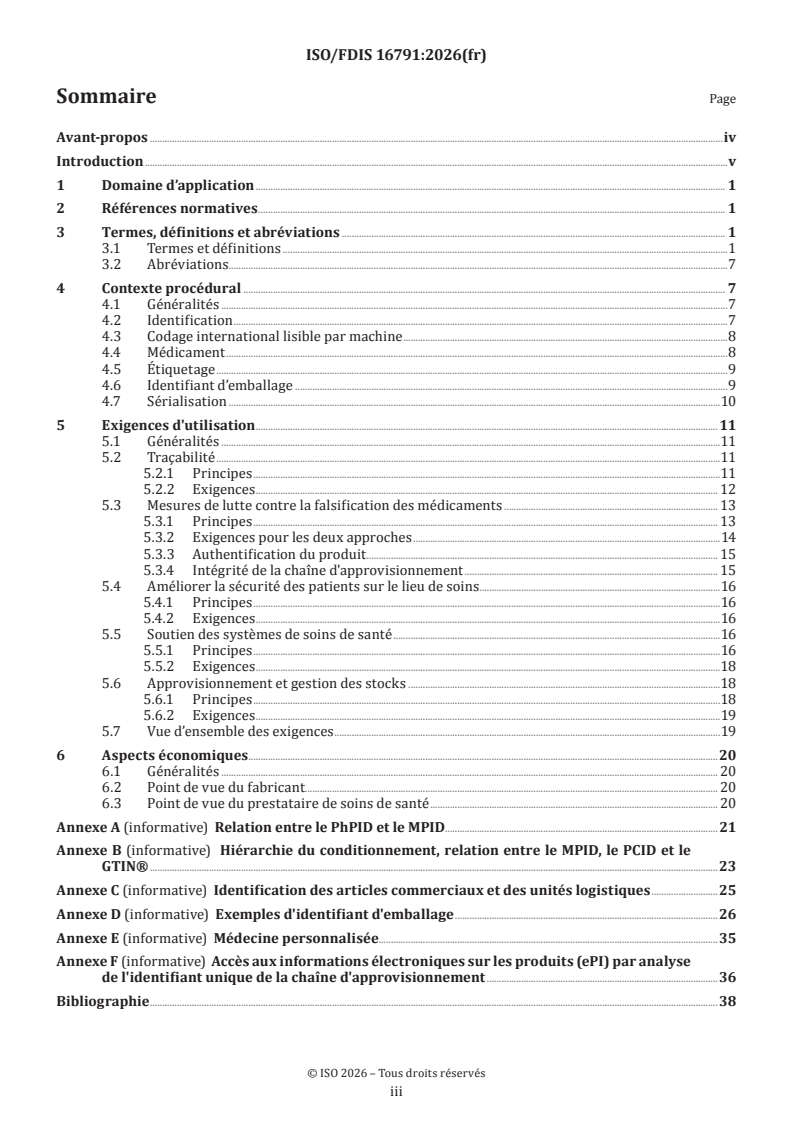
ISO/FDIS 16791 - Informatique de santé — Exigences relatives au codage international lisible par machine des identifiants de paquetage de médicaments Released:21. 01. 2026
Get Certified
Connect with accredited certification bodies for this standard

BSI Group
BSI (British Standards Institution) is the business standards company that helps organizations make excellence a habit.

NYCE
Mexican standards and certification body.
Sponsored listings
Frequently Asked Questions
ISO/FDIS 16791 is a draft published by the International Organization for Standardization (ISO). Its full title is "Health informatics — Requirements for international machine-readable coding of medicinal product package identifiers". This standard covers: This document provides guidelines on identification and labelling of medicinal products from the point of manufacture of packaged medicinal product to the point of dispensing the product. This document outlines best practice for AIDC barcoding solutions for applications. Users can, however, consider the coding interoperability requirements for other AIDC technologies, e.g. Radio Frequency Identification (RFID).
This document provides guidelines on identification and labelling of medicinal products from the point of manufacture of packaged medicinal product to the point of dispensing the product. This document outlines best practice for AIDC barcoding solutions for applications. Users can, however, consider the coding interoperability requirements for other AIDC technologies, e.g. Radio Frequency Identification (RFID).
ISO/FDIS 16791 is classified under the following ICS (International Classification for Standards) categories: 35.240.80 - IT applications in health care technology. The ICS classification helps identify the subject area and facilitates finding related standards.
ISO/FDIS 16791 has the following relationships with other standards: It is inter standard links to FprEN ISO 16791, ISO 18193:2021, ISO/TS 16791:2020. Understanding these relationships helps ensure you are using the most current and applicable version of the standard.
ISO/FDIS 16791 is available in PDF format for immediate download after purchase. The document can be added to your cart and obtained through the secure checkout process. Digital delivery ensures instant access to the complete standard document.
Standards Content (Sample)
FINAL DRAFT
International
Standard
ISO/TC 215
Health informatics — Requirements
Secretariat: ANSI
for international machine-readable
Voting begins on:
coding of medicinal product
2026-01-01
package identifiers
Voting terminates on:
2026-02-26
Informatique de santé — Exigences relatives au codage
international lisible par machine des identifiants de paquetage de
médicaments
RECIPIENTS OF THIS DRAFT ARE INVITED TO SUBMIT,
WITH THEIR COMMENTS, NOTIFICATION OF ANY
RELEVANT PATENT RIGHTS OF WHICH THEY ARE AWARE
AND TO PROVIDE SUPPOR TING DOCUMENTATION.
IN ADDITION TO THEIR EVALUATION AS
BEING ACCEPTABLE FOR INDUSTRIAL, TECHNO
ISO/CEN PARALLEL PROCESSING LOGICAL, COMMERCIAL AND USER PURPOSES, DRAFT
INTERNATIONAL STANDARDS MAY ON OCCASION HAVE
TO BE CONSIDERED IN THE LIGHT OF THEIR POTENTIAL
TO BECOME STAN DARDS TO WHICH REFERENCE MAY BE
MADE IN NATIONAL REGULATIONS.
Reference number
FINAL DRAFT
International
Standard
ISO/TC 215
Health informatics — Requirements
Secretariat: ANSI
for international machine-readable
Voting begins on:
coding of medicinal product
2026-01-01
package identifiers
Voting terminates on:
Informatique de santé — Exigences relatives au codage
international lisible par machine des identifiants de paquetage de
médicaments
RECIPIENTS OF THIS DRAFT ARE INVITED TO SUBMIT,
WITH THEIR COMMENTS, NOTIFICATION OF ANY
RELEVANT PATENT RIGHTS OF WHICH THEY ARE AWARE
AND TO PROVIDE SUPPOR TING DOCUMENTATION.
© ISO 2026
IN ADDITION TO THEIR EVALUATION AS
All rights reserved. Unless otherwise specified, or required in the context of its implementation, no part of this publication may
BEING ACCEPTABLE FOR INDUSTRIAL, TECHNO
ISO/CEN PARALLEL PROCESSING
LOGICAL, COMMERCIAL AND USER PURPOSES, DRAFT
be reproduced or utilized otherwise in any form or by any means, electronic or mechanical, including photocopying, or posting on
INTERNATIONAL STANDARDS MAY ON OCCASION HAVE
the internet or an intranet, without prior written permission. Permission can be requested from either ISO at the address below
TO BE CONSIDERED IN THE LIGHT OF THEIR POTENTIAL
or ISO’s member body in the country of the requester.
TO BECOME STAN DARDS TO WHICH REFERENCE MAY BE
MADE IN NATIONAL REGULATIONS.
ISO copyright office
CP 401 • Ch. de Blandonnet 8
CH-1214 Vernier, Geneva
Phone: +41 22 749 01 11
Email: copyright@iso.org
Website: www.iso.org
Published in Switzerland Reference number
ii
Contents Page
Foreword .iv
Introduction .v
1 Scope . 1
2 Normative references . 1
3 Terms, definitions and abbreviated terms . 1
3.1 Terms and definitions .1
3.2 Abbreviated terms .7
4 Procedural background . 7
4.1 General .7
4.2 Identification .7
4.3 International machine-readable coding .8
4.4 Medicinal product .8
4.5 Labelling .8
4.6 Package identifier .9
4.7 Serialization .10
5 Usage requirements .10
5.1 General .10
5.2 Traceability .10
5.2.1 Principles .10
5.2.2 Requirements . 12
5.3 Measures to combat falsification of medicines . 12
5.3.1 Principles . 12
5.3.2 Requirements for both approaches . 13
5.3.3 Product authentication .14
5.3.4 Supply chain integrity .14
5.4 Improving patient safety at point of care . 15
5.4.1 Principles . 15
5.4.2 Requirements . 15
5.5 Support of healthcare systems . 15
5.5.1 Principles . 15
5.5.2 Requirements .16
5.6 Procurement and stock management .17
5.6.1 Principles .17
5.6.2 Requirements .17
5.7 Overview of requirements .18
6 Economic aspects .18
6.1 General .18
6.2 Manufacturer perspective .18
6.3 Healthcare provider perspective .19
Annex A (informative) Relationship between PhPID and MPID .20
Annex B (informative) Packaging hierarchy, relationship between MPID, PCID and GTIN®.22
Annex C (informative) Identification of trade items and logistic units.24
Annex D (informative) Examples for package identifier .25
Annex E (informative) Personalized medicine .34
Annex F (informative) Accessing electronic product information (ePI) by scanning the supply
chain unique identifier .35
Bibliography .37
iii
Foreword
ISO (the International Organization for Standardization) is a worldwide federation of national standards
bodies (ISO member bodies). The work of preparing International Standards is normally carried out through
ISO technical committees. Each member body interested in a subject for which a technical committee
has been established has the right to be represented on that committee. International organizations,
governmental and non-governmental, in liaison with ISO, also take part in the work. ISO collaborates closely
with the International Electrotechnical Commission (IEC) on all matters of electrotechnical standardization.
The procedures used to develop this document and those intended for its further maintenance are described
in the ISO/IEC Directives, Part 1. In particular, the different approval criteria needed for the different types
of ISO documents should be noted. This document was drafted in accordance with the editorial rules of the
ISO/IEC Directives, Part 2 (see www.iso.org/directives).
ISO draws attention to the possibility that the implementation of this document may involve the use of (a)
patent(s). ISO takes no position concerning the evidence, validity or applicability of any claimed patent
rights in respect thereof. As of the date of publication of this document, ISO had not received notice of (a)
patent(s) which may be required to implement this document. However, implementers are cautioned that
this may not represent the latest information, which may be obtained from the patent database available at
www.iso.org/patents. ISO shall not be held responsible for identifying any or all such patent rights.
Any trade name used in this document is information given for the convenience of users and does not
constitute an endorsement.
For an explanation of the voluntary nature of standards, the meaning of ISO specific terms and expressions
related to conformity assessment, as well as information about ISO’s adherence to the World Trade
Organization (WTO) principles in the Technical Barriers to Trade (TBT), see www.iso.org/iso/foreword.html.
This document was prepared by Technical Committee ISO/TC 215, Health informatics, in collaboration with
the European Committee for Standardization (CEN) Technical Committee CEN/TC 251, Health informatics, in
accordance with the Agreement on technical cooperation between ISO and CEN (Vienna Agreement).
This third edition cancels and replaces the second edition (ISO/TS 16791:2020), which has been technically
revised.
The main changes are as follows:
— addition of a definition on electronic product information;
— adjustment of 5.5.1 to reference ePL;
— addition of Annex F.
Any feedback or questions on this document should be directed to the user’s national standards body. A
complete listing of these bodies can be found at www.iso.org/members.html.
iv
Introduction
Globally, healthcare regulators, medicinal product suppliers, and healthcare providers, among others,
are facing increased pressure to ensure a more secure and safer supply chain for medicinal products.
The primary objective is to ensure optimal patient safety outcomes. Organizations such as the World
Health Organization (WHO), the European Union and the US Congress, along with many other healthcare
organizations, are also seeking robust systems that will deliver outcomes to enhance overall supply chain
integrity, to prevent product falsification and to improve patient safety, especially at the point of care.
Machine-readable coding is a technology capable of achieving these stated outcomes. Therefore, the core
purpose of this document is to provide requirements for machine-readable coding based on globally
harmonized and interoperable standards for wide scale international implementation, such as GS1 System
or UDI for medical devices.
This document outlines the requirements to implement international machine-readable coding on medicinal
product packages in the healthcare supply chain; this process cannot be isolated from more general
identification practice with medical devices or other categories of products. It assists all stakeholders
implement, use, and optimize automatic identification and data capture (AIDC) technologies in their
respective enterprises with a particular attention to health informatics. In that respect, this document
complements ISO 11615; for example, it provides requirements regarding medicinal product package
identifiers (PCID) and their relation with DCID.
As AIDC offers a wide spectrum of potential solutions, particularly for data carriers such as barcodes, it has
highlighted the importance of properly defining data structures to prevent ambiguity when information is
encoded and captured.
Furthermore, the semantics of data carried can be specified by a number of organizations (also called
“issuing agencies”), some with commercial activities, some with a national emphasis, and others with a
1)
standard development organizations’ objective. This document focuses on the GS1® System of Standards.
The majority of supplies (such as processed food, office supplies, apparels, medical devices and equipment,
medicinal products) in healthcare around the world use the GS1® System of Standards for AIDC as it is
multi-sectorial and a globally implemented system of standards. Interoperability along the supply chain is
easier to achieve once a single system of standards is used in any market, including healthcare.
This document is intended to guide healthcare packaging designers, regulatory affairs specialists, logistics
operators, and others to implement AIDC solutions for healthcare.
NOTE 1 See Reference [34].
NOTE 2 See Reference [35].
1) GS1® is a registered trademark. This information is given for the convenience of users of this document and does not
constitute an endorsement by ISO.
v
FINAL DRAFT International Standard ISO/FDIS 16791:2026(en)
Health informatics — Requirements for international
machine-readable coding of medicinal product package
identifiers
1 Scope
This document provides requirements on identification and labelling of medicinal products from the point
of manufacturing of packaged medicinal product to the point of dispensing the product.
This document outlines commonly accepted international practices for automatic identification and data
capture (AIDC) barcoding solutions for applications and applies to manufacturers, distributors, healthcare
facilities and all parties involved in labelling and distribution of packaged medicinal products. These users
can, however, consider the coding interoperability requirements for other AIDC technologies, e.g. radio
frequency identification (RFID); that technology is not addressed in this document except as for information.
2 Normative references
The following documents are referred to in the text in such a way that some or all of their content constitutes
requirements of this document. For dated references, only the edition cited applies. For undated references,
the latest edition of the referenced document (including any amendments) applies.
ISO 11615, Health informatics — Identification of medicinal products — Data elements and structures for the
unique identification and exchange of regulated medicinal product information
ISO/TS 19256, Health informatics — Requirements for medicinal product dictionary systems for health care
3 Terms, definitions and abbreviated terms
For the purposes of this document, the following terms and definitions apply.
ISO and IEC maintain terminology databases for use in standardization at the following addresses:
— ISO Online browsing platform: available at https:// www .iso .org/ obp
— IEC Electropedia: available at https:// www .electropedia .org/
3.1 Terms and definitions
3.1.1
aggregation
packaging aggregation
hierarchical, parent-child relationship between a containing object (i.e. parent) and one or more objects (i.e.
children) which are contained
Note 1 to entry: When the content of a delivery is not homogeneous, aggregation shall be provided by using a univocal
identification of the delivery, such as with a serial shipping container code (SSCC); see Annex C.
3.1.2
application identifier
AI
GS1® prefix that specifies the meaning and purpose of the data element that follows, as specified in
[33]
ISO/IEC 15418 and GS1® General Specifications
[SOURCE: ISO/IEC 19762:2025, 3.1.1.77, modified — “defines” and “defined” were changed to “specifies” and
“specified”.]
3.1.3
automatic identification and data capture
AIDC
methods or technologies for automatically identifying objects, collecting data about them, and entering that
data directly into computer systems, eliminating manual entry
Note 1 to entry: The methods or technologies typically considered as part of AIDC include barcodes (3.1.9) which can
be linear or 2-dimensional symbols and radio frequency identification (RFID) (3.1.33) tags/chips.
3.1.4
authentication
comparing the attributes of the object itself to what is known about objects of that origin
Note 1 to entry: Attributes include unique identifier besides overt, covert, and/or forensic solutions.
3.1.5
medicinal product batch identifier 1
BAID1
unique identifier (3.1.37) allocated to a specific batch (3.1.7) of a medicinal product (3.1.22), which appears on
the outer packaging (3.1.26) of the medicinal product
Note 1 to entry: It is constructed by using the batch number (3.1.8) assigned by the manufacturer and the expiration
date. This is for indexing purposes and to contribute to improving patient safety by allowing for the unique
identification of a medicinal product at the package level.
Note 2 to entry: BAID1 is market specific.
Note 3 to entry: See 5.2.1.5 for the difference between BAID1 and BAID2, and batch or lot number.
2)
[SOURCE: ISO 11615:— , 3.1.51, modified — Notes 2 and 3 to entry were added.]
3.1.6
medicinal product batch identifier 2
BAID2
unique identifier (3.1.37) allocated to a specific batch (3.1.7) of a medicinal product (3.1.22), which appears on
the immediate packaging, where this is not the outer packaging (3.1.26)
Note 1 to entry: It is constructed by using the batch number (3.1.8) assigned by the manufacturer and the expiration
date. This is for indexing purposes and to contribute to improving patient safety by allowing for the unique
identification of a medicinal product based at the level of the immediate container.
Note 2 to entry: ‘Immediate packaging’ corresponds frequently to ‘primary packaging’. See Annex B.
Note 3 to entry: See 5.2.1.5 for the difference between BAID1 and BAID2, and batch or lot number.
[SOURCE: ISO 11615:—, 3.1.52, modified — Notes 2 and 3 to entry were added.]
2) Under preparation. Stage at the time of publication: ISO/DIS 11615.
3.1.7
batch
specific quantity of a drug or other material that is intended to have uniform character and quality, within
specified limits, and is produced according to a single manufacturing (3.1.19) order during the same cycle of
manufacturing
Note 1 to entry: See 5.2.1.5 for the difference between BAID1 and BAID2, and batch or lot number.
Note 2 to entry: ‘Lot’ is frequently used as synonym of batch.
[SOURCE: ISO 11615:—, 3.1.8, modified — Notes to entry were added.]
3.1.8
batch number
identifier (3.1.17) assigned to a specific batch (3.1.7) of a medicinal product (3.1.22) or item resulting from a
manufacturing (3.1.19) process at a specific point of time
Note 1 to entry: A batch number permits its manufacturing history to be traced.
Note 2 to entry: A batch number is made of series of ASCII characters.
Note 3 to entry: ‘Lot number’ is frequently used as synonym of batch number.
[SOURCE: ISO 11615:—, 3.1.9, modified — Notes to entry were added.]
3.1.9
barcode
optical machine-readable representation of data, showing data about the object to which it attaches
Note 1 to entry: Originally, barcodes represented data by varying the widths and spacings of parallel lines, and they
can be referred to as linear or one-dimensional (1D). Later they evolved into rectangles, dots, hexagons, and other
geometric patterns in two dimensions (2D). Although 2D systems use a variety of symbols, they are generally referred
to as barcodes as well.
3.1.10
compounded preparation
medicinal products (3.1.22) generally consisting of active substances that can be combined with excipients,
formulated into a dosage form suitable for the intended use
3.1.11
dispense
prepare and give out a medicinal product (3.1.22) in accordance with a prescription
Note 1 to entry: This includes assessing the pharmaceutical appropriateness including decision support.
Note 2 to entry: See ISO/TS 19293.
3.1.12
electronic product information
ePI
authorized, statutory product information for medicines (i.e. SmPC, PL and labelling)
Note 1 to entry: See Reference [47].
3.1.13
global trade item number
GTIN®
number that is used for the unique identification (3.1.15) of trade items worldwide
EXAMPLE 1 GS1® Identification Key, which comprises a GS1® Company Prefix, an Item Reference and Check digit.
EXAMPLE 2 Used to identify trade items such as medicinal products (3.1.22) and medical devices.
Note 1 to entry: See Annex A for the relationship between medicinal product identifier (MPID) (3.1.23) and medicinal
product package identifier (PCID) (3.1.24).
[SOURCE: ISO/IEC 15420:2025, 3.2 modified — “GS1 identification key” was changed to “number”; “which
may be 8, 12, 13 or 14 digits in length” was removed; Examples and Note 1 to entry were added.]
3.1.14
healthcare system
organization of people, institutions, and resources to deliver healthcare services to meet the health needs of
target populations
3.1.15
identification
way information about an object, such as a trade item, can be found in IT systems using a sequence of
characters
3.1.16
identification schema namespace
container for a set of identifiers (3.1.17) that allows the disambiguation of homonym identifiers residing in
different identification schema
3.1.17
identifier
ID
description that is sufficient to represent an object in a given environment identification schema
Note 1 to entry: This concept is generic and applies to all identifications mentioned in this document.
3.1.18
machine-readable code
code, readable by a machine, that contains information used to establish a relationship between a physical
object such as a medicinal product (3.1.22) package and data sources such as medical, production, logistical
or reimbursement coding systems
3.1.19
manufacturing
process of production from the acquisition of all materials through all processing stages, including final
packaging
3.1.20
marketing authorization
authorization issued from a medicines regulatory agency that allows a medicinal product (3.1.22) to be
placed on the market
[SOURCE: ISO 11615:—, 3.1.40]
3.1.21
marketing authorization holder
MAH
organization that holds the authorization for marketing a medicinal product (3.1.22) in a region or country
[SOURCE: ISO 11615:—, 3.1.41 modified — “or country” was added.]
3.1.22
medicinal product
pharmaceutical product (3.1.29) or combination of pharmaceutical products that may be administered to
human beings for treating or preventing disease, with the aim or purpose of making a medical diagnosis or
to restore, correct or modify physiological functions
Note 1 to entry: The same definition applies for animal health.
Note 2 to entry: Corresponds frequently to “medicines”.
[SOURCE: ISO 11615:—, 3.1.50, modified — “(or animals)” was removed; the original Notes 1 and 3 to entry
were removed and new Notes to entry were added.]
3.1.23
medicinal product identifier
MPID
identifier allocated to a medicinal product (3.1.22) supplementary to any existing authorization number as
ascribed by a medicines regulatory agency in a region
[SOURCE: ISO 11615:—, 3.1.53, modified — “unique identifier” was changed to “identifier”; Notes to entry
were removed.]
3.1.24
medicinal product package identifier
PCID
identifier allocated to a packaged medicinal product (3.1.28) supplementary to any existing authorization
number as ascribed by a medicines regulatory agency in a region
Note 1 to entry: See Annex D for relationship between medicinal product identifier (MPID) (3.1.23), medicinal product
package identifier (PCID) (3.1.24) and global trade item number (GTIN®) (3.1.13).
[SOURCE: ISO 11615:—, 3.1.55, modified — “unique identifier” was changed to “identifier”; Note 1 to entry
was removed and replaced by a new note.]
3.1.25
object identifier
OID
globally unique value associated with an object to unambiguously identify it
3.1.26
outer packaging
external container in which a medicinal product (3.1.22) is supplied
Note 1 to entry: Corresponds frequently to “secondary packaging” (see Annex B).
[SOURCE: ISO 11615:—, 3.1.57 modified — Note 1 to entry was removed and replaced by a new note.]
3.1.27
packaging hierarchy
relationship between a medicinal product (3.1.22) package and its grouping in larger or smaller quantities
Note 1 to entry: See Annex B for illustration of “primary packaging”, “secondary packaging”, etc.
3.1.28
packaged medicinal product
medicinal product (3.1.22) in a container being part of a package, representing the entirety that has been
packaged for sale or supply
Note 1 to entry: Corresponds frequently to “primary packaging” (see Annex B).
[SOURCE: ISO 11615:—, 3.1.59, modified — Note 1 to entry was added.]
3.1.29
pharmaceutical product
qualitative and quantitative composition of a medicinal product (3.1.22) in the dose form approved for
administration in line with the regulated product information
[SOURCE: ISO 11615:—, 3.1.60, modified — Note 1 to entry was removed.]
3.1.30
pharmaceutical product identifier
PhPID
identifier for a pharmaceutical product (3.1.29)
[SOURCE: ISO 11615:—, 3.1.61 modified — “unique identifier” was changed to “identifier”.]
3.1.31
pharmacovigilance
science and activities relating to the detection, assessment, understanding and prevention of adverse effects
[23,24,43]
or any other medicine-related problem
Note 1 to entry: Adapted from Reference [43].
3.1.32
pseudo-randomized
sequence of numbers that appears to be statistically random, despite having been produced by a completely
deterministic and repeatable process
3.1.33
radio frequency identification
RFID
wireless non-contact system that uses radio-frequency electromagnetic fields to transfer data from a tag
attached to an object, for the purposes of automatic identification (3.1.15) and tracking
3.1.34
reconstitution
manipulation to enable the use or application of a medicinal product (3.1.22) with a marketing authorization
(3.1.20) (e.g. solving a powder to a solution) in accordance with the instructions given in the summary of
product characteristics or the patient information leaflet
3.1.35
serialization
assigning a unique identifier (3.1.37) (e.g. a number) to an item (e.g. pack, case or pallet)
Note 1 to entry: This identifier is stored on a database along with other information about the item (e.g. manufacturer,
batch info). Serialization typically includes randomly selected, encrypted, numerical or alpha- numeric serial number.
Note 2 to entry: According to Reference [44], ‘unique identifier’ is the safety feature which enables the verification
(3.1.38) of the authenticity and the identification of an individual pack of a medicinal product (3.1.22).
3.1.36
traceability
ability to track forward the movement through specified stage(s) of the extended supply chain and trace
backward the history, application, or location of that which is under consideration
Note 1 to entry: Adapted from Reference [48].
3.1.37
unique identifier
univocal coding
identification (3.1.15) that is unique to a specific instance and cannot be confused with another identification
3.1.38
verification
reading unique identifier (3.1.37) numbers and checking these in a database
3.2 Abbreviated terms
IHE integrating the healthcare enterprise
NDC national drug code (from US FDA)
OCR optical character recognition
4 Procedural background
4.1 General
Clause 4 specifies the distinctions between identification and data carriers (machine-readable coding and
its international characters). It then focuses on medicinal product and the characteristics of their physical
packaging in the marketplace.
Supply chain, traceability, and patient safety require appropriate labelling and the use of packaging
identifiers (as described in ISO 11615).
4.2 to 4.7 describe the key components of AIDC in the healthcare context, including the structure of
identifiers (4.2), machine-readable codes (4.3), medicinal products and their packaging hierarchy (4.4),
labelling technologies (4.5), package identifiers (4.6), and serialization practices (4.7), which together
support traceability and patient safety.
4.2 Identification
Identification shall be a unique sequence structured according to a globally agreed architecture or syntax
and may contain inbuilt significance.
EXAMPLE 1 The identifier for one pre-filled syringe of XYZ medicinal product is: 7665431234887. The identifier for
one telephone-service subscription is: 022 592 74 25.
Uniqueness of the identifier is the key to ensuring unambiguous identification. It is important to note that
the same sequence of characters can identify different items or objects belonging to different domains
(or contexts), but each unique object within a single domain (or context) shall also have an unambiguous
identifier. Uniqueness is also governed by the selected identification schema (or namespace) and the domains
(contexts) in which the schema applies. The identification schema rules are therefore paramount.
EXAMPLE 2 7665431234887 uniquely identifies the class pre-filled syringe of XYZ medicinal product in the domain
“GS1”. 022 592 74 25 uniquely identifies a web conference access point in the domain “telephone-service subscription
numbers, Switzerland”.
There are several types of identifiers in computer systems, varying in structure, purpose, governance, etc.
Uniform resource identifiers (URIs) are used for electronically available identifiers.
Uniform resource identifiers (URIs) can be:
— Uniform resource locators (URLs) – which are references to a location and therefore to an identifier in
the source location, such as http:// somewebesite/ products/ identifiers.
— Uniform resource names (URN) – which identify an object regardless of its location and availability,
by means of a value (the identifier of the object) and the namespace (how the identifier is assigned). To
ensure uniqueness and availability of the identifiers, there are two approaches – either a hierarchical
identifier assignment, or a random identifier creation. Illustrative examples:
— Object identifiers (OID), are defined by a naming system with structured (hierarchical), global
governance, to ensure that only one entity can assign identifiers in one space.
— Universally unique identifiers (UUID), sometimes called globally unique identifiers (GUID), are
practically unique IDs, generated without a global governance. A UUID is randomly generated and
the probability of two systems creating the same UUID is extremely low, so the UUID can also be
considered unique for practical reasons.
EXAMPLE 3 OID < 2.51.1.1 > delimits the domain “GS1 GTIN” in which product identifier 7665431234887 is unique.
OID < 0.0.17.825.0.6.8 > delimits the domain “callingPartyNumber” in which web conference access point 022 592 74
25 is unique.
3)
EXAMPLE 4 In HL7® FHIR® standard, GTINs® can be used to identify a product, OIDs can be used for entities,
and URLs can identify other online resources such as prescriptions or documents (e.g. URL for the domain “GS1 GTIN”
is https:// www .gs1 .org/ 1/ gtinrules// en/ ).
4.3 International machine-readable coding
The manufacturer of the medicinal product shall apply product labelling that incorporates international
machine-readable code. Further, the manufacturer shall ensure any labelling carried out by external
parties along the supply chain (distributor, dispenser etc) applies AIDC and international machine-readable
code (see ISO/IEC 15424, the ISO/IEC 15426 series, ISO/IEC 15459-1, ISO/IEC 15459-2, ISO/IEC 15459-3,
ISO/IEC 15459-4, ISO/IEC 15459-6, ISO/IEC 16022, ISO/IEC 19762). This can be done by contractual
arrangements and vendor controls.
Unique identifier, as described in 4.2, is required when medicinal products are intended to be used in the
international market, if they physically circulate, or if information about them is used across the jurisdictions.
That means that the domain (or context) is not national or regional, but global.
International machine-readable coding is not just limited to packaging identifiers; it also encompasses
attributes such as batch number, expiry date, and serial numbers. Depending on medicinal product’s
characteristics, all of these attributes require semantics in such a way as to allow encoding and then
capturing regardless of the origin of the medicinal products. Application identifiers provide the semantics
of the data carried in an international machine-readable code, and they shall therefore be used uniformly
across the global market.
4.4 Medicinal product
Medicinal products are traded in various outer packaging configurations, between which there is an
established relationship. For example, the pharmaceutical product “Painkiller” has a market authorization
for 100 mg tablets (medicinal product). These tablets can be packed in 10. Packages of 10 tablets can be
bundled by 5; bundles can be grouped into cartons of 12 and cartons can be grouped in shipping cases of 20.
Annex B illustrates these relationships referred to as “packaging hierarchy”. There are numerous complex
situations which are not illustrated in this document but for which the same principles shall apply.
In the packaging hierarchy, each packaging level shall be uniquely identified.
Medicinal products can be authorized with two or more strengths, each being identified using a different
and unique pharmaceutical product identifier (PhPID) and medicinal product ID (MPID) (see Annex A).
“Painkiller” can be marketed in 100 mg and in 200 mg tablets. Each of these strengths corresponds to a
different medicinal product. There will be different packaging hierarchies, one for each strength. Again, for
medicinal product, all levels of packaging require univocal identification.
4.5 Labelling
AIDC has demonstrated its efficiency over several decades, and the use of that technology has enables
significant progresses in data accuracy.
For more than 40 years, standardized optical carriers such as linear barcodes and two-dimensional symbols
have been used by trading partners for AIDC (see ISO 22742). RFID was once considered as a technology
that could be used for identification without direct handling and still remains among the possibilities for the
future AIDC widespread adoption. Likewise, trading partners have not adopted other AIDC solutions, such
3) HL7® and FHIR® are registered trademarks. This information is given for the convenience of users of this document
and does not constitute an endorsement by ISO.
as OCR and biometrics, because of lack of efficiencies, ease of encoding, decoding, and the use of proprietary
algorithms. However, the use of AIDC based on standardized optical carriers does offer the possibility for
users to attain more efficient and effective logistics and material management (see ISO/IEC 15423). For
medicinal products, the possibility of implementing AIDC at the point of care given is enabled.
The number of possible optical symbols available needs to be contained and standardized. Effective AIDC
uses globally standardized symbols with standardized globally agreed data encoded in the symbols. This
ensures overall efficiency, i.e. the same type data structures encoded in a set of pre- defined symbols shall
be used by any geography or economy, regardless of the type products (e.g. food, medicinal products, office
devices). As a result, manufacturers shall standardize their production processes by using consistent AIDC
symbols and eliminating variability. From a user’s perspective, this increases global interoperability since
the identification schema namespace is widespread.
There are many devices and software solutions available for encoding and decoding the data in the AIDC
symbol. All are capable of delivering a wide variety of solutions because of the use of global standards.
Software and devices ensure that they are focused on delivery standard solutions that are interoperable.
In 2017, IHE released a new profile (Uniform Barcode Processing), to help software vendors meet these
[37]
requirements.
Mass production requires high quality label printing. In addition to manufacturers selecting the right
optical symbol (data carrier) and correct data for the symbol, suitable software shall ensure that the print
quality of the AIDC symbol is satisfactory for reading purposes. Testing symbol readability shall always be
documented, which includes standard procedures about the control practice, symbol quality and verification
frequency. Some ISO deliverables, e.g. ISO/IEC 15415, ISO/IEC 15416 or ISO/IEC 15426, have been developed
for testing and measuring the readability of barcodes. Manufacturers (labellers) shall further pay particular
attention to packaging or label design so that the placement of labels on outer packaging ensures that the
AIDC process is not compromised. Data encoded in the symbol should be printed in human readable format
to ensure process continuity where readers might not be available, or by equipment failure.
4.6 Package identifier
There are a number of identification relationships that should be understood for effective AIDC of medicinal
products. This includes the relationship between pharmaceutical product identifier (PhPID), medicinal
product identifier (MPID), packaging identifier (PCID), marketing authorization number, and global trade
item number (GTIN®). The relationship between marketing authorization number and GTIN® varies
depending on regulatory framework. There are two main scenarios:
— The marketing authorization number and the GTIN® can be the same (i.e. the same sequence of
characters). Examples of this situation can be observed in the US or in France (see Annex D).
NOTE In some countries, such as France or Austria, GTINs® are generated by including a national number
maintained by another authority than the marketing authorization holder. In this circumstance, one uses the
acronym “NTIN” (National Trade Item Number). Usually NTIN correspond to secondary packaging. Primary
packaging and higher levels of packaging are identified by following the normal GTIN® allocation rules.
— A single marketing authorization number is delivered by a central regulator for different markets.
Different GTINs® shall be used to distinguish the different packages of the same medicinal product as
the actual packaging differs from one market to another. An example of this situation is seen in Europe
(i.e. there is central marketing authorization, but there is country-specific packaging in the European
member states). The marketing authorization number issued is related to the GTIN® in a database, not
via AIDC.
Annex D illustrates the current scenario in some countries.
The GTIN®-14 standard is defined as the unique 14-
...
ISO/DISFDIS 16791:2025(en)
ISO/TC 215
Secretariat: ANSI
Date: 2025-06-2712-17
Health informatics — Requirements for international machine-
readable coding of medicinal product package identifiers
Informatique de santé — Exigences pour une identification internationale,relatives au codage international
lisible par capture automatique,machine des produits médicinauxidentifiants de paquetage de médicaments
FDIS stage
TThhiis drs draafftt i is s susubbmmiitttteed d ttoo aa ppaarraallellel l vvoottee i inn IISSOO,, CCEEN.N.
All rights reserved. Unless otherwise specified, or required in the context of its implementation, no part of this publication
may be reproduced or utilized otherwise in any form or by any means, electronic or mechanical, including photocopying,
or posting on the internet or an intranet, without prior written permission. Permission can be requested from either ISO
at the address below or ISO’s member body in the country of the requester.
ISO copyright office
CP 401 • Ch. de Blandonnet 8
CH-1214 Vernier, Geneva
Phone: + 41 22 749 01 11
EmailE-mail: copyright@iso.org
Website: www.iso.org
Published in Switzerland
ii
ISO/DISFDIS 16791:2025(en)
Contents
Foreword . iv
Introduction . v
1 Scope . 1
2 Normative references . 1
3 Terms, definitions and abbreviated terms . 1
3.1 Terms and definitions . 1
3.2 Abbreviated terms . 7
4 Procedural background . 8
4.1 General . 8
4.2 Identification . 8
4.3 International machine-readable coding . 9
4.4 Medicinal product . 9
4.5 Labelling . 9
4.6 Package identifier . 10
4.7 Serialization . 11
5 Usage requirements . 11
5.1 General . 11
5.2 Traceability . 12
5.3 Measures to combat falsification of medicines . 14
5.4 Improving patient safety at point of care . 16
5.5 Support of healthcare systems . 17
5.6 Procurement and stock management . 18
5.7 Overview of requirements . 19
6 Economic aspects . 20
6.1 General . 20
6.2 Manufacturer perspective . 20
6.3 Healthcare provider perspective . 20
Annex A (informative) Relationship between PhPID and MPID . 22
Annex B (informative) Packaging hierarchy, relationship between MPID, PCID and GTIN® . 25
Annex C (informative) Identification of trade items and logistic units . 30
Annex D (informative) Examples for package identifier . 31
Annex E (informative) Personalized medicine. 43
Annex F (informative) Accessing electronic product information (ePI) by scanning the supply
chain unique identifier . 44
Bibliography . 47
This template allows you to work with default MS Word functions and styles. You can use these
if you want to maintain the Table of Contents automatically and apply auto-numbering.
To update the Table of Contents please select it and press "F9".
iii
Foreword
ISO (the International Organization for Standardization) is a worldwide federation of national standards
bodies (ISO member bodies). The work of preparing International Standards is normally carried out through
ISO technical committees. Each member body interested in a subject for which a technical committee has been
established has the right to be represented on that committee. International organizations, governmental and
non-governmental, in liaison with ISO, also take part in the work. ISO collaborates closely with the
International Electrotechnical Commission (IEC) on all matters of electrotechnical standardization.
The procedures used to develop this document and those intended for its further maintenance are described
in the ISO/IEC Directives, Part 1. In particular, the different approval criteria needed for the different types of
ISO documents should be noted. This document was drafted in accordance with the editorial rules of the
ISO/IEC Directives, Part 2 (see www.iso.org/directives).
ISO draws attention to the possibility that the implementation of this document may involve the use of (a)
patent(s). ISO takes no position concerning the evidence, validity or applicability of any claimed patent rights
in respect thereof. As of the date of publication of this document, ISO had not received notice of (a) patent(s)
which may be required to implement this document. However, implementers are cautioned that this may not
represent the latest information, which may be obtained from the patent database available at
www.iso.org/patents. ISO shall not be held responsible for identifying any or all such patent rights.
Any trade name used in this document is information given for the convenience of users and does not
constitute an endorsement.
For an explanation of the voluntary nature of standards, the meaning of ISO specific terms and expressions
related to conformity assessment, as well as information about ISO'sISO’s adherence to the World Trade
Organization (WTO) principles in the Technical Barriers to Trade (TBT), see www.iso.org/iso/foreword.html.
This document was prepared by Technical Committee ISO/TC 215, Health informatics, in collaboration with
the European Committee for Standardization (CEN) Technical Committee CEN/TC 251, Health informatics, in
accordance with the Agreement on technical cooperation between ISO and CEN (Vienna Agreement).
This third edition cancels and replaces the second edition (ISO/TS 16791:2020), which has been technically
revised.
The main changes are as follows:
— — addition of a definition on electronic product information;
— — adjustment of 5.5.15.5.1 to reference ePL;
— — addition of Annex FAnnex F.
Any feedback or questions on this document should be directed to the user’s national standards body. A
complete listing of these bodies can be found at www.iso.org/members.html.
iv
ISO/DISFDIS 16791:2025(en)
Introduction
Globally, healthcare regulators, medicinal product suppliers, and healthcare providers, among others, are
facing increased pressure to ensure a more secure and safer supply chain for medicinal products. The primary
objective is to ensure optimal patient safety outcomes. Organizations such as the World Health Organization
(WHO), the European Union and the US Congress, along with many other healthcare organizations, are also
seeking robust systems that will deliver outcomes to enhance overall supply chain integrity, to prevent
product falsification and to improve patient safety, especially at the point of care.
Machine-readable coding is a technology capable of achieving these stated outcomes. Therefore, the core
purpose of this document is to provide requirements for machine-readable coding based on globally
harmonized and interoperable standards for wide scale international implementation, such as GS1 System or
UDI for medical devices.
This document outlines the requirements to implement international machine-readable coding on medicinal
product packages in the healthcare supply chain; this process cannot be isolated from more general
identification practice with medical devices or other categories of products. It assists all stakeholders
implement, use, and optimize Automatic Identificationautomatic identification and Data Capturedata capture
(AIDC) technologies in their respective enterprises with a particular attention to health informatics. In that
respect, this document complements ISO 11615; for example, it provides requirements regarding medicinal
product package identifiers (PCID) and their relation with DCID.
As AIDC offers a wide spectrum of potential solutions, particularly for data carriers such as barcodes, it has
highlighted the importance of properly defining data structures to prevent ambiguity when information is
encoded and captured.
Furthermore, the semantics of data carried can be specified by a number of organizations (also called “issuing
agencies”), some with commercial activities, some with a national emphasis, and others with a standard
11)
development organizations’ objective. This document focuses on the GS1® System of Standards.
The majority of supplies (such as processed food, office supplies, apparels, medical devices and equipment,
medicinal products) in healthcare around the world use the GS1® System of Standards for AIDC as it is multi-
sectorial and a globally implemented system of standards. Interoperability along the supply chain is easier to
achieve once a single system of standards is used in any market, including healthcare.
This document is intended to guide healthcare packaging designers, regulatory affairs specialists, logistics
operators, and others to implement AIDC solutions for healthcare.
NOTE 1 See Reference [34[39].].
NOTE 2 See Reference [35[40].].
GS1® is a registered trademark. This information is given for the convenience of users of this document and does not
constitute an endorsement by ISO.
1)
GS1® is a registered trademark. This information is given for the convenience of users of this document and does not
constitute an endorsement by ISO.
v
ISO/DISFDIS 16791:2025(en)
Health informatics — Requirements for international machine-
readable coding of medicinal product package identifiers
1 Scope
This document provides requirements on identification and labelling of medicinal products from the point of
manufacturing of packaged medicinal product to the point of dispensing the product.
This document outlines commonly accepted international practices for AIDCautomatic identification and data
capture (AIDC) barcoding solutions for applications and applies to manufacturers, distributors, healthcare
facilities and all parties involved in labelling and distribution of packaged medicinal products. These users can,
however, consider the coding interoperability requirements for other AIDC technologies, e.g. radio frequency
identification (RFID); that technology is not addressed in this document except as for information.
2 Normative references
The following documents are referred to in the text in such a way that some or all of their content constitutes
requirements of this document. For dated references, only the edition cited applies. For undated references,
the latest edition of the referenced document (including any amendments) applies.
ISO 11615:,, Health informatics — Identification of medicinal products — Data elements and structures for the
unique identification and exchange of regulated medicinal product information
ISO/TS 19256, Health informatics — Requirements for medicinal product dictionary systems for health care
3 Terms, definitions and abbreviated terms
For the purposes of this document, the following terms and definitions apply.
ISO and IEC maintain terminology databases for use in standardization at the following addresses:
— — ISO Online browsing platform: available at https://www.iso.org/obp
— — IEC Electropedia: available at https://www.electropedia.org/
3.1 Terms and definitions
3.1.1 3.1.1
aggregation
packaging aggregation
hierarchical, parent-child relationship between a containing object (i.e. parent) and one or more objects (i.e.
children) which are contained
Note 1 to entry: When the content of a delivery is not homogeneous, aggregation shall be provided by using a univocal
identification of the delivery, such as with a Serial Shipping Containerserial shipping container code (SSCC); see
Annex CAnnex C.
3.1.2 3.1.2
application identifier
AI
GS1® prefix that specifies the meaning and purpose of the data element that follows, as specified in
[33 [38]]
ISO/IEC 15418 and GS1® General Specifications
[SOURCE: ISO/IEC 19762:2025, 3.1.1.77]
Note 1 to entry: GTIN® is a registered trademark. This information is given for the convenience of users of
this document, modified — “defines” and does not constitute an endorsement by ISO“defined” were changed
to “specifies” and “specified”.]
3.1.3 3.1.3
automatic identification and data capture
AIDC
methods or technologies for automatically identifying objects, collecting data about them, and entering that
data directly into computer systems, eliminating manual entry
Note 1 to entry: The methods or technologies typically considered as part of AIDC include barcodes (3.1.9) which can be
linear or 2-dimensional symbols and Radio Frequency Identificationradio frequency identification (RFID) (3.1.33)
tags/chips.
3.1.4 3.1.4
authentication
comparing the attributes of the object itself to what is known about objects of that origin
Note 1 to entry: Attributes include unique identifier besides overt, covert, and/or forensic solutions.
3.1.5 3.1.5
medicinal product batch identifier 1
BAID1
unique identifier (3.1.37) allocated to a specific batch (3.1.7) of a medicinal product (3.1.22,), which appears on
the outer packaging (3.1.26) of the medicinal product
Note 1 to entry: It is constructed by using the batch number (3.1.8) assigned by the manufacturer and the expiration date.
This is for indexing purposes and to contribute to improving patient safety by allowing for the unique identification of a
medicinal product at the package level.
Note 2 to entry: BAID1 is market specific.
Note 3 to entry: see clause 5.2.1.5 See 5.2.1.5 for the difference between BAID1 and BAID2, and batch or lot number.
2)
[SOURCE: ISO 11615:2017,:— , 3.1.51]
, modified — Notes 2 and 3.1.6 to entry were added.]
3.1.6
medicinal product batch identifier 2
BAID2
unique identifier (3.1.37) allocated to a specific batch (3.1.7) of a medicinal product (3.1.22,), which appears on
the immediate packaging, where this is not the outer packaging (3.1.26)
Note 1 to entry: It is constructed by using the batch number (3.1.8) assigned by the manufacturer and the expiration date.
This is for indexing purposes and to contribute to improving patient safety by allowing for the unique identification of a
medicinal product based at the level of the immediate container.
Note 2 to entry: ‘immediate ‘Immediate packaging’ corresponds frequently to ‘primary packaging’. See Annex BAnnex B.
Note 3 to entry: see clause 5.2.1.5 See 5.2.1.5 for the difference between BAID1 and BAID2, and batch or lot number.
[SOURCE: ISO 11615:2017,:—, 3.1.52]
2)
Under preparation. Stage at the time of publication: ISO/DIS 11615.
ISO/DISFDIS 16791:2025(en)
, modified — Notes 2 and 3.1.7 to entry were added.]
3.1.7
batch
specific quantity of a drug or other material that is intended to have uniform character and quality, within
specified limits, and is produced according to a single manufacturing (3.1.19) order during the same cycle of
manufacturing
Note 1 to entry: see clause 5.2.1.5 See 5.2.1.5 for the difference between BAID1 and BAID2, and batch or lot number.
Note 2 to entry: lot ‘Lot’ is frequently used as synonym of batch.
[SOURCE: ISO 11615:2017,:—, 3.1.8, modified, “lot” was — Notes to entry were added as a preferred term.]
3.1.8 3.1.8
batch number
lot number
identifier (3.1.17) assigned to a specific batch (3.1.7) of a medicinal product (3.1.22) or item resulting from a
manufacturing (3.1.19) process at a specific point of time
Note 1 to entry: A batch number permits its manufacturing history to be traced.
Note 2 to entry: A batch number is made of series of ASCII characters.
Note 3 to entry: lot number ‘Lot number’ is frequently used as synonym of batch number.
[SOURCE: ISO 11615:2017,:—, 3.1.9, modified — Notes to entry were added.]
3.1.9 3.1.9
barcode
optical machine-readable representation of data, showing data about the object to which it attaches
Note 1 to entry: Originally, barcodes represented data by varying the widths and spacings of parallel lines, and they can
be referred to as linear or one-dimensional (1D). Later they evolved into rectangles, dots, hexagons, and other geometric
patterns in two dimensions (2D). Although 2D systems use a variety of symbols, they are generally referred to as barcodes
as well.
3.1.10
3.1.10 Compounded
compounded preparation
medicinal products (3.1.22) generally consisting of active substances that can be combined with excipients,
formulated into a dosage form suitable for the intended use
3.1.11 3.1.11
dispense
prepare and give out a medicinal product (3.1.22) in accordance with a prescription
Note 1 to entry: This includes assessing the pharmaceutical appropriateness including decision support.
Note 2 to entry: See [8]. ISO/TS 19293.
3.1.12 3.1.12
electronic product information
ePI
[55]
authorized, statutory product information for medicines (i.e. SmPC, PL and labelling) )
Note 1 to entry: See Reference [47 [55]].
3.1.13 3.1.13
global trade item number
GTIN®
number that is used for the unique identification (3.1.15) of trade items worldwide
EXAMPLE 1 GS1® Identification Key, which comprises a GS1® Company Prefix, an Item Reference and Check digit.
EXAMPLE 2 Used to identify trade items such as medicinal products (3.1.22) and medical devices.
Note 1 to entry: See Annex AAnnex A for the relationship between medicinal product identifier (MPID) (3.1.23) and
medicinal product package identifier (PCID) (3.1.24).
[SOURCE: ISO/IEC 15420:20092025, 3.7 2 modified, digit — “GS1 identification key” was changed to
“number”; “which may be 8, 12, 13 or 14 digits in length” was removed; Examples and Note 1 to entry were
added.]
3.1.14 3.1.14
healthcare system
organization of people, institutions, and resources to deliver healthcare services to meet the health needs of
target populations
3.1.15 3.1.15
identification
way information about an object, such as a trade item, can be found in IT systems using a sequence of
characters
3.1.16 3.1.16
identification schema namespace
container for a set of identifiers (3.1.17) that allows the disambiguation of homonym identifiers residing in
different identification schema
3.1.17 3.1.17
identifier
ID
description that is sufficient to represent an object in a given environment identification schema
Note 1 to entry: This concept is generic and applies to all identifications mentioned in this document.
3.1.18 3.1.18
machine-readable code
code, readable by a machine, that contains information used to establish a relationship between a physical
object such as a medicinal product (3.1.22) package and data sources such as medical, production, logistical or
reimbursement coding systems
3.1.19 3.1.19
manufacturing
process of production from the acquisition of all materials through all processing stages, including final
packaging
3.1.20 3.1.20
marketing authorization
authorization issued from a medicines regulatory agency that allows a medicinal product (3.1.22) to be placed
on the market
[SOURCE: ISO 11615:2017,:—, 3.1.40]
ISO/DISFDIS 16791:2025(en)
3.1.21 3.1.21
marketing authorization holder
MAH
organization that holds the authorization for marketing a medicinal product (3.1.22) in a region or country
[SOURCE: ISO 11615:2017,:—, 3.1.41 modified, " — “or country"” was added.]
3.1.22 3.1.22
medicinal product
pharmaceutical product (3.1.29) or combination of pharmaceutical products that may be administered to
human beings for treating or preventing disease, with the aim orpurposeor purpose of making a medical
diagnosis or to restore, correct or modify physiological functions
Note 1 to entry: The same definition applies for animal health.
Note 2 to entry: corresponds Corresponds frequently to “medicines””.
[SOURCE: ISO 11615:2017,:—, 3.1.50, modified, — “(or animals)” was removed; notesthe original Notes 1 and
3 to entry 1 and 2were removed and a new note 1Notes to entry were added.]
3.1.23 3.1.23
medicinal product identifier
MPID
identifier allocated to a medicinal product (3.1.22) supplementary to any existing authorization number as
ascribed by a medicines regulatory agency in a region
[SOURCE: ISO 11615:—, 3.1.53, modified — “unique identifier” was changed to “identifier”; Notes to entry
were removed.]
3.1.24
medicinal product package identifier
PCID
identifier allocated to a packaged medicinal product (3.1.28) supplementary to any existing authorization
number as ascribed by a medicines regulatory agency in a region
[SOURCE: ISO 11615:2017, 3.1.53, modified, “unique” removed; notes to Note 1 to entry removed.]
3.1.24
medicinal product package identifier
PCID
identifier allocated to a packaged medicinal product supplementary to any existing authorization number as
ascribed by a medicines regulatory agency in a region
Note 1 to entry: : See Annex DAnnex D for relationship between medicinal product identifier (MPID) (3.1.23), medicinal
product package identifier (PCID) (3.1.24, PCID,) and global trade item number (GTIN®) (3.1.13®.).
[SOURCE: ISO 11615:2017,:—, 3.1.55, modified. Term “Medicinal Product Package Identifier” replaced by
“medicinal product packagemodified — “unique identifier” and “PCID”, “unique” removed as first word of the
definition; note to entrywas changed to “identifier”; Note 1 to entry was removed and replaced by a new note.]
3.1.243.1.25 3.1.25
object identifier
OID
globally unique value associated with an object to unambiguously identify it
3.1.253.1.26 3.1.26
outer packaging
external container in which a medicinal product (3.1.22) is supplied
Note 1 to entry: Corresponds frequently to “secondary packaging” (see Annex BAnnex B).).
[SOURCE: ISO 11615:2017,:—, 3.1.57 modified, note — Note 1 to entry was removed and replaced by a new
note to entry.]
3.1.263.1.27 3.1.27
packaging hierarchy
relationship between a medicinal product (3.1.22) package and its grouping in larger orsmalleror smaller
quantities
Note 1 to entry: See Annex BAnnex B for illustration of “primary packaging”, “secondary packaging”, etc.
3.1.273.1.28 3.1.28
packaged medicinal product
medicinal product (3.1.22) in a container being part of a package, representing the entirety that has been
packaged for sale or supply
Note 1 to entry: Corresponds frequently to “primary packaging” (see Annex BAnnex B).).
[SOURCE: ISO 11615:2017,:—, 3.1.59]
3., modified — Note 1.29 to entry was added.]
3.1.283.1.29
pharmaceutical product
qualitative and quantitative composition of a medicinal product (3.1.22) in the dose form approved for
administration in line with the regulated product information
[SOURCE: ISO 11615:2017,:—, 3.1.60], modified — Note 1 to entry was removed.]
3.1.293.1.30 3.1.30
pharmaceutical product identifier
PhPID
identifier for a pharmaceutical product (3.1.29)
[SOURCE: ISO 11615:2017,:—, 3.1.61 modified, — “unique” removed.] identifier” was changed to “identifier”.]
3.1.303.1.31 3.1.31
pharmacovigilance
science and activities relating to the detection, assessment, understanding and prevention of adverse effects
[23,24,43[29, 30, 49] ]
or any other medicine-related problem
[SOURCE:Note 1 to entry: Adapted from Reference [43 [49]]].
3.1.32
Pseudo-randomization
3.1.32 a pseudorandom
pseudo-randomized
sequence of numbers is one that appears to be statistically random, despite having been produced by a
completely deterministic and repeatable process.
ISO/DISFDIS 16791:2025(en)
3.1.33 3.1.33
radio frequency identification
RFID
wireless non-contact system that uses radio-frequency electromagnetic fields to transfer data from a tag
attached to an object, for the purposes of automatic identification (3.1.15) and tracking
3.1.34
Reconstitution
3.1.34
reconstitution
manipulation to enable the use or application of a medicinal product (3.1.22) with a marketing authorization
(3.1.20) (e.g. solving a powder to a solution) in accordance with the instructions given in the summary of
product characteristics or the patient information leaflet
3.1.363.1.35 3.1.35
serialization
assigning a unique identifier (3.1.37) (e.g. a number) to an item (e.g. pack, case or pallet)
Note 1 to entry: This identifier is stored on a database along with other information about the item (e.g. manufacturer,
batch info, etc). Serialization typically includes randomly selected, encrypted, numerical or alpha- numeric serial number.
Note 2 to entry: According to Reference [44[51],], ‘unique identifier’ is the safety feature which enables the verification
(3.1.38) of the authenticity and the identification of an individual pack of a medicinal product (3.1.22.).
3.1.373.1.36 3.1.36
traceability
ability to track forward the movement through specified stage(s) of the extended supply chain and trace
backward the history, application, or location of that which is under consideration.
[SOURCE:Note 1 to entry: Adapted from Reference [48 [57]]].
3.1.37
univocal coding
3.1.403.1.37
unique identifier
univocal coding
identification (3.1.15) that is unique to a specific instance and cannot be confused with another identification
3.1.413.1.38 3.1.38
verification
reading unique identifier (3.1.37) numbers and checking these in a database
3.2 Abbreviated terms
IHE integrating the healthcare enterprise
INN international non-proprietary name
NDC national drug code (from US FDA)
OCR optical character recognition
4 Procedural background
4.1 General
Clause 4Clause 4 specifies the distinctions between identification and data carriers (machine-readable coding
and its international characters). It then focuses on medicinal product and the characteristics of their physical
packaging in the marketplace.
Supply chain, traceability, and patient safety require appropriate labelling and the use of packaging identifiers
(as described in ISO 11615).
4.2Subclauses 4.2 to 4.74.7 describe the key components of AIDC in the healthcare context, including the
structure of identifiers (4.2(4.2),), machine-readable codes (4.3(4.3),), medicinal products and their packaging
hierarchy (4.4(4.4),), labelling technologies (4.5(4.5),), package identifiers (4.6(4.6),), and serialization
practices (4.7(4.7),), which together support traceability and patient safety.
4.2 Identification
Identification shall be a unique sequence structured according to a globally agreed architecture or syntax and
may contain inbuilt significance.
EXAMPLE 1 The identifier for one pre-filled syringe of XYZ medicinal product is: 7665431234887. The identifier for
one telephone-service subscription is: 022 592 74 25.
Uniqueness of the identifier is the key to ensuring unambiguous identification. It is important to note that the
same sequence of characters can identify different items or objects belonging to different domains (or
contexts), but each unique object within a single domain (or context) shall also have an unambiguous
identifier. Uniqueness is also governed by the selected identification schema (or namespace) and the domains
(contexts) in which the schema applies. The identification schema rules are therefore paramount.
EXAMPLE 2 7665431234887 uniquely identifies the class pre-filled syringe of XYZ medicinal product in the domain
“GS1”. 022 592 74 25 uniquely identifies a web conference access point in the domain “telephone-service subscription
numbers, Switzerland”.
There are several types of identifiers in computer systems, varying in structure, purpose, governance, etc.
uniformUniform resource identifiers (URIs) are used for electronically available identifiers.
Uniform resource identifiers (URIs) can be:
— — Uniform resource locators (URLs) – which are references to a location and therefore to an identifier in
the source location, such as .http://somewebesite/products/identifiers.
— — Uniform resource names (URN) – which identify an object regardless of its location and availability,
by means of a value (the identifier of the object) and the namespace (how the identifier is assigned). To
ensure uniqueness and availability of the identifiers, there are two approaches – either a hierarchical
identifier assignment, or a random identifier creation. Illustrative examples:
— — Object identifiers (OID), are defined by a naming system with structured (hierarchical), global
governance, to ensure that only one entity can assign identifiers in one space.
— — Universally unique identifiers (UUID), sometimes called globally unique identifiers (GUID), are
practically unique IDs, generated without a global governance. A UUID is randomly generated and the
probability of two systems creating the same UUID is extremely low, so the UUID can also be
considered unique for practical reasons.
ISO/DISFDIS 16791:2025(en)
EXAMPLE 3 OID < 2.51.1.1 > delimits the domain “GS1 GTIN” in which product identifier 7665431234887 is unique.
OID < 0.0.17.825.0.6.8 > delimits the domain “callingPartyNumber” in which web conference access point 022 592 74 25
is unique.
23)
EXAMPLE 4 In HL7® FHIR® standard, GTINs® can be used to identify a product, OIDs can be used for entities, and
URLs can identify other online resources such as prescriptions or documents (e.g. URL for the domain “GS1 GTIN” is
https://www.gs1.org/1/gtinrules//en/).
4.3 International machine-readable coding
The manufacturer of the medicinal product shall apply product labelling that incorporates international
machine-readable code. Further, the manufacturer shall ensuringensure any labelling carried out by external
parties along the supply chain (distributor, dispenser etc) applies AIDC and international machine readable
[17] [18] [19] [20] [21] [22] [23] [24] [25]
code (see , , , , , , , , ).-readable code (see ISO/IEC 15424, the ISO/IEC 15426 series,
ISO/IEC 15459-1, ISO/IEC 15459-2, ISO/IEC 15459-3, ISO/IEC 15459-4, ISO/IEC 15459-6, ISO/IEC 16022,
ISO/IEC 19762). This can be done by contractual arrangements and vendor controls.
Univocal codingUnique identifier, as described in 4.24.2,, is required when medicinal products are intended
to be used in the international market, if they physically circulate, or if information about them is used across
the jurisdictions. That means that the domain (or context) is not national or regional, but global.
International machine-readable coding is not just limited to packaging identifiers; it also encompasses
attributes such as batch number, expiry date, and serial numbers. Depending on medicinal product’s
characteristics, all of these attributes require semantics in such a way as to allow encoding and then capturing
regardless of the origin of the medicinal products. Application identifiers provide the semantics of the data
carried in an international machine-readable code, and they shall therefore be used uniformly across the
global market.
4.4 Medicinal product
Medicinal products are traded in various outer packaging configurations, between which there is an
established relationship. For example, the pharmaceutical product “Painkiller” has a market authorization for
100 mg tablets (medicinal product). These tablets can be packed in 10. Packages of 10 tablets can be bundled
by 5; bundles can be grouped into cartons of 12 and cartons can be grouped in shipping cases of 20.
Annex BAnnex B illustrates these relationships referred to as “packaging hierarchy”. There are numerous
complex situations which are not illustrated in this document but for which the same principles shall apply.
In the packaging hierarchy, each packaging level shall be uniquely identified.
Medicinal products can be authorized with two or more strengths, each being identified using a different and
unique pharmaceutical product identifier (PhPID) and medicinal product ID (MPID) (see Annex AAnnex A).).
“Painkiller” can be marketed in 100 mg and in 200 mg tablets. Each of these strengths corresponds to a
different medicinal product. There will be different packaging hierarchies, one for each strength. Again, for
medicinal product, all levels of packaging require univocal identification.
4.5 Labelling
AIDC has demonstrated its efficiency over several decades, and the use of that technology has enables
significant progresses in data accuracy.
HL7® and FHIR® are registered trademarks. This information is given for the convenience of users of this document
and does not constitute an endorsement by ISO.
3)
HL7® and FHIR® are registered trademarks. This information is given for the convenience of users of this document
and does not constitute an endorsement by ISO.
For more than 40 years, standardized optical carriers such as linear barcodes and two-dimensional symbols
[6]
have been used by trading partners for AIDC .(see ISO 22742). RFID was once considered as a technology
that could be used for identification without direct handling and still remains among the possibilities for the
future AIDC widespread adoption. Likewise, trading partners have not adopted other AIDC solutions, such as
OCR and biometrics, because of lack of efficiencies, ease of encoding, decoding, and the use of proprietary
algorithms. However, the use of AIDC based on standardized optical carriers does offer the possibility for users
to attain more efficient and effective logistics and material management (see [16]). ISO/IEC 15423). For
medicinal products, the possibility of implementing AIDC at the point of care given is enabled.
The number of possible optical symbols available needs to be contained and standardized. Effective AIDC uses
globally standardized symbols with standardized globally agreed data encoded in the symbols. This ensures
overall efficiency, i.e. the same type data structures encoded in a set of pre- defined symbols shall be used by
any geography or economy, regardless of the type products (e.g. food, medicinal products, office devices). As
a result, manufacturers shall standardize their production processes by using consistent AIDC symbols and
eliminating variability. From a user’s perspective, this increases global interoperability since the identification
schema namespace is widespread.
There are many devices and software solutions available for encoding and decoding the data in the AIDC
symbol. All are capable of delivering a wide variety of solutions because of the use of global standards.
Software and devices ensure that they are focused on delivery standard solutions that are interoperable. In
2017, IHE released a new profile (Uniform Barcode Processing), to help software vendors meet these
[37[42] ]
requirements. .
Mass production requires high quality label printing. In addition to manufacturers selecting the right optical
symbol (data carrier) and correct data for the symbol, suitable software shall ensure that the print quality of
the AIDC symbol is satisfactory for reading purposes. Testing symbol readability shall always be documented,
which includes standard procedures about the control practice, symbol quality and verification frequency.
Some ISO deliverables, e.g. the ISO/IEC 15415, ISO/IEC 15416 or ISO/IEC 15426, have been developed for
testing and measuring the readability of barcodes. Manufacturers (labellers) shall further pay particular
attention to packaging or label design so that the placement of labels on outer packaging ensures that the AIDC
process is not compromised. Data encoded in the symbol should be printed in human readable format to
ensure process continuity where readers might not be available, or by equipment failure.
4.6 Package identifier
There are a number of identification relationships that should be understood for effective AIDC of medicinal
products. This includes the relationship between pharmaceutical product identifier (PhPID), medicinal
product identifier (MPID), packaging identifier (PCID), marketing authorization number, and global trade item
number (GTIN®). The relationship between Marketing Authorizationmarketing authorization number and
GTIN® varies depending on regulatory framework. There are two main scenarios:
— — The Marketing Authorizationmarketing authorization number and the GTIN® can be the same (i.e. the
same sequence of characters). Examples of this situation can be observed in the US or in France (see
Annex DAnnex D).).
NOTE In some countries, such as France or Austria, GTINs® are generated by including a national number
maintained by another authority than the marketing authorization holder. In this circumstance, one uses the
acronym “NTIN” (National Trade Item Number). Usually NTIN correspond to secondary packaging. Primary
packaging and higher levels of packaging are identified by following the normal GTIN® allocation rules.
— — A single marketing authorization number is delivered by a central regulator for different markets.
Different GTINs® shall be used to distinguish the different packages of the same medicinal product as the
actual packaging differs from one market to another. An example of this situation is seen in Europe (i.e.
there is central marketing authorization, but there is country-specific packaging in the European member
states). The marketing authorization number issued is related to the GTIN® in a database, not via AIDC.
ISO/DISFDIS 16791:2025(en)
Annex DAnnex D illustrates the current scenario in some countries.
The GTIN®-14 standard is defined as the unique 14-digit identifier for trade items; it includes, in sequence,
the following:
a) a) Indicator digit: The indicator digit is a one-digit logistical code, which value can be a zero (0);).
b) b) Country code: The country code is the country code corresponding to the GS1® member
organization of which the brand or license owner is a member;.
c) c) Brand or license owner code - Company prefix: The brand or license owner code is a code
allocated to the brand owner by the GS1® member organization of which the brand or license owner is a
member;.
d) d) Product code: Product codes are unique numbers. The value for product code is arbitrary and
is at the discretion of the brand or license owner;.
e) e) Check digit: A final digit calculated from the other digits of GS1® GTIN® (and some other
Identification Keys). This digit is used to check that the data has been correctly composed.
4.7 Serialization
The serial number is an attribute of the product identifier (Global Trade Item Number, GTIN®). This means
that the combination GTIN® + + serial number provides the uniqueness required to develop either tracking
or verification, or both, to the ‘instance’ level of the item for a given level of packaging.
NOTE Some regulations refer to “unique identifier”, which corresponds to the combination GTIN® + serial number.
Serial numbers can be either alpha or numeric characters. Alpha characters, as well changing a character set
[10] [11]
(see ISO/IEC 8859-1 and ISO/IEC 10646 ),), require more space in the data carrier, but increase the
numbering capacity with fewer characters. The user community has limited the size of the serial number to a
maximum of 20 characters.
Serial numbers are allocated to secondary or tertiary level packaging and shall not be found on the primary
package (unit of use, i.e. blistered solid forms). A medicinal product marketed in its primary package [i.e.
hospital packaging (bottle) containing hundreds of solid forms] shall have a GTIN® and should be serialized.
When medicinal product packaging is assigned a GTIN® and is serialized by the manufacturer at the time of
production, the combination GTIN® + + serial number shall be stored in a data
...
PROJET FINAL
Norme
internationale
ISO/TC 215
Informatique de santé — Exigences
Secrétariat: ANSI
relatives au codage international
Début de vote:
lisible par machine des identifiants
2026-01-01
de paquetage de médicaments
Vote clos le:
2026-02-26
Health informatics — Requirements for international machine-
readable coding of medicinal product package identifiers
LES DESTINATAIRES DU PRÉSENT PROJET SONT
INVITÉS À PRÉSENTER, AVEC LEURS OBSERVATIONS,
NOTIFICATION DES DROITS DE PROPRIÉTÉ DONT ILS
AURAIENT ÉVENTUELLEMENT CONNAISSANCE ET À
FOURNIR UNE DOCUMENTATION EXPLICATIVE.
OUTRE LE FAIT D’ÊTRE EXAMINÉS POUR
ÉTABLIR S’ILS SONT ACCEPTABLES À DES FINS
INDUSTRIELLES, TECHNOLOGIQUES ET COM-MERCIALES,
AINSI QUE DU POINT DE VUE DES UTILISATEURS, LES
PROJETS DE NORMES
TRAITEMENT PARALLÈLE ISO/CEN
INTERNATIONALES DOIVENT PARFOIS ÊTRE CONSIDÉRÉS
DU POINT DE VUE DE LEUR POSSI BILITÉ DE DEVENIR DES
NORMES POUVANT
SERVIR DE RÉFÉRENCE DANS LA RÉGLEMENTATION
NATIONALE.
Numéro de référence
PROJET FINAL
Norme
internationale
ISO/TC 215
Informatique de santé — Exigences
Secrétariat: ANSI
relatives au codage international
Début de vote:
lisible par machine des identifiants
2026-01-01
de paquetage de médicaments
Vote clos le:
2026-02-26
Health informatics — Requirements for international machine-
readable coding of medicinal product package identifiers
LES DESTINATAIRES DU PRÉSENT PROJET SONT
INVITÉS À PRÉSENTER, AVEC LEURS OBSERVATIONS,
NOTIFICATION DES DROITS DE PROPRIÉTÉ DONT ILS
AURAIENT ÉVENTUELLEMENT CONNAISSANCE ET À
FOURNIR UNE DOCUMENTATION EXPLICATIVE.
DOCUMENT PROTÉGÉ PAR COPYRIGHT
OUTRE LE FAIT D’ÊTRE EXAMINÉS POUR
ÉTABLIR S’ILS SONT ACCEPTABLES À DES FINS
© ISO 2026 INDUSTRIELLES, TECHNOLOGIQUES ET COM-MERCIALES,
AINSI QUE DU POINT DE VUE DES UTILISATEURS, LES
Tous droits réservés. Sauf prescription différente ou nécessité dans le contexte de sa mise en œuvre, aucune partie de cette
PROJETS DE NORMES
TRAITEMENT PARALLÈLE ISO/CEN
INTERNATIONALES DOIVENT PARFOIS ÊTRE CONSIDÉRÉS
publication ne peut être reproduite ni utilisée sous quelque forme que ce soit et par aucun procédé, électronique ou mécanique,
DU POINT DE VUE DE LEUR POSSI BILITÉ DE DEVENIR DES
y compris la photocopie, ou la diffusion sur l’internet ou sur un intranet, sans autorisation écrite préalable. Une autorisation peut
NORMES POUVANT
être demandée à l’ISO à l’adresse ci-après ou au comité membre de l’ISO dans le pays du demandeur.
SERVIR DE RÉFÉRENCE DANS LA RÉGLEMENTATION
NATIONALE.
ISO copyright office
Case postale 401 • Ch. de Blandonnet 8
CH-1214 Vernier, Genève
Tél.: +41 22 749 01 11
E-mail: copyright@iso.org
Web: www.iso.org
Publié en Suisse Numéro de référence
ii
Sommaire Page
Avant-propos .iv
Introduction .v
1 Domaine d’application . 1
2 Références normatives . 1
3 Termes, définitions et abréviations . 1
3.1 Termes et définitions .1
3.2 Abréviations.7
4 Contexte procédural . 7
4.1 Généralités .7
4.2 Identification .7
4.3 Codage international lisible par machine .8
4.4 Médicament .8
4.5 Étiquetage .9
4.6 Identifiant d’emballage .9
4.7 Sérialisation .10
5 Exigences d'utilisation .11
5.1 Généralités .11
5.2 Traçabilité .11
5.2.1 Principes .11
5.2.2 Exigences . 12
5.3 Mesures de lutte contre la falsification des médicaments . 13
5.3.1 Principes . 13
5.3.2 Exigences pour les deux approches .14
5.3.3 Authentification du produit . 15
5.3.4 Intégrité de la chaîne d'approvisionnement . 15
5.4 Améliorer la sécurité des patients sur le lieu de soins .16
5.4.1 Principes .16
5.4.2 Exigences .16
5.5 Soutien des systèmes de soins de santé .16
5.5.1 Principes .16
5.5.2 Exigences .18
5.6 Approvisionnement et gestion des stocks .18
5.6.1 Principes .18
5.6.2 Exigences .19
5.7 Vue d’ensemble des exigences .19
6 Aspects économiques . .20
6.1 Généralités . 20
6.2 Point de vue du fabricant. 20
6.3 Point de vue du prestataire de soins de santé . 20
Annexe A (informative) Relation entre le PhPID et le MPID.21
Annexe B (informative) Hiérarchie du conditionnement, relation entre le MPID, le PCID et le
GTIN® .23
Annexe C (informative) Identification des articles commerciaux et des unités logistiques .25
Annexe D (informative) Exemples d'identifiant d'emballage .26
Annexe E (informative) Médecine personnalisée.35
Annexe F (informative) Accès aux informations électroniques sur les produits (ePI) par analyse
de l'identifiant unique de la chaîne d'approvisionnement .36
Bibliographie .38
iii
Avant-propos
L’ISO (Organisation internationale de normalisation) est une fédération mondiale d’organismes nationaux
de normalisation (comités membres de l’ISO). L’élaboration des Normes internationales est en général
confiée aux comités techniques de l’ISO. Chaque comité membre intéressé par une étude a le droit de faire
partie du comité technique créé à cet effet. Les organisations internationales, gouvernementales et non
gouvernementales, en liaison avec l’ISO participent également aux travaux. L’ISO collabore étroitement avec
la Commission électrotechnique internationale (IEC) en ce qui concerne la normalisation électrotechnique.
Les procédures utilisées pour élaborer le présent document et celles destinées à sa mise à jour sont
décrites dans les Directives ISO/IEC, Partie 1. Il convient, en particulier de prendre note des différents
critères d’approbation requis pour les différents types de documents ISO. Le présent document
a été rédigé conformément aux règles de rédaction données dans les Directives ISO/IEC, Partie 2
(voir www.iso.org/directives).
L’ISO attire l’attention sur le fait que la mise en application du présent document peut entraîner l’utilisation
d’un ou de plusieurs brevets. L’ISO ne prend pas position quant à la preuve, à la validité et à l’applicabilité
de tout droit de brevet revendiqué à cet égard. À la date de publication du présent document, l’ISO n’avait
pas reçu notification qu’un ou plusieurs brevets pouvaient être nécessaires à sa mise en application.
Toutefois, il y a lieu d’avertir les responsables de la mise en application du présent document que des
informations plus récentes sont susceptibles de figurer dans la base de données de brevets, disponible à
l’adresse www.iso.org/brevets. L’ISO ne saurait être tenue pour responsable de ne pas avoir identifié de tels
droits de brevet et averti de leur existence.
Les appellations commerciales éventuellement mentionnées dans le présent document sont données pour
information, par souci de commodité, à l’intention des utilisateurs et ne sauraient constituer un engagement.
Pour une explication de la nature volontaire des normes, la signification des termes et expressions
spécifiques de l’ISO liés à l’évaluation de la conformité, ou pour toute information au sujet de l’adhésion de
l’ISO aux principes de l’Organisation mondiale du commerce (OMC) concernant les obstacles techniques au
commerce (OTC), voir www.iso.org/avant-propos.
Le présent document a été élaboré par le comité technique ISO/TC 215, Informatique de santé, en collaboration
avec le comité technique CEN/TC 251, Informatique de santé, du Comité européen de normalisation (CEN),
conformément à l’Accord de coopération technique entre l’ISO et le CEN (Accord de Vienne).
Cette troisième édition annule et remplace la deuxième édition (ISO/TS 16791:2020), qui a fait l’objet d’une
révision technique.
Les principales modifications sont les suivantes:
— ajout d'une définition relative aux informations électroniques sur les produits;
— ajustement de 5.5.1 à l'ePL de référence;
— ajout de l’Annexe F.
Il convient que l’utilisateur adresse tout retour d’information ou toute question concernant le présent
document à l’organisme national de normalisation de son pays. Une liste exhaustive desdits organismes se
trouve à l’adresse www.iso.org/fr/members.html.
iv
Introduction
À l'échelle mondiale, les organismes de réglementation des soins de santé, les fournisseurs de médicaments
et les prestataires de soins de santé, entre autres, sont confrontés à une pression accrue pour assurer
une chaîne d'approvisionnement plus sécurisée et plus sûre pour les médicaments. L'objectif principal
est de garantir des résultats optimaux en matière de sécurité des patients. Des organisations telles que
l'Organisation mondiale de la santé (OMS), l'Union européenne et le Congrès des États-Unis, ainsi que de
nombreuses autres organismes de soins de santé, recherchent également des systèmes robustes qui
permettent d'améliorer l'intégrité globale de la chaîne d'approvisionnement, d’empêcher la falsification des
produits et d'améliorer la sécurité des patients, en particulier sur le lieu de soins.
La lecture par capture automatique est une technologie qui permet d'atteindre ces résultats déclarés.
Par conséquent, l'objectif principal du présent document est de fournir des exigences pour un codage lisible
par machine basé sur des normes harmonisées à l'échelle mondiale et interopérables pour une mise en
œuvre internationale à grande échelle, telles que le système GS1 ou l'UDI pour les dispositifs médicaux.
Le présent document décrit les exigences relatives à la mise en œuvre d'un codage international lisible
par machine sur les emballages de médicaments dans la chaîne d'approvisionnement des soins de santé.
Ce processus ne peut pas être isolé d’une pratique d'identification plus générale avec des dispositifs
médicaux ou d'autres catégories de produits. Il aide toutes les parties prenantes à mettre en œuvre,
utiliser et optimiser les technologies d'identification et de capture de données automatiques (AIDC) dans
leurs entreprises respectives, en accordant une attention particulière à l'informatique de santé. À cet égard,
le présent document complète l'ISO 11615; par exemple, il fournit des exigences concernant les identifiants
d'emballage de médicament (PCID) et leur relation avec le DCID.
L'AIDC offrant un large éventail de solutions potentielles, en particulier pour les supports de données tels
que les codes à barres, il faut souligner l'importance de bien définir les structures de données afin d'éviter
toute ambiguïté lors du codage et de la saisie des informations.
En outre, la sémantique des données transportées peut être spécifiée par un certain nombre d’organismes
(également appelés «agences émettrices»), certains ayant des activités commerciales, d’autres ayant une
importance nationale, et d’autres ayant un objectif d’organisme de développement de normes. Le présent
1)
document se concentre sur le système de normes GS1® .
La majorité des fournitures (telles que les aliments transformés, les fournitures de bureau, les accessoires,
les dispositifs et équipements médicaux, les médicaments) dans le domaine de la santé dans le monde entier
utilisent le système de normes GS1® pour l’AIDC, car il s'agit d'un système de normes multisectoriel et mis
en œuvre à l'échelle mondiale. L'interopérabilité tout au long de la chaîne d'approvisionnement est plus facile
à réaliser lorsqu'un seul système de normes est utilisé sur un marché, y compris les soins de santé.
Le présent document est destiné à guider les concepteurs de conditionnements de soins de santé,
les spécialistes des affaires réglementaires, les opérateurs logistiques et autres dans la mise en œuvre des
solutions d’AIDC pour les soins de santé.
NOTE 1 Voir Référence [34].
NOTE 2 Voir Référence [35].
1) GS1® est une marque déposée. Cette information est donnée à l’intention des utilisateurs du présent document et ne
signifie nullement que l’ISO approuve l’emploi du (des) produit(s) ainsi désigné(s).
v
PROJET FINAL Norme internationale ISO/FDIS 16791:2026(fr)
Informatique de santé — Exigences relatives au codage
international lisible par machine des identifiants de
paquetage de médicaments
1 Domaine d’application
Le présent document spécifie les exigences relatives à l'identification et à l'étiquetage des médicaments,
depuis le point de fabrication du médicament emballé jusqu'au point de distribution du produit.
Le présent document décrit les pratiques internationales communément admises pour les solutions de codage
à barres d'identification et de capture de données automatiques (AIDC) pour les applications et s'applique
aux fabricants, aux distributeurs, aux établissements de santé et à toutes les parties impliquées dans
l'étiquetage et la distribution des médicaments emballés. Ces utilisateurs peuvent toutefois tenir compte des
exigences d'interopérabilité du codage pour d'autres technologies d’AIDC, par exemple l'identification par
radiofréquence (RFID); cette technologie n'est pas traitée dans le présent document, sauf en ce qui concerne
l'information.
2 Références normatives
Les documents suivants sont cités dans le texte de sorte qu’ils constituent, pour tout ou partie de leur
contenu, des exigences du présent document. Pour les références datées, seule l’édition citée s’applique. Pour
les références non datées, la dernière édition du document de référence s’applique (y compris les éventuels
amendements).
ISO 11615, Informatique de santé — Identification des médicaments — Éléments de données et structures pour
l’identification unique et l’échange d’informations sur les médicaments contrôlés
ISO/TS 19256, Informatique de santé — Exigences pour les systèmes de dictionnaires de produits médicaux pour
les soins de santé
3 Termes, définitions et abréviations
Pour les besoins du présent document, les termes et définitions suivants s’appliquent.
L’ISO et l’IEC tiennent à jour des bases de données terminologiques destinées à être utilisées en normalisation,
consultables aux adresses suivantes:
— ISO Online browsing platform: disponible à l’adresse https:// www .iso .org/ obp
— IEC Electropedia: disponible à l’adresse https:// www .electropedia .org/
3.1 Termes et définitions
3.1.1
agrégation
agrégation de conditionnements
relation parent-enfant hiérarchique entre un objet contenant (c'est-à-dire parent) et un ou plusieurs objets
(c'est-à-dire enfants) qui sont contenus
Note 1 à l'article: Lorsque le contenu d’une distribution n’est pas homogène, l’agrégation doit être assurée en utilisant
une identification univoque de la distribution, par exemple avec un code conteneur d’expédition en série (SSCC);
voir l’Annexe C.
3.1.2
identifiant d'application
IA
Préfixe GS1® qui spécifie la signification et la finalité de l’élément de données qui suit, tel que spécifié dans
[33]
l’ISO/IEC 15418 et les spécifications générales GS1®
[SOURCE: ISO/IEC 19762:2025, 3.1.1.77, modifié — «définit» et «défini» ont été remplacés par «spécifie» et
«spécifié».]
3.1.3
identification et capture automatiques des données
AIDC
méthodes ou technologies permettant d'identifier automatiquement des objets, de collecter des données
les concernant et d'entrer ces données directement dans des systèmes informatiques, en éliminant la saisie
manuelle
Note 1 à l'article: Les méthodes ou technologies généralement considérées comme faisant partie de l’AIDC
comprennent les codes-à barres (3.1.9) qui peuvent être des symboles linéaires ou en 2 dimensions et les étiquettes/
puces d’identification par radiofréquence (RFID) (3.1.33).
3.1.4
authentification
comparaison des attributs de l'objet lui-même avec ce que l'on sait des objets de cette origine
Note 1 à l'article: Les attributs comprennent un identifiant unique en plus des solutions explicites, implicites et
judiciaires.
3.1.5
identifiant de lot de médicament 1
BAID1
identifiant unique (3.1.37) attribué à un lot (3.1.7) spécifique d’un médicament (3.1.22) et figurant sur le
conditionnement extérieur (3.1.26) du médicament
Note 1 à l'article: Il se compose du numéro de lot (3.1.8) attribué par le fabricant et de la date de péremption.
Cet identifiant est utilisé à des fins d’indexation et vise à renforcer la sécurité des patients en permettant l’identification
unique d’un médicament au niveau de l’emballage.
Note 2 à l'article: Le BAID1 est spécifique au marché.
Note 3 à l'article: Voir 5.2.1.5 pour la différence entre BAID1 et BAID2, et les numéros de lot.
2)
[SOURCE: ISO 11615:— , 3.1.51, modifié — Les Notes 2 et 3 à l'article ont été ajoutées.]
3.1.6
identifiant de lot de médicament 2
BAID2
identifiant unique (3.1.37) attribué à un lot (3.1.7) spécifique d’un médicament (3.1.22) et figurant sur le
conditionnement primaire lorsque celui-ci diffère du conditionnement extérieur (3.1.26)
Note 1 à l'article: Il se compose du numéro de lot (3.1.8) attribué par le fabricant et de la date de péremption.
Cet identifiant est utilisé à des fins d’indexation et vise à renforcer la sécurité des patients en permettant l’identification
unique d’un médicament au niveau du conteneur primaire.
Note 2 à l'article: Le «conditionnement primaire» correspond fréquemment au «conditionnement principal».
Voir l’Annexe B.
Note 3 à l'article: Voir 5.2.1.5 pour la différence entre BAID1 et BAID2, et les numéros de lot.
[SOURCE: ISO 11615:—, 3.1.52, modifié — les Notes 2 et 3 à l'article ont été ajoutées.]
2) En préparation. Stade au moment de la publication: ISO/DIS 11615.
3.1.7
lot
quantité spécifique d’un médicament ou d’un autre matériau destinée à présenter un caractère et une qualité
uniformes dans des limites spécifiées et produite conformément à un ordre de fabrication (3.1.19) unique au
cours du même cycle de fabrication
Note 1 à l'article: Voir 5.2.1.5 pour la différence entre BAID1 et BAID2, et les numéros de lot.
Note 2 à l'article: «Lot» est fréquemment utilisé comme synonyme d’assortiment.
[SOURCE: ISO 11615:—, 3.1.8, modifié — Des notes à l'article ont été ajoutées.]
3.1.8
numéro de lot
identifiant (3.1.17) attribué à un lot (3.1.7) spécifique d’un médicament (3.1.22) ou d’un élément résultant
d’un processus de fabrication (3.1.19) à un moment spécifique
Note 1 à l'article: Un numéro de lot permet de tracer son historique de fabrication.
Note 2 à l'article: Un numéro de lot est constitué d'une série de caractères ASCII.
Note 3 à l'article: «Numéro de lot» est fréquemment utilisé comme synonyme de numéro d’assortiment.
[SOURCE: ISO 11615:—, 3.1.9, modifié — Des notes à l'article ont été ajoutées.]
3.1.9
code à barres
représentation optique de données lisible par machine, montrant les données relatives à l'objet auquel il est
attaché
Note 1 à l'article: À l'origine, les codes à barres représentaient les données en faisant varier les largeurs et les
espacements des lignes parallèles, et ils peuvent être appelés linéaires ou unidimensionnels (1D). Plus tard, ils ont
évolué en rectangles, points, hexagones et autres motifs géométriques en deux dimensions (2D). Bien que les systèmes
2D utilisent une variété de symboles, ils sont généralement également appelés codes-à barres.
3.1.10
préparation composée
médicaments (3.1.22) généralement constitués de substances actives pouvant être associées à des excipients,
formulés sous une forme galénique adaptée à l’usage prévu
3.1.11
distribuer
préparer et délivrer un médicament (3.1.22) conformément à une ordonnance
Note 1 à l'article: Cela comprend l'évaluation de l'adéquation pharmaceutique, y compris l'aide à la décision.
Note 2 à l'article: Voir l’ISO/TS 19293.
3.1.12
informations électroniques sur le produit
ePI
informations légales et autorisées sur le produit pour les médicaments (à savoir SmPC, PL et étiquetage)
Note 1 à l'article: Voir Référence [47].
3.1.13
code d’article international
GTIN®
numéro utilisé pour l’identification (3.1.15) unique d’articles commerciaux dans le monde
EXEMPLE 1 Clé d'identification GS1®, qui comprend un préfixe d'entreprise GS1®, une référence d'article et un
chiffre de contrôle.
EXEMPLE 2 Utilisé pour identifier des articles commerciaux tels que des médicaments (3.1.22) et des dispositifs
médicaux.
Note 1 à l'article: Voir l’Annexe A pour la relation entre identifiant de médicament (MPID) (3.1.23) et identifiant d'emballage
de médicament (PCID) (3.1.24).
[SOURCE: ISO/IEC 15420:2025, 3.2 modifié — «clé d'identification GS1» a été remplacé par «numéro»; «qui
peut avoir 8, 12, 13 ou 14 chiffres» a été supprimé; des exemples et la Note 1 à l'article ont été ajoutés.]
3.1.14
système de soins de santé
organisation de personnes, d’institutions et de ressources devant fournir des services de soins santé
répondant aux besoins de santé des populations cibles
3.1.15
identification
manière dont les informations relatives à un objet, tel qu'un article commercial, peuvent être trouvées dans
les systèmes informatiques à l'aide d'une séquence de caractères
3.1.16
espace de nom du schéma d'identification
conteneur d'un ensemble d'identifiants (3.1.17) qui permet de lever l’ambiguïté des identifiants homonymes
résidant dans différents schémas d'identification
3.1.17
identifiant
ID
description suffisante pour représenter un objet dans un schéma d’identification d’environnement donné
Note 1 à l'article: Ce concept est générique et s'applique à toutes les identifications mentionnées dans le présent
document.
3.1.18
code lisible par machine
code, lisible par une machine, qui contient des informations utilisées pour établir une relation entre un objet
physique tel qu’un emballage de médicament (3.1.22) et des sources de données telles que des systèmes de
codage médicaux, de production, logistiques ou de remboursement
3.1.19
fabrication
processus de production depuis l'acquisition de tous les matériaux jusqu'à toutes les étapes de transformation,
y compris le conditionnement final
3.1.20
autorisation de mise sur le marché
autorisation délivrée par une agence de réglementation des médicaments permettant la mise sur le marché
d’un médicament (3.1.22)
[SOURCE: ISO 11615:—, 3.1.40]
3.1.21
détenteur d’une autorisation de mise sur le marché
organisme qui détient l’autorisation pour la mise sur le marché d’un médicament (3.1.22) dans une région ou
un pays
[SOURCE: ISO 11615:—, 3.1.41 modifié — «ou un pays» a été ajouté.]
3.1.22
médicament
produit pharmaceutique (3.1.29) ou combinaison de produits pharmaceutiques pouvant être administré(e)
aux êtres humains pour le traitement ou la prévention d’une maladie, avec l’objectif/l’intention d’établir un
diagnostic médical ou de rétablir, corriger ou modifier des fonctions physiologiques
Note 1 à l'article: La même définition s'applique à la santé animale.
Note 2 à l'article: Correspond souvent à «produit médicamenteux».
[SOURCE: ISO 11615:—, 3.1.50, modifié — «(ou aux animaux)» a été supprimé; les Notes 1 et 3 originales à
l'article ont été supprimées et de nouvelles Notes à l'article ont été ajoutées.]
3.1.23
identifiant de médicament
MPID
identifiant attribué à un médicament (3.1.22) en plus de tout numéro d’autorisation existant attribué par une
agence de réglementation des médicaments au sein d’une région
[SOURCE: ISO 11615:—, 3.1.53, modifié — «identifiant unique» a été remplacé par «identifiant»; les Notes à
l'article ont été supprimées.]
3.1.24
identifiant d’emballage de médicament
PCID
identifiant attribué à un médicament emballé (3.1.28) en plus de tout numéro d'autorisation existant attribué
par une agence de réglementation des médicaments au sein d'une région
Note 1 à l'article: Voir l’Annexe D pour la relation entre identifiant de médicament (MPID) (3.1.23), identifiant d'emballage
de médicament (PCID) (3.1.24) et code d'article international (GTIN®) (3.1.13).
[SOURCE: ISO 11615:—, 3.1.55, modifié — «identifiant unique» a été remplacé par «identifiant»; la Note 1 à
l'article a été supprimée et remplacée par une nouvelle note.]
3.1.25
identifiant d’objet
OID
valeur mondialement unique associée à un objet pour l'identifier sans ambiguïté
3.1.26
conditionnement extérieur
conteneur externe dans lequel un médicament (3.1.22) est distribué
Note 1 à l'article: Correspond fréquemment au «conditionnement secondaire» (voir l’Annexe B).
[SOURCE: ISO 11615:—, 3.1.57 modifié — La Note 1 à l'article a été supprimée et remplacée par une nouvelle
note.]
3.1.27
hiérarchie de conditionnement
relation entre un emballage d’un médicament (3.1.22) et son regroupement en quantités plus ou moins
importantes
Note 1 à l'article: Voir l’Annexe B pour une illustration de «emballage primaire», «emballage secondaire», etc.
3.1.28
médicament emballé
médicament (3.1.22) dans un conteneur faisant partie d’un emballage, représentant la totalité qui a été
conditionnée pour la vente ou la distribution
Note 1 à l'article: Correspond fréquemment au «conditionnement primaire» (voir l’Annexe B).
[SOURCE: ISO 11615:—, 3.1.59, modifié — la Note 1 à l'article a été ajoutée.]
3.1.29
produit pharmaceutique
composition qualitative et quantitative d’un médicament (3.1.22)dans la forme galénique autorisée pour
l’administration conforme aux informations réglementées sur le produit
[SOURCE: ISO 11615:—, 3.1.60, modifié — La Note 1 à l'article a été supprimée.]
3.1.30
identifiant de produit pharmaceutique
PhPID
identifiant d’un produit pharmaceutique (3.1.29)
[SOURCE: ISO 11615:—, 3.1.61 modifié — «identifiant unique» a été remplacé par «identifiant».]
3.1.31
pharmacovigilance
science et activités relatives à la détection, l’évaluation, la compréhension et la prévention des effets
[23,24,43]
indésirables ou de tout autre problème lié à la médecine
Note 1 à l'article: Adapté de la Référence [43].
3.1.32
pseudo-aléatoire
séquence de nombres qui semble être statistiquement aléatoire, bien qu'elle ait été produite par un processus
totalement déterministe et répétable
3.1.33
identification par radiofréquence
RFID
système sans fil sans contact qui utilise des champs électromagnétiques de radiofréquence pour transférer
des données d’une étiquette attachée à un objet, à des fins d’identification (3.1.15) et de suivi automatiques
3.1.34
reconstitution
manipulation pour permettre l’utilisation ou l’application d’un médicament (3.1.22) avec une autorisation
de mise sur le marché (3.1.20) (p. ex. résolution d’une poudre en solution) conformément aux instructions
données dans le résumé des caractéristiques du produit ou dans la notice patient
3.1.35
sérialisation
attribution d’un identifiant unique (3.1.37) (par exemple un numéro) à un article (par exemple un emballage,
une caisse ou une palette)
Note 1 à l'article: Cet identifiant est stocké dans une base de données avec d'autres informations sur l'article
(par exemple, fabricant, informations sur le lot). La sérialisation comprend généralement un numéro de série
numérique ou alphanumérique sélectionné de manière aléatoire, crypté.
Note 2 à l'article: Selon la référence [44], «identifiant unique» est la caractéristique de sécurité qui permet la vérification
(3.1.38) de l’authenticité et de l’identification d’un emballage individuel d’un médicament (3.1.22).
3.1.36
traçabilité
capacité à suivre le mouvement à travers des étapes spécifiées de la chaîne d'approvisionnement étendue et
à retracer l'historique, l'application ou l'emplacement de ce qui est considéré
Note 1 à l'article: Adapté de la Référence [48].
3.1.37
identifiant unique
codage univoque
identification (3.1.15) qui est unique à une instance spécifique et ne peut être confondue avec une autre
identification
3.1.38
vérification
lecture des numéros d’identifiant unique (3.1.37) et vérification dans une base de données
3.2 Abréviations
IHE intégrer l’entreprise de soins de santé (integrating the healthcare enterprise)
NDC code national des médicaments (national drug code) (de la FDA des États-Unis)
OCR reconnaissance optique de caractères (optical character recognition)
4 Contexte procédural
4.1 Généralités
L’Article 4 précise les distinctions entre identification et supports de données (codage lisible par machine et
ses caractères internationaux). Elle se concentre ensuite sur les médicaments et les caractéristiques de leur
conditionnement physique sur le marché.
La chaîne d'approvisionnement, la traçabilité et la sécurité des patients nécessitent un étiquetage approprié
et l'utilisation d'identifiants d'emballage (comme décrit dans l'ISO 11615).
Les paragraphes 4.2 à 4.7 décrivent les composants clés de l'AIDC dans le contexte des soins de santé,
y compris la structure des identifiants (4.2), des codes lisibles par machine (4.3), des médicaments et de leur
hiérarchie de conditionnement (4.4), des technologies d'étiquetage (4.5), des identifiants d'emballage (4.6) et
des pratiques de sérialisation (4.7), qui conjointement soutiennent la traçabilité et la sécurité des patients.
4.2 Identification
L'identification doit être une séquence unique structurée selon une architecture ou une syntaxe convenue à
l'échelle mondiale et peut contenir une signification intégrée.
EXEMPLE 1 L'identifiant d'une seringue pré-remplie d’un médicament XYZ est: 7665431234887. L’identifiant d’un
abonnement au service téléphonique est: 022 592 74 25.
L'unicité de l'identifiant est la clé pour garantir une identification sans ambiguïté. Il est important de noter
que la même séquence de caractères peut identifier différents éléments ou objets appartenant à différents
domaines (ou contextes), mais chaque objet unique au sein d'un même domaine (ou contexte) doit également
avoir un identifiant non ambigu. L'unicité est également régie par le schéma d'identification sélectionné
(ou espace de nom) et les domaines (contextes) dans lesquels le schéma s'applique. Les règles du schéma
d’identification sont donc primordiales.
EXEMPLE 2 7665431234887 identifie de manière unique la classe des seringues pré-remplies du médicament
XYZ dans le domaine «GS1». 022 592 74 25 identifie de manière unique un point d’accès à la conférence web dans le
domaine «numéros d’abonnement aux services téléphoniques, Suisse».
Il existe plusieurs types d'identifiants dans les systèmes informatiques, qui varient en matière de structure,
de finalité, de gouvernance, etc. Des identifiants de ressources uniformes (URI) sont utilisés pour les
identifiants disponibles électroniquement.
Les identifiants de ressources uniformes (URI) peuvent être les suivants:
— Uniform resource locators (URL) – qui sont des références à un emplacement et donc à un identifiant
dans l'emplacement source, tel que http:// somewebesite/ products/ identifiers.
— Noms de ressources uniformes (URN) – qui identifient un objet indépendamment de son emplacement et de
sa disponibilité, au moyen d'une valeur (l'identifiant de l'objet) et de l'espace de nom (comment l'identifiant
est attribué). Pour garantir l'unicité et la disponibilité des identifiants, il existe deux approches: soit une
attribution hiérarchique d'identifiants, soit une création aléatoire d'identifiants. Exemples illustratifs:
— Les identifiants d'objets (OID) sont définis par un système de nommage avec une gouvernance globale
structurée (hiérarchique), afin de garantir qu'une seule entité peut attribuer des identificateurs
dans un espace.
— Les identifiants universellement uniques (UUID), parfois appelés identifiants mondialement uniques
(GUID), sont des identifiants uniques, générés sans gouvernance mondiale. Un UUID est généré
aléatoirement et la probabilité que deux systèmes créent le même UUID est extrêmement faible,
de sorte que l'UUID peut également être considéré comme unique pour des raisons pratiques.
EXEMPLE 3 OID < 2.51.1.1 > délimite le domaine «GS1 GTIN» dans lequel l'identifiant de produit 7665431234887
est unique. OID < 0.0.17.825.0.6.8 > délimite le domaine «Numéro de partie appelante» dans lequel le point d’accès à la
conférence web 022 592 74 25 est unique.
3)
EXEMPLE 4 Dans la norme HL7® FHIR® , les GTIN® peuvent être utilisés pour identifier un produit, les
OID peuvent être utilisés pour les entités, et les URL peuvent identifier d'autres ressources en ligne telles que des
ordonnances ou des documents (par exemple, l'URL du domaine «GS1 GTIN» est https:// www .gs1 .org/ 1/ gtinrules//
en/ ).
4.3 Codage international lisible par machine
Le fabricant du médicament doit appliquer un étiquetage du produit comportant un code international
lisible par machine. En outre, le fabricant doit s'assurer que tout étiquetage effectué par des parties externes
tout au long de la chaîne d'approvisionnement (distributeur, etc.) applique l'AIDC et le codage international
lisible par machine (voir l'ISO/IEC 15424, la série ISO/IEC 15426, l’ISO/IEC 15459-1, l’ISO/IEC 15459-2,
l’ISO/IEC 15459-3, l’ISO/IEC 15459-4, l’ISO/IEC 15459-6, l’ISO/IEC 16022, l’ISO/IEC 19762). Cela peut être
fait par des dispositions contractuelles et des contrôles des fournisseurs.
L’identifiant unique, tel que décrit en 4.2, est requis lorsque des médicaments sont destinés à être utilisés
sur le marché international, s’ils circulent physiquement, ou si des informations les concernant sont utilisées
dans différentes juridictions. Cela signifie que le domaine (ou contexte) n'est pas national ou régional,
mais mondial.
Le codage international lisible par machine ne se limite pas aux identifiants de conditionnement; il englobe
également des attributs tels que le numéro de lot, la date de péremption et les numéros de série. En fonction
des caractéristiques du médicament, tous ces attributs nécessitent une sémantique permettant un codage
puis une capture quelle que soit l’origine du médicament. Les identifiants d'application fournissent la
sémantique des données transportées dans un code international lisible par machine, et ils doivent donc
être utilisés uniformément sur le marché mondial.
4.4 Médicament
Les médicaments sont commercialisés en différentes configurations de conditionnement extérieur,
entre lesquelles il existe une relation établie. Par exemple, le produit pharmaceutique «Antalgique» dispose
d’une autorisation de mise sur le marché pour les comprimés à 100 mg (médicament). Ces comprimés
peuvent être emballés par 10. Les emballages de 10 comprimés peuvent être regroupés par 5; les paquets
peuvent être regroupés dans des cartons de 12 et les cartons peuvent être regroupés dans des caisses
d'expédition de 20.
L’Annexe B illustre ces relations appelées «hiérarchie du conditionnement». Il existe de nombreuses
situations complexes qui ne sont pas illustrées dans le présent document mais pour lesquelles les mêmes
principes doivent s'appliquer.
Dans la hiérarchie du conditionnement, chaque niveau de conditionnement doit être identifié de manière
unique.
3) HL7® et FHIR® sont des marques déposées. Cette information est donnée à l’intention des utilisateurs du présent
document et ne signifie nullement que l’ISO approuve l’emploi du (des) produit(s) ainsi désigné(s).
Les médicaments peuvent être autorisés avec deux dosages ou plus, chacun étant identifié à l’aide d’un
identifiant de produit pharmaceutique (PhPID) et d’un identifiant de médicament (MPID) différents et
uniques (voir l’Annexe A). Un «antalgique» peut être commercialisé en comprimés de 100 mg et 200 mg.
Chacun de ces dosages correspond à un médicament différent. Il existe donc différentes hiérarchies
de conditionnement, une pour chaque dosage. Là encore, pour un médicament, tous les niveaux de
conditionnement nécessitent une identification univoque.
4.5 Étiquetage
L'AIDC a démontré son efficacité pendant plusieurs décennies, et l'utilisation de cette technologie a permis
des progrès significatifs en matière d'exactitude des données.
Depuis plus de 40 ans, des supports optiques normalisés tels que des codes à barres linéaires et des
symboles bidimensionnels sont utilisés par les partenaires commerciaux de l'AIDC (voir l'ISO 22742).
Autrefois considérée comme une technologie pouvant être utilisée pour l'identification sans manipulation
directe, la RFID fait toujours partie des possibilités d'une fu
...
Questions, Comments and Discussion
Ask us and Technical Secretary will try to provide an answer. You can facilitate discussion about the standard in here.
Loading comments...