

ISO/TS 21231:2019
(Main)Water quality — Characterization of analytical methods — Guidelines for the selection of a representative matrix
General Information
- Abstract
This document specifies representative materials suitable for the determination of the performance characteristics, including uncertainty, during the initial assessment of a quantitative method, used in a laboratory, for physico-chemical water analysis. This document focuses on five main types of water: — waters intended for consumption (5.2); — natural waters (5.3); — waste waters (5.4); — marine waters (5.5); — recreational waters (5.6). NOTE Other more specific or less common types of water can be incorporated in any of the above types provided appropriate justifications. The characteristics of the standard matrix are compatible with the characteristics of the samples handled.
- Status
- Published
- Publication Date
- 04-Feb-2019
- Technical Committee
- ISO/TC 147/SC 2 - Physical, chemical and biochemical methods
- Drafting Committee
- ISO/TC 147/SC 2/WG 48 - QA/QC (Quality assurance/Quality control)
- Current Stage
- 9093 - International Standard confirmed
- Start Date
- 08-Apr-2026
- Completion Date
- 29-Aug-2026
Buy Documents



ISO/TS 21231:2019 - Water quality — Characterization of analytical methods — Guidelines for the selection of a representative matrix Released:2/5/2019
ISO/TS 21231:2019 - Water quality — Characterization of analytical methods — Guidelines for the selection of a representative matrix/5/2019
Overview
ISO/TS 21231:2019 - Water quality - Characterization of analytical methods - Guidelines for the selection of a representative matrix provides guidance for laboratories to select or prepare representative matrices for the initial assessment of quantitative physico‑chemical water analysis methods. The technical specification helps determine method performance characteristics, including uncertainty, across typical water types such as waters intended for consumption, natural waters, waste waters, marine waters, and recreational waters. It also covers how to define scope, acceptable reference values, and reporting expectations.
Key topics and requirements
- Definition of representative matrix: A matrix is the set of sample constituents (excluding the analyte) that affect analytical behavior. The standard describes how to select matrices whose intrinsic characteristics match the samples a lab handles.
- Scope and assessment procedure: Laboratories must define the method scope (matrix types, analytes and concentration ranges) and decide whether to segment scope rather than validate a single overly broad method.
- Influence parameters: The document identifies parameters that can modify analytical results (common parameters include pH and other matrix properties such as salinity). For each analyte, performance must be assessed across relevant parameter ranges.
- Limits and verification: Definitions and requirements for limit of detection (LOD) and limit of quantification (LOQ) are included, with emphasis that LOD/LOQ shall be verified in the intended matrix.
- Available materials: Guidance on using real matrices (including reasonable dilution), artificial matrices, and analyte‑specific blank values. The specification offers selected recipes - e.g., four marine‑water and five waste‑water recipes - to support method characterization.
- Accepted reference values & reference materials: Describes acceptable ways to establish reference values (certified reference materials, inter‑laboratory consensus, reference methods, or target values).
- Documentation: Requirements for reporting characterization results and matrix descriptions (see Section 8).
Applications and users
ISO/TS 21231:2019 is intended for:
- Water quality laboratories conducting method validation, verification, or initial characterization
- Environmental monitoring and regulatory labs responsible for drinking water, wastewater, marine and recreational water analysis
- Method development teams and validation managers who must define method scope and uncertainty
- Accreditation bodies and auditors assessing laboratory competence and method applicability
Practical uses:
- Selecting representative matrices to determine method accuracy, precision and uncertainty
- Preparing artificial or diluted matrices to mimic field samples where CRMs are unavailable
- Verifying LOD/LOQ and identifying matrix interferences before routine deployment
Related standards
- ISO 5667-3 (Sampling - preservation and handling)
- ISO 6107 (Water quality - Vocabulary)
- ISO Guide 35 and ISO/TS 13530 referenced for reference material and certification concepts
Keywords: ISO/TS 21231:2019, water quality, representative matrix, analytical methods, method validation, uncertainty, LOD, LOQ, physico‑chemical analysis.
Relations
- Effective Date
- 06-Jun-2022
Buy Documents
ISO/TS 21231:2019 - Water quality — Characterization of analytical methods — Guidelines for the selection of a representative matrix Released:2/5/2019
ISO/TS 21231:2019 - Water quality — Characterization of analytical methods — Guidelines for the selection of a representative matrix/5/2019
Get Certified
Connect with accredited certification bodies for this standard

CIS Institut d.o.o.
Personal Protective Equipment (PPE) certification body. Notified Body NB-2890 for EU Regulation 2016/425 PPE.

Kiwa BDA Testing
Building and construction product certification.
Kmetijski inštitut Slovenije
Agricultural Institute of Slovenia. Soil testing, plant health, agricultural product analysis.
Sponsored listings
Frequently Asked Questions
ISO/TS 21231:2019 is a technical specification published by the International Organization for Standardization (ISO). Its full title is "Water quality — Characterization of analytical methods — Guidelines for the selection of a representative matrix". This standard covers: This document specifies representative materials suitable for the determination of the performance characteristics, including uncertainty, during the initial assessment of a quantitative method, used in a laboratory, for physico-chemical water analysis. This document focuses on five main types of water: — waters intended for consumption (5.2); — natural waters (5.3); — waste waters (5.4); — marine waters (5.5); — recreational waters (5.6). NOTE Other more specific or less common types of water can be incorporated in any of the above types provided appropriate justifications. The characteristics of the standard matrix are compatible with the characteristics of the samples handled.
This document specifies representative materials suitable for the determination of the performance characteristics, including uncertainty, during the initial assessment of a quantitative method, used in a laboratory, for physico-chemical water analysis. This document focuses on five main types of water: — waters intended for consumption (5.2); — natural waters (5.3); — waste waters (5.4); — marine waters (5.5); — recreational waters (5.6). NOTE Other more specific or less common types of water can be incorporated in any of the above types provided appropriate justifications. The characteristics of the standard matrix are compatible with the characteristics of the samples handled.
ISO/TS 21231:2019 is classified under the following ICS (International Classification for Standards) categories: 13.060.50 - Examination of water for chemical substances. The ICS classification helps identify the subject area and facilitates finding related standards.
ISO/TS 21231:2019 has the following relationships with other standards: It is inter standard links to ISO/TS 24283-1:2022. Understanding these relationships helps ensure you are using the most current and applicable version of the standard.
ISO/TS 21231:2019 is available in PDF format for immediate download after purchase. The document can be added to your cart and obtained through the secure checkout process. Digital delivery ensures instant access to the complete standard document.
Standards Content (Sample)
SLOVENSKI STANDARD
01-oktober-2019
Kakovost vode - Karakterizacija analiznih metod - Smernice za izbiro
reprezentativnega matriksa
Water quality - Characterization of analytical methods - Guidelines for the selection of a
representative matrix
Qualité de l'eau - Caractérisation des méthodes d'analyses - Lignes directrices pour la
sélection d'une matrice représentative
Ta slovenski standard je istoveten z: ISO/TS 21231:2019
ICS:
13.060.50 Preiskava vode na kemične Examination of water for
snovi chemical substances
2003-01.Slovenski inštitut za standardizacijo. Razmnoževanje celote ali delov tega standarda ni dovoljeno.
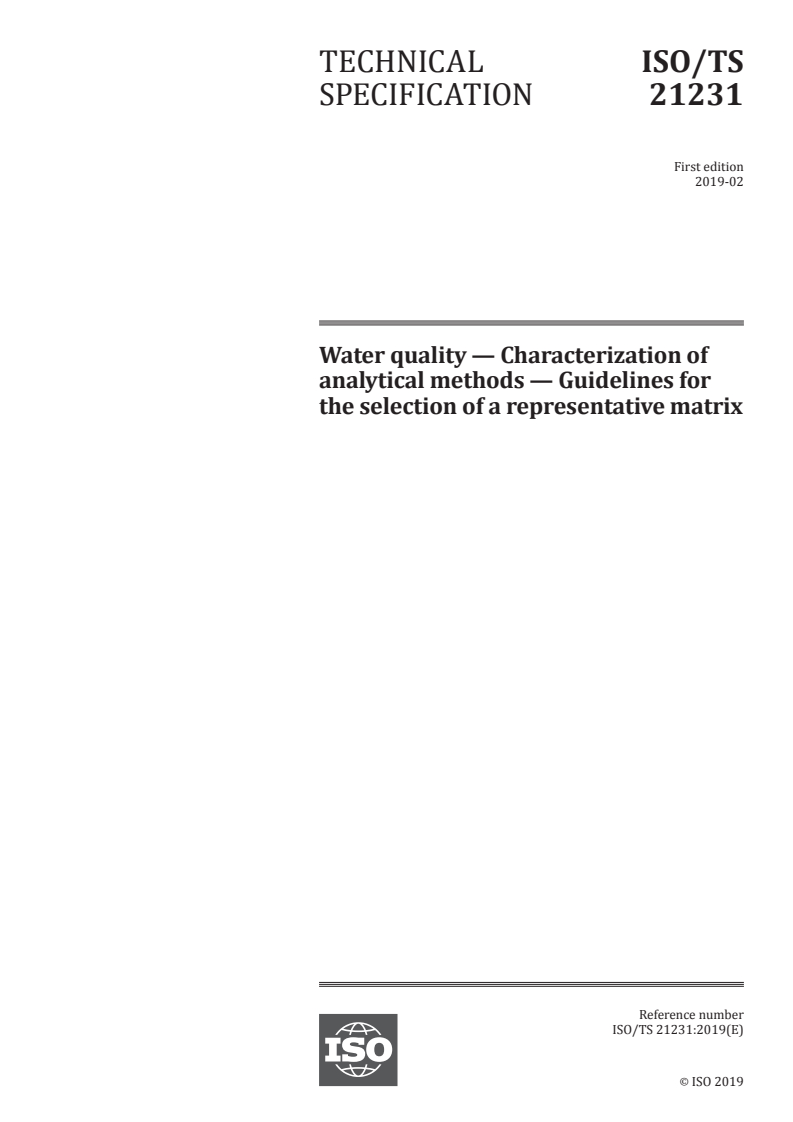
TECHNICAL ISO/TS
SPECIFICATION 21231
First edition
2019-02
Water quality — Characterization of
analytical methods — Guidelines for
the selection of a representative matrix
Reference number
©
ISO 2019
© ISO 2019
All rights reserved. Unless otherwise specified, or required in the context of its implementation, no part of this publication may
be reproduced or utilized otherwise in any form or by any means, electronic or mechanical, including photocopying, or posting
on the internet or an intranet, without prior written permission. Permission can be requested from either ISO at the address
below or ISO’s member body in the country of the requester.
ISO copyright office
CP 401 • Ch. de Blandonnet 8
CH-1214 Vernier, Geneva
Phone: +41 22 749 01 11
Fax: +41 22 749 09 47
Email: copyright@iso.org
Website: www.iso.org
Published in Switzerland
ii © ISO 2019 – All rights reserved
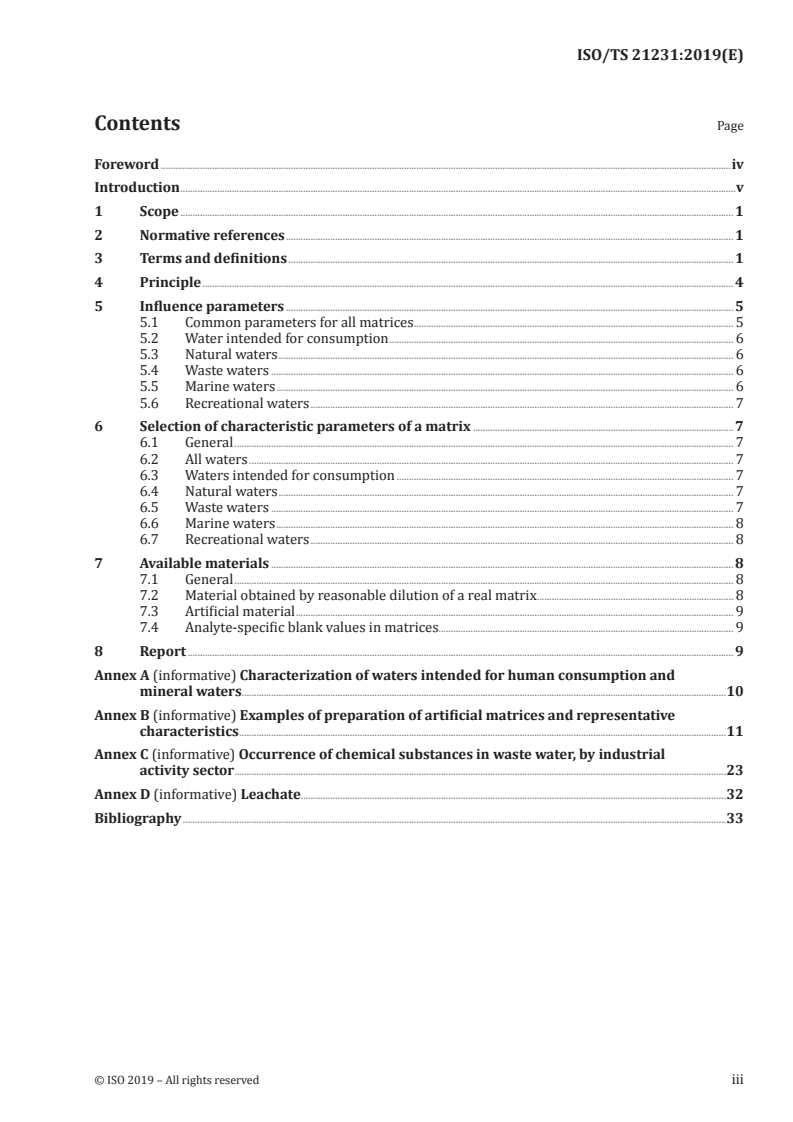
Contents Page
Foreword .iv
Introduction .v
1 Scope . 1
2 Normative references . 1
3 Terms and definitions . 1
4 Principle . 4
5 Influence parameters . 5
5.1 Common parameters for all matrices . 5
5.2 Water intended for consumption . 6
5.3 Natural waters . 6
5.4 Waste waters . 6
5.5 Marine waters . 6
5.6 Recreational waters . 7
6 Selection of characteristic parameters of a matrix . 7
6.1 General . 7
6.2 All waters . 7
6.3 Waters intended for consumption . 7
6.4 Natural waters . 7
6.5 Waste waters . 7
6.6 Marine waters . 8
6.7 Recreational waters . 8
7 Available materials . 8
7.1 General . 8
7.2 Material obtained by reasonable dilution of a real matrix . 8
7.3 Artificial material . 9
7.4 Analyte-specific blank values in matrices. 9
8 Report . 9
Annex A (informative) Characterization of waters intended for human consumption and
mineral waters .10
Annex B (informative) Examples of preparation of artificial matrices and representative
characteristics .11
Annex C (informative) Occurrence of chemical substances in waste water, by industrial
activity sector .23
Annex D (informative) Leachate .32
Bibliography .33
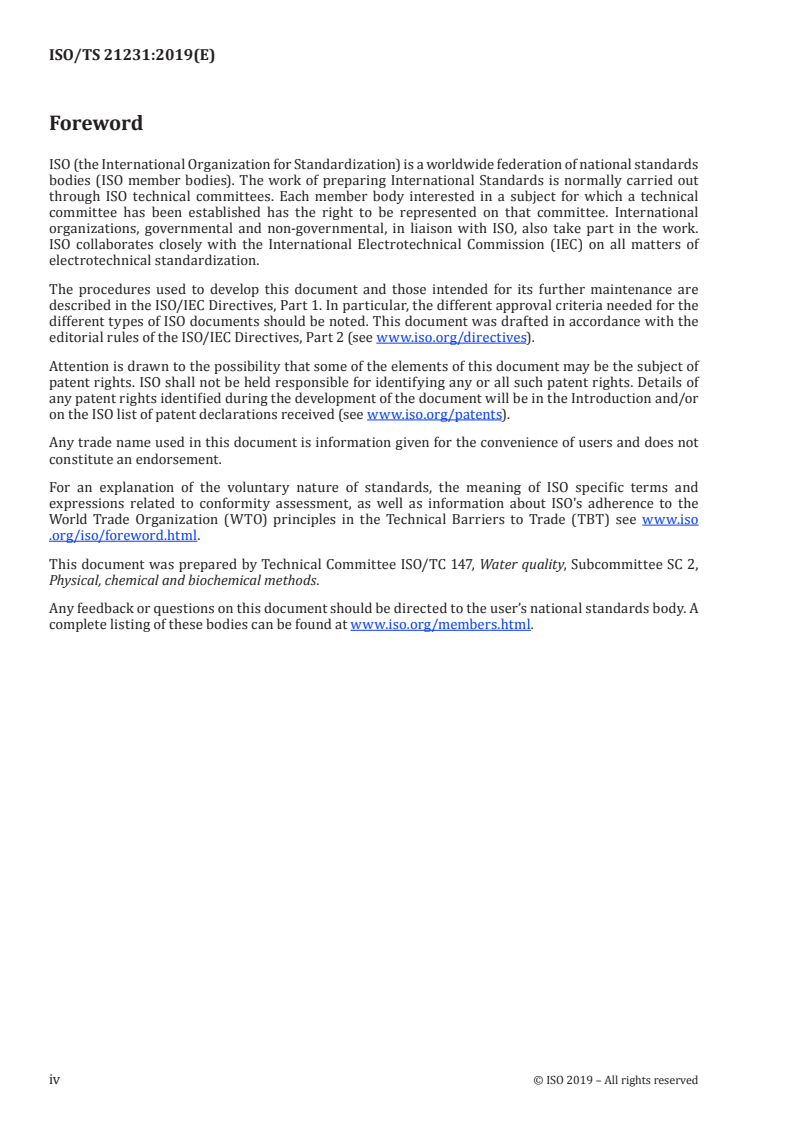
Foreword
ISO (the International Organization for Standardization) is a worldwide federation of national standards
bodies (ISO member bodies). The work of preparing International Standards is normally carried out
through ISO technical committees. Each member body interested in a subject for which a technical
committee has been established has the right to be represented on that committee. International
organizations, governmental and non-governmental, in liaison with ISO, also take part in the work.
ISO collaborates closely with the International Electrotechnical Commission (IEC) on all matters of
electrotechnical standardization.
The procedures used to develop this document and those intended for its further maintenance are
described in the ISO/IEC Directives, Part 1. In particular, the different approval criteria needed for the
different types of ISO documents should be noted. This document was drafted in accordance with the
editorial rules of the ISO/IEC Directives, Part 2 (see www .iso .org/directives).
Attention is drawn to the possibility that some of the elements of this document may be the subject of
patent rights. ISO shall not be held responsible for identifying any or all such patent rights. Details of
any patent rights identified during the development of the document will be in the Introduction and/or
on the ISO list of patent declarations received (see www .iso .org/patents).
Any trade name used in this document is information given for the convenience of users and does not
constitute an endorsement.
For an explanation of the voluntary nature of standards, the meaning of ISO specific terms and
expressions related to conformity assessment, as well as information about ISO's adherence to the
World Trade Organization (WTO) principles in the Technical Barriers to Trade (TBT) see www .iso
.org/iso/foreword .html.
This document was prepared by Technical Committee ISO/TC 147, Water quality, Subcommittee SC 2,
Physical, chemical and biochemical methods.
Any feedback or questions on this document should be directed to the user’s national standards body. A
complete listing of these bodies can be found at www .iso .org/members .html.
iv © ISO 2019 – All rights reserved
Introduction
This document has been prepared for the validation of analytical methods applied to the water quality
field. It enables a laboratory to determine the characteristics of a material suitable for determination of
the performances of an analytical method itself.
It is not intended to provide an exhaustive inventory of all published recipes, but to propose a selection
of recipes supporting the characterization of the performances of analytical methods used by a
laboratory. For this reason, a restricted number of recipes are proposed. References giving access to
other recipes are available in the Bibliography.
This document includes four recipes for preparing marine waters and five recipes for waste waters
with controlled characteristics.
TECHNICAL SPECIFICATION ISO/TS 21231:2019(E)
Water quality — Characterization of analytical methods —
Guidelines for the selection of a representative matrix
1 Scope
This document specifies representative materials suitable for the determination of the performance
characteristics, including uncertainty, during the initial assessment of a quantitative method, used in a
laboratory, for physico-chemical water analysis.
This document focuses on five main types of water:
— waters intended for consumption (5.2);
— natural waters (5.3);
— waste waters (5.4);
— marine waters (5.5);
— recreational waters (5.6).
NOTE Other more specific or less common types of water can be incorporated in any of the above types
provided appropriate justifications. The characteristics of the standard matrix are compatible with the
characteristics of the samples handled.
2 Normative references
The following documents are referred to in the text in such a way that some or all of their content
constitutes requirements of this document. For dated references, only the edition cited applies. For
undated references, the latest edition of the referenced document (including any amendments) applies.
ISO 5667-3, Water quality — Sampling — Part 3: Preservation and handling of water samples
ISO 6107 (all parts), Water quality — Vocabulary
3 Terms and definitions
For the purposes of this document, the terms and definitions given in ISO 6107 (all parts) and the
following apply.
ISO and IEC maintain terminological databases for use in standardization at the following addresses:
— ISO Online browsing platform: available at https: //www .iso .org/obp
— IEC Electropedia: available at http: //www .electropedia .org/
3.1 General vocabulary
3.1.1
matrix
set of constituents of the test sample, except the analyte (3.2.1)
Note 1 to entry: By extension, a matrix defines a group of waters characterized by similar analytical behaviour in
relation to the analytical method used.
3.1.2
accepted reference value
value that serves as an agreed-upon reference for comparison, and which is derived as:
a) a theoretical or established value, based on scientific principles;
b) an assigned or certified value, based on experimental work of some national or international
organization;
c) a consensus or certified value, based on collaborative experimental work under the auspices of a
scientific or engineering group;
d) when a), b) and c) are not available, the expectation of the (measurable) quantity, i.e. the mean of a
specified population of measurements
Note 1 to entry: In the specific context of this document, the accepted reference value (or conventionally true
value) of the sample is provided according to possibilities by:
— the value from a certified reference material certificate,
— the consensus value obtained from an inter-laboratory comparison,
— the arithmetic mean of the repeated measurement values according to the reference method,
— the target value by adding analyte to a representative matrix of the scope in question.
[SOURCE: ISO 5725-1:1994, 3.5]
3.1.3
reference material
material, sufficiently homogeneous and stable with respect to one or more specified properties, which
has been established to be fit for its intended use in a measurement process
[SOURCE: ISO Guide 35:2017, 3.1]
3.1.4
certified reference material
reference material (3.1.3), accompanied by a certificate, one or more of whose property values are
certified by a procedure which establishes traceability to an accurate realization of the unit in which
the property values are expressed, and for which each certified value is accompanied by an uncertainty
at a stated level of confidence
[SOURCE: ISO/TS 13530:2009, 3.2.7]
3.1.5
assessment procedure
procedure related to the establishment of the specifications for the performance of a new method and/
or experimental verification that a method meets theoretically derived quality criteria
3.2 Terms related to analytical methods
3.2.1
analyte
subject of the analytical method
3.2.2
analytical method
unambiguously written procedure describing all details required to carry out the analysis of the analyte
(3.2.1), namely: scope and field of application, principle and/or reactions, definitions, reagents, apparatus,
analytical procedures, calculations and presentation of results, performance data and test report
[SOURCE: ISO/TS 16489:2006, 3.3]
2 © ISO 2019 – All rights reserved
3.2.3
quantitative analytical method
analytical method for measuring the quantity of analyte (3.2.1)contained in the test sample
Note 1 to entry: The result can consist of a quantity in a given quantity of test sample.
3.2.4
limit of detection
output signal or value above which it can be affirmed, with a stated level of confidence, for example
95 %, that a sample is different from a blank sample containing no determinand of interest, and which
could be estimated by different means and shall be verified in the intended matrix
[SOURCE: ISO 6107-2:2006, 60, modified — “and which could be estimated by different means and shall
be verified in the intended matrix” has been added.]
3.2.5
limit of quantification
LOQ
lowest value of a determinand that can be determined with an acceptable level of accuracy, which could
be estimated by different means and shall be verified in the intended matrix
Note 1 to entry: For each matrix, this limit is related to the pair [analyte (3.2.1), method].
3.2.6
reasonable dilution
dilution conditions for reducing the concentration of a substance in a matrix without substantially
modifying the intrinsic characteristics of the matrix
3.2.7
matrix blank values
values of a given parameter obtained using a test conducted on a matrix giving rise to a result below the
limit of detection (3.2.4) for the analyte (3.2.1) in question
3.2.8
scope of the analytical method
combination of the various types of matrix and the analyte (3.2.1) concentration range covered, to
which the analytical method applies
Note 1 to entry: In addition to an indication of all the satisfactory performance conditions for each factor, the
scope of the analytical method may also include warnings in respect of known interferences from other analytes,
or inapplicability to some matrices or conditions.
3.3 Terms related to matrix
3.3.1
influence parameter
intrinsic characteristic of the matrix, independent of the analyte (3.2.1) concentration, a variation of
which is liable to modify the analytical result
3.3.2
representative matrix
sample for which all the intrinsic characteristics are characteristic of a type of water or the source of a
group of samples
3.3.3
salinity
mass in grams of solid substances contained in one kilogram of sea water, when the bromide and iodide
ions are replaced by their chloride equivalent, carbonates converted into oxides and all the organic
matter oxidized
3.3.4
leachate
water which has percolated through tipped refuse or other specified permeable material
Note 1 to entry: See Annex D.
[SOURCE: ISO 6107-7:2006, 23]
4 Principle
The purpose of this document is to specify the concept of a representative matrix and its characteristics
with a view to studying the performance of an analytical method.
For each analyte under test, the scope of an analytical method includes all the matrices under test,
their descriptive parameters, and the concentration ranges of the influence parameters for which the
method is applicable. The laboratory should define its requirements beforehand in respect of the scope
of the analytical method, selecting the materials most in line with requirements.
WARNING — The definition of the scope is entirely dependent on the analyst (the validation or
characterization study manager) and their knowledge acquired while developing the method.
It is sometimes preferable to segment a scope rather than seek to validate an overly general
method. In this case, a validation file should be compiled for each scope.
See Figure 1.
4 © ISO 2019 – All rights reserved
Figure 1 — Summary flow chart
5 Influence parameters
5.1 Common parameters for all matrices
The following influence parameters are liable to have an impact on analysis procedures. They shall help
classify the types of water on which the laboratory has validated its method or determined performance
characteristics.
— pH;
— ion composition and/or conductivity;
— salinity;
— dissolved organic carbon (DOC) and/or total organic carbon (TOC);
— colour or turbidity;
— suspended particular matter (SPM) content.
During the validation or characterization study, it is up to the laboratory to:
— define, for its practice, the characteristic ranges associated with each of the above parameters;
— justify, if applicable, the lack of influence thereof on the characterized method;
— complement this list with other characteristic parameters based on the methods and the source of
the samples analysed, using for example Annex A or Annex C.
5.2 Water intended for consumption
Water intended for human and livestock consumption is water considered to be fit for drinking.
Drinking water belongs to this category. It includes groundwater that has been chlorinated in the
resource.
The minimum additional characteristics to be included for this category are:
— disinfectant presence and content (distributed waters or groundwater chlorinated in the resource);
— CO content (natural mineral water), if relevant to subsequent specified analysis requirements.
5.3 Natural waters
Natural waters are waters taken from the natural environment not undergoing to any treatment other
than the addition of reagents for analyte preservation.
Surface waters and groundwater belong to this category. Brackish waters with salinity lower than
30 g/l are incorporated in this category.
Rainwater, which is generally not intended for consumption, are incorporated in this category.
5.4 Waste waters
Waste waters can originate from any combination of household, industrial or commercial activities.
They include collected run-offs and those from any spillage or infiltration from the waste water
collection system, including the contents of storm water tanks or ponds, discharged into collection
systems or into the environment.
NOTE 1 Waste waters can be collected in common systems or in separate systems.
NOTE 2 For the purposes of this document, the definition of waste water also includes untreated sanitary
waters.
NOTE 3 National or local regulations can include lists of substances of concern in relation to sewer discharges.
Annex C gives a list of examples of additional characteristics associated with some sectors of activity.
Some waste waters may have a high salinity.
5.5 Marine waters
Sea water consists of a large number of compounds distributed over the following categories: gases,
particulate matter, colloids, and dissolved elements (see Reference [7]).
6 © ISO 2019 – All rights reserved
The dissolved elements consist of 92 natural chemical elements, approximately two-thirds of which
are present in ultra-trace amounts and are difficult to detect. Sea water is characterized in that the
[8]
relative proportions of its 11 main constituents are substantially constant (Dittmar's law ) within
1 %. Dittmar's law can thus be used to determine the salinity of sea water by measuring only one of its
components.
The average salinity of sea water is 35 g/kg. It is generally between 30 g/kg (North Atlantic) and 40 g/
kg (Red Sea) but exhibits extreme values in closed or semi-closed seas (6 g/kg in the Baltic Sea, 330 g/
kg in the Dead Sea). The pH of sea water is approximately 8,2.
5.6 Recreational waters
Recreational waters are bathing, swimming pool, thermal bath and spa waters. They may be sourced
from natural waters or waters intended for human consumption and are characterized, in addition to
the influence parameters defined in 5.2, by the potential presence of specific disinfection products and
by-products, and the potential presence of sulfur compounds.
6 Selection of characteristic parameters of a matrix
6.1 General
For the purposes of characterization of the applicability and the performances of an analytical method
to a matrix, the laboratory shall describe the limits of the ranges associated with the characteristic
parameters discussed in this clause.
6.2 All waters
The parameters are those defined in 5.1.
6.3 Waters intended for consumption
In addition to the characteristics listed in 5.1, waters intended for consumption are characterized by:
— their free and total chlorine content;
— the nature and content of disinfection reagents and by-products;
— their CO content, if relevant.
Refer to Annex A for more detailed characterization of waters intended for human consumption.
6.4 Natural waters
In addition to the characteristics listed in 5.1, natural waters are characterized by:
— the sampling location, including the sampling depth;
— the identified surrounding anthropic pressures.
In the case of groundwater used as drinking water resources, which are treated in situ, free and total
chlorine content should be verified.
6.5 Waste waters
In addition to the characteristics listed in 5.1, waste waters are characterized by:
— the original activity sector (see Annex C);
— the connected activity sectors in the case of municipal waste water treatment plants (MWWTP)
discharges.
6.6 Marine waters
In addition to the characteristics listed in 5.1, marine waters are characterized by:
— the sampling location, including sampling depth;
— their salinity.
6.7 Recreational waters
In addition to the characteristics listed in 5.1, recreational waters are characterized by:
— the sampling location;
— the nature and content of disinfection reagents and by products.
7 Available materials
7.1 General
The laboratory shall select study matrices for one or more of the above water types from, in order of
preference:
— reference materials if the matrix is sufficiently characterized;
— supernumerary material from interlaboratory tests if stable and sufficiently characterized;
— material obtained by spiking with the real matrix free from the analytes of interest;
— material obtained by spiking a reasonable dilution of a real matrix, after adjusting the characteristics
modified by the dilution;
— material obtained by spiking of an artificial matrix based on a recipe (see Annex B).
At least three different representative samples of each water type should be studied to provide a
realistic evaluation of performance of the method on the selected water type. Wherever possible, the
method performances shall be characterized on a non-artificial sample.
7.2 Material obtained by reasonable dilution of a real matrix
When the laboratory cannot select a real matrix free from analyte(s) of interest, but it is possible to
select a real matrix containing the analyte(s) of interest at a concentration lower than 10× the limit
of quantification (LOQ) defined for the method under examination, a representative matrix can be
prepared by diluting the low-concentration real matrix, so as to lower the concentration of analyte(s) of
interest to less than the LOQ defined for the method.
The dilution factor, f, shall be lower than 10. For this dilution, a water free from analyte(s) of interest
having a similar composition to the chosen matrix (major elements and influence factors) shall be used.
Before dilution, the selected matrix shall be characterized on the basis of the influence parameters
chosen for the study. After dilution, these parameters shall be readjusted if required using solid state
reagents or stock solutions of solid state reagents so that the value of each influence parameter remains
within the scope defined by the laboratory.
8 © ISO 2019 – All rights reserved
7.3 Artificial material
Artificial materials can be prepared according to Annex B, after adjusting the influence parameters
selected based on a bibliographic study, and/or on Annex C, within the concentration range defining the
scope of the method.
7.4 Analyte-specific blank values in matrices
For some analytes, such as heavy metals, no analyte-free natural or artificial matrix can be obtained.
After proper justification, the laboratory should study LOQ as follows.
— Determine LOQ on ultrapure water.
MQ
— Calculate LOQ by correcting LOQ using the recovery of the analyte in the intended matric,
water i MQ
i.e. water by using Formula (1):
LOQ
MQ
LOQ = (1)
water i
ρ
water i
where
LOQ is the LOQ of the method for the analyte in water type i;
water i
LOQ is the LOQ of the method for the analyte in ultra pure water;
MQ
is the mean recovery of the method for the analyte in water type i.
ρ
water i
8 Report
The quantitative analytical method assessment report, for a given matrix, shall include, in addition to
the information requested by the assessment procedure:
a) the name of the tested matrix according to the typology defined in Clause 5;
b) the characteristic parameters of the matrix according to Clause 6 and the associated representative
ranges (scope);
c) the influence parameters tested, the justification for their selection and the representative
contents;
d) the source of the matrix and, if applicable, its preparation method.
Annex A
(informative)
Characterization of waters intended for human consumption and
mineral waters
Water intended for human consumption produced, is generally characterized by:
— the absence of suspended solids;
— a relatively low organic content (TOC < 4 mg/ l);
— a conductivity at 25 °C between 50 µS/cm and 1 100 µS/cm and
— a pH between 6 and 9.
Waters sampled during the production cycle, or at distribution point, often show traces of oxidants
used to disinfect resource water, usually chlorine, chlorine dioxide or ozone at levels between 0,2 mg/l
and 2 mg/l. Depending on the parameters to be analysed, it may be necessary to eliminate these
traces of oxidants by a neutralizing agent, usually sodium thiosulfate pentahydrate added to reach a
concentration between 20 mg/l and 200 mg/l.
The oxidant addition may also generate disinfection by-products, mainly trihalomethanes, bromates,
chlorates.
Mineral waters show generally the same figures, without addition of oxidant, but some of them are also
characterized by:
— high mineralization level (higher than 2 g/l);
— presence of carbon dioxide (sparkling waters), or
— presence of sulfides (thermal waters).
To select a representative model water for the validation of a method dedicated to the analysis of water
intended for human consumption, the data listed above, and, where their presence might influence
on the analytical protocol, the presence of ions representative of the catchment zone, nature and
concentration, according to the geological characteristics thereof is taken into account.
10 © ISO 2019 – All rights reserved
Annex B
(informative)
Examples of preparation of artificial matrices and representative
characteristics
B.1 Overview
This annex gives examples of formulae that may be used to prepare various water types in a reproducible
manner, to be used for the validation of analytical method.
NOTE In case of use for quality control (QC), suitable procedure for homogeneity and stability checking can
[19]
be found, if necessary, in ISO Guide 80 .
B.2 Equipment
B.2.1 Balance accurate to 1/10 mg.
B.2.2 Common laboratory glassware.
B.2.3 Non-actinic glassware for storage of stock solutions.
B.2.4 Flask with screw cap, for degassing beer.
B.2.5 Laboratory mixer, comprising an inert container and a lid, for waste water preparations.
B.3 Reagents
All reagents used for a formula should be of sufficient quality (at least “analysis quality”). Unless
otherwise indicated, water compliant to ISO 3696 shall be used to implement these formulae.
Some reagents are specific to one of the formulae.
B.3.1 Boric acid, H BO , anhydrous.
2 3
B.3.2 Nitric acid, HNO , c(HNO ) = 15,8 mol/l, ρ = 1,4 kg.
3 3
B.3.3 Ammonium chloride, NH Cl, anhydrous.
B.3.4 Potassium bromide, KBr, anhydrous.
B.3.5 Aluminium chloride hexahydrate, AlCl ·6H O.
3 2
B.3.6 Magnesium chloride hexahydrate, MgCl ·6H 0.
2 2
B.3.7 Anhydrous calcium chloride, CaCl .
B.3.8 Strontium chloride hexahydrate, SrCl ·6H 0.
2 2
B.3.9 Potassium chloride, KCl, anhydrous.
B.3.10 Sodium chloride, NaCl, anhydrous.
B.3.11 Sodium fluoride, NaF, anhydrous.
B.3.12 Sodium hydroxide, NaOH, solution 0,10 mol/l.
B.3.13 Sodium hydrogen carbonate, NaHCO , anhydrous.
B.3.14 Barium nitrate, Ba(NO ) , anhydrous.
3 2
B.3.15 Manganese nitrate hexahydrate, Mn(NO ) ·6H O.
3 2 2
B.3.16 Copper nitrate trihydrate, Cu(NO ) ·3H O.
3 2 2
B.3.17 Zinc nitrate hexahydrate, Zn(NO ) ·6H O.
3 2 2
B.3.18 Lead nitrate, Pb(NO ) , anhydrous.
3 2
B.3.19 Potassium acid phosphate, (KH PO ), anhydrous.
2 4
B.3.20 Sodium sulfate, Na SO , anhydrous.
2 4
B.3.21 Ferric sulfate, Fe(SO ) , anhydrous.
4 3
B.3.22 Magnesium sulfate, Mg SO , anhydrous.
2 4
B.3.23 Urea, (NH ) CO.
3 2
B.3.24 Kaolin.
Argillaceous rock containing kaolinite, hydrous aluminium silicate (2SiO , Al O , 2H O). This rock is
2 2 3 2
friable, impermeable and refractory.
B.3.25 Degassed beer. Industrially produced commercial drink, obtained by fermenting a mixture of
cereal grains, malt and hops. “Low-calorie” quality (<1 180 J/ml).
Transfer the beer into a closed container with capacity 20 % greater than the quantity of beer to be
degassed. Close, shake vigorously, then release the pressure by slightly loosening the cap. Leave to rest
in the refrigerator for 24 h.
Bring to ambient temperature before use.
B.3.26 Microcrystalline cellulose, dried to constant mass at 105 °C and kept in a desiccator.
B.3.27 Dry salt for marine aquarium.
A commercial mixture of mineral salts for marine aquariums, such as sold in pet shops for example,
dried to constant mass at 105 °C and kept in a desiccator.
B.3.28 Yeast, Saccharomyces cerevisiae, also called baker's yeast, fresh.
12 © ISO 2019 – All rights reserved
B.3.29 Peptone.
An animal protein digestate used in the preparation of biological culture media, containing ≥12 %
nitrogen.
B.4 Marine waters
B.4.1 General
These formulae enable preparation of a solution containing mineral salts in comparable proportions to
a sea water, corresponding to a typical heavy metal-enriched sea water, that is reproducible and usable
when it is necessary to simulate a marine water.
Preparation of stock solutions is required.
B.4.2 Stock solutions
B.4.2.1 Stock solution No. 1
In a 1 l volumetric flask, place 500 ml of water. Dissolve:
MgCl ·6H 0: 555,6 g
2 2
CaCl : 57,9 g
SrCl ·6H O: 2,1 g
2 2
Adjust to 1 l with water. Store in a carefully stoppered amber glass flask.
B.4.2.2 Stock solution No. 2
In a 1 l volumetric flask, place 500 ml of water. Dissolve:
KCl: 69,5 g
NaHCO : 20,1 g
KBr: 10,0 g
H BO : 2,7 g
3 3
NaF: 0,3 g
Adjust to 1 l with water. Store in a carefully stoppered amber glass flask.
B.4.2.3 Stock solution No. 3
In a 1 l volumetric flask, place 500 ml of water. Dissolve:
Ba(NO ) : 0,994 g
3 2
Mn(NO ) ·6H O: 0,546 g
3 2 2
Cu(NO ) ·3H O: 0,396 g
3 2 2
Zn(NO ) ·6H O: 0,151 g
3 2 2
Pb(NO ) : 0,066 g
3 2
Adjust to 1 l with water. Store in a carefully stoppered amber glass flask.
NOTE Larger quantities of stock solutions can be prepared by proportionally adapting the above
formulations.
B.4.3 Preparation
[7], [10]
B.4.3.1 Artificial marine water
In a 1 l volumetric flask, place 800 ml of water. Dissolve:
NaCl: 24,534 g
Anhydrous Na SO : 4,094 g
2 4
Add 20 ml of stock solution No. 1 and 10 ml of stock solution No. 2. Shake vigorously. Adjust to 1 l. Adjust
the pH to 8,2 with a few drops of 0,1 N sodium hydroxide solution (B.3.12).
The artificial marine water thus prepared has the following composition:
Concentration (g/l)
NaCl: 24,534
Na SO : 4,09
2 4
KCl: 0,695
NaHCO : 0,201
KBr: 0,100
H BO : 0,027
3 3
NaF: 0,030
MgCl : 5,20
CaCl : 1,16
SrCl : 0,025
This preparation should be used immediately after preparation.
[11]
B.4.3.2 Heavy metal-enriched artificial marine water
Add 1 ml of stock solution No. 3 to 1 l of artificial marine water (B.4.2.1).
The heavy metal-enriched artificial marine water thus prepared has the following composition:
Concentration (g/l)
NaCl: 24,534
Na SO : 4,09
2 4
KCl: 0,695
NaHCO : 0,201
14 © ISO 2019 – All rights reserved
KBr: 0,100
H BO : 0,027
3 3
NaF: 0,030
MgCl : 5,20
CaCl : 1,16
SrCl : 0,025
Ba(NO ) : 0,000 994
3 2
Mn(NO ) ·6H O: 0,000 546
3 2 2
Cu(NO ) ·3H O: 0,000 396
3 2 2
Zn(NO ) ·6H O: 0,000 151
3 2 2
Pb(NO ) : 0,000 066
3 2
This formula should be used immediately after preparation.
[15]
B.4.3.3 Artificial marine water as per Kester
Dissolve in 750 ml of distilled water:
Compound NaCl Na S0 KCl NaHC0 KBr H BO NaF
2 4 3 3 3
Mass (g) 23,926 4,008 0,677 0,196 0,098 0,026 0,003
Add:
a
Solution Volume (ml)
−1
MgCl ·6 H 0: 1 mol·l 53,27
2 2
−1
CaCl ·2 H 0: 1 mol·l 10,33
2 2
−1
SrCl ·6 H 0: 0,1 mol·l 0,90
2 2
a
Solutions with precise concentrations of silver nitrate.
Make up to 1 kg with distilled water.
This water has a salinity of 35,00 g/kg.
[15], [16]
B.4.3.4 Controlled-salinity artificial marine waters as per Grasshoff
B.4.3.4.1 Artificial marine water as per Grasshoff — Formula 1
Dissolve in 500 ml of distilled water (solution G1a):
Compound NaCl Na S0 KCl NaHC0 KBr H BO NaF
2 4 3 3 3
Mass (g) 23,9 4,0 0,7 0,2 0,1 0,03 0,003
Dissolve in 455 ml of distilled water (solution G1b):
Compound MgCl ·6 H O CaCl ·2H O SrCl ·6H O
2 2 2 2 2 2
Mass (g) 10,8 1,5 0,025
Mix solutions G1a and G1b, measure the salinity of the mixture (S approximately 35).
B.4.3.4.2 Artificial marine water as per Grasshoff — Formula 2
Dissolve in approximately 800 ml of distilled water:
Compound NaCl NaHCO MgS0 ·7 H 0
3 4 2
Mass (g) 32 0,2 14
Make up to 1 l with distilled water: salinity is equal to 34,2 (chlorosity = 19,4 g/l).
B.5 Waste waters
B.5.1 General
Waste waters can have very variable compositions depending on their source. The formulations
suggested below contain compounds in concentrations such as those that can be found in treated
urban waste water discharges. They are not intended to represent all waste waters, but can provide a
laboratory material enabling assessment of the initial performances and performances over time of the
analytical methods on a reproducible and inexpensive material.
If the laboratory wishes to refine the prepared material in order to adapt its representativeness to
certain types of discharges, it may select the relevant substances or interfering substances using the
substance lists provided in Annex C.
[9]
B.5.2 WWTP water
Place approximately 500 ml of water in the container of the mixer. Set the mixing speed to the lowest.
Add in this order:
Microcrystalline cellulose (B.3.26): 0,400 g
Dry salt for marine aquarium (B.3.27): 2,000 g
Kaolin (B.3.24): 0,080 g
Degassed beer (B.3.25): 120,0 ml
Mix for 30 s. Transfer quantitatively to a 2 l volumetric flask and adjust.
16 © ISO 2019 – All rights reserved
This solution may be kept in the refrigerator for 24 h. Preservative additives described in ISO 5667-3
should be added depending on the analytical method to be assessed.
The typical characteristics of this effluent are listed in Tables B.1 and B.2.
B.5.3 Discharge water
B.5.3.1 Source of the formula
This formula has been used by INERIS since 2005 (see Reference [17]). The values have been chosen
regarding applicable national French regulation setting the technical requirements relating to
collection and waste water treatment plans:
— suspended solids are represented by microcrystalline cellulose in the proportion of 250 mg/l;
— the total nitrogen content of 10 mg/l will be obtained using a mixture of urea and ammonium
chloride;
— the total phosphorus content of 1 mg/l will be obtained using KH PO .
2 4
Aluminium and iron are not part of the monitoring of discharge waters and do not appear in the
IOW databases (International Office for Water). On the other hand, they are regularly present in
interlaboratory test materials, for example those supplied by AGLAE (General Association of Analysis
and Testing Laboratories). Based on the study of contents between June 2003 and May 2004, a typical
content of 200 µg/l for each of these is proposed, expressed as total metal, for a given range of:
Al (µg/l): 170 to 775
Fe (µg/l): 130 to 590
As this model is intended for studying the performances of methods in a limited catchment area or
in a specific industrial sector, it is always created based on drill water or water for consumption in
the geographical area concerned; this is why only anthropogenic parameters are adjusted by means of
reagents. Its composition in terms of main elements is to be recorded.
B.5.3.2 Preparation
Place approximately 500 ml of water in the container of the mixer. Set the mixing speed to the lowest.
Add in this order:
Microcrystalline cellulose (B.3.26) 500 mg
Urea (B.3.23) and ammonium chloride (B.3.3) Equiv 20 mg nitrogen each
KH PO (B.3.19) Equiv 2 mg phosphorus
2 4
AlCl ·6H O (B.3.5) Equiv 400 µg aluminium
3 2
Fe(SO ) (B.3.21) Equiv 400 µg iron
4 3
Mix for 30 s. Transfer quantitatively to a 2 l volumetric flask and adjust. Check the characteristic
parameters of the prepared effluent; adjust if necessary using the reagents above.
This solution may be kept in the refrigerator for 24 h. Preservative additives described in ISO 5667-3
should be added depending on the analytical method to be assessed.
The typical characteristics of this effluent are listed in Tables B.1 and B.2.
[12]
B.5.4 Artificial effluent 1
To 1 l of deionized water, add:
Compound Microcrystalline Urea Yeast NaCl K HPO CaCl MgSO
2 4 2 4
cellulose
QS 0,400 g/l 0,03 g/l 0,11 g/l 0,007 g/l 0,028 g/l 0,028 g/l 0,028 g/l
Mix and check the characteristic parameters of the prepared effluent; adjust if necessary using the
reagents above.
The typical characteristics of this effluent are listed in Tables B.1 and B.2.
This solution should be prepared daily. Preservative additives described in ISO 5667-3 should be added
depending on the analytical method to be assessed.
[11]
B.5.5 Artificial effluent 2
To 1 l of deionized water, add:
Compound Peptone Urea Yeast NaCl K HPO CaCl MgSO
2 4 2 4
QS 0,16 g/l 0,03 g/l 0,11 g/l 0,007 g/l 0,028 g/l 0,028 g/l 0,028 g/l
1)
NOTE 0,9 ml of the food product Viandox® can replace the peptone. Before dilution, it has the following
+ 3-
characteristics: COD: 260 g/l, BOD: 155 g/l, Kjeldahl nitrogen: 26 g/l, NH : 7 g/l PO : 3,6 g/l (see References [12]
4 4
and [14]).
The typi
...
TECHNICAL ISO/TS
SPECIFICATION 21231
First edition
2019-02
Water quality — Characterization of
analytical methods — Guidelines for
the selection of a representative matrix
Reference number
©
ISO 2019
© ISO 2019
All rights reserved. Unless otherwise specified, or required in the context of its implementation, no part of this publication may
be reproduced or utilized otherwise in any form or by any means, electronic or mechanical, including photocopying, or posting
on the internet or an intranet, without prior written permission. Permission can be requested from either ISO at the address
below or ISO’s member body in the country of the requester.
ISO copyright office
CP 401 • Ch. de Blandonnet 8
CH-1214 Vernier, Geneva
Phone: +41 22 749 01 11
Fax: +41 22 749 09 47
Email: copyright@iso.org
Website: www.iso.org
Published in Switzerland
ii © ISO 2019 – All rights reserved
Contents Page
Foreword .iv
Introduction .v
1 Scope . 1
2 Normative references . 1
3 Terms and definitions . 1
4 Principle . 4
5 Influence parameters . 5
5.1 Common parameters for all matrices . 5
5.2 Water intended for consumption . 6
5.3 Natural waters . 6
5.4 Waste waters . 6
5.5 Marine waters . 6
5.6 Recreational waters . 7
6 Selection of characteristic parameters of a matrix . 7
6.1 General . 7
6.2 All waters . 7
6.3 Waters intended for consumption . 7
6.4 Natural waters . 7
6.5 Waste waters . 7
6.6 Marine waters . 8
6.7 Recreational waters . 8
7 Available materials . 8
7.1 General . 8
7.2 Material obtained by reasonable dilution of a real matrix . 8
7.3 Artificial material . 9
7.4 Analyte-specific blank values in matrices. 9
8 Report . 9
Annex A (informative) Characterization of waters intended for human consumption and
mineral waters .10
Annex B (informative) Examples of preparation of artificial matrices and representative
characteristics .11
Annex C (informative) Occurrence of chemical substances in waste water, by industrial
activity sector .23
Annex D (informative) Leachate .32
Bibliography .33
Foreword
ISO (the International Organization for Standardization) is a worldwide federation of national standards
bodies (ISO member bodies). The work of preparing International Standards is normally carried out
through ISO technical committees. Each member body interested in a subject for which a technical
committee has been established has the right to be represented on that committee. International
organizations, governmental and non-governmental, in liaison with ISO, also take part in the work.
ISO collaborates closely with the International Electrotechnical Commission (IEC) on all matters of
electrotechnical standardization.
The procedures used to develop this document and those intended for its further maintenance are
described in the ISO/IEC Directives, Part 1. In particular, the different approval criteria needed for the
different types of ISO documents should be noted. This document was drafted in accordance with the
editorial rules of the ISO/IEC Directives, Part 2 (see www .iso .org/directives).
Attention is drawn to the possibility that some of the elements of this document may be the subject of
patent rights. ISO shall not be held responsible for identifying any or all such patent rights. Details of
any patent rights identified during the development of the document will be in the Introduction and/or
on the ISO list of patent declarations received (see www .iso .org/patents).
Any trade name used in this document is information given for the convenience of users and does not
constitute an endorsement.
For an explanation of the voluntary nature of standards, the meaning of ISO specific terms and
expressions related to conformity assessment, as well as information about ISO's adherence to the
World Trade Organization (WTO) principles in the Technical Barriers to Trade (TBT) see www .iso
.org/iso/foreword .html.
This document was prepared by Technical Committee ISO/TC 147, Water quality, Subcommittee SC 2,
Physical, chemical and biochemical methods.
Any feedback or questions on this document should be directed to the user’s national standards body. A
complete listing of these bodies can be found at www .iso .org/members .html.
iv © ISO 2019 – All rights reserved
Introduction
This document has been prepared for the validation of analytical methods applied to the water quality
field. It enables a laboratory to determine the characteristics of a material suitable for determination of
the performances of an analytical method itself.
It is not intended to provide an exhaustive inventory of all published recipes, but to propose a selection
of recipes supporting the characterization of the performances of analytical methods used by a
laboratory. For this reason, a restricted number of recipes are proposed. References giving access to
other recipes are available in the Bibliography.
This document includes four recipes for preparing marine waters and five recipes for waste waters
with controlled characteristics.
TECHNICAL SPECIFICATION ISO/TS 21231:2019(E)
Water quality — Characterization of analytical methods —
Guidelines for the selection of a representative matrix
1 Scope
This document specifies representative materials suitable for the determination of the performance
characteristics, including uncertainty, during the initial assessment of a quantitative method, used in a
laboratory, for physico-chemical water analysis.
This document focuses on five main types of water:
— waters intended for consumption (5.2);
— natural waters (5.3);
— waste waters (5.4);
— marine waters (5.5);
— recreational waters (5.6).
NOTE Other more specific or less common types of water can be incorporated in any of the above types
provided appropriate justifications. The characteristics of the standard matrix are compatible with the
characteristics of the samples handled.
2 Normative references
The following documents are referred to in the text in such a way that some or all of their content
constitutes requirements of this document. For dated references, only the edition cited applies. For
undated references, the latest edition of the referenced document (including any amendments) applies.
ISO 5667-3, Water quality — Sampling — Part 3: Preservation and handling of water samples
ISO 6107 (all parts), Water quality — Vocabulary
3 Terms and definitions
For the purposes of this document, the terms and definitions given in ISO 6107 (all parts) and the
following apply.
ISO and IEC maintain terminological databases for use in standardization at the following addresses:
— ISO Online browsing platform: available at https: //www .iso .org/obp
— IEC Electropedia: available at http: //www .electropedia .org/
3.1 General vocabulary
3.1.1
matrix
set of constituents of the test sample, except the analyte (3.2.1)
Note 1 to entry: By extension, a matrix defines a group of waters characterized by similar analytical behaviour in
relation to the analytical method used.
3.1.2
accepted reference value
value that serves as an agreed-upon reference for comparison, and which is derived as:
a) a theoretical or established value, based on scientific principles;
b) an assigned or certified value, based on experimental work of some national or international
organization;
c) a consensus or certified value, based on collaborative experimental work under the auspices of a
scientific or engineering group;
d) when a), b) and c) are not available, the expectation of the (measurable) quantity, i.e. the mean of a
specified population of measurements
Note 1 to entry: In the specific context of this document, the accepted reference value (or conventionally true
value) of the sample is provided according to possibilities by:
— the value from a certified reference material certificate,
— the consensus value obtained from an inter-laboratory comparison,
— the arithmetic mean of the repeated measurement values according to the reference method,
— the target value by adding analyte to a representative matrix of the scope in question.
[SOURCE: ISO 5725-1:1994, 3.5]
3.1.3
reference material
material, sufficiently homogeneous and stable with respect to one or more specified properties, which
has been established to be fit for its intended use in a measurement process
[SOURCE: ISO Guide 35:2017, 3.1]
3.1.4
certified reference material
reference material (3.1.3), accompanied by a certificate, one or more of whose property values are
certified by a procedure which establishes traceability to an accurate realization of the unit in which
the property values are expressed, and for which each certified value is accompanied by an uncertainty
at a stated level of confidence
[SOURCE: ISO/TS 13530:2009, 3.2.7]
3.1.5
assessment procedure
procedure related to the establishment of the specifications for the performance of a new method and/
or experimental verification that a method meets theoretically derived quality criteria
3.2 Terms related to analytical methods
3.2.1
analyte
subject of the analytical method
3.2.2
analytical method
unambiguously written procedure describing all details required to carry out the analysis of the analyte
(3.2.1), namely: scope and field of application, principle and/or reactions, definitions, reagents, apparatus,
analytical procedures, calculations and presentation of results, performance data and test report
[SOURCE: ISO/TS 16489:2006, 3.3]
2 © ISO 2019 – All rights reserved
3.2.3
quantitative analytical method
analytical method for measuring the quantity of analyte (3.2.1)contained in the test sample
Note 1 to entry: The result can consist of a quantity in a given quantity of test sample.
3.2.4
limit of detection
output signal or value above which it can be affirmed, with a stated level of confidence, for example
95 %, that a sample is different from a blank sample containing no determinand of interest, and which
could be estimated by different means and shall be verified in the intended matrix
[SOURCE: ISO 6107-2:2006, 60, modified — “and which could be estimated by different means and shall
be verified in the intended matrix” has been added.]
3.2.5
limit of quantification
LOQ
lowest value of a determinand that can be determined with an acceptable level of accuracy, which could
be estimated by different means and shall be verified in the intended matrix
Note 1 to entry: For each matrix, this limit is related to the pair [analyte (3.2.1), method].
3.2.6
reasonable dilution
dilution conditions for reducing the concentration of a substance in a matrix without substantially
modifying the intrinsic characteristics of the matrix
3.2.7
matrix blank values
values of a given parameter obtained using a test conducted on a matrix giving rise to a result below the
limit of detection (3.2.4) for the analyte (3.2.1) in question
3.2.8
scope of the analytical method
combination of the various types of matrix and the analyte (3.2.1) concentration range covered, to
which the analytical method applies
Note 1 to entry: In addition to an indication of all the satisfactory performance conditions for each factor, the
scope of the analytical method may also include warnings in respect of known interferences from other analytes,
or inapplicability to some matrices or conditions.
3.3 Terms related to matrix
3.3.1
influence parameter
intrinsic characteristic of the matrix, independent of the analyte (3.2.1) concentration, a variation of
which is liable to modify the analytical result
3.3.2
representative matrix
sample for which all the intrinsic characteristics are characteristic of a type of water or the source of a
group of samples
3.3.3
salinity
mass in grams of solid substances contained in one kilogram of sea water, when the bromide and iodide
ions are replaced by their chloride equivalent, carbonates converted into oxides and all the organic
matter oxidized
3.3.4
leachate
water which has percolated through tipped refuse or other specified permeable material
Note 1 to entry: See Annex D.
[SOURCE: ISO 6107-7:2006, 23]
4 Principle
The purpose of this document is to specify the concept of a representative matrix and its characteristics
with a view to studying the performance of an analytical method.
For each analyte under test, the scope of an analytical method includes all the matrices under test,
their descriptive parameters, and the concentration ranges of the influence parameters for which the
method is applicable. The laboratory should define its requirements beforehand in respect of the scope
of the analytical method, selecting the materials most in line with requirements.
WARNING — The definition of the scope is entirely dependent on the analyst (the validation or
characterization study manager) and their knowledge acquired while developing the method.
It is sometimes preferable to segment a scope rather than seek to validate an overly general
method. In this case, a validation file should be compiled for each scope.
See Figure 1.
4 © ISO 2019 – All rights reserved
Figure 1 — Summary flow chart
5 Influence parameters
5.1 Common parameters for all matrices
The following influence parameters are liable to have an impact on analysis procedures. They shall help
classify the types of water on which the laboratory has validated its method or determined performance
characteristics.
— pH;
— ion composition and/or conductivity;
— salinity;
— dissolved organic carbon (DOC) and/or total organic carbon (TOC);
— colour or turbidity;
— suspended particular matter (SPM) content.
During the validation or characterization study, it is up to the laboratory to:
— define, for its practice, the characteristic ranges associated with each of the above parameters;
— justify, if applicable, the lack of influence thereof on the characterized method;
— complement this list with other characteristic parameters based on the methods and the source of
the samples analysed, using for example Annex A or Annex C.
5.2 Water intended for consumption
Water intended for human and livestock consumption is water considered to be fit for drinking.
Drinking water belongs to this category. It includes groundwater that has been chlorinated in the
resource.
The minimum additional characteristics to be included for this category are:
— disinfectant presence and content (distributed waters or groundwater chlorinated in the resource);
— CO content (natural mineral water), if relevant to subsequent specified analysis requirements.
5.3 Natural waters
Natural waters are waters taken from the natural environment not undergoing to any treatment other
than the addition of reagents for analyte preservation.
Surface waters and groundwater belong to this category. Brackish waters with salinity lower than
30 g/l are incorporated in this category.
Rainwater, which is generally not intended for consumption, are incorporated in this category.
5.4 Waste waters
Waste waters can originate from any combination of household, industrial or commercial activities.
They include collected run-offs and those from any spillage or infiltration from the waste water
collection system, including the contents of storm water tanks or ponds, discharged into collection
systems or into the environment.
NOTE 1 Waste waters can be collected in common systems or in separate systems.
NOTE 2 For the purposes of this document, the definition of waste water also includes untreated sanitary
waters.
NOTE 3 National or local regulations can include lists of substances of concern in relation to sewer discharges.
Annex C gives a list of examples of additional characteristics associated with some sectors of activity.
Some waste waters may have a high salinity.
5.5 Marine waters
Sea water consists of a large number of compounds distributed over the following categories: gases,
particulate matter, colloids, and dissolved elements (see Reference [7]).
6 © ISO 2019 – All rights reserved
The dissolved elements consist of 92 natural chemical elements, approximately two-thirds of which
are present in ultra-trace amounts and are difficult to detect. Sea water is characterized in that the
[8]
relative proportions of its 11 main constituents are substantially constant (Dittmar's law ) within
1 %. Dittmar's law can thus be used to determine the salinity of sea water by measuring only one of its
components.
The average salinity of sea water is 35 g/kg. It is generally between 30 g/kg (North Atlantic) and 40 g/
kg (Red Sea) but exhibits extreme values in closed or semi-closed seas (6 g/kg in the Baltic Sea, 330 g/
kg in the Dead Sea). The pH of sea water is approximately 8,2.
5.6 Recreational waters
Recreational waters are bathing, swimming pool, thermal bath and spa waters. They may be sourced
from natural waters or waters intended for human consumption and are characterized, in addition to
the influence parameters defined in 5.2, by the potential presence of specific disinfection products and
by-products, and the potential presence of sulfur compounds.
6 Selection of characteristic parameters of a matrix
6.1 General
For the purposes of characterization of the applicability and the performances of an analytical method
to a matrix, the laboratory shall describe the limits of the ranges associated with the characteristic
parameters discussed in this clause.
6.2 All waters
The parameters are those defined in 5.1.
6.3 Waters intended for consumption
In addition to the characteristics listed in 5.1, waters intended for consumption are characterized by:
— their free and total chlorine content;
— the nature and content of disinfection reagents and by-products;
— their CO content, if relevant.
Refer to Annex A for more detailed characterization of waters intended for human consumption.
6.4 Natural waters
In addition to the characteristics listed in 5.1, natural waters are characterized by:
— the sampling location, including the sampling depth;
— the identified surrounding anthropic pressures.
In the case of groundwater used as drinking water resources, which are treated in situ, free and total
chlorine content should be verified.
6.5 Waste waters
In addition to the characteristics listed in 5.1, waste waters are characterized by:
— the original activity sector (see Annex C);
— the connected activity sectors in the case of municipal waste water treatment plants (MWWTP)
discharges.
6.6 Marine waters
In addition to the characteristics listed in 5.1, marine waters are characterized by:
— the sampling location, including sampling depth;
— their salinity.
6.7 Recreational waters
In addition to the characteristics listed in 5.1, recreational waters are characterized by:
— the sampling location;
— the nature and content of disinfection reagents and by products.
7 Available materials
7.1 General
The laboratory shall select study matrices for one or more of the above water types from, in order of
preference:
— reference materials if the matrix is sufficiently characterized;
— supernumerary material from interlaboratory tests if stable and sufficiently characterized;
— material obtained by spiking with the real matrix free from the analytes of interest;
— material obtained by spiking a reasonable dilution of a real matrix, after adjusting the characteristics
modified by the dilution;
— material obtained by spiking of an artificial matrix based on a recipe (see Annex B).
At least three different representative samples of each water type should be studied to provide a
realistic evaluation of performance of the method on the selected water type. Wherever possible, the
method performances shall be characterized on a non-artificial sample.
7.2 Material obtained by reasonable dilution of a real matrix
When the laboratory cannot select a real matrix free from analyte(s) of interest, but it is possible to
select a real matrix containing the analyte(s) of interest at a concentration lower than 10× the limit
of quantification (LOQ) defined for the method under examination, a representative matrix can be
prepared by diluting the low-concentration real matrix, so as to lower the concentration of analyte(s) of
interest to less than the LOQ defined for the method.
The dilution factor, f, shall be lower than 10. For this dilution, a water free from analyte(s) of interest
having a similar composition to the chosen matrix (major elements and influence factors) shall be used.
Before dilution, the selected matrix shall be characterized on the basis of the influence parameters
chosen for the study. After dilution, these parameters shall be readjusted if required using solid state
reagents or stock solutions of solid state reagents so that the value of each influence parameter remains
within the scope defined by the laboratory.
8 © ISO 2019 – All rights reserved
7.3 Artificial material
Artificial materials can be prepared according to Annex B, after adjusting the influence parameters
selected based on a bibliographic study, and/or on Annex C, within the concentration range defining the
scope of the method.
7.4 Analyte-specific blank values in matrices
For some analytes, such as heavy metals, no analyte-free natural or artificial matrix can be obtained.
After proper justification, the laboratory should study LOQ as follows.
— Determine LOQ on ultrapure water.
MQ
— Calculate LOQ by correcting LOQ using the recovery of the analyte in the intended matric,
water i MQ
i.e. water by using Formula (1):
LOQ
MQ
LOQ = (1)
water i
ρ
water i
where
LOQ is the LOQ of the method for the analyte in water type i;
water i
LOQ is the LOQ of the method for the analyte in ultra pure water;
MQ
is the mean recovery of the method for the analyte in water type i.
ρ
water i
8 Report
The quantitative analytical method assessment report, for a given matrix, shall include, in addition to
the information requested by the assessment procedure:
a) the name of the tested matrix according to the typology defined in Clause 5;
b) the characteristic parameters of the matrix according to Clause 6 and the associated representative
ranges (scope);
c) the influence parameters tested, the justification for their selection and the representative
contents;
d) the source of the matrix and, if applicable, its preparation method.
Annex A
(informative)
Characterization of waters intended for human consumption and
mineral waters
Water intended for human consumption produced, is generally characterized by:
— the absence of suspended solids;
— a relatively low organic content (TOC < 4 mg/ l);
— a conductivity at 25 °C between 50 µS/cm and 1 100 µS/cm and
— a pH between 6 and 9.
Waters sampled during the production cycle, or at distribution point, often show traces of oxidants
used to disinfect resource water, usually chlorine, chlorine dioxide or ozone at levels between 0,2 mg/l
and 2 mg/l. Depending on the parameters to be analysed, it may be necessary to eliminate these
traces of oxidants by a neutralizing agent, usually sodium thiosulfate pentahydrate added to reach a
concentration between 20 mg/l and 200 mg/l.
The oxidant addition may also generate disinfection by-products, mainly trihalomethanes, bromates,
chlorates.
Mineral waters show generally the same figures, without addition of oxidant, but some of them are also
characterized by:
— high mineralization level (higher than 2 g/l);
— presence of carbon dioxide (sparkling waters), or
— presence of sulfides (thermal waters).
To select a representative model water for the validation of a method dedicated to the analysis of water
intended for human consumption, the data listed above, and, where their presence might influence
on the analytical protocol, the presence of ions representative of the catchment zone, nature and
concentration, according to the geological characteristics thereof is taken into account.
10 © ISO 2019 – All rights reserved
Annex B
(informative)
Examples of preparation of artificial matrices and representative
characteristics
B.1 Overview
This annex gives examples of formulae that may be used to prepare various water types in a reproducible
manner, to be used for the validation of analytical method.
NOTE In case of use for quality control (QC), suitable procedure for homogeneity and stability checking can
[19]
be found, if necessary, in ISO Guide 80 .
B.2 Equipment
B.2.1 Balance accurate to 1/10 mg.
B.2.2 Common laboratory glassware.
B.2.3 Non-actinic glassware for storage of stock solutions.
B.2.4 Flask with screw cap, for degassing beer.
B.2.5 Laboratory mixer, comprising an inert container and a lid, for waste water preparations.
B.3 Reagents
All reagents used for a formula should be of sufficient quality (at least “analysis quality”). Unless
otherwise indicated, water compliant to ISO 3696 shall be used to implement these formulae.
Some reagents are specific to one of the formulae.
B.3.1 Boric acid, H BO , anhydrous.
2 3
B.3.2 Nitric acid, HNO , c(HNO ) = 15,8 mol/l, ρ = 1,4 kg.
3 3
B.3.3 Ammonium chloride, NH Cl, anhydrous.
B.3.4 Potassium bromide, KBr, anhydrous.
B.3.5 Aluminium chloride hexahydrate, AlCl ·6H O.
3 2
B.3.6 Magnesium chloride hexahydrate, MgCl ·6H 0.
2 2
B.3.7 Anhydrous calcium chloride, CaCl .
B.3.8 Strontium chloride hexahydrate, SrCl ·6H 0.
2 2
B.3.9 Potassium chloride, KCl, anhydrous.
B.3.10 Sodium chloride, NaCl, anhydrous.
B.3.11 Sodium fluoride, NaF, anhydrous.
B.3.12 Sodium hydroxide, NaOH, solution 0,10 mol/l.
B.3.13 Sodium hydrogen carbonate, NaHCO , anhydrous.
B.3.14 Barium nitrate, Ba(NO ) , anhydrous.
3 2
B.3.15 Manganese nitrate hexahydrate, Mn(NO ) ·6H O.
3 2 2
B.3.16 Copper nitrate trihydrate, Cu(NO ) ·3H O.
3 2 2
B.3.17 Zinc nitrate hexahydrate, Zn(NO ) ·6H O.
3 2 2
B.3.18 Lead nitrate, Pb(NO ) , anhydrous.
3 2
B.3.19 Potassium acid phosphate, (KH PO ), anhydrous.
2 4
B.3.20 Sodium sulfate, Na SO , anhydrous.
2 4
B.3.21 Ferric sulfate, Fe(SO ) , anhydrous.
4 3
B.3.22 Magnesium sulfate, Mg SO , anhydrous.
2 4
B.3.23 Urea, (NH ) CO.
3 2
B.3.24 Kaolin.
Argillaceous rock containing kaolinite, hydrous aluminium silicate (2SiO , Al O , 2H O). This rock is
2 2 3 2
friable, impermeable and refractory.
B.3.25 Degassed beer. Industrially produced commercial drink, obtained by fermenting a mixture of
cereal grains, malt and hops. “Low-calorie” quality (<1 180 J/ml).
Transfer the beer into a closed container with capacity 20 % greater than the quantity of beer to be
degassed. Close, shake vigorously, then release the pressure by slightly loosening the cap. Leave to rest
in the refrigerator for 24 h.
Bring to ambient temperature before use.
B.3.26 Microcrystalline cellulose, dried to constant mass at 105 °C and kept in a desiccator.
B.3.27 Dry salt for marine aquarium.
A commercial mixture of mineral salts for marine aquariums, such as sold in pet shops for example,
dried to constant mass at 105 °C and kept in a desiccator.
B.3.28 Yeast, Saccharomyces cerevisiae, also called baker's yeast, fresh.
12 © ISO 2019 – All rights reserved
B.3.29 Peptone.
An animal protein digestate used in the preparation of biological culture media, containing ≥12 %
nitrogen.
B.4 Marine waters
B.4.1 General
These formulae enable preparation of a solution containing mineral salts in comparable proportions to
a sea water, corresponding to a typical heavy metal-enriched sea water, that is reproducible and usable
when it is necessary to simulate a marine water.
Preparation of stock solutions is required.
B.4.2 Stock solutions
B.4.2.1 Stock solution No. 1
In a 1 l volumetric flask, place 500 ml of water. Dissolve:
MgCl ·6H 0: 555,6 g
2 2
CaCl : 57,9 g
SrCl ·6H O: 2,1 g
2 2
Adjust to 1 l with water. Store in a carefully stoppered amber glass flask.
B.4.2.2 Stock solution No. 2
In a 1 l volumetric flask, place 500 ml of water. Dissolve:
KCl: 69,5 g
NaHCO : 20,1 g
KBr: 10,0 g
H BO : 2,7 g
3 3
NaF: 0,3 g
Adjust to 1 l with water. Store in a carefully stoppered amber glass flask.
B.4.2.3 Stock solution No. 3
In a 1 l volumetric flask, place 500 ml of water. Dissolve:
Ba(NO ) : 0,994 g
3 2
Mn(NO ) ·6H O: 0,546 g
3 2 2
Cu(NO ) ·3H O: 0,396 g
3 2 2
Zn(NO ) ·6H O: 0,151 g
3 2 2
Pb(NO ) : 0,066 g
3 2
Adjust to 1 l with water. Store in a carefully stoppered amber glass flask.
NOTE Larger quantities of stock solutions can be prepared by proportionally adapting the above
formulations.
B.4.3 Preparation
[7], [10]
B.4.3.1 Artificial marine water
In a 1 l volumetric flask, place 800 ml of water. Dissolve:
NaCl: 24,534 g
Anhydrous Na SO : 4,094 g
2 4
Add 20 ml of stock solution No. 1 and 10 ml of stock solution No. 2. Shake vigorously. Adjust to 1 l. Adjust
the pH to 8,2 with a few drops of 0,1 N sodium hydroxide solution (B.3.12).
The artificial marine water thus prepared has the following composition:
Concentration (g/l)
NaCl: 24,534
Na SO : 4,09
2 4
KCl: 0,695
NaHCO : 0,201
KBr: 0,100
H BO : 0,027
3 3
NaF: 0,030
MgCl : 5,20
CaCl : 1,16
SrCl : 0,025
This preparation should be used immediately after preparation.
[11]
B.4.3.2 Heavy metal-enriched artificial marine water
Add 1 ml of stock solution No. 3 to 1 l of artificial marine water (B.4.2.1).
The heavy metal-enriched artificial marine water thus prepared has the following composition:
Concentration (g/l)
NaCl: 24,534
Na SO : 4,09
2 4
KCl: 0,695
NaHCO : 0,201
14 © ISO 2019 – All rights reserved
KBr: 0,100
H BO : 0,027
3 3
NaF: 0,030
MgCl : 5,20
CaCl : 1,16
SrCl : 0,025
Ba(NO ) : 0,000 994
3 2
Mn(NO ) ·6H O: 0,000 546
3 2 2
Cu(NO ) ·3H O: 0,000 396
3 2 2
Zn(NO ) ·6H O: 0,000 151
3 2 2
Pb(NO ) : 0,000 066
3 2
This formula should be used immediately after preparation.
[15]
B.4.3.3 Artificial marine water as per Kester
Dissolve in 750 ml of distilled water:
Compound NaCl Na S0 KCl NaHC0 KBr H BO NaF
2 4 3 3 3
Mass (g) 23,926 4,008 0,677 0,196 0,098 0,026 0,003
Add:
a
Solution Volume (ml)
−1
MgCl ·6 H 0: 1 mol·l 53,27
2 2
−1
CaCl ·2 H 0: 1 mol·l 10,33
2 2
−1
SrCl ·6 H 0: 0,1 mol·l 0,90
2 2
a
Solutions with precise concentrations of silver nitrate.
Make up to 1 kg with distilled water.
This water has a salinity of 35,00 g/kg.
[15], [16]
B.4.3.4 Controlled-salinity artificial marine waters as per Grasshoff
B.4.3.4.1 Artificial marine water as per Grasshoff — Formula 1
Dissolve in 500 ml of distilled water (solution G1a):
Compound NaCl Na S0 KCl NaHC0 KBr H BO NaF
2 4 3 3 3
Mass (g) 23,9 4,0 0,7 0,2 0,1 0,03 0,003
Dissolve in 455 ml of distilled water (solution G1b):
Compound MgCl ·6 H O CaCl ·2H O SrCl ·6H O
2 2 2 2 2 2
Mass (g) 10,8 1,5 0,025
Mix solutions G1a and G1b, measure the salinity of the mixture (S approximately 35).
B.4.3.4.2 Artificial marine water as per Grasshoff — Formula 2
Dissolve in approximately 800 ml of distilled water:
Compound NaCl NaHCO MgS0 ·7 H 0
3 4 2
Mass (g) 32 0,2 14
Make up to 1 l with distilled water: salinity is equal to 34,2 (chlorosity = 19,4 g/l).
B.5 Waste waters
B.5.1 General
Waste waters can have very variable compositions depending on their source. The formulations
suggested below contain compounds in concentrations such as those that can be found in treated
urban waste water discharges. They are not intended to represent all waste waters, but can provide a
laboratory material enabling assessment of the initial performances and performances over time of the
analytical methods on a reproducible and inexpensive material.
If the laboratory wishes to refine the prepared material in order to adapt its representativeness to
certain types of discharges, it may select the relevant substances or interfering substances using the
substance lists provided in Annex C.
[9]
B.5.2 WWTP water
Place approximately 500 ml of water in the container of the mixer. Set the mixing speed to the lowest.
Add in this order:
Microcrystalline cellulose (B.3.26): 0,400 g
Dry salt for marine aquarium (B.3.27): 2,000 g
Kaolin (B.3.24): 0,080 g
Degassed beer (B.3.25): 120,0 ml
Mix for 30 s. Transfer quantitatively to a 2 l volumetric flask and adjust.
16 © ISO 2019 – All rights reserved
This solution may be kept in the refrigerator for 24 h. Preservative additives described in ISO 5667-3
should be added depending on the analytical method to be assessed.
The typical characteristics of this effluent are listed in Tables B.1 and B.2.
B.5.3 Discharge water
B.5.3.1 Source of the formula
This formula has been used by INERIS since 2005 (see Reference [17]). The values have been chosen
regarding applicable national French regulation setting the technical requirements relating to
collection and waste water treatment plans:
— suspended solids are represented by microcrystalline cellulose in the proportion of 250 mg/l;
— the total nitrogen content of 10 mg/l will be obtained using a mixture of urea and ammonium
chloride;
— the total phosphorus content of 1 mg/l will be obtained using KH PO .
2 4
Aluminium and iron are not part of the monitoring of discharge waters and do not appear in the
IOW databases (International Office for Water). On the other hand, they are regularly present in
interlaboratory test materials, for example those supplied by AGLAE (General Association of Analysis
and Testing Laboratories). Based on the study of contents between June 2003 and May 2004, a typical
content of 200 µg/l for each of these is proposed, expressed as total metal, for a given range of:
Al (µg/l): 170 to 775
Fe (µg/l): 130 to 590
As this model is intended for studying the performances of methods in a limited catchment area or
in a specific industrial sector, it is always created based on drill water or water for consumption in
the geographical area concerned; this is why only anthropogenic parameters are adjusted by means of
reagents. Its composition in terms of main elements is to be recorded.
B.5.3.2 Preparation
Place approximately 500 ml of water in the container of the mixer. Set the mixing speed to the lowest.
Add in this order:
Microcrystalline cellulose (B.3.26) 500 mg
Urea (B.3.23) and ammonium chloride (B.3.3) Equiv 20 mg nitrogen each
KH PO (B.3.19) Equiv 2 mg phosphorus
2 4
AlCl ·6H O (B.3.5) Equiv 400 µg aluminium
3 2
Fe(SO ) (B.3.21) Equiv 400 µg iron
4 3
Mix for 30 s. Transfer quantitatively to a 2 l volumetric flask and adjust. Check the characteristic
parameters of the prepared effluent; adjust if necessary using the reagents above.
This solution may be kept in the refrigerator for 24 h. Preservative additives described in ISO 5667-3
should be added depending on the analytical method to be assessed.
The typical characteristics of this effluent are listed in Tables B.1 and B.2.
[12]
B.5.4 Artificial effluent 1
To 1 l of deionized water, add:
Compound Microcrystalline Urea Yeast NaCl K HPO CaCl MgSO
2 4 2 4
cellulose
QS 0,400 g/l 0,03 g/l 0,11 g/l 0,007 g/l 0,028 g/l 0,028 g/l 0,028 g/l
Mix and check the characteristic parameters of the prepared effluent; adjust if necessary using the
reagents above.
The typical characteristics of this effluent are listed in Tables B.1 and B.2.
This solution should be prepared daily. Preservative additives described in ISO 5667-3 should be added
depending on the analytical method to be assessed.
[11]
B.5.5 Artificial effluent 2
To 1 l of deionized water, add:
Compound Peptone Urea Yeast NaCl K HPO CaCl MgSO
2 4 2 4
QS 0,16 g/l 0,03 g/l 0,11 g/l 0,007 g/l 0,028 g/l 0,028 g/l 0,028 g/l
1)
NOTE 0,9 ml of the food product Viandox® can replace the peptone. Before dilution, it has the following
+ 3-
characteristics: COD: 260 g/l, BOD: 155 g/l, Kjeldahl nitrogen: 26 g/l, NH : 7 g/l PO : 3,6 g/l (see References [12]
4 4
and [14]).
The typical characteristics of this effluent are listed in Table B.1.
Check the characteristic parameters of the prepared effluent; adjust if necessary using the reagents above.
This solution should be prepared daily. Preservative additives described in ISO 5667-3 should be added
depending on the analytical method to be assessed.
[13]
B.5.6 Artificial effluent 3
A commercial mixture comprising meat, vegetable extracts and sugars (Viandox®) can constitute an
anthropogenic model of dissolved organic matter. It contains 42 g/l carbohydrates, 173 g/l protein, and
0,77 mg/l fat (see Reference [14]).
Artificial waste water can be prepared based on Viandox®, by diluting at 1 % in mineral water.
Dissolved organic matter is simulated by 1 g of yeast.
The typical characteristics of this effluent are listed in Tables B.1 and B.2.
Check the characteristic parameters of the prepared effluent; adjust if necessary using the reagents
in B.4.1.
This solution should be prepared daily. Preservative additives described in ISO 5667-3 should be added
depending on the analytical method to be assessed.
B.5.7 Typical values of the characteristic parameters of waste water formulae
The typical values of the characteristic parameters of the waste water formulae described in B.5
were measured on formulae that were reconstituted based on water for consumption distributed in
1) Viandox® is an example of a suitable product available commercially, solution of a product similar to OXO®,
VEGEMITE®, or BOVRIL®. This examp
...
TECHNICAL ISO/TS
SPECIFICATION 21231
First edition
2019-02
Water quality — Characterization of
analytical methods — Guidelines for
the selection of a representative matrix
Reference number
©
ISO 2019
© ISO 2019
All rights reserved. Unless otherwise specified, or required in the context of its implementation, no part of this publication may
be reproduced or utilized otherwise in any form or by any means, electronic or mechanical, including photocopying, or posting
on the internet or an intranet, without prior written permission. Permission can be requested from either ISO at the address
below or ISO’s member body in the country of the requester.
ISO copyright office
CP 401 • Ch. de Blandonnet 8
CH-1214 Vernier, Geneva
Phone: +41 22 749 01 11
Fax: +41 22 749 09 47
Email: copyright@iso.org
Website: www.iso.org
Published in Switzerland
ii © ISO 2019 – All rights reserved
Contents Page
Foreword .iv
Introduction .v
1 Scope . 1
2 Normative references . 1
3 Terms and definitions . 1
4 Principle . 4
5 Influence parameters . 5
5.1 Common parameters for all matrices . 5
5.2 Water intended for consumption . 6
5.3 Natural waters . 6
5.4 Waste waters . 6
5.5 Marine waters . 6
5.6 Recreational waters . 7
6 Selection of characteristic parameters of a matrix . 7
6.1 General . 7
6.2 All waters . 7
6.3 Waters intended for consumption . 7
6.4 Natural waters . 7
6.5 Waste waters . 7
6.6 Marine waters . 8
6.7 Recreational waters . 8
7 Available materials . 8
7.1 General . 8
7.2 Material obtained by reasonable dilution of a real matrix . 8
7.3 Artificial material . 9
7.4 Analyte-specific blank values in matrices. 9
8 Report . 9
Annex A (informative) Characterization of waters intended for human consumption and
mineral waters .10
Annex B (informative) Examples of preparation of artificial matrices and representative
characteristics .11
Annex C (informative) Occurrence of chemical substances in waste water, by industrial
activity sector .23
Annex D (informative) Leachate .32
Bibliography .33
Foreword
ISO (the International Organization for Standardization) is a worldwide federation of national standards
bodies (ISO member bodies). The work of preparing International Standards is normally carried out
through ISO technical committees. Each member body interested in a subject for which a technical
committee has been established has the right to be represented on that committee. International
organizations, governmental and non-governmental, in liaison with ISO, also take part in the work.
ISO collaborates closely with the International Electrotechnical Commission (IEC) on all matters of
electrotechnical standardization.
The procedures used to develop this document and those intended for its further maintenance are
described in the ISO/IEC Directives, Part 1. In particular, the different approval criteria needed for the
different types of ISO documents should be noted. This document was drafted in accordance with the
editorial rules of the ISO/IEC Directives, Part 2 (see www .iso .org/directives).
Attention is drawn to the possibility that some of the elements of this document may be the subject of
patent rights. ISO shall not be held responsible for identifying any or all such patent rights. Details of
any patent rights identified during the development of the document will be in the Introduction and/or
on the ISO list of patent declarations received (see www .iso .org/patents).
Any trade name used in this document is information given for the convenience of users and does not
constitute an endorsement.
For an explanation of the voluntary nature of standards, the meaning of ISO specific terms and
expressions related to conformity assessment, as well as information about ISO's adherence to the
World Trade Organization (WTO) principles in the Technical Barriers to Trade (TBT) see www .iso
.org/iso/foreword .html.
This document was prepared by Technical Committee ISO/TC 147, Water quality, Subcommittee SC 2,
Physical, chemical and biochemical methods.
Any feedback or questions on this document should be directed to the user’s national standards body. A
complete listing of these bodies can be found at www .iso .org/members .html.
iv © ISO 2019 – All rights reserved
Introduction
This document has been prepared for the validation of analytical methods applied to the water quality
field. It enables a laboratory to determine the characteristics of a material suitable for determination of
the performances of an analytical method itself.
It is not intended to provide an exhaustive inventory of all published recipes, but to propose a selection
of recipes supporting the characterization of the performances of analytical methods used by a
laboratory. For this reason, a restricted number of recipes are proposed. References giving access to
other recipes are available in the Bibliography.
This document includes four recipes for preparing marine waters and five recipes for waste waters
with controlled characteristics.
TECHNICAL SPECIFICATION ISO/TS 21231:2019(E)
Water quality — Characterization of analytical methods —
Guidelines for the selection of a representative matrix
1 Scope
This document specifies representative materials suitable for the determination of the performance
characteristics, including uncertainty, during the initial assessment of a quantitative method, used in a
laboratory, for physico-chemical water analysis.
This document focuses on five main types of water:
— waters intended for consumption (5.2);
— natural waters (5.3);
— waste waters (5.4);
— marine waters (5.5);
— recreational waters (5.6).
NOTE Other more specific or less common types of water can be incorporated in any of the above types
provided appropriate justifications. The characteristics of the standard matrix are compatible with the
characteristics of the samples handled.
2 Normative references
The following documents are referred to in the text in such a way that some or all of their content
constitutes requirements of this document. For dated references, only the edition cited applies. For
undated references, the latest edition of the referenced document (including any amendments) applies.
ISO 5667-3, Water quality — Sampling — Part 3: Preservation and handling of water samples
ISO 6107 (all parts), Water quality — Vocabulary
3 Terms and definitions
For the purposes of this document, the terms and definitions given in ISO 6107 (all parts) and the
following apply.
ISO and IEC maintain terminological databases for use in standardization at the following addresses:
— ISO Online browsing platform: available at https: //www .iso .org/obp
— IEC Electropedia: available at http: //www .electropedia .org/
3.1 General vocabulary
3.1.1
matrix
set of constituents of the test sample, except the analyte (3.2.1)
Note 1 to entry: By extension, a matrix defines a group of waters characterized by similar analytical behaviour in
relation to the analytical method used.
3.1.2
accepted reference value
value that serves as an agreed-upon reference for comparison, and which is derived as:
a) a theoretical or established value, based on scientific principles;
b) an assigned or certified value, based on experimental work of some national or international
organization;
c) a consensus or certified value, based on collaborative experimental work under the auspices of a
scientific or engineering group;
d) when a), b) and c) are not available, the expectation of the (measurable) quantity, i.e. the mean of a
specified population of measurements
Note 1 to entry: In the specific context of this document, the accepted reference value (or conventionally true
value) of the sample is provided according to possibilities by:
— the value from a certified reference material certificate,
— the consensus value obtained from an inter-laboratory comparison,
— the arithmetic mean of the repeated measurement values according to the reference method,
— the target value by adding analyte to a representative matrix of the scope in question.
[SOURCE: ISO 5725-1:1994, 3.5]
3.1.3
reference material
material, sufficiently homogeneous and stable with respect to one or more specified properties, which
has been established to be fit for its intended use in a measurement process
[SOURCE: ISO Guide 35:2017, 3.1]
3.1.4
certified reference material
reference material (3.1.3), accompanied by a certificate, one or more of whose property values are
certified by a procedure which establishes traceability to an accurate realization of the unit in which
the property values are expressed, and for which each certified value is accompanied by an uncertainty
at a stated level of confidence
[SOURCE: ISO/TS 13530:2009, 3.2.7]
3.1.5
assessment procedure
procedure related to the establishment of the specifications for the performance of a new method and/
or experimental verification that a method meets theoretically derived quality criteria
3.2 Terms related to analytical methods
3.2.1
analyte
subject of the analytical method
3.2.2
analytical method
unambiguously written procedure describing all details required to carry out the analysis of the analyte
(3.2.1), namely: scope and field of application, principle and/or reactions, definitions, reagents, apparatus,
analytical procedures, calculations and presentation of results, performance data and test report
[SOURCE: ISO/TS 16489:2006, 3.3]
2 © ISO 2019 – All rights reserved
3.2.3
quantitative analytical method
analytical method for measuring the quantity of analyte (3.2.1)contained in the test sample
Note 1 to entry: The result can consist of a quantity in a given quantity of test sample.
3.2.4
limit of detection
output signal or value above which it can be affirmed, with a stated level of confidence, for example
95 %, that a sample is different from a blank sample containing no determinand of interest, and which
could be estimated by different means and shall be verified in the intended matrix
[SOURCE: ISO 6107-2:2006, 60, modified — “and which could be estimated by different means and shall
be verified in the intended matrix” has been added.]
3.2.5
limit of quantification
LOQ
lowest value of a determinand that can be determined with an acceptable level of accuracy, which could
be estimated by different means and shall be verified in the intended matrix
Note 1 to entry: For each matrix, this limit is related to the pair [analyte (3.2.1), method].
3.2.6
reasonable dilution
dilution conditions for reducing the concentration of a substance in a matrix without substantially
modifying the intrinsic characteristics of the matrix
3.2.7
matrix blank values
values of a given parameter obtained using a test conducted on a matrix giving rise to a result below the
limit of detection (3.2.4) for the analyte (3.2.1) in question
3.2.8
scope of the analytical method
combination of the various types of matrix and the analyte (3.2.1) concentration range covered, to
which the analytical method applies
Note 1 to entry: In addition to an indication of all the satisfactory performance conditions for each factor, the
scope of the analytical method may also include warnings in respect of known interferences from other analytes,
or inapplicability to some matrices or conditions.
3.3 Terms related to matrix
3.3.1
influence parameter
intrinsic characteristic of the matrix, independent of the analyte (3.2.1) concentration, a variation of
which is liable to modify the analytical result
3.3.2
representative matrix
sample for which all the intrinsic characteristics are characteristic of a type of water or the source of a
group of samples
3.3.3
salinity
mass in grams of solid substances contained in one kilogram of sea water, when the bromide and iodide
ions are replaced by their chloride equivalent, carbonates converted into oxides and all the organic
matter oxidized
3.3.4
leachate
water which has percolated through tipped refuse or other specified permeable material
Note 1 to entry: See Annex D.
[SOURCE: ISO 6107-7:2006, 23]
4 Principle
The purpose of this document is to specify the concept of a representative matrix and its characteristics
with a view to studying the performance of an analytical method.
For each analyte under test, the scope of an analytical method includes all the matrices under test,
their descriptive parameters, and the concentration ranges of the influence parameters for which the
method is applicable. The laboratory should define its requirements beforehand in respect of the scope
of the analytical method, selecting the materials most in line with requirements.
WARNING — The definition of the scope is entirely dependent on the analyst (the validation or
characterization study manager) and their knowledge acquired while developing the method.
It is sometimes preferable to segment a scope rather than seek to validate an overly general
method. In this case, a validation file should be compiled for each scope.
See Figure 1.
4 © ISO 2019 – All rights reserved
Figure 1 — Summary flow chart
5 Influence parameters
5.1 Common parameters for all matrices
The following influence parameters are liable to have an impact on analysis procedures. They shall help
classify the types of water on which the laboratory has validated its method or determined performance
characteristics.
— pH;
— ion composition and/or conductivity;
— salinity;
— dissolved organic carbon (DOC) and/or total organic carbon (TOC);
— colour or turbidity;
— suspended particular matter (SPM) content.
During the validation or characterization study, it is up to the laboratory to:
— define, for its practice, the characteristic ranges associated with each of the above parameters;
— justify, if applicable, the lack of influence thereof on the characterized method;
— complement this list with other characteristic parameters based on the methods and the source of
the samples analysed, using for example Annex A or Annex C.
5.2 Water intended for consumption
Water intended for human and livestock consumption is water considered to be fit for drinking.
Drinking water belongs to this category. It includes groundwater that has been chlorinated in the
resource.
The minimum additional characteristics to be included for this category are:
— disinfectant presence and content (distributed waters or groundwater chlorinated in the resource);
— CO content (natural mineral water), if relevant to subsequent specified analysis requirements.
5.3 Natural waters
Natural waters are waters taken from the natural environment not undergoing to any treatment other
than the addition of reagents for analyte preservation.
Surface waters and groundwater belong to this category. Brackish waters with salinity lower than
30 g/l are incorporated in this category.
Rainwater, which is generally not intended for consumption, are incorporated in this category.
5.4 Waste waters
Waste waters can originate from any combination of household, industrial or commercial activities.
They include collected run-offs and those from any spillage or infiltration from the waste water
collection system, including the contents of storm water tanks or ponds, discharged into collection
systems or into the environment.
NOTE 1 Waste waters can be collected in common systems or in separate systems.
NOTE 2 For the purposes of this document, the definition of waste water also includes untreated sanitary
waters.
NOTE 3 National or local regulations can include lists of substances of concern in relation to sewer discharges.
Annex C gives a list of examples of additional characteristics associated with some sectors of activity.
Some waste waters may have a high salinity.
5.5 Marine waters
Sea water consists of a large number of compounds distributed over the following categories: gases,
particulate matter, colloids, and dissolved elements (see Reference [7]).
6 © ISO 2019 – All rights reserved
The dissolved elements consist of 92 natural chemical elements, approximately two-thirds of which
are present in ultra-trace amounts and are difficult to detect. Sea water is characterized in that the
[8]
relative proportions of its 11 main constituents are substantially constant (Dittmar's law ) within
1 %. Dittmar's law can thus be used to determine the salinity of sea water by measuring only one of its
components.
The average salinity of sea water is 35 g/kg. It is generally between 30 g/kg (North Atlantic) and 40 g/
kg (Red Sea) but exhibits extreme values in closed or semi-closed seas (6 g/kg in the Baltic Sea, 330 g/
kg in the Dead Sea). The pH of sea water is approximately 8,2.
5.6 Recreational waters
Recreational waters are bathing, swimming pool, thermal bath and spa waters. They may be sourced
from natural waters or waters intended for human consumption and are characterized, in addition to
the influence parameters defined in 5.2, by the potential presence of specific disinfection products and
by-products, and the potential presence of sulfur compounds.
6 Selection of characteristic parameters of a matrix
6.1 General
For the purposes of characterization of the applicability and the performances of an analytical method
to a matrix, the laboratory shall describe the limits of the ranges associated with the characteristic
parameters discussed in this clause.
6.2 All waters
The parameters are those defined in 5.1.
6.3 Waters intended for consumption
In addition to the characteristics listed in 5.1, waters intended for consumption are characterized by:
— their free and total chlorine content;
— the nature and content of disinfection reagents and by-products;
— their CO content, if relevant.
Refer to Annex A for more detailed characterization of waters intended for human consumption.
6.4 Natural waters
In addition to the characteristics listed in 5.1, natural waters are characterized by:
— the sampling location, including the sampling depth;
— the identified surrounding anthropic pressures.
In the case of groundwater used as drinking water resources, which are treated in situ, free and total
chlorine content should be verified.
6.5 Waste waters
In addition to the characteristics listed in 5.1, waste waters are characterized by:
— the original activity sector (see Annex C);
— the connected activity sectors in the case of municipal waste water treatment plants (MWWTP)
discharges.
6.6 Marine waters
In addition to the characteristics listed in 5.1, marine waters are characterized by:
— the sampling location, including sampling depth;
— their salinity.
6.7 Recreational waters
In addition to the characteristics listed in 5.1, recreational waters are characterized by:
— the sampling location;
— the nature and content of disinfection reagents and by products.
7 Available materials
7.1 General
The laboratory shall select study matrices for one or more of the above water types from, in order of
preference:
— reference materials if the matrix is sufficiently characterized;
— supernumerary material from interlaboratory tests if stable and sufficiently characterized;
— material obtained by spiking with the real matrix free from the analytes of interest;
— material obtained by spiking a reasonable dilution of a real matrix, after adjusting the characteristics
modified by the dilution;
— material obtained by spiking of an artificial matrix based on a recipe (see Annex B).
At least three different representative samples of each water type should be studied to provide a
realistic evaluation of performance of the method on the selected water type. Wherever possible, the
method performances shall be characterized on a non-artificial sample.
7.2 Material obtained by reasonable dilution of a real matrix
When the laboratory cannot select a real matrix free from analyte(s) of interest, but it is possible to
select a real matrix containing the analyte(s) of interest at a concentration lower than 10× the limit
of quantification (LOQ) defined for the method under examination, a representative matrix can be
prepared by diluting the low-concentration real matrix, so as to lower the concentration of analyte(s) of
interest to less than the LOQ defined for the method.
The dilution factor, f, shall be lower than 10. For this dilution, a water free from analyte(s) of interest
having a similar composition to the chosen matrix (major elements and influence factors) shall be used.
Before dilution, the selected matrix shall be characterized on the basis of the influence parameters
chosen for the study. After dilution, these parameters shall be readjusted if required using solid state
reagents or stock solutions of solid state reagents so that the value of each influence parameter remains
within the scope defined by the laboratory.
8 © ISO 2019 – All rights reserved
7.3 Artificial material
Artificial materials can be prepared according to Annex B, after adjusting the influence parameters
selected based on a bibliographic study, and/or on Annex C, within the concentration range defining the
scope of the method.
7.4 Analyte-specific blank values in matrices
For some analytes, such as heavy metals, no analyte-free natural or artificial matrix can be obtained.
After proper justification, the laboratory should study LOQ as follows.
— Determine LOQ on ultrapure water.
MQ
— Calculate LOQ by correcting LOQ using the recovery of the analyte in the intended matric,
water i MQ
i.e. water by using Formula (1):
LOQ
MQ
LOQ = (1)
water i
ρ
water i
where
LOQ is the LOQ of the method for the analyte in water type i;
water i
LOQ is the LOQ of the method for the analyte in ultra pure water;
MQ
is the mean recovery of the method for the analyte in water type i.
ρ
water i
8 Report
The quantitative analytical method assessment report, for a given matrix, shall include, in addition to
the information requested by the assessment procedure:
a) the name of the tested matrix according to the typology defined in Clause 5;
b) the characteristic parameters of the matrix according to Clause 6 and the associated representative
ranges (scope);
c) the influence parameters tested, the justification for their selection and the representative
contents;
d) the source of the matrix and, if applicable, its preparation method.
Annex A
(informative)
Characterization of waters intended for human consumption and
mineral waters
Water intended for human consumption produced, is generally characterized by:
— the absence of suspended solids;
— a relatively low organic content (TOC < 4 mg/ l);
— a conductivity at 25 °C between 50 µS/cm and 1 100 µS/cm and
— a pH between 6 and 9.
Waters sampled during the production cycle, or at distribution point, often show traces of oxidants
used to disinfect resource water, usually chlorine, chlorine dioxide or ozone at levels between 0,2 mg/l
and 2 mg/l. Depending on the parameters to be analysed, it may be necessary to eliminate these
traces of oxidants by a neutralizing agent, usually sodium thiosulfate pentahydrate added to reach a
concentration between 20 mg/l and 200 mg/l.
The oxidant addition may also generate disinfection by-products, mainly trihalomethanes, bromates,
chlorates.
Mineral waters show generally the same figures, without addition of oxidant, but some of them are also
characterized by:
— high mineralization level (higher than 2 g/l);
— presence of carbon dioxide (sparkling waters), or
— presence of sulfides (thermal waters).
To select a representative model water for the validation of a method dedicated to the analysis of water
intended for human consumption, the data listed above, and, where their presence might influence
on the analytical protocol, the presence of ions representative of the catchment zone, nature and
concentration, according to the geological characteristics thereof is taken into account.
10 © ISO 2019 – All rights reserved
Annex B
(informative)
Examples of preparation of artificial matrices and representative
characteristics
B.1 Overview
This annex gives examples of formulae that may be used to prepare various water types in a reproducible
manner, to be used for the validation of analytical method.
NOTE In case of use for quality control (QC), suitable procedure for homogeneity and stability checking can
[19]
be found, if necessary, in ISO Guide 80 .
B.2 Equipment
B.2.1 Balance accurate to 1/10 mg.
B.2.2 Common laboratory glassware.
B.2.3 Non-actinic glassware for storage of stock solutions.
B.2.4 Flask with screw cap, for degassing beer.
B.2.5 Laboratory mixer, comprising an inert container and a lid, for waste water preparations.
B.3 Reagents
All reagents used for a formula should be of sufficient quality (at least “analysis quality”). Unless
otherwise indicated, water compliant to ISO 3696 shall be used to implement these formulae.
Some reagents are specific to one of the formulae.
B.3.1 Boric acid, H BO , anhydrous.
2 3
B.3.2 Nitric acid, HNO , c(HNO ) = 15,8 mol/l, ρ = 1,4 kg.
3 3
B.3.3 Ammonium chloride, NH Cl, anhydrous.
B.3.4 Potassium bromide, KBr, anhydrous.
B.3.5 Aluminium chloride hexahydrate, AlCl ·6H O.
3 2
B.3.6 Magnesium chloride hexahydrate, MgCl ·6H 0.
2 2
B.3.7 Anhydrous calcium chloride, CaCl .
B.3.8 Strontium chloride hexahydrate, SrCl ·6H 0.
2 2
B.3.9 Potassium chloride, KCl, anhydrous.
B.3.10 Sodium chloride, NaCl, anhydrous.
B.3.11 Sodium fluoride, NaF, anhydrous.
B.3.12 Sodium hydroxide, NaOH, solution 0,10 mol/l.
B.3.13 Sodium hydrogen carbonate, NaHCO , anhydrous.
B.3.14 Barium nitrate, Ba(NO ) , anhydrous.
3 2
B.3.15 Manganese nitrate hexahydrate, Mn(NO ) ·6H O.
3 2 2
B.3.16 Copper nitrate trihydrate, Cu(NO ) ·3H O.
3 2 2
B.3.17 Zinc nitrate hexahydrate, Zn(NO ) ·6H O.
3 2 2
B.3.18 Lead nitrate, Pb(NO ) , anhydrous.
3 2
B.3.19 Potassium acid phosphate, (KH PO ), anhydrous.
2 4
B.3.20 Sodium sulfate, Na SO , anhydrous.
2 4
B.3.21 Ferric sulfate, Fe(SO ) , anhydrous.
4 3
B.3.22 Magnesium sulfate, Mg SO , anhydrous.
2 4
B.3.23 Urea, (NH ) CO.
3 2
B.3.24 Kaolin.
Argillaceous rock containing kaolinite, hydrous aluminium silicate (2SiO , Al O , 2H O). This rock is
2 2 3 2
friable, impermeable and refractory.
B.3.25 Degassed beer. Industrially produced commercial drink, obtained by fermenting a mixture of
cereal grains, malt and hops. “Low-calorie” quality (<1 180 J/ml).
Transfer the beer into a closed container with capacity 20 % greater than the quantity of beer to be
degassed. Close, shake vigorously, then release the pressure by slightly loosening the cap. Leave to rest
in the refrigerator for 24 h.
Bring to ambient temperature before use.
B.3.26 Microcrystalline cellulose, dried to constant mass at 105 °C and kept in a desiccator.
B.3.27 Dry salt for marine aquarium.
A commercial mixture of mineral salts for marine aquariums, such as sold in pet shops for example,
dried to constant mass at 105 °C and kept in a desiccator.
B.3.28 Yeast, Saccharomyces cerevisiae, also called baker's yeast, fresh.
12 © ISO 2019 – All rights reserved
B.3.29 Peptone.
An animal protein digestate used in the preparation of biological culture media, containing ≥12 %
nitrogen.
B.4 Marine waters
B.4.1 General
These formulae enable preparation of a solution containing mineral salts in comparable proportions to
a sea water, corresponding to a typical heavy metal-enriched sea water, that is reproducible and usable
when it is necessary to simulate a marine water.
Preparation of stock solutions is required.
B.4.2 Stock solutions
B.4.2.1 Stock solution No. 1
In a 1 l volumetric flask, place 500 ml of water. Dissolve:
MgCl ·6H 0: 555,6 g
2 2
CaCl : 57,9 g
SrCl ·6H O: 2,1 g
2 2
Adjust to 1 l with water. Store in a carefully stoppered amber glass flask.
B.4.2.2 Stock solution No. 2
In a 1 l volumetric flask, place 500 ml of water. Dissolve:
KCl: 69,5 g
NaHCO : 20,1 g
KBr: 10,0 g
H BO : 2,7 g
3 3
NaF: 0,3 g
Adjust to 1 l with water. Store in a carefully stoppered amber glass flask.
B.4.2.3 Stock solution No. 3
In a 1 l volumetric flask, place 500 ml of water. Dissolve:
Ba(NO ) : 0,994 g
3 2
Mn(NO ) ·6H O: 0,546 g
3 2 2
Cu(NO ) ·3H O: 0,396 g
3 2 2
Zn(NO ) ·6H O: 0,151 g
3 2 2
Pb(NO ) : 0,066 g
3 2
Adjust to 1 l with water. Store in a carefully stoppered amber glass flask.
NOTE Larger quantities of stock solutions can be prepared by proportionally adapting the above
formulations.
B.4.3 Preparation
[7], [10]
B.4.3.1 Artificial marine water
In a 1 l volumetric flask, place 800 ml of water. Dissolve:
NaCl: 24,534 g
Anhydrous Na SO : 4,094 g
2 4
Add 20 ml of stock solution No. 1 and 10 ml of stock solution No. 2. Shake vigorously. Adjust to 1 l. Adjust
the pH to 8,2 with a few drops of 0,1 N sodium hydroxide solution (B.3.12).
The artificial marine water thus prepared has the following composition:
Concentration (g/l)
NaCl: 24,534
Na SO : 4,09
2 4
KCl: 0,695
NaHCO : 0,201
KBr: 0,100
H BO : 0,027
3 3
NaF: 0,030
MgCl : 5,20
CaCl : 1,16
SrCl : 0,025
This preparation should be used immediately after preparation.
[11]
B.4.3.2 Heavy metal-enriched artificial marine water
Add 1 ml of stock solution No. 3 to 1 l of artificial marine water (B.4.2.1).
The heavy metal-enriched artificial marine water thus prepared has the following composition:
Concentration (g/l)
NaCl: 24,534
Na SO : 4,09
2 4
KCl: 0,695
NaHCO : 0,201
14 © ISO 2019 – All rights reserved
KBr: 0,100
H BO : 0,027
3 3
NaF: 0,030
MgCl : 5,20
CaCl : 1,16
SrCl : 0,025
Ba(NO ) : 0,000 994
3 2
Mn(NO ) ·6H O: 0,000 546
3 2 2
Cu(NO ) ·3H O: 0,000 396
3 2 2
Zn(NO ) ·6H O: 0,000 151
3 2 2
Pb(NO ) : 0,000 066
3 2
This formula should be used immediately after preparation.
[15]
B.4.3.3 Artificial marine water as per Kester
Dissolve in 750 ml of distilled water:
Compound NaCl Na S0 KCl NaHC0 KBr H BO NaF
2 4 3 3 3
Mass (g) 23,926 4,008 0,677 0,196 0,098 0,026 0,003
Add:
a
Solution Volume (ml)
−1
MgCl ·6 H 0: 1 mol·l 53,27
2 2
−1
CaCl ·2 H 0: 1 mol·l 10,33
2 2
−1
SrCl ·6 H 0: 0,1 mol·l 0,90
2 2
a
Solutions with precise concentrations of silver nitrate.
Make up to 1 kg with distilled water.
This water has a salinity of 35,00 g/kg.
[15], [16]
B.4.3.4 Controlled-salinity artificial marine waters as per Grasshoff
B.4.3.4.1 Artificial marine water as per Grasshoff — Formula 1
Dissolve in 500 ml of distilled water (solution G1a):
Compound NaCl Na S0 KCl NaHC0 KBr H BO NaF
2 4 3 3 3
Mass (g) 23,9 4,0 0,7 0,2 0,1 0,03 0,003
Dissolve in 455 ml of distilled water (solution G1b):
Compound MgCl ·6 H O CaCl ·2H O SrCl ·6H O
2 2 2 2 2 2
Mass (g) 10,8 1,5 0,025
Mix solutions G1a and G1b, measure the salinity of the mixture (S approximately 35).
B.4.3.4.2 Artificial marine water as per Grasshoff — Formula 2
Dissolve in approximately 800 ml of distilled water:
Compound NaCl NaHCO MgS0 ·7 H 0
3 4 2
Mass (g) 32 0,2 14
Make up to 1 l with distilled water: salinity is equal to 34,2 (chlorosity = 19,4 g/l).
B.5 Waste waters
B.5.1 General
Waste waters can have very variable compositions depending on their source. The formulations
suggested below contain compounds in concentrations such as those that can be found in treated
urban waste water discharges. They are not intended to represent all waste waters, but can provide a
laboratory material enabling assessment of the initial performances and performances over time of the
analytical methods on a reproducible and inexpensive material.
If the laboratory wishes to refine the prepared material in order to adapt its representativeness to
certain types of discharges, it may select the relevant substances or interfering substances using the
substance lists provided in Annex C.
[9]
B.5.2 WWTP water
Place approximately 500 ml of water in the container of the mixer. Set the mixing speed to the lowest.
Add in this order:
Microcrystalline cellulose (B.3.26): 0,400 g
Dry salt for marine aquarium (B.3.27): 2,000 g
Kaolin (B.3.24): 0,080 g
Degassed beer (B.3.25): 120,0 ml
Mix for 30 s. Transfer quantitatively to a 2 l volumetric flask and adjust.
16 © ISO 2019 – All rights reserved
This solution may be kept in the refrigerator for 24 h. Preservative additives described in ISO 5667-3
should be added depending on the analytical method to be assessed.
The typical characteristics of this effluent are listed in Tables B.1 and B.2.
B.5.3 Discharge water
B.5.3.1 Source of the formula
This formula has been used by INERIS since 2005 (see Reference [17]). The values have been chosen
regarding applicable national French regulation setting the technical requirements relating to
collection and waste water treatment plans:
— suspended solids are represented by microcrystalline cellulose in the proportion of 250 mg/l;
— the total nitrogen content of 10 mg/l will be obtained using a mixture of urea and ammonium
chloride;
— the total phosphorus content of 1 mg/l will be obtained using KH PO .
2 4
Aluminium and iron are not part of the monitoring of discharge waters and do not appear in the
IOW databases (International Office for Water). On the other hand, they are regularly present in
interlaboratory test materials, for example those supplied by AGLAE (General Association of Analysis
and Testing Laboratories). Based on the study of contents between June 2003 and May 2004, a typical
content of 200 µg/l for each of these is proposed, expressed as total metal, for a given range of:
Al (µg/l): 170 to 775
Fe (µg/l): 130 to 590
As this model is intended for studying the performances of methods in a limited catchment area or
in a specific industrial sector, it is always created based on drill water or water for consumption in
the geographical area concerned; this is why only anthropogenic parameters are adjusted by means of
reagents. Its composition in terms of main elements is to be recorded.
B.5.3.2 Preparation
Place approximately 500 ml of water in the container of the mixer. Set the mixing speed to the lowest.
Add in this order:
Microcrystalline cellulose (B.3.26) 500 mg
Urea (B.3.23) and ammonium chloride (B.3.3) Equiv 20 mg nitrogen each
KH PO (B.3.19) Equiv 2 mg phosphorus
2 4
AlCl ·6H O (B.3.5) Equiv 400 µg aluminium
3 2
Fe(SO ) (B.3.21) Equiv 400 µg iron
4 3
Mix for 30 s. Transfer quantitatively to a 2 l volumetric flask and adjust. Check the characteristic
parameters of the prepared effluent; adjust if necessary using the reagents above.
This solution may be kept in the refrigerator for 24 h. Preservative additives described in ISO 5667-3
should be added depending on the analytical method to be assessed.
The typical characteristics of this effluent are listed in Tables B.1 and B.2.
[12]
B.5.4 Artificial effluent 1
To 1 l of deionized water, add:
Compound Microcrystalline Urea Yeast NaCl K HPO CaCl MgSO
2 4 2 4
cellulose
QS 0,400 g/l 0,03 g/l 0,11 g/l 0,007 g/l 0,028 g/l 0,028 g/l 0,028 g/l
Mix and check the characteristic parameters of the prepared effluent; adjust if necessary using the
reagents above.
The typical characteristics of this effluent are listed in Tables B.1 and B.2.
This solution should be prepared daily. Preservative additives described in ISO 5667-3 should be added
depending on the analytical method to be assessed.
[11]
B.5.5 Artificial effluent 2
To 1 l of deionized water, add:
Compound Peptone Urea Yeast NaCl K HPO CaCl MgSO
2 4 2 4
QS 0,16 g/l 0,03 g/l 0,11 g/l 0,007 g/l 0,028 g/l 0,028 g/l 0,028 g/l
1)
NOTE 0,9 ml of the food product Viandox® can replace the peptone. Before dilution, it has the following
+ 3-
characteristics: COD: 260 g/l, BOD: 155 g/l, Kjeldahl nitrogen: 26 g/l, NH : 7 g/l PO : 3,6 g/l (see References [12]
4 4
and [14]).
The typical characteristics of this effluent are listed in Table B.1.
Check the characteristic parameters of the prepared effluent; adjust if necessary using the reagents above.
This solution should be prepared daily. Preservative additives described in ISO 5667-3 should be added
depending on the analytical method to be assessed.
[13]
B.5.6 Artificial effluent 3
A commercial mixture comprising meat, vegetable extracts and sugars (Viandox®) can constitute an
anthropogenic model of dissolved organic matter. It contains 42 g/l carbohydrates, 173 g/l protein, and
0,77 mg/l fat (see Reference [14]).
Artificial waste water can be prepared based on Viandox®, by diluting at 1 % in mineral water.
Dissolved organic matter is simulated by 1 g of yeast.
The typical characteristics of this effluent are listed in Tables B.1 and B.2.
Check the characteristic parameters of the prepared effluent; adjust if necessary using the reagents
in B.4.1.
This solution should be prepared daily. Preservative additives described in ISO 5667-3 should be added
depending on the analytical method to be assessed.
B.5.7 Typical values of the characteristic parameters of waste water formulae
The typical values of the characteristic parameters of the waste water formulae described in B.5
were measured on formulae that were reconstituted based on water for consumption distributed in
1) Viandox® is an example of a suitable product available commercially, solution of a product similar to OXO®,
VEGEMITE®, or BOVRIL®. This examp
...