

ISO 7884-1:1987
(Main)Glass — Viscosity and viscometric fixed points — Part 1: Principles for determining viscosity and viscometric fixed points
General Information
- Abstract
Rules a given characterizing glass as a liquid (or liquid-analogue deformable) material. Three ranges of viscosity can be distinguished: melting, working and annealing range. General requirements for measurement and calibration, for apparatus and for sampling are specified. The formulae for calculating the different values are described. In annex A tables for estimating the influence of errors in viscosity and temperature determination and in annex B examples of certified reference glasses are shown.
- Status
- Published
- Publication Date
- 25-Nov-1987
- Technical Committee
- ISO/TC 48 - Laboratory equipment
- Drafting Committee
- ISO/TC 48 - Laboratory equipment
- Current Stage
- 9060 - Close of review
- Completion Date
- 04-Jun-2030
Overview
ISO 7884-1:1987 - Glass - Viscosity and viscometric fixed points - Part 1: Principles for determining viscosity and viscometric fixed points provides internationally recognized principles and requirements for characterizing glass as a liquid or liquid-analogue deformable material. Developed by the International Organization for Standardization (ISO), this standard specifies how to determine and report the viscosity and key viscometric fixed points of glass, which are essential parameters in glass manufacturing and quality control. It outlines measurement ranges, apparatus requirements, calibration rules, sampling protocols, and formulae for calculations, thus laying the foundation for reliable and comparable viscosity measurements across the glass industry.
Key Topics
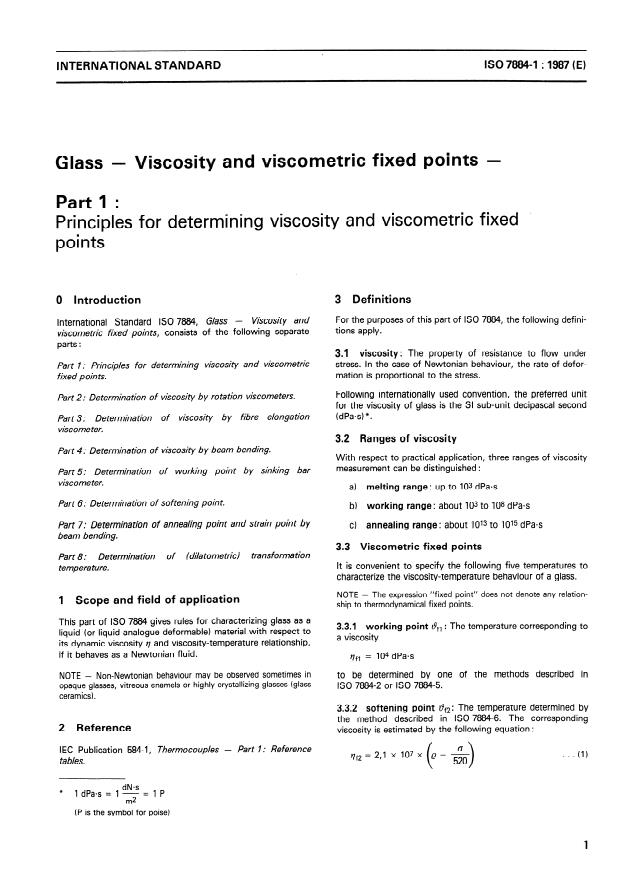
- Viscosity Ranges and Fixed Points: ISO 7884-1 distinguishes three main viscosity ranges-melting, working, and annealing. Each range is significant in defining processing and thermal properties of glass:
- Melting range: Up to 10³ dPas
- Working range: About 10³ to 10⁸ dPas
- Annealing range: About 10¹³ to 10¹⁵ dPas
- Defining Viscometric Fixed Points: The standard introduces five reference temperatures that characterize the viscosity-temperature behavior of glass:
- Working Point
- Softening Point
- Annealing Point
- Strain Point
- Transformation Temperature
- Measurement and Calibration: General requirements for viscometric measurement techniques, apparatus calibration (including use of certified reference glasses), and temperature measurement (primarily using thermocouples) are outlined to ensure reproducibility and accuracy.
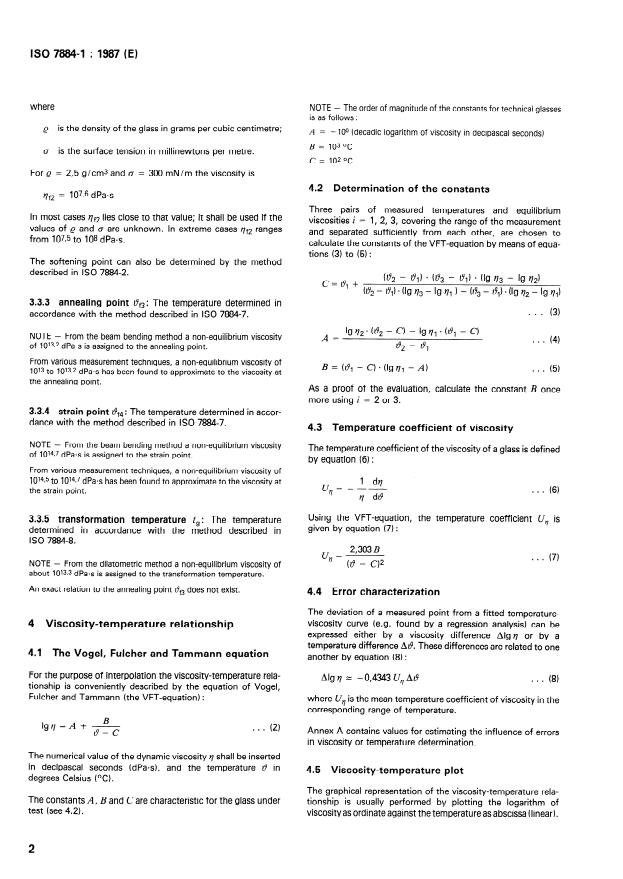
- Formulae and Error Estimation: Calculation methods, based on established equations like the Vogel-Fulcher-Tammann (VFT) equation, are prescribed. Annexes provide practical tables and examples for estimating errors in viscosity or temperature determinations.
- Sample Preparation and Treatment: Guidelines for handling and preparing glass samples ensure integrity and consistency during testing.
Applications
ISO 7884-1 is pivotal for industrial, research, and quality control applications:
- Glass Manufacturing: Enables manufacturers to optimize melting, forming, and annealing processes by providing clear viscosity benchmarks.
- Quality Assurance: Standardized measurement protocols facilitate product certification and compliance with international specifications.
- Research & Development: Supporting innovation, the standard helps researchers characterize new glass compositions and compare properties consistently.
- Calibration of Equipment: Provides a basis for calibrating viscometric devices using certified reference glasses, supporting traceability and accuracy.
- Troubleshooting: Enables process engineers to diagnose production issues related to glass flow, deformation, or thermal treatment.
Related Standards
ISO 7884-1 serves as the foundational document in a series of standards on glass viscosity and viscometric fixed points. Related standards include:
- ISO 7884-2: Determination of viscosity by rotation viscometers
- ISO 7884-3: Determination of viscosity by fibre elongation viscometer
- ISO 7884-4: Determination of viscosity by beam bending
- ISO 7884-5: Working point by sinking bar viscometer
- ISO 7884-6: Determination of softening point
- ISO 7884-7: Annealing and strain point by beam bending
- ISO 7884-8: Determination of transformation temperature (dilatometric method)
- IEC 584-1: Reference tables for thermocouples (temperature measurements)
Conclusion
ISO 7884-1:1987 plays a critical role in ensuring reliable, reproducible, and internationally comparable glass viscosity measurements. Its clear procedures, definitions, and calibration protocols are essential for production efficiency, quality control, and the advancement of glass science and technology. For those involved in glass manufacturing or research, adherence to this standard guarantees best practices and supports global standardization in the glass industry.
Relations
- Effective Date
- 09-Feb-2026
- Effective Date
- 09-Feb-2026
Frequently Asked Questions
ISO 7884-1:1987 is a standard published by the International Organization for Standardization (ISO). Its full title is "Glass — Viscosity and viscometric fixed points — Part 1: Principles for determining viscosity and viscometric fixed points". This standard covers: Rules a given characterizing glass as a liquid (or liquid-analogue deformable) material. Three ranges of viscosity can be distinguished: melting, working and annealing range. General requirements for measurement and calibration, for apparatus and for sampling are specified. The formulae for calculating the different values are described. In annex A tables for estimating the influence of errors in viscosity and temperature determination and in annex B examples of certified reference glasses are shown.
Rules a given characterizing glass as a liquid (or liquid-analogue deformable) material. Three ranges of viscosity can be distinguished: melting, working and annealing range. General requirements for measurement and calibration, for apparatus and for sampling are specified. The formulae for calculating the different values are described. In annex A tables for estimating the influence of errors in viscosity and temperature determination and in annex B examples of certified reference glasses are shown.
ISO 7884-1:1987 is classified under the following ICS (International Classification for Standards) categories: 81.040.01 - Glass in general. The ICS classification helps identify the subject area and facilitates finding related standards.
ISO 7884-1:1987 has the following relationships with other standards: It is inter standard links to EN ISO 18097:2022, EN 14706:2012. Understanding these relationships helps ensure you are using the most current and applicable version of the standard.
ISO 7884-1:1987 is available in PDF format for immediate download after purchase. The document can be added to your cart and obtained through the secure checkout process. Digital delivery ensures instant access to the complete standard document.
Standards Content (Sample)
ISO
INTERNATIONAL STANDARD
First edition
1987-12-15
INTERNATIONAL ORGANIZATION FOR STANDARDIZATION
ORGANISATION INTERNATIONALE DE NORMALISATION
MEXAYHAPOflHAfl OPrAHM3A~Mfl fl0 CTAH~APTM3AL&lM
- Vkcosity and viscometric fixed Points -
Glass
Part 1 :
Principles for determining viscosity and viscometric fixed
Points
Reference number
ISO 7884-1 : 1987 (E)
Foreword
ISO (the International Organization for Standardization) is a worldwide federation of
national Standards bodies (ISO member bedies). The work of preparing International
Standards is normally carried out through ISO technical committees. Esch member
body interested in a subject for which a technical committee has been established has
the right to be represented on that committee. International organizations, govern-
mental and non-governmental, in liaison with ISO, also take part in the work.
Draft International Standards adopted by the technical committees are circulated to
the member bodies for approval before their acceptance as International Standards by
the ISO Council. They are approved in accordance with ISO procedures requiring at
least 75 % approval by the member bodies voting.
International Standard ISO 7884-1 was prepared by Technical Committee ISO/TC 48,
Laborstory glassware and rela ted appara tus.
Users should note that all International Standards undergo revision from time to time
and that any reference made herein to any other International Standard implies its
latest edition, unless otherwise stated.
0 International Organkation for Standardkation, 1987
Printed in Switzerland
INTERNATIONAL STANDARD
ISO 7884-1 : 1987 (E)
Glass - Viscosity and viscometric fixed Points -
Part 1 :
Principles for determining viscosity and viscometric fixed ’
Points
0 Introduction 3 Definitions
For the purposes of this part of ISO 7884, the following defini-
International Standard ISO 7884, Glass - Viscosity and
tions apply.
viscometric fixed Points, consists of the following separate
Parts :
31 viscosity : The property of resistance to flow under
skess. In the case of Newtonian behaviour, the rate of defor-
Part 7: Principles for determining viscosity and viscometric
fixed p oin ts. mation is proportional to the stress.
Following internationally used convention, the preferred unit
Part 2 : Determination of viscosity b y ro ta tion viscometers.
for the viscosity of glass is the SI sub-unit decipascal second
(dPas) *.
Part 3: Determination of viscosity b y fibre elonga tion
viscome ter.
3.2 Ranges of viscosity
Part 4: Determination of viscosity b y beam bending.
With respect to practical application, three ranges of viscosity
measurement tan be distinguished :
Part 5: Determination of working Point by sinking bar
viscome ter.
a) melting range: up to 103 dPas
Part 6: Determination of softening Point.
b) working range: about 103 to IO* dPas
Part 7: Determination of annealing Point and strain Point by c) annealing range: about 1013 to 1015 dPas
beam bending.
3.3 Viscometric fixed Points
transforma tion
Part 8: Determination o f (dila tometricl
lt is convenient to specify the following five temperatures to
tempera ture.
characterize the viscosity-temperature behaviour of a glass.
NOTE - The expression “fixed Point” does not denote any relation-
1 Scope and field of application
ship to thermodynamical fixed Points.
This part of ISO 7884 gives rules for characterizing glass as a
3.3.1 working Point & : The temperature corresponding to
liquid (or liquid-analogue deformable) material with respect to
a viscosity
its dynamic viscosity q and viscosity-temperature relationship,
if it behaves as a Newtonian fluid.
104 dPa=s
Vfl =
NOTE - Non-Newtonian behaviour may be observed sometimes in to be determined by one of the methods described in
opaque glasses, vitreous enamels or highly crystallizing glasses (glass
ISO 7884-2 or ISO 7884-5.
ceramics).
3.3.2 softening Point 19,: The temperature determined by
the method described in ISO 7884-6. The corresponding
2 Reference
viscosity is estimated by the following equation :
IEC Publication 584-1, Thermocouples - Part 7: Reference
. . .
qf2 = 2,l x 107 x Q - & (1)
tables.
( 1
dN*s
*
1 dpa-s = 1 ,2 = 1 P
(P is the Symbol for Poise)
ISO 7884-1 : 1987 (E)
NOTE - The Order of magnitude of the constants for technicai glasses
is as follows :
is the density of the glass in grams per cubic centimetre;
e A= - 100 (decadic logarithm of viscosity in decipascal seconds)
B= 103 OC
0 is the surface tension in millinewtons per metre.
c = 102 OC
For ,Q = 2,5 g/cm3 and c7 = 300 mN/m the viscosity is
4.2 Determination of the constants
= 107,6 dPas
Vf2
Three pairs of measured temperatures and equilibrium
In most cases rf2 lies close to that value; it shall be used if the
viscosities i = 1, 2, 3, covering the range of the measurement
values of Q and 0 are unknown. In extreme cases rf2 ranges
and separated sufficiently from each other, are Chosen to
from 107,s to 108 dPas.
calculate the constants of the VFT-equation by means of equa-
tions (3) to (5) :
The softening Point tan also be determined by the method
described in ISO 7884-2.
w, - 8,) l w, - 8,) l (Ig q3 - lg (9)
C=V,+
($2 - 81) - (lg 73 - Ig q1 ) - ($3 - 8,) = (Ig q2 - Ig q,)
3.3.3 annealing Point tif3: The temperature determined in
. . . (3)
accordance with the method described in ISO 7884-7.
Cl - Ig 111 . (I-9, - C)
b 112 m (8, -
NOTE - From the beam bending method a non-equilibrium viscosity
A= . . .
(4)
of 1013,2 dpa. s is assigned to the annealing Point. r92 - 81
From various measurement techniques, a non-equilibrium viscosity of
B = (8, - C) n (Ig ql - A) . . . (5)
1013 to 1013J dPas has been found to approximate to the viscosity at
the annealing Point.
As a proof of the evaluation, calculate constant B once
more using i = 2 or 3.
3.3.4 strain Point tif,: The temperature determined in accor-
dance with the method described in ISO 7884-7.
43 . Temperature coefficient of viscosity
NOTE
- From the beam bending method a non-equilibrium viscosity
The temperature coeffi cient of the viscosity of a glass is defined
of 10’4J dP as is assigned to the strain Point.
by equation (6) :
From various measurement techniques, a non-equilibrium viscosity of
1014#5 to 10t4r7 dPas has been found to approximate to the viscosity at
1 dv
qy ---
. . .
(6)
the strain Point.
r dfl
Using the VFT-equation, the temperature coefficient U,, is
3.3.5 transformation temperature t, : The temperature
given by equation (7) :
determined in accordance with the method described in
ISO 7884-8.
2,303 B
UV = . . . (7)
(V - CP
NOTE - From the dilatometric method a non-equilibrium viscosity of
about 1013J dPas is assigned to the transformation temperature.
An exact relation to the annealing Point 4, does not exist.
4.4 Error characterization
The deviation of a measured Point from a fitted temperature-
viscosity curve (e.g. found by a regression analysis) tan be
4 Viscosity-temperature relationship
expressed either by a viscosity differente Alg q or by a
temperature differente AC? These differentes are related to one
4.1 The Vogel, Fulcher and Tarnmann equation
another by equation (8) :
For the purpose of interpolation the viscosity-temperature rela-
Alg q = -0,433 UV At9 . . . (8)
tionship is conveniently described by the equation of Vogel,
Fulcher and Tarnmann (the VFT-equation) : where UV is the mean temperature coefficient of viscosity in the
corresponding range
of temperature.
=A+B
. . . (2)
b 1?
Annex A contains values for estimating the influence of errors
V-C
in viscosity or temperature determination.
The numerical value of the dynamic viscosity 71 shall be inserted
in decipascal seconds (dPas), and the temperature 19 in
4.5 Viscosity-temperature plot
degrees Celsius (OC).
The graphical representation of the viscosity-temperature rela-
The constants A, B and C are characteristic for the glass under tionship is usually performed by plotting the logarithm of
test (sec 4.2).
viscosityas Ordinate against the temperature as abscissa (linear).
ISO 78844 :1987 (E)
6 Apparatus
5 Principles of measurement and calibration
6.1 Viscometric devices
5.1 Measurement of the viscosity
The viscometric devices are specified in ISO 7884-2 to
The Performance of the apparatus, the measurement pro-
ISO 7884-8.
cedure and the evaluation of viscosity depend heavily on the
type of method used. The methods are described in ISO 7884-2
to ISO 7884-8. 6.2 Furnaces
The different ranges of viscosity should preferably be determin- In some cases (sec ISO 7884-61, special furnace devices are
prescribed in detail.
ed using the following methods of measurement :
a) rotation (see ISO 7884-2) : 10 to 108 dPas Generally, a weil-insulated furnace, electrically heated, shall
have a constancy of temperature with respect to time of & 1 OC
b) fibre elongation (see ISO 7884-3) : 108 to 1013 dPas within that part of its hot region which is relevant for the
measurement of viscosity.
c) beam bending (see ISO 7884-4) : 109 to 1015 dPas
In some cases the furnace and its control shall be capable of
achieving required rates of increase or decrease in temperature.
5.2 Viscometric calibration
6.3 Materials of the apparatus
In some cases the calculation of the viscosity from the shape
and dimension of the flow field and from the measured forces
The materials in the hot region of the furnace, the heaters, the
and rates of deformation is possible. In practice, however, it is
crucibles, sockets, and measuring devices shall be able to
convenient to calibrate or to check the test devices by means of
withstand the relevant temperatures and mechanical forces
appropriate viscometric certified reference glasses (see annex B
without fracture or essential deformation. The materials in con-
for further information).
tact with the glass melt shall be sufficiently resistant to
Chemical attack by this melt. This property should be checked
before the measurement is performed, if the type of glass is
5.3 Measurement of temperature
unknown.
The temperature is determined mainly by appropriate ther-
For temperatures above 800 OC, platinum-rhodium alloys and
mocouples according to IEC 584-1. For temperatures above
AI203 ceramics are appropriate materials for contact with the
1 200 OC thermocouples such as platinum-30% rhodium/
glass Sample. Some other special high-temperature ceramics 1)
platinum-6 % rhodium (type B) according to IEC 584-1 should
may be used, if no contact with the glass Sample is provided.
prefera bly be used.
For minimizing systematic errors in temperature measurement,
the
...