

ISO 3585:1998
(Main)Borosilicate glass 3.3 — Properties
General Information
- Abstract
- Status
- Published
- Publication Date
- 24-Jun-1998
- Technical Committee
- ISO/TC 48 - Laboratory equipment
- Drafting Committee
- ISO/TC 48 - Laboratory equipment
- Current Stage
- 9060 - Close of review
- Completion Date
- 04-Jun-2030


Overview
ISO 3585:1998 specifies the main characteristics of borosilicate glass 3.3, focusing on its physical and chemical properties relevant to its use in laboratory glassware, glass plant, pipelines, and fittings. This international standard facilitates consistency and quality in the selection and identification of borosilicate glass 3.3 for scientific and industrial applications. Glass characterized by this standard is known for its excellent thermal and chemical resistance, making it highly suitable for demanding environments where precision and durability are essential.
Key Topics
- Physical Properties: The standard outlines nominal values for important properties such as density, coefficient of mean linear thermal expansion, viscosity, thermal conductivity, specific heat capacity, elastic modulus, Poisson's ratio, and ultimate tensile strength.
- Chemical Resistance: Borosilicate glass 3.3 exhibits high resistance to hydrolytic attack at both 98°C and 121°C, acid resistance, and alkali resistance, making it ideal for use with aggressive substances.
- Thermal Stability: The glass is designed to perform reliably within a nominal temperature range of 20°C to 300°C, with specified transformation and softening temperatures.
- Mechanical Strength: The standard provides guidance on tensile strength and factors influencing mechanical reliability, indicating the importance of manufacturing quality and surface finish.
- Testing Methods: It references standardized methods, ensuring reliable and repeatable assessment of both physical and chemical properties.
Applications
Borosilicate glass 3.3, as defined by ISO 3585:1998, is widely used in:
- Laboratory Glassware: Beakers, flasks, and test tubes benefit from the high chemical and thermal stability of borosilicate glass, ensuring safety and reliability in chemical analyses and experiments.
- Industrial Glass Plant: Pipelines and fittings in chemical processing plants utilize borosilicate glass 3.3 for transporting and handling corrosive or high-temperature substances.
- Process Equipment: Its resistance to thermal shock and chemical attack makes it suitable for sensors, reaction vessels, and other critical glass components in both research and production environments.
- Scientific Instrumentation: The properties detailed in ISO 3585 support the design of precise measurement and observation tools requiring stable material performance.
Using glass that conforms to ISO 3585:1998 ensures compatibility, safety, and interchangeability of components in both new installations and maintenance operations.
Related Standards
Organizations and professionals referring to ISO 3585:1998 often use related standards for further specification and testing, including:
- ISO 695 - Glass - Resistance to attack by a boiling aqueous solution of mixed alkali - Method of test and classification
- ISO 719 - Glass - Hydrolytic resistance at 98°C - Method of test and classification
- ISO 720 - Glass - Hydrolytic resistance at 121°C - Method of test and classification
- ISO 1776 - Resistance to attack by hydrochloric acid at 100°C
- ISO 7884 series - Viscosity and viscometric fixed points
- ISO 7991 - Determination of coefficient of mean linear thermal expansion
- ISO 3586, ISO 3587, ISO 3819, ISO 4704, ISO 4797, ISO 4803 - Additional specifications for glass plant components, laboratory glassware (beakers, flasks, tubing), and handling guidelines
Consulting these international standards helps ensure compliance, performance, and safety when selecting and utilizing borosilicate glass 3.3 in various scientific and industrial applications.
Relations
- Effective Date
- 25-Aug-2026
- Effective Date
- 25-Aug-2026
- Effective Date
- 25-Aug-2026
- Effective Date
- 25-Aug-2026
- Effective Date
- 25-Aug-2026
- Effective Date
- 25-Aug-2026
- Effective Date
- 25-Aug-2026
- Effective Date
- 25-Aug-2026
- Effective Date
- 25-Aug-2026
- Effective Date
- 25-Aug-2026
- Referred By
EN ISO 4797:2004 - Laboratory glassware - Boiling flasks with conical ground joints (ISO 4797:2004) - Effective Date
- 25-Aug-2026
- Effective Date
- 25-Aug-2026
- Effective Date
- 25-Aug-2026
- Referred By
EN ISO 4796-2:2000 - Laboratory glassware - Bottles - Part 2: Conical neck bottles (ISO 4796-2:2000) - Effective Date
- 25-Aug-2026
- Effective Date
- 25-Aug-2026
Frequently Asked Questions
ISO 3585:1998 is a standard published by the International Organization for Standardization (ISO). Its full title is "Borosilicate glass 3.3 — Properties". This standard covers: Borosilicate glass 3.3 — Properties
Borosilicate glass 3.3 — Properties
ISO 3585:1998 is classified under the following ICS (International Classification for Standards) categories: 81.040.01 - Glass in general. The ICS classification helps identify the subject area and facilitates finding related standards.
ISO 3585:1998 has the following relationships with other standards: It is inter standard links to EN ISO 21530:2004, EN ISO 10545-13:2016, EN ISO 16496:2016, EN ISO 11143:2008, EN ISO 10993-15:2023, EN ISO 6556:2012, EN ISO 13017:2012, EN ISO 24450:2005, EN ISO 15212-1:1999, EN ISO 13130:2011, EN ISO 4797:2004, EN ISO 28706-2:2017, EN ISO 3819:2015, EN ISO 4796-2:2000, EN ISO 28706-3:2018. Understanding these relationships helps ensure you are using the most current and applicable version of the standard.
ISO 3585:1998 is available in PDF format for immediate download after purchase. The document can be added to your cart and obtained through the secure checkout process. Digital delivery ensures instant access to the complete standard document.
Standards Content (Sample)
INTERNATIONAL ISO
STANDARD 3585
Third edition
1998-07-01
Borosilicate glass 3.3 — Properties
Verre borosilicaté 3.3 — Propriétés
A
Reference number
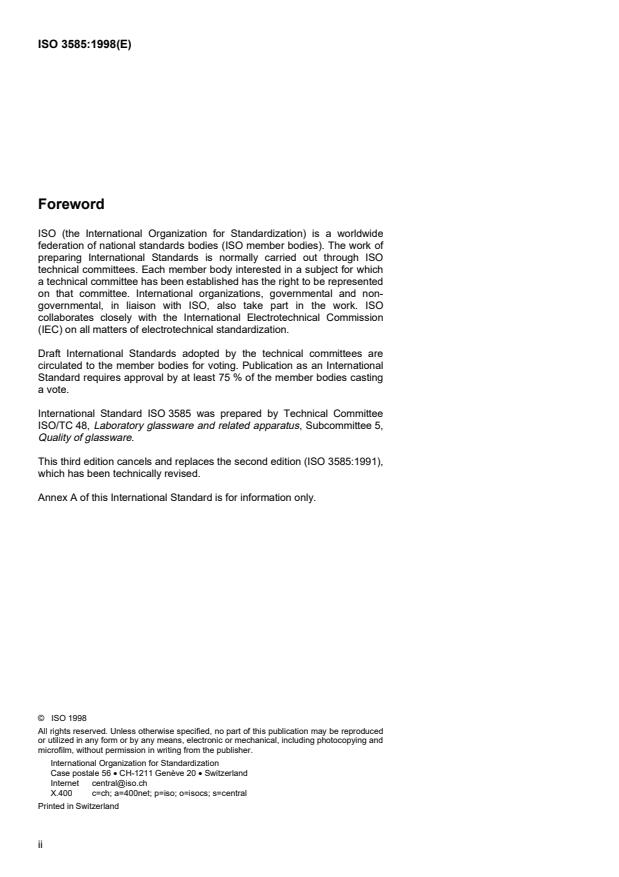
Foreword
ISO (the International Organization for Standardization) is a worldwide
federation of national standards bodies (ISO member bodies). The work of
preparing International Standards is normally carried out through ISO
technical committees. Each member body interested in a subject for which
a technical committee has been established has the right to be represented
on that committee. International organizations, governmental and non-
governmental, in liaison with ISO, also take part in the work. ISO
collaborates closely with the International Electrotechnical Commission
(IEC) on all matters of electrotechnical standardization.
Draft International Standards adopted by the technical committees are
circulated to the member bodies for voting. Publication as an International
Standard requires approval by at least 75 % of the member bodies casting
a vote.
International Standard ISO 3585 was prepared by Technical Committee
ISO/TC 48, Laboratory glassware and related apparatus, Subcommittee 5,
Quality of glassware.
This third edition cancels and replaces the second edition (ISO 3585:1991),
which has been technically revised.
Annex A of this International Standard is for information only.
© ISO 1998
All rights reserved. Unless otherwise specified, no part of this publication may be reproduced
or utilized in any form or by any means, electronic or mechanical, including photocopying and
microfilm, without permission in writing from the publisher.
International Organization for Standardization
Case postale 56 • CH-1211 Genève 20 • Switzerland
Internet central@iso.ch
X.400 c=ch; a=400net; p=iso; o=isocs; s=central
Printed in Switzerland
ii
©
ISO ISO 3585:1998(E)
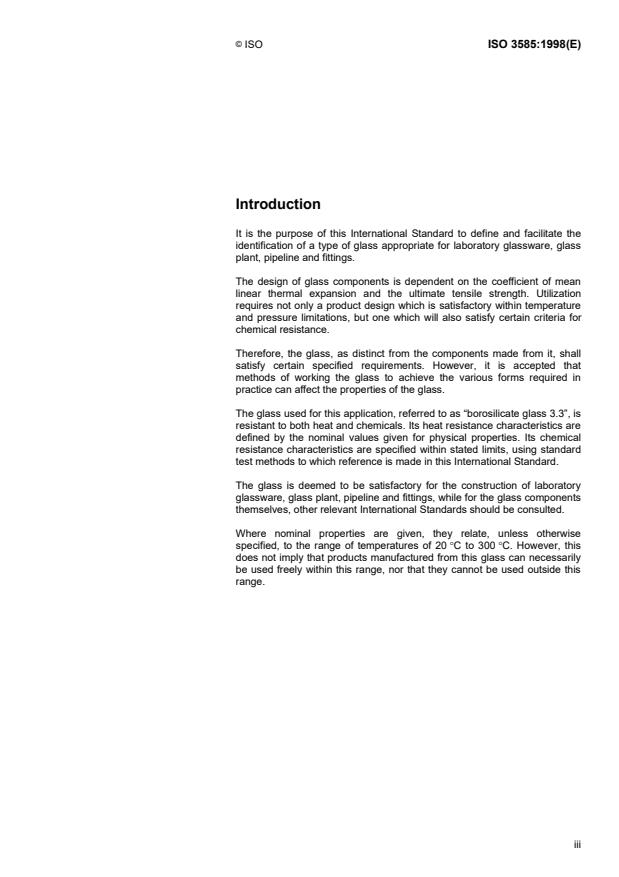
Introduction
It is the purpose of this International Standard to define and facilitate the
identification of a type of glass appropriate for laboratory glassware, glass
plant, pipeline and fittings.
The design of glass components is dependent on the coefficient of mean
linear thermal expansion and the ultimate tensile strength. Utilization
requires not only a product design which is satisfactory within temperature
and pressure limitations, but one which will also satisfy certain criteria for
chemical resistance.
Therefore, the glass, as distinct from the components made from it, shall
satisfy certain specified requirements. However, it is accepted that
methods of working the glass to achieve the various forms required in
practice can affect the properties of the glass.
The glass used for this application, referred to as “borosilicate glass 3.3”, is
resistant to both heat and chemicals. Its heat resistance characteristics are
defined by the nominal values given for physical properties. Its chemical
resistance characteristics are specified within stated limits, using standard
test methods to which reference is made in this International Standard.
The glass is deemed to be satisfactory for the construction of laboratory
glassware, glass plant, pipeline and fittings, while for the glass components
themselves, other relevant International Standards should be consulted.
Where nominal properties are given, they relate, unless otherwise
specified, to the range of temperatures of 20 �C to 300 �C. However, this
does not imply that products manufactured from this glass can necessarily
be used freely within this range, nor that they cannot be used outside this
range.
iii
©
INTERNATIONAL STANDARD ISO ISO 3585:1998(E)
Borosilicate glass 3.3 — Properties
1 Scope
This International Standard specifies the characteristics of a type of glass designated “borosilicate glass 3.3” used
for the construction of laboratory glassware, glass plant, pipeline and fittings.
NOTE — Annex A lists related International Standards.
2 Normative references
The following standards contain provisions which, through reference in this text, constitute provisions of this
International Standard. At the time of publication, the editions indicated were valid. All standards are subject to
revision, and parties to agreements based on this International Standard are encouraged to investigate the
possibility of applying the most recent editions of the standards indicated below. Members of IEC and ISO maintain
registers of currently valid International Standards.
ISO 695:1991, Glass — Resistance to attack by a boiling aqueous solution of mixed alkali — Method of test and
classification.
ISO 719:1985, Glass — Hydrolytic resistance of glass grains at 98 �C — Method of test and classification.
ISO 720:1985, Glass — Hydrolytic resistance of glass grains at 121 �C — Method of test and classification.
ISO 1776:1985, Glass — Resistance to attack by hydrochloric acid at 100 �C — Flame emission or flame atomic
absorption spectrometric method.
ISO 7884-2:1987, Glass — Viscosity and viscometri
...