


ISO/FDIS 15589-1
(Main)Oil and gas industries including lower carbon energy — Cathodic protection of pipeline transportation systems — Part 1: On-land pipelines
Oil and gas industries including lower carbon energy — Cathodic protection of pipeline transportation systems — Part 1: On-land pipelines
ISO 15589-1:2015 specifies requirements and gives recommendations for the pre-installation surveys, design, materials, equipment, installation, commissioning, operation, inspection, and maintenance of cathodic protection systems for on-land pipelines, as defined in ISO 13623 or EN 14161 for the petroleum, petrochemical, and natural gas industries, and in EN 1594 or EN 12007‑1 and EN 12007‑3 used by gas supply industries in Europe. All contents of this part of ISO 15589 are applicable to on-land pipelines and piping systems used in other industries and transporting other media such as industrial gases, waters, or slurries. ISO 15589-1:2015 applies to buried pipelines, landfalls of offshore pipeline sections protected by on-shore based cathodic protection installations, and to immersed sections of on-land pipelines such as river or lake crossings. ISO 15589-1:2015 specifies requirements for pipelines of carbon steel, stainless steel, cast iron, galvanized steel, or copper. If other pipeline materials are used, the criteria to apply are defined under the responsibility of the pipeline operator. ISO 15589-1:2015 does not apply to pipelines made of reinforced concrete for which EN 12696 can be applied. NOTE Special conditions sometimes exist where cathodic protection is ineffective or only partially effective. Such conditions can include shielding (e.g. disbonded coatings, thermal-insulating coatings, rocky soil, etc.) and unusual contaminants in the electrolyte.
Industries du pétrole et du gaz y compris les énergies à faible teneur en carbone — Protection cathodique des systèmes de transport par conduites — Partie 1: Conduites terrestres
La présente partie de l'ISO 15589 spécifie les exigences et donne des recommandations pour les études de préinstallation, la conception, les matériaux, l'équipement, l'installation, la mise en service, l'exploitation, l'inspection et la maintenance des systèmes de protection cathodique destinés aux conduites terrestres. Les conduites terrestres sont définies dans l'ISO 13623 ou l'EN 14161 relatives aux industries du pétrole, pétrochimiques et du gaz naturel. Elles sont également décrites dans l'EN 1594, l'EN 12007-1 et l'EN 12007-3 utilisées par les industries de fourniture de gaz en Europe. La présente partie de l'ISO 15589 est applicable aux conduites terrestres et aux systèmes de conduites utilisés dans d'autres industries et transportant d'autres fluides comme les gaz industriels, les eaux ou les boues liquides. Dans l'ensemble du présent document, le terme « conduites terrestres » désigne : — les conduites qui sont enterrées ; — les atterrages de tronçons de conduites en mer protégées par des installations de protection cathodique basées à terre ; — les tronçons immergés de conduites terrestres tels que les traversées de cours d'eau ou de lacs. La présente partie de l'ISO 15589 spécifie les exigences concernant les conduites en acier au carbone, en acier inoxydable, en fonte, en acier galvanisé et en cuivre. Si d'autres matériaux sont utilisés pour les conduites, les critères de protection à appliquer doivent être placés sous la responsabilité de l'exploitant des conduites. La présente partie de l'ISO 15589 ne s'applique pas aux conduites constituées de béton armé. L'ISO 12696 peut être appliquée aux conduites de ce type. Note Dans des conditions particulières, la protection cathodique peut s'avérer inefficace ou seulement partiellement efficace. De telles conditions peuvent comprendre un effet d'écran (par exemple, des décollements de revêtements, des revêtements thermo-isolants, un sol rocheux, des selles de poids et des coussins de soutien non conducteurs) et la présence de contaminants inhabituels dans l'électrolyte.
General Information
- Status
- Not Published
- Technical Committee
- ISO/TC 67/SC 2 - Pipeline transportation systems
- Drafting Committee
- ISO/TC 67/SC 2 - Pipeline transportation systems
- Current Stage
- 5020 - FDIS ballot initiated: 2 months. Proof sent to secretariat
- Start Date
- 10-Mar-2026
- Completion Date
- 10-Mar-2026
Relations
- Effective Date
- 12-Feb-2026
- Effective Date
- 22-Apr-2023
Overview
ISO/FDIS 15589-1:2024 is an international standard developed by ISO for the oil and gas industries, including lower carbon energy. This standard addresses the cathodic protection of on-land pipeline transportation systems, focusing on the requirements, recommendations, and best practices essential for pipeline integrity. It applies broadly to pipelines as defined in ISO 13623 and EN 14161 for petroleum, petrochemical, and natural gas industries, as well as EN 1594 and EN 12007 used by gas supply industries in Europe. Additionally, it is relevant for pipelines carrying other media like industrial gases, water, and slurries.
The standard covers buried pipelines, landfalls of offshore pipelines protected onshore, and immersed pipeline sections such as river or lake crossings. It is applicable to pipelines made of carbon steel, stainless steel, cast iron, galvanized steel, or copper. ISO/FDIS 15589-1 outlines the entire lifecycle of cathodic protection systems: from pre-installation surveys, design, and material selection, to installation, commissioning, operation, inspection, and maintenance.
Key Topics
- Pre-Installation Surveys: Guidance on assessing site conditions, soil resistivity, and environmental factors affecting corrosion.
- Design and Materials: Criteria for designing effective cathodic protection systems, including selection of suitable materials, coatings, and anode types for varied pipeline materials.
- Equipment and Installation: Specifications for installation processes, electrical continuity, isolation, and compatibility of coatings and wraps.
- Cathodic Protection Methods: Use of impressed current and galvanic anode systems; criteria for monitoring and maintaining appropriate protection potentials.
- Commissioning and Testing: Procedures for verifying effectiveness, including DC and AC potential measurements, and system adjustments.
- Operation and Maintenance: Requirements for ongoing inspection, remote monitoring, specialized surveys, and maintenance plans to ensure system reliability and pipeline safety.
- Documentation: Mandates for comprehensive design, commissioning, and operational documentation to support regulatory compliance and system traceability.
- Special Conditions: Recommendations for addressing scenarios where cathodic protection may be less effective due to shielding, soil conditions, or unusual contaminants.
Applications
ISO/FDIS 15589-1 serves as a practical reference for a wide range of industries, ensuring the integrity and safety of on-land pipeline systems transporting fuels, gases, water, and other substances. Common applications include:
- Oil and Gas Pipelines: Reducing external corrosion risks for buried and immersed steel pipelines in the petroleum and natural gas sectors.
- Gas Supply Infrastructure: Protecting steel pipelines in urban and industrial gas distribution networks.
- Industrial Pipelines: Applicable to pipelines transporting industrial gases, waters, or slurries within manufacturing facilities.
- Crossover Sections: Landfalls of offshore pipelines and river or lake crossings that are subject to unique corrosion challenges.
- Other Critical Infrastructure: Supporting sustainability and asset integrity for pipelines used in emerging lower carbon energy delivery systems.
Using this standard helps operators minimize corrosion-related failures, extend service life, and reduce maintenance costs while supporting safe and environmentally responsible operations.
Related Standards
When implementing ISO/FDIS 15589-1, organizations may also reference the following standards for broader compliance and best practices:
- ISO 13623 – Petroleum and natural gas industries - Pipeline transportation systems
- EN 14161 – Petroleum and natural gas industries - Pipeline transportation systems
- EN 1594 – Gas infrastructure - Pipelines for maximum operating pressure over 16 bar
- ISO 21809 – External coatings for buried or submerged pipelines
- ISO 8044 – Corrosion of metals and alloys - Vocabulary
- ISO 15257 – Cathodic protection - Competence levels of cathodic protection personnel
- EN 12007 – Gas infrastructure standards for steel and plastic pipelines
- ISO 12696 – Cathodic protection of steel in concrete (for reinforced concrete pipes)
- IEC 60079-10-1 / IEC 62305-1 – Protection against explosive atmospheres and lightning
By adhering to ISO/FDIS 15589-1 and related standards, pipeline operators ensure they meet international best practices for safety, regulatory compliance, and sustainability in pipeline corrosion protection.
Buy Documents

ISO/FDIS 15589-1 - Oil and gas industries including lower carbon energy — Cathodic protection of pipeline transportation systems — Part 1: On-land pipelines/9/2024

ISO/FDIS 15589-1 - Oil and gas industries including lower carbon energy — Cathodic protection of pipeline transportation systems — Part 1: On-land pipelines


REDLINE ISO/FDIS 15589-1 - Oil and gas industries including lower carbon energy — Cathodic protection of pipeline transportation systems — Part 1: On-land pipelines

ISO/FDIS 15589-1 - Industries du pétrole et du gaz y compris les énergies à faible teneur en carbone — Protection cathodique des systèmes de transport par conduites — Partie 1: Conduites terrestres/26/2024

ISO/FDIS 15589-1 - Industries du pétrole et du gaz y compris les énergies à faible teneur en carbone — Protection cathodique des systèmes de transport par conduites — Partie 1: Conduites terrestres
Get Certified
Connect with accredited certification bodies for this standard

ABS Quality Evaluations Inc.
American Bureau of Shipping quality certification.

Element Materials Technology
Materials testing and product certification.

ABS Group Brazil
ABS Group certification services in Brazil.
Sponsored listings
Frequently Asked Questions
ISO/FDIS 15589-1 is a draft published by the International Organization for Standardization (ISO). Its full title is "Oil and gas industries including lower carbon energy — Cathodic protection of pipeline transportation systems — Part 1: On-land pipelines". This standard covers: ISO 15589-1:2015 specifies requirements and gives recommendations for the pre-installation surveys, design, materials, equipment, installation, commissioning, operation, inspection, and maintenance of cathodic protection systems for on-land pipelines, as defined in ISO 13623 or EN 14161 for the petroleum, petrochemical, and natural gas industries, and in EN 1594 or EN 12007‑1 and EN 12007‑3 used by gas supply industries in Europe. All contents of this part of ISO 15589 are applicable to on-land pipelines and piping systems used in other industries and transporting other media such as industrial gases, waters, or slurries. ISO 15589-1:2015 applies to buried pipelines, landfalls of offshore pipeline sections protected by on-shore based cathodic protection installations, and to immersed sections of on-land pipelines such as river or lake crossings. ISO 15589-1:2015 specifies requirements for pipelines of carbon steel, stainless steel, cast iron, galvanized steel, or copper. If other pipeline materials are used, the criteria to apply are defined under the responsibility of the pipeline operator. ISO 15589-1:2015 does not apply to pipelines made of reinforced concrete for which EN 12696 can be applied. NOTE Special conditions sometimes exist where cathodic protection is ineffective or only partially effective. Such conditions can include shielding (e.g. disbonded coatings, thermal-insulating coatings, rocky soil, etc.) and unusual contaminants in the electrolyte.
ISO 15589-1:2015 specifies requirements and gives recommendations for the pre-installation surveys, design, materials, equipment, installation, commissioning, operation, inspection, and maintenance of cathodic protection systems for on-land pipelines, as defined in ISO 13623 or EN 14161 for the petroleum, petrochemical, and natural gas industries, and in EN 1594 or EN 12007‑1 and EN 12007‑3 used by gas supply industries in Europe. All contents of this part of ISO 15589 are applicable to on-land pipelines and piping systems used in other industries and transporting other media such as industrial gases, waters, or slurries. ISO 15589-1:2015 applies to buried pipelines, landfalls of offshore pipeline sections protected by on-shore based cathodic protection installations, and to immersed sections of on-land pipelines such as river or lake crossings. ISO 15589-1:2015 specifies requirements for pipelines of carbon steel, stainless steel, cast iron, galvanized steel, or copper. If other pipeline materials are used, the criteria to apply are defined under the responsibility of the pipeline operator. ISO 15589-1:2015 does not apply to pipelines made of reinforced concrete for which EN 12696 can be applied. NOTE Special conditions sometimes exist where cathodic protection is ineffective or only partially effective. Such conditions can include shielding (e.g. disbonded coatings, thermal-insulating coatings, rocky soil, etc.) and unusual contaminants in the electrolyte.
ISO/FDIS 15589-1 is classified under the following ICS (International Classification for Standards) categories: 75.200 - Petroleum products and natural gas handling equipment. The ICS classification helps identify the subject area and facilitates finding related standards.
ISO/FDIS 15589-1 has the following relationships with other standards: It is inter standard links to FprEN ISO 15589-1, ISO 15589-1:2015. Understanding these relationships helps ensure you are using the most current and applicable version of the standard.
ISO/FDIS 15589-1 is available in PDF format for immediate download after purchase. The document can be added to your cart and obtained through the secure checkout process. Digital delivery ensures instant access to the complete standard document.
Standards Content (Sample)
DRAFT
International
Standard
ISO/DIS 15589-1
ISO/TC 67/SC 2
Oil and gas industries including
Secretariat: UNI
lower carbon energy — Cathodic
Voting begins on:
protection of pipeline systems —
2024-04-05
Part 1:
Voting terminates on:
2024-06-28
On-land pipelines
Industries du pétrole, de la pétrochimie et du gaz naturel —
Protection cathodique des systèmes de transport par conduites —
Partie 1: Conduites terrestres
ICS: 75.200
THIS DOCUMENT IS A DRAFT CIRCULATED
FOR COMMENTS AND APPROVAL. IT
IS THEREFORE SUBJECT TO CHANGE
AND MAY NOT BE REFERRED TO AS AN
INTERNATIONAL STANDARD UNTIL
PUBLISHED AS SUCH.
This document is circulated as received from the committee secretariat.
IN ADDITION TO THEIR EVALUATION AS
BEING ACCEPTABLE FOR INDUSTRIAL,
TECHNOLOGICAL, COMMERCIAL AND
USER PURPOSES, DRAFT INTERNATIONAL
STANDARDS MAY ON OCCASION HAVE TO
ISO/CEN PARALLEL PROCESSING
BE CONSIDERED IN THE LIGHT OF THEIR
POTENTIAL TO BECOME STANDARDS TO
WHICH REFERENCE MAY BE MADE IN
NATIONAL REGULATIONS.
RECIPIENTS OF THIS DRAFT ARE INVITED
TO SUBMIT, WITH THEIR COMMENTS,
NOTIFICATION OF ANY RELEVANT PATENT
RIGHTS OF WHICH THEY ARE AWARE AND TO
PROVIDE SUPPORTING DOCUMENTATION.
Reference number
ISO/DIS 15589-1:2024(en)
DRAFT
ISO/DIS 15589-1:2024(en)
International
Standard
ISO/DIS 15589-1
ISO/TC 67/SC 2
Oil and gas industries including
Secretariat: UNI
lower carbon energy — Cathodic
Voting begins on:
protection of pipeline systems —
Part 1:
Voting terminates on:
On-land pipelines
Industries du pétrole, de la pétrochimie et du gaz naturel —
Protection cathodique des systèmes de transport par conduites —
Partie 1: Conduites terrestres
ICS: 75.200
THIS DOCUMENT IS A DRAFT CIRCULATED
FOR COMMENTS AND APPROVAL. IT
IS THEREFORE SUBJECT TO CHANGE
AND MAY NOT BE REFERRED TO AS AN
INTERNATIONAL STANDARD UNTIL
PUBLISHED AS SUCH.
This document is circulated as received from the committee secretariat.
IN ADDITION TO THEIR EVALUATION AS
BEING ACCEPTABLE FOR INDUSTRIAL,
© ISO 2024
TECHNOLOGICAL, COMMERCIAL AND
USER PURPOSES, DRAFT INTERNATIONAL
All rights reserved. Unless otherwise specified, or required in the context of its implementation, no part of this publication may
STANDARDS MAY ON OCCASION HAVE TO
ISO/CEN PARALLEL PROCESSING
be reproduced or utilized otherwise in any form or by any means, electronic or mechanical, including photocopying, or posting on
BE CONSIDERED IN THE LIGHT OF THEIR
the internet or an intranet, without prior written permission. Permission can be requested from either ISO at the address below
POTENTIAL TO BECOME STANDARDS TO
WHICH REFERENCE MAY BE MADE IN
or ISO’s member body in the country of the requester.
NATIONAL REGULATIONS.
ISO copyright office
RECIPIENTS OF THIS DRAFT ARE INVITED
CP 401 • Ch. de Blandonnet 8
TO SUBMIT, WITH THEIR COMMENTS,
CH-1214 Vernier, Geneva
NOTIFICATION OF ANY RELEVANT PATENT
Phone: +41 22 749 01 11
RIGHTS OF WHICH THEY ARE AWARE AND TO
PROVIDE SUPPORTING DOCUMENTATION.
Email: copyright@iso.org
Website: www.iso.org
Published in Switzerland Reference number
ISO/DIS 15589-1:2024(en)
ii
ISO/DIS 15589-1:2024(en)
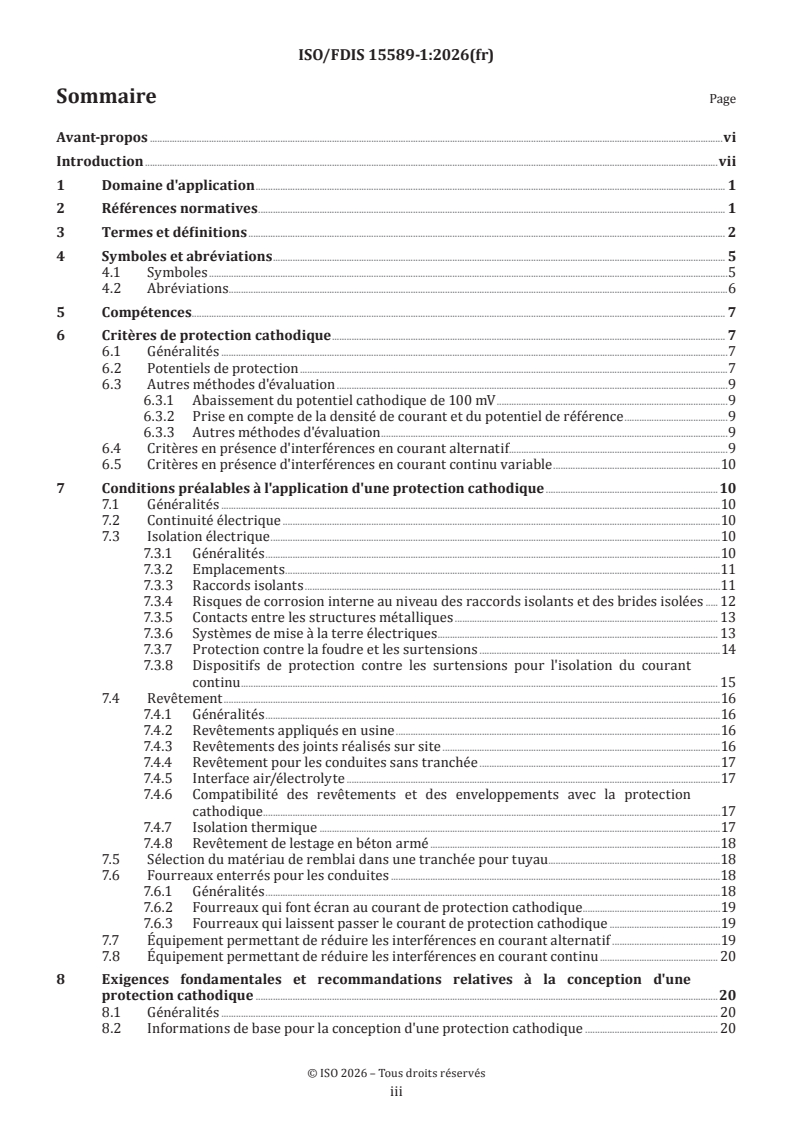
Contents Page
Foreword .vi
Introduction .vii
1 Scope . 1
2 Normative references . 1
3 Terms and definitions . 2
4 Symbols and abbreviations . 5
4.1 Symbols .5
4.2 Abbreviations .6
5 Competence . 7
6 Cathodic protection criteria . 7
6.1 General .7
6.2 Protection potentials .8
6.3 Alternative assessment methods .9
6.3.1 100 mV cathodic potential shift .9
6.3.2 Other assessment methods .9
6.4 Criteria in the presence of AC .10
6.5 Criteria in the presence of DC.10
7 Pre-requisites for the application of cathodic protection .10
7.1 General .10
7.2 Electrical continuity .10
7.3 Electrical isolation .10
7.3.1 General .10
7.3.2 Locations .11
7.3.3 Isolating joints .11
7.3.4 Internal corrosion risks at isolating joints . 12
7.3.5 Contacts between metallic structures. 12
7.3.6 Electrical earthing systems . . 13
7.3.7 Lightning and overvoltage protection .14
7.3.8 Overvoltage protection devices for DC isolation .14
7.4 Coating . 15
7.4.1 General . 15
7.4.2 Factory-applied coatings .16
7.4.3 Field joint coatings .16
7.4.4 Coating for trenchless pipelines .16
7.4.5 Air to electrolyte interface .17
7.4.6 Compatibility of coatings and wraps with cathodic protection .17
7.4.7 Thermal insulation .17
7.4.8 Reinforced concrete weight coating .17
7.5 Selection of pipe trench backfill material.17
7.6 Buried casings for pipelines .18
7.6.1 General .18
7.6.2 Casings that shield cathodic protection current .18
7.6.3 Casings that pass cathodic protection current .18
7.7 Equipment for the reduction of AC interference .19
7.8 Equipment for the mitigation of DC interference .19
8 Basic requirements for cathodic protection design . 19
8.1 General .19
8.2 Basic information for cathodic protection design .19
8.3 Contents of cathodic protection design report . 20
8.4 Cathodic protection current demand .21
8.4.1 Calculation of the theoretical total current demand .21
8.4.2 Current demand based on current density values for coated pipelines .21
iii
ISO/DIS 15589-1:2024(en)
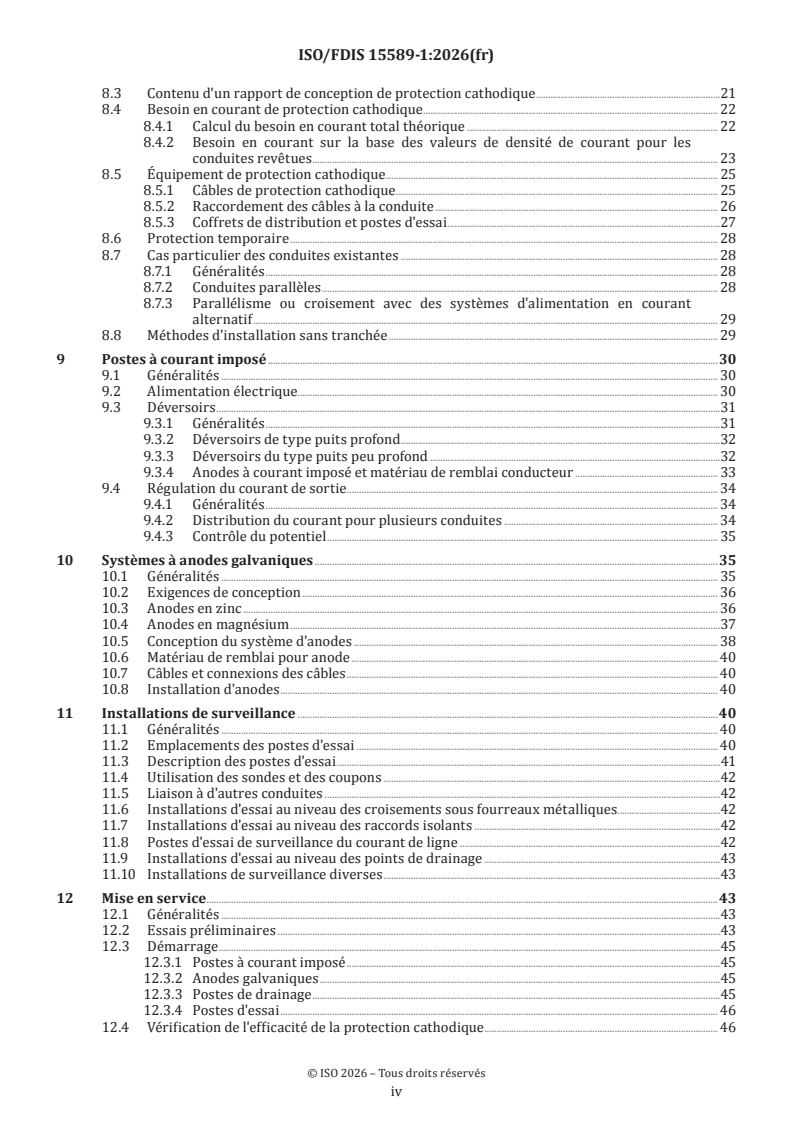
8.5 Cathodic protection equipment . 23
8.5.1 Cathodic protection cables . 23
8.5.2 Cable connection .24
8.5.3 Distribution boxes and Test stations . 25
8.6 Temporary protection . 26
8.7 Specific case of existing pipelines . 26
8.7.1 General . 26
8.7.2 Parallel pipelines . 26
8.7.3 Parallelism or crossing with AC power systems .27
8.8 Trenchless installation methods .27
9 Impressed current stations .27
9.1 General .27
9.2 Power supply . 28
9.3 Groundbeds . 29
9.3.1 General . 29
9.3.2 Deep-well groundbeds . 29
9.3.3 Shallow groundbeds . . 30
9.3.4 Impressed-current anodes and conductive backfill . 30
9.4 Output control .32
9.4.1 General .32
9.4.2 Current distribution for multiple pipelines .32
9.4.3 Potential control .32
10 Galvanic anode systems .33
10.1 General . 33
10.2 Design requirements . 33
10.3 Zinc anodes . 34
10.4 Magnesium anodes . 35
10.5 Design of the anode system. 36
10.6 Anode backfill. 38
10.7 Cables and cable connections . 38
10.8 Anode installation . 38
11 Monitoring facilities .38
11.1 General . 38
11.2 Locations of test stations . 38
11.3 Description of test stations . 39
11.4 Use of probes and coupons . 39
11.5 Bonding to other pipelines . 40
11.6 Test facilities at cased crossings . 40
11.7 Test facilities at isolating joints . 40
11.8 Line current monitoring test stations . 40
11.9 Drain-point test facilities . 40
11.10 Miscellaneous monitoring facilities . 40
12 Commissioning. 41
12.1 General .41
12.2 Preliminary tests . .41
12.3 Start up .42
12.3.1 Impressed current stations .42
12.3.2 Galvanic anodes .43
12.3.3 Drainage stations .43
12.3.4 Test stations.43
12.4 Verification of cathodic protection effectiveness .43
12.4.1 General .43
12.4.2 Measurements of DC potential and AC voltage . 44
12.4.3 Current measurements . 44
12.4.4 Adjustments . 44
12.5 Commissioning report . 44
12.5.1 Installation documentation . 44
iv
ISO/DIS 15589-1:2024(en)
12.5.2 Commissioning measurements .45
13 Monitoring, inspection, and maintenance .45
13.1 General .45
13.2 Implementation of inspection . 46
13.3 Inspection intervals . 46
13.4 Remote monitoring . 49
13.5 Specialized surveys . 49
13.6 Monitoring plan . 49
13.7 Monitoring equipment . 49
13.8 Maintenance and repair . 50
14 Documentation .50
14.1 Design documentation . 50
14.1.1 General . 50
14.1.2 Construction details and installation procedures .51
14.2 Commissioning documentation . .52
14.3 Operating and maintenance documentation .52
14.3.1 General .52
14.3.2 Inspection and monitoring data . 53
14.3.3 Maintenance records . 53
Annex A (normative) Cathodic protection measurements .54
Annex B (normative) Electrical interference .62
Annex C (informative) Fault detection of impressed-current systems during operation .66
Annex D (informative) Description of specialized surveys .68
Annex E (informative) Calculation of the CP potential attenuation .75
Annex F (informative) Electrical tests for isolating joints before installation .78
Annex G (informative) Internal corrosion at insulating joints .79
Bibliography .82
v
ISO/DIS 15589-1:2024(en)
Foreword
ISO (the International Organization for Standardization) is a worldwide federation of national standards
bodies (ISO member bodies). The work of preparing International Standards is normally carried out through
ISO technical committees. Each member body interested in a subject for which a technical committee
has been established has the right to be represented on that committee. International organizations,
governmental and non-governmental, in liaison with ISO, also take part in the work. ISO collaborates closely
with the International Electrotechnical Commission (IEC) on all matters of electrotechnical standardization.
The procedures used to develop this document and those intended for its further maintenance are described
in the ISO/IEC Directives, Part 1. In particular the different approval criteria needed for the different types
of ISO documents should be noted. This document was drafted in accordance with the editorial rules of the
ISO/IEC Directives, Part 2 (see www.iso.org/directives).
Attention is drawn to the possibility that some of the elements of this document may be the subject of patent
rights. ISO shall not be held responsible for identifying any or all such patent rights. Details of any patent
rights identified during the development of the document will be in the Introduction and/or on the ISO list of
patent declarations received (see www.iso.org/patents).
Any trade name used in this document is information given for the convenience of users and does not
constitute an endorsement.
For an explanation on the meaning of ISO specific terms and expressions related to conformity assessment,
as well as information about ISO's adherence to the WTO principles in the Technical Barriers to Trade (TBT)
see the following URL: Foreword - Supplementary information
The committee responsible for this document is ISO/TC 67, Oil and gas industries including lower carbon
energy, Subcommittee SC 2, Pipeline transportation systems.
This third edition cancels and replaces the second edition (ISO 15589-1:2015), which has been technically
revised with the following changes:
— cathodic protection criteria have been extended with further clarification on the application of the
criteria;
— requirements for design have been more detailed and periodicities for inspection of cathodic equipment
have been enlarged, and the option for remote monitoring added;
— requirements for measurements and testing during commissioning have been further detailed.
ISO 15589 consists of the following parts, under the general title Petroleum, petrochemical and natural gas
industries — Cathodic protection of pipeline systems:
— Part 1: On-land pipelines
— Part 2: Offshore pipelines
vi
ISO/DIS 15589-1:2024(en)
Introduction
Pipeline cathodic protection is achieved by the supply of sufficient direct current to the external pipe
surface, so that the steel-to-electrolyte potential is lowered to values at which external corrosion is reduced
to an insignificant rate.
Cathodic protection is normally used in combination with a suitable protective coating system to protect
the external surfaces of steel pipelines from corrosion.
It is necessary that users of this part of ISO 15589 be aware that further or differing requirements can be
needed for individual applications. This part of ISO 15589 is not intended to inhibit the use of alternative
equipment or engineering solutions for the individual application. This can be particularly applicable
where there is innovative or developing technology. It is necessary that, where an alternative is offered, any
variations from this part of ISO 15589 be identified and documented.
vii
DRAFT International Standard ISO/DIS 15589-1:2024(en)
Oil and gas industries including lower carbon energy —
Cathodic protection of pipeline systems —
Part 1:
On-land pipelines
1 Scope
This part of ISO 15589 specifies requirements and gives recommendations for the pre-installation surveys,
design, materials, equipment, installation, commissioning, operation, inspection, and maintenance of
cathodic protection systems for on-land pipelines. On-land pipelines are defined in ISO 13623 or EN 14161
for the petroleum, petrochemical, and natural gas industries. They are also described in EN 1594, EN 12007-
1 and EN 12007-3, which are used by gas supply industries in Europe.
This part of ISO 15589 is applicable to on-land pipelines and piping systems used in other industries and
transporting other media such as industrial gases, waters, or slurries.
Throughout this document on-land pipelines means:
— pipelines that are buried,
— landfalls of offshore pipeline sections protected by onshore based cathodic protection installations,
— immersed sections of on-land pipelines such as river or lake crossings.
This part of ISO 15589 specifies requirements for pipelines of carbon steel, stainless steel, cast iron,
galvanized steel, and copper. If other pipeline materials are used, the protection criteria to apply shall be the
responsibility of the pipeline operator.
This part of ISO 15589 does not apply to pipelines made of reinforced concrete. ISO 12696 can be applied to
reinforced concrete.
Note Special conditions sometimes exist where cathodic protection is ineffective or only partially effective. Such
conditions can include shielding (e.g. disbonded coatings, thermal-insulating coatings, rocky soil, weight saddles and
non-conducting support cushions.) and unusual contaminants in the electrolyte.
2 Normative references
The following documents, in whole or in part, are normatively referenced in this document and are
indispensable for its application. For dated references, only the edition cited applies. For undated references,
the latest edition of the referenced document (including any amendments) applies.
ISO 8044, Corrosion of metals and alloys — Vocabulary
ISO 10012, Measurement management systems — Requirements for measurement processes and measuring
equipment
ISO 13623, Petroleum and natural gas industries — Pipeline transportation systems
ISO 13847, Petroleum and natural gas industries — Pipeline transportation systems — Welding of pipelines
ISO 15257, Cathodic protection — Competence levels of cathodic protection persons — Basis for a certification
scheme
ISO/DIS 15589-1:2024(en)
ISO 18086, Corrosion of metals and alloys — Determination of AC corrosion — Protection criteria
ISO 21809 (all parts), Petroleum and natural gas industries — External coatings for buried or submerged
pipelines used in pipeline transportation systems
ISO 21857, Petroleum, petrochemical and natural gas industries — Prevention of corrosion on pipeline systems
influenced by stray currents
ISO 22426, Assessment of the effectiveness of cathodic protection based on coupon measurements
IEC 60079-10-1, Explosive atmospheres — Part 10-1: Classification of areas — Explosive gas atmospheres
IEC 60529, Degrees of protection provided by enclosures (IP Code)
IEC 62561-3, Lightning protection system components (LPSC) - Part 3: Requirements for isolating spark gaps
(ISGs)
EN 1594, Gas infrastructure — Pipelines for maximum operating pressure over 16 bar — Functional
requirements
EN 12007-3, Gas infrastructure — Pipelines for maximum operating pressure up to and including 16 bar – Part
3: Specific functional recommendations for steel
EN 14161, Petroleum and natural gas industries — Pipeline transportation systems (ISO 13623:2009 modified)
IEC 62305-1, Protection against lightning- Part 1: General principles
3 Terms and definitions
For the purposes of this document, the terms and definitions given in ISO 8044 and the following apply.
3.1
anode backfill
added material immediately surrounding a buried anode
3.2
bond
metal conductor, usually copper, connecting two points on the same or on different structures
3.3
cathodic protection system
impressed current and galvanic anode systems consist of all the equipment necessary for the application
of cathodic protection, such as impressed current installations, power supplies impressed current anodes,
galvanic anodes, bonds and cables
3.4
coupon
metal sample of defined dimensions made of a metal equivalent to the metal of the pipeline
3.5
coating defect
anomaly in the coating that results in the steel surface making direct contact with the surrounding
electrolyte.
3.6
DC decoupling device
equipment that provides a low-impedance path for AC and high resistance for DC
EXAMPLE Polarization cells, capacitors, or diode assemblies
ISO/DIS 15589-1:2024(en)
3.7
drain point
location of the cable connection to the protected pipeline through which the protective current returns to
its source
3.8
drainage
Transfer of stray current between structures by means of a deliberate bond
Note 1 to entry: See ISO 21587 for drainage devices (direct drainage bond, resistance drainage bond, unidirectional
drainage bond, and forced drainage bond).
3.9
drainage station
equipment and materials required to provide drainage of stray currents from affected systems
3.10
galvanic anode
see Definition in ISO 8044 chapter 7.4.10
3.11
galvanic anode station
equipment and materials required to provide cathodic protection by the use of galvanic anodes
Note 1 to entry: Such materials and equipment include galvanic anodes and cables
3.12
groundbed
system of buried or immersed anodes
3.13
impressed current anode
electrode that delivers cathodic protection current
3.14
impressed current station
equipment and materials required to provide cathodic protection by impressed current
Note 1 to entry: Such materials and equipment include impressed current anodes, cables, and a DC source.
3.15
instant-off potential
See 3.23 “off potential”
3.16
IR drop
voltage that is the product of all currents flowing through the cathodic protection circuit and the resistance
of the current path (mainly the electrolyte and the pipeline)
Note 1 to entry: This is derived from Ohm’s law (U = I × R)
3.17
IR free potential
coating defect or coupon to electrolyte potential without the voltage error caused by the IR drop due to the
protection current or any other current
3.18
isolating joint
electrically insulating component inserted between two lengths of pipe to prevent electrical continuity
between them
EXAMPLE Monobloc isolating joint, isolating flange
ISO/DIS 15589-1:2024(en)
3.19
isolating spark gap
component with discharge distance for isolating electrically conductive installation sections
Note 1 to entry: In the event of lighting strike, the installation sections are temporarily connected conductively as the
result of response of the discharge
3.20
local earthing
earthed metallic electrode not directly electrically connected to any other main earthing system
3.21
measuring point
location where the actual potential measurement takes place
Note 1 to entry: In the case of pipe-to-electrolyte potential measurement, this refers to the location of the reference
electrode.
3.22
on-potential
see Definition in ISO 8044 chapter 5.14
3.23
off potential
see Definition in ISO 8044 chapter 5.13
Note 1 to entry: The off potential of a pipeline is always a mixed potential resulting from the IR free (aline spelling
over the entire text) potentials of multiple coating defects
3.24
structure to-electrolyte potential
difference in potential between a pipeline and a specified reference electrode in contact with the electrolyte.
3.25
pitting resistance equivalent number PREN
number, developed to reflect and predict the pitting resistance of a stainless steel, based upon the
proportions of Cr, Mo, W, and N in the chemical composition of the alloy
3.26
polarization
change of pipe-to-electrolyte potential with respect to the free corrosion potential caused by the application
of an external electrical current
3.27
probe
device incorporating a coupon that provides measurements of parameters used to assess the effectiveness
of cathodic protection and/or corrosion risk
3.28
protection potential
pipe-to-electrolyte potential at which the metal corrosion rate is acceptable
3.29
reference electrode
see Definition in ISO 8044 chapter 7.1.19
3.30
remote earth
part of the electrolyte in which no measurable voltages, caused by current flow, occur between any two
points
Note 1 to entry: This condition generally prevails outside the zone of influence of an earth electrode, an earthing
system, an anode groundbed, or a protected pipeline
ISO/DIS 15589-1:2024(en)
3.31
rock jacket coating
coating that provides mechanical protection to the pipeline and is applied as a flexible coating
3.32
stray current
current flowing through paths other than the intended circuit
3.33
surge protective device
see Definition in IEC 62305-1 chapter 3.53
Note 1 to entry: It contains at least one nonlinear component
3.34
telluric current
current in the earth as a result of geomagnetic fluctuations
3.35
test station, Monitoring station
installation that provides measuring and test facilities
Note 1 to entry: Such installations include cabling and pipeline connections
3.36
utilization factor
fraction of the anodic material weight of an anode that can be consumed before the anode ceases to provide
the minimum required current output
4 Symbols and abbreviations
4.1 Symbols
D anode diameter
a
D backfill diameter
b
E potential measured at the metal/electrolyte interface
ΔE potential shift due to cathodic protection current measured against a remote reference electrode
E design closed-circuit potential of a galvanic anode
a
E design protection potential
c
E free corrosion potential (also called natural potential)
cor
E IR free potential
IRfree
E critical negative potential limit
l
E on-potential
ON
E off-potential
OFF
E protection potential
p
Δf average yearly increase in the coating breakdown factor
I total current demand
tot
I actual end-of-life individual anode current output
af
I mean current demand
cm
I required end-of-life individual anode current output
f
j current density for bare steel
j current density for coated pipelines
c
k contingency factor
ISO/DIS 15589-1:2024(en)
L length of the pipeline
m total net anode mass
m individual ne
...
FINAL DRAFT
International
Standard
ISO/TC 67/SC 2
Oil and gas industries including
Secretariat: UNI
lower carbon energy —
Voting begins on:
Cathodic protection of pipeline
2026-03-10
transportation systems —
Voting terminates on:
2026-05-05
Part 1:
On-land pipelines
Industries du pétrole et du gaz y compris les énergies à faible
teneur en carbone — Protection cathodique des systèmes de
transport par conduites —
Partie 1: Conduites terrestres
RECIPIENTS OF THIS DRAFT ARE INVITED TO SUBMIT,
WITH THEIR COMMENTS, NOTIFICATION OF ANY
RELEVANT PATENT RIGHTS OF WHICH THEY ARE AWARE
AND TO PROVIDE SUPPOR TING DOCUMENTATION.
IN ADDITION TO THEIR EVALUATION AS
BEING ACCEPTABLE FOR INDUSTRIAL, TECHNO-
ISO/CEN PARALLEL PROCESSING LOGICAL, COMMERCIAL AND USER PURPOSES, DRAFT
INTERNATIONAL STANDARDS MAY ON OCCASION HAVE
TO BE CONSIDERED IN THE LIGHT OF THEIR POTENTIAL
TO BECOME STAN DARDS TO WHICH REFERENCE MAY BE
MADE IN NATIONAL REGULATIONS.
Reference number
FINAL DRAFT
International
Standard
ISO/TC 67/SC 2
Oil and gas industries including
Secretariat: UNI
lower carbon energy —
Voting begins on:
Cathodic protection of pipeline
transportation systems —
Voting terminates on:
Part 1:
On-land pipelines
Industries du pétrole et du gaz y compris les énergies à faible
teneur en carbone — Protection cathodique des systèmes de
transport par conduites —
Partie 1: Conduites terrestres
RECIPIENTS OF THIS DRAFT ARE INVITED TO SUBMIT,
WITH THEIR COMMENTS, NOTIFICATION OF ANY
RELEVANT PATENT RIGHTS OF WHICH THEY ARE AWARE
AND TO PROVIDE SUPPOR TING DOCUMENTATION.
© ISO 2026
IN ADDITION TO THEIR EVALUATION AS
All rights reserved. Unless otherwise specified, or required in the context of its implementation, no part of this publication may
BEING ACCEPTABLE FOR INDUSTRIAL, TECHNO-
ISO/CEN PARALLEL PROCESSING
LOGICAL, COMMERCIAL AND USER PURPOSES, DRAFT
be reproduced or utilized otherwise in any form or by any means, electronic or mechanical, including photocopying, or posting on
INTERNATIONAL STANDARDS MAY ON OCCASION HAVE
the internet or an intranet, without prior written permission. Permission can be requested from either ISO at the address below
TO BE CONSIDERED IN THE LIGHT OF THEIR POTENTIAL
or ISO’s member body in the country of the requester.
TO BECOME STAN DARDS TO WHICH REFERENCE MAY BE
MADE IN NATIONAL REGULATIONS.
ISO copyright office
CP 401 • Ch. de Blandonnet 8
CH-1214 Vernier, Geneva
Phone: +41 22 749 01 11
Email: copyright@iso.org
Website: www.iso.org
Published in Switzerland Reference number
ii
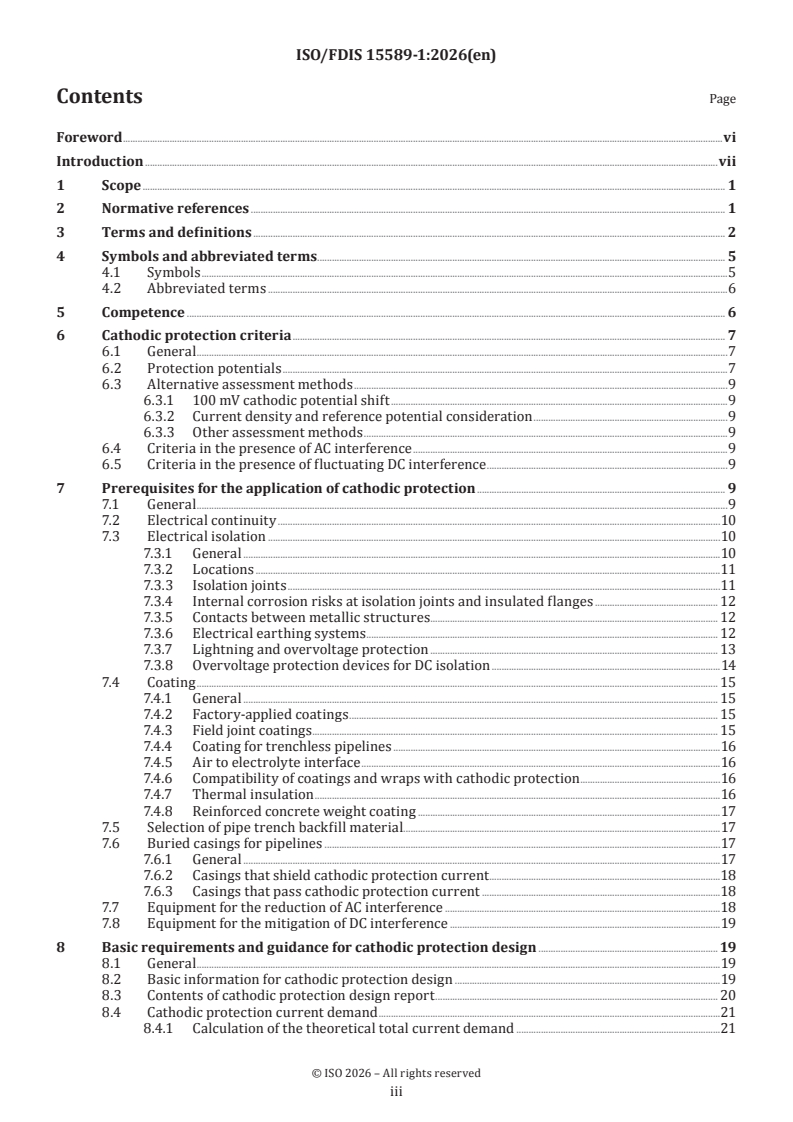
Contents Page
Foreword .vi
Introduction .vii
1 Scope . 1
2 Normative references . 1
3 Terms and definitions . 2
4 Symbols and abbreviated terms. 5
4.1 Symbols .5
4.2 Abbreviated terms .6
5 Competence . 6
6 Cathodic protection criteria . 7
6.1 General .7
6.2 Protection potentials .7
6.3 Alternative assessment methods .9
6.3.1 100 mV cathodic potential shift .9
6.3.2 Current density and reference potential consideration .9
6.3.3 Other assessment methods .9
6.4 Criteria in the presence of AC interference .9
6.5 Criteria in the presence of fluctuating DC interference .9
7 Prerequisites for the application of cathodic protection . 9
7.1 General .9
7.2 Electrical continuity .10
7.3 Electrical isolation .10
7.3.1 General .10
7.3.2 Locations .11
7.3.3 Isolation joints .11
7.3.4 Internal corrosion risks at isolation joints and insulated flanges . 12
7.3.5 Contacts between metallic structures. 12
7.3.6 Electrical earthing systems . . 12
7.3.7 Lightning and overvoltage protection . 13
7.3.8 Overvoltage protection devices for DC isolation .14
7.4 Coating . 15
7.4.1 General . 15
7.4.2 Factory-applied coatings . 15
7.4.3 Field joint coatings . 15
7.4.4 Coating for trenchless pipelines .16
7.4.5 Air to electrolyte interface .16
7.4.6 Compatibility of coatings and wraps with cathodic protection .16
7.4.7 Thermal insulation .16
7.4.8 Reinforced concrete weight coating .17
7.5 Selection of pipe trench backfill material.17
7.6 Buried casings for pipelines .17
7.6.1 General .17
7.6.2 Casings that shield cathodic protection current .18
7.6.3 Casings that pass cathodic protection current .18
7.7 Equipment for the reduction of AC interference .18
7.8 Equipment for the mitigation of DC interference .19
8 Basic requirements and guidance for cathodic protection design . 19
8.1 General .19
8.2 Basic information for cathodic protection design .19
8.3 Contents of cathodic protection design report . 20
8.4 Cathodic protection current demand .21
8.4.1 Calculation of the theoretical total current demand .21
iii
8.4.2 Current demand based on current density values for coated pipelines . 22
8.5 Cathodic protection equipment . 23
8.5.1 Cathodic protection cables . 23
8.5.2 Cable connection to pipeline .24
8.5.3 Distribution boxes and test stations . 25
8.6 Temporary protection . 26
8.7 Specific case of existing pipelines . 26
8.7.1 General . 26
8.7.2 Parallel pipelines . 26
8.7.3 Parallelism or crossing with AC power systems .27
8.8 Trenchless installation methods .27
9 Impressed current stations .27
9.1 General .27
9.2 Power supply . 28
9.3 Ground beds . 29
9.3.1 General . 29
9.3.2 Deep-well ground beds . 29
9.3.3 Shallow ground beds . 30
9.3.4 Impressed-current anodes and conductive backfill . 30
9.4 Output control .31
9.4.1 General .31
9.4.2 Current distribution for multiple pipelines .32
9.4.3 Potential control .32
10 Galvanic anode systems .33
10.1 General . 33
10.2 Design requirements . 33
10.3 Zinc anodes . 34
10.4 Magnesium anodes . 35
10.5 Design of the anode system. 35
10.6 Anode backfill.37
10.7 Cables and cable connections .37
10.8 Anode installation .37
11 Monitoring facilities .37
11.1 General .37
11.2 Locations of test stations .37
11.3 Description of test stations . 38
11.4 Use of probes and coupons . 38
11.5 Bonding to other pipelines . 39
11.6 Test facilities at metallic cased crossings . 39
11.7 Test facilities at isolation joints . 39
11.8 Line current monitoring test stations . 39
11.9 Drain-point test facilities . 39
11.10 Miscellaneous monitoring facilities . 39
12 Commissioning.40
12.1 General . 40
12.2 Preliminary tests . . 40
12.3 Start-up .41
12.3.1 Impressed current stations .41
12.3.2 Galvanic anodes .41
12.3.3 Drainage stations .42
12.3.4 Test stations.42
12.4 Verification of cathodic protection effectiveness .42
12.4.1 General .42
12.4.2 Measurements of DC potential and AC voltage .42
12.4.3 Current measurements .43
12.4.4 Adjustments .43
12.5 Commissioning report .43
iv
12.5.1 Installation documentation .43
12.5.2 Commissioning data and information . 44
13 Monitoring, inspection and maintenance .44
13.1 General . 44
13.2 Implementation of inspection .45
13.3 Inspection intervals .45
13.4 Remote monitoring . 48
13.5 Specialized surveys . 48
13.6 Monitoring plan . 48
13.7 Measuring equipment . 48
13.8 Maintenance and repair . 49
14 Documentation .49
14.1 Design documentation . 49
14.1.1 General . 49
14.1.2 Construction details and installation procedures . 50
14.2 Commissioning documentation . .51
14.3 Operating and maintenance documentation .51
14.3.1 General .51
14.3.2 Inspection and monitoring data .52
14.3.3 Maintenance records .52
Annex A (normative) Cathodic protection measurements .53
Annex B (normative) Electrical interference . 61
Annex C (informative) Fault detection of impressed-current systems during operation .65
Annex D (informative) Description of specialized surveys . 67
Annex E (informative) Calculation of the CP potential attenuation . 74
Annex F (informative) Electrical tests for isolation joints before installation .78
Annex G (informative) Internal corrosion at insulating flange .79
Bibliography .82
v
Foreword
ISO (the International Organization for Standardization) is a worldwide federation of national standards
bodies (ISO member bodies). The work of preparing International Standards is normally carried out through
ISO technical committees. Each member body interested in a subject for which a technical committee
has been established has the right to be represented on that committee. International organizations,
governmental and non-governmental, in liaison with ISO, also take part in the work. ISO collaborates closely
with the International Electrotechnical Commission (IEC) on all matters of electrotechnical standardization.
The procedures used to develop this document and those intended for its further maintenance are described
in the ISO/IEC Directives, Part 1. In particular, the different approval criteria needed for the different types
of ISO document should be noted. This document was drafted in accordance with the editorial rules of the
ISO/IEC Directives, Part 2 (see www.iso.org/directives).
ISO draws attention to the possibility that the implementation of this document may involve the use of (a)
patent(s). ISO takes no position concerning the evidence, validity or applicability of any claimed patent
rights in respect thereof. As of the date of publication of this document, ISO had not received notice of (a)
patent(s) which may be required to implement this document. However, implementers are cautioned that
this may not represent the latest information, which may be obtained from the patent database available at
www.iso.org/patents. ISO shall not be held responsible for identifying any or all such patent rights.
Any trade name used in this document is information given for the convenience of users and does not
constitute an endorsement.
For an explanation of the voluntary nature of standards, the meaning of ISO specific terms and expressions
related to conformity assessment, as well as information about ISO's adherence to the World Trade
Organization (WTO) principles in the Technical Barriers to Trade (TBT), see www.iso.org/iso/foreword.html.
This document was prepared by Technical Committee ISO/TC 67, Oil and gas industries including lower carbon
energy, Subcommittee SC 2, Pipeline transportation systems, in collaboration with the European Committee
for Standardization (CEN) Technical Committee CEN/TC 219, Cathodic protection, in accordance with the
Agreement on technical cooperation between ISO and CEN (Vienna Agreement).
This third edition cancels and replaces the second edition (ISO 15589-1:2015), which has been technically
revised.
The main changes are as follows:
— cathodic protection criteria have been extended with further clarification on the application of the
criteria;
— requirements for design have been more detailed; periodicities for inspection of cathodic equipment
have been enlarged; and the option for remote monitoring has been added;
— requirements for measurements and testing during commissioning have been further detailed.
A list of all parts in the ISO 15589 series can be found on the ISO website.
Any feedback or questions on this document should be directed to the user’s national standards body. A
complete listing of these bodies can be found at www.iso.org/members.html.
vi
Introduction
Pipeline cathodic protection is achieved by the supply of sufficient direct current to the external pipe
surface, so that the steel-to-electrolyte potential is lowered to values at which external corrosion is reduced
to an insignificant rate.
Cathodic protection is normally used in combination with a suitable protective coating system to protect
the external surfaces of steel pipelines from corrosion.
vii
FINAL DRAFT International Standard ISO/FDIS 15589-1:2026(en)
Oil and gas industries including lower carbon energy —
Cathodic protection of pipeline transportation systems —
Part 1:
On-land pipelines
1 Scope
This document specifies requirements and gives recommendations for the pre-installation surveys, design,
materials, equipment, installation, commissioning, operation, inspection, and maintenance of cathodic
protection systems for the external surface of on-land pipelines.
This document is applicable to on-land pipelines and piping systems used in other industries and
transporting other media such as industrial gases, waters, or slurries.
Throughout this document, on-land pipelines means:
— pipelines that are buried;
— landfalls of offshore pipeline sections protected by onshore based cathodic protection installations;
— immersed sections of on-land pipelines such as river or lake crossings.
This document is applicable to pipelines of carbon steel, stainless steel, cast iron, galvanized steel, and
copper.
This document does not apply to pipelines made of reinforced concrete (see ISO 12696).
2 Normative references
The following documents are referred to in the text in such a way that some or all of their content constitutes
requirements of this document. For dated references, only the edition cited applies. For undated references,
the latest edition of the referenced document (including any amendments) applies.
ISO 8044, Corrosion of metals and alloys — Vocabulary
ISO 10012, Measurement management systems — Requirements for measurement processes and measuring
equipment
ISO 13623, Petroleum and natural gas industries — Pipeline transportation systems
ISO 13847, Petroleum and natural gas industries — Pipeline transportation systems — Welding of pipelines
ISO 21809-3, Oil and gas industries including lower carbon energy — External coatings for buried or submerged
pipelines used in pipeline transportation systems — Part 3: Field joint coatings
ISO 21809-5, Oil and gas industries including lower carbon energy — External coatings for buried or submerged
pipelines used in pipeline transportation systems — Part 5: External concrete coatings
ISO 21857, Petroleum, petrochemical and natural gas industries — Prevention of corrosion on pipeline systems
influenced by stray currents
IEC 60079-10-1, Explosive atmospheres — Part 10-1: Classification of areas — Explosive gas atmospheres
IEC 60529, Degrees of protection provided by enclosures (IP Code)
IEC 62561-3, Lightning protection system components (LPSC) - Part 3: Requirements for isolating spark gaps
(ISGs)
EN 1594, Gas infrastructure — Pipelines for maximum operating pressure over 16 bar — Functional
requirements
EN 12007-3, Gas infrastructure — Pipelines for maximum operating pressure up to and including 16 bar – Part
3: Specific functional recommendations for steel
EN 14161, Petroleum and natural gas industries — Pipeline transportation systems from 2011+A1 from 2015
(ISO 13623:2017)
3 Terms and definitions
For the purposes of this document, the terms and definitions given in ISO 8044 and the following apply.
ISO and IEC maintain terminology databases for use in standardization at the following addresses:
— ISO Online browsing platform: available at https://www.iso.org/obp
— IEC Electropedia: available at https://www.electropedia.org/
3.1
anode backfill
added material immediately surrounding a buried anode
3.2
bond
conductor connecting two points on the same structure or between different structures
3.3
cathodic protection system
impressed current and galvanic anode system consisting of all the equipment necessary for the application
of cathodic protection, such as impressed current installations, power supplies, impressed current anodes
(3.12), galvanic anodes, monitoring facilities, bonds (3.2) and cables
3.4
coupon
metal sample of defined surface area and thickness made of a metal equivalent to the metal of the pipeline
3.5
coating defect
anomaly in the coating that results in the steel surface making direct contact with the surrounding
electrolyte
3.6
DC decoupling device
direct current decoupling device
equipment that provides a low-impedance path for alternating current and high resistance for direct current
EXAMPLE Polarization cells, capacitors, or diode assemblies.
3.7
drain point
location of the cable connection to the protected pipeline through which the protective current returns to
its source
3.8
drainage
transfer of stray current (3.24) between structures by means of a deliberate bond (3.2)
Note 1 to entry: See ISO 21857 for drainage devices (direct drainage bond, resistance drainage bond, unidirectional
drainage bond and forced drainage bond).
3.9
drainage station
equipment and materials required to provide drainage (3.8) of stray currents (3.24) from affected systems
3.10
galvanic anode station
equipment and materials required to provide cathodic protection by the use of galvanic anodes
Note 1 to entry: Such materials and equipment include galvanic anodes and cables.
3.11
ground bed
system of buried or immersed anodes
3.12
impressed current anode
electrode that delivers cathodic protection current in combination with an impressed current station (3.13)
3.13
impressed current station
equipment and materials required to provide cathodic protection by impressed current
Note 1 to entry: Such materials and equipment include impressed current anodes (3.12), cables, and a DC source.
3.14
IR drop
voltage that is the product of all currents flowing through the cathodic protection circuit and the resistance
of the current path (mainly the electrolyte and the pipeline)
Note 1 to entry: This is derived from Ohm’s law (U = I × R).
3.15
IR free potential
polarized potential
coating defect (3.5) or coupon (3.4) to electrolyte potential without the voltage error caused by the IR drop
(3.14) due to the protection current or any other current
3.16
isolation joint
electrically insulating component inserted between two lengths of pipe to prevent electrical continuity
between them
EXAMPLE Monobloc isolation joint, insulated flange.
3.17
spark gap
component with discharge distance for isolating electrically conductive installation sections
Note 1 to entry: In the event of lightning strike, the installation sections are temporarily connected conductively as
the result of response of the discharge.
3.18
local earth
conductive mass of the electrolyte, whose voltage between two reference electrodes at any point is not equal
to zero
3.19
measuring point
location where the actual potential measurement takes place
Note 1 to entry: In the case of pipe-to-electrolyte potential measurement, this refers to the location of the reference
electrode.
3.20
pipeline-to-electrolyte potential
difference in potential between a pipeline and a specified reference electrode in contact with the electrolyte
3.21
probe
device incorporating a coupon (3.4) that provides measurements of parameters used to assess the
effectiveness of cathodic protection and/or corrosion risk
3.22
remote earth
conductive mass of the electrolyte, whose voltage between two reference electrodes at any point is
conventionally taken as equal to zero
Note 1 to entry: This condition generally prevails outside the zone of influence of an earth electrode, an earthing
system, an anode ground bed (3.11), or a protected pipeline.
3.24
stray current
current flowing through paths other than the intended circuit
3.25
telluric current
current in the earth as a result of geomagnetic fluctuations
3.26
test station
monitoring station
installation that provides measuring and test facilities
Note 1 to entry: Such installations include cabling and pipeline connections.
3.27
trenchless installation
buried pipe installation methodology that does not require an open ditch
3.28
utilization factor
fraction of the anodic material weight of an anode that can be consumed before the anode ceases to provide
the minimum required current output
3.29
on-land pipeline
pipeline laid on or in land, including lines laid under inland water courses
Note 1 to entry: From the EN 14161 scope are excluded on-land supply systems used by the European gas supply
industry from the input of gas into the on-land transmission network up to the inlet connection of gas appliances.
3.30
coating breakdown factor
ratio of current density required to polarize a coated steel surface as compared to a bare steel surface
4 Symbols and abbreviated terms
4.1 Symbols
D anode diameter
a
D backfill diameter
b
E potential measured at the metal/electrolyte interface
∆E
potential shift due to cathodic protection current measured against a remote reference electrode
E open-circuit potential of a galvanic anode
a
E design protection potential
c
E free corrosion potential (also called natural potential)
cor
E potential at the metal/electrolyte interface, i.e. the potential that is free from the IR drop in the
IRfree
corrosive environment
E critical negative potential limit
l
E on-potential
ON
E instant-off potential
OFF
E protection potential criterion
p
I total current demand
tot
I actual end-of-life individual anode current output
af
I mean current demand
cm
I required end-of-life individual anode current output
f
j current density for bare steel
j current density for coated pipelines
c
k contingency factor
L length of the pipeline
m total net anode mass
m individual net anode mass
a
n number of anodes
r average coating resistance
co
R total circuit resistance for a galvanic anode cathodic protection system
a
R anode resistance relative to backfill
a/b
R backfill bed resistance relative to the natural electrolyte
b/s
ρ resistivity of an electrolyte
T temperature
t design life
dl
U voltage
u utilization factor
4.2 Abbreviated terms
AC alternating current
ACVG alternating current voltage gradient
CIPS close interval potential survey
CP cathodic protection
CSE copper−copper sulphate (saturated) reference electrode
DC direct current
DCVG direct current voltage gradient
ER electrical resistance
FBE fusion-bonded epoxy
I/J isolation joint
MMO mixed metal oxide
SRB sulphate reducing bacteria
UV ultraviolet
3LPE three-layer polyethylene
3LPP three-layer polypropylene
rms root mean square
5 Competence
Persons who undertake the design, supervision of installation, commissioning, supervision of operation,
measurements, monitoring, and supervision of maintenance of cathodic protection systems shall have the
appropriate level of competence for the tasks undertaken.
NOTE 1 Competence of cathodic protection persons to the level appropriate for tasks undertaken can be
demonstrated by certification in accordance with prequalification procedures such as ISO 15
...
ISO/TC 67/SC 2
Secretariat: UNI
Date: 2025-11-042026-02-23
Oil and gas industries including lower carbon energy — Cathodic
protection of pipeline transportation systems — Part 1: On-land
pipelines
Part 1:
On-land pipelines
Industries du pétrole et du gaz y compris les énergies à faible teneur en carbone — Protection cathodique des
systèmes de transport par conduites — Partie 1: Conduites terrestres
Partie 1: Conduites terrestres
TTTTTThhhhhhiiiiiis drs drs drs drs drs draaaaaafffffftttttt i i i i i is s s s s s susususususubbbbbbmmmmmmiiiiiitttttttttttteeeeeed d d d d d ttttttoooooo aaaaaa ppppppaaaaaarrrrrraaaaaallellellellellellel l l l l l vvvvvvooooootttttteeeeee i i i i i innnnnn IIIIIISSSSSSOOOOOO,,,,,, CCCCCCEEEEEEN.N.N.N.N.N.
FDIS stage
All rights reserved. Unless otherwise specified, or required in the context of its implementation, no part of this
publication may be reproduced or utilized otherwise in any form or by any means, electronic or mechanical, including
photocopying, or posting on the internet or an intranet, without prior written permission. Permission can be requested
from either ISO at the address below or ISO'sISO’s member body in the country of the requester.
ISO Copyright Officecopyright office
CP 401 • Ch. de Blandonnet 8
CH-1214 Vernier, Geneva
Phone: + 41 22 749 01 11
Email: E-mail: copyright@iso.org
Website: www.iso.org
Published in Switzerland.
ii
iii
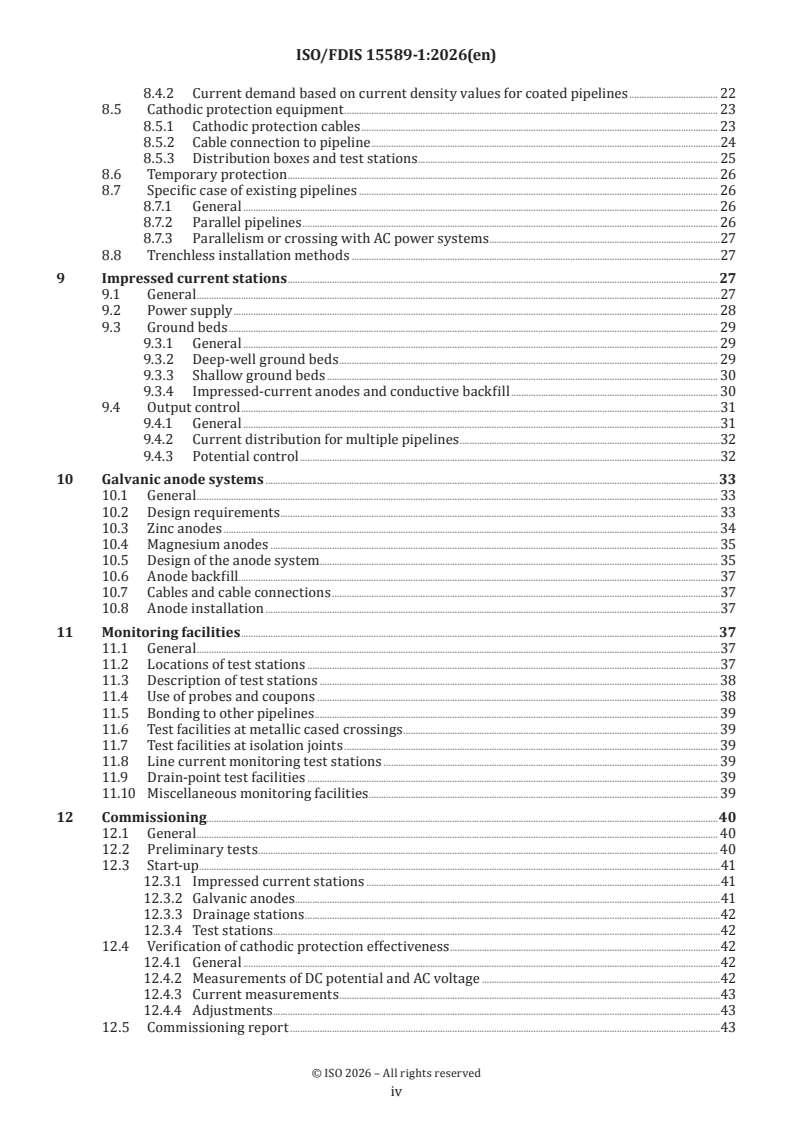
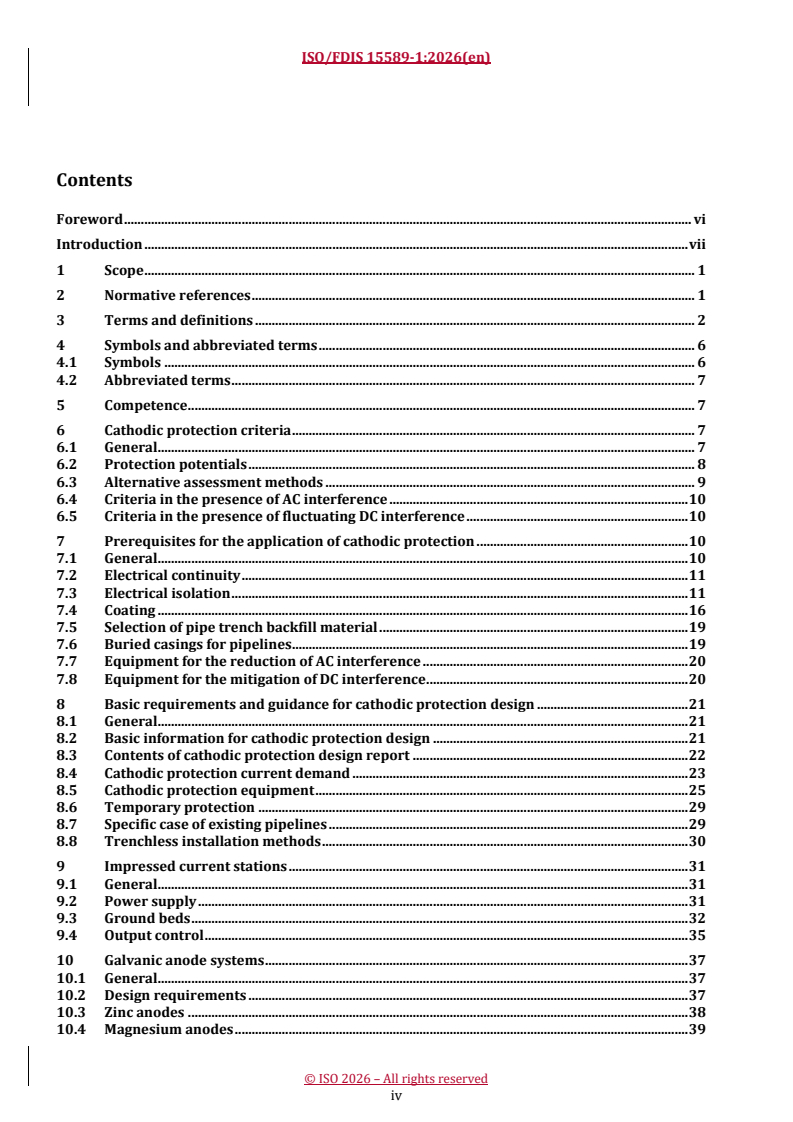
Contents
Foreword . vi
Introduction . vii
1 Scope . 1
2 Normative references . 1
3 Terms and definitions . 2
4 Symbols and abbreviated terms . 6
4.1 Symbols . 6
4.2 Abbreviated terms . 7
5 Competence . 7
6 Cathodic protection criteria . 7
6.1 General . 7
6.2 Protection potentials . 8
6.3 Alternative assessment methods . 9
6.4 Criteria in the presence of AC interference . 10
6.5 Criteria in the presence of fluctuating DC interference . 10
7 Prerequisites for the application of cathodic protection . 10
7.1 General . 10
7.2 Electrical continuity . 11
7.3 Electrical isolation . 11
7.4 Coating . 16
7.5 Selection of pipe trench backfill material . 19
7.6 Buried casings for pipelines . 19
7.7 Equipment for the reduction of AC interference . 20
7.8 Equipment for the mitigation of DC interference . 20
8 Basic requirements and guidance for cathodic protection design . 21
8.1 General . 21
8.2 Basic information for cathodic protection design . 21
8.3 Contents of cathodic protection design report . 22
8.4 Cathodic protection current demand . 23
8.5 Cathodic protection equipment . 25
8.6 Temporary protection . 29
8.7 Specific case of existing pipelines . 29
8.8 Trenchless installation methods . 30
9 Impressed current stations . 31
9.1 General . 31
9.2 Power supply . 31
9.3 Ground beds . 32
9.4 Output control . 35
10 Galvanic anode systems . 37
10.1 General . 37
10.2 Design requirements . 37
10.3 Zinc anodes . 38
10.4 Magnesium anodes . 39
iv
10.5 Design of the anode system . 40
10.6 Anode backfill . 42
10.7 Cables and cable connections . 42
10.8 Anode installation . 42
11 Monitoring facilities . 42
11.1 General . 42
11.2 Locations of test stations . 42
11.3 Description of test stations. 43
11.4 Use of probes and coupons . 44
11.5 Bonding to other pipelines . 44
11.6 Test facilities at metallic cased crossings . 44
11.7 Test facilities at isolation joints . 44
11.8 Line current monitoring test stations . 44
11.9 Drain-point test facilities . 45
11.10 Miscellaneous monitoring facilities . 45
12 Commissioning . 45
12.1 General . 45
12.2 Preliminary tests . 45
12.3 Start-up . 47
12.4 Verification of cathodic protection effectiveness . 48
12.5 Commissioning report . 49
13 Monitoring, inspection and maintenance . 50
13.1 General . 50
13.2 Implementation of inspection . 51
13.3 Inspection intervals . 52
13.4 Remote monitoring . 54
13.5 Specialized surveys . 54
13.6 Monitoring plan . 55
13.7 Measuring equipment . 55
13.8 Maintenance and repair . 56
14 Documentation . 56
14.1 Design documentation . 56
14.2 Commissioning documentation . 57
14.3 Operating and maintenance documentation . 58
Annex A (normative) Cathodic protection measurements . 60
Annex B (normative) Electrical interference . 71
Annex C (informative) Fault detection of impressed-current systems during operation . 75
Annex D (informative) Description of specialized surveys . 78
Annex E (informative) Calculation of the CP potential attenuation . 87
Annex F (informative) Electrical tests for isolation joints before installation . 96
Annex G (informative) Internal corrosion at insulating flange . 98
Bibliography . 102
v
Foreword
ISO (the International Organization for Standardization) is a worldwide federation of national standards
bodies (ISO member bodies). The work of preparing International Standards is normally carried out through
ISO technical committees. Each member body interested in a subject for which a technical committee has
been established has the right to be represented on that committee. International organizations,
governmental and non-governmental, in liaison with ISO, also take part in the work. ISO collaborates closely
with the International Electrotechnical Commission (IEC) on all matters of electrotechnical standardization.
The procedures used to develop this document and those intended for its further maintenance are described
in the ISO/IEC Directives, Part 1. In particular, the different approval criteria needed for the different types
of ISO document should be noted. This document was drafted in accordance with the editorial rules of the
ISO/IEC Directives, Part 2 (see www.iso.org/directives).
ISO draws attention to the possibility that the implementation of this document may involve the use of (a)
patent(s). ISO takes no position concerning the evidence, validity or applicability of any claimed patent
rights in respect thereof. As of the date of publication of this document, ISO had not received notice of (a)
patent(s) which may be required to implement this document. However, implementers are cautioned that
this may not represent the latest information, which may be obtained from the patent database available at
www.iso.org/patents. ISO shall not be held responsible for identifying any or all such patent rights.
Any trade name used in this document is information given for the convenience of users and does not
constitute an endorsement.
For an explanation of the voluntary nature of standards, the meaning of ISO specific terms and expressions
related to conformity assessment, as well as information about ISO's adherence to the World Trade
Organization (WTO) principles in the Technical Barriers to Trade (TBT), see
www.iso.org/iso/foreword.html.
This document was prepared by Technical Committee ISO/TC 67, Oil and gas industries including lower
carbon energy, Subcommittee SC 2, Pipeline transportation systems, in collaboration with the European
Committee for Standardization (CEN) Technical Committee CEN/TC 219, Cathodic protection, in accordance
with the Agreement on technical cooperation between ISO and CEN (Vienna Agreement).
This third edition cancels and replaces the second edition (ISO 15589--1:2015), which has been technically
revised.
The main changes are as follows:
— — cathodic protection criteria have been extended with further clarification on the application
of the criteria;
— — requirements for design have been more detailed; periodicities for inspection of cathodic
equipment have been enlarged; and the option for remote monitoring has been added;
— — requirements for measurements and testing during commissioning have been further
detailed.
A list of all parts in the ISO 15589 series can be found on the ISO website.
Any feedback or questions on this document should be directed to the user’s national standards body. A
complete listing of these bodies can be found at www.iso.org/members.html.
vi
Introduction
Pipeline cathodic protection is achieved by the supply of sufficient direct current to the external pipe
surface, so that the steel-to-electrolyte potential is lowered to values at which external corrosion is reduced
to an insignificant rate.
Cathodic protection is normally used in combination with a suitable protective coating system to protect the
external surfaces of steel pipelines from corrosion.
vii
FINAL DRAFT International Standard ISO/FDIS 15589-1:2024(en)
Oil and gas industries including lower carbon energy — Cathodic
protection of pipeline transportation systems — —
Part 1:
On-land pipelines
1 Scope
This document specifies requirements and gives recommendations for the pre-installation surveys, design,
materials, equipment, installation, commissioning, operation, inspection, and maintenance of cathodic
protection systems for the external surface of on-land pipelines, .
This document is applicable to on-land pipelines and piping systems used in other industries and
transporting other media such as industrial gases, waters, or slurries.
Throughout this document, on-land pipelines means:
— — pipelines that are buried;
— — landfalls of offshore pipeline sections protected by onshore based cathodic protection
installations;
— — immersed sections of on-land pipelines such as river or lake crossings.
This document is applicable to pipelines of carbon steel, stainless steel, cast iron, galvanized steel, and
copper.
This document does not apply to pipelines made of reinforced concrete (see ISO 12696).
NOTE Special conditions sometimes exist where cathodic protection is ineffective or only partially effective. Such
conditions can include shielding (e.g. disbonded coatings, thermal-insulating coatings, rocky soil, weight saddles and
non-conducting support cushions) and unusual contaminants in the electrolyte.
2 Normative references
The following documents are referred to in the text in such a way that some or all of their content constitutes
requirements of this document. For dated references, only the edition cited applies. For undated references,
the latest edition of the referenced document (including any amendments) applies.
ISO 8044, Corrosion of metals and alloys — Vocabulary
ISO 10012, Measurement management systems — Requirements for measurement processes and measuring
equipment
ISO 13623, Petroleum and natural gas industries — Pipeline transportation systems
ISO 13847, Petroleum and natural gas industries — Pipeline transportation systems — Welding of pipelines
ISO 18086, Corrosion of metals21809-3, Oil and alloys — Determination of AC corrosion — Protection criteria
ISO 21809 (all parts), Petroleum and natural gas industries including lower carbon energy — External
coatings for buried or submerged pipelines used in pipeline transportation systems — Part 3: Field joint
coatings
ISO 21809-5, Oil and gas industries including lower carbon energy — External coatings for buried or
submerged pipelines used in pipeline transportation systems — Part 5: External concrete coatings
ISO 21857, Petroleum, petrochemical and natural gas industries — Prevention of corrosion on pipeline systems
influenced by stray currents
ISO 22426, Assessment of the effectiveness of cathodic protection based on coupon measurements
IEC 60079--10--1, Explosive atmospheres — Part 10-1: Classification of areas — Explosive gas atmospheres
IEC 60529, Degrees of protection provided by enclosures (IP Code)
IEC 62561--3, Lightning protection system components (LPSC) - Part 3: Requirements for isolating spark gaps
(ISGs)
EN 1594, Gas infrastructure — Pipelines for maximum operating pressure over 16 bar — Functional
requirements
EN 12007--3, Gas infrastructure — Pipelines for maximum operating pressure up to and including 16 bar –
Part 3: Specific functional recommendations for steel
EN 14161, Petroleum and natural gas industries — Pipeline transportation systems from 2011+A1 from 2015
(ISO 13623:2017)
IEC 62305-1, Protection against lightning- Part 1: General principles
BARLO T.J. “Field Testing the Criteria for Cathodic Protection”, AGA Project PR-151-163, Interim Report,
1988.
EN 12732, Gas infrastructure — Welding steel pipework — Functional requirements
Gummow, R.A., Materials Performance 25 (9): p. 9-16, 1986.
NACE/TM0108-2012 Testing of Catalyzed Titanium Anodes for Use in Soils or Natural Waters
U. Angst et al. “Cathodic protection of soil buried steel pipelines - a critical discussion of protection criteria
and threshold values”, Materials and Corrosion 67 (2016) 1135–1142
3 Terms and definitions
For the purposes of this document, the terms and definitions given in ISO 8044 and the following apply.
ISO and IEC maintain terminology databases for use in standardization at the following addresses:
— — ISO Online browsing platform: available at https://www.iso.org/obp
— — IEC Electropedia: available at https://www.electropedia.org/
3.1 3.1
anode backfill
added material immediately surrounding a buried anode
3.2 3.2
bond
conductor connecting two points on the same structure or between different structures
3.3 3.3
cathodic protection system
impressed current and galvanic anode system consisting of all the equipment necessary for the application
of cathodic protection, such as impressed current installations, power supplies, impressed current anodes
(3.12(3.13),), galvanic anodes, monitoring facilities, bonds (3.2(3.2)) and cables”
3.4 3.4
coupon
metal sample of defined surface area and thickness made of a metal equivalent to the metal of the pipeline
3.5 3.5
coating defect
anomaly in the coating that results in the steel surface making direct contact with the surrounding
electrolyte
3.6 3.6
DC decoupling device
direct current decoupling device
equipment that provides a low-impedance path for alternating current and high resistance for direct current
EXAMPLE Polarization cells, capacitors, or diode assemblies.
3.7 3.7
drain point
location of the cable connection to the protected pipeline through which the protective current returns to its
source
3.8 3.8
drainage
transfer of stray current (3.24(3.32)) between structures by means of a deliberate bond (3.2(3.2))
Note 1 to entry: See ISO 21857 for drainage devices (direct drainage bond, resistance drainage bond, unidirectional
drainage bond and forced drainage bond).
3.9 3.9
drainage station
equipment and materials required to provide drainage (3.8(3.8)) of stray currents (3.24(3.32)) from affected
systems
3.10 3.10
galvanic anode station
equipment and materials required to provide cathodic protection by the use of galvanic anodes
Note 1 to entry: Such materials and equipment include galvanic anodes and cables.
3.11 3.11
ground bed
system of buried or immersed anodes
3.12 3.12
impressed current anode
electrode that delivers cathodic protection current in combination with an impressed current station (3.13)
3.13 3.13
impressed current station
equipment and materials required to provide cathodic protection by impressed current
Note 1 to entry: Such materials and equipment include impressed current anodes (3.12(3.13),), cables, and a DC source.
3.14 3.14
IR drop
voltage that is the product of all currents flowing through the cathodic protection circuit and the resistance
of the current path (mainly the electrolyte and the pipeline)
Note 1 to entry: This is derived from Ohm’s law (U = I × R).
3.15 3.15
IR free potential
polarized potential
coating defect (3.5(3.5)) or coupon (3.4(3.4)) to electrolyte potential without the voltage error caused by the
IR drop (3.14(3.16)) due to the protection current or any other current
3.16 3.16
isolation joint
electrically insulating component inserted between two lengths of pipe to prevent electrical continuity
between them
EXAMPLE Monobloc isolation joint, insulated flange.
3.17 3.17
spark gap
component with discharge distance for isolating electrically conductive installation sections
Note 1 to entry: In the event of lightning strike, the installation sections are temporarily connected conductively as the
result of response of the discharge.
3.18 3.18
local earth
conductive mass of the electrolyte, whose voltage between two reference electrodes at any point is not equal
to zero
3.19 3.19
measuring point
location where the actual potential measurement takes place
Note 1 to entry: In the case of pipe-to-electrolyte potential measurement, this refers to the location of the reference
electrode.
3.20 3.20
pipeline-to-electrolyte potential
difference in potential between a pipeline and a specified reference electrode in contact with the electrolyte
3.21 3.21
probe
device incorporating a coupon (3.4(3.4)) that provides measurements of parameters used to assess the
effectiveness of cathodic protection and/or corrosion risk
3.22 3.22
remote earth
conductive mass of the electrolyte, whose voltage between two reference electrodes at any point is
conventionally taken as equal to zero
Note 1 to entry: This condition generally prevails outside the zone of influence of an earth electrode, an earthing
system, an anode ground bed (3.11groundbed (3.12),), or a protected pipeline.
3.23 3.24
stray current
current flowing through paths other than the intended circuit
3.24 3.25
telluric current
current in the earth as a result of geomagnetic fluctuations
3.25 3.26
test station
monitoring station
installation that provides measuring and test facilities
Note 1 to entry: Such installations include cabling and pipeline connections.
3.26 3.XXX
trenchless installation
buried pipe installation methodology that does not require an open ditch.
3.27 3.27
utilization factor
fraction of the anodic material weight of an anode that can be consumed before the anode ceases to provide
the minimum required current output
3.28 3.28
on-land pipeline
pipeline laid on or in land, including lines laid under inland water courses
Note 1 to entry: From the EN 14161 scope are excluded on-land supply systems used by the European gas supply
industry from the input of gas into the on-land transmission network up to the inlet connection of gas appliances.
3.29 3.29
coating breakdown factor
ratio of current density required to polarize a coated steel surface as compared to a bare steel surface
3.30
geological cell
corrosion cell constituted between two different parts of a single metallic pipeline in contact with soils or
electrolytes having different characteristics
3.31
specified minimum yield strength
a factor in determining the maximum allowable operating pressure or MAOP of a pipe
3.32
cathodic protection power supply
a source of DC power for impressed current cathodic protection.
4 Symbols and abbreviated terms
4.1 Symbols
D anode diameter
a
D backfill diameter
b
E potential measured at the metal/electrolyte interface
potential shift due to cathodic protection current measured against a remote reference
ΔE
electrode
E open-circuit potential of a galvanic anode
a
E design protection potential
c
E free corrosion potential (also called natural potential)
cor
E potential at the metal/electrolyte interface, i.e. the potential that is free from the IR drop in the
IRfree
corrosive environment
E critical negative potential limit
l
E on-potential
ON
E instant-off potential
OFF
E protection potential criterion
p
I total current demand
tot
I actual end-of-life individual anode current output
af
I mean current demand
cm
I required end-of-life individual anode current output
f
j current density for bare steel
j current density for coated pipelines
c
k contingency factor
L length of the pipeline
m total net anode mass
m individual net anode mass
a
n number of anodes
r average coating resistance
co
R total circuit resistance for a galvanic anode cathodic protection system
a
R anode resistance relative to backfill
a/b
R backfill bed resistance relative to the natural electrolyte
b/s
ρ resistivity of an electrolyte
T temperature
t design life
dl
U voltage
u utilization factor
4.2 Abbreviated terms
AC alternating current
ACVG alternating current voltage gradient
CIPS close interval potential survey
CP cathodic protection
CSE copper−copper sulphate (saturated) reference electrode
DC direct current
DCVG direct current voltage gradient
ER electrical resistance
FBE fusion-bonded epoxy
I/J isolation joint
MMO mixed metal oxide
SRB sulphate reducing bacteria
UV ultraviolet
3LPE three-layer polyethylene
3LPP three-layer polypropylene
rms Rootroot mean square
5 Competence
Persons who undertake the design, supervision of installation, commissioning, supervision of operation,
measurements, monitoring, and supervision of maintenance of cathodic protection systems shall have the
appropriate level of competence for the tasks undertaken.
NOTE 1 Competence of cathodic protection persons to the level appropriate for tasks undertaken can be
demonstrated by certification in accordance with prequalification procedures such as ISO15257ISO 15257 or by any
other equivalent scheme and issued by a certification body conforming with ISO/IEC 17024.
NOTE 2 This does not preclude documented confirmation of task-specific competence by bodies that are not
certification bodies.
6 Cathodic protection criteria
6.1 General
The corrosion rate of a metal in soil or water is a function of the electrode potential, E, of the material in its
surrounding media. The protection potential, E , depends on the metal in its environment. For carbon steel
p
and cast iron, the corrosion rate corresponding to E is considered to be 0,01 mm per year in the absence of
p
AC or fluctuating DC interference (in case of AC interference s. clause 6.4, see 6.4 or 6.56.5)).
The criterion for CP is therefore, given by the condition in Formula (1)Formula (1)::
E ≤ E (1)
IRfree p
The protection potential of a metal depends on the corrosive environment (e.g electrolyte) and on the type
of metal used (see Table 1Table 1).).
Application of potentials that are too negative can result in coating disbondment and blistering and
hydrogen embrittlement of some metals.
The IR free potential, E , should not be more negative than the critical negative potential limit, E .
IRfree l
If E is defined, the criterion for CP is given by the conditions in Formula (2)Formula (2)::
l
E ≤ E ≤ E (2)
l IRfree p
If the conditions in Formula (2)Formula (2) cannot be achieved to avoid coating disbondment or blistering,
then Formula (1)Formula (1) shall be applied.
NOTE 1 If the protection potentials according to Table 1Table 1 are not fulfilled at all times or to all coating defects,
the corrosion rate can be higher than 0,01 mm per year.
NOTE 2 Corrosion can be expected to present as pitting/ or localised corrosion. The corrosion rate considered above
is a general, uniform corrosion rate; but pit depths can be expected to be greater.
6.2 Protection potentials
The IR free potential, E , shall meet the criteria given by Formula (1)Formula (1) and, if applicable,
IRfree
Formula (2)Formula (2). Table 1. Table 1 presents free corrosion potentials, E , protection potentials, E ,
cor p
and critical negative potential limit, E , for different metals in different environmental conditions.
l
Table 1 — Free corrosion potentials, protection potentials, and critical negative potential limits of
common metallic materials in soils and waters (except seawater) measured against CSE
Critical
Free corrosion Protection
negative
potential range potential
potential limit
Metals or alloys Environmental conditions (indicative values) (IR free)
(IR free)
E E
cor p
El
V V
V
Soils and waters in all conditions
a
−0,65 to −0,40 −0,85
except those hereunder described
Soils and waters at
b a
—
40 C < T < 60 C
c a
Soils and waters at T > 60 C −0,80 to −0,50 −0,95
Soils and waters in aerobic
Carbon steels, low a
conditions at T < 40 C with −0,50 to −0,30 −0,75
alloyed steels and cast
100 Ωm < ρ < 1000 1 000 Ωm
iron
Soils and waters in aerobic
a
conditions at T < 40 C with
−0,40 to −0,20 −0,65
ρ > 1000 1 000 Ωm
Soils and waters in anaerobic
conditions and with corrosion
a
−0,80 to −0,65 −0,95
risks caused by sulfate reducing
bacteria activity
Critical
Free corrosion Protection
negative
potential range potential
potential limit
Metals or alloys Environmental conditions (indicative values) (IR free)
(IR free)
Ecor Ep
El
V V
V
Austenitic stainless
d
−0,10 to + 0,20 −0,50
steels with PREN < 40
Austenitic stainless
−0,10 to + 0,20 −0,30 -
steels with PREN > 40 Neutral and alkaline soils and
waters at ambient temperatures
Martensitic or
austeno-ferritic
e
−0,10 to + 0,20 −0,50
(duplex) stainless
steels
Acidic soils and waters at ambient
e e
All stainless steels −0,10 to + 0,20
temperatures
Copper −0,20 to 0,00 −0,20 -
Soils and waters at ambient
temperatures
Galvanized steel −1,10 to −0,90 −1,20
During the lifetime of the pipeline, any possible changes of resistivity of the medium around the pipeline shall be taken into account.
If the environmental conditions of the pipeline do not meet those outlined in this table to obtain cathodic protection, the chosen
protection criteria should be based on documented practical experience.
NOTE All potentials are IR free and refer to a copper/ copper sulfate (saturated) reference electrode, ECSE = ENHE – 0,32.
a To prevent hydrogen embrittlement on high-strength, non-alloyed and low alloyed steels with SMYS exceeding 550 MPa, the
[22]
critical negative potential limits should be documented or determined experimentally [22].
b For temperatures 40 °C ≤ T ≤ 60 °C, the protection potential may be interpolated linearly between the potential value determined
for 40 °C (−0,65 V, −0,75 V, −0,85 V or –0,95 V) and the potential value for 60 °C (−0,95 V).
c The risk of high pH stress corrosion cracking increases with increase of temperature.
d In case of presence of any martensitic or ferritic phase (e.g. due to hardening), the risk of hydrogen embrittlement should be
determined by documentation or experimentally.
e Determination of the critical negative limit critical potential should be by documentation or experimentally.
Protective coatings can become blistered or disbonded under the influence of cathodic protection. Coated
structures should not generally be cathodically polarized beyond −1,2 V CSE (IR free). Values more negative
than −1,2 V CSE (IR free) associated or not with current density values may be used if experience or data for
the particular coating system and its application demonstrate that more negative values do not cause coating
blistering or disbondment on buried or immersed pipelines.
Where it is not practicable to comply with the least negative and the most negative criteria to avoid coating
should be prioritized.
disbondment and blistering, achieving the cathodic protection criterion E
p
6.3 Alternative assessment methods
6.3.1 100 mV cathodic potential shift
If the criteria defined in Table 1Table 1 cannot be achieved, a minimum cathodic potential shift of 100 mV
[1][1]
may be applied to reduce the corrosion rate (see AMPP Publication n 35108 ).). A residual corrosion rate
less than 0,01 mm/a might not be achieved. The formation or decay of potential shift can be measured in
accordance with the method defined in Annex AAnnex A.
The application of the 100 mV potential shift shall be avoided at operating temperatures above 40 C, in SRB-
containing soils, when interference currents, equalizing currents, or telluric currents can be present, or
when there is a risk of external stress corrosion cracking. Furthermore, the potential shift method shall not
be used in the case of pipelines connected to or consisting of mixed metal components.
6.3.2 Current density and reference potential consideration
Demonstration of effective cathodic protection on a coupon can be used based on the measured current I
cpn
and the calculated current density J , which can be compared to J . Similarly, an assessment of the
cpn ref
effectiveness of CP is possible based on the reference potential E by considering the coating defect size, the
ref
soil resistivity and the reference current density J . A description of the current density and the reference
ref
potential consideration is given in ISO 21857:2021, Annex J.
6.3.3 Other assessment methods
Alternative assessment methods, may be used if it can be demonstrated that the corrosion rate is acceptable.
The use of coupons, perforation coupons, and ER probes in accordance with ISO 22426 is suitable.
6.4 Criteria in the presence of AC interference
In locations where AC interference is possible, measurements of AC voltage and/or current density shall be
carried out to evaluate the level of the AC influence.
In the presence of AC voltage on the pipeline, the protection criteria defined in Table 1Table 1 shall be
fulfilled although they do not necessarily provide protection against AC corrosion and therefore the
corrosion rate can be higher than that given in 6.16.1.
ISO 18086 gives guidelines for the AC corrosion likelihood. The detailed criteria defined in ISO18086
ISO 18086 may be applied.
6.5 Criteria in the presence of fluctuating DC interference
In the presence of fluctuating DC interference/ or influence on the pipeline, the protection criteria defined in
Table 1Table 1 are not always verifiable. The detailed criteria defined in ISO 21857 shall apply.
It is possible that under fluctuating DC interference conditions, the corrosion rate considered in
6.1clause 6.1 cannot always be met, and an expected corrosion rate (design value) for a given design life
shall therefore be considered (see ISO 21857).
7 Prerequisites for the application of cathodic protection
7.1 General
For the application of cathodic protection, the pipeline, or section of the pipeline to be protected, shall be
electrically continuous. The pipeline should be coated and electrically isolated from foreign electrodes such
as other pipelines and earthing systems. Justification shall be provided if the pipeline is not electrically
isolated from other structures and earthing systems.
NOTE Coatings are universally applied to buried pipelines to provide a barrier between the pipeline steel and the
corrosive environment. Cathodic protection is applied to protect the P/L where the coating is compromised. Coatings
reduce the overall cathodic protection current requirement and, as a consequence, the risk of interference to adjacent
buried structures. Nevertheless, pipelines without coatings or with very poor coatings do exist and they can be
protected with cathodic protection but the protection current demand will beis high and the probability of unacceptable
interference to adjacent structures will beis increased.
7.2 Electrical continuity
The electrical continuity of the pipeline, or any section of the pipeline to be protected, shall be achieved
using reliable, low resistance, bond attachment methods.
On non-welded pipelines, the electrical continuity shall be achieved on the length to be protected by the
installation of permanent bonds across the high-resistance mechanical connectors using reliable bond
attachment methods. The continuity of non-welded pipelines shall be checked by carrying out resistance and
potential measurements.
When necessary, bonding may be carried out across isolating devices for measurement or other purposes. If
it is necessary that electrical continuity be established permanently, this bonding should be done in a test
station.
7.3 Electrical isolation
7.3.1 General
To avoid increasing the risk of corrosion, the pipeline should be electrically isolated from other metallic
structures and earthing systems.
Such structures include:
— — compressor stations;
— — pump stations;
— — pressure reducing stations;
— — water pumping and storage facilities;
— — well sites;
— — offshore pipelines and structures;
— — terminals and processing facilities;
— — interfaces with other pipelines.
Particular attention should be given to the electrical isolation between offshore pipelines with galvanic
anode CP systems and on-land pipelines with impressed current CP systems. Lack of effective isolation can
lead to difficulties in controlling and measuring potentials for both the offshore and the on-land sections
with the risk of over-polarisation and under-protection. It can also exacerbate the risk of internal corrosion
(see Annex GAnnex G).).
Electrical isolation between sections of the pipeline can help to reduce the effects of stray currents by
dividing the pipeline into shorter sections.
E
...
PROJET
Norme
internationale
ISO/DIS 15589-1
ISO/TC 67/SC 2
Industries du pétrole et du gaz
Secrétariat: UNI
y compris les énergies à faible
Début de vote:
teneur en carbone — Protection
2024-04-05
cathodique des systèmes de
Vote clos le:
transport par conduites —
2024-06-28
Partie 1:
Conduites terrestres
Oil and gas industries including lower carbon energy — Cathodic
protection of pipeline systems —
Part 1: On-land pipelines
ICS: 75.200
CE DOCUMENT EST UN PROJET DIFFUSÉ
POUR OBSERVATIONS ET APPROBATION. IL
EST DONC SUSCEPTIBLE DE MODIFICATION
ET NE PEUT ÊTRE CITÉ COMME NORME
INTERNATIONALE AVANT SA PUBLICATION EN
TANT QUE TELLE.
Le présent document est distribué tel qu’il est parvenu du secrétariat
du comité. OUTRE LE FAIT D’ÊTRE EXAMINÉS POUR
ÉTABLIR S’ILS SONT ACCEPTABLES À DES
FINS INDUSTRIELLES, TECHNOLOGIQUES ET
COMMERCIALES, AINSI QUE DU POINT DE VUE
DES UTILISATEURS, LES PROJETS DE NORMES
INTERNATIONALES DOIVENT PARFOIS ÊTRE
TRAITEMENT PARALLÈLE ISO/CEN
CONSIDÉRÉS DU POINT DE VUE DE LEUR
POSSIBILITÉ DE DEVENIR DES NORMES
POUVANT SERVIR DE RÉFÉRENCE DANS LA
RÉGLEMENTATION NATIONALE.
LES DESTINATAIRES DU PRÉSENT PROJET
SONT INVITÉS À PRÉSENTER, AVEC LEURS
OBSERVATIONS, NOTIFICATION DES DROITS
DE PROPRIÉTÉ DONT ILS AURAIENT
ÉVENTUELLEMENT CONNAISSANCE
ET À FOURNIR UNE DOCUMENTATION
EXPLICATIVE.
Numéro de référence
ISO/DIS 15589-1:2024(fr)
ISO/DIS 15589-1:2024(fr)
ISO/DIS 15589-1:2024(fr)
ISO/TC 67/SC 2
Secrétariat : UNI
Date : 2024-04-05
Industries du pétrole et du gaz y compris les énergies à faible teneur en carbone —
Protection cathodique des systèmes de transport par conduites — Partie 1 : Conduites
terrestres
Petroleum, petrochemical and natural gas industries — Cathodic protection of pipeline
systems — Part 1: On-land pipelines
DOCUMENT PROTÉGÉ PAR COPYRIGHT
© ISO 2024
Tous droits réservés. Sauf prescription différente ou nécessité dans le contexte de sa mise en œuvre, aucune partie de cette
publication ne peut être reproduite ni utilisée sous quelque forme que ce soit et par aucun procédé, électronique ou mécanique,
y compris la photocopie, ou la diffusion sur l’internet ou sur un intranet, sans autorisation écrite préalable. Une autorisation peut
être demandée à l’ISO à l’adresse ci-après ou au comité membre de l’ISO dans le pays du demandeur.
ISO copyright office
Case postale 401 • Ch. de Blandonnet 8
CH-1214 Vernier, Genève
Tél.: +41 22 749 01 11
E-mail: copyright@iso.org
Web: www.iso.org
Publié en Suisse
ii
ISO/DIS 15589-1:2024(fr)
Sommaire Page
Avant-propos .vi
Introduction . vii
1 Domaine d'application . 1
2 Références normatives . 1
3 Termes et définitions . 2
4 Symboles et abréviations . 6
4.1 Symboles . 6
4.2 Abréviations . 7
5 Compétences . 8
6 Critères de protection cathodique . 8
6.1 Généralités . 8
6.2 Potentiels de protection . 9
6.3 Autres méthodes d'évaluation . 10
6.3.1 Abaissement du potentiel cathodique de 100 mV . 10
6.3.2 Autres méthodes d'évaluation . 11
6.4 Critères en présence de courant alternatif . 11
6.5 Critères en présence de courant continu . 11
7 Conditions préalables à l'application d'une protection cathodique . 11
7.1 Généralités . 11
7.2 Continuité électrique . 12
7.3 Isolation électrique . 12
7.3.1 Généralités . 12
7.3.2 Emplacements . 13
7.3.3 Raccords isolants . 13
7.3.4 Risques de corrosion interne au niveau des raccords isolants. 14
7.3.5 Contacts entre les structures métalliques . 14
7.3.6 Systèmes de mise à la terre électriques . 15
7.3.7 Protection contre la foudre et les surtensions . 16
7.3.8 Dispositifs de protection contre les surtensions pour l'isolation du courant continu
................................................................................................................................................................... 17
7.4 Revêtement . 18
7.4.1 Généralités . 18
7.4.2 Revêtements appliqués en usine . 18
7.4.3 Revêtements des joints réalisés sur site . 19
7.4.4 Revêtement pour les conduites sans tranchée . 19
7.4.5 Interface air/électrolyte . 19
7.4.6 Compatibilité des revêtements et des enveloppements avec la protection cathodique
................................................................................................................................................................... 19
7.4.7 Isolation thermique . 20
7.4.8 Revêtement de lestage en béton armé . 20
7.5 Sélection du matériau de remblai dans une tranchée pour tuyau. 20
7.6 Fourreaux enterrés pour les conduites . 21
7.6.1 Généralités . 21
7.6.2 Fourreaux qui font écran au courant de protection cathodique . 21
7.6.3 Fourreaux qui laissent passer le courant de protection cathodique . 21
7.7 Équipement permettant de réduire les interférences en courant alternatif . 22
iii
ISO/DIS 15589-1:2024(fr)
7.8 Équipement permettant de réduire les interférences en courant continu .22
8 Exigences fondamentales relatives à la conception d'une protection cathodique .22
8.1 Généralités.22
8.2 Informations de base pour la conception d'une protection cathodique .23
8.3 Contenu d'un rapport de conception de protection cathodique .24
8.4 Besoin en courant de protection cathodique .25
8.4.1 Calcul du besoin en courant total théorique .25
8.4.2 Besoin en courant sur la base des valeurs de densité de courant pour les conduites
revêtues .25
8.5 Équipement de protection cathodique .27
8.5.1 Câbles de protection cathodique .27
8.5.2 Raccordement des câbles .28
8.5.3 Coffrets de distribution et postes d'essai .29
8.6 Protection temporaire .30
8.7 Cas particulier des conduites existantes .31
8.7.1 Généralités.31
8.7.2 Conduites parallèles .31
8.7.3 Parallélisme ou croisement avec des systèmes d'alimentation en courant alternatif
....................................................................................................................................................................31
8.8 Méthodes d'installation sans tranchée.32
9 Postes à courant imposé .32
9.1 Généralités.32
9.2 Alimentation électrique .33
9.3 Déversoirs .34
9.3.1 Généralités.34
9.3.2 Déversoirs de type puits profond .34
9.3.3 Déversoirs du type puits peu profond .35
9.3.4 Anodes à courant imposé et matériau de remblai conducteur .36
9.4 Régulation du courant de sortie .37
9.4.1 Généralités.37
9.4.2 Distribution du courant pour plusieurs conduites .38
9.4.3 Contrôle du potentiel .38
10 Systèmes à anodes galvaniques .39
10.1 Généralités.39
10.2 Exigences de conception .39
10.3 Anodes en zinc .40
10.4 Anodes en magnésium.41
10.5 Conception du système d'anodes .43
10.6 Matériau de remblai pour anode .44
10.7 Câbles et connexions des câbles .44
10.8 Installation d'anodes .45
11 Installations de surveillance .45
11.1 Généralités.45
11.2 Emplacements des postes d'essai .45
11.3 Description des postes d'essai .46
11.4 Utilisation des sondes et des coupons .46
11.5 Liaison à d'autres conduites.47
11.6 Installations d'essai au niveau des croisements sous fourreaux .47
11.7 Installations d'essai au niveau des raccords isolants .47
11.8 Postes d'essai de surveillance du courant de ligne .47
iv
ISO/DIS 15589-1:2024(fr)
11.9 Installations d'essai au niveau des points de drainage . 47
11.10 Installations de surveillance diverses. 47
12 Mise en service . 48
12.1 Généralités . 48
12.2 Essais préliminaires . 48
12.3 Démarrage . 49
12.3.1 Postes à courant imposé . 49
12.3.2 Anodes galvaniques . 50
12.3.3 Postes de drainage . 50
12.3.4 Postes d'essai . 50
12.4 Vérification de l'efficacité de la protection cathodique . 51
12.4.1 Généralités . 51
12.4.2 Mesurages du potentiel de courant continu et de la tension alternative . 51
12.4.3 Mesurages du courant . 51
12.4.4 Réglages . 52
12.5 Rapport de mise en service . 52
12.5.1 Documentation concernant l'installation . 52
12.5.2 Mesurages de mise en service . 52
13 Surveillance, inspection et maintenance . 53
13.1 Généralités . 53
13.2 Mise en œuvre de l'inspection . 54
13.3 Intervalles entre les inspections . 54
13.4 Télésurveillance . 57
13.5 Études spécialisées . 57
13.6 Plan de surveillance . 58
13.7 Équipement de surveillance . 58
13.8 Entretien et réparation . 59
14 Documentation . 59
14.1 Documentation de conception . 59
14.1.1 Généralités . 59
14.1.2 Détails relatifs à la construction et modes opératoires d'installation . 60
14.2 Documentation relative à la mise en service . 61
14.3 Documentation relative au fonctionnement et à la maintenance . 61
14.3.1 Généralités . 61
14.3.2 Données d'inspection et de surveillance. 62
14.3.3 Enregistrements de maintenance . 62
Annexe A (normative) Mesurages de la protection cathodique . 63
Annexe B (normative) Interférences électriques . 73
Annexe C (informative) Fault detection of impressed-current systems during operation . 78
Annexe D (informative) Description of specialized surveys . 80
Annexe E (informative) Calculation of the CP potential attenuation . 88
Annexe F (informative) Electrical tests for isolating joints before installation . 91
Annexe G (informative) Internal corrosion at insulating joints . 92
Bibliographie . 95
v
ISO/DIS 15589-1:2024(fr)
Avant-propos
L'ISO (Organisation internationale de normalisation) est une fédération mondiale d'organismes
nationaux de normalisation (comités membres de l'ISO). L'élaboration des Normes internationales est en
général confiée aux comités techniques de l'ISO. Chaque comité membre intéressé par une étude a le droit
de faire partie du comité technique créé à cet effet. Les organisations internationales, gouvernementales
et non gouvernementales, en liaison avec l'ISO participent également aux travaux. L'ISO collabore
étroitement avec la Commission électrotechnique internationale (IEC) en ce qui concerne la
normalisation électrotechnique.
Les procédures utilisées pour élaborer le présent document et celles destinées à sa mise à jour sont
décrites dans les Directives ISO/IEC, Partie 1. Il convient, en particulier de prendre note des différents
critères d'approbation requis pour les différents types de documents ISO. Le présent document a été
rédigé conformément aux règles de rédaction données dans les Directives ISO/IEC, Partie 2
(voir www.iso.org/directives).
L'attention est attirée sur le fait que certains des éléments du présent document peuvent faire l'objet de
droits de propriété intellectuelle ou de droits analogues. L'ISO ne saurait être tenue pour responsable de
ne pas avoir identifié de tels droits de propriété et averti de leur existence. Les détails concernant les
références aux droits de propriété intellectuelle ou autres droits analogues identifiés lors de l'élaboration
du document sont indiqués dans l'Introduction et/ou dans la liste des déclarations de brevets reçues par
l'ISO (voir www.iso.org/brevets).
Les appellations commerciales éventuellement mentionnées dans le présent document sont données
pour information, par souci de commodité, à l'intention des utilisateurs et ne sauraient constituer un
engagement.
Pour une explication de la signification des termes et expressions spécifiques de l'ISO liés à l'évaluation
de la conformité, ou pour toute information au sujet de l'adhésion de l'ISO aux principes de l'OMC
concernant les obstacles techniques au commerce (OTC), voir le lien suivant : Avant-propos -
Informations supplémentaires.
Le présent document a été élaboré par le comité technique ISO/TC 67, Industries du pétrole et du gaz, y
compris les énergies à faible teneur en carbone, sous-comité SC 2, Systèmes de transport par conduites.
Cette deuxième édition annule et remplace la première édition (ISO 15589-1:2015), qui a fait l'objet d'une
révision technique intégrant les modifications suivantes :
— les critères de protection cathodique ont été développés afin de clarifier leur application ;
— les exigences en termes de conception ont été plus détaillées, les périodicités d'examen de
l'équipement cathodique ont été développées et l'option concernant une télésurveillance a été
ajoutée ;
— les exigences en termes de mesurage et d'essais au cours d'une mise en service ont été davantage
détaillées.
L'ISO 15589 comprend les parties suivantes, présentées sous le titre général Industries du pétrole, de la
pétrochimie et du gaz naturel — Protection cathodique des systèmes de transport par conduites :
— Partie 1 : Conduites terrestres
— Partie 2 : Conduites en mer
vi
ISO/DIS 15589-1:2024(fr)
Introduction
La protection cathodique des conduites est réalisée par l'application sur la surface extérieure des tuyaux
d'un courant continu suffisant pour que le potentiel de l'acier par rapport à l'électrolyte soit abaissé à des
valeurs telles que la corrosion extérieure soit réduite à un niveau négligeable.
La protection cathodique est en général utilisée en association avec un système de revêtement protecteur
adapté, destiné à protéger les surfaces extérieures des conduites en acier de la corrosion.
Il est nécessaire que les utilisateurs de la présente partie de l'ISO 15589 soient informés que des
exigences supplémentaires ou différentes peuvent être nécessaires pour des applications particulières.
La présente partie de l'ISO 15589 ne vise pas à interdire l'utilisation d'équipements ou de solutions
techniques autres pour l'application prévue. De telles solutions alternatives peuvent notamment être
applicables lorsqu'il s'agit de technologies innovantes ou en cours de développement. Lorsqu'une autre
alternative est proposée, il est nécessaire d'identifier et de documenter tout écart par rapport à la
présente partie de l'ISO 15589.
vii
PROJET de Norme internationale ISO/DIS 15589-1:2024(fr)
Industries du pétrole et du gaz y compris les énergies à faible
teneur en carbone — Protection cathodique des systèmes de
transport par conduites — Partie 1 : Conduites terrestres
1 Domaine d'application
La présente partie de l'ISO 15589 spécifie les exigences et donne des recommandations pour les études
de préinstallation, la conception, les matériaux, l'équipement, l'installation, la mise en service,
l'exploitation, l'inspection et la maintenance des systèmes de protection cathodique destinés aux
conduites terrestres. Les conduites terrestres sont définies dans l'ISO 13623 ou l'EN 14161 relatives aux
industries du pétrole, pétrochimiques et du gaz naturel. Elles sont également décrites dans l'EN 1594,
l'EN 12007-1 et l'EN 12007-3 utilisées par les industries de fourniture de gaz en Europe.
La présente partie de l'ISO 15589 est applicable aux conduites terrestres et aux systèmes de conduites
utilisés dans d'autres industries et transportant d'autres fluides comme les gaz industriels, les eaux ou
les boues liquides.
Dans l'ensemble du présent document, le terme « conduites terrestres » désigne :
— les conduites qui sont enterrées ;
— les atterrages de tronçons de conduites en mer protégées par des installations de protection
cathodique basées à terre ;
— les tronçons immergés de conduites terrestres tels que les traversées de cours d'eau ou de lacs.
La présente partie de l'ISO 15589 spécifie les exigences concernant les conduites en acier au carbone, en
acier inoxydable, en fonte, en acier galvanisé et en cuivre. Si d'autres matériaux sont utilisés pour les
conduites, les critères de protection à appliquer doivent être placés sous la responsabilité de l'exploitant
des conduites.
La présente partie de l'ISO 15589 ne s'applique pas aux conduites constituées de béton armé.
L'ISO 12696 peut être appliquée aux conduites de ce type.
Note Dans des conditions particulières, la protection cathodique peut s'avérer inefficace ou seulement
partiellement efficace. De telles conditions peuvent comprendre un effet d'écran (par exemple, des décollements de
revêtements, des revêtements thermo-isolants, un sol rocheux, des selles de poids et des coussins de soutien non
conducteurs) et la présence de contaminants inhabituels dans l'électrolyte.
2 Références normatives
Les documents ci-après, dans leur intégralité ou non, sont des références normatives indispensables à
l'application du présent document. Pour les références datées, seule l'édition citée s'applique. Pour les
références non datées, la dernière édition du document de référence s'applique (y compris les éventuels
amendements).
ISO 8044, Corrosion des métaux et alliages — Vocabulaire
ISO 10012, Systèmes de management de la mesure — Exigences pour les processus et les équipements de
mesure
ISO/DIS 15589-1:2024(fr)
ISO 13623, Industries du pétrole et du gaz naturel — Systèmes de transport par conduites
ISO 13847, Industries du pétrole et du gaz naturel — Conduites pour systèmes de transport — Soudage des
conduites
ISO 15257, Protection cathodique — Niveaux de compétence des personnes en protection cathodique —
Base pour un dispositif particulier de certification
ISO 18086, Corrosion des métaux et alliages — Détermination de la corrosion occasionnée par les courants
alternatifs — Critères de protection
ISO 21809 (toutes les parties), Industries du pétrole et du gaz naturel — Revêtements externes des
conduites enterrées ou immergées utilisées dans les systèmes de transport par conduites
ISO 21857, Industries du pétrole, de la pétrochimie et du gaz naturel — Prévention de la corrosion sur les
systèmes de conduites soumis à l'influence de courants vagabonds
ISO 22426, Évaluation de l'efficacité de la protection cathodique par mesurages sur coupon
IEC 60079-10-1, Atmosphères explosives — Partie 10-1 : Classement des emplacements — Atmosphères
explosives gazeuses
IEC 60529, Degrés de protection procurés par les enveloppes (code IP)
IEC 62561-3, Composants des systèmes de protection contre la foudre (CSPF) — Partie 3 : Exigences pour
les éclateurs d'isolement
EN 1594, Systèmes d'alimentation en gaz — Canalisations pour pression maximale de service supérieure à
16 bar — Prescriptions fonctionnelles
EN 12007-3, Infrastructures gazières — Canalisations pour pression maximale de service inférieure ou
égale à 16 bar — Partie 3 : Exigences fonctionnelles spécifiques pour l'acier
EN 14161, Industries du pétrole et du gaz naturel — Systèmes de transport par conduites (ISO 13623:2009
modifiée)
IEC 62305-1, Protection contre la foudre — Partie 1 : Principes généraux
3 Termes et définitions
Pour les besoins du présent document, les termes et définitions donnés dans l'ISO 8044 ainsi que les
suivants s'appliquent.
3.1
matériau de remblai pour anode
matériau d'apport entourant immédiatement une anode enterrée
3.2
liaison
conducteur en métal, habituellement en cuivre, connectant deux points sur les mêmes structures ou des
structures différentes
ISO/DIS 15589-1:2024(fr)
3.3
système de protection cathodique
les systèmes à courant imposé et à anodes galvaniques sont constitués de tous les équipements
nécessaires à l'application d'une protection cathodique, tels que les installations à courant imposé, les
anodes à courant imposé des sources d'alimentation, les anodes galvaniques, les liaisons et les câbles
3.4
coupon
échantillon de métal de dimensions définies constitué d'un métal équivalent au métal de la conduite
3.5
défaut de revêtement
anomalie dans le revêtement entraînant un contact direct entre la surface en acier et l'électrolyte
environnant
3.6
dispositif de découplage de courant continu
équipement fournissant un chemin d'impédance faible pour le courant alternatif et une résistance élevée
pour le courant continu
EXEMPLE : Cellules de polarisation, condensateurs ou ensembles de diodes.
3.7
point de drainage
emplacement de la connexion par câble à la conduite protégée par l'intermédiaire de laquelle le courant
de protection retourne à sa source
3.8
drainage
transfert de courant vagabond entre les structures au moyen d'une liaison délibérée
Note 1 à l'article : Voir l'ISO 21587 pour les dispositifs de drainage (liaison de drainage direct, liaison de drainage
résistif, liaison de drainage unidirectionnel et liaison de drainage forcé).
3.9
poste de drainage
équipement et matériaux requis pour permettre un drainage des courants vagabonds à partir des
systèmes affectés
3.10
anode galvanique
voir la définition de l'ISO 8044, chapitre 7.4.10
3.11
poste d'anode galvanique
équipement et matériaux requis pour assurer une protection cathodique à l'aide d'anodes galvaniques
Note 1 à l'article : Il peut s'agir d'anodes galvaniques et de câbles.
3.12
déversoir
système d'anodes enterrées ou immergées
ISO/DIS 15589-1:2024(fr)
3.13
anode à courant imposé
électrode qui fournit le courant de protection cathodique
3.14
poste à courant imposé
équipement et matériaux requis pour assurer une protection cathodique par un courant imposé
Note 1 à l'article : Il peut s'agir d'anodes à courant imposé, de câbles ou d'une source de courant continu.
3.15
potentiel instantané à courant coupé
voir 3.23, « potentiel à courant coupé »
3.16
chute de tension ohmique
tension qui est le produit de tous les courants circulant à travers le circuit de protection cathodique et de
la résistance du chemin du courant (principalement l'électrolyte et la conduite)
Note 1 à l'article : Celle-ci est issue de la loi d'Ohm (U = I × R).
3.17
potentiel sans chute ohmique
potentiel du défaut de revêtement ou du coupon par rapport à l'électrolyte sans l'erreur de tension
provoquée par la chute de tension ohmique en raison du courant de protection ou de tout autre courant
3.18
raccord isolant
composant d'isolement électrique, inséré entre deux longueurs d'un tuyau pour empêcher une continuité
électrique entre ces dernières
EXEMPLE Raccord isolant monobloc, bride isolante.
3.19
éclateur d'isolement
composant présentant une distance de décharge en vue d'isoler électriquement les sections
d'installations conductrices
Note 1 à l'article : Dans le cas de la foudre, les sections d'installations sont temporairement connectées par
conduction en réponse à la décharge.
3.20
mise à la terre locale
électrode métallique mise à la masse qui n'est pas directement connectée à un autre dispositif principal
de mise à la terre
3.21
point de mesurage
emplacement du mesurage du potentiel réel
Note 1 à l'article : Dans le cas du mesurage du potentiel de la conduite par rapport à l'électrolyte, celui-ci correspond
à l'emplacement de l'électrode de référence.
ISO/DIS 15589-1:2024(fr)
3.22
potentiel à courant établi
voir la définition de l'ISO 8044, chapitre 5.14
3.23
potentiel à courant coupé
voir la définition de l'ISO 8044, chapitre 5.13
Note 1 à l'article : Le potentiel à courant coupé d'une conduite est toujours un potentiel combiné résultant des
potentiels sans chute de tension ohmique (aligner l'orthographe sur l'ensemble du texte) de plusieurs défauts de
revêtement.
3.24
potentiel de la structure par rapport à l'électrolyte
différence de potentiel entre une conduite et une électrode de référence spécifiée en contact avec
l'électrolyte
3.25
indice de résistance à la corrosion par piqûres (PREN)
indice mis en place pour indiquer et prédire la résistance à la corrosion par piqûres d'un acier inoxydable,
fondé sur les proportions de Cr, Mo, W et N dans la composition chimique de l'alliage
3.26
polarisation
variation du potentiel conduite-électrolyte par rapport au potentiel de corrosion libre provoquée par
l'application d'un courant électrique externe
3.27
sonde
dispositif intégrant un coupon qui permet des mesurages de paramètres utilisés pour évaluer l'efficacité
d'une protection cathodique et/ou le risque de corrosion
3.28
potentiel de protection
potentiel de conduite par rapport à un électrolyte auquel la vitesse de corrosion du métal est acceptable
3.29
électrode de référence
voir la définition de l'ISO 8044, chapitre 7.1.19
3.30
terre lointaine
partie de l'électrolyte dans laquelle il n'existe aucune tension provoquée par une circulation du courant
suffisamment importante entre deux points quelconques pour pouvoir être mesurée
Note 1 à l'article : Cette condition prévaut en général en dehors de la zone d'influence d'une électrode de terre, d'un
système de mise à la terre, d'un déversoir d'anode ou d'une conduite protégée.
3.31
revêtement protecteur contre les rochers
revêtement qui assure une protection mécanique de la conduite et qui est appliqué sous forme d'un
revêtement souple
ISO/DIS 15589-1:2024(fr)
3.32
courant vagabond
courant passant par un circuit autre que celui prévu
3.33
dispositif de protection contre les surtensions
voir la définition de l'IEC 62305-1, chapitre 3.53
Note 1 à l'article : Il contient au moins un composant non linéaire.
3.34
courant tellurique
courant dans la terre résultant de variations géomagnétiques
3.35
poste d'essai, poste de surveillance
installation qui fournit des équipements de mesurage et d'essais
Note 1 à l'article : Il peut s'agir de câbles et de connexions à la conduite.
3.36
facteur d'utilisation
fraction du poids d'un matériau anodique d'une anode qui peut être consommée avant que l'anode ne
cesse de fournir l'intensité de courant minimale requise
4 Symboles et abréviations
4.1 Symboles
D diamètre de l'anode
a
D diamètre du matériau de remblai
b
E potentiel mesuré au niveau de l'interface métal/électrolyte
ΔE abaissement du potentiel dû au courant de protection cathodique mesuré par rapport à une
électrode de référence située à distance
E potentiel en circuit fermé de calcul d'une anode galvanique
a
E potentiel de protection de calcul
c
E potentiel de corrosion libre (également appelé potentiel naturel)
cor
E potentiel sans chute ohmique
IRfree
E limite de potentiel négatif critique
l
E potentiel à courant établi
ON
E potentiel à courant coupé
OFF
E potentiel de protection
p
Δf augmentation annuelle moyenne du facteur de dégradation de revêtement
I besoin en courant total
tot
I intensité de courant d'anode individuelle réelle en fin de vie
af
ISO/DIS 15589-1:2024(fr)
I besoin en courant moyen
cm
I intensité de courant d'anode individuelle exigée en fin de vie
f
j densité de courant pour acier nu
j densité de courant pour conduite revêtue
c
k facteur de contingence
L longueur de la conduite
m masse nette totale d'une anode
m masse nette individuelle d'une anode
a
n nombre d'anodes
r résistance moyenne du revêtement
co
Ra résistance totale du circuit pour un système de protection cathodique par anodes
galvaniques (supposée être équivalente à la résistance des anodes)
R résistance des anodes par rapport au matériau de remblai
a/b
R résistance du lit de remblai par rapport à l'électrolyte naturel
b/s
ρ résistivité d'un électrolyte
T température
t durée de vie nominale
dl
U tension
u facteur d'utilisation
4.2 Abréviations
ACVG gradient de tension de courant alternatif (Alternating Current Voltage Gradient)
CA courant alternatif
CC courant continu
CIPS étude de potentiel à intervalles rapprochés (Close Interval Potential Survey)
CP protection cathodique (Cathodic Protection)
CSE électrode de référence au cuivre-sulfate de cuivre (saturée) (Copper-copper Sulfate
(saturated) reference Electrode)
DCVG gradient de tension de courant continu (Direct Current Voltage Gradient)
ER résistance électrique (Electrical Resistance)
FBE résine époxydique appliquée par fusion (Fusion-Bonded Epoxy)
LPC composant de protection contre la foudre (Lightening Protection Component)
MMO oxyde métallique mixte (Metal Mixed Oxide)
PREN indices de résistance à la corrosion par piqûres (Pitting Resistance Equivalent Number)
SCC corrosion sous contrainte (Stress Corrosion Cracking)
SCE électrode de référence au calomel (Calomel Reference Electrode)
ISO/DIS 15589-1:2024(fr)
SRB bactéries sulfato-réductrices (Sulphate Reducing Bacteria)
UV ultraviolet
2LFBE résine époxydique appliquée par fusion bicouche (Two Layer Fusion Bonded Epoxy)
3LPE polyéthylène tricouche (Three Layer PolyEthylene)
3LPP polypropylène tricouche (Three Layer PolyPropylene)
5 Compétences
Les personnes en charge de la conception, de la supervision de l'installation, de la mise en service, de la
supervision des opérations, des mesurages, du contrôle et de la supervision de la maintenance des
systèmes de protection cathodique doivent avoir le niveau de compétence approprié pour les tâches qui
leur sont confiées.
L'ISO 15257 constitue une méthode appropriée d'évaluation et de certification de la compétence des
personnes en matière de protection cathodique.
Il convient que les compétences des personnes en charge de la protection cathodique pour le niveau
correspondant aux tâches entreprises soit démontré par une certification conforme aux modes
opératoires de préqualification tels que l'ISO 15257 ou par tout autre système équivalent. Il convient que
tout autre certificat équivalent soit émis par un organisme dont les activités sont conformes à
l'ISO/IEC 17024.
Note : Cela n'exclut pas la possibilité pour des organismes autres que les organismes de certification de confirmer
par écrit des compétences spécifiques à une tâche.
6 Critères de protection cathodique
6.1 Généralités
La vitesse de corrosion d'un métal dans le sol ou dans l'eau est fonction du potentiel d'électrode, E, du
matériau présent dans les milieux environnants. Le potentiel de protection E dépend du métal présent
p
dans l'environnement. Pour l'acier au carbone et la fonte, la vitesse de corrosion correspondant à E est
p
considérée comme égale à 0,01 mm par an en l'absence d'interférences en courant alternatif ou en
courant continu variable.
Le critère pour une protection cathodique est donc donné par la condition spécifiée dans la Formule (1) :
E ≤ E (1)
IRfree p
où
E représente le critère du potentiel de protection ;
p
E représente le potentiel mesuré au niveau de l'interface métal/électrolyte, c'est-à-dire le
IRfree
potentiel qui est exempt de chute de tension ohmique dans l'environnement corrosif
(potentiel sans chute de tension ohmique, également appelé « potentiel polarisé »).
Le potentiel de protection d'un métal dépend de l'environnement corrosif (par exemple, un électrolyte)
et du type de métal utilisé (voir Tableau 1).
L'application de potentiels trop négatifs peut se traduire par une protection cathodique excessive
entraînant un décollement du revêtement, la formation de cloques et une fragilisation par l'hydrogène de
certains métaux.
ISO/DIS
...
PROJET FINAL
Norme
internationale
ISO/TC 67/SC 2
Industries du pétrole et du gaz
Secrétariat: UNI
y compris les énergies à faible
Début de vote:
teneur en carbone — Protection
2026-03-10
cathodique des systèmes de
Vote clos le:
transport par conduites —
2026-05-05
Partie 1:
Conduites terrestres
Oil and gas industries including lower carbon energy — Cathodic
protection of pipeline transportation systems —
Part 1: On-land pipelines
LES DESTINATAIRES DU PRÉSENT PROJET SONT
INVITÉS À PRÉSENTER, AVEC LEURS OBSERVATIONS,
NOTIFICATION DES DROITS DE PROPRIÉTÉ DONT ILS
AURAIENT ÉVENTUELLEMENT CONNAISSANCE ET À
FOURNIR UNE DOCUMENTATION EXPLICATIVE.
OUTRE LE FAIT D’ÊTRE EXAMINÉS POUR
ÉTABLIR S’ILS SONT ACCEPTABLES À DES FINS
INDUSTRIELLES, TECHNOLOGIQUES ET COM-MERCIALES,
AINSI QUE DU POINT DE VUE DES UTILISATEURS, LES
PROJETS DE NORMES
TRAITEMENT PARALLÈLE ISO/CEN
INTERNATIONALES DOIVENT PARFOIS ÊTRE CONSIDÉRÉS
DU POINT DE VUE DE LEUR POSSI BILITÉ DE DEVENIR DES
NORMES POUVANT
SERVIR DE RÉFÉRENCE DANS LA RÉGLEMENTATION
NATIONALE.
Numéro de référence
PROJET FINAL
Norme
internationale
ISO/TC 67/SC 2
Industries du pétrole et du gaz
Secrétariat: UNI
y compris les énergies à faible
Début de vote:
teneur en carbone — Protection
2026-03-10
cathodique des systèmes de
Vote clos le:
transport par conduites —
2026-05-05
Partie 1:
Conduites terrestres
Oil and gas industries including lower carbon energy — Cathodic
protection of pipeline transportation systems —
Part 1: On-land pipelines
LES DESTINATAIRES DU PRÉSENT PROJET SONT
INVITÉS À PRÉSENTER, AVEC LEURS OBSERVATIONS,
NOTIFICATION DES DROITS DE PROPRIÉTÉ DONT ILS
AURAIENT ÉVENTUELLEMENT CONNAISSANCE ET À
FOURNIR UNE DOCUMENTATION EXPLICATIVE.
DOCUMENT PROTÉGÉ PAR COPYRIGHT
OUTRE LE FAIT D’ÊTRE EXAMINÉS POUR
ÉTABLIR S’ILS SONT ACCEPTABLES À DES FINS
© ISO 2026 INDUSTRIELLES, TECHNOLOGIQUES ET COM-MERCIALES,
AINSI QUE DU POINT DE VUE DES UTILISATEURS, LES
Tous droits réservés. Sauf prescription différente ou nécessité dans le contexte de sa mise en œuvre, aucune partie de cette
PROJETS DE NORMES
TRAITEMENT PARALLÈLE ISO/CEN
INTERNATIONALES DOIVENT PARFOIS ÊTRE CONSIDÉRÉS
publication ne peut être reproduite ni utilisée sous quelque forme que ce soit et par aucun procédé, électronique ou mécanique,
DU POINT DE VUE DE LEUR POSSI BILITÉ DE DEVENIR DES
y compris la photocopie, ou la diffusion sur l’internet ou sur un intranet, sans autorisation écrite préalable. Une autorisation peut
NORMES POUVANT
être demandée à l’ISO à l’adresse ci-après ou au comité membre de l’ISO dans le pays du demandeur.
SERVIR DE RÉFÉRENCE DANS LA RÉGLEMENTATION
NATIONALE.
ISO copyright office
Case postale 401 • Ch. de Blandonnet 8
CH-1214 Vernier, Genève
Tél.: +41 22 749 01 11
E-mail: copyright@iso.org
Web: www.iso.org
Publié en Suisse Numéro de référence
ii
Sommaire Page
Avant-propos .vi
Introduction .vii
1 Domaine d'application . 1
2 Références normatives . 1
3 Termes et définitions . 2
4 Symboles et abréviations . 5
4.1 Symboles .5
4.2 Abréviations.6
5 Compétences . . 7
6 Critères de protection cathodique . 7
6.1 Généralités .7
6.2 Potentiels de protection .7
6.3 Autres méthodes d'évaluation .9
6.3.1 Abaissement du potentiel cathodique de 100 mV .9
6.3.2 Prise en compte de la densité de courant et du potentiel de référence .9
6.3.3 Autres méthodes d'évaluation .9
6.4 Critères en présence d'interférences en courant alternatif.9
6.5 Critères en présence d'interférences en courant continu variable .10
7 Conditions préalables à l'application d'une protection cathodique .10
7.1 Généralités .10
7.2 Continuité électrique .10
7.3 Isolation électrique .10
7.3.1 Généralités .10
7.3.2 Emplacements .11
7.3.3 Raccords isolants .11
7.3.4 Risques de corrosion interne au niveau des raccords isolants et des brides isolées . 12
7.3.5 Contacts entre les structures métalliques . 13
7.3.6 Systèmes de mise à la terre électriques . 13
7.3.7 Protection contre la foudre et les surtensions .14
7.3.8 Dispositifs de protection contre les surtensions pour l'isolation du courant
continu . 15
7.4 Revêtement .16
7.4.1 Généralités .16
7.4.2 Revêtements appliqués en usine .16
7.4.3 Revêtements des joints réalisés sur site .16
7.4.4 Revêtement pour les conduites sans tranchée .17
7.4.5 Interface air/électrolyte .17
7.4.6 Compatibilité des revêtements et des enveloppements avec la protection
cathodique . .17
7.4.7 Isolation thermique .17
7.4.8 Revêtement de lestage en béton armé .18
7.5 Sélection du matériau de remblai dans une tranchée pour tuyau .18
7.6 Fourreaux enterrés pour les conduites .18
7.6.1 Généralités .18
7.6.2 Fourreaux qui font écran au courant de protection cathodique .19
7.6.3 Fourreaux qui laissent passer le courant de protection cathodique .19
7.7 Équipement permettant de réduire les interférences en courant alternatif .19
7.8 Équipement permettant de réduire les interférences en courant continu . 20
8 Exigences fondamentales et recommandations relatives à la conception d'une
protection cathodique .20
8.1 Généralités . 20
8.2 Informations de base pour la conception d'une protection cathodique . 20
iii
8.3 Contenu d'un rapport de conception de protection cathodique .21
8.4 Besoin en courant de protection cathodique . 22
8.4.1 Calcul du besoin en courant total théorique . 22
8.4.2 Besoin en courant sur la base des valeurs de densité de courant pour les
conduites revêtues . . 23
8.5 Équipement de protection cathodique . 25
8.5.1 Câbles de protection cathodique . 25
8.5.2 Raccordement des câbles à la conduite . 26
8.5.3 Coffrets de distribution et postes d'essai .27
8.6 Protection temporaire . 28
8.7 Cas particulier des conduites existantes . 28
8.7.1 Généralités . 28
8.7.2 Conduites parallèles . 28
8.7.3 Parallélisme ou croisement avec des systèmes d'alimentation en courant
alternatif . 29
8.8 Méthodes d'installation sans tranchée . 29
9 Postes à courant imposé .30
9.1 Généralités . 30
9.2 Alimentation électrique. 30
9.3 Déversoirs .31
9.3.1 Généralités .31
9.3.2 Déversoirs de type puits profond .32
9.3.3 Déversoirs du type puits peu profond .32
9.3.4 Anodes à courant imposé et matériau de remblai conducteur . 33
9.4 Régulation du courant de sortie . . 34
9.4.1 Généralités . 34
9.4.2 Distribution du courant pour plusieurs conduites . 34
9.4.3 Contrôle du potentiel . 35
10 Systèmes à anodes galvaniques .35
10.1 Généralités . 35
10.2 Exigences de conception . 36
10.3 Anodes en zinc . 36
10.4 Anodes en magnésium .37
10.5 Conception du système d'anodes . 38
10.6 Matériau de remblai pour anode . 40
10.7 Câbles et connexions des câbles . 40
10.8 Installation d'anodes . 40
11 Installations de surveillance .40
11.1 Généralités . 40
11.2 Emplacements des postes d'essai . 40
11.3 Description des postes d'essai .41
11.4 Utilisation des sondes et des coupons .42
11.5 Liaison à d'autres conduites .42
11.6 Installations d'essai au niveau des croisements sous fourreaux métalliques.42
11.7 Installations d'essai au niveau des raccords isolants .42
11.8 Postes d'essai de surveillance du courant de ligne .42
11.9 Installations d'essai au niveau des points de drainage .43
11.10 Installations de surveillance diverses .43
12 Mise en service .43
12.1 Généralités .43
12.2 Essais préliminaires .43
12.3 Démarrage .45
12.3.1 Postes à courant imposé .45
12.3.2 Anodes galvaniques .45
12.3.3 Postes de drainage .45
12.3.4 Postes d'essai . 46
12.4 Vérification de l'efficacité de la protection cathodique . 46
iv
12.4.1 Généralités . 46
12.4.2 Mesurages du potentiel de courant continu et de la tension alternative . 46
12.4.3 Mesurages du courant . 46
12.4.4 Réglages .47
12.5 Rapport de mise en service .47
12.5.1 Documentation concernant l'installation .47
12.5.2 Données et informations relatives à la mise en service .47
13 Surveillance, inspection et maintenance . .48
13.1 Généralités . 48
13.2 Mise en œuvre de l'inspection . 49
13.3 Intervalles entre les inspections . 49
13.4 Télésurveillance .51
13.5 Études spécialisées .52
13.6 Plan de surveillance .52
13.7 Équipement de mesure . .52
13.8 Entretien et réparation . 53
14 Documentation .53
14.1 Documentation de conception . 53
14.1.1 Généralités . 53
14.1.2 Détails relatifs à la construction et modes opératoires d'installation . 54
14.2 Documentation relative à la mise en service . 55
14.3 Documentation relative au fonctionnement et à la maintenance. 55
14.3.1 Généralités . 55
14.3.2 Données d'inspection et de surveillance . 56
14.3.3 Enregistrements de maintenance . 56
Annexe A (normative) Mesurages de la protection cathodique .57
Annexe B (normative) Interférences électriques .66
Annexe C (informative) Fault detection of impressed-current systems during operation .70
Annexe D (informative) Description of specialized surveys .72
Annexe E (informative) Calculation of the CP potential attenuation .79
Annexe F (informative) Electrical tests for isolation joints before installation .84
Annexe G (informative) Internal corrosion at insulating flange .85
Bibliographie .88
v
Avant-propos
L'ISO (Organisation internationale de normalisation) est une fédération mondiale d'organismes nationaux
de normalisation (comités membres de l'ISO). L'élaboration des Normes internationales est en général
confiée aux comités techniques de l'ISO. Chaque comité membre intéressé par une étude a le droit de faire
partie du comité technique créé à cet effet. Les organisations internationales, gouvernementales et non
gouvernementales, en liaison avec l'ISO participent également aux travaux. L'ISO collabore étroitement avec
la Commission électrotechnique internationale (IEC) en ce qui concerne la normalisation électrotechnique.
Les procédures utilisées pour élaborer le présent document et celles destinées à sa mise à jour sont
décrites dans les Directives ISO/IEC, Partie 1. Il convient, en particulier, de prendre note des différents
critères d'approbation requis pour les différents types de documents ISO. Le présent document
a été rédigé conformément aux règles de rédaction données dans les Directives ISO/IEC, Partie 2
(voir www.iso.org/directives).
L'ISO attire l'attention sur le fait que la mise en application du présent document peut entraîner l'utilisation
d'un ou de plusieurs brevets. L'ISO ne prend pas position quant à la preuve, à la validité et à l'applicabilité de
tout droit de propriété revendiqué à cet égard. À la date de publication du présent document, l'ISO n'avait pas
reçu notification qu'un ou plusieurs brevets pouvaient être nécessaires à sa mise en application. Toutefois,
il y a lieu d'avertir les responsables de la mise en application du présent document que des informations
plus récentes sont susceptibles de figurer dans la base de données de brevets, disponible à l'adresse
www.iso.org/brevets. L'ISO ne saurait être tenue pour responsable de ne pas avoir identifié tout ou partie de
tels droits de brevet.
Les appellations commerciales éventuellement mentionnées dans le présent document sont données pour
information, par souci de commodité, à l'intention des utilisateurs et ne sauraient constituer un engagement.
Pour une explication de la nature volontaire des normes, la signification des termes et expressions
spécifiques de l'ISO liés à l'évaluation de la conformité, ou pour toute information au sujet de l'adhésion de
l'ISO aux principes de l'Organisation mondiale du commerce (OMC) concernant les obstacles techniques au
commerce (OTC), voir www.iso.org/avant-propos.
Le présent document a été élaboré par le comité technique ISO/TC 67, Industries du pétrole et du gaz, y compris
les énergies à faible teneur en carbone, sous-comité SC 2, Systèmes de transport par conduites, en collaboration
avec le comité technique CEN/TC 219, Protection cathodique, du Comité européen de normalisation (CEN),
conformément à l'Accord de coopération technique entre l'ISO et le CEN (Accord de Vienne).
Cette troisième édition annule et remplace la deuxième édition (ISO 15589-1:2015), qui a fait l'objet d'une
révision technique.
Les principales modifications sont les suivantes:
— les critères de protection cathodique ont été développés afin de clarifier leur application;
— les exigences en termes de conception ont été plus détaillées; les périodicités d'examen de l'équipement
cathodique ont été développées et l'option concernant une télésurveillance a été ajoutée;
— les exigences en termes de mesurage et d'essais au cours d'une mise en service ont été davantage
détaillées.
Une liste de toutes les parties de la série ISO 15589 se trouve sur le site web de l'ISO.
Il convient que l'utilisateur adresse tout retour d'information ou toute question concernant le présent
document à l'organisme national de normalisation de son pays. Une liste exhaustive desdits organismes se
trouve à l'adresse www.iso.org/fr/members.html.
vi
Introduction
La protection cathodique des conduites est réalisée par l'application sur la surface extérieure des tuyaux
d'un courant continu suffisant pour que le potentiel de l'acier par rapport à l'électrolyte soit abaissé à des
valeurs telles que la corrosion extérieure soit réduite à un niveau négligeable.
La protection cathodique est en général utilisée en association avec un système de revêtement protecteur
adapté, destiné à protéger les surfaces extérieures des conduites en acier de la corrosion.
vii
PROJET FINAL Norme internationale ISO/FDIS 15589-1:2026(fr)
Industries du pétrole et du gaz y compris les énergies à faible
teneur en carbone — Protection cathodique des systèmes de
transport par conduites —
Partie 1:
Conduites terrestres
1 Domaine d'application
Le présent document spécifie les exigences et donne des recommandations pour les études de préinstallation,
la conception, les matériaux, l'équipement, l'installation, la mise en service, l'exploitation, l'inspection et la
maintenance des systèmes de protection cathodique pour la surface externe des conduites terrestres.
Le présent document est applicable aux conduites terrestres et aux systèmes de conduites utilisés dans
d'autres industries et transportant d'autres fluides comme les gaz industriels, les eaux ou les boues liquides.
Dans l'ensemble du présent document, le terme «conduites terrestres» désigne:
— les conduites qui sont enterrées;
— les atterrages de tronçons de conduites en mer protégées par des installations de protection cathodique
basées à terre;
— les tronçons immergés de conduites terrestres tels que les traversées de cours d'eau ou de lacs.
Le présent document s'applique aux conduites en acier au carbone, en acier inoxydable, en fonte, en acier
galvanisé et en cuivre.
Le présent document ne s'applique pas aux conduites en béton armé (voir l'ISO 12696).
2 Références normatives
Les documents suivants sont cités dans le texte de sorte qu'ils constituent, pour tout ou partie de leur
contenu, des exigences du présent document. Pour les références datées, seule l'édition citée s'applique. Pour
les références non datées, la dernière édition du document de référence s'applique (y compris les éventuels
amendements).
ISO 8044, Corrosion des métaux et alliages — Vocabulaire
ISO 10012, Management de la qualité — Exigences pour les systèmes de management de la mesure
ISO 13623, Industries du pétrole et du gaz naturel — Systèmes de transport par conduites
ISO 13847, Industries du pétrole et du gaz naturel — Conduites pour systèmes de transport — Soudage des
conduites
ISO 21809-3, Industries du pétrole et du gaz, y compris les énergies à faible teneur en carbone — Revêtements
externes des conduites enterrées ou immergées utilisées dans les systèmes de transport par conduites — Partie 3:
Revêtements des joints réalisés sur site
ISO 21809-5, Industries du pétrole et du gaz, y compris les énergies à faible teneur en carbone — Revêtements
externes des conduites enterrées ou immergées utilisées dans les systèmes de transport par conduites — Partie 5:
Revêtements externes en béton
ISO 21857, Industries du pétrole, de la pétrochimie et du gaz naturel — Prévention de la corrosion sur les
systèmes de conduites soumis à l'influence de courants vagabonds
IEC 60079-10-1, Atmosphères explosives — Partie 10-1: Classement des emplacements — Atmosphères explosives
gazeuses
IEC 60529, Degrés de protection procurés par les enveloppes (Code IP)
IEC 62561-3, Composants des systèmes de protection contre la foudre (CSPF) — Partie 3: Exigences pour les
éclateurs d’isolement
EN 1594, Infrastructures gazières — Canalisation pour pression maximale de service supérieure à 16 bar —
Prescriptions fonctionnelles
EN 12007-3, Infrastructures gazières — Canalisations pour pression maximale de service inférieure ou égale
à 16 bar — Partie 3: Exigences fonctionnelles spécifiques pour l’acier
EN 14161, Industries du pétrole et du gaz naturel — Systèmes de transport par conduites de 2011+A1 de 2015
(ISO 13623:2017)
3 Termes et définitions
Pour les besoins du présent document, les termes et les définitions de l'ISO 8044 ainsi que les suivants
s'appliquent.
L'ISO et l'IEC tiennent à jour des bases de données terminologiques destinées à être utilisées en normalisation,
consultables aux adresses suivantes:
— ISO Online browsing platform: disponible à l'adresse https:// www .iso .org/ obp
— IEC Electropedia: disponible à l'adresse https:// www .electropedia .org/
3.1
matériau de remblai pour anode
matériau d'apport entourant immédiatement une anode enterrée
3.2
liaison
conducteur connectant deux points sur la même structure ou sur des structures différentes
3.3
système de protection cathodique
système à courant imposé et à anode galvanique constitué de tous les équipements nécessaires à l'application
d'une protection cathodique, tels que les installations à courant imposé, les sources d'alimentation, les
anodes à courant imposé (3.12), les anodes galvaniques, les installations de surveillance, les liaisons (3.2) et
les câbles
3.4
coupon
échantillon de métal d'une surface et d'une épaisseur définies constitué d'un métal équivalent au métal de la
conduite
3.5
défaut de revêtement
anomalie dans le revêtement entraînant un contact direct entre la surface en acier et l'électrolyte environnant
3.6
dispositif de découplage de courant continu
équipement fournissant un chemin d'impédance faible pour le courant alternatif et une résistance élevée
pour le courant continu
EXEMPLE Cellules de polarisation, condensateurs ou ensembles de diodes.
3.7
point de drainage
emplacement de la connexion par câble à la conduite protégée par l'intermédiaire de laquelle le courant de
protection retourne à sa source
3.8
drainage
transfert de courant vagabond (3.24) entre les structures au moyen d'une liaison (3.2) délibérée
Note 1 à l'article: Voir l'ISO 21857 pour les dispositifs de drainage (liaison de drainage direct, liaison de drainage
résistif, liaison de drainage unidirectionnel et liaison de drainage forcé).
3.9
poste de drainage
équipement et matériaux requis pour permettre un drainage (3.8) des courants vagabonds (3.24) à partir des
systèmes affectés
3.10
poste d'anode galvanique
équipement et matériaux requis pour assurer une protection cathodique à l'aide d'anodes galvaniques
Note 1 à l'article: De tels matériaux et équipement comprennent des anodes galvaniques et des câbles.
3.11
déversoir
système d'anodes enterrées ou immergées
3.12
anode à courant imposé
électrode qui fournit le courant de protection cathodique en combinaison avec un poste à courant imposé
(3.13)
3.13
poste à courant imposé
équipement et matériaux requis pour assurer une protection cathodique par un courant imposé
Note 1 à l'article: Il peut s'agir d'anodes à courant imposé (3.12), de câbles ou d'une source de courant continu
3.14
chute de tension ohmique
tension qui est le produit de tous les courants circulant à travers le circuit de protection cathodique et de la
résistance du chemin du courant (principalement l'électrolyte et la conduite)
Note 1 à l'article: Celle-ci est issue de la loi d’Ohm (U = I × R).
3.15
potentiel sans chute ohmique
potentiel polarisé
potentiel du défaut de revêtement (3.5) ou du coupon (3.4) par rapport à l'électrolyte sans l'erreur de tension
provoquée par la chute de tension ohmique (3.14) en raison du courant de protection ou de tout autre courant
3.16
raccord isolant
composant d'isolement électrique, inséré entre deux longueurs d'un tuyau pour empêcher une continuité
électrique entre ces dernières
EXEMPLE Raccord isolant monobloc, bride isolée.
3.17
éclateur
composant présentant une distance de décharge en vue d'isoler électriquement les sections d'installations
conductrices
Note 1 à l'article: Dans le cas de la foudre, les sections d'installations sont temporairement connectées par conduction
en réponse à la décharge.
3.18
mise à la terre locale
masse conductrice de l'électrolyte, dont la tension entre deux électrodes de référence en tout point n'est pas
égale à zéro
3.19
point de mesurage
emplacement du mesurage du potentiel réel
Note 1 à l'article: Dans le cas du mesurage du potentiel de la conduite par rapport à l'électrolyte, celui-ci correspond à
l'emplacement de l'électrode de référence.
3.20
potentiel de la conduite par rapport à l'électrolyte
différence de potentiel entre une conduite et une électrode de référence spécifiée en contact avec l'électrolyte
3.21
sonde
dispositif intégrant un coupon (3.4) qui permet des mesurages de paramètres utilisés pour évaluer l'efficacité
d'une protection cathodique et/ou le risque de corrosion
3.22
terre lointaine
masse conductrice de l'électrolyte, dont la tension entre deux électrodes de référence en tout point est
généralement prise comme étant égale à zéro
Note 1 à l'article: Cette condition prévaut en général en dehors de la zone d'influence d'une électrode de terre, d'un
système de mise à la terre, d'un déversoir (3.11) d'anode ou d'une conduite protégée.
3.23
courant vagabond
courant passant par un circuit autre que celui prévu
3.24
courant tellurique
courant dans la terre résultant de variations géomagnétiques
3.25
poste d'essai
poste de surveillance
installation qui fournit des équipements de mesurage et d'essais
Note 1 à l'article: De telles installations comprennent un câblage et des connexions à la canalisation.
3.26
installation sans tranchée
méthodologie d'installation de conduite enterrée qui ne nécessite pas de fossé ouvert
3.27
facteur d'utilisation
fraction du poids d'un matériau anodique d'une anode qui peut être consommée avant que l'anode ne cesse
de fournir l'intensité de courant minimale requise
3.28
conduite terrestre
conduite terrestre, aérienne ou enterrée, incluant les conduites traversant des étendues d'eau situées à
l'intérieur des terres
Note 1 à l'article: Du domaine d'application de l'EN 14161 sont exclus les systèmes d'alimentation à terre utilisés par
l'industrie d'alimentation en gaz européenne allant de l'entrée du gaz dans le réseau de transmission à terre jusqu'au
raccord d'entrée des appareils à gaz.
3.29
facteur de dégradation d'un revêtement
rapport de la densité de courant requise pour polariser une surface en acier revêtu par comparaison à une
surface en acier nu
4 Symboles et abréviations
4.1 Symboles
D diamètre de l'anode
a
D diamètre du matériau de remblai
b
E potentiel mesuré au niveau de l'interface métal/électrolyte
∆E
abaissement du potentiel dû au courant de protection cathodique mesuré par rapport à une
électrode de référence située à distance
E potentiel en circuit ouvert d'une anode galvanique
a
E potentiel de protection de calcul
c
E potentiel de corrosion libre (également appelé potentiel naturel)
cor
E potentiel mesuré au niveau de l'interface métal/électrolyte, c'est-à-dire le potentiel qui est
IRfree
exempt de chute de tension ohmique dans l'environnement corrosif
E limite de potentiel négatif critique
l
E potentiel à courant établi
ON
E potentiel instantané à courant coupé
OFF
E critère de potentiel de
...
Questions, Comments and Discussion
Ask us and Technical Secretary will try to provide an answer. You can facilitate discussion about the standard in here.
Loading comments...