


IWA 27:2017
(Main)Guiding principles and framework for the sharing economy
Guiding principles and framework for the sharing economy
IWA27:2017 provides guiding principles and a framework for decision making and action to address key social, environmental, and economic impacts and opportunities of the sharing economy.
Principes directeurs et cadre de travail pour l'économie du partage
General Information
- Status
- Withdrawn
- Publication Date
- 17-Sep-2017
- Technical Committee
- ISO/TMBG - Technical Management Board - groups
- Drafting Committee
- ISO/TMBG - Technical Management Board - groups
- Current Stage
- 9599 - Withdrawal of International Standard
- Start Date
- 19-Sep-2023
- Completion Date
- 13-Dec-2025


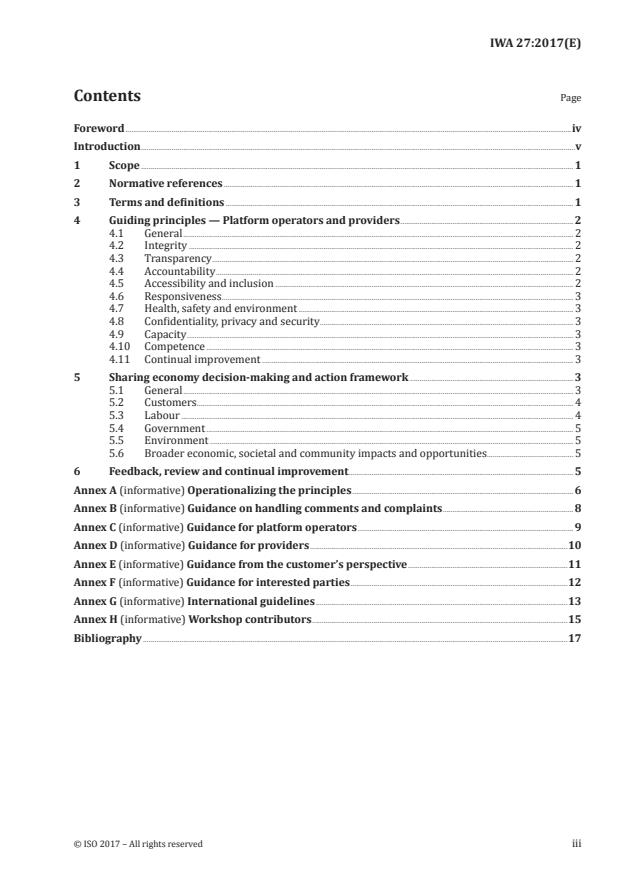
IWA 27:2017 - Guiding principles and framework for the sharing economy

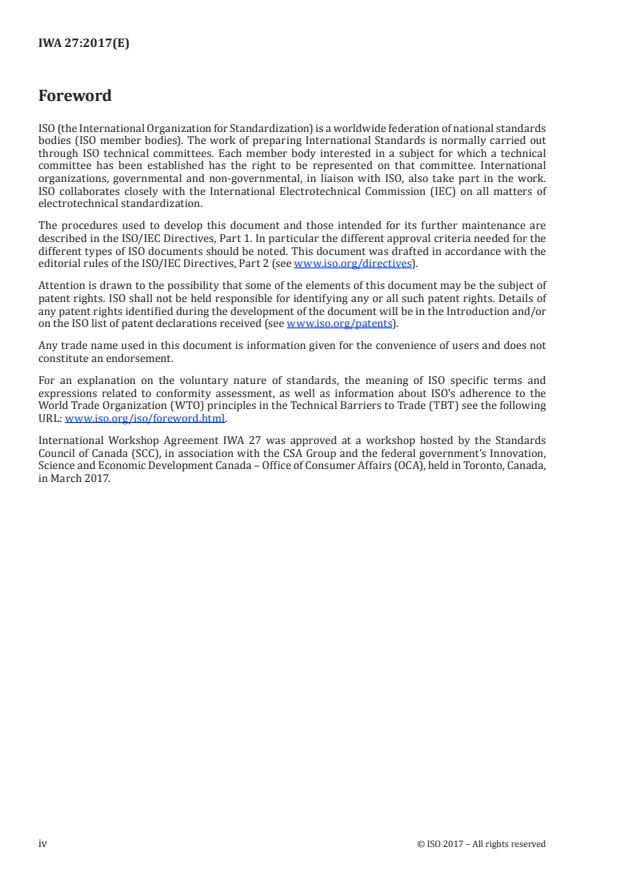
IWA 27:2017 - Guiding principles and framework for the sharing economy Released:9/18/2017
Frequently Asked Questions
IWA 27:2017 is a standard published by the International Organization for Standardization (ISO). Its full title is "Guiding principles and framework for the sharing economy". This standard covers: IWA27:2017 provides guiding principles and a framework for decision making and action to address key social, environmental, and economic impacts and opportunities of the sharing economy.
IWA27:2017 provides guiding principles and a framework for decision making and action to address key social, environmental, and economic impacts and opportunities of the sharing economy.
IWA 27:2017 is classified under the following ICS (International Classification for Standards) categories: 01.040.03 - Services. Company organization, management and quality. Administration. Transport. Sociology. (Vocabularies); 03.080.01 - Services in general; 35.020 - Information technology (IT) in general. The ICS classification helps identify the subject area and facilitates finding related standards.
You can purchase IWA 27:2017 directly from iTeh Standards. The document is available in PDF format and is delivered instantly after payment. Add the standard to your cart and complete the secure checkout process. iTeh Standards is an authorized distributor of ISO standards.
Standards Content (Sample)
INTERNATIONAL IWA
WORKSHOP 27
AGREEMENT
First edition
2017-09
Guiding principles and framework for
the sharing economy
Principes directeurs et cadre de travail pour l'économie du partage
Reference number
©
ISO 2017
© ISO 2017, Published in Switzerland
All rights reserved. Unless otherwise specified, no part of this publication may be reproduced or utilized otherwise in any form
or by any means, electronic or mechanical, including photocopying, or posting on the internet or an intranet, without prior
written permission. Permission can be requested from either ISO at the address below or ISO’s member body in the country of
the requester.
ISO copyright office
Ch. de Blandonnet 8 • CP 401
CH-1214 Vernier, Geneva, Switzerland
Tel. +41 22 749 01 11
Fax +41 22 749 09 47
copyright@iso.org
www.iso.org
ii © ISO 2017 – All rights reserved
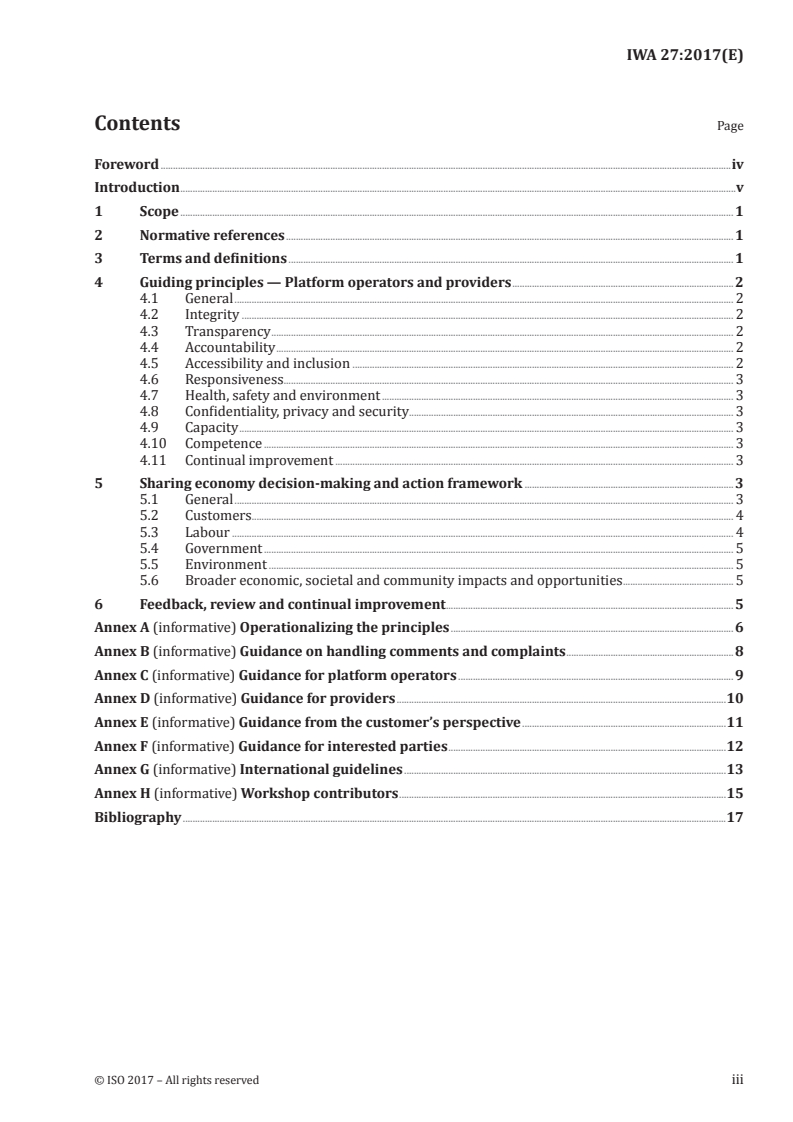
Contents Page
Foreword .iv
Introduction .v
1 Scope . 1
2 Normative references . 1
3 Terms and definitions . 1
4 Guiding principles — Platform operators and providers . 2
4.1 General . 2
4.2 Integrity . 2
4.3 Transparency . 2
4.4 Accountability . 2
4.5 Accessibility and inclusion . 2
4.6 Responsiveness . 3
4.7 Health, safety and environment . 3
4.8 Confidentiality, privacy and security. 3
4.9 Capacity . 3
4.10 Competence . 3
4.11 Continual improvement . 3
5 Sharing economy decision-making and action framework . 3
5.1 General . 3
5.2 Customers. 4
5.3 Labour . 4
5.4 Government . 5
5.5 Environment . 5
5.6 Broader economic, societal and community impacts and opportunities . 5
6 Feedback, review and continual improvement . 5
Annex A (informative) Operationalizing the principles . 6
Annex B (informative) Guidance on handling comments and complaints . 8
Annex C (informative) Guidance for platform operators . 9
Annex D (informative) Guidance for providers .10
Annex E (informative) Guidance from the customer’s perspective .11
Annex F (informative) Guidance for interested parties .12
Annex G (informative) International guidelines .13
Annex H (informative) Workshop contributors .15
Bibliography .17
Foreword
ISO (the International Organization for Standardization) is a worldwide federation of national standards
bodies (ISO member bodies). The work of preparing International Standards is normally carried out
through ISO technical committees. Each member body interested in a subject for which a technical
committee has been established has the right to be represented on that committee. International
organizations, governmental and non-governmental, in liaison with ISO, also take part in the work.
ISO collaborates closely with the International Electrotechnical Commission (IEC) on all matters of
electrotechnical standardization.
The procedures used to develop this document and those intended for its further maintenance are
described in the ISO/IEC Directives, Part 1. In particular the different approval criteria needed for the
different types of ISO documents should be noted. This document was drafted in accordance with the
editorial rules of the ISO/IEC Directives, Part 2 (see www.iso.org/directives).
Attention is drawn to the possibility that some of the elements of this document may be the subject of
patent rights. ISO shall not be held responsible for identifying any or all such patent rights. Details of
any patent rights identified during the development of the document will be in the Introduction and/or
on the ISO list of patent declarations received (see www.iso.org/patents).
Any trade name used in this document is information given for the convenience of users and does not
constitute an endorsement.
For an explanation on the voluntary nature of standards, the meaning of ISO specific terms and
expressions related to conformity assessment, as well as information about ISO's adherence to the
World Trade Organization (WTO) principles in the Technical Barriers to Trade (TBT) see the following
URL: www.iso.org/iso/foreword.html.
International Workshop Agreement IWA 27 was approved at a workshop hosted by the Standards
Council of Canada (SCC), in association with the CSA Group and the federal government’s Innovation,
Science and Economic Development Canada – Office of Consumer Affairs (OCA), held in Toronto, Canada,
in March 2017.
iv © ISO 2017 – All rights reserved
Introduction
A combination of technological and other factors have enabled the sharing economy. The rise in global
usage of mobile devices together with changing consumer behaviour are driving its growth. This
document provides principles and a practical implementation framework with the intention of making
participation in the sharing economy a positive experience for all interested and affected parties.
The activities associated with the sharing economy in some ways challenge traditional business
models. The sharing economy includes transactions for a fee or free, matching often-underused assets
and skills with customer needs, and can provide reserve capacity for managing impacts of planned and
unforeseen events. Customers and providers are typically unknown to one another and trust is often
initially absent. Sharing economy participants often use reviews, customized for specific products and
services and usually involving mutual ratings of providers and customers in addition to other trust-
building mechanisms, such as guarantees of compensation for non-conformance.
The sharing economy presents both opportunities and challenges:
— customers can find improved prices, options and social interaction, but question trustworthiness,
quality, safety, reliability and validity of online reviews;
— providers can welcome flexible work arrangements and access to new income opportunities, but face
challenges with respect to benefits, insurance, security and other economic and safety protections;
— platform providers can seek broader market access and economic opportunities, but can face
challenges with respect to meeting legal requirements while assuring technological reliability, data
integrity, securing customer privacy and safeguarding consumer rights;
— governments can welcome the broader contributions to economic growth, innovation and improved
social trust networks associated with the sharing economy, but can also need to formulate public
policy that is responsive to the changes associated with the sharing economy, develop new
taxation mechanisms, and address collateral disruptions and transformations affecting traditional
businesses; and
— other parties that are not directly involved in sharing economy activities can find the activities to
be socially disruptive, but can also find new opportunities and positive environmental impacts as
the sharing economy evolves.
This document is the result of an open and transparent multi-stakeholder process involving experts
from different countries representing a variety of different perspectives. It is a voluntary guidance
document intended for global use. This document, in its present or revised form, could also provide the
basis for a future ISO standard or for future private sector, institutional or government guidelines.
International Workshop Agreement IWA 27:2017(E)
Guiding principles and framework for the sharing economy
1 Scope
This document provides guiding principles and a framework for decision making and action to address
key social, environmental, and economic impacts and opportunities of the sharing economy.
2 Normative references
There are no normative references in this document.
3 Terms and definitions
For the purposes of this document, the following terms and definitions apply.
ISO and IEC maintain terminological databases for use in standardization at the following addresses:
— ISO Online browsing platform: available at https://www.iso.org/obp
— IEC Electropedia: available at http://www.electropedia.org/
3.1
sharing economy
form of economic activity where platforms (3.2) enable providers (3.4) and customers (3.5) to exchange,
often underutilized, goods and services using information technology
Note 1 to entry: It is
a) often peer-to-peer;
b) for a fee or for free;
c) often sequential use; and
d) mutually beneficial.
3.2
platform
information technology mechanisms that facilitate the ability for transactions to take place between
those who have assets and services and those who want to use those assets and services
3.3
platform operator
individual or entity that administers a sharing economy (3.1) platform (3.2)
3.4
provider
individual or entity that provides assets or services to customers (3.5) who want access to those assets
or services, using a sharing economy (3.1) platform (3.2)
3.5
customer
person or organization that uses a sharing economy (3.1) provider’s (3.4) assets or services
Note 1 to entry: For the purposes of this document, the term “customer” includes potential customers.
3.6
interested party
person or organization that can affect, be affected by, or perceive itself to be affected by a decision or
activity
4 Guiding principles — Platform operators and providers
4.1 General
In their activities associated with the sharing economy, platform operators and providers should adhere
to the following guiding principles:
a) integrity;
b) transparency;
c) accountability;
d) accessibility and inclusion;
e) responsiveness;
f) health, safety and environment;
g) confidentiality, privacy and security;
h) capacity;
i) competence; and
j) continual improvement.
NOTE 1 Guiding principles are also applicable to the relationship between platform operators and providers.
NOTE 2 See Annex A for guidance on operationalizing the principles.
4.2 Integrity
Decisions and activities are conducted in an honest, respectful and courteous manner, taking into
account the interests of customers, and are communicated accurately.
4.3 Transparency
Decisions and activities affecting customers and others are findable, usable, relevant, timely and
accurate to allow customers and others to make informed decisions.
4.4 Accountability
Decisions and activities and their impacts and opportunities with respect to customers and others are
open to scrutiny by governing bodies, legal authorities, and other interested parties.
4.5 Accessibility and inclusion
The products and services are available to the widest possible range of customers and others, fairly and
without discrimination contrary to human rights obligations.
2 © ISO 2017 – All rights reserved
4.6 Responsiveness
Decisions and activities are made in a culturally sensitive manner and reflect the evolving needs and
expectations of customers and others.
4.7 Health, safety and environment
The health and safety of customers and others and their environmental expectations are given priority
at the operational level.
4.8 Confidentiality, privacy and security
Personal information is treated in a confidential manner, respecting the privacy of the customer,
disclosing information to others only where the consent of the customer is provided, and that
information is stored in a secure manner.
4.9 Capacity
Resources provided are sufficient to carry out all their decisions and activities in an effective, efficient,
consistent, courteous and responsible manner.
4.10 Competence
Knowledge, skills and attributes and education training and experience permit decisions and activities
to be carried out in a responsible and effective manner reflecting the needs and interests of customers
and others.
4.11 Continual improvement
Decisions and activities lead to continual improvement in meeting the needs and interests of customers
and others.
5 Sharing economy decision-making and action framework
5.1 General
Platform operators and providers should structure and implement their activities in accordance with a
decision-making and action framework. The framework should include
a) commitments or codes of conduct to be communicated to customers and others affected by their
activities,
b) policies and processes for fair, effective and efficient operation and continuous evaluation of same,
c) mechanisms for ensuring compliance with commitments, policies and processes and related laws
and regulations,
d) approaches for selection and deployment of appropriate people, and adequate training, resourcing
for people and other activities,
e) approaches for obtaining feedback, and
f) complaints handling and dispute resolution.
NOTE 1 There could be a single decision-making and action framework that applies to both the platform
operator and its providers.
NOTE 2 See Annex B for guidance on handling comments and complaints.
The framework and its implementation should operate in accordance with the guiding principles and
address the following:
a) customers;
b) labour;
c) government;
d) environment;
e) broader economic, societal, and community impacts and opportunities.
5.2 Customers
Consideration should be given to the rights, protections, interests and expectations of customers, taking
into account applicable laws and regulations and international standards including those pertaining to:
a) consumer protection;
b) false and misleading advertising;
c) guarantees;
d) provision of insurance;
e) information disclosure expectations and requirements;
f) identity-related authentication;
g) pricing, taxation, charges and fees;
h) customer responsibilities;
i) personal information protections and financial information security;
j) health, safety, and environmental expectations and requirements;
k) non-discriminatory access and other anti-discrimination protections;
l) reputational information provision processes; and
m) complaints handling and dispute resolution, refunds, recalls.
NOTE With respect to these elements of the framework, a number of ISO standards can provide useful
guidance, including those in the ISO 9000 quality management series pertaining to customer satisfaction codes
of conduct (ISO 10001), complaints handling (ISO 10002), external dispute resolution (ISO 10003), business to
consumer electronic commerce (ISO 10008), and other ISO standards such as pertaining to online consumer
1)
reviews (ISO 20488 ), environmental management (ISO 14000), and ISO 26000 (social responsibility). See
Annex G for information on the scope of some of the ISO standards.
5.3 Labour
Consideration should be given to the rights, protections, interests and expectations of those providing
sharing economy activities (including employer-employee relationships, independent contractors, or
other), taking into account applicable laws and regulations and international norms concerning:
a) remuneration;
b) collective bargaining;
c) occupational health and safety protections;
1) To be published.
4 © ISO 2017 – All rights reserved
d) benefits and other protections;
e) anti-discrimi
...
INTERNATIONAL IWA
WORKSHOP 27
AGREEMENT
First edition
2017-09
Guiding principles and framework for
the sharing economy
Principes directeurs et cadre de travail pour l'économie du partage
Reference number
©
ISO 2017
© ISO 2017, Published in Switzerland
All rights reserved. Unless otherwise specified, no part of this publication may be reproduced or utilized otherwise in any form
or by any means, electronic or mechanical, including photocopying, or posting on the internet or an intranet, without prior
written permission. Permission can be requested from either ISO at the address below or ISO’s member body in the country of
the requester.
ISO copyright office
Ch. de Blandonnet 8 • CP 401
CH-1214 Vernier, Geneva, Switzerland
Tel. +41 22 749 01 11
Fax +41 22 749 09 47
copyright@iso.org
www.iso.org
ii © ISO 2017 – All rights reserved
Contents Page
Foreword .iv
Introduction .v
1 Scope . 1
2 Normative references . 1
3 Terms and definitions . 1
4 Guiding principles — Platform operators and providers . 2
4.1 General . 2
4.2 Integrity . 2
4.3 Transparency . 2
4.4 Accountability . 2
4.5 Accessibility and inclusion . 2
4.6 Responsiveness . 3
4.7 Health, safety and environment . 3
4.8 Confidentiality, privacy and security. 3
4.9 Capacity . 3
4.10 Competence . 3
4.11 Continual improvement . 3
5 Sharing economy decision-making and action framework . 3
5.1 General . 3
5.2 Customers. 4
5.3 Labour . 4
5.4 Government . 5
5.5 Environment . 5
5.6 Broader economic, societal and community impacts and opportunities . 5
6 Feedback, review and continual improvement . 5
Annex A (informative) Operationalizing the principles . 6
Annex B (informative) Guidance on handling comments and complaints . 8
Annex C (informative) Guidance for platform operators . 9
Annex D (informative) Guidance for providers .10
Annex E (informative) Guidance from the customer’s perspective .11
Annex F (informative) Guidance for interested parties .12
Annex G (informative) International guidelines .13
Annex H (informative) Workshop contributors .15
Bibliography .17
Foreword
ISO (the International Organization for Standardization) is a worldwide federation of national standards
bodies (ISO member bodies). The work of preparing International Standards is normally carried out
through ISO technical committees. Each member body interested in a subject for which a technical
committee has been established has the right to be represented on that committee. International
organizations, governmental and non-governmental, in liaison with ISO, also take part in the work.
ISO collaborates closely with the International Electrotechnical Commission (IEC) on all matters of
electrotechnical standardization.
The procedures used to develop this document and those intended for its further maintenance are
described in the ISO/IEC Directives, Part 1. In particular the different approval criteria needed for the
different types of ISO documents should be noted. This document was drafted in accordance with the
editorial rules of the ISO/IEC Directives, Part 2 (see www.iso.org/directives).
Attention is drawn to the possibility that some of the elements of this document may be the subject of
patent rights. ISO shall not be held responsible for identifying any or all such patent rights. Details of
any patent rights identified during the development of the document will be in the Introduction and/or
on the ISO list of patent declarations received (see www.iso.org/patents).
Any trade name used in this document is information given for the convenience of users and does not
constitute an endorsement.
For an explanation on the voluntary nature of standards, the meaning of ISO specific terms and
expressions related to conformity assessment, as well as information about ISO's adherence to the
World Trade Organization (WTO) principles in the Technical Barriers to Trade (TBT) see the following
URL: www.iso.org/iso/foreword.html.
International Workshop Agreement IWA 27 was approved at a workshop hosted by the Standards
Council of Canada (SCC), in association with the CSA Group and the federal government’s Innovation,
Science and Economic Development Canada – Office of Consumer Affairs (OCA), held in Toronto, Canada,
in March 2017.
iv © ISO 2017 – All rights reserved
Introduction
A combination of technological and other factors have enabled the sharing economy. The rise in global
usage of mobile devices together with changing consumer behaviour are driving its growth. This
document provides principles and a practical implementation framework with the intention of making
participation in the sharing economy a positive experience for all interested and affected parties.
The activities associated with the sharing economy in some ways challenge traditional business
models. The sharing economy includes transactions for a fee or free, matching often-underused assets
and skills with customer needs, and can provide reserve capacity for managing impacts of planned and
unforeseen events. Customers and providers are typically unknown to one another and trust is often
initially absent. Sharing economy participants often use reviews, customized for specific products and
services and usually involving mutual ratings of providers and customers in addition to other trust-
building mechanisms, such as guarantees of compensation for non-conformance.
The sharing economy presents both opportunities and challenges:
— customers can find improved prices, options and social interaction, but question trustworthiness,
quality, safety, reliability and validity of online reviews;
— providers can welcome flexible work arrangements and access to new income opportunities, but face
challenges with respect to benefits, insurance, security and other economic and safety protections;
— platform providers can seek broader market access and economic opportunities, but can face
challenges with respect to meeting legal requirements while assuring technological reliability, data
integrity, securing customer privacy and safeguarding consumer rights;
— governments can welcome the broader contributions to economic growth, innovation and improved
social trust networks associated with the sharing economy, but can also need to formulate public
policy that is responsive to the changes associated with the sharing economy, develop new
taxation mechanisms, and address collateral disruptions and transformations affecting traditional
businesses; and
— other parties that are not directly involved in sharing economy activities can find the activities to
be socially disruptive, but can also find new opportunities and positive environmental impacts as
the sharing economy evolves.
This document is the result of an open and transparent multi-stakeholder process involving experts
from different countries representing a variety of different perspectives. It is a voluntary guidance
document intended for global use. This document, in its present or revised form, could also provide the
basis for a future ISO standard or for future private sector, institutional or government guidelines.
International Workshop Agreement IWA 27:2017(E)
Guiding principles and framework for the sharing economy
1 Scope
This document provides guiding principles and a framework for decision making and action to address
key social, environmental, and economic impacts and opportunities of the sharing economy.
2 Normative references
There are no normative references in this document.
3 Terms and definitions
For the purposes of this document, the following terms and definitions apply.
ISO and IEC maintain terminological databases for use in standardization at the following addresses:
— ISO Online browsing platform: available at https://www.iso.org/obp
— IEC Electropedia: available at http://www.electropedia.org/
3.1
sharing economy
form of economic activity where platforms (3.2) enable providers (3.4) and customers (3.5) to exchange,
often underutilized, goods and services using information technology
Note 1 to entry: It is
a) often peer-to-peer;
b) for a fee or for free;
c) often sequential use; and
d) mutually beneficial.
3.2
platform
information technology mechanisms that facilitate the ability for transactions to take place between
those who have assets and services and those who want to use those assets and services
3.3
platform operator
individual or entity that administers a sharing economy (3.1) platform (3.2)
3.4
provider
individual or entity that provides assets or services to customers (3.5) who want access to those assets
or services, using a sharing economy (3.1) platform (3.2)
3.5
customer
person or organization that uses a sharing economy (3.1) provider’s (3.4) assets or services
Note 1 to entry: For the purposes of this document, the term “customer” includes potential customers.
3.6
interested party
person or organization that can affect, be affected by, or perceive itself to be affected by a decision or
activity
4 Guiding principles — Platform operators and providers
4.1 General
In their activities associated with the sharing economy, platform operators and providers should adhere
to the following guiding principles:
a) integrity;
b) transparency;
c) accountability;
d) accessibility and inclusion;
e) responsiveness;
f) health, safety and environment;
g) confidentiality, privacy and security;
h) capacity;
i) competence; and
j) continual improvement.
NOTE 1 Guiding principles are also applicable to the relationship between platform operators and providers.
NOTE 2 See Annex A for guidance on operationalizing the principles.
4.2 Integrity
Decisions and activities are conducted in an honest, respectful and courteous manner, taking into
account the interests of customers, and are communicated accurately.
4.3 Transparency
Decisions and activities affecting customers and others are findable, usable, relevant, timely and
accurate to allow customers and others to make informed decisions.
4.4 Accountability
Decisions and activities and their impacts and opportunities with respect to customers and others are
open to scrutiny by governing bodies, legal authorities, and other interested parties.
4.5 Accessibility and inclusion
The products and services are available to the widest possible range of customers and others, fairly and
without discrimination contrary to human rights obligations.
2 © ISO 2017 – All rights reserved
4.6 Responsiveness
Decisions and activities are made in a culturally sensitive manner and reflect the evolving needs and
expectations of customers and others.
4.7 Health, safety and environment
The health and safety of customers and others and their environmental expectations are given priority
at the operational level.
4.8 Confidentiality, privacy and security
Personal information is treated in a confidential manner, respecting the privacy of the customer,
disclosing information to others only where the consent of the customer is provided, and that
information is stored in a secure manner.
4.9 Capacity
Resources provided are sufficient to carry out all their decisions and activities in an effective, efficient,
consistent, courteous and responsible manner.
4.10 Competence
Knowledge, skills and attributes and education training and experience permit decisions and activities
to be carried out in a responsible and effective manner reflecting the needs and interests of customers
and others.
4.11 Continual improvement
Decisions and activities lead to continual improvement in meeting the needs and interests of customers
and others.
5 Sharing economy decision-making and action framework
5.1 General
Platform operators and providers should structure and implement their activities in accordance with a
decision-making and action framework. The framework should include
a) commitments or codes of conduct to be communicated to customers and others affected by their
activities,
b) policies and processes for fair, effective and efficient operation and continuous evaluation of same,
c) mechanisms for ensuring compliance with commitments, policies and processes and related laws
and regulations,
d) approaches for selection and deployment of appropriate people, and adequate training, resourcing
for people and other activities,
e) approaches for obtaining feedback, and
f) complaints handling and dispute resolution.
NOTE 1 There could be a single decision-making and action framework that applies to both the platform
operator and its providers.
NOTE 2 See Annex B for guidance on handling comments and complaints.
The framework and its implementation should operate in accordance with the guiding principles and
address the following:
a) customers;
b) labour;
c) government;
d) environment;
e) broader economic, societal, and community impacts and opportunities.
5.2 Customers
Consideration should be given to the rights, protections, interests and expectations of customers, taking
into account applicable laws and regulations and international standards including those pertaining to:
a) consumer protection;
b) false and misleading advertising;
c) guarantees;
d) provision of insurance;
e) information disclosure expectations and requirements;
f) identity-related authentication;
g) pricing, taxation, charges and fees;
h) customer responsibilities;
i) personal information protections and financial information security;
j) health, safety, and environmental expectations and requirements;
k) non-discriminatory access and other anti-discrimination protections;
l) reputational information provision processes; and
m) complaints handling and dispute resolution, refunds, recalls.
NOTE With respect to these elements of the framework, a number of ISO standards can provide useful
guidance, including those in the ISO 9000 quality management series pertaining to customer satisfaction codes
of conduct (ISO 10001), complaints handling (ISO 10002), external dispute resolution (ISO 10003), business to
consumer electronic commerce (ISO 10008), and other ISO standards such as pertaining to online consumer
1)
reviews (ISO 20488 ), environmental management (ISO 14000), and ISO 26000 (social responsibility). See
Annex G for information on the scope of some of the ISO standards.
5.3 Labour
Consideration should be given to the rights, protections, interests and expectations of those providing
sharing economy activities (including employer-employee relationships, independent contractors, or
other), taking into account applicable laws and regulations and international norms concerning:
a) remuneration;
b) collective bargaining;
c) occupational health and safety protections;
1) To be published.
4 © ISO 2017 – All rights reserved
d) benefits and other protections;
e) anti-discrimi
...
Questions, Comments and Discussion
Ask us and Technical Secretary will try to provide an answer. You can facilitate discussion about the standard in here.
Loading comments...