

ISO 7685:2026
(Main)Glass-reinforced thermosetting plastics (GRP) pipes — Determination of initial ring stiffness
General Information
- Abstract
This document specifies methods for determining the initial ring stiffness of glass-reinforced thermosetting plastics (GRP) pipes. Two methods are given (constant load and constant deflection), and within the specified deflection limits, each is equally valid and can be used for any diameter.
- Status
- Published
- Publication Date
- 06-Jan-2026
- Drafting Committee
- ISO/TC 138/SC 6/WG 1 - Methods of test
- Current Stage
- 6060 - International Standard published
- Start Date
- 07-Jan-2026
- Due Date
- 15-May-2026
- Completion Date
- 07-Jan-2026

Overview
ISO 7685:2026 sets forth standardized methods for determining the initial ring stiffness of glass-reinforced thermosetting plastics (GRP) pipes. Developed by the International Organization for Standardization (ISO), this international standard is essential for ensuring the structural integrity and mechanical performance of GRP pipes used in a wide range of piping systems. The two test methods specified - constant load and constant deflection - are equally valid within defined deflection limits and suitable for any pipe diameter. This standard is relevant to manufacturers, testing laboratories, regulatory bodies, and end-users concerned with GRP pipe quality and compliance.
Key Topics
- Initial Ring Stiffness: Defined as the measure of a GRP pipe’s resistance to diametric deflection under an external load, serving as a primary indicator of structural performance.
- Test Methods:
- Method A (Constant Load): Applies a steady load to achieve a specific relative deflection, maintaining the load to observe final deflection.
- Method B (Constant Deflection): Applies a load until a specific deflection is reached and maintains the deflection to observe final load.
- Test Setup and Apparatus: Details on compressive-loading machines, load application surfaces (plates and beam bars), and calibration requirements for measuring instruments.
- Test Piece Preparation: Procedures for cutting, marking, and measuring pipe samples, addressing internal and external diameters and wall thickness in accordance with ISO 3126.
- Calculation and Reporting: Formulas for calculating ring stiffness, requirements for averaging results from multiple positions, and specifications for reporting test data.
Applications
ISO 7685:2026 is widely applicable in sectors where glass-reinforced thermosetting plastics (GRP) pipes are integral to operations:
- Quality Assurance and Manufacturing: Ensures GRP pipe products meet defined stiffness requirements for safe and durable performance.
- Infrastructure and Construction: Applicable in water and wastewater transportation, chemical processing, and industrial fluid handling systems where pipe rigidity is critical.
- Product Certification and Regulatory Compliance: Facilitates third-party validation of pipe products for compliance with international performance benchmarks.
- Research and Development: Provides a reference test method for comparative analysis and innovation in reinforced plastics pipe design.
By offering two recognized test methods for initial ring stiffness, this standard allows flexibility for testing laboratories and manufacturers, ensuring results are consistent and reproducible across different pipe diameters and geographic regions.
Related Standards
To ensure comprehensive testing and compatibility in plastics piping systems, users of ISO 7685:2026 may also reference:
- ISO 3126: Plastics piping systems - Plastics components - Determination of dimensions. Required for mastering measurement techniques for test sample dimensions referenced in ISO 7685.
- ISO 9969: Thermoplastics pipes - Determination of ring stiffness. For similar testing methods applied to thermoplastics, facilitating comparative analysis with GRP products.
These related standards ensure a robust framework for assessing physical and mechanical properties of plastic-based piping solutions across multiple industries.
Keywords: ISO 7685, initial ring stiffness, GRP pipes, glass-reinforced thermosetting plastics, pipe testing standard, structural rigidity, constant load method, constant deflection method, pipe quality control, plastics standards, ISO pipe standards.
Relations
- Effective Date
- 18-May-2024
Get Certified
Connect with accredited certification bodies for this standard

Institut za varilstvo d.o.o. (Welding Institute)
Slovenia's leading welding institute since 1952. ISO 3834, EN 1090, pressure equipment certification, NDT personnel, welder qualification. Only IIW Au
Sponsored listings
Frequently Asked Questions
ISO 7685:2026 is a standard published by the International Organization for Standardization (ISO). Its full title is "Glass-reinforced thermosetting plastics (GRP) pipes — Determination of initial ring stiffness". This standard covers: This document specifies methods for determining the initial ring stiffness of glass-reinforced thermosetting plastics (GRP) pipes. Two methods are given (constant load and constant deflection), and within the specified deflection limits, each is equally valid and can be used for any diameter.
This document specifies methods for determining the initial ring stiffness of glass-reinforced thermosetting plastics (GRP) pipes. Two methods are given (constant load and constant deflection), and within the specified deflection limits, each is equally valid and can be used for any diameter.
ISO 7685:2026 is classified under the following ICS (International Classification for Standards) categories: 23.040.20 - Plastics pipes. The ICS classification helps identify the subject area and facilitates finding related standards.
ISO 7685:2026 has the following relationships with other standards: It is inter standard links to ISO 7685:2019. Understanding these relationships helps ensure you are using the most current and applicable version of the standard.
ISO 7685:2026 is available in PDF format for immediate download after purchase. The document can be added to your cart and obtained through the secure checkout process. Digital delivery ensures instant access to the complete standard document.
Standards Content (Sample)
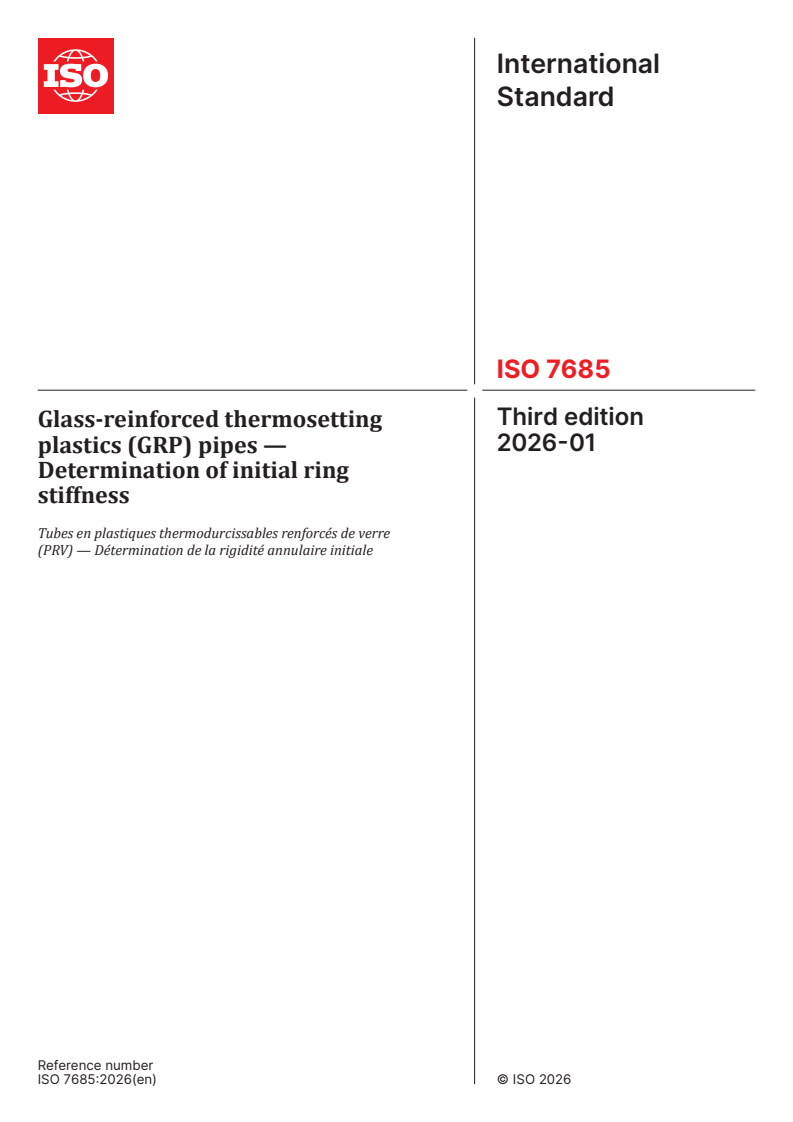
International
Standard
ISO 7685
Third edition
Glass-reinforced thermosetting
2026-01
plastics (GRP) pipes —
Determination of initial ring
stiffness
Tubes en plastiques thermodurcissables renforcés de verre
(PRV) — Détermination de la rigidité annulaire initiale
Reference number
© ISO 2026
All rights reserved. Unless otherwise specified, or required in the context of its implementation, no part of this publication may
be reproduced or utilized otherwise in any form or by any means, electronic or mechanical, including photocopying, or posting on
the internet or an intranet, without prior written permission. Permission can be requested from either ISO at the address below
or ISO’s member body in the country of the requester.
ISO copyright office
CP 401 • Ch. de Blandonnet 8
CH-1214 Vernier, Geneva
Phone: +41 22 749 01 11
Email: copyright@iso.org
Website: www.iso.org
Published in Switzerland
ii
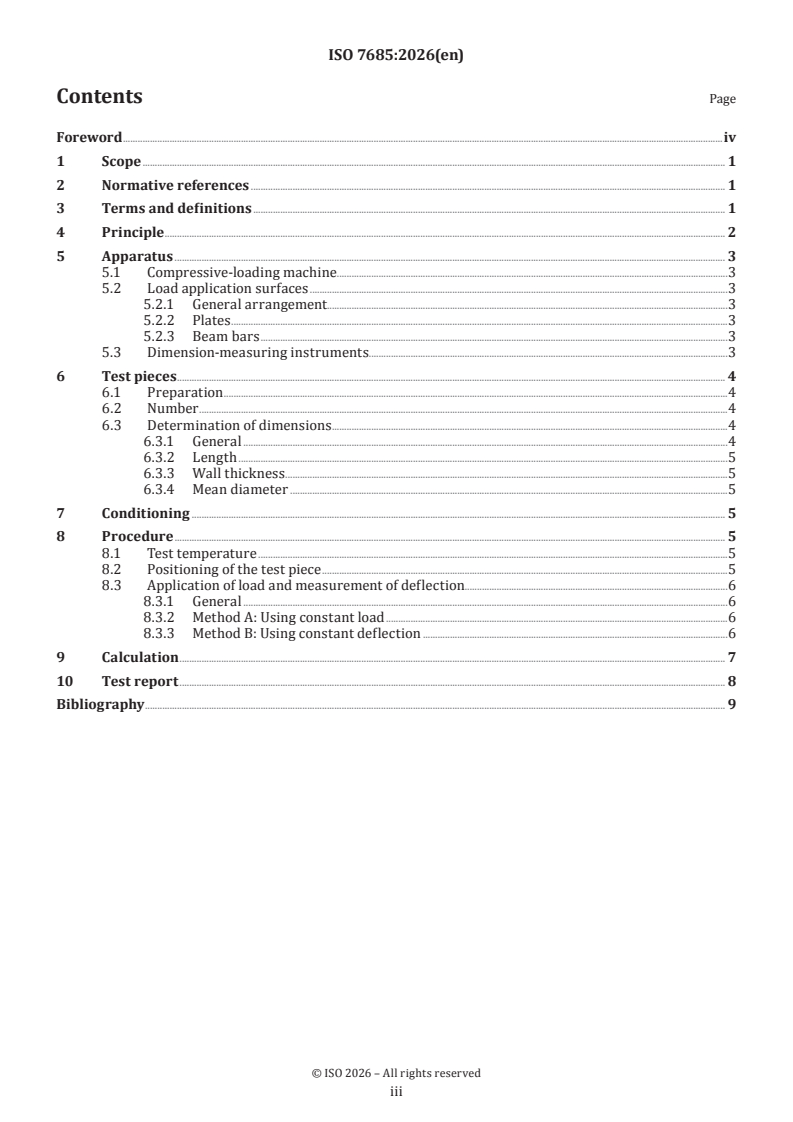
Contents Page
Foreword .iv
1 Scope . 1
2 Normative references . 1
3 Terms and definitions . 1
4 Principle . 2
5 Apparatus . 3
5.1 Compressive-loading machine . .3
5.2 Load application surfaces .3
5.2.1 General arrangement.3
5.2.2 Plates .3
5.2.3 Beam bars .3
5.3 Dimension-measuring instruments.3
6 Test pieces . 4
6.1 Preparation .4
6.2 Number .4
6.3 Determination of dimensions .4
6.3.1 General .4
6.3.2 Length .5
6.3.3 Wall thickness .5
6.3.4 Mean diameter .5
7 Conditioning . 5
8 Procedure . 5
8.1 Test temperature .5
8.2 Positioning of the test piece .5
8.3 Application of load and measurement of deflection.6
8.3.1 General .6
8.3.2 Method A: Using constant load .6
8.3.3 Method B: Using constant deflection .6
9 Calculation . 7
10 Test report . 8
Bibliography . 9
iii
Foreword
ISO (the International Organization for Standardization) is a worldwide federation of national standards
bodies (ISO member bodies). The work of preparing International Standards is normally carried out through
ISO technical committees. Each member body interested in a subject for which a technical committee
has been established has the right to be represented on that committee. International organizations,
governmental and non-governmental, in liaison with ISO, also take part in the work. ISO collaborates closely
with the International Electrotechnical Commission (IEC) on all matters of electrotechnical standardization.
The procedures used to develop this document and those intended for its further maintenance are described
in the ISO/IEC Directives, Part 1. In particular, the different approval criteria needed for the different types
of ISO document should be noted. This document was drafted in accordance with the editorial rules of the
ISO/IEC Directives, Part 2 (see www.iso.org/directives).
ISO draws attention to the possibility that the implementation of this document may involve the use of (a)
patent(s). ISO takes no position concerning the evidence, validity or applicability of any claimed patent
rights in respect thereof. As of the date of publication of this document, ISO had not received notice of (a)
patent(s) which may be required to implement this document. However, implementers are cautioned that
this may not represent the latest information, which may be obtained from the patent database available at
www.iso.org/patents. ISO shall not be held responsible for identifying any or all such patent rights.
Any trade name used in this document is information given for the convenience of users and does not
constitute an endorsement.
For an explanation of the voluntary nature of standards, the meaning of ISO specific terms and expressions
related to conformity assessment, as well as information about ISO's adherence to the World Trade
Organization (WTO) principles in the Technical Barriers to Trade (TBT), see www.iso.org/iso/foreword.html.
This document was prepared by Technical Committee ISO/TC 138, Plastics pipes, fittings and valves for the
transport of fluids, Subcommittee SC 6, Reinforced plastics pipes and fittings for all applications.
This third edition cancels and replaces the second edition (ISO 7685:2019), which has been technically
revised.
The main changes are as follows:
— the formula for the definition of the mean diameter has been corrected;
— Notes have been added in 8.3.2 and 8.3.3.
Any feedback or questions on this document should be directed to the user’s national standards body. A
complete listing of these bodies can be found at www.iso.org/members.html.
iv
International Standard ISO 7685:2026(en)
Glass-reinforced thermosetting plastics (GRP) pipes —
Determination of initial ring stiffness
1 Scope
This document specifies methods for determining the initial ring stiffness of glass-reinforced thermosetting
plastics (GRP) pipes. Two methods are given (constant load and constant deflection), and within the specified
deflection limits, each is equally valid and can be used for any diameter.
2 Normative references
The following documents are referred to in the text in such a way that some or all of their content constitutes
requirements of this document. For dated references, only the edition cited applies. For undated references,
the latest edition of the referenced document (including any amendments) applies.
ISO 3126, Plastics piping systems — Plastics components — Determination of dimensions
3 Terms and definitions
For the purposes of this document, the following terms and definitions apply.
ISO and IEC maintain terminology databases for use in standardization at the following addresses:
— ISO Online browsing platform: available at https:// www .iso .org/ obp
— IEC Electropedia: available at http:// www .electropedia .org/
3.1
compressive load
F
load applied to a pipe to cause a diametric deflection
Note 1 to entry: Compressive load is expressed in newtons (N).
3.2
vertical deflection
y
vertical change in diameter of a pipe in a horizontal position in response to a vertical compressive load (3.1)
Note 1 to entry: Vertical deflection is expressed in metres (m).
3.3
relative vertical deflection
y/d
m
ratio of the vertical deflection, y (3.2), to the mean diame
...