

ISO 8458-3:2026
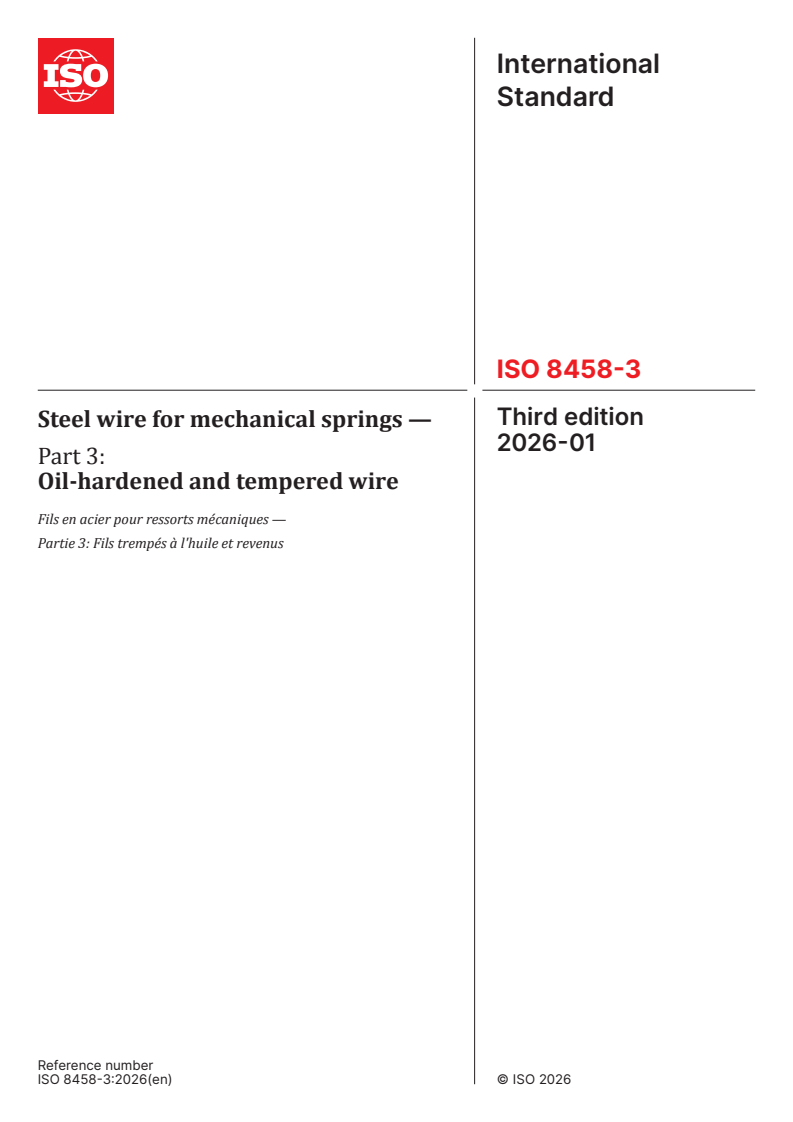
(Main)Steel wire for mechanical springs — Part 3: Oil-hardened and tempered wire
General Information
- Abstract
This document specifies requirements for oil-hardened and tempered carbon and low alloy steel wire, for the manufacture of mechanical springs for static duty and dynamic duty applications, in accordance with the general requirements of ISO 8458-1.
- Status
- Published
- Publication Date
- 22-Jan-2026
- Technical Committee
- ISO/TC 17/SC 17 - Steel wire rod and wire products
- Drafting Committee
- ISO/TC 17/SC 17 - Steel wire rod and wire products
- Current Stage
- 6060 - International Standard published
- Start Date
- 23-Jan-2026
- Due Date
- 23-Dec-2026
- Completion Date
- 23-Jan-2026

Overview
ISO 8458-3:2026 specifies the requirements for oil-hardened and tempered steel wire made from carbon and low alloy steels, designed for the production of mechanical springs. This international standard covers wire intended for both static duty and dynamic duty applications, ensuring consistent quality and performance for spring manufacturers. The requirements outlined align with the general provisions in ISO 8458-1, providing a comprehensive framework for wire used in automotive, industrial, and general engineering applications.
Key Topics
- Scope of Application: Covers oil-hardened and tempered carbon and low alloy steel wire, focusing on wire for mechanical springs with static and dynamic loading.
- Grades and Classification: Specifies grades for varying applications:
- FD (for static duty)
- TD (for medium fatigue)
- VD (for high fatigue, such as valve springs)
- Diameter Range: Wire diameters from 0.50 mm up to 17.00 mm, depending on application and grade.
- Chemical Composition: Outlines composition requirements (carbon, silicon, manganese, phosphorus, sulfur, chromium, vanadium, copper).
- Surface Quality: Defines maximum permissible surface discontinuities and the need for smooth wire surfaces.
- Mechanical Properties: Establishes tensile strength ranges, reduction of area, and mandates tests for mechanical reliability, including wrapping, torsion, bend, and coiling tests.
- Inspection and Testing: Details test frequency, methods (such as eddy current testing for VD grades), and acceptance criteria to verify chemical, structural, and mechanical consistency.
Applications
- Automotive Industry: Used in the production of suspension springs, valve springs, and clutch springs, where consistent fatigue performance is critical.
- Industrial Machinery: Applied in load-bearing, resilient elements including actuators and vibration isolators.
- General Engineering: Essential for the manufacture of a wide range of mechanical springs found in tools, assemblies, and appliances.
- Static and Dynamic Springs: FD grades for non-cyclic (static) loads, TD grades where moderate fatigue life is needed, and VD grades for high-cycle, dynamically stressed components.
- Customization & Quality Control: Manufacturers and designers rely on this standard to select appropriate wire grades, ensure uniform mechanical properties, and meet precise dimensional and surface requirements.
Related Standards
- ISO 8458-1: Steel wire for mechanical springs - General requirements (foundation for all related spring wire standards).
- ISO 4967: Steel - Determination of content of non-metallic inclusions - Reference for quality assessment.
- Other ISO 8458 Parts: Covers unalloyed, non-oil-hardened wires and associated specifications for a comprehensive spring wire standardization.
- ISO/IEC Directives: Governs the editorial and procedural framework for ISO standards, ensuring global harmonization.
By implementing ISO 8458-3:2026, manufacturers and end-users benefit from a harmonized approach to spring wire quality, fostering global trade and technical compatibility. Compliance ensures that products deliver long-lasting performance and safety, essential for high-stress engineering environments.
Relations
- Effective Date
- 28-Jun-2025
Get Certified
Connect with accredited certification bodies for this standard

Element Materials Technology
Materials testing and product certification.

Inštitut za kovinske materiale in tehnologije
Institute of Metals and Technology. Materials testing, metallurgical analysis, NDT.
Sponsored listings
Frequently Asked Questions
ISO 8458-3:2026 is a standard published by the International Organization for Standardization (ISO). Its full title is "Steel wire for mechanical springs — Part 3: Oil-hardened and tempered wire". This standard covers: This document specifies requirements for oil-hardened and tempered carbon and low alloy steel wire, for the manufacture of mechanical springs for static duty and dynamic duty applications, in accordance with the general requirements of ISO 8458-1.
This document specifies requirements for oil-hardened and tempered carbon and low alloy steel wire, for the manufacture of mechanical springs for static duty and dynamic duty applications, in accordance with the general requirements of ISO 8458-1.
ISO 8458-3:2026 is classified under the following ICS (International Classification for Standards) categories: 77.140.25 - Spring steels. The ICS classification helps identify the subject area and facilitates finding related standards.
ISO 8458-3:2026 has the following relationships with other standards: It is inter standard links to ISO 8458-3:2002. Understanding these relationships helps ensure you are using the most current and applicable version of the standard.
ISO 8458-3:2026 is available in PDF format for immediate download after purchase. The document can be added to your cart and obtained through the secure checkout process. Digital delivery ensures instant access to the complete standard document.
Standards Content (Sample)
International
Standard
ISO 8458-3
Third edition
Steel wire for mechanical springs —
2026-01
Part 3:
Oil-hardened and tempered wire
Fils en acier pour ressorts mécaniques —
Partie 3: Fils trempés à l'huile et revenus
Reference number
© ISO 2026
All rights reserved. Unless otherwise specified, or required in the context of its implementation, no part of this publication may
be reproduced or utilized otherwise in any form or by any means, electronic or mechanical, including photocopying, or posting on
the internet or an intranet, without prior written permission. Permission can be requested from either ISO at the address below
or ISO’s member body in the country of the requester.
ISO copyright office
CP 401 • Ch. de Blandonnet 8
CH-1214 Vernier, Geneva
Phone: +41 22 749 01 11
Email: copyright@iso.org
Website: www.iso.org
Published in Switzerland
ii
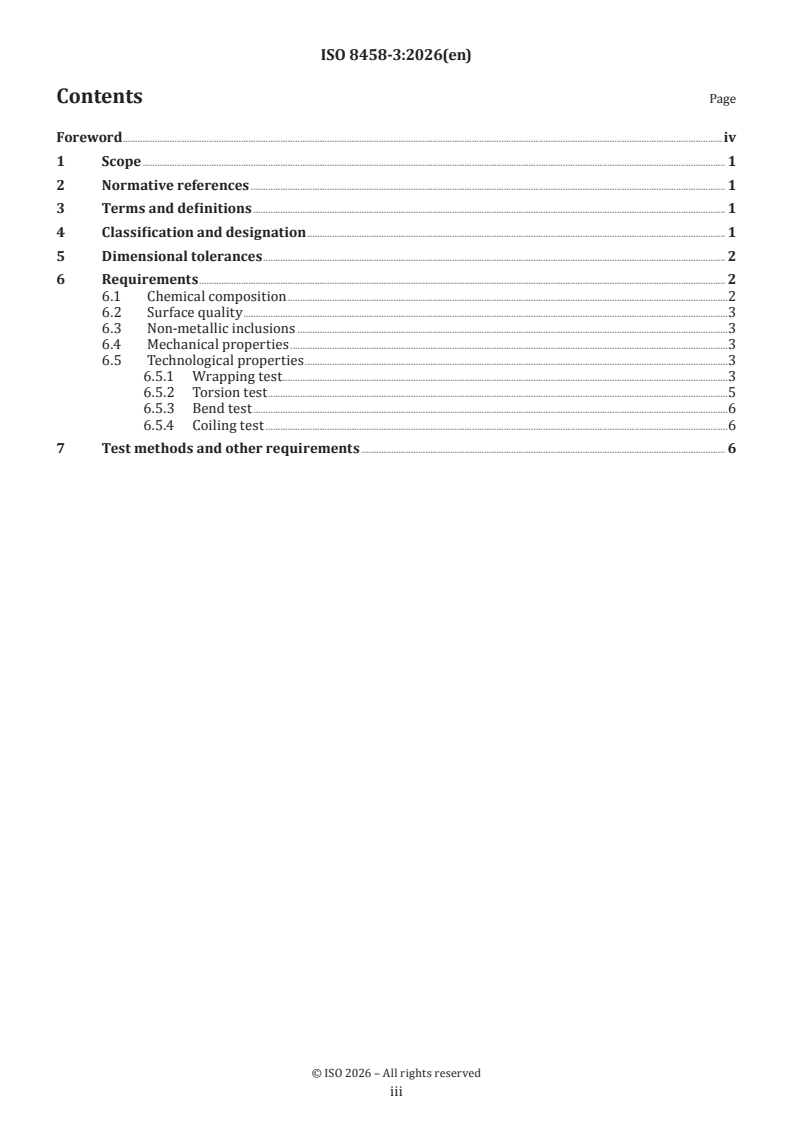
Contents Page
Foreword .iv
1 Scope . 1
2 Normative references . 1
3 Terms and definitions . 1
4 Classification and designation . 1
5 Dimensional tolerances . 2
6 Requirements . 2
6.1 Chemical composition .2
6.2 Surface quality .3
6.3 Non-metallic inclusions .3
6.4 Mechanical properties .3
6.5 Technological properties .3
6.5.1 Wrapping test .3
6.5.2 Torsion test .5
6.5.3 Bend test .6
6.5.4 Coiling test .6
7 Test methods and other requirements . 6
iii
Foreword
ISO (the International Organization for Standardization) is a worldwide federation of national standards
bodies (ISO member bodies). The work of preparing International Standards is normally carried out through
ISO technical committees. Each member body interested in a subject for which a technical committee
has been established has the right to be represented on that committee. International organizations,
governmental and non-governmental, in liaison with ISO, also take part in the work. ISO collaborates closely
with the International Electrotechnical Commission (IEC) on all matters of electrotechnical standardization.
The procedures used to develop this document and those intended for its further maintenance are described
in the ISO/IEC Directives, Part 1. In particular, the different approval criteria needed for the different types
of ISO document should be noted. This document was drafted in accordance with the editorial rules of the
ISO/IEC Directives, Part 2 (see www.iso.org/directives).
ISO draws attention to the possibility that the implementation of this document may involve the use of (a)
patent(s). ISO takes no position concerning the evidence, validity or applicability of any claimed patent
rights in respect thereof. As of the date of publication of this document, ISO had not received notice of (a)
patent(s) which may be required to implement this document. However, implementers are cautioned that
this may not represent the latest information, which may be obtained from the patent database available at
www.iso.org/patents. ISO shall not be held responsible for identifying any or all such patent rights.
Any trade name used in this document is information given for the convenience of users and does not
constitute an endorsement.
For an explanation of the voluntary nature of standards, the meaning of ISO specific terms and expressions
related to conformity assessment, as well as information about ISO's adherence to the World Trade
Organization (WTO) principles in the Technical Barriers to Trade (TBT), see www.iso.org/iso/foreword.html.
This document was prepared by Technical Committee ISO/TC 17, Steel, Subcommittee SC 17, Steel wire rod
and wire products.
This third edition cancels and replaces the second edition (ISO 8458-3:2002), of which it constitutes a minor
revision.
The changes are as follows:
— the normative references have been updated;
— the structure of the document has been updated in accordance with the latest ISO/IEC Directives, Part 2.
A list of all parts in the ISO 8458 series can be found on the ISO website.
Any feedback or questions on this document should be directed to the user’s national standards body. A
complete listing of these bodies can be found at www.iso.org/members.html.
iv
International Standard ISO 8458-3:2026(en)
Steel wire for mechanical springs —
Part 3:
Oil-hardened and tempered wire
1 Scope
This document specifies requirements for oil-hardened and tempered carbon and low alloy steel wire, for
the manufacture of mechanical springs for static duty and dynamic duty applications, in accordance with
the general requirements of ISO 8458-1.
2 Normative references
The following documents are referred to in the text in such a way that some or all of their content constitutes
requirements of this document. For dated references, only the edition cited applies. For undated references,
the latest edition of the referenced document (including any amendments) applies.
ISO 4967, Steel — Determination of content of non-metallic inclusions — Micrographic method using standard
diagrams
ISO 8458-1, Steel wire for mechanical springs — Part 1: General requirements
3 Terms and definitions
For the purposes of this document, the terms and definitions given in ISO 8458-1 apply.
ISO and IEC maintain terminology databases for use in standardization at the following addresses:
— ISO Online browsing platform: available at https:// www .iso .org/ obp
— IEC Electropedia: available at https:// www .electropedia .org/
4 Classification and designation
The various spring wire grades and the relevant diameters are shown in Table 1.
Table 1 — Spring wire grades and diameter ranges
Tensile strength Static Medium fatigue High fatigue
Low tensile strength FDC TDC VDC
Medium tensile strength FDCrV(A.B) TDCrV(A.B) VDCrV(A.B)
High tensile strength FDSiCr TDSiCr VDSiCr
Diameter range (mm) 0,50 to 17,00 0,50 to 10,00 0,50 to 10,00
FD grade is intended for static applications, required for normal springs.
TD grade is intended for medium fatigue levels.
VD grade is intended for use under severe dynamic duty such as for valve springs.
5 Dimensional tolerances
The permissible dimensional tolerances on wire in coils and cut lengths shall be in accordance with those
specified in ISO 8458-1.
When the required tolerance level is different from those mentioned above, it shall be agreed at the time of
ordering.
6 Requirements
6.1 Chemical composition
The steel is characterized by the heat analysis, which shall be in accordance with the values listed in Table 2.
The permissible deviation of the product analysis from the heat analysis shall be in accordance with Table 3.
Table 2 — Chemical composition, mass fraction
Values in percent
Grade C Si Mn P S Cr V Cu max.
max. max.
FDC 0,60 to 0,75 0,10 to 0,35 0,50 to 1,20 0,030 0,030 — — 0,20
TDC 0,60 to 0,75 0,10 to 0,35 0,50 to 1,20 0,020 0,025 — — 0,12
VDC 0,60 to 0,75 0,15 to 0,30 0,50 to 1,00 0,020 0,025 — — 0,12
FDCrV-A 0,030 0,030 0,20
TDCrV-A 0,47 to 0,55 0,10 to 0,40 0,60 to 1,20 0,025 0,025 0,80 to 1,10 0,15 to 0,25 0,12
VDCrV-A 0,025 0,025 0,12
FDCrV-B 0,030 0,030 0,20
TDCrV-B 0,62 to 0,72 0,15 to 0,30 0,50 to 0,90 0,025 0,025 0,40 to 0,60 0,15 to 0,25 0,12
VDCrV-B 0,025 0,025 0,12
FDSiCr 0,030 0,030 0,20
TDSiCr 0,50 to 0,60 1,20 to 1,60 0,50 to 0,90 0,025 0,025 0,50 to 0,80 — 0,12
VDSiCr 0,025 0,025 0,12
Table 3 — Permissible deviation of the product analysis from the limiting values for the heat
analysis
Chemical element Wire grade Permissible deviation, % by mass
C All ± 0,03
SiCr ±0,05
Si
other grades ±0,03
Mn All ±0,04
P All +0,005
S All +0,005
Cu All +0,02
Cr All ±0,05
V All ±0,02
...