

ISO 16481:2025
(Main)Sustainable mobility and transportation — Digital governance — Strategic needs regarding ISO 37101 purposes of sustainability
General Information
- Abstract
This document aims at achieving sustainability goals of the local community. It applies to the digital governance part of the mobility system of a city engaged in sustainability. This document applies to the digital governance part of the mobility system of a city committed to sustainability. It aims at achieving sustainability goals of the local community. It targets urban mobility and its connections with intercity and other long-distance transport solutions. It applies to the mobility of people and goods. An urban mobility system is a system of transport systems which: — contributes to the dimensioning and governance of mobility as a whole; — contributes to transport solutions: orchestrated, on demand, shared or not; — provides mobility services.
- Status
- Published
- Publication Date
- 16-Sep-2025
- Current Stage
- 6060 - International Standard published
- Start Date
- 17-Sep-2025
- Due Date
- 12-Jun-2027
- Completion Date
- 17-Sep-2025

Overview
ISO 16481:2025 - Sustainable mobility and transportation - Digital governance - Strategic needs regarding ISO 37101 purposes of sustainability - defines strategic digital governance needs for urban mobility systems to help cities meet local sustainability objectives. Published in 2025, this first-edition International Standard targets the digital governance layer of urban and intercity mobility (people and goods), and guides transport authorities and stakeholders in translating the sustainability purposes of ISO 37101 into concrete mobility policies, projects and technical requirements.
Key topics and technical requirements
The standard structures high-level needs and allocates them to system components. Major technical topics include:
- Mobility data governance: standardizing data semantics, data services, data sharing policies, data lifecycle, ownership and privacy, data hubs and data audit requirements.
- System clusters and requirements: mobility offer, regulation, transport capacity adjustment, mobility information, energy/emission management, scalability and upgrades.
- Operational subsystems: requirements for hypervision systems (data flow aggregation, anomaly detection, real-time updates), supervision (systemic regulation, continuous reporting), MaaS/ticketing (traveller counting, incentives, on‑demand compatibility), passenger information and alerts, and resilient digital infrastructure.
- Energy and emissions management: strategic digital needs to support energy control and emission-reduction measures across transport modes.
- Interoperability & cybersecurity: semantic interfaces, backward compatibility, standardized energy and security interfaces, and system cybersecurity considerations.
- Governance process guidance: recommended steps for mobility projects - political commitment, baseline review, and strategy definition - and mapping to ISO 37101/ISO 37104 sustainability purposes.
The document also provides annexes with a generic analysis of sustainable mobility purposes, examples of users, and allocation of requirement clusters to high-level needs.
Practical applications and users
ISO 16481:2025 is intended to be used by:
- Transport authorities and city planners designing sustainable mobility strategies and governance.
- Policy makers seeking to align mobility policy with ISO 37101 sustainability objectives (environment, resilience, resource use).
- System architects, IT vendors and integrators building MaaS platforms, data hubs, hypervision and supervision systems.
- Mobility operators and fleet managers implementing data-driven energy and capacity management.
- Consultants and auditors preparing sustainability assessments, baselines and digital governance roadmaps.
Practical uses include defining high‑level digital requirements, structuring mobility data governance, enabling multimodal coordination, supporting emissions and energy reduction initiatives, and informing procurement and system interoperability specifications.
Related standards
- ISO 37101 - Purposes of sustainability for cities and communities (primary reference)
- ISO 37104 - Related guidance for community management systems
- ISO 16483: (companion) - Standardizing metrics for sustainable mobility goals
- A forthcoming document addressing the mobility data framework
Keywords: ISO 16481, sustainable mobility, digital governance, mobility data governance, urban mobility, MaaS, transport authorities, ISO 37101, energy management, mobility system.
Get Certified
Connect with accredited certification bodies for this standard

BSI Group
BSI (British Standards Institution) is the business standards company that helps organizations make excellence a habit.

Bureau Veritas
Bureau Veritas is a world leader in laboratory testing, inspection and certification services.

DNV
DNV is an independent assurance and risk management provider.
Sponsored listings
Frequently Asked Questions
ISO 16481:2025 is a standard published by the International Organization for Standardization (ISO). Its full title is "Sustainable mobility and transportation — Digital governance — Strategic needs regarding ISO 37101 purposes of sustainability". This standard covers: This document aims at achieving sustainability goals of the local community. It applies to the digital governance part of the mobility system of a city engaged in sustainability. This document applies to the digital governance part of the mobility system of a city committed to sustainability. It aims at achieving sustainability goals of the local community. It targets urban mobility and its connections with intercity and other long-distance transport solutions. It applies to the mobility of people and goods. An urban mobility system is a system of transport systems which: — contributes to the dimensioning and governance of mobility as a whole; — contributes to transport solutions: orchestrated, on demand, shared or not; — provides mobility services.
This document aims at achieving sustainability goals of the local community. It applies to the digital governance part of the mobility system of a city engaged in sustainability. This document applies to the digital governance part of the mobility system of a city committed to sustainability. It aims at achieving sustainability goals of the local community. It targets urban mobility and its connections with intercity and other long-distance transport solutions. It applies to the mobility of people and goods. An urban mobility system is a system of transport systems which: — contributes to the dimensioning and governance of mobility as a whole; — contributes to transport solutions: orchestrated, on demand, shared or not; — provides mobility services.
ISO 16481:2025 is classified under the following ICS (International Classification for Standards) categories: 13.020.20 - Environmental economics. Sustainability; 35.240.60 - IT applications in transport. The ICS classification helps identify the subject area and facilitates finding related standards.
ISO 16481:2025 is available in PDF format for immediate download after purchase. The document can be added to your cart and obtained through the secure checkout process. Digital delivery ensures instant access to the complete standard document.
Standards Content (Sample)
International
Standard
ISO 16481
First edition
Sustainable mobility and
2025-09
transportation — Digital
governance — Strategic needs
regarding ISO 37101 purposes of
sustainability
Reference number
© ISO 2025
All rights reserved. Unless otherwise specified, or required in the context of its implementation, no part of this publication may
be reproduced or utilized otherwise in any form or by any means, electronic or mechanical, including photocopying, or posting on
the internet or an intranet, without prior written permission. Permission can be requested from either ISO at the address below
or ISO’s member body in the country of the requester.
ISO copyright office
CP 401 • Ch. de Blandonnet 8
CH-1214 Vernier, Geneva
Phone: +41 22 749 01 11
Email: copyright@iso.org
Website: www.iso.org
Published in Switzerland
ii
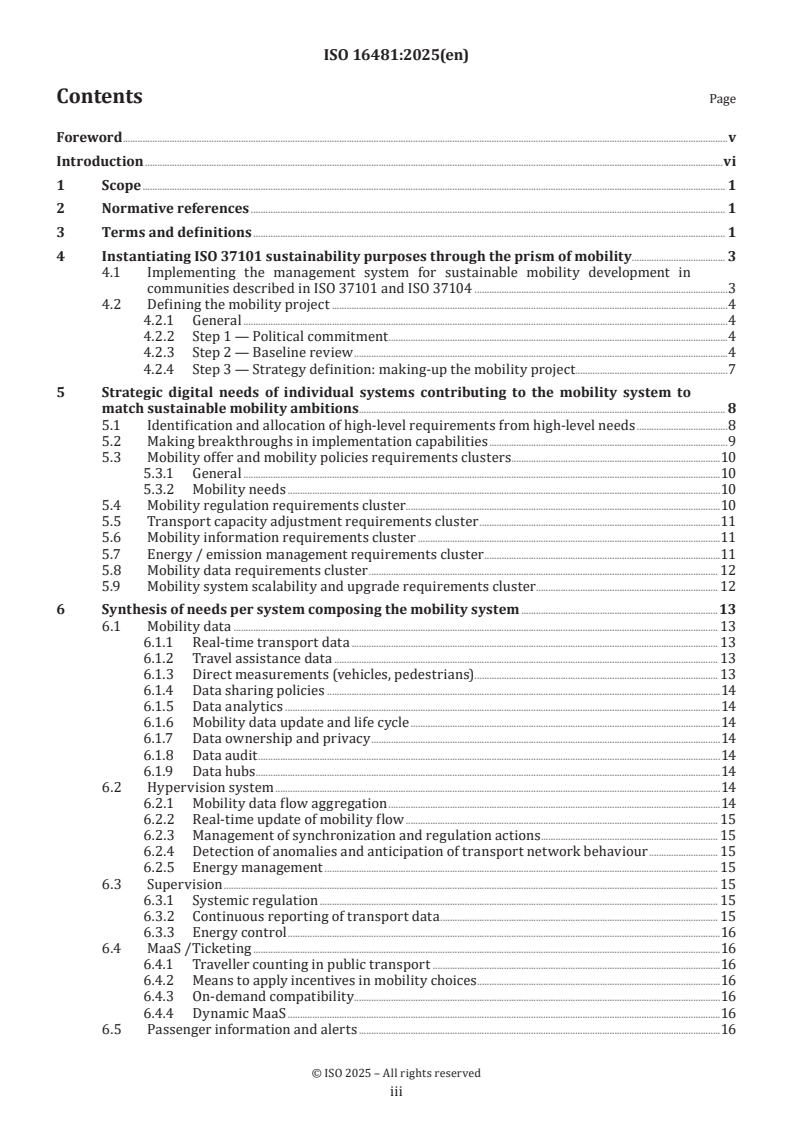
Contents Page
Foreword .v
Introduction .vi
1 Scope . 1
2 Normative references . 1
3 Terms and definitions . 1
4 Instantiating ISO 37101 sustainability purposes through the prism of mobility. 3
4.1 Implementing the management system for sustainable mobility development in
communities described in ISO 37101 and ISO 37104 .3
4.2 Defining the mobility project .4
4.2.1 General .4
4.2.2 Step 1 — Political commitment .4
4.2.3 Step 2 — Baseline review .4
4.2.4 Step 3 — Strategy definition: making-up the mobility project.7
5 Strategic digital needs of individual systems contributing to the mobility system to
match sustainable mobility ambitions . 8
5.1 Identification and allocation of high-level requirements from high-level needs .8
5.2 Making breakthroughs in implementation capabilities .9
5.3 Mobility offer and mobility policies requirements clusters .10
5.3.1 General .10
5.3.2 Mobility needs .10
5.4 Mobility regulation requirements cluster.10
5.5 Transport capacity adjustment requirements cluster .11
5.6 Mobility information requirements cluster .11
5.7 Energy / emission management requirements cluster .11
5.8 Mobility data requirements cluster . 12
5.9 Mobility system scalability and upgrade requirements cluster . 12
6 Synthesis of needs per system composing the mobility system .13
6.1 Mobility data . 13
6.1.1 Real-time transport data . 13
6.1.2 Travel assistance data . 13
6.1.3 Direct measurements (vehicles, pedestrians) . . 13
6.1.4 Data sharing policies .14
6.1.5 Data analytics .14
6.1.6 Mobility data update and life cycle .14
6.1.7 Data ownership and privacy .14
6.1.8 Data audit .14
6.1.9 Data hubs .14
6.2 Hypervision system .14
6.2.1 Mobility data flow aggregation .14
6.2.2 Real-time update of mobility flow . 15
6.2.3 Management of synchronization and regulation actions . 15
6.2.4 Detection of anomalies and anticipation of transport network behaviour . 15
6.2.5 Energy management . 15
6.3 Supervision . 15
6.3.1 Systemic regulation . 15
6.3.2 Continuous reporting of transport data . 15
6.3.3 Energy control .16
6.4 MaaS /Ticketing .16
6.4.1 Traveller counting in public transport .16
6.4.2 Means to apply incentives in mobility choices .16
6.4.3 On-demand compatibility . . .16
6.4.4 Dynamic MaaS .16
6.5 Passenger information and alerts .16
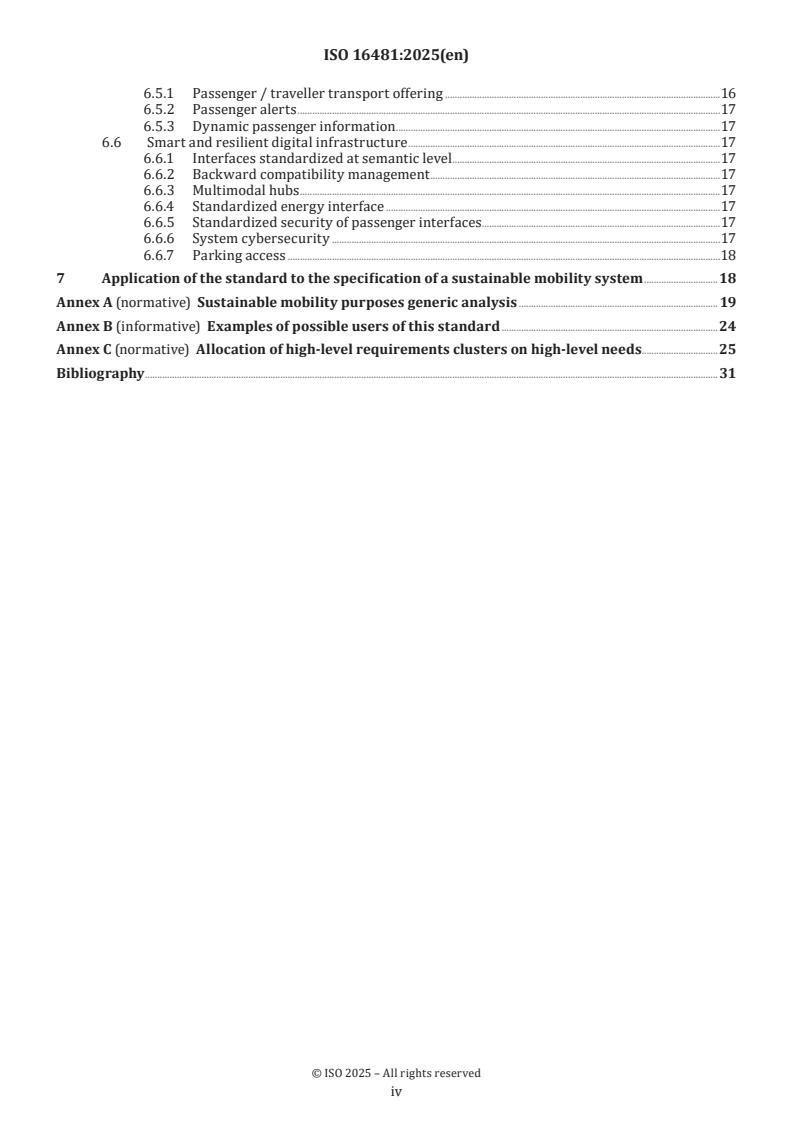
iii
6.5.1 Passenger / traveller transport offering .16
6.5.2 Passenger alerts .17
6.5.3 Dynamic passenger information .17
6.6 Smart and resilient digital infrastructure .17
6.6.1 Interfaces standardized at semantic level .17
6.6.2 Backward compatibility management .17
6.6.3 Multimodal hubs .17
6.6.4 Standardized energy interface .17
6.6.5 Standardized security of passenger interfaces .17
6.6.6 System cybersecurity .17
6.6.7 Parking access .18
7 Application of the standard to the specification of a sustainable mobility system .18
Annex A (normative) Sustainable mobility purposes generic analysis . 19
Annex B (informative) Examples of possible users of this standard .24
Annex C (normative) Allocation of high-level requirements clusters on high-level needs .25
Bibliography .31
iv
Foreword
ISO (the International Organization for Standardization) is a worldwide federation of national standards
bodies (ISO member bodies). The work of preparing International Standards is normally carried out through
ISO technical committees. Each member body interested in a subject for which a technical committee
has been established has the right to be represented on that committee. International organizations,
governmental and non-governmental, in liaison with ISO, also take part in the work. ISO collaborates closely
with the International Electrotechnical Commission (IEC) on all matters of electrotechnical standardization.
The procedures used to develop this document and those intended for its further maintenance are described
in the ISO/IEC Directives, Part 1. In particular, the different approval criteria needed for the different types
of ISO document should be noted. This document was drafted in accordance with the editorial rules of the
ISO/IEC Directives, Part 2 (see www.iso.org/directives).
ISO draws attention to the possibility that the implementation of this document may involve the use of (a)
patent(s). ISO takes no position concerning the evidence, validity or applicability of any claimed patent
rights in respect thereof. As of the date of publication of this document, ISO had not received notice of (a)
patent(s) which may be required to implement this document. However, implementers are cautioned that
this may not represent the latest information, which may be obtained from the patent database available at
www.iso.org/patents. ISO shall not be held responsible for identifying any or all such patent rights.
Any trade name used in this document is information given for the convenience of users and does not
constitute an endorsement.
For an explanation of the voluntary nature of standards, the meaning of ISO specific terms and expressions
related to conformity assessment, as well as information about ISO's adherence to the World Trade
Organization (WTO) principles in the Technical Barriers to Trade (TBT), see www.iso.org/iso/foreword.html.
This document was prepared by Technical Committee ISO/TC 268, Sustainable cities and communities,
Subcommittee SC 2, Sustainable mobility and transportation.
Any feedback or questions on this document should be directed to the user’s national standards body. A
complete listing of these bodies can be found at www.iso.org/members.html.
v
Introduction
0.1 General
This document aims at structuring the needs and specifying the digital governance capabilities on a mobility
system to make it more sustainable.
It supports mobility stakeholders and especially transport authorities in the emergence and the realization
of contributive solutions to the objectives of sustainability described in ISO 37101.
This document is the first of an intended set composed of the following documents:
— ISO 16481: to build a vision about the functional and environmental needs on systems composing the
mobility system;
— ISO 16483: to identify and standardize the metrics that will help define strategic goals and quantify the
evolution of the sustainable mobility system;
— and a forthcoming document dealing with mobility data framework.
A sustainable mobility system is a complex system combining multiple mobility systems. Mobility data
governance is the cornerstone of the capabilities of such a system: standardizing data semantics, data
services and data exploitation rules are among the key topics of the proposal.
This set of International Standards contributes directly to reducing energy consumption and air pollution
from mobility. It introduces a systemic approach on sustainable mobility of a city or a territory.
This is unprecedented and complements the numerous standard initiatives that contribute to specific
aspects of mobility solutions. These International Standards can guide transport authorities to translate
sustainability ambitions into concrete plans, helping to define the associated mobility policies. It also
defines the common rules among the co-existing systems of the mobility system. Once defined, this allows
the systemic governance of the mobility system to implement strategic choices. For example, all measures
creating directly or indirectly energy savings and air pollution, as well as improving resilience of the
solutions, are described and leverages are given for decision makers to make well-based choices.
From the guidance of the purposes of sustainable cities and territories, especially "Preservation and
improvement of environment", "Resilience" and "Responsible resource use", the contribution of mobility is
analysed and associated needs are identified. Relevant actions levers are used to specify mechanisms and
behaviours on the systems composing the mobility system.
Thus, the use of this International Standard set, starting with ISO 16481, aims at helping transport
authorities in implementing their sustainability strategies and implement a governance able to handle the
complexity of a mobility system.
This document deals with the strategic needs of digital governance for sustainable mobility. It is organized
in two parts.
0.2 Use-case of part 1
The first part presents the links between the sustainability purposes and issues of the ISO 37101 and
mobility needs:
It introduces the high-level needs of a sustainable mobility system.
This part of the document supports the transport authorities of an urban area to build a vision about the
functional, social and environmental needs on the systems composing the mobility system to develop
sustainability. Examples of users of this standard are detailed in Annex B.
— First, the users of this standard should apply the recommendations described in 4.1 to prepare the
assessment and evolution plans of the mobility system. In later stages, this document also aims at
providing support to the organizations adapting their governance to a mobility becoming more digital.
vi
— Second, the users should apply the process described in 4.2 to assess the sustainability purposes and
issues and define/ challenge the ambitions of the territory.
0.3 Use-case of part 2
The second part translates the high-level needs on the mobility system to high-level needs on digital systems
that are involved in sustainable mobility, named “High-level digital needs" afterwards.
The high-level digital needs per the sustainability purposes of Clause 5 and the ones per the mobility systems
of Clause 6 help in specifying or designing systems contributing to the mobility system. This approach
provides a way to check that key digital features have been well covered and are consistent with the overall
strategic sustainable mobility plan of the territory.
0.4 Introduction to the backbone of this document
Figure 1 below represents the structure of this document.
This document uses two generic analyses:
— The first one is labelled “Sustainable mobility purposes generic analysis”, it identifies sustainability
mobility issues associated to sustainability purposes of the ISO 37101 and proposes a combination into
high-level needs. This is further developed in Clause 4.
— The second one is labelled “Clusters of requirements”, it identifies a breakdown of requirements
able to fulfil the whole set of high-level needs. This is further developed in Clauses 5 and 6.
Key
generic analyses results introduced in the document
processes defined in the document
solutions developed in the document
outputs of needs to produce the mobility project
vii
outputs of needs identified in the document
mobility needs domain
mobility solution domain
Figure 1 — Graphical representation of the document structure
— The back end-coloured rectangles clarify the type of handled objects: The grey ones deal with needs, the
light one deals with requirements positioned as potential solutions to expressed needs.
— On top, the “Mobility system needs domain” represents the structure of “part 1” described in 0.1 above.
This is a process to produce a mobility project for the users of this document.
— The “Mobility system solution domain” in the middle and the “Digital needs domain onto contributory
systems of the mobility system” at the bottom represent the structure of "part 2” described in 0.3 above.
This is a solution to identify the digital strategic needs on the systems contributing to the mobility system.
viii
International Standard ISO 16481:2025(en)
Sustainable mobility and transportation — Digital
governance — Strategic needs regarding ISO 37101 purposes
of sustainability
1 Scope
This document aims at achieving sustainability goals of the local community. It applies to the digital
governance part of the mobility system of a city engaged in sustainability.
This document applies to the digital governance part of the mobility system of a city committed to
sustainability. It aims at achieving sustainability goals of the local community.
It targets urban mobility and its connections with intercity and other long-distance transport solutions. It
applies to the mobility of people and goods.
An urban mobility system is a system of transport systems which:
— contributes to the dimensioning and governance of mobility as a whole;
— contributes to transport solutions: orchestrated, on demand, shared or not;
— provides mobility services.
2 Normative references
The following documents are referred to in the text in such a way that some or all of their content constitutes
requirements of this document. For dated references, only the edition cited applies. For undated references,
the latest edition of the referenced document (including any amendments) applies.
ISO 37101:2016, Sustainable development in communities — Management system for sustainable development
— Requirements with guidance for use
ISO 37104:2019, Sustainable cities and communities — Transforming our cities — Guidance for practical local
implementation of ISO 37101
ISO 16483, Sustainable Mobility and Transportation — Digital Governance — Indicators
3 Terms and definitions
For the purposes of this document, the terms and definitions given in ISO 16483 and the following apply.
ISO and IEC maintain terminology databases for use in standardization at the following addresses:
— ISO Online browsing platform: available at https:// www .iso .org/ obp
— IEC Electropedia: available at https:// www .electropedia .org/
3.1
baseline review
initial diagnosis mapping the local situation, with regard to the six purposes of sustainability
Note 1 to entry: See ISO 37104:2019, 5.2.
3.2
local community
community of the area of interest
3.3
digital need
part of needs that concern computerized systems
Note 1 to entry: Other parts of needs relate, e.g. to physical infrastructure, or policies.
3.4
high-level need
global expectation on the mobility system of the concerned territory that define the desired characteristics,
dimensioning, choices shaping or animating the mobility system
3.5
strategic need
global expectation on the systems composing the mobility system of the concerned territory that define the
essential characteristics, dimensioning and choices allowing the achievement of the requirements on the
targeted mobility system
3.6
high-level requirement
specification of objectives that describe the scope, the context and the targeted results intended to fulfil
expressed needs
Note 1 to entry: High-level requirements are the proposed replies to high-level needs (3.4).
3.7
key performance indicator
KPI
quantifiable measure of performance over time for a specific objective
3.8
greenhouse gas emission
GHG emission
release of a GHG into the atmosphere
[SOURCE: ISO 14064-1: 2018, 3.1.5]
3.9
hypervision system
supervision system at mobility system level, such as a monitoring and control system of the mobility flows
and multimodal services
3.10
exploitation aided system
EAS
system that assists the mobility operators in their diagnosis and any support to intervene, and that regulates
the concerned system
3.11
data policy manual
governance manual that provides roles and responsibilities related to data governance through policies,
processes and procedures
Note 1 to entry: A data policy manual may also provide remedies.
3.12
passenger
person who has a reservation to travel or is travelling in a vehicle except for any crew, staff or drivers
[SOURCE: ISO/TS 14812:2025, 3.6.2.1]
3.13
traveller
person who is headed to a destination
[SOURCE: ISO/TS 14812:2025, 3.6.1.1]
3.14
vulnerable person
weak person with no protection and that can easily be hurt physically
Note 1 to entry: This includes people living with disabilities, children, pregnant women and the elderly.
4 Instantiating ISO 37101 sustainability purposes through the prism of mobility
4.1 Implementing the management system for sustainable mobility development in
communities described in ISO 37101 and ISO 37104
The management system specified in ISO 37101 and ISO 37104 describes the methodology to design and
implement a scheme that contributes to the sustainable development of cities and local communities.
Figure 2 represents this management system to drive sustainability ambition over the 12 relevant
sustainability issues faced by communities versus the 6 sustainability purposes described in ISO 37101.
It shows that, to instantiate ISO 37101 through the prism of mobility, sustainability purposes and
sustainability issues have to be analysed in terms of mobility.
The users of this standard shall first get acquainted with ISO 37101 and ISO 37104, especially
ISO 37101:2016 “Context of the organization” (Clause 4) and ISO 37104:2019 “Political commitment:
leadership, responsibilities, organization and capacity building” and “Implementing a management system
for sustainable development” (Clauses 4 and 5).
It can be useful for the user to get acquainted with the ISO 37154 for transportation in order to support the
infrastructure development vision.
Figure 2 — Management system for sustainable development derived from ISO 37104
4.2 Defining the mobility project
4.2.1 General
The mobility project is defined or iterated by unfolding the 3 first steps of the process as shown in the red
rectangle labelled “A” in Figure 2.
Those 3 steps are identified as political commitment (5.1.a), baseline review (5.2) and strategy for sustainable
development (5.3) in ISO 37104:2019. They are instantiated for sustainable mobility as described below:
4.2.2 Step 1 — Political commitment
ISO 37104 political framework shall be refined and detailed relating to mobility organizations, decisions,
funding, regulations, and areas of competencies of the concerned area. It is required to build the mobility
project plan with the correct sequences of actions, decisions, and founding.
4.2.3 Step 2 — Baseline review
4.2.3.1 General
The baseline review aims at identifying the relevant mobility ambitions to realize a step towards a more
sustainable community. Mobility ambitions are to be understood as the targeted mobility needs.
This review shall be executed in the following in the order of Sequences 1, 2 and 3.
4.2.3.2 Sequence 1
This sequence identifies mobility issues through following activities:
— map and describe the local situation;
— establish the diagnosis (for instance, by performing a SWOT analysis);
— benchmark or organize pear learnings, or both;
— formulate, and rank the ambitions browsing the 6 sustainability purposes as shown under the Label “B”
in Figure 2 (vertical red arrow).
ISO 37101 sustainability purposes and issues should be reviewed by the organization to get a clear picture
of mobility issues and to identify new objectives consistent with the established global sustainability vision
and constraints of the city.
High-level needs generic analysis on the mobility system for each purpose of sustainability shall be done in
accordance with Annex A. This analysis can help to initiate the local situational analysis.
Stakeholders should go through the items listed in the 6 matrices (A.1 to A.6) to evaluate the performance
status and set the ambitions of the concerned urban zone.
The outputs of this review are the sustainable mobility needs for a given situational analysis of a city. They
help to prioritize strategic needs in the retained project.
4.2.3.3 Sequence 2
Sequence 2 aims at doing a cross analysis between mobility and the 12 issues identified in ISO 37101.
Beyond the objective to get a mobility system sustainable, mobility serves also sustainable and resilient
territories ambitions, thus status or plans of other sustainability issues (the 12 issues identified in ISO 37101)
of the concerned territory create dependencies or expectations towards mobility.
Each of the 12 issues shall be reviewed versus mobility issue as shown under label “B” in Figure 2 (horizontal
green arrow). The findings are used to influence and supplement the ambitions list established in Sequence
1. Figure 3 illustrates this sequence.
To achieve completely this sequence consistently with the intent of the ISO 37101, it is assumed that the
same analysis described in sequence one (4.2.3.1) is executed for each of the 12 sustainability issues, thus
resulting in a complete picture of dependencies, exported constraints and influences involving mobility. The
corresponding analyses are not developed in this document.
Figure 3 — Example of cross analysis of sustainability issues versus mobility
4.2.3.4 Sequence 3
This sequence summarizes selected mobility ambitions with their associated priorities and dependencies.
Table 1 illustrates a possible synthesis board of ranked needs with the dependencies and associated strategic
triggers.
Table 1 — Example of a synthesis of retained ambitions and their dependencies
Mobility project Name sustainability improvement review
Scope analysis items Action # Priority dependency description comments
Sustainability Attractiveness 1 1 -urbanism Adapt mass transit ca-
purposes plan pacity to urbanism plan
and city mobility plan
2 1 New car park Realize an extra multi-
and road ex- modal hub at location
change XXXX
3 2 Action # 2 Hub XXXX supervision Optimization of
multimodal con-
nections
Preserv. & im- 4 1 - Switch to hydrogen bus Prepare new en-
prov. of environ- for next bus invest- ergy infrastruc-
ment ments ture
5 2 Action #N+a Implement low con- Synchronize
sumption mode transport ser-
vices
….
Resilience N 1 Implement a central Log of dynamic
transport Data service transport infor-
to improve MaaS infor- mation
mation
Responsible …….
resource use
Social cohesion ……
Well being …….
Sustainability Governance N+a 1 Implement an opera- Means to monitor
issues tional governance of traffic and acti-
mobility policies vate regulation
mechanisms
………
Education ………
……….
Innovation …….
Health …….
Culture …….
Living together …….
Economy …….
Living env. …….
Safety and secu- N+x 1 Surveillance means of
rity buses and trams stop
stations
Infrastructures …….
Mobility …….
Ecosystem ……
4.2.4 Step 3 — Strategy definition: making-up the mobility project
This step mainly consists in formalizing the objectives of sustainable development that are the key priorities
retained among the identified ambitions.
The retained part is the outcome of project convergence phase; it is done as any project that faces feasibility
constraints. This is a combination of accessible means, operational constrains and global context (e.g.
political, economic, events). The outcome becomes the action plan for sustainable mobility.
The definition of the strategy is the third step in the sustainability management process. It should contain:
— the formulation of the city/ territory development vision that is targeted;
— the allocation of leadership;
— the retained strategic priorities and sustainable objectives issued from the step 2 of the process;
— the definition of the selected affordable strategy to realize those objectives, including steps and terms
that takes into account human, environmental and financial resources;
— the related KPIs that fit with the objectives of the project;
— the principles of governance including the implementation of stakeholders’ commitment.
5 Strategic digital needs of individual systems contributing to the mobility system to
match sustainable mobility ambitions
5.1 Identification and allocation of high-level requirements from high-level needs
Annex A provides a high-level needs generic analysis on the mobility system for each purpose of
sustainability. This a key input used in Clause 4 to establish the mobility project.
The allocation of requirements to the sustainability mobility system in front of the high-level needs shall
be in accordance with the matrices of Annex A and Annex C. The tables of Annex A are extended with the
allocated requirements. Those new tables are grouped in Annex C.
Requirements are part of the solution domain; they provide replies to the specified needs. As a starting point,
clusters of requirements are used to position the expected type of solution, named high-level requirements
clusters.
The following set of 8 high-level requirements clusters covers all the high-level needs identified in the
matrices of needs (A.1 to A.6).
The scope definition of these clusters is described in the Table 2 below.
Table 2 — Definition of the clusters of high-level requirements
High-level requirements clusters Scope definition
Mobility offer This cluster of requirements regroups all design and dimensioning aspects of
the transport solutions.
Mobility policies This cluster of requirements deals with all the mobility rules that define
implementation choices, mobility behaviour and urbanism solutions such as
infrastructure design (streets/roads, stations, hubs, green ways, VRU protec-
tions,…) societal layout of the urban area,….
Mobility regulation This cluster of requirements contains the mobility flow monitoring and con-
trol aspects as well as perturbation and crisis management features.
Transport capacity adjustment This cluster of requirements addresses dynamic adjustment of the offer versus
demand cases.
Mobility information This cluster of requirements regroups the digital information that formaliz-
es and communicates traffic information, dynamic MaaS services, rerouting
assistance.
TTabablele 2 2 ((ccoonnttiinnueuedd))
High-level requirements clusters Scope definition
Energy / emission management This cluster of requirements covers the coordinated energy saving / emission
reduction modes.
Mobility data This cluster of requirements specifies data availability and exploitability. It
also defines the management of data privacy and ownership.
Mobility system scalability and This cluster of requirements deals with integration and evolution of the mobil-
upgrade ity system capabilities (as well as non-functional aspects such as security).
5.2 Making breakthroughs in implementation capabilities
Clause 4 instantiates the sustainability process on the mobility issue. It supports mobility authorities to
create or iterate about their mobility project.
The purpose of Clause 5 is to make breakthroughs in standardized implementation capabilities. This is
done by specifying the strategic digital needs of the mobility system and especially cooperation capabilities
between transport systems contributing to the mobility system of the targeted area.
The positioning of this contribution in the sustainability process is visualized in Figure 4 below: This is the
red shape covering the first part of the implementation step.
Standardization of the strategic digital needs has two use cases:
— The assistance of mobility authorities during the execution phase of their mobility project, starting by
specification of works and of purchases, including the governance means.
— The input reference to produce the next International Standards as described in the introduction section
of this document.
Figure 4 — Positioning of the contribution in the sustainability project
Clause 5 refines the high-level requirements identified at a cluster level into strategic digital needs on the
systems composing the mobility system. Almost all identified needs are described in Clause 6 otherwise a
description is provided in the cluster of requirements that identified it.
Those digital needs make-up a reference about the cooperation, the functional and environmental aspects of
the systems of mobility involved. They are not creating a specification of dimensioning. The latter is totally
linked to other elements such as the initial maturity of the mobility system, investment capacity, global
transport policy, governance culture, and so on. Those aspects are taken into account in the design of each
mobility project as explained in Clause 4.
This document deals with the digital aspects of the mobility system. It does not cover the needs on the
design of the infrastructures themselves, for example, architecture and ergonomics of stations, corridors,
carriageways, etc.
5.3 Mobility offer and mobility policies requirements clusters
5.3.1 General
The mobility offer of the mobility system holds the potential of sustainability. Weak basis will not allow great
results. What is considered here, are the digital enablers to take the best decisions in term of investment,
transformations and targeted policies. This cluster of requirements regroups all design and dimensioning
aspects of the transport solutions.
The mobility policies are deeply linked to the mobility vision that guided the choices about the mobility
solutions and transformations so that they guide the mobility offer and the mobility governance. Digital
enablers are very much focused on measurements to feed choices and governance of rules. The enabler
analysis of mobility offer and mobility policies requirements clusters is described in Table 3 below:
Table 3 — Enabler analysis of the mobility offer and mobility policies requirements clusters
Operational Requirements Enabler A Enabler B Enabler C
O/D measurements Mobility needs 5.3.2 Ticketing data 6.4.1 Travel assistance data 6.1.2
Direct measurements (vehi-
History flows Hypervision system 6.2.1 Transport data 6.1.1
cles, pedestrians,.) 6.1.3
Direct measurements (vehi-
throughput transport data 6.1.1 Supervision 6.3.2
cles, pedestrians,.) 6.1.3
5.3.2 Mobility needs
The organization in charge of defining the evolution of the mobility system can need recent O/D data but
most likely forecasts also.
O/D estimates and expectations and satisfaction should be produced from surveys when it is not possible to
derive historical data. when it’s difficult to get an accurate view of the needs from this process. An alternative
resides in purchasing data from telecom service suppliers that provide the mobility map at low resolution.
Enquiries and simulation remain the sole solution when the city changes its urbanism plans.
5.4 Mobility regulation requirements cluster
This cluster of requirements contains the mobility flow monitoring and control aspects as well as
perturbation and crisis management features.
This set of operational requirements holds key capabilities of the mobility system to provide an accurate
view on the mobility flows dynamically on the one hand and on the other hand transport regulation and
orchestration means to react in an appropriate manner to optimize transport services accordingly. The
enabler analysis of the mobility regulation requirements cluster is described in Table 4 below:
Table 4 — Enabler analysis of the mobility regulation requirements cluster
Operational requirements Enabler A Enabler B Enabler C
Real-time flow Data sharing policies 6.1.4 Supervision 6.3.2 Travel assistance data 6.1.2
Vehicle movement monitor-
Supervision 6.3.2 Hypervision system 6.2.1 Passenger alerts 6.5.2
ing
Flow regulation Hypervision system 6.2.2 Supervision 6.3.2 Travel assistance data 6.1.2
Perturbation management Supervision 6.3.2 Hypervision system 6.2.4 On site Assistance 6.2.3
Crisis management, rerout- Passenger / traveller trans-
Hypervision system 6.2.3 Supervision 6.3.2
ing port offering 6.5.1
5.5 Transport capacity adjustment requirements cluster
This cluster of requirements addresses dynamic adjustment of the offer versus demand items.
There is the need to monitor the quality of service, detect needs to adjust reinforcements of reduction of
services. The enabler analysis of the transport capacity adjustment requirements cluster is described in
Table 5 below:
Table 5 — Enabler analysis of the transport capacity adjustment requirements cluster
Operational Requirements Enabler A Enabler B Enabler C
Predictive travel time Historical data 6.1.5 Real-time data 6.1.5 Hypervision system 6.2.4
Service adaptation: rein-
Hypervision system 6.2.3 Supervision 6.3.1
forcement or relief
Service adaptation: on de-
MaaS 6.4.3 Travel assistance 6.4.4
mand service
5.6 Mobility information requirements cluster
This cluster of requirements regroups the digital information that formalizes and communicates traffic
information, dynamic MaaS services, rerouting assistance.
Mobility systems and mobility regulation requires relevant passenger information and efficient rerouting
assistance that does not shift a detected or anticipated congestion to a new one. The enabler analysis of the
mobility information requirements cluster is described in Table 6 below:
Table 6 — Enabler analysis of the mobility information requirements cluster
Operational Requirements Enabler A Enabler B Enabler C
MaaS and travel assistance
Traffic information Traveller information 6.5.3 Traveller alerts 6.5.2
6.4.4
MaaS and travel assistance
Rerouting assistance Mobility data 6.1.1
6.4.4
5.7 Energy / emission management requirements cluster
This cluster of requirements covers the coordinated energy saving
...