

ISO/IEC 19566-5:2023/Amd 1:2025
(Amendment)Information technologies — JPEG systems — Part 5: JPEG universal metadata box format (JUMBF) — Amendment 1: JUMBF box compression and standalone JUMBF files
General Information
- Abstract
- Status
- Published
- Publication Date
- 26-Mar-2025
- Current Stage
- 6060 - International Standard published
- Start Date
- 27-Mar-2025
- Due Date
- 19-Jul-2025
- Completion Date
- 27-Mar-2025

Overview
ISO/IEC 19566-5:2023/Amd 1:2025 is an amendment to the international standard for information technologies, focusing specifically on the JPEG Universal Metadata Box Format (JUMBF). This amendment introduces new features supporting JUMBF box compression and the use of standalone JUMBF files. It enhances the interoperability, efficiency, and flexibility of metadata handling within JPEG systems, providing both technical and practical value for digital image processing, archiving, and distribution.
Key Topics
JUMBF Box Compression
The amendment specifies a mechanism for compressing payload boxes within JUMBF, primarily utilizing the Brotli compression algorithm (IETF RFC 7932). The compressed data is encapsulated in a 'Brob' Box, providing efficient storage and transmission of metadata.Standalone JUMBF Files
Beyond embedding metadata within JPEG files, JUMBF boxes can now be delivered as independent files with the .jumbf extension, using theapplication/jumbfmedia type. This enables metadata to be distributed, updated, or managed independently of the digital image content.Compatibility and Flexibility
This amendment maintains compatibility with existing JPEG file formats, such as JPEG 2000, JPEG XL, and now explicitly supports embedding in JPEG 1 through the JPEG XT Box Format. This flexibility allows JUMBF to be used across a wide range of JPEG-based workflows and systems.Future-Proof Design
The specification reserves bits and structures for future compression algorithms and extensions, ensuring adaptability and long-term relevance of the standard.
Applications
The enhanced JUMBF box compression and standalone file capabilities introduced by ISO/IEC 19566-5:2023/Amd 1:2025 benefit a range of practical scenarios:
Digital Asset Management
Efficiently associate, store, and transmit rich metadata (e.g., rights management, provenance, captions, or custom data) with large or sensitive digital images, without modifying the original files.Archiving and Preservation
Store metadata independently when direct embedding in image files is impractical or disallowed, ensuring comprehensive documentation of digital assets for archival applications.Content Distribution
Reduce bandwidth and storage requirements through compressed JUMBF payloads, improving content delivery in bandwidth-constrained or cloud-based environments.Flexible Metadata Integration
Prepare standalone JUMBF files for later embedding, supporting workflow optimization in image production, editing, or repurposing pipelines.Interoperability
Streamline metadata exchange and integration across platforms and applications in compliance with international JPEG standards.
Related Standards
ISO/IEC 19566 Series
The parent family of JPEG Systems standards, including other specifications for metadata, file format, and system integration.IETF RFC 7932
Brotli Compressed Data Format referenced for implementing compression within JUMBF boxes.ISO/IEC 18181-2:2024
JPEG XL image coding system - file format, which similarly uses compressed payload boxes.JPEG 2000, JPEG XL, and JPEG 1 (via JPEG XT Box Format)
Supported formats for embedding JUMBF metadata, ensuring broad applicability across diverse JPEG-based environments.
For deeper technical guidance or details on implementation, consult the official ISO documentation and coordinate with relevant technical committees or national standards bodies.
Relations
- Effective Date
- 27-Jan-2024
Get Certified
Connect with accredited certification bodies for this standard

BSI Group
BSI (British Standards Institution) is the business standards company that helps organizations make excellence a habit.

NYCE
Mexican standards and certification body.
Sponsored listings
Frequently Asked Questions
ISO/IEC 19566-5:2023/Amd 1:2025 is a standard published by the International Organization for Standardization (ISO). Its full title is "Information technologies — JPEG systems — Part 5: JPEG universal metadata box format (JUMBF) — Amendment 1: JUMBF box compression and standalone JUMBF files". This standard covers: Information technologies — JPEG systems — Part 5: JPEG universal metadata box format (JUMBF) — Amendment 1: JUMBF box compression and standalone JUMBF files
Information technologies — JPEG systems — Part 5: JPEG universal metadata box format (JUMBF) — Amendment 1: JUMBF box compression and standalone JUMBF files
ISO/IEC 19566-5:2023/Amd 1:2025 is classified under the following ICS (International Classification for Standards) categories: 35.040.30 - Coding of graphical and photographical information. The ICS classification helps identify the subject area and facilitates finding related standards.
ISO/IEC 19566-5:2023/Amd 1:2025 has the following relationships with other standards: It is inter standard links to ISO/IEC 19566-5:2023. Understanding these relationships helps ensure you are using the most current and applicable version of the standard.
ISO/IEC 19566-5:2023/Amd 1:2025 is available in PDF format for immediate download after purchase. The document can be added to your cart and obtained through the secure checkout process. Digital delivery ensures instant access to the complete standard document.
Standards Content (Sample)
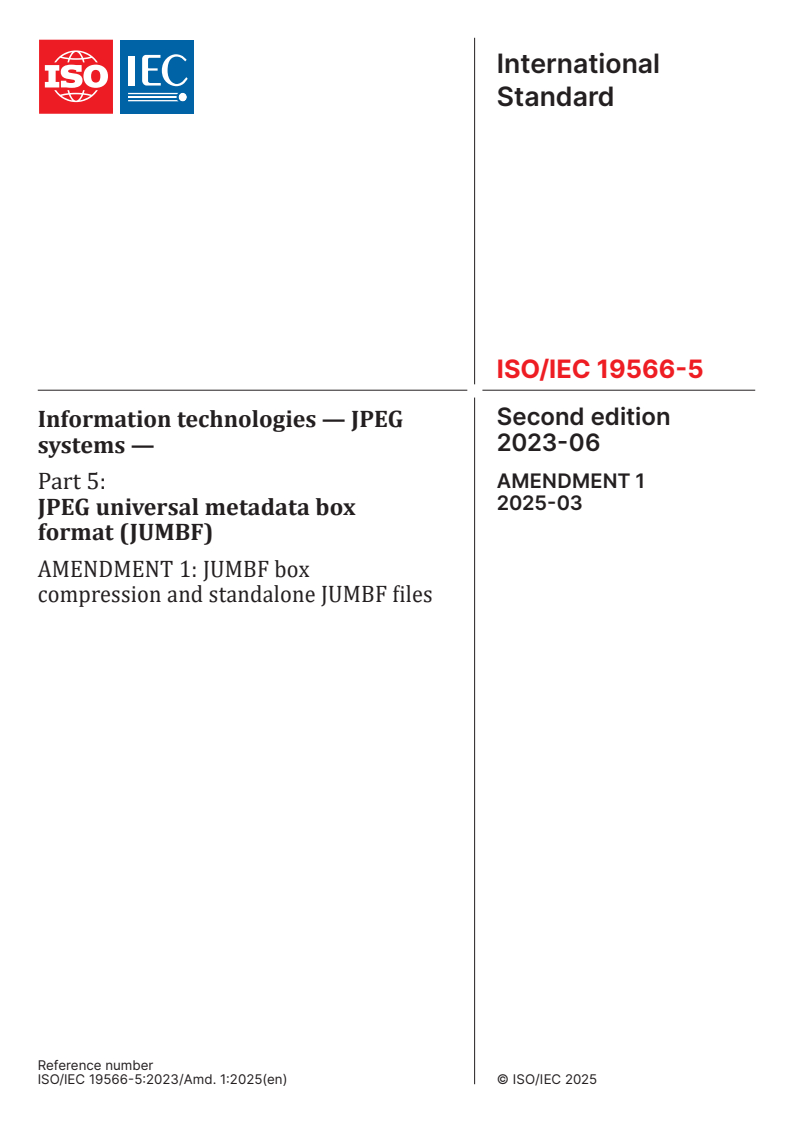
International
Standard
ISO/IEC 19566-5
Second edition
Information technologies — JPEG
2023-06
systems —
AMENDMENT 1
Part 5:
2025-03
JPEG universal metadata box
format (JUMBF)
AMENDMENT 1: JUMBF box
compression and standalone JUMBF files
Reference number
ISO/IEC 19566-5:2023/Amd. 1:2025(en) © ISO/IEC 2025
ISO/IEC 19566-5:2023/Amd. 1:2025(en)
© ISO/IEC 2025
All rights reserved. Unless otherwise specified, or required in the context of its implementation, no part of this publication may
be reproduced or utilized otherwise in any form or by any means, electronic or mechanical, including photocopying, or posting on
the internet or an intranet, without prior written permission. Permission can be requested from either ISO at the address below
or ISO’s member body in the country of the requester.
ISO copyright office
CP 401 • Ch. de Blandonnet 8
CH-1214 Vernier, Geneva
Phone: +41 22 749 01 11
Email: copyright@iso.org
Website: www.iso.org
Published in Switzerland
© ISO/IEC 2025 – All rights reserved
ii
ISO/IEC 19566-5:2023/Amd. 1:2025(en)
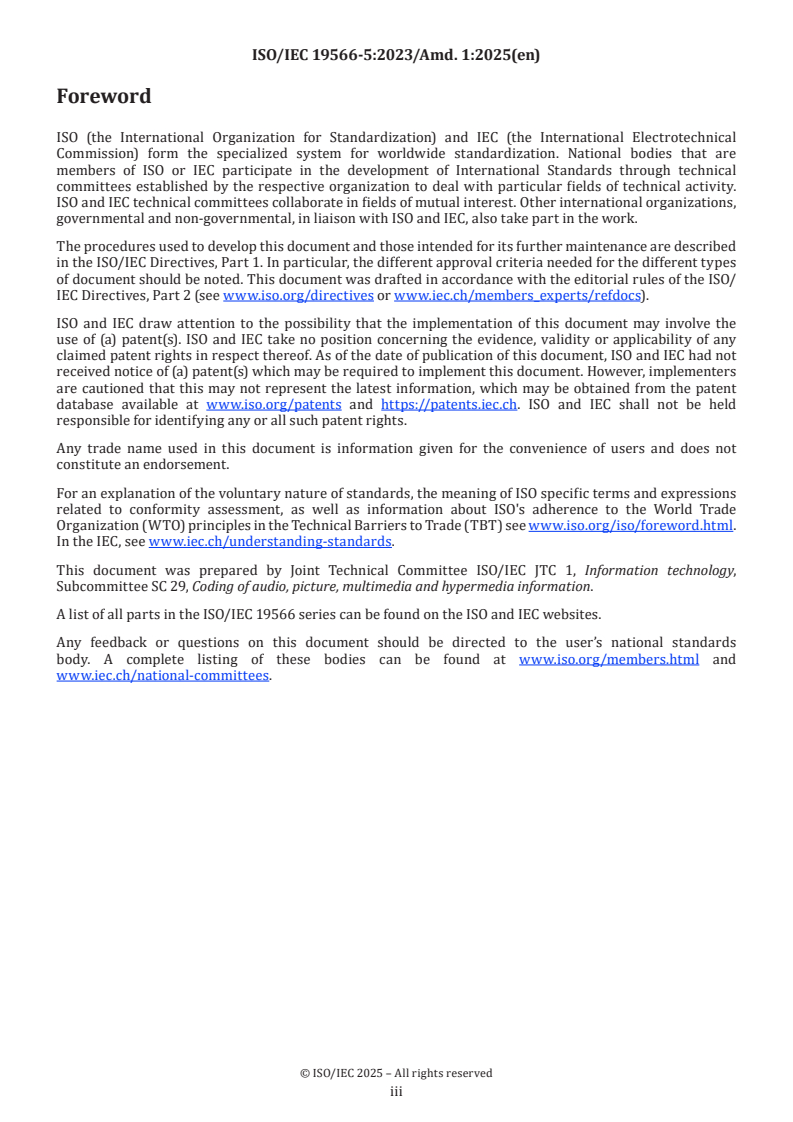
Foreword
ISO (the International Organization for Standardization) and IEC (the International Electrotechnical
Commission) form the specialized system for worldwide standardization. National bodies that are
members of ISO or IEC participate in the development of International Standards through technical
committees established by the respective organization to deal with particular fields of technical activity.
ISO and IEC technical committees collaborate in fields of mutual interest. Other international organizations,
governmental and non-governmental, in liaison with ISO and IEC, also take part in the work.
The procedures used to develop this document and those intended for its further maintenance are described
in the ISO/IEC Directives, Part 1. In particular, the different approval criteria needed for the different types
of document should be noted. This document was drafted in accordance with the editorial rules of the ISO/
IEC Directives, Part 2 (see www.iso.org/directives or www.iec.ch/members_experts/refdocs).
ISO and IEC draw attention to the possibility that the implementation of this document may involve the
use of (a) patent(s). ISO and IEC take no position concerning the evidence, validity or applicability of any
claimed patent rights in respect thereof. As of the date of publication of this document, ISO and IEC had not
received notice of (a) patent(s) which may be required to implement this document. However, implementers
are cautioned that this may not represent the latest information, which may be obtained from the patent
database available at www.iso.org/patents and https://patents.iec.ch. ISO and IEC shall not be held
responsible for identifying any or all such patent rights.
Any trade name used in this document is information given for the convenience of users and does not
constitute an endorsement.
For an explanation of the voluntary nature of standards, the meaning of ISO specific terms and expressions
related to conformity assessment, as well as information about ISO's adherence to the World Trade
Organization (WTO) principles in the Technical Barriers to Trade (TBT) see www.iso.org/iso/foreword.html.
In the IEC, see www.iec.ch/understanding-standards.
This document was prepared by Joint Technical Committee ISO/IEC JTC 1, Information technology,
Subcommittee SC 29, Coding of audio, picture, multimedia and hypermedia information.
A list of all parts in the ISO/IEC 19566 series can be found on the ISO and IEC websites.
Any feedback or questions on this document should be directed to the user’s national standards
body. A complete listing of these bodies can be found at www.iso.org/members.html and
www.iec.ch/national-committees.
© ISO/IEC 2025 – All rights reserved
iii
ISO/IEC 19566-5:2023/Amd. 1:2025(en)
Information technologies — JPEG systems —
Part 5:
JPEG universal metadata box format (JUMBF)
AMENDMENT 1: JUMBF box compression and standalone
JUMBF files
Everywhere
Replace “JPEG-1” with “JPEG 1”
Clause 2, Normative references
...