

ISO/IEC 27403:2024
(Main)Cybersecurity – IoT security and privacy – Guidelines for IoT-domotics
General Information
- Abstract
This document provides guidelines to analyse security and privacy risks and identifies controls that can be implemented in Internet of Things (IoT)-domotics systems.
- Status
- Published
- Publication Date
- 24-Jun-2024
- Drafting Committee
- ISO/IEC JTC 1/SC 27/WG 4 - Security controls and services
- Current Stage
- 6060 - International Standard published
- Start Date
- 25-Jun-2024
- Due Date
- 13-Sep-2024
- Completion Date
- 25-Jun-2024

Overview
ISO/IEC 27403:2024 - Cybersecurity – IoT security and privacy – Guidelines for IoT-domotics provides structured guidance to analyse security and privacy risks and to identify controls for Internet of Things (IoT) domotics (home automation) systems. Published by ISO/IEC JTC 1/SC 27, the standard adapts general IoT cybersecurity and privacy principles to the specific features of domotics - including non‑expert users, ad‑hoc architectures and long supply chains - and promotes practical, life‑cycle oriented risk management.
Key topics and technical scope
The standard covers the following high‑level areas and technical topics:
- Risk assessment for IoT‑domotics systems, including sources of security and privacy risk across:
- service sub‑systems, gateways, devices/physical entities and networks
- Reference model and life cycles for domotics deployments to map threats and controls by stage
- Security and privacy dimensions tailored to home automation scenarios
- Security controls and best practices such as:
- security policy and organizational measures, asset management, secure disposal
- secure system engineering, secure development environments, verification and testing
- monitoring, logging and log protection; device and user authentication
- software/firmware update provisioning, vulnerability sharing, supplier relationship management
- management of vulnerable devices and lifecycle‑specific security measures
- Privacy controls, including:
- privacy by default, notice and transparent communication of privacy preferences
- minimization of data collection, unlinkability of personal data, accountability measures
- unique device identity, fail‑safe authentication, verification of automated decisions
- Principles and user considerations such as easy security settings for non‑expert users, child protection, and scenario‑specific privacy preferences
- Informative annexes with use cases, stakeholder concerns, responsibilities and device‑specific measures
Practical applications
ISO/IEC 27403:2024 is designed to be applied to:
- Risk assessments and security reviews of home automation products and services
- System and solution design for IoT‑domotics gateways, devices and cloud services
- Procurement and supplier management to ensure secure lifecycle practices
- Creating user‑facing security/privacy defaults and guidance for non‑expert consumers
- Incident response, vulnerability disclosure and maintenance procedures for domotics ecosystems
Who should use this standard
Primary audiences named in the standard:
- IoT‑domotics service providers and service developers
- Organizations or assessors who supervise, verify or certify domotics security and privacy
Other stakeholders who will benefit include device manufacturers, integrators, system architects, security testers and privacy officers working in smart home/automation ecosystems.
Related standards
ISO/IEC 27403 complements other ISO/IEC cybersecurity and privacy guidance (developed by JTC 1/SC 27) and relevant IoT standards and best practices. It is intended to be used alongside organizational information security frameworks when securing domotics deployments.
Keywords: ISO/IEC 27403:2024, IoT security, domotics, home automation security, privacy by design, risk assessment, IoT gateway, firmware updates, privacy controls.
Relations
- Effective Date
- 28-Oct-2023
Get Certified
Connect with accredited certification bodies for this standard

BSI Group
BSI (British Standards Institution) is the business standards company that helps organizations make excellence a habit.

Bureau Veritas
Bureau Veritas is a world leader in laboratory testing, inspection and certification services.

DNV
DNV is an independent assurance and risk management provider.
Sponsored listings
Frequently Asked Questions
ISO/IEC 27403:2024 is a standard published by the International Organization for Standardization (ISO). Its full title is "Cybersecurity – IoT security and privacy – Guidelines for IoT-domotics". This standard covers: This document provides guidelines to analyse security and privacy risks and identifies controls that can be implemented in Internet of Things (IoT)-domotics systems.
This document provides guidelines to analyse security and privacy risks and identifies controls that can be implemented in Internet of Things (IoT)-domotics systems.
ISO/IEC 27403:2024 is classified under the following ICS (International Classification for Standards) categories: 35.030 - IT Security. The ICS classification helps identify the subject area and facilitates finding related standards.
ISO/IEC 27403:2024 has the following relationships with other standards: It is inter standard links to ISO 9013:2017/Amd 1:2024. Understanding these relationships helps ensure you are using the most current and applicable version of the standard.
ISO/IEC 27403:2024 is available in PDF format for immediate download after purchase. The document can be added to your cart and obtained through the secure checkout process. Digital delivery ensures instant access to the complete standard document.
Standards Content (Sample)
International
Standard
ISO/IEC 27403
First edition
Cybersecurity – IoT security
2024-06
and privacy – Guidelines for IoT-
domotics
Cybersécurité — Sécurité et protection de la vie privée pour l'IDO
— Lignes directrices pour la domotique-IDO
Reference number
© ISO/IEC 2024
All rights reserved. Unless otherwise specified, or required in the context of its implementation, no part of this publication may
be reproduced or utilized otherwise in any form or by any means, electronic or mechanical, including photocopying, or posting on
the internet or an intranet, without prior written permission. Permission can be requested from either ISO at the address below
or ISO’s member body in the country of the requester.
ISO copyright office
CP 401 • Ch. de Blandonnet 8
CH-1214 Vernier, Geneva
Phone: +41 22 749 01 11
Email: copyright@iso.org
Website: www.iso.org
Published in Switzerland
© ISO/IEC 2024 – All rights reserved
ii
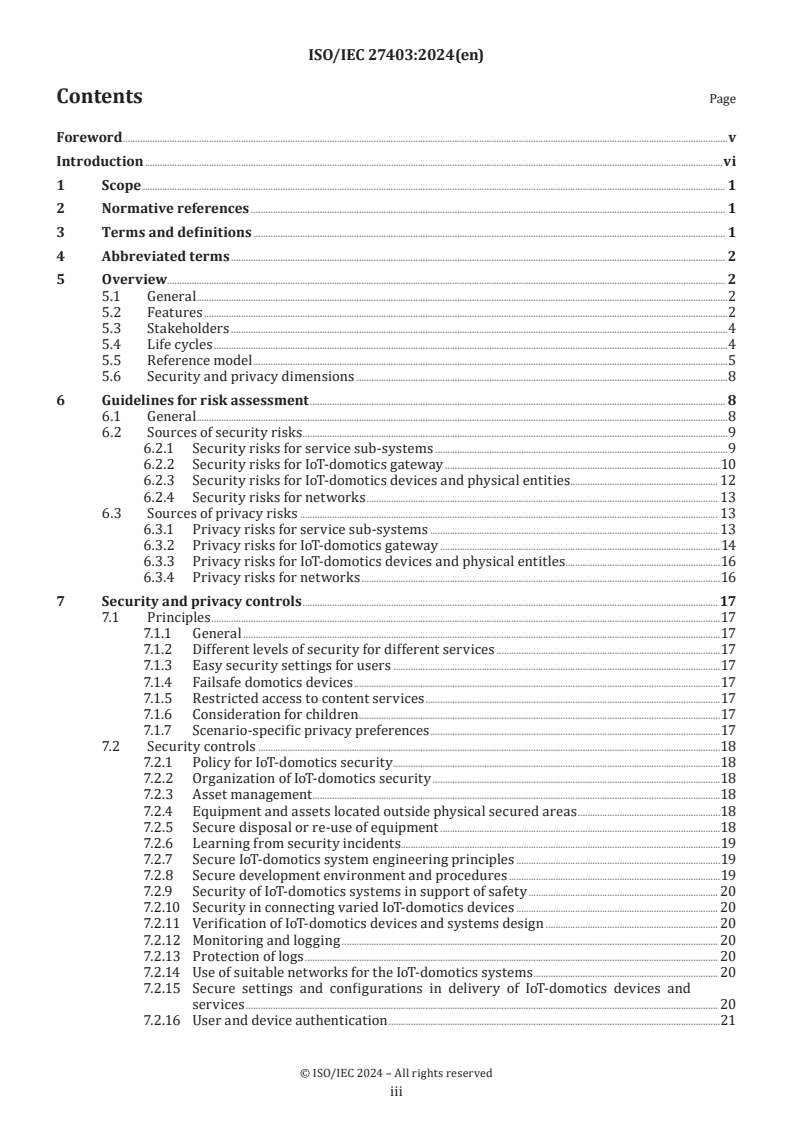
Contents Page
Foreword .v
Introduction .vi
1 Scope . 1
2 Normative references . 1
3 Terms and definitions . 1
4 Abbreviated terms . 2
5 Overview . 2
5.1 General .2
5.2 Features .2
5.3 Stakeholders .4
5.4 Life cycles .4
5.5 Reference model .5
5.6 Security and privacy dimensions .8
6 Guidelines for risk assessment . 8
6.1 General .8
6.2 Sources of security risks . . .9
6.2.1 Security risks for service sub-systems .9
6.2.2 Security risks for IoT-domotics gateway .10
6.2.3 Security risks for IoT-domotics devices and physical entities . . 12
6.2.4 Security risks for networks . 13
6.3 Sources of privacy risks . 13
6.3.1 Privacy risks for service sub-systems . 13
6.3.2 Privacy risks for IoT-domotics gateway .14
6.3.3 Privacy risks for IoT-domotics devices and physical entitles .16
6.3.4 Privacy risks for networks .16
7 Security and privacy controls . 17
7.1 Principles .17
7.1.1 General .17
7.1.2 Different levels of security for different services .17
7.1.3 Easy security settings for users .17
7.1.4 Failsafe domotics devices .17
7.1.5 Restricted access to content services .17
7.1.6 Consideration for children .17
7.1.7 Scenario-specific privacy preferences .17
7.2 Security controls .18
7.2.1 P olicy for IoT-domotics security .18
7.2.2 Organization of IoT-domotics security .18
7.2.3 Asset management .18
7.2.4 Equipment and assets located outside physical secured areas .18
7.2.5 Secure disposal or re-use of equipment .18
7.2.6 Learning from security incidents.19
7.2.7 Secure IoT-domotics system engineering principles .19
7.2.8 Secure development environment and procedures .19
7.2.9 Security of IoT-domotics systems in support of safety . 20
7.2.10 Security in connecting varied IoT-domotics devices . 20
7.2.11 Verification of IoT-domotics devices and systems design . 20
7.2.12 Monitoring and logging . 20
7.2.13 Protection of logs . 20
7.2.14 Use of suitable networks for the IoT-domotics systems . 20
7.2.15 Secure settings and configurations in delivery of IoT-domotics devices and
services . 20
7.2.16 User and device authentication .21
© ISO/IEC 2024 – All rights reserved
iii
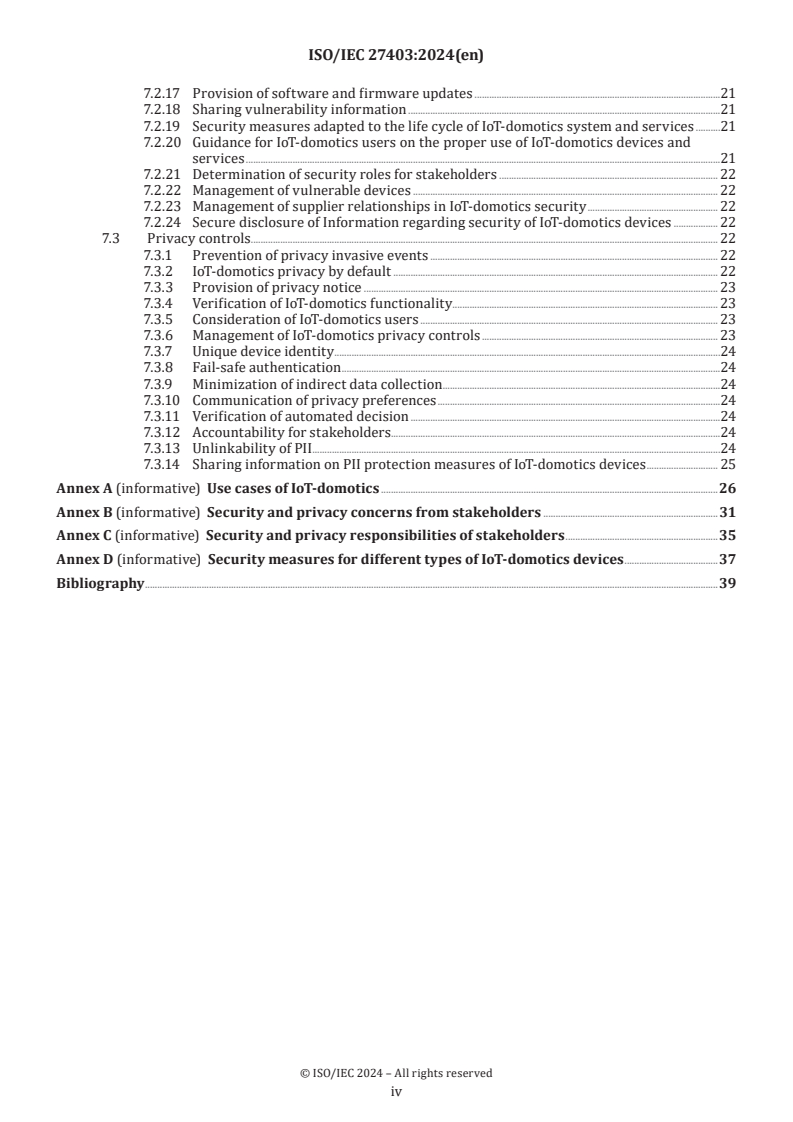
7.2.17 Provision of software and firmware updates .21
7.2.18 Sharing vulnerability information .21
7.2.19 Security measures adapted to the life cycle of IoT-domotics system and services .21
7.2.20 Guidance for IoT-domotics users on the proper use of IoT-domotics devices and
services .21
7.2.21 Determination of security roles for stakeholders . 22
7.2.22 Management of vulnerable devices . 22
7.2.23 Management of supplier relationships in IoT-domotics security . 22
7.2.24 Secure disclosure of Information regarding security of IoT-domotics devices . 22
7.3 Privacy controls . . 22
7.3.1 Prevention of privacy invasive events . 22
7.3.2 IoT-domotics privacy by default . 22
7.3.3 Provision of privacy notice . 23
7.3.4 Verification of IoT-domotics functionality . . 23
7.3.5 Consideration of IoT-domotics users . 23
7.3.6 Management of IoT-domotics privacy controls . 23
7.3.7 Unique device identity .24
7.3.8 Fail-safe authentication .24
7.3.9 Minimization of indirect data collection .24
7.3.10 Communication of privacy preferences .24
7.3.11 Verification of automated decision .24
7.3.12 Accountability for stakeholders.24
7.3.13 Unlinkability of PII . .24
7.3.14 Sharing information on PII protection measures of IoT-domotics devices . 25
Annex A (informative) Use cases of IoT-domotics .26
Annex B (informative) Security and privacy concerns from stakeholders .31
Annex C (informative) Security and privacy responsibilities of stakeholders .35
Annex D (informative) Security measures for different types of IoT-domotics devices .37
Bibliography .39
© ISO/IEC 2024 – All rights reserved
iv
Foreword
ISO (the International Organization for Standardization) and IEC (the International Electrotechnical
Commission) form the specialized system for worldwide standardization. National bodies that are
members of ISO or IEC participate in the development of International Standards through technical
committees established by the respective organization to deal with particular fields of technical activity.
ISO and IEC technical committees collaborate in fields of mutual interest. Other international organizations,
governmental and non-governmental, in liaison with ISO and IEC, also take part in the work.
The procedures used to develop this document and those intended for its further maintenance are described
in the ISO/IEC Directives, Part 1. In particular, the different approval criteria needed for the different types
of document should be noted. This document was drafted in accordance with the editorial rules of the ISO/
IEC Directives, Part 2 (see www.iso.org/directives or www.iec.ch/members_experts/refdocs).
ISO and IEC draw attention to the possibility that the implementation of this document may involve the
use of (a) patent(s). ISO and IEC take no position concerning the evidence, validity or applicability of any
claimed patent rights in respect thereof. As of the date of publication of this document, ISO and IEC had not
received notice of (a) patent(s) which may be required to implement this document. However, implementers
are cautioned that this may not represent the latest information, which may be obtained from the patent
database available at www.iso.org/patents and https://patents.iec.ch. ISO and IEC shall not be held
responsible for identifying any or all such patent rights.
Any trade name used in this document is information given for the convenience of users and does not
constitute an endorsement.
For an explanation of the voluntary nature of standards, the meaning of ISO specific terms and expressions
related to conformity assessment, as well as information about ISO's adherence to the World Trade
Organization (WTO) principles in the Technical Barriers to Trade (TBT) see www.iso.org/iso/foreword.html.
In the IEC, see www.iec.ch/understanding-standards.
This document was prepared by Joint Technical Committee ISO/IEC JTC 1, Information technology,
Subcommittee SC 27, Information security, cybersecurity and privacy protection.
Any feedback or questions on this document should be directed to the user’s national standards
body. A complete listing of these bodies can be found at www.iso.org/members.html and
www.iec.ch/national-committees.
© ISO/IEC 2024 – All rights reserved
v
Introduction
Although IoT-domotics have been widely applied worldwide, many IoT-domotics devices, communication
protocols and platforms are developed without sufficient security and privacy considerations, which can
pose security and privacy risks. Due to the long supply chain and the large number of stakeholders involved,
it is important to establish the stakeholders, identify risks during the life cycle, and put forward proposals
for resolving security and privacy issues in IoT-domotics. This document provides guidelines to analyse
security and privacy risks and identifies controls that should be implemented in IoT-domotics systems.
IoT-domotics have some features that differ from other forms of IoT deployment, such as non-expert users,
and ad hoc architecture. This document therefore adapts the general IoT security and privacy principles to
IoT-domotics and provides stakeholders with thorough and tailored guidelines for scenarios specific to IoT-
domotics.
The target audiences of this document include IoT-domotics service providers, IoT-domotics service
developers, and those who supervise or verify security and privacy for IoT-domotics.
The goal of this document is to ensure that security and privacy for IoT-domotics are achieved without
requiring end-users to have in-depth IT knowledge. Although this document can be used by interested end-
users, they are not the target audience.
© ISO/IEC 2024 – All rights reserved
vi
International Standard ISO/IEC 27403:2024(en)
Cybersecurity – IoT security and privacy – Guidelines for IoT-
domotics
1 Scope
This document provides guidelines to analyse security and privacy risks and identifies controls that can be
implemented in Internet of Things (IoT)-domotics systems.
2 Normative references
The following documents are referred to in the text in such a way that some or all of their content constitutes
requirements of this document. For dated references, only the edition cited applies. For undated references,
the latest edition of the referenced document (including any amendments) applies.
ISO/IEC 20924, Internet of Things (IoT) and digital twin — Vocabulary
ISO/IEC 27000, Information technology — Security techniques — Information security management systems —
Overview and vocabulary
ISO/IEC 29100, Information technology — Security techniques — Privacy framework
3 Terms and definitions
For the purposes of this document, the terms and definitions given in ISO/IEC 27000, ISO/IEC 29100,
ISO/IEC 20924 and the following apply.
ISO and IEC maintain terminology databases for use in standardization at the following addresses:
— ISO Online browsing platform: available at https:// www .iso .org/ obp
— IEC Electropedia: available at https:// www .electropedia .org/
3.1
IoT-domotics
Internet of Things (IoT) system composed of networks, devices, services and users typically used in the
domicile or as electronic wearables
Note 1 to entry: Devices are usually available to the consumer through retail purchase.
Note 2 to entry: According to ISO/IEC TR 22417:2017, 6.3, IoT-domotics denotes the private, hence highly customizable
indoor area where someone lives, alone or with friends/relatives/roommates. Thus, it includes dedicated
infrastructure aimed to support those individuals, such as healthcare and wellness systems, building control systems,
smart metering and systems for entertainment and gaming.
3.2
entity
physical or non-physical element, which has a distinct and independent existence
Note 1 to entry: Every entity has a unique identity.
Note 2 to entry: See ISO/IEC 30141:2018, 8.2.1.2.
© ISO/IEC 2024 – All rights reserved
3.3
domain
major functional group of an Internet of Things (IoT) system
Note 1 to entry: Every entity (3.2) in an IoT system participates in one or more domains and is said to be included or
contained by that domain.
Note 2 to entry: See ISO/IEC 30141:2018, 8.2.1.3.
4 Abbreviated terms
AI artificial intelligence
App application
AR augmented reality
CRM customer relationship management
DDoS distributed denial of service
ICT information and communication technology
IP internet protocol
IoT Internet of Things
NB-IoT narrow band Internet of Things
PII personally identifiable information
RF radio frequency
TV television
URL uniform resource locator
USB universal serial bus
VR virtual reality
5 Overview
5.1 General
The security and privacy of IoT-domotics have a bearing on the normal operation of in-domicile services, the
well-being of residents, and the integrity of infrastructures that are linked directly or indirectly with devices
of services. Stakeholders including users, service providers, device manufacturers, network operators and
industry supervisors are becoming increasingly concerned by security and privacy issues of IoT-domotics.
In comparison with other IoT solutions, IoT-domotics have specific features and concerns. It is therefore
essential to adapt the general IoT security and privacy principles to IoT-domotics and provide stakeholders
with thorough and tailored guidelines in specific scenarios of IoT-domotics.
5.2 Features
Some examples of IoT-domotics systems can be found in Annex A. Many of the features of IoT-domotics
can affect the security and privacy considerations. These features should be specifically considered in the
context of security and privacy. Such features include:
a) open and varied home environments;
1) terminal devices: devices can be smart devices, lightweight function devices or appliances;
2) communication protocols: such as ethernet, wireless, and/or bluetooth;
3) physical input methods: such as voice commands, touch, and/or gestures;
© ISO/IEC 2024 – All rights reserved
4) varied applications and services: an IoT-domotics solution can provide multiple services
simultaneously, like entertainment, electrical appliance control, security system, assistance service
and energy management;
5) dynamic network: a device or service can join and leave the environment dynamically and flexibly;
6) complex interactions: interactions can be in multiple forms, such as human-device, device-device,
device-service and human-service;
7) multi-party interactions: multiple devices/points of connectivity in domiciles.
b) features related to domiciles;
1) context awareness: as devices and services get smarter, it can be necessary for IoT-domotics to
have awareness of social and cultural imperatives in order to be useful for end users. A human can
interact with the IoT-domotics device which in turn can share context information with another
device or another human;
2) privacy concerns: devices and services are likely to have access to personal data (e.g. location,
habits, and/or relationships). Besides, devices and services exchange context information which can
contain personal data;
3) relationships:
i) human to device relationships: interactions relying on a variety of information inputs such as
images and user presence, as well as identification methods such as speech;
ii) device-to-device relationships: interactions where devices communicate with one another
actively (e.g. a thermostat that triggers the lowering of a window shade) or passively (e.g. a
device that identifies presence of a user when the user leaves one area of the domicile and
enters another).
4) access restrictions: IoT-domotics devices are used in scenarios involving children and can involve
the protection of children from accessing the Internet, such as payment business restrictions,
content hierarchical access restrictions;
5) biometric protection: IoT-domotics devices can record personal biometric information such as irises,
fingerprints, faces and voice. It involves the secure storage, verification and protection of data;
6) operational protection mechanism: IoT-domotics devices can have hierarchical use or
interoperability secondary confirmation security protection, such as preventing children from
operating washing machines and microwave ovens, as well as protection buttons to prevent pets
and children from misoperations.
c) users, inhabitants and other living entities that can be present and/or impacted by the deployment and
use of an IoT-domotic solution in a home, such as:
1) by categories: elderly, adults, teenagers, children, babies, people with reduced autonomy, persons
with disabilities and pets;
2) by roles: owners, administrators, users, as well as individuals and other living entities, such as pets
and plants that can be impacted;
3) by adverse impact: victims of coercive control (e.g. of smart locks or thermostats), or surveillance
(e.g. by hidden cameras or microphones).
d) interoperability: this is an important aspect for seamless communication between all devices in an IoT-
domotics environment, regardless of their make or model.
e) user-friendly interface and usability: IoT-domotics systems' interfaces should be intuitive and designed
to be easy for users to navigate, especially considering that it is possible that not all users are tech-savvy.
© ISO/IEC 2024 – All rights reserved
5.3 Stakeholders
Stakeholders of IoT-domotics are IoT-domotics service providers, IoT-domotics service developers and IoT-
domotics users. These stakeholders are identified in the context of the features of IoT-domotics (see 5.2) in
conformance with the stakeholders of IoT systems defined in ISO/IEC 30141. Table 1 shows the stakeholders
of IoT-domotics with explanations.
Table 1 — Stakeholders involved in IoT-domotics
Stakeholders Sub-role Descriptions
IoT-domotics service Business manager To document the approach to be taken for
provider the risk assessment, and to manage and
Delivery manager
operate IoT-domotics services and/or to
Domicile network/sensor installer
provide network connectivity.
System operator
IoT-domotics service Solution architect To design, implement, test and integrate
developer IoT-domotics services, devices and applica-
Solution/application/device developer
tions.
Developer manager
System integrator
IoT-domotics user Residents in domicile End users of IoT-domotics services
Domicile visitors
The definitions of the roles of IoT-domotics stakeholders are as follows:
a) IoT-domotics service provider
Role definition: to document the approach to be taken for the risk assessment, and to manage and
operate IoT-domotics services and/or to provide network connectivity. Since IoT-domotics devices can
be physically linked to the domicile, an important sub-role is IoT-domotics installer, who installs the IoT-
domotics within the domicile.
b) IoT-domotics service developer
Role definition: to develop, test and integrate IoT-domotics services, devices and applications.
c) IoT-domotics user
Role definition: owners, administrators, users, as well as individuals and other digital and living entities
that can use or be impacted by the deployment and use of an IoT-domotic solution in a domicile.
Refer to Annex B for the security and privacy concerns of these stakeholders. Refer to Annex C for the
responsibilities of these stakeholders.
5.4 Life cycles
This document describes the IoT-domotics life cycles adapted from the IoT service life cycles in
ISO/IEC 27400:2022, 5.5. According to related stakeholders, three different life cycles processes are
considered for different stakeholders. Figure 1 shows the IoT-domotics life cycles processes of stakeholders.
© ISO/IEC 2024 – All rights reserved
Figure 1 — IoT-domotics life cycles
Life cycles vary depending on each stakeholder. Different stakeholders can be related at different stages
in their respective life cycles, especially for service providers. The IoT-domotics service is provided to IoT-
domotics users through the supply process of the IoT-domotics service providers. An IoT-domotics service
provider acquires an IoT device and software from the IoT-domotics developer in the acquisition process.
When an IoT-domotics user acquires and uses IoT-domotics products or services, life cycles stages include
requirement definition, selection, utilization, and termination. In the requirement definition stage, the IoT-
domotics user can consider product functional requirements and other aspects, such as security and privacy
requirements. Based on the information disclosed in the supply process, an IoT-domotics user selects an
IoT-domotics service that meets the required specification. For example, at the termination stage, there are
risks of personal data leakage if measures such as account deletion and verification of secure data deletion
are not implemented both in the IoT-domotics devices and on the server databases on the back-office side.
For the developer of IoT-domotic services, it is not only about the development, testing and deployment of
software, but also about the production and maintenance of devices. In the process of mass production of
the IoT-domotic solution (i.e. software and devices), the demonstration of security consistency with the
initial requirements should also be taken into account. For example, software and firmware updates are
processes that carry their own set of security risks which can arise during the use and support phases, and
which should be mitigated.
5.5 Reference model
The reference model in this document is based on the entity-based reference model in ISO/IEC 30141
with instanced objects involving IoT-domotics users and networks as shown in Figure 2. An entity-based
representation of IoT-domotics includes physical entities, IoT-domotics users, IoT-domotics devices, IoT-
domotics gateway, networks and services for operation and management, applications and services, as well
as access and communication.
© ISO/IEC 2024 – All rights reserved
Key
IOT-domotics system inner-domotics environment
physical connection logical connection
Figure 2 — IoT-domotics reference model
Figure 2 shows the following entities in IoT-domotics:
a) Physical entity
A physical entity is a discrete, identifiable, and observable part of the physical environment. Examples
of physical entities are living organisms (e.g. human beings, pets or plants), natural objects (e.g. water,
air or temperature) and man-made objects (e.g. a room, a door, or a curtain).
b) IoT-domotics users
IoT-domotics users are subdivided into user types, for example:
1) human user: interacts with IoT-domotics devices and services with the help of controlling devices
and controlling software;
2) controlling device: dedicated devices for human users to interact with IoT-domotics devices or to
control IoT-domotics devices on behalf of human users;
3) controlling software: software to assist human users to interact with IoT-domotics devices or to
control IoT-domotics devices on behalf of human users;
© ISO/IEC 2024 – All rights reserved
4) digital user: digital user applications can use capabilities of IoT-domotics devices and IoT-domotics
services to create higher level services for human users.
c) IoT-domotics devices
IoT-domotics devices (e.g. smart camera, smart TV, smart door lock, or smoking detector) interact with
the physical entity and/or act based on IoT-domotics user’s command through devices such as sensors
and actuators.
d) IoT-domotics gateway
An IoT-domotics gateway forms a connection between local network(s) and the wide area access
network.
e) Networks
IoT-domotics systems can be connected by networks. Internet domotics devices are connected or
bridged through wide area networks (WAN), such as those controlled via external server-based
solutions that are not collocated on the same network or equivalent address space. These devices can be
connected through ground-based RF terrestrial (e.g. cellular/microwave) connections, wired networks
(e.g. copper/fibre) provided by telecommunication companies, and satellite/stratospheric RF relays. IoT-
domotics devices leverage local area networks (LAN) whereby interaction is limited to collocation and
can leverage RF range limiting protocols such as Z-Wave or can be attached to an isolated sub-network.
1) local area networks: short range network to connect kinds of IoT-domotics devices with low energy
1) 2)
consumption, such as Zigbee®, Bluetooth®, WiFi, 3G/4G/5G;
2) wide area networks: wide range network to connect devices with application and management
platforms;
3) others: other IoT-domotics networks, such as personal area network (PAN).
f) Service sub-systems
As in other IoT systems, IoT-domotics services also contain virtual entities, where a virtual entity is a
digital representation of a physical entity.
1) operation and management sub-system: provides monitoring, management and administrative
capabilities;
2) application and service sub-system: provides IoT-domotics data storage, data analytics and service
process management;
3) access and communication sub-system: provides controlled interfaces for service capabilities, for
administration capabilities and for business capabilities.
It should be noted that a domain-based reference model is illustrated in ISO/IEC 27400:2022, 5.6. Table 2
shows the correspondence between the entities described this document and domains described in
ISO/IEC 27400.
1) Zigbee® is a trademark of Zigbee alliance. This information is given for the convenience of users of this document
and does not constitute an endorsement by ISO of the product named.
2) Bluetooth® is a trademark of Bluetooth special interest group. This information is given for the convenience of users
of this document and does not constitute an endorsement by ISO of the product named.
© ISO/IEC 2024 – All rights reserved
Table 2 — Correspondence between entities described in this document and domains described in
ISO/IEC 27400
Entities in this document Domains in ISO/IEC 27400
IoT-domotics user User domain
Operations and management domain, application and service domain, and
Service sub-system
resource access and interchange domain
IoT-domotics gateway Sensing and controlling domain
IoT-domotics devices Sensing and controlling domain
Physical entity Physical entity domain
Operations and management domain, application and service domain, and
Networks
resource access and interchange domain
5.6 Security and privacy dimensions
The reference model architecture in Figure 2 is logically composed of IoT-domotics users, service sub-
systems, the IoT-domotics gateway, IoT-domotics devices and physical entites, networks and other entities.
The security and privacy risks faced by each entity and the control measures taken can be considered from
the four dimensions of service, application, network, and hardware. The security and privacy dimensions
involved in different entities are shown in Table 3.
Table 3 — IoT-domotics entities and their involved security and privacy dimensions
Security and privacy dimensions to analyse risks and implement
countermeasures
IoT-domotics entities
Service Application Network Hardware
a
IoT-domotics users Optional Optional Optional Optional
Service sub-systems Present Optional Present Absent
IoT-domotics gateway Optional Present Present Present
IoT-domotics devices and physical enti-
Optional Present Present Present
ties
Networks Absent Absent Present Optional
NOTE As the form of these entities differ, not all of the four dimensions are present. For example, some do not have a hardware
layer. Therefore, some involved security and privacy dimensions are optional or absent.
a
A human can be an IoT-domotics user, in which case all the layers are absent.
6 Guidelines for risk assessment
6.1 General
This clause provides guidance and information on risk assessment for IoT-domotics. Risk assessment for
IoT-domotics systems should be done by using the approaches and methods specified in the following
documents:
— ISO 31000, which gives generic guidelines on risk management;
— IEC 31010, which provides guidance on the selection and application of techniques for assessing risk in a
wide range of situations;
— ISO/IEC 27005, which gives specific information on security guidelines for risk management.
Where adoption of an information security management system is necessary (in particular, in big
organizations or if an IoT-domotics system is part of an ecosystem), the following documents are also
relevant:
— ISO/IEC 27001, which provides requirements for information security management systems;
© ISO/IEC 2024 – All rights reserved
— ISO/IEC 27701, which provides extended requirements for privacy information management.
Furthermore, there are specific risk sources which should be considered for the risk assessment of IoT-
domotics systems. The specific risk sources are addressed in the following documents:
— ISO/IEC 24767-1, which gives threat analysis and security requirements for home networks;
— ISO/IEC 27400, which gives general risk sources related to IoT systems;
— ISO/IEC 27402, which gives requirements for IoT device manufacturers to perform risk assessment.
IoT-domotics risk sources are identified in 6.2 and 6.3, which should be considered for the risk assessment.
Detailed and specific security risks are provided in 6.2 and detailed and specific privacy risks are
provided in 6.3.
6.2 Sources of security risks
6.2.1 Security risks for service sub-systems
6.2.1.1 Service dimension
The following risk sources are relevant to IoT-domotics service sub-systems relating to the service
dimension:
NOTE Some of these risk sources have already been addressed in existing documents, which are cited below in
parentheses.
— an IoT system, application of service that has no or weak security function, e.g. weak authentication and
authorization function or access control (see ISO/IEC 27400:2022, 6.2.2.4);
— documented operation procedure of an IoT system or service with vulnerabilities (see ISO/IEC 27400:2022,
6.2.2.2);
— an IoT system, application or service with vulnerabilities (see ISO/IEC 27400:2022, 6.2.2.3);
— lack of knowledge and skills of persons who play a role in the provision or use of the IoT system, application
or service (see ISO/IEC 27400:2022, 6.2.1);
— lack of governance (see ISO/IEC 27400);
— malicious software and configuration (see ISO/IEC 24767-1:2008, 7.3);
— system failures (see ISO/IEC 24767-1:2008, 7.7);
— security service providers (see ISO/IEC 24767-1:2008, 7.8).
The following use cases should be considered for IoT-domotics:
— lack of a security warning mechanism;
For example, IoT-domotics devices fail to send warning messages to the user to remind them that a
security incident can occur.
— lack of access control;
For example, permissions are the same for every user including children to access social application,
voice and live video on IoT-domotics devices, which can include pornographic, violent and political
content; advertising; abuse; violation of advertising law and contraband content;
© ISO/IEC 2024 – All rights reserved
— AI services are abused.
For example, AI technology applied in devices including an intelligent voice speaker and an intelligent
door lock lack security design and verification, which can lead to misfunctions that are out of human
control.
6.2.1.2 Network dimension
The following risk sources are relevant for IoT-domotics service sub-systems relating to network dimension:
NOTE These risk sources have already been addressed in existing documents, which are cited below in
parentheses.
— an IoT system or application of service that has no or weak security function, e.g. weak authentication
and authorization function or access control (see ISO/IEC 27400:2022, 6.2.2.4);
— unauthorized access (see ISO/IEC 24767-1:2008, 7.2);
— malicious software and configuration (see ISO/IEC 24767-1:2008, 7.3);
— denial of service (see ISO/IEC 24767-1:2008, 7.4);
— unintended modification of data during communication (see ISO/IEC 24767-1:2008, 7.5).
The following use cases should be considered for IoT-domotics:
— access control flaw;
For example, IoT-domotics users can access the resources owned by other family members without any
authorization while using the IoT-domotics devices.
— lack of effective authentication.
For example, almost no such appropriate authentication mechanism has been designed for IoT-domotics
devices. Malicious applications installed by the owner of the IoT-domotics devices have access to the
platform service without valid authentication. Meanwhile, the platform service also lacks enough
capacity to effectively authenticate counterfeit IoT-domotics devices.
6.2.2 Security risks for IoT-domotics gateway
6.2.2.1 Application dimension
The following risk sources are relevant for IoT-domotics gateway relating to application dimension:
NOTE These risk sources have already been addressed in existing documents, which are cited below in
parentheses.
— an IoT system, application of service that has no or weak security function, e.g. weak authentication and
authorization function or access control (see ISO/IEC 27400:2022, 6.2.2.4);
— human error or of persons who play a role in the provision or use of the IoT system, application or service
(see ISO/IEC 27400:2022, 6.2.1);
— an IoT service developer who does not have capabilities to develop a secure IoT application and service
(see ISO/IEC 27400:2022, 6.2.2.3);
— an established methodology that is not followed in the development of a system, application or service
(see ISO/IEC 27400:2022, 6.2.2.3);
— an IoT system, application or service with vulnerabilities (see ISO/IEC 27400:2022, 6.2.2.3);
— lack of knowledge and skills of persons who play a role in the provision or use of the IoT system, application
or service (see ISO/IEC 27400:2022, 6.2.1);
© ISO/IEC 2024 – All rights reserved
...