

ISO 8078:2025
(Main)Aerospace process — Anodic treatment of aluminium alloys — Sulfuric acid process, undyed coating
General Information
- Abstract
This document specifies requirements for producing and testing an undyed sulfuric acid anodic coating on aluminium alloys. The anodizing process is applied in the manufacture of aerospace products to improve paint adhesion and resistance to corrosion.
- Status
- Published
- Publication Date
- 22-May-2025
- Technical Committee
- ISO/TC 20/SC 18 - Materials
- Drafting Committee
- ISO/TC 20/SC 18 - Materials
- Current Stage
- 6060 - International Standard published
- Start Date
- 23-May-2025
- Due Date
- 24-Mar-2025
- Completion Date
- 23-May-2025
Overview
ISO 8078:2025 – Aerospace process - Anodic treatment of aluminium alloys - Sulfuric acid process, undyed coating provides internationally recognized requirements for the production and testing of undyed sulfuric acid anodic coatings on aluminium alloys. This standard is specifically designed for use in the aerospace sector to enhance the durability, corrosion resistance, and paint adhesion of aluminium components. By following ISO 8078:2025, manufacturers can ensure consistent, high-quality anodic treatment suitable for demanding aerospace environments.
Key Topics
ISO 8078:2025 addresses several essential aspects of the anodizing process:
Materials and Surface Preparation
- Specifies suitable aluminium alloys compatible with sulfuric acid anodizing.
- Details criteria for surface cleanliness and defect-free base materials before processing.
Anodizing Process Requirements
- Outlines requirements for anodizing solutions, water quality, racking, cleaning, deoxidizing, and process control.
- Stipulates the use of undyed sulfuric acid anodizing, focusing on the key conditions such as solution concentration, temperature, immersion time, and electrical parameters.
Sealing and Drying
- Defines approved sealing agents including sodium or potassium dichromate, alternatives such as nickel acetate, and hexavalent chromium-free solutions.
- Covers thorough rinsing and controlled drying methods to prevent contamination and ensure coating effectiveness.
Inspection and Testing
- Describes visual inspection requirements for uniformity and defect detection.
- Sets standards for coating thickness, mass per unit area, and corrosion resistance (including salt spray testing).
- Specifies test methods for sealing effectiveness, such as dye spot tests, adhering to referenced ISO methods.
Quality Assurance and Approval
- Details responsibilities for quality assurance, lot acceptance tests, process control and qualification tests.
- Provides guidelines for documentation, approval procedures, and change management.
Packaging and Delivery
- Specifies packaging requirements to protect anodized components during handling, shipping, and storage.
Applications
ISO 8078:2025 is critical for:
Aerospace Component Manufacturers
- Ensures reliable anodic coatings on structural and non-structural aluminium parts such as panels, fasteners, brackets, and frames.
- Supports the production of components requiring high resistance to corrosion and enhanced paint adhesion.
Quality Assurance and Regulatory Compliance
- Facilitates conformity with aerospace industry requirements for surface finishing of aluminium alloys.
- Supports traceability and approval processes essential for regulated aerospace supply chains.
Process Optimization and Consistency
- Serves as a guideline for anodizing facilities to maintain consistent output quality and minimize rework by standardizing process parameters and quality tests.
Global Supply Chain Integration
- Provides a harmonized reference for suppliers and purchasers across international markets, streamlining procurement and contract specifications.
Related Standards
For complete compliance and integration with related aerospace anodic and surface treatment processes, the following standards should also be considered:
- ISO 2064 – Metallic and other inorganic coatings - Definitions and conventions concerning the measurement of thickness
- ISO 2106 – Anodizing of aluminium and its alloys - Determination of mass per unit area of anodic oxidation coatings - Gravimetric method
- ISO 2360 – Non-conductive coatings on non-magnetic electrically conductive base metals - Measurement of coating thickness - Eddy-current method
- ISO 2859-1 – Sampling procedures for inspection by attributes
- ISO 9227 – Corrosion tests in artificial atmospheres - Salt spray tests
- ISO 8081 – Aerospace process - Chemical conversion coating for aluminium alloys - General purpose (referenced in bibliography)
Adhering to ISO 8078:2025 and these complementary standards helps ensure robust, high-performance anodic coatings for aluminium alloys in the aerospace sector, supporting longevity, safety, and compliance.
Relations
- Effective Date
- 06-Jun-2022
Get Certified
Connect with accredited certification bodies for this standard

BUREAU VERITAS Certification Germany
Bureau Veritas certification in Germany.

Element Materials Technology
Materials testing and product certification.

AQMS Ltd.
AQMS provides ISO certification to SMEs across the UK.
Sponsored listings
Frequently Asked Questions
ISO 8078:2025 is a standard published by the International Organization for Standardization (ISO). Its full title is "Aerospace process — Anodic treatment of aluminium alloys — Sulfuric acid process, undyed coating". This standard covers: This document specifies requirements for producing and testing an undyed sulfuric acid anodic coating on aluminium alloys. The anodizing process is applied in the manufacture of aerospace products to improve paint adhesion and resistance to corrosion.
This document specifies requirements for producing and testing an undyed sulfuric acid anodic coating on aluminium alloys. The anodizing process is applied in the manufacture of aerospace products to improve paint adhesion and resistance to corrosion.
ISO 8078:2025 is classified under the following ICS (International Classification for Standards) categories: 49.040 - Coatings and related processes used in aerospace industry. The ICS classification helps identify the subject area and facilitates finding related standards.
ISO 8078:2025 has the following relationships with other standards: It is inter standard links to ISO 8078:1984. Understanding these relationships helps ensure you are using the most current and applicable version of the standard.
ISO 8078:2025 is available in PDF format for immediate download after purchase. The document can be added to your cart and obtained through the secure checkout process. Digital delivery ensures instant access to the complete standard document.
Standards Content (Sample)
International
Standard
ISO 8078
Second edition
Aerospace process — Anodic
2025-05
treatment of aluminium alloys —
Sulfuric acid process, undyed coating
Procédés de traitement dans l'industrie aérospatiale —
Traitement anodique des alliages d'aluminium — Traitement à
l'acide sulfurique pour revêtement non teinté
Reference number
© ISO 2025
All rights reserved. Unless otherwise specified, or required in the context of its implementation, no part of this publication may
be reproduced or utilized otherwise in any form or by any means, electronic or mechanical, including photocopying, or posting on
the internet or an intranet, without prior written permission. Permission can be requested from either ISO at the address below
or ISO’s member body in the country of the requester.
ISO copyright office
CP 401 • Ch. de Blandonnet 8
CH-1214 Vernier, Geneva
Phone: +41 22 749 01 11
Email: copyright@iso.org
Website: www.iso.org
Published in Switzerland
ii
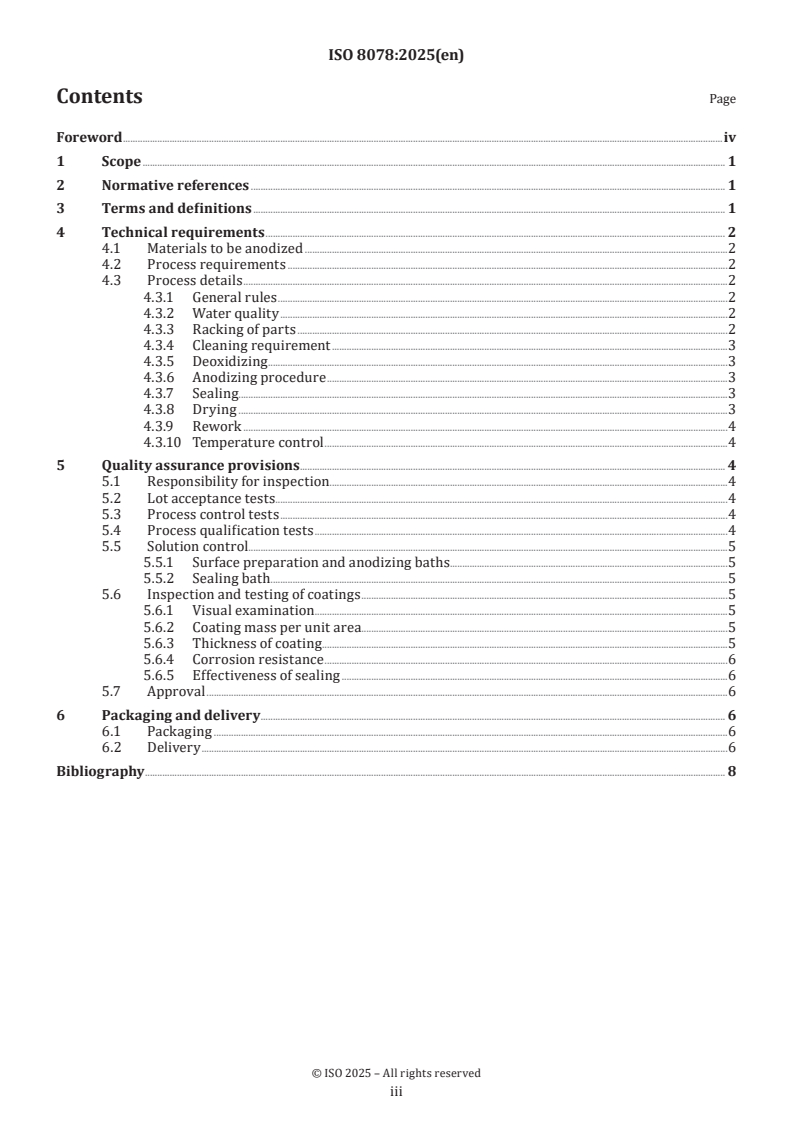
Contents Page
Foreword .iv
1 Scope . 1
2 Normative references . 1
3 Terms and definitions . 1
4 Technical requirements . 2
4.1 Materials to be anodized .2
4.2 Process requirements .2
4.3 Process details .2
4.3.1 General rules .2
4.3.2 Water quality .2
4.3.3 Racking of parts .2
4.3.4 Cleaning requirement .3
4.3.5 Deoxidizing . .3
4.3.6 Anodizing procedure .3
4.3.7 Sealing.3
4.3.8 Drying .3
4.3.9 Rework .4
4.3.10 Temperature control .4
5 Quality assurance provisions . . 4
5.1 Responsibility for inspection.4
5.2 Lot acceptance tests.4
5.3 Process control tests .4
5.4 Process qualification tests .4
5.5 Solution control . .5
5.5.1 Surface preparation and anodizing baths . .5
5.5.2 Sealing bath.5
5.6 Inspection and testing of coatings .5
5.6.1 Visual examination .5
5.6.2 Coating mass per unit area.5
5.6.3 Thickness of coating .5
5.6.4 Corrosion resistance .6
5.6.5 Effectiveness of sealing .6
5.7 Approval .6
6 Packaging and delivery . 6
6.1 Packaging .6
6.2 Delivery .6
Bibliography . 8
iii
Foreword
ISO (the International Organization for Standardization) is a worldwide federation of national standards
bodies (ISO member bodies). The work of preparing International Standards is normally carried out through
ISO technical committees. Each member body interested in a subject for which a technical committee
has been established has the right to be represented on that committee. International organizations,
governmental and non-governmental, in liaison with ISO, also take part in the work. ISO collaborates closely
with the International Electrotechnical Commission (IEC) on all matters of electrotechnical standardization.
The procedures used to develop this document and those intended for its further maintenance are described
in the ISO/IEC Directives, Part 1. In particular, the different approval criteria needed for the different types
of ISO documents should be noted. This document was drafted in accordance with the editorial rules of the
ISO/IEC Directives, Part 2 (see www.iso.org/directives).
ISO draws attention to the possibility that the implementation of this document may involve the use of (a)
patent(s). ISO takes no position concerning the evidence, validity or applicability of any claimed patent
rights in respect thereof. As of the date of publication of this document, ISO had not received notice of (a)
patent(s) which may be required to implement this document. However, implementers are cautioned that
this may not represent the latest information, which may be obtained from the patent database available at
www.iso.org/patents. ISO shall not be held responsible for identifying any or all such patent rights.
Any trade name used in this document is information given for the convenience of users and does not
constitute an endorsement.
For an explanation of the voluntary nature of standards, the meaning of ISO specific terms and expressions
related to conformity assessment, as well as information about ISO's adherence to the World Trade
Organization (WTO) principles in the Technical Barriers to Trade (TBT), see www.iso.org/iso/foreword.html.
This document was prepared by Technical Committee ISO/TC 20, Aircraft and space vehicles, Subcommittee
SC 18, Materials.
This second edition cancels and replaces the first edition (ISO 8078:1984), which has been technically
revised.
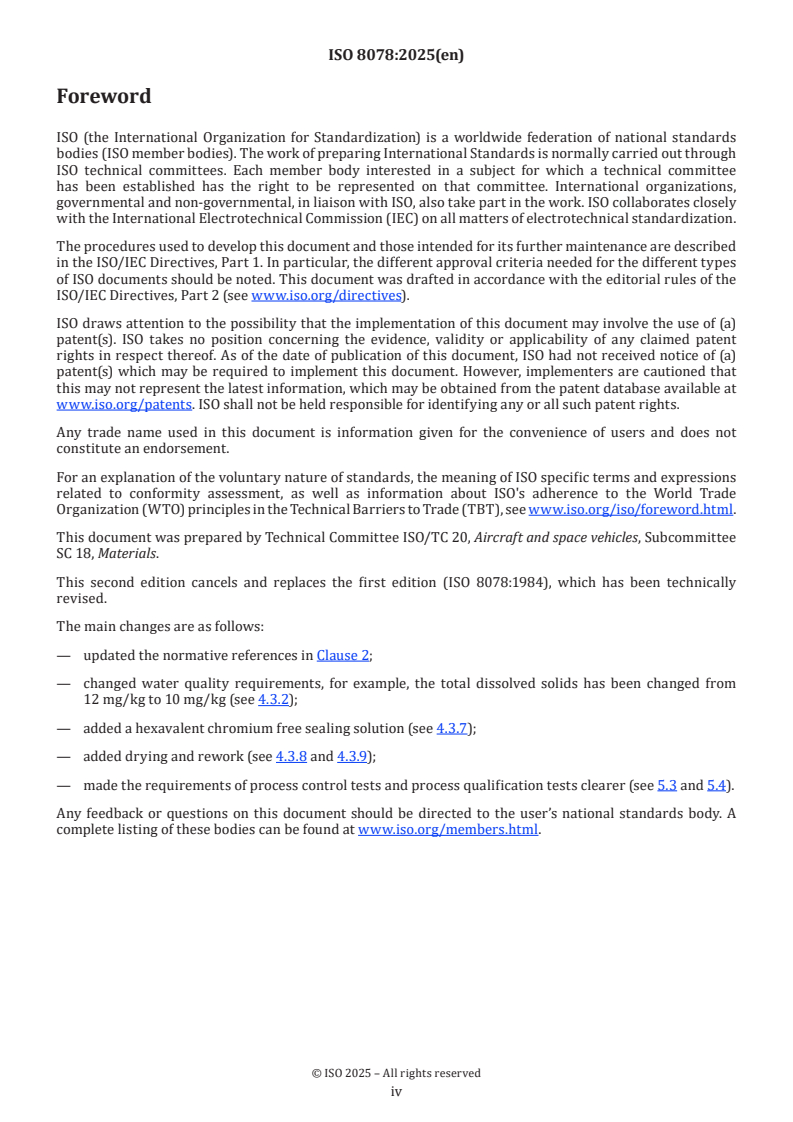
The main changes are as follows:
— updated the normative references in Clause 2;
— changed water quality requirements, for example, the total dissolved solids has been changed from
12 mg/kg to 10 mg/kg (see 4.3.2);
— added a hexavalent chromium free sealing solution (see 4.3.7);
— added drying and rework (see 4.3.8 and 4.3.9);
— made the requirements of process control tests and process qualification tests clearer (see 5.3 and 5.4).
Any feedback or questions on this document should be directed to the user’s national standards body. A
complete listing of these bodies can be found at www.iso.org/members.html.
iv
International Standard ISO 8078:2025(en)
Aerospace process — Anodic treatment of aluminium alloys
— Sulfuric acid process, undyed coating
1 Scope
This document specifies requirements for producing and testing an undyed sulfuric acid anodic coating on
aluminium alloys.
The anodizing process is applied in the manufacture of aerospace products to improve paint adhesion and
resistance to corrosion.
2 Normative references
The following documents are referred to in the text in such a way that some or all of their content constitutes
requirements of this document. For dated references, only the edition cited applies. For undated references,
the latest edition of the referenced document (including any amendments) applies.
ISO 2064, Metallic and other inorganic coatings — Definitions and conventions concerning the measurement of
thickness
ISO 2106, Anodizing of aluminium and its alloys — Determination of mass per unit area (surface density) of
anodic oxidation coatings — Gravimetric method
ISO 2360, Non-conductive coatings on non-magnetic electrically conductive base metals — Measurement of
coating thickness — Amplitude-sensitive eddy-current method
ISO 2859-1, Sampling procedures for inspection by attributes — Part 1: Sampling schemes indexed by acceptance
quality (AQL) for lot-by-lot inspection
ISO 9227, Corrosion tests in artificial atmospheres — Salt spray tests
3 Terms and definitions
For the purposes of this document, the following terms and definitions apply.
ISO and IEC maintain terminology databases for use in standardization at the following addresses:
— ISO Online browsing platform: available at https:// www .iso .org/ obp
— IEC Electropedia: available at https:// www .electropedia .org/
3.1
lot
all parts treated in the same baths at the same time
[SOURCE: ISO 8081:2021, 3.1]
3.2
water-break-free surface
surface that maintains a continuous water film for a period of at least 30 s after being sprayed or rinsed by
immersion in clean water at ambient temperature
[SOURCE: ISO 8081:2021, 3.2]
4 Technical requirements
4.1 Materials to be anodized
The alloys shall be of a chemical composition compatible with sulfuric acid anodizing.
The base metal shall be free from surface defects caused by metalworking processes or handling, and free
from grease, pitting, corrosion, heavy etching, etc. which are detrimental to the application of anodized
coatings capable of meeting the requirements of this document.
4.2 Process requirements
The processes employed shall be suc
...