

ISO 28701:2025
(Main)Inland navigation and commercial shipping — Safety and sustainability management systems — Requirements and guidance for use
General Information
- Abstract
This document provides requirements and guidance for implementing a safety and sustainability management system for commercial shipping on inland waterways. The document is tailored toward navigation on the inland waterways, including but not limited to rivers and lakes. It applies to freight, cruise, ferries and passenger vessels larger than 24 m in length on inland waterways and land-based operations supporting ships. This document is aligned with the ISM Code[14] and is also applicable to sea going vessels when sailing on inland waterways.
- Status
- Published
- Publication Date
- 18-Aug-2025
- Technical Committee
- ISO/TC 8/SC 7 - Inland navigation vessels
- Drafting Committee
- ISO/TC 8/SC 7 - Inland navigation vessels
- Current Stage
- 6060 - International Standard published
- Start Date
- 19-Aug-2025
- Due Date
- 04-May-2025
- Completion Date
- 19-Aug-2025

Overview
ISO 28701:2025 - Inland navigation and commercial shipping: Safety and sustainability management systems defines requirements and provides guidance for implementing a combined safety and sustainability management system for commercial shipping on inland waterways. Tailored to navigation on rivers, lakes and similar inland waterways, the standard applies to freight, cruise, ferry and passenger vessels longer than 24 m, and to land‑based operations that support ships. ISO 28701 is aligned with the ISM Code and can also be applied to sea‑going vessels when operating on inland waterways. The standard promotes risk‑based thinking and integration with existing environmental and safety management systems.
Key topics and requirements
Key technical topics covered by ISO 28701 include:
- Context of the organization: understanding internal/external factors and interested parties; defining scope and boundaries across the three sustainability dimensions (social, environmental, governance/economic).
- Leadership: top management commitment, safety and sustainability policy, emergency response and crisis management.
- Roles and responsibilities: designated persons ashore, the master’s responsibility on board, and arrangements for multiple ownership.
- Planning: actions to address risks and opportunities (social, environmental, economic), objectives (short‑ and long‑term), compliance obligations and change planning.
- Support: resources, competence, awareness, communication (internal/external) and documented information including ESG policy documentation.
- Operation: operational planning and control, navigation procedures and appliances, safety equipment, maintenance of hull and ship systems, procurement and management of change.
- Performance evaluation: monitoring, measurement, analysis, internal audit and management review.
- Improvement: continual improvement, nonconformity and corrective action processes.
Applications and users
ISO 28701 is intended for:
- Shipowners and operators of inland navigation vessels (vessels >24 m) - freight, passenger, ferry and cruise operators.
- Port authorities, inland waterway authorities and service providers supporting ship operations.
- Managers responsible for safety, environmental compliance, ESG reporting and operational resilience.
- Organizations seeking to align inland shipping operations with the ISM Code and to integrate safety with sustainability objectives.
Practical benefits include improved safety performance, clarified governance and responsibilities, better environmental risk management on inland waterways, and a structured approach to meet stakeholder and regulatory expectations.
Related standards
- Aligned with the ISM Code for ship safety management.
- Intended to integrate with other management systems (for example, existing environmental and occupational safety standards) rather than replace them.
Keywords: ISO 28701, inland navigation, safety and sustainability management system, inland waterways, commercial shipping, ISM Code, environmental management, risk-based thinking, maritime ESG.
Get Certified
Connect with accredited certification bodies for this standard

BSI Group
BSI (British Standards Institution) is the business standards company that helps organizations make excellence a habit.

Bureau Veritas
Bureau Veritas is a world leader in laboratory testing, inspection and certification services.

DNV
DNV is an independent assurance and risk management provider.
Sponsored listings
Frequently Asked Questions
ISO 28701:2025 is a standard published by the International Organization for Standardization (ISO). Its full title is "Inland navigation and commercial shipping — Safety and sustainability management systems — Requirements and guidance for use". This standard covers: This document provides requirements and guidance for implementing a safety and sustainability management system for commercial shipping on inland waterways. The document is tailored toward navigation on the inland waterways, including but not limited to rivers and lakes. It applies to freight, cruise, ferries and passenger vessels larger than 24 m in length on inland waterways and land-based operations supporting ships. This document is aligned with the ISM Code[14] and is also applicable to sea going vessels when sailing on inland waterways.
This document provides requirements and guidance for implementing a safety and sustainability management system for commercial shipping on inland waterways. The document is tailored toward navigation on the inland waterways, including but not limited to rivers and lakes. It applies to freight, cruise, ferries and passenger vessels larger than 24 m in length on inland waterways and land-based operations supporting ships. This document is aligned with the ISM Code[14] and is also applicable to sea going vessels when sailing on inland waterways.
ISO 28701:2025 is classified under the following ICS (International Classification for Standards) categories: 03.100.70 - Management systems; 03.220.40 - Transport by water; 13.020.20 - Environmental economics. Sustainability. The ICS classification helps identify the subject area and facilitates finding related standards.
ISO 28701:2025 is available in PDF format for immediate download after purchase. The document can be added to your cart and obtained through the secure checkout process. Digital delivery ensures instant access to the complete standard document.
Standards Content (Sample)
International
Standard
ISO 28701
First edition
Inland navigation and commercial
2025-08
shipping — Safety and sustainability
management systems —
Requirements and guidance for use
Reference number
© ISO 2025
All rights reserved. Unless otherwise specified, or required in the context of its implementation, no part of this publication may
be reproduced or utilized otherwise in any form or by any means, electronic or mechanical, including photocopying, or posting on
the internet or an intranet, without prior written permission. Permission can be requested from either ISO at the address below
or ISO’s member body in the country of the requester.
ISO copyright office
CP 401 • Ch. de Blandonnet 8
CH-1214 Vernier, Geneva
Phone: +41 22 749 01 11
Email: copyright@iso.org
Website: www.iso.org
Published in Switzerland
ii
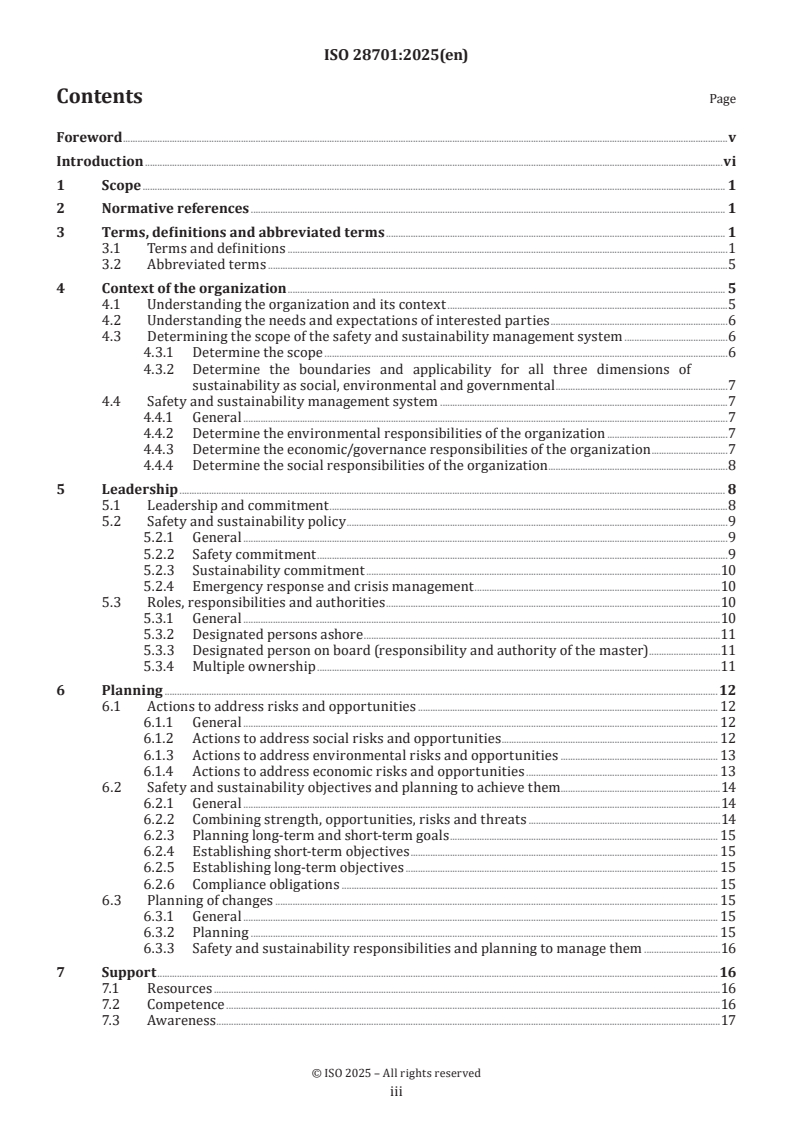
Contents Page
Foreword .v
Introduction .vi
1 Scope . 1
2 Normative references . 1
3 Terms, definitions and abbreviated terms . 1
3.1 Terms and definitions .1
3.2 Abbreviated terms .5
4 Context of the organization . 5
4.1 Understanding the organization and its context .5
4.2 Understanding the needs and expectations of interested parties .6
4.3 Determining the scope of the safety and sustainability management system .6
4.3.1 Determine the scope .6
4.3.2 Determine the boundaries and applicability for all three dimensions of
sustainability as social, environmental and governmental .7
4.4 Safety and sustainability management system .7
4.4.1 General .7
4.4.2 Determine the environmental responsibilities of the organization .7
4.4.3 Determine the economic/governance responsibilities of the organization .7
4.4.4 Determine the social responsibilities of the organization .8
5 Leadership . 8
5.1 Leadership and commitment .8
5.2 Safety and sustainability policy .9
5.2.1 General .9
5.2.2 Safety commitment .9
5.2.3 Sustainability commitment .10
5.2.4 Emergency response and crisis management .10
5.3 Roles, responsibilities and authorities .10
5.3.1 General .10
5.3.2 Designated persons ashore .11
5.3.3 Designated person on board (responsibility and authority of the master) .11
5.3.4 Multiple ownership .11
6 Planning .12
6.1 Actions to address risks and opportunities . 12
6.1.1 General . 12
6.1.2 Actions to address social risks and opportunities . 12
6.1.3 Actions to address environmental risks and opportunities . 13
6.1.4 Actions to address economic risks and opportunities . 13
6.2 Safety and sustainability objectives and planning to achieve them .14
6.2.1 General .14
6.2.2 Combining strength, opportunities, risks and threats .14
6.2.3 Planning long-term and short-term goals . 15
6.2.4 Establishing short-term objectives . 15
6.2.5 Establishing long-term objectives . 15
6.2.6 Compliance obligations . 15
6.3 Planning of changes . 15
6.3.1 General . 15
6.3.2 Planning . 15
6.3.3 Safety and sustainability responsibilities and planning to manage them .16
7 Support .16
7.1 Resources .16
7.2 Competence .16
7.3 Awareness .17
iii
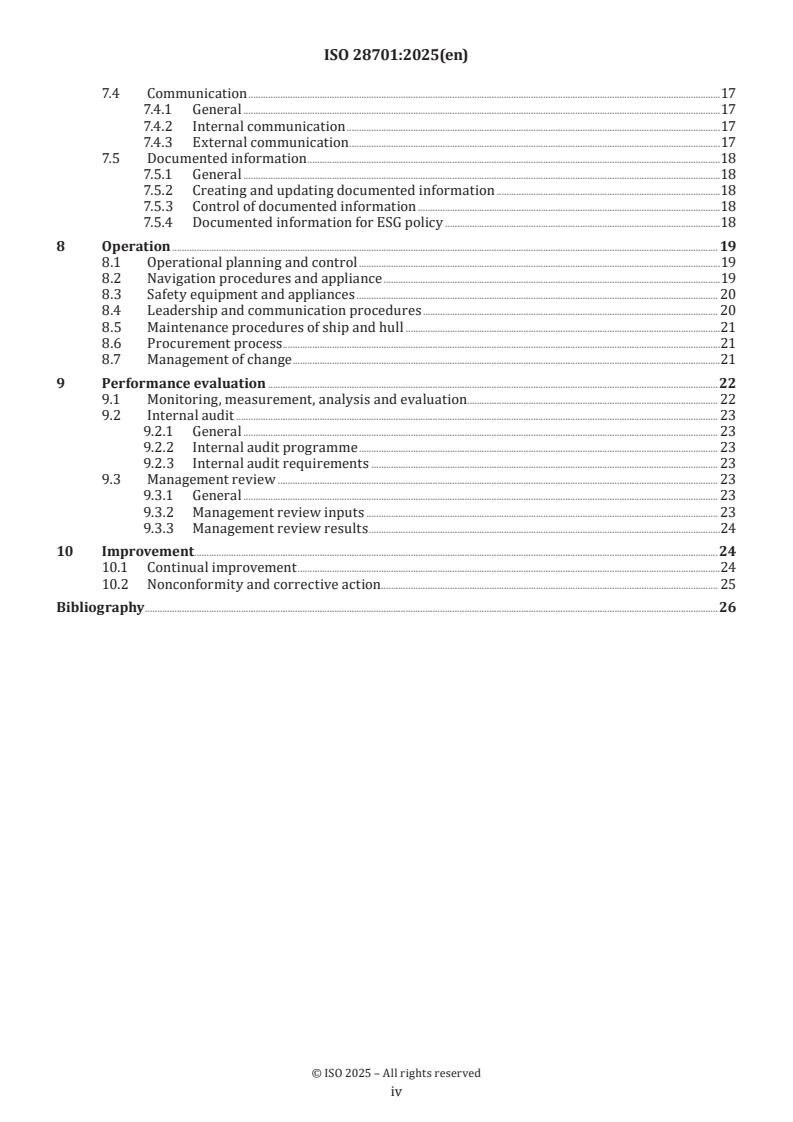
7.4 Communication .17
7.4.1 General .17
7.4.2 Internal communication .17
7.4.3 External communication .17
7.5 Documented information .18
7.5.1 General .18
7.5.2 Creating and updating documented information .18
7.5.3 Control of documented information .18
7.5.4 Documented information for ESG policy .18
8 Operation . 19
8.1 Operational planning and control .19
8.2 Navigation procedures and appliance .19
8.3 Safety equipment and appliances . 20
8.4 Leadership and communication procedures . 20
8.5 Maintenance procedures of ship and hull .21
8.6 Procurement process .21
8.7 Management of change .21
9 Performance evaluation .22
9.1 Monitoring, measurement, analysis and evaluation . . 22
9.2 Internal audit . 23
9.2.1 General . 23
9.2.2 Internal audit programme . 23
9.2.3 Internal audit requirements . 23
9.3 Management review . 23
9.3.1 General . 23
9.3.2 Management review inputs . 23
9.3.3 Management review results .24
10 Improvement .24
10.1 Continual improvement .24
10.2 Nonconformity and corrective action . 25
Bibliography .26
iv
Foreword
ISO (the International Organization for Standardization) is a worldwide federation of national standards
bodies (ISO member bodies). The work of preparing International Standards is normally carried out through
ISO technical committees. Each member body interested in a subject for which a technical committee
has been established has the right to be represented on that committee. International organizations,
governmental and non-governmental, in liaison with ISO, also take part in the work. ISO collaborates closely
with the International Electrotechnical Commission (IEC) on all matters of electrotechnical standardization.
The procedures used to develop this document and those intended for its further maintenance are described
in the ISO/IEC Directives, Part 1. In particular, the different approval criteria needed for the different types
of ISO document should be noted. This document was drafted in accordance with the editorial rules of the
ISO/IEC Directives, Part 2 (see www.iso.org/directives).
ISO draws attention to the possibility that the implementation of this document may involve the use of (a)
patent(s). ISO takes no position concerning the evidence, validity or applicability of any claimed patent
rights in respect thereof. As of the date of publication of this document, ISO had not received notice of (a)
patent(s) which may be required to implement this document. However, implementers are cautioned that
this may not represent the latest information, which may be obtained from the patent database available at
www.iso.org/patents. ISO shall not be held responsible for identifying any or all such patent rights.
Any trade name used in this document is information given for the convenience of users and does not
constitute an endorsement.
For an explanation of the voluntary nature of standards, the meaning of ISO specific terms and expressions
related to conformity assessment, as well as information about ISO's adherence to the World Trade
Organization (WTO) principles in the Technical Barriers to Trade (TBT), see www.iso.org/iso/foreword.html.
This document was prepared by Technical Committee ISO/TC 8, Ships and marine technology, Subcommittee
SC 7, Inland navigation vessels.
Any feedback or questions on this document should be directed to the user’s national standards body. A
complete listing of these bodies can be found at www.iso.org/members.html.
v
Introduction
This document enables an organization to use a common approach and risk-based thinking to integrate
its safety and sustainability management system with the requirements of other management systems.
This document does not replace current standards in environmental management or safety management.
Instead, it should serve as a management system for the implementation of the successful measures used in
inland waterway shipping.
vi
International Standard ISO 28701:2025(en)
Inland navigation and commercial shipping — Safety and
sustainability management systems — Requirements and
guidance for use
1 Scope
This document provides requirements and guidance for implementing a safety and sustainability
management system for commercial shipping on inland waterways. The document is tailored toward
navigation on the inland waterways, including but not limited to rivers and lakes. It applies to freight, cruise,
ferries and passenger vessels larger than 24 m in length on inland waterways and land-based operations
supporting ships.
[14]
This document is aligned with the ISM Code and is also applicable to sea going vessels when sailing on
inland waterways.
2 Normative references
There are no normative references in this document.
3 Terms, definitions and abbreviated terms
3.1 Terms and definitions
For the purposes of this document, the following terms and definitions apply.
ISO and IEC maintain terminology databases for use in standardization at the following addresses:
— ISO Online browsing platform: available at https:// www .iso .org/ obp
— IEC Electropedia: available at https:// www .electropedia .org/
3.1.1
organization
person or group of people that has its own functions with responsibilities, authorities and relationships to
achieve its objectives (3.1.6)
Note 1 to entry: The concept of organization includes, but is not limited to, sole-trader, company, corporation, firm,
enterprise, authority, partnership, charity or institution, or part or combination thereof, whether incorporated or not,
public or private.
Note 2 to entry: If the organization is part of a larger entity, the term “organization” refers only to the part of the larger
entity that is within the scope of the safety and sustainability management system (3.1.4).
Note 3 to entry: In this document, organization refers to the owner of the vessel (3.1.32) or any other organization
or person such as the manager, or charterer, who has assumed the responsibility for the operation of the ship from
the owner of the vessel (3.1.32) and who, on assuming such responsibility, has agreed to take over all the duties and
responsibility imposed by this document.
3.1.2
interested party
stakeholder
person or organization (3.1.1) that can affect, be affected by, or perceive itself to be affected by a decision or
activity
3.1.3
top management
person or group of people who directs and controls an organization (3.1.1) at the highest level
Note 1 to entry: Top management has the power to delegate authority and provide resources within the organization.
Note 2 to entry: If the scope of the management system (3.1.4) covers only part of an organization, then top management
refers to those who direct and control that part of the organization.
3.1.4
management system
set of interrelated or interacting elements of an organization (3.1.1) to establish policies (3.1.5) and objectives
(3.1.6), as well as processes (3.1.8) to achieve those objectives
Note 1 to entry: A management system can address a single discipline or several disciplines.
Note 2 to entry: The management system elements include the organization’s structure, roles and responsibilities,
planning and operation.
3.1.5
policy
intentions and direction of an organization (3.1.1) as formally expressed by its top management (3.1.3)
3.1.6
objective
result to be achieved
Note 1 to entry: An objective can be strategic, tactical, or operational.
Note 2 to entry: Objectives can relate to different disciplines (such as finance, health and safety, and environment).
They can be, for example, organization-wide or specific to a project, product or process (3.1.8).
Note 3 to entry: An objective can be expressed in other ways, e.g. as an intended result, as a purpose, as an operational
criterion, as a safety and sustainability objective or by the use of other words with similar meaning (e.g. aim, goal, or
target).
Note 4 to entry: In the context of safety and sustainability management systems (3.1.4), safety and sustainability
objectives are set by the organization (3.1.1), consistent with the safety and sustainability policy (3.1.5), to achieve
specific results.
3.1.7
risk
effect of uncertainty
Note 1 to entry: An effect is a deviation from the expected — positive or negative.
Note 2 to entry: Uncertainty is the state, even partial, of deficiency of information related to, understanding or
knowledge of, an event, its consequence, or likelihood.
Note 3 to entry: Risk is often characterized by reference to potential events and consequences, or a combination of these.
Note 4 to entry: Risk is often expressed in terms of a combination of the consequences of an event (including changes
in circumstances) and the associated likelihood of occurrence.
3.1.8
process
set of interrelated or interacting activities that uses or transforms inputs to deliver a result
Note 1 to entry: Whether the result of a process is called an output, a product or a service depends on the context of
the reference.
3.1.9
competence
ability to apply knowledge and skills to achieve intended results
3.1.10
documented information
information required to be controlled and maintained by an organization (3.1.1) and the medium on which
it is contained
Note 1 to entry: Documented information can be in any format and media and from any source.
Note 2 to entry: Documented information can refer to:
— the management system (3.1.4), including related processes (3.1.8);
— information created in order for the organization to operate (documentation);
— evidence of results achieved (records).
3.1.11
performance
measurable result
Note 1 to entry: Performance can relate either to quantitative or qualitative findings.
Note 2 to entry: Performance can relate to managing activities, processes (3.1.8), products, services, systems or
organizations (3.1.1).
3.1.12
continual improvement
recurring activity to enhance performance (3.1.11)
3.1.13
effectiveness
extent to which planned activities are realized and planned results are achieved
3.1.14
requirement
need or expectation that is stated, generally implied or obligatory
Note 1 to entry: “Generally implied” means that it is custom or common practice for the organization (3.1.1) and
interested parties (3.1.2) that the need or expectation under consideration is implied.
Note 2 to entry: A specified requirement is one that is stated, e.g. in documented information (3.1.10).
3.1.15
conformity
fulfilment of a requirement (3.1.14)
3.1.16
nonconformity
non-fulfilment of a requirement (3.1.14)
3.1.17
corrective action
action to eliminate the cause(s) of a nonconformity (3.1.16) and to prevent recurrence
3.1.18
audit
systematic and independent process (3.1.8) for obtaining evidence and evaluating it objectively to determine
the extent to which the audit criteria are fulfilled
Note 1 to entry: An audit can be an internal audit (first party) or an external audit (second party or third party), and it
can be a combined audit (combining two or more disciplines).
Note 2 to entry: An internal audit is conducted by the organization (3.1.1) itself, or by an external party on its behalf.
Note 3 to entry: “Audit evidence” and “audit criteria” are defined in ISO 19011.
3.1.19
measurement
process (3.1.8) to determine a value
3.1.20
monitoring
determining the status of a system, a process (3.1.8) or an activity
Note 1 to entry: To determine the status, there can be a need to check, supervise or critically observe.
3.1.21
administration
government of the state where the vessel (3.1.32) is registered
3.1.22
contractor
external organization providing services to the organization (3.1.1) in accordance with agreed specifications,
terms and conditions
[SOURCE: ISO 45001:2018, 3.7, modified — note to entry has been removed.]
3.1.23
environment
surroundings in which an organization (3.1.1) operates, including air, water, land, natural resources, flora,
fauna, humans and their interrelationships
[SOURCE: ISO 14050:2020, 3.2.2]
3.1.24
hazard
source with a potential to cause injury and ill health (3.1.26)
[SOURCE: ISO 45001:2018, 3.19, modified — note to entry has been removed.]
3.1.25
indicator
measurable representation of the condition or status of operations, management or conditions
3.1.26
injury and ill health
adverse effect on the physical, mental or cognitive condition of a person
[SOURCE: ISO 45001:2018, 3.18, modified — notes to entry have been removed.]
3.1.27
legal requirements and other requirements
legal requirements that an organization has to comply with and other requirements that an organization
has to or chooses to comply with
[SOURCE: ISO 45001:2018, 3.9, modified — notes to entry have been removed.]
3.1.28
life cycle
consecutive and interlinked stages of a product (or service) system, from raw material acquisition or
generation from natural resources to final disposal
[SOURCE: ISO 14040:2006, 3.1, modified — “(or service)” has been added to the definition.]
3.1.29
procedure
specified way to carry out an activity or a process (3.1.8)
[SOURCE: ISO 45001:2018, 3.26, modified— note to entry has been removed.]
3.1.30
safety
freedom from risk (3.1.7) which is not tolerable
[SOURCE: ISO/IEC Guide 51:2014, 3.14]
3.1.31
sustainability
state of the global system, including environmental, social and economic aspects, in which the needs of the
present are met without compromising the ability of future generations to meet their own needs
Note 1 to entry: The environmental, social and economic aspects interact, are interdependent and are often referred
to as the three dimensions of sustainability.
Note 2 to entry: Sustainability is the goal of sustainable development.
[SOURCE: ISO Guide 82:2019, 3.1]
3.1.32
vessel
inland waterway craft, including small craft and ferry boats, as well as floating equipment and seagoing vessels
3.1.33
worker
person performing work or work-related activities that are under the control of the organization (3.1.1)
[SOURCE: ISO 45001:2018, 3.3, modified — notes to entry have been removed.]
3.1.34
workplace
place under the control of the organization (3.1.1) where a person needs to be or to go for work purposes
[SOURCE: ISO 45001:2018, 3.6, modified — note to entry has been removed.]
3.2 Abbreviated terms
ESG environmental, social, governance
KPI key performance indicator
PDCA Plan-Do-Check-Act
SDG Sustainable Development Goal
SMS safety management system
SWOT Strength, Weakness, Opportunity, and Threat
4 Context of the organization
4.1 Understanding the organization and its context
The organization shall determine external and internal issues that are relevant to its purpose and that affect
its ability to achieve the intended result(s) of its safety and sustainability management system.
The organization shall determine whether climate change is a relevant issue.
Such relevant issues shall include the environmental, social and governance (also referred to as economical)
responsibilities of safety and sustainability management for commercial shipping on the inland waterways.
The relevant external and internal issues which are determined shall be combined into a policy referred
to as environmental, social and governance (ESG) policy, which aims to enhance a current safety and
sustainability management system.
It shall be recognized that no two shipping organizations are the same and that vessels operate under a
range of different conditions. The ESG policy based on this document shall be implemented in consideration
of these different conditions of shipping organizations.
The organization shall be managed appropriately so it can respond to the needs of those on board vessels
and achieve and maintain high benchmarks of social, safety and environmental standards and practices.
4.2 Understanding the needs and expectations of interested parties
The organization shall determine:
— the interested parties that are relevant to the safety and sustainability management system;
— the relevant requirements of these interested parties;
— which of these requirements will be addressed through the safety and sustainability management system.
NOTE Relevant interested parties can have requirements related to climate change.
4.3 Determining the scope of the safety and sustainability management system
4.3.1 Determine the scope
The organization shall determine the boundaries and applicability of the safety and sustainability
management system to establish its scope.
When determining this scope, the organization shall consider:
a) the external and internal issues referred to in 4.1;
b) the requirements referred to in 4.2;
c) its organizational units, functions and physical boundaries;
d) its activities, products and services;
e) its authority and ability to exercise control and influence.
The scope shall be available as documented information to interested parties.
The organization shall determine how the size, flexibility and structure of the organization are impacted by
the requirements listed in this document.
When determining the scope, the organization shall take into consideration:
f) agreement on the functional requirement of the ESG policy in regard to safety and environmental
protection policies; a specific reference shall be made to all documentation that has been taken into
consideration;
g) compliance with the requirements of a classification society or with the national regulatory
requirements of an administration, which provides an equivalent or national level of safety and
environmental protection;
NOTE 1 Legal regulations can apply.
h) agreement on the ESG requirement to cover a set of local laws and regulations in the area of operation; a
[14]
specific reference shall be made on how the ISM Code relates to the local rules and regulations of the
country the organization operates within;
i) agreement on the execution of ESG practices based on levels of authority and lines of communication
such as a shoreside and shipboard staff. This shall include precisely determining the designated person
on board and the designated person ashore responsible for this role;
j) agreement on the reporting and auditing needs; this shall include a reference on how the system will
later be visible and communicated to the stakeholders. This can consist of the need for internal and
external reporting and the means of communication via publication, web source, etc;
k) determination of the handling and authority concerning nonconformities. This shall include an apparent
reference on how maintenance and training are handled and approved.
Once the scope is defined, all activities, products and services of the organization within that scope shall
be included in the management system. The content shall be noted in a policy document that combines the
initial research and structure of the organization and strategy.
[14]
NOTE 2 Occupational health and safety topics are covered in ISO 45001 and the ISM Code.
4.3.2 Determine the boundaries and applicability for all three dimensions of sustainability as
social, environmental and governmental
The organization shall determine those social, environmental and governmental responsibilities that have
or can have a significant impact on safety ship operation.
4.4 Safety and sustainability management system
4.4.1 General
The organization shall establish, implement, maintain and continually improve a safety and sustainability
management system, including the processes needed and their interactions, in accordance with the
requirements of this document.
4.4.2 Determine the environmental responsibilities of the organization
The organization shall:
a) determine its responsibility to meet expectations regarding environmental safety and environmental
sustainability. It is recommended to perform a full life cycle analysis on the product, service and/or
equipment used. At a minimum, a carbon accounting practice shall be in place;
b) consider local projects and focus set by its authority or other stakeholders that impact the organization's
environmental safety. It shall focus on short-term improvements to ensure the ecological operation is
safely upheld;
c) refer to global projects regarding environmental sustainability, for example, long-term international
[1]
efforts such as those outlined in the United Nations Sustainable Development Goals or any other
global goals.
Environmental responsibilities shall be determined using a Strength, Weakness, Opportunity and Threat
(SWOT) analysis, risk assessment methods, and/or stakeholder analysis (non-comprehensive list). The
research outcome shall be used to educate the organization and its workforce on the need and purpose of
the implementation.
4.4.3 Determine the economic/governance responsibilities of the organization
The organization shall:
a) determine the regulatory framework to which it is bound and evaluate how this framework impacts the
regulatory framework applied to the operational vessel area;
b) take into account the industry's economic power and associations to determine if infrastructure
investments should be carried out by the organization or relied upon by third parties. This shall include
infrastructure projects such as docking areas, power supply, vessel design and safety regulations.
The economic responsibility shall be determined by a stakeholder analysis and by comparing the data
of the stakeholder analysis with the infrastructure present in the destination, operations area and the
organization's location.
4.4.4 Determine the social responsibilities of the organization
The organization shall:
a) determine its regulatory framework regarding social standards covering aspects such as employment
laws, including contracting, workforce management, education and scheduling. The organization shall
determine if there is a gap between the country of operation and the organization's country of origin;
b) consolidate the research performed in 5.1 into a SWOT analysis that determines stakeholder impact
consisting of interested parties such as the owner, operator, employee, authorities, people who are
locally impacted and the global society.
The social impact analysis shall provide a framework that is heavily driven by occupational health and social
well-being.
The organization shall establish an implementation timeline, consisting of a research phase as outlined in
Clause 4, followed by an implementation phase outlined in Clauses 7 to 8, followed by a review and auditing
phase as outlined in Clauses 9 and 10. Once the initial implementation is completed, the organization shall
use the tools listed in Clause 6 to establish short-, medium- and long-term goals. The feedback received
pertaining to processes and requirements from Clauses 9 and 10 shall be included in the goal-setting
process. This is intended to continuously improve the responsibility of the organization.
5 Leadership
5.1 Leadership and commitment
Top management shall demonstrate leadership and commitment with respect to the safety and sustainability
management system by:
— ensuring that the safety and sustainability policy and safety and sustainability objectives are established
and are compatible with the strategic direction of the organization;
— ensuring the integration of the safety and sustainability management system requirements into the
organization’s business processes;
— ensuring that the resources needed for the safety and sustainability management system are available;
— communicating the importance of effective safety and sustainability management and of conforming to
the safety and sustainability management system requirements;
— ensuring that the safety and sustainability management system achieves its intended result(s);
— directing and supporting persons to contribute to the effectiveness of the safety and sustainability
management system;
— promoting continual improvement;
— ensuring the adoption, effective implementation and promotion of occupational safety and health policies
and programmes;
— supporting other relevant roles to demonstrate their leadership as it applies to their areas of responsibility.
NOTE Reference to “business” in this document can be interpreted broadly to mean those activities that are core
to the purposes of the organization’s existence.
Top management shall facilitate the process of determining the stakeholders of the organization and their
interests. This facilitation shall be performed by:
a) listing the stakeholders involved;
b) determining the impact that they have on the organization;
c) determining the impact that the organization has on them;
d) verifying if there are different stakeholders ashore and on board.
Leadership shall expressively recognize the impact that the organization has on the stakeholders and their
commitment to a safety and sustainability management system by agreeing on a set of KPIs on at least a
yearly basis.
The organization shall implement a process for consultation and participation of stakeholders regarding the
safety and sustainability management system. This can be done via customer feedback tools, staff surveys,
and by engaging with authorities, industry associations and any other form of stakeholder management
programmes.
In cases where the organization responsible for the operation of the vessel is not the owner of the vessel,
the owner shall state the full name of this organization in the system and clarify the relationship of
responsibility.
5.2 Safety and sustainability policy
5.2.1 General
Top management shall establish a safety and sustainability policy that:
a) is appropriate to the purpose of the organization;
b) provides a framework for setting safety and sustainability management objectives;
c) includes a commitment to meet applicable requirements;
d) includes a commitment to continual improvement of the safety and sustainability management system.
The safety and sustainability policy shall:
— be available as documented information;
— be communicated within the organization;
— be available to interested parties, as appropriate.
5.2.2 Safety commitment
Top management shall take the ultimate responsibility for safety. This shall not be limited to occupational
health and environmental protection but shall reflect a sensible and common approach determined by the
stakeholder analysis.
Although responsibility and authority can be assigned, policies and procedures as outlined in the ESG policy
shall be executed, with the end responsibility remaining with top management. Top management shall give
the authority and responsibility for:
a) ensuring policies and procedures are executed within the context and scope of the system;
b) frequent reporting on the system's performance;
c) setting short-term goals to ensure nonconformities are addressed on time;
d) ensuring certification is obtained and valid for all vessels, the vessel operation and the person operating
the vessel.
5.2.3 Sustainability commitment
It is essential to differentiate between environmental safety and environmental sustainability. Environmental
safety is geared towards protection policies that govern the status quo. Sustainability policies govern future
sustainability efforts formalized in long-term goals. The same principle can be applied to health and safety
or social and economic policies.
The organization shall provide an ESG mechanism that ensures that the following processes are in place:
a) reviewing the scope and context yearly to ensure it is up to date with the latest research;
b) reviewing the legal obligations and commitments by governments, governmental agencies and other
organizations within the context of this document on at least a six-monthly basis;
c) providing a framework for objective-setting, resulting in long-term goals. This can be based on energy
efficiency standards, life cycle analysis or any other method used in the country of origin;
d) ensuring the policy is communicated within the context and scope of the system.
5.2.4 Emergency response and crisis management
The organization shall:
a) ide
...