

IEC/TS 62622:2012
(Main)Artificial gratings used in nanotechnology — Description and measurement of dimensional quality parameters
General Information
- Abstract
IEC/TS 62622:2012(E), which is a technical specification, specifies the generic terminology for the global and local quality parameters of artificial gratings, interpreted in terms of deviations from nominal positions of grating features, and provides guidance on the categorization of measurement and evaluation methods for their determination. This specification is intended to facilitate communication among manufacturers, users and calibration laboratories dealing with the characterization of the dimensional quality parameters of artificial gratings used in nanotechnology. This specification supports quality assurance in the production and use of artificial gratings in different areas of application in nanotechnology. Whilst the definitions and described methods are universal to a large variety of different gratings, the focus is on one-dimensional (1D) and two-dimensional (2D) gratings.
- Status
- Published
- Publication Date
- 04-Oct-2012
- Technical Committee
- ISO/TC 229 - Nanotechnologies
- Drafting Committee
- ISO/TC 229/JWG 2 - Measurement and characterization
- Current Stage
- 9093 - International Standard confirmed
- Start Date
- 21-Jan-2026
- Completion Date
- 29-Aug-2026
Buy Documents
IEC/TS 62622:2012 - Artificial gratings used in nanotechnology — Description and measurement of dimensional quality parameters/5/2012
IEC/TS 62622:2012 - Artificial gratings used in nanotechnology -- Description and measurement of dimensional quality parameters
Overview
IEC/TS 62622:2012 - published by the International Electrotechnical Commission in collaboration with ISO TC 229 - is a technical specification for artificial gratings used in nanotechnology. It defines generic terminology and dimensional quality parameters for gratings (interpreted as deviations from nominal feature positions), and provides guidance on categorizing measurement and evaluation methods. The specification focuses principally on one-dimensional (1D) and two-dimensional (2D) gratings and aims to improve communication and quality assurance between manufacturers, users and calibration laboratories.
Key topics
- Terminology and definitions for grating features, reference planes and quality parameters (global and local).
- Grating types and pattern descriptions (1D line gratings, 2D lattices) including geometric considerations such as Bravais lattices.
- Dimensional quality parameters expressed as deviations from nominal positions (pitch, straightness, periodicity, local defects).
- Measurement method categories:
- Global methods (whole-grating characterization),
- Local methods (feature-by-feature inspection),
- Hybrid methods (combined approaches).
- Calibration and characterization methods applicable to metrological instruments (e.g., SEMs, scanning probe microscopes) and encoder systems.
- Deviations beyond nominal positions: out-of-axis, out-of-plane and other feature deviations.
- Filter algorithms and evaluation techniques for processing grating measurement data.
- Reporting and documentation: recommended content for calibration procedures, grating specifications and published quality parameters.
Applications
IEC/TS 62622 supports practical applications where grating dimensional quality directly impacts measurement or production outcomes:
- Semiconductor lithography - alignment and overlay control using grating-based feedback.
- Precision position feedback - length and angular encoder systems relying on grating accuracy.
- Metrology and calibration - artificial gratings as calibration standards for high-resolution microscopes (SEM, TEM, AFM/SPM).
- Quality assurance - suppliers and users assessing grating fitness for purpose to reduce measurement uncertainty.
Who should use this standard
- Grating manufacturers specifying and validating production tolerances.
- Calibration laboratories establishing traceable characterization procedures (aligned with ISO/IEC 17025).
- Metrology engineers and microscopy labs that use gratings to calibrate imaging scale and distortion.
- Process engineers in nanofabrication and semiconductor manufacturing who rely on grating-based alignment and encoders.
Related standards
- ISO/IEC 17025 - competence of testing and calibration laboratories.
- ISO/TS 80004-1:2010 - nanotechnology vocabulary (core terms).
IEC/TS 62622:2012 delivers a practical framework for defining, measuring and reporting grating dimensional quality - improving interoperability and reducing uncertainty where artificial gratings are used as functional components or calibration artifacts in nanotechnology.
Buy Documents
IEC/TS 62622:2012 - Artificial gratings used in nanotechnology — Description and measurement of dimensional quality parameters/5/2012
IEC/TS 62622:2012 - Artificial gratings used in nanotechnology -- Description and measurement of dimensional quality parameters
Frequently Asked Questions
IEC/TS 62622:2012 is a technical specification published by the International Organization for Standardization (ISO). Its full title is "Artificial gratings used in nanotechnology — Description and measurement of dimensional quality parameters". This standard covers: IEC/TS 62622:2012(E), which is a technical specification, specifies the generic terminology for the global and local quality parameters of artificial gratings, interpreted in terms of deviations from nominal positions of grating features, and provides guidance on the categorization of measurement and evaluation methods for their determination. This specification is intended to facilitate communication among manufacturers, users and calibration laboratories dealing with the characterization of the dimensional quality parameters of artificial gratings used in nanotechnology. This specification supports quality assurance in the production and use of artificial gratings in different areas of application in nanotechnology. Whilst the definitions and described methods are universal to a large variety of different gratings, the focus is on one-dimensional (1D) and two-dimensional (2D) gratings.
IEC/TS 62622:2012(E), which is a technical specification, specifies the generic terminology for the global and local quality parameters of artificial gratings, interpreted in terms of deviations from nominal positions of grating features, and provides guidance on the categorization of measurement and evaluation methods for their determination. This specification is intended to facilitate communication among manufacturers, users and calibration laboratories dealing with the characterization of the dimensional quality parameters of artificial gratings used in nanotechnology. This specification supports quality assurance in the production and use of artificial gratings in different areas of application in nanotechnology. Whilst the definitions and described methods are universal to a large variety of different gratings, the focus is on one-dimensional (1D) and two-dimensional (2D) gratings.
IEC/TS 62622:2012 is classified under the following ICS (International Classification for Standards) categories: 07.030 - Physics. Chemistry; 07.120 - Nanotechnologies. The ICS classification helps identify the subject area and facilitates finding related standards.
IEC/TS 62622:2012 is available in PDF format for immediate download after purchase. The document can be added to your cart and obtained through the secure checkout process. Digital delivery ensures instant access to the complete standard document.
Standards Content (Sample)
IEC/TS 62622
Edition 1.0 2012-10
TECHNICAL
SPECIFICATION
Nanotechnologies – Description, measurement and dimensional quality
parameters of artificial gratings
All rights reserved. Unless otherwise specified, no part of this publication may be reproduced or utilized in any form
or by any means, electronic or mechanical, including photocopying and microfilm, without permission in writing from
either IEC or IEC's member National Committee in the country of the requester.
If you have any questions about IEC copyright or have an enquiry about obtaining additional rights to this publication,
please contact the address below or your local IEC member National Committee for further information.
IEC Central Office Tel.: +41 22 919 02 11
3, rue de Varembé Fax: +41 22 919 03 00
CH-1211 Geneva 20 info@iec.ch
Switzerland www.iec.ch
About the IEC
The International Electrotechnical Commission (IEC) is the leading global organization that prepares and publishes
International Standards for all electrical, electronic and related technologies.
About IEC publications
The technical content of IEC publications is kept under constant review by the IEC. Please make sure that you have the
latest edition, a corrigenda or an amendment might have been published.
Useful links:
IEC publications search - www.iec.ch/searchpub Electropedia - www.electropedia.org
The advanced search enables you to find IEC publications The world's leading online dictionary of electronic and
by a variety of criteria (reference number, text, technical electrical terms containing more than 30 000 terms and
committee,…). definitions in English and French, with equivalent terms in
It also gives information on projects, replaced and additional languages. Also known as the International
withdrawn publications. Electrotechnical Vocabulary (IEV) on-line.
IEC Just Published - webstore.iec.ch/justpublished Customer Service Centre - webstore.iec.ch/csc
Stay up to date on all new IEC publications. Just Published If you wish to give us your feedback on this publication
details all new publications released. Available on-line and or need further assistance, please contact the
also once a month by email. Customer Service Centre: csc@iec.ch.
IEC/TS 62622
Edition 1.0 2012-10
TECHNICAL
SPECIFICATION
Nanotechnologies – Description, measurement and dimensional quality
parameters of artificial gratings
INTERNATIONAL
ELECTROTECHNICAL
COMMISSION
PRICE CODE
W
ICS 07.030 ISBN 978-2-83220-394-1
– 2 – TS 62622 © IEC:2012(E)
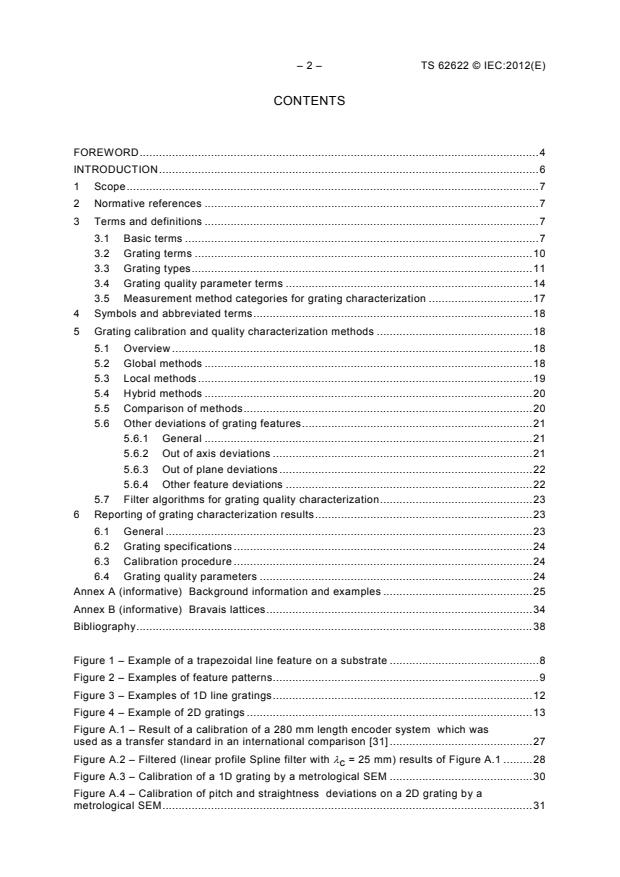
CONTENTS
FOREWORD . 4
INTRODUCTION . 6
1 Scope . 7
2 Normative references . 7
3 Terms and definitions . 7
3.1 Basic terms . 7
3.2 Grating terms . 10
3.3 Grating types . 11
3.4 Grating quality parameter terms . 14
3.5 Measurement method categories for grating characterization . 17
4 Symbols and abbreviated terms . 18
5 Grating calibration and quality characterization methods . 18
5.1 Overview . 18
5.2 Global methods . 18
5.3 Local methods . 19
5.4 Hybrid methods . 20
5.5 Comparison of methods . 20
5.6 Other deviations of grating features . 21
5.6.1 General . 21
5.6.2 Out of axis deviations . 21
5.6.3 Out of plane deviations . 22
5.6.4 Other feature deviations . 22
5.7 Filter algorithms for grating quality characterization . 23
6 Reporting of grating characterization results . 23
6.1 General . 23
6.2 Grating specifications . 24
6.3 Calibration procedure . 24
6.4 Grating quality parameters . 24
Annex A (informative) Background information and examples . 25
Annex B (informative) Bravais lattices . 34
Bibliography . 38
Figure 1 – Example of a trapezoidal line feature on a substrate . 8
Figure 2 – Examples of feature patterns. 9
Figure 3 – Examples of 1D line gratings . 12
Figure 4 – Example of 2D gratings . 13
Figure A.1 – Result of a calibration of a 280 mm length encoder system which was
used as a transfer standard in an international comparison [31] . 27
Figure A.2 – Filtered (linear profile Spline filter with λ = 25 mm) results of Figure A.1 . 28
c
Figure A.3 – Calibration of a 1D grating by a metrological SEM . 30
Figure A.4 – Calibration of pitch and straightness deviations on a 2D grating by a
metrological SEM . 31
TS 62622 © IEC:2012(E) – 3 –
Figure A.5 – Results of an international comparison on a 2D grating by different
participants and types of instruments . 33
Figure B.1 – One-dimensional Bravais lattice . 34
Figure B.2 – The five fundamental two-dimensional Bravais lattices illustrating the
primitive vectors and and the angle φ between them . 35
a b
Figure B.3 – The 14 fundamental three-dimensional Bravais lattices . 36
Table 1 – Comparison of different categories for grating characterization methods . 21
Table A.1 – Grating quality parameters of the grating in Figures A.1 and A.2 . 28
Table A.2 – Grating quality parameters of the grating in Figure A.3. 30
Table A.3 – Grating quality parameters of the grating in Figure A.4. 32
Table B.1 – Bravais lattices volumes . 37
– 4 – TS 62622 © IEC:2012(E)
INTERNATIONAL ELECTROTECHNICAL COMMISSION
____________
NANOTECHNOLOGIES – DESCRIPTION, MEASUREMENT AND
DIMENSIONAL QUALITY PARAMETERS OF ARTIFICIAL GRATINGS
FOREWORD
1) The International Electrotechnical Commission (IEC) is a worldwide organization for standardization comprising
all national electrotechnical committees (IEC National Committees). The object of IEC is to promote interna-
tional co-operation on all questions concerning standardization in the electrical and electronic fields. To this
end and in addition to other activities, IEC publishes International Standards, Technical Specifications, Tech-
nical Reports, Publicly Available Specifications (PAS) and Guides (hereafter referred to as “IEC Publica-
tion(s)”). Their preparation is entrusted to technical committees; any IEC National Committee interested in the
subject dealt with may participate in this preparatory work. International, governmental and non-governmental
organizations liaising with the IEC also participate in this preparation. IEC collaborates closely with the Interna-
tional Organization for Standardization (ISO) in accordance with conditions determined by agreement between
the two organizations.
2) The formal decisions or agreements of IEC on technical matters express, as nearly as possible, an international
consensus of opinion on the relevant subjects since each technical committee has representation from all inter-
ested IEC National Committees.
3) IEC Publications have the form of recommendations for international use and are accepted by IEC National
Committees in that sense. While all reasonable efforts are made to ensure that the technical content of IEC
Publications is accurate, IEC cannot be held responsible for the way in which they are used or for any misinter-
pretation by any end user.
4) In order to promote international uniformity, IEC National Committees undertake to apply IEC Publications
transparently to the maximum extent possible in their national and regional publications. Any divergence be-
tween any IEC Publication and the corresponding national or regional publication shall be clearly indicated in
the latter.
5) IEC itself does not provide any attestation of conformity. Independent certification bodies provide conformity
assessment services and, in some areas, access to IEC marks of conformity. IEC is not responsible for any
services carried out by independent certification bodies.
6) All users should ensure that they have the latest edition of this publication.
7) No liability shall attach to IEC or its directors, employees, servants or agents including individual experts and
members of its technical committees and IEC National Committees for any personal injury, property damage or
other damage of any nature whatsoever, whether direct or indirect, or for costs (including legal fees) and ex-
penses arising out of the publication, use of, or reliance upon, this IEC Publication or any other IEC Publica-
tions.
8) Attention is drawn to the Normative references cited in this publication. Use of the referenced publications is
indispensable for the correct application of this publication.
9) Attention is drawn to the possibility that some of the elements of this IEC Publication may be the subject of
patent rights. IEC shall not be held responsible for identifying any or all such patent rights.
The main task of IEC technical committees is to prepare International Standards. In excep-
tional circumstances, a technical committee may propose the publication of a technical speci-
fication when
• the required support cannot be obtained for the publication of an International Standard,
despite repeated efforts, or
• the subject is still under technical development or where, for any other reason, there is the
future but no immediate possibility of an agreement on an International Standard.
Technical specifications are subject to review within three years of publication to decide
whether they can be transformed into International Standards.
IEC 62622, which is a technical specification, has been prepared within the joint working
group 2 of IEC technical committee 113 and ISO technical committee 229.
TS 62622 © IEC:2012(E) – 5 –
The text of this technical specification is based on the following documents:
Enquiry draft Report on voting
113/133/DTS 113/143/RVC
Full information on the voting for the approval of this technical specification can be found in
the report on voting indicated in the above table. In ISO, the standard has been approved by
16 member bodies out of 16 having cast a vote.
This publication has been drafted in accordance with the ISO/IEC Directives, Part 2.
The committee has decided that the contents of this publication will remain unchanged until
the stability date indicated on the IEC web site under "http://webstore.iec.ch" in the data re-
lated to the specific publication. At this date, the publication will be
• transformed into an International Standard,
• reconfirmed,
• withdrawn,
• replaced by a revised edition, or
• amended.
A Bilingual version of this publication may be issued at a later date.
IMPORTANT – The “colour inside” logo on the cover page of this publication indicates
that it contains colours which are considered to be useful for the correct understanding
of its contents. Users should therefore print this publication using a colour printer.
– 6 – TS 62622 © IEC:2012(E)
INTRODUCTION
Artificial gratings play an important role in the manufacturing processes of small structures at
the nanoscale as well as characterization of nano-objects.
For example, in high volume manufacturing of semiconductor integrated circuits by means of
lithography techniques, grating patterns on the photomask and the silicon wafer are optically
probed and the resulting optical signal is analyzed and used for relative alignment purposes
of mask to wafer in the different lithographic production steps in the wafer-scanner production
tools. In semiconductor manufacturing as well as in other manufacturing processes requiring
high positioning accuracy at the nanoscale, often length or angular encoder systems based on
artificial gratings are used to provide position feedback of moving axes. Another area of appli-
cation for artificial gratings in nanotechnology is their use as calibration standards for high
resolution microscopes, like scanning probe microscopes, scanning electron microscopes or
transmission electron microscopes which are necessary tools for the characterization of na-
noscale structures.
The quality of the artificial gratings used for position feedback generally influences the
achievable accuracy of alignment systems or positioning systems in manufacturing tools. This
also holds for the application of artificial gratings as standards for calibration of image magni-
fication of high resolution microscopes, where the quality of the grating plays an important
role in the achievable calibration uncertainty of the standard and thus for the attainable
measurement uncertainty of the microscope.
This technical specification concentrates on specifying quality parameters, expressed in terms
of deviations from nominal positions of grating features, and provides guidance on the appli-
cation of different categories of measurement and evaluation methods to be used for calibra-
tion and characterization of artificial gratings
TS 62622 © IEC:2012(E) – 7 –
NANOTECHNOLOGIES – DESCRIPTION, MEASUREMENT AND
DIMENSIONAL QUALITY PARAMETERS OF ARTIFICIAL GRATINGS
1 Scope
This technical specification specifies the generic terminology for the global and local quality
parameters of artificial gratings, interpreted in terms of deviations from nominal positions of
grating features, and provides guidance on the categorization of measurement and evaluation
methods for their determination.
This specification is intended to facilitate communication among manufacturers, users and
calibration laboratories dealing with the characterization of the dimensional quality parame-
ters of artificial gratings used in nanotechnology.
This specification supports quality assurance in the production and use of artificial gratings in
different areas of application in nanotechnology. Whilst the definitions and described methods
are universal to a large variety of different gratings, the focus is on one-dimensional (1D) and
two-dimensional (2D) gratings.
2 Normative references
The following documents, in whole or in part, are normatively referenced in this document and
are indispensable for its application. For dated references, only the edition cited applies. For
undated references, the latest edition of the referenced document (including any amend-
ments) applies.
ISO/IEC 17025, General requirements for the competence of testing and calibration laborato-
ries
ISO/TS 80004-1:2010, Nanotechnologies – Vocabulary – Part 1: Core terms
3 Terms and definitions
For the purposes of this document, the following terms and definitions apply.
3.1 Basic terms
3.1.1
feature
region within a single continuous boundary, and referred to a reference plane, that has a de-
fining physical property (parameter) that is distinct from the region outside the boundary
– 8 – TS 62622 © IEC:2012(E)
Side view Top view
IEC 1791/12
Figure 1 – Example of a trapezoidal line feature on a substrate
EXAMPLE In Figure 1 a feature with a trapezoidal cross-section on a substrate is shown.
Note 1 to entry: This definition is adapted from [1] (SEMI P35 (5.1.5 feature (lithographic)).
Note 2 to entry: In general, a feature is a three-dimensional object. It can also be a nano-object (defined in
ISO/TS 80004-1:2010, 2.5). It can have different shape, e.g. it can be a dot, a line, a groove, etc. It might be sym-
metric or non–symmetric. It can have the same material properties as the substrate or different ones. It can be
located on the surface of a substrate or within the substrate (sometimes called “buried feature”).
Note 3 to entry: In [2] the term ‘geometrical feature’ is generally defined as point, line or surface.
3.1.2
reference plane
user-defined plane approximating the surface of a substrate and containing a feature coordi-
nate system
Note 1 to entry: This definition is adapted from [1].
3.1.3
feature coordinate system
coordinate system
Cartesian coordinate system defined by the reference plane as x-y plane, the x-axis defined
by the main grating direction and the origin defined by a suitable, specified reference position
Note 1 to entry: Often, the position of a particular feature is chosen as the origin of the coordinate system, e.g.
the first feature in a 1D grating, or the lower left feature in a 2D grating.
Note 2 to entry: In other cases, the origin can also be defined from an analysis of the positions of all features of
interest, e.g. the mean value of all positions in the x-direction for a 1D grating. In the case of a 2D grating the
origin can also be defined by a least squares regression fit over all measured x- and y-positions of all features of
the 2D grating allowing translation of the origin and rotation of the whole 2D grating (so-called multi-point align-
ment). In these cases the origin of the feature coordinate system no longer corresponds to a particular feature.
Note 3 to entry: The origin can also be chosen as the position of a specified alignment feature or auxiliary feature
within the reference plane.
Note 4 to entry: In case of angular gratings the feature coordinate system can favorably be defined as a polar
coordinate system: r, φ or a cylindrical coordinate system: r, φ, z.
3.1.4
feature pattern
set of features, specified by number, type, and positions of features
—————————
Numbers in square brackets refer to the Bibliography.
TS 62622 © IEC:2012(E) – 9 –
Double cross Cross of line arrays So-called Braker structure pattern
IEC 1792/12
Figure 2 – Examples of feature patterns
EXAMPLE Figure 2 shows examples of different types of feature patterns.
Note 1 to entry: Different kinds of features can be arranged differently in a set to form feature patterns. These can
be rather simple e.g. a single cross structure as a combination of two orthogonal line features, complex like, e.g. a
double cross-structure or a line array or even more complex, e.g. irregularly spaced line features.
3.1.5
feature position
x , y , z
i i i
th
coordinates describing the position of a prescribed point of the i feature of a number N of
features projected onto the reference plane relative to a specified coordinate system
Note 1 to entry: For 1D gratings the x-positions of the features are primarily of interest assuming the direction of
the grating, i.e. the direction in which the number of grating features per unit length is maximal, is the x-direction,
whereas for 2D gratings their x- and y-positions are of interest. In both cases, their z-positions are usually of minor
interest, assuming the reference plane is already well aligned to the axes of the measurement instrument.
Note 2 to entry: Depending on the chosen criterion for the feature position evaluation (see Note 3), the measured
feature position is dependent on the interaction of the measurement instrument used with the feature characteris-
tics, like its shape, size and material properties.
Note 3 to entry: The determination of the feature position is often based on the analysis of a microscopic image of
the feature. The microscope image signals can be analyzed in different ways to determine the feature position.
Mostly the centre position of the feature is of interest which can be determined, e.g. by calculation of the centroid
or by determination of the mean value between the position of the left and the right edge of the feature.
Note 4 to entry: If only parts of the feature are of interest, e.g. the edge position of a line feature, the determina-
tion of the position of the respective edge(s) should be based only on the parts of the feature that are of interest.
Note 5 to entry: The above definition for the feature position can also be applied to a feature pattern.
Note 6 to entry: If angular gratings are analyzed, it is favorable to express the feature position in polar coordi-
nates r, φ or in cylindrical ones r, φ, z.
3.1.6
distance between features
d
difference of the feature positions determined on equivalent or homologous feature character-
istics in the direction of interest
Note 1 to entry: The distance d between two consecutive features, i and i-1, in the x-direction is:
d = abs (x - x )
i i-1
Note 2 to entry: The distance d between two consecutive features in the reference x,y plane generally is:
0,5
d = [(x - x )² + (y - y )²]
i i-1 i i-1
– 10 – TS 62622 © IEC:2012(E)
Note 3 to entry: The distance d between two consecutive features at the positions x , y , z and x , y z in the
i i i i-1 i-1 i-1
general case is:
0,5
d = [(x - x )² + (y - y )² + (z - z )²]
i i-1 i i-1 i i-1
Note 4 to entry: Usually the distance between features is of interest for the centre positions of the features. In
some cases however the distance can also be of interest for positions on the feature edges.
3.2 Grating terms
3.2.1
grating
periodically spaced collection of identical features
Note 1 to entry: In [3], which provides a vocabulary of diffractive optics, a grating is defined as a “periodic spatial
structure for optical use” (3.3.1.2). In this technical specification, gratings are not restricted to optical use only.
Note 2 to entry: Often gratings show a ratio of the distance between neighboring identical features to their size
that is close to one. However, the definition is not restricted to these cases and also includes so-called sparse grat-
ings and thus in principle line scales, too.
Note 3 to entry: Although this technical specification is primarily addressing periodic gratings, the definition of
grating quality parameters should also be applicable to non-periodic gratings, like chirped gratings (3.3.5.2) as far
as possible. Limitations might occur in particular for spatial filtering approaches of feature position data.
Note 4 to entry: Sometimes a grating can be divided into several sub-gratings having different features.
3.2.2
pitch
p
distance between neighboring features of a grating
Note 1 to entry: Often, the feature centre positions are used to determine the pitch. In some cases, however, also
the distance between equivalent edges of a pair of features is used to determine the pitch values.
Note 2 to entry: This definition is in alignment with the definition for pitch as specified in [1] (5.1.14).
3.2.3
nominal pitch
p
nom
intended pitch value, indicated in the specification of a grating
3.2.4
number of grating features
N
f
result of a summation over all identical features of the grating in the direction of interest
Note 1 to entry: The number of grating features can be different in the different directions for 2D and three-
dimensional (3D) gratings. The total number of features in 2D and 3D gratings is the product of the number of grat-
ing features along the 2 or 3 different directions (e.g. dots in the case of 1D features).
3.2.5
mean pitch
p
m
average pitch value determined over all identical features of the grating
Note 1 to entry: The mean pitch is not necessarily the arithmetic mean pitch, but any statistically characteristic
pitch.
Note 2 to entry: If all feature positions of the grating are known, the mean pitch of a grating can be determined by
a linear least squares regression fit of all measured feature positions x to the nominal feature positions x . If
i, m i, nom
the uncertainties of the measured feature positions are equal, a standard linear regression fit can be applied. In
case of a variation of the uncertainties u of the measured feature positions x , a weighted linear regression fit
xi i, m
should be applied, using the inverse variances as weights (w = 1/(u )²). The resulting slope m of the regression
i xi
line (yielding values for slope m and intercept b) can be used to calculate the mean pitch value p = m⋅p taking
m nom
into account the position information of all features of the grating.
TS 62622 © IEC:2012(E) – 11 –
Note 3 to entry: The mean pitch of a grating is often also called the period length or grating constant Λ of the
grating.
Note 4 to entry: For an ideal grating, the values for the mean pitch, the local pitch and the pitch for all neighbor-
ing features are identical. For real gratings, however, the values would be different, depending on the quality of the
grating and the different length ranges over which the local pitch value will be evaluated. In addition, the capability
of measurement methods to determine the different pitch values on non-ideal gratings is different. The measure-
ment methods, therefore, can be classified in different groups, see 3.5.
Note 5 to entry: If the boundary length of a grating L (3.2.8) and the number of grating features N (3.2.4) are
b f
known, an approximation to the mean pitch can be determined by the equation: p = L / (N - 1); N ≥ 2. The same
m b f f
pitch value results if the arithmetic mean value of all pitch values over all neighboring features is calculated. In the
Nf-1
sum Σ (x - x ) / (N -1) for calculation of the arithmetic mean value of all pitch values of a grating all feature
i=1 i+1 i f
position values x cancel out except for the first and last feature. In both cases the resulting approximation of the
i
mean pitch value is based on the positions of the first and the last feature in the grating only and thus less repre-
sentative of the whole grating than the mean pitch determined by a linear regression fit [4].
3.2.6
local pitch
p (x , l )
loc c r
average pitch value determined over a defined length range l of a grating centered around a
r
defined feature position x
c
EXAMPLE If a local pitch p of a nominally 1 mm long 1D grating with 100 nm nominal pitch is evaluated around
loc
a central position at x = 400 µm over a length range l of 20 µm, the resulting local pitch should be expressed as:
c r
p (400 µm, 20 µm) or p (4001, 201) if expressed in number of features of the grating.
loc loc
Note 1 to entry: The local pitch can also be defined over a specified number of features N centered around a
r
specified feature with index N . In this case the notation for the local pitch is: p (N , N ).
c loc c r
3.2.7
nominal length of grating
L
nom
intended length of a grating, indicated in the specification of the grating
Note 1 to entry: The length of a grating is defined in the direction of the grating, i.e. the direction in which the
number of grating features per unit length is maximal.
3.2.8
boundary length of grating
L
b
distance between the first and the last feature of a grating
Note 1 to entry: The center to center distance is the default case.
3.2.9
characteristic length of grating
L
c
length of a grating, based on the mean pitch and the number of grating features
L = p ·(N -1)
c m f
Note 1 to entry: For an ideal grating the nominal length, the boundary length and the characteristic length values
of a grating are identical. For real gratings, however, they are different.
3.3 Grating types
3.3.1
1D grating
grating in which features are repeated in only one direction within the reference plane
– 12 – TS 62622 © IEC:2012(E)
p
y y
x x
a) b)
ρ
p
y
y
x x
c) d)
IEC 1793/12
Pitch p is defined in the direction of the grating.
a) ideal 1D grating;
b) 1D grating with local pitch variation;
c) ideal 1D grating with misalignment by angle ρ to the instrument axes x and y;
d) 1D grating with local pitch variation and misalignment to instrument axes.
Figure 3 – Examples of 1D line gratings
EXAMPLE Figure 3 shows examples of 1D line gratings.
Note 1 to entry: 1D gratings are also denoted as one-dimensional gratings.
Note 2 to entry: According to the Note 2 to entry of 3.2.1 a line scale can be understood as a sparse 1D grating,
too.
3.3.2
2D grating
grating in which features are repeated in two, non-parallel directions within the reference
plane
TS 62622 © IEC:2012(E) – 13 –
p
p
y y
y y
b)
a) x
x
x x
a) b)
p
p ρ
Px
p x
ρ
α
y
y
y y α
P
yp
y
c)
x d)
x
x x
c) d)
IEC 1794/12
Pitches p and p are defined in the directions of the grating:
x y
a) ideal 2D grating;
b) 2D grating with local pitch variation in both directions;
c) ideal 2D grating with misalignment by angle ρ to the instrument axes x and y;
d) 2D grating with deviation from orthogonality (α ≠ 90 °), different pitch values and misalignment to instrument
axes x and y.
Figure 4 – Example of 2D gratings
EXAMPLE Figure 4 shows examples of 2D gratings
Note 1 to entry: Often the two directions are nominally orthogonal to each other, e.g. along the x- and y-direction.
Note 2 to entry: 2D gratings are also denoted as two-dimensional gratings.
Note 3 to entry: The deviation from orthogonality of the 2D grating can be described as in 3.4.13 and [5].
3.3.3
3D grating
grating in which features are repeated in three, non-parallel directions, containing the refer-
ence plane
Note 1 to entry: Often the three directions are nominally orthogonal to each other, e.g. along the x-, y- and z-
direction.
Note 2 to entry: 3D gratings are also denoted as three-dimensional gratings.
Note 3 to entry: An example of a 3D grating is a 3D photonic crystal.
3.3.4
angular grating
grating which extends along a circular direction within the reference plane
Note 1 to entry: In most cases the angular gratings extend over the full angular range of 2π rad (360 °), i.e. the
first and the last feature of the angular grating are neighboring features.
Note 2 to entry: Angular gratings are also denoted as radial gratings.
– 14 – TS 62622 © IEC:2012(E)
3.3.5
complex grating
grating characterized by more than one nominal pitch value in the direction of interest
3.3.6
double pitch grating
complex grating characterized by two different nominal pitch values in the direction of interest
3.3.7
chirped grating
complex grating characterized by an intended, monotonic variation of pitch values in the di-
rection of interest
Note 1 to entry: Monotonic variation means that the pitch values always increase, or decrease, along the direction
of interest.
3.4 Grating quality parameter terms
3.4.1
deviation in boundary length
δL
b
difference between the measured boundary length and the nominal length
δL = L - L
b b, m nom
where
L is the measured boundary length;
b, m
is the nominal length.
L
nom
3.4.2
relative deviation in boundary length
δL
b, rel
deviation in boundary length relative to the nominal length
δL =δL / L
b, rel b nom
3.4.3
deviation in characteristic length
δL
c
difference between the measured characteristic length and the nominal length
δL = L – L
c c, m nom
where
is the measured characteristic length;
L
c, m
L is the nominal length.
nom
Note 1 to entry: The parameter deviation in characteristic length δL is a quality parameter of a grating. In some
c
applications, however, the characteristic length L of a grating is only of secondary interest; δL is of minor im-
c c
portance in these cases.
3.4.4
relative deviation in characteristic length
δL
c, rel
deviation in characteristic length relative to the nominal length
—————————
The definitions of grating deviations in 3.4 provide grating quality parameters, which can be determined for
every type of grating. However, the impact of these grating quality parameters can be of varying importance for
different applications.
TS 62622 © IEC:2012(E) – 15 –
δL =δL / L
c, rel c nom
3.4.5
deviation in feature position
δx
i
difference between the measured feature position and the nominal feature position, based on
the nominal pitch
δx = x - p · (i -1)
i i, m nom
where
th
x is the measured feature position of the i feature in a grating – oriented along
i, m
the x-direction;
p is the nominal pitch of the grating.
nom
Note 1 to entry: This definition assumes a grating with one nominal pitch value. It can be extended, however, also
to complex gratings, like e.g. chirped gratings, provided all the nominal feature positions are specified.
Note 2 to entry: If the orientation of the grating features is in other directions, the definition can be adapted ac-
cordingly, i.e. δy , δz .
i i
Note 3 to entry: In case of angular gratings over 360 °, the sum over all deviations in angular feature positions δα
i
always is zero because the circular angle 2π rad (360 °) is a natural, invariable and error-free angle standard. This
fact is the basis of application of error separation techniques, which allow for determining the deviations in angular
feature position of angular gratings with very small uncertainties in the nanoradian range [6].
3.4.6
relative deviation in feature position
δx
i, rel
deviation in feature position relative to the nominal feature position
δx =δx / (p · (i -1))
i, rel i nom
where
th
δx is the deviation in feature position of the i feature in a grating;
i
p is the nominal pitch of the grating.
nom
3.4.7
feature position deviation from linearity
δx
i,nl
difference between the measured feature position and the calculated feature position, based
on the measured mean pitch
δx = x – (p · (i -1) + b)
i, nl i, m m
where
th
x is the measured feature position of the i feature in a grating;
i,m
p is the measured mean pitch of the grating;
m
b is the intercept of a linear least squares regression line, determined according
to 3.2.5, Note to entry 2.
Note 1 to entry: As a result of the mean pitch definition, the sum over all feature position deviation from linearity
values of a grating is zero.
3.4.8
relative feature position deviation from linearity
δx
i,nl, rel
feature position deviation from linearity relative to the nominal feature position
δx =δx / (p · (i -1))
i, nl, rel i, nl nom
– 16 – TS 62622 © IEC:2012(E)
where
th
δx is the feature position deviation from linearity of the i feature in a grating;
i, nl
is the nominal pitch of the grating.
p
nom
3.4.9
peak-to-valley deviation from linearity
δL
nl,P-V
difference of the maximum and the minimum value or range of the feature position deviations
from linearity of all grating features
δL =δx - δx
nl, P-V i,nl, max i,nl, min
where
δx is the maximum of all feature position deviations from linearity;
i,nl, max
δx is the minimum of all feature position deviations from linearity.
i,nl, min
3.4.10
relative peak-to-valley deviation from linearity
δL
nl,P-V, rel
peak-to-valley deviation from linearity relative to the nominal length of a grating
δL =δL / L
nl, P-V, rel nl, P-V nom
where
δL is the peak-to-valley deviation from linearity;
nl, P-V
L is the nominal length of a grating.
nom
3.4.11
rms deviation from linearity
δL
nl, rms
square root of the arithmetic mean of the squares of the feature position deviation from linear-
ity over all N features of the grating
f
Nf 2 0,5
δL = [Σ (δx ) / N ]
nl, rms i=1 i,nl f
where
th
δx is the feature position deviation from linearity of the i feature in a grating;
i,nl
N is the number of grating features.
f
3.4.12
relative rms deviation from linearity
δL
nl, rms, rel
rms deviation from linearity relative to the nominal length of a grating
δL =δL / L
nl, rms, rel nl, rms nom
where
δL is the rms deviation from linearity over all features of the grating;
nl, rms
L is the nominal length of a grating.
nom
3.4.13
deviation from orthogonality
δα
ortho
deviation from π/2 rad (90°) of the nominally orthogonal directions of 2D or 3D gratings
Note 1 to entry: The term squareness is often also used as a synonym for orthogonality.
TS 62622 © IEC:2012(E) – 17 –
3.4.14
filtered grating deviation terms
F
δX (λ , P)
Y c
any grating deviation term as defined in 3.4, however determined on the basis of filtered val-
ues of the deviations in feature positions
F
δX (λ , β, P)
Y c
where
X is a general symbol to be replaced by one of the defined quantities in 3.4 for a
particular case;
Y is a general subscript symbol to be replaced by one of the defined indices in
3.4 for a particular case;
F is a general superscript symbol to be replaced by a suitable term which une-
quivocally describes the characteristics of the filter algorithm applied for the
analysis of the deviations in feature position of a grating;
λ is a parameter which describes the critical filter length of the applied filter;
c
β is an additional (optional) parameter to describe the filter characteristics;
P is a parameter describing which spectral parts of the filtered data are to be an-
alyzed. P can either be LP for low-pass, HP for high-pass or BP for band-pass
data.
EXAMPLE 1 If the deviations in feature position δx of a grating are analyzed after an arbitrary filter algorithm F
i
with wavelength λ and high-pass characteristic has been applied to the original data, the filtered deviations in fea-
c
F
ture position are denoted by δx (λ , , HP).
i c
EXAMPLE 2 If the relative rms deviation from linearityδL of a grating is of interest in case a linear profile
nl, rms, rel
filter with Gaussian low-pass filter characteristics and an assumed cut-off wavelength of 80 nm is applied to the
FPLG
original data, the filtered relative rms deviation from linearity should e.g. be denoted as δL (80 nm, , LP)
nl, rms, rel
(FPLG stands for Filter Profile Linear Gaussian).
Note 1 to entry: Clause 5 discusses the different classes of existing filter algorithms applicable to grating devia-
tion terms in more detail.
3.5 Measurement method categories for grating characterization
3.5.1
global methods
GM
measurement methods which probe the grating of interest as a whole
Note 1 to entry: Examples of grating characterization methods which belong to the GM category are given in
Clause 5 and in Clause A.2.
Note 2 to entry: Global methods sometimes are also called integral methods.
3.5.2
local methods
LM
measurement methods which probe the grating in a small region of interest only and which do
not offer a sufficient displacement metrology capability to link the information from subse-
quent measurements of the grating phase-coherently
Note 1 to entry: Examples of grating characterization methods which belong to the LM category are given in
Clause 5 and in Clause A.2.
3.5.3
hybrid methods
HM
measurement methods which probe the grating in a small region of interest and which in addi-
tion allow to link the information from subsequent measurements over the whole grating
phase-coherently by use of suitable displacement metrology
– 18 – TS 62622 © IEC:2012(E)
Note 1 to entry: Examples of grating characterization methods which belong to the HM category are given in
Clause 5 and in Clause A.2.
4 Symbols and abbreviated terms
AFM atomic force microscopy
CCD charge-coupled device
DOE diffractive optical element
DUV deep ultraviolet
EUV extreme ultraviolet
GM global method
GPS geometrical product specifications
HM hybrid method
HR-OM high resolution optical microscopy
IR infrared
LER line edge roughness
LM local method
LWR line width roughness
OD optical diffraction
OM optical microscopy
SEM scanning electron microscopy
SPM scanning probe microscopy
TEM transmission electron microscopy
Vis visible spectrum
5 Grating calibration and quality characterization methods
5.1 Overview
Artificial gratings play an important role in the manufacturing as well as characterization of
structures on the nanoscale. The use of the term nanoscale shall conform to
ISO/TS 80004-1:2010, 2.1 where it is defined as "size range from approximately 1 nm to
100 nm". In this Clause 5 different categories of measurement methods for grating calibration
and characterization of grating quality are given. Guidance is provided to choose a measure-
ment method category which best fits the requirements set for the characterization in terms of
global and local quality parameters of a particular grating.
5.2 Global methods
The category of global methods comprises measurement methods, which prob
...
IEC/TS 62622
Edition 1.0 2012-10
TECHNICAL
SPECIFICATION
Nanotechnologies – Description, measurement and dimensional quality
parameters of artificial gratings
All rights reserved. Unless otherwise specified, no part of this publication may be reproduced or utilized in any form
or by any means, electronic or mechanical, including photocopying and microfilm, without permission in writing from
either IEC or IEC's member National Committee in the country of the requester.
If you have any questions about IEC copyright or have an enquiry about obtaining additional rights to this publication,
please contact the address below or your local IEC member National Committee for further information.
IEC Central Office Tel.: +41 22 919 02 11
3, rue de Varembé Fax: +41 22 919 03 00
CH-1211 Geneva 20 info@iec.ch
Switzerland www.iec.ch
About the IEC
The International Electrotechnical Commission (IEC) is the leading global organization that prepares and publishes
International Standards for all electrical, electronic and related technologies.
About IEC publications
The technical content of IEC publications is kept under constant review by the IEC. Please make sure that you have the
latest edition, a corrigenda or an amendment might have been published.
Useful links:
IEC publications search - www.iec.ch/searchpub Electropedia - www.electropedia.org
The advanced search enables you to find IEC publications The world's leading online dictionary of electronic and
by a variety of criteria (reference number, text, technical electrical terms containing more than 30 000 terms and
committee,…). definitions in English and French, with equivalent terms in
It also gives information on projects, replaced and additional languages. Also known as the International
withdrawn publications. Electrotechnical Vocabulary (IEV) on-line.
IEC Just Published - webstore.iec.ch/justpublished Customer Service Centre - webstore.iec.ch/csc
Stay up to date on all new IEC publications. Just Published If you wish to give us your feedback on this publication
details all new publications released. Available on-line and or need further assistance, please contact the
also once a month by email. Customer Service Centre: csc@iec.ch.
IEC/TS 62622
Edition 1.0 2012-10
TECHNICAL
SPECIFICATION
Nanotechnologies – Description, measurement and dimensional quality
parameters of artificial gratings
INTERNATIONAL
ELECTROTECHNICAL
COMMISSION
PRICE CODE
W
ICS 07.030 ISBN 978-2-83220-394-1
– 2 – TS 62622 © IEC:2012(E)
CONTENTS
FOREWORD . 4
INTRODUCTION . 6
1 Scope . 7
2 Normative references . 7
3 Terms and definitions . 7
3.1 Basic terms . 7
3.2 Grating terms . 10
3.3 Grating types . 11
3.4 Grating quality parameter terms . 14
3.5 Measurement method categories for grating characterization . 17
4 Symbols and abbreviated terms . 18
5 Grating calibration and quality characterization methods . 18
5.1 Overview . 18
5.2 Global methods . 18
5.3 Local methods . 19
5.4 Hybrid methods . 20
5.5 Comparison of methods . 20
5.6 Other deviations of grating features . 21
5.6.1 General . 21
5.6.2 Out of axis deviations . 21
5.6.3 Out of plane deviations . 22
5.6.4 Other feature deviations . 22
5.7 Filter algorithms for grating quality characterization . 23
6 Reporting of grating characterization results . 23
6.1 General . 23
6.2 Grating specifications . 24
6.3 Calibration procedure . 24
6.4 Grating quality parameters . 24
Annex A (informative) Background information and examples . 25
Annex B (informative) Bravais lattices . 34
Bibliography . 38
Figure 1 – Example of a trapezoidal line feature on a substrate . 8
Figure 2 – Examples of feature patterns. 9
Figure 3 – Examples of 1D line gratings . 12
Figure 4 – Example of 2D gratings . 13
Figure A.1 – Result of a calibration of a 280 mm length encoder system which was
used as a transfer standard in an international comparison [31] . 27
Figure A.2 – Filtered (linear profile Spline filter with λ = 25 mm) results of Figure A.1 . 28
c
Figure A.3 – Calibration of a 1D grating by a metrological SEM . 30
Figure A.4 – Calibration of pitch and straightness deviations on a 2D grating by a
metrological SEM . 31
TS 62622 © IEC:2012(E) – 3 –
Figure A.5 – Results of an international comparison on a 2D grating by different
participants and types of instruments . 33
Figure B.1 – One-dimensional Bravais lattice . 34
Figure B.2 – The five fundamental two-dimensional Bravais lattices illustrating the
primitive vectors and and the angle φ between them . 35
a b
Figure B.3 – The 14 fundamental three-dimensional Bravais lattices . 36
Table 1 – Comparison of different categories for grating characterization methods . 21
Table A.1 – Grating quality parameters of the grating in Figures A.1 and A.2 . 28
Table A.2 – Grating quality parameters of the grating in Figure A.3. 30
Table A.3 – Grating quality parameters of the grating in Figure A.4. 32
Table B.1 – Bravais lattices volumes . 37
– 4 – TS 62622 © IEC:2012(E)
INTERNATIONAL ELECTROTECHNICAL COMMISSION
____________
NANOTECHNOLOGIES – DESCRIPTION, MEASUREMENT AND
DIMENSIONAL QUALITY PARAMETERS OF ARTIFICIAL GRATINGS
FOREWORD
1) The International Electrotechnical Commission (IEC) is a worldwide organization for standardization comprising
all national electrotechnical committees (IEC National Committees). The object of IEC is to promote interna-
tional co-operation on all questions concerning standardization in the electrical and electronic fields. To this
end and in addition to other activities, IEC publishes International Standards, Technical Specifications, Tech-
nical Reports, Publicly Available Specifications (PAS) and Guides (hereafter referred to as “IEC Publica-
tion(s)”). Their preparation is entrusted to technical committees; any IEC National Committee interested in the
subject dealt with may participate in this preparatory work. International, governmental and non-governmental
organizations liaising with the IEC also participate in this preparation. IEC collaborates closely with the Interna-
tional Organization for Standardization (ISO) in accordance with conditions determined by agreement between
the two organizations.
2) The formal decisions or agreements of IEC on technical matters express, as nearly as possible, an international
consensus of opinion on the relevant subjects since each technical committee has representation from all inter-
ested IEC National Committees.
3) IEC Publications have the form of recommendations for international use and are accepted by IEC National
Committees in that sense. While all reasonable efforts are made to ensure that the technical content of IEC
Publications is accurate, IEC cannot be held responsible for the way in which they are used or for any misinter-
pretation by any end user.
4) In order to promote international uniformity, IEC National Committees undertake to apply IEC Publications
transparently to the maximum extent possible in their national and regional publications. Any divergence be-
tween any IEC Publication and the corresponding national or regional publication shall be clearly indicated in
the latter.
5) IEC itself does not provide any attestation of conformity. Independent certification bodies provide conformity
assessment services and, in some areas, access to IEC marks of conformity. IEC is not responsible for any
services carried out by independent certification bodies.
6) All users should ensure that they have the latest edition of this publication.
7) No liability shall attach to IEC or its directors, employees, servants or agents including individual experts and
members of its technical committees and IEC National Committees for any personal injury, property damage or
other damage of any nature whatsoever, whether direct or indirect, or for costs (including legal fees) and ex-
penses arising out of the publication, use of, or reliance upon, this IEC Publication or any other IEC Publica-
tions.
8) Attention is drawn to the Normative references cited in this publication. Use of the referenced publications is
indispensable for the correct application of this publication.
9) Attention is drawn to the possibility that some of the elements of this IEC Publication may be the subject of
patent rights. IEC shall not be held responsible for identifying any or all such patent rights.
The main task of IEC technical committees is to prepare International Standards. In excep-
tional circumstances, a technical committee may propose the publication of a technical speci-
fication when
• the required support cannot be obtained for the publication of an International Standard,
despite repeated efforts, or
• the subject is still under technical development or where, for any other reason, there is the
future but no immediate possibility of an agreement on an International Standard.
Technical specifications are subject to review within three years of publication to decide
whether they can be transformed into International Standards.
IEC 62622, which is a technical specification, has been prepared within the joint working
group 2 of IEC technical committee 113 and ISO technical committee 229.
TS 62622 © IEC:2012(E) – 5 –
The text of this technical specification is based on the following documents:
Enquiry draft Report on voting
113/133/DTS 113/143/RVC
Full information on the voting for the approval of this technical specification can be found in
the report on voting indicated in the above table. In ISO, the standard has been approved by
16 member bodies out of 16 having cast a vote.
This publication has been drafted in accordance with the ISO/IEC Directives, Part 2.
The committee has decided that the contents of this publication will remain unchanged until
the stability date indicated on the IEC web site under "http://webstore.iec.ch" in the data re-
lated to the specific publication. At this date, the publication will be
• transformed into an International Standard,
• reconfirmed,
• withdrawn,
• replaced by a revised edition, or
• amended.
A Bilingual version of this publication may be issued at a later date.
IMPORTANT – The “colour inside” logo on the cover page of this publication indicates
that it contains colours which are considered to be useful for the correct understanding
of its contents. Users should therefore print this publication using a colour printer.
– 6 – TS 62622 © IEC:2012(E)
INTRODUCTION
Artificial gratings play an important role in the manufacturing processes of small structures at
the nanoscale as well as characterization of nano-objects.
For example, in high volume manufacturing of semiconductor integrated circuits by means of
lithography techniques, grating patterns on the photomask and the silicon wafer are optically
probed and the resulting optical signal is analyzed and used for relative alignment purposes
of mask to wafer in the different lithographic production steps in the wafer-scanner production
tools. In semiconductor manufacturing as well as in other manufacturing processes requiring
high positioning accuracy at the nanoscale, often length or angular encoder systems based on
artificial gratings are used to provide position feedback of moving axes. Another area of appli-
cation for artificial gratings in nanotechnology is their use as calibration standards for high
resolution microscopes, like scanning probe microscopes, scanning electron microscopes or
transmission electron microscopes which are necessary tools for the characterization of na-
noscale structures.
The quality of the artificial gratings used for position feedback generally influences the
achievable accuracy of alignment systems or positioning systems in manufacturing tools. This
also holds for the application of artificial gratings as standards for calibration of image magni-
fication of high resolution microscopes, where the quality of the grating plays an important
role in the achievable calibration uncertainty of the standard and thus for the attainable
measurement uncertainty of the microscope.
This technical specification concentrates on specifying quality parameters, expressed in terms
of deviations from nominal positions of grating features, and provides guidance on the appli-
cation of different categories of measurement and evaluation methods to be used for calibra-
tion and characterization of artificial gratings
TS 62622 © IEC:2012(E) – 7 –
NANOTECHNOLOGIES – DESCRIPTION, MEASUREMENT AND
DIMENSIONAL QUALITY PARAMETERS OF ARTIFICIAL GRATINGS
1 Scope
This technical specification specifies the generic terminology for the global and local quality
parameters of artificial gratings, interpreted in terms of deviations from nominal positions of
grating features, and provides guidance on the categorization of measurement and evaluation
methods for their determination.
This specification is intended to facilitate communication among manufacturers, users and
calibration laboratories dealing with the characterization of the dimensional quality parame-
ters of artificial gratings used in nanotechnology.
This specification supports quality assurance in the production and use of artificial gratings in
different areas of application in nanotechnology. Whilst the definitions and described methods
are universal to a large variety of different gratings, the focus is on one-dimensional (1D) and
two-dimensional (2D) gratings.
2 Normative references
The following documents, in whole or in part, are normatively referenced in this document and
are indispensable for its application. For dated references, only the edition cited applies. For
undated references, the latest edition of the referenced document (including any amend-
ments) applies.
ISO/IEC 17025, General requirements for the competence of testing and calibration laborato-
ries
ISO/TS 80004-1:2010, Nanotechnologies – Vocabulary – Part 1: Core terms
3 Terms and definitions
For the purposes of this document, the following terms and definitions apply.
3.1 Basic terms
3.1.1
feature
region within a single continuous boundary, and referred to a reference plane, that has a de-
fining physical property (parameter) that is distinct from the region outside the boundary
– 8 – TS 62622 © IEC:2012(E)
Side view Top view
IEC 1791/12
Figure 1 – Example of a trapezoidal line feature on a substrate
EXAMPLE In Figure 1 a feature with a trapezoidal cross-section on a substrate is shown.
Note 1 to entry: This definition is adapted from [1] (SEMI P35 (5.1.5 feature (lithographic)).
Note 2 to entry: In general, a feature is a three-dimensional object. It can also be a nano-object (defined in
ISO/TS 80004-1:2010, 2.5). It can have different shape, e.g. it can be a dot, a line, a groove, etc. It might be sym-
metric or non–symmetric. It can have the same material properties as the substrate or different ones. It can be
located on the surface of a substrate or within the substrate (sometimes called “buried feature”).
Note 3 to entry: In [2] the term ‘geometrical feature’ is generally defined as point, line or surface.
3.1.2
reference plane
user-defined plane approximating the surface of a substrate and containing a feature coordi-
nate system
Note 1 to entry: This definition is adapted from [1].
3.1.3
feature coordinate system
coordinate system
Cartesian coordinate system defined by the reference plane as x-y plane, the x-axis defined
by the main grating direction and the origin defined by a suitable, specified reference position
Note 1 to entry: Often, the position of a particular feature is chosen as the origin of the coordinate system, e.g.
the first feature in a 1D grating, or the lower left feature in a 2D grating.
Note 2 to entry: In other cases, the origin can also be defined from an analysis of the positions of all features of
interest, e.g. the mean value of all positions in the x-direction for a 1D grating. In the case of a 2D grating the
origin can also be defined by a least squares regression fit over all measured x- and y-positions of all features of
the 2D grating allowing translation of the origin and rotation of the whole 2D grating (so-called multi-point align-
ment). In these cases the origin of the feature coordinate system no longer corresponds to a particular feature.
Note 3 to entry: The origin can also be chosen as the position of a specified alignment feature or auxiliary feature
within the reference plane.
Note 4 to entry: In case of angular gratings the feature coordinate system can favorably be defined as a polar
coordinate system: r, φ or a cylindrical coordinate system: r, φ, z.
3.1.4
feature pattern
set of features, specified by number, type, and positions of features
—————————
Numbers in square brackets refer to the Bibliography.
TS 62622 © IEC:2012(E) – 9 –
Double cross Cross of line arrays So-called Braker structure pattern
IEC 1792/12
Figure 2 – Examples of feature patterns
EXAMPLE Figure 2 shows examples of different types of feature patterns.
Note 1 to entry: Different kinds of features can be arranged differently in a set to form feature patterns. These can
be rather simple e.g. a single cross structure as a combination of two orthogonal line features, complex like, e.g. a
double cross-structure or a line array or even more complex, e.g. irregularly spaced line features.
3.1.5
feature position
x , y , z
i i i
th
coordinates describing the position of a prescribed point of the i feature of a number N of
features projected onto the reference plane relative to a specified coordinate system
Note 1 to entry: For 1D gratings the x-positions of the features are primarily of interest assuming the direction of
the grating, i.e. the direction in which the number of grating features per unit length is maximal, is the x-direction,
whereas for 2D gratings their x- and y-positions are of interest. In both cases, their z-positions are usually of minor
interest, assuming the reference plane is already well aligned to the axes of the measurement instrument.
Note 2 to entry: Depending on the chosen criterion for the feature position evaluation (see Note 3), the measured
feature position is dependent on the interaction of the measurement instrument used with the feature characteris-
tics, like its shape, size and material properties.
Note 3 to entry: The determination of the feature position is often based on the analysis of a microscopic image of
the feature. The microscope image signals can be analyzed in different ways to determine the feature position.
Mostly the centre position of the feature is of interest which can be determined, e.g. by calculation of the centroid
or by determination of the mean value between the position of the left and the right edge of the feature.
Note 4 to entry: If only parts of the feature are of interest, e.g. the edge position of a line feature, the determina-
tion of the position of the respective edge(s) should be based only on the parts of the feature that are of interest.
Note 5 to entry: The above definition for the feature position can also be applied to a feature pattern.
Note 6 to entry: If angular gratings are analyzed, it is favorable to express the feature position in polar coordi-
nates r, φ or in cylindrical ones r, φ, z.
3.1.6
distance between features
d
difference of the feature positions determined on equivalent or homologous feature character-
istics in the direction of interest
Note 1 to entry: The distance d between two consecutive features, i and i-1, in the x-direction is:
d = abs (x - x )
i i-1
Note 2 to entry: The distance d between two consecutive features in the reference x,y plane generally is:
0,5
d = [(x - x )² + (y - y )²]
i i-1 i i-1
– 10 – TS 62622 © IEC:2012(E)
Note 3 to entry: The distance d between two consecutive features at the positions x , y , z and x , y z in the
i i i i-1 i-1 i-1
general case is:
0,5
d = [(x - x )² + (y - y )² + (z - z )²]
i i-1 i i-1 i i-1
Note 4 to entry: Usually the distance between features is of interest for the centre positions of the features. In
some cases however the distance can also be of interest for positions on the feature edges.
3.2 Grating terms
3.2.1
grating
periodically spaced collection of identical features
Note 1 to entry: In [3], which provides a vocabulary of diffractive optics, a grating is defined as a “periodic spatial
structure for optical use” (3.3.1.2). In this technical specification, gratings are not restricted to optical use only.
Note 2 to entry: Often gratings show a ratio of the distance between neighboring identical features to their size
that is close to one. However, the definition is not restricted to these cases and also includes so-called sparse grat-
ings and thus in principle line scales, too.
Note 3 to entry: Although this technical specification is primarily addressing periodic gratings, the definition of
grating quality parameters should also be applicable to non-periodic gratings, like chirped gratings (3.3.5.2) as far
as possible. Limitations might occur in particular for spatial filtering approaches of feature position data.
Note 4 to entry: Sometimes a grating can be divided into several sub-gratings having different features.
3.2.2
pitch
p
distance between neighboring features of a grating
Note 1 to entry: Often, the feature centre positions are used to determine the pitch. In some cases, however, also
the distance between equivalent edges of a pair of features is used to determine the pitch values.
Note 2 to entry: This definition is in alignment with the definition for pitch as specified in [1] (5.1.14).
3.2.3
nominal pitch
p
nom
intended pitch value, indicated in the specification of a grating
3.2.4
number of grating features
N
f
result of a summation over all identical features of the grating in the direction of interest
Note 1 to entry: The number of grating features can be different in the different directions for 2D and three-
dimensional (3D) gratings. The total number of features in 2D and 3D gratings is the product of the number of grat-
ing features along the 2 or 3 different directions (e.g. dots in the case of 1D features).
3.2.5
mean pitch
p
m
average pitch value determined over all identical features of the grating
Note 1 to entry: The mean pitch is not necessarily the arithmetic mean pitch, but any statistically characteristic
pitch.
Note 2 to entry: If all feature positions of the grating are known, the mean pitch of a grating can be determined by
a linear least squares regression fit of all measured feature positions x to the nominal feature positions x . If
i, m i, nom
the uncertainties of the measured feature positions are equal, a standard linear regression fit can be applied. In
case of a variation of the uncertainties u of the measured feature positions x , a weighted linear regression fit
xi i, m
should be applied, using the inverse variances as weights (w = 1/(u )²). The resulting slope m of the regression
i xi
line (yielding values for slope m and intercept b) can be used to calculate the mean pitch value p = m⋅p taking
m nom
into account the position information of all features of the grating.
TS 62622 © IEC:2012(E) – 11 –
Note 3 to entry: The mean pitch of a grating is often also called the period length or grating constant Λ of the
grating.
Note 4 to entry: For an ideal grating, the values for the mean pitch, the local pitch and the pitch for all neighbor-
ing features are identical. For real gratings, however, the values would be different, depending on the quality of the
grating and the different length ranges over which the local pitch value will be evaluated. In addition, the capability
of measurement methods to determine the different pitch values on non-ideal gratings is different. The measure-
ment methods, therefore, can be classified in different groups, see 3.5.
Note 5 to entry: If the boundary length of a grating L (3.2.8) and the number of grating features N (3.2.4) are
b f
known, an approximation to the mean pitch can be determined by the equation: p = L / (N - 1); N ≥ 2. The same
m b f f
pitch value results if the arithmetic mean value of all pitch values over all neighboring features is calculated. In the
Nf-1
sum Σ (x - x ) / (N -1) for calculation of the arithmetic mean value of all pitch values of a grating all feature
i=1 i+1 i f
position values x cancel out except for the first and last feature. In both cases the resulting approximation of the
i
mean pitch value is based on the positions of the first and the last feature in the grating only and thus less repre-
sentative of the whole grating than the mean pitch determined by a linear regression fit [4].
3.2.6
local pitch
p (x , l )
loc c r
average pitch value determined over a defined length range l of a grating centered around a
r
defined feature position x
c
EXAMPLE If a local pitch p of a nominally 1 mm long 1D grating with 100 nm nominal pitch is evaluated around
loc
a central position at x = 400 µm over a length range l of 20 µm, the resulting local pitch should be expressed as:
c r
p (400 µm, 20 µm) or p (4001, 201) if expressed in number of features of the grating.
loc loc
Note 1 to entry: The local pitch can also be defined over a specified number of features N centered around a
r
specified feature with index N . In this case the notation for the local pitch is: p (N , N ).
c loc c r
3.2.7
nominal length of grating
L
nom
intended length of a grating, indicated in the specification of the grating
Note 1 to entry: The length of a grating is defined in the direction of the grating, i.e. the direction in which the
number of grating features per unit length is maximal.
3.2.8
boundary length of grating
L
b
distance between the first and the last feature of a grating
Note 1 to entry: The center to center distance is the default case.
3.2.9
characteristic length of grating
L
c
length of a grating, based on the mean pitch and the number of grating features
L = p ·(N -1)
c m f
Note 1 to entry: For an ideal grating the nominal length, the boundary length and the characteristic length values
of a grating are identical. For real gratings, however, they are different.
3.3 Grating types
3.3.1
1D grating
grating in which features are repeated in only one direction within the reference plane
– 12 – TS 62622 © IEC:2012(E)
p
y y
x x
a) b)
ρ
p
y
y
x x
c) d)
IEC 1793/12
Pitch p is defined in the direction of the grating.
a) ideal 1D grating;
b) 1D grating with local pitch variation;
c) ideal 1D grating with misalignment by angle ρ to the instrument axes x and y;
d) 1D grating with local pitch variation and misalignment to instrument axes.
Figure 3 – Examples of 1D line gratings
EXAMPLE Figure 3 shows examples of 1D line gratings.
Note 1 to entry: 1D gratings are also denoted as one-dimensional gratings.
Note 2 to entry: According to the Note 2 to entry of 3.2.1 a line scale can be understood as a sparse 1D grating,
too.
3.3.2
2D grating
grating in which features are repeated in two, non-parallel directions within the reference
plane
TS 62622 © IEC:2012(E) – 13 –
p
p
y y
y y
b)
a) x
x
x x
a) b)
p
p ρ
Px
p x
ρ
α
y
y
y y α
P
yp
y
c)
x d)
x
x x
c) d)
IEC 1794/12
Pitches p and p are defined in the directions of the grating:
x y
a) ideal 2D grating;
b) 2D grating with local pitch variation in both directions;
c) ideal 2D grating with misalignment by angle ρ to the instrument axes x and y;
d) 2D grating with deviation from orthogonality (α ≠ 90 °), different pitch values and misalignment to instrument
axes x and y.
Figure 4 – Example of 2D gratings
EXAMPLE Figure 4 shows examples of 2D gratings
Note 1 to entry: Often the two directions are nominally orthogonal to each other, e.g. along the x- and y-direction.
Note 2 to entry: 2D gratings are also denoted as two-dimensional gratings.
Note 3 to entry: The deviation from orthogonality of the 2D grating can be described as in 3.4.13 and [5].
3.3.3
3D grating
grating in which features are repeated in three, non-parallel directions, containing the refer-
ence plane
Note 1 to entry: Often the three directions are nominally orthogonal to each other, e.g. along the x-, y- and z-
direction.
Note 2 to entry: 3D gratings are also denoted as three-dimensional gratings.
Note 3 to entry: An example of a 3D grating is a 3D photonic crystal.
3.3.4
angular grating
grating which extends along a circular direction within the reference plane
Note 1 to entry: In most cases the angular gratings extend over the full angular range of 2π rad (360 °), i.e. the
first and the last feature of the angular grating are neighboring features.
Note 2 to entry: Angular gratings are also denoted as radial gratings.
– 14 – TS 62622 © IEC:2012(E)
3.3.5
complex grating
grating characterized by more than one nominal pitch value in the direction of interest
3.3.6
double pitch grating
complex grating characterized by two different nominal pitch values in the direction of interest
3.3.7
chirped grating
complex grating characterized by an intended, monotonic variation of pitch values in the di-
rection of interest
Note 1 to entry: Monotonic variation means that the pitch values always increase, or decrease, along the direction
of interest.
3.4 Grating quality parameter terms
3.4.1
deviation in boundary length
δL
b
difference between the measured boundary length and the nominal length
δL = L - L
b b, m nom
where
L is the measured boundary length;
b, m
is the nominal length.
L
nom
3.4.2
relative deviation in boundary length
δL
b, rel
deviation in boundary length relative to the nominal length
δL =δL / L
b, rel b nom
3.4.3
deviation in characteristic length
δL
c
difference between the measured characteristic length and the nominal length
δL = L – L
c c, m nom
where
is the measured characteristic length;
L
c, m
L is the nominal length.
nom
Note 1 to entry: The parameter deviation in characteristic length δL is a quality parameter of a grating. In some
c
applications, however, the characteristic length L of a grating is only of secondary interest; δL is of minor im-
c c
portance in these cases.
3.4.4
relative deviation in characteristic length
δL
c, rel
deviation in characteristic length relative to the nominal length
—————————
The definitions of grating deviations in 3.4 provide grating quality parameters, which can be determined for
every type of grating. However, the impact of these grating quality parameters can be of varying importance for
different applications.
TS 62622 © IEC:2012(E) – 15 –
δL =δL / L
c, rel c nom
3.4.5
deviation in feature position
δx
i
difference between the measured feature position and the nominal feature position, based on
the nominal pitch
δx = x - p · (i -1)
i i, m nom
where
th
x is the measured feature position of the i feature in a grating – oriented along
i, m
the x-direction;
p is the nominal pitch of the grating.
nom
Note 1 to entry: This definition assumes a grating with one nominal pitch value. It can be extended, however, also
to complex gratings, like e.g. chirped gratings, provided all the nominal feature positions are specified.
Note 2 to entry: If the orientation of the grating features is in other directions, the definition can be adapted ac-
cordingly, i.e. δy , δz .
i i
Note 3 to entry: In case of angular gratings over 360 °, the sum over all deviations in angular feature positions δα
i
always is zero because the circular angle 2π rad (360 °) is a natural, invariable and error-free angle standard. This
fact is the basis of application of error separation techniques, which allow for determining the deviations in angular
feature position of angular gratings with very small uncertainties in the nanoradian range [6].
3.4.6
relative deviation in feature position
δx
i, rel
deviation in feature position relative to the nominal feature position
δx =δx / (p · (i -1))
i, rel i nom
where
th
δx is the deviation in feature position of the i feature in a grating;
i
p is the nominal pitch of the grating.
nom
3.4.7
feature position deviation from linearity
δx
i,nl
difference between the measured feature position and the calculated feature position, based
on the measured mean pitch
δx = x – (p · (i -1) + b)
i, nl i, m m
where
th
x is the measured feature position of the i feature in a grating;
i,m
p is the measured mean pitch of the grating;
m
b is the intercept of a linear least squares regression line, determined according
to 3.2.5, Note to entry 2.
Note 1 to entry: As a result of the mean pitch definition, the sum over all feature position deviation from linearity
values of a grating is zero.
3.4.8
relative feature position deviation from linearity
δx
i,nl, rel
feature position deviation from linearity relative to the nominal feature position
δx =δx / (p · (i -1))
i, nl, rel i, nl nom
– 16 – TS 62622 © IEC:2012(E)
where
th
δx is the feature position deviation from linearity of the i feature in a grating;
i, nl
is the nominal pitch of the grating.
p
nom
3.4.9
peak-to-valley deviation from linearity
δL
nl,P-V
difference of the maximum and the minimum value or range of the feature position deviations
from linearity of all grating features
δL =δx - δx
nl, P-V i,nl, max i,nl, min
where
δx is the maximum of all feature position deviations from linearity;
i,nl, max
δx is the minimum of all feature position deviations from linearity.
i,nl, min
3.4.10
relative peak-to-valley deviation from linearity
δL
nl,P-V, rel
peak-to-valley deviation from linearity relative to the nominal length of a grating
δL =δL / L
nl, P-V, rel nl, P-V nom
where
δL is the peak-to-valley deviation from linearity;
nl, P-V
L is the nominal length of a grating.
nom
3.4.11
rms deviation from linearity
δL
nl, rms
square root of the arithmetic mean of the squares of the feature position deviation from linear-
ity over all N features of the grating
f
Nf 2 0,5
δL = [Σ (δx ) / N ]
nl, rms i=1 i,nl f
where
th
δx is the feature position deviation from linearity of the i feature in a grating;
i,nl
N is the number of grating features.
f
3.4.12
relative rms deviation from linearity
δL
nl, rms, rel
rms deviation from linearity relative to the nominal length of a grating
δL =δL / L
nl, rms, rel nl, rms nom
where
δL is the rms deviation from linearity over all features of the grating;
nl, rms
L is the nominal length of a grating.
nom
3.4.13
deviation from orthogonality
δα
ortho
deviation from π/2 rad (90°) of the nominally orthogonal directions of 2D or 3D gratings
Note 1 to entry: The term squareness is often also used as a synonym for orthogonality.
TS 62622 © IEC:2012(E) – 17 –
3.4.14
filtered grating deviation terms
F
δX (λ , P)
Y c
any grating deviation term as defined in 3.4, however determined on the basis of filtered val-
ues of the deviations in feature positions
F
δX (λ , β, P)
Y c
where
X is a general symbol to be replaced by one of the defined quantities in 3.4 for a
particular case;
Y is a general subscript symbol to be replaced by one of the defined indices in
3.4 for a particular case;
F is a general superscript symbol to be replaced by a suitable term which une-
quivocally describes the characteristics of the filter algorithm applied for the
analysis of the deviations in feature position of a grating;
λ is a parameter which describes the critical filter length of the applied filter;
c
β is an additional (optional) parameter to describe the filter characteristics;
P is a parameter describing which spectral parts of the filtered data are to be an-
alyzed. P can either be LP for low-pass, HP for high-pass or BP for band-pass
data.
EXAMPLE 1 If the deviations in feature position δx of a grating are analyzed after an arbitrary filter algorithm F
i
with wavelength λ and high-pass characteristic has been applied to the original data, the filtered deviations in fea-
c
F
ture position are denoted by δx (λ , , HP).
i c
EXAMPLE 2 If the relative rms deviation from linearityδL of a grating is of interest in case a linear profile
nl, rms, rel
filter with Gaussian low-pass filter characteristics and an assumed cut-off wavelength of 80 nm is applied to the
FPLG
original data, the filtered relative rms deviation from linearity should e.g. be denoted as δL (80 nm, , LP)
nl, rms, rel
(FPLG stands for Filter Profile Linear Gaussian).
Note 1 to entry: Clause 5 discusses the different classes of existing filter algorithms applicable to grating devia-
tion terms in more detail.
3.5 Measurement method categories for grating characterization
3.5.1
global methods
GM
measurement methods which probe the grating of interest as a whole
Note 1 to entry: Examples of grating characterization methods which belong to the GM category are given in
Clause 5 and in Clause A.2.
Note 2 to entry: Global methods sometimes are also called integral methods.
3.5.2
local methods
LM
measurement methods which probe the grating in a small region of interest only and which do
not offer a sufficient displacement metrology capability to link the information from subse-
quent measurements of the grating phase-coherently
Note 1 to entry: Examples of grating characterization methods which belong to the LM category are given in
Clause 5 and in Clause A.2.
3.5.3
hybrid methods
HM
measurement methods which probe the grating in a small region of interest and which in addi-
tion allow to link the information from subsequent measurements over the whole grating
phase-coherently by use of suitable displacement metrology
– 18 – TS 62622 © IEC:2012(E)
Note 1 to entry: Examples of grating characterization methods which belong to the HM category are given in
Clause 5 and in Clause A.2.
4 Symbols and abbreviated terms
AFM atomic force microscopy
CCD charge-coupled device
DOE diffractive optical element
DUV deep ultraviolet
EUV extreme ultraviolet
GM global method
GPS geometrical product specifications
HM hybrid method
HR-OM high resolution optical microscopy
IR infrared
LER line edge roughness
LM local method
LWR line width roughness
OD optical diffraction
OM optical microscopy
SEM scanning electron microscopy
SPM scanning probe microscopy
TEM transmission electron microscopy
Vis visible spectrum
5 Grating calibration and quality characterization methods
5.1 Overview
Artificial gratings play an important role in the manufacturing as well as characterization of
structures on the nanoscale. The use of the term nanoscale shall conform to
ISO/TS 80004-1:2010, 2.1 where it is defined as "size range from approximately 1 nm to
100 nm". In this Clause 5 different categories of measurement methods for grating calibration
and characterization of grating quality are given. Guidance is provided to choose a measure-
ment method category which best fits the requirements set for the characterization in terms of
global and local quality parameters of a particular grating.
5.2 Global methods
The category of global methods comprises measurement methods, which prob
...