


ISO 22502:2020
(Main)Simplified design of connections of concrete claddings to concrete structures
Simplified design of connections of concrete claddings to concrete structures
The present document refers to the panel-to-structure and panel-to panel connections used for the cladding systems of reinforced concrete frame structures of single-storey buildings, typically precast. They can be used also for multi-storey buildings with proper modifications. The fastening devices considered in the present document consist mainly of steel elements or sliding connectors. Dissipative devices with friction or plastic behaviour are also considered. Other types of common supports and bond connections are treated where needed. The use of any other existing fastening types or the connections with different characteristics than those described in the following clauses is not allowed unless comparable experimental and analytical studies do provide the necessary data and verify the design methodology for the particular type.
Titre manque
General Information
- Status
- Published
- Publication Date
- 02-Aug-2020
- Technical Committee
- ISO/TC 71/SC 5 - Simplified design standard for concrete structures
- Drafting Committee
- ISO/TC 71/SC 5 - Simplified design standard for concrete structures
- Current Stage
- 9060 - Close of review
- Completion Date
- 04-Mar-2031
Overview
ISO 22502:2020 - Simplified design of connections of concrete claddings to concrete structures provides practical provisions for the mechanical design and structural analysis of panel-to-structure and panel-to-panel connections used in cladding systems for reinforced concrete frame buildings. Originally targeted at single‑storey, typically precast structures, the guidance can be adapted for multi‑storey buildings with appropriate modifications. The standard focuses on common fastening types - steel elements, sliding connectors, and dissipative devices (friction or plastic behaviour) - and limits the use of other fastening types unless backed by comparable experimental and analytical verification.
Key topics and requirements
- Design approaches: Defines three main design philosophies - isostatic, integrated, and dissipative - and explains when each approach is appropriate for seismic performance of cladding connections.
- System strategies: Describes practical systems such as sliding-frame (SF), double-hinged pendulum (DHP) and rocking panel (RP) to control load transfer and relative movement between panels and frames.
- Device types and detailing: Covers sliding devices, hinge connections, steel brackets, bolted plates, shear keys, hammerhead straps, cantilever box and steel angle connections, as well as dissipative solutions like friction devices, steel cushions, multi‑slit devices and folded steel plates.
- Structural analysis guidance: Offers suggestions for modelling buildings and panels, classification parameters, application procedures, and limitations on using seismic force reduction factors for cladding connections.
- Design documentation: Includes practical design flowcharts (Annex A) and procedures for the analysis and verification of conventional, integrated and dissipative connection systems.
- Limitations and validation: Prohibits use of connection types not described in the document unless supported by comparable experimental and analytical studies demonstrating equivalence.
Applications
- Ensures seismic resilience of precast and cast-in-place concrete cladding systems by defining reliable connection design methods.
- Applicable to designers developing panel-to-structure and panel-to-panel fastenings, architects specifying façade attachment strategies, and fabricators producing connection hardware.
- Useful for retrofit or strengthening projects where conventional connections are upgraded to meet seismic performance goals.
Who should use this standard
- Structural and façade engineers
- Precast concrete designers and manufacturers
- Construction detailers and façade contractors
- Code authorities and reviewers assessing cladding connection safety under seismic action
Related standards and next steps
- Consult ISO/TC 71 publications and your applicable national or regional seismic design codes for complementary requirements and load criteria.
- To implement designs, obtain the full ISO 22502:2020 document from ISO for detailed procedures, formulas and prescriptive connection details.

Frequently Asked Questions
ISO 22502:2020 is a standard published by the International Organization for Standardization (ISO). Its full title is "Simplified design of connections of concrete claddings to concrete structures". This standard covers: The present document refers to the panel-to-structure and panel-to panel connections used for the cladding systems of reinforced concrete frame structures of single-storey buildings, typically precast. They can be used also for multi-storey buildings with proper modifications. The fastening devices considered in the present document consist mainly of steel elements or sliding connectors. Dissipative devices with friction or plastic behaviour are also considered. Other types of common supports and bond connections are treated where needed. The use of any other existing fastening types or the connections with different characteristics than those described in the following clauses is not allowed unless comparable experimental and analytical studies do provide the necessary data and verify the design methodology for the particular type.
The present document refers to the panel-to-structure and panel-to panel connections used for the cladding systems of reinforced concrete frame structures of single-storey buildings, typically precast. They can be used also for multi-storey buildings with proper modifications. The fastening devices considered in the present document consist mainly of steel elements or sliding connectors. Dissipative devices with friction or plastic behaviour are also considered. Other types of common supports and bond connections are treated where needed. The use of any other existing fastening types or the connections with different characteristics than those described in the following clauses is not allowed unless comparable experimental and analytical studies do provide the necessary data and verify the design methodology for the particular type.
ISO 22502:2020 is classified under the following ICS (International Classification for Standards) categories: 91.080.40 - Concrete structures. The ICS classification helps identify the subject area and facilitates finding related standards.
ISO 22502:2020 is available in PDF format for immediate download after purchase. The document can be added to your cart and obtained through the secure checkout process. Digital delivery ensures instant access to the complete standard document.
Standards Content (Sample)
INTERNATIONAL ISO
STANDARD 22502
First edition
2020-08
Simplified design of connections
of concrete claddings to concrete
structures
Reference number
©
ISO 2020
© ISO 2020
All rights reserved. Unless otherwise specified, or required in the context of its implementation, no part of this publication may
be reproduced or utilized otherwise in any form or by any means, electronic or mechanical, including photocopying, or posting
on the internet or an intranet, without prior written permission. Permission can be requested from either ISO at the address
below or ISO’s member body in the country of the requester.
ISO copyright office
CP 401 • Ch. de Blandonnet 8
CH-1214 Vernier, Geneva
Phone: +41 22 749 01 11
Email: copyright@iso.org
Website: www.iso.org
Published in Switzerland
ii © ISO 2020 – All rights reserved
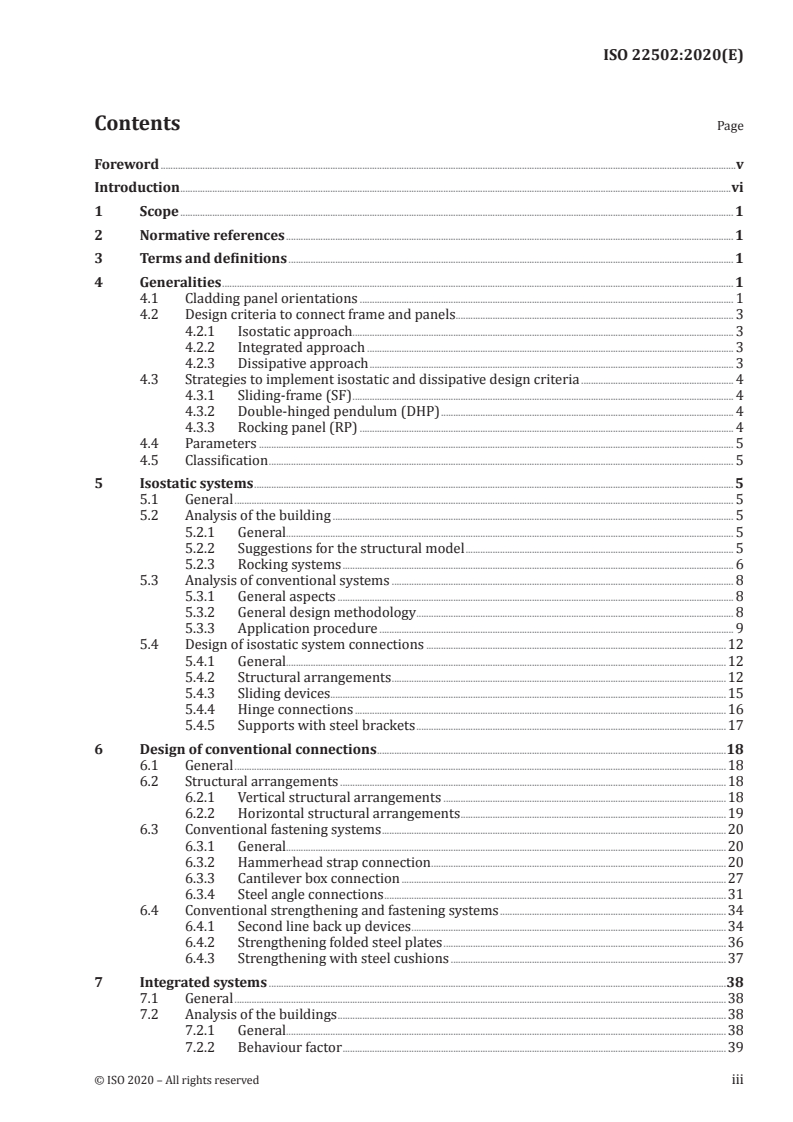
Contents Page
Foreword .v
Introduction .vi
1 Scope .1
2 Normative references .1
3 Terms and definitions .1
4 Generalities .1
4.1 Cladding panel orientations . 1
4.2 Design criteria to connect frame and panels . 3
4.2.1 Isostatic approach. 3
4.2.2 Integrated approach . 3
4.2.3 Dissipative approach . 3
4.3 Strategies to implement isostatic and dissipative design criteria . 4
4.3.1 Sliding-frame (SF) . 4
4.3.2 Double-hinged pendulum (DHP) . 4
4.3.3 Rocking panel (RP) . 4
4.4 Parameters . 5
4.5 Classification . 5
5 Isostatic systems .5
5.1 General . 5
5.2 Analysis of the building . 5
5.2.1 General. 5
5.2.2 Suggestions for the structural model . 5
5.2.3 Rocking systems . 6
5.3 Analysis of conventional systems . 8
5.3.1 General aspects . 8
5.3.2 General design methodology . 8
5.3.3 Application procedure . 9
5.4 Design of isostatic system connections .12
5.4.1 General.12
5.4.2 Structural arrangements .12
5.4.3 Sliding devices.15
5.4.4 Hinge connections .16
5.4.5 Supports with steel brackets .17
6 Design of conventional connections .18
6.1 General .18
6.2 Structural arrangements .18
6.2.1 Vertical structural arrangements .18
6.2.2 Horizontal structural arrangements .19
6.3 Conventional fastening systems .20
6.3.1 General.20
6.3.2 Hammerhead strap connection .20
6.3.3 Cantilever box connection .27
6.3.4 Steel angle connections .31
6.4 Conventional strengthening and fastening systems .34
6.4.1 Second line back up devices .34
6.4.2 Strengthening folded steel plates .36
6.4.3 Strengthening with steel cushions .37
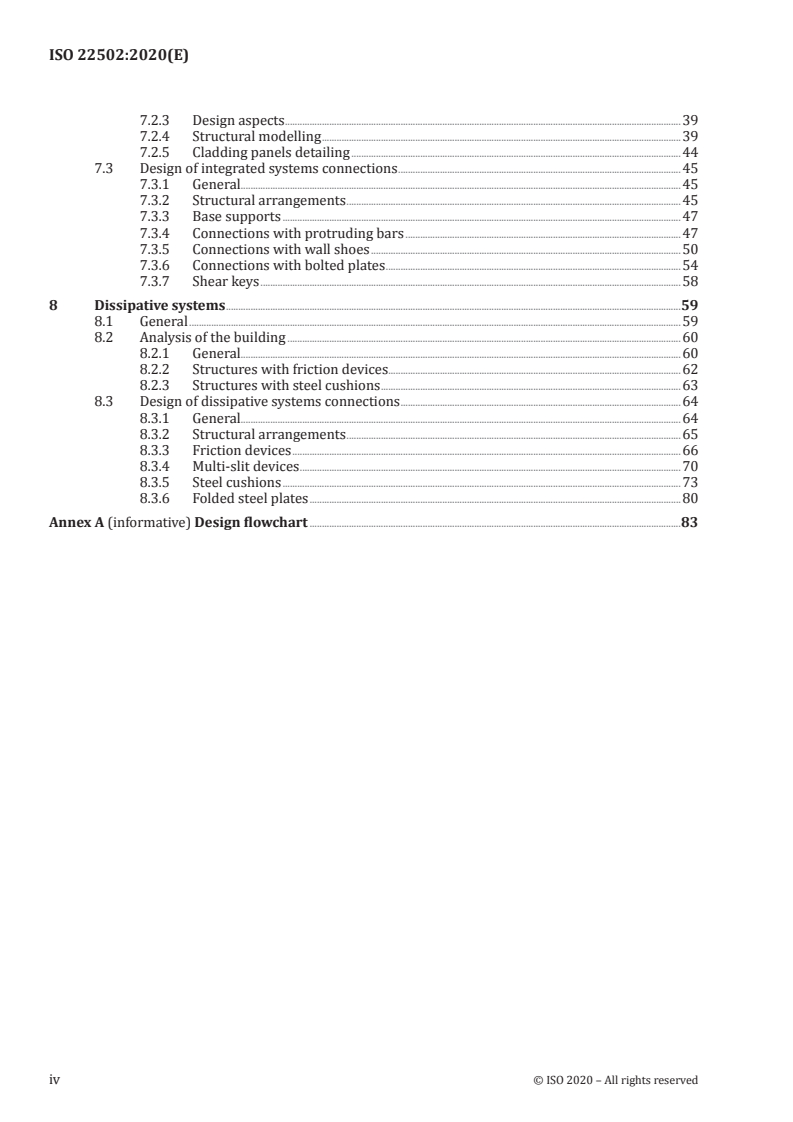
7 Integrated systems .38
7.1 General .38
7.2 Analysis of the buildings .38
7.2.1 General.38
7.2.2 Behaviour factor .39
7.2.3 Design aspects .39
7.2.4 Structural modelling .39
7.2.5 Cladding panels detailing .44
7.3 Design of integrated systems connections .45
7.3.1 General.45
7.3.2 Structural arrangements .45
7.3.3 Base supports .47
7.3.4 Connections with protruding bars .47
7.3.5 Connections with wall shoes .50
7.3.6 Connections with bolted plates .54
7.3.7 Shear keys .58
8 Dissipative systems .59
8.1 General .59
8.2 Analysis of the building .60
8.2.1 General.60
8.2.2 Structures with friction devices.62
8.2.3 Structures with steel cushions .63
8.3 Design of dissipative systems connections .64
8.3.1 General.64
8.3.2 Structural arrangements .65
8.3.3 Friction devices .66
8.3.4 Multi-slit devices .70
8.3.5 Steel cushions .73
8.3.6 Folded steel plates .80
Annex A (informative) Design flowchart .83
iv © ISO 2020 – All rights reserved
Foreword
ISO (the International Organization for Standardization) is a worldwide federation of national standards
bodies (ISO member bodies). The work of preparing International Standards is normally carried out
through ISO technical committees. Each member body interested in a subject for which a technical
committee has been established has the right to be represented on that committee. International
organizations, governmental and non-governmental, in liaison with ISO, also take part in the work.
ISO collaborates closely with the International Electrotechnical Commission (IEC) on all matters of
electrotechnical standardization.
The procedures used to develop this document and those intended for its further maintenance are
described in the ISO/IEC Directives, Part 1. In particular, the different approval criteria needed for the
different types of ISO documents should be noted. This document was drafted in accordance with the
editorial rules of the ISO/IEC Directives, Part 2 (see www .iso .org/ directives).
Attention is drawn to the possibility that some of the elements of this document may be the subject of
patent rights. ISO shall not be held responsible for identifying any or all such patent rights. Details of
any patent rights identified during the development of the document will be in the Introduction and/or
on the ISO list of patent declarations received (see www .iso .org/ patents).
Any trade name used in this document is information given for the convenience of users and does not
constitute an endorsement.
For an explanation of the voluntary nature of standards, the meaning of ISO specific terms and
expressions related to conformity assessment, as well as information about ISO's adherence to the
World Trade Organization (WTO) principles in the Technical Barriers to Trade (TBT), see www .iso .org/
iso/ foreword .html.
This document was prepared by Technical Committee ISO/TC 71, Concrete, reinforced concrete and
prestressed concrete, Subcommittee SC 5, Simplified design standard for concrete structures.
Any feedback or questions on this document should be directed to the user’s national standards body. A
complete listing of these bodies can be found at www .iso .org/ members .html.
Introduction
The current design practice of reinforced concrete buildings, most commonly precast, is based on a
frame model, where the peripheral cladding panels enter only as masses without any stiffness. The
panels are then connected to the structure with fastenings dimensioned with a local calculation based
on their mass for anchorage forces orthogonal to the plane of the panels.
Furthermore, the seismic force reduction in the type of reinforced concrete structures of concern relies
on energy dissipation in plastic hinges formed in the columns. Very large drifts of the columns are
needed to activate this energy dissipation foreseen in design. However, typically, the capacity of the
connections between cladding and structure is exhausted well before such large drifts can develop.
Therefore, the design of these connections cannot rely on the seismic reduction factor typically used for
design of the bare structure.
This document contains a set of practical provisions for the design of mechanical connections of
concrete claddings to concrete structures under seismic actions as well as suggestions for structural
analysis for the specified systems.
vi © ISO 2020 – All rights reserved
INTERNATIONAL STANDARD ISO 22502:2020(E)
Simplified design of connections of concrete claddings to
concrete structures
1 Scope
The present document refers to the panel-to-structure and panel-to panel connections used for the
cladding systems of reinforced concrete frame structures of single-storey buildings, typically precast.
They can be used also for multi-storey buildings with proper modifications.
The fastening devices considered in the present document consist mainly of steel elements or sliding
connectors. Dissipative devices with friction or plastic behaviour are also considered. Other types of
common supports and bond connections are treated where needed.
The use of any other existing fastening types or the connections with different characteristics than
those described in the following clauses is not allowed unless comparable experimental and analytical
studies do provide the necessary data and verify the design methodology for the particular type.
2 Normative references
The following documents are referred to in the text in such a way that some or all of their content
constitutes requirements of this document. For dated references, only the edition cited applies. For
undated references, the latest edition of the referenced document (including any amendments) applies.
ISO 20987, Simplified design for mechanical connections between precast concrete structural elements in
buildings
3 Terms and definitions
For the purposes of this document, the following terms and definitions apply.
ISO and IEC maintain terminological databases for use in standardization at the following addresses:
— ISO Online browsing platform: available at https:// www .iso .org/ obp
— IEC Electropedia: available at http:// www .electropedia .org/
3.1
behaviour factor q
q factor by which the elastic design spectrum in linear analysis is reduced
Note 1 to entry: Directly or indirectly linked to the ductility and deformation demands on members and
connections.
4 Generalities
4.1 Cladding panel orientations
Figure 1 a) shows a vertical panel orientation referred to a system of orthogonal axes, where x is
oriented horizontally in the panel plane, y is oriented orthogonally to that plane and z is oriented
vertically parallel to the gravity loads. The origin is placed in a corner at the base side of the panel.
Four connections are foreseen at the corners of the panel, indicated respectively by A, B, C and D. Any one
of these connections is intended to give only translational restraints without any rotational restraint. E
and F indicate the possible joint connections with the adjacent panels. Usually, the connections A and B
are attached to the foundation beam, the connections C and D are attached to the top beam.
The couple of bottom and top connections may be replaced by single connections placed in the middle
of the bottom and top sides for a pendulum arrangement of the panel. In this case, the connections are
respectively named A and C, and the symbols B and D are omitted.
In Figure 1 b), the same reference system is associated with a horizontal panel for which the connections
A, B, C and D are usually attached to the columns, and E and F refer to the possible joint connections
with the adjacent panels, foundation or top beam where the uncertain friction effect can act due to the
superimposed panels.
a) Vertical b) Horizontal
Figure 1 — Cladding panel orientations
Table 1 — Symbols and graphic schemes for supports
Symbol Description Graphic scheme
▼
f fixed (bilateral)
►◄,▲
f+ fixed (unilateral in + direction) ▲, ►
f- fixed (unilateral in - direction) ▼, ◄
s sliding (bilateral) ↔, ↕
d dissipative ⋀⋀⋀
/ omitted [empty]
Table 1 gives a general description of the symbols and graphic schemes regarding the effect of the
supports along the three directions x, y and z. As an example, Table 2 gives the arrangement matrix
indicating the effect of the supports for a vertical panel.
2 © ISO 2020 – All rights reserved
Table 2 — Arrangement matrix – example
Direction A B C D E F
x f / s / f f
y f / f / / /
z f / / / d d
The term “fixed” is used with reference to the restrained linear displacement while the rotational
restraints are not provided.
4.2 Design criteria to connect frame and panels
4.2.1 Isostatic approach
An isostatic arrangement of panel connections is able to allow without reactions the large displacements
expected for the frame structure under earthquake conditions. Very large displacement capacities are
required for connectors with this choice.
The frame deformation demand is allowed by a relative clearance that uncouples the motion of frame
and panels. The two systems are kinematically uncoupled, except for the out-of-plane displacements
[see Figure 2 a)].
4.2.2 Integrated approach
An integrated arrangement relies on fixed connections that integrate the panels in the resistant
structural assembly with a dual wall-frame system behaviour. High forces may arise in the connections
with this choice.
Panels and frame have a coupled motion: the system is kinematically paired [see Figure 2 b)]. Panels
become part of the seismic resisting system and they act as the main restraints in the horizontal
direction thanks to their higher stiffness. As a consequence, the connections shall be over-proportioned
to carry the higher loads transferred by the frame, according to capacity design rules.
4.2.3 Dissipative approach
An arrangement of dissipative connections between the panels is added to an isostatic system of
fastenings to the structure, able to maintain displacements and forces within lower predetermined limits.
Specific devices can balance the overall building response, reducing the displacement and keeping the
load below an imposed threshold, determined by the connections themselves [see Figure 2 c)]. Like in
the isostatic configuration, the systems are kinematically uncoupled but they are also constrained by
inelastic links, like friction or yielding devices. The joints between structure and panels – or among the
panels – shall be designed to dissipate energy during the seismic action.
a) b) c)
Figure 2 — Design criteria to connect frame and panels
4.3 Strategies to implement isostatic and dissipative design criteria
4.3.1 Sliding-frame (SF)
Like an ideal uncoupled system, the isostatic sliding-frame is, in principle, the easiest way to disconnect
frame and panels. To achieve this result while avoiding the issues that affect current systems, proper
connections (sliders) shall be introduced. They only restrain out-of-plane motions, reproducing the
hypothesis typically assumed in the current practice, but in a safer way [see Figure 3 a)].
4.3.2 Double-hinged pendulum (DHP)
The double-hinged pendulum is the proper way to connect the cladding as simple mass without any
stiffness contribution [see Figure 3 b)]. This result can be obtained either by connecting panel edges
with hinges, or by replacing the top hinge with coupled sliders.
4.3.3 Rocking panel (RP)
Starting from DHP, the rocking panel configuration may be obtained replacing the bottom hinge with
a pair of horizontal restraints. These leave the panel free to rock around its bottom corners. Even
though this solution looks very similar to the former one, some differences in statics and in kinematic
behaviour need to be highlighted [see Figure 3 c)].
a) b) c)
Figure 3 — Isostatic and dissipative design criteria: schemes of design strategies
4 © ISO 2020 – All rights reserved
4.4 Parameters
ISO 20987 shall apply. In addition to the provisions of ISO 20987, the following applies.
Among the main parameters that characterize the seismic behaviour of the connection, the following
one is added:
slide - free linear relative displacement capacity with null or negligible reaction.
The main behaviour parameters are provided for each x, y, z direction defined in ISO 20987 specifying
possible interaction effects.
4.5 Classification
ISO 20987 shall apply. In addition to the provisions of ISO 20987, the following applies.
Connections present in existing buildings, where sufficient information about their strength and/or
ductility is not available, can be classified as unknown.
Existing connections can be classified as insufficient when a specific calculation under the expected
seismic action shows their inadequate strength.
5 Isostatic systems
5.1 General
For buildings with isostatic arrangements of cladding panel connections, the structural analysis
under seismic action shall refer to the frame system following the conventional design practice of such
structures. In expectation of large displacements, the second order effects, PΔ, should be taken into
account. In addition to the ordinary output data used for the design of member resistance at ultimate
1)
limit state (ULS ), the sliding or rotation displacements shall be provided for the design of the pertinent
capacities of panel connection devices.
5.2 Analysis of the building
5.2.1 General
For the frame systems considered, capacity design criteria for the proportioning of the connection are
applied. It is assumed, as a rule, that the beam-to-column and column-to-foundation connections are
properly over-proportioned with respect to the bending moment ultimate capacities of the columns.
Floor connections involved in the diaphragm action can refer to some approximate methods.
In any case, the structural connections can be over-proportioned, referring to the forces obtained from
a structural analysis performed with behaviour factor q = 1,5
Figure A.1 shows a simplified design flowchart. It shows the required steps to design a cladding to
concrete structure connection. Specific suggestions regarding the isostatic systems structural model
analysis are given in 5.2.2 and 5.2.3.
5.2.2 Suggestions for the structural model
For the numerical model of the structure, the ordinary linear elements (beam type) can be used,
positioned along the axis of the members. Different eccentricities between the members should be
reproduced using link rigid elements at their joints. The connections between the elements shall be
faithfully represented with their degrees of freedom in the different planes. It should be considered
that, if the connections are modelled with no deformability (e.g. fixed built-in full support or hinged
1) ULS: state at which the material stresses are limited to the point at which the bearing elements can withstand
the design loads and maintain the safety and integrity of the structure.
support), the results of the analysis can lead to very high joint forces. The actual deformability of the
connections, even small, can substantially lower these forces. More reliable results can be obtained if
the actual deformability of the connections is reproduced in the model.
The floor elements can be modelled as linear elements concentrating their mechanical properties along
the axis. To reach the actual points of their connections, link rigid elements can protrude from the
axis. The diaphragm action of the floors shall be properly represented, implicitly by the layout of their
members or explicitly through the options provided by the computation code.
If the cladding panels are introduced as members in the model, they can be reproduced as linear
elements distributing their weight along the axis. Their supports shall faithfully reproduce the isostatic
arrangement of the connections. To reach the actual points of the connections, where some response
parameters are needed, rigid link elements can protrude from the panel axis.
If the cladding panels are introduced as masses in the model, their total mass, M, shall be transferred to
the sustaining members in a ratio, R , depending on the connection arrangement.
y
For one-storey structures with vertical panels in the horizontal orthogonal y direction, this ratio, R , is
y
given by Formula (1):
06, 7Mh
R = (1)
y
h
o
where
h is the height of the panel;
h is the elevation of its upper support connected with the roof deck;
o
M is the total mass of the cladding panels in the model.
In the in-plane horizontal x direction, the same ratio, R = R , can be assumed for a pendulum support
x y
arrangement. A null ratio, R = 0, can be assumed for a cantilever arrangement with upper sliding
x
connections.
For one-storey structures with horizontal panels in the orthogonal y direction, their mass, M, shall be
shared between the two lateral supporting columns, amplified as a function of their elevation h [see
i
Formula (2)]:
05, Mh
i
R = (2)
y
h
o
where h is the elevation of the roof deck.
o
In the in-plane horizontal x direction, their mass shall be transferred to the lateral columns with the
same amplification, based on the constraint degree of the corresponding support.
5.2.3 Rocking systems
The vertical panel of Figure 4 keeps its stability in its plane until the horizontal top force, H [see
o
Formula (3)], is smaller than the limit force
Gb
H = (3)
o
2h
where
G is the weight of the panel;
b and h are geometrical quantities indicated in Figure 4.
6 © ISO 2020 – All rights reserved
If H > H , the panel starts rocking around its lower corner like an inverted pendulum with a restoring
o
force, H , that remains constant for small displacements. At the reverse motion, the panel sits back on
o
the base side and starts a new opposite cycle similar to the previous one. To capture such vibration
motion, a refined dynamic analysis should be carried out for the solution of the non-linear algorithms
inclusive of the unilateral effects of the base supports.
Considering this, the small value of the limit force, H , can prevent the rocking motion only for low
o
actions. For practical design applications, a simplified approach can be used, based on a linear elastic
structural analysis for each of the two possible structural schemes: integrated and isostatic. The design
approach can therefore adopt a first model corresponding to the integrated system with cantilever
panels fully fixed at their base and connected with an equivalent hinge to the roof and a second model
referred to the isostatic system with pendulum panels connected with two end hinges.
2)
Starting with the integrated system, the first analysis refers to the serviceability limit state (SLS )
seismic action, evaluated using the pertinent elastic response spectrum. Its outcome provides the
forces and displacements. If the corresponding connection forces are not greater than H , the calculated
o
displacements are used for the verification of the drift limits. If they are greater, the analysis of the
isostatic model is necessary.
Figure 4 — Vertical panel force equilibrium
The second analysis of the integrated system refers to the ultimate limit state seismic action (no-
collapse requirement), evaluated using the pertinent design response spectrum with the behaviour
factor q = 1,0. Its outcome provides the forces and displacements. If the corresponding connection
forces are not greater than H , the forces calculated in the structure are used for the strength design. If
o
they are greater, the analysis of the isostatic model is necessary.
When necessary, the isostatic system is analysed neglecting the restoring force, H . The panels only
o
contribute to the response of the structure as masses without any stiffness. Thus, they can be modelled
as indicated in 5.2.2. For SLS, the elastic response spectrum is used. The resulting displacements are
verified against the required drift limits. For the ULS, the design response spectrum is used. The
behaviour factor q, of the frame systems and the resulting forces are used in the strength designs.
In any case, the forces in the panel connections for their strength design, taking into account the
impulsive effects of the dynamic action, shall be taken at least equal to 2H .
o
2) SLS: state at which the structure is supposed to be comfortable and usable taking into account vibrations,
deflections and cracks.
5.3 Analysis of conventional systems
5.3.1 General aspects
The term “conventional systems” used in these rules is for the reinforced concrete buildings with the
existing fastening systems of cladding panels, which have been extensively used in the past and may
still be used at present in zones with low to medium seismicity.
The existing design practice for the conventional systems usually has been based on the model that is
not explicitly considering the interaction between the main structural system and the claddings in the
plane of the façade. Such approach cannot identify eventual complex interaction between the structure
and the panels leading to possible failure of the fastening system and to the fall of the panels during
strong earthquakes. Some of such systems, in case of small seismic demand and/or structures with
large over-strength and stiffness, can still provide sufficiently safe design solutions.
A suitable design procedure is provided in 5.3.2 and 5.3.3. It can be used for strengthening existing
structures as well as for the design of new ones.
5.3.2 General design methodology
These rules are strictly limited to those fastening systems described in Clause 6. When the applied
fastening system is different from those presented in Clause 6, the system shall be experimentally and
analytically investigated (taking into account the 3D behaviour of the structure) to provide the basic
data needed in the proposed methodology. These data include, but are not limited to, the mechanism of
the structure-to-panel interaction, deformation and strength capacity, equivalent stiffness, and, in the
case when refined inelastic response analysis is chosen, the hysteretic models for the structure and the
fastening system.
Furthermore, these rules are limited to fastening schemes presented in Figure 5 a) for vertical panels
and Figure 5 b) for horizontal panels. In particular, the vertical panels are attached to the upper beam
with two connections giving bilateral restraint in y (orthogonal) direction and bilateral essentially
sliding freedoms in x (horizontal) and z (vertical) directions, while at the base they are supported
with two pinned connections providing restraints in all the three directions. Any horizontal panel is
attached to the lateral columns with two connections at the upper part and with two connections at
the lower part giving bilateral restraint in y (orthogonal) direction, unilateral support in z (vertical)
direction and bilateral partially sliding freedom in x (horizontal) direction.
The approach has two possible levels of complexity and it is based on the following main considerations:
a) weak interaction between the panel and the bare frame (i.e. the stiffness of the fastening devices
is small compared to the stiffness of the structure itself) can be expected in conventional systems
until certain deformation threshold is exhausted. Until this deformation limit is reached, the
system behaves essentially as isostatic and relatively simple traditional structural models can be
used, neglecting the structure-to-cladding interaction. The relevant deformation capacity of the
addressed conventional systems is provided in 6.3;
b) after the deformation limit is reached, more complex model shall be used considering the
interaction between the panels and the bare structure through the fastening system. Relevant
input parameters for the addressed conventional systems are provided in 6.3;
c) if the more refined model does not prove the adequacy of the system, a different cladding connection
system shall be chosen.
8 © ISO 2020 – All rights reserved
a) Vertical configuration b) Horizontal configuration
Key
1 panel
2 column
3 beam
Figure 5 — Cladding elements fastening schemes for conventional systems
Design of the connections in the direction perpendicular to the plane shall always be done.
The most critical problem in the case of the conventional systems is their quite limited deformation
capacity. Below this limit, the conventional connections behave essentially as isostatic connections.
Since the deformation threshold and the interacting mechanism are highly uncertain, back-up devices,
such as restrainers shall always be used (see 6.4.1).
5.3.3 Application procedure
5.3.3.1 Practical application
5.3.3.1.1 General
The practical design application can be made through steps 1 to 4.
Step 1:
The bare frame (without panels) is analysed taking into account the local seismicity at the site. The
modal response spectrum analysis is used.
Estimation of the required strength of the structure can be based on the un-cracked cross-section of
columns. For calculating the displacements, the cracked cross-sections shall be considered.
Step 2:
The displacement capacity of the connections in the plane of the panel is compared with the
displacement demand defined in Step 1 as it is stated below:
a) vertical panels: the displacement capacity of the top connections is compared with the displacement
of the beam [see Figure 6 a)]. The size of the gap, corresponding to the displacement demand shall
be checked according to the procedure presented in 6.3;
b) horizontal panels: the displacement capacity of the connections is compared with the displacements
of the columns at the level of these connections [Figure 6 b)].
a) Vertical configuration b) Horizontal configuration
Figure 6 — Displacement demand of cladding elements
If the displacement capacity of vertical panel connections is larger than the displacement demand, the
analysis is completed unless the gap between the beam and the panel is closed. If the displacement
capacity of horizontal panel connections is larger than the displacement demand, the analysis of this
step is completed. In such cases, it can be assumed that the interaction between panels and the bare
frame is weak.
If the displacement demand exceeds the capacity of the connections and/or the gap between the vertical
panels and the beam is closed, the cladding-to-structure interaction shall be considered in the analysis
(see Step 4) or different cladding system shall be chosen.
Step 3:
In the direction perpendicular to the panel, the strength of all connections shall be verified with respect
to the demand, evaluated according to normal rules for non-structural elements. The capacity of the
connections in the direction perpendicular to the panel is estimated according to the data provided by
the manufacturer. If the strength of the connections is inadequate, a different connection system shall
be chosen.
Step 4:
The cladding-to-structure interaction is taken into account by means of a more refined structural
analysis. Rules regarding this analysis are provided in 5.3.3.4.
If the displacement demand exceeds the capacity of the connection and/or the gap between the vertical
panel and the beam is closed, a different connection system should be chosen. If not, go to Step 3.
5.3.3.2 Suggestions for the structural model
Any type of structural model and analysis can be used for the evaluation of the existing reinforced
concrete buildings. While the equivalent elastic modal spectrum analysis is the first choice in the
conventional design practice, more refined inelastic analysis method can be adopted in some cases due
to the highly complex non-linear behaviour considering panel-to-structure interaction.
In the general case of existing reinforced concrete structures, the frame or dual wall-frame analysis
should be performed by means of software computation. The ordinary methods for the formulation
10 © ISO 2020 – All rights reserved
of the calculation model is applied with the specific pertinent indications given in 5.3 for conventional
systems, 5.2 for isostatic systems or in 7.1 for integrated systems of connections.
5.3.3.3 Conditions for strengthening interventions
Any intervention of upgrading or retrofitting of panel connections on existing buildings shall be made
only when the adequacy of all the remaining parts of the structure has been verified to be compliant
with the requirements of the chosen level of seismic resistance.
When the proposed analysis procedure is used for existing buildings the following specifics shall be
considered:
— the analysis and design shall follow the general requirements for the design of the main
structural system;
— in Step 1 the adequacy of the main structural system (bare frame) shall be checked first before
proceeding to Step 2. The main structural system itself may need upgrading first.
5.3.3.4 Refined analysis model
Numerical models of the connections shall be able to describe all important features of their seismic
response. For conventional fastening systems, the appropriate hysteretic models presented in 6.3 can
be used. Such models can imply the nonlinear dynamic analysis. For regular structures, the analysis
can be simplified using the nonlinear pushover-based analysis.
The quoted numerical models of connections can
...
Questions, Comments and Discussion
Ask us and Technical Secretary will try to provide an answer. You can facilitate discussion about the standard in here.
Loading comments...