

ISO 20987:2019
(Main)Simplified design for mechanical connections between precast concrete structural elements in buildings
General Information
- Abstract
This document refers to connections in precast frame systems, either for single-storey or multi-storey buildings. The connections for all orders of joints are considered. Large wall panel and three-dimensional cell systems are not considered. According to the position in the overall construction and of the consequent different structural functions, the seven following orders of joints are considered: a) mutual joints between floor or roof elements (floor-to-floor) that, in the seismic behaviour of the structural system, concern the diaphragm action of the floor; b) joints between floor or roof elements and supporting beams (floor-to-beam) that give the peripheral constraints to the floor diaphragm in its seismic behaviour; c) joints between beam and column (beam-to-column) that ensure in any direction the required degree of restraint in the frame system; d) joints between column segments (column-to-column) used for multi-storey buildings usually for dual wall braced systems; e) joints between column and foundation (column-to-foundation), able to ensure in any plane a fixed full support of the column; f) fastenings of cladding panels to the structure (panel-to-structure) that ensure the stability of the panels under the high forces or the large drifts expected under seismic action; g) joints between adjacent cladding panels (panel-to-panel) possibly used to increase the stiffness of the peripheral wall system and provide an additional source of energy dissipation. Simple bearings working by gravity load friction are not considered. Sliding and elastic deformable supporting devices neither, being all these types of connections not suitable for the transmission of seismic actions. The document provides formulae for the strength design of a large number of joint typologies.
- Status
- Withdrawn
- Publication Date
- 10-Oct-2019
- Technical Committee
- ISO/TC 71/SC 5 - Simplified design standard for concrete structures
- Drafting Committee
- ISO/TC 71/SC 5 - Simplified design standard for concrete structures
- Current Stage
- 9599 - Withdrawal of International Standard
- Start Date
- 08-Dec-2025
- Completion Date
- 29-Aug-2026
Buy Documents

ISO 20987:2019 - Simplified design for mechanical connections between precast concrete structural elements in buildings/11/2019



ISO 20987:2019 - Simplified design for mechanical connections between precast concrete structural elements in buildings



REDLINE ISO 20987:2019 - Simplified design for mechanical connections between precast concrete structural elements in buildings Released:10/11/2019
Overview
ISO 20987:2019 - "Simplified design for mechanical connections between precast concrete structural elements in buildings" - is an international standard that provides guidance and strength-design formulae for mechanical joints in precast frame systems. It covers single‑storey and multi‑storey precast buildings and focuses on connections that must transfer seismic actions. The standard does not cover large wall-panel or three-dimensional cell systems, nor simple gravity bearings, sliding supports or elastic deformable devices (these are considered unsuitable for seismic force transmission).
Key topics and technical requirements
- Scope of joints: seven orders of joints are explicitly considered:
- Floor-to-floor (diaphragm-related)
- Floor-to-beam (peripheral diaphragm restraints)
- Beam-to-column (frame restraint)
- Column-to-column (multi-storey, dual wall/braced systems)
- Column-to-foundation (full fixed support)
- Panel-to-structure (cladding fastenings for drift and seismic loads)
- Panel-to-panel (stiffness and energy dissipation of peripheral walls)
- Design content: classification of connections, material and component properties, and strength-design formulae for many joint typologies.
- Performance parameters: guidance and checks for strength, ductility, energy dissipation, deformation capacity, cyclic decay, and damage under seismic loading.
- Connection types addressed: cast‑in‑situ toppings and joints, welded and bolted steel connectors, supports using steel angles or shoes, dowel connections, mechanical couplers, hybrid solutions and pocket foundations.
- Limitations: excludes connections that rely on friction-only gravity bearing or sliding/elastic devices for seismic action transmission.
Practical applications
- Use ISO 20987:2019 to:
- Size and detail mechanical connections between precast elements for seismic resistance
- Select and specify appropriate connector types (bolted, welded, couplers, dowels)
- Evaluate ductility and energy dissipation capacity of joints during design reviews
- Inform erection detailing, quality control, and tender specifications for precast projects
- Support retrofit or assessment work where mechanical connections are critical to structural performance
Who should use this standard
- Structural and seismic engineers designing precast frame systems
- Precast manufacturers and connector suppliers developing product solutions
- Contractors and erectors preparing shop drawings and sequence plans
- Building officials and reviewers assessing compliance for seismic performance
- Researchers and educators focused on precast connection behavior
Related standards and practice
ISO 20987:2019 is intended to be used alongside applicable national and international structural and seismic design codes and standards and with project-specific specifications. It provides practical formulae and classifications to complement code-based load and performance requirements.
Keywords: ISO 20987:2019, precast concrete connections, mechanical connections, precast frame systems, seismic design, joint typologies, strength design formulae, ductility, beam-to-column, floor-to-beam.
Buy Documents
ISO 20987:2019 - Simplified design for mechanical connections between precast concrete structural elements in buildings/11/2019
ISO 20987:2019 - Simplified design for mechanical connections between precast concrete structural elements in buildings
REDLINE ISO 20987:2019 - Simplified design for mechanical connections between precast concrete structural elements in buildings Released:10/11/2019
Get Certified
Connect with accredited certification bodies for this standard

DIBt (Deutsches Institut für Bautechnik)
German Institute for Building Technology.
DIN CERTCO
DIN Group product certification.

Aboma Certification B.V.
Specialized in construction, metal, and transport sectors.
Sponsored listings
Frequently Asked Questions
ISO 20987:2019 is a standard published by the International Organization for Standardization (ISO). Its full title is "Simplified design for mechanical connections between precast concrete structural elements in buildings". This standard covers: This document refers to connections in precast frame systems, either for single-storey or multi-storey buildings. The connections for all orders of joints are considered. Large wall panel and three-dimensional cell systems are not considered. According to the position in the overall construction and of the consequent different structural functions, the seven following orders of joints are considered: a) mutual joints between floor or roof elements (floor-to-floor) that, in the seismic behaviour of the structural system, concern the diaphragm action of the floor; b) joints between floor or roof elements and supporting beams (floor-to-beam) that give the peripheral constraints to the floor diaphragm in its seismic behaviour; c) joints between beam and column (beam-to-column) that ensure in any direction the required degree of restraint in the frame system; d) joints between column segments (column-to-column) used for multi-storey buildings usually for dual wall braced systems; e) joints between column and foundation (column-to-foundation), able to ensure in any plane a fixed full support of the column; f) fastenings of cladding panels to the structure (panel-to-structure) that ensure the stability of the panels under the high forces or the large drifts expected under seismic action; g) joints between adjacent cladding panels (panel-to-panel) possibly used to increase the stiffness of the peripheral wall system and provide an additional source of energy dissipation. Simple bearings working by gravity load friction are not considered. Sliding and elastic deformable supporting devices neither, being all these types of connections not suitable for the transmission of seismic actions. The document provides formulae for the strength design of a large number of joint typologies.
This document refers to connections in precast frame systems, either for single-storey or multi-storey buildings. The connections for all orders of joints are considered. Large wall panel and three-dimensional cell systems are not considered. According to the position in the overall construction and of the consequent different structural functions, the seven following orders of joints are considered: a) mutual joints between floor or roof elements (floor-to-floor) that, in the seismic behaviour of the structural system, concern the diaphragm action of the floor; b) joints between floor or roof elements and supporting beams (floor-to-beam) that give the peripheral constraints to the floor diaphragm in its seismic behaviour; c) joints between beam and column (beam-to-column) that ensure in any direction the required degree of restraint in the frame system; d) joints between column segments (column-to-column) used for multi-storey buildings usually for dual wall braced systems; e) joints between column and foundation (column-to-foundation), able to ensure in any plane a fixed full support of the column; f) fastenings of cladding panels to the structure (panel-to-structure) that ensure the stability of the panels under the high forces or the large drifts expected under seismic action; g) joints between adjacent cladding panels (panel-to-panel) possibly used to increase the stiffness of the peripheral wall system and provide an additional source of energy dissipation. Simple bearings working by gravity load friction are not considered. Sliding and elastic deformable supporting devices neither, being all these types of connections not suitable for the transmission of seismic actions. The document provides formulae for the strength design of a large number of joint typologies.
ISO 20987:2019 is classified under the following ICS (International Classification for Standards) categories: 91.080.40 - Concrete structures. The ICS classification helps identify the subject area and facilitates finding related standards.
ISO 20987:2019 is available in PDF format for immediate download after purchase. The document can be added to your cart and obtained through the secure checkout process. Digital delivery ensures instant access to the complete standard document.
Standards Content (Sample)
INTERNATIONAL ISO
STANDARD 20987
First edition
2019-10
Simplified design for mechanical
connections between precast concrete
structural elements in buildings
Conception simplifiée pour les assemblages mécaniques entre
éléments structurels en béton préfabriqué dans les bâtiments
Reference number
©
ISO 2019
© ISO 2019
All rights reserved. Unless otherwise specified, or required in the context of its implementation, no part of this publication may
be reproduced or utilized otherwise in any form or by any means, electronic or mechanical, including photocopying, or posting
on the internet or an intranet, without prior written permission. Permission can be requested from either ISO at the address
below or ISO’s member body in the country of the requester.
ISO copyright office
CP 401 • Ch. de Blandonnet 8
CH-1214 Vernier, Geneva
Phone: +41 22 749 01 11
Fax: +41 22 749 09 47
Email: copyright@iso.org
Website: www.iso.org
Published in Switzerland
ii © ISO 2019 – All rights reserved
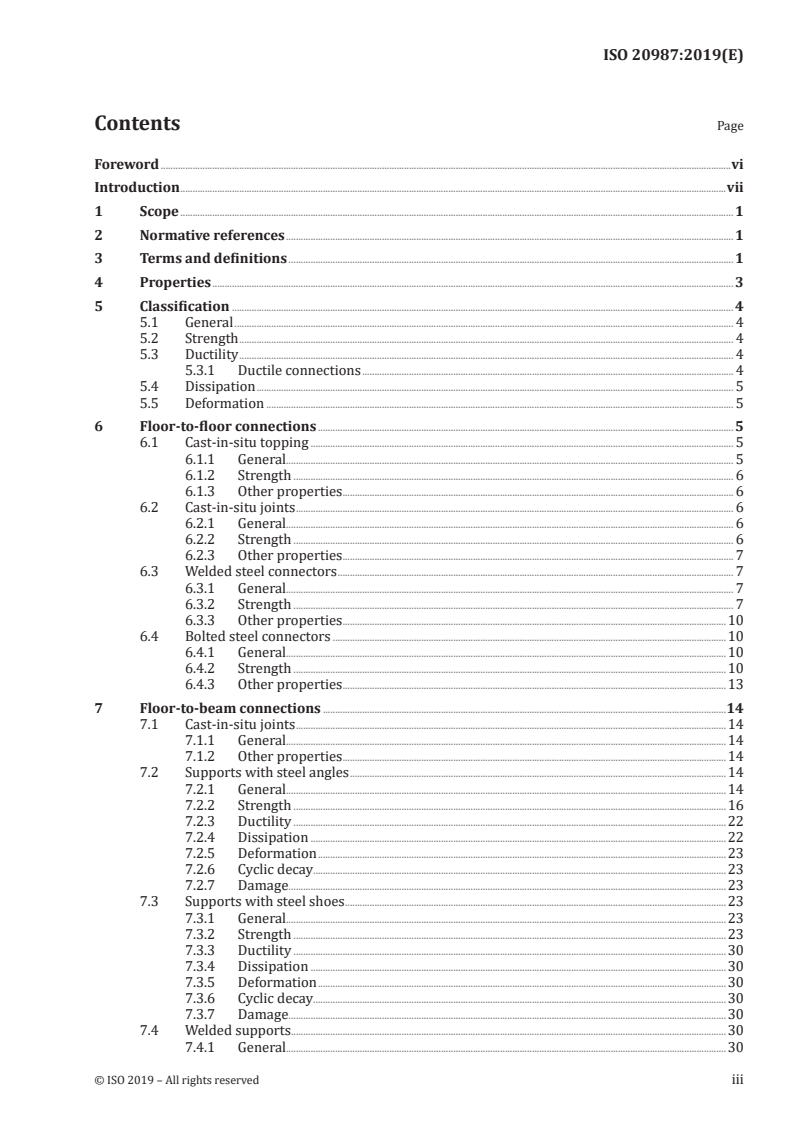
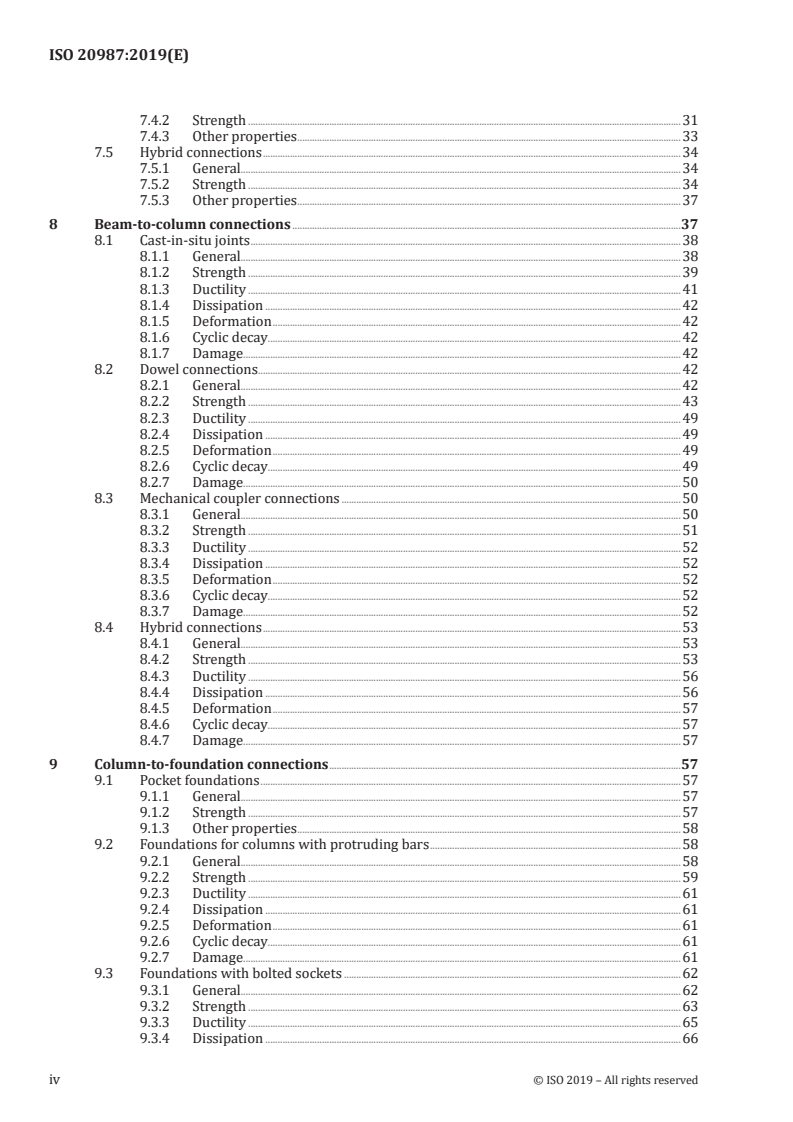
Contents Page
Foreword .vi
Introduction .vii
1 Scope . 1
2 Normative references . 1
3 Terms and definitions . 1
4 Properties .3
5 Classification .4
5.1 General . 4
5.2 Strength . 4
5.3 Ductility . 4
5.3.1 Ductile connections . 4
5.4 Dissipation . 5
5.5 Deformation . 5
6 Floor-to-floor connections .5
6.1 Cast-in-situ topping . 5
6.1.1 General. 5
6.1.2 Strength . 6
6.1.3 Other properties . 6
6.2 Cast-in-situ joints . 6
6.2.1 General. 6
6.2.2 Strength . 6
6.2.3 Other properties . 7
6.3 Welded steel connectors . 7
6.3.1 General. 7
6.3.2 Strength . 7
6.3.3 Other properties .10
6.4 Bolted steel connectors .10
6.4.1 General.10
6.4.2 Strength .10
6.4.3 Other properties .13
7 Floor-to-beam connections .14
7.1 Cast-in-situ joints .14
7.1.1 General.14
7.1.2 Other properties .14
7.2 Supports with steel angles .14
7.2.1 General.14
7.2.2 Strength .16
7.2.3 Ductility .22
7.2.4 Dissipation .22
7.2.5 Deformation .23
7.2.6 Cyclic decay . . .23
7.2.7 Damage .23
7.3 Supports with steel shoes .23
7.3.1 General.23
7.3.2 Strength .23
7.3.3 Ductility .30
7.3.4 Dissipation .30
7.3.5 Deformation .30
7.3.6 Cyclic decay . . .30
7.3.7 Damage .30
7.4 Welded supports.30
7.4.1 General.30
7.4.2 Strength .31
7.4.3 Other properties .33
7.5 Hybrid connections .34
7.5.1 General.34
7.5.2 Strength .34
7.5.3 Other properties .37
8 Beam-to-column connections .37
8.1 Cast-in-situ joints .38
8.1.1 General.38
8.1.2 Strength .39
8.1.3 Ductility .41
8.1.4 Dissipation .42
8.1.5 Deformation .42
8.1.6 Cyclic decay . . .42
8.1.7 Damage .42
8.2 Dowel connections.42
8.2.1 General.42
8.2.2 Strength .43
8.2.3 Ductility .49
8.2.4 Dissipation .49
8.2.5 Deformation .49
8.2.6 Cyclic decay . . .49
8.2.7 Damage .50
8.3 Mechanical coupler connections .50
8.3.1 General.50
8.3.2 Strength .51
8.3.3 Ductility .52
8.3.4 Dissipation .52
8.3.5 Deformation .52
8.3.6 Cyclic decay . . .52
8.3.7 Damage .52
8.4 Hybrid connections .53
8.4.1 General.53
8.4.2 Strength .53
8.4.3 Ductility .56
8.4.4 Dissipation .56
8.4.5 Deformation .57
8.4.6 Cyclic decay . . .57
8.4.7 Damage .57
9 Column-to-foundation connections .57
9.1 Pocket foundations .57
9.1.1 General.57
9.1.2 Strength .57
9.1.3 Other properties .58
9.2 Foundations for columns with protruding bars .58
9.2.1 General.58
9.2.2 Strength .59
9.2.3 Ductility .61
9.2.4 Dissipation .61
9.2.5 Deformation .61
9.2.6 Cyclic decay . . .61
9.2.7 Damage .61
9.3 Foundations with bolted sockets .62
9.3.1 General.62
9.3.2 Strength .63
9.3.3 Ductility .65
9.3.4 Dissipation .66
iv © ISO 2019 – All rights reserved
9.3.5 Deformation .66
9.3.6 Cyclic decay . . .66
9.3.7 Damage .66
9.4 Foundations with bolted flanges .67
9.4.1 General.67
9.4.2 Strength .67
9.4.3 Other properties .68
9.5 Foundations with mechanical couplers .68
9.5.1 General.68
9.5.2 Strength .68
9.5.3 Ductility .69
9.5.4 Dissipation .70
9.5.5 Deformation .70
9.5.6 Cyclic decay . . .70
9.5.7 Damage .70
10 Calculation of actions.70
10.1 General criteria .70
10.2 Capacity design .70
Foreword
ISO (the International Organization for Standardization) is a worldwide federation of national standards
bodies (ISO member bodies). The work of preparing International Standards is normally carried out
through ISO technical committees. Each member body interested in a subject for which a technical
committee has been established has the right to be represented on that committee. International
organizations, governmental and non-governmental, in liaison with ISO, also take part in the work.
ISO collaborates closely with the International Electrotechnical Commission (IEC) on all matters of
electrotechnical standardization.
The procedures used to develop this document and those intended for its further maintenance are
described in the ISO/IEC Directives, Part 1. In particular, the different approval criteria needed for the
different types of ISO documents should be noted. This document was drafted in accordance with the
editorial rules of the ISO/IEC Directives, Part 2 (see www .iso .org/directives).
Attention is drawn to the possibility that some of the elements of this document may be the subject of
patent rights. ISO shall not be held responsible for identifying any or all such patent rights. Details of
any patent rights identified during the development of the document will be in the Introduction and/or
on the ISO list of patent declarations received (see www .iso .org/patents).
Any trade name used in this document is information given for the convenience of users and does not
constitute an endorsement.
For an explanation of the voluntary nature of standards, the meaning of ISO specific terms and
expressions related to conformity assessment, as well as information about ISO's adherence to the
World Trade Organization (WTO) principles in the Technical Barriers to Trade (TBT) see www .iso
.org/iso/foreword .html.
This document was prepared by Technical Committee ISO/TC 71, Concrete, reinforced concrete and pre-
stressed concrete, Subcommittee SC 5, Simplified design standard for concrete structures.
Any feedback or questions on this document should be directed to the user’s national standards body. A
complete listing of these bodies can be found at www .iso .org/members .html.
vi © ISO 2019 – All rights reserved
Introduction
This document contains a set of practical provisions for the design of the mechanical connections in
precast elements under seismic actions. Design of the connections is carried out in terms of strength
verifications. Indications are also provided for defining the actions to be used in design.
If national standards provide alternate formulae for the same typology, those can be used instead of the
ones given in this document.
INTERNATIONAL STANDARD ISO 20987:2019(E)
Simplified design for mechanical connections between
precast concrete structural elements in buildings
1 Scope
This document refers to connections in precast frame systems, either for single-storey or multi-
storey buildings. The connections for all orders of joints are considered. Large wall panel and three-
dimensional cell systems are not considered.
According to the position in the overall construction and of the consequent different structural
functions, the seven following orders of joints are considered:
a) mutual joints between floor or roof elements (floor-to-floor) that, in the seismic behaviour of the
structural system, concern the diaphragm action of the floor;
b) joints between floor or roof elements and supporting beams (floor-to-beam) that give the peripheral
constraints to the floor diaphragm in its seismic behaviour;
c) joints between beam and column (beam-to-column) that ensure in any direction the required degree
of restraint in the frame system;
d) joints between column segments (column-to-column) used for multi-storey buildings usually for
dual wall braced systems;
e) joints between column and foundation (column-to-foundation), able to ensure in any plane a fixed
full support of the column;
f) fastenings of cladding panels to the structure (panel-to-structure) that ensure the stability of the
panels under the high forces or the large drifts expected under seismic action;
g) joints between adjacent cladding panels (panel-to-panel) possibly used to increase the stiffness of
the peripheral wall system and provide an additional source of energy dissipation.
Simple bearings working by gravity load friction are not considered. Sliding and elastic deformable
supporting devices neither, being all these types of connections not suitable for the transmission of
seismic actions.
The document provides formulae for the strength design of a large number of joint typologies.
2 Normative references
There are no normative references in this document.
3 Terms and definitions
For the purposes of this document, the following terms and definitions apply.
ISO and IEC maintain terminological databases for use in standardization at the following addresses:
— ISO Online browsing platform: available at https: //www .iso .org/obp
— IEC Electropedia: available at http: //www .electropedia .org/
3.1
union
generic linking constraint between two or more members
3.2
connection
local region that includes the union (3.1) between two or more members
3.3
connector
linking device (usually metallic) interposed between the parts to be connected
3.4
node
local region of convergence between different members
3.5
joint
equipped interface between adjacent members
3.6
system
set of linking practices classified on the basis of the execution technology
3.7
typical joint
dry joint (3.5) with mechanical connectors (3.3) generally composed of angles, plates, channel bars,
anchors, fasteners, bolts, dowel bars, etc., including joints completed in-situ with mortar for filling
or fixing
3.8
emulative joint
wet joint (3.5) with rebar splices and cast-in-situ concrete restoring the monolithic continuity typical of
cast-in-situ structures and leading usually to “moment-resisting” unions (3.1)
3.9
strength
maximum value of the force which can be transferred between the parts
3.10
ductility
ultimate plastic deformation compared to the yielding limit
Note 1 to entry: The ductility values or ranges provided refer to the connections (3.2) themselves and, in general,
have no direct relation with the global ductility of the structure. Those values are given for the sake of classifying
the connection and are not supposed to intervene in the design, which is carried out in terms of strength (3.10).
Note 2 to entry: Instead of the plastic deformation of steel element beyond the yield limit, other physical
equivalent non-conservative phenomena can be referred to (such as friction).
3.11
dissipation
specific energy dissipated through the load cycles related to the corresponding perfect elastic-
plastic cycle
Note 1 to entry: The values or ranges provided refer to the connections (3.2) themselves and, in general, have
no direct relation with the global energy dissipation of the structure. Those values are given for the sake of
classifying the connection and are not supposed to intervene in the design, which is carried out in terms of
strength (3.10).
3.12
cyclic decay
decay
strength (3.10) loss through the load cycles compared to the force level
2 © ISO 2019 – All rights reserved
3.13
damage
residual deformation at unloading compared to the maximum displacement and/or evidence of rupture
4 Properties
A connection is composed of three parts: two lateral parts A and C, corresponding to the local regions
of the adjacent members close to the connector; and a central part B constituted by the connector itself
with its metallic components (see Figure 1).
Figure 1 — Scheme of connection
The main parameters which characterize the seismic behaviour of the connection, as measured through
monotonic and cyclic tests, refer to the six properties of:
— strength;
— ductility;
— dissipation;
— deformation;
— decay;
— damage.
A ductile dissipative behaviour of the connection can be provided by the steel connector B:
— when parts A and C have a non-ductile non-dissipative behaviour characterized by a brittle failure,
with small displacements, due to the tensile cracking of concrete; and
— if it is correctly designed for a failure involving flexural or tension-compression modes and not
shear modes or by other dissipative phenomena like friction.
In this case, for a ductile connection, in addition to a ductile connector, the criteria of capacity design
shall be applied, under-proportioning the connector with respect to the lateral parts.
Also, the geometric compatibility of deformations shall be checked (e.g. against the loss of bearing).
Non-ductile connections shall be:
— suitably over-proportioned by capacity design with respect to the resistance of the critical
dissipative regions of the structure; or
— proportioned on the basis of the action obtained from a structural analysis that does not account for
any energy dissipation capacity.
The ductility of the connections can contribute to the global ductility of the structure or not depending
on their position in the structural assembly and on their relative stiffness.
5 Classification
5.1 General
For any single type of connection, the strength is quantified by the relevant formulae. The other
behaviour properties listed in this clause are quantified by specific numerical values. When this precise
numerical quantification is not possible, because of lack of experimental data or excessive variability of
performances, the type of connection is classified in qualitative terms corresponding to ranges of values.
5.2 Strength
For strength, the following information shall be given:
— behaviour models corresponding to the working mechanisms of the connection;
— failure modes of the resistant mechanisms;
— calculation formulae for the evaluation of the ultimate strength for any failure mode;
— other data concerning the specific properties of the connection.
Reference is made to the strength obtained from cyclic loading tests.
5.3 Ductility
For ductility, the following classification is deduced from the force-displacement diagrams obtained in
experiments:
— brittle connections, for which failure is reached without relevant plastic deformation;
— over-resisting connections, for which failure has not been reached at the functional deformation limit;
— ductile connections, for which a relevant plastic deformation has been measured.
In this classification, intentional friction mechanism is equal to plastic deformation. Brittle connections
can be used in seismic zones provided they are:
— over-proportioned by capacity design with respect to the critical regions of the overall structure; or
— proportioned with the action deducted from a structural analysis that does not account for any
energy dissipation capacity.
5.3.1 Ductile connections
Furthermore, ductile connections are divided into:
— high ductility connections, with a displacement ductility ratio of at least 4,5;
— medium ductility connections, with a displacement ductility ratio of at least 3,0;
— low ductility connections, with a displacement ductility ratio of at least 1,5.
With ductility ratio lower than 1,5, the connection is classified as brittle.
These definitions refer to the connection itself and, in general, have no direct relation with the global
ductility of the structure. For any single order of connections, specific indications are given on this
aspect, referring both to ductility and dissipation.
4 © ISO 2019 – All rights reserved
5.4 Dissipation
For dissipation, the following classification is deduced from the force-displacement diagrams of cyclic
tests and related enveloped area histograms:
— low dissipation, with specific values of dissipated energy between 0,10 and 0,30;
— medium dissipation, with specific values of dissipated energy between 0,30 and 0,50;
— high dissipation, with specific values of dissipated energy over 0,50.
With dissipated energy lower than 0,1, the connection is classified as not dissipative.
The theoretical value 1,00 would correspond to the maximum energy dissipated through a perfect
elastic-plastic cycle, e.g. by a massive section of ductile steel under alternate flexure, medium dissipation
corresponds to well confined reinforced concrete sections under alternate flexure and high dissipation
can be achieved with the use of special dissipative devices.
5.5 Deformation
For deformation, indications can be given about the order of magnitude of the relative displacements of
the connection at certain relevant limits, such as the first yielding of steel devices, the ultimate failure
limit or the maximum allowable deformation referred to its functionality.
Indications about cyclic decay and damage are given if relevant and when specific experimental
information is available.
6 Floor-to-floor connections
6.1 Cast-in-situ topping
6.1.1 General
Figure 2 shows the details of a floor made of precast elements interconnected by a concrete topping cast
over their upper surface. The concrete topping, with its reinforcing steel mesh, provides a monolithic
continuity to the floor that also involves the precast elements if properly connected to it. The diaphragm
action for the in-plane transmission of the horizontal forces to the bracing vertical elements of the
structure can be allotted entirely to the topping. Unless greater dimensions are defined from design,
for its structural functions, the concrete topping shall have a minimum thickness, t , related also to
min
the maximum aggregate size of the concrete, d , such as t = 2,4 d ≥ 60 mm.
g min g
Figure 2 — Floor made by precast elements
6.1.2 Strength
Interface shear strength of the connection between the precast element and the topping under seismic
action can be evaluated neglecting the friction contribution due to gravity loads. Transverse vertical
shear at the joint between adjacent floor elements is diverted into the topping. For the good behaviour
of the connection, proper steel links crossing the interface shall ensure, with adequate anchorages, an
effective shear tie between the two parts (see Figure 3).
Figure 3 — Precast elements with and without interface connections with topping
6.1.3 Other properties
No specific parameters of seismic behaviour (ductility, dissipation, deformation, decay, damage) have
been experimentally measured for this type of indirect connection provided by the cast-in-situ topping
that can be calculated like an ordinary reinforced concrete element.
6.2 Cast-in-situ joints
6.2.1 General
Figure 4 shows the floor-to-floor connection made with the concrete filling of a continuous joint
between adjacent elements. It is typical of some precast products like hollow-core slabs. The joint has a
proper shape to ensure good interlocking with the transmission of the vertical transverse shear forces,
when filled in. For the transmission of the horizontal longitudinal shear forces, the interface shear
strength can be improved providing the adjoining edges with vertical indentations. With reference to
the diaphragmatic action, this type of connections ensures that the floor has the same performance as
a monolithic cast-in-situ floor, provided that a continuous peripheral tie is placed against the opening
of the joints. For good filling, the maximum size of the aggregate of the cast-in-situ concrete shall be
limited with reference to the joint width.
Figure 4 — Floor-to-floor connection made by concrete filling
Other types of floor-to-floor cast-in-situ connections, possibly provided with spliced tying steel links,
are not considered in this document.
6.2.2 Strength
The type of connection of concern is usually intended as a continuous longitudinal hinge. Its strength is
ensured following the specifications for the erection of the elements given by the manufacturer.
6 © ISO 2019 – All rights reserved
6.2.3 Other properties
No ductility and dissipation capacities are expected from the concerned type of connections that are
located away from the critical regions of the structure.
6.3 Welded steel connectors
6.3.1 General
In Figure 5 two types of floor-to-floor welded connections are represented. The solution a) is constituted
by two steel angles inserted at the edges of the adjacent elements and fixed to them with anchor loops.
On the joint lap, a bar is placed welded in site to the angles, compensating the erection tolerances. Two
steel plates inserted at the edges of the adjacent elements and fixed to them with anchor loops constitute
the solution b). Over the joint, a middle smaller plate is placed, welded in site to the lateral ones. In both
solutions, the steel components may be placed within a recess in order to save the upper plane surface
of the finishing. In the first solution, the angles may be replaced with plates placed inclined so to leave
in the joint the room for the positioning of the middle bar. These kinds of connections are used to join
ribbed floor elements without topping. They are also used to join special roof elements when placed in
contact one to the other.
a) Steel angles b) Steel plates
Key
1 steel angles 3 steel bar
2 anchor loops 4 steel plates
Figure 5 — Floor-to-floor welded connections
These connections are distributed in some local position along the length of the floor elements. They
provide the transverse deflection consistency with the uniform distribution of the load between the
elements. Under seismic conditions, they mainly provide the transmission of the diaphragm action with
horizontal longitudinal shear forces.
6.3.2 Strength
The following indications about the mechanical behaviour of this type of connections leave out of
consideration the transverse vertical shear forces that are related to the distribution of the loads
between the elements and ref
...
INTERNATIONAL ISO
STANDARD 20987
First edition
2019-10
Simplified design for mechanical
connections between precast concrete
structural elements in buildings
Conception simplifiée pour les assemblages mécaniques entre
éléments structurels en béton préfabriqué dans les bâtiments
Reference number
©
ISO 2019
© ISO 2019
All rights reserved. Unless otherwise specified, or required in the context of its implementation, no part of this publication may
be reproduced or utilized otherwise in any form or by any means, electronic or mechanical, including photocopying, or posting
on the internet or an intranet, without prior written permission. Permission can be requested from either ISO at the address
below or ISO’s member body in the country of the requester.
ISO copyright office
CP 401 • Ch. de Blandonnet 8
CH-1214 Vernier, Geneva
Phone: +41 22 749 01 11
Fax: +41 22 749 09 47
Email: copyright@iso.org
Website: www.iso.org
Published in Switzerland
ii © ISO 2019 – All rights reserved
Contents Page
Foreword .vi
Introduction .vii
1 Scope . 1
2 Normative references . 1
3 Terms and definitions . 1
4 Properties .3
5 Classification .4
5.1 General . 4
5.2 Strength . 4
5.3 Ductility . 4
5.3.1 Ductile connections . 4
5.4 Dissipation . 5
5.5 Deformation . 5
6 Floor-to-floor connections .5
6.1 Cast-in-situ topping . 5
6.1.1 General. 5
6.1.2 Strength . 6
6.1.3 Other properties . 6
6.2 Cast-in-situ joints . 6
6.2.1 General. 6
6.2.2 Strength . 6
6.2.3 Other properties . 7
6.3 Welded steel connectors . 7
6.3.1 General. 7
6.3.2 Strength . 7
6.3.3 Other properties .10
6.4 Bolted steel connectors .10
6.4.1 General.10
6.4.2 Strength .10
6.4.3 Other properties .13
7 Floor-to-beam connections .14
7.1 Cast-in-situ joints .14
7.1.1 General.14
7.1.2 Other properties .14
7.2 Supports with steel angles .14
7.2.1 General.14
7.2.2 Strength .16
7.2.3 Ductility .22
7.2.4 Dissipation .22
7.2.5 Deformation .23
7.2.6 Cyclic decay . . .23
7.2.7 Damage .23
7.3 Supports with steel shoes .23
7.3.1 General.23
7.3.2 Strength .23
7.3.3 Ductility .30
7.3.4 Dissipation .30
7.3.5 Deformation .30
7.3.6 Cyclic decay . . .30
7.3.7 Damage .30
7.4 Welded supports.30
7.4.1 General.30
7.4.2 Strength .31
7.4.3 Other properties .33
7.5 Hybrid connections .34
7.5.1 General.34
7.5.2 Strength .34
7.5.3 Other properties .37
8 Beam-to-column connections .37
8.1 Cast-in-situ joints .38
8.1.1 General.38
8.1.2 Strength .39
8.1.3 Ductility .41
8.1.4 Dissipation .42
8.1.5 Deformation .42
8.1.6 Cyclic decay . . .42
8.1.7 Damage .42
8.2 Dowel connections.42
8.2.1 General.42
8.2.2 Strength .43
8.2.3 Ductility .49
8.2.4 Dissipation .49
8.2.5 Deformation .49
8.2.6 Cyclic decay . . .49
8.2.7 Damage .50
8.3 Mechanical coupler connections .50
8.3.1 General.50
8.3.2 Strength .51
8.3.3 Ductility .52
8.3.4 Dissipation .52
8.3.5 Deformation .52
8.3.6 Cyclic decay . . .52
8.3.7 Damage .52
8.4 Hybrid connections .53
8.4.1 General.53
8.4.2 Strength .53
8.4.3 Ductility .56
8.4.4 Dissipation .56
8.4.5 Deformation .57
8.4.6 Cyclic decay . . .57
8.4.7 Damage .57
9 Column-to-foundation connections .57
9.1 Pocket foundations .57
9.1.1 General.57
9.1.2 Strength .57
9.1.3 Other properties .58
9.2 Foundations for columns with protruding bars .58
9.2.1 General.58
9.2.2 Strength .59
9.2.3 Ductility .61
9.2.4 Dissipation .61
9.2.5 Deformation .61
9.2.6 Cyclic decay . . .61
9.2.7 Damage .61
9.3 Foundations with bolted sockets .62
9.3.1 General.62
9.3.2 Strength .63
9.3.3 Ductility .65
9.3.4 Dissipation .66
iv © ISO 2019 – All rights reserved
9.3.5 Deformation .66
9.3.6 Cyclic decay . . .66
9.3.7 Damage .66
9.4 Foundations with bolted flanges .67
9.4.1 General.67
9.4.2 Strength .67
9.4.3 Other properties .68
9.5 Foundations with mechanical couplers .68
9.5.1 General.68
9.5.2 Strength .68
9.5.3 Ductility .69
9.5.4 Dissipation .70
9.5.5 Deformation .70
9.5.6 Cyclic decay . . .70
9.5.7 Damage .70
10 Calculation of actions.70
10.1 General criteria .70
10.2 Capacity design .70
Foreword
ISO (the International Organization for Standardization) is a worldwide federation of national standards
bodies (ISO member bodies). The work of preparing International Standards is normally carried out
through ISO technical committees. Each member body interested in a subject for which a technical
committee has been established has the right to be represented on that committee. International
organizations, governmental and non-governmental, in liaison with ISO, also take part in the work.
ISO collaborates closely with the International Electrotechnical Commission (IEC) on all matters of
electrotechnical standardization.
The procedures used to develop this document and those intended for its further maintenance are
described in the ISO/IEC Directives, Part 1. In particular, the different approval criteria needed for the
different types of ISO documents should be noted. This document was drafted in accordance with the
editorial rules of the ISO/IEC Directives, Part 2 (see www .iso .org/directives).
Attention is drawn to the possibility that some of the elements of this document may be the subject of
patent rights. ISO shall not be held responsible for identifying any or all such patent rights. Details of
any patent rights identified during the development of the document will be in the Introduction and/or
on the ISO list of patent declarations received (see www .iso .org/patents).
Any trade name used in this document is information given for the convenience of users and does not
constitute an endorsement.
For an explanation of the voluntary nature of standards, the meaning of ISO specific terms and
expressions related to conformity assessment, as well as information about ISO's adherence to the
World Trade Organization (WTO) principles in the Technical Barriers to Trade (TBT) see www .iso
.org/iso/foreword .html.
This document was prepared by Technical Committee ISO/TC 71, Concrete, reinforced concrete and pre-
stressed concrete, Subcommittee SC 5, Simplified design standard for concrete structures.
Any feedback or questions on this document should be directed to the user’s national standards body. A
complete listing of these bodies can be found at www .iso .org/members .html.
vi © ISO 2019 – All rights reserved
Introduction
This document contains a set of practical provisions for the design of the mechanical connections in
precast elements under seismic actions. Design of the connections is carried out in terms of strength
verifications. Indications are also provided for defining the actions to be used in design.
If national standards provide alternate formulae for the same typology, those can be used instead of the
ones given in this document.
INTERNATIONAL STANDARD ISO 20987:2019(E)
Simplified design for mechanical connections between
precast concrete structural elements in buildings
1 Scope
This document refers to connections in precast frame systems, either for single-storey or multi-
storey buildings. The connections for all orders of joints are considered. Large wall panel and three-
dimensional cell systems are not considered.
According to the position in the overall construction and of the consequent different structural
functions, the seven following orders of joints are considered:
a) mutual joints between floor or roof elements (floor-to-floor) that, in the seismic behaviour of the
structural system, concern the diaphragm action of the floor;
b) joints between floor or roof elements and supporting beams (floor-to-beam) that give the peripheral
constraints to the floor diaphragm in its seismic behaviour;
c) joints between beam and column (beam-to-column) that ensure in any direction the required degree
of restraint in the frame system;
d) joints between column segments (column-to-column) used for multi-storey buildings usually for
dual wall braced systems;
e) joints between column and foundation (column-to-foundation), able to ensure in any plane a fixed
full support of the column;
f) fastenings of cladding panels to the structure (panel-to-structure) that ensure the stability of the
panels under the high forces or the large drifts expected under seismic action;
g) joints between adjacent cladding panels (panel-to-panel) possibly used to increase the stiffness of
the peripheral wall system and provide an additional source of energy dissipation.
Simple bearings working by gravity load friction are not considered. Sliding and elastic deformable
supporting devices neither, being all these types of connections not suitable for the transmission of
seismic actions.
The document provides formulae for the strength design of a large number of joint typologies.
2 Normative references
There are no normative references in this document.
3 Terms and definitions
For the purposes of this document, the following terms and definitions apply.
ISO and IEC maintain terminological databases for use in standardization at the following addresses:
— ISO Online browsing platform: available at https: //www .iso .org/obp
— IEC Electropedia: available at http: //www .electropedia .org/
3.1
union
generic linking constraint between two or more members
3.2
connection
local region that includes the union (3.1) between two or more members
3.3
connector
linking device (usually metallic) interposed between the parts to be connected
3.4
node
local region of convergence between different members
3.5
joint
equipped interface between adjacent members
3.6
system
set of linking practices classified on the basis of the execution technology
3.7
typical joint
dry joint (3.5) with mechanical connectors (3.3) generally composed of angles, plates, channel bars,
anchors, fasteners, bolts, dowel bars, etc., including joints completed in-situ with mortar for filling
or fixing
3.8
emulative joint
wet joint (3.5) with rebar splices and cast-in-situ concrete restoring the monolithic continuity typical of
cast-in-situ structures and leading usually to “moment-resisting” unions (3.1)
3.9
strength
maximum value of the force which can be transferred between the parts
3.10
ductility
ultimate plastic deformation compared to the yielding limit
Note 1 to entry: The ductility values or ranges provided refer to the connections (3.2) themselves and, in general,
have no direct relation with the global ductility of the structure. Those values are given for the sake of classifying
the connection and are not supposed to intervene in the design, which is carried out in terms of strength (3.10).
Note 2 to entry: Instead of the plastic deformation of steel element beyond the yield limit, other physical
equivalent non-conservative phenomena can be referred to (such as friction).
3.11
dissipation
specific energy dissipated through the load cycles related to the corresponding perfect elastic-
plastic cycle
Note 1 to entry: The values or ranges provided refer to the connections (3.2) themselves and, in general, have
no direct relation with the global energy dissipation of the structure. Those values are given for the sake of
classifying the connection and are not supposed to intervene in the design, which is carried out in terms of
strength (3.10).
3.12
cyclic decay
decay
strength (3.10) loss through the load cycles compared to the force level
2 © ISO 2019 – All rights reserved
3.13
damage
residual deformation at unloading compared to the maximum displacement and/or evidence of rupture
4 Properties
A connection is composed of three parts: two lateral parts A and C, corresponding to the local regions
of the adjacent members close to the connector; and a central part B constituted by the connector itself
with its metallic components (see Figure 1).
Figure 1 — Scheme of connection
The main parameters which characterize the seismic behaviour of the connection, as measured through
monotonic and cyclic tests, refer to the six properties of:
— strength;
— ductility;
— dissipation;
— deformation;
— decay;
— damage.
A ductile dissipative behaviour of the connection can be provided by the steel connector B:
— when parts A and C have a non-ductile non-dissipative behaviour characterized by a brittle failure,
with small displacements, due to the tensile cracking of concrete; and
— if it is correctly designed for a failure involving flexural or tension-compression modes and not
shear modes or by other dissipative phenomena like friction.
In this case, for a ductile connection, in addition to a ductile connector, the criteria of capacity design
shall be applied, under-proportioning the connector with respect to the lateral parts.
Also, the geometric compatibility of deformations shall be checked (e.g. against the loss of bearing).
Non-ductile connections shall be:
— suitably over-proportioned by capacity design with respect to the resistance of the critical
dissipative regions of the structure; or
— proportioned on the basis of the action obtained from a structural analysis that does not account for
any energy dissipation capacity.
The ductility of the connections can contribute to the global ductility of the structure or not depending
on their position in the structural assembly and on their relative stiffness.
5 Classification
5.1 General
For any single type of connection, the strength is quantified by the relevant formulae. The other
behaviour properties listed in this clause are quantified by specific numerical values. When this precise
numerical quantification is not possible, because of lack of experimental data or excessive variability of
performances, the type of connection is classified in qualitative terms corresponding to ranges of values.
5.2 Strength
For strength, the following information shall be given:
— behaviour models corresponding to the working mechanisms of the connection;
— failure modes of the resistant mechanisms;
— calculation formulae for the evaluation of the ultimate strength for any failure mode;
— other data concerning the specific properties of the connection.
Reference is made to the strength obtained from cyclic loading tests.
5.3 Ductility
For ductility, the following classification is deduced from the force-displacement diagrams obtained in
experiments:
— brittle connections, for which failure is reached without relevant plastic deformation;
— over-resisting connections, for which failure has not been reached at the functional deformation limit;
— ductile connections, for which a relevant plastic deformation has been measured.
In this classification, intentional friction mechanism is equal to plastic deformation. Brittle connections
can be used in seismic zones provided they are:
— over-proportioned by capacity design with respect to the critical regions of the overall structure; or
— proportioned with the action deducted from a structural analysis that does not account for any
energy dissipation capacity.
5.3.1 Ductile connections
Furthermore, ductile connections are divided into:
— high ductility connections, with a displacement ductility ratio of at least 4,5;
— medium ductility connections, with a displacement ductility ratio of at least 3,0;
— low ductility connections, with a displacement ductility ratio of at least 1,5.
With ductility ratio lower than 1,5, the connection is classified as brittle.
These definitions refer to the connection itself and, in general, have no direct relation with the global
ductility of the structure. For any single order of connections, specific indications are given on this
aspect, referring both to ductility and dissipation.
4 © ISO 2019 – All rights reserved
5.4 Dissipation
For dissipation, the following classification is deduced from the force-displacement diagrams of cyclic
tests and related enveloped area histograms:
— low dissipation, with specific values of dissipated energy between 0,10 and 0,30;
— medium dissipation, with specific values of dissipated energy between 0,30 and 0,50;
— high dissipation, with specific values of dissipated energy over 0,50.
With dissipated energy lower than 0,1, the connection is classified as not dissipative.
The theoretical value 1,00 would correspond to the maximum energy dissipated through a perfect
elastic-plastic cycle, e.g. by a massive section of ductile steel under alternate flexure, medium dissipation
corresponds to well confined reinforced concrete sections under alternate flexure and high dissipation
can be achieved with the use of special dissipative devices.
5.5 Deformation
For deformation, indications can be given about the order of magnitude of the relative displacements of
the connection at certain relevant limits, such as the first yielding of steel devices, the ultimate failure
limit or the maximum allowable deformation referred to its functionality.
Indications about cyclic decay and damage are given if relevant and when specific experimental
information is available.
6 Floor-to-floor connections
6.1 Cast-in-situ topping
6.1.1 General
Figure 2 shows the details of a floor made of precast elements interconnected by a concrete topping cast
over their upper surface. The concrete topping, with its reinforcing steel mesh, provides a monolithic
continuity to the floor that also involves the precast elements if properly connected to it. The diaphragm
action for the in-plane transmission of the horizontal forces to the bracing vertical elements of the
structure can be allotted entirely to the topping. Unless greater dimensions are defined from design,
for its structural functions, the concrete topping shall have a minimum thickness, t , related also to
min
the maximum aggregate size of the concrete, d , such as t = 2,4 d ≥ 60 mm.
g min g
Figure 2 — Floor made by precast elements
6.1.2 Strength
Interface shear strength of the connection between the precast element and the topping under seismic
action can be evaluated neglecting the friction contribution due to gravity loads. Transverse vertical
shear at the joint between adjacent floor elements is diverted into the topping. For the good behaviour
of the connection, proper steel links crossing the interface shall ensure, with adequate anchorages, an
effective shear tie between the two parts (see Figure 3).
Figure 3 — Precast elements with and without interface connections with topping
6.1.3 Other properties
No specific parameters of seismic behaviour (ductility, dissipation, deformation, decay, damage) have
been experimentally measured for this type of indirect connection provided by the cast-in-situ topping
that can be calculated like an ordinary reinforced concrete element.
6.2 Cast-in-situ joints
6.2.1 General
Figure 4 shows the floor-to-floor connection made with the concrete filling of a continuous joint
between adjacent elements. It is typical of some precast products like hollow-core slabs. The joint has a
proper shape to ensure good interlocking with the transmission of the vertical transverse shear forces,
when filled in. For the transmission of the horizontal longitudinal shear forces, the interface shear
strength can be improved providing the adjoining edges with vertical indentations. With reference to
the diaphragmatic action, this type of connections ensures that the floor has the same performance as
a monolithic cast-in-situ floor, provided that a continuous peripheral tie is placed against the opening
of the joints. For good filling, the maximum size of the aggregate of the cast-in-situ concrete shall be
limited with reference to the joint width.
Figure 4 — Floor-to-floor connection made by concrete filling
Other types of floor-to-floor cast-in-situ connections, possibly provided with spliced tying steel links,
are not considered in this document.
6.2.2 Strength
The type of connection of concern is usually intended as a continuous longitudinal hinge. Its strength is
ensured following the specifications for the erection of the elements given by the manufacturer.
6 © ISO 2019 – All rights reserved
6.2.3 Other properties
No ductility and dissipation capacities are expected from the concerned type of connections that are
located away from the critical regions of the structure.
6.3 Welded steel connectors
6.3.1 General
In Figure 5 two types of floor-to-floor welded connections are represented. The solution a) is constituted
by two steel angles inserted at the edges of the adjacent elements and fixed to them with anchor loops.
On the joint lap, a bar is placed welded in site to the angles, compensating the erection tolerances. Two
steel plates inserted at the edges of the adjacent elements and fixed to them with anchor loops constitute
the solution b). Over the joint, a middle smaller plate is placed, welded in site to the lateral ones. In both
solutions, the steel components may be placed within a recess in order to save the upper plane surface
of the finishing. In the first solution, the angles may be replaced with plates placed inclined so to leave
in the joint the room for the positioning of the middle bar. These kinds of connections are used to join
ribbed floor elements without topping. They are also used to join special roof elements when placed in
contact one to the other.
a) Steel angles b) Steel plates
Key
1 steel angles 3 steel bar
2 anchor loops 4 steel plates
Figure 5 — Floor-to-floor welded connections
These connections are distributed in some local position along the length of the floor elements. They
provide the transverse deflection consistency with the uniform distribution of the load between the
elements. Under seismic conditions, they mainly provide the transmission of the diaphragm action with
horizontal longitudinal shear forces.
6.3.2 Strength
The following indications about the mechanical behaviour of this type of connections leave out of
consideration the transverse vertical shear forces that are related to the distribution of the loads
between the elements and ref
...
Error! Reference source not found.
ISO/TC 71/SC 5
Date: 2018‐01‐12
Deleted: /FDIS
ISO/TC 71/SC 5/WG 4
Secretariat: ICONTEC
Simplified design for mechanical connections between precast
concrete structural elements in buildings
Document type: Error! Reference source not found.
Document subtype: Error! Reference source not found.
Document stage: Error! Reference source not found.
Document language: Error! Reference source not found.
D:\temp\macroserver\DOCX2PDFRGB\DOCX2PDFRGB.gavoille@W13183_241\C069686e_trackchang
es.docx Error! Reference source not found.
Error! Reference source not found.
COPYRIGHT PROTECTED DOCUMENT
All rights reserved. Unless otherwise specified, no part of this publication may be reproduced or
utilized otherwise in any form or by any means, electronic or mechanical, including photocopying,
or posting on the internet or an intranet, without prior written permission. Permission can be
requested from either ISO at the address below or ISO’s member body in the country of the
requester.
ISO copyright office
Ch. de Blandonnet 8 • CP 401
CH‐1214 Vernier, Geneva, Switzerland
Tel. + 41 22 749 01 11
Fax + 41 22 749 09 47
copyright@iso.org
www.iso.org
Error! Reference source not found.
ii
Error! Reference source not found.
Contents Page
Foreword . 6
Introduction . 7
1 Scope . 1
2 Normative references . 1
3 Terms and definitions . 1
4 Properties . 3
5 Classification . 4
5.1 General . 4
5.2 Strength . 4
5.3 Ductility . 4
5.3.1 Ductile connections . 5
5.4 Dissipation . 5
5.5 Deformation . 5
6 Floor-to-floor connections . 6
6.1 Cast-in-situ topping . 6
6.1.1 General . 6
6.1.2 Strength . 6
6.1.3 Other properties . 6
6.2 Cast-in-situ joints . 7
6.2.1 General . 7
6.2.2 Strength . 7
6.2.3 Other properties . 7
6.3 Welded steel connectors . 7
6.3.1 General . 7
6.3.2 Strength . 8
6.3.3 Other properties . 11
6.4 Bolted steel connectors . 11
6.4.1 General . 11
6.4.2 Strength . 11
6.4.3 Other properties . 14
7 Floor-to-beam connections . 14
7.1 Cast-in-situ joints . 14
7.1.1 General . 14
7.1.2 Other properties . 15
7.2 Supports with steel angles . 15
7.2.1 General . 15
7.2.2 Strength . 17
7.2.3 Ductility . 23
7.2.4 Dissipation . 23
7.2.5 Deformation . 23
7.2.6 Cyclic decay . 23
7.2.7 Damage . 24
7.3 Supports with steel shoes . 24
Error! Reference source not found.
iii
Error! Reference source not found.
7.3.1 General . 24
7.3.2 Strength . 24
7.3.3 Ductility . 30
7.3.4 Dissipation . 30
7.3.5 Deformation . 30
7.3.6 Cyclic decay . 31
7.3.7 Damage . 31
7.4 Welded supports . 31
7.4.1 General . 31
7.4.2 Strength . 31
7.4.3 Other properties . 34
7.5 Hybrid connections . 34
7.5.1 General . 34
7.5.2 Strength . 34
7.5.3 Other properties . 37
8 Beam-to-column connections . 37
8.1 Cast-in-situ joints . 38
8.1.1 General . 38
8.1.2 Strength . 40
8.1.3 Ductility . 42
8.1.4 Dissipation . 42
8.1.5 Deformation . 42
8.1.6 Cyclic decay . 42
8.1.7 Damage . 42
8.2 Dowel connections . 42
8.2.1 General . 42
8.2.2 Strength . 43
8.2.3 Ductility . 49
8.2.4 Dissipation . 49
8.2.5 Deformation . 49
8.2.6 Cyclic decay . 49
8.2.7 Damage . 50
8.3 Mechanical coupler connections . 50
8.3.1 General . 50
8.3.2 Strength . 51
8.3.3 Ductility . 52
8.3.4 Dissipation . 52
8.3.5 Deformation . 52
8.3.6 Cyclic decay . 52
8.3.7 Damage . 52
8.4 Hybrid connections . 53
8.4.1 General . 53
8.4.2 Strength . 53
8.4.3 Ductility . 56
8.4.4 Dissipation . 56
8.4.5 Deformation . 56
8.4.6 Cyclic decay . 57
8.4.7 Damage . 57
9 Column-to-foundation connections . 57
9.1 Pocket foundations . 57
9.1.1 General . 57
9.1.2 Strength . 57
Error! Reference source not found.
iv
Error! Reference source not found.
9.1.3 Other properties . 58
9.2 Foundations for columns with protruding bars . 58
9.2.1 General . 58
9.2.2 Strength . 59
9.2.3 Ductility . 61
9.2.4 Dissipation . 61
9.2.5 Deformation . 61
9.2.6 Cyclic decay . 61
9.2.7 Damage . 61
9.3 Foundations with bolted sockets . 62
9.3.1 General . 62
9.3.2 Strength . 63
9.3.3 Ductility . 65
9.3.4 Dissipation . 66
9.3.5 Deformation . 66
9.3.6 Cyclic decay . 66
9.3.7 Damage . 66
9.4 Foundations with bolted flanges . 67
9.4.1 General . 67
9.4.2 Strength . 68
9.4.3 Other properties . 68
9.5 Foundations with mechanical couplers . 68
9.5.1 General . 68
9.5.2 Strength . 68
9.5.3 Ductility . 70
9.5.4 Dissipation . 70
9.5.5 Deformation . 70
9.5.6 Cyclic decay . 70
9.5.7 Damage . 70
10 Calculation of actions . 70
10.1 General criteria . 70
10.2 Capacity design . 70
Error! Reference source not found.
v
Error! Reference source not found.
Foreword
ISO (the International Organization for Standardization) is a worldwide federation of national
standards bodies (ISO member bodies). The work of preparing International Standards is normally
carried out through ISO technical committees. Each member body interested in a subject for which a
technical committee has been established has the right to be represented on that committee.
International organizations, governmental and non‐governmental, in liaison with ISO, also take part in
the work. ISO collaborates closely with the International Electrotechnical Commission (IEC) on all
matters of electrotechnical standardization.
The procedures used to develop this document and those intended for its further maintenance are
described in the ISO/IEC Directives, Part 1. In particular, the different approval criteria needed for the
different types of ISO documents should be noted. This document was drafted in accordance with the
editorial rules of the ISO/IEC Directives, Part 2 (see www.iso.org/directives).
Attention is drawn to the possibility that some of the elements of this document may be the subject of
patent rights. ISO shall not be held responsible for identifying any or all such patent rights. Details of
any patent rights identified during the development of the document will be in the Introduction and/or
on the ISO list of patent declarations received (see www.iso.org/patents).
Any trade name used in this document is information given for the convenience of users and does not
constitute an endorsement.
For an explanation of the voluntary nature of standards, the meaning of ISO specific terms and
expressions related to conformity assessment, as well as information about ISO's adherence to the
World Trade Organization (WTO) principles in the Technical Barriers to Trade (TBT)
see www.iso.org/iso/foreword.html.
This document was prepared by Technical Committee ISO/TC 71, Concrete, reinforced concrete and pre-
stressed concrete, Subcommittee SC 5, Simplified design standard for concrete structures.
Any feedback or questions on this document should be directed to the user’s national standards body. A
complete listing of these bodies can be found at www.iso.org/members.html.
Error! Reference source not found.
vi
Error! Reference source not found.
Introduction
This document contains a set of practical provisions for the design of the mechanical connections in
precast elements under seismic actions. Design of the connections is carried out in terms of strength
verifications. Indications are also provided for defining the actions to be used in design.
If national standards provide alternate formulae for the same typology, those can be used instead of the
ones given in this document.
Error! Reference source not found.
vii
Error! Reference source not found. Error! Reference source not found.
Simplified design for mechanical connections between precast
concrete structural elements in buildings
1 Scope
This document refers to connections in precast frame systems, either for single‐storey or multi‐storey
buildings. The connections for all orders of joints are considered. Large wall panel and three‐
dimensional cell systems are not considered.
According to the position in the overall construction and of the consequent different structural
functions, the seven following orders of joints are considered:
a) mutual joints between floor or roof elements (floor‐to‐floor) that, in the seismic behaviour of the
structural system, concern the diaphragm action of the floor;
b) joints between floor or roof elements and supporting beams (floor‐to‐beam) that give the peripheral
constraints to the floor diaphragm in its seismic behaviour;
c) joints between beam and column (beam‐to‐column) that ensure in any direction the required degree
of restraint in the frame system;
d) joints between column segments (column‐to‐column) used for multi‐storey buildings usually for
dual wall braced systems;
e) joints between column and foundation (column‐to‐foundation), able to ensure in any plane a fixed
full support of the column;
f) fastenings of cladding panels to the structure (panel‐to‐structure) that ensure the stability of the
panels under the high forces or the large drifts expected under seismic action;
g) joints between adjacent cladding panels (panel‐to‐panel) possibly used to increase the stiffness of
the peripheral wall system and provide an additional source of energy dissipation.
Simple bearings working by gravity load friction are not considered. Sliding and elastic deformable
supporting devices neither, being all these types of connections not suitable for the transmission of
seismic actions.
The document provides formulae for the strength design of a large number of joint typologies.
2 Normative references
There are no normative references in this document.
3 Terms and definitions
For the purposes of this document, the following terms and definitions apply.
ISO and IEC maintain terminological databases for use in standardization at the following addresses:
Error! Reference source not found.
Error! Reference source not found.
— ISO Online browsing platform: available at https://www.iso.org/obp
— IEC Electropedia: available at http://www.electropedia.org/
3.1
union
generic linking constraint between two or more members
3.2
connection
local region that includes the union (3.1) between two or more members
3.3
connector
linking device (usually metallic) interposed between the parts to be connected
3.4
node
local region of convergence between different members
3.5
joint
equipped interface between adjacent members
3.6
system
set of linking practices classified on the basis of the execution technology
3.7
typical joint
dry joint (3.5) with mechanical connectors (3.3) generally composed of angles, plates, channel bars,
anchors, fasteners, bolts, dowel bars, etc., including joints completed in‐situ with mortar for filling or
fixing
3.8
emulative joint
wet joint (3.5) with rebar splices and cast‐in‐situ concrete restoring the monolithic continuity typical of
cast‐in‐situ structures and leading usually to “moment‐resisting” unions (3.1)
3.9
strength
maximum value of the force which can be transferred between the parts
3.10
ductility
ultimate plastic deformation compared to the yielding limit
Note 1 to entry: The ductility values or ranges provided refer to the connections (3.2) themselves and, in general,
have no direct relation with the global ductility of the structure. Those values are given for the sake of classifying
the connection and are not supposed to intervene in the design, which is carried out in terms of strength (3.10).
Note 2 to entry: Instead of the plastic deformation of steel element beyond the yield limit, other physical
equivalent non‐conservative phenomena can be referred to (such as friction).
Error! Reference source not found.
Error! Reference source not found.
3.11
dissipation
specific energy dissipated through the load cycles related to the corresponding perfect elastic‐plastic
cycle
Note 1 to entry: The values or ranges provided refer to the connections (3.2) themselves and, in general, have no
direct relation with the global energy dissipation of the structure. Those values are given for the sake of classifying
the connection and are not supposed to intervene in the design, which is carried out in terms of strength (3.10).
3.12
cyclic decay
decay
strength (3.10) loss through the load cycles compared to the force level
3.13
damage
residual deformation at unloading compared to the maximum displacement and/or evidence of rupture
4 Properties
A connection is composed of three parts: two lateral parts A and C, corresponding to the local regions of
the adjacent members close to the connector; and a central part B constituted by the connector itself
with its metallic components (see Figure 1).
Deleted:
Formatted: Font:
Figure 1 — Scheme of connection
The main parameters which characterize the seismic behaviour of the connection, as measured through
monotonic and cyclic tests, refer to the six properties of:
— strength;
— ductility;
— dissipation;
— deformation;
— decay;
— damage.
A ductile dissipative behaviour of the connection can be provided by the steel connector B:
Error! Reference source not found.
Error! Reference source not found.
— when parts A and C have a non‐ductile non‐dissipative behaviour characterized by a brittle failure,
with small displacements, due to the tensile cracking of concrete; and
— if it is correctly designed for a failure involving flexural or tension‐compression modes and not
shear modes or by other dissipative phenomena like friction.
In this case, for a ductile connection, in addition to a ductile connector, the criteria of capacity design
shall be applied, under‐proportioning the connector with respect to the lateral parts.
Also, the geometric compatibility of deformations shall be checked (e.g. against the loss of bearing).
Non‐ductile connections shall be:
— suitably over‐proportioned by capacity design with respect to the resistance of the critical
dissipative regions of the structure; or
— proportioned on the basis of the action obtained from a structural analysis that does not account
for any energy dissipation capacity.
The ductility of the connections can contribute to the global ductility of the structure or not depending
on their position in the structural assembly and on their relative stiffness.
5 Classification
5.1 General
For any single type of connection, the strength is quantified by the relevant formulae. The other
behaviour properties listed in this clause are quantified by specific numerical values. When this precise
numerical quantification is not possible, because of lack of experimental data or excessive variability of
performances, the type of connection is classified in qualitative terms corresponding to ranges of
values.
5.2 Strength
For strength, the following information shall be given:
— behaviour models corresponding to the working mechanisms of the connection;
— failure modes of the resistant mechanisms;
— calculation formulae for the evaluation of the ultimate strength for any failure mode;
— other data concerning the specific properties of the connection.
Reference is made to the strength obtained from cyclic loading tests.
5.3 Ductility
For ductility, the following classification is deduced from the force‐displacement diagrams obtained in
experiments:
— brittle connections, for which failure is reached without relevant plastic deformation;
— over-resisting connections, for which failure has not been reached at the functional deformation
limit;
— ductile connections, for which a relevant plastic deformation has been measured.
Error! Reference source not found.
Error! Reference source not found.
In this classification, intentional friction mechanism is equal to plastic deformation. Brittle connections
can be used in seismic zones provided they are:
— over‐proportioned by capacity design with respect to the critical regions of the overall structure; or
— proportioned with the action deducted from a structural analysis that does not account for any
energy dissipation capacity.
5.3.1 Ductile connections
Furthermore, ductile connections are divided into:
— high ductility connections, with a displacement ductility ratio of at least 4,5;
— medium ductility connections, with a displacement ductility ratio of at least 3,0;
— low ductility connections, with a displacement ductility ratio of at least 1,5.
With ductility ratio lower than 1,5, the connection is classified as brittle.
These definitions refer to the connection itself and, in general, have no direct relation with the global
ductility of the structure. For any single order of connections, specific indications are given on this
aspect, referring both to ductility and dissipation.
5.4 Dissipation
For dissipation, the following classification is deduced from the force‐displacement diagrams of cyclic
tests and related enveloped area histograms:
— low dissipation, with specific values of dissipated energy between 0,10 and 0,30;
— medium dissipation, with specific values of dissipated energy between 0,30 and 0,50;
— high dissipation, with specific values of dissipated energy over 0,50.
With dissipated energy lower than 0,1, the connection is classified as not dissipative.
The theoretical value 1,00 would correspond to the maximum energy dissipated through a perfect
elastic‐plastic cycle, e.g. by a massive section of ductile steel under alternate flexure, medium
dissipation corresponds to well confined reinforced concrete sections under alternate flexure and high
dissipation can be achieved with the use of special dissipative devices.
5.5 Deformation
For deformation, indications can be given about the order of magnitude of the relative displacements of
the connection at certain relevant limits, such as the first yielding of steel devices, the ultimate failure
limit or the maximum allowable deformation referred to its functionality.
Indications about cyclic decay and damage are given if relevant and when specific experimental
information is available.
Error! Reference source not found.
Error! Reference source not found.
6 Floor-to-floor connections
6.1 Cast-in-situ topping
6.1.1 General
Figure 2 shows the details of a floor made of precast elements interconnected by a concrete topping
cast over their upper surface. The concrete topping, with its reinforcing steel mesh, provides a
monolithic continuity to the floor that also involves the precast elements if properly connected to it. The
diaphragm action for the in‐plane transmission of the horizontal forces to the bracing vertical elements
of the structure can be allotted entirely to the topping. Unless greater dimensions are defined from
design, for its structural functions, the concrete topping shall have a minimum thickness, t , related
min
also to the maximum aggregate size of the concrete, d, such as t = 2,4 d ≥ 60 mm.
g min g
Deleted:
Formatted: Font:
Figure 2— Floor made by precast elements
6.1.2 Strength
Interface shear strength of the connection between the precast element and the topping under seismic
action can be evaluated neglecting the friction contribution due to gravity loads. Transverse vertical
shear at the joint between adjacent floor elements is diverted into the topping. For the good behaviour
of the connection, proper steel links crossing the interface shall ensure, with adequate anchorages, an
effective shear tie between the two parts (see Figure 3).
Deleted:
Formatted: Font:
Figure 3— Precast elements with and without interface connections with topping
6.1.3 Other properties
No specific parameters of seismic behaviour (ductility, dissipation, deformation, decay, damage) have
been experimentally measured for this type of indirect connection provided by the cast‐in‐situ topping
that can be calculated like an ordinary reinforced concrete element.
Error! Reference source not found.
Error! Reference source not found.
6.2 Cast-in-situ joints
6.2.1 General
Figure 4 shows the floor‐to‐floor connection made with the concrete filling of a continuous joint
between adjacent elements. It is typical of some precast products like hollow‐core slabs. The joint has a
proper shape to ensure good interlocking with the transmission of the vertical transverse shear forces,
when filled in. For the transmission of the horizontal longitudinal shear forces, the interface shear
strength can be improved providing the adjoining edges with vertical indentations. With reference to
the diaphragmatic action, this type of connections ensures that the floor has the same performance as a
monolithic cast‐in‐situ floor, provided that a continuous peripheral tie is placed against the opening of
the joints. For good filling, the maximum size of the aggregate of the cast‐in‐situ concrete shall be
limited with reference to the joint width.
Deleted:
Formatted: Font:
Figure 4 — Floor-to-floor connection made by concrete filling
Other types of floor‐to‐floor cast‐in‐situ connections, possibly provided with spliced tying steel links,
are not considered in this document.
6.2.2 Strength
The type of connection of concern is usually intended as a continuous longitudinal hinge. Its strength is
ensured following the specifications for the erection of the elements given by the manufacturer.
6.2.3 Other properties
No ductility and dissipation capacities are expected from the concerned type of connections that are
located away from the critical regions of the structure.
6.3 Welded steel connectors
6.3.1 General
In Figure 5 two types of floor‐to‐floor welded connections are represented. The solution a) is
constituted by two steel angles inserted at the edges of the adjacent elements and fixed to them with
anchor loops. On the joint lap, a bar is placed welded in site to the angles, compensating the erection
tolerances. Two steel plates inserted at the edges of the adjacent elements and fixed to them with
anchor loops constitute the solution b). Over the joint, a middle smaller plate is placed, welded in site to
the lateral ones. In both solutions, the steel components may be placed within a recess in order to save
the upper plane surface of the finishing. In the first solution, the angles may be replaced with plates
placed inclined so to leave in the joint the room for the positioning of the middle bar. These kinds of
connections are used to join ribbed floor elements without topping. They are also used to join special
roof elements when placed in contact one to the other.
Error! Reference source not found.
Error! Reference source not found.
Deleted:
Formatted: Font: Bold
a) Steel angles b) Steel plates
Key
1 steel angles 3 steel bar
2 anchor loops 4 steel plates
Figure 5 — Floor-to-floor welded connections
These connections are distributed in some local position along the length of the floor elements. They
provide the transverse deflection consistency with the uniform distribution of the load between the
elements. Under seismic conditions, they mainly provide the transmission of the diaphragm action with
horizontal longitudinal shear forces.
6.3.2 Strength
The following indications about the mechanical behaviour of this type of connections leave out of
consideration the transverse vertical shear forces that are related to the distribution of the loads
between the elements and refer to a non‐seismic action. Proper combinations of effects should be added
Deleted:
to evaluate the compatibility with the seismic action.
Formatted: Font: Bold
6.3.2.1 Behaviour models
With reference to the transmission of the diaphragm action under seismic conditions, the behaviour
model is given in Figure 6 both for the solutions a) and b) described in 6.3.1. The longitudinal shear
force, R, shall be mainly transmitted, with no relevant transverse normal forces.
Error! Reference source not found.
Error! Reference source not found.
Deleted:
Formatted: Font:
a) Action of the connection b) Action with normal forces c) Free body diagram
Key
Fc normal compression force
Ft normal tension force
Figure 6 — Behaviour models for welded steel connectors
6.3.2.2 Failure modes
The principal failure modes are as follows:
a) rupture of the welding between the angles and the interposed bar or plate;
b) failure of the interposed plate for solution b); Deleted:
Formatted: Font:
c) failure of the anchor loops for tensile yielding (see NOTE);
d) failure of the anchor loops for pull‐out(see NOTE);
Deleted:
e) spalling of concrete edges due to tensile stresses.
Formatted: Font:
NOTE It is assumed that the anchor loops are fixed to the angles with an adequate welding.
6.3.2.3 Calculation formulae
In expectation of a brittle behaviour of the connection, the action R is evaluated through the analysis of
the overall structural system with an adequately reduced behaviour factor or through a reliable model
of capacity design with respect to the resistance of the critical sections of the structure, using the due
overstrength factor, γ.
R
NOTE Values γR = 1,20 for medium ductility structures and γR = 1,35 for high ductility structures.
a) welding. For the verification of the welding the usual rules shall be applied.
b) plate. Formulae (1) and (2) apply.
RR (1)
vR
Error! Reference source not found.
Error! Reference source not found.
with
f
yd
Rt0,67a (2)
vR p
where
t is the plate thickness;
p
a is the plate width;
fyd is the design tensile yielding
...