

IEC 60835-2-4:1993/AMD1:1997
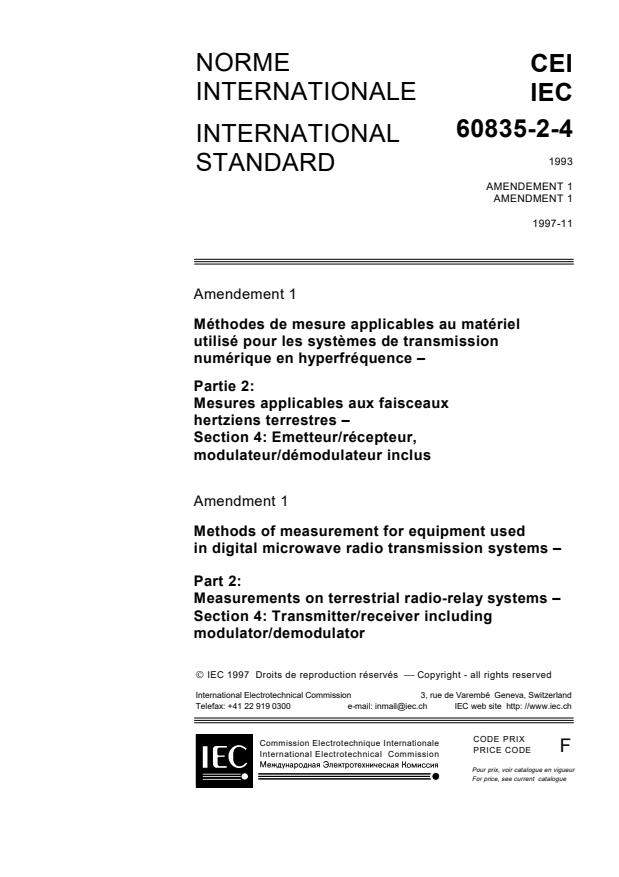
(Amendment)Amendment 1 - Methods of measurement for equipment used in digital microwave radio transmission systems - Part 2: Measurements on terrestrial radio-relay systems - Section 4: Transmitter/receiver including modulator/demodulator
General Information
- Abstract
- Status
- Published
- Publication Date
- 25-Nov-1997
- Current Stage
- PPUB - Publication issued
- Start Date
- 26-Nov-1997
- Completion Date
- 30-Nov-1997
Buy Documents
IEC 60835-2-4:1993/AMD1:1997 - Amendment 1 - Methods of measurement for equipment used in digital microwave radio transmission systems - Part 2: Measurements on terrestrial radio-relay systems - Section 4: Transmitter/receiver including modulator/demodulator Released:11/26/1997
Overview
IEC 60835-2-4:1993/AMD1:1997 is an amendment to the International Electrotechnical Commission (IEC) standard that specifies methods of measurement for equipment used in digital microwave radio transmission systems, focusing on terrestrial radio-relay systems. This amendment adds detailed procedures for assessing the transmitter/receiver, including their modulator and demodulator components, under selective fading conditions caused by multipath propagation. Addressing these measurement methods helps ensure reliable system performance and supports the development of robust digital microwave communication links.
Key Topics
- Selective Fading Signature: Describes how to simulate and assess the effects of multipath fading, which causes variations in signal amplitude and phase, impacting bit error rate (BER) performance in digital radio-relay systems.
- Two-Ray Fading Simulator: Guidelines for using a two-ray simulator to replicate real-world fading scenarios by splitting the input signal into direct and delayed paths, allowing for measurement and comparison of system susceptibility.
- Measurement Methods: Two approaches for measuring selective fading signatures:
- Method 1: Varies notch frequency within the transmission band to determine the notch depth at which the specified BER threshold is reached.
- Method 2: Sets different notch depths and varies the frequency offset to observe corresponding changes in BER, providing enhanced accuracy for large frequency offsets.
- Results Presentation: Recommends graphical representation of notch depth (in dB) versus notch frequency displacement, illustrating system response in minimum and non-minimum phase situations.
- Specification Details: Specifies what must be reported in equipment documentation, such as receiver input level, bit rate, BER threshold, fading simulator delay, and conditions of minimum/non-minimum phase.
Applications
The procedures in IEC 60835-2-4:1993/AMD1:1997 are vital for:
- Type Testing and Acceptance: Enables manufacturers and network operators to consistently evaluate the performance of digital microwave radio systems, especially under real-world multipath conditions.
- Performance Comparison: Facilitates benchmarking across different radio-relay equipment and adaptive equalizer designs to predict field performance and outage times due to selective fading.
- Equipment Specification: Provides detailed methods for setting measurement conditions and performance criteria, supporting clear and reliable documentation for procurement, installation, and compliance testing.
- Network Reliability: Helps ensure that microwave links deliver expected data integrity by quantifying bit error rates under selective fading, supporting the deployment of high-capacity terrestrial transmission systems in critical infrastructure and telecommunication networks.
Related Standards
- IEC 60835-2-8: Provides additional guidance on BER (bit error rate) measurement arrangements, referenced for setting up test scenarios in this amendment.
- IEC 60835 Series: Covers broader aspects of digital microwave radio transmission systems, including measurement techniques for various components and operational conditions.
- ICS 33.060.30: International Classification for Standards - Transmitting and receiving equipment for radiocommunication.
Keywords: IEC 60835-2-4, digital microwave radio, terrestrial radio-relay, selective fading, multipath propagation, bit error rate, two-ray fading simulator, transmitter receiver measurement, modulator demodulator testing, radio communication standards.
Relations
- Effective Date
- 05-Sep-2023
Buy Documents
IEC 60835-2-4:1993/AMD1:1997 - Amendment 1 - Methods of measurement for equipment used in digital microwave radio transmission systems - Part 2: Measurements on terrestrial radio-relay systems - Section 4: Transmitter/receiver including modulator/demodulator Released:11/26/1997
Get Certified
Connect with accredited certification bodies for this standard

ANCE
Mexican certification and testing association.

Intertek Slovenia
Intertek testing, inspection, and certification services in Slovenia.

LNE (Laboratoire National de Métrologie et d'Essais)
French national laboratory for metrology and testing.
Sponsored listings
Frequently Asked Questions
IEC 60835-2-4:1993/AMD1:1997 is a standard published by the International Electrotechnical Commission (IEC). Its full title is "Amendment 1 - Methods of measurement for equipment used in digital microwave radio transmission systems - Part 2: Measurements on terrestrial radio-relay systems - Section 4: Transmitter/receiver including modulator/demodulator". This standard covers: Amendment 1 - Methods of measurement for equipment used in digital microwave radio transmission systems - Part 2: Measurements on terrestrial radio-relay systems - Section 4: Transmitter/receiver including modulator/demodulator
Amendment 1 - Methods of measurement for equipment used in digital microwave radio transmission systems - Part 2: Measurements on terrestrial radio-relay systems - Section 4: Transmitter/receiver including modulator/demodulator
IEC 60835-2-4:1993/AMD1:1997 is classified under the following ICS (International Classification for Standards) categories: 33.060.30 - Radio relay and fixed satellite communications systems. The ICS classification helps identify the subject area and facilitates finding related standards.
IEC 60835-2-4:1993/AMD1:1997 has the following relationships with other standards: It is inter standard links to IEC 60835-2-4:1993. Understanding these relationships helps ensure you are using the most current and applicable version of the standard.
IEC 60835-2-4:1993/AMD1:1997 is available in PDF format for immediate download after purchase. The document can be added to your cart and obtained through the secure checkout process. Digital delivery ensures instant access to the complete standard document.
Standards Content (Sample)
NORME
CEI
INTERNATIONALE
IEC
60835-2-4
INTERNATIONAL
STANDARD
AMENDEMENT 1
AMENDMENT 1
1997-11
Amendement 1
Méthodes de mesure applicables au matériel
utilisé pour les systèmes de transmission
numérique en hyperfréquence –
Partie 2:
Mesures applicables aux faisceaux
hertziens terrestres –
Section 4: Emetteur/récepteur,
modulateur/démodulateur inclus
Amendment 1
Methods of measurement for equipment used
in digital microwave radio transmission systems –
Part 2:
Measurements on terrestrial radio-relay systems –
Section 4: Transmitter/receiver including
modulator/demodulator
IEC 1997 Droits de reproduction réservés Copyright - all rights reserved
International Electrotechnical Commission 3, rue de Varembé Geneva, Switzerland
Telefax: +41 22 919 0300 e-mail: inmail@iec.ch IEC web site http: //www.iec.ch
CODE PRIX
Commission Electrotechnique Internationale
PRICE CODE F
International Electrotechnical Commission
Pour prix, voir catalogue en vigueur
For price, see current catalogue
– 2 – 60835-2-4 amend. 1 CEI:1997
AVANT-PROPOS
Le présent amendement a été établi par le comité d'études 102: Matériels utilisés dans les
services mobiles et les systèmes de communication par satellite.
Le texte de cet amendement est issu des documents suivants:
FDIS Rapport de vote
102/8/FDIS 102/18/RVD
Le rapport de vote indiqué dans le tableau ci-dessus donne toute information sur le vote ayant
abouti à l'approbation de cet amendement.
___________
Page 2
SOMMAIRE
Ajouter, à la page 4, les éléments suivants:
5.3 Evanouissements sélectifs – Signature .
5.3.1 Généralités .
5.3.2 Méthode de mesure .
5.3.3 Présentation des résultats .
5.3.4 Détails à spécifier .
Figures
5 Schéma fonctionnel du simulateur de trajets multiples.
6 Caractéristique large bande d’un simulateur f.i. à deux rayons .
7 Exemple de signature à minimum et non-minimum de phase.
Page 28
5.3 Evanouissements sélectifs – Signature
Ajouter le nouveau texte suivant:
5.3.1 Généralités
Les faisceaux hertziens numériques à grande capacité sont sensibles aux évanouissements
sélectifs dus à la propagation par trajets multiples. Ceci se traduit par une augmentation du
taux d’erreur qui est plus élevé que celui qui correspond à un évanouissement constant de
même valeur moyenne.
60835-2-4 Amend. 1 IEC:1997 – 3 –
FOREWORD
This amendment has been prepared by IEC technical committee 102: Equipment used in
mobile sevices and satellite communication systems.
The text of this amendment is based on the following documents:
FDIS Report on voting
102/8/FDIS 102/18/RVD
Full information on the voting for the approval of this amendment can be found in the report on
voting indicated in the above table.
___________
Page 3
CONTENTS
Add, on page 5, the following items:
5.3 Selective fading signature .
5.3.1 General considerations .
5.3.2 Method of measurement.
5.3.3 Presentation of results .
5.3.4 Details to be specified .
Figures
5 Functional arrangement of the fading simulator .
6 Wideband frequency characteristic of the two-ray i.f. fading simulator .
7 Example of minimum / non-minimum phase signature .
Page 29
5.3 Selective fading signature
Add the following new text:
5.3.1 General considerations
Digital radio-relay systems designed for the transmission of high bit rates are susceptible to
selective fading due to multipath propagation. This results in a BER which is higher than that
which would be caused by flat fading of the same mean value.
– 4 – 60835-2-4 amend. 1 CEI:1997
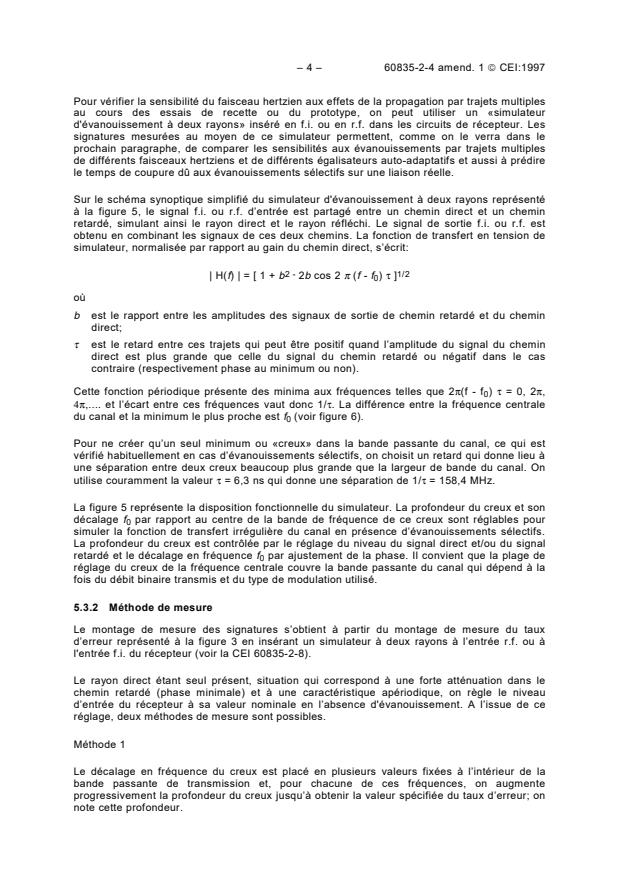
Pour vérifier la sensibilité du faisceau hertzien aux effets de la propagation par trajets multiples
au cours des essais de recette ou du prototype, on peut utiliser un «simulateur
d'évanouissement à deux rayons» inséré en f.i. ou en r.f. dans les circuits de récepteur. Les
signatures mesurées au moyen de ce simulateur permettent, comme on le verra dans le
prochain paragraphe, de comparer les sensibilités aux évanouissements par trajets multiples
de différents faisceaux hertziens et de différents égalisateurs auto-adaptatifs et aussi à prédire
le temps de coupure dû aux évanouissements sélectifs sur une liaison réelle.
Sur le schéma synoptique simplifié du simulateur d'évanouissement à deux rayons représenté
à la figure 5, le signal f.i. ou r.f. d’entrée est partagé entre un chemin direct et un chemin
retardé, simulant ainsi le rayon direct et le rayon réfléchi. Le signal de sortie f.i. ou r.f. est
obtenu en combinant les signaux de ces deux chemins. La fonction de transfert en tension de
simulateur, normalisée par rapport au gain du chemin direct, s’écrit:
2 - 1/2
| H(f) | = [ 1 + b 2b cos 2 π (f - f ) τ ]
où
b est le rapport entre les amplitudes des signaux de sortie de chemin retardé et du chemin
direct;
τ est le retard entre ces trajets qui peut être positif quand l’amplitude du signal du chemin
direct est plus grande que celle du signal du chemin retardé ou négatif dans le cas
contraire (respectivement phase au minimum ou non).
Cette fonction périodique présente des minima aux fréquences telles que 2π(f - f ) τ = 0, 2π,
4π,. et l’écart entre ces fréquences vaut donc 1/τ. La différence entre la fréquence centrale
du canal et la minimum le plus proche est f (voir figure 6).
Pour ne créer qu’un seul minimum ou «creux» dans la bande passante du canal, ce qui est
vérifié habituellement en cas d’évanouissements sélectifs, on choisit un retard qui donne lieu à
une séparation entre deux creux beaucoup plus grande que la largeur de bande du canal. On
utilise couramment la valeur τ = 6,3 ns qui donne une séparation de 1/τ = 158,4 MHz.
La figure 5 représente la disposition fonctionnelle du simulateur. La profondeur du creux et son
décalage f par rapport au centre de la bande de fréquence de ce creux sont réglables pour
simuler la fonction de transfert irrégulière du canal en présence d’évanouissements sélectifs.
La profondeur du creux est contrôlée par le réglage du niveau du signal direct et/ou du signal
retardé et le décalage en fréquence f par ajustement de la phase. Il convient que la plage de
réglage du creux de la fréquence centrale couvre la bande passante du canal qui dépend à la
fois du débit binaire transmis et du type de modulation utilisé.
5.3.2 Méthode de mesure
Le montage de mesure des signatures s’obtient à partir du montage de mesure du taux
d’erreur représenté à la figure 3 en insérant un simulateur à deux rayons à l’entrée r.f. ou à
l'entrée f.i. du récepteur (voir la CEI 60835-2-8).
Le rayon direct étant seul présent, situation qui correspond à une forte atténuation dans le
chemin retardé (phase minimale) et à une caractéristique apériodique, on règle le niveau
d’entrée du récepteur à sa valeur nominale en l’absence d'évanouissement. A l’issue de ce
réglage, deux méthodes de mesure sont possibles.
Méthode 1
Le décalage en fréquence du creux est placé en plusieurs valeurs fixées à l’intérieur de la
bande passante de transmission et, pour chacune de ces fréquences, on augmente
progressivement la profondeur du creux jusqu’à obtenir la valeur spécifiée du taux d’erreur; on
note cette profondeur.
60835-2-4 Amend. 1 IEC:1997 – 5 –
In order to assess the sensitivity of the radio-relay system to the effects of multipath
propagation during acceptance or type test, a "two-ray fading simulator" can be used in the i.f.
or r.f. path of the receiver. Signatures measured with this simulator, as explained in the next
subclause, are suitable for the comparison of different digital radio-relay systems and adaptive
equalizers in their se
...