

IEC 60695-11-10:1999/AMD1:2003
(Amendment)Amendment 1 - Fire hazard testing - Part 11-10: Test flames - 50 W horizontal and vertical flame test methods
General Information
- Abstract
Amendment 1
- Status
- Published
- Publication Date
- 25-Jun-2003
- Technical Committee
- TC 89 - Fire hazard testing
- Drafting Committee
- WG 12 - TC 89/WG 12
- Current Stage
- DELPUB - Deleted Publication
- Start Date
- 21-May-2013
- Completion Date
- 28-Aug-2026
Overview
IEC 60695-11-10:1999/AMD1:2003 is an important amendment to the international standard focused on fire hazard testing for materials and products. This amendment, issued by the International Electrotechnical Commission (IEC) Technical Committee 89, specifies updated test methods using a 50 W test flame in both horizontal and vertical orientations. Its primary purpose is to provide precise procedures for evaluating the flammability of molded materials and finished products, ensuring safety and compliance with fire hazard regulations.
The amendment refines specimen preparation, testing processes, and classification criteria to improve test accuracy and relevance. It also introduces provisions for handling special materials such as industrial laminates and those prone to deformation when exposed to flames. This document is essential for manufacturers, testers, and regulators involved in fire safety assessment of electrical and plastic components.
Key Topics
Test Flames Specification
- Details on horizontal and vertical 50 W flame test methods.
- Clear guidance on burner positioning and operator viewing angle (60°) to ensure consistent test conditions.
Specimen Preparation
- Test specimens must be cut from molded materials taken from final products or produced using standard molding processes (injection, compression, transfer molding).
- Special care to remove surface dust and sand edges smoothly for accurate test results.
- Requirements for specimens’ dimensions (typically 125 mm x 13 mm, thickness up to 13 mm).
- Testing of specimens with varying thickness, color, density, and additives to represent the material range.
Classification Criteria
- Introduction of classifications HB, HB40, and HB75 for horizontal burning tests:
- HB indicates specific flame spread and burning rate limits.
- Criteria include visible burning time after ignition, flame front progression, and linear burning rates depending on thickness.
- Introduction of classifications HB, HB40, and HB75 for horizontal burning tests:
Testing Procedures
- Method A (horizontal flame) requires at least 6 specimens; Method B (vertical flame) requires 20 specimens.
- Provisions for conditioning industrial laminates at 125 °C ± 2 °C for 24 hours before testing.
- Acceptance of alternative test procedures (e.g., ISO 9773) for materials that deform or shrink excessively during tests.
Material Considerations
- Testing of extreme and intermediate values of density, melt flow, pigment loading, and filler contents to define performance range.
- Emphasis on testing pigments known to affect flammability.
Applications
This amendment provides critical guidance for industries involved in the development, manufacturing, and safety certification of materials, particularly in:
Electrical and Electronic Equipment
Evaluating components and insulating materials to conform with fire safety standards, reducing fire risks in devices.Plastics Manufacturing
Standardized flame testing helps in material selection and formulation adjustments to enhance flame retardancy.Automotive and Aerospace Components
Ensuring safety compliance of polymer parts exposed to potential ignition sources.Building and Construction Materials
Assessing fire hazard of materials used in architectural elements such as laminates and panels.Quality Control and Certification Laboratories
Implementing reliable test methods for flammability classification and regulatory compliance.
Related Standards
- IEC 60695-2-2 - Needle Flame Test Method for material flammability.
- ISO 294, ISO 293, ISO 295 - Standards for injection, compression, and transfer molding used in specimen preparation.
- ISO 9773 - Test procedure for certain vertical burning tests relevant for materials prone to distortion.
- ISO 307 - Method for determination of viscosity number in polyamides, important for evaluating nylon materials tested for flammability.
- IEC 60707 - Guidance on testing plastics relevant to fire hazards.
This amendment reinforces IEC 60695-11-10’s position as a fundamental safety publication in the field of fire hazard testing. It ensures harmonized, accurate, and reproducible flame tests for horizontal and vertical burning, critical for material safety assessment worldwide. Users and manufacturers benefit from clear test specimen requirements, classification criteria, and alternative methods, facilitating compliance with international fire safety regulations.
Relations
- Effective Date
- 05-Sep-2023
- Effective Date
- 05-Sep-2023
Get Certified
Connect with accredited certification bodies for this standard

IMQ S.p.A. (Certification)
Italian electrical product certification.

SLG Prüf- und Zertifizierungs GmbH
German testing and certification body.

UL Solutions
Global safety science company with testing, inspection and certification.
Sponsored listings
Frequently Asked Questions
IEC 60695-11-10:1999/AMD1:2003 is a standard published by the International Electrotechnical Commission (IEC). Its full title is "Amendment 1 - Fire hazard testing - Part 11-10: Test flames - 50 W horizontal and vertical flame test methods". This standard covers: Amendment 1
Amendment 1
IEC 60695-11-10:1999/AMD1:2003 is classified under the following ICS (International Classification for Standards) categories: 13.220.40 - Ignitability and burning behaviour of materials and products; 29.020 - Electrical engineering in general. The ICS classification helps identify the subject area and facilitates finding related standards.
IEC 60695-11-10:1999/AMD1:2003 has the following relationships with other standards: It is inter standard links to IEC 60695-11-10:1999, IEC 60695-11-10:2013. Understanding these relationships helps ensure you are using the most current and applicable version of the standard.
IEC 60695-11-10:1999/AMD1:2003 is available in PDF format for immediate download after purchase. The document can be added to your cart and obtained through the secure checkout process. Digital delivery ensures instant access to the complete standard document.
Standards Content (Sample)
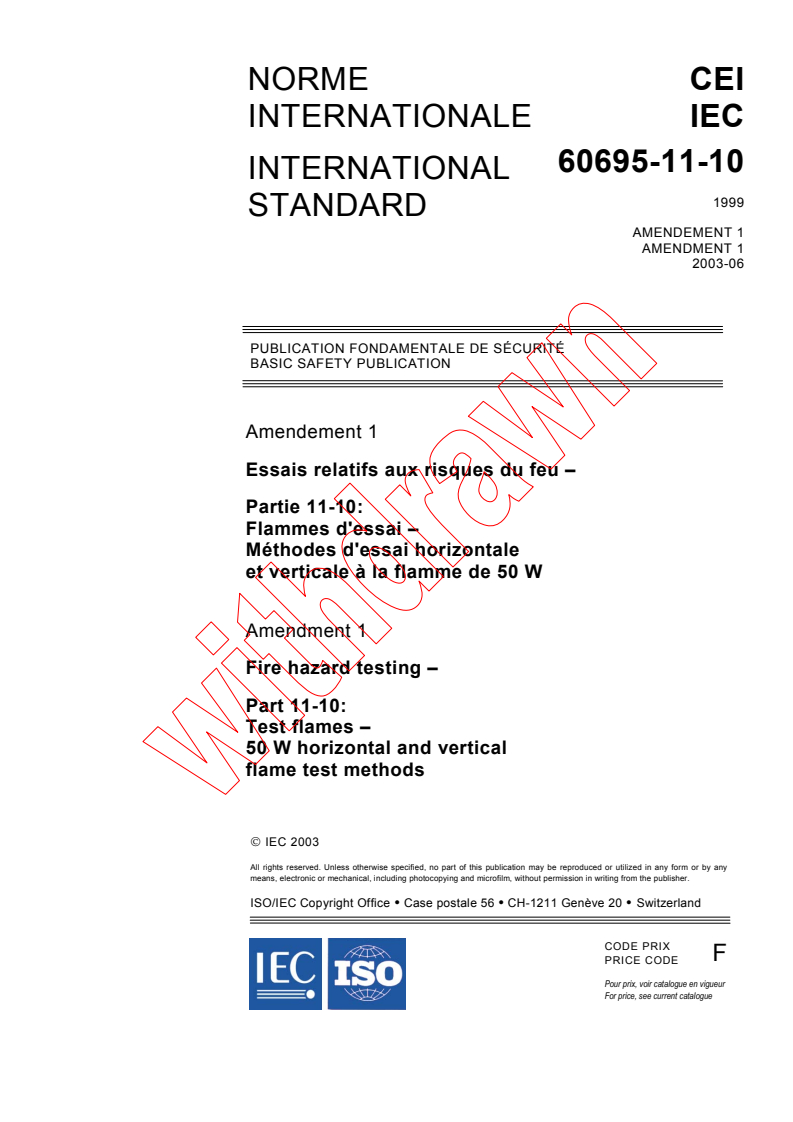
NORME CEI
INTERNATIONALE IEC
60695-11-10
INTERNATIONAL
STANDARD
AMENDEMENT 1
AMENDMENT 1
2003-06
PUBLICATION FONDAMENTALE DE SÉCURITÉ
BASIC SAFETY PUBLICATION
Amendement 1
Essais relatifs aux risques du feu –
Partie 11-10:
Flammes d'essai –
Méthodes d'essai horizontale
et verticale à la flamme de 50 W
Amendment 1
Fire hazard testing –
Part 11-10:
Test flames –
50 W horizontal and vertical
flame test methods
IEC 2003
All rights reserved. Unless otherwise specified, no part of this publication may be reproduced or utilized in any form or by any
means, electronic or mechanical, including photocopying and microfilm, without permission in writing from the publisher.
ISO/IEC Copyright Office Case postale 56 CH-1211 Genève 20 Switzerland
• • •
CODE PRIX
F
PRICE CODE
Pour prix, voir catalogue en vigueur
For price, see current catalogue
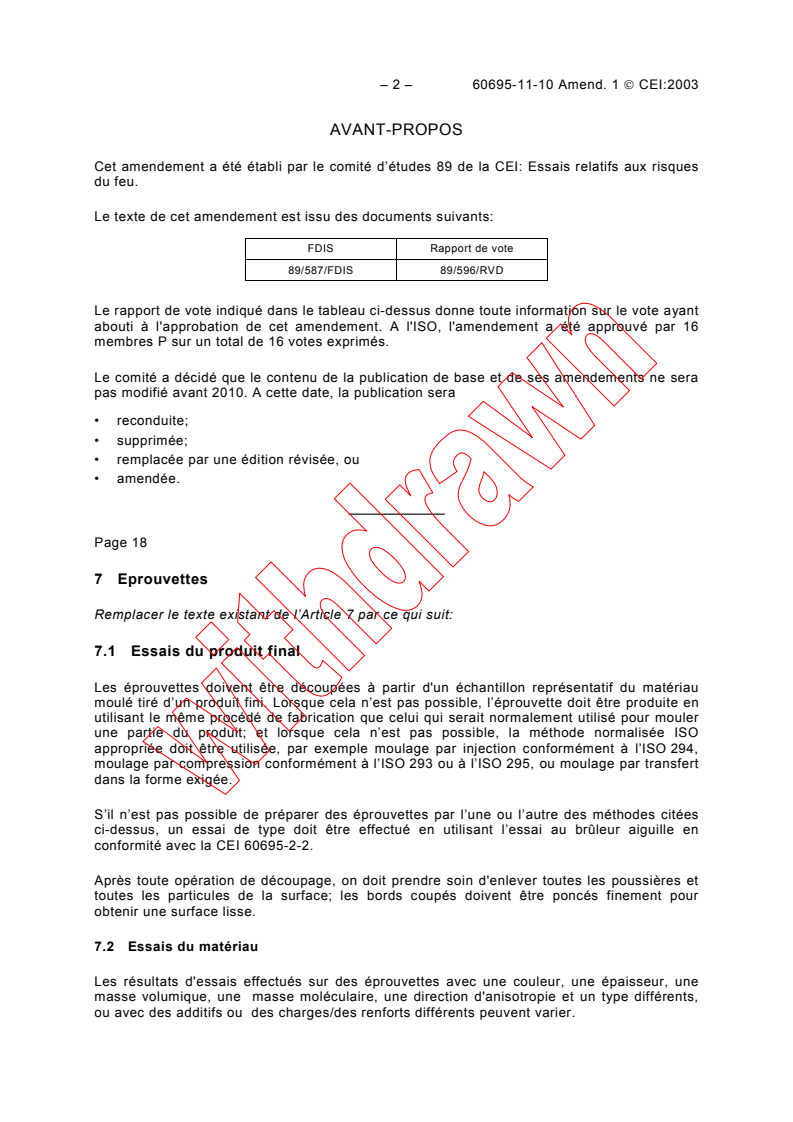
– 2 – 60695-11-10 Amend. 1 CEI:2003
AVANT-PROPOS
Cet amendement a été établi par le comité d’études 89 de la CEI: Essais relatifs aux risques
du feu.
Le texte de cet amendement est issu des documents suivants:
FDIS Rapport de vote
89/587/FDIS 89/596/RVD
Le rapport de vote indiqué dans le tableau ci-dessus donne toute information sur le vote ayant
abouti à l'approbation de cet amendement. A l'ISO, l'amendement a été approuvé par 16
membres P sur un total de 16 votes exprimés.
Le comité a décidé que le contenu de la publication de base et de ses amendements ne sera
pas modifié avant 2010. A cette date, la publication sera
• reconduite;
• supprimée;
• remplacée par une édition révisée, ou
• amendée.
_____________
Page 18
7 Eprouvettes
Remplacer le texte existant de l’Article 7 par ce qui suit:
7.1 Essais du produit final
Les éprouvettes doivent être découpées à partir d'un échantillon représentatif du matériau
moulé tiré d’un produit fini. Lorsque cela n’est pas possible, l’éprouvette doit être produite en
utilisant le même procédé de fabrication que celui qui serait normalement utilisé pour mouler
une partie du produit; et lorsque cela n’est pas possible, la méthode normalisée ISO
appropriée doit être utilisée, par exemple moulage par injection conformément à l’ISO 294,
moulage par compression conformément à l’ISO 293 ou à l’ISO 295, ou moulage par transfert
dans la forme exigée.
S’il n’est pas possible de préparer des éprouvettes par l’une ou l’autre des méthodes citées
ci-dessus, un essai de type doit être effectué en utilisant l’essai au brûleur aiguille en
conformité avec la CEI 60695-2-2.
Après toute opération de découpage, on doit prendre soin d'enlever toutes les poussières et
toutes les particules de la surface; les bords coupés doivent être poncés finement pour
obtenir une surface lisse.
7.2 Essais du matériau
Les résultats d'essais effectués sur des éprouvettes avec une couleur, une épaisseur, une
masse volumique, une masse moléculaire, une direction d'anisotropie et un type différents,
ou avec des additifs ou des charges/des renforts différents peuvent varier.
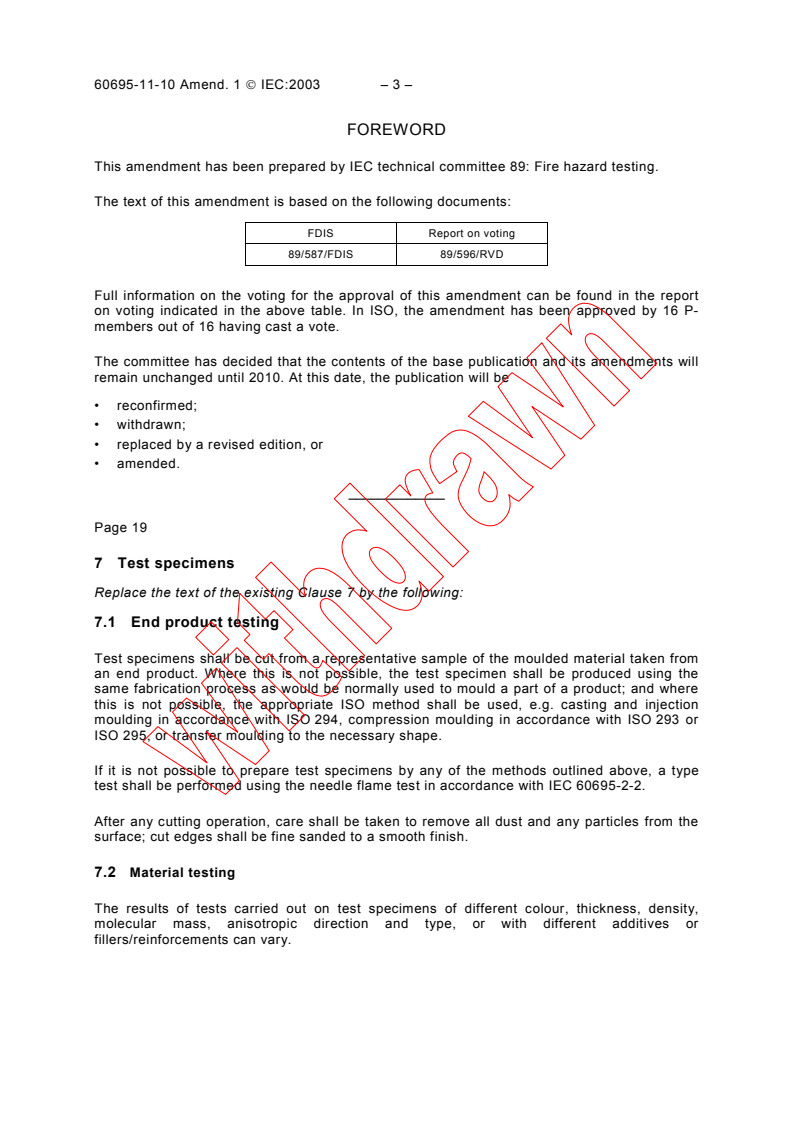
60695-11-10 Amend. 1 IEC:2003 – 3 –
FOREWORD
This amendment has been prepared by IEC technical committee 89: Fire hazard testing.
The text of this amendment is based on the following documents:
FDIS Report on voting
89/587/FDIS 89/596/RVD
Full information on the voting for the approval of this amendment can be found in the report
on voting indicated in the above table. In ISO, the amendment has been approved by 16 P-
members out of 16 having cast a vote.
The committee has decided that the contents of the base publication and its amendments will
remain unchanged until 2010. At this date, the publication will be
• reconfirmed;
• withdrawn;
• replaced by a revised edition, or
• amended.
_____________
Page 19
7 Test specimens
Replace the text of the existing Clause 7 by the following:
7.1 End product testing
Test specimens shall be cut from a representative sample of the moulded material taken from
an end product. Where this is not possible, the test specimen shall be produced using the
same fabrication process as would be normally used to mould a part of a product; and where
this is not possible, the appropriate ISO method shall be used, e.g. casting and injection
moulding in accordance with ISO 294, compression moulding in accordance with ISO 293 or
ISO 295, or transfer moulding to the necessary shape.
If it is not possible to prepare test specimens by any of the methods outlined above, a type
test shall be performed using the needle flame test in accordance with IEC 60695-2-2.
After any cutting operation, care shall be taken to remove all dust and any particles from the
surface; cut edges shall be fine sanded to a smooth finish.
7.2 Material testing
The results of tests carried out on test specimens of different colour, thickness, density,
molecular mass, anisotropic direction and type, or with different additives or
fillers/reinforcements can vary.
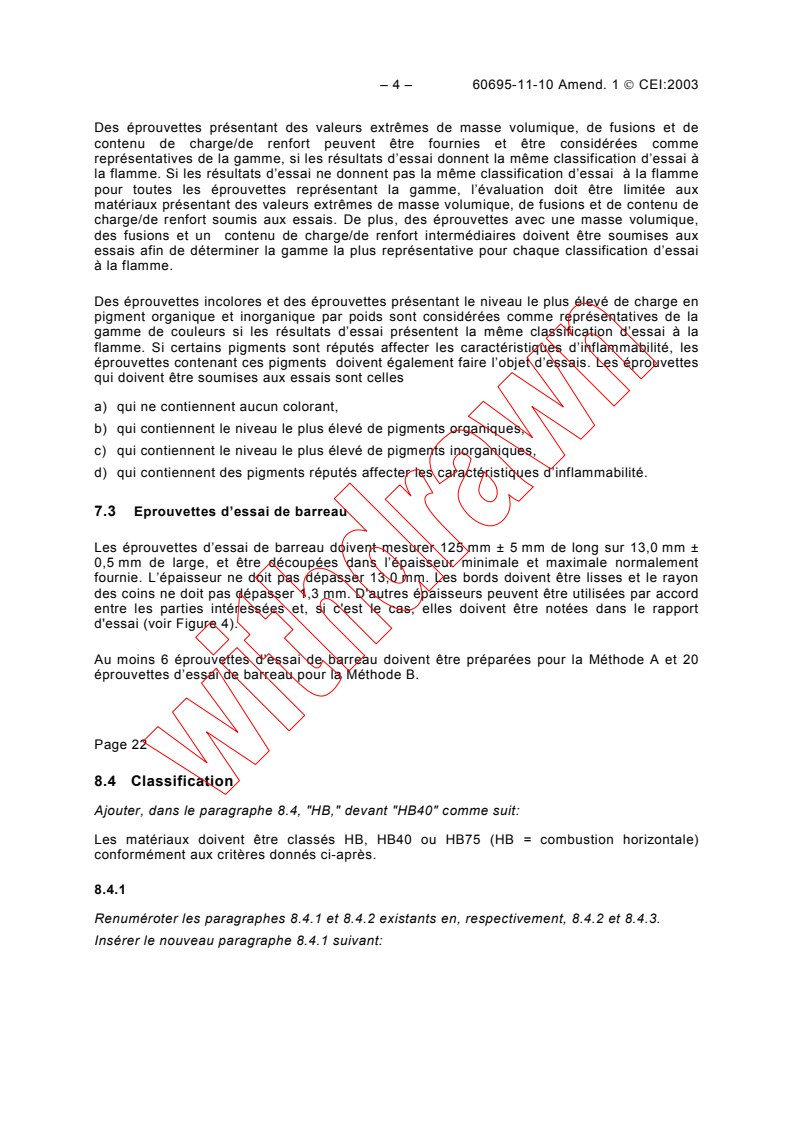
– 4 – 60695-11-10 Amend. 1 CEI:2003
Des éprouvettes présentant des valeurs extrêmes de masse volumique, de fusions et de
contenu de charge/de renfort peuvent être fournies et être considérées comme
représentatives de la gamme, si les résultats d’essai donnent la même classification d’essai à
la flamme. Si les résultats d’essai ne donnent pas la même classification d’essai à la flamme
pour toutes les éprouvettes représentant la gamme, l’évaluation doit être limitée aux
matériaux présentant des valeurs extrêmes de masse volumique, de fusions et de contenu de
charge/de renfort soumis aux essais. De plus, des éprouvettes avec une masse volumique,
des fusions et un contenu de charge/de renfort intermédiaires doivent être soumises aux
essais afin de déterminer la gamme la plus représentative pour chaque classification d’essai
à la flamme.
Des éprouvettes incolores et des éprouvettes présentant le niveau le plus élevé de charge en
pigment organique et inorganique par poids sont considérées comme représentatives de la
gamme de couleurs si les résultats d’essai présentent la même classification d’essai à la
flamme. Si certains pigments sont réputés affecter les caractéristiques d’inflammabilité, les
éprouvettes contenant ces pigments doivent également faire l’objet d’essais. Les éprouvettes
qui doivent être soumises aux essais sont celles
a) qui ne contiennent aucun colorant,
b) qui contiennent le niveau le plus élevé de pigments organiques,
c) qui contiennent le niveau le plus élevé de pigments inorganiques,
d) qui contiennent des pigments réputés affecter les caractéristiques d’inflammabilité.
7.3 Eprouvettes d’essai de barreau
Les éprouvettes d’essai de barreau doivent mesurer 125 mm ± 5 mm de long sur 13,0 mm ±
0,5 mm de large, et être découpées dans l’épaisseur minimale et maximale normalement
fournie. L’épaisseur ne doit pas dépasser 13,0 mm. Les bords doivent être lisses et le rayon
des coins ne doit pas dépasser 1,3 mm. D'autres épaisseurs peuvent être utilisées par accord
entre les parties intéressées et, si c'est le cas, elles doivent être notées dans le rapport
d'essai (voir Figure 4).
Au moins 6 éprouvettes d’essai de barreau doivent être préparées pour la Méthode A et 20
éprouvettes d’essai de barreau pour la Méthode B.
Page 22
8.4 Classification
Ajouter, dans le paragraphe 8.4, "HB," devant "HB40" comme suit:
Les matériaux doivent être classés HB, HB40 ou HB75 (HB = combustion horizontale)
conformément aux critères donnés ci-après.
8.4.1
Renuméroter les paragraphes 8.4.1 et 8.4.2 existants en, respectivement, 8.4.2 et 8.4.3.
Insérer le nouveau paragraphe 8.4.1 suivant:
60695-11-10 Amend. 1 IEC:2003 – 5 –
Test specimens with extremes of density, melt flows and filler/reinforcement content may be
provided and considered representative of the range if the test results yield the same flame
test classification. If the test results do not yield the same flame test classification for all test
specimens representing the range, eva
...