

IEC 61629-1:1996
(Main)Aramid pressboard for electrical purposes - Part 1: Definitions, designations and general requirements
General Information
- Abstract
Contains the definitions, designations and general requirements of aramid pressboard for electrical purposes. The selection of these materials is also recommended for use in applications other than electrical insulation.
- Status
- Published
- Publication Date
- 18-Nov-1996
- Technical Committee
- TC 15 - Solid electrical insulating materials
- Drafting Committee
- MT 14 - TC 15/MT 14
- Current Stage
- PPUB - Publication issued
- Start Date
- 19-Nov-1996
- Completion Date
- 31-Oct-1996
Overview
IEC 61629-1:1996 (Aramid pressboard for electrical purposes – Part 1: Definitions, designations and general requirements) establishes a common foundation for the classification, terminology, and baseline requirements of aramid pressboard used primarily for electrical insulation. Published by the International Electrotechnical Commission (IEC), this international standard ensures clarity in identification and performance expectations of aramid-based insulation materials, improving both quality assurance and global trade in electrical components.
Aramid pressboard, recognized for its high-temperature resistance and robust insulating properties, plays a crucial role in safeguarding the reliability and efficiency of electrical systems. While its primary function is electrical insulation, the standard also covers designations and properties that make these materials suitable for other technical applications.
Key Topics
IEC 61629-1:1996 addresses several essential aspects:
Definitions
The standard provides precise definitions for aramid pressboard types, including standard, calendered, low-density, and high-density forms.- Aramid pressboard: Board produced from pulp derived from high-temperature-resistant aramid fibres.
- Calendered aramid pressboard: Densified via calendering.
- High-density aramid pressboard: Densified via heat-pressing.
Material Designations
Clarifies naming conventions based on density and surface finishing, vital for procurement and specification.- APB-LD (Low density)
- APB (Standard density)
- APB-C (Medium density, calendered)
- APB-HD (High density, heat-pressed)
General Requirements
Outlines minimal performance and quality criteria, including board finish, machinability, nominal thickness ranges, packaging, and marking.- Boards must be flat, free of surface defects, and properly edged.
- They must demonstrate integrity during cutting or machining (no undue splitting or ragging).
- Boards are delivered in protective packaging and marked for traceability with electrically neutral, oil-resistant, and non-polluting codes.
Applications
Aramid pressboard compliant with IEC 61629-1:1996 is widely used in:
Electrical Insulation
- Power transformers
- High-voltage equipment
- Switchgear
- Motors and generators
Thermal and Mechanical Protection
Thanks to its high-temperature resistance and mechanical strength, aramid pressboard finds application wherever robust insulation or mechanical support is required under challenging conditions.Broader Technical Uses
The standard recommends aramid pressboard for non-electrical uses where its unique properties – such as durability, stability under heat, and machinability – are advantageous.
By clearly defining types and requirements, the standard aids manufacturers, engineers, and procurement specialists in selecting the appropriate material for both classic and advanced applications, ensuring reliable performance and safety.
Related Standards
For comprehensive quality control and further technical details, IEC 61629-1:1996 should be considered alongside:
- IEC 61629-2: Methods of test for aramid pressboard for electrical purposes
- IEC 61629-3: Specifications for individual aramid pressboard materials
- IEC 641-1: Specification for pressboard and presspaper for electrical purposes – Definitions and general requirements
- IEC 641-2: Methods of test for pressboard and presspaper
- IEC 641-3-1: Specifications for individual types of pressboard
These related standards collectively enable effective evaluation, testing, and deployment of aramid pressboard in both electrical and other high-demand industrial environments.
Keywords: IEC 61629-1, aramid pressboard, electrical insulation, insulation materials, electrical standards, aramid fibre, IEC standards, transformer insulation, high-temperature insulation, material designation, pressboard requirements
Get Certified
Connect with accredited certification bodies for this standard

IMQ S.p.A. (Certification)
Italian electrical product certification.

SLG Prüf- und Zertifizierungs GmbH
German testing and certification body.

UL Solutions
Global safety science company with testing, inspection and certification.
Sponsored listings
Frequently Asked Questions
IEC 61629-1:1996 is a standard published by the International Electrotechnical Commission (IEC). Its full title is "Aramid pressboard for electrical purposes - Part 1: Definitions, designations and general requirements". This standard covers: Contains the definitions, designations and general requirements of aramid pressboard for electrical purposes. The selection of these materials is also recommended for use in applications other than electrical insulation.
Contains the definitions, designations and general requirements of aramid pressboard for electrical purposes. The selection of these materials is also recommended for use in applications other than electrical insulation.
IEC 61629-1:1996 is classified under the following ICS (International Classification for Standards) categories: 29.035.10 - Paper and board insulating materials. The ICS classification helps identify the subject area and facilitates finding related standards.
IEC 61629-1:1996 is available in PDF format for immediate download after purchase. The document can be added to your cart and obtained through the secure checkout process. Digital delivery ensures instant access to the complete standard document.
Standards Content (Sample)
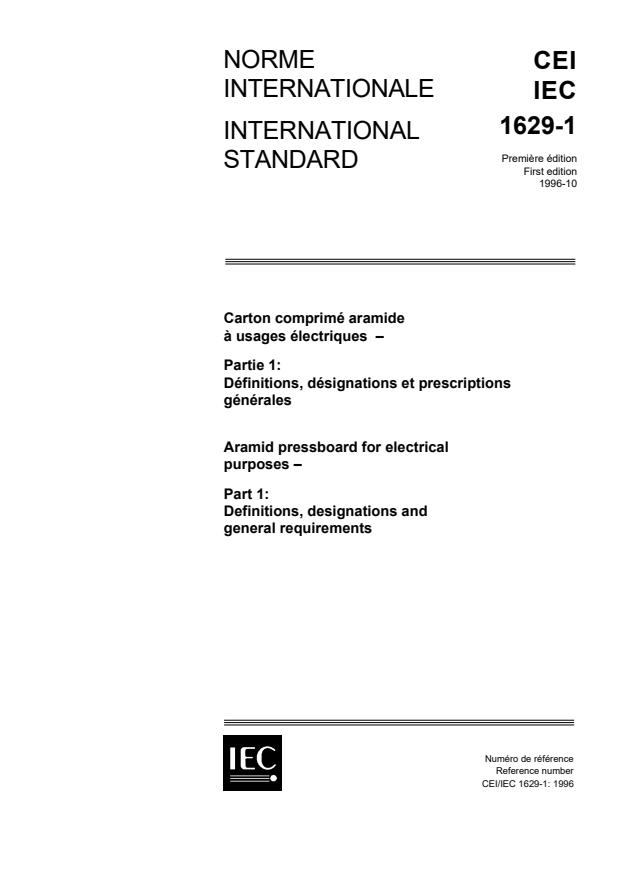
NORME
CEI
INTERNATIONALE
IEC
1629-1
INTERNATIONAL
Première édition
STANDARD
First edition
1996-10
Carton comprimé aramide
à usages électriques –
Partie 1:
Définitions, désignations et prescriptions
générales
Aramid pressboard for electrical
purposes –
Part 1:
Definitions, designations and
general requirements
Numéro de référence
Reference number
CEI/IEC 1629-1: 1996
Validité de la présente publication Validity of this publication
Le contenu technique des publications de la CEI est cons- The technical content of IEC publications is kept under
tamment revu par la CEI afin qu'il reflète l'état actuel de constant review by the IEC, thus ensuring that the content
la technique. reflects current technology.
Des renseignements relatifs à la date de reconfirmation de Information relating to the date of the reconfirmation of the
la publication sont disponibles auprès du Bureau Central de publication is available from the IEC Central Office.
la CEI.
Les renseignements relatifs à ces révisions, à l'établis- Information on the revision work, the issue of revised
sement des éditions révisées et aux amendements peuvent editions and amendments may be obtained from IEC
être obtenus auprès des Comités nationaux de la CEI et National Committees and from the following IEC
dans les documents ci-dessous: sources:
• Bulletin de la CEI • IEC Bulletin
• Annuaire de la CEI • IEC Yearbook
Publié annuellement Published yearly
• Catalogue des publications de la CEI • Catalogue of IEC publications
Publié annuellement et mis à jour régulièrement Published yearly with regular updates
Terminologie Terminology
En ce qui concerne la terminologie générale, le lecteur se For general terminology, readers are referred to IEC 50:
reportera à la CEI 50: Vocabulaire Electrotechnique Inter- International Electrotechnical Vocabulary (IEV), which is
national (VEI), qui se présente sous forme de chapitres issued in the form of separate chapters each dealing
séparés traitant chacun d'un sujet défini. Des détails with a specific field. Full details of the IEV will be
complets sur le VEI peuvent être obtenus sur demande. supplied on request. See also the IEC Multilingual
Voir également le dictionnaire multilingue de la CEI. Dictionary.
Les termes et définitions figurant dans la présente publi- The terms and definitions contained in the present publi-
cation ont été soit tirés du VEI, soit spécifiquement cation have either been taken from the IEV or have been
approuvés aux fins de cette publication. specifically approved for the purpose of this publication.
Symboles graphiques et littéraux Graphical and letter symbols
Pour les symboles graphiques, les symboles littéraux et les For graphical symbols, and letter symbols and signs
signes d'usage général approuvés par la CEI, le lecteur approved by the IEC for general use, readers are referred to
consultera: publications:
– la CEI 27: Symboles littéraux à utiliser en – IEC 27: Letter symbols to be used in electrical
électro-technique; technology;
– la CEI 417: Symboles graphiques utilisables – IEC 417: Graphical symbols for use on
sur le matériel. Index, relevé et compilation des equipment. Index, survey and compilation of the
feuilles individuelles; single sheets;
– la CEI 617: Symboles graphiques pour – IEC 617: Graphical symbols for diagrams;
schémas;
et pour les appareils électromédicaux, and for medical electrical equipment,
– la CEI 878: Symboles graphiques pour – IEC 878: Graphical symbols for electromedical
équipements électriques en pratique médicale. equipment in medical practice.
Les symboles et signes contenus dans la présente publi- The symbols and signs contained in the present publication
cation ont été soit tirés de la CEI 27, de la CEI 417, de la have either been taken from IEC 27, IEC 417, IEC 617
CEI 617 et/ou de la CEI 878, soit spécifiquement approuvés and/or IEC 878, or have been specifically approved for the
aux fins de cette publication. purpose of this publication.
Publications de la CEI établies par le IEC publications prepared by the same
même comité d'études technical committee
L'attention du lecteur est attirée sur les listes figurant à la fin The attention of readers is drawn to the end pages of this
de cette publication, qui énumèrent les publications de la publication which list the IEC publications issued by the
CEI préparées par le comité d'études qui a établi la technical committee which has prepared the present
présente publication. publication.
NORME
CEI
INTERNATIONALE
IEC
1629-1
INTERNATIONAL
Première édition
STANDARD
First edition
1996-10
Carton comprimé aramide
à usages électriques –
Partie 1:
Définitions, désignations et prescriptions
générales
Aramid pressboard for electrical
purposes –
Part 1:
Definitions, designations and
general requirements
CEI 1996 Droits de reproduction réservés Copyright - all rights reserved
Aucune partie de cette publication ne peut être reproduite ni No part of this publication may be reproduced or utilized
utilisée sous quelque forme que ce soit et par aucun procédé, in any form or by any means, electronic or mechanical,
électronique ou mécanique, y compris la photocopie et les including photocopying and microfilm, without permission
microfilms, sans l'accord écrit de l'éditeur. in writing from the publisher
Bureau central de la Commission Electrotechnique Internationale 3, rue de Varembé Genève, Suisse
CODE PRIX
Commission Electrotechnique Internationale
E
International Electrotechnical Commission PRICE CODE
Pour prix, voir catalogue en vigueur
For price, see current catalogue
– 2 – 1629-1 © CEI:1996
COMMISSION ÉLECTROTECHNIQUE INTERNATIONALE
____________
CARTON COMPRIMÉ ARAMIDE À USAGES ÉLECTRIQUES –
Partie 1: Définitions, désignations et prescriptions générales
AVANT-PROPOS
1) La CEI (Commission Electrotechnique Internationale) est une organisation mondiale de normalisation
composée de l'ensemble des comités électrotechniques nationaux (Comités nationaux de la CEI). La CEI a
pour objet de favoriser la coopération internationale pour toutes les questions de normalisation dans les
domaines de l'électricité et de l'électronique. A cet effet, la CEI, entre autres activités, publie des Normes
Internationales. Leur élaboration est confiée à des comités d'études, aux travaux desquels tout Comité
national intéressé par le sujet traité peut participer. Les organisations internationales, gouvernementales et
non gouvernementales, en liaison avec la CEI, participent également aux travaux. La CEI collabore
étroitement avec l'Organisation Internationale de Normalisation (ISO), selon des conditions fixées par accord
entre les deux organisations.
2) Les décisions ou accords officiels de la CEI concernant les questions techniques, représentent, dans la
mesure du possible un accord international sur les sujets étudiés, étant donné que les Comités nationaux
intéressés sont représentés dans chaque comité d’études.
3) Les documents produits se présentent sous la forme de recommandations internationales. Ils sont publiés
comme normes, rapports techniques ou guides et agréés comme tels par les Comités nationaux.
4) Dans le but d'encourager l'unification internationale, les Comités nationaux de la CEI s'engagent à appliquer
de façon transparente, dans toute la mesure possible, les Normes internationales de la CEI dans leurs normes
nationales et régionales. Toute divergence entre la norme de la CEI et la norme nationale ou régionale
correspondante doit être indiquée en termes clairs dans cette dernière.
5) La CEI n’a fixé aucune procédure concernant le marquage comme indication d’approbation et sa
responsabilité n’est pas engagée quand un matériel est déclaré conforme à l’une de ses normes.
6) L’attention est attirée sur le fait que certains des éléments de la présente Norme internationale peuvent faire
l’objet de droits de propriété intellectuelle ou de droits analogues. La CEI ne saurait être tenue pour
responsable de ne pas avoir identifié de tels droits de propriété et de ne pas avoir signalé leur existence.
La Norme internationale CEI 1629-1 a été établie par le sous-comité 15C: Spécifications, du
comité d’études 15 de la CEI: Matériaux isolants.
Le texte de cette norme est issu des documents suivants:
FDIS Rapport de vote
15C/618/FDIS 15C/688/RVD
Le rapport de vote indiqué dans le tableau ci-dessus donne toute information sur le vote ayant
abouti à l’approbation de cette norme.
La CEI 1629 comprend les parties suivantes, présentées sous le titre général Carton comprimé
aramide à usages électriques:
– Partie 1: Définitions, désignations et prescriptions générales
– Partie 2: Méthodes d’essais
– Partie 3: Spécifications pour matériaux particuliers
L’annexe A est donnée uniquement à titre d’information.
1269-1 © IEC:1996 – 3 –
INTERNATIONAL ELECTROTECHNICAL COMMISSION
____________
ARAMID PRESSBOARD FOR ELECTRICAL PURPOSES –
Part 1: Definitions, designations and general requirements
FOREWORD
1) The IEC (International Electrotechnical Commission) is a worldwide organization for standardization
comprising all national electrotechnical committees (IEC National Committees). The object of the IEC is to
promote international co-operation on all questions concerning standardization in the electrical and electronic
fields. To this end and in addition to other activities, the IEC publishes International Standards. Their
preparation is entrusted to technical committees; any IEC National Committee interested in the subject dealt
with may participate in this preparatory work. International, governmental and non-governmental organizations
liaising with the IEC also participate in this preparation. The IEC collaborates closely with the International
Organization for Standardization (ISO) in accordance with conditions determined by agreement between the
two organizations.
2) The formal decisions or agreements of the IEC on technical matters express, as nearly as possible, an
international consensus of opinion on the relevant subjects since each technical committee has representation
from all interested National Committees.
3) The
...