

ISO TS 81060-5:2020
(Main)Non-invasive sphygmomanometers - Part 5: Requirements for the repeatability and reproducibility of NIBP simulators for testing of automated non-invasive sphygmomanometers
General Information
- Abstract
This document specifies requirements for the repeatability and reproducibility of non-invasive blood pressure (NIBP) simulators intended to test automated sphygmomanometers utilizing the oscillometric non-continuous method only.
In addition, the pulse rate set on the NIBP simulator is tested.
This document is not intended to relate the signals, generated by the NIBP simulator, to the oscillometric signal recorded in a cuff attached to a human. It does not intend to test the interaction between the NIBP simulator and the tested automated sphygmomanometer (e.g. the agreement of the set values of the NIBP simulator and the displayed values of the tested automated sphygmomanometer or the properties of the cuff and tubing, such as design or elastic properties).
NOTE 1 These parameters can be tested separately in a clinical investigation or by using different special test setups.
This document does not check whether or not the NIBP simulator is able to test the accuracy of the absolute blood pressure value of oscillometric automated sphygmomanometers.
NOTE 2 Usually this is tested by a clinical investigation according ISO 81060-2 or other protocols.
This document is applicable to NIBP simulators testing automated sphygmomanometers for adults, children and neonates at the upper arm, thigh etc. and automated sphygmomanometers measuring at the wrist.
- Status
- Published
- Publication Date
- 02-Feb-2020
- Technical Committee
- SC 62D - Particular medical equipment, software, and systems
- Drafting Committee
- JWG 7 - TC 62/SC 62D/JWG 7
- Current Stage
- PPUB - Publication issued
- Start Date
- 07-Feb-2020
- Completion Date
- 19-Mar-2020
Buy Documents

ISO TS 81060-5:2020 - Non-invasive sphygmomanometers - Part 5: Requirements for the repeatability and reproducibility of NIBP simulators for testing of automated non-invasive sphygmomanometers Released:2/3/2020
Overview
ISO/TS 81060-5:2020 is a technical specification developed by ISO and IEC that defines requirements for the repeatability and reproducibility of non-invasive blood pressure (NIBP) simulators. These simulators are used to test automated sphygmomanometers employing the oscillometric non-continuous method. The document focuses on verifying the stability and consistency of NIBP simulators over time, which is critical for ensuring reliable testing of automated blood pressure monitors used in clinical and home settings.
This standard emphasizes the importance of consistent simulation signals for quality control purposes but does not address the direct accuracy of blood pressure readings or interactions between simulators and sphygmomanometers. It applies broadly to devices intended for use on adults, children, neonates, and in different measurement locations such as upper arm, thigh, and wrist.
Key Topics
Scope and Purpose
- Specifies testing requirements for NIBP simulators targeting automated oscillometric sphygmomanometers.
- Evaluates repeatability and reproducibility of generated oscillations and pulse rate signals, fundamental for stable device performance.
- Excludes accuracy testing of absolute blood pressure values or simulator-to-device signal correlations.
Technical Requirements
- Static Pressure Accuracy: NIBP simulators must have a minimum resolution of 0.1 mmHg; measurement error should not exceed ±1.0 mmHg within typical temperature and humidity ranges.
- Pulse Rate Accuracy: Pulse rate signals generated by simulators are tested to maintain an error margin within ±1 pulse per minute.
- Oscillation Characteristics: Repeatability and reproducibility of oscillation amplitudes and shapes are critical to verify consistent signal generation.
- Testing setups involve calibrated pressure manometers, air reservoirs to simulate different cuff types, pumps, and high-resolution recording units.
Testing Procedures
- Measurements at several static pressure steps ensure stability of the simulator under different conditions.
- Pulse oscillations are recorded over time to verify pulse rate accuracy and waveform consistency.
- Tests are repeated periodically to guarantee long-term reliability.
Terminology and Definitions
- Clear definitions of terms such as NIBP simulator and related measurement concepts ensure uniform understanding among users.
Applications
ISO/TS 81060-5:2020 serves a practical role in the medical device industry related to blood pressure monitoring. Primary applications include:
Quality Control for Manufacturers and Test Labs
Ensuring that NIBP simulators used in product testing are reliable and consistent across batches and over time. This helps validate the performance of automated sphygmomanometers before market release.Device Maintenance and Calibration
Periodic checks using this standard help maintain the stability and accuracy of NIBP simulators after repairs or during routine maintenance.Regulatory Compliance and Certification
Facilitates adherence to internationally recognized protocols for evaluating test equipment used in blood pressure monitor validation.Research and Development
Provides a framework for R&D teams to assess and improve simulation technologies for non-invasive sphygmomanometer testing.
Related Standards
ISO/TS 81060-5:2020 is part of a series addressing non-invasive sphygmomanometry, and should be considered alongside:
- ISO 81060-1:2007 – Requirements and test methods for non-automated blood pressure measurement devices.
- ISO 81060-2 – Clinical investigation protocols for automated sphygmomanometer accuracy assessment.
- IEC 60601-1:2005 + AMD1:2012 – General requirements for basic safety and essential performance of medical electrical equipment.
- IEC 80601-2-30:2018 – Particular safety and performance requirements for automated non-invasive sphygmomanometers.
For clinical investigation aspects, ISO 14155:2011 provides guidance on good clinical practice for medical devices.
Conclusion
ISO/TS 81060-5:2020 establishes foundational requirements for the stability and performance of NIBP simulators critical to validating automated blood pressure devices. Adhering to this standard supports the reliability of sphygmomanometer testing, ultimately contributing to improved patient safety and healthcare outcomes. Manufacturers, testing laboratories, and regulatory bodies benefit from structured evaluation methods for NIBP simulator repeatability and reproducibility, ensuring trusted performance across market devices.
By integrating ISO/TS 81060-5:2020 into device quality systems, stakeholders can confidently uphold consistent testing practices aligned with global medical device standards.
Buy Documents
ISO TS 81060-5:2020 - Non-invasive sphygmomanometers - Part 5: Requirements for the repeatability and reproducibility of NIBP simulators for testing of automated non-invasive sphygmomanometers Released:2/3/2020
Get Certified
Connect with accredited certification bodies for this standard

BSI Group
BSI (British Standards Institution) is the business standards company that helps organizations make excellence a habit.

TÜV Rheinland
TÜV Rheinland is a leading international provider of technical services.

TÜV SÜD
TÜV SÜD is a trusted partner of choice for safety, security and sustainability solutions.
Sponsored listings
Frequently Asked Questions
ISO TS 81060-5:2020 is a technical specification published by the International Electrotechnical Commission (IEC). Its full title is "Non-invasive sphygmomanometers - Part 5: Requirements for the repeatability and reproducibility of NIBP simulators for testing of automated non-invasive sphygmomanometers". This standard covers: This document specifies requirements for the repeatability and reproducibility of non-invasive blood pressure (NIBP) simulators intended to test automated sphygmomanometers utilizing the oscillometric non-continuous method only. In addition, the pulse rate set on the NIBP simulator is tested. This document is not intended to relate the signals, generated by the NIBP simulator, to the oscillometric signal recorded in a cuff attached to a human. It does not intend to test the interaction between the NIBP simulator and the tested automated sphygmomanometer (e.g. the agreement of the set values of the NIBP simulator and the displayed values of the tested automated sphygmomanometer or the properties of the cuff and tubing, such as design or elastic properties). NOTE 1 These parameters can be tested separately in a clinical investigation or by using different special test setups. This document does not check whether or not the NIBP simulator is able to test the accuracy of the absolute blood pressure value of oscillometric automated sphygmomanometers. NOTE 2 Usually this is tested by a clinical investigation according ISO 81060-2 or other protocols. This document is applicable to NIBP simulators testing automated sphygmomanometers for adults, children and neonates at the upper arm, thigh etc. and automated sphygmomanometers measuring at the wrist.
This document specifies requirements for the repeatability and reproducibility of non-invasive blood pressure (NIBP) simulators intended to test automated sphygmomanometers utilizing the oscillometric non-continuous method only. In addition, the pulse rate set on the NIBP simulator is tested. This document is not intended to relate the signals, generated by the NIBP simulator, to the oscillometric signal recorded in a cuff attached to a human. It does not intend to test the interaction between the NIBP simulator and the tested automated sphygmomanometer (e.g. the agreement of the set values of the NIBP simulator and the displayed values of the tested automated sphygmomanometer or the properties of the cuff and tubing, such as design or elastic properties). NOTE 1 These parameters can be tested separately in a clinical investigation or by using different special test setups. This document does not check whether or not the NIBP simulator is able to test the accuracy of the absolute blood pressure value of oscillometric automated sphygmomanometers. NOTE 2 Usually this is tested by a clinical investigation according ISO 81060-2 or other protocols. This document is applicable to NIBP simulators testing automated sphygmomanometers for adults, children and neonates at the upper arm, thigh etc. and automated sphygmomanometers measuring at the wrist.
ISO TS 81060-5:2020 is classified under the following ICS (International Classification for Standards) categories: 11.040.10 - Anaesthetic, respiratory and reanimation equipment. The ICS classification helps identify the subject area and facilitates finding related standards.
ISO TS 81060-5:2020 is available in PDF format for immediate download after purchase. The document can be added to your cart and obtained through the secure checkout process. Digital delivery ensures instant access to the complete standard document.
Standards Content (Sample)
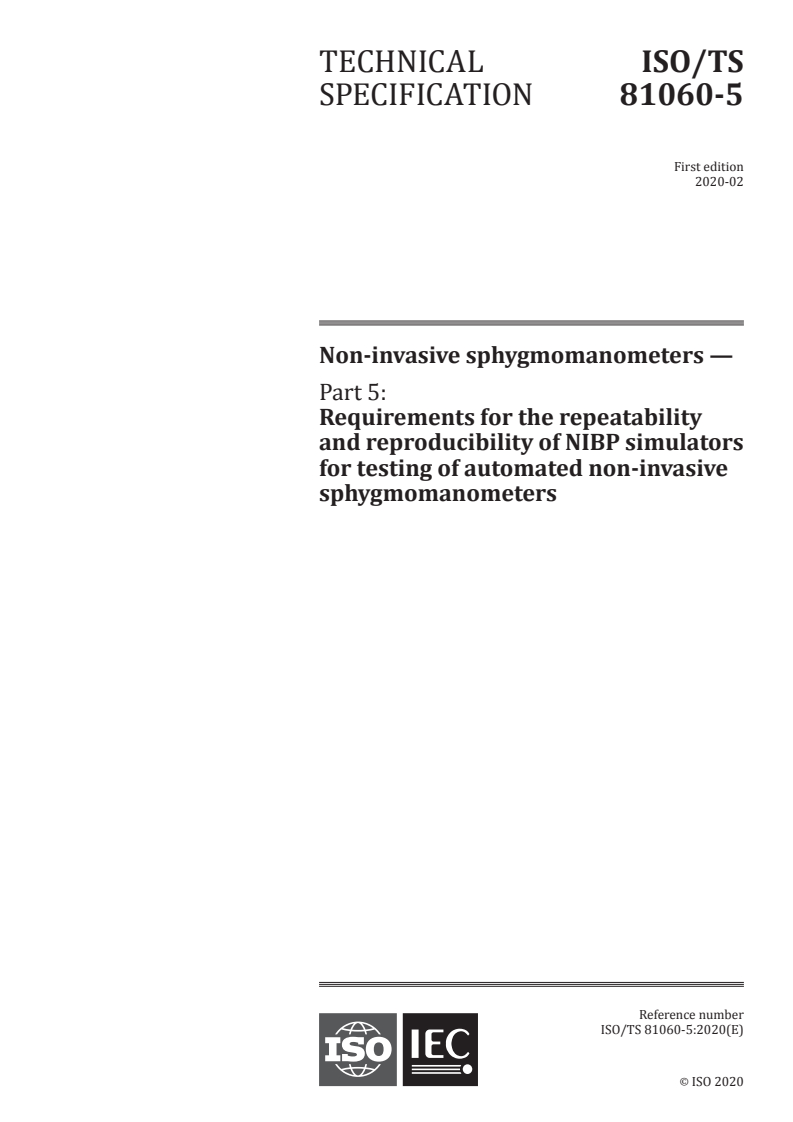
TECHNICAL ISO/TS
SPECIFICATION 81060-5
First edition
2020-02
Non-invasive sphygmomanometers —
Part 5:
Requirements for the repeatability
and reproducibility of NIBP simulators
for testing of automated non-invasive
sphygmomanometers
Reference number
ISO/TS 81060-5:2020(E)
©
ISO 2020
ISO/TS 81060-5:2020(E)
© ISO 2020
All rights reserved. Unless otherwise specified, or required in the context of its implementation, no part of this publication may
be reproduced or utilized otherwise in any form or by any means, electronic or mechanical, including photocopying, or posting
on the internet or an intranet, without prior written permission. Permission can be requested from either ISO at the address
below or ISO’s member body in the country of the requester.
ISO copyright office
CP 401 • Ch. de Blandonnet 8
CH-1214 Vernier, Geneva
Phone: +41 22 749 01 11
Fax: +41 22 749 09 47
Email: copyright@iso.org
Website: www.iso.org
Published in Switzerland
ii © ISO 2020 – All rights reserved
ISO/TS 81060-5:2020(E)
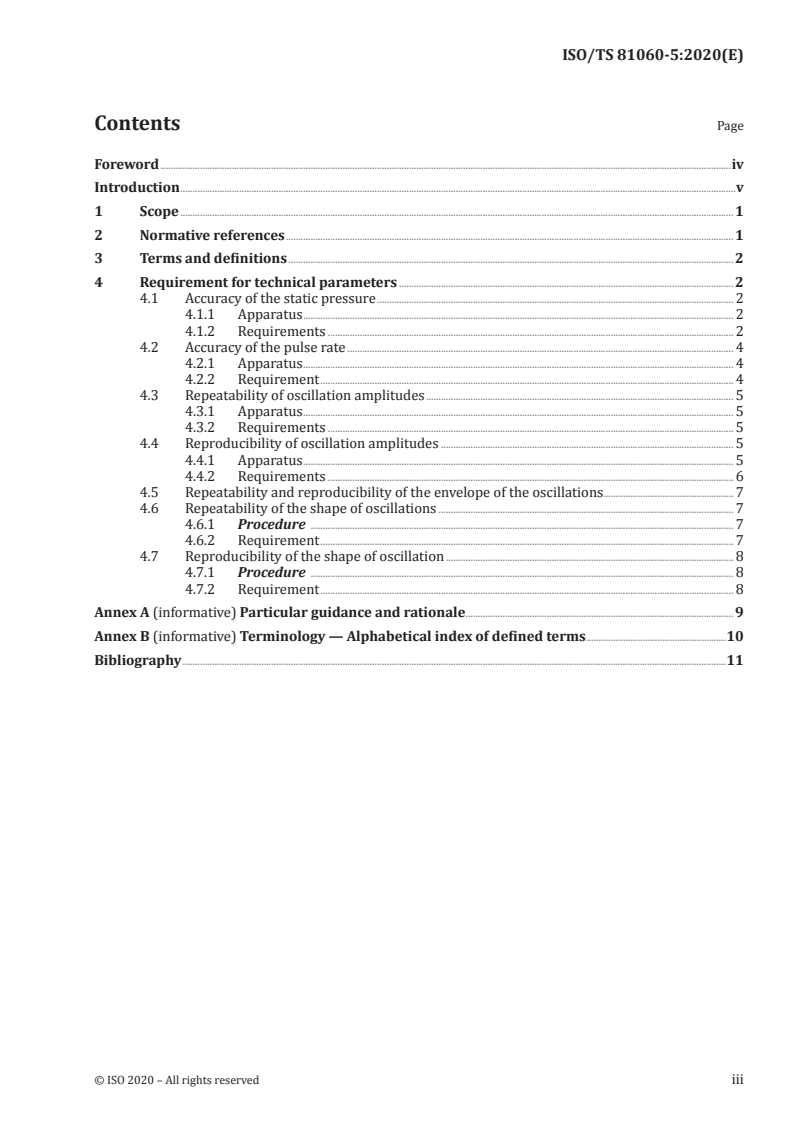
Contents Page
Foreword .iv
Introduction .v
1 Scope . 1
2 Normative references . 1
3 Terms and definitions . 2
4 Requirement for technical parameters . 2
4.1 Accuracy of the static pressure . 2
4.1.1 Apparatus . 2
4.1.2 Requirements . 2
4.2 Accuracy of the pulse rate . 4
4.2.1 Apparatus . 4
4.2.2 Requirement . 4
4.3 Repeatability of oscillation amplitudes . 5
4.3.1 Apparatus . 5
4.3.2 Requirements . 5
4.4 Reproducibility of oscillation amplitudes . 5
4.4.1 Apparatus . 5
4.4.2 Requirements . 6
4.5 Repeatability and reproducibility of the envelope of the oscillations. 7
4.6 Repeatability of the shape of oscillations . 7
4.6.1 Procedure . 7
4.6.2 Requirement . 7
4.7 Reproducibility of the shape of oscillation . 8
4.7.1 Procedure . 8
4.7.2 Requirement . 8
Annex A (informative) Particular guidance and rationale . 9
Annex B (informative) Terminology — Alphabetical index of defined terms .10
Bibliography .11
ISO/TS 81060-5:2020(E)
Foreword
ISO (the International Organization for Standardization) is a worldwide federation of national standards
bodies (ISO member bodies). The work of preparing International Standards is normally carried out
through ISO technical committees. Each member body interested in a subject for which a technical
committee has been established has the right to be represented on that committee. International
organizations, governmental and non-governmental, in liaison with ISO, also take part in the work.
ISO collaborates closely with the International Electrotechnical Commission (IEC) on all matters of
electrotechnical standardization.
The procedures used to develop this document and those intended for its further maintenance are
described in the ISO/IEC Directives, Part 1. In particular, the different approval criteria needed for the
different types of ISO documents should be noted. This document was drafted in accordance with the
editorial rules of the ISO/IEC Directives, Part 2 (see www .iso .org/ directives).
Attention is drawn to the possibility that some of the elements of this document may be the subject of
patent rights. ISO shall not be held responsible for identifying any or all such patent rights. Details of
any patent rights identified during the development of the document will be in the Introduction and/or
on the ISO list of patent declarations received (see www .iso .org/ patents).
Any trade name used in this document is information given for the convenience of users and does not
constitute an endorsement.
For an explanation of the voluntary nature of standards, the meaning of ISO specific terms and
expressions related to conformity assessment, as well as information about ISO's adherence to the
World Trade Organization (WTO) principles in the Technical Barriers to Trade (TBT), see www .iso .org/
iso/ foreword .html.
This document was prepared jointly by Technical Committee ISO/TC 121, Anaesthetic and respiratory
equipment, Subcommittee SC 3, Respiratory devices and related equipment used for patient care,
and Technical Committee IEC/TC 62, Electrical equipment in medical practice, Subcommittee SC D,
Electromedical equipment.
A list of all parts in the ISO 81060 series and the IEC 81060 series can be found on the ISO website.
Any feedback or questions on this document should be directed to the user’s national standards body. A
complete listing of these bodies can be found at www .iso .org/ members .html.
iv © ISO 2020 – All rights reserved
ISO/TS 81060-5:2020(E)
Introduction
The repeatability and reproducibility of NIBP simulators intended to test automated sphygmomanometers
should be ensured, as they are often used to check the stability of an automated sphygmomanometer
over time of use, after repair or to compare automated sphygmomanometers of the same type.
This document should be used to determine the quality of the NIBP simulator once it is produced, sold
or received by the responsible organization and thereafter periodically tested for the purpose of quality
control. It specifies acceptance limits for repeatability and reproducibility regarding the amplitude
and shape of the generated oscillations. Indirectly, it also tests the repeatability and reproducibility of
the shape of the envelope of generated oscillations over (cuff ) pressure, since the document specifies
measurements at different static pressures at the same setting of the NIBP simulator, thus measuring
the envelope at 2 or 3 pressure values. If there are reasons to doubt that this number is too low, the
test might be extended to 5 or more static pressures. It is not practically hard to do, to compare the
whole envelope of the generated oscillations by a dynamic process, i.e. by recording the data during
the deflation or inflation of the cuff. This kind of dynamic measurement would require an identical
deflation or inflation curve. Technically, this can be done by a closed-loop process, which is not a simple
task. Since the oscillations at constant pressures are not different from those during small pressure
changes, the proposed approach is adequate.
The tests described in this document should be repeated periodically to ensure the long-term stability
of the NIBP simulator.
In this document, it is intended to balance the tests necessary to ensure the stability of the NIBP
simulator required to work properly and the effort to do it. Many of the recordings required can be
evaluated under different aspects.
In this document, the following print types are used:
— requirements, conformance with which can be verified, and definitions: roman type;
— notes and examples: smaller roman type;
— defined terms and test methods: italic type;
In this document, the conjunctive “or” is used as an “inclusive or” so a statement is true if any
combination of the conditions is true.
For the purposes of this document, the auxiliary verb:
— “shall” means that conformance with a requirement or a test is mandatory for conformance with
this document;
— “should” means that conformance with a requirement or a test is recommended but is not mandatory
for conformance with this document;
— “may” is used to describe permission (e.g. a permissible way to achieve conformance with a
requirement or test);
— "can" is used to describe a possibility or capability; and
— "must" is used to express an external constraint.
An asterisk (*) as the first character of a title or at the beginning of a paragraph or table title indicates
that there is guidance or rationale related to that item in Annex A.
TECHNICAL SPECIFICATION ISO/TS 81060-5:2020(E)
Non-invasive sphygmomanometers —
Part 5:
Requirements for the repeatability and reproducibility
of NIBP simulators for testing of automated non-invasive
sphygmomanometers
1 Scope
This document specifies requirements for the repeatability and reproducibility of non-invasive blood
pressure (NIBP) simulators intended to test automated sphygmomanometers utilizing the oscillometric
non-continuous method only.
In addition, the pulse rate set on the NIBP simulator is tested.
This document is not intended to relate the signals, generated by the NIBP simulator, to the oscillometric
signal recorded in a cuff attached to a human. It does not intend to test the interaction between the
NIBP simulator and the tested automated sphygmomanometer (e.g. the agreement of the set values of the
NIBP simulator and the displayed values of the tested automated sphygmomanometer or the properties
of the cuff and tubing, such as design or elastic properties).
NOTE 1 These parameters can be tested separately in a clinical investigation or by using different special test
setups.
This document does not check whether or not the NIBP simulator is able to test the accuracy of the
absolute blood pressure value of oscillometric automated sphygmomanometers.
NOTE 2 Usually this is tested by a clinical investigation according ISO 81060-2 or other protocols.
This document is applicable to NIBP simulators testing automated sphygmomanometers for adults,
children and neonates at the upper arm, thigh etc. and automated sphygmomanometers measuring at
the wrist.
2 Normative references
The following documents are referred to in the text in such a way that some or all of their content
constitutes requirements of this document. For dated references, only the edition cited applies. For
undated references, the latest edition of the referenced document (including any amendments) applies.
ISO 14155:2011, Clinical investigation of medical devices for human subjects — Good clinical practice
ISO 81060-1:2007, Non-invasive sphygmomanometers — Part 1: Requirements and test methods for non-
automated measurement type
IEC 60601-1:2005+AMD1: 2012, Medical electrical equipment — Part 1: General requirements for basic
safety and essential performance
IEC 80601-2-30:2018, Medical electrical equipment — Part 2-30: Particular requirements for basic safety
and essential performance of automated non-invasive sphygmomanometers
ISO/TS 81060-5:2020(E)
3 Terms and definitions
For the purposes of this document, the terms and definitions given in ISO 14155:2011, ISO 81060-1:2007,
IEC 60601-1:2005+AMD1: 2012, IEC 60601-2-30:2018 and the following apply.
ISO and IEC maintain terminological databases for use in standardization at the following addresses:
— ISO Online browsing platform: available at https:// www .iso .org/ obp
— IEC Electropedia: available at http:// www .electropedia .org/
NOTE An index of defined terms can be found in Annex B.
3.1
* non-invasive blood pressure stimulator
NIBP simulator
device generating artificial blood pressure oscillations in the pneumatic system of automated
sphygmomanometers, which is used to test automated sphygmomanometers
Note 1 to entry: NIBP simulators are not able to confirm the accuracy of an automated sphygmomanometer. They
are used to assess the repeatability and reproducibility of the automated sphygmomanometer.
Note 2 to entry: Not a
...