

IEC TS 62098:2000
(Main)Evaluation methods for microprocessor- based instruments
General Information
- Abstract
This Technical Specification aims at providing background information for developing evaluation methods for microprocessor-based instruments. An evaluation starts with analysis of the instrument in terms of the external and internal information flows from and to the process, the human operator and external systems. Main function blocks in the instrument are then identified. By using the checklists given in 4.2 and 4.3, the functions and properties that may be embedded in the function blocks of the instrument to be evaluated can be identified.
- Status
- Published
- Publication Date
- 21-Nov-2000
- Technical Committee
- SC 65B - Measurement and control devices
- Drafting Committee
- WG 6 - TC 65/SC 65B/WG 6
- Current Stage
- PPUB - Publication issued
- Start Date
- 22-Nov-2000
- Completion Date
- 31-Oct-2000
Buy Documents
IEC TS 62098:2000 - Evaluation methods for microprocessor- based instruments/22/2000
IEC TS 62098:2000 - Evaluation methods for microprocessor- based instruments Released:11/22/2000
Overview
IEC TS 62098:2000 specifies the foundational methods for evaluating microprocessor-based instruments in industrial process measurement and control systems. Developed by the International Electrotechnical Commission (IEC), this technical specification guides the structured analysis and assessment of instruments using microprocessor technology, focusing on both the internal design and external interfaces. The standard outlines systematic evaluation approaches addressing essential functions, properties, and environmental influences, to ensure reliable performance and support cost-effective deployment.
Key Topics
Microprocessor-Based Instrument Evaluation:
The standard details a comprehensive evaluation framework, ensuring that instruments function accurately, reliably, and efficiently within their intended environment.System Approach:
A key methodological aspect is treating each instrument as a system defined by its elements, functions, properties, and external influencing conditions.Functional Block Identification:
IEC TS 62098 encourages evaluators to identify major function blocks, analyze information flows, and clarify instrument boundaries.Checklists and Evaluation Matrix:
Using structured checklists, users can identify functions and properties embedded in each function block. The evaluation matrix model helps map out the test criteria for each property and condition.Instrument Interfaces:
Detailed attention is given to the multiple domains interacting with instruments, including process, human operator, utility, environment, task, hardware, external systems, and time domain.Performance and Reliability Testing:
The standard emphasizes tests for functional operation, accuracy, dependability, responsiveness, and operability. Maintenance, safety, and field testing are also referenced for comprehensive assessment.
Applications
Industrial Automation:
The methods in IEC TS 62098 are mainly applicable to microprocessor-based instruments used in industrial process control, including transmitters, controllers, and intelligent actuators.Integration in Digital Communication Systems:
With the increasing incorporation of instruments into digital networks, the standard helps evaluate devices’ communication interfaces and interaction with distributed control systems.Selection and Procurement:
By providing a basis for comparing different manufacturers' products, the standard facilitates informed procurement and system integration decisions.Quality Assurance and Maintenance:
Applying these evaluation methods supports long-term reliability, reduces downtime, and aids in predictive maintenance planning.Lifecycle Cost Assessment:
The guidelines assist organizations in estimating total cost of ownership by factoring in installation, maintenance, operation, and replacement costs for measurement and control devices over their lifespan.
Related Standards
Several related international standards complement IEC TS 62098, offering further guidance for evaluating and utilizing process measurement and control instruments:
- IEC 60050-351: International Electrotechnical Vocabulary – Part 351: Automatic control
- IEC 60546 (all parts): Controllers with analogue signals for industrial-process control systems
- IEC 60770-1: Transmitters for use in industrial-process control systems – Performance evaluation
- IEC 61069 (all parts): Evaluation of system properties for system assessment in industrial-process measurement and control
- IEC 61298 (all parts): General evaluation methods for process measurement and control devices
Practical Value
IEC TS 62098:2000 provides a flexible yet thorough framework for the evaluation of microprocessor-based instruments, ensuring that complex digital devices can be benchmarked, validated, and selected according to international best practices. Through its structured approach and attention to real-world interfacing and performance, the standard supports the deployment of robust, high-quality process control solutions across varied industrial environments.
Keywords: IEC TS 62098, evaluation methods, microprocessor-based instruments, industrial process measurement and control, performance testing, reliability testing, instrument evaluation, standards for instrumentation, system assessment, process automation.
Relations
- Effective Date
- 10-Feb-2026
Buy Documents
IEC TS 62098:2000 - Evaluation methods for microprocessor- based instruments/22/2000
IEC TS 62098:2000 - Evaluation methods for microprocessor- based instruments Released:11/22/2000
Get Certified
Connect with accredited certification bodies for this standard

BSI Group
BSI (British Standards Institution) is the business standards company that helps organizations make excellence a habit.

DVS-ZERT GmbH
German welding certification society.
CARES (UK Certification Authority for Reinforcing Steels)
UK certification for reinforcing steels and construction.
Sponsored listings
Frequently Asked Questions
IEC TS 62098:2000 is a technical specification published by the International Electrotechnical Commission (IEC). Its full title is "Evaluation methods for microprocessor- based instruments". This standard covers: This Technical Specification aims at providing background information for developing evaluation methods for microprocessor-based instruments. An evaluation starts with analysis of the instrument in terms of the external and internal information flows from and to the process, the human operator and external systems. Main function blocks in the instrument are then identified. By using the checklists given in 4.2 and 4.3, the functions and properties that may be embedded in the function blocks of the instrument to be evaluated can be identified.
This Technical Specification aims at providing background information for developing evaluation methods for microprocessor-based instruments. An evaluation starts with analysis of the instrument in terms of the external and internal information flows from and to the process, the human operator and external systems. Main function blocks in the instrument are then identified. By using the checklists given in 4.2 and 4.3, the functions and properties that may be embedded in the function blocks of the instrument to be evaluated can be identified.
IEC TS 62098:2000 is classified under the following ICS (International Classification for Standards) categories: 25.040.40 - Industrial process measurement and control; 35.240.50 - IT applications in industry. The ICS classification helps identify the subject area and facilitates finding related standards.
IEC TS 62098:2000 has the following relationships with other standards: It is inter standard links to EN 61514-2:2013. Understanding these relationships helps ensure you are using the most current and applicable version of the standard.
IEC TS 62098:2000 is available in PDF format for immediate download after purchase. The document can be added to your cart and obtained through the secure checkout process. Digital delivery ensures instant access to the complete standard document.
Standards Content (Sample)
TECHNICAL IEC
SPECIFICATION
TS 62098
First edition
2000-11
Evaluation methods for microprocessor-
based instruments
Méthodes d'évaluation des instruments
à microprocesseur
Reference number
IEC/TS 62098:2000(E)
Publication numbering
As from 1 January 1997 all IEC publications are issued with a designation in the
60000 series. For example, IEC 34-1 is now referred to as IEC 60034-1.
Consolidated editions
The IEC is now publishing consolidated versions of its publications. For example,
edition numbers 1.0, 1.1 and 1.2 refer, respectively, to the base publication, the
base publication incorporating amendment 1 and the base publication incorporating
amendments 1 and 2.
Further information on IEC publications
The technical content of IEC publications is kept under constant review by the IEC,
thus ensuring that the content reflects current technology. Information relating to
this publication, including its validity, is available in the IEC Catalogue of
publications (see below) in addition to new editions, amendments and corrigenda.
Information on the subjects under consideration and work in progress undertaken
by the technical committee which has prepared this publication, as well as the list
of publications issued, is also available from the following:
• IEC Web Site (www.iec.ch)
• Catalogue of IEC publications
The on-line catalogue on the IEC web site (www.iec.ch/catlg-e.htm) enables
you to search by a variety of criteria including text searches, technical
committees and date of publication. On-line information is also available on
recently issued publications, withdrawn and replaced publications, as well as
corrigenda.
• IEC Just Published
This summary of recently issued publications (www.iec.ch/JP.htm) is also
available by email. Please contact the Customer Service Centre (see below) for
further information.
• Customer Service Centre
If you have any questions regarding this publication or need further assistance,
please contact the Customer Service Centre:
Email: custserv@iec.ch
Tel: +41 22 919 02 11
Fax: +41 22 919 03 00
TECHNICAL IEC
SPECIFICATION
TS 62098
First edition
2000-11
Evaluation methods for microprocessor-
based instruments
Méthodes d'évaluation des instruments
à microprocesseur
IEC 2000 Copyright - all rights reserved
No part of this publication may be reproduced or utilized in any form or by any means, electronic or
mechanical, including photocopying and microfilm, without permission in writing from the publisher.
International Electrotechnical Commission 3, rue de Varembé Geneva, Switzerland
Telefax: +41 22 919 0300 e-mail: inmail@iec.ch IEC web site http://www.iec.ch
Commission Electrotechnique Internationale
PRICE CODE
W
International Electrotechnical Commission
For price, see current catalogue
– 2 – TS 62098 IEC:2000(E)
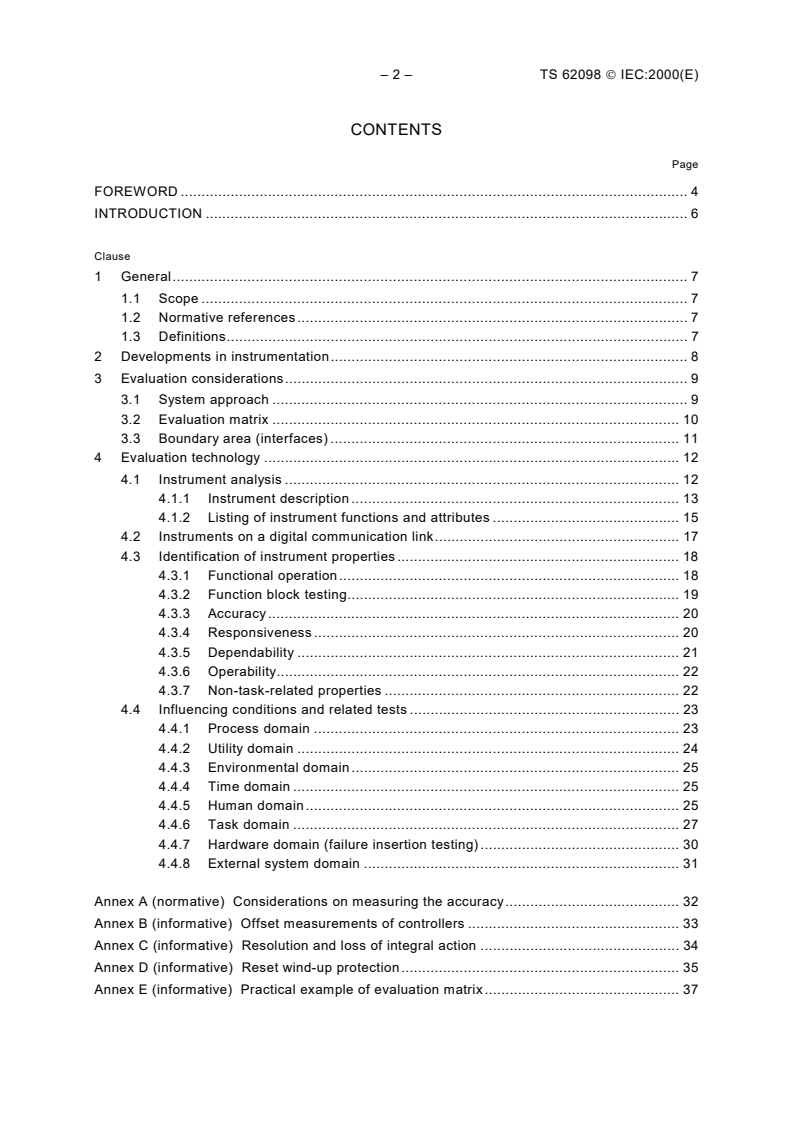
CONTENTS
Page
FOREWORD . 4
INTRODUCTION .6
Clause
1 General. 7
1.1 Scope . 7
1.2 Normative references. 7
1.3 Definitions. 7
2 Developments in instrumentation. 8
3 Evaluation considerations. 9
3.1 System approach . 9
3.2 Evaluation matrix . 10
3.3 Boundary area (interfaces) . 11
4 Evaluation technology . 12
4.1 Instrument analysis . 12
4.1.1 Instrument description . 13
4.1.2 Listing of instrument functions and attributes . 15
4.2 Instruments on a digital communication link. 17
4.3 Identification of instrument properties . 18
4.3.1 Functional operation. 18
4.3.2 Function block testing. 19
4.3.3 Accuracy. 20
4.3.4 Responsiveness . 20
4.3.5 Dependability . 21
4.3.6 Operability. 22
4.3.7 Non-task-related properties . 22
4.4 Influencing conditions and related tests . 23
4.4.1 Process domain . 23
4.4.2 Utility domain . 24
4.4.3 Environmental domain. 25
4.4.4 Time domain . 25
4.4.5 Human domain. 25
4.4.6 Task domain . 27
4.4.7 Hardware domain (failure insertion testing) . 30
4.4.8 External system domain . 31
Annex A (normative) Considerations on measuring the accuracy. 32
Annex B (informative) Offset measurements of controllers . 33
Annex C (informative) Resolution and loss of integral action . 34
Annex D (informative) Reset wind-up protection . 35
Annex E (informative) Practical example of evaluation matrix . 37
TS 62098 © IEC:2000(E) – 3 –
Page
Figure 1 – Generic system model. 10
Figure 2 – Model of an evaluation matrix. 11
Figure 3 – Functional information flows entering and exiting an instrument . 12
Figure 4 – Generic instrument model . 13
Figure 5 – Generic model of a system with a digital communication link . 17
Figure 6 – Test for verifying functional operation . 18
Figure 7 – Test for verifying functional operation . 18
Figure B.1 – Setpoint/input subsystems . 33
Figure D.1 – Reset wind up effects . 35
Table 1 – Analog and microprocessor-based instrument functions. 9
– 4 – TS 62098 IEC:2000(E)
INTERNATIONAL ELECTROTECHNICAL COMMISSION
____________
EVALUATION METHODS
FOR MICROPROCESSOR-BASED INSTRUMENTS
FOREWORD
1) The IEC (International Electrotechnical Commission) is a worldwide organization for standardization comprising
all national electrotechnical committees (IEC National Committees). The object of the IEC is to promote
international co-operation on all questions concerning standardization in the electrical and electronic fields. To
this end and in addition to other activities, the IEC publishes International Standards. Their preparation is
entrusted to technical committees; any IEC National Committee interested in the subject dealt with may
participate in this preparatory work. International, governmental and non-governmental organizations liaising
with the IEC also participate in this preparation. The IEC collaborates closely with the International Organization
for Standardization (ISO) in accordance with conditions determined by agreement between the two
organizations.
2) The formal decisions or agreements of the IEC on technical matters express, as nearly as possible, an
international consensus of opinion on the relevant subjects since each technical committee has representation
from all interested National Committees.
3) The documents produced have the form of recommendations for international use and are published in the form
of standards, technical specifications, technical reports or guides and they are accepted by the National
Committees in that sense.
4) In order to promote international unification, IEC National Committees undertake to apply IEC International
Standards transparently to the maximum extent possible in their national and regional standards. Any
divergence between the IEC Standard and the corresponding national or regional standard shall be clearly
indicated in the latter.
5) The IEC provides no marking procedure to indicate its approval and cannot be rendered responsible for any
equipment declared to be in conformity with one of its standards.
6) Attention is drawn to the possibility that some of the elements of this technical specification may be the subject
of patent rights. The IEC shall not be held responsible for identifying any or all such patent rights.
The main task of IEC technical committees is to prepare International Standards. In
exceptional circumstances, a technical committee may propose the publication of a technical
specification when
the required support cannot be obtained for the publication of an International Standard,
despite repeated efforts, or
The subject is still under technical development or where, for any other reason, there is the
future but no immediate possibility of an agreement on an International Standard.
IEC 62098, which is a technical specification, has been prepared by subcommittee 65B:
Devices, of IEC technical committee 65: Industrial-process measurement and control.
The text of this technical specification is based on the following documents:
Enquiry draft Report on voting
65B/388/CDV 65B/401/RVC
Full information on the voting for the approval of this technical specification can be found in the
report on voting indicated in the above table.
This publication has been drafted in accordance with the ISO/IEC Directives, Part 3.
TS 62098 © IEC:2000(E) – 5 –
Annex A forms an integral part of this technical specification.
Annexes B, C, D and E are given for information only.
The committee has decided that the contents of this publication will remain unchanged until
2006. At this date, the publication will be
transformed into an International Standard;
reconfirmed;
withdrawn;
replaced by a revised edition, or
amended.
– 6 – TS 62098 IEC:2000(E)
INTRODUCTION
Rationale
An evaluation of an instrument or a process controller is a supportive tool for assessing the
cost of ownership for a measurement or a control function in a plant over the lifetime of that
plant. The cost of ownership then comprises all costs for investments (including replacements
over plant lifetime), engineering, installation, maintenance, energy and material consumption.
New instruments for process control and measurement are often equipped with
microprocessors, thereby utilising digital data processing methods and artificial intelligence.
This makes them more complex, and the existing standardised evaluation methods are not
always sufficient to show the instrument capabilities.
An evaluation can consist in its most extended form of the following activities:
- design review (hardware and software);
- performance (functional) testing;
- study of testing for reliability, maintainability;
- safety study and testing for safety;
- field testing.
The evaluation methods described herein mainly treat aspects related to performance and
reliability testing. This Technical Specification can be seen as an expansion on IEC 61298.
Methods mentioned therein that are still valid for microprocessor-based instruments are
mentioned here for completeness but are not repeated in full. When relevant, that publication
shall be consulted.
Some considerations on the evaluation of microprocessor-based instruments in this technical
specification are based on ideas brought forward in IEC 61069.
In the future, microprocessor-based instruments will increasingly be integrated in digital
communication systems. Therefore the communication aspect and its possible influence on
real-time operation and further performance of the instruments will also be considered.
TS 62098 © IEC:2000(E) – 7 –
EVALUATION METHODS
FOR MICROPROCESSOR-BASED INSTRUMENTS
1 General
1.1 Scope
This Technical Specification aims at providing background information for developing
evaluation methods for microprocessor-based instruments.
An evaluation starts with analysis of the instrument in terms of the external and internal
information flows from and to the process, the human operator and external systems. Main
function blocks in the instrument are then identified. By using the checklists given in 4.2 and
4.3, the functions and properties that may be embedded in the function blocks of the
instrument to be evaluated can be identified.
Subclause 4.4 gives a checklist for identification of the relevant influencing conditions for the
instrument to be evaluated.
Depending on the application of an instrument, the user of this technical specification may
have to define further functions and properties or influencing conditions.
1.2 Normative references
The following normative documents contain provisions which, through reference in this text,
constitute provisions of this Technical Specification. For dated references, subsequent
amendments to, or revisions of, any of these publications do not apply. However, parties to
agreements based on this Technical Specification are encouraged to investigate the possibility
of applying the most recent editions of the normative documents indicated below. For undated
references, the latest edition of the normative document referred to, applies. Members of IEC
and ISO maintain registers of currently valid International Standards.
IEC 60050-351, International Electrotechnical Vocabulary (IEV) – Part 351: Automatic control
IEC 60546 (all parts), Controllers with analogue signals for use in industrial-process control
systems
IEC 60770-1, Transmitters for use in industrial-process control systems – Part 1: Methods for
performance evaluation
IEC 61069 (all parts), Industrial-process measurement and control – Evaluation of system
properties for the purpose of system assessment
IEC 61298 (all parts), Process measurement and control devices – General methods and
procedures for evaluating performance
1.3 Definitions
For the purposes of this technical specification the definitions given in IEC 60050-351, IEC
60546, IEC 60770-1, IEC 61069 and IEC 61298 apply.
– 8 – TS 62098 IEC:2000(E)
2 Developments in instrumentation
Instrument functions can be realised in various ways.
In analogue instruments, functions are realised by the layout and size of hardware components
and by the use of analogue data processing.
The first instruments equipped with microprocessors and using digital data processing
techniques appeared in the late 1970s and early 1980s. Since then, the use of software-based
digital data processing techniques for measuring instruments and controllers has grown
disproportionally. Also there has been an increase in functionality and data processing
capacity.
Microprocessor-based instruments are sampled data systems. That means that the outputs
and other relevant data are refreshed or updated with new data at certain time intervals or
cycle times. Besides the measurement task, the instrument has in the same operating interval
to perform other tasks such as communication and self-testing. In particular, for time-
dependent functions (control, integration, etc.) microprocessor-based instruments can become
time-critical. This means that errors can appear when time-housekeeping is either inaccurate
or disturbed. Time-housekeeping can for instance be upset when the design allows
simultaneous operation of various tasks without a careful prioritisation in the multi-tasking.
The extensive data processing, memory and storage capabilities of microprocessors permit the
integration of control algorithms (e.g. PID) and process trend information in measuring
instruments.
The data processing capabilities also permit the use of more complex sensing techniques.
They have provided opportunities to develop more “exotic” types of sensors where the
measuring principle needs for instance the use of statistical methods to determine the physical
quantity.
Increased knowledge of sensors has led to better mapping of the sensor characteristics. These
maps can be embedded in the software, and by the use for instance of internal auxiliary
sensors they can be used to provide a much greater rangeability such as in pressure and
differential pressure sensors.
Moreover, the processing capacity provides the possibility of processing sensor data to derive
other information that can be of interest for maintenance purposes. Maintenance may also be
supported by auxiliary sensors that provide information on wear-out or overloading etc. of the
instrument or the equipment to which it is connected. Stored historic, diagnostic and statistical
data may also be used for improving maintenance.
The communication interface may be designed for communication with a high-level operator
interface over a digital communication link. It may also allow direct instrument-to-instrument
communication over the same link.
Some of the above-mentioned considerations are summarised in table 1.
TS 62098 © IEC:2000(E) – 9 –
Table 1 – Analog and microprocessor-based instrument functions
Functionality Analogue instruments Microprocessor-based instruments
Data processing – continuously: pneumatic or electric – sampled data (can be time-critical)
– single function – multifunction often provided with a
library of standardised function blocks
– large processing capacity, suitable for
complex calculations, (smart) alarming
– suitable for new sensing techniques
Process I/O functions – single sensor – multisensor
– single output analogue – multi-output analogue and/or digital
– limited rangeability – extended rangeability by better
mapping of sensor characteristics and
use of auxiliary internal sensors for
temperature, pressure compensation,
etc.
– equipped with binary inputs for sensing
contact closure
Human I/O functions – dial gauges, potentiometers – local digital displays and pushbuttons
for parameter adjustment
– remote control via CRT and keyboard
Communication – analogue (4-20 mA) – digital with local hand terminals
functions
– digital over long cables
– integration in DCS (digital
communication system)
Construction – one integrated unit – modular construction
Self-testing – limited (live zero, TC-break) – extensive
– check for internal failures
– check for line break/power failure
– check on related external devices
– check for preventive maintenance
3 Evaluation considerations
3.1 System approach
The system approach gives the best explanation of the development of the evaluation
technology addressed in this technical specification. The term “system” is defined as follows:
"A system is a set of interdependent elements constituted to achieve a given objective by
performing a definite function.”
An informative note accompanying the definition gives an alternative approach, which is of
equal importance as it indicates the boundaries of a system with its environment; it reads:
"A system is considered to be separated from the environment and other external systems by
an imaginary surface which cuts the links between them and the considered system. Through
these links the system is affected by the environment and is acted upon by the external
systems, or acts itself on the environment or the external systems."
Using this definition, every instrument can be treated as a system.
– 10 – TS 62098 IEC:2000(E)
An ideal system (the concept) should be able to indefinitely perform its function without error,
fault, failure and unwanted delay. However, the real system developed from the functional
concepts is not ideal due to the imperfect (time- and space-bound) nature of the materials
used. It is therefore sensitive to disturbing external factors.
Because of this non-ideal behaviour of the real system, there is a practical need for
characterising the points of concern with respect to their application in more or less
measurable properties, such as accuracy, stability, reliability, maintainability, etc.
The specifications of the properties indicate the deviations between the functional concepts
and the realisation of the functions of a system and are a measure of its quality.
The main constituents of a system described above and the interaction with the environment
are clearly shown in figure 1. The environment is for practical reasons further split into a
number of domains. The boundary is expanded to a boundary area consisting of a number of
interfaces. The various environmental domains are the sources of disturbance (influencing
conditions) for an instrument.
Hardware domain
Utility domain
Process domain
Task domain
ELEMENTS
FUNCTIONS
PROPERTIES
External systems Environmental
domain domain
Boundary area
(interfaces)
Human domain
Time domain
IEC 1829/2000
Figure 1 – Generic system model
3.2 Evaluation matrix
The main points to be defined in detail for an evaluation are:
a) instrument elements;
b) instrument functions;
c) instrument properties;
d) influencing conditions.
The choice made may not cover the totality of requirements and specifications for an
instrument under consideration and is a compromise between the parties involved.
TS 62098 © IEC:2000(E) – 11 –
The results of the definition phase are then structured in a multidimensional (multilayered)
matrix, which unambiguously shows the mutually agreed programme. A model is shown in
figure 2. The first three rows summarise the inside of the instrument and the first column
describes the environment. Every field of the matrix represents a test. The matrix can be split
up further, if required, to indicate even parameters of properties or functions. Annex E shows a
practical example for an electromagnetic flowmeter.
Before the actual performance of the evaluation, the evaluator needs to consider the evaluation
techniques, which can be summarised as follows:
– definition and design of methods and means for measuring the functions and properties;
– definition of methods and means to apply, measure and control the test conditions to be
imposed on the instrument;
– consideration of results to be expected.
In this phase it may still be found that the evaluation methods for the instrument have to be
revised because of their physical and practical limitations.
After the actual testing has started, it is a good practice for the evaluator to keep in contact
with the parties involved. Unexpected results may temporarily stop the evaluation. They may
also lead to reconsideration and modification of the design.
Element level Element 1
Function level Function 1 Function 2 Function3
Property level A B C D a b c d e ABC
Influence domain Test type
Utility domain Test 1
Test 2
Test 3
Test 4
Test 5
Process domain Test 1
Test 2
Test 3
Test 4
Environmental domain Test 1
Test 2
Test 3
Test 4
Test 5
IEC 1830/2000
Figure 2 – Model of an evaluation matrix
3.3 Boundary area (interfaces)
In setting up an evaluation, the definition of the boundaries of an instrument is an important
issue. At the periphery of a system, the boundaries need to be clearly defined.
How and where the boundary lines are drawn is an arbitrary process, which requires a detailed
knowledge of the instrument and its interfaces and thorough discussion with the parties
involved in the evaluation. The choices made determine the extent of an evaluation and the
resources required to perform it.
– 12 – TS 62098 IEC:2000(E)
4 Evaluation technology
4.1 Instrument analysis
The actual performance of an instrument evaluation should be preceded by a structured
analysis of the physical and functional design of the instrument concerned and its operational
environment. This analysis together with the requirements stated by the user should lead to
definition of the functions and properties to be evaluated.
Figure 3 shows the intended functional interaction of the instrument through its boundaries with
the operational environment. The arrows indicate the following information flows that are
relevant for process measurement, supervision and control:
– information flow from and to the process domain;
– information flow from and to the human domain;
– information flow from and to the external systems domain.
Hardware domain Utility domain
Task domain
Process domain
ELEMENTS
FUNCTIONS
PROPERTIES
Environmental
domain
External systems
domain
Boundary area
(interfaces)
Time domain Human domain
IEC 1831/2000
Figure 3 – Functional information flows entering and exiting an instrument
Figure 4 shows a block diagram of a generic instrument model and its internal structure. The
analysis is guided and facilitated by the model shown in figure 3 and the detailed instrument
description given in 4.1.1. The block diagram shows the basic modules (building blocks) that
can be distinguished in a maximum configuration of an instrument.
The model can be used for describing various types of instruments for measuring and
controlling the relevant physical quantities of industrial processes.
Within an instrument, the external information flows shown in figure 3 are intentionally inter-
connected over information flow routes. In an operational instrument we may have the following
information flow routes:
– process to process via the function blocks embedded in the data processing unit;
– process (inputs) to digital communication link via communication interface;
– digital communication link via communication interface to process (outputs);
TS 62098 © IEC:2000(E) – 13 –
– operator via human interface to process (outputs);
– process (inputs) via human interface to operators (operations, maintenance and
management).
Because of the sequential operation of microprocessor-based instruments, several cycle times
are distinguished in the various information flow routes. In the model they are indicated with the
terms “ct 1” to “ct 4”. The cycle times shown in the model are not necessarily equal. Depending
on the type of information and its priority, other cycle times may exist in one information flow
route.
EXTERNAL SYSTEM DOMAIN
Digital communication link to control system
ct
Communication
Power
interface
supply
ct
Data
Output
Sensor/input
processing
subsystem
subsystem
unit
ct
ct PROCESS DOMAIN
PROCESS DOMAIN
Human
interface
ct = cycle time
HUMAN DOMAIN IEC 1832/2000
Figure 4 – Generic instrument model
The instrument will have to perform various tasks with different priorities within the time frame
available. The design should be such that all relevant information can be processed and
provided under the most unfavourable conditions.
It shall be noted that instruments may exist that do not operate with a fixed time frame but
restart their cycle after the last instruction is executed. Specific tasks may be run on a time
countdown basis or by interrupts.
4.1.1 Instrument description
4.1.1.1 Sensor/input subsystem
The sensor/input subsystem converts the measurement signals, analogue or binary (e.g.
pressure switches), into electrical signals which are conditioned and converted into digital
information and then fed into the data processing unit.
These subsystems can also have several sensors of a different type (e.g. auxiliary for
compensation or diagnostic purposes). For each sensor a suitable measurement equipment is
required.
– 14 – TS 62098 IEC:2000(E)
The subsystem may be integrated with the other modules in one enclosure. It can also be
located remotely (e.g. densitometer, thermocouple transmitter). Depending on the
measurement principle used, the sensor assembly may not require auxiliary (external) power
(e.g. thermocouples) or it may require auxiliary power (e.g. strain gauges) or a specifically
characterised power source (e.g. electromagnetic and Coriolis-type mass flowmeters).
As it is in contact with the process medium, the sensor may be influenced by medium
properties, medium conditions and installation conditions. As a remote unit the sensor may
also be subjected to more severe environmental conditions. Moreover, it shall also be
considered whether it is necessary to apply combined environmental and process conditions
during an evaluation.
4.1.1.2 Data processing unit
The functionality of an instrument is determined by the functions embedded in the data
processing unit. The data processing unit receives the digitised information from the sensor
subsystem, the human and the external system interfaces. The processed information is then
used to refresh the information flows to the output subsystem and back to the human and
external interfaces. The data processing unit may also control the power to sensors.
The data processing unit may also be equipped with extensive memory capacity for historic
trends of process data and condition monitoring.
Microprocessor-based instruments are equipped with more or less extensive self-diagnostic
software and in some cases with diagnostic sensors for automatically maintaining integrity.
The application software, in particular for controllers is often organised in a library of function
blocks that can be used in any order to provide specific transfer functions. For single function
microprocessor-based instruments, the user software is less extensive.
4.1.1.3 Output subsystem
For process control the output subsystem provides standardised analogue electrical output
signals (mA, V) via a digital to analogue converter, frequency or pulse train signals or binary
(contact, solid state) output signals.
4.1.1.4 Human interface
The human interface provides means for observing the process variables and for manipulating
and adjusting certain parameters. In simple instruments it may be only a numeric display. In
more complex instruments it may be a fixed or a plug-in type keyboard/display unit for read-out
and operator access.
4.1.1.5 Communication interface
The communication interface provides means for either parallel or serial communication by a
digital communication link to a data acquisition system, a distributed control system or a hand
terminal for local read-out.
4.1.1.6 Power supply assembly
The power supply assembly receives either an unregulated a.c. or d.c. supply voltage. It
provides stabilised and regulated supply voltages and/or currents (either a.c. or d.c. or a
combination) to the various parts of the instrument.
TS 62098 © IEC:2000(E) – 15 –
4.1.2 Listing of instrument functions and attributes
In general, an instrument user is only interested in the overall functions of the above-mentioned
information flow routes (from boundary-to-boundary). However, when possibilities exist in the
instrument to make measurements inside that black box, they shall be considered. If
instrument problems arise during an evaluation, these measurements can be of great help in
diagnosing the cause and curing possible design faults. Therefore, based on the above division
of an instrument into subsystems, we need to further detail the functions and their attributes to
obtain an overview of the capabilities.
It shall also be realised that the number of functions defined to be evaluated has an effect on
the time required for an evaluation and the costs.
From the model of figure 4 the following main function groups can be identified:
− measurement functions;
− output functions;
− data processing and control functions;
− communication functions;
− human interface functions;
− supervisory functions.
4.1.2.1 Measurement functions
− Number of quantities to be measured
− Measurement ranges
− Adjustment options (may be resident in data processing unit)
− Cycle times
− Filtering for electrical signals
− Sensor attributes used:
• thermocouple, resistance temperature detector (RTD), pulse rate, strain gauge, V, mA
etc.;
•
characteristic: linear, logarithmic, quadratic, etc.;
• self-powered or requiring power;
− Split architecture (sensor assembly separated from other subsystems)
4.1.2.2 Output functions
− Number of output channels
− Type of output signals
• analogue: electrical (mA, V), pneumatic, hydraulic
• binary: relay, solid state
• pulse rate (frequency, amplitude, shape)
− Adjustment facilities
− Load rating (voltage, current, load impedance)
– 16 – TS 62098 IEC:2000(E)
4.1.2.3 Data processing and control functions
− Processing capacity in combination with a minimum cycle time
− Task prioritisation and timing
− Application software, function block structure:
• Time-dependent function blocks:
− control (e.g. PID)
− lead/lag
− totalisers, timers
− velocity limiter
− bandfilters
• Time-independent function blocks:
− calculatory
− polynomial
− logical functions
− hi/lo selectors
− alarm functions (hi, lo, velocity, deviation)
− statistical functions
− Data storage capacity
4.1.2.4 Communication functions
− Cycle time
− Buffer size for data transfer
− Transmission speed (throughput)
− transmission medium
4.1.2.5 Human interface functions
− Setpoint control: local, remote
− Mode control: auto/manual, cascade
− Trend storage and replay
− Condition monitoring (see also supervisory functions)
− Parameter control: PID, bias, measurement range, alarm levels
4.1.2.6 Supervisory functions
− Self-test functions with checks for:
• internal failures (processor, memories, data transfer),
• communication failure,
• line break, power failure,
• maintenance prediction;
− Configuration (programming) function: offline, online
TS 62098 © IEC:2000(E) – 17 –
4.1.2.7 Supply function
− Electrical, pneumatic, hydraulic
− Filtering, stabilisation, regulation
4.1.2.8 Environmental interface function
The interface provides protective measures against environmental influences such as:
− ambient temperature (e.g. ventilation);
− vibration (passive or active dampers);
− water and dust (enclosure design as defined per IP-protection class);
− electrostatic discharge (anti-static paint).
4.2 Instruments on a digital communication link
For the purpose of an evaluation three types of instruments are identified in figure 5:
− measuring instruments;
− process controllers;
− intelligent actuators.
Measuring instruments in such a configuration do not necessarily need the output system that
provides an analogue output. On the other hand, actuators receive digital information for
controlling the final control elements.
We can further expect that the functionality to be expected or realised in each of the three
types can differ considerably from manufacturer to manufacturer.
Some measuring instruments provide only the measurement function, whereas other
measuring instruments may include a control function or a supervisory function and send their
output signal over the digital communication link to the computer and/or an actuator. The
operator then provides the controller setpoints by means of the computer.
Actuators may be equipped with the controller function.
The process controller shown in figure 5 may be equivalent to classical instruments.
In a digital communication system, it can be expected that instruments will be supplied that
have no facilities for local read-out and manipulation of parameter settings etc.
Digital communication link
Computer
Measuring
(Intelligent)
Controller
instrument
actuator
PROCESS DOMAIN
IEC 1833/2000
Figure 5 – Generic model of a system with a digital communication link
– 18 – TS 62098 IEC:2000(E)
Digital communication systems should be universally applicable and must be able to support
instruments from different makes simultaneously. A digital communication system operates
cyclically and is thus inherently time-critical.
4.3 Identification of instrument properties
4.3.1 Functional operation
The correct functional operation of a microprocessor-based instrument can best be verified by
using a continuously changing input signal. At a constant input signal the test may give
misleading information. Instruments may turn into a hold condition when exposed to certain
influencing (test) conditions.
For instruments with an electrical input the test can be done as follows. The instrument
receives a low-frequency triangular signal from an external signal generator (see figure 6). The
frequency used is approximately 0,1 times the sample frequency.
Instrument
Input
Output
To recorder
IEC 1834/2000
Figure 6 – Test for verifying functional operation
The input and output signals of the instrument are recorded. This “test loop” is in principle
operating during the whole evaluation. It is a tool to detect failures such as temporary or
permanent loss of output signal, hold conditions and irregularities in cycle time. The real time
behaviour can be observed in this way down to one cycle time of the controller.
With some modification, this method can also be used for monitoring communication between
an instrument and a higher level system.
In instruments with digital inputs and outputs only, functional operation can also be verified by
configuring in the instrument an inverter function block. The output of that function is fed back
to the input (see figure 7).
The output will then be switching on and off at the sample frequency. The output can be
recorded.
Digital input Digital output
Instrument
to recorder
configured
as inverter
IEC 1835/2000
Figure 7 – Test for verifying functional operation
TS 62098 © IEC:2000(E) – 19 –
4.3.2 Function block testing
Microprocessor-based instruments and process controllers are provided with a “library” of more
or less standardised algorithms, often called function blocks. Put together in a certain order
and connected to the physical I/O-circuits, they can be used to realise all kinds of data
processing and control functions. The variety of function blocks will be large, in particular for
controllers. Each manufacturer may have his own set and though often the same names
appear, the algorithms may show significant differences. Subclause 4.3.2.1 gives some generic
rules for designing test procedures.
The function blocks can be divided into two groups:
− time-dependent functions (totalisers, controllers, timers, lead/lag);
− time-independent functions, which can again roughly be divided into
• calculatory blocks;
• logic blocks (and, or, etc.).
For both types of function blocks, the following qualitative checks can be performed:
− restart conditions after short-duration power interruptions will be checked for correct
operation for outputs and control modes as far as provided;
− the effects of introducing negative parameters will be checked;
− bumpless transfer from manual-to-automatic and setpoint tracking facilities will be checked;
− manual output control facilities will be checked.
4.3.2.1 Time-dependent function blocks
For time-dependent function blocks with integrating factors, measurements over extended
periods may be required to reveal the actual time behaviour. Each function block may require a
specific test. Linear algorithms may be tested with a frequency response test, a step test or a
ramp or pulse test. The various measured responses of the time-dependent function blocks will
be compared with the actual responses calculated for the specified differential equations. The
differential equations of possible hardware filters in the input circuits may also have to be taken
into account.
For non-linear control algorithms, closed loop testing with some benchmark processes may
show their capabilities.
For control algorithms (e.g. PID) having an integral action, the following tests shall also be
carried out.
− The reset wind-up protection (protection against saturation effects) is in general a software
provision available by setting function block output limits. Whether automatic adaptation of
the software wind-up protection is provided with respect to the physical limitations of the
hardware output circuits shall however be checked. If not, real reset wind-up protection
may be partial or ineffective.
− The resolution with which the integral action is calculated will be checked. In the case of
too small a resolution, the integral action will become inactive although a deviation may still
exist between the setpoint and the measured value.
– 20 – TS 62098 IEC:2000(E)
4.3.2.2 Time-independent function blocks
For calculatory and time-independent function blocks, the following checks also have to be
made.
− Determine to what extent calculations are performed in engineering units and how scaling
is done at the connections to I/O circuits.
− Determine the protection provided against division by zero and how it is realised.
− Determine the protection provided against unrealistic parameter settings (such as low limit
exceeding high limit).
− Determine the effects of exceeding the resolution of the calculation capacity (single or
double precision). An inefficient method of calculation may cause considerable errors.
− To determine the effects of extreme values; some actual calculations at extreme inputs and
parameter settings are performed and compared with the theoretical formula.
4.3.3 Accuracy
The values of accuracy in an information flow route are determined by the accuracy of the
analogue circuitry as well as the analogue-to-digital and digital-to-analogue circuitry. Other
(digital) circuits in an information flow route have predetermined resolution effects on the
accuracy.
The evaluation of accuracy may still be performed as described in IEC 60770 and IEC 61298.
4.3.4 Responsiveness
4.3.4.1 Response time
The classical step and frequency response measurements are still valid for single instruments
and can be performed using the methods described in IEC 61298, IEC 60770-1 and IEC 60546.
For frequency response measurements, the test shall be stopped at a frequency not higher
than 0,5 times the sample frequency of the instrument. It shall be checked if the instrument is
provided with an anti-aliasing filter that prevents frequencies exce
...
IEC/TS 62098
Edition 1.0 2000-11
TECHNICAL
SPECIFICATION
SPÉCIFICATION
TECHNIQUE
Evaluation methods for microprocessor-based instruments
Méthodes d’évaluation pour instruments à microprocesseur
IEC/TS 62098:2000
All rights reserved. Unless otherwise specified, no part of this publication may be reproduced or utilized in any form or by
any means, electronic or mechanical, including photocopying and microfilm, without permission in writing from either IEC or
IEC's member National Committee in the country of the requester.
If you have any questions about IEC copyright or have an enquiry about obtaining additional rights to this publication,
please contact the address below or your local IEC member National Committee for further information.
Droits de reproduction réservés. Sauf indication contraire, aucune partie de cette publication ne peut être reproduite
ni utilisée sous quelque forme que ce soit et par aucun procédé, électronique ou mécanique, y compris la photocopie
et les microfilms, sans l'accord écrit de la CEI ou du Comité national de la CEI du pays du demandeur.
Si vous avez des questions sur le copyright de la CEI ou si vous désirez obtenir des droits supplémentaires sur cette
publication, utilisez les coordonnées ci-après ou contactez le Comité national de la CEI de votre pays de résidence.
IEC Central Office
3, rue de Varembé
CH-1211 Geneva 20
Switzerland
Email: inmail@iec.ch
Web: www.iec.ch
About the IEC
The International Electrotechnical Commission (IEC) is the leading global organization that prepares and publishes
International Standards for all electrical, electronic and related technologies.
About IEC publications
The technical content of IEC publications is kept under constant review by the IEC. Please make sure that you have the
latest edition, a corrigenda or an amendment might have been published.
ƒ Catalogue of IEC publications: www.iec.ch/searchpub
The IEC on-line Catalogue enables you to search by a variety of criteria (reference number, text, technical committee,…).
It also gives information on projects, withdrawn and replaced publications.
ƒ IEC Just Published: www.iec.ch/online_news/justpub
Stay up to date on all new IEC publications. Just Published details twice a month all new publications released. Available
on-line and also by email.
ƒ Electropedia: www.electropedia.org
The world's leading online dictionary of electronic and electrical terms containing more than 20 000 terms and definitions
in English and French, with equivalent terms in additional languages. Also known as the International Electrotechnical
Vocabulary online.
ƒ Customer Service Centre: www.iec.ch/webstore/custserv
If you wish to give us your feedback on this publication or need further assistance, please visit the Customer Service
Centre FAQ or contact us:
Email: csc@iec.ch
Tel.: +41 22 919 02 11
Fax: +41 22 919 03 00
A propos de la CEI
La Commission Electrotechnique Internationale (CEI) est la première organisation mondiale qui élabore et publie des
normes internationales pour tout ce qui a trait à l'électricité, à l'électronique et aux technologies apparentées.
A propos des publications CEI
Le contenu technique des publications de la CEI est constamment revu. Veuillez vous assurer que vous possédez
l’édition la plus récente, un corrigendum ou amendement peut avoir été publié.
ƒ Catalogue des publications de la CEI: www.iec.ch/searchpub/cur_fut-f.htm
Le Catalogue en-ligne de la CEI vous permet d’effectuer des recherches en utilisant différents critères (numéro de référence,
texte, comité d’études,…). Il donne aussi des informations sur les projets et les publications retirées ou remplacées.
ƒ Just Published CEI: www.iec.ch/online_news/justpub
Restez informé sur les nouvelles publications de la CEI. Just Published détaille deux fois par mois les nouvelles
publications parues. Disponible en-ligne et aussi par email.
ƒ Electropedia: www.electropedia.org
Le premier dictionnaire en ligne au monde de termes électroniques et électriques. Il contient plus de 20 000 termes et
définitions en anglais et en français, ainsi que les termes équivalents dans les langues additionnelles. Egalement appelé
Vocabulaire Electrotechnique International en ligne.
ƒ Service Clients: www.iec.ch/webstore/custserv/custserv_entry-f.htm
Si vous désirez nous donner des commentaires sur cette publication ou si vous avez des questions, visitez le FAQ du
Service clients ou contactez-nous:
Email: csc@iec.ch
Tél.: +41 22 919 02 11
Fax: +41 22 919 03 00
IEC/TS 62098
Edition 1.0 2000-11
TECHNICAL
SPECIFICATION
SPÉCIFICATION
TECHNIQUE
Evaluation methods for microprocessor-based instruments
Méthodes d’évaluation pour instruments à microprocesseur
INTERNATIONAL
ELECTROTECHNICAL
COMMISSION
COMMISSION
ELECTROTECHNIQUE
PRICE CODE
INTERNATIONALE
W
CODE PRIX
ICS 25.040.40; 35.240.50 ISBN 2-8318-5842-9
– 2 – TS 62098 © CEI:2000
SOMMAIRE
AVANT-PROPOS.4
INTRODUCTION.8
1 Généralités.10
1.1 Domaine d’application .10
1.2 Références normatives.10
1.3 Définitions.10
2 Développements en instrumentation.12
3 Considérations concernant l’évaluation .14
3.1 Approche système.14
3.2 Matrice d’évaluation.16
3.3 Zone limite (interfaces).20
4 Technologie d’évaluation.20
4.1 Analyse de l’instrument .20
4.2 Instruments sur une liaison de communication numérique .30
4.3 Identification des propriétés des instruments.32
4.4 Conditions d’influence et essais .42
Annexe A (normative) Considérations pour mesurer la précision.62
Annexe B (informative) Mesures de l'écart permanent d’une boucle de régulation .64
Annexe C (informative) Résolution et perte de l’action intégrale .66
Annexe D (informative) Mise à zéro de l’intégrateur par la protection anti-saturation .68
Annexe E (informative) Exemple pratique de matrice d'évaluation.72
Bibliographie.76
Figure 1 – Modèle de système générique.16
Figure 2 – Modèle de matrice d’évaluation.18
Figure 3 – Flux des données fonctionnelles en E/S de l’instrument .20
Figure 4 – Modèle d'instrument générique .22
Figure 5 – Modèle générique de système avec une liaison de communication numérique .32
Figure 6 – Essai de vérification du fonctionnement .32
Figure 7 – Essai de vérification du fonctionnement .34
Figure B.1 – Sous-systèmes – Consigne entrée.64
Figure D.1 – Effets de la mise à zéro de l’intégrateur par la protection anti-saturation .70
Tableau 1 – Fonctions des instruments analogiques et à microprocesseur.14
TS 62098 © IEC:2000 – 3 –
CONTENTS
FOREWORD.5
INTRODUCTION.9
1 General.11
1.1 Scope.11
1.2 Normative references.11
1.3 Definitions .11
2 Developments in instrumentation .13
3 Evaluation considerations .15
3.1 System approach.15
3.2 Evaluation matrix .17
3.3 Boundary area (interfaces).21
4 Evaluation technology .21
4.1 Instrument analysis.21
4.2 Instruments on a digital communication link .31
4.3 Identification of instrument properties .33
4.4 Influencing conditions and related tests.43
Annex A (normative) Considerations on measuring accuracy .63
Annex B (informative) Offset measurements of controllers.65
Annex C (informative) Resolution and loss of integral action .67
Annex D (informative) Reset wind-up protection .69
Annex E (informative) Practical example of evaluation matrix .73
Bibliography .77
Figure 1 – Generic system model .17
Figure 2 – Model of an evaluation matrix .19
Figure 3 – Functional information flows entering and exiting an instrument.21
Figure 4 – Generic instrument model.23
Figure 5 – Generic model of a system with a digital communication link .33
Figure 6 – Test for verifying functional operation.33
Figure 7 – Test for verifying functional operation.35
Figure B.1 – Setpoint/input subsystems .65
Figure D.1 – Reset wind-up effects.71
Table 1 – Analog and microprocessor-based instrument functions .15
– 4 – TS 62098 © CEI:2000
COMMISSION ÉLECTROTECHNIQUE INTERNATIONALE
____________
MÉTHODES D’ÉVALUATION
POUR INSTRUMENTS À MICROPROCESSEUR
AVANT-PROPOS
1) La CEI (Commission Électrotechnique Internationale) est une organisation mondiale de normalisation
composée de l'ensemble des comités électrotechniques nationaux (Comités nationaux de la CEI). La CEI a
pour objet de favoriser la coopération internationale pour toutes les questions de normalisation dans les
domaines de l'électricité et de l'électronique. A cet effet, la CEI, entre autres activités, publie des Normes
internationales. Leur élaboration est confiée à des comités d'études, aux travaux desquels tout Comité national
intéressé par le sujet traité peut participer. Les organisations internationales, gouvernementales et non
gouvernementales, en liaison avec la CEI, participent également aux travaux. La CEI collabore étroitement
avec l'Organisation Internationale de Normalisation (ISO), selon des conditions fixées par accord entre les
deux organisations.
2) Les décisions ou accords officiels de la CEI concernant les questions techniques représentent, dans la mesure
du possible, un accord international sur les sujets étudiés, étant donné que les Comités nationaux intéressés
sont représentés dans chaque comité d’études.
3) Les documents produits se présentent sous la forme de recommandations internationales. Ils sont publiés
comme normes, spécifications techniques, rapports techniques ou guides et agréés comme tels par les
Comités nationaux.
4) Dans le but d'encourager l'unification internationale, les Comités nationaux de la CEI s'engagent à appliquer de
façon transparente, dans toute la mesure possible, les Normes internationales de la CEI dans leurs normes
nationales et régionales. Toute divergence entre la norme de la CEI et la norme nationale ou régionale
correspondante doit être indiquée en termes clairs dans cette dernière.
5) La CEI n’a fixé aucune procédure concernant le marquage comme indication d’approbation et sa responsabilité
n’est pas engagée quand un matériel est déclaré conforme à l’une de ses normes.
6) L’attention est attirée sur le fait que certains des éléments de la présente spécification technique peuvent faire
l’objet de droits de propriété intellectuelle ou de droits analogues. La CEI ne saurait être tenue pour
responsable de ne pas avoir identifié de tels droits de propriété et de ne pas avoir signalé leur existence.
La tâche principale des comités d’études de la CEI est l’élaboration des Normes
internationales. Exceptionnellement, un comité d’études peut proposer la publication d’une
spécification technique
• lorsqu’en dépit de maints efforts, l’accord requis ne peut être réalisé en faveur de la
publication d’une Norme internationale, ou
• lorsque le sujet en question est encore en cours de développement technique ou quand,
pour une raison quelconque, la possibilité d’un accord pour la publication d’une Norme
internationale peut être envisagée pour l’avenir mais pas dans l’immédiat.
La CEI 62098, qui est une spécification technique, a été établie par le sous-comité 65B:
Dispositifs, du comité d'études 65 de la CEI: Mesure et commande dans les processus
industriels.
Cette version bilingue, publiée en 2001-05, correspond à la version anglaise.
Le texte anglais de cette spécification technique est basé sur les documents 65B/388/CDV et
65B/401/RVC. Le rapport de vote 65B/401/RVC donne toute information sur le vote ayant
abouti à l'approbation de cette spécification technique.
La version française de cette spécification technique n'a pas été soumise au vote.
Cette publication a été rédigée selon les Directives ISO/CEI, Partie 3.
TS 62098 © IEC:2000 – 5 –
INTERNATIONAL ELECTROTECHNICAL COMMISSION
____________
EVALUATION METHODS
FOR MICROPROCESSOR-BASED INSTRUMENTS
FOREWORD
1) The IEC (International Electrotechnical Commission) is a worldwide organization for standardization comprising
all national electrotechnical committees (IEC National Committees). The object of the IEC is to promote
international co-operation on all questions concerning standardization in the electrical and electronic fields. To
this end and in addition to other activities, the IEC publishes International Standards. Their preparation is
entrusted to technical committees; any IEC National Committee interested in the subject dealt with may
participate in this preparatory work. International, governmental and non-governmental organizations liaising
with the IEC also participate in this preparation. The IEC collaborates closely with the International Organization
for Standardization (ISO) in accordance with conditions determined by agreement between the two
organizations.
2) The formal decisions or agreements of the IEC on technical matters express, as nearly as possible, an
international consensus of opinion on the relevant subjects since each technical committee has representation
from all interested National Committees.
3) The documents produced have the form of recommendations for international use and are published in the form
of standards, technical specifications, technical reports or guides and they are accepted by the National
Committees in that sense.
4) In order to promote international unification, IEC National Committees undertake to apply IEC International
Standards transparently to the maximum extent possible in their national and regional standards. Any
divergence between the IEC Standard and the corresponding national or regional standard shall be clearly
indicated in the latter.
5) The IEC provides no marking procedure to indicate its approval and cannot be rendered responsible for any
equipment declared to be in conformity with one of its standards.
6) Attention is drawn to the possibility that some of the elements of this technical specification may be the subject
of patent rights. The IEC shall not be held responsible for identifying any or all such patent rights.
The main task of IEC technical committees is to prepare International Standards. In
exceptional circumstances, a technical committee may propose the publication of a technical
specification when
• the required support cannot be obtained for the publication of an International Standard,
despite repeated efforts, or
• The subject is still under technical development or where, for any other reason, there is the
future but no immediate possibility of an agreement on an International Standard.
IEC 62098, which is a technical specification, has been prepared by subcommittee 65B:
Devices, of IEC technical committee 65: Industrial-process measurement and control.
This bilingual version, published in 2001-05, corresponds to the English version.
The text of this technical specification is based on the following documents:
Enquiry draft Report on voting
65B/388/CDV 65B/401/RVC
Full information on the voting for the approval of this technical specification can be found in the
report on voting indicated in the above table.
This publication has been drafted in accordance with the ISO/IEC Directives, Part 3.
– 6 – TS 62098 © CEI:2000
L'annexe A fait partie intégrante de cette spécification technique.
Les annexes B, C, D et E sont données uniquement pour information.
Le comité a décidé que le contenu de cette publication ne sera pas modifié avant 2006. A
cette date, la publication sera
• transformée en Norme internationale;
• reconduite;
• supprimée;
• remplacée par une édition révisée, ou
• amendée.
TS 62098 © IEC:2000 – 7 –
Annex A forms an integral part of this technical specification.
Annexes B, C, D and E are given for information only.
The committee has decided that the contents of this publication will remain unchanged
until 2006. At this date, the publication will be
• transformed into an International Standard;
• reconfirmed;
• withdrawn;
• replaced by a revised edition, or
• amended.
– 8 – TS 62098 © CEI:2000
INTRODUCTION
Considérations générales
L’évaluation d’un instrument ou d’un automate de processus constitue un outil d’aide à
l’appréciation du coût de propriété pour une fonction de mesure ou de commande dans une
installation sur l’ensemble du cycle de vie de l’installation. Le coût de propriété comprend
donc tous les coûts d’investissement (y compris les remplacements intervenant pendant la
durée de vie de l’installation), l’ingénierie, l’installation, la maintenance, la consommation
d’énergie et de matières premières.
Les nouveaux instruments pour les mesures et les commandes dans les processus industriels
sont souvent équipés de microprocesseurs et utilisent ainsi les méthodes numériques de
traitement des données et l’intelligence artificielle. Cela les rend plus complexes et les
méthodes normalisées existantes d’évaluation ne sont pas toujours suffisantes pour mettre en
évidence les possibilités des instruments.
Sous sa forme la plus complète, une évaluation peut englober les activités suivantes:
– revue de conception (matériel et logiciel);
– essais des qualités de fonctionnement (essai fonctionnel);
– étude et essais de fiabilité et de maintenabilité;
– étude et essais de sécurité;
– essais sur site.
Les méthodes d’évaluation décrites dans ce texte traitent essentiellement des aspects liés à
la qualité de fonctionnement et aux essais de fiabilité. La présente spécification technique
peut également être considérée comme une extension de la CEI 61298. Les méthodes
mentionnées dans cette dernière norme et qui sont aussi valables pour les instruments à
microprocesseur sont indiquées dans la présente spécification mais elles ne sont pas
retranscrites intégralement. Le cas échéant, on doit donc se reporter à la CEI 61298.
Certains aspects concernant l’évaluation des instruments à microprocesseur dans la présente
spécification technique sont fondés sur des idées exposées dans la CEI 61069.
A l’avenir, les instruments à microprocesseur seront de plus en plus intégrés à des systèmes
numériques de communication; c’est pourquoi l’aspect de la communication et son éventuelle
influence sur le fonctionnement en temps réel et sur d’autres qualités de fonctionnement des
instruments seront également examinés.
TS 62098 © IEC:2000 – 9 –
INTRODUCTION
Rationale
An evaluation of an instrument or a process controller is a supportive tool for assessing the
cost of ownership for a measurement or a control function in a plant over the lifetime of that
plant. The cost of ownership then comprises all costs for investments (including replacements
over plant lifetime), engineering, installation, maintenance, energy and material consumption.
New instruments for process control and measurement are often equipped with micro-
processors, thereby utilising digital data processing methods and artificial intelligence. This
makes them more complex, and the existing standardised evaluation methods are not always
sufficient to show the instrument capabilities.
An evaluation can consist in its most extended form of the following activities:
– design review (hardware and software);
– performance (functional) testing;
– study of testing for reliability, maintainability;
– safety study and testing for safety;
– field testing.
The evaluation methods described herein mainly treat aspects related to performance and
reliability testing. This Technical Specification can be seen as an expansion on IEC 61298.
Methods mentioned therein that are still valid for microprocessor-based instruments are
mentioned here for completeness but are not repeated in full. When relevant, that publication
shall be consulted.
Some considerations on the evaluation of microprocessor-based instruments in this technical
specification are based on ideas brought forward in IEC 61069.
In the future, microprocessor-based instruments will increasingly be integrated in digital
communication systems. Therefore the communication aspect and its possible influence on
real-time operation and further performance of the instruments will also be considered.
– 10 – TS 62098 © CEI:2000
MÉTHODES D’ÉVALUATION
POUR INSTRUMENTS À MICROPROCESSEUR
1 Généralités
1.1 Domaine d’application
La présente spécification technique est destinée à donner des informations de base pour le
développement de méthodes d’évaluation pour les instruments à microprocesseur.
L’évaluation commence par l’analyse de l’instrument et des flux d’informations externes et
internes qui existent à partir de et vers le processus, l’opérateur et les systèmes externes. On
identifie ensuite les blocs fonctionnels principaux de l’instrument. On peut identifier les
fonctions et les propriétés qui peuvent être contenues dans les blocs fonctionnels de
l’instrument à évaluer en utilisant les listes de contrôle de 4.2 et 4.3.
Le paragraphe 4.4 donne une liste de contrôle pour l’identification des conditions d’influence
applicables dans le cas de l’instrument à évaluer.
En fonction de l’application de l’instrument, l’utilisateur de cette spécification technique peut
avoir à définir des fonctions, des propriétés ou des conditions d’influence supplémentaires.
1.2 Références normatives
Les documents normatifs suivants contiennent des dispositions qui, par suite de la référence
qui y est faite, constituent des dispositions valables pour la présente spécification technique.
Pour les références datées, les amendements ultérieurs ou les révisions de ces publications
ne s’appliquent pas. Toutefois, les parties prenantes aux accords fondés sur la présente
spécification technique sont invitées à rechercher la possibilité d'appliquer les éditions les
plus récentes des documents normatifs indiqués ci-après. Pour les références non datées, la
dernière édition du document normatif en référence s’applique. Les membres de la CEI et de
l'ISO possèdent le registre des Normes internationales en vigueur.
CEI 60050-351, Vocabulaire Electrotechnique International (VEI) – Partie 351: Commande et
régulation automatiques
CEI 60546 (toutes les parties), Régulateurs à signaux analogiques utilisés pour les systèmes
de conduite des processus industriels
CEI 60770 (toutes les parties), Transmetteurs utilisés dans les systèmes de conduite des
processus industriels
CEI 61069 (toutes les parties), Mesure et commande dans les processus industriels –
Appréciation des propriétés d'un système en vue de son évaluation
CEI 61298 (toutes les parties), Dispositifs de mesure et de commande de processus –
Méthodes et procédures générales d'évaluation des performances
1.3 Définitions
Pour les besoins de la présente spécification technique, les définitions données dans la
CEI 60050-351, la CEI 60546, la CEI 60770-1, la CEI 61069 et la CEI 61298 s'appliquent.
TS 62098 © IEC:2000 – 11 –
EVALUATION METHODS
FOR MICROPROCESSOR-BASED INSTRUMENTS
1 General
1.1 Scope
This Technical Specification aims at providing background information for developing
evaluation methods for microprocessor-based instruments.
An evaluation starts with analysis of the instrument in terms of the external and internal
information flows from and to the process, the human operator and external systems.
Main function blocks in the instrument are then identified. By using the checklists given in 4.2
and 4.3, the functions and properties that may be embedded in the function blocks of the
instrument to be evaluated can be identified.
Subclause 4.4 gives a checklist for identification of the relevant influencing conditions for the
instrument to be evaluated.
Depending on the application of an instrument, the user of this technical specification may
have to define further functions and properties or influencing conditions.
1.2 Normative references
The following normative documents contain provisions which, through reference in this text,
constitute provisions of this Technical Specification. For dated references, subsequent
amendments to, or revisions of, any of these publications do not apply. However, parties to
agreements based on this Technical Specification are encouraged to investigate the possibility
of applying the most recent editions of the normative documents indicated below. For undated
references, the latest edition of the normative document referred to, applies. Members of IEC
and ISO maintain registers of currently valid International Standards.
IEC 60050-351, International Electrotechnical Vocabulary (IEV) – Part 351: Automatic control
IEC 60546 (all parts), Controllers with analogue signals for use in industrial-process control
systems
IEC 60770 (all parts), Transmitters for use in industrial-process control systems
IEC 61069 (all parts), Industrial-process measurement and control – Evaluation of system
properties for the purpose of system assessment
IEC 61298 (all parts), Process measurement and control devices – General methods and
procedures for evaluating performance
1.3 Definitions
For the purposes of this technical specification the definitions given in IEC 60050-351,
IEC 60546, IEC 60770-1, IEC 61069 and IEC 61298 apply.
– 12 – TS 62098 © CEI:2000
2 Développements en instrumentation
Les fonctions des instruments peuvent être réalisées de différentes façons.
Dans le cas des instruments analogiques, les fonctions sont réalisées par la configuration et
la taille des composants du matériel et par l’utilisation d’un traitement analogique des
données.
Les premiers instruments équipés de microprocesseurs et utilisant les techniques numériques
de traitement des données sont apparus à la fin des années soixante-dix et au début des
années quatre-vingts. Depuis cette époque, l’utilisation des techniques de traitement
numérique des données à l’aide de logiciels pour les instruments de mesure et les automates
a connu une croissance disproportionnée. Cette croissance est allée de pair avec une
augmentation des fonctionnalités et des capacités de traitement des données.
Les instruments à microprocesseur fonctionnent comme des systèmes de traitement de
données par échantillonnage. Cela signifie que les valeurs de sortie et les autres données
concernées sont rafraîchies ou mises à jour avec de nouvelles données à des fréquences ou
selon des cycles donnés. Pendant le même temps de fonctionnement, l’instrument doit
assurer d’autres tâches en plus de la tâche de mesure, par exemple des communications et
des autotests. En particulier pour les fonctions dépendant du temps (commande, intégration,
etc.), les instruments à microprocesseur peuvent passer à un état critique. Cela signifie que
des erreurs peuvent apparaître lorsque la gestion du temps est soit imprécise, soit perturbée.
La gestion du temps peut par exemple être faussée lorsque la conception permet la
réalisation de plusieurs tâches en simultané sans priorité soigneusement organisée dans le
fonctionnement multitâche.
Les énormes capacités de traitement de données, de mémoire et de stockage des micro-
processeurs permettent l’intégration d’algorithmes de commande (par exemple PID) et
d’informations de tendance de processus dans les instruments de mesure.
Les capacités de traitement de données permettent également l’utilisation de techniques de
détection plus complexes. Elles permettent le développement de types plus «exotiques» de
capteurs où le principe de mesure nécessite par exemple l’utilisation de méthodes statistiques
pour déterminer la grandeur physique.
La connaissance accrue des capteurs a permis d’obtenir une meilleure caractérisation des
capteurs. Cette caractérisation peut être intégrée dans le logiciel et, en utilisant par exemple
des capteurs auxiliaires internes, elle peut être utilisée pour obtenir une meilleure adaptabilité
à la gamme de mesures, comme c’est le cas pour les capteurs de pression et de pression
différentielle.
De plus, cette capacité de traitement donne la possibilité de traiter les données des capteurs
pour en déduire d’autres informations qui peuvent présenter un intérêt pour la maintenance.
La maintenance peut également être aidée par l’action des capteurs auxiliaires qui fournissent
des informations sur l’usure ou les surcharges, etc., de l’instrument ou de l’équipement
auxquels ils sont connectés. On peut également utiliser des données historiques, de
diagnostic et des données statistiques stockées pour améliorer la maintenance.
L’interface de communication peut être conçue pour la communication avec une interface
opérateur de haut niveau par l’intermédiaire d’une liaison de communication numérique. Elle
peut également permettre une communication directe d'instrument à instrument par la même
liaison.
Certaines des considérations exposées ci-dessus sont reprises au tableau 1.
TS 62098 © IEC:2000 – 13 –
2 Developments in instrumentation
Instrument functions can be realised in various ways.
In analogue instruments, functions are realised by the layout and size of hardware components
and by the use of analogue data processing.
The first instruments equipped with microprocessors and using digital data processing
techniques appeared in the late 1970s and early 1980s. Since then, the use of software-based
digital data processing techniques for measuring instruments and controllers has grown
disproportionally. Also there has been an increase in functionality and data processing
capacity.
Microprocessor-based instruments are sampled data systems. That means that the outputs
and other relevant data are refreshed or updated with new data at certain time intervals or
cycle times. Besides the measurement task, the instrument has in the same operating interval
to perform other tasks such as communication and self-testing. In particular, for time-
dependent functions (control, integration, etc.) microprocessor-based instruments can become
time-critical. This means that errors can appear when time-housekeeping is either inaccurate
or disturbed. Time-housekeeping can for instance be upset when the design allows
simultaneous operation of various tasks without a careful prioritisation in the multi-tasking.
The extensive data processing, memory and storage capabilities of microprocessors permit the
integration of control algorithms (e.g. PID) and process trend information in measuring
instruments.
The data processing capabilities also permit the use of more complex sensing techniques.
They have provided opportunities to develop more “exotic” types of sensors where the
measuring principle needs for instance the use of statistical methods to determine the physical
quantity.
Increased knowledge of sensors has led to better mapping of the sensor characteristics. These
maps can be embedded in the software, and by the use for instance of internal auxiliary
sensors they can be used to provide a much greater rangeability such as in pressure and
differential pressure sensors.
Moreover, the processing capacity provides the possibility of processing sensor data to derive
other information that can be of interest for maintenance purposes. Maintenance may also be
supported by auxiliary sensors that provide information on wear-out or overloading etc. of the
instrument or the equipment to which it is connected. Stored historic, diagnostic and statistical
data may also be used for improving maintenance.
The communication interface may be designed for communication with a high-level operator
interface over a digital communication link. It may also allow direct instrument-to-instrument
communication over the same link.
Some of the above-mentioned considerations are summarised in table 1.
– 14 – TS 62098 © CEI:2000
Tableau 1 – Fonctions des instruments analogiques et à microprocesseur
Fonctionnalité Instruments analogiques Instruments à microprocesseur
Traitement des – en continu: pneumatique ou électrique – données échantillonnées (pouvant
données présenter une criticité temporelle)
– fonction unique
– multifonctions souvent équipées d’une
bibliothèque de blocs fonctionnels normalisés
– capacité de traitement importante, adaptée à
des calculs complexes, alarmes (intelligentes)
– adaptés aux nouvelles techniques de détection
Fonctions E/S de – capteur unique – multicapteur
processus
– sortie unique analogique – analogique et/ou numérique à sorties multiples
– adaptabilité limitée à la gamme de – adaptabilité accrue à la gamme de mesures
mesures par une meilleure identification des caracté-
ristiques des capteurs et l’utilisation de
capteurs auxiliaires internes pour la tempé-
rature, la compensation de pression, etc.
– équipés d’entrées binaires pour détecter
la fermeture de contact
Fonctions E/S – comparateurs à cadran, potentiomètres – affichages numériques locaux et boutons-
homme-machine poussoirs pour le réglage des paramètres
– commande à distance via CRT et clavier
Fonctions de – analogique (4 mA à 20 mA) – numériques avec terminaux portatifs locaux
communication
– numériques avec câbles de grande longueur
– intégration en DCS (système de communi-
cation numérique)
Construction – une unité intégrée – construction modulaire
Autotest – limité (vie zéro, rupture TC) – complet
– vérifications des défaillances internes
– vérifications des défaillances telles que
coupure de ligne/perte d’alimentation
– vérifications des dispositifs externes associés
– vérifications pour la maintenance préventive
3 Considérations concernant l’évaluation
3.1 Approche système
C’est l’approche système qui explique le mieux le développement de la technologie
d’évaluation exposée dans la présente spécification technique. Elle commence par la
définition du terme «système» donnée ci-dessous:
«Un système est un ensemble d’éléments interdépendants constitué pour atteindre un objectif
donné en exécutant une fonction définie.»
Une note informative accompagnant cette définition donne une approche alternative, qui a la
même importance puisqu’elle indique les limites d’un système par rapport à son environ-
nement, à savoir:
«On considère qu’un système est séparé de son environnement et des autres systèmes
externes par une surface imaginaire qui coupe les liens entre eux et le système considéré.
Par ces liens, le système subit des influences venant de l’environnement et fonctionne par la
sollicitation des systèmes externes ou agit lui-même sur l’environnement ou sur les systèmes
externes.»
TS 62098 © IEC:2000 – 15 –
Table 1 – Analog and microprocessor-based instrument functions
Functionality Analogue instruments Microprocessor-based instruments
Data processing – continuously: pneumatic or electric – sampled data (can be time-critical)
– single function – multifunction often provided with a
library of standardised function blocks
– large processing capacity, suitable for
complex calculations, (smart) alarming
– suitable for new sensing techniques
Process I/O functions – single sensor – multisensor
– single output analogue – multi-output analogue and/or digital
– limited rangeability – extended rangeability by better
mapping of sensor characteristics and
use of auxiliary internal sensors for
temperature, pressure compensation,
etc.
– equipped with binary inputs for sensing
contact closure
Human I/O functions – dial gauges, potentiometers – local digital displays and pushbuttons
for parameter adjustment
– remote control via CRT and keyboard
Communication – analogue (4 mA to 20 mA) – digital with local hand terminals
functions
– digital over long cables
– integration in DCS (digital
communication system)
Construction – one integrated unit – modular construction
Self-testing – limited (live zero, TC-break) – extensive
– check for internal failures
– check for line break/power failure
– check on related external devices
– check for preventive maintenance
3 Evaluation considerations
3.1 System approach
The system approach gives the best explanation of the development of the evaluation
technology addressed in this technical specification. The term “system” is defined as follows:
"A system is a set of interdependent elements constituted to achieve a given objective by
performing a definite function.”
An informative note accompanying the definition gives an alternative approach, which is of
equal importance as it indicates the boundaries of a system with its environment; it reads:
"A system is considered to be separated from the environment and other external systems by
an imaginary surface which cuts the links between them and the considered system. Through
these links the system is affected by the environment and is acted upon by the external
systems, or acts itself on the environment or the external systems."
– 16 – TS 62098 © CEI:2000
Sur la base de cette définition, tout instrument peut être traité comme un système.
Il convient qu’un système idéal (concept) soit capable d’assurer sa fonction indéfiniment sans
erreur, ni panne, ni défaillance et sans retards indésirables. Cependant, le système réel
développé à partir des concepts fonctionnels n’est pas idéal en raison de la nature imparfaite
(dans le temps et dans l’espace) des matériaux utilisés. C’est pourquoi il devient aussi
sensible aux facteurs perturbateurs externes.
Compte tenu de ce comportement du système réel qui n’est pas idéal, il est nécessaire, en
pratique, de donner les caractéristiques des points importants pour leur application dans des
propriétés plus ou moins mesurables telles que la précision, la stabilité, la fiabilité, la
maintenabilité, etc.
Les spécifications des propriétés indiquent les écarts entre les concepts fonctionnels et la
réalisation des fonctions d’un système et constituent une mesure de sa qualité.
Les principaux éléments qui constituent un système comme décrit ci-dessus et l’interaction
avec l’environnement sont clairement indiqués à la figure 1. Pour des raisons pratiques,
l’environnement est subdivisé en un certain nombre de domaines. Les limites sont étendues à
une zone composée d’un certain nombre d’interfaces. Pour un instrument, les différents
domaines d’environnement sont les sources de perturbations (conditions d’influence).
Domaine
Domaine de
du matériel
l’utilisation
Domaine
Domaine du
PROPRIÉTÉS
de la tâche
processus
FONCTIONS
ÉLÉMENTS
Domaine
Domaine des
environnemental
systèmes
externes
Zone limite
(interfaces)
Domaine
Domaine
temporel
humain
IEC 1829/2000
Figure 1 – Modèle de système générique
3.2 Matrice d’évaluation
Les principaux points qui doivent être définis de manière détaillée dans une évaluation sont
les suivants:
a) les éléments des instruments;
b) les fonctions des instruments;
c) les propriétés des instruments;
d) les conditions d’influence.
TS 62098 © IEC:2000 – 17 –
Using this definition, every instrument can be treated as a system.
An ideal system (the concept) should be able to indefinitely perform its function without error,
fault, failure and unwanted delay. However, the real syste
...