

IEC 62056-5-3:2013
(Main)Electricity metering data exchange - The DLMS/COSEM suite - Part 5-3: DLMS/COSEM application layer
General Information
- Abstract
IEC 620565-3:2013 specifies the DLMS/COSEM application layer in terms of structure, services and protocols for COSEM clients and servers, and defines how to use the DLMS/COSEM application layer in various communication profiles. It defines services for establishing and releasing application associations, and data communication services for accessing the methods and attributes of COSEM interface objects, defined in IEC 62056-6-2, using either logical name (LN) or short name (SN) referencing. This edition cancels and replaces IEC 62056-53 published in 2006. It constitutes a technical revision.
- Status
- Published
- Publication Date
- 04-Jun-2013
- Technical Committee
- TC 13 - Electrical energy measurement and control
- Current Stage
- DELPUB - Deleted Publication
- Start Date
- 04-Mar-2016
- Completion Date
- 28-Aug-2026
Overview
IEC 62056-5-3:2013 is a key international standard published by the International Electrotechnical Commission (IEC) that specifies the DLMS/COSEM application layer for electricity metering data exchange. It defines the structure, services, and protocols for COSEM (Companion Specification for Energy Metering) clients and servers, detailing how to utilize the DLMS (Device Language Message Specification)/COSEM application layer with different communication profiles. This edition supersedes the 2006 version and represents a technical revision that strengthens interoperability and security in smart metering communications.
DLMS/COSEM has become a widely adopted suite of standards for standardized communication protocols in smart meters and other energy management systems. IEC 62056-5-3 focuses on higher-layer application aspects, including session management, data access, and secure data communication mechanisms between metering devices and data collection systems.
Key Topics
Application Layer Structure: The standard outlines the architectural layers and components of the COSEM application layer, ensuring consistent implementation across devices and systems.
Services for Association Management: It defines services for establishing and releasing application associations between clients and servers, which manage communication sessions effectively.
Data Communication Services: The standard provides detailed specifications for invoking methods and accessing attributes of COSEM interface objects, using logical name (LN) or short name (SN) referencing methods as standardized in IEC 62056-6-2.
Information Security: IEC 62056-5-3 incorporates comprehensive information security measures, including:
- Data Access Security options such as Lowest Level Security (no security), Low Level Security (LLS), and High Level Security (HLS).
- Data Transport Security protocols that specify ciphering and deciphering, security contexts, and cryptographic key management.
- Implementation of advanced cryptographic techniques like Galois/Counter Mode (GCM) for data integrity and confidentiality.
Service Primitives and Protocols: Detailed definitions of service primitives (e.g., GET, SET, ACTION, READ, WRITE) and their corresponding protocol sequences ensure robust and flexible data exchange mechanisms.
Communication Profiles Support: Annexes provide guidance for using the application layer across different communication contexts, enhancing versatility for utility operators.
Applications
IEC 62056-5-3 is fundamental to enabling secure and interoperable smart metering solutions worldwide across various sectors:
Utility Metering Systems: It forms the backbone for implementing standardized communication in electricity meters, supporting accurate remote meter reading, load profiling, and demand management.
Smart Grid Initiatives: Helps streamline data exchange in complex smart grid environments by providing secure and reliable application layer protocols.
Energy Management and Billing: Facilitates integration between metering devices and billing systems for efficient and accurate data collection and processing.
Device Interoperability: Ensures seamless interaction among metering devices from different manufacturers by standardizing the application layer services and protocols.
Advanced Metering Infrastructure (AMI): Supports AMI frameworks by enabling secure, authenticated communication between meters and data collection points.
Related Standards
IEC 62056-5-3 is part of the broader DLMS/COSEM suite and references multiple related standards critical for a comprehensive metering communications solution:
IEC 62056-6-2: Defines the COSEM interface classes and their attributes and methods, working in conjunction with IEC 62056-5-3 for data modeling and access.
IEC 62056-3: Details the physical and link layer aspects, complementing the application layer specification.
IEC 62056 (General Series): Covers overall protocols for electricity metering data exchange and provides the foundation for DLMS/COSEM standardization.
Security and Cryptography Standards: The standard integrates cryptographic schemes and security policies aligned with internationally recognized information security best practices.
Keywords: IEC 62056-5-3, DLMS/COSEM application layer, electricity metering data exchange, smart metering, COSEM clients and servers, application association, data communication services, logical name referencing, short name referencing, information security, metering protocols, Low Level Security, High Level Security, cryptographic keys, Galois/Counter Mode, smart grid communication, meter interoperability, advanced metering infrastructure (AMI).
Relations
- Effective Date
- 05-Sep-2023
- Effective Date
- 05-Sep-2023
Get Certified
Connect with accredited certification bodies for this standard

BSI Group
BSI (British Standards Institution) is the business standards company that helps organizations make excellence a habit.

DIBt (Deutsches Institut für Bautechnik)
German Institute for Building Technology.
DIN CERTCO
DIN Group product certification.
Sponsored listings
Frequently Asked Questions
IEC 62056-5-3:2013 is a standard published by the International Electrotechnical Commission (IEC). Its full title is "Electricity metering data exchange - The DLMS/COSEM suite - Part 5-3: DLMS/COSEM application layer". This standard covers: IEC 620565-3:2013 specifies the DLMS/COSEM application layer in terms of structure, services and protocols for COSEM clients and servers, and defines how to use the DLMS/COSEM application layer in various communication profiles. It defines services for establishing and releasing application associations, and data communication services for accessing the methods and attributes of COSEM interface objects, defined in IEC 62056-6-2, using either logical name (LN) or short name (SN) referencing. This edition cancels and replaces IEC 62056-53 published in 2006. It constitutes a technical revision.
IEC 620565-3:2013 specifies the DLMS/COSEM application layer in terms of structure, services and protocols for COSEM clients and servers, and defines how to use the DLMS/COSEM application layer in various communication profiles. It defines services for establishing and releasing application associations, and data communication services for accessing the methods and attributes of COSEM interface objects, defined in IEC 62056-6-2, using either logical name (LN) or short name (SN) referencing. This edition cancels and replaces IEC 62056-53 published in 2006. It constitutes a technical revision.
IEC 62056-5-3:2013 is classified under the following ICS (International Classification for Standards) categories: 17.220.20 - Measurement of electrical and magnetic quantities; 35.110 - Networking; 91.140.50 - Electricity supply systems. The ICS classification helps identify the subject area and facilitates finding related standards.
IEC 62056-5-3:2013 has the following relationships with other standards: It is inter standard links to IEC 62056-53:2006, IEC 62056-5-3:2016. Understanding these relationships helps ensure you are using the most current and applicable version of the standard.
IEC 62056-5-3:2013 is available in PDF format for immediate download after purchase. The document can be added to your cart and obtained through the secure checkout process. Digital delivery ensures instant access to the complete standard document.
Standards Content (Sample)
IEC 62056-5-3 ®
Edition 1.0 2013-06
INTERNATIONAL
STANDARD
NORME
INTERNATIONALE
colour
inside
Electricity metering data exchange – The DLMS/COSEM suite –
Part 5-3: DLMS/COSEM application layer
Échange des données de comptage de l'électricité – La suite DLMS/COSEM –
Partie 5-3: Couche application DLMS/COSEM
All rights reserved. Unless otherwise specified, no part of this publication may be reproduced or utilized in any form
or by any means, electronic or mechanical, including photocopying and microfilm, without permission in writing from
either IEC or IEC's member National Committee in the country of the requester.
If you have any questions about IEC copyright or have an enquiry about obtaining additional rights to this publication,
please contact the address below or your local IEC member National Committee for further information.
Droits de reproduction réservés. Sauf indication contraire, aucune partie de cette publication ne peut être reproduite ni
utilisée sous quelque forme que ce soit et par aucun procédé, électronique ou mécanique, y compris la photocopie et les
microfilms, sans l'accord écrit de la CEI ou du Comité national de la CEI du pays du demandeur.
Si vous avez des questions sur le copyright de la CEI ou si vous désirez obtenir des droits supplémentaires sur cette
publication, utilisez les coordonnées ci-après ou contactez le Comité national de la CEI de votre pays de résidence.
IEC Central Office Tel.: +41 22 919 02 11
3, rue de Varembé Fax: +41 22 919 03 00
CH-1211 Geneva 20 info@iec.ch
Switzerland www.iec.ch
About the IEC
The International Electrotechnical Commission (IEC) is the leading global organization that prepares and publishes
International Standards for all electrical, electronic and related technologies.
About IEC publications
The technical content of IEC publications is kept under constant review by the IEC. Please make sure that you have the
latest edition, a corrigenda or an amendment might have been published.
Useful links:
IEC publications search - www.iec.ch/searchpub Electropedia - www.electropedia.org
The advanced search enables you to find IEC publications The world's leading online dictionary of electronic and
by a variety of criteria (reference number, text, technical electrical terms containing more than 30 000 terms and
committee,…). definitions in English and French, with equivalent terms in
It also gives information on projects, replaced and additional languages. Also known as the International
withdrawn publications. Electrotechnical Vocabulary (IEV) on-line.
IEC Just Published - webstore.iec.ch/justpublished Customer Service Centre - webstore.iec.ch/csc
Stay up to date on all new IEC publications. Just Published If you wish to give us your feedback on this publication
details all new publications released. Available on-line and or need further assistance, please contact the
also once a month by email. Customer Service Centre: csc@iec.ch.
A propos de la CEI
La Commission Electrotechnique Internationale (CEI) est la première organisation mondiale qui élabore et publie des
Normes internationales pour tout ce qui a trait à l'électricité, à l'électronique et aux technologies apparentées.
A propos des publications CEI
Le contenu technique des publications de la CEI est constamment revu. Veuillez vous assurer que vous possédez
l’édition la plus récente, un corrigendum ou amendement peut avoir été publié.
Liens utiles:
Recherche de publications CEI - www.iec.ch/searchpub Electropedia - www.electropedia.org
La recherche avancée vous permet de trouver des Le premier dictionnaire en ligne au monde de termes
publications CEI en utilisant différents critères (numéro de électroniques et électriques. Il contient plus de 30 000
référence, texte, comité d’études,…). termes et définitions en anglais et en français, ainsi que
Elle donne aussi des informations sur les projets et les les termes équivalents dans les langues additionnelles.
publications remplacées ou retirées. Egalement appelé Vocabulaire Electrotechnique
International (VEI) en ligne.
Just Published CEI - webstore.iec.ch/justpublished
Service Clients - webstore.iec.ch/csc
Restez informé sur les nouvelles publications de la CEI.
Just Published détaille les nouvelles publications parues. Si vous désirez nous donner des commentaires sur
Disponible en ligne et aussi une fois par mois par email. cette publication ou si vous avez des questions
contactez-nous: csc@iec.ch.
IEC 62056-5-3 ®
Edition 1.0 2013-06
INTERNATIONAL
STANDARD
NORME
INTERNATIONALE
colour
inside
Electricity metering data exchange – The DLMS/COSEM suite –
Part 5-3: DLMS/COSEM application layer
Échange des données de comptage de l'électricité – La suite DLMS/COSEM –
Partie 5-3: Couche application DLMS/COSEM
INTERNATIONAL
ELECTROTECHNICAL
COMMISSION
COMMISSION
ELECTROTECHNIQUE
PRICE CODE
INTERNATIONALE
CODE PRIX XH
ICS 17.220; 35.110; 91.140.50 ISBN 978-2-83220-812-0
– 2 – 62056-5-3 © IEC:2013
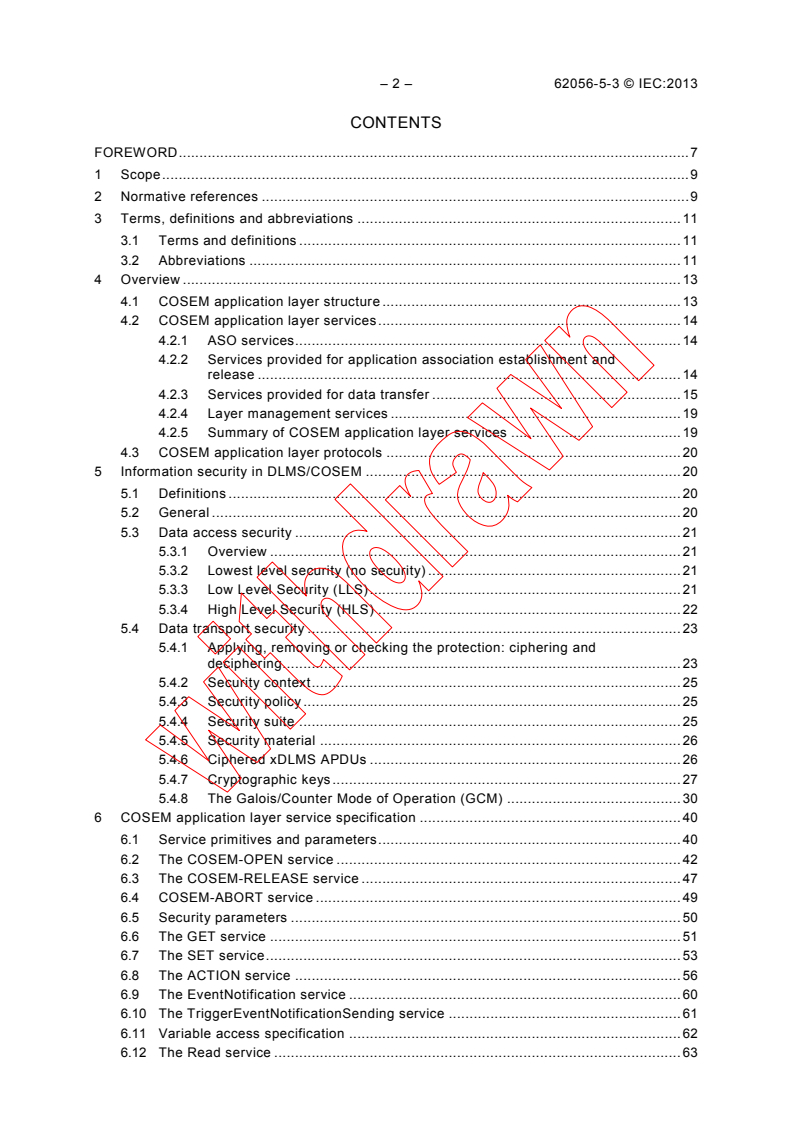
CONTENTS
FOREWORD . 7
1 Scope . 9
2 Normative references . 9
3 Terms, definitions and abbreviations . 11
3.1 Terms and definitions . 11
3.2 Abbreviations . 11
4 Overview . 13
4.1 COSEM application layer structure . 13
4.2 COSEM application layer services . 14
4.2.1 ASO services . 14
4.2.2 Services provided for application association establishment and
release . 14
4.2.3 Services provided for data transfer . 15
4.2.4 Layer management services . 19
4.2.5 Summary of COSEM application layer services . 19
4.3 COSEM application layer protocols . 20
5 Information security in DLMS/COSEM . 20
5.1 Definitions . 20
5.2 General . 20
5.3 Data access security . 21
5.3.1 Overview . 21
5.3.2 Lowest level security (no security) . 21
5.3.3 Low Level Security (LLS) . 21
5.3.4 High Level Security (HLS) . 22
5.4 Data transport security . 23
5.4.1 Applying, removing or checking the protection: ciphering and
deciphering. 23
5.4.2 Security context . 25
5.4.3 Security policy . 25
5.4.4 Security suite . 25
5.4.5 Security material . 26
5.4.6 Ciphered xDLMS APDUs . 26
5.4.7 Cryptographic keys . 27
5.4.8 The Galois/Counter Mode of Operation (GCM) . 30
6 COSEM application layer service specification . 40
6.1 Service primitives and parameters . 40
6.2 The COSEM-OPEN service . 42
6.3 The COSEM-RELEASE service . 47
6.4 COSEM-ABORT service . 49
6.5 Security parameters . 50
6.6 The GET service . 51
6.7 The SET service . 53
6.8 The ACTION service . 56
6.9 The EventNotification service . 60
6.10 The TriggerEventNotificationSending service . 61
6.11 Variable access specification . 62
6.12 The Read service . 63
62056-5-3 © IEC:2013 – 3 –
6.13 The Write service . 67
6.14 The UnconfirmedWrite service . 70
6.15 The InformationReport service. 71
6.16 Client side layer management services: the SetMapperTable.request . 72
6.17 Summary of services and LN/SN data transfer service mapping . 72
7 COSEM application layer protocol specification . 73
7.1 The control function . 73
7.1.1 State definitions of the client side control function . 73
7.1.2 State definitions of the server side control function . 75
7.2 The ACSE services and APDUs . 76
7.2.1 ACSE functional units, services and service parameters . 76
7.2.2 Registered COSEM names . 79
7.2.3 APDU encoding rules . 81
7.2.4 Protocol for application association establishment . 81
7.2.5 Protocol for application association release . 85
7.3 Protocol for the data transfer services . 89
7.3.1 Negotiation of services and options – the conformance block . 89
7.3.2 Confirmed and unconfirmed service invocations . 90
7.3.3 Protocol for the GET service . 91
7.3.4 Protocol for the SET service . 94
7.3.5 Protocol for the ACTION service . 97
7.3.6 Protocol for the EventNotification service . 99
7.3.7 Protocol for the Read service . 100
7.3.8 Protocol for the Write service. 104
7.3.9 Protocol for the UnconfirmedWrite service . 108
7.3.10 Protocol for the InformationReport service . 109
8 Abstract syntax of ACSE and COSEM APDUs . 110
Annex A (normative) Using the COSEM application layer in various communications
profiles . 124
Annex B (informative) AARQ and AARE encoding examples . 126
Annex C (informative) Encoding examples: AARQ and AARE APDUs using a ciphered
application context . 140
Annex D (informative) Data transfer service examples . 148
Annex E (informative) Overview of cryptography . 163
Annex F (informative) Significant technical changes with respect to IEC 62056-53 . 169
Bibliography . 172
Index . 174
Figure 1 – Structure of the COSEM Application layers . 13
Figure 2 – Summary of COSEM AL services . 19
Figure 3 – LLS and HLS authentication . 23
Figure 4 – Data transport security in DLMS/COSEM . 24
Figure 5 – Ciphered xDLMS APDUs . 26
Figure 6 – Cryptographic protection of xDLMS APDUs using GCM . 33
Figure 7 – Service primitives . 40
Figure 8 – Time sequence diagrams . 41
Figure 9 – Partial state machine for the client side control function . 74
– 4 – 62056-5-3 © IEC:2013
Figure 10 – Partial state machine for the server side control function . 75
Figure 11 – MSC for successful AA establishment preceded by a successful lower
layer connection establishment . 82
Figure 12 – Graceful AA release using the A-RELEASE service . 87
Figure 13 – Graceful AA release by disconnecting the supporting layer . 88
Figure 14 – Aborting an AA following a PH-ABORT.indication . 89
Figure 15 – MSC of the GET service . 92
Figure 16 – MSC of the GET service with block transfer . 92
Figure 17 – MSC of the GET service with block transfer, long GET aborted . 94
Figure 18 – MSC of the SET service . 95
Figure 19 – MSC of the SET service with block transfer . 96
Figure 20 – MSC of the ACTION service . 98
Figure 21 – MSC of the ACTION service with block transfer . 99
Figure 22 – MSC of the Read service used for reading an attribute . 102
Figure 23 – MSC of the Read service used for invoking a method . 103
Figure 24 – MSC of the Read Service used for reading an attribute, with block transfer . 104
Figure 25 – MSC of the Write service used for writing an attribute . 107
Figure 26 – MSC of the Write service used for invoking a method . 107
Figure 27 – MSC of the Write Service used for writing an attribute, with block transfer . 108
Figure 28 – MSC of the Unconfirmed Write service used for writing an attribute . 109
Figure E.1 – Hash function. 164
Figure E.2 – Encryption and decryption. 165
Figure E.3 – Message Authentication Codes (MACs) . 166
Table 1 – Clarification of the meaning of PDU Size for DLMS/COSEM . 16
Table 2 – Security suites . 26
Table 3 – Security control field . 27
Table 4 – Cryptographic keys and their management . 30
Table 5 – Plaintext and additional authenticated data . 34
Table 6 – Example for ciphered APDUs . 37
Table 7 – HLS example with GMAC . 39
Table 8 – Codes for AL service parameters . 42
Table 9 – Service parameters of the COSEM-OPEN service primitives . 43
Table 10 – Service parameters of the COSEM-RELEASE service primitives . 47
Table 11 – Service parameters of the COSEM-ABORT service primitives . 50
Table 12 – Security parameters . 50
Table 13 – Service parameters of the GET service . 51
Table 14 – GET service request and response types . 52
Table 15 – Service parameters of the SET service . 54
Table 16 – SET service request and response types . 55
Table 17 – Service parameters of the ACTION service . 57
Table 18 – ACTION service request and response types . 58
Table 19 – Service parameters of the EventNotification service primitives . 60
62056-5-3 © IEC:2013 – 5 –
Table 20 – Service parameters of the TriggerEventNotificationSending.request service
primitive . 61
Table 21 – Variable Access Specification . 63
Table 22 – Service parameters of the Read service . 64
Table 23 – Use of the Variable_Access_Specification variants and the Read.response
choices . 65
Table 24 – Service parameters of the Write service . 68
Table 25 – Use of the Variable_Access_Specification variants and the Write.response
choices . 68
Table 26 – Service parameters of the UnconfirmedWrite service . 70
Table 27 – Use of the Variable_Access_Specification variants . 71
Table 28 – Service parameters of the InformationReport service. 72
Table 29 – Service parameters of the SetMapperTable.request service primitives . 72
Table 30 – Summary of ACSE services . 73
Table 31 – Summary of xDLMS services for LN referencing . 73
Table 32 – Summary of xDLMS services for SN referencing . 73
Table 33 – ACSE functional units, services and service parameters. 77
Table 34 – Use of ciphered / unciphered APDUs . 80
Table 35 – xDLMS Conformance block . 90
Table 36 – GET service types and APDUs . 91
Table 37 – SET service types and APDUs . 95
Table 38 – ACTION service types and APDUs . 98
Table 39 – Mapping between the GET and the Read services . 100
Table 40 – Mapping between the ACTION and the Read services . 101
Table 41 – Mapping between the SET and the Write services . 105
Table 42 – Mapping between the ACTION and the Write service. 106
Table 43 – Mapping between the SET and the UnconfirmedWrite services . 108
Table 44 – Mapping between the ACTION and the UnconfirmedWrite services . 109
Table 45 – Mapping between the EventNotification and InformationReport services . 110
Table B.1 – Conformance block . 127
Table B.2 – A-XDR encoding of the xDLMS InitiateRequest APDU . 128
Table B.3 – A-XDR encoding of the xDLMS InitiateResponse APDU . 129
Table B.4 – BER encoding of the AARQ APDU . 132
Table B.5 – Complete AARQ APDU . 134
Table B.6 – BER encoding of the AARE APDU . 135
Table B.7 – The complete AARE APDU . 139
Table C.1 – A-XDR encoding of the xDLMS InitiateRequest APDU . 140
Table C.2 – Authenticated encryption of the xDLMS InitiateRequest APDU . 141
Table C.3 – BER encoding of the AARQ APDU . 142
Table C.4 – A-XDR encoding of the xDLMS InitiateResponse APDU . 143
Table C.5 – Authenticated encryption of the xDLMS InitiateResponse APDU . 144
Table C.6 – BER encoding of the AARE APDU . 145
Table C.7 – BER encoding of the RLRQ APDU . 146
Table C.8 – BER encoding of the RLRE APDU . 147
– 6 – 62056-5-3 © IEC:2013
Table D.1 – Objects used in the examples . 148
Table D.2 – Example: Reading the value of a single attribute without block transfer . 149
Table D.3 – Example: Reading the value of a list of attributes without block transfer . 150
Table D.4 – Example: Reading the value of a single attribute with block transfer . 151
Table D.5 – Example: Reading the value of a list of attributes with block transfer . 153
Table D.6 – Example: Writing the value of a single attribute without block transfer . 155
Table D.7 – Example: Writing the value of a list of attributes without block transfer . 156
Table D.8 – Example: Writing the value of a single attribute with block transfer . 158
Table D.9 – Example: Writing the value of a list of attributes with block transfer . 160
62056-5-3 © IEC:2013 – 7 –
INTERNATIONAL ELECTROTECHNICAL COMMISSION
____________
ELECTRICITY METERING DATA EXCHANGE –
THE DLMS/COSEM SUITE –
Part 5-3: DLMS/COSEM application layer
FOREWORD
1) The International Electrotechnical Commission (IEC) is a worldwide organization for standardization comprising
all national electrotechnical committees (IEC National Committees). The object of IEC is to promote
international co-operation on all questions concerning standardization in the electrical and electronic fields. To
this end and in addition to other activities, IEC publishes International Standards, Technical Specifications,
Technical Reports, Publicly Available Specifications (PAS) and Guides (hereafter referred to as “IEC
Publication(s)”). Their preparation is entrusted to technical committees; any IEC National Committee interested
in the subject dealt with may participate in this preparatory work. International, governmental and non-
governmental organizations liaising with the IEC also participate in this preparation. IEC collaborates closely
with the International Organization for Standardization (ISO) in accordance with conditions determined by
agreement between the two organizations.
2) The formal decisions or agreements of IEC on technical matters express, as nearly as possible, an international
consensus of opinion on the relevant subjects since each technical committee has representation from all
interested IEC National Committees.
3) IEC Publications have the form of recommendations for international use and are accepted by IEC National
Committees in that sense. While all reasonable efforts are made to ensure that the technical content of IEC
Publications is accurate, IEC cannot be held responsible for the way in which they are used or for any
misinterpretation by any end user.
4) In order to promote international uniformity, IEC National Committees undertake to apply IEC Publications
transparently to the maximum extent possible in their national and regional publications. Any divergence
between any IEC Publication and the corresponding national or regional publication shall be clearly indicated in
the latter.
5) IEC itself does not provide any attestation of conformity. Independent certification bodies provide conformity
assessment services and, in some areas, access to IEC marks of conformity. IEC is not responsible for any
services carried out by independent certification bodies.
6) All users should ensure that they have the latest edition of this publication.
7) No liability shall attach to IEC or its directors, employees, servants or agents including individual experts and
members of its technical committees and IEC National Committees for any personal injury, property damage or
other damage of any nature whatsoever, whether direct or indirect, or for costs (including legal fees) and
expenses arising out of the publication, use of, or reliance upon, this IEC Publication or any other IEC
Publications.
8) Attention is drawn to the Normative references cited in this publication. Use of the referenced publications is
indispensable for the correct application of this publication.
9) Attention is drawn to the possibility that some of the elements of this IEC Publication may be the subject of
patent rights. IEC shall not be held responsible for identifying any or all such patent rights.
The International Electrotechnical Commission (IEC) draws attention to the fact that it is claimed that compliance
with this International Standard may involve the use of a maintenance service concerning the stack of protocols on
which the present standard IEC 62056-5-3 is based.
The IEC takes no position concerning the evidence, validity and scope of this maintenance service.
The provider of the maintenance service has assured the IEC that he is willing to provide services under
reasonable and non-discriminatory terms and conditions for applicants throughout the world. In this respect, the
statement of the provider of the maintenance service is registered with the IEC. Information may be obtained from:
DLMS User Association
Zug/Switzerland
www.dlms.ch
___________
Device Language Message Specification.
– 8 – 62056-5-3 © IEC:2013
International Standard IEC 62056-5-3 has been prepared by IEC technical committee 13:
Electrical energy measurement, tariff- and load control.
This edition cancels and replaces IEC 62056-53 published in 2006. It constitutes a technical
revision.
The significant technical changes with respect to IEC 62056-53 are listed in Annex F.
The text of this standard is based on the following documents:
FDIS Report on voting
13/1523/FDIS 13/1541/RVD
Full information on the voting for the approval of this standard can be found in the report on
voting indicated in the above table.
This publication has been drafted in accordance with the ISO/IEC Directives, Part 2.
A list of all the parts in the IEC 62056 series, published under the general title Electricity
metering data exchange– The DLMS/COSEM suite, can be found on the IEC website.
Future standards in this series will carry the new general title as cited above. Titles of existing
standards in this series will be updated at the time of the next edition.
The numbering scheme has changed from IEC 62056-XY to IEC 62056-X-Y. For example
IEC 62056-53 becomes IEC 62056-5-3.
The committee has decided that the contents of this publication will remain unchanged until
the stability date indicated on the IEC web site under "http://webstore.iec.ch" in the data
related to the specific publication. At this date, the publication will be
• reconfirmed,
• withdrawn,
• replaced by a revised edition, or
• amended.
IMPORTANT – The 'colour inside' logo on the cover page of this publication indicates
that it contains colours which are considered to be useful for the correct
understanding of its contents. Users should therefore print this document using a
colour printer.
62056-5-3 © IEC:2013 – 9 –
ELECTRICITY METERING DATA EXCHANGE –
THE DLMS/COSEM SUITE –
Part 5-3: DLMS/COSEM application layer
1 Scope
This part of IEC 62056 specifies the DLMS/COSEM application layer in terms of structure,
services and protocols for COSEM clients and servers, and defines how to use the
DLMS/COSEM application layer in various communication profiles.
It defines services for establishing and releasing application associations, and data
communication services for accessing the methods and attributes of COSEM interface
objects, defined in IEC 62056-6-2 , using either logical name (LN) or short name (SN)
referencing.
Annex A (normative) defines how to use the COSEM application layer in various
communication profiles. It specifies how various communication profiles can be constructed
for exchanging data with metering equipment using the COSEM interface model, and what are
the necessary elements to specify in each communication profile. The actual, media-specific
communication profiles are specified in separate parts of the IEC 62056 series.
Annex B, Annex C and Annex D (informative) include encoding examples for APDUs.
Annex E (informative) provides an overview of cryptography.
2 Normative references
The following documents, in whole or in part, are normatively referenced in this document and
are indispensable for its application. For dated references, only the edition cited applies. For
undated references, the latest edition of the referenced document (including any
amendments) applies.
IEC 61334-4-41:1996, Distribution automation using distribution line carrier systems – Part 4:
Data communication protocols – Section 41: Application protocols – Distribution line message
specification
IEC 61334-6:2000, Distribution automation using distribution line carrier systems – Part 6: A-
XDR encoding rule
IEC/TR 62051:1999, Electricity metering – Glossary of terms
IEC/TR 62051-1:2004, Electricity metering – Data exchange for meter reading, tariff and load
control – Glossary of terms – Part 1: Terms related to data exchange with metering equipment
using DLMS/COSEM
___________
To be published simultaneously with this part of IEC 62056.
– 10 – 62056-5-3 © IEC:2013
IEC 62056-6-1:—, Electricity metering data exchange – The DLMS/COSEM suite – Part 6-1:
Object Identification System (OBIS)
IEC 62056-6-2:—, Electricity metering data exchange – The DLMS/COSEM suite – Part 6-2:
COSEM interface classes
IEC 62056-8-3:—, Electricity metering data exchange – The DLMS/COSEM suite – Part 8-3:
Communication profile for PLC S-FSK neighbourhood networks
ISO/IEC 15953:1999, Information technology – Open Systems Interconnection – Service
definition for the Application Service Object Association Control Service Element
ISO/IEC 15954:1999, Information technology – Open Systems Interconnection – Connection-
mode protocol for the Application Service Object Association Control Service Element
ISO/IEC 8824-1:2008, Information technology – Abstract Syntax Notation One (ASN.1):
Specification of basic notation
ISO/IEC 8825-1:2008, Information technology – ASN.1 encoding rules: Specification of Basic
Encoding Rules (BER), Canonical Encoding Rules (CER) and Distinguished Encoding Rules
(DER)
FIPS PUB 180-1:2002, Secure hash standard
FIPS PUB 197:2001, Advanced Encryption Standard (AES)
NIST SP 800-38D:2007, Recommendation for Block Cipher Modes of Operation:
Galois/Counter Mode (GCM) and GMAC
NIST SP 800-57:2006, Recommendation for Key Management – Part 1: General (Revised)
RFC 1321:1992, Internet Engineering Task Force (IETF). The MD5 Message-Digest
Algorithm. Edited by R. Rivest (MIT Laboratory for Computer Science and RSA Data Security,
Inc.) April 1992. Available from: http://www.rfc-editor.org/rfc/rfc1321.txt
RFC 3394:2002, Internet Engineering Task Force (IETF). Advanced Encryption Standard
(AES) Key Wrap Algorithm. Edited by J. Schaad (Soaring Hawk Consulting) and R. Housley
(RSA Laboratories) September 2002. Available from: http://www.rfc-editor.org/rfc/rfc3394.txt
RFC 4106:2005, The Use of Galois/Counter Mode (GCM) in IPsec Encapsulating Security
Payload (ESP)
NOTE See also the Bibliography.
___________
To be published simultaneously with this part of IEC 62056.
To be published simultaneously with this part of IEC 62056.
To be published simultaneously with this part of IEC 62056.
62056-5-3 © IEC:2013 – 11 –
3 Terms, definitions and abbreviations
3.1 Terms and definitions
For the purposes of this document, the terms and definitions given in RFC 4106,
IEC/TR 62051 and IEC/TR 62051-1 and the following apply.
3.2 Abbreviations
AA Application Association
AAD Additional Authenticated Data (used with ciphering of APDUs)
AARE A-Associate Response – an APDU of the ACSE
AARQ A-Associate Request – an APDU of the ACSE
ACPM Association Control Protocol Machine
ACSE Association Control Service Element
AE Application Entity
AES Advanced Encryption Standard
AL Application Layer
AP Application Process
APDU Application Layer Protocol Data Unit
API Application Programming Interface
ASE Application Service Element
ASO Application Service Object
A-XDR Adapted Extended Data Representation
base_name The short_name corresponding to the first attribute (“logical_name”) of a
COSEM object
BER Basic Encoding Rules
CF Control Function
CL Connectionless
Client A station, asking for services. In the case of the 3-layer, CO HDLC based
profile it is the master station
.cnf .confirm service primitive
CO Connection-oriented
COSEM Companion Specification for Energy Metering
COSEM class_id COSEM interface class identifier
COSEM object An instance of a COSEM interface class
DCS Data Collection System
DLMS Device Language Message Specification
DLMS UA DLMS User Association
FCS Frame Check Sequence
FIPS Federal Information Processing Standard
GCM Galois/Counter Mode, an algorithm for authenticated encryption with
associated data
GMAC A specialization of GCM for generating a message authentication code
(MAC) on data that is not encrypted
HDLC High-level Data Link Control
– 12 – 62056-5-3 © IEC:2013
HLS High Level Security
HMAC Keyed-Hash Message Authentication Code
IEEE Institute of Electrical and Electronics Engineers
IETF Internet Engineering Task Force
.ind .indication service primitive
IP Internet Protocol
ISO International Organization for Standardization
IV Initialization Vector
LDN Logical Device Name
LLC Logical Link Control (Sublayer)
LLS Low Level Security
LSB Least Significant Bit
MAC Medium Access Control (sublayer)
MAC Message Authentication Code (cryptography)
master Central station – station which takes the initiative and controls the data
flow
MSB Most Significant Bit
MSC Message Sequence Chart
NIST National Institute of Standards and Technology
OBIS OBject Identification System
OSI Open System Interconnection
PDU Protocol Data Unit
PHSDU PH SDU
PLC Power line carrier
PPP Point-to-Point Protocol
.req .request service primitive
.res .response service primitive
RLRE A-Release Response – an APDU of the ACSE
RLRQ A-Release Request – an APDU of the ACSE
SAP Service Access Point
Server A station, delivering services. The tariff device (meter) is normally the
server, delivering the requested values or executing the requested tasks.
TCP Transmission Control Protocol
TDEA Triple Data Encryption Algorithm
UDP User Datagram Protocol
VAA Virtual Application Association
xDLMS_ASE Extended DLMS Application Service Element
62056-5-3 © IEC:2013 – 13 –
4 Overview
4.1 COSEM application layer structure
The structure of the client and server COSEM application layers is shown in Figure 1.
COSEM client
COSEM server
Application Process
Application Process
COSEM client ASO services
COSEM server ASO services
Referencing by Logical Name
COSEM client application layer
COSEM server application layer
COSEM client ASO
COSEM server ASO
Client control function
Server control function
Client
xDLMS_ ASE
Client
Server Server
ACSE
Client xDLMS_ ASE ACSE
SN_MAPPER
Supporting layer services Supporting layer services
Supporting layer Supporting layer
and
and
other protocol layers other protocol layers
WAN, LAN
IEC 1112/13
Figure 1 – Structure of the COSEM Application layers
The main component of the COSEM AL is the COSEM Application Service Object. It provides
services to its service user, the COSEM Application Process, and uses services provided by
the supporting lower layer. It contains three mandatory components both on the client and on
the server side:
• the Association Control Service Element, ACSE;
• the extended DLMS Application Service Element, xDLMS_ASE;
• the Control Function, CF.
On the client side, there is a fourth, optional element, called the SN_MAPPER ASE.
The task of the ACSE is to establish, maintain, and release application associations. For the
purposes of DLMS/COSEM connection oriented (CO) communication profiles, the CO ACSE,
specified in ISO/IEC 15953 and ISO/IEC 15954 is used.
The task of the xDLMS_ASE is to provide data transfer services between COSEM APs. It is
based on the DLMS standard, IEC 61334-4-41. It has been extended for DLMS/COSEM; see
4.2.3.1. The main objective of DLMS/COSEM is to provide a business domain oriented
interface object model for metering devices and systems while keeping backward compatibility
with the DLMS standard. To meet these objectives, DLMS/COSEM includes an evolution of
DLMS. Remaining fully compliant to the DLMS standard, DLMS/COSEM provides a more
metering specific view of the meter through the COSEM interface objects.
IEC 62056-6-2:—, 4.2 specifies two referencing methods to attributes and methods of COSEM
interface objects for use in COSEM servers: LN and SN referencing. When LN referencing is
used, the Logical Name of the COSEM objects shall be as specified in IEC 62056-6-1.
Therefore, on the server side, two distinct xDLMS service sets are specified: one exclusively
Applications
Protocol
(interface objects)
(communications)
– 14 – 62056-5-3 © IEC:2013
for LN referencing and the other exclusively for SN referencing. It can be considered that
there are two different xDLMS_ASEs: one providing services for LN referencing and the other
for SN referencing. The server AL may include one, the other or both xDLMS_ASEs.
The CF element specifies how the ASO services invoke the appropriate service primitives of
the ACSE, the xDLMS_ASE and the services of the supporting layer.
NOTE Both the client and the server COSEM ASO can contain other, optional application protocol components.
The optional SN_MAPPER ASE is present in the client side AL ASO, when the server uses SN
referencing. It provides mapping between services using LN and SN referencing. See also
6.17.
The COSEM AL also performs some functions of the OSI presentation layer:
• encoding the ACSE APDUs in BER (ISO/IEC 8825-1). See also 7.2.3;
• encoding the xDLMS APDUs carrying the data transfer services in A-XDR (IEC 61334-6).
4.
...