

IEC SRD 62913-2-2:2019
(Main)Generic smart grid requirements - Part 2-2: Market related domain
General Information
- Abstract
IEC SRD 62913-2-2:2019(E) initiates and illustrates the IEC’s systems approach based on Use Cases and involving the identification of generic smart grid requirements for further standardization work for market related domains, based on the methods and tools developed in IEC SRD 62913-1.
It captures possible “common and repeated usage” of a smart grid system, under the format of “Use Cases” with a view to feeding further standardization activities. Use Cases can be described in different ways and can represent competing alternatives. From there, this document derives the common requirements to be considered by these further standardization activities in terms of interfaces between actors interacting with the given system.
To this end, Use Case implementations are given for information purposes only. The interface requirements to be considered for later standardization activities are summarized (typically information pieces, communication services and specific non-functional requirements: performance level, security specification, etc.).
- Status
- Published
- Publication Date
- 16-May-2019
- Technical Committee
- SyC Smart Energy - Smart Energy
- Drafting Committee
- WG 6 - SyC Smart Energy/WG 6
- Current Stage
- PPUB - Publication issued
- Start Date
- 17-May-2019
- Completion Date
- 30-May-2019
Overview
IEC SRD 62913-2-2:2019 is an international standard developed by the International Electrotechnical Commission (IEC) that defines generic smart grid requirements for the market-related domain. As part of the IEC SRD 62913 family, this standard builds on a systems approach utilizing use cases to identify common, repeatable requirements for smart grid functions in energy markets. The primary goal of IEC SRD 62913-2-2 is to guide further standardization activities by summarizing key requirements for interfaces and interactions between various market actors in smart grid systems.
By employing use case methodology, the document provides a neutral, practical framework for analyzing recurring scenarios in electricity markets. This supports interoperability, performance, and security across different market models and regulatory frameworks, helping stakeholders achieve reliable and efficient smart grid operations.
Key Topics
- Systems Approach and Use Case Methodology
Promotes a holistic view of market-related smart grid activities by detailing functional requirements and interfaces using representative real-world scenarios. - Identification of Market Actors and Roles
Lists and describes typical business roles (e.g., balance responsible parties, grid operators, suppliers, flexibility aggregators, producers, consumers, and prosumers) involved in electricity markets. - Flexibility and Demand Response
Defines concepts such as active demand, flexibility, and aggregation to address variable renewable generation and dynamic customer participation. - Market Mechanisms and Processes
Explores the integration of flexibility products and services, and how they are traded, managed, and coordinated to maintain grid reliability. - Information Exchange and Security
Summarizes requirements relating to information pieces, communication services, and non-functional needs such as security and performance. - Interoperability and Integration
Supports harmonization and interoperability across market players and systems, facilitating seamless participation in electricity markets.
Applications
IEC SRD 62913-2-2:2019 provides practical value to a wide range of stakeholders involved in smart grid development and deployment:
- Grid Operators and System Planners:
Use the standard to define interface and data exchange requirements for market participation, support grid reliability, and enable new flexibility services. - Market Operators and Regulators:
Refer to use case-based requirements to ensure efficient, secure, and transparent market design and operation, supporting customer empowerment and fair competition. - Technology Vendors and Integrators:
Apply standardized requirements for implementing software, communication, and automation solutions that interact with diverse market actors. - Energy Service Providers:
Leverage clear process definitions for rolling out demand response, aggregation, and flexibility management solutions in compliance with international best practices. - Policy Makers:
Utilize the systems approach to facilitate policies promoting smart energy markets, encourage the integration of renewables, and ensure security of supply. - Researchers and Consultants:
Benefit from well-defined roles and use cases for market-related grid activities to inform studies, pilot projects, and roadmapping exercises.
Related Standards
IEC SRD 62913-2-2:2019 is closely related to several standards and reference frameworks:
- IEC SRD 62913-1:
Outlines the use case methodology and systems approach for defining smart grid requirements across domains. - IEC SRD 62913 Series (Parts 2-1, 2-3, 2-4):
Cover requirements for other smart grid domains, including grid management, connected resources, and electric transportation. - IEC 62559-2:
Provides templates for use case description and management. - IEC 60050 (Electropedia):
Supplies standardized terminology for smart grid and electricity markets. - ENTSO-E, European and Regional Market Models:
Inform the identification of roles and processes addressed in the standard.
Keywords:
IEC SRD 62913-2-2:2019, smart grid requirements, market related domain, use case methodology, flexibility products, demand response, market actors, interoperability, electricity markets, energy systems standardization.
Get Certified
Connect with accredited certification bodies for this standard

IMQ S.p.A. (Certification)
Italian electrical product certification.

SLG Prüf- und Zertifizierungs GmbH
German testing and certification body.

UL Solutions
Global safety science company with testing, inspection and certification.
Sponsored listings
Frequently Asked Questions
IEC SRD 62913-2-2:2019 is a standard published by the International Electrotechnical Commission (IEC). Its full title is "Generic smart grid requirements - Part 2-2: Market related domain". This standard covers: IEC SRD 62913-2-2:2019(E) initiates and illustrates the IEC’s systems approach based on Use Cases and involving the identification of generic smart grid requirements for further standardization work for market related domains, based on the methods and tools developed in IEC SRD 62913-1. It captures possible “common and repeated usage” of a smart grid system, under the format of “Use Cases” with a view to feeding further standardization activities. Use Cases can be described in different ways and can represent competing alternatives. From there, this document derives the common requirements to be considered by these further standardization activities in terms of interfaces between actors interacting with the given system. To this end, Use Case implementations are given for information purposes only. The interface requirements to be considered for later standardization activities are summarized (typically information pieces, communication services and specific non-functional requirements: performance level, security specification, etc.).
IEC SRD 62913-2-2:2019(E) initiates and illustrates the IEC’s systems approach based on Use Cases and involving the identification of generic smart grid requirements for further standardization work for market related domains, based on the methods and tools developed in IEC SRD 62913-1. It captures possible “common and repeated usage” of a smart grid system, under the format of “Use Cases” with a view to feeding further standardization activities. Use Cases can be described in different ways and can represent competing alternatives. From there, this document derives the common requirements to be considered by these further standardization activities in terms of interfaces between actors interacting with the given system. To this end, Use Case implementations are given for information purposes only. The interface requirements to be considered for later standardization activities are summarized (typically information pieces, communication services and specific non-functional requirements: performance level, security specification, etc.).
IEC SRD 62913-2-2:2019 is classified under the following ICS (International Classification for Standards) categories: 29.020 - Electrical engineering in general; 29.240 - Power transmission and distribution networks; 33.200 - Telecontrol. Telemetering. The ICS classification helps identify the subject area and facilitates finding related standards.
IEC SRD 62913-2-2:2019 is available in PDF format for immediate download after purchase. The document can be added to your cart and obtained through the secure checkout process. Digital delivery ensures instant access to the complete standard document.
Standards Content (Sample)
IEC SRD 62913-2-2 ®
Edition 1.0 2019-05
SYSTEMS
REFERENCE DELIVERABLE
colour
inside
Generic smart grid requirements –
Part 2-2: Market related domain
All rights reserved. Unless otherwise specified, no part of this publication may be reproduced or utilized in any form
or by any means, electronic or mechanical, including photocopying and microfilm, without permission in writing from
either IEC or IEC's member National Committee in the country of the requester. If you have any questions about IEC
copyright or have an enquiry about obtaining additional rights to this publication, please contact the address below or
your local IEC member National Committee for further information.
IEC Central Office Tel.: +41 22 919 02 11
3, rue de Varembé info@iec.ch
CH-1211 Geneva 20 www.iec.ch
Switzerland
About the IEC
The International Electrotechnical Commission (IEC) is the leading global organization that prepares and publishes
International Standards for all electrical, electronic and related technologies.
About IEC publications
The technical content of IEC publications is kept under constant review by the IEC. Please make sure that you have the
latest edition, a corrigendum or an amendment might have been published.
IEC publications search - webstore.iec.ch/advsearchform Electropedia - www.electropedia.org
The advanced search enables to find IEC publications by a The world's leading online dictionary on electrotechnology,
variety of criteria (reference number, text, technical containing more than 22 000 terminological entries in English
committee,…). It also gives information on projects, replaced and French, with equivalent terms in 16 additional languages.
and withdrawn publications. Also known as the International Electrotechnical Vocabulary
(IEV) online.
IEC Just Published - webstore.iec.ch/justpublished
Stay up to date on all new IEC publications. Just Published IEC Glossary - std.iec.ch/glossary
details all new publications released. Available online and 67 000 electrotechnical terminology entries in English and
once a month by email. French extracted from the Terms and Definitions clause of
IEC publications issued since 2002. Some entries have been
IEC Customer Service Centre - webstore.iec.ch/csc collected from earlier publications of IEC TC 37, 77, 86 and
If you wish to give us your feedback on this publication or CISPR.
need further assistance, please contact the Customer Service
Centre: sales@iec.ch.
IEC SRD 62913-2-2 ®
Edition 1.0 2019-05
SYSTEMS
REFERENCE DELIVERABLE
colour
inside
Generic smart grid requirements –
Part 2-2: Market related domain
INTERNATIONAL
ELECTROTECHNICAL
COMMISSION
ICS 29.020; 29.240; 33.200 ISBN 978-2-8322-6881-0
– 2 – IEC SRD 62913-2-2:2019 © IEC 2019
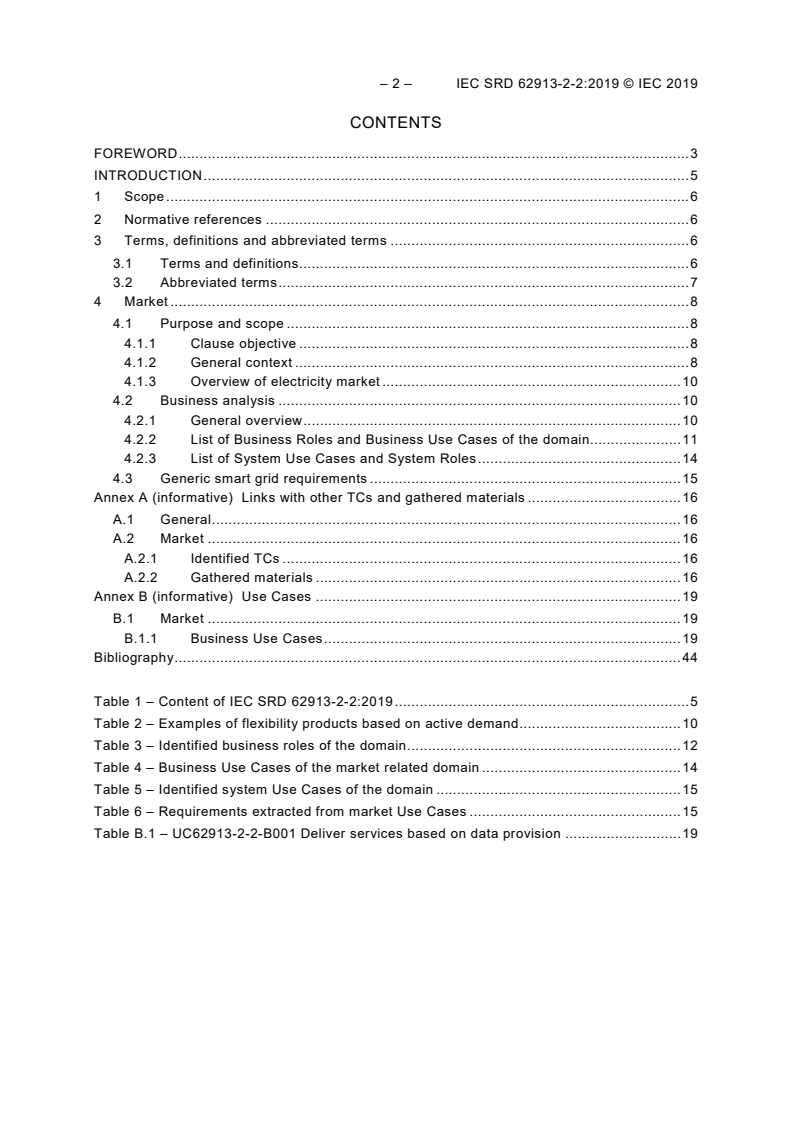
CONTENTS
FOREWORD . 3
INTRODUCTION . 5
1 Scope . 6
2 Normative references . 6
3 Terms, definitions and abbreviated terms . 6
3.1 Terms and definitions . 6
3.2 Abbreviated terms . 7
4 Market . 8
4.1 Purpose and scope . 8
4.1.1 Clause objective . 8
4.1.2 General context . 8
4.1.3 Overview of electricity market . 10
4.2 Business analysis . 10
4.2.1 General overview . 10
4.2.2 List of Business Roles and Business Use Cases of the domain. 11
4.2.3 List of System Use Cases and System Roles . 14
4.3 Generic smart grid requirements . 15
Annex A (informative) Links with other TCs and gathered materials . 16
A.1 General . 16
A.2 Market . 16
A.2.1 Identified TCs . 16
A.2.2 Gathered materials . 16
Annex B (informative) Use Cases . 19
B.1 Market . 19
B.1.1 Business Use Cases . 19
Bibliography . 44
Table 1 – Content of IEC SRD 62913-2-2:2019 . 5
Table 2 – Examples of flexibility products based on active demand . 10
Table 3 – Identified business roles of the domain . 12
Table 4 – Business Use Cases of the market related domain . 14
Table 5 – Identified system Use Cases of the domain . 15
Table 6 – Requirements extracted from market Use Cases . 15
Table B.1 – UC62913-2-2-B001 Deliver services based on data provision . 19
INTERNATIONAL ELECTROTECHNICAL COMMISSION
____________
GENERIC SMART GRID REQUIREMENTS –
Part 2-2: Market related domain
FOREWORD
1) The International Electrotechnical Commission (IEC) is a worldwide organization for standardization comprising
all national electrotechnical committees (IEC National Committees). The object of IEC is to promote
international co-operation on all questions concerning standardization in the electrical and electronic fields. To
this end and in addition to other activities, IEC publishes International Standards, Technical Specifications,
Technical Reports, Publicly Available Specifications (PAS) and Guides (hereafter referred to as “IEC
Publication(s)”). Their preparation is entrusted to technical committees; any IEC National Committee interested
in the subject dealt with may participate in this preparatory work. International, governmental and non-
governmental organizations liaising with the IEC also participate in this preparation. IEC collaborates closely
with the International Organization for Standardization (ISO) in accordance with conditions determined by
agreement between the two organizations.
2) The formal decisions or agreements of IEC on technical matters express, as nearly as possible, an international
consensus of opinion on the relevant subjects since each technical committee has representation from all
interested IEC National Committees.
3) IEC Publications have the form of recommendations for international use and are accepted by IEC National
Committees in that sense. While all reasonable efforts are made to ensure that the technical content of IEC
Publications is accurate, IEC cannot be held responsible for the way in which they are used or for any
misinterpretation by any end user.
4) In order to promote international uniformity, IEC National Committees undertake to apply IEC Publications
transparently to the maximum extent possible in their national and regional publications. Any divergence
between any IEC Publication and the corresponding national or regional publication shall be clearly indicated in
the latter.
5) IEC itself does not provide any attestation of conformity. Independent certification bodies provide conformity
assessment services and, in some areas, access to IEC marks of conformity. IEC is not responsible for any
services carried out by independent certification bodies.
6) All users should ensure that they have the latest edition of this publication.
7) No liability shall attach to IEC or its directors, employees, servants or agents including individual experts and
members of its technical committees and IEC National Committees for any personal injury, property damage or
other damage of any nature whatsoever, whether direct or indirect, or for costs (including legal fees) and
expenses arising out of the publication, use of, or reliance upon, this IEC Publication or any other IEC
Publications.
8) Attention is drawn to the Normative references cited in this publication. Use of the referenced publications is
indispensable for the correct application of this publication.
9) Attention is drawn to the possibility that some of the elements of this IEC Publication may be the subject of
patent rights. IEC shall not be held responsible for identifying any or all such patent rights.
IEC SRD 62913-2-2, which is a Systems Reference Deliverable, has been prepared by
IEC systems committee Smart Energy.
The text of this Systems Reference Deliverable is based on the following documents:
Draft SRD Report on voting
SyCSmartEnergy/88/DTS SyCSmartEnergy/97/RVDTS
Full information on the voting for the approval of this Systems Reference Deliverable can be
found in the report on voting indicated in the above table.
This document has been drafted in accordance with the ISO/IEC Directives, Part 2.
A list of all parts in the IEC SRD 62913 series, published under the general title Generic smart
grid requirements, can be found on the IEC website.
– 4 – IEC SRD 62913-2-2:2019 © IEC 2019
The committee has decided that the contents of this publication will remain unchanged until
the stability date indicated on the IEC website under "http://webstore.iec.ch" in the data
related to the specific publication. At this date, the publication will be
• reconfirmed,
• withdrawn,
• replaced by a revised edition, or
• amended.
A bilingual version of this publication may be issued at a later date.
IMPORTANT – The 'colour inside' logo on the cover page of this publication indicates
that it contains colours which are considered to be useful for the correct
understanding of its contents. Users should therefore print this document using a
colour printer.
INTRODUCTION
Under the general title Generic smart grid requirements, the IEC SRD 62913 series consists
of the following parts:
– Part 1: Specific application of the Use Case methodology for defining generic smart grid
requirements according to the IEC systems approach;
– Part 2: is composed of five subparts which refer to the clusters that group several domains:
• Part 2-1: Grid related domains – these include transmission grid management,
distribution grid management, microgrids and smart substation automation;
• Part 2-2: Market related domain;
• Part 2-3: Resources connected to the grid domains – these include bulk generation,
distributed energy resources, smart home / commercial / industrial / DR-customer
energy management, and energy storage;
• Part 2-4: Electric transportation related domain;
IEC SRD 62913 refers to 'clusters' of domains for its different parts so as to provide a neutral
term for document management purposes simply because it is necessary to split in several
documents the broad scope of smart grid.
The document for each domain is composed as follows.
• Purpose and scope.
• Business analysis: to address domain’s strategic goals and principles regarding its smart
grid environment. It also lists business use cases and system use cases identified, their
associated business roles and system roles (actors) and the simplified role model
highlighting main interactions between actors.
• Generic smart grid requirements: extracted from Use Cases described in Annex B.
• Annex A lists links between domains, technical committees and gathered materials
(existing standardization documents, user stories, Use Cases and functional architectures).
• Annex B includes a complete description of Use Cases per domain based on IEC 62559-2.
• Bibliography.
The purpose of this document is to define the generic smart grid requirements of the market
related domain, based on the methods and tools developed in IEC SRD 62913-1.
This analysis is based on the business input from domain experts as well as existing material
on grid management in a smart grid environment when relevant. Table 1 highlights the
domains and business use cases described in this document.
Table 1 – Content of IEC SRD 62913-2-2:2019
Domain Content Scope
Market Described with 1 business Use Case
and 6 system Use Cases identified
– 6 – IEC SRD 62913-2-2:2019 © IEC 2019
GENERIC SMART GRID REQUIREMENTS –
Part 2-2: Market related domain
1 Scope
This part of IEC SRD 62913 initiates and illustrates the IEC’s systems approach based on
Use Cases and involving the identification of generic smart grid requirements for further
standardization work for market related domains, based on the methods and tools developed
in IEC SRD 62913-1.
It captures possible “common and repeated usage” of a smart grid system, under the format
of “Use Cases” with a view to feeding further standardization activities. Use Cases can be
described in different ways and can represent competing alternatives. From there, this
document derives the common requirements to be considered by these further standardization
activities in terms of interfaces between actors interacting with the given system.
To this end, Use Case implementations are given for information purposes only. The interface
requirements to be considered for later standardization activities are summarized (typically
information pieces, communication services and specific non-functional requirements:
performance level, security specification, etc.).
2 Normative references
There are no normative references in this document.
3 Terms, definitions and abbreviated terms
3.1 Terms and definitions
For the purposes of this document, the following terms and definitions apply.
ISO and IEC maintain terminological databases for use in standardization at the following
addresses:
• IEC Electropedia: available at http://www.electropedia.org/
• ISO Online browsing platform: available at http://www.iso.org/obp
3.1.1
active demand definition
demand offered for the purposes of, but not restricted to, providing active power management,
voltage and frequency regulation and system reserve
3.1.2
aggregation
process of combining data from various sources
[SOURCE: ISO/IEC 29182-2:2013, 2.4.2]
3.1.3
dispatchable generation source
source of electricity that can be dispatched at the request of power grid operators or of the
plant owner
Note 1 to entry: That is, generating plants that can be turned on or off, or can adjust their power output according
to an order.
3.1.4
flexibility
modification of electricity injection and/or extraction, on an individual or aggregated level, in
reaction to an external signal in order to provide a service within the energy system
Note 1 to entry: This definition is based on EURELECTRIC, Active Distribution System management. A key tool
for the smooth integration of distributed generation, 2013.
3.1.5
flexibility aggregator
entity that buys and aggregates the flexibility of consumption (demand response) and
distributed generation in order to value them on the market and through the transportation
products (adjustment mechanism, capacity market)
Note 1 to entry: Flexibility aggregator contracts with end-customer directly or through an intermediary like an
energy supplier.
3.1.6
quality of service
collective effect of service performance which determines the degree of satisfaction of a user
of the service
Note 1 to entry: The quality of service is characterized by the combined aspects of service support performance,
service operability performance, serveability performance, service integrity and other factors specific to each
service.
[SOURCE: IEC 60050-191:1990, 191-19-01]
3.1.7
security
ability to operate in such a way that credible events do not give
rise to loss of load, stresses of system components beyond their ratings, bus voltages or
system frequency outside tolerances, instability, voltage collapse, or cascading
Note 1 to entry: In the context of smart grid, the term ‘security’ may be too vague. In this document it may be
replaced by ‘operational reliability’ or ‘operational security’ to reflect the real practices of, for example, NERC or
ENTSO-E.
[SOURCE: IEC 60050-191:1999, 191-21-03]
3.1.8
work programme
schedule for operations related to the creation, maintenance, and repair of network assets on
the transmission or distribution grid
[SOURCE: evolvDSO, D2.1 Business Use Cases Definition and requirements, 2014]
3.2 Abbreviated terms
BRP Balance Responsible Party
CBA Cost Benefit Analysis
EHV Extremely High Voltage
DER Distributed Energy Resources
DR Demand-Response
DSO Distribution System Operator
FCR Frequency Control Reserve
FRR Frequency Restoration Reserve
– 8 – IEC SRD 62913-2-2:2019 © IEC 2019
HV High Voltage
HVDC High Voltage Direct Current
LV Low Voltage
MV Medium Voltage
RR Restoration Reserve
SGAM Smart Grid Architecture Model
TSO Transmission System Operator
4 Market
4.1 Purpose and scope
4.1.1 Clause objective
The purpose of Clause 4 is to present a business analysis of the market domain in a smart
grid context, and more specifically to describe the smart grid requirements of the domain
using the generic Use Case approach as defined in [1] . This analysis is based on a
European perspective, and will need to be extended to other regions (such as North-American
markets).
4.1.2 General context
4.1.2.1 General
Two technological trends are impacting the electric power system:
• the development of distributed renewable energy sources, which are intermittent;
• the development of smart grid technologies.
4.1.2.2 An electric power system perspective – the need to strengthen the
management of balance between demand and supply through interconnected
transmission grids
The functioning of the electric power system requires maintaining the balance between supply
and demand at any time, in order to avoid situations leading to load shedding or even
blackouts, which could have dramatic economic consequences.
The electric power system, in which balance between demand and supply is managed at the
level of transmission networks by the TSO, provides the following benefits.
• It contributes to ensure security of supply and cost optimization to the benefits of
consumers, by reducing and localizing the impacts of faults and other unexpected events,
and by using the most efficient generation capacities at each synchronous area at first and
if not existing at the national level.
• It offers a better use and increases the value of intermittent renewable energy sources, by
mitigating their variations (see for example North-South grid interconnections in Germany).
• It allows solidarity between regions which have high penetration of distributed renewable
energy sources and others with lower shares of renewable energy sources.
To ensure the reliability of the electric power system, stakeholders can rely on the following
key players:
Numbers in square brackets refer to the Bibliography.
• regulated actors, like system and grid operators, who manage the networks and ensure
physical balance between production and consumption in their balancing zone for system
operators;
• deregulated actors (such as suppliers/retailers, flexibility aggregators, producers, or
electricity traders/brokers), who operate within a balancing zone, on which balance
responsible parties have a financial responsibility.
4.1.2.3 Evolutions needed for the electric power system
4.1.2.3.1 A need for more flexibilities
First, the development of renewable energy sources, more particularly wind and solar power,
increases the variability and uncertainties on balance between supply and demand. The
electric power system will need more flexibility to maintain this balance and further face new
challenges.
A global cost benefit analysis (CBA) should be achieved to assess the economic relevance of
the flexibility versus grids developments.
4.1.2.3.2 New constraints in distribution networks
The increased penetration of distributed generation from renewable energy sources into
distribution and transmission networks tends to generate operational problems. The risk to
violate grid operational constraints increases.
Grid operators have traditionally managed these constraints in the long term with network
reinforcement, investments, and in the operational time horizon by switching actions,
emergency control of customers and, if other means fail, by disconnection of less critical
feeders and customers.
Otherwise the result is an uncontrolled wider and longer nonselective blackout.
A more dynamic management of the grid would allow grid operators to optimize network
investments and to reduce the risk of blackouts and a loss or limitation of customers’ physical
access to the market.
With the increasingly dynamic power flows, it also becomes necessary to take into account
the dynamic grid constraints in the electricity markets in a fair and transparent way.
4.1.2.3.3 Expected benefits of smart grid technologies on flexibilities and network
management
Furthermore, smart grid technologies, including the deployment of smart metering systems for
residential and business customers and communicating electrical equipment, will enable the
development of further flexibilities and contribute to the reliability and efficiency of the electric
power system.
These flexibilities, which can be defined as a modification of injection and/or extraction on an
individual or aggregated level, in reaction to an external signal in order to provide a service
within the energy system, may be traded within the electricity market, to deliver ancillary
services, services to grid operators, for the TSO for balancing purposes, or to allow an
optimization of production costs for instance.
Flexibilities can be incentivized and remunerated by:
• a variation of electricity prices (purchased or supplied),
• a variation of network tariffs,
• a direct compensation for the provider of the flexibility.
– 10 – IEC SRD 62913-2-2:2019 © IEC 2019
Furthermore, the activation of localized flexibilities (injection or extraction) can allow system
and grid operators to solve specific grid constraints. These local flexibilities, developed by
actors within their balancing zone, impact the balance between supply and demand and
therefore have to be taken into account in its management at a system level.
Table 2 lists some examples of flexibility products based on active demand, as well as their
main characteristics.
Table 2 – Examples of flexibility products based on active demand
Active demand Conditionality Typical example
product
Bi-directional conditional Conditional (real Having the capacity to provide a specified demand
re-profiling option) modification during a given period in a bi-directional range
[y, x] MW, including both demand increase and decrease.
The delivery is called upon by the buyer of the active
demand product (similar to a reserve service).
Conditional re-profiling Conditional (real Having the capacity to provide a specified demand
option) modification during a given period. The delivery is called
upon by the buyer of the active demand product (similar to
a reserve service).
Scheduled re-profiling Unconditional Obligation to provide a specified demand modification
(obligation) (reduction or increase) at a given time to the product
buyer.
The business analysis of the market domain will detail how these flexibilities can be provided
and used by various roles of the electric power system within the electricity market.
4.1.3 Overview of electricity market
The purpose of electricity market is to allow actors of the electric power system to purchase
and sell energy and energy-related products and services. Trading can take place:
• on stock exchanges – such as EPEX Spot for instance;
• via mutual agreement (direct or brokered).
Even though the domain is referred to as “market” in the singular, it is more accurate to speak
about “electricity markets” in the plural. Indeed, separate marketplaces or market mechanisms
with specific sets of rules, roles, and objectives may exist in the same zone and even be
coordinated.
The business analysis of the domain focuses on the flexibility products and services traded
within electricity markets which allow market players to execute/enable their business
processes. These internal processes are out of the scope of this document.
4.2 Business analysis
4.2.1 General overview
The electricity markets are going to have a preponderant place for the whole electric power
system. The development of new electricity usages and the integration of DER need reliable
and efficient market mechanisms. To contribute to the security of the system and to obtain the
best deals between market participants, the development of market facilities, market products
and a better cooperation between actors are required.
Flexibility products and services may be traded within existing or new markets and market
mechanisms – depending on various elements such as legal rules, the time scale or
geographic scale.
Here are some major improvements expected for the main domain business roles from the
integration of flexibility products and services within electricity markets.
• End-customers may benefit from better energy supply contracts and reduced electricity
bills if they accept to modulate their consumption and participate in the market (via a
supplier, a flexibility aggregator/operator, or another third party).
• Suppliers will be able to propose to their customers flexible offers and create value with
attractive tariffs, by developing active demand offers combined with competitive tariffs
during off-peak periods and/or less competitive tariffs during peak periods for instance.
This flexibility can create value on energy markets or allow system or grid operators to
solve network constraints. Suppliers may also participate in a capacity market or
mechanism – when such a market/mechanism has been implemented.
• Flexibility aggregators will develop, offer and manage various flexibility products and
stakeholders for grid users (consumers, producers, and/or prosumers), system operators,
or grid operators.
• System operators and grid operators may obtain (new) flexibilities to ensure the network
reliability, plan work programmes and ultimately realize investments – as long as these
flexibilities meet certain requirements according to the legal framework.
• Producers may rely on new levers to sell their production, plan their investments and
works, and self-insure against business risks – by buying flexibilities.
A strong coordination between certain roles will be needed to prevent market side effects and
ensure the overall optimization of the system. More specifically, Transmission system
operators and grid operators may have to reinforce their cooperation to prevent situations
where their actions on a given network would generate unacceptable constraints on another
network, or situations where they compete for the same products. Different models may be
proposed, with shared portfolio or separate markets/mechanisms for instance. These models
should be assessed through a global analysis taking into account all the aspects of the
system to select the most economically efficient option, complying with the legal framework.
Regarding the potential use of flexibilities by system and/or grid operators, the following
points should be noted.
• Local flexibilities obtained by grid operators may benefit the overall electric power system,
provided that the benefits for the grid exceed their costs (additional energy costs,
management costs, loss of opportunity, etc.). Regulation mechanisms would have to be
implemented to manage the activation and ex-post certification of such flexibilities. Grid
operators may have to pay compensations for their use.
• Several ways to request local flexibilities may exist; grid operators should be incited to use
the most cost-efficient ones.
• Flexibility price signals should combine their value for the grid and their value for the
market. Flexibilities exist in limited number. A strong coordination between flexibilities
activated for grid purposes and flexibilities activated for market purposes should therefore
be targeted, in order to avoid reducing their value and as a result the incentive for the
customer.
It is proposed that the focus of the market should be the support of power system
stakeholders’ activities via the use of flexibilities in marketplaces. Several new and evolving
business processes are proposed in 4.2.2, and could be described as business use cases.
4.2.2 List of business roles and business use cases of the domain
The business use cases listed are a result of the business analysis carried out previously –
the list is not exhaustive, and it is likely to grow as new Use Cases come to light.
– 12 – IEC SRD 62913-2-2:2019 © IEC 2019
Table 3 lists the business roles that have been identified so far. This list is not exhaustive.
Table 3 – Identified business roles of the domain
Business roles Definition
Balance responsible party Party that has a contract proving financial security and identifying balance
responsibility with the imbalance settlement responsible party of the market
balance area entitling the party to operate in the market. This is the only role
allowing a party to nominate energy on a wholesale level.
Additional information: The meaning of the word “balance” in this context signifies
that the quantity contracted to be provided or to be consumed must be equal to the
quantity really provided or consumed.
Equivalent to “program responsible party” in the Netherlands. Equivalent to
“balance group manager” in Germany. Equivalent to “market agent” in Spain.
[SOURCE: ENTSO-E, EFET, and ebIX, 2014][2]
Billing agent The party responsible for invoicing a concerned party.
[SOURCE: ENTSO-E, EFET, and ebIX, 2014]
Centralized electricity Electricity producer with generator(s) connected to the transmission grid.
producer Production can be dispatchable and/or non-dispatchable.
This is a type of producer.
[SOURCE: based on ADDRESS, D1.1 Technical and commercial conceptual
architectures, 2009]
Client / customer (of A party connected to the grid that contract for the ability to consume electricity at a
electricity supplier) metering point.
Decentralized electricity Electricity producer with generator(s) connected to the distribution grid. Production
producer can be dispatchable and/or non-dispatchable.
This is a type of producer.
[SOURCE: based on ADDRESS, D1.1 Technical and commercial conceptual
architectures, 2009]
Distribution grid operator Entity responsible for the planning, operation and maintenance of the electricity
distribution network (LV, MV, and potentially HV).
Equivalent to distribution network operators or distribution system operators.
In some countries, the distribution grid operator may also manage the metering
system (for example France).
Electricity trader / broker Entity whose principal commercial activity is the purchase and resale of electricity
on the wholesale power markets. Traders may be speculators and can contribute to
risk management. They may be operating on cross-border interconnections.
[SOURCE: ADDRESS, D1.1 Technical and commercial conceptual architectures,
2009]
Flexibility aggregator A party which aggregates flexibilities for its customers.
May activate flexibility sites.
Flexibility operator A party which technically operates flexibilities for its customers.
Grid user A party connected to the grid and consuming and/or producing electricity. Grid
users include consumers, producers, and prosumers.
Equivalent to party connected to the grid.
Business roles Definition
Imbalance settlement A party that is responsible for settlement of the difference between the contracted
responsible party quantities and the realized quantities of energy products for the balance
responsible parties in a market balance area.
NOTE The imbalance settlement responsible party has the responsibility to
invoice. The imbalance settlement responsible party may delegate the invoicing
responsibility to a more generic role such as a billing agent.
[SOURCE: ENTSO-E, EFET, and ebIX, 2014]
Party that is authorized to acquire energy usage information from the metering data
Metered data user
manager.
Metering data manager The metering data manager is a macro-role, including:
• Metered data aggregator: A party responsible for the establishment and
qualification of metered data from the metered data responsible. This data is
aggregated according to a defined set of market rules.
• Metered data responsible: A party responsible for the establishment and
validation of metered data based on the collected data received from the
metering system operator. The party is responsible for the history of metered
data for a metering point.
• Metering point administrator: A party responsible for registering the parties
linked to the metering points in a metering grid area. The metering point
administrator is also responsible for maintaining the metering point technical
specifications, and for creating and terminating metering points.
• Other metered data user relationship manager: Respond to regulatory changes
and expand the range of smart-related services offered to actors of the electric
power system (not grid users/suppliers/BRPs).
The possibility to provide regulated services based on data management and
provision in order to facilitate national and local public policies and enable
customer empowerment.
[SOURCE: ENTSO-E role model]
Producer Party generating electric energy.
[SOURCE: IEC 60050-617:2009, 617-02-01]
This is a type of grid user.
Prosumer The term prosumer comes from the contraction of producer and consumer; a
prosumer is therefore a consumer who has generation and/or storage capabilities
in its premises (e.g. embedded generation such as photo-voltaic, micro-turbine,
etc.).
[SOURCE: ADDRESS, D1.1 Technical and commercial conceptual architectures,
2009]
Service provider Entity providing electricity-related services (such as energy efficiency or
communication services).
(Electricity) supplier / Party having a contract to supply electric power and energy to a customer.
retailer
[SOURCE: IEC 60050-617:2009, 617-02-08]
Suppliers can generate flexibilities through modulation of electricity prices (time-of-
use, critical peak prices, etc.), flexibilities which can have value on energy markets
and/or for network operations.
The supplier may also deliver energy related-services.
System operator Party responsible for safe and reliable operation of a part of the electric power
system in a certain area and for connection to other parts of the electric power
system.
[SOURCE: IEC 60050-617:2009, 617-02-09]
– 14 – IEC SRD 62913-2-2:2019 © IEC 2019
Business roles Definition
Transmission system A natural or legal person responsible for operating, ensuring the maintenance of
operator and, if necessary, developing the transmission system in a given area and, where
applicable, its interconnections with other systems, and for ensuring the long term
ability of the system to meet reasonable demands for the transmission of
electricity.
[SOURCE: Directive 2009/72/EC]
Table 4 lists the business Use Cases that have been. This list is non-exhaustive.
Table 4 – Business Use Cases of the market related domain
Index of Identified Brief description System Use Business Level of maturity
business Use business Use Case required to cases
Cases Cases enable/execute
the business
Use Case
• Browse and
UC62913-2-2- Deliver services The business Use Facilitate/ Incomplete due to
download
B001 based on data Case describes enable uncertainty
personal
provision how the metering customer (Regulatory,…)
consumption
data manager empowerment
data
transmits and
consumption data sustainable
• Collect
to consumers or national and
consumer’s
metered data user local public
consent
while respecting policies
• Revoke
relevant data
privacy issues. consumer’s
consent
• Collect
consumer’s
consumption
data for a
given
purpose
• Produce data
services
• Execute data
transmission
4.2.3 List of system Use Cases and system roles
4.2.3.1 System Use Cases and system roles of the domain
Table 5 lists the system Use Cases which have been identified so far to enable the business
Use Cases described above to operate. The list is non-exhaustive and will be updated when
new editions of IEC SRD 62913-2-2 are published.
Table 5 – Identified system Use Cases of the domain
Index of the system Use Cases Identified system Use Cases
UC62913-2-2-S001 Browse and download personal consumption data
UC62913-2-2-S002 Collect consumer’s consent
Collect consumer’s consumption data for a given
UC62913-2-2-S003
purpose
UC62913-2-2-S004 Execute data transmission
UC62913-2-2-S005 Produce data services
UC62913-2-2-S006 Revoke consumer’s consent
4.3 Generic smart grid requirements
The market requirements in 4.3 have been extracted from the following Use Cases described
in Annex B according to the IEC 62559-2 Use Case template:
• Deliver services based on data provision.
The IEC core standards shall support the needs and requirements listed in Table 6.
Table 6 – Requirements extracted from market Use Cases
Requirement ID Requirement description Link to Use Cases
R62913-2-2-001 An agreement for data services Annex B.1.1.1 Narrative
exists between the metering data
manager and the metered data user
R62913-2-2-002 The metering data manager and the Annex B.1.1.1 Scenario 1
metered data user have an
agreement for data services
R62913-2-2-003 The consumer gives his or her Annex B.1.1.1 Scenario 1
consent for data collection
R62913-2-2-004 The consumer gives his or her Annex B.1.1.1 Scenario 1
consent for data transmission
– 16 – IEC SRD 62913-2-2:2019 © IEC 2019
Annex A
(informative)
Links with other TCs and gathered materials
A.1 General
In order to capture generic smart grid requirements, existing materials have been gathered
(standardization documents, user stories, Use Cases, and functional architectures) as a
starting point for further work on generic smart grid requirements.
A.2 Market
A.2.1 Identified TCs
Below are listed the relevant TCs working on smart grid requirements of the domain.
• IEC SG 3 – Smart Grid
• IEC TC 57: Power systems management and associated information exchange
– WG 13: Energy management system application program interface (EMS – API)
– WG 14: System interfaces for distribution management (SIDM)
– WG 16: Deregulated energy market communications
– WG 17: Power system intelligent electronic device communication and associated data
models for distributed energy resources and distribution automation
– WG 21: Interfaces and protocol profiles relevant to systems connected to the electrical
grid
• IEC PC 118 – Smart grid user interface
A.2.2 Gathered materials
A.2.2.1 General
Concerning standardization, it seems interesting to refer to IEC SG 3 (Strategic Group on
Smart Grid) general recommendation on Markets. SG 3 worked together with IEC SyC Smart
Energy to progressively gather smart grid requirements information with a single method,
within a single framework, based on Use Cases, and then enable standards to be developed
in harmony, and incrementally match the moving market expectations. The IEC Smart Grid
Standardization Roadmap [3] states that in the electricity market domain, electrical energy is
purchased and sold as a commodity. The price of electrical energy is set by supply and
demand. In future domains, market and price information will be distributed to a larger extent
and to participants in the domain which do not today receive price and market information.
Information must be distributed online and within a far shorter time period than today. Pricing
information at the consumer site may be available on an hourly or even shorter basis. The
relevant standards are not within the scope of the IEC.
The IEC Smart Grid Standardization Roadmap states:
“The IEC should seek close cooperation with stakeholders in the domain “markets”. A lot of
proprietary work is done in that field. The IEC should seek close cooperation with
organizations such as UN/CEFACT and UN/EDIFACT as well as other important regulatory
authorities and trade associations. An investigation of the most promising market data
systems must be performed. This input is vital for an extension of the smart grid with market
information.” Recommendation G-4
NOTE Many works have been undertaken to address market related communication, especially in the IEC 62325
series [4]. Many parts are also to come. This series is the result of large worldwide co-operation between
stakeholders. Its structure allows creating region-specific profiles and its acceptance is already very encouraging.
This series is now part of the set of smart grid core standards.
A.2.2.2 Standardization documents
Name Author or Status Date Relevant
organization sections or
pages
(optional)
IEC 62325-301:2018, Framework for energy market IEC TC 57 IS 2018
communications – Part 301: Common information model WG 16
(CIM) extensions for
...